




No CrossRef data available.
Article contents
Elephant populations and CITES trade resolutions
Published online by Cambridge University Press: 14 April 2009
Summary
The Convention on International Trade in Endangered Species of Wild Fauna and Flora (CITES) relies on the Elephant Trade Information System (ETIS) and Monitoring the Illegal Killing of Elephants Programme (MIKE) monitoring systems and trends in elephant numbers and the illegal killing of elephants to put resolutions forward to the Conference of Parties. Imprecision in elephant estimates and trends, as well as the spatial reality of elephant dynamics constrain CITES resolutions. Clusters of populations should instead serve as management units and demographic profiling predicting future population trends may complement existing approaches to inform CITES decisions.
Information
- Type
- Comment
- Information
- Copyright
- Copyright © Foundation for Environmental Conservation 2009
References
Blake, S., Strindberg, S., Boudjan, P., Makombo, C., Bila-Isia, I., Ilambu, O., Grossmann, F.O., Bene-Bene, L., de Semboli, B., Mbenzo, V., S'hwa, D., Bayogo, R., Williamson, L., Fay, M., Hart, J. & Maisels, F. (2007) Forest elephant crisis in the Congo Basin. PLoS Biology 5 (4): 945–953. e111 doi:10.1371/journal.pbio.0050111CrossRefGoogle ScholarPubMed
Chamaillé-Jammes, S., Fritz, H., Valeix, M., Murindagomo, F. & Clobert, J. (2008) Resource variability, aggregation and direct density dependence in an open context: the local regulation of an African elephant population. Journal of Animal Ecology 77: 135–144.CrossRefGoogle Scholar
CITES (1989) Trade in elephant specimens [www document]. URL www.cites.org/eng/res/10/10-10.shtmlGoogle Scholar
CITES (1997) Trade in elephant specimens [www document]. URL http://www.cites.org/eng/cop/10/E10-amendments.pdfGoogle Scholar
CITES (2007 a) Elephants: conditions for the disposal of ivory stocks and generating resources for conservation in African elephant range states [www document]. URL http://www.cites.org/eng/dec/valid14/10_02.shtmlGoogle Scholar
CITES (2007 b) The Elephant Trade Information System (ETIS) [www document]. URL http://www.cites.org/eng/prog/ETIS/index.shtmlGoogle Scholar
CITES (2007 c) Monitoring the illegal killing of elephants [www document]. URL http://www.cites.org/eng/prog/MIKE/intro/index.shtmlGoogle Scholar
Courouble, M., Hurst, F. & Millken, T. (2003) More ivory than elephants: domestic ivory markets in three West African countries. TRAFFIC International, Cambridge, UK.Google Scholar
Ferreira, S.M. & van Aarde, R.J. (2008) A rapid method to estimate population variables for African elephants. Journal of Wildlife Management 72: 822–829.CrossRefGoogle Scholar
Frank, B. & Maurseth, P.B. (2006) The spatial econometrics of elephant population change: a note. Ecological Economics 60: 320–323.CrossRefGoogle Scholar
IFAW (2004) Elephants on the high street: an investigation into ivory trade in the UK. International Fund for Animal Welfare, London, UK.Google Scholar
Junker, J. (2009) An analysis of numerical trends in African elephant populations. M.Sc. thesis, University of Pretoria, Pretoria, South Africa.Google Scholar
Junker, J., van Aarde, R.J. & Ferreira, S.M. (2008) An appraisal of temporal trends in elephant numbers and densities in northern Botswana. Oryx 42: 58–65.CrossRefGoogle Scholar
Martin, E.B. & Stiles, D. (2003) The ivory markets of East Asia. Save the Elephants, Nairobi, Kenya.Google Scholar
Mpanduji, D.G., Hofer, H., Hildebrandt, T.B., Goeritz, F. & East, M.L. (2002) Movement of elephants in the Selous-Naissa wildlife corridor, southern Tanzania. Pachyderm 33: 18–31.Google Scholar
Morley, R.C. & van Aarde, R.J. (2007) Estimating abundance for a savanna elephant population using mark-resight methods: a case study for the Tembe Elephant Park, South Africa. Journal of Zoology, London 271: 418–427.CrossRefGoogle Scholar
Ntumi, C.P., Ferreira, S.M. & van Aarde, R.J. (2009) A review of historical trends in the distribution and abundance of elephants in Mozambique. Oryx (in press).CrossRefGoogle Scholar
Olivier, P.I., Ferreira, S.M. & van Aarde, R.J. (2009) Dung survey bias and elephant population estimates in southern Mozambique. African Journal of Ecology (in press).CrossRefGoogle Scholar
Spinage, C.A. (1973) A review of ivory exploitation and elephant population trends in Africa. East African Wildlife Journal 11: 281–289.CrossRefGoogle Scholar
Stiles, D. (2004) The ivory trade and elephant conservation. Environmental Conservation 31: 309–321.CrossRefGoogle Scholar
Stiles, D. & Martin, E.B. (2001) Status and trends of the ivory trade in Africa, 1989–1999. Pachyderm 30: 24–36.Google Scholar
van Aarde, R.J. & Jackson, T.P. (2007) Megaparks for metapopulations: addressing the causes of locally high elephant numbers in southern Africa. Biological Conservation 134: 289–297.CrossRefGoogle Scholar
van Aarde, R.J., Ferreira, S.M., Jackson, T.P., Page, B., de Beer, Y., Junker, J., Gough, K., Guldemond, R., Olivier, P.I., Ott, T. & Trimble, M.J. (2008) Population biology and ecology. In: Elephant Management: A Scientific Assessment for South Africa, ed. Scholes, R.J. & Mennell, K.G., pp. 84–145. Johannesburg, South Africa: Wits University Press.CrossRefGoogle Scholar
Wasser, S.K., Mailand, C., Booth, R., Mutayoba, B., Kisamo, E., Clark, B. & Stephens, M. (2007) Using DNA to track the origin of the largest ivory seizure since the 1989 trade ban. Proceedings of the National Academy of Science 104: 4228–4233.CrossRefGoogle ScholarPubMed
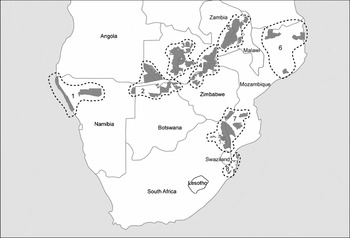
Figure 1 Clusters of elephant conservation areas in southern Africa based on proximity as examples of management units for CITES resolutions. (1) Etosha Cluster, (2) Chobe Cluster, (3) Kafue Cluster, (4) Zambezi Cluster, (5) Luangwa Cluster, (6) Niassa Cluster, (7) Limpopo Cluster and (8) Maputo Cluster.

Van Aarde supplementary material
Summary.doc

File
27.6 KB
 You have
Access
- 16
- Cited by
The Convention on International Trade in Endangered Species of Wild Fauna and Flora (CITES) regulates trade in species and their products. The original listing of the African elephant (Loxodonta africana) in Appendix II limited international trade, but their listing on Appendix I at the 7th CITES Conference of Parties (CoP) in 1989 (CITES 1989) banned international trade (Stiles Reference Stiles2004). In 1997, the 10th CITES CoP allowed sales of ivory from Botswana, Namibia and Zambia (CITES 1997) and the 12th CITES CoP conditionally refined further sales by these countries in 2007 (CITES 2007a). All these decisions relied on trends in numbers and poaching derived from the Elephant Trade Information System (ETIS; CITES 2007b) and Monitoring the Illegal Killing of Elephants Programme (MIKE; CITES 2007c). Such information clearly ignores demographic and spatial variables that drive these trends in elephant populations. We propose that clusters of conservation areas are required as spatial and demographic units on which to frame CITES decision-taking processes for elephants, and suggest that information on the demographic profiles of subpopulations within clusters should supplement census information from MIKE and ETIS.
Debate around the ‘ivory ban’ of CITES stems from suggestions that poaching will reduce elephant numbers in Central, East and West Africa (Blake et al. Reference Blake, Strindberg, Boudjan, Makombo, Bila-Isia, Ilambu, Grossmann, Bene-Bene, de Semboli, Mbenzo, S'hwa, Bayogo, Williamson, Fay, Hart and Maisels2007). Supporters of the ban argue that international trade provides a demand for ivory (IFAW [International Fund for Animal Welfare] 2004), but opponents thereof argue that ivory from culled elephants in southern Africa can fund conservation (for example Cumming Reference Cumming2000). Few studies support the effectiveness of the ban to reduce the illegal trade, the intensity of poaching or the bush meat trade (for example Stiles & Martin Reference Stiles and Martin2001; Courouble et al. Reference Courouble, Hurst and Millken2003; Martin & Stiles Reference Martin and Stiles2003; IFAW 2004; Stiles Reference Stiles2004). Recent confiscations suggest that elephant poaching is rife in parts of Africa (Blake et al. Reference Blake, Strindberg, Boudjan, Makombo, Bila-Isia, Ilambu, Grossmann, Bene-Bene, de Semboli, Mbenzo, S'hwa, Bayogo, Williamson, Fay, Hart and Maisels2007; Wasser et al. Reference Wasser, Mailand, Booth, Mutayoba, Kisamo, Clark and Stephens2007). Proponents of the ivory trade claim that local circumstances, political instability and lack of law enforcement rather than the partial lifting of the ban influence ivory demand and supply (Stiles Reference Stiles2004). These observations and a lack of precise information on numbers may further hinder CITES decision making.
Claims of elephant numbers declining before the 1989 Ivory Ban were based on inept censuses; 47% of estimates for southern and eastern Africa were based on guesses. Many structured elephant censuses yield estimates with low precision (CERU [Conservation Ecology Research Unit], unpublished data 2008), but reveal variation in regional population trends. Because elephant numbers are increasing (for example van Aarde et al. Reference van Aarde, Ferreira, Jackson, Page, de Beer, Junker, Gough, Guldemond, Olivier, Ott, Trimble, Scholes and Mennell2008), some southern African countries claim that their elephants are well managed and wish to trade in ivory (CITES 2007a). However, country specific assessments can be misleading. For instance, elephant numbers in two Zambian populations are decreasing and in two others are relatively stable (CERU, unpublished data 2008). Numbers in Zambia's neighbour Botswana and in Zimbabwe's Hwange National Park may be stable (Chamaillé-Jammes et al. Reference Chamaillé-Jammes, Fritz, Valeix, Murindagomo and Clobert2008; Junker et al. Reference Junker, van Aarde and Ferreira2008), while populations in Mozambique are recovering, albeit from low numbers (Ntumi et al. Reference Ntumi, Ferreira and van Aarde2009). At the same time, some Namibian, Zimbabwean and most South African populations are increasing (van Aarde et al. Reference van Aarde, Ferreira, Jackson, Page, de Beer, Junker, Gough, Guldemond, Olivier, Ott, Trimble, Scholes and Mennell2008). Death and birth rates vary between populations (van Aarde et al. Reference van Aarde, Ferreira, Jackson, Page, de Beer, Junker, Gough, Guldemond, Olivier, Ott, Trimble, Scholes and Mennell2008) and demographic variation, confounded by the unknown effects of movements across international boundaries (van Aarde & Jackson Reference van Aarde and Jackson2007), makes it difficult to interpret trends, a problem not provided for by CITES resolutions.
Furthermore, for CITES, the unit for resolutions on trade in elephant products centres on the Range State; consequently the population is an administrative rather than ecological entity. Decisions depend on country-specific information, mostly of limited precision, provided by MIKE and ETIS. MIKE monitors elephant population trends and the illegal killing of elephants, while ETIS tracks the illegal trade in ivory and elephant products (Hunter & Milliken Reference Hunter and Milliken2004). However, most major populations span several countries and elephants move freely across borders (Mpanduji et al. Reference Mpanduji, Hofer, Hildebrandt, Goeritz and East2002; CERU, unpublished data 2008). Resolutions for one country therefore may be undermined by factors affecting elephants in another country (Frank & Maurseth Reference Frank and Maurseth2006).
The limitations imposed by low quality data and short time series that restrict the statistical power to detect trends (Junker Reference Junker2009), as well as variability in population numbers due to changes in living conditions that influence demography and dispersal, may diminish the scientific reliability of CITES decisions. How can these shortcomings be addressed? We propose an approach that relies on the population as an ecological unit, rather than a political unit dictated by artificial boundaries. Furthermore, by supplementing censuses with demographic information, conservationists can target management towards the drivers of numerical trends.
We plead that clusters of protected areas be recognized as conservation units. Such clusters should include existing protected areas close to each other, or those that share boundaries along international borders. Sub-populations within a cluster may function as a metapopulation and cluster boundaries may be defined by elephant movements (van Aarde & Jackson Reference van Aarde and Jackson2007). The cluster as a principle unit for CITES elephant decisions thereby recognizes the population as an ecological, rather than administrative entity. For the southern African region we propose that eight such clusters should be recognized (Fig. 1). Our lack of field experience beyond southern Africa does not allow us to posit similar delineations for other regions in Africa. We hope that our approach will stimulate similar delineations for the other major regions in Africa.
Clusters of elephant conservation areas in southern Africa based on proximity as examples of management units for CITES resolutions. (1) Etosha Cluster, (2) Chobe Cluster, (3) Kafue Cluster, (4) Zambezi Cluster, (5) Luangwa Cluster, (6) Niassa Cluster, (7) Limpopo Cluster and (8) Maputo Cluster.
By extracting subpopulation-specific demographic profiles (Ferreira & van Aarde Reference Ferreira and van Aarde2008) for each of these clusters and combining these with census data, CITES decisions may be based on predicted population trends rather than past trends alone. Demographic profiling extracts population growth rates from age-specific birth and survival rates and allows for the assessment of skewness in age structures induced by age-specific ivory poaching (Spinage Reference Spinage1973), as is the case in Zambia (CERU, unpublished data 2008). This can complement information from MIKE, and the stability in age distributions in addition to trends in numbers can serve as robust criteria on which CITES may set resolutions.
We acknowledge that similar approaches to extract demographic profiles may not be valid for elephants living in forested areas, such as those in central and western Africa. Under these conditions, other indirect measures, such as the counting and measuring of dung boli can yield some of the demographic data that can complement population estimates derived from dung or registration counts (Morley & van Aarde Reference Morley and van Aarde2007, Olivier et al. Reference Olivier, Ferreira and van Aarde2009).