Patriotism is when love of your own people comes first; nationalism, when hate for people other than your own comes first (Charles De Gaulle).
There has been a significant increase in terrorist attacks around the world in recent decades.Footnote 1 According to the Global Terrorism Database (GTD), there were 1,523 attacks in 1970; there were over 13,000 attacks in 2016.Footnote 2 Examples include attacks by Shias, Sunnis, and Kurds in Iraq and Turkey; Palestinians against Israelis; Tamil Tigers against the Singhalese in Sri Lanka; Catholics against Protestants in Northern Ireland; Chechens against Russians; and the Euskadi Ta Askatasuna (ETA) (Basque Country and Freedom) against the Spanish. In all these cases, the terrorist attacks were anchored by ethnic identity.Footnote 3 The GTD shows that in 2016, four of the five most notorious terrorist attacks were committed in the name of an ethnic group, such as Iraqi Sunnis, Tamil Tigers or Chechens. In total, these attacks killed an estimated 7,283 civilians (Polo Reference Polo2020). These statistics are consistent with the assessment of terrorism analyst Pluchinsky (Reference Pluchinsky, Schnabel and Gunaratna2015, 33): ‘it is ethnicity that continues to power the majority of armed conflicts in the world today’. Given the high frequency of attacks and their consequential threat to national security, it is important to understand what motivates ethnic groups to turn to terrorism.
Previous research has considered ethnicity as a cause of terrorism (see Asal and Rethemeyer Reference Asal and Rethemeyer2008; Jeffrelot Reference Jeffrelot2010; Mincheva and Gurr Reference Mincheva and Gurr2013; Sullivan Reference Sullivan1988; Wayland Reference Wayland2004).Footnote 4 These studies examine the impact of ethnic identity as a prominent feature of terrorist organizations. For example, Asal and Rethemeyer (Reference Asal and Rethemeyer2008) assert that terrorist organizations with strong ethnic components are likely to engage in more fatal attacks. While this body of research is insightful and informative, it overlooks the appeals to ethnic identity in service of the political interests of top leadership in the incumbent government: ethnic terrorismFootnote 5 may break out as a response to presidents and prime ministers who emphasize the pride and unity of their own ethnic group. Depending on the nationalist orientation of the incumbent government, some leaders promote their own ethnicity at the expense of other ethnic groups and are thus likely to inflame ethnic terrorism, while others are likely to make peace with other ethnic groups.
This study departs from previous studies in four ways. First, it draws attention to the nationalist orientation of political leaders, instead of the masses, as a trigger of ethnic terrorism. Prior studies rarely discuss the role of nationalist leaders in provoking ethnic terrorism, while the popular media obsesses over the masses (or leaders of the masses), often as part of nationalist independence movements (for example, Gurr and Harff Reference Gurr and Harff1994; Wayland Reference Wayland2004; Wilkinson Reference Wilkinson2011). Put differently, while the masses are likely to contribute to the rise of nationalism, they are unlikely to be the origin of ethnic terrorism. Another reason I pay attention to nationalist leaders is the lack of observational data on mass nationalism. This is consistent with Hobsbawm's (Reference Hobsbawm1992, 11) remarks: ‘[the] view from below, that is, the nation as seen not by governments and the spokesmen and activists of nationalist (or non-nationalist) movements, but by the ordinary persons who are the objects of their action and propaganda, is exceedingly difficult to discover’.Footnote 6 I use the term ‘leader nationalism’ to distinguish the nationalist orientation of political leaders from that of the masses.
Secondly, I look into nationalism fomented by state (rather than ethnic group) leaders. Previous research conceptualizes nationalism as part of independence movements organized by leaders of ethnic groups who pursue collective interests and the safeguarding of a communal identity (for example, Boylan Reference Boylan2016; Wilkinson Reference Wilkinson2011). I refocus the conceptualization from leaders of disfavored ethnic groups to those of the dominant ethnic group who instigate nationalist feelings to prop up their legitimacy (for example, the nationalism of Adolph Hitler). Specifically, when state leaders promote the notion that their nation contains people who are ethnically inferior to those favored by the top leadership and should thus be treated differently, those disfavored ethnic people become fearful for their continued existence and turn to terrorist tactics such as bombings, kidnappings and assassinations to settle their grievances. When the state's monopoly on legitimate violence becomes the sole province of a single favored ethnic group, disfavored ethnic groups within the state revolt by engaging in terrorist violence.
The third way in which this study departs from previous research is that since the sample data includes all available ethnic groups across countries and years, I examine the effect of leader nationalism on ethnic terrorism regardless of regime type. Just as ‘democracy can facilitate either majority rule and the exclusion of minorities or minority rule and the exclusion of majorities’ (Horowitz Reference Horowitz1993), state leaders, regardless of whether they are elected in a free and fair election, may or may not play the nationalist card to legitimize their political authority. This research is similar to previous studies conducted by Mansfield and Snyder (Reference Mansfield and Snyder1995) and Snyder (Reference Snyder2000). In those studies, the authors discuss the role of political elites invoking nationalism during periods of democratization. Few other studies explore the significance of political leaders in the context of ethnic conflict rather than ethnic terrorism. Focusing on India and the former Soviet Union, Brass (Reference Brass1991) discusses the significance of centralizing state policies and their impact on patterns of elite competition among ethnic groups. Sekulić, Massey and Hodson (Reference Sekulić, Massey and Hodson2006) analyze the causal link between ethnic intolerance and ethnic conflict in Croatia and highlight the role of political leaders such as former President Franjo Tudjman. My approach differs from those studies by (1) going beyond democratizing countries or a small number of case studies and (2) analyzing the determinants of ethnic terrorism, not ethnic conflict.
Fourthly, since most previous studies are qualitatively rich but quantitatively scant, I explore the nationalism–terrorism connection from a quantitative perspective, which should shed additional light on the subject.
Armed rebellions rarely occur in a vacuum. In particular, ethnic terrorism hardly ever erupts simply due to the presence of multiple ethnic groups within the same state. If anything, the existence of multiple ethnic groups is a necessary, but insufficient, condition for ethnic terrorism. In addition to ethnic divisions, ethnic terrorism is likely to occur when leaders rely on nationalist politics of ‘us’ versus ‘them’ to legitimize their power. In doing so, they place members of their own ethnic group as the key players in the state, while discriminating against or excluding other ethnic groups. This legitimation strategy creates a nationalist state in which other ethnic groups feel oppressed or disfranchised. As a reaction to nationalist leaders who oppose ethnic pluralism, disfavored ethnic groups are likely to seek justice by organizing terrorist attacks on the dominant ethnic group and the incumbent government. Through a series of terrorist attacks, disfavored ethnic groups may seek to protect the integrity of their ethnic identity by pursuing forms of self-determination or establishing an independent state (Brancati Reference Brancati2006; Byman Reference Byman1998).
For example, ETA was founded in 1959 as a reaction to dictator Francisco Franco's promotion of a unitary national identity. In the name of a united Spain, Franco repressed all elements of Basque identity, including language, culture and history (Minder Reference Minder2018; Sullivan Reference Sullivan1988). Perceiving Basque identity as being in imminent danger of extinction, a group of young radicals, mostly college students, engaged in armed struggle against the Spanish government to create an independent homeland for the Basque community (Barros Reference Barros2003). As Bereciartu (Reference Bereciartu2006, 82) describes, ‘it was precisely Francoism, with its repressive violence, which provoked ETA into the choice of violent methods of struggle’. Similarly, in response to President Slobodan Milošević's Serbian nationalism, disfavored ethnic groups such as Croats, Slovenians and Kosovars relied on terrorist violence to reconfigure the former Yugoslavia. As Milošević called himself the defender of Serbdom and promoted the cultural unity of Serbs, disfavored ethnic groups became concerned for their survival. In response, these ethnic groups took up arms against the belligerent Serbian nationalists (Gagnon Reference Gagnon2006; Toft Reference Toft2012). Simply put, ‘the attempt of Servia's Milošević-regime to usurp Yugoslavia by way of reviving Serb nationalism provoked reactions by the leaderships of Slovenia and Croatia to defend and bolster their republics’ (Weber Reference Weber2010, 78).
In this study, I analyze a sample of 766 ethnic groups from 163 countries during the period from 1970 to 2009. I subject the sample to multilevel mixed-effects negative binomial regression analysis. The results show that leader nationalism is a significant driver of ethnic terrorism. When I use a generalized method of moments (GMM) model to account for possible reverse causality, the detrimental effect of nationalism remains the same. A case study of Sinhalese nationalist leaders versus Tamil Tigers also supports the nationalism–terrorism nexus. The study's findings should be of interest to a general audience seeking to learn about the negative consequences of nationalism, the destructiveness of ethnic terrorism and future counterterrorism options.
This study proceeds in five sections. The following section lays out the conceptual linkage between leader nationalism and ethnic terrorism; the next section introduces the research design in terms of statistical model building, operationalization and data sources; this is followed by a discussion of the empirical results. The next section presents the case study of Sinhalese nationalist leaders versus Tamil Tigers. The final section summarizes the study's main findings and discusses the policy implications.
The Rise of Ethnic Terrorism
In an ethnically homogeneous society, ethnic and national identities coincide. In such societies, there is no possibility for two social identities to collide. Feeling close to one's own ethnic group and love of country are likely to be bound together. Examples of these societies include South Korea, which has a population that is over 99 percent ethnically Korean, and Japan, which has a population that is 98.5 percent ethnically Japanese.Footnote 7 These countries have little or no risk of ethnic terrorism since they are racially homogeneous. However, in multiethnic societies such as Afghanistan, India, Iraq, Nigeria, Pakistan, Russia, Spain and Sri Lanka, there are multiple ethnic populations within a single state. In multiethnic states, citizens may have problems prioritizing their identities. For example, after the Pearl Harbor bombing during World War II, American authorities doubted the loyalties of Japanese Americans and interned them. American authorities perceived Japanese Americans as having two different identities: the ethnicity of their family's country of origin and their state of residence. In turn, Japanese Americans felt conflicted about their dual identity. They might have supported the United States against Japan in the war, but resented being interned. If individuals insist on holding two different identities because of an unfavorable political environment, loyalties to an ethnic identification and loyalties to the state are likely to collide (Citrin and Sears Reference Citrin and Sears2014; Gurr and Harff Reference Gurr and Harff1994; Horowitz Reference Horowitz1993). To be Tamil is to not be Sinhalese; to be Tutsi is to not be Hutu; to be Kurdish is to not be Turkish. Because ethnic identities come with great emotional significance, ethnic group identity may challenge loyalties to the state. In the worst-case scenario, certain ethnic group identities can even become security threats to the state.
Nevertheless, the mere presence of multiple ethnic identities in a state is insufficient to inspire terrorist violence. Just because multiple ethnic groups in diverse societies have an opportunity to take violent action does not necessarily mean those groups are willing to take up arms against the incumbent government (Most and Starr Reference Most and Starr1989). A tinder box of conflicting ethnic identities still needs a spark to light it. If ethnic terrorism does not grow out of thin air, what ignites it? Ethnic nationalism fomented by state leaders drives disfavored ethnic groups to armed rebellion. When state leaders promote nationalism as their legitimation strategy, they threaten the existence of disfavored ethnic groups. In response, these groups utilize terrorist attacks to survive, translating their opportunity into a willingness to rebel against the incumbent government (Brass Reference Brass1991; Mansfield and Snyder Reference Mansfield and Snyder1995; Sekulić, Massey, and Hodson Reference Sekulić, Massey and Hodson2006; Snyder Reference Snyder2000; Wilkinson Reference Wilkinson2004).
In multiethnic societies, one ethnic group typically constitutes the nation's ethnic core due to its historical role in creating the state, its larger size, or its political and cultural dominance (Devos and Banaji Reference Devos and Banaji2005). For the dominant group, ethnicity and nationality completely overlap, and attachments to the two identities are complementary. However, a conflict may arise in the process of nation building when top leaders wield the power of their co-ethnics by drawing distinctive boundaries between ‘us’ and ‘them’. These leaders are likely to inseminate a nationalistic idea: they will preserve the cultural heritage of their ethnic group while degrading other groups, making the state and favored ethnic group congruent (Gellner Reference Gellner1983). With this idea in place, leaders try to boost their legitimacy through the universal consent of their own ethnic group. This is in line with John Locke's argument of the Second Treatise: ‘the government is not legitimate unless it is carried on with the consent of the governed’ (Ashcraft Reference Ashcraft1991, 524). By differentiating between ‘we-ness’ and ‘other-ness’, leadership may ‘justify itself continuously to its following, and its principal claim is that it represents that following’ (Barker Reference Barker2001, 61). This is a typical strategy of leaders who follow Gellner's (Reference Gellner1983) vision of the nation as coincident with the state and thus see the promotion of nationalism as raising their political profile.Footnote 8 Scholars consider nationalism to be an effective legitimation tool since it provides leaders with inherent credibility and consent (for example, Kailitz Reference Kailitz2013).
Legitimacy is the foundation of leaders' political power, so state leaders promote nationalism as a legitimation strategy. Political legitimacy provides a basic condition for governing (Gerth and Mills Reference Gerth and Mills1946). Legitimacy, in the contemporary world, is not automatically bestowed upon leaders through political institutions, history of rules or ideology. Leaders need to constantly legitimize their authority to further their policy agenda and stay in power (Barker Reference Barker2001). Authority that the governed view as legitimate gives leaders the right and justification to effectively implement their vision and ideas. When leaders lack political legitimacy, they are likely to face a horde that will fight against the leader's vision and ideas, resulting in legislative deadlock(s) and/or regime collapse (Dahl Reference Dahl1971). Nationalism as a legitimation occurs regardless of regime type (Barker Reference Barker2001, 24). As nationalism takes root and grows, a close relationship forms between leaders and their co-ethnics. Throughout history, and across the globe, one observes such nationalist states, from consolidated democracies such as the US and the UK; to recently democratized nations such as Mexico, Slovakia and Estonia; to authoritarian regimes such as Russia and China.
By asserting their legitimation through nationalism, leaders engender an unfavorable political environment for marginal ethnic groups. Feeling isolated, separate and disengaged, disfavored ethnic groups are likely to define themselves less in terms of their national identity and more in terms of their ethnic identity; ethnicity and nationality collide, and the former comes out ahead. Leaders' nationalist politics makes ethnicity a salient issue for disfavored ethnic groups that will ‘express strong commitment to their group's cause and report highly favorable attitudes and group-supportive beliefs’ (Devos and Banaji Reference Devos and Banaji2005, 448). The ethnic tensions created between the dominant and disfavored groups are conducive to the emergence of terrorism. When nationalism is on the rise, disfavored ethnic groups consider terrorism to be an acceptable tactic to settle scores. This is supported by Byman's (Reference Byman1998, 156) analysis: the dominant ethnic group's ‘discrimination along economic, political, or cultural lines can trigger tremendous resentment and cause ethnic terrorism’. An example is the Provisional Irish Republican Army, formed to fight nationalist British leaders in the late 1960s. Feelings of alienation alone may not give disfavored ethnic groups the incentive to rebel, but when those feelings are aggravated by leaders' nationalist politics, they become a sufficient condition for ethnic terrorism.
In the cases of Basque versus Spanish, Irish versus English, and Tamil versus Singhalese, one can easily find ethnic terrorism resulting from the collision of ethnic and national identities. Those disfavored ethnic groups believe that the dominant ethnic group has wrongly usurped their rights or territory. This belief provides the disfavored ethnic group with the justification to engage in terrorist attacks in an effort to establish an autonomous region or gain independence from the dominant ethnic group (Schwartz, Dunkel and Waterman Reference Schwartz, Dunkel and Waterman2009). However, this belief alone may not be powerful enough to cause disfavored ethnic groups to willingly engage in terrorist attacks to settle their grievances. Not all aggrieved feelings trigger terrorism (Basedau et al. Reference Basedau2017; Cederman, Gleditsch, and Buhaug Reference Cederman, Gleditsch and Buhaug2013). Many disgruntled groups never engage in political violence (Lindemann and Wimmer Reference Lindemann and Wimmer2018).
What makes some disenfranchised groups willingly engage in terrorist violence but not others? The arrival of nationalist leaders is the linchpin of linking disfavored ethnic groups' sense of alienation and disenfranchisement to acts of terrorism. When political leaders promote nationalism to shore up their legitimacy, it prompts disfavored ethnic groups to engage in terrorist violence. Nationalism that is fomented by leaders deprives disfavored ethnic groups of opportunities to advance their socio-political goals through legitimate political processes (Brass Reference Brass1991; Mansfield and Snyder Reference Mansfield and Snyder1995; Sekulić, Massey and Hodson Reference Sekulić, Massey and Hodson2006; Snyder Reference Snyder2000; Wilkinson Reference Wilkinson2004). There is evidence that many members of the Palestinian terrorist organizations Hamas and Islamic Jihad became agents of terrorism after they realized that their life paths were blocked by Israeli nationalist leaders (Post Reference Post2005). In Sri Lanka, many Tamils joined the Liberation Tigers of Tamil Eelam (LTTE) when Sinhalese leaders started to repress Tamils while favoring Sinhalese (Spencer Reference Spencer1990). Other examples include Aung San Suu Kyi against Rohingya Muslims in Myanmar, Adolf Hitler against Jewish people in Germany, and military leaders in West Pakistan against the people of East Pakistan (Kapferer Reference Kapferer1988; Lieven Reference Lieven2011; O'Leary and Sambanis Reference O'Leary, Sambanis, Gheciu and Wohlforth2018; Spencer Reference Spencer1990; Weiss Reference Weiss2011). When political leaders draw sharp distinctions between ‘us’ and ‘them’, they disregard the political rights of disfavored ethnic groups (Mylonas and Kuo Reference Mylonas, Kuo and Thies2018; Tajfel Reference Tajfel1982). By dehumanizing other ethnic groups, state leaders portray their own group as superior and encourage the latter to displace its anger onto the former (Bonikowski and Gheihman Reference Bonikowski, Gheihman and Wright2015; Woodwell Reference Woodwell2007).
Ironically, as nationalist leaders glorify the superiority of their own group and discriminate against and persecute disfavored ethnic groups, members of the latter develop feelings of moral superiority against the leader's nationalist politics. When nationalist leaders intensify their efforts to remove disfavored ethnic groups from political institutions controlled by the dominant group (Atran Reference Atran1990), they have to face the unintended consequence of giving the latter justification for armed rebellions. Disenfranchised and alienated people are likely to resort to terrorism to protect their ethnic identification. Osama bin Laden and Ayman Al-Zawahiri were recruited from this pool of the disenfranchised and alienated. Russian nationalist leaders drive Chechens who feel discriminated against and persecuted under the banner of Slavic nationalism to terrorist organizations. Other examples include the terrorists behind the London Underground bombings, the Glasgow Airport attacks and the Spanish rail system attacks (Schwartz, Dunkel, and Waterman Reference Schwartz, Dunkel and Waterman2009). Disfavored ethnic groups are likely to perceive state leaders' use of nationalism as a threat to their survival, and then resort to terrorist violence to redress the perceived wrong. The survival instinct of disfavored ethnic groups matters. As Mearsheimer (Reference Mearsheimer2018, 16) points out, ‘social groups need political institutions to help them survive in the face of threats from other groups’. Similarly, evolutionary psychologists attribute separatist rebellions to an insecurity exhibited as aggression anchored in the survival instinct of other ethnic groups (McKinnon and Silverman Reference McKinnon and Silverman2005; Van den Berghe Reference Van den Berghe1987).
The policies of nationalist leaders cause fear of outside groups to grow. State leaders may openly discriminate against disfavored ethnic groups in the areas of employment, social services, public health, education and housing (Boylan Reference Boylan2016). State leaders may also use harsh repressive measures against disfavored ethnic groups for demonstration effect. By deploying the state security apparatus, nationalist leaders may engage in police brutality, extermination, exile, extortion, extrajudicial killing, torture, human rights violations and even genocide against disfavored ethnic groups. The feelings of frustration from disfavored ethnic groups are likely to translate into acts of terrorism. Nationalist leaders Slobodan Milošević (against Kosovar Albanians in the Federal Republic of Yugoslavia) and Adolf Hitler (against Jewish and Romani people in Germany) did not hesitate to engage in genocide and ethnic expulsions (Harff Reference Harff2003; O'Leary and Sambanis Reference O'Leary, Sambanis, Gheciu and Wohlforth2018). When the Pakistani military committed genocide against the people of East Pakistan in 1971, East Pakistanis launched a series of terrorist attacks in response, ultimately leading to the birth of the People's Republic of Bangladesh in East Pakistan (Lieven Reference Lieven2011).
When political leaders openly prosecute, abuse and murder disfavored ethnic groups, those groups are likely to become hostile to the incumbent government, increasing the likelihood of armed struggle. Given that ‘very little nationalist rabble-rousing or nationalistic combativeness is required to generate very dangerous situations’ (Posen Reference Posen1993, 29), political leaders' use of nationalism to legitimize their rule amplifies ethnic animosity between their own ethnic group and disfavored ethnic groups, especially when there are historic sources of enmity and memories of past atrocities (Horowitz Reference Horowitz2001; Sambanis Reference Sambanis2001). Leaders’ nationalist proclivity is also found in Schmitt's (Reference Schmitt1976) perspective that politics is the fundamental differentiation between friend and enemy. Other studies likewise observe political leaders' use of nationalism as their political legitimation tool. Connor (Reference Connor1994) argues that ethnic nationalism is a cause of armed rebellion; Linz (Reference Linz2000) contends that nationalist leaders in post-independence states frequently invoke nationalist identity to legitimize and consolidate power; Mansfield and Snyder (Reference Mansfield and Snyder1995) show that leaders in democratizing countries underscore ethnic identity and superiority around national elections as a way to mobilize political gains. Krastev (Reference Krastev2011) demonstrates that the same strategy is used when power transitions occur between governments. The new leadership plays the politics of ethnic identity to boost their popularity and national unity.
When political leaders promote nationalism to legitimize their authority, disfavored ethnic groups fear a potential loss of group identity and, in extreme cases, potential extinction. As a result, disfavored ethnic groups are likely to view terrorism as a legitimate way to fight back. This discussion leads me to formulate the following hypothesis:
Hypothesis 1: When political leaders use nationalism as their legitimation strategy, disfavored ethnic groups are more likely to engage in terrorist violence.
Research Design
To empirically test the leader nationalism hypothesis, I employ a sample of 766 ethnic groups from 163 countries from 1970 to 2009. Since the theoretical discussion revolves around terrorist attacks executed by ethnic groups in response to nationalist leaders, I structure the sample data by ethnic group and year-country; thus, the unit of analysis is group-year-country.
I operationalize Ethnic Terrorism, the dependent variable, as the total number of terrorist attacks carried out by related ethnic groups per year. For example, in 1991, Palestinians engaged in terrorist attacks eight times in Lebanon, zero times in Jordan and 124 times in Israel. Since I conceptualize ethnic groups’ political violence targeted at the nationalist politics of leaders within a territory, I include domestic (not international) terrorist attacks.Footnote 9 I gather ethnic terrorism data from Polo's (Reference Polo2020) GTD2EPR dataset during the period from 1970 to 2009. The dataset is created by carefully linking terrorist groups that appeared in the GTD to politically relevant ethnic groups in the Ethnic Power Relations (EPR) dataset.Footnote 10 As soon as ethnic groups have a minimal degree of political mobilization, or political leaders subject them to intentional political discrimination due to their ethnic background, they are classified as being politically relevant. Once politically active, some groups may have more access to central-level state power via representatives than others. Accordingly, ethnically inclusive governments allow politically relevant ethnic groups to have consistent access to the highest levels of state power, while ethnically exclusive governments give preferential treatment to their own group at the cost of disfavored groups (Wimmer, Cederman and Min Reference Wimmer, Cederman and Min2009). About 18 percent of the 766 ethnic groups in the sample have some record of terrorism. About two-thirds of all terrorist attacks are carried out by ethnic groups that are politically excluded, and about one-third of the groups that have experienced active discrimination have associated organizations that have carried out attacks at some point.Footnote 11
Since the dependent variable is the count of terrorist incidents carried out by related ethnic groups per country-year, I consider a Poisson regression model as the estimation technique. But I find the Pearson goodness-of-fit χ 2 test to be statistically significant (χ 2 = 1,842,103, p < 0.001). This suggests that a Poisson regression estimation fails to fit the data correctly. I instead use multilevel mixed-effects negative binomial regression as an alternative estimation method. Because negative binomial regression adds a dispersion parameter to model the unobserved heterogeneity among observations, it can control for the overdispersion found in a Poisson regression model (Hilbe Reference Hilbe2007). In addition, given the clustered nature of the data, with ethnic groups nested within year nested within country, I employ a multilevel mixed-effects negative binomial regression in which the ethnic groups comprise the first level, the years comprise the second level, and the countries comprise the third. In doing so, I assume that observations in the same cluster are correlated because they share common-level random effects.
Although qualitative studies speculate about the role of leader nationalism in conflict processes, they rarely examine it due to a lack of data. O'Leary and Sambanis (Reference O'Leary, Sambanis, Gheciu and Wohlforth2018, 420) lament that ‘nationalism is hard to measure in a way that facilitates cross-country comparisons over time’. For empirical testing, I rely on a recently constructed leader nationalism variable by the 2019 Varieties of Democracy (V-Dem) Project.Footnote 12 The V-Dem Project constructs the variable on the basis of two expert survey questions. The first is, ‘to what extent does the current government promote a specific ideology or societal model (an officially codified set of beliefs used to justify a particular set of social, political, and economic relations; for example, socialism, nationalism, religious traditionalism, etc.) in order to justify the regime in place?’ The second question is, ‘How would you characterize the ideology/ideologies identified in the previous question?’ The ideolog(ies) that country experts are asked to choose are (a) nationalist, (b) socialist or communist, (c) restorative or conservative, (d) separatist or autonomist or (e) religious. I focus on the first category, which captures the extent to which leaders promote nationalism as their legitimation strategy across time and space. The V-Dem Project transforms the expert responses into a continuous measure, fluctuating from 0 (lowest nationalism) to 1 (highest nationalism) across countries and years using the point estimates from a Bayesian factor analysis model.
As in the wording of the two survey questions, the measure has little to do with whether countries become more nationalistic in the lead-up to conflict or amid ethnic tensions. For example, the V-Dem Project neither increased or decreased Margaret Thatcher's nationalism score before or after the 1982 Falklands War with Argentina. She received the same nationalism score during her entire time as prime minister. Nor is the measure related to how the public judges the legitimacy of rulers whose governance is anchored in nationalism, but to what degree political leaders provide justifications for nationalism under which they govern. Nor does it trace the origins or evolution of nationalism; it takes these as a given. To rule out the possibility of reverse causality, I set leader nationalism (predictor) at time t – 1 and ethnic terrorism (outcome variable) at time t. In the next section, I introduce an advanced estimation method to further address possible reverse causality.
To avoid obtaining spurious statistical results, I include five groups of confounding variables commonly shown to have some relation to terrorist events: political, security, economic, religious and group environment. To ensure the causal time order that the events captured by the explanatory variables occurred before the outcome variable, I also lag all confounding variables on the right-hand side by one year.
I capture political environment in two ways: democracy and political exclusion. Democratic political institutions offer non-violent conflict resolution to defuse discriminatory grievances, so they should be associated with lower risks of ethnic terrorism (Choi Reference Choi2010). However, democratic political institutions also provide opportunities that terrorist groups can exploit. For example, terrorist groups may take advantage of the freedom of association to easily organize and take collective action to deliver their political agenda. Terrorist groups may also exploit media openness by seeking to expand publicity and media coverage of their activities (Li Reference Li2005). Since the literature suggests that democracy has mixed effects, I am agnostic about the relationship between democracy and terrorism. I operationalize democracy through Vreeland's (Reference Vreeland2008) X-POLITY variable, the sum of XCONST, XRCOMP and XROPEN. I exclude PARCOMP and PARREG to address Vreeland's contention that a Polity composite democracy score is problematic for studies of the relationship between democracy and internal conflict since the two subcomponents refer to the already existing presence of political violence and internal conflict (on Polity, see Marshall and Jaggers Reference Marshall and Jaggers2007).
Political exclusion occurs when a particular ethnic group's members are barred from government service or representation (Cederman, Wimmer and Min Reference Cederman, Wimmer and Min2010; Wimmer, Cederman and Min Reference Wimmer, Cederman and Min2009). Accordingly, political exclusion may be a cause of ethnic terrorism (Boylan Reference Boylan2016; Choi and Piazza Reference Choi and Piazza2016). To control for the effect of political exclusion, I create five dummy variables based on the political status of ethnic groups: inclusive, regional autonomy, powerless, discriminated and separatist. When the executive branch of government includes politically relevant ethnic groups, I classify the government as inclusive. When elite members of an ethnic group have no central power but have some influence at the subnational level (for example, Georgians under Soviet rule), I categorize it as regional autonomy. When elite representatives hold no political power at either the national or regional level without being explicitly discriminated against, I categorize the group as powerless. When group members are subjected to active, intentional and targeted discrimination with the intent of excluding them from both national and regional power (for example, African Americans until the Civil Rights Movement), I classify it as discriminated. When local governments controlled by representatives of an ethnic group have declared their territory to be independent from the central government, I classify it as separatist. I use ‘inclusive’ as the reference category in the estimation. The EPR-ETH dataset is the source for the operationalization.Footnote 13
I relate a country's security environment to terrorism in two ways: political instability and civil war. Political instability allows ethnic groups' rebellions to develop easily since the central government is disorganized and institutionally weak, and is likely incapable of deploying sufficient security forces to establish control over the territory (Hegre and Sambanis Reference Hegre and Sambanis2006). I obtain the political instability variable from Banks’ (Reference Banks2010) Cross-National Time-Series Data Archive, measuring it as the weighted conflict index of assassinations, general strikes, guerrilla warfare, government crises, purges, riots, revolutions and antigovernment demonstrations.Footnote 14 Civil war is another security destabilizer that prior studies associate with terrorism (for example, Findley and Young Reference Findley and Young2012). I define civil war as a contested incompatibility between a government and one or more opposition groups that results in at least twenty-five battle deaths in a year. Data comes from the Uppsala and PRIO Armed Conflict Dataset.Footnote 15
I measure a country's economic environment based on its economic development. As an economy prospers, it should encounter fewer terrorist incidents stemming from economic grievances (Boylan Reference Boylan2016; Choi Reference Choi2014, Reference Choi2015 and Reference Choi2019; Li Reference Li2005). Accordingly, I include the economic development variable as a control for reducing terrorism. I derive data for this variable from Gleditsch (Reference Gleditsch2002), measuring it as logged GDP per capita, adjusted for purchasing power parity.
Previous studies have found that a sizable Muslim population is a significant factor in the occurrence of terrorist attacks (for example, Piazza Reference Piazza2008). Religious terrorists are motivated by and organized according to religious doctrine. In addition, ‘religious terrorists are far less nationalistic than ethnic terrorists’ since their rebellion originates in religious persecution by the government (Byman Reference Byman1998, 151). I operationalize religious environment as the percentage of the population that is Muslim during the observed country-year. The percentage of religious adherents varies from year to year within countries. I collect data from the Religious Characteristics of States dataset.Footnote 16
I capture group environment in two ways: group size and terrorist outbidding. Ethnic groups come in all shapes and sizes, each of which has a different ability to mobilize ethnic terrorism (Polo Reference Polo2020). Group size captures each ethnic group's absolute influence in the executive branch of government and usually changes when mass emigration, population exchange or genocide occur. Group size is measured as the number and importance of the positions controlled by group members. The measure is continuous, ranging from 0 (weakest) and 1 (strongest). The EPR-ETH dataset is the source for the operationalization.
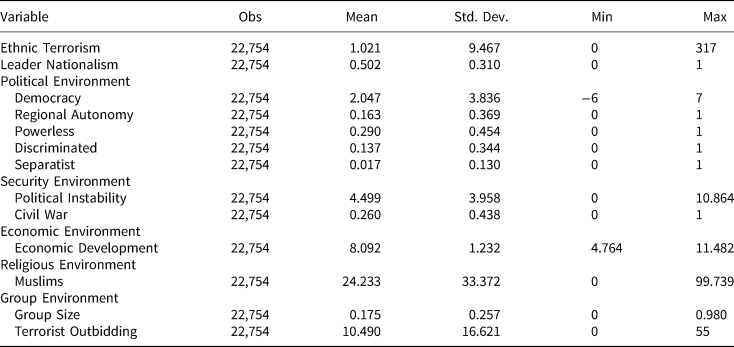
The qualitative literature maintains that domestic competition among terrorist organizations leads to an increase in political violence as a result of each organization's effort to distinguish itself and stand out from the crowd. But the empirical evidence is inconclusive (Bakke, Cunningham and Seymour Reference Bakke, Cunningham and Seymour2012; Boylan Reference Boylan2016; Choi Reference Choi2018; Young and Dugan Reference Young and Dugan2014). I measure terrorist outbidding as the total number of ethnic groups in each country. I gather data from Polo (Reference Polo2020). Table 1 reports the descriptive statistics for all variables used in the study.
Descriptive statistics

Empirical Results
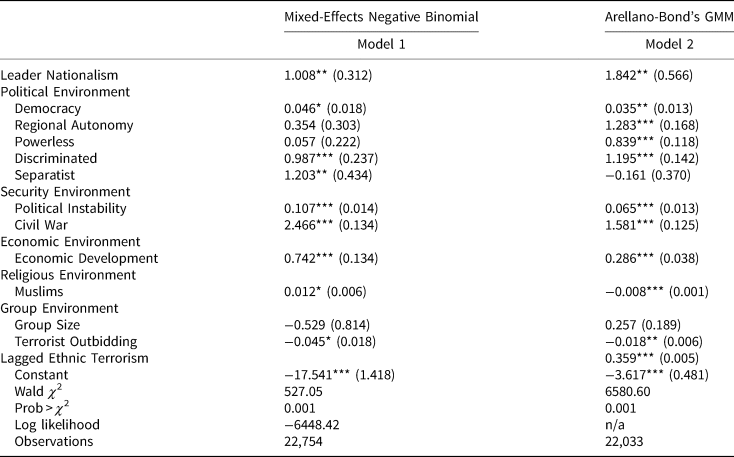
Table 2 displays the estimated results of the multivariate regression models. The diagnostic tests of variance inflation factors, R2, eigenvalues and condition index show no signs of severe multicollinearity among predictors. To set the bar high, I utilize a two-tailed test at the 0.05, 0.01 and 0.001 levels of significance. The overall results in the table indicate that the main hypothesis of nationalism is supported: disfavored ethnic groups are more likely to engage in terrorist violence when they feel threatened by the nationalist politics of their top leaders.
Leader nationalism and ethnic terrorism

*** p < 0.001, ** p < 0.01, and * p < 0.05, two-tailed tests
In Model 1, where I use multilevel mixed-effect negative binomial regression, leader nationalism is significantly different from zero and in the expected direction. This suggests that when nationalist leaders play hardball, they are more likely to provoke disfavored ethnic groups, which then resort to terrorist violence. The five environment factors are also supported one way or another. Political environment appears to matter. Democracy appears to allow disfavored ethnic groups to exploit the opportunities of political institutions such as freedom of association and freedom of the press to garner support for terrorist activity. Among the four political exclusion-related variables, disfavored ethnic groups are likely to engage in terrorist violence when they are discriminated against and wish to create their own nation. When the security environment is exacerbated by political instability or civil war, ethnic terrorism is more likely. It appears that economic development leads to more frequent terrorist activities by ethnic groups. This is counterintuitive. I speculate that advanced economies’ vulnerability to terrorism may be due to a rapidly growing number of migrants and their descendants who lack upward career mobility and thus are attracted to terrorist groups out of frustration and anger (for example, the 2005 London bombings). When there is a larger presence of Muslims, countries are more likely to experience ethnic terrorism. Group environment has either no bearing on ethnic terrorism (Group Size) or is negatively associated with it (Terrorist Outbidding).
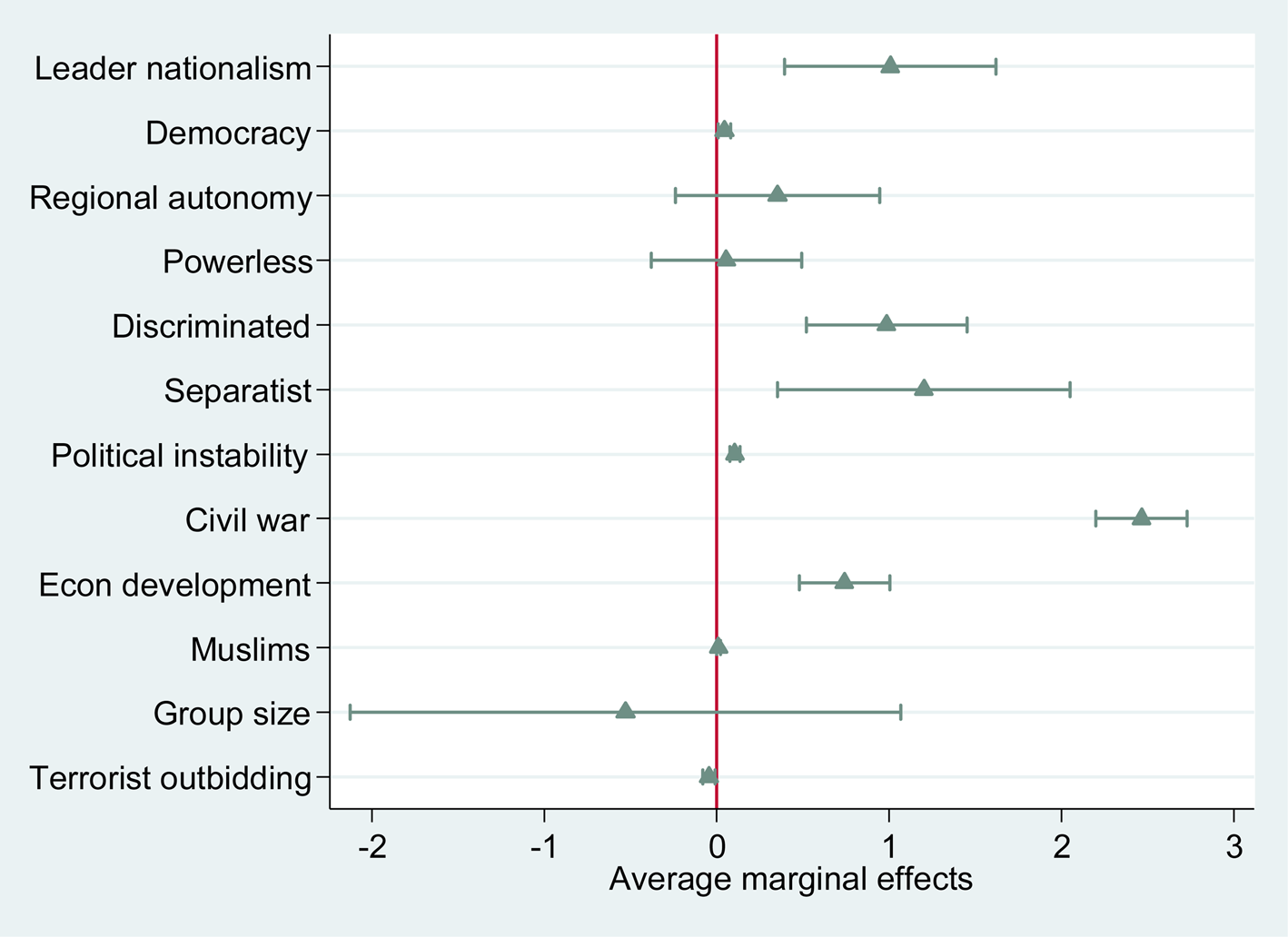
Since statistical significance does not necessarily suggest a meaningful finding in a practical sense, the marginal/substantive effects of the variables should be reported for empirical verification (Greene Reference Greene2003). I plot the average marginal effects of all predictors in Figure 1 based on the logs of predicted counts of the outcome variable from Model 1. Average marginal effects indicate the average change in the predicted counts when each of the twelve predictors increases by one unit. The figure illustrates that, on average, a one-unit increase in nationalism is predicted to prompt 1.5 terrorist attacks, all else equal. This visual analysis confirms the positive relationship between nationalism and terrorism: when leaders play the nationalist card, disfavored ethnic groups are more likely to turn to terrorist violence. Put differently, the analysis of substantive effects confirms the results of the conventional significance level tests.
Average marginal effects with 95% confidence intervals

The results in Model 1 are unlikely to be an artifact of possible reverse causation from terrorism to nationalism. The statistical tests related to the effect of nationalism are in line with the substantive tests. If reverse causation exists, I should not have found nationalism to be statistically significant. Following common practice in empirical research, I lag all the predictors one year behind the outcome variable to control for the possibility of reverse causality. I further investigate the endogeneity issue by implementing an advanced estimation method to account for possible reverse causation: a rise in ethnic terrorism may lead to the emergence of nationalist political leaders. I use a GMM model developed by Arellano and Bond (Reference Arellano and Bond1991), which treats nationalism and terrorism as endogenous but all other regressors in the model as exogenous. As shown in Model 2 of Table 2, the estimated results of this reverse causality test conform to those of Model 1. Leader nationalism emerges as a significant predictor of ethnic terrorism even after addressing reverse causality concerns.
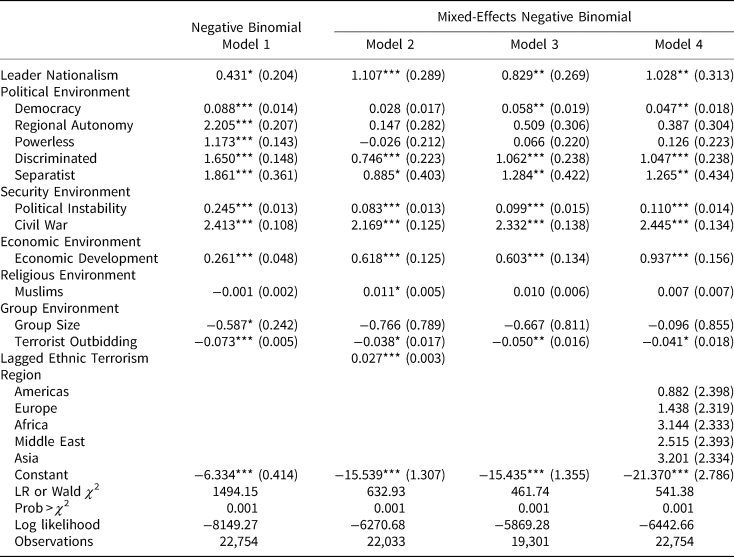
To examine how sensitive the findings are to changes in the model specification, I perform four robustness tests in Table 3: (1) use of a parsimonious model, (2) inclusion of a lagged dependent variable, (3) alternate measure of nationalism by the government and (4) inclusion of region dummies.Footnote 17 In Model 1, I replace the multilevel mixed-effects negative binomial regression with a standard negative binomial regression since the former may impose additional unnecessary constraints on model estimation. A parsimonious model without multilevel mixed effects might be better suited to testing the effect of nationalism. The estimated results in Model 1 are similar to those in Model 1 of Table 2: leader nationalism is a cause of ethnic terrorism. Although terrorist attacks may increase or decrease drastically, historical terrorism is an important predictor of contemporary terrorist activities (Choi and Piazza Reference Choi and Piazza2016; Li Reference Li2005).
Leader nationalism and ethnic terrorism: robustness tests

*** p < 0.001, ** p < 0.01, and * p < 0.05, two-tailed tests
The historical terrorism variable is operationalized as a lagged term for ethnic terrorism. Yet including a lagged dependent variable on the right-hand side of the equation may soak up the explanatory power of other theoretically interesting independent variables (Achen Reference Achen2000). When I add the lagged terrorism variable in Model 2, it does not cause the leader nationalism variable to become insignificant. Using an alternate measure of nationalism by the government may produce less robust results. I measure Government Nationalism using the EXECNAT variable gathered from the Database of Political Institutions 2017.Footnote 18 It is a dichotomous measure, coded 1 if the chief executive's political party is nationalist (that is, the executive party's platform advocates the defense of a national or ethnic identity), and 0 otherwise. Model 3 displays the estimated results. The alternative measure, Government Nationalism, emerges as a significant predictor of ethnic terrorism. Ethnic terrorism is not evenly distributed geographically: some regions are more vulnerable to terrorism than others (Li Reference Li2005). To control for regional differences, I create six region dummy variables: Africa, Americas, Asia, Europe, Middle East and Oceania. I use Oceania as the reference category in the estimation. Even though I control for regional differences in Model 4, I still find that Leader Nationalism is significant. The robustness tests do not alter the study's main findings in any meaningful way.
Case Study: Sinhalese Nationalist Leaders Versus Tamil Tigers
Sri Lanka is an island country in the Indian Ocean, to the south of the Indian subcontinent. Its historic trade in luxury goods and spices attracted merchants and migrant workers, which diversified the population. The multiethnic country is the 58th most populated in the world (about 21.4 million people).Footnote 19 The three major ethnic groups are Sinhalese, Sri Lankan Tamils and Sri Lankan Moors. Sinhalese are the largest ethnic group, comprising 75 percent of the population, and are concentrated in the densely populated southwest and central parts of the island. Sri Lankan Tamils, who live predominantly in the north and east, are the largest minority group, representing 11 percent of the population. Sri Lankan Moors, descendants of Arab traders that settled in Sri Lanka and married local women, constitute 9 percent of the population. The Tamils, who are 4 percent of the population, are of Indian origin; British colonists brought them into the country as tea and rubber plantation workers. Smaller minorities include the Burghers (of mixed European descent), Malays from Southeast Asia, ethnic Chinese migrants, African descendants and the indigenous Vedda.Footnote 20
Throughout history, Sinhalese leaders have legitimized their political authority by promoting the interests of their own ethnic group at the expense of other groups, especially Tamils. Sinhalese leaders have skillfully fomented ethnic tensions and exploited the presence of diverse ethnic groups as a legitimation strategy. When Sinhalese leaders promoted a domestic and foreign policy that favored the Sinhalese, the discriminatory policies disenfranchised other ethnic groups. Accordingly, potential conflictual elements constantly existed between the Sinhalese and disfavored ethnic groups, especially the Sri Lankan Tamils, over ‘who gets what – and why’. But the Sri Lankan Tamils did not engage in terrorist violence against the Sinhalese people until political leaders started to use nationalism to legitimize their authority. Put differently, the tinderbox of Tamil rebellion existed, but did not ignite Tamils' warrior spirit until Sinhalese leaders played the nationalist card.
In the early years of independence, the Sinhalese and Tamils seemed to get along. Dudley Senanayake, the first prime minister of Sri Lanka, invited prominent Tamil leaders such as Arunachalam Mahadeva into his cabinet. But Senanayake may have planted the seeds of conflict by approving the Ceylon Citizenship Act of 1948. The act denied citizenship to migrant workers even if they had settled in Sri Lanka a long time ago (for example, Tamils from India). Sinhalese nationalism became acute when Solomon Bandaranaike became prime minister in 1956. Bandaranaike was a self-proclaimed ‘defender of the besieged Sinhalese culture’ (Nubin Reference Nubin2002, 123). He believed that Sinhalese Buddhist myths and rituals should provide a crucial foundation for the Sinhalese people. In 1956, he introduced the Sinhala Only Act, recognizing Sinhala, the language of the Sinhalese, as the only official language of the government (Brown and Ganguly Reference Brown and Ganguly2003; Schmid and Schroeder Reference Schmid and Schroeder2001). He started to discriminate, torture and kill Tamils due simply to their ethnicity, while favoring his own ethnic group for employment and work in the public and civil sectors. Successive prime ministers did not deviate from nationalist politics, and only intensified the discrimination, repression and killings of Tamils.
In response, Tamils formed a terrorist group, the LTTE, in 1976 and launched ruthless attacks against the central government of the Sinhalese-controlled state. Sinhalese leaders intensified their discrimination against Tamils and used indiscriminate violence, including anti-Tamil pogroms. The LTTE fought back and tried to create an independent Tamil state in the north and east of the country. The LTTE carried out a series of terrorist attacks, including assassinations of symbolic figures of Sinhalese nationalism such as President Ranasinghe Premadasa in 1993. As the struggle between the Sinhalese government and the LTTE dragged on, and a large number of male fighters died, Tamils brought women and children into their terrorist operations. The Sri Lankan military defeated the LTTE in 2009. Between 1983 and 2009, more than 80,000 were killed in the armed struggle (Kapferer Reference Kapferer1988; Spencer Reference Spencer1990; Van de Voorde Reference Van de Voorde2005; Wayland Reference Wayland2004; Weiss Reference Weiss2011).
In sum, the case study is consistent with the main finding of the empirical analysis: leader nationalism precipitates ethnic terrorism. When Sinhalese nationalist leaders suppressed Tamils’ ethnic identity, the Tamils responded by forming a terrorist group, the LTTE, and launched a series of attacks to protect their ethnicity.
Conclusion
Given ethnic terrorism's frequency and serious security risks, exploring its determinants is an important research topic. Yet few previous studies have explored which conditions cause ethnic groups to resort to terrorist violence. Importantly, the literature has long overlooked the link between Gellner's (Reference Gellner1983, 1) definition of nationalism as ‘primarily a political principle, which holds that the political and the national unit should be congruent’ and Weber's ideal of the state as holding ‘the monopoly of the legitimate use of violence’ (Gerth and Mills Reference Gerth and Mills1946, 78). Once a dominant ethnic group successfully makes the political congruent with their ethnic nation, it captures the monopoly of legitimate violence, leaving illegitimate violence in the form of terrorism as the only tool available to disfavored ethnic groups. Simply put, this linkage indicates that leader nationalism is a contributing factor to the outbreak of ethnic terrorism, which prior studies have largely overlooked. The paucity of theoretical and empirical development on the nationalism–terrorism nexus is largely due to a lack of nationalism data across countries and years.
In this study, I offer a theoretical linkage between the two factors, perform a first-cut empirical analysis across ethnic groups, and present a case study as qualitative evidence. The empirical results provide strong evidence that when political leaders behave in a nationalistic manner, other ethnic groups become belligerent, often resorting to terrorism, to protect their own ethnicity. Disfavored ethnic groups’ use of terrorism for survival is not surprising, given that ‘individuals usually develop strong attachments to their group and are sometimes willing to make great sacrifices for their fellow members’ (Mearsheimer Reference Mearsheimer2018, 15). When state leaders become nationalistic, this makes disfavored ethnic groups feel marginalized. Confronted with persistent discrimination and persecution, disfavored ethnic groups are likely to take up arms to survive. A reverse causality analysis does not cause the Leader Nationalism variable to become insignificant. The case study of Sinhalese nationalist leaders versus Tamil Tigers also supports the theoretical expectation and empirical analysis.
Given that ethnic terrorism remains one of the primary sources of political violence around the world, more systemic empirical scrutiny is in order. The empirical analysis also indicates the need for further research on ethnic terrorism that represents a serious security challenge to governments led by elites who rely on an ‘us’ versus ‘them’ narrative of ethnic identity. Leaders' divisive politics along ethnic lines are not conducive to strong nation building, and instead tend to plunge the nation into internal conflict. However, since few studies have exclusively examined the determinants of ethnic terrorism, which ‘often differs considerably from other types of terrorism’ (Byman Reference Byman1998, 165), researchers have struggled to prescribe appropriate policy recommendations.
Future research should investigate the separate effects of civil versus ethnic nationalism on terrorist violence. Researchers assume civil nationalism has a benign effect, and construe ethnic nationalism as malicious. Because the available nationalism data is not divided into the two types across time and space, this study leaves the inquiry for future research. Future studies should also attempt to distinguish between leader nationalism and ethnically motivated mob violence that is inspired by a leader. This study claims that leader nationalism is a precipitator of ethnic terrorism, rather than the only one. Another possibility is that political leaders may have to inspire people to take up spontaneous action against a disfavored ethnic group before that group decides to resort to terrorism. Due to insufficient observational data on mass nationalism (Hobsbawm Reference Hobsbawm1992, 11), this study also leaves this inquiry to future research.
Data availability statement
Replication materials are available in the Harvard Dataverse at: https://doi.org/10.7910/DVN/QKGQQI.
Acknowledgements
I am grateful to Jiyoung Ko, Justin Labonte, Sara Polo, Marco Rossi, Dillon Tyksinski, and Daniel Williams for their helpful comments and suggestions.