
I. INTRODUCTION
Supercapacitors, also known as electric double layer capacitors (EDLCs) or ultracapacitors, have been widely used in applications such as memory power backup, uninterrupted power supply, wind turbines pitch system, stop-start power supply for automobiles, etc. The two most recognized benefits of supercapacitors are long-cycle life and high power performance, which stem from its physical rather than chemical charge storage/release mechanism at the electrode/electrolyte interface. Porous carbon materials, such as high surface area-activated carbon (AC) materials, are normally used as the electrode material, and organic electrolytes, using quaternary ammonium salts such as tetraethylammonium tetrafluoroborate (TEA-BF4) or triethylmethylammonium tetrafluoroborate (TEMA-BF4), dissolved in acetonitrile (ACN) or propylene carbonate (PC), are commonly applied as the electrolyte material. Upon charging, two electric double layers are formed at the interface of positive and negative electrodes with organic electrolyte and then dissipated upon discharging. The process is considered to be a physical process, and therefore, the resulting supercapacitors can be exceptionally durable exhibiting extraordinary cycle life, while delivering remarkably high power.
The power and energy performance of supercapacitor devices scale with the square of operational voltage. In this context, one of the chief limitations with AC-based supercapacitors using organic electrolytes is the operational voltage maximum around 2.7 V. Several studies have revealed that it may not be practically possible to realize AC-based EDLCs with voltages higher than 3.0 V when conventional solvents (ACN and PC) are used.Reference Ruch, Cericola, Foelske-Schmitz, Kötz and Wokaun1–Reference Naoi, Ishimoto, Miyamoto and Naoi3 Therefore, to boost the performance of supercapacitors further, systems offering significantly higher operational voltages are necessary. Our approach to high-voltage operation of supercapacitor devices involves two modifications to conventional supercapacitor design. First, carbon nanotubes (CNTs) are used as active electrode materials instead of AC. CNTs have been widely investigated as electrodes in supercapacitors due to their excellent electrical and mechanical properties coupled with moderate specific surface area and porosity.Reference Chen and Dai4–Reference Frackowiak, Jurewicz, Delpeux and Beguin8 In the majority of cases, however, the electrode material formulation includes incorporating a surfactant for aiding with the preparation of stable CNT dispersion,Reference Hu, Cho, Yang, Jeong, Mantia, Cui and Cui9,Reference Tortorich and Choi10 or alternatively, the CNT component may be included to function primarily as conductive binder or additive to the AC electrode to achieve a mechanically robust coating with appropriate network connectivity.Reference Shi and Zhitomirsky11,Reference Rangom, Tang and Nazar12
In the present work, a purified CNT material is used as the active electrode material. A proprietary purification treatment was performed on commercial CNT materials to reduce inorganic and carbonaceous impurities to very low levels, and a surfactant-free and binder-free CNT coating process is used to prepare the CNT-based electrode. The second modification from a conventional EDLC design is the replacement of the organic electrolyte with room temperature ionic liquid (RTIL) electrolytes. A room-temperature ionic liquid is a salt that has a melting point below 100 °C and is a liquid at or near room temperature. In regard to an energy storage electrolyte, one of the most attractive characteristics of ionic liquids is the potential to operate at voltages higher than 3.0 V, and thereby above the maximum voltage currently achieved with conventional organic-based electrolytes. This offers the potential advantage of achieving higher energy and power densities than conventional EDLCs. Generally, ionic liquids feature a multitude of desirable properties including non-volatility, non-flammability, high charge carrier concentration, high decomposition temperatures, high chemical stability, and wide electrochemical stability windows. Therefore, many ionic liquids (ILs) are being considered as electrolytes to increase supercapacitor operating voltages.Reference Zhou, Wang, Mao, Chen, Zhou, Yin, Xie, Liu, Chen and Wang13–Reference Eftekhari20 One common ionic liquid that has been previously investigated as electrolyte for energy storage devices is 1-butyl-3-methylimidazolium tetrafluoroborate (BMIM-BF4). Previous reports indicate that the electrochemical potential window of BMIM-BF4 at a Pt electrode range from 4.1 V to as high as 5.1 V.Reference Schroder, Wadhawan, Compton, Marken, Suarez, Consorti, de Souza and Dupont21–Reference Ong, Andreussi, Wu, Marzari and Ceder23 To the best of our knowledge, the highest reported electrochemical potential window for BMIM-BF4 was 6.1 V at a tungsten electrode.Reference Suarez, Selbach, Dullius, Einloft, Paitnicki, Azambuja, de Souza and Dupont24 The RTILs examined in this study include 1-butyl-3-methylimidazolium tetrafluoroborate (BMIM-BF4), diethyl-methyl-(2-methoxyethyl) ammonium bis(trifluoromethanesulfonyl)imide (DEME-TFSI), diethyl-(methyl-2-methoxyethyl) ammonium tetrafluoroborate (DEME-BF4), and 1-butyl-1-methylpyrrolidinium bis (trifluoromethanesulfonyl)imide (Pyr14-TFSI), all of which are commercially available, non-flammable, and possess relatively high electrochemical potential window. Consequently, via the combination of CNT electrodes and RTIL electrolytes, the fabrication of next generation supercapacitors offering high operational voltage >3.0 V may be realized.
II. EXPERIMENTAL
A. Materials and supercapacitor construction
Commercial-grade single-walled carbon nanotubes (Tuball™; OCSiAl, Columbus, Ohio) with typical impurity levels ranging from 15 to 25 wt% were used in this study. Removal of the impurities to <1 wt% level was carried out through a proprietary gas-based sintering process. This technique is scalable and consistently yields high-purity CNT material with preserved structural integrity. The purified CNT was subsequently dispersed in organic solvent by mechanical mixing without the inclusion of a surfactant.
A surfactant-free CNT dispersion was thus prepared and knife-coated on electronics-grade Al foil (Japan Capacitor Industrial Co. Ltd., Tokyo, Japan) to produce CNT-based electrodes without the inclusion of a binder. The CNT electrodes were vacuum dried overnight at 200 °C before cell assembly. The average CNT dry coating thickness was 14 μm.
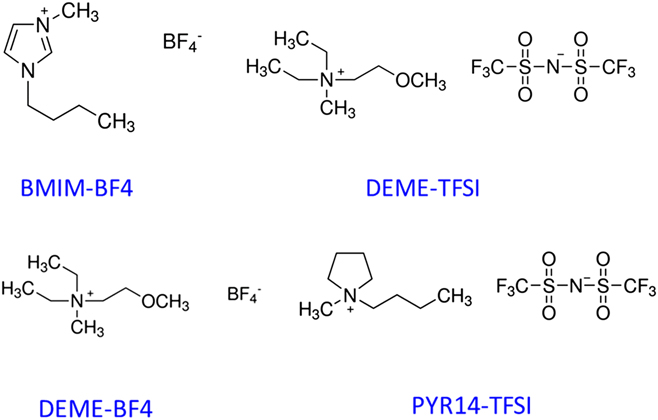
The four commercial RTILs, i.e., 1-butyl-3-methylimidazolium tetrafluoroborate (BMIM-BF4) from Sigma Aldrich (St. Louis, Missouri), ≥98% purity, N,N-diethyl-N-methyl-N-(2-methoxyethyl)ammonium bis(trifluoromethanesulfonyl)imide (DEME-TFSI) from IoLiTec (Tuscaloosa, Alabama), 99% purity, diethyl-methyl-(2-methoxyethyl)ammonium tetrafluoroborate (DEME-BF4) from IoLiTec, 99% purity, and 1-butyl-1-methylpyrrolidinium bis(trifluoromethanesulfonyl)imide (Pyr14-TFSI) from Solvionic (Toulouse, France), 99.9% purity, were used without further purification. Figure 1 shows the chemical structures of the RTILs.
Chemical structures of the various room temperature ionic liquids investigated as electrolytes for CNT-based supercapacitors.

Pouch cells of approximate dimension 40 mm (W) × 40 mm (L) × 1 mm (T) using the as-prepared CNT electrodes and above-mentioned RTIL electrolytes were constructed in a glove box with <1 ppm of oxygen and water. Each cell was filled with 50 µL of RTIL electrolyte. A cellulose-based separator with a thickness around 20 µm was applied in all pouch cells. At least three cells were assembled for each electrolyte, and the performance of a representative cell was used for each electrolyte for comparison.
B. Performance evaluation
1. RTIL electrolyte
A three-electrode electrochemical cell was prepared to examine the electrochemical potential window of the RTIL electrolytes via stepwise cyclic voltammetry (CV) test on a Gamry 1000 Electrochemical Workstation. A non-aqueous Ag/Ag+ electrode was used as reference electrode. Non-aqueous reference electrode preparation was performed as follows: (i) immerse the glass body and Vycor plug in electrolyte under test for approximately 1 h; (ii) add an equal volume of 0.01 M AgNO3-based solution to the RTIL to prepare the supporting electrolyte; (iii) clean silver surface of the wire reference electrode by a light polish on 600 grit sandpaper, rinse with distilled water followed by isopropyl alcohol (IPA), and then dry before use; (iv) assemble Teflon cap w/silver wire and glass body and Vycor plug with the appropriate prepared supporting electrolyte.
Glassy carbon and platinum were used as the working and counter electrodes, respectively. Nitrogen gas was purged into the three-electrode electrochemical cell to form a blanket of N2 protection.
2. CNT-RTIL pouch cells
The electrochemical performance of the assembled CNT-RTIL supercapacitor pouch cells was examined systematically after conditioning them with a potentiostatic hold at 2.7 V and room temperature for 22 h. Stepwise cyclic voltammetric, electrochemical impedance spectroscopic and constant current charge–discharge tests were conducted on each supercapacitor cell using a PAR VersaStat Electrochemical workstation (Advanced Measurement Technology, Oak Ridge, Tennessee). The cycling stability of the assembled supercapacitor cells at a voltage of 4 V for up to 100,000 cycles was evaluated and compared using a Gamry 1000 Electrochemical workstation (Gamry Instruments, Warminster, Pennsylvania).
III. RESULTS AND DISCUSSIONS
A. BET surface area and pore size distribution of conformal CNT electrodes
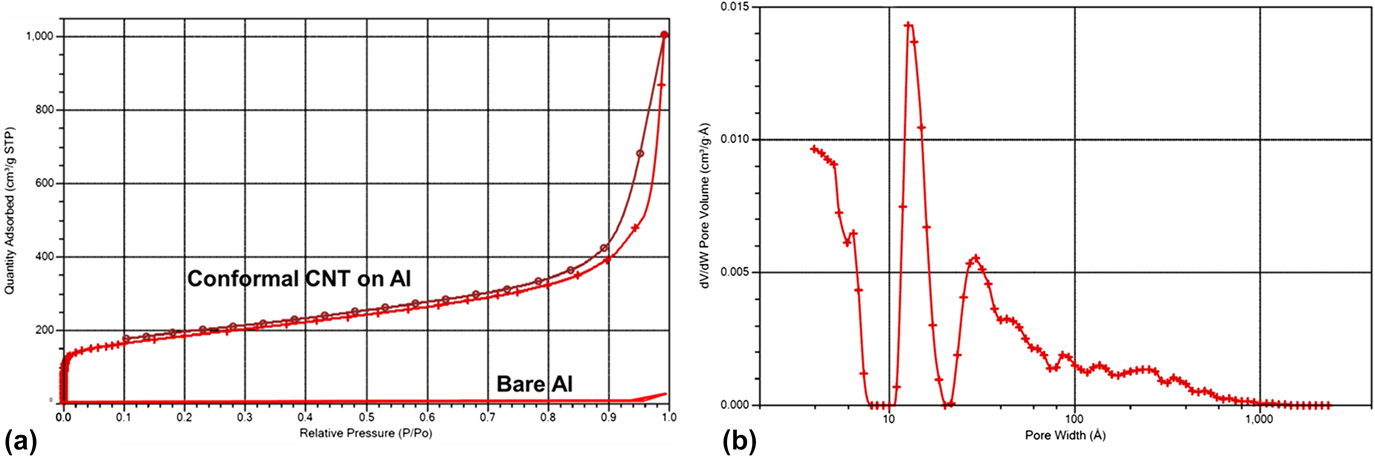
BET physisorption analyses (N2 gas) were performed on the conformal CNT electrodes using a Micromeritics 3Flex physisorption analyzer. For baseline data, bare Al foil electrodes were also analyzed. The resulting N2 adsorption isotherms are shown in Fig. 2(a) for the CNT-coated Al foil (top plot) and bare Al foil electrodes (bottom plot). The bare Al foil showed only marginal adsorption of N2 gas under the test conditions used, i.e., less than 5 cm3/g at all relative pressures. This is likely due to the small porosity created by etching of the Al foil surface. The Al foil showed little or no physisorption with a low surface area (6 m2/g) and negligible pore volume (0.005 cm3/g). In contrast, the CNT-coated Al foil exhibited a markedly increased adsorption of N2 gas (600 cm3/g). Based on these adsorption isotherms, the conformal CNT coating had a BET surface area approaching 600 m2/g. Figure 2(b) shows the pore size distribution of the conformal CNT coating measured using N2 adsorption at 77 K via the BJH method. It can be seen that the nanocarbon coating possesses both microporosity and mesoporosity, both essential for facile diffusion of ions from bulk electrolyte into the porous electrode coating to establish an effective double layer. The average pore diameter of the conformal CNT electrode coating was determined to be 10.2 nm, with corresponding t-plot determined micropore volume of 0.016 cm3/g. The conformal CNT electrodes of the present study possess average pore diameter that is an order of magnitude larger than typical values reported for AC, which are around 1 nm.Reference Miyamoto, Kanoh and Kaneko25
(a) N2 adsorption/desorption isotherms of conformal CNT coating on Al current collector. The corresponding isotherms for bare Al current collector are included for reference. (b) Pore size distribution of conformal CNT coating on Al current collector measured using N2 adsorption at 77 K via the BJH method.

B. Cyclic voltammetry
1. RTIL electrolytes
Room temperature ionic liquids (RTILs) are attractive as electrolytes because their relatively high electrochemical potential window (EPW) (≥4 V) compared to organic (<2.7 V) or aqueous-based electrolytes (∼1.1 V) may enable operation at increased voltages. The high EPW is the most alluring merit which has the potential to lead to significant EDLC performance boost since both the power and energy densities are proportional to the square of EPW. Herein, four RTILs, i.e., BMIM-BF4, DEME-TFSI, DEME-BF4, and Pyr14-TFSI were examined through a three-electrode characterization process.
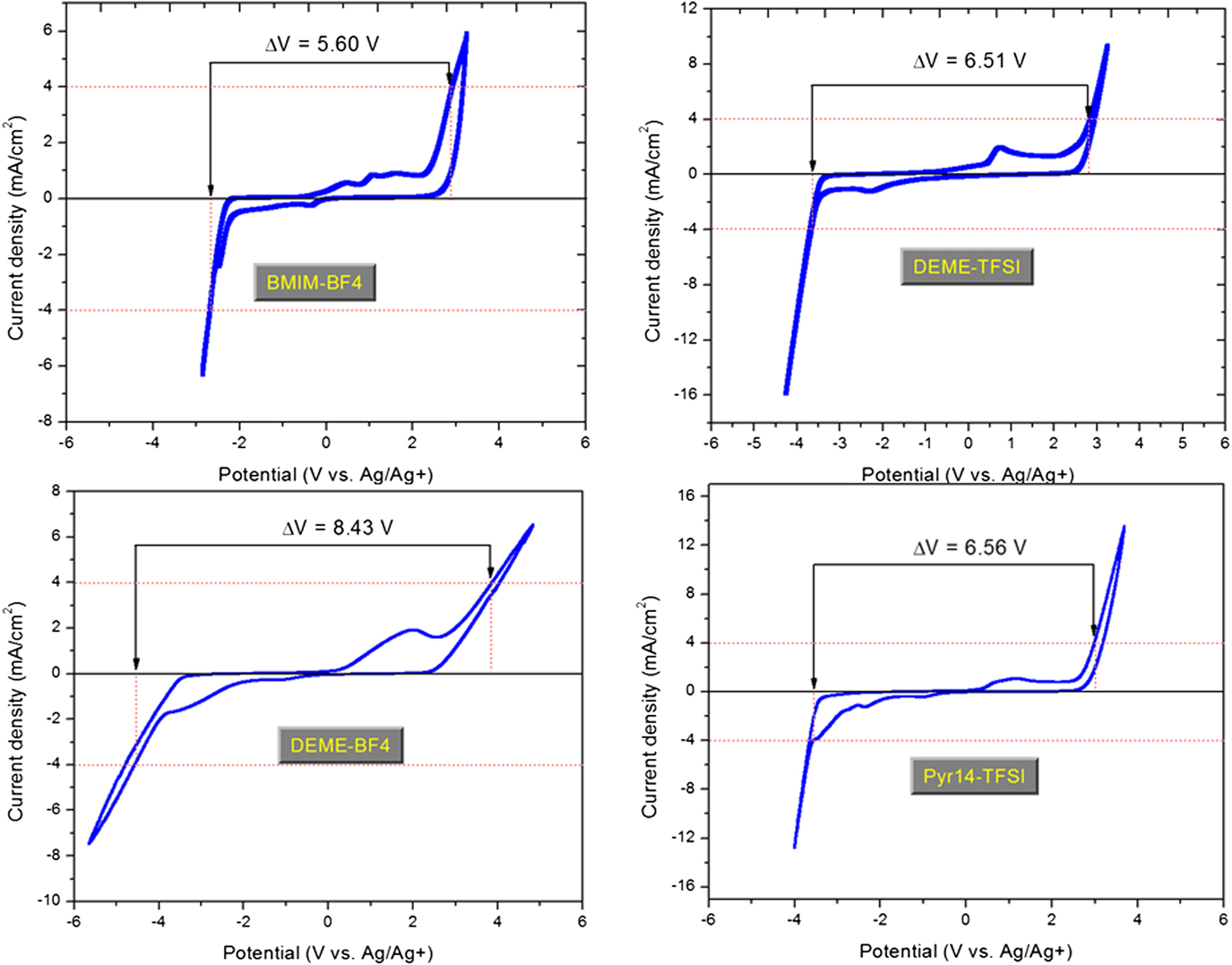
The electrochemical stability limits were measured via stepwise CV tests by measuring the onset potentials of electrolyte oxidation and reduction. The onset potentials were determined on the anodic and cathodic sweeps of the CV curves when a specific current density was reached. This specific current-density is also named cutoff current-density, i cut-off. However, this cutoff current-density is typically selected quite arbitrarily, which gives rise to widely varying reports in the literature.Reference Mousavi, Wilson, Kashefolgheta, Anderson, He, Buhlmann and Stein26,Reference O’Mahony, Silvester, Aldous, Hardacre and Comton27 In addition, the electrochemical stability limits of the electrolyte can also be affected by the material of the working and reference electrodes and the electrolyte concentration. Consequently, inconsistencies on electrochemical stability limits of electrolytes are common in the literature. Herein, all oxidation and reduction limits were determined at a cutoff current-density of 4 mA/cm2 and a scan-rate of 100 mV/s (high scan rate to assure cell’s high rate performance) on a 3 mm-diameter glassy carbon working electrode. The cyclic voltammograms and EPWs of the BMIM-BF4, DEME-TFSI, and DEME-BF4 are shown in Fig. 3.
Cyclic voltammograms of BMIM-BF4, DEME-TFSI, DEME-BF4, and Pyr14-TFSI ionic liquid electrolytes on glassy carbon with electrochemical stability limits and electrochemical potential window, ΔV, indicated at cutoff current-density of 4 mA/cm2 and scan rate of 100 mV/s.

As shown in Fig. 3, BMIM-BF4, DEME-TFSI, DEME-BF4, and Pyr14-TFSI demonstrated EPWs of 5.60 V, 6.51 V, 8.43 V, and 6.56 V, respectively. DEME-BF4 showed the highest EPW among the investigated RTILs. Compared to the previously reported value of 6 V for DEME-BF4,Reference Kim, Matsuzawa, Ozaki, Park, Kim, Endo, Yoshida, Masuda, Sato and Dresselhaus28,Reference Sato, Masuda and Takagi29 the EPW of 8.43 V for DEME-BF4 from this study was higher (possibly due to the use of higher cutoff current-density). Applying a cutoff current-density of 2 mA/cm2, the EPW of DEME-BF4 would be reduced to 6.96 V. The high EPW of BMIM-BF4, DEME-TFSI, DEME-BF4, and Pyr14-TFSI could possibly offer higher operational voltage for supercapacitors. In addition, by comparing the EPWs of DEME-BF4 (8.43 V) with BMIM-BF4 (5.60 V), it was concluded that DEME+ was more stable than BMIM+. Similarly, Pyr14+ and DEME+ appeared to be on par with each other based on the comparable EPWs of DEME-TFSI (6.51 V) and Pyr14-TFSI (6.56 V). It was also determined that BF4− was more difficult to oxidize than TFSI− via the EPWs’ comparison of DEME-BF4 (8.43 V) and DEME-TFSI (6.51 V).
2. CNT-RTIL supercapacitors
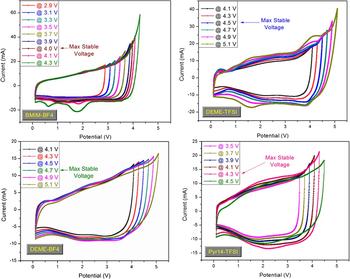
High EPW of RTILs obtained using a three-electrode system on glassy-carbon electrode normally overestimates the operational voltage of the resulting supercapacitors using RTIL electrolyte. However, the actual operational voltages of the resulting supercapacitors are typically observed to be lower than the corresponding EPWs of the electrolytes due to the limitations stemming from the electrode material. Therefore, stepwise CV tests were performed with CNT-based full cells using BMIM-BF4, DEME-TFSI, DEME-BF4, and Pyr14-TFSI as the electrolyte. The results are shown in Fig. 4 with operational voltage marked as max stable voltage.
Stepwise cyclic voltammograms of CNT-based supercapacitors using BMIM-BF4, DEME-TFSI, DEME-BF4, and Pyr14-TFSI as electrolytes, with the corresponding operational voltages marked in the figure.

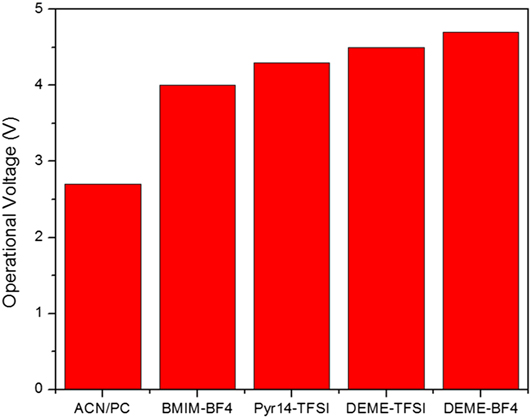
In good agreement with the 3-electrode EPW results, the CNT/DEME-BF4-based cell exhibited the highest operational voltage of 4.7 V, whereas CNT/DEME-TFSI, CNT/Pyr14-TFSI, and CNT/BMIM-BF4-based cells showed lower operational voltages of 4.5 V, 4.3 V, and 4.0 V, respectively. All of these voltages are substantially higher than the operational voltage of AC-based supercapacitors using acetonitrile (ACN)- or propylene carbonate (PC)-based organic electrolytes, which are normally rated at 2.7 V. For better comparison, Fig. 5 shows a comparison of conventional AC-based supercapacitors using ACN/PC-based organic electrolytes. The DEME-BF4, DEME-TFSI, Pyr14-TFSI, and BMIM-BF4 ionic liquid containing cells used high-purity CNT as active electrode material.
Comparison of operational voltages of CNT-based supercapacitors using DEME-BF4, DEME-TFSI, Pyr14-TFSI, and BMIM-BF4 as electrolytes and activated carbon-based supercapacitors using ACN/PC-based organic electrolytes.

C. Nyquist and Bode profiles
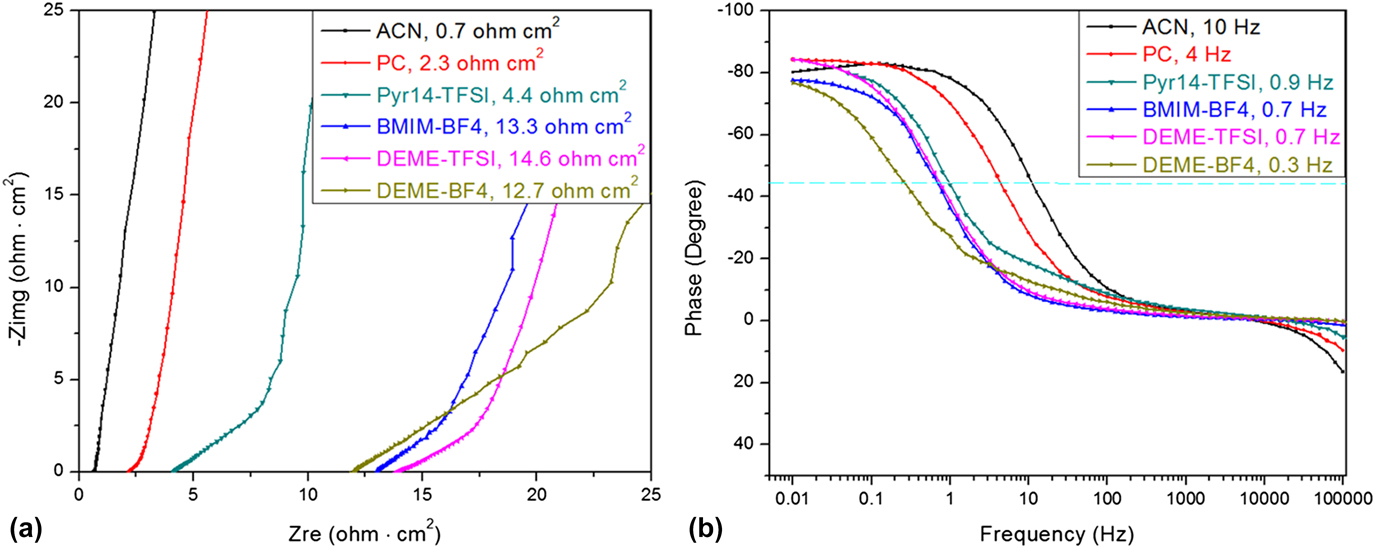
The Nyquist and Bode plots of CNT-based supercapacitors using DEME-BF4, DEME-TFSI, Pyr14-TFSI, and BMIM-BF4 as electrolytes are shown in Figs. 6(a) and 6(b), respectively. In comparison with ACN/PC-based organic electrolytes equipped with the same CNT-based electrodes. All of the ESR values reported in the figure were taken at 1 kHz. Compared to the ESR values of 14.6 Ω cm2 for DEME-TFSI and 13.3 Ω cm2 for BMIM-BF4-based pouch cells, the ESR value of 12.7 Ω cm2 for DEME-BF4-based pouch cells was slightly lower. Moreover, the very noticeable increase in diffusional impedance observed in the Nyquist profile with DEME-BF4-based cell compared to cells with all other electrolytes was most likely due to its high viscosity. Pyr14-TFSI based cell showed the lowest ESR value of 5.4 Ω cm2 among all RTIL-based cells but still higher than those of ACN- and PC-based pouch cells, i.e., 0.7 and 2.3 Ω cm2, respectively.
(a) Nyquist plots of CNT-based supercapacitors using DEME-BF4, DEME-TFSI, DEME-BF4, and Pyr14-TFSI as electrolytes, in comparison with CNT-based supercapacitors using ACN- and PC-based organic electrolytes. (b) Bode plots of CNT-based supercapacitors using DEME-BF4, DEME-TFSI, DEME-BF4, and Pyr14-TFSI as electrolytes, in comparison with CNT-based supercapacitors using ACN- and PC-based organic electrolytes.

The Bode profiles shown in Fig. 6(b) are consistent with the corresponding Nyquist profiles shown in Fig. 6(a). A higher ESR results in a lower transition frequency measured at the phase angle of −45°. ACN demonstrated the highest frequency value of 10 Hz, and PC the second highest value of 4 Hz. Pyr14-TFSI-based cell showed a frequency value of 1.2 Hz, which was highest among the RTIL-based cells examined in this study and is consistent with its relatively low resistance. BMIM-BF4- and DEME-TFSI-based cells exhibited a similar frequency value of 0.7 Hz, which agreed well with their alike resistance values. Consistent with its high viscosity of 410 mPa s, DEME-BF4 showed the lowest frequency value of 0.3 Hz. In addition, the time constants of the cells were computed based on the frequency values and are summarized in Table I for comparison. In general, the higher the frequency values, the lower the time constant, indicating faster cell response. The fastest cell response among RTILs was observed with the Pyr14-TFSI ionic liquid electrolyte. As shown in Table I, the high ESRs of RTIL-based cells are due to their relatively higher viscosity compared to ACN- or PC-based cells, which is limiting cell performance in terms of response time.
Comparison of ESR, frequency values, and time constants of CNT-based supercapacitors using DEME-BF4-, DEME-TFSI-, BMIM-BF4-, Pyr14-TFSI-based RTIL electrolytes, and ACN/PC-based organic electrolytes. The viscosities of the electrolytes are included as well.

D. Capacitance
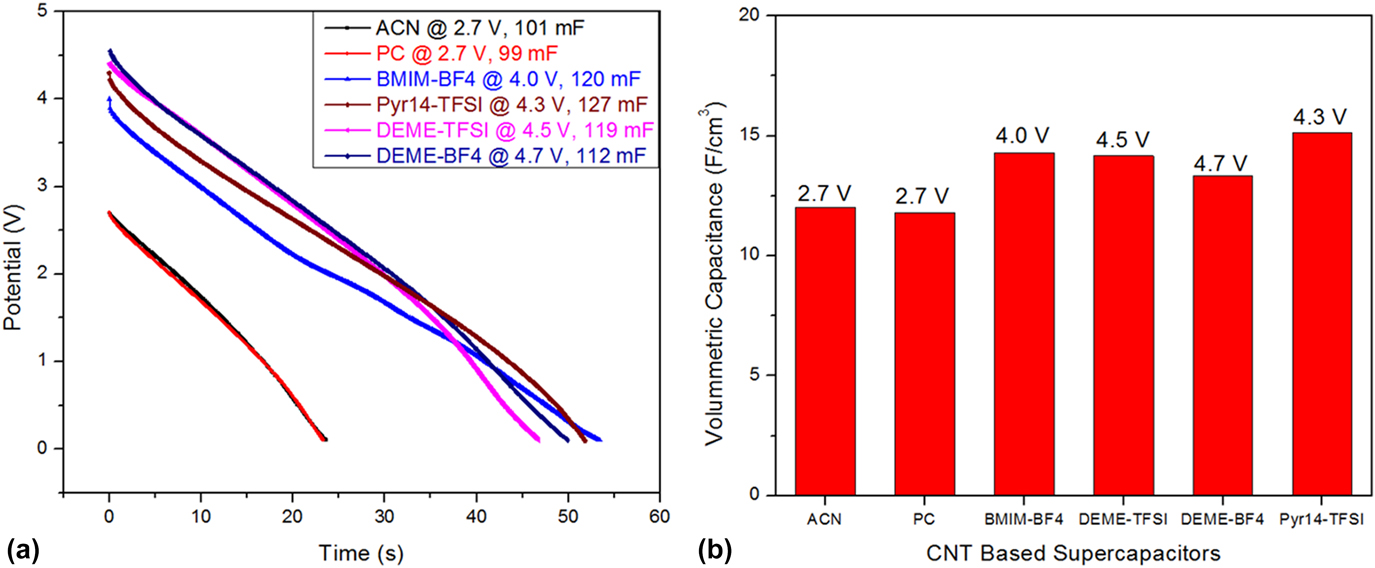
Constant current charge/discharge tests were performed at 10 mA and room temperature to compare the capacitive energy storage performance of the CNT-based supercapacitors operating at voltages ≥4.0 V, i.e., at operational voltages significantly higher than the conventional practical upper voltage limit of 2.7 V for organic electrolytes with AC. Specifically, the CNT-based cells using DEME-BF4 were operated at 4.7 V, DEME-TFSI at 4.5 V, BMIM-BF4 at 4.0 V, Pyr14-TFSI at 4.3 V, and as reference CNT-based cells with ACN/PC at 2.7 V. The results are shown in Fig. 7(a). All of the capacitance values were calculated by discharging cells from operational voltage V o to half of the operational voltage V o/2. At 4.3 V, the Pyr14-TFSI-based cell demonstrated the highest nominal capacitance of 127 mF, whereas BMIM-BF4-, DEME-TFSI-, and DEME-BF4-based cells exhibited nominal capacitances of 120 mF at 4.0 V, 119 mF at 4.5 V, and 112 mF at 4.7 V, respectively. For comparison, CNT cells assembled with the conventional organic electrolytes of ACN and PC had capacitance values of 101 mF at 2.7 V and 99 mF at 2.7 V, respectively. The volumetric capacitance values of the CNT-based supercapacitors using DEME-BF4 at 4.7 V, DEME-TFSI at 4.5 V, BMIM-BF4 at 4.0 V, Pyr14-TFSI at 4.3 V, and ACN/PC at 2.7 V were also calculated and presented in Fig. 7(b). The Pyr14-TFSI-based cell demonstrated the highest volumetric capacitance of 15 F/cm3, whereas BMIM-BF4- and DEME-TFSI-based cells exhibited capacitance values around 14 F/cm3, and DEME-BF4-based cells around 13 F/cm3, all higher than corresponding volumetric capacitance values for ACN- and PC-based cells, which was around 11 F/cm3.
(a) Constant current discharge curves of CNT-based supercapacitors using DEME-BF4 at 4.7 V, DEME-TFSI at 4.5 V, BMIM-BF4 at 4.0 V, Pyr14-TFSI at 4.3 V, and ACN/PC at 2.7 V based electrolytes. (b) Comparison of volumetric capacitance of CNT-based supercapacitors using DEME-BF4 at 4.7 V, DEME-TFSI at 4.5 V, BMIM-BF4 at 4.0 V, Pyr14-TFSI at 4.3 V, and ACN/PC at 2.7 V based electrolytes.

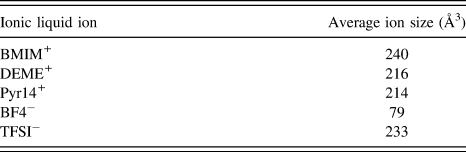
Table II compares the average ion sizes of the RTIL cations and anions in the present study.Reference Maiti, Pramanik and Mahanty30
Comparison of average ion size of ionic liquids utilized in the study.

The high capacitive energy storage ability of the CNT-RTIL-based cells, in particular, the Pyr14-TFSI- and BMIM-BF4-based cells, is thought to originate from the possible size matching of the porous structure of CNT electrodes and the Pyr14+ and BMIM+ cations. As indicated previously in Fig. 2(b), the conformal CNT coatings possess average pore diameter of 10.2 nm. This average pore size of the CNT coating is significantly larger than the largest ion size of 0.4 nm exhibited by the BMIM+ cation (assuming spherical volume). Thus the porous nature of the conformal CNT electrode coating with its resulting microporous volume content is capable of accommodating the ionic liquid ion sizes, allowing facile and unhindered movement of the ions from the bulk electrolyte into the CNT porous structure.
Based on the ESR values, operational voltages, and nominal capactiance, the power and energy densities of the CNT-based supercapacitors in BMIM-BF4, DEME-TFSI, DEME-BF4, and Pyr14-TFSI ionic liquid electrolytes, and in ACN- and PC-based electrolytes were calculated and presented in Table III together with above-mentioned parameters. The values for power (ΔV 2/4 × ESR × vol) and energy (1/2 CΔV 2) densities were calculated based on CNT electrode volumes only and not using the full packaged device. As shown in Table III, ACN-based cells with CNT electrodes demonstrated the highest power density approaching 1000 W/cm3. The RTIL-based cells showed lower power densities ranging from 107 to 375 W/cm3, primarily due to the significantly higher ESR values compared to the organic electrolytes. The Pyr14-TFSI-based cell showed highest power density among the four RTIL-based cells due to its relatively low ESR. Although the ESR of the Pyr14-TFSI based cell was higher than that of the PC-based cell, the power density of the Pyr14-TFSI-based cell (375 W/cm3) was still higher than that of the PC-based cell (283 W/cm3). The primary contributor is considered to be the higher operational voltage of 4.3 V for the Pyr14-TFSI-based cell. Equally important, the RTIL-based cells exhibited higher energy densities ranging from 32 to 40 mW h/cm3, about three times higher than that of ACN- and PC-based cells. The superior energy densities of the CNT-RTIL-based cells stemmed from the high capacitance values and more importantly, from the higher operational voltages achieved with the RTIL electrolytes.
Comparison of EDLC performance parameters of CNT-based supercapacitors using Pyr14-TFSI-, BMIM-BF4-, DEME-TFSI-, DEME-BF4-based RTILs electrolytes, and ACN/PC-based organic electrolytes.

a Calculated based on the average CNT thickness of 14 µm. The electrode area is 2 × 1.5 cm.
When operated at 4.0 V, the Pyr14-TFSI-based cell showed a nominal capacitance of 111 mF, which is lower than the 120 mF for the BMIM-BF4-based cells at 4.0 V. In other words, BMIM-BF4-based cell exhibited the highest nominal capacitance at 4.0 V and was selected for prolonged cycling stability tests along with the DEME-based cells.
E. Cycling stability
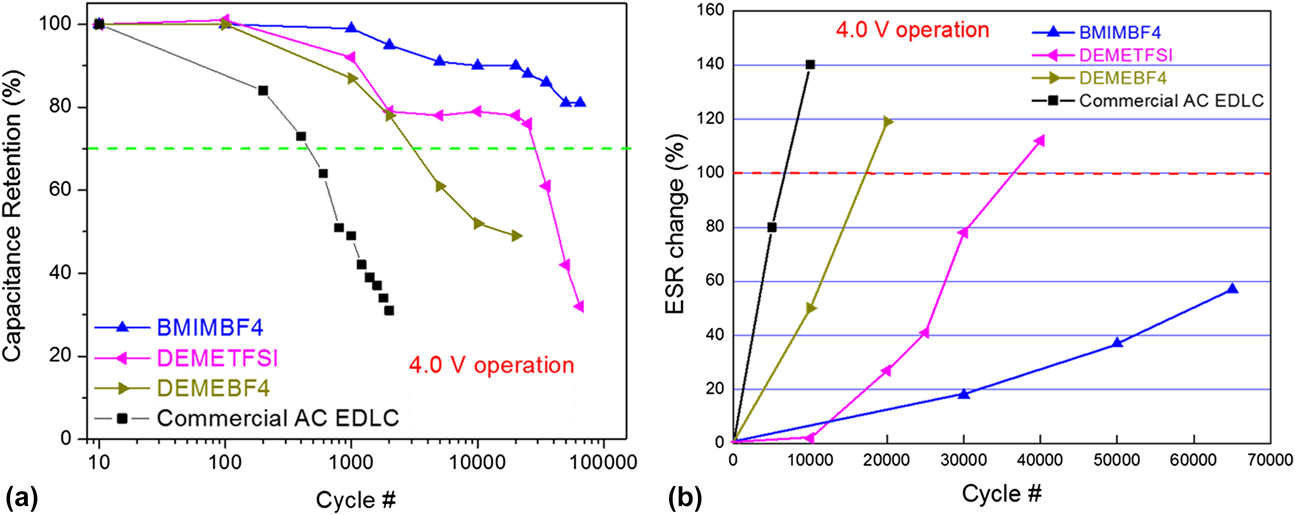
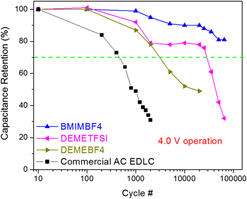
The cycling stabilities of the CNT-based supercapacitors using BMIM-BF4, DEME-TFSI, and DEME-BF4 ionic liquids as electrolytes were examined and compared to a commercial AC-based supercapacitor pouch cell with organic electrolyte at operational voltage of 4.0 V and room temperature. Each supercapacitor cell, including the commercial AC-based cell, was consecutively cycled between 0.1 and 4.0 V using constant charge and discharge currents of 50 mA. As shown in Fig. 8(a), the commercial AC-based supercapacitor was observed to fail first, defined by capacitance drop to less than 70% of the original value, after only 400 consecutive cycles between 0.1 and 4.0 V. The breakdown of the organic electrolyte components at the AC electrodes due to operation at a high voltage exceeding 2.7 V resulted in very rapid fall of capacitance. In contrast, all selected CNT-RTIL-based cells passed 1000 cycles up to 4.0 V. Among the CNT-RTIL-based cells, the DEME-BF4-based cell was the first to fail after 3000 cycles. The DEME-TFSI-based cell was capable of cycling 10 times longer before it also failed, exhibiting less than 30% of capacitance retention after 30,000 cycles. The most durable cell was that assembled using BMIM-BF4 as electrolyte which did not fail the high-voltage cycling test but showed >80% retention of its original capacitance after 65,000 consecutive cycles of charge/discharge between 0.1 and 4.0 V. The decrease in capacitance observed among all investigated CNT-RTIL pouch cells may be due to a combination of factors. The commercial ionic liquids were used as received without further purification, and the presence of impurities may limit the cycling stability. Also, generation of undesired by-products from such impurities from repetitive cycling at the high voltage can significantly attenuate the capacitance over time by hindering ion mobility or blocking ion diffusion into the pores of the active electrodes. The corresponding change in cell ESR using the RTIL electrolytes during the 4.0 V cycling study is shown in Fig. 8(b). The commercial AC EDLC was also the first to fail in this performance parameter, exhibiting a rapidly rising ESR well inside of 10,000 cycles. As observed with the change in capacitance, a similar trend was seen among the three ionic liquid-based pouch cells, with the DEME-BF4-based cell being first to fail. After 65,000 continuous charge–discharge cycles up to 4.0 V, the BMIM-BF4 cell ESR increase was less than 60% and therefore was also not categorized as failing in this performance parameter. Consequently, BMIM-BF4 was regarded as the most stable electrolyte among the RTILs examined in this cycling study using CNT electrodes operating at high voltage.
(a) Cycling stability of CNT-based supercapacitors using BMIM-BF4, DEME-TFSI, and DEME-BF4 as electrolytes in comparison with a commercial AC-based supercapacitor at 4.0 V and room temperature. (b) ESR change during cycling stability of CNT-based supercapacitors using BMIM-BF4, DEME-TFSI, and DEME-BF4 ionic liquid electrolytes in comparison with a commercial AC-based supercapacitor at 4.0 V and room temperature.

IV. CONCLUSIONS
Supercapacitors with stable operating voltage ≥4.0 V were fabricated via the combination of surfactant-free and binder-free CNT electrodes using several commercial room temperature ionic liquids as electrolyte. Cyclic voltammetry testing showed the maximum operational voltage to be 4.0 V for BMIM-BF4, 4.3 V for Pyr14-TFSI, 4.5 V for DEME-TFSI, and 4.7 V for DEME-BF4 based supercapacitors. Compared to EDLC cells using conventional acetonitrile (ACN)- and propylene carbonate (PC)-based organic electrolyte at 2.7 V and room temperature operation, capacitance increased by about 20% using the BMIM-BF4, Pyr14-TFSI and DEME-TFSI based cells operating at ≥4.0 V, with consequent tripling of energy density. While significant improvements to energy density were achieved with the use of ionic liquid electrolytes, the higher ESR of these ionic liquids, arising primarily from their increased viscosity, hinders the power performance of the CNT-RTIL supercapacitors. At the best, the Pyr14-TFSI-based cell exhibited power density that was comparable to the PC-based cell but still was less than one half the power density of the ACN-based cell, in spite of its higher voltage operation. Long-term cyclability of the CNT-based EDLC cell using BMIM-BF4 ionic liquid electrolyte operating at 4.0 V and room temperature was demonstrated with retention of >80% of initial capacitance after 65,000 continuous full charge–discharge cycles and without doubling of initial cell ESR. The results from this work demonstrate the potential for assembly of next-generation high-voltage and high-energy supercapacitors beyond conventional activated carbon/organic electrolyte-based EDLCs. However, to realize the real-world application of RTILs in EDLCs offering the attractive combination of high energy and power densities, major advancement is needed to lower the viscosities of RTILs and the corresponding cell ESR values.