It is hard to say if and how the experience of theatre might change lives or serve a community. Has theatre ever done so? Thinking of the effects of contemporary possibilities of ritual performance—a lifetime attending Catholic mass, yearly pilgrimages to Burning Man festivals or Disney World, an annual subscription to a regional theatre season, yearly participation in Mardi Gras, habitual involvement in political demonstrations, attending Red Sox games every season, following the Grateful Dead for years, or regular exposure to wayang kulit shadow-puppet shows in a Javanese village—one imagines that it's not so much that change takes place but that existing values are reinforced and community and personal identity are confirmed in live, shared experience. The live, in-time realization during a Donald Trump rally that one is not alone in feeling rebuffed and abused and that enemies can be identified, named, and vilified in a collective catharsis might change a life in the sense that both buried fears and suspicions and hopes for a “better” future might just be realized (in this case through the embrace of an authoritarian, if not fascist, spirit). This kind of transformation is not so much a doorway to change—a new direction—as it is a confirmation of convictions already deeply held.
Since the theatre experience is deeply tangled up with social, familial, and individual doubts, convictions, and contradictions, it seems hard to gather and identify data that could clearly point to life changed by, for example, the experience of seeing a play. Part of this has to do with the fact that the theatre experience is intensely social and multifaceted. It goes beyond the combination and contradictions of image, text, and sound to include the dynamics of the audience, the experience of going to and from the performance space, the nature of one's relationship to theatregoing partners and the strangers sitting around you, and how those strangers respond.
In our Great Small Works theatre company we are asked by funding agencies to explain, somehow, how our theatre work has affected the city of Brooklyn—whom we reach and how often. It seems that the ultimate desire of potential funders is to know exactly how and when the theatre experience changes lives. Our company manager spends hours upon hours filling out forms for the New York State Council on the Arts and the New York City Department of Cultural Affairs, quantifying the theatre experiences we offer, compiling data that the government agencies appear to believe will answer their questions about the efficacy of the theatre experiences we create. But in fact the arts appear to resist the call—the hoped-for certainty—of data. My sudden remembrance of a moment from Reza Abdoh's 1993 Quotations from a Ruined City (a recitation of one of Rumi's ghazels) and my abrupt realization that it connects to my understanding of the situation in Iraq more than fifteen years after seeing this moment performed onstage reminds me that the effects of theatre resist quantification and translation into useful data. Is theatre useless?
The concept of “underserved communities,” as I understand it, began to take form in the 1980s with concerns about health care, education, access to technology, and the arts. We understand the term to apply to “populations and individuals in low income communities, communities of color and underserved rural and urban areas.”Footnote 1 In our Great Small Works productions in the New York metropolitan area, we see the call to connect with underserved communities as a spur to reach out beyond our own generally white, middle-class milieu. I think that when it comes to theatre, most of us constitute an underserved community. By this I mean that the majority of Americans do not currently reap the benefits of live performance. Only 15 percent of the US population saw a live theatre production in the twelve months preceding the spring of 2015, whereas huge majorities of our fellow citizens saw movies, television, sporting events, or Internet entertainments during the same period.Footnote 2 Since it is hard to get Americans into the seats of Broadway, Off-Broadway, and regional theatres, it makes sense to think of other ways to bring theatre to people where they are, which is one of the attractions of parades, pageants, street theatre, school workshops, and other performances that might connect with audiences and performers in alternative ways.
I think it is possible to say that theatre can serve a community just as a church does, or as music concerts, sporting events, civic events, or regular amateur cultural activities do. I think of four examples of theatre that might be considered to have a powerful effect on those performing and those watching. I am not sure if and how these types of performance might change lives and how exactly they connect with underserved populations, except for the fact that, in terms of theatre, we are all underserved.
1. Volunteers as Expert Performers
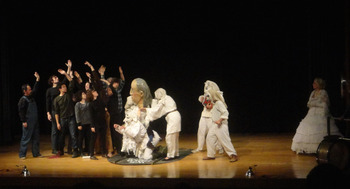
Over the past forty years, Peter Schumann's Bread & Puppet Theater has developed a strategy for producing large-scale productions with limited means by engaging volunteer performers. In some cases this involves immediate involvement: community members, students in a college workshop, or activists taking part in a demonstration are given brief instructions, shown simple ways of operating puppets and masked characters, and then incorporated into a procession, puppet circus, outdoor pageant, or indoor spectacle. Such community performance offers all sorts of satisfactions (as the creators of the American pageant movement discovered over a hundred years ago),Footnote 3 and many volunteers reappear for future shows. During the period of Bread & Puppet's Domestic Resurrection Circuses (1971–98), an ensemble of experienced community performers slowly coalesced around the rehearsals and performances of the two-day immersive theatrical extravaganza in rural Vermont, learning and perfecting techniques of movement, voice, musical instrument playing, and puppet and mask performance. In the end, this group constituted a vast repertory company of consummate skill. This volunteer ensemble of sixty to one hundred performers, which augmented Bread & Puppet's smaller resident company of eight to twelve puppeteers, allowed director Peter Schumann to create large-scale theatrical productions at a high level of artistic competence on a very low budget. The practice continues to this day: floating companies of volunteers join Bread & Puppet annually in New York City and Boston in such productions as The Return of Ulysses (2010), The Shatterer of Worlds (chapel with naturalization services for applicants requesting citizenship in the shattered world) (2014), and The Seditious Conspiracy Theater Presents: A Monument to the Political Prisoner Oscar Lopez Rivera (2016). Figure 1, an image from this past February, shows the Bread & Puppet company of five puppeteers and twenty volunteers performing an opening scene from the Oscar Lopez Rivera show on the proscenium stage of Massachusetts College of Art and Design's Tower Auditorium. The White Clowns, operating a Founding Father puppet, have just laid low a large, flat, cut-out First Nations puppet—a consequence of the creation of the “USA,” as the White Clowns have shown us with a banner—and the Founding Father is about to ride away on the back of one of them. The dark-costumed chorus is raising its arms in a hint of protest, a gesture that in the proceedings of the show will gradually reveal the group as conspirators (literally, those who breathe together) involved in the radical activism of Puerto Rican nationalist Oscar Lopez Rivera. The performers include a beekeeper from outside Boston, a recent Boston University theatre graduate, a bartender from Brooklyn, an early childhood educator from Cambridge, a Québécois puppeteer, a seventy-year-old retired Vietnam veteran, a middle-aged mother of a college student, a real estate agent and painter of Cheap Art from central Vermont, a Yiddish poet in her late sixties, and a recent graduate of the University of Puerto Rico at Río Piedras. Many of the performers have worked annually with Bread & Puppet in Boston for more than a decade, and their command of post–Judson Church everyday choreography (which Schumann has used since his own days at Judson in the 1960s) is focused and clean; their gestures, precise and committed.
Bread & Puppet Theater, The Seditious Conspiracy Theater Presents: A Monument to the Political Prisoner Oscar Lopez Rivera, Massachusetts College of Art and Design, February 2016. Photograph by John Bell.

In terms of community involvement, such a production gives a company of extremely well-trained, intergenerational, nonprofessional performers the ability to articulate activist ideas in the form of theatre. In terms of changing lives, I think the production shows both audience and performers that it is possible to communicate political ideas in a theatrical medium; and that, in a way, anyone can use these tools.
2. Toy Theatre and the Politics of Race
In the spring of 2015, the Ballard Institute and Museum of Puppetry and members of Great Small Works conducted a one-day workshop with Hartford, Connecticut, high-school students who represented an underserved community and students from the University of Connecticut Law School that asked the participants to express their ideas about legal and social issues and concepts through the puppet medium of toy theatre. Eight different shows were created and performed by and for the group and then later exhibited with puppets from the Ballard Institute collections in the Thomas J. Meskill Law Library on the university campus.
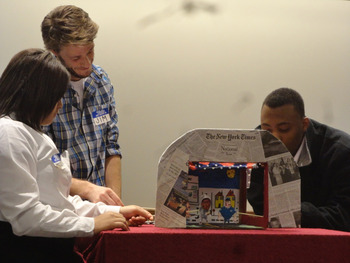
One of the shows, created by Jahriq Knighton from Hartford Public High School, a student named Yolanda from Bulkeley High School, and UConn Law School student Jim Anderson was a three-act drama entitled Trayvon Martin Remix (Fig. 2). The show, using puppets representing Martin; his killer, George Zimmerman; and a policeman (images all found on the Internet) played out the story of Trayvon Martin three times, each with a different ending. The first act recounted the events as they unfolded in real life, with Zimmerman unaccountably shooting and killing Martin. In the second iteration, a policeman arrives before Zimmerman can shoot, but in an action chillingly reminiscent of events in Ferguson, Missouri, the year before, shoots Martin himself. The third act arrives at the just but seemingly utopian ideal: after Zimmerman confronts Martin, the policeman arrives but sends George Zimmerman away so that Trayvon Martin survives.
Scene from The Trayvon Martin Remix, University of Connecticut Law School, May 2015. Left to right: Yolanda; Jim Anderson, and Jahriq Knighton. Photograph by John Bell.

Trayvon Martin Remix and the other short productions created in the workshop dealt with issues of substantial and sometimes immediate concern to the participating black and Latino Hartford students: wrongful conviction, bullying, unreasonable searches and seizures, and racial profiling, as well as less direct issues such as ocean pollution. Great Small Works wants to jump-start the possibilities of toy theatre as a tool for empowering one's own perspectives on important social and political issues: we say “you can do it yourself.” In the UConn Law School workshops, the form allowed students to develop their thinking about critical social and legal issues in effective visual performance. The shows were not seen by many people outside of the workshop context, but we felt the project was a success because it shared the tools of theatrical production through the creation of eight strong articulations of subjects to which the students felt directly and powerfully connected.
3. Photorealism as Activist Spectacle: JR in New York and Paris
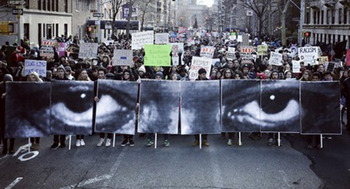
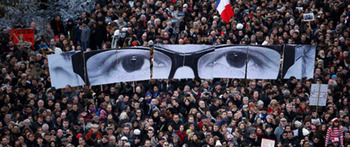
The highly successful Parisian artist JR works with giant photographs usually installed in public or semipublic spaces. However, over a four-week period a little over a year ago he was able to use the dynamics and aesthetics of giant puppetry in two massive street demonstrations, in New York and Paris, that articulated intense feelings of outrage and grief connected to the Black Lives Matter movement in the United States and the Charlie Hebdo terrorist shootings in France. In eight-panel blown-up portraits of two murder victims—Staten Island horticulturalist Eric Garner and Charlie Hebdo cartoonist Stéphane Charbonnier—JR was able to match the overwhelming performance presence of political street demonstration with the “high-affect aesthetics” of giant puppets (Figs. 3 and 4).Footnote 4 The scale of JR's political portraits is not unusual—such dynamics are used to great effect by the French company Royale de Luxe, the global touring arena spectacle Walking with Dinosaurs, most Olympic opening ceremonies, and other vastly popular examples of giant puppet aesthetics—but what is striking about the Garner and Charbonnier puppet portraits is the speed, simplicity, and effectiveness of the work. JR was able to respond to the immediacy of the moment (the Paris demonstration took place only four days after the massacre of the Charlie Hebdo staff) by designing and building his cheap and stunningly powerful objects, and to connect these giant portraits to the massiveness of the demonstrations in each city in a way that succinctly epitomized the prevailing sentiment of each event. Puppets gather in ideas and feelings and then send them out to audiences in the concentrated form of imagistic objects, and JR took advantage of this age-old usefulness to represent visually and theatrically in public space what thousands of people were experiencing.
Photo portrait of Eric Garner at a Black Lives Matter march in New York City, 13 December 2014. Photo by JR.

JR's photo portrait of Charlie Hebdo editor Stéphane Charbonnier at a march in Paris, 11 January 2015. Photo by Reuters / Charles Platiau. Source: Sarah Elzas, “Millions March for Charlie Hebdo in Biggest Rally in French History,” RFI English, 12 January 2015, http://en.rfi.fr/europe/20150112-paris-sunday-march..

4. Creating Platforms for Activism at the Honk! Festival
Last year was the tenth anniversary of the Somerville, Massachusetts, Honk! Festival of Activist Street Bands, which since its inception in 2005 has inspired six other Honk! festivals across the United States and individual festivals in Australia and Brazil. In addition to its presentation of scores of brass bands from across the United States and around the world, the Somerville Honk! Festival produces a Sunday morning Honk! parade from Davis Square in Somerville to Harvard Square in Cambridge. Over twenty brass bands and more than thirty community and activist groups parade in this event, the aim of which is to reclaim the ancient arts of parade spectacle for the twenty-first century. As part of our parade last year, we invited the participation of the Cambridge chapter of Black Lives Matter (BLM), whose particular national focus that fall was the situation of black queer and transgendered people. The Cambridge chapter of the group was joined by representatives of the national BLM organization, and the combined contingent marched in the Honk! parade and then made a presentation during our All-Band Review on a flatbed trailer stage in Harvard Square.
Like many efforts by mostly white activist organizations to collaborate with activists of color, our collaboration with Black Lives Matter was marked by a certain amount of awkwardness and misunderstanding, compounded by the fact that the day of our parade was also the first time the national BLM representatives would meet with their Cambridge chapter. The national BLM organization, having experienced an intense period of marches and demonstrations, had developed a strategy of taking part only in unofficial, nonpermitted events: sit-ins, street blockades, and other spontaneous gatherings of resistance, a somewhat more militant approach than the local BLM chapter. Our festival, however, was a fully sanctioned, officially supported community event organized with the cooperation of the cities of Somerville and Cambridge and their police and public works departments. Espousing the idea that activist street performance with music and visual imagery is a necessary element of community discourse puts us (I think) near the edge of official acceptability, and our sense of the importance of welcoming Black Lives Matter put us closer to that edge. The Cambridge Police Department was wary of BLM because of what had happened at nonpermitted events on public streets around the country in previous months, and the combined BLM contingent was wary of participating in a legal street procession because their whole method of operation depended on disobedience in public space.
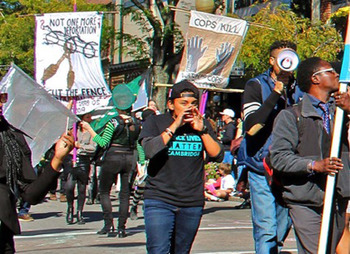
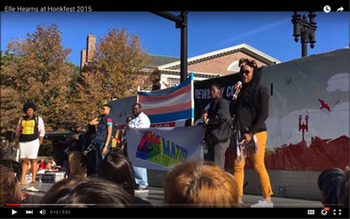
We placed the BLM contingent in the middle of our mile-and-a-half-long parade, in front of the Rude Mechanical Orchestra, a Brooklyn-based activist band that had been participating in antiracism events since the shooting of Michael Brown in Ferguson, Missouri, more than a year before (Fig. 5). When those contingents reached Porter Square, the border between Cambridge and Somerville, the BLM contingent, without warning, decided to sit down in the middle of the street—an unannounced activity that the Rude Mechanical Orchestra immediately joined. The entire parade paused for a quarter of an hour and the Cambridge Police were alarmed, but then the parade continued to its end at Harvard Square. There, during a performance time slotted for our Second Line Social Aid and Pleasure Society Brass Band, the BLM contingent (at the band's invitation) mounted the stage and, seeing the moment as an intervention rather than an invitation, presented the mostly sympathetic and white audience with a declamation by trans activist Elle Hearns about BLM's position on “Black queer and trans folks, disabled folks, black-undocumented folks, folks with records, women and all Black lives along the gender spectrum,” and how Black Lives Matter “centers those that have been marginalized within Black liberation movements” as “a tactic to (re)build the Black liberation movement” (Fig. 6).Footnote 5
Black Lives Matter contingent (Cambridge chapter and national organization) at 2015 Honk! Festival parading before Brooklyn's Rude Mechanical Orchestra. Photo by Carol Goodman. Used by permission of Carol Goodman.

Black Lives Matter transgender activist Elle Hearns speaking on the Main Stage at Harvard Square at the 2015 Honk! Festival. Still from “Elle Hearns at Honkfest 2015,” YouTube video, www.youtube.com/watch?v=8H6-lZyRERA, accessed 3 March 2016.

The somewhat awkward mutual embrace of the Honk! Festival and Black Lives Matter—our effort to welcome BLM's disruptions of daily life in our community celebratory spectacle and BLM's effort to maintain the consistency of its national tactics of disobedience—was probably invisible to those in the parade and Harvard Square audiences, but it was obvious to those of us organizing the events. While we had hoped to create collaborative performances with Black Lives Matter, what seemed to make the most sense for BLM was to see their work as an interruption, a “shut down.” This was fine with us, although in theatrical terms it may have (incorrectly) seemed to define the relationship between the Honk! Festival and Black Lives Matter activists as that of antagonists more than collaborators. Our communication misfire seems less important to me than the fact that the performance structures we created through the production of the Honk! Festival have allowed for the articulation of political ideas in public spaces by a wide array of musicians, artists, activists, and community members. Although our collaboration with Black Lives Matter last fall might have been awkward and marked by misunderstanding, it was entirely successful because we worked out our collective response to the politics of white hegemony, unrehearsed, unforeseen, in public spaces in real time, in front of audiences representing our community. The creation of such opportunities is a way to work out and perform the dynamics of activist collaboration with and as performance.
• • •
I think these examples of puppet and street performance offer possible ways theatre can connect with audiences who might not normally attend the theatre. And if they don't immediately change people's lives, they at least offer some hints of possible change.