Usage-based models of language propose that language usage affects grammar. Bybee (Reference Bybee2006:730) asserted that “usage feeds into the creation of grammar just as much as grammar determines the shape of usage” and that “grammar is the cognitive organization of experience with language.” These models have been applied to morphology and syntax (e.g., Bybee, Perkins, & Pagliuca, Reference Bybee, Perkins and Pagliuca1994; Du Bois, Reference Du Bois and Haiman1985; Hopper, Reference Hopper and Tomasello1998) as well as to phonology (e.g., Bybee, Reference Bybee2001, Reference Bybee2002). A major part of experience with language is frequency. Words vary in the number of times they occur in running speech. Some words are frequent, or even very frequent, while other words are less frequent. Furthermore, some words co-occur with each other frequently while others do not. Additionally, some words occur relatively frequently in phonological contexts that favor their articulatory reduction while others do not. Usage-based models of language propose that such differences in frequency in spontaneously produced language are stored in memory, affecting both the mental representation of words and phrases as well as their access and articulation in later usage.
The earliest studies of the effects of usage in phonology focused on the role of the lexical frequency of words and phrases in their articulatory reduction. Schuchardt (Reference Schuchardt1885:26, translated by Vennemann & Wilbur, Reference Vennemann and Wilbur1972:58) said: “The greater or lesser frequency in the use of individual words that plays such a prominent role in analogical formation is also of great importance for their phonetic transformation, not within rather small differences, but within significant ones. Rarely-used words drag behind; very frequently used ones hurry ahead.” Hooper (Reference Hooper and Christie1976) pointed out that the higher-frequency English words memory and nursery are more likely than lower-frequency armory and cursory to experience post-tonic schwa deletion and therefore be pronounced with two syllables rather than three. More recent studies continued to find significant effects from lexical frequency. Bybee (Reference Bybee2002:265–266) reported that the rate of deletion of intervocalic /d/ in Spanish is greater for higher-frequency words such as pasado ‘passed’ than for lower-frequency words such as tocado ‘touched’. File-Muriel (Reference File-Muriel2009) showed that lexical frequency is the most important factor in the reduction of word-medial, syllable-final /s/ in a reading task in the Spanish of Barranquilla, Colombia. Many other studies have found similar effects from lexical frequency on the reduction of sounds (e.g., Bybee, Reference Bybee2001; Phillips, Reference Phillips2006). In addition to single-word frequency, effects have been found from the frequency of multiword strings (e.g., Bush, Reference Bush, Bybee and Hopper2001; Bybee & Scheibman, Reference Bybee and Scheibman1999; Krug, Reference Krug1998, Reference Krug, Bybee and Hopper2001; Smith, Reference Smith, Bybee and Hopper2001) and from the frequency of strings in proportion to the frequency of the individual words of which the strings are composed (e.g., Alba, Reference Alba2005:157–180, Reference Alba2008; Bush, Reference Bush, Bybee and Hopper2001; Jurafsky, Bell, Gregory, & Raymond, Reference Jurafsky, Bell, Gregory, Raymond, Bybee and Hopper2001).
Recently, a growing number of studies have found an effect from the frequency with which words occur in contexts that favor their articulatory reduction, a variable that has been given several labels, including Contextual Frequency, Frequency in a Favorable Context for Reduction (FFC), and Frequency in a Reducing Context (FRC). We refer to it here as FRCFootnote 1 (cf. Brown, Reference Brown2009:93–100; Brown, Reference Brown2004:89–114, Reference Brown2005, Reference Brown2006, Reference Brown2015; Brown & Raymond, Reference Brown and Raymond2012; Bybee, Reference Bybee, Broe and Pierrehumbert2000, Reference Bybee2002; Raymond & Brown, Reference Raymond, Brown, Gries and Divjak2012). Brown (Reference Brown2004) reported that word-initial /s/ in the colonial Spanish of northern New Mexico and southern Colorado is reduced four times more often in words that occur most often in a phonological context that favors reduction, even when the immediate phonological context is controlled for. Brown (Reference Brown2009) found a similar effect with word-final /s/ in Cali, Colombia, but only when measured in favorable phonological contexts. Brown (Reference Brown2015) reported that word-initial /d/ in bilingual Spanish-English speech is reduced most in high-FRC words and that differences in /d/ articulation between cognates and noncognates can be attributed to differences in rates of FRC.
Brown and Raymond (Reference Brown and Raymond2012) explored factors affecting the Modern Spanish outcome of Latin words beginning in /f/ plus a vowel (FV- words) such as favor ‘favor’ < Lat. favor versus hablar ‘to talk’< Lat. fabulare. They find that two factors significantly predict the distribution of [f] and Ø in modern words: stress patterns and FRC, the latter being the frequency with which a Latin FV- word type is preceded by a nonhigh vowel (i.e., /a/, /e/, /o/) in the Medieval Spanish text La Celestina (Fernando de Rojas, Reference De Rojas1499). Words with a high FRC are one and a half times more likely to be realized as Ø in Modern Spanish than are those with low FRC. Interestingly, there was no effect from lexical frequency. Brown and Raymond (Reference Brown and Raymond2012) asserted that their findings show that FRC gives a more accurate depiction of the reductive process than does lexical frequency and that their results provide key insights into the nature of frequency effects. They state: “FFC, which measures word frequency in combination with independent conditioning factors (such as extralexical preceding/following phonological environments), is a more precise measure and predictor of change than word frequency alone,” and “We conclude that word frequency effects are not context independent, but rather register effects of specific reducing environments on each lexical item” (156, emphasis in the original).
As evidence mounts for an effect from FRC, a theoretical question arises as to the relationship between this frequency effect and the online articulatory processes from which it derives. Intuitively, for FRC to possibly exert a significant influence on the articulation of a sound, the extralexical phonological context upon which it is based must itself exert a significant effect on the sound. In the case of word-initial Latin /f/, for instance, Brown and Raymond's (Reference Brown and Raymond2012) FRC measure was based upon the phonological context preceding /f/. Thus, if FRC exerts an effect upon /f/ here, so too must the preceding phonological context itself. If this were not the case, exposure to the preceding phonological context, however prolonged, would do little or nothing to influence the articulation of the sound.
This raises other questions: Which effect is greater diachronically, that of the phonological context itself or that of FRC? Will the online articulatory process of reduction always outweigh the cumulative frequency effect of the context favorable to reduction? Or, as representation is strengthened in memory, might the frequency effect eventually overtake the articulatory process that gave rise to it? Given enough time, could the effects of FRC actually block or nullify the effects of any further online processes?
Brown and Raymond (Reference Brown and Raymond2012) provided important insights into their view on the relative significance of phonological context and FRC generally. Referencing several studies of synchronic variation of Spanish /s/ wherein the effects of FRC were tested alongside phonological variables (Brown, Reference Brown2004:89–114, Reference Brown2005, Reference Brown2006; Raymond & Brown, Reference Raymond, Brown, Gries and Divjak2012), Brown and Raymond (Reference Brown and Raymond2012) affirmed that the effect of FRC persists when the phonological variables are brought under statistical control. Commenting on the specific case of /s/ reduction in the word sí ‘yes’ (which primarily occurs utterance-initially, a context not favorable to reduction), they state, “The low reduction rate of sí persists even in phonetic contexts conducive to reduction … suggesting that the source of a word's reduction from FFC is in its representation and not its articulation” (144).
On the other hand, while Brown and Raymond (Reference Brown and Raymond2012) asserted the importance of FRC in the development of Latin /f/, they do not claim its primacy over phonological context in that study. They state only that their analysis “establishes the cumulative effect of extralexical conditioning contexts (as measured by FFC) as a significant and independent force in phonological variation and change. … [The] results argue that it is the cumulative effect of phonetic environment and not exclusively the online effect of phonetic environment that constrains variation” (155–156, emphasis in the original). Brown and Raymond (Reference Brown and Raymond2012) did not, in fact, include preceding phonological context as a separate variable in their analysis of Latin /f/ (Brown & Raymond, personal communication).Footnote 2 Thus, no direct comparison of the effects of FRC and preceding context was possible there.
The present study analyzes factors contributing to the reduction of word-initial /f/ in Modern Spanish. A major thrust is to compare our findings for Modern Spanish with Brown and Raymond's (Reference Brown and Raymond2012) findings for Latin /f/, especially those relating to frequency effects. Brown and Raymond were motivated by parallels previously drawn between the historical development of Latin /f/ and the synchronic variation observed with syllable-initial /s/ (e.g., Brown & Brown, Reference Brown, Brown, File-Muriel and Orozco2012; Brown, Reference Brown2004, Reference Brown2006; Brown & Torres Cacoullos, Reference Brown, Torres Cacoullos, Núñez-Cedeño, López and Cameron2003; Méndez Dosuna, Reference Méndez Dosuna, Hurch and Rhodes1996; Raymond & Brown, Reference Raymond, Brown, Gries and Divjak2012). As voiceless fricatives, /f/ and /s/ have the potential of being articulated as [h] or another similar aspiration when reduced in speech. As hypothesized, Brown and Raymond found some of the same factors to be relevant in both cases—namely stress and FRC. For the present study, we are motivated in part by potential parallels between the historical development of Latin /f/ and the realization of initial /f/ in Modern Spanish. According to Foulkes (Reference Foulkes1997:258): “Spanish … is in the process of undergoing a change from /f/ > /h/ for the second time. … A reprise of the original change appears to be underway in some varieties of Modern South American Spanish, where /f/ is being pronounced [h] or [x], especially before /u/ and /w/.”
Foulkes's proposal falls in line with Guy's (Reference Guy, Joseph and Janda2005:372) assertion that “the processes and mechanisms of diachrony should be reflected in synchronic variation” and with Brown and Raymond's (Reference Brown and Raymond2012:144) assumption that “mechanisms working to create synchronic variation are the same as those that functioned in the past (Paredes & Sánchez-Prieto Borja, Reference Paredes and Sánchez-Prieto Borja2008).” We must note, however, that it is not our intention to confirm here whether the synchronic variation observed in the realization of Modern Spanish /f/ constitutes a reprise of the diachronic change, as Foulkes proposed. Rather, what we seek to show is a similar effect of FRC in both phenomena. Given Brown and Raymond's (Reference Brown and Raymond2012) discovery that the factors involved in the development of Latin /f/ were similar to those at play in the variable realization of Modern Spanish /s/, it seems reasonable that we will find similar factors constraining the reduction of modern /f/, including FRC. Brown and Raymond (Reference Brown and Raymond2012:147) affirmed that “both voiceless fricatives [/s/ and /f/] can undergo phonological reduction in syllable-initial position in some dialects, and it has been noted that ‘there is little doubt that /s/ > [h] and /f/ > [h] are instances of weakening with a clear articulatory motivation’ (Méndez Dosuna, Reference Méndez Dosuna, Hurch and Rhodes1996:99).” Here we test many of the same factors Brown and Raymond (Reference Brown and Raymond2012) included in their analysis along with a few others, the most significant of which is the phonological context preceding initial /f/. Thus, our study allows us not only to compare the effect of FRC on synchronic variation of Modern Spanish /f/ with its role in the development of Latin /f/, but also to advance our understanding of frequency effects and of their relationship to online articulatory processes. Specifically, we are able to examine the relative influence of the effects produced by FRC and by the phonological context upon which FRC is based and to explore any interaction between these two factors.
LATIN /F/ > /H/ > Ø
The Modern Spanish outcome of a Latin word beginning with /f/ depends in part on the sound immediately following /f/: If this sound was a consonant or a glide (FC- word), the modern word has /f/ (e.g., frente < Lat. frontis ‘forehead’), but if it was a vowel (FV- word), the modern word may or may not have /f/ (e.g., fácil ‘easy’ < Lat. facilis vs. hacer ‘to do’ < Lat. facere). Accounting for the presence of /f/ in some, but not all, FV- words in Modern Spanish is a classic problem in Spanish diachronic phonology. In brief, the predominant view recognizes the following stages in the general development of initial Latin /f/. First, the labiodental fricative /f/ was replaced at an early point in all F- words by the voiceless bilabial fricative /ɸ/ (cf. Torreblanca, Reference Torreblanca1992:372–373).Footnote 3 Over time, /ɸ/ was reduced in FV- words through lenition (i.e., aspirated to [h], which was sometimes then elided), while it was maintained in FC- words. Labiodental /f/ later returned with an influx of speakers whose languages had this phoneme (e.g., French), as well as through speakers of some regional Peninsular dialects who had never lost it (e.g., Portuguese, Catalan). Subsequently, /f/ gradually reclaimed its place over /ɸ/ in all words in which the initial consonant persisted (e.g., FC- words). New FV- words entered the Iberian Peninsula from written Latin and Greek during the Medieval Period as so-called cultismos ‘learned words’. Additionally, the aforementioned speakers of other languages that had maintained /f/ restored this sound to some former FV- words from which /ɸ/ had been lost through so-called semi-cultismos (Pharies, Reference Pharies2007:96). However, the majority of FV- words that had lost /ɸ/ never regained it (cf. Brown & Raymond, Reference Brown and Raymond2012:145; Penny, Reference Penny2002:90–94).
The exact historical and linguistic processes involved in the various stages just described are hotly contested in the literature, particularly in the case of the first stage, in which /f/ is replaced by /ɸ/. The impact of substrate and contact languages (e.g., Mozarab, Basque, Gascon, French, Provençal, Occitan), pronunciation differences among regional Peninsular varieties (e.g., Cantabria, Burgos, Toledo), social variation (e.g., urban vs. rural varieties), and various processes of sound change (e.g., analogy, dissimilation, generalization, homophony avoidance, hypercorrection, and phonotactic constraints) are commonly cited, though consensus on the details has been highly elusive. Of particular interest to our current study of modern /f/ reduction are the conditioning effects of phonological context and the mechanisms that drive such conditioning. Though not always at the forefront of their accounts, most authors acknowledge the importance of phonological/phonetic variables. Brown and Raymond (Reference Brown and Raymond2012:146) attested that the existence of FC- words clearly demonstrates that phonetic conditioning played a role in the development of Latin F- in Spanish.
Indeed we know that consonants and vowels produced different effects in the development of Latin F- words, but in the case of FV- words it also seems clear that the specific vowel involved was not directly responsible for the outcome, as attested by numerous Latin-to-Modern Spanish pairs such as fijo ‘fixed’ < Lat. fixus versus hijo ‘son’ < Lat. filius, and fecha ‘date’ < Lat. facta versus hecho ‘done’ < factus).
REDUCTION OF /F/ IN MODERN SPANISH
Variable pronunciation of initial /f/ in Modern Spanish is widely attested throughout the Spanish-speaking world. Such variation includes distinct standard pronunciations across dialects (regional and social) as well as allophonic alternations within dialects. According to Lipski (Reference Lipski1995:285–286), “standard treatises of Spanish pronunciation describe /f/ as a [voiceless] labiodental fricative. Several other variants exist, some representing large areas and others limited to isolated groups. Many dialects of Spanish realize /f/ as a [voiceless] bilabial fricative [ɸ].” For each dialect they describe, authors generally cite either the labiodental [f] or the bilabial [ɸ] variant as the standard or predominant pronunciation (e.g., Alvar, Reference Alvar and Alvar2013:196–208; Canfield, Reference Canfield1981:11; Erikson, Reference Erikson1986:303; Lipski, Reference Lipski1994:248–249, 271, 320, 322–323; Mendoza Cuba, Reference Mendoza Cuba1976:81–85; Montes Giraldo, Reference Montes Giraldo1985:296; Quesada Pacheco, Reference Quesada Pacheco and Alvar2013:101–115; Quilis, Reference Quilis and Alvar2013:233–243; Resnick, Reference Resnick1975:24–25; Vaquero, Reference Vaquero and Alvar2013:51–67; Zamora Vicente, Reference Zamora Vicente1996:413–414). In either case, other allophones also occur, the most common of which are the velar and glottal aspirates [x] and [h]. Where [f] is the standard pronunciation, [ɸ] is usually cited as an allophonic variant as well.
Some authors believe that the presence of [ɸ] in Modern Spanish represents an intermediate stage in the aspiration of /f/ to [h], presuming that the bilabial articulation signifies a loss of tension or friction present in the labiodental (e.g., Torreblanca, Reference Torreblanca1992:373). Others believe that [ɸ] is a remnant of the Latin spoken in Castile (e.g., Lipski, Reference Lipski1995:285–286; Lloyd, Reference Lloyd1987:213; Torreblanca, Reference Torreblanca1983). Whether [ɸ] exists synchronically as a reduced form of /f/ or as a vestige of an earlier time in any given dialect, what is important to the current study is that both [f] and [ɸ] undergo phonetic reduction in the dialects in which they occur. The purpose of this study is not to trace the precise steps by which /f/ might arrive at [h] in our data nor, for that matter, to determine that [h] or some other variant is a specific outcome of /f/ for any given token. Rather, it is to measure the degree of articulatory reduction occurring in each token as manifested in the gradient variable center of gravity, to identify the factors contributing to this reduction, and to compare our findings with those obtained for Latin /f/ > /h/ > Ø (Brown & Raymond, Reference Brown and Raymond2012).
Previous accounts of /f/ in Modern Spanish consistently identify following phonological context as a key factor in the selection of variants (e.g., Alvar, Reference Alvar and Alvar2013:201; Craddock, Reference Craddock2006:211; Foulkes, Reference Foulkes1997:258; Lipski, Reference Lipski1995:286; Mazzaro, Reference Mazzaro2005:59–60; Mendoza Cuba, Reference Mendoza Cuba1976:82–84; Merz, Reference Merz1979:114; Moya, Reference Moya1981:213; Resnick, Reference Resnick1975:24–25, 98–107; Vaquero, Reference Vaquero and Alvar2013:59; Zamora Vicente, Reference Zamora Vicente1996:413). Authors cite a variety of contexts, including the quality of the following vowel or glide (e.g., Lipski, Reference Lipski1995:286; Mazzaro, Reference Mazzaro2005:59–60; Mendoza, Reference Mendoza Cuba1976:81–86; Merz, Reference Merz1979:114), and whether /f/ falls between vowels or a consonant and a vowel (Calvo Shadid, Reference Calvo Shadid1996:123–125).
Other factors widely cited are social class and education level. Many accounts classify reduced variants of Modern Spanish /f/ as typical of speech that is “uneducated,” “illiterate,” “vulgar,” “rural,” “rustic,” “inculto” “lower or middle class,” etc., while [f] is characteristic of speech that is “careful,” “urban,” “culto” “upper class,” etc. (e.g., Agüero Chaves, Reference Agüero Chaves1962:26; Alvar, Reference Alvar and Alvar2013:201; Calvo Shadid, Reference Calvo Shadid1996:123–125; Canfield, Reference Canfield1981:11; Moya, Reference Moya1981:213; Quesada Pacheco, Reference Quesada Pacheco and Alvar2013:103; Resnick Reference Resnick1975:98–107; Zamora Vicente, Reference Zamora Vicente1996:413). For example, Calvo Shadid (Reference Calvo Shadid1996:123–125) found a consistent correlation between social class and reduced forms of /f/ in all phonetic environments in Costa Rican Spanish, while Resnick (Reference Resnick1975) reported similar findings in numerous dialects of Latin American Spanish, including in some of the Mexican states from which the speakers in the current study originate.
Another social factor Resnick (Reference Resnick1975:98–106) cited is speaker age. For the Valle de México Region of Mexico, he reported that while labiodental [f] is predominant, bilabial [ɸ] also occurs, particularly among older speakers in speech that is inculto ‘lower-class, less cultured’ or semiculto ‘relatively higher-class’. Similarly, for the Valle Central region of Costa Rica, he reported that labiodental [f] always occurs, except among older speakers, who frequently use bilabial [ɸ], aspirated [h], or velar [x].
Some authors imply that rate of speech also conditions the distribution of the variants of /f/; for example, Canfield (Reference Canfield1981:11) indicated that labiodental [f] is found in “careful” speech. Merz's (Reference Merz1979) study looked at the variable realization of three voiceless fricatives: /f/, /s/, and /h/. She found that changes in the rate of speech, in general, had an effect on the frequency of the production of the allophones, with aspirated variants occurring more often in faster speech. However, in the case of /f/ she conceded that “the limited number of occurrences precludes correlation with speed” (114).
The previous literature, especially Brown and Raymond (Reference Brown and Raymond2012), motivated the following research questions for the present study:
-
What factors condition /f/ reduction in Modern Spanish and are they the same ones that conditioned Latin /f/ reduction in Medieval Spanish (Brown & Raymond, Reference Brown and Raymond2012)?
-
In general terms, is FRC again exerting an influence on the articulation of /f/, like it did in the reduction of Latin /f/ to /h/, and eventually Ø in Spanish?
-
If so, what is its relative influence in comparison to the influence from the immediate preceding phonological context?
DATA AND METHODS
The data for the current study were extracted from a corpus of sociolinguistic interviews (cf. Labov, Reference Labov, Baugh and Sherzer1984; Milroy & Gordon, Reference Milroy and Gordon2003:57–68) of speakers of Mexican Spanish living in and near Salinas, California (Brown, Reference Brown2012). The speakers were born and raised until at least adolescence in one of the three west-central Mexican states of Guanajuato, Michoacan, and Jalisco before migrating to the United States, usually directly to California. The majority of the interviews were conducted and later transcribed by research assistants who themselves were native speakers of Mexican Spanish, born and raised in one of those three states. The recordings were made between 2010 and 2012, most often using a solid-state Edirol R-1 recorder and a lapel-mounted Audio-Technica microphone in a sound studio of a university radio station in central California. A few interviews were recorded with a Tascam DR-05 solid-state recorder in a classroom of that university or in the homes of the informants.
The research assistants engaged the participants in spontaneous conversation about a variety of topics, as is the norm in sociolinguistic interviews. Often, the researchers spoke with informants who were their own friends, family members, and classmates, and as such, the topics of conversation included those typical of conversation between members of the same social networks (cf. Milroy & Gordon, Reference Milroy and Gordon2003:117–130). This situation is ideal when attempting to elicit participants’ vernacular, or the type of speech to which speakers pay the least attention. Analyzing the vernacular is best when studying linguistic variation, as this type of speech shows the most systematic patterns of speech (Labov, Reference Labov, Baugh and Sherzer1984:29).
The tokens for this study come from a subset of the corpus and were produced by 38 speakers: 14 men and 24 women. This distribution is an artefact of the recruitment process, which was accomplished for the most part through the social networks of the student assistants. Concerning the geographic origin of the participants, 7 were born and raised in Guanajuato, 12 in Jalisco, and 19 in Michoacan. The ages of the speakers range from 20 to 54, with a mean of 32, a median of 29 (SD = 11). The participants arrived in the United States between the ages of 9 and 41, with a mean and median age of arrival of 17 (SD = 6). The educational background of the speakers is varied, but biased toward that of the research assistants, who were university students. Three participants had completed or were working on a graduate degree, 16 had completed or were completing a bachelor's degree, 6 had completed high school, 4 middle school, and 9 primary school only.Footnote 4
All tokens of word-initial /f/ followed by a vowel or glide were extracted.Footnote 5 Subsequently, while viewing both the spectrogram and the waveform of each token with the phonetics software Praat (Boersma & Weenink, Reference Boersma and Weenink2014), the aspiration of /f/ was delimited. The sampling rate of the audio recorded during the interviews was 44,100 Hz, with 24 bits per sample. A script automated the extraction of the center of gravity (COG) of /f/ as well as the duration of the three-word string in which the /f/ word occurred. Simply put, COG is a measurement of the average frequency range in Hertz across a specified interval of speech. Robust friction returns higher COG measurements while weakened aspiration results in lower COG measurements. As voicing is predominantly manifested in the lowest frequencies and significantly lowers COG of fricatives, in order to accurately measure COG, and following precedent established with another voiceless fricative (/s/) (Silbert & de Jong, Reference Silbert and de Jong2008:2772), the script eliminated the voicing bar from the speech signal with a high-pass filter before measuring COG. Specifically, in our case, frequencies below 250 Hz were eliminated. While /f/ is a voiceless fricative and in principle should be fully voiceless, the high-pass filter controlled for the possibility of a skewing effect of voicing from flanking segments. Finally, the duration of the three-word string was measured and was used to calculate the speaking rate immediately around each token of /f/.
The decision to use COG of /f/ as a means of measuring the amount of reduction of this sound is based on previous studies’ use of this acoustic correlate. Forrest, Weismer, Milenkovic, and Dougall (Reference Forrest, Weismer, Milenkovic and Dougall1988) proposed a methodology to use COG to measure the place of articulation of voiceless obstruents and report high levels of accuracy of prediction with voiceless fricatives. Jongman, Wayland and Wong (Reference Jongman, Wayland and Wong2000) also provided evidence that place of articulation of fricatives can be predicted by the COG of the frication. Concerning the reasons COG might vary, van Son and van Santen (Reference Van Son and van Santen2005:105) pointed out that: “To increase the CoG [center of gravity] of a fricative … a speaker must either increase the lung pressure to increase the air-speed or decrease the size of the opening against the air pressure. … An increase in the center of gravity of the spectrum of a specific phoneme requires the speaker to exert more effort in terms of muscle tension or lung pressure.” Reduction of /f/ in this paper is to be understood as either a change in the place of articulation from the labiodental position (the standard in Mexican Spanish), which would imply an increase in size of the opening through which air flows, or a weakening of the acoustic energy of the fricative. Both of these changes decrease the COG of /f/. This acoustic correlate has been shown to be useful when analyzing the reduction of Spanish /s/, for example, in studies on Dominican Spanish in New York City (Erker, Reference Erker2010, Reference Erker2012) and on the Spanish of Cali, Colombia (File-Muriel & Brown, Reference File-Muriel and Brown2011).
While the initial coding process began with 1190 tokens, some were excluded for several reasons. Tokens of /f/ in proper nouns were excluded (n = 6), as the frequency with which these words occur varies by community and even by individual. Also, as FRC is a cumulative measure and therefore unlikely to be reliable when based on few words, tokens of /f/ whose FRC was based on fewer than 3 word tokens in the combined frequency corpus were excluded (n = 55). Finally, for the statistical model to be able to gauge the relative influence of the various frequency measurements presented, several of which are based on the co-occurrence of the preceding word and the word with /f/ (i.e., bigram frequency, ratio frequency, and transitional probability), tokens that were preceded by a pause were excluded (n = 133). These exclusions left 996 tokens of /f/, from 103 word types, for the analyses reported herein.
Rather than use the raw COG measurements, normalized COG measurements were created to control for individual and sex-based variation in overall tone of voice, something that affects the COG of voiceless fricatives. For example, men in general have longer vocal folds, and therefore lower voices, than women, and as such, generally have lower COG measurements than women. Consequently, centered and scaled z-scores were created per speaker by subtracting the mean COG of that speaker from each token of /f/ and then dividing those values by the standard deviation of that speaker. The resulting normalized COG values were centered on 0, with values above 0 representing COG values higher than the mean for that speaker, and values below 0 representing COG values lower than the mean for the speaker.
In addition to the dependent variable of center of gravity, a variety of independent variables were analyzed. As previous studies have shown a main effect from the surrounding phonological contexts, for example, that preceding nonhigh vowels are conducive to fricative reduction (e.g., Brown, Reference Brown2004; Brown & Brown, Reference Brown, Brown, File-Muriel and Orozco2012), the preceding phonological context was coded as either nonhigh vowel or other. The following phonological context was coded as one of the five vowel phonemes: /a/, /e/, /i/, /o/, and /u/, with the glide /j/ being grouped with /i/ and the glide /w/ being grouped with /u/. The prosodic stress of the syllable in which /f/ occurred was coded as either tonic or atonic. Because the speed with which speakers talk varies naturally during a conversation and during an interview, the speaking rate was calculated, as we already mentioned, using the three-word string in which the word with /f/ occurred. The duration in seconds of the three-word string was divided by the number of segments in it to create a gradient variable of seconds-per-segment. It should be noted that the /f/ segment itself was excluded from the calculation so as to avoid circularity in the prediction of /f/. To measure any priming effect that might be present in later mentions of the same lexical items, another independent variable controlled for whether the word in which /f/ occurred had already been mentioned at least once by the speaker in the interview.
Several variables analyzed the influence of the sociodemographic traits of the speakers, such as sex, age, and educational attainment. Age in years was entered into the models reported here as a gradient variable. The educational attainment of the speakers was placed on an ordinal scale: primary school, middle school, high school, vocational school, bachelor's degree, graduate degree.
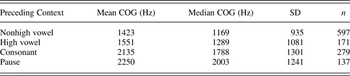
Finally, a handful of independent variables measured the influence of frequency. A combined corpus of Mexican and Mexican-American Spanish was utilized to extract the frequency measurements: FRC, lexical frequency, bigram frequency, ratio frequency, and transitional probability. The combined corpus included the corpus from which the tokens in this study were taken (Brown, Reference Brown2012) as well as the Mexico City portion of the Habla Culta corpus (Lope Blanch, Reference Lope Blanch1971), the Habla Popular of Mexico City (Lope Blanch, Reference Lope Blanch1976), a corpus of Spanish in the Southwestern United States (Lope Blanch, Reference Lope Blanch1990), and a handful of interviews of spontaneous speech recorded in Irapuato, Guanajuato, by Jeffrey Turley of Brigham Young University in the early 2000s, as well as 11 interviews of the corpus El habla de Monterrey (Mexico) (Rodriguez Alfano, Reference Rodriguez Alfano2005). The number of words in this combined corpus is 592,195. With lexical frequency, rather than enter the raw frequency into the statistical models described here, the logarithmic numbers were entered to mitigate the huge disparity between the highest-frequency words and all others (cf. Gries, Reference Gries2013:254). This procedure is motivated by the Power Law of Practice, which proposes that “performance improves with practice but the amount of improvement decreases as a function of increasing practice or frequency” (Bybee, Reference Bybee2010:34, based on Anderson, Reference Anderson1982). Bigram frequency calculated the number of occurrences of the preceding word and the word with /f/. Ratio frequency was calculated by dividing bigram frequency by lexical frequency. This variable analyzes how often a word with /f/ occurs in a bigram in comparison to all occurrences of the word with /f/. Similarly, the transitional probability was calculated by dividing the bigram frequency by the lexical frequency of the preceding word. This measurement controls for the predictability of the word with /f/ given the preceding word (cf. Jurafsky et al., Reference Jurafsky, Bell, Gregory, Raymond, Bybee and Hopper2001, and Raymond, Dautricourt, & Hume, Reference Raymond, Dautricourt and Hume2006, for discussion of measures of word predictabilities). In order to calculate the FRC, all instances of each word type with /f/ in our data were searched for in the combined frequency corpus and then, based on the orthography in the transcripts, it was determined how often each word type was preceded by a nonhigh vowel in comparison to other sounds and pauses. This process placed each word type on a scale between .0 (or 0%) and 1.0 (or 100%), with FRC values near .0 identifying word types that rarely occur after a nonhigh vowel and FRC values near 1.0 indicating word types that frequently occur after this sound. In our data, preceding nonhigh vowels occur with the lowest mean center of gravity of /f/, as seen in Table 1. Consequently, preceding nonhigh vowels represent the phonological context most favorable to reduction of /f/ in these data. As noted, Brown and Raymond (Reference Brown and Raymond2012) also considered preceding nonhigh vowels as conducive to /f/ reduction in their study.
Distribution of COG of /f/ in Hertz by preceding phonological context

Furthermore, two interaction variables were entered into the mixed-effects linear regression model reported, one between FRC and the immediate preceding phonological context, and another between lexical frequency and the age of the speakers.Footnote 6 As we previously mentioned, because FRC is based on the accumulated exposure to the immediate preceding phonological context, for FRC to have the possibility of exerting a significant influence on the articulation of word-initial /f/, the preceding phonological context must itself exert a significant effect. Concerning lexical frequency and age, Hay and colleagues (Hay, Pierrehumbert, Walker, & LaShell, Reference Hay, Pierrehumbert, Walker and LaShell2015; Hay & Foulkes, Reference Hay and Foulkes2016) recently found a significant interaction between these factors with two different phonetic variables in New Zealand English. For example, Hay and Foulkes (Reference Hay and Foulkes2016) reported that younger speakers produce innovative articulations in frequent words at higher rates than older speakers do.
RESULTS
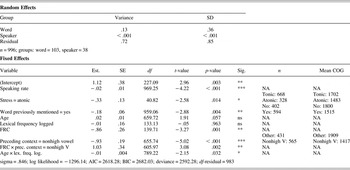
The results of the mixed-effects linear regression show that seven fixed-effects independent variables were selected as making a significant contribution to the prediction of COG of /f/ (Table 2).
Mixed-effects linear regression with varying intercepts of COG of /s/

Note: *p < .05; **p < .01; ***p < .001.
AIC, Akaike information criterion; BIC, Bayesian information criterion; freq, frequency; lex, lexical; log, logged; NA, not applicable; ns, not significant; prec., preceding; Sig, significance; V, vowel.
As seen in Table 2, FRC as a main effect was selected as making a significant contribution to the prediction of COG of /f/ in these data. More importantly, the interaction term between FRC and the preceding context was also selected as significant. Furthermore, it should be noted that the significant p-value for FRC as a main effect is only present when the reference level of the preceding context is specified as a sound other than a nonhigh vowel, as is the case in the model presented in Table 2. Differently, when the reference level for the preceding context is set to nonhigh vowels, FRC is not selected as significant. The fact that the p-value of FRC as a main effect varies as a function of the reference level of the preceding context is further evidence, in addition to the significant interaction term, of a significant interaction between FRC and preceding context. In addition to FRC as a main effect and the interaction between FRC and preceding context, the preceding context as a main effect also significantly conditions COG. The COG of /f/ is lower when this sound is preceded by a nonhigh vowel than when preceded by other sounds. Speaking rate also significantly conditions /f/ in these data, such that as speaking rate increases, COG decreases. The prosodic stress of the syllable in which /f/ occurs has a significant effect as well, as /f/ has a lower COG in atonic syllables than in tonic ones. The results show that /f/ in words that had been previously mentioned in the interview had a lower COG than /f/ in newly introduced words. Finally, the interaction term between age and lexical frequency proved significant, with the COG of speakers between the ages of 30 and 39 least affected by lexical frequency and the COG of speakers between the ages of 40 and 54 most affected by lexical frequency, while the COG of speakers between the ages of 20 and 29 fall in an intermediary position. These results do not provide the clarity that Hay and Foulkes (Reference Hay and Foulkes2016) found in their analysis of medial /t/ in New Zealand English, and as such, future studies are needed to elucidate the interaction between lexical frequency and age of speaker.
The independent variables not selected as significant in the mixed-effects model were the lexical frequency of the word in which /f/ occurred as a main effect,Footnote 7 the bigram frequency, the ratio frequency, as well as the transitional probability of the two-word string in which /f/ occurred. Furthermore, the following phonological context, the sex and educational attainment of the speaker, as well as the age of the speaker as a main effect also were not selected by the model as significantly predicting COG of /f/ in these data.
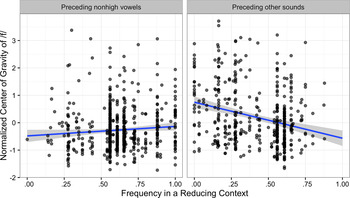
To elucidate the significant interaction between FRC and the preceding context, the data were subset by preceding context and two scatterplots were created; see Figure 1.
Normalized COG of /f/ as a function of FRC, grouped by preceding context.

The plot on the left-hand side of the figure displays the normalized COG values of /f/ when this sound is preceded by nonhigh vowels, while the plot on the right-hand side presents /f/ preceded by sounds other than nonhigh vowels. The significant interaction between FRC and preceding context is visually apparent in several ways. To begin with, the tokens in the left-hand plot are positioned, in general, more toward the right than are the tokens in the right-hand plot. That is, tokens of /f/ preceded by nonhigh vowels occur in words with, on average, higher FRC values (mean FRC = .62, SD = .19) than do tokens of /f/ preceded by other sounds (mean FRC = .41, SD = .22). The interaction between FRC and the preceding context is also apparent in the slope of the regression line in each plot. The regression line in the left-hand plot is slightly upwardly sloped, while the line in the right-hand plot is downwardly sloped. Furthermore, and importantly, the regression line in the left-hand plot is flatter than that in the right-hand plot, so much so that a horizontal line could be drawn completely within the 95% confidence interval, represented by the gray band around the line, of the first plot. Differently, a line could not be drawn completely within the confidence interval band of the line in the second plot. This is prima facie evidence that the line in the left-hand plot is not significantly sloped while the line in the right-hand plot is significantly sloped.
In summary, the results of the mixed-effects linear regression indicate a significant main effect for the preceding context and FRC, as well as for other variables, including speaking rate, prosodic stress, whether the word with /f/ was previously mentioned in the interview, and the interaction term between speaker age and lexical frequency. Possibly most importantly, the mixed-effects model finds a significant interaction between FRC and preceding context. Figure 1 elucidates this interaction and suggests that FRC exerts a significant influence on the reduction of the COG of /f/ only when it is preceded by sounds other than nonhigh vowels, that is, only in the nonfavorable environment.
DISCUSSION
The results of this paper concur on several counts with previous studies of /f/ in Modern Spanish by showing that the reduction of this consonant, as measured by COG, is conditioned by both internal and external factors. However, there are also some important differences that highlight key shortcomings of the prior studies, as well as of diachronic treatments of Latin /f/. Specifically concerning the social factors we examined, only age had a significant effect in the mixed-effects multifactorial model, and only within the interaction with lexical frequency. However, when viewed independently, the effect of age in our data concurs with what Resnick (Reference Resnick1975:98–106) reported in certain parts of Mexico and Costa Rica, that is, that reduced forms of /f/ are more common in the speech of older speakers, the opposite of a change in progress.
The most prevalent social factor in prior accounts of Modern Spanish /f/ is socioeconomic status. Several authors assert that robust articulation (i.e., labiodental [f]) is typical of higher-class, more cultured speech, while more reduced articulations (e.g., bilabial [ɸ] and aspirated [h]) are more characteristic of lower-class, less cultured speech (e.g., Alvar, Reference Alvar and Alvar2013:201; Canfield, Reference Canfield1981:11; Quesada Pacheco, Reference Quesada Pacheco and Alvar2013:103; Resnick, Reference Resnick1975:98–107). These correlations were not born out in our results for educational attainment: though speakers with less education did trend toward lower COG of /f/ than speakers with more education, the difference was not significant in the multifactorial mixed-effects model. Neither were the correlations supported by our results for sex. Given the proposed association between /f/ reduction and socioeconomic status, we might expect women to deliberately avoid reduced forms of /f/ because they are stigmatized, as it is well known that women tend to use socially stigmatized variants in their speech less often than men (cf. Labov, Reference Labov2001:266–293). COG of /f/ was lower among male speakers than among females, which is to be expected given the fact that, generally, men have longer vocal folds than women do. However, when COG was normalized by speaker, a process described in the Data and Methods section, there was no difference among the sexes.
Two phonological factors contributed to the reduction of /f/ in our data. While not mentioned in previous accounts of Modern Spanish /f/, prosodic stress proved significant here, as seen in Table 2. Our finding that the COG of /f/ is significantly lower in atonic syllables than in tonic ones does correspond with Brown and Raymond's (Reference Brown and Raymond2012:153) finding for the development of Latin /f/; that is, Latin /f/ is more likely to be absent from Modern Spanish words when it occurred in an unstressed syllable than when it occurred in a stressed one.
The other phonological factor that was significant is preceding context. It is noteworthy that this variable had the largest magnitude of effect on the COG of /f/ in our data, given that it is absent from most prior accounts of Modern Spanish /f/. On the other hand, following context, a variable for which previous authors consistently claim an effect on the reduction of /f/, is not significant in our data. Interestingly, our results again coincide in this respect with those of Brown and Raymond (Reference Brown and Raymond2012), who found no effect for following context on the development of /f/ diachronically.
The reason most previous studies of word-initial sounds analyze the following phonological context but not the preceding one may be that the preceding context varies according to where a word happens to be used and is thus deemed less influential than the following context, which does not change. Our finding that the immediate preceding phonological context conditions the reduction of /f/ concurs with previous studies on the effect of alternating environments (e.g., Bybee, Reference Bybee, Broe and Pierrehumbert2000, Reference Bybee2002) and reveals that prior accounts of initial /f/, both synchronic and diachronic (excluding Brown & Raymond, Reference Brown and Raymond2012), fail to identify the phonological environment most conducive to reduction (i.e., preceding nonhigh vowel). This deficiency has likely prevented previous researchers from finding a key pattern in the distribution of reduced forms of Modern Spanish /f/ and may account for the inability of previous diachronic studies to adequately explain the variable outcome of Latin FV- words in Modern Spanish.
Two other factors we examined that are related to articulation and the attention given to speech are previous mention and rate of speech. Our examination of previous mention is novel among studies of Modern Spanish /f/. Our finding that /f/ has a lower COG in words that had previously been mentioned in the interview than in those that were mentioned for the first time suggests that a priming effect contributes to reduction in that a previously mentioned word, and therefore an activated word, is prone to more reduction. In general terms, previous mention can affect fluency of articulation as follows: As words or phrases are repeated within a relatively short stretch of discourse, the speaker becomes more fluent in accessing and articulating them, resulting in the speeding up of neuromotor processes during production (cf. Bybee, Reference Bybee2001:15). This result concurs with a priming effect found with medial /t/ reduction in New Zealand English (Hay & Foulkes, Reference Hay and Foulkes2016). Regarding speech rate, our finding that increased rate of speech results in lower COG corroborates prior indications that the distribution of the variants of /f/ correlates with care given to speech (e.g., Canfield, Reference Canfield1981:11) and helps to substantiate Merz's (Reference Merz1979:114) cursory observations about the effect of speech rate on /f/ aspiration specifically.
The current study is the first, to our knowledge, to examine frequency effects on the reduction of Modern Spanish /f/, and our inclusion of four frequency measures―lexical frequency, bigram frequency, ratio frequency, and FRC―is very informative. Of these four, FRC and lexical frequency are significant, corroborating the findings of previous studies of the reduction of another voiceless fricative, namely, /s/ (e.g., Brown, Reference Brown2004, Reference Brown2006; Raymond & Brown, Reference Raymond, Brown, Gries and Divjak2012). This result supports Brown and Raymond's (Reference Brown and Raymond2012) finding that FRC produced a significant effect on the development of Latin /f/. However, contrary to their results, we find that lexical frequency also had a significant effect. Moreover, unlike in their study, both FRC and lexical frequency in our data exert a significant effect only in interaction terms, FRC with preceding context and lexical frequency with age of speaker. This fact does not allow us to directly compare the effect sizes of these two variables, and therefore we cannot make any claims about one being a “more precise predictor” (Brown & Raymond, Reference Brown and Raymond2012:156) than the other. Despite this, our results, like theirs, provide evidence that words that occur frequently in phonological contexts favorable to reduction within running speech are more likely to be reduced, even when they appear outside of those contexts. As such, this paper supports the idea that the manner in which language is used in spontaneous speech affects the mental storage of language, that is, its grammar (cf. Bybee, Reference Bybee2006:730).
Despite exerting a significant effect on the COG of /f/ in these data, FRC is not as influential as the immediately preceding phonological context. The true nature of the effect of FRC is seen only when we take into account the preceding context, that is, as FRC interacts with this variable. Differently, the effect of preceding context is seen both as a main effect as well as in the interaction term with FRC. Thus, while there is now ample support (e.g., Brown, Reference Brown2005; Brown, Reference Brown2009; File-Muriel, Reference File-Muriel2009; Hooper, Reference Hooper and Christie1976; Minnick Fox, Reference Minnick Fox2006, among many others) for the conditioning effect of usage-based factors on phonetic and phonological reduction (including the results presented here), the influence of online articulatory factors must not be discredited. In fact, the strong effect of preceding phonological context is actually crucial to a case for an effect of FRC, as we have already mentioned. If we are to suppose that FRC represents a cumulative effect of phonological context, then it stands to reason that phonological context must produce a significant effect to begin with. In other words, the preceding phonological context must first condition a weakening of /f/ in a significant way before the effects of this conditioning environment can be registered and accumulated in memory over time, potentially making FRC a significant predictor of /f/ reduction.
In answer to the question about whether the influence of FRC could potentially overtake the influence of the variable upon which it is based, that is, the preceding phonological context, the results fail to confirm this possibility. In these data, the accumulated exposure to the phonological contexts in which a word with /f/ is most used is not as strong as the influence of the phonological context in which a word happens to be used in the moment.
The fact that preceding phonological context was so important in our data indicates that the reduction of /f/ in Modern Spanish is indeed an instance of weakening with a major (if not primary) articulatory motivation, as Méndez Dosuna (Reference Méndez Dosuna, Hurch and Rhodes1996:99) asserted. The mechanisms by which FRC is less influential—or has a smaller magnitude of effect—than the immediate phonological context might be explained as follows. Whenever an /f/ word is produced in speech, the immediate phonological context has a direct articulatory effect on its realization: words occurring in a context favorable to reduction are more reduced than those occurring in contexts that do not favor reduction. Over time, words that occur frequently in contexts favoring reduction have more reduced forms in the mental representation than those that occur less frequently in such contexts—this is the effect of FRC. However, online articulatory processes continue to be in effect with future use: when those more-reduced forms are subsequently accessed in memory for speech, the immediate phonological context can either further reduce them or not, depending on whether this context favors reduction (cf. Pierrehumbert, Reference Pierrehumbert, Bybee and Hopper2001, on the production-perception loop). Consequently, any prior reduction caused by FRC seems to be diminished in the reducing context. In sum, the effect of FRC is simply more visible when the immediate phonological context does not contribute to further reduction of /f/.
As we have stated, it has not been the intent of this paper to determine whether or not Spanish is experiencing a reprise of the sound change that variably reduced Latin /f/ to /h/, and eventually Ø, in Spanish. Indeed, it might be that rather than a change in progress, the results are indicative of stable variation or, perhaps, the “seeds” of change (Hombert, Ohala, & Ewan, Reference Hombert, Ohala and Ewan1979). However, assuming that we have a change rather than stable variation, the results of this paper do suggest that a reprise could be underway. That is, albeit in a nascent stage, we see phonetic reduction of /f/ significantly more often in some words than in others and, more importantly, the variables that are reported to have contributed to the reduction of Latin /f/ to /h/ (cf. Brown & Raymond, Reference Brown and Raymond2012) are among those that make significant contributions to the reduction of /f/ in our data. Nevertheless, we should be cautious in assuming that this sound change will run its course to completion, as happened with Latin /f/ in many words. Indeed, it may be the case that /f/ eventually erodes to Ø, probably passing through [ɸ] and [h] along the way. However, two confounding factors in this process might be the higher rate of literacy today as well as the more widespread availability of written material, whether in printed or digital format. The fact that the orthographic < f > representing the sound /f/ is more accessible to speakers of Modern Spanish than was the orthographic < f > in late Latin and early Romance may inhibit, or even halt, the sound change from running its course. It is likely that speakers of Modern Spanish are more influenced by orthography in general than were speakers of late Latin and early Romance. It may turn out to be the case that a situation of complementary distribution is created in the future, in which [h] is used after nonhigh vowels (e.g., ella se [h]ue ‘she left’) while [f] is present after other sounds and after a pause (e.g. ella sí [f]ue ‘yes, she did leave’). In the end, only future longitudinal studies will be able to definitively determine the eventual fate of /f/ in Modern Spanish.