Introduction
A memento labelled ‘Curiosity file’ lies among the papers of Sir Walter Lawrence, private secretary to the viceroy Lord Curzon and the official coordinator of the Prince of Wales's tour of India in 1905 and 1906. Several dozen petitions, poems, and addresses offer a glimpse of what some of the prince's Indian subjects hoped to gain from his visit. One petitioner, who referred to himself as ‘John Samuel, walking round the world’, provided a brief life history in order to explain his request. After the death of his father, he became determined to make a name for himself. He soon realized, however, that ‘without money I cannot be a famous man or I cannot do anything in this world’. Originally hoping to seek his fortune in Calcutta by joining a ship's crew, John hatched a new plan on arrival there. He reported that he became determined to find fame ‘by wandering every country & forest & desert’, eventually travelling to England ‘via Persia—Tribizond—Caucasus Mountain—Austria—Paris’. Cleary a man of great determination, he asked the prince for a favour to smooth his journey: ‘one chit of paper from your Highness to satisfy to England Gentlemen after my arrival’.Footnote 1
John was not alone in pinning his hopes on securing the prince's intercession. V. W. Scindia, the third son of a pensioned tahsildar of the Mysore State Service, also sent a petition to the prince along with a printed marriage advertisement under the banner: ‘Look here! Look sharp!! Golden opportunity to virgin ladies desirous of getting married!!!’ Scindia hoped that the Prince would step in as matchmaker, ‘to do me the needful’, since ‘not even a single individual in India has taken up my case’. Lest the prince get the false impression that Scindia was willing to lower his standards to secure a bride, he also asked him to ensure that ‘no due encouragement is given to Non-Brahmins, especially to Mahrattas and Rajputs in general, who are found to be in a degenerating state’.Footnote 2
Like John and V. W. Scindia, subjects of the Raj, from impoverished orphans to princely scions, petitioned individuals at the highest echelons of colonial government asking for them to intervene on their behalf. Their petitions invoked what this article terms ‘patriarchal notions of governance’, which were hierarchical, personalized, and often intimate in nature. Their authors almost always addressed specific colonial officials (overwhelmingly male, with the exception of the queen herself), rather than more abstract embodiments of the state, such as departments. They also often appealed to intimate, and in many cases, gendered notions of dependency, turning to colonial officials to provide support—for help in making a start in life to arranging a marriage, which familial relations might normally provide. While the Raj period is often associated with the increasing bureaucratization of the colonial state, this article locates critical insights into the conflicting impulses of late-imperial governance in this genre of petitions, referred to here as personal pleas. By focusing on petitions that flowed into and out of the port city of Bombay, the article also situates the genre within wider patterns of British imperialism in the Indian Ocean region, including indirect rule.
Laced with stylized idioms of address, the colonial genre of personal pleas in some respects echoed patterns of petitioning extending back to early modern South Asia. As scholarship on older traditions of petitioning have noted, this practice was entangled in wider patterns of patrimonial-bureaucratic statecraft, in which rulers related to their subject through reciprocal bonds of supplication and support.Footnote 3 Appeals to the ruler-cum-patriarch in colonial petitions was thus reminiscent of the Mughal custom of holding special sessions in the imperial harem to receive petitions from women, widows, and orphans.Footnote 4 Similarly, the common practice in colonial petitions of offering prayers on behalf of the recipients reinforced continuities between petitioning and devotional supplication, which were also central to early modern petitioning cultures.Footnote 5
While acknowledging such continuities with the early modern period, scholarship on petitioning in colonial India has emphasized how the genre adapted to the needs of colonial state formation and new Indian publics. Bhavani Raman has argued that the East India Company in South India transformed petitioning into ‘a primary mode of effecting and negotiating sedentarization and pacification’.Footnote 6 In this special issue she and Robert Travers delve more deeply into these processes by showing how the early colonial regulation of petitioning contributed to the ‘judicialization’ of politics by making legal forums the only legitimate means through which to seek redress. Other scholars, particularly those focused on the later period of colonial rule, have examined petitioning from the perspective of their Indian authors, focusing on their role in forging new publics and political collectives. Majid Siddiqi, one of the first scholars to draw attention to petitioning in South Asia, was primarily interested in its role in ‘the emergence of both early nationalism and the nascent nation-state’.Footnote 7 Douglas Haynes, in his study of the evolving public culture of Surat, has shown how colonial petitioning allowed urban notables and new elites to position themselves as spokesmen for different communal, urban, and national publics.Footnote 8 In this special issue Prashant Kidambi elaborates on these themes by looking at how petitioning by groups, from urban merchants to factory workers, mobilized new publics in colonial Bombay.
This article extends these insights into the Raj period by showing how the hierarchical and intimate dimensions of personal petitioning had particular affinities with shifts in colonial governance which followed in the wake of the Rebellion of 1857. While carrying over the practice of receiving petitions from the Company, the Raj's embrace of the personal plea complemented the realignment of imperial strategies away from liberal projects of reform towards structures of authority rooted in ideas of colonial difference.Footnote 9 Both in India and in Britain's expanding network of Indian Ocean protectorates, this shift increased reliance on indirect forms of colonial rule, which left native rulers in place but under the supervision of British officials.Footnote 10 Notions of imperial paternalism underpinned these arrangements, as Britain claimed to offer guardianship and tutelage to its supposedly more primitive protectorates. Through arrangements that Sumit Guha has evocatively compared to a ‘gigantic crèche’, the Raj repurposed liberal notions of the pedagogical functions of empire into a more conservative project of overseeing the political, and familial, lives of native elites.Footnote 11 Further accentuating the paternalistic dimension of these relations, British officials supervised the education of the children of native elites and the selection of their marriage partners and successors through institutions such as the Court of Wards.Footnote 12 Petitioning fitted comfortably into these idioms of imperial guardianship with its intimate, hierarchical terms of address and its appeal to the discretionary authority that officials enjoyed in supervising princely and native elites.Footnote 13
What is striking about the Bombay petitions, however, is the extent to which these ideas seeped out of the distinct spaces of indirect rule and elite social circles. The article begins with a series of petitions submitted by Nazli Raffiya, the former wife of the nawab of Janjira, who, after separating from her husband, relocated to Bombay, where she was friends with some of the city's most prominent political and legal luminaries. The next section turns to Bombay's more subaltern subjects, looking at how some of the city's most impoverished residents petitioned higher officials. In both contexts personal petitions adeptly braided different, and potentially conflicting, idioms of Raj governance, from stylized imitations of courtly etiquette to bureaucratized paperwork. Yet, despite creatively intermingling these different idioms, personal pleas were overwhelmingly rejected, often with reference to a standardized list of petition rules. These repeated rejections beg the question of why the practice continued, despite the rarity with which it resulted in concrete government action.
A disappointment to their authors, the petitions also troubled their recipients. Rather than viewing petitioning as a successful strategy of pacification, British observers described the practice with a mixture of humour and anxiety. Mocking the awkward hybrids that the genre inspired, a book titled Baboo English noted: ‘Naturally in the process of translation the sentiments of the customer are curiously presented, and as often as not the petition furnishes material for merriment in the family circle of its recipient.’Footnote 14 Making fun of petitioners, however, may have been a way of deflecting uneasiness about the subversive undertones lurking beneath the genre's outward servility.Footnote 15 While many of the petitions in the article were filed in the Judicial Department of the Bombay Government, they refused the ‘judicializing’ logic which Raman and Travers have identified in their contributions to this special issue.Footnote 16 Personal pleas emphasized needs over legal rights, as their authors turned to petitioning because they viewed the courts as too costly or cumbersome. The petitions were also at odds with the distancing logic which animated many facets of colonial bureaucracy, whether censuses or legal codes.Footnote 17 Summarizing the purpose of such forms, Douglas Haynes has written: ‘. . . the civil servant was to act as an impersonal agent of a distant government whose authority derived less from his personal qualities and his ability to dispense favours than from the office he occupied and the principles of British rule which he supposedly applied with an even hand’.Footnote 18 The petition as personal plea flagrantly defied this ideal; it drew rulers into the intimate lives of their subjects and located justice in the application of sentiment and discretion rather than rule-bound procedures. Reflecting this discomfort, the House of Commons issued a special report in 1904 which recommended reigning in petitioning in order ‘to save them [the petitioners] unnecessary expenditure, as well as disappointment, when their Petitions bring them no redress’.Footnote 19 The report's recommendations did little to stem the tide of petitions. Yet while personal pleas unsettled the Raj's bureaucratic logic, they never coalesced into the collective protests discussed in Kidambi's article in this special issue.
Rather than trying to explain away this apparent fruitlessness, this article embraces it and provides different insights into the work done by petitioning. Historians of the state, and of popular politics generally, analyse documentary practices in terms of their functional roles in strengthening state institutions, securing material benefits from the state, or resisting its power—themes echoed in South Asia. In contrast, both the authors and recipients of personal pleas seemed to patronize the practice because it satisfied deeper, less clearly functional, urges. The petitions resonate with new scholarship on the emotive, at times unconscious, processes at work in sustaining documentary practices. Ann Stoler has urged scholars to read colonial archives through ‘the febrile movements of persons off balance—of thoughts and feelings in and out of place’, and Ben Kafka has drawn attention to the ‘psychic life of paperwork’.Footnote 20 Read through these alternative rubrics, the play of contradictions that proliferated in the bureaucratized receipt of personal pleas—of intimacy and distance, discretion and routinization—reflects larger tensions which plagued the lived experiences of governance under the Raj. Writing petitions allowed the inhabitants of a teeming port city like Bombay, who were often separated from their own extended families, to imagine an intimate bond with an imperial guardian. Reading petitions allowed British officials to indulge in the fantasy of acting as saviours to their colonial subjects.Footnote 21 In the routinized process of rejection, these failed fantasies intermingled with the everyday frustrations of empire—of imperial paternalism subordinated to budgetary parsimony and of the rule of law bent to accommodate strategic interests.
Petitions from a begam in Bombay: the Raj as patriarch (or matriarch)
While many studies of colonial governance focus on Calcutta, the official capital of British India, Bombay provides an alternative perspective as the economic, cultural, and political hub of Britain's sprawling arenas of Indian Ocean influence.Footnote 22 As a trading port, Bombay churned with centuries-old circuits of Indian Ocean mobility, accelerated to a dizzying pace by steam travel and the centripetal pull of British integration. These old and new mobilities echoed through the cacophony of voices which poured out of the mouldering towers of petitions that piled up in the offices of the Bombay government—from Indian Ocean seamen, pilgrims en route to hajj, rural migrants working in cotton mills, and the myriad entrepreneurs who profited off this ceaseless flow of humanity—from bookies to street performers. Further adding to this mix, some of the more refined petitions preserved within this motley collection stemmed from Bombay's role in supervising a vast array of different spheres of indirect rule. Upwards of 361 different princely states, over half of the total number in India, fell under the jurisdiction of the Bombay presidency, with some states covering as little as a few square miles.Footnote 23 And as if this bureaucratic muddle was not complicated enough, the government of Bombay also supervised British residencies in the protectorates of Zanzibar and Aden, linking Bombay to Britain's wider spheres of Indian Ocean influence.Footnote 24
Many of these different facets of Bombay came together in the life story and petitioning battles of Nazli Raffiya. In 1925 Nazli began what eventually stretched into a decades-long process of petitioning for recognition of her status as the dowager begam of the princely state of Janjira. Located 40 miles south of Bombay, and stretching inland from an offshore island fortress, Janjira provides an ideal vista from which to survey the shifting tides of sovereign power that ebbed and flowed across Britain's Bombay-centred imperial geographies. From the seventeenth century onwards, Janjira was ruled by a dynasty of Siddis, a term used to describe African groups that had migrated to the subcontinent during the early modern period. In the fifteenth and sixteenth centuries, Africans extended control over key areas along the coast of western India. Cementing this trend, Malik Ambar, an African slave turned mercenary general, became the de facto ruler of the Ahmadnagar sultanate in 1608 and installed a fellow Siddi as commander of the island of Janjira. Within a few years a Siddi ruling elite gained independent control over the island and adjoining coastal regions, holding off Maratha incursions. With the rise of British suzerainty, Janjira became a protectorate in 1834 and a princely state in 1879.Footnote 25
In 1887 Nazli Raffiya, then 13 years old, married into the Janjira dynasty. She belonged to a prominent, urbane Bombay family, the Fyzee-Tyabjis. Her maternal great uncle, Badruddin Tyabji, was the first Indian admitted to the bar, a leading High Court justice, and president of the Indian National Congress. The family prided itself on its liberal values, including allowing its female members to appear in public unveiled. As members of Bombay's new professional elite, the Fyzee-Tyabjis also seemed to value the prestige associated with marrying into a princely family.Footnote 26 Nazli, however, would later describe her marriage as an act of charity towards the Janjira state, which the family agreed to out of loyalty to the government of Bombay, which facilitated the match. As she explained in one of her many petitions: ‘I was chosen because of my blue blood and good family, and also being the most cultured girl at that time. Janjra was the most primitive and backward State, I was to help in making a progressive Principality, so that it could cause no trouble to the British Government.’Footnote 27 As well as their different class backgrounds, the couple was also divided by sectarian affiliation: the Fyzee-Tyabjis were Shia Ismailis, the Janjira dynasty was Sunni, a central issue in the legal debates which emerged around their divorce.
During the decades that Nazli spent at the Janjira court, these differences troubled the marriage. She believed that her role was to enlighten her husband and his subjects. The nawab and his inner circle were more concerned about Nazli's in ability to produce a male heir. When, after nearly three decades of marriage without offspring, they pressed on her the need to produce an heir, Nazli dismissed the recommendation as an ‘insane monstrous suggestion’. She was even more furious when the nawab contracted a second marriage with a younger woman whom Nazli dismissed as ‘an outside maidservant’. Rattled by the shock, which she claimed ‘nearly killed’ her, Nazli embarked on a two-year trip to America, stopping in China and Japan. In 1920 she returned not to Janjira, but to Bombay, where she set up her own house. For several years Nazli enjoyed the best of both worlds—the prestige of being associated with a princely family and the pleasure of being back among her friends and family in Bombay.Footnote 28
After the nawab’s death in 1922 this compromise unravelled. Nazli first began to suspect that something was amiss in 1924 when she was refused an interview with the governor of Bombay and his wife. Her fears were confirmed when Janjira declined to pay for the cost of maintaining a state guard at her home in Bombay.Footnote 29 Nazli then turned for help to her friend Cornelia Sorabji, the first woman (either Indian or English) to be admitted to the British bar and the ‘Lady Assistant’ to the Court of Wards, which managed the affairs of princely states and zamindari estates which lacked a mature, male heir.Footnote 30 Sorabji was a formidable ally. She combined legal expertise with experience navigating the alternative institutions that the Raj used to extend imperial guardianship over elite Indian families. Under Sorabji's influence, Nazli combined both idioms—defending her claims in court and through petitions, which insisted that officials bore a paternal responsibility for her well-being.
On inquiring about Nazli's situation, Sorabji was informed that the late nawab had divorced Nazli before his death. When Nazli and Sorabji challenged the divorce, they were told that Nazli must press her case in the Janjira courts. Sorabji travelled on her behalf to Janjira, which she compared to a ‘pirate's fortress’. (She gamely informed her male co-counsel that if anyone troubled them en route, she could fight them off with her umbrella!Footnote 31) In the legal realm, Sorabji's main tactic was to insist that a Muslim divorce was governed by the laws pertaining to the wife's, rather than the husband's, sect. While Sunni jurists only required three witnesses to be present when the husband pronounced a divorce, Shia jurists required a husband to directly inform his wife, a condition that Nazli insisted had not been met. After several appeals, the Janjira High Court upheld the divorce in 1931. Nazli decried the trial as one ‘opposed to the British sense of justice’ and insisted that the new nawab and his mother had rigged the result.Footnote 32
When the law, or what Nazli believed was political caprice thinly cloaked in judicial procedure, failed her, she turned to petitioning to seek redress through idioms of imperial paternalism. Having lost the legal battle, she abandoned any hope of securing the material benefits associated with being recognized as the late nawab’s widow but fought on for permission to use the title of begam—a matter of honour to which she was fiercely attached. Nazli marshalled all of her accumulated social capital to press for this concession, including drawing on her friendships with the wives of key government officials. While these affective connections opened doors for Nazli, they ultimately proved fruitless in securing her ultimate goal. After the viceroy was warned that granting her request might lead to tensions with Janjira, his wife wrote to Nazli saying that she could only offer her ‘love and intense sympathy’.Footnote 33
When her social links to British administrators failed, Nazli marshalled her family's wider networks. In the process she introduced a third idiom of colonial politics to her efforts: the communal public. She enlisted elite Muslims to lobby on her behalf; they argued that her treatment by Janjira and colonial officials was not just a personal insult to Nazli, but an affront to the entire Muslim community. In the process she effectively wrapped her personal plea in the enabling cloak of a collective petition.Footnote 34 Deftly braiding these idioms with her earlier use of judicial language to defend her claim, she forwarded to government officials unofficial legal briefs on her case written by two of India's most esteemed Muslim barristers, Sir Mian Muhammad Shafi and Sir S. Sultan Ahmed.Footnote 35 She also convinced Shaukat Ali, a leader of the Khilafat Movement, and Muhammad Iqbal, the renowned poet and politician (and lawyer), to write on her behalf. The former described the divorce as an ‘infringement of Islamic law’ and warned that if the matter came before ‘the Public Press or on the public platform . . . public sympathy will be entirely with H. H. Nazli Begaum Saheba’.Footnote 36
For over two decades Nazli's own petitions, and the letters sent on her behalf by others, piled up in Bombay, Delhi, and London, where she travelled to press her case in person. While Nazli shifted between different strategies of pressing her claims, her disparate approaches were knitted together by a common insistence that British officials bore a particular, gendered obligation to protect Indian women. In her own case, she argued that this duty sprung from the responsibility that officials had assumed by intervening to arrange her marriage—in effect taking her on, in Nazli's words, as ‘their ward’.Footnote 37 Yet while Nazli framed her own claims in terms of imperial guardianship over princely families, she also generalized these obligations to embrace Indian women more widely. She complained: ‘May God alone have mercy on we unprotected women; our men are bad enough, but when there is no just treatment from the governing powers, one begins to feel that the world is Godless.’Footnote 38 Nazli's comments referenced gendered projects of social reform, such as the abolition of sati, which, while scaled back after 1857, continued to circulate during the Raj through diffuse ideologies of what Mitra Sharafi has referred to as ‘chivalric imperialism’ through which British officials imagined themselves as saviours to Indian women.Footnote 39
When appeals to paternalism and imperial chivalry fell on deaf ears, Nazli switched the gendering of her idioms—substituting ideas of maternal obligation and sisterly solidarity—to address Queen Mary herself. She complained that the government of Bombay had ‘taken the fullest advantage of my position’ as ‘an unprotected woman’. Nazli therefore explained that she was ‘appealing to Your Imperial Majesty as one woman to another’ and expressed confidence that ‘it is not possible that your Imperial Majesty will not feel the deliberate injustice that the Bombay Political Department has forced down on me just because I happen to be a woman’.Footnote 40
Nazli's marathon petitioning efforts are impressive in the variety of strategies that she deployed, from judicial suits to social influence, and the mixture of different imperial ideologies she appealed to, from communal publics to imperial chivalry. Yet, ultimately, her petitions resulted, like so many other personal pleas, in little more than bureaucratic paper pushing. The private secretary to the queen merely forwarded her petition to the Government of India, where officials noted that the document included ‘highly objectionable language’, one of the grounds on which petitions could be rejected under the official petition rules.Footnote 41 More sympathetic officials attempted to pull strings behind the scenes but backed off at the first hint of political risk. After the new nawab and his mother made it clear that they were opposed to Nazli using the title of begam, the leading official in charge of the Deccan States recommended dropping the matter.Footnote 42 As Nazli's efforts became increasingly desperate, she was shut out from the networks of informal influence that she had once enjoyed. By 1945 the wife of the viceroy was counselled to avoid meeting with Nazli since officials believed that her seemly benign request to discuss the condition of women in the princely states might be a cover for another attempt to press her case.Footnote 43
Nazli spent decades of her life caught up in an ultimately fruitless process of petitioning. Despite her unusual degree of social privilege, her experience was far from unique. Like Nazli, other residents of Bombay turned to petitioning as an alternative to legal redress because they had tried and failed in the courts or could not afford legal fees. While few shared the same degree of intimacy with colonial officials, they nonetheless insisted that the relationships of dependence that linked rulers and subjects gave rise to certain obligations, ties that were often described in familial terms. More ominously they suggested, like Nazli, that public censure might result if these duties were left unfulfilled, even as few of these unanswered personal pleas led to concrete political action.
Paupers’ petitions: empire's abandoned dependants
The mountains of petitions preserved in the provincial archives of the Bombay government describe a dizzying array of problems, from a sailor departing for Australia who could not locate his wife, to the grandmother of a dancing girl who feared that her granddaughter had been murdered while on tour in Britain.Footnote 44 In many cases abandoned by their own families, and leveraging what they felt was the moral power of their own desperation, the petitioners begged the imperial sovereign to step in. They showed how idioms of imperial guardianship, which the Raj cultivated with more elite families and in its spheres of indirect rule, seeped out of these groups and spaces. Flipping Raj paternalism on its head, these petitioners insisted that their lack of social and financial capital gave them a special claim to discretionary aid. With little to offer the Raj as strategic collaborators, however, their pleas were summarily rejected. As these petitions piled up in colonial offices, they became a troubling testament to the gap between the expectations of the Raj's subjects and its capacity and will to meet them.
Many of these petitions, like Nazli's, show evidence of the rubbing together, often awkwardly, of different geographies and ideologies of empire. From the complex interface between British and princely authority, to the murky networks of social connection that influenced supposedly impartial bureaucratic outcomes, petitioners looked for help navigating the disorderly landscapes of imperial power. Some petitioners asked the government to provide information, whether to locate missing relatives or for guidance in understanding complex legal regimes. A father wrote to the governor of Bombay for legal advice after his son was killed while working on a railway line on the border between the princely state of Kurundwad and the Bombay presidency. Although his son was killed on Kurundwad territory, the father wrote that, ‘it is rumoured that the state gave up its Powers (judicial etc) to Govt. on the Ry. Line’. The father therefore asked the governor to clarify whether he should sue for compensation for his son's death in the courts of Bombay or Kurundwad. Unfortunately for the father, officials did not want to get entangled in a contested legal question and therefore declined to give him an answer but instead suggested that he retain legal counsel.Footnote 45
Other petitioners wanted more sustained help, often when they had lost the support of their own families. The Bombay records included numerous petitions from widows, children, and parents asking for pensions after the death of a male provider who had served in the army, police, or other branches of the imperial bureaucracy. A more unusual request for support involved an orphaned dwarf who had travelled from Peshawar in hope of receiving public aid in India. In a petition addressed to the governor of Bombay, the man explained that, ‘he is not tall enough to do any work’ and ‘has no relatives in the world’. If the governor could not help him, the petitioner suggested as an alternative that he might ‘grant him a free pass from here to England where [he] will go and request the European gentlemen to be supplied with his request’. The man promised that, ‘Should I be so fortunate as to succeed in the matter I shall ever pray for your Excellency's long life and prosperity.’ A note attached to the petition indicated that officials were suspicious of the petition because it was written and signed in English, indicating a level of literacy that they found it difficult to believe the petitioner possessed. (Although many petitioners employed petition writers to compose their petitions in English, often with mixed degrees of fluency, they were expected to attest to the authenticity of the document by signing in an Indian vernacular language or applying their thumbprint.) The Bombay government instructed the police commissioner to investigate the veracity of the dwarf's story. Yet even after the police verified the details outlined in the petition, the government declined to support the man or fund his onward travels.Footnote 46
Such petitions were most likely to receive official consideration if they involved individuals who could claim a special relationship with the government. Some of these petitioners, like Nazli, fell into the category of native elites, illustrating the wider role of petitioning in the Raj's post-1857 strategy of cultivating native collaborators among ‘traditional’ authority figures. One such case involved a dispute between two brothers over the headship of a Sufi shrine. A note on the file suggests that ‘the Pir seems to be a person of consequence, perhaps his petition may be received & forwarded’.Footnote 47 The dependants of government employees were also more likely to receive a positive response.Footnote 48 A note on the file of a widow petitioning for financial support after her husband was murdered by a fellow police officer described her situation as ‘a very sad case’. While officials ultimately rejected her request for a formal pension because her husband was not killed in the line of duty, they recommended that special efforts be made to find government employment for her son.Footnote 49 Such responses indicate that individuals employed by the government were, like native elites, considered important bastions of support and therefore officials were sometimes willing to use discretionary powers to aid them.
In contrast, many of the people who petitioned the government of Bombay lacked any meaningful financial or social capital. As the sailor searching for his missing wife explained: ‘Your Petitioner being a poor helpless man cannot afford to make any solicitor or a Pleader’.Footnote 50 Similarly, a former employee of the Bombay Port Trust petitioned the Bombay Marine Department to intercede when he was dismissed on suspicion that he had siphoned off toll revenues. Accounting for his resort to petitioning to clear his name, the man explaining that: ‘. . . I am ashamed to own that I have been without employment since the date of dismissal. I am a poor family-man and had I sufficient means wherewith to proceed to law, I would have done so even at the risk of losing all’.Footnote 51 Other petitioners complained not of their inability to pursue legal redress, but rather of their incapacity to marshal the financial resources to bribe lower-level officials. As one woman explained: ‘I am a poor widow & old woman [with] none to take notice of my pitiable case having no money to bribe them’.Footnote 52
Such individuals hoped that their abject dependence would elicit the sympathy and support of the government. One woman wrote to the government after her only son, whom she described as her ‘protector in time of her old age’, was kidnapped by a troupe of dramatic performers and taken across the border into the princely state of Baroda. She suspected that her husband's prostitute-mistress was behind the plot and was using her son to gain control of her husband's estate after his death. The woman lamented that she was ‘forlorn and dejected . . . and unable to take any lawful steps to revenge the wrongs done to her in the eye of the law, owing to her being penniless as well as supportless’. She hoped that ‘. . . Your Excellency will, after deliberate consideration over the matter be graciously pleased to pass some kind of order by which she may be able to bring to light those men who have taken the [sic] advantage of her poverty to gratify their own evil ends’. In response, the woman was informed that although the courts were open to her, the government could not interfere.Footnote 53
A bureaucracy of rejection
Confronted with an avalanche of human needs, but constrained by a state without the desire or capacity to provide a safety net for its subjects, officials turned instead to managing the petitioning process. At the provincial, all-India, and imperial levels, departments regularly issued lists of petitioning rules which redirected petitioning subjects away from higher authorities and towards local offices and the courts. Officials also tried to manage the role of petition writers, who served as the intermediaries between the petitioning public and government bureaucracy. Given that Bhavani Raman has documented similar efforts during the Company period, what is striking in the context of the late nineteenth century, is the repeated failure of such regulation to accomplish its stated purposes. Despite the regular circulation of petitioning rules for decades, petitioners continued to bypass official hierarchies and to submit pleas that officials viewed as inappropriate. The colonial government's sustained efforts at regulating petitioning thus merely bureaucratized the process of rejection. Frustrating both rulers and subjects alike, this routinization of disappointment shows how petitioning became further entrenched through chronic dysfunction rather than bureaucratic efficacy.
The most substantial effort at managing the petitions process involved a set of rules that was periodically revised and reissued by various government departments. While issued under the auspices of different authorities, these rules resembled each other, including provisions for the summary rejection of petitions for reasons ranging from failure to first pursue redress through local or judicial authorities, to submitting petitions anonymously, to using language that was ‘unnecessarily prolix’ or ‘couched in exaggerated or disrespectful terms’.Footnote 54 Edited and recirculated repeatedly in the course of the nineteenth and twentieth centuries, officials and petitioners alike seem to have adapted to these bureaucratic regulations, although often in ways that did little to reduce the flow of personal pleas to upper-level officials.
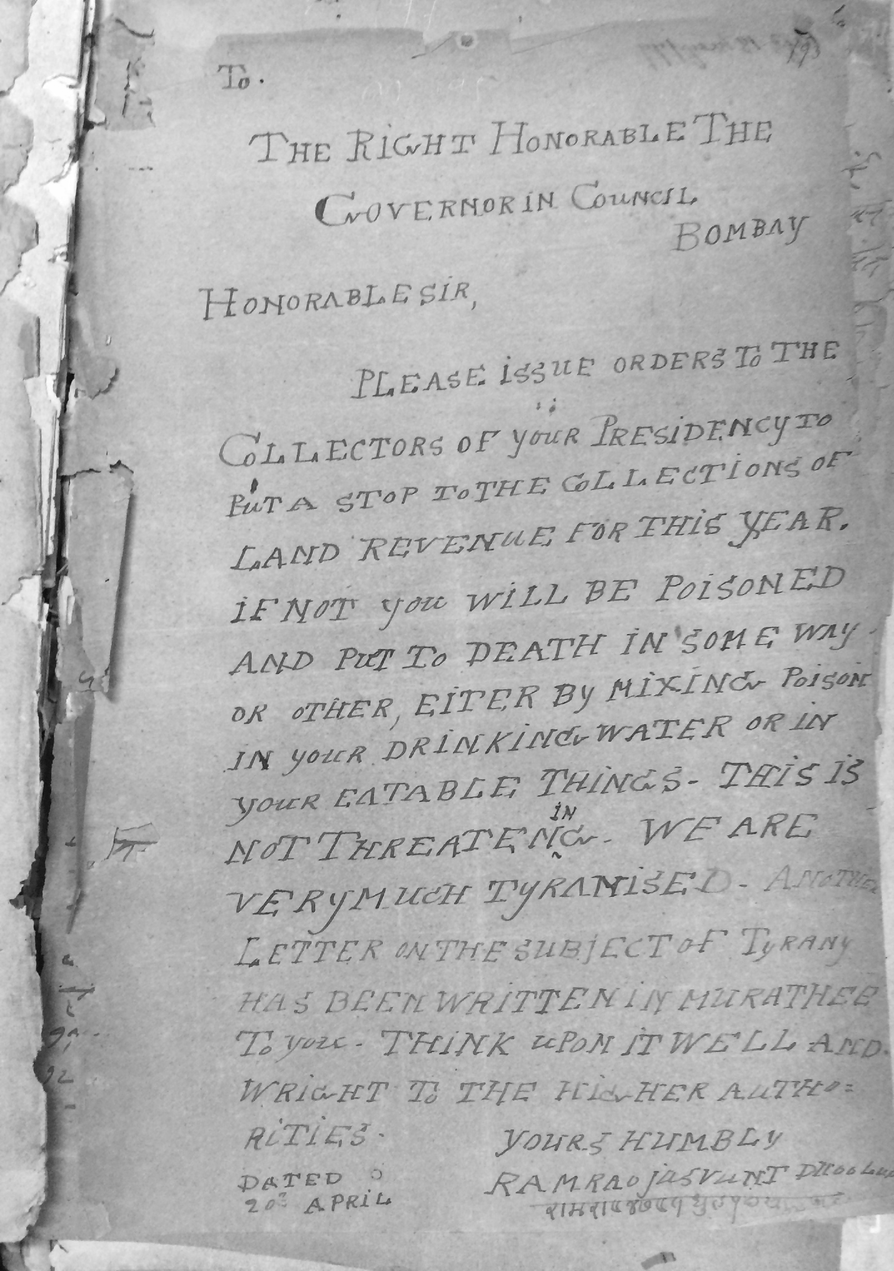
Perhaps the best evidence of the diffuse impact of these rules were petitioners’ efforts to tailor their petitions to avoid rejection. A particularly striking, if not necessarily successful, example of this involved a petition filed in the records of the Bombay Revenue Department. The petition, which was written in capital letters, in a hand that appears intended to avoid easy detection, exhorted: ‘PLEASE ISSUE ORDERS TO THE COLLECTORS OF YOUR PRESIDENCY TO PUT A STOP TO THE COLLECTIONS OF LAND REVENUE FOR THIS YEAR. IF NOT YOU WILL BE POISONED AND PUT TO DEATH IN SOME WAY OR OTHER, EITHER BY MIXING POISON IN YOUR DRINKING WATER OR IN YOUR EATABLE THINGS.’ Yet the petitioned added, in stark contrast to the statement above: ‘THIS IS NOT THREATENING. WE ARE VERY MUCH TYRANISED’, an addendum that seemed intended to ward off rejection on the grounds that the petition included abusive language (see Figure 1). The sense that the petitioner was attempting to skirt sanction under the petition rules is further reinforced by the fact that the petition was signed with a false name, again suggesting an effort to avoid rejection on the grounds of anonymity.Footnote 55
Ram Rao to the Governor in Council, Bombay, 20 April 1877, MAS/Revenue 1878/vol. 1010/no. 109. Source: Document provided courtesy of the Maharashtra State Archives; photograph provided courtesy of the author.

As the above example illustrates, while petition rules were repeatedly reissued, they were also easily skirted. Officials therefore looked for other ways to control the practice, including attempts at regulating what Bhavani Raman has evocatively termed the ‘document bazaar’, or the informal documentary service providers who served as intermediaries between the Indian public and the colonial state.Footnote 56 Some officials took a benign view of petition writers, describing them as ‘a convenience to the public’ akin to the fruit and cold-drink vendors who marketed their wares within the premises of colonial courts.Footnote 57 Other officials, however, viewed petition writers with deep suspicion, believing that they profited out of encouraging the genre's excesses. Bombay's chief presidency magistrate was convinced that petition writers held ‘out inducements to the Office peons and Police Sepoys on duty here to tout for them’. He informed his superiors that he had ‘posted notices prohibiting these persons from frequenting the Courts and Office’, but reported that his efforts were to no avail.Footnote 58 To bring these informal networks under greater government surveillance, in the 1890s the Bombay police courts imposed a scheme for appointing a single petition writer for each court, who would pay a monthly fee for this privileged monopoly. After several years, however, officials reported that the official petition writers, who charged a standard fee of eight annas for short petitions and one rupee for longer petitions, continued to face stiff competition from unofficial writers.Footnote 59
Other solutions for streamlining the petitioning process came not from the government, but from petitioners themselves. In the 1920s Mr N. D. Marathe of Belgaum, the honorary secretary of the railway mandal, and an all-around Good Samaritan, wrote to the government of Bombay suggesting that a box for petitions should be placed in front of every government office. Merging the genre of polite petition with the power of the press, Marathe also enclosed two clippings from the local newspaper, the Belgaum Samachar, endorsing his proposal. Within official circles, responses to Marathe's suggestion were mixed; while one official noted on the file that, ‘The proposal aims at the convenience of the poorest class of petitioners . . .’, another official curtly replied: ‘If a petitioner is too poor to use the post for petitions about which he does not want a personal interview, it will be at least as safe to hand the petition to a peon (or servant at the officer's house) as to put it in a box.’ Proponents of the scheme ultimately prevailed, but the implementation of the new programme continued to encounter official foot dragging. Anxious to see his pet project fully implemented, Marathe again wrote to the government of Bombay to inform them that some offices had not complied with the order and attached another newspaper clipping from the Belgaum Samachar commenting on the delay.Footnote 60
Whether lists of rules, regulation of petition writers, or specially designed mailboxes, efforts to discipline petitioning rarely produced the desired results, either on the part of officials or the petitioning public. Petitioning proved remarkably resistant to such disciplinary efforts. By its very logic, the practice presumed that officials had the discretionary authority to override rules and procedures in order to personally intercede on a petitioner's behalf. Efforts to mould petitioning to conform to the abstract, depersonalized logic of colonial bureaucracy were therefore crippled by their own contradictions. One woman, after her petition was returned to her with a copy of the Bombay government's petition rules, captured these clashing logics. In response to the indication that her petition was turned down under Rule 5, which stated that the government could not entertain petitions regarding judicial matters, she asserted: ‘That your Excellency's humble petitioner now begs to state that she is quite ignorant of the Rule 5 of the Petition Rules, but she has every confidence that your Excellency has power over the proceedings of the Civil or Criminal Courts.’Footnote 61 As the woman's comment suggests, by allowing the practice of petitioning to continue, officials encouraged Indians to believe that in exceptional circumstances official hierarchies could be circumvented and justice might be delivered through extra-judicial channels. When officials attempted to regulate petitioning to reassert these same jurisdictional hierarchies and boundaries, they effectively locked the practice into a perpetual cycle of contradiction, encouraging, and then thwarting, expectations of paternal benevolence.Footnote 62
Conclusion: seeing the state from the petitioners' perspective
The practice of submitting personal pleas to higher-level Raj officials was a failure on both fronts. From the perspective of petitioners, these documents rarely secured them the support they needed. For officials, efforts to discipline petitioning to conform to bureaucratic procedures were thwarted by logics of discretion and intimacy which adhered in the practice itself. The historian is therefore left wondering why the parties involved continued to author petitions and to receive, record, and reject them. This persistence is difficult to explain in an analytical model that presumes that public documentary practices serve primarily to entrench state power, secure material benefits, or further collective politics. Instead, the genre is more easily understood with reference to emotive, as opposed to functional, needs. A study of the petitions that are piled up in the Raj archives suggests that they served as an outlet for the accumulated frustrations of interacting with a state that David Washbrook has memorably referred to as ‘Janus-faced’.Footnote 63 The colonial state attempted to manage its conflicting impulses, between traditionalizing and modernizing Indian society, and between logics of primitive difference and liberal universalism, through differentiated spatial and social logics. During the Raj period the state increasingly sought to balance these competing imperatives by differentiating between direct and indirect spheres of colonial rule and cultivating paternalistic relationships of imperial guardianship with select elite collaborators. In theory, petitioning had a particular affinity with these zones of ‘traditional’ governance. In practice, however, it proved difficult to contain. Princesses and paupers alike expected the Raj to act as a paternal provider—a role which conflicted with its budgetary parsimony. Thus, rather than helping the Raj to pacify its subjects, petitioning threatened to bring its conflicting ideological projects into discordant dialogue. Efforts to tame the practice through bureaucratic regulation resulted in repeated failures, serving only to deepen the internal contradictions between promising empathetic discretion and delivering depersonalized rejection.
Yet petitioning seems to have gained a perverse staying power, despite, or perhaps because of, its internal contradictions. Through petitioning, subjects were able to confront the Raj's rule-bound rhetoric with the lived realities of day-to-day interactions with the government, in which officials’ discretionary judgement, and arbitrary whims, determined outcomes.Footnote 64 Petitions were thus full of complaints about corruption, as when the woman whose son had been kidnapped by the dramatic troupe complained that her adversaries had ‘so arranged that the Police did not at all take any steps in the matter’.Footnote 65 Yet in choosing to fight such abuses through petitioning, as opposed to taking their cases to court, petitioners refused to simply reaffirm the Raj's avowed commitment to the rule of law. Instead they insisted that individual discretion and personalized power were an inevitable feature of governance.
While pushing back against the distancing logic of an abstract state, petitioners also revealed that randomness, as much as reason, prevailed in everyday encounters with state officials. Petitioning was a bit like gambling: while the vast majority of petitions were rejected, once in a while petitioners succeeded in drawing official attention to their case. One particularly striking example of the sheer randomness of petitioning outcomes involved the sailor Antoni Garbi. Garbi petitioned between 1857 and 1861 for free passage so he could return to London to resume treatment at the Greenwich Hospital for wounds he had received while serving in the Crimean War. He explained that he had left London to rejoin his wife in India, but she then left him to become a prostitute. When the government replied that he was not entitled to free passage back to London, he sent a further petition explaining that he was ‘fully aware that he is not entitled to a passage to England at the charge of the Government’, but instead ‘prays that in consideration of his helpless state, caused by his wounds in the Crimea having lost his right arm and his left hand being maimed by a sword cut, he may as an act of charity be allowed a passage’. Unusually, this plea elicited a response from a sympathetic official, who sanctioned a free passage. But again, Garbi's luck failed him. The captain of the ship refused to allow him to board due to his ill health and when he applied for passage on another ship, his request was rejected. When another official interceded on his behalf, explaining that the passage had already been sanctioned, his superior replied that the previous decision was irrelevant.Footnote 66
Rejected, accepted, and rejected again—one can only imagine that Garbi must have felt that the government was devoid of both reason and sympathy. Yet the very arbitrariness of the government's response to petitions, rejecting most while occasionally making exceptions, made petitioning continue to seem like a worthwhile gamble. But, like gambling, petitioning was not animated by a rational calculus of likely gain. There are limits to the historian's ability to get inside the heads of past petitioners. In more contemporary contexts, however, Francis Cody has noted that petitioners in Tamil Nadu describe petitioning as ‘a matter of faith’.Footnote 67 Like prayer, the efficacy of petitioning was difficult to gauge but the act itself provided solace, allowing subjects to give voice to their grievances and to imagine that they might be heard.
Understanding the power of giving voice to one's needs and frustrations, and to conjuring the possibility, however remote, of being heard by a distant sovereign, may require turning from bureaucratic archives to more literary sources. The experience of petitioners is reminiscent of the protagonist in Rabindranath Tagore's famous play Dakghar (The Post Office). In the play the boy Amal suffers from a chronic illness which requires that he remain indoors. Filled with boyhood curiosity, Amal spends his days looking out the window, vicariously quenching his thirst for adventure by speaking about the world beyond with the people who pass by. During one of these conversations the village watchman tells him about the new post office that has opened and Amal becomes taken with the idea that one day he might receive a letter from the king. At the end of the play the village headman, a pompous busybody with little patience for a sick boy, makes fun of Amal by pretending to hand him a letter from the king, which is in fact a piece of blank paper. Amal, however, is delighted and much to the surprise of the others, his receipt of the fake letter is followed by the arrival of the king's herald and his personal physician, who deliver the news that the king himself will imminently visit. When the physician asks about his health, Amal declares that, ‘All pain is gone’ and when urged by his father to ask the king for a gift, he replies that he wants to serve as one of the king's postmen, ‘that I may wander far and wide’.Footnote 68 The play's happy denouement, however, shifts in a different direction when Amal drifts off to sleep and quietly expires. Despite the tragedy of Amal's premature death, the ending of the play is suffused with a sense of peace resulting from the boy's happiness in thinking that the king has written to him and that one day he might satisfy his hunger for worldly adventure. The play speaks to the solace that comes from imagining that a higher power cares about one's fate—even when the material reality of confinement remains unchanged. This central message has echoed through the play's many performances, including a famous rendition at an orphanage in the Warsaw ghetto just weeks before the children were sent to their deaths at Treblinka.Footnote 69
Reading the play against the historical backdrop of Raj governance adds another layer of pathos. The historian cannot help but think of Amal receiving a form response referencing violations of petition rules rather than the king's herald and physician. Wishing, like Amal, that they might attract the attention of a higher authority, actual colonial petitioners were deprived even of this emotive release from their troubles when their imaginary escape was cut short by the reality of colonial rejection.