Introduction
The participation of the male partner in childbirth (family labour/delivery) has evolved over time. In modern times, given the choice, many men are willing to attend and support their partners (Leavitt, Reference Leavitt2003). A survey on Salvadoran men (Carter & Speizer, Reference Carter and Speizer2005) identified wanted pregnancies, couples living together, higher level of male partner's education/socioeconomic class and urban residence as associations of male participation. Male participation ideally starts from pregnancy; involvement in antenatal visits and childbirth classes has been shown to increase their willingness to attend the delivery (Wieglos et al., Reference Wielgos, Jarosz, Szymusik, Myszewska, Kaminski, Ziolkowska and Przybos2007). Male participants have different attitudes to family birth, ranging from eagerness (Chan & Peterson-Brown, Reference Chan and Peterson-Brown2002; Carter Speizer, Reference Carter and Speizer2005), even actively protesting hospital policies that bar them from participating, according to a mid-20th century history review in the US (Leavitt, Reference Leavitt2003), to acquiescing simply to please their partner (Rykowska-Pierzchala et al., Reference Rykowska-Pierzchala, Smoleń, Wislocka-Stawarczyk, Wójtowicz and Jakiel2001). Most men claim that the decision to be at delivery was theirs, not their wives'. An Indian study concluded that men believed the health of a woman during pregnancy is her husband's responsibility, but physical and moral support should be from other women. Socio-cultural restrictions impeded them accompanying their wives to clinic visits or being present at delivery (Khan et al., Reference Khan, Khan and Mukerjee1997). It appears that hospital policies and staff's hostile attitude to male ‘intrusion’ in the labour room still contribute to limit family delivery (Dragonas, Reference Dragonas1992; Khan et al., Reference Khan, Khan and Mukerjee1997; de Carvalho, Reference de Carvalho2003). For their own part, women often want their partners to attend labour. Some studies concluded that both partners felt their relationships with each other had improved following their shared experiences irrespective of mode of delivery (Dragonas, Reference Dragonas1992; Chan & Peterson-Brown, Reference Chan and Peterson-Brown2002). Yet, some of them prefer a traditional delivery. Reasons proffered include that men would be out of place in the labour ward and that the experience may adversely affect their sexual relationship afterwards (Hung et al., Reference Hung, Chung and Liu1997; Wieglos, Reference Wielgos, Jarosz, Szymusik, Myszewska, Kaminski, Ziolkowska and Przybos2007).
One-to-one support in labour, according to the Cochrane Review, has been shown to be beneficial, in that women who experienced continuous support during labour were more likely to give birth without using analgesia or anaesthesia, less likely to have a Caesarean or instrumental vaginal birth, and less likely to report dissatisfaction with their childbirth experiences (Hodnett et al., Reference Hodnett, Gates, Hofmeyr and Sakala2006). The review looked at female support in labour, though, and the place of male support has been less studied.
From a wider public health view, maternal mortality has remained a scourge of the developing world; the current figure for Nigeria is 1100 per 100,000 live births (WHO, 2007). Greater emphasis has been put on its non-medical causes and avenues for stemming them. A great contributor to Phase I delay (that is, delay in making the decision to seek medical care) is the fact that male partners make decisions in most families, including those related to health and reproductive care. In many cases, the woman (the partner at direct risk) is not empowered to make these decisions. Other benefits include those demonstrated by a study on antenatal blood donation by husbands (an option often explored where voluntary blood donation is low), which showed that they were more likely to donate when they participated in antenatal programmes (Obi, Reference Obi2007).
This study aims to assess the level of pregnancy and birth participation in Nigerian men, the possible associations, the attitude of the women and likely targets for improved care delivery.
Methods
This was a descriptive hospital-based, cross-sectional study carried out on pregnant women attending antenatal care in three government-owned health facilities in Ibadan, in Yoruba-speaking south-western Nigeria: Idi-Ogungun Maternity Centre (IMC; a primary care facility), Adeoyo Maternity Hospital (AMH; secondary) and University College Hospital (UCH; tertiary), catering for rural, semi-urban and urban populations, respectively. A total sample of all consenting clients from 28th April to 9th May 2008 was taken. Nulliparous women were excluded, as information on their previous experience with deliveries was sought. The instrument used was a 48-item interviewer-administered questionnaire, which elicited information on the couple's biodata, the women's knowledge of and attitude towards male participation, and the practice of their male partners in this respect.
The outcome variables were: husbands' participation in household chores, attendance at antenatal care and attendance at delivery. Explanatory variables were age of respondents, educational attainments, ethnicity and occupations of both husbands and wives.
Data was entered into Microsoft Excel spreadsheets and imported into Stata software for analysis. Categorical variables were analysed using the χ2 (Fisher's exact) test while continuous variables were analysed by t test for both equal and unequal variance using the variance ratio function of the Stata software to determine the appropriate use of the Satterthwaite correction for the degrees of freedom. Multivariate analyses were performed by multiple logistic regressions. Level of statistical significance was at p<0.05 for all the analyses.
Results
Demographic data
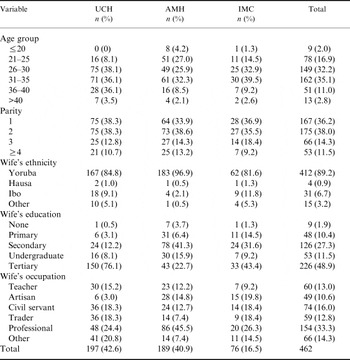
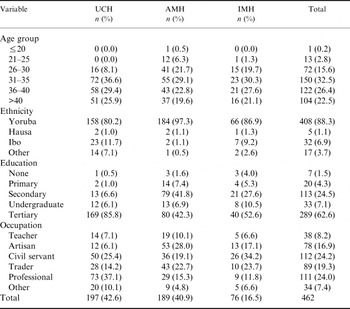
Four hundred and sixty-two women were surveyed, with a mean age of 30.5 (95% CI 30.0–31.0) years. Mean parity was 2. Table 1 shows the demographic characteristics of the respondents and Table 2 shows that of their husbands.
Demographic characteristics of respondents

IMC, Idi-Ogungun Maternity Centre; AMH, Adeoyo Maternity Hospital; UCH, University College Hospital.
Demographic characteristics of husbands

Participation of husbands during pregnancy
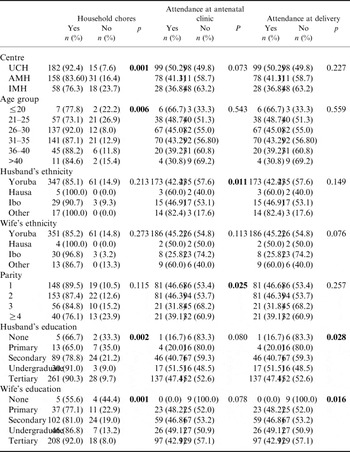
Three hundred and forty-nine women (75.5%) were aware that husbands could participate in childbirth. Of these, most of them were educated by nurses (35.5%). Older respondents were more likely to be aware of the concept (p<0.01), as were UCH patients (p<0.01). Parity was not associated with awareness. Nearly all husbands (450, i.e. 97.4%) encouraged their wives to attend antenatal clinic – paying for the antenatal service bills (96.5%), paying for transport to clinic (94.6%) and reminding them of their clinic visits (83.3%). Many husbands also encouraged their wives to take adequate nutrition (96.5%) and helped with household chores during the pregnancy (86.1%). Table 3 shows that respondents were more likely to be assisted at home if they attended the urban centre, if they were in their late 20s and if the couples had at least tertiary education. However, less than half of the husbands (44.4%) accompanied their wives to antenatal clinics. Table 3 shows that husbands from the minority tribes were the most likely to do this.
Husbands' participation in household chores, attendance at antenatal clinic and attendance at delivery

Participation of husbands during last delivery
Three hundred and thirty-five husbands (72.5%) accompanied their wives to the hospital for their last delivery, while 63.9% were present at delivery. Again, couples with higher education were more likely to share this experience (Table 3). Most of these women admitted to benefiting from their partner's presence (although there was no statistically significant advantage), most citing emotional support as the main benefit. Almost half of the respondents (45.9%) stated that the attending health workers resisted their husband's presence at delivery.
Attitude to male participation
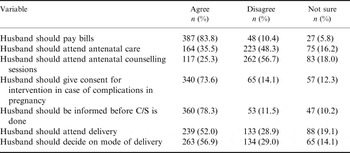
The attitude of the respondents to various forms of male participation was sought (Table 4). Most women did not think it was their husband's place to attend antenatal clinic (48.3%) or the counselling sessions (56.7%). They did, however, expect them to be responsible for paying the hospital bills, attend the delivery and to be involved in decision-making as regard the pregnancy and childbirth. Most (93.7%) would discuss their provider's health advice with their husbands, and most (68.2%) would prefer their husband to a female relative at delivery (p<0.01). Most women (65.9%) would make a decision in their partner's absence in an emergency (p<0.001); others (13.0%) would allow another relative to make the decision, while 13.2% would wait for their partner's return. A few respondents (6.1%) felt they could not anticipate their behaviour in this instance.
Attitude of respondents to male participation in pregnancy and delivery

Logistic regression analysis
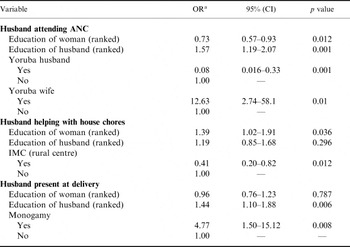
When adjusted for age, education, ethnicity, religion, plurality of marriage relationship and location of facility, more-educated women were less likely to be accompanied to antenatal clinic (OR 0.73, 95% CI 0.57–0.93), while more-educated men were likely to accompany their wives (OR 1.57, 95% CI 1.19–2.07) (Table 5).
Logistic regression analysis of male participation

a Adjusted for age of respondent, age of husband, centre, religion and ethnicity of couple.
A Yoruba husband was less likely to accompany his wife (OR 0.08, 95% CI 0.016–0.33), but Yoruba wives with non-Yoruba husbands were 12 times more likely to be accompanied (OR 12.63, 95% CI 2.72–58.1).
Women in the rural centre were less likely to receive help with household chores from their husbands during pregnancy (OR 0.41, 95% CI 0.20–0.82), while educated women were more likely to benefit from this (OR 1.39, 95% CI 1.02–1.91). Monogamous unions (OR 4.77, 95% CI 1.50–15.12) and increasing level of husband's education (OR 1.44, 95% CI 1.10–1.88) were associated with spousal presence at delivery.
Discussion
The awareness that husbands can participate in childbirth is high amongst the women in this study. Health talks and counselling sessions are carried out by nurses in all the centres, and is probably the source of most of their information. Women are well supported during pregnancy, as evidenced by financial support, better nutrition (the tradition usually is for the husband to have the best part of the meals, etc.) and assistance with household chores. The latter is particularly welcome, as it is probably seen as effeminate in a patriarchal society. In a similar study carried out in a Delhi slum (Dutta et al., Reference Dutta, Kapilashrami and Tiwari2004), less than a tenth of husbands improved on their wives' diet during pregnancy. Respondents from the rural centre were less likely to be assisted at home with chores, comparable to another study in rural India where household help was low (Singh & Arora, Reference Singh and Arora2008). More highely educated men were more likely to attend antenatal clinic and delivery, in concord with Wieglos' Polish study, and contrary to the findings of a Taiwanese study (Hung et al., Reference Hung, Chung and Liu1997).
Men's attendance at antenatal clinic was low. This may be partly due to the discomfort of men to attend a female-oriented and dominated programme. Socio-cultural restrictions may play a role, as shown in the Indian study discussed earlier (Khan et al., Reference Khan, Khan and Mukerjee1997). Another study in Bangladesh showed that men did not feel comfortable taking their wives to a health facility because they did not like to discuss sexual reproductive health issues with the service providers (Shahjahan & Kabir, Reference Shahjahan and Kabir2007), and poor couple interaction made it difficult for them to understand their wives' reproductive health issues. Most of the respondents, however, claim to discuss the health advice given them with their husbands. With some education and encouragement, there would probably be better attendance, given the high level of participation of the husbands in other aspects of pregnancy in this study. It would be advantageous for them to attend the counselling sessions at the clinic as this would allow them to support their wives better, and to prepare them for labour. Wieglos et al. (Reference Wielgos, Jarosz, Szymusik, Myszewska, Kaminski, Ziolkowska and Przybos2007) demonstrated that men who attended childbirth classes were more likely to attend labour. Our respondents' own testimony confirmed the benefit of their partner attending labour, preferring it to the presence of a doula.
The attitude of the women themselves is important in the actualization of male participation: sometimes male partners only attend childbirth in response to their wives' desire (Rykowska-Pierzchala et al., Reference Rykowska-Pierzchala, Smoleń, Wislocka-Stawarczyk, Wójtowicz and Jakiel2001). While most women feel that the man should bear the financial responsibility, it is gratifying that they feel empowered enough to make emergency decisions in his absence, reducing the delay that often contributes to maternal morbidity and mortality. Findings from another Nigerian study (Odimegwu, Reference Odimegwu, Adewuyi, Odebiyi, Aina, Adesina, Olatubara and Eniola2005) were similar: surveyed men corroborated their wives' ability to decide in their absence. Most of our respondents seemed to agree with the traditional model of male financial and social support, without intruding into antenatal care services.
In conclusion, it appears that male participation in pregnancy and delivery is satisfactory in some respects in Ibadan, but more is desirable, especially for husbands' attendance at antenatal services and delivery. The importance of counselling sessions by nurses is emphasized. Education at all levels is desirable, due to all its positive associations, with specific education on family participation. Care-givers and hospital policies need to refrain from hostile policies towards family delivery, given its known benefits.
Acknowledgment
The authors acknowledge the medical students of Group D2005 of the College of Medicine, University of Ibadan, for their invaluable contribution in administering the questionnaires to the respondents.