Introduction
Dioecy is a breeding system in which male and female plants coexist in the same population. Despite the theoretical expectation of a 1:1 sex ratio in offspring proposed by Fisher (Reference Fisher1930), recent reviews have found that sex ratios deviate from equality in half of the studied species and, in these cases, male bias is almost twice as common as female bias (Field et al. Reference Field, Pickup and Barrett2013, Sinclair et al. Reference Sinclair, Emlen and Freeman2012). An important question regarding sex ratio is at what stage(s) of the plant’s life cycle is bias established (Field et al. Reference Field, Pickup and Barrett2013). In dioecious species, the proportion of seeds that will produce male and female plants is defined as the primary sex ratio (de Jong & Van der Meijden Reference de Jong and Van der Meijden2004, Stehlik & Barrett Reference Stehlik and Barrett2005). To identify this primary sex ratio (i.e. the sex of seeds), it is necessary to use sex-specific genetic markers. However, this is rarely achieved (Stehlik & Barrett Reference Stehlik and Barrett2005), perhaps because genetic sex determination seems to have evolved recently in many angiosperms, and many species may not yet have evolved extensive sex-linked regions (Charlesworth Reference Charlesworth2016). Moreover, environmental factors such as elevation, light and soil moisture content may affect seed germination and seedling survival (Eppley Reference Eppley2001, Stehlik et al. Reference Stehlik, Friedman and Barrett2008), which can act to alter sex ratios. Other methods to estimate sex ratios have been used; however, the information generated can differ depending on the stage of the plant life cycle at which it is estimated. Most sex ratio estimations are based on adult flowering plants (flowering sex ratio or secondary sex ratio), but the bias reported might be the result of different flowering frequencies or higher mortality in one of the genders (usually females), which could explain the male-biased sex ratios (Delph Reference Delph, Geber, Dawson and Delph1999). To circumvent this problem, one alternative is to evaluate sex ratio when plants reach sexual maturity (de Jong & Van der Meijden Reference de Jong and Van der Meijden2004, Delph Reference Delph, Geber, Dawson and Delph1999 and references therein; Purrington Reference Purrington1993). This method may help to understand whether male-biased sex ratios are present from the beginning of the first flowering (de Jong et al. Reference de Jong, Van Batenburg and Van Dijk2002) or conversely, whether sex ratio bias in adult populations is the result of differences in survival and/or flowering frequency between genders.
Two important features of most dioecious species that deserve attention are differences in resource allocation patterns and in life-history traits and the relationships of these to sexual dimorphism. Sexual dimorphism is defined as the differences between genders in primary (related to sexual organs) and secondary sexual characters (i.e. morphological or physiological traits not directly related to sexual organs: Barrett & Hough Reference Barrett and Hough2013, Delph Reference Delph, Geber, Dawson and Delph1999). Female plants are expected to have higher costs of reproduction than males because of fruit production (Lloyd and Webb Reference Lloyd and Webb1977), an assumption that is confirmed in most published studies (Delph Reference Delph, Geber, Dawson and Delph1999, Obeso Reference Obeso2002). Sexual dimorphism in life history traits such as age and height at first reproduction may be a consequence of differential patterns in resource allocation according to gender; they may be the result of differences in the cost of reproduction between genders in order to maximize their fitness and function (Delph Reference Delph, Geber, Dawson and Delph1999). Given the different patterns of resource allocation among genders, and assuming that resources are limited, assignation of resources to a single function should have negative consequences for other functions, producing trade-offs between vegetative and reproductive traits. For example, we know little regarding the relationship between plant height and flower production among genders of dioecious species when reaching sexual maturity. In a literature review of life history traits, Delph (Reference Delph, Geber, Dawson and Delph1999) found that females of dioecious species were in most cases older and taller at the first reproductive event, while in some cases no significant differences were detected. However, in none of the cases were males taller or older than females. In addition, morphological differences in the form of reproductive structures or floral traits involved in pollinator attraction, such as sepals or petals, are relatively common among dioecious species (Delph et al. Reference Delph, Galloway and Stanton1996). According to Bateman’s principle, floral traits that increase pollinator attraction would be expected to evolve under stronger pollinator-mediated selection in male rather than in female plants. Therefore, larger floral displays are expected in male plants in order to increase male fertility (Barrett & Hough Reference Barrett and Hough2013).
Fuchsia parviflora is a dioecious shrub that depends on biotic pollination (González et al. Reference González, Alvarez-Baños and Cuevas2018). Previous study has suggested that males produce more flowers, although adult plant height does not differ between genders, and male-biased sex ratios have been found in some natural populations (Cuevas et al. Reference Cuevas, Pérez and Sevillano2017). To determine whether male-biased sex ratios previously found in natural populations are present at the point at which plants reach sexual maturity, and to investigate possible relationships between vegetative and reproductive functions, we performed a common garden experiment to address the following questions: (1) Do sex ratios in Fuchsia parviflora differ from 1:1 upon reaching sexual maturity? (2) Does the timing of sexual maturity differ between genders? Is the timing of sexual maturity related to plant height? (3) Is there a relationship between plant height and flower production? (4) Do flower production and reproductive biomass differ between genders?
Since we expect the sex ratio not to differ from 1:1 on reaching sexual maturity, the male-biased sex ratio found in natural populations could be the consequence of a higher mortality in females and/or higher flowering frequency in males. We also expected no difference between genders in terms of flowering initiation time or plant height, since such differences could be expected after several reproductive episodes (i.e. fruit production, Lloyd & Webb Reference Lloyd and Webb1977). On the other hand, in accordance with Bateman’s principle, selection related to pollinator attraction could favour increased flower numbers in males compared with females.
Study species
Fuchsia parviflora (Onagraceae) is an erect dioecious shrub of 1.5–4 m in height, pollinated by hummingbirds and bees (González et al. Reference González, Alvarez-Baños and Cuevas2018). It is distributed in Pinus, Quercus and Arbutus forests from northern Mexico (south-west of Durango) through the western part of the Trans-Mexican Volcanic Belt of Jalisco, Michoacán and Estado de México to the Sierra Madre del Sur, at elevations from 1500–2500 m asl. The red tubular flowers are smaller in females (3.2–5.7 mm long) than in males (8.5–11.2 mm). Each flower remains open for 3–4 days in either gender. The small berry fruits are green when immature and dark red when maturing. They are dispersed by birds, and each fruit produces 14–20 seeds (Breedlove Reference Breedlove1969, González et al. Reference González, Alvarez-Baños and Cuevas2018).
Methods
Field procedures and experimental design
We collected 10 mature fruits from 20 female individuals during November 2013 in five populations of Fuchsia parviflora: one located in Chupícuaro, three near Pátzcuaro (Cañada 1 and 2, and Residuos) and one in Zirahuén (Agua Verde), all in the State of Michoacán, Mexico. In April 2014, four seeds were randomly selected from each fruit collected per individual and population (40 seeds per plant and 800 seeds per population) and planted in groups of 40 seeds, using plastic pots filled with leaf soil. Mature seeds were planted with no scarification treatment, since previous germination tests showed no differences with or without such treatment (López, unpublished data). Pots were placed in a shade house at the Universidad Michoacana de San Nicolás de Hidalgo campus in Morelia, Michoacán, where elevation (1900 m asl) and climatic conditions (min–max temperature 8–30°C) were similar to those experienced by natural populations. We used automatic irrigation to maintain the soil at field capacity and the pots were moved randomly on the tables every 15 days throughout the study, so that all of the plants experienced similar environmental conditions in terms of temperature, humidity and light. We recorded the date on which each seed germinated and when each plant began to flower, the gender of each plant, the number of flowers produced (recorded every week to avoid counting the same flowers twice) and the height of each plant, measured once a month for 9 months from the initiation of flowering. In July 2014 (three months after the seeds were sown), the seedlings began to be transplanted into individual pots. We ceased observation two years later (April 2016), even though not all germinated plants had reached the flowering stage. We only used data from surviving seedlings that flowered during the experiment, not one flowering plant died during the experiment. The sex ratio of a population was defined as: no. of males/(no. of females + no. of males).
Reproductive biomass allocation in the field
Initially, we attempted to estimate reproductive biomass from plants growing in the shade house. However, we had problems obtaining mature fruits, so these data were recorded instead from a natural population. In order to estimate the reproductive biomass invested in male and female plants, we obtained the fresh weight (to the nearest 0.001 g) of 15 flowers per gender from different plants of the ‘Residuos’ population, using an electronic balance (Ohaus, Pioneer PX). In the same population, we estimated the number of flowers per plant in 20 plants per gender throughout the flowering season. Finally, we estimated the total fruit production in these same plants and fruit fresh weight in 20 fruits per plant (for 20 plants).
Statistical analysis
Sex ratio was analysed for all five populations pooled, and then for each population separately. For this, we determined whether sex ratio differed significantly from 0.5 with a binomial test. To test whether males germinate and flower (i.e. reach sexual maturity) before females, we performed survival analyses, which determine the probability of an event occurring considering the time elapsed until the appearance of that particular event in a set of individuals. An important feature of these analyses is that they consider cases in which the event did not occur during the studied time. In our case, however, we could not determine the gender of the plants that did not flower and therefore had to exclude those cases in which the event did not occur from the analyses. Survival analyses were performed for three periods of plant development: (a) time (in days) elapsed from sowing of seeds to germination (seed–seedling), (b) time (in days) elapsed from germination to the beginning of flowering (seedling–flowering) and (c) time (in days) elapsed from sowing of seeds to the beginning of flowering (seed–flowering).
In order to determine whether flower production differs according to gender, the total number of flowers produced over a period of 14 months between males and females was compared using a two-way analysis of covariance (two-way ANCOVA). In this model, plant gender and population were fixed factors, while plant height (at the beginning of the flowering and at the end of the observations) and the periods of time elapsed from sowing to germination and from the seedling stage to flowering were treated as covariates. The number of flowers produced was the dependent variable. Finally, a post-hoc test was conducted to evaluate differences between populations. The data were log+1 or square root transformed as required prior to analysis to correct for non-normality.
To test whether females invest more resources in growth than males, the heights of plants of both genders were compared by one-way ANCOVA. In this model, plant gender was the fixed factor, the periods of time elapsed from sowing to germination and from the seedling stage to flowering were treated as covariates, and plant heights (at the beginning of the flowering and end of the observations) were dependent variables. Finally, a t test was performed to explore the difference in flower mass and flower number between genders, using data obtained from the natural population. All analyses were performed with R v. 3.3.2 (R Development Core Team 2008).
Results
Germination and sex ratio at reaching sexual maturity
Of the 4000 seeds planted, 800 seeds germinated (20%). The proportion of seeds that germinated varied from 0.05 (Cañada 1) to 0.58 (Chupícuaro; Table 1). Of the germinated seeds, 510 seedlings died prior to flowering (64%) and 176 seedlings did not flower at the end of the experiment (two years after being planted). At the end of the observation period, a total of 114 plants reached the flowering stage, of which 71 were males and 43 were females. Considering the plants of the five populations pooled, the number of males (71) was significantly greater than that of females (43) according to an exact binomial test (Probability of success = 0.62, P < 0.05). However, at population level, and following Bonferroni corrections, there was a significant male-biased sex ratio only in one population (Chupícuaro; Probability of success = 0.9, P = 0.01; Table 1).
Germination and flowering proportions, and sex ratio (no. of males/(no. of females + no. of males) of the 800 seeds sown of each population.

Probability of germination and flowering between males and females
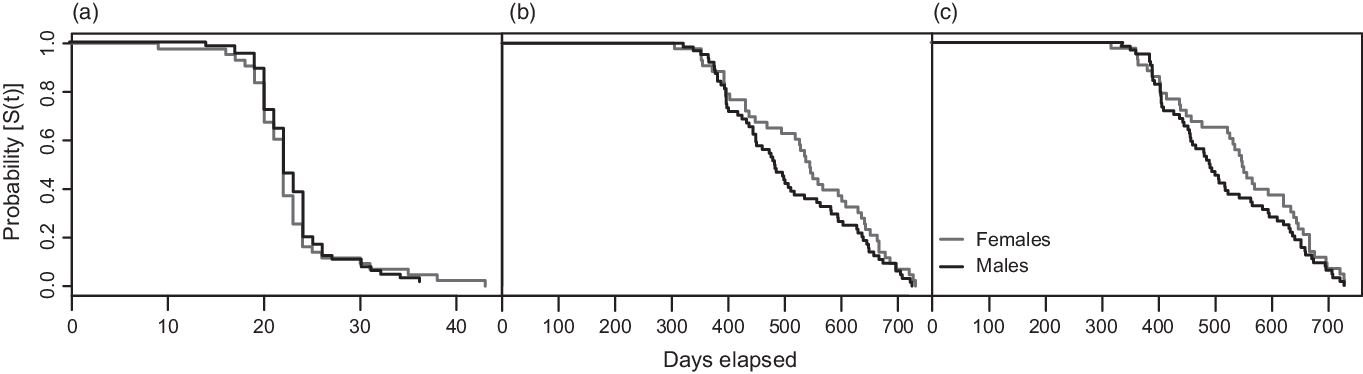
Survival analyses showed no difference in germination probability between genders (χ2 = 0.01, df = 1, P > 0.05, n = 107; Figure 1A). On average, germination took (hereafter, mean ± SD) 22.88 ± 3.87 days in males and 22.77 ± 5.64 days in females. Moreover, males did not differ from females in terms of the probability of reaching flowering from the seedling stage (χ2 = 1.8, df = 1, P > 0.05, n = 107; Figure 1B) or from the seed stage (χ2 = 1.8, df = 1, P > 0.05, n = 107; Figure 1C). On average, males took 516.29 ± 113.01 and 493.44 ± 112.93 days to flower from seeds and from seedlings, respectively, while females took 545.14 ± 119.34 and 522.37 ± 119.34 days, respectively.
Survival curves showing no differences between genders of Fuchsia parviflora in terms of: (a) probability of germination, (b) probability of flowering from the seedling stage, and (c) probability of flowering from the seed stage during two-year observation period and under controlled conditions. The abbreviation S(t) is the probability that an event has not yet occurred (germinate, flowering from seedlings, flowering from seeds). Days elapsed refers to the number of days elapsed since the start of the experiment.

Flower production and plant height
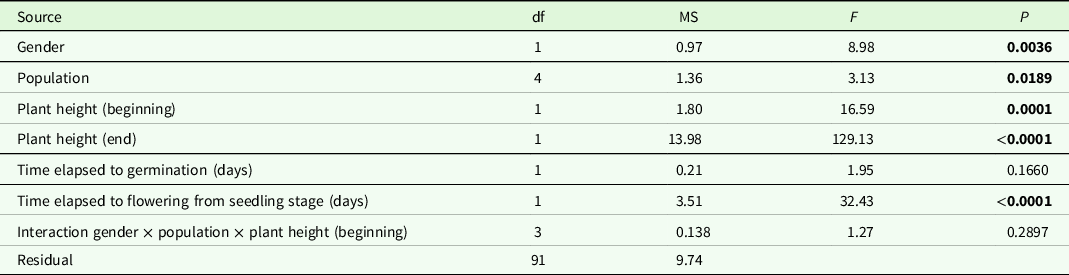
The mean number of flowers per plant in males after 10 months of observation was significantly higher (44.6 ± 13.45) than in females (35.36 ± 7.9), regardless of the time elapsed to germination. However, this difference was not independent of plant height at the beginning of flowering or at the end of the observations, or the time elapsed from the seedling stage to flowering (Table 2). There was an extreme case of one male that produced 879 flowers over the course of the experiment, but this individual was excluded from the analyses as an outlier. The interaction plant gender × population was not significant, meaning that males produced significantly more flowers consistently across all of the populations. Only the three-way interaction of plant gender × population × plant height (at the beginning) was significant, and all non-significant interactions between the fixed factors and the covariates were removed from the model. In the final model, the three-way interaction was not significant. The significant relationships detected in the ANCOVA model were further explored for each plant gender by regressing the number of flowers with plant height (at the beginning and at the end) and with time elapsed from the seedling stage to flowering. We found that the number of flowers produced in both genders increased significantly with increased height at the end of the observation period (males, R2 = 0.33, P < 0.0001; females, R2 = 0.43, P < 0.0001; Figure S1 A, B), but not at the beginning of the observations. Similarly, the number of flowers decreased significantly with increased time from the germination stage to flowering in both males and females (males, R2 = 0.51, P < 0.0001; females, R2 = 0.70, P < 0.0001; Figure S1 C, D). Flower production across populations was very similar, with only one population (Chupícuaro) differing from the rest, probably due to the fact that few individuals flowered during the period in which the observations were made.
Results of the ANCOVA for the regression of total number of flowers produced against plant height and time elapsed to germination and flowering in male and female plants of Fuchsia parviflora. Non-significant interactions between gender or population and the covariates were removed from the model.

Significant differences are shown in bold.
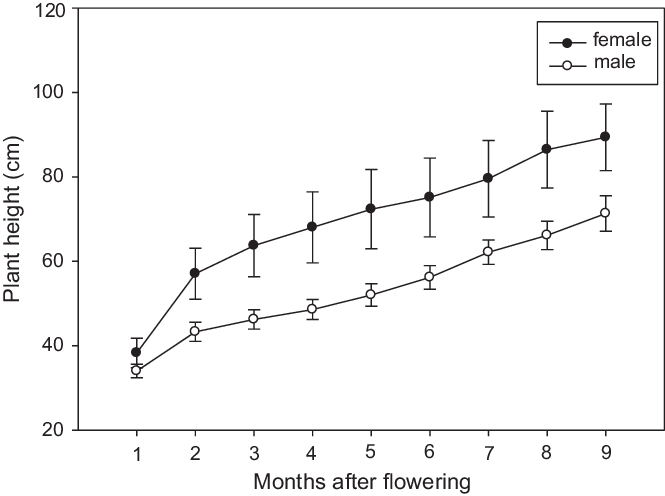
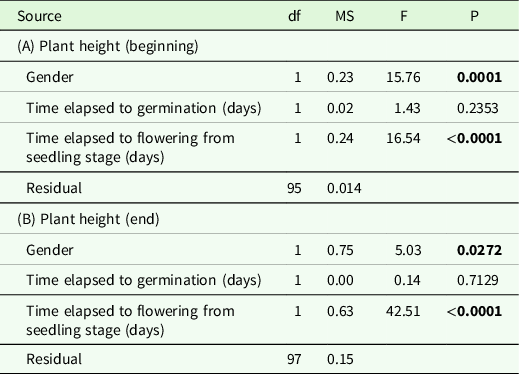
When flowering began, and at the end of the experiment, the female plants were taller (beginning, 45.57 ± 15.09 cm; end, 69.43 ± 27.82) than the males (beginning, 35.36 ± 9.06 cm; end, 59.73 ± 18.01; Figure 2; Table 3), independently of the time elapsed to germination, but this difference was not independent of the time elapsed from the seedling stage to flowering. Significant relationships detected in the ANCOVA model were further explored for each plant gender by regressing plant height (at the beginning and at the end) with the time elapsed from the seedling stage to flowering. We found that the tallest plants required more time to reach sexual maturity (males, R2 = 0.10, P < 0.0106; females, R2 = 0.20, P = 0.0033). However, the height of the plants at the end of the experiment decreased with increased time taken from the germination stage to flowering (males, R2 = 0.29, P < 0.0001; females, R2 = 0.32, P < 0.0001).
Average height (± 1 SE) of male and female plants of Fuchsia parviflora after flowering. Female plants were significantly taller than male plants (P = 0.02, see Table 3).

Results of the ANCOVA for the regression of plant height at the beginning of flowering and at the end of observations against time elapsed to germination and flowering in male and female plants of Fuchsia parviflora. Non-significant interactions between gender and the covariates were removed from the model.

Significant differences are shown in bold.
Reproductive biomass allocation in the field
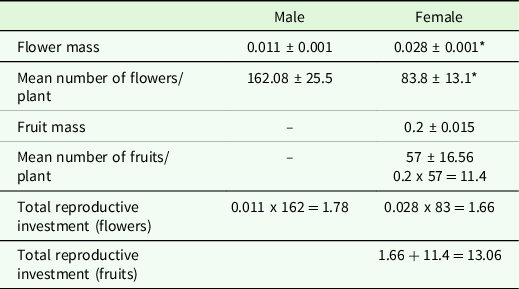
Mean mass of female flowers was twice that of male flowers (t = 8.6, df = 30, P < 0.0001, n = 32), but male plants produced almost twice the number of flowers as the females (t = 2.64, df = 44, P < 0.01, Table 4). Consequently, the relative reproductive biomass invested in flower production was slightly higher in male plants. However, considering also the mean fruit mass and mean total fruit production per plant, the total reproductive biomass was seven-fold greater in females than in males (Table 4).
Reproductive biomass (g) allocated to flower and fruit production in a natural population of Fuchsia parviflora.

Total reproductive investment was estimated by multiplying the mean flower mass by the mean number of flowers per gender. In the case of female plants, the total flower biomass invested per plant was added to the total fruit investment. * Significant differences between males and females, see text for details.
Discussion
Our study showed that: (1) sex ratios on reaching sexual maturity did not differ from 0.5, with the exception of one population; (2) there were no differences between Fuchsia parviflora genders in terms of the probability of germination or flowering, (3) when flowering began, and at the end of the experiment, female plants were significantly taller than males, and the tallest plants of both genders required more time to reach sexual maturity; (4) males produced significantly more flowers than females and the number of flowers increased with plant height in both genders; and (5) in the natural population studied, the reproductive biomass invested in female plants was seven-fold greater than that invested in male plants.
With the exception of the smallest seedling population, in which male-biased sex ratios were observed, the sex ratios obtained in the shade house did not differ from 0.5. Interestingly, a previous study also found male-bias in the same population, which was the smallest in number of individuals (n = 16; Cuevas et al. Reference Cuevas, Pérez and Sevillano2017). Both the sex ratios at reaching sexual maturity and secondary sex ratios in F. parviflora were closer to 0.5 or slightly male-biased, but in no case were females found to be more abundant. Male-bias in the secondary sex ratio could be the consequence of higher flowering frequency in males or higher mortality in females (Meagher Reference Meagher1984). However, a limitation of our study was the low proportion of seeds that germinated and thus the low number of plants that reached flowering. This occurred despite previous germination tests that showed no differences among treatments (López, unpublished data) and the fact that all plants had the same favourable conditions for germination and growth. It is therefore likely that the proportion of germination observed is similar to that presented by natural populations. However, it is likely that non-flowering seedlings at the end of the experiment could modify the sex ratio reported for some populations. Finally, since we did not detect bias in the sex ratio on reaching sexual maturity, sex-biased mortality prior to flowering must be relatively low, but longer studies are necessary to corroborate this prediction. Although earlier flowering times in males have been observed in several studies (Armstrong & Irvine Reference Armstrong and Irvine1989, Meagher Reference Meagher1984, Osunkoya Reference Osunkoya1999), we did not detect differences in this regard in F. parviflora. This flowering synchrony between genders may favour adequate pollen transfer and deposition on the stigma of the female plants.
In relation to the time taken to reach sexual maturity and plant heights at this stage, according to Lloyd & Webb (Reference Lloyd and Webb1977), we expected no differences between genders in flowering initiation time or plant height on reaching sexual maturity, since differences may not emerge until after several reproductive episodes (i.e. after fruit production). However, female plants of F. parviflora were older and taller than males when flowering began and these differences remained until the end of the observations. Our results are in accordance with those described by Delph (Reference Delph, Geber, Dawson and Delph1999), who found that female plants were both older and taller at the first reproductive events in most of the studies reviewed; however, the taller plants of both genders were also those that produced more flowers. It is possible that trade-offs in both genders of F. parviflora became evident under the effect of stressful conditions such as low nutrient or water availability (Van Drunen & Dorken Reference Van Drunen and Dorken2012).
The number of flowers of F. parviflora was higher in male plants from the shade house as well as in the plants from natural populations, but the difference was much more pronounced for plants in the latter. This phenomenon is similar to that reported in Silene alba, S. dioica (Kay et al. Reference Kay, Lack, Bamber and Davies1984) and Chamelirium luteum (Meagher Reference Meagher1984). The higher flower production in males is in accordance with Bateman’s principle and may act to enhance the preferential visiting of pollinators to male plants, thus increasing the probability of fertilizing the female flowers.
The estimated reproductive biomass between genders in the natural population was almost the same in terms of flower production. However, if we consider fruit production, the reproductive investment by females is seven-fold greater than that of the male plants. In Lindera berzoin, reproductive biomass was 14 times greater in female plants (Cipollini & Whigham Reference Cipollini and Whigham1994), whereas females of Chamelirium luteum allocated only twice as many resources as males (Meagher Reference Meagher1984). In previous studies, we found no fruit production by apomixis (González et al. Reference González, Alvarez-Baños and Cuevas2018). Consequently, fruit production depends entirely on pollen transfer to the female flowers, mediated by pollinators. Resource investment in fruit production may vary depending on the fruit set (Armstrong & Irvine Reference Armstrong and Irvine1989). However, we found no pollen limitation in populations of Fuchsia parviflora, and the fruit set reached values higher than 70% (González et al. Reference González, Alvarez-Baños and Cuevas2018).
In conclusion, we found no sex ratio bias when plants reached sexual maturity and detected no evidence of possible trade-offs between growth and reproduction, even though the female plants invest several times more in reproductive biomass. Future studies might evaluate differences in life history traits in plants grown in the greenhouse and then transfer to natural populations, in order to evaluate possible sex-ratio biased and trade-offs under natural conditions. Other factors not evaluated in this study, such as sex-biased herbivory (reviewed in Cepeda-Cornejo & Dirzo Reference Cepeda-Cornejo and Dirzo2010, Cornelissen & Stiling, Reference Cornelissen and Stiling2005) could modify sex ratios in natural populations.
Financial support
This study was supported by the Coordinación de la Investigación Científica of Universidad Michoacana de San Nicolás de Hidalgo (CIC 2016).
Supplementary material
To view supplementary material for this article, please visit https://doi.org/10.1017/S0266467421000043