


Introduction
Academic biomedical innovation plays a central role in advancing healthcare by enabling the development of new technologies, treatments, and interventions that improve quality of life and expand therapeutic options [Reference Califf and Berglund1]. Institutions and funders commonly assess these efforts using commercialization metrics such as return on investment (ROI), licensing outcomes, and follow-on funding [Reference Gressler2,Reference Marks3]. These measures provide standardized benchmarks of economic viability.
Many academic innovation programs pursue broader objectives that extend beyond financial return. In addition to advancing technologies toward market adoption, they de-risk early-stage ideas, build translational expertise, support investigator development, and strengthen institutional and regional innovation capacity. These goals align with the public mission of academic institutions and with the Clinical and Translational Science Awards (CTSA) Program’s emphasis on developing, demonstrating, and disseminating scientific and operational innovations that accelerate translation of discoveries into improved health and real-world impact [4,5].
Prior evaluations and commentaries on academic innovation programs describe structured supports that can increase entrepreneurial awareness, translational thinking, follow-on activity, and readiness for commercialization [Reference Benam, Baler and Duke6–Reference Nearing, Rainwater and Neves8]. These supports include training, mentorship, gap funding, project management, regulatory and commercialization expertise, and customer discovery programs. However, existing evaluations often emphasize outputs such as applications, patents, licensing, funding, startups, or near-term participant experience, leaving less visible the program-level capacities that accumulate across individuals, institutional culture, and ecosystem relationships.
The timing of downstream outcomes can further limit their utility. Commercial outcomes often emerge years after programmatic intervention, particularly in biomedical fields characterized by regulatory complexity and long development timelines [Reference Searles, Doran and Attia9]. As lagging indicators, they offer limited guidance for real-time program improvement or strategic resource allocation.
These constraints support the use of complementary evaluation approaches that reflect how innovation capacity is built, mobilized, and sustained over time. This paper proposes an innovation-focused evaluation framework organized around three domains: supporting individual innovators, building a culture of innovation, and strengthening the innovation ecosystem. Drawing on programming at the Oregon Clinical and Translational Research Institute (OCTRI), a CTSA hub at Oregon Health & Science University (OHSU), we illustrate how these domains make visible forms of programmatic value that can be observed before downstream commercial outcomes are known. The framework is intended as a conceptual, program-level complement to existing translational impact models, not as a replacement for those models or as a causal proof model.
Institutional context: Innovation programming at OCTRI
OCTRI supports a portfolio of initiatives designed to address recurring translational barriers including technical uncertainty, regulatory complexity, limited access to early-stage capital, and gaps in commercialization expertise. These programs advance individual projects and build durable institutional capacity for translation.
Central among these initiatives is the Biomedical Innovation Program (BIP), launched in 2013, which provides early-stage proof-of-concept funding coupled with structured project management, industry mentorship, and commercialization education. This flexible development model emphasizes milestone-based progression, iterative refinement, and translational skill-building beyond the scope of traditional research grants. Sustained engagement with innovation teams has allowed OCTRI to identify common inflection points where projects stall and require additional institutional support.
One recurring barrier identified through BIP participation was regulatory uncertainty, particularly related to U.S. Food and Drug Administration (FDA) pathways. While teams progressed in areas such as feasibility and market planning, many encountered delays in regulatory strategy development. In response, OCTRI established the Regulatory Consultation and Assistance Program (RCAP) in late 2023 to provide tailored regulatory guidance to investigators and early-stage companies.
OCTRI’s innovation ecosystem is further supported through institutional and regional and statewide partnerships, including philanthropic gap funding through the Innovation Development and Entrepreneurship Acceleration Fund and collaborations with regional incubators and accelerators. Across this portfolio, outcomes accrue over multiple time horizons, from near-term gains in investigator capability to intermediate regulatory and funding milestones, and ultimately to clinical translation and ecosystem growth.
Purpose-built evaluation frameworks beyond financial metrics
Purpose-built evaluation frameworks are designed to reflect the outcomes a program seeks to achieve and the intended use of the evaluation itself. Utilization-focused evaluation should produce useful, feasible, and credible information for decision-makers [Reference Patton and Campbell-Patton10,Reference Yarbrough, Shulha, Hopson and Caruthers11]. In translational science, several models have been developed to broaden evaluation beyond conventional academic outputs and capture different forms of research impact.
The Translational Science Benefits Model (TSBM) captures downstream societal impacts across clinical practice, public health, policy change, and economic benefit [Reference Gholami, Johnson, Swanson, Rojas and Bouland12]. The Framework to Assess the Impact from Translational Health Research (FAIT) integrates evaluation into the translational process through a logic model linking activities, outputs, and anticipated impacts [Reference Searles, Doran and Attia9].
Together, TSBM and FAIT reflect the importance of aligning evaluation with program purpose. For academic biomedical innovation programs, the evaluation question is often earlier-stage and programmatic: how support mechanisms build investigator capability, institutional readiness, and ecosystem coordination while projects are still developing. The framework proposed here complements downstream impact models by providing a shared structure for assessing growth and learning as innovation unfolds, while leaving empirical testing of relationships with later commercialization outcomes to future work.
Rare disease innovation as a stress test
Rare disease innovation provides a useful case for broader evaluation approaches. Rare diseases collectively affect hundreds of millions of individuals worldwide, yet most still lack approved therapies [Reference Rodrigues, Poletto, Vairo and Baldo13]. Although some rare disease therapies achieve commercial viability through regulatory incentives and high pricing, traditional financial metrics often do not justify early investment in ultra-rare conditions. At the same time, rare disease research can generate network effects, shared infrastructure, and partnerships that extend beyond a single project [Reference Runge, Campbell and Runge14].
The development of Strimvelis®, the first ex vivo gene therapy approved for adenosine deaminase–severe combined immunodeficiency, illustrates this dynamic. Serving only a few dozen eligible patients annually, the therapy offered limited commercial incentive. Its advancement depended on sustained academic leadership and the coordinated efforts of Fondazione Telethon, an Italian nonprofit organization. The Telethon partnership helped advance the therapy by building gene therapy infrastructure, developing regulatory strategy, and establishing clinical-grade capabilities. This led to securing an industry partnership with GlaxoSmithKline to achieve manufacturing scale and market authorization [Reference Monaco and Faccio15].
Similar patterns are evident in nonprofit-driven innovation at OHSU. The Spoonbill Foundation, founded by OHSU clinician-scientists Penny Hogarth, M.D., and Susan Hayflick, M.D., is advancing a nutritional therapy for pantothenate kinase-associated neurodegeneration, an ultra-rare neurodegenerative disorder [Reference Hayflick, Jeong and Sibon16]. Operating outside venture-backed structures, Spoonbill leveraged OCTRI’s BIP seed funding and mentorship to scale compound production, navigate early regulatory pathways, and secure NIH support for clinical trial development. The Foundation additionally built a transatlantic collaboration with Stichting Lepelaar and the University Medical Center Groningen, aligning scientific and regulatory efforts across the United States and Europe.
Evaluation frameworks centered on commercial return do not fully reflect the institutional capacities that make high-risk or low-market translation possible. In both Strimvelis® and Spoonbill, progress stemmed from sustained investment in translational expertise and regulatory coordination. Rare disease innovation therefore illustrates why evaluation must account for program-level capacities that may be essential to translation even when near-term financial return is limited.
Rethinking evaluation for academic biomedical innovation
While project milestones can act as a benchmark of success, academic biomedical innovation programs also create value through the support structures, institutional learning, and coordinated resource deployment that accumulate across a portfolio. Program success, in this sense, is reflected in sustained innovation activity over time, not only in the downstream outcomes of any single project.
To define this form of value, we propose an innovation-focused evaluative framework organized around three domains: supporting the individual innovator, building a culture of innovation, and strengthening the innovation ecosystem. These domains were selected to align with a multilevel view of translational innovation. Team-science literature emphasizes that progress is shaped by individual, organizational, institutional, and broader contextual influences, while academic entrepreneurship literature similarly frames university-based innovation as an ecosystem shaped by scientist engagement, organizational support, and external networks [Reference Stokols, Misra, Moser, Hall and Taylor17–Reference Hayter, Nelson, Zayed and O’Connor19]. Accordingly, our proposed framework organizes programmatic value across innovator capability, institutional culture and readiness, and ecosystem coordination, which are complementary levels rather than independent categories. Figure 1 illustrates how these domains span levels of influence and how activity in one domain may reinforce progress in others.
Programmatic domains of academic biomedical innovation. The framework depicts three interrelated domains that collectively describe programmatic translational capacity. These domains are presented as measurable areas of growth, participation, and coordination that may support later commercialization outcomes.

Figure 1. Long description
The diagram is organized in three vertical columns under the heading Primary Evaluation Domains. The left column is Supporting the Individual Innovator. Its measure of success is capability development and sustained translational engagement. Key outcomes are increased translational knowledge and skills. They also include continued engagement with innovation resources, progression to subsequent innovation efforts, and growth in confidence, agency, and translational readiness. The center column is Building a Culture of Innovation. Its measure of success is redefining institutional norms and patterns of engagement. Key outcomes are broad and diverse program participation, cross disciplinary collaboration, reduced barriers to innovation entry, and integration with institutional promotion and tenure policies. The right column is Strengthening the Innovation Ecosystem. Its measure of success is increasing connectivity and shared infrastructure. Key outcomes are more cross sector and intra institutional partnerships, improved linkage of regional support, increased access to capital and expertise, and engagement with policy, industry, and economic development. The three columns are presented as interrelated components of programmatic translational capacity.
Framing evaluation around these domains allows innovation programs to move beyond retrospective reporting toward more responsive assessment. Because these domains capture early and iterative progress, they can help program facilitators observe patterns of engagement and assess utility while barriers are still actionable. Evaluation grounded in these domains can inform near-term decisions about resource allocation and program design while innovation unfolds. Figure 2 situates these domains along the translational continuum, illustrating how they may serve as leading indicators observable before traditional commercialization outcomes emerge.
Time-horizon framing of innovation evaluation across translational stages. This figure illustrates how the proposed evaluative domains operate across the translational lifecycle of a typical innovation project. During early and mid-stage development, spanning discovery through clinical testing, program-level evaluation can identify leading indicators of translational readiness. Traditional commercialization metrics (e.g., return on investment, licensing, startup exit, revenue) typically emerge later. Evaluating earlier domains enables institutions to assess translational readiness prior to downstream commercial outcomes.

Figure 2. Long description
The diagram moves from left to right across three stages of translation. The early translational stage covers discovery and feasibility. It contains three evaluation domains. Supporting the Individual Innovator includes skill development and translational fluency. Building a Culture of Innovation includes repeat engagement and participation across programs. Strengthening the Innovation Ecosystem includes partnership formation and regulatory engagement. An arrow leads to the middle translational stage, which covers regulatory engagement and clinical testing. Four leading indicators are shown. They are regulatory readiness, milestone progression, follow on funding, and cross sector collaboration. A second arrow leads to the late commercial stage, which represents commercialization. Traditional commercialization metrics are return on investment, licensing, revenue, and startup exit. The figure emphasizes that program level indicators can be observed earlier than commercial outcomes.
Operationalizing this approach requires modest but intentional data infrastructure. Programs need consistent intake and participation records, shared identifiers that allow repeat engagement to be tracked across offerings, and basic milestone data on funding, regulatory interactions, partnerships, and project progression. These quantitative records should be paired with periodic participant feedback to capture whether innovators are gaining confidence and accessing appropriate expertise. In practice, this work requires coordination among program staff, evaluators, and institutional data so that indicators are collected routinely rather than reconstructed retrospectively.
Important domains for evaluating academic biomedical innovation
Supporting the individual innovator
Academic biomedical innovation advances through individuals who engage in translational pathways beyond traditional academic training and reward structures. Innovation programs enable this work by providing structured exposure to innovation education, mentorship, tailored guidance/project management, commercialization considerations, and interdisciplinary collaboration. Evaluating programs in this domain focuses on whether programmatic support equips investigators with the knowledge, skills, and confidence to sustain innovation efforts beyond the initial project.
Proposed indicators within this domain may include:
-
Evidence of increased translational knowledge and skill development among participants
-
Investigator progression to subsequent translational efforts
-
Continued engagement with institutional and external innovation resources
-
Changes in investigator confidence or readiness to pursue translation
Building an institutional culture of innovation
Innovation programs also shape the institutional context in which translation occurs. A culture of innovation is reflected less in formal outputs than in whether innovation is perceived as accessible and supported across the institution. This domain focuses on how programs influence participation over time by lowering barriers to entry and signaling institutional commitment to innovation activities.
Evaluating this domain examines whether innovation programming contributes to broader and sustained engagement rather than isolated participation by a small subset of investigators. This pattern influences how readily new ideas enter translational pathways.
Proposed indicators within this domain may include:
-
Breadth and diversity of participants engaging in innovation programs, including discipline, department, career stage, translational role, and, where collected, demographic representation
-
Incorporation of innovation activities into institutional norms or policies (e.g. Promotion and Tenure guidelines)
-
Repeat engagement by investigators or teams over time
-
Evidence of cross-disciplinary or cross-departmental collaboration
-
Participation across multiple innovation programs, indicating familiarity with innovation pathways
Strengthening the innovation ecosystem
Effective academic biomedical innovation depends on access to resources and relationships that extend beyond any single program or institution. Innovation programs contribute to ecosystem development by connecting investigators to talent, commercialization expertise, funding pathways, and external partners. This domain examines whether programs improve the ability to mobilize these resources as projects mature.
Evaluation at this level emphasizes cumulative value. Stronger connections and clearer pathways can support multiple projects and persist as individual efforts conclude or change direction.
Proposed indicators within this domain may include:
-
Formation or strengthening of cross-sector partnerships
-
Engagement with audiences that influence regional innovation, including legislators, government entities, economic development organizations, philanthropy, industry partners, and funders
-
Evidence of ecosystem-level coordination that benefits multiple projects
-
Increased access to technical and commercialization expertise, talent, capital, and partners
-
Improved connectivity between regional innovation support programs
Applying the framework: Making programmatic value visible
Innovation programs create value through individual project advancement and through the translational capacity institutions build over time. To illustrate how the proposed evaluation framework can be applied in practice, we draw on two core OCTRI initiatives, BIP and RCAP, as examples. These programs contribute across the proposed domains.
Program-level outcomes from the Biomedical Innovation Program (BIP): Individual development, cultural signals, and institutional learning
As OCTRI’s flagship innovation program, BIP demonstrates how sustained programmatic support can advance individual investigator development while strengthening institutional capacity for translation. Since its launch in 2013, BIP has supported 77 investigator-led teams across 23 departments, reflecting engagement that extends beyond a single discipline or clinical area.
Supporting the individual innovator
At the individual level, BIP supports career innovators by pairing targeted funding with project management and advisory support. This combination provides early-stage investigators with resources and structured guidance as they engage with regulatory, clinical, and commercialization pathways that are not typically embedded within traditional academic training.
Annual program evaluations indicate high participant satisfaction with the BIP application and management process, with awardees consistently rating project management, staff professionalism, and staff responsiveness strongly [Reference Martin, Jubera, Mudd, Shaw and Biber20]. Qualitative feedback underscores the value of structured milestone planning, commercialization mentoring, and advisory guidance in helping investigators translate early-stage concepts into actionable development plans.
This impact is exemplified by Dr David Sheridan, an OHSU physician who had multiple promising technology ideas early in his career but lacked the funding, guidance, and infrastructure to advance them. Through BIP, Dr Sheridan received awards for two distinct technologies, enabling early development and validation work reflected in subsequent peer-reviewed publications and ultimately leading to the formation of a startup company and the successful pursuit of external commercialization grants [Reference Sheridan, Baker and Dehart21]. Beyond advancing his own innovations, Dr Sheridan became a mentor to other inventors at the institution, supporting concept refinement and prototyping.
In 2013, Summer Gibbs, Ph.D., an associate professor of Biomedical Engineering, received a BIP award to advance proof-of-concept studies for nerve-sparing fluorophores designed to improve visualization during prostate cancer surgery, work later described in peer-reviewed translational imaging literature [Reference Barth and Gibbs22]. Early institutional support enabled the research team to generate preliminary data that later contributed to successful NIH R01 funding and the formation of Trace Biosciences, a startup developing surgical imaging technologies. During this process, Connor Barth, Ph.D., then a postdoctoral fellow in the Gibbs laboratory, assumed the role of CEO to guide commercialization efforts. Through participation in the BIP Commercialization Readiness Program – an NSF I-CORPS™–based training focused on customer discovery offered annually through OCTRI – Dr Barth helped translate the technology toward market applications. The company has since secured Small Business Innovation Research (SBIR) funding, completed multiple private investment rounds, and obtained patents based on intellectual property licensed from OHSU, demonstrating how early institutional investment can simultaneously advance technology development and cultivate new translational leaders.
These outcomes reflect the first domain of innovation impact: supporting sustained engagement and progression of individual investigators along translational pathways.
Building a culture of innovation
Evaluation at the program level shows that BIP’s impact extends beyond individual awardees. Twenty-seven percent of BIP-supported investigators subsequently engaged in additional OCTRI innovation programming, indicating repeat participation and growing familiarity with institutional translational pathways. Teams participating in BIP span clinical, engineering, public health, and basic science departments, demonstrating cross-disciplinary engagement.
This pattern of repeat engagement and cross-departmental participation indicates progress toward a culture of innovation in which translational activity is perceived as accessible and supported rather than isolated or high-risk. By embedding milestone-based development, regulatory planning, and commercialization exposure into structured programming, BIP contributes to institutional norms that support early translational engagement.
Institutional learning and adaptive support
Programmatic evaluation of BIP identified recurring challenges that individual project support alone could not address. Across promising teams, uncertainty around regulatory strategy consistently emerged as a shared constraint. Although teams progressed on technical feasibility and proof-of-concept, many encountered delays in FDA pathway planning.
In response, OCTRI established the RCAP as an institutional support mechanism, making regulatory navigation a structured resource rather than an ad hoc burden. Since its inception in late 2023, RCAP has supported 7 teams across 6 departments, including investigators without prior formal regulatory consultation.
By lowering barriers to early regulatory engagement and embedding regulatory planning as a standard component of innovation activity, RCAP reflects the second domain of innovation impact: building a culture of innovation through institutional commitment and barrier reduction.
RCAP in practice: Regulatory readiness as a leading indicator
Early outcomes from RCAP show how regulatory progress functions as a leading indicator of translational readiness. Siloam Vision, led by Dr Peter Campbell, engaged RCAP to support regulatory strategy development as the team advanced pediatric retinal imaging technologies, including published work on ultra-widefield optical coherence tomography approaches to retinopathy of prematurity [Reference Sutter, Woodward and Jackson23]. This work contributed to two FDA Breakthrough Device Designations, one for an AI-based plus-disease detection system and another for the iCam OCT, an investigational retinal imaging camera designed for use in neonatal and pediatric settings [24]. Achieved before market entry, these designations signaled translational progress years earlier than traditional commercialization milestones.
RCAP’s impact extends beyond any single project. Among early applicants, 42.8% had previously participated in the BIP device award program, suggesting that RCAP is being used as a complementary resource by teams already engaged in OCTRI’s innovation pathway. This pattern supports proactive regulatory planning without requiring teams to navigate FDA strategy as an isolated activity.
These regulatory milestones reinforce early planning norms, encourage participation by additional teams, and strengthen connections with external regulatory expertise, spanning the three evaluative domains.
Ecosystem-level outcomes through regional and state partnerships
The third domain of the proposed framework, strengthening the innovation ecosystem, is reflected in OCTRI’s engagement with regional infrastructure and state-level initiatives.
The Oregon Bioscience Incubator (OBI), supported by the State of Oregon’s economic development agency, Business Oregon, provides shared wet-lab facilities, mentorship, and entrepreneurial education that enable early-stage companies to progress from concept toward viability. Over the past 13 years, 19 OHSU-affiliated startup teams have launched or scaled within OBI, using incubator resources to pursue SBIR and Small Business Technology Transfer funding, private investment, and strategic partnerships.
Leadership alignment between OHSU and OBI strengthens connectivity between institutional innovation programs and regional infrastructure, facilitating smoother transitions from academic discovery to commercial execution.
OCTRI leadership also engages with Business Oregon and Innovate Collaborate Oregon (ICOregon), a joint alliance of Oregon universities designed to support statewide innovation growth. In 2025, ICOregon partnered with Business Oregon and regional stakeholders to launch the inaugural Oregon Innovation Showcase, which brought together over 300 attendees from 11 states, including 60 startup companies, 50 entrepreneurs, and over 50 investors.
These initiatives connect academic innovation efforts with broader economic development strategy, improving alignment across funding, policy, and translational support.
More recently, OCTRI secured a nationally competitive Small Business Administration Growth Accelerator Fund Competition award to establish the Biotech Collective, a regional coalition led by OHSU in partnership with accelerators and incubators across Oregon. The Collective includes five regional partner organizations and supports shared initiatives that expand investor access, increase visibility for early-stage bioscience companies, and improves multi-organization coordination.
Cross-domain impact and institutional capacity
These examples show how evaluation across the proposed domains captures outcomes that traditional commercialization metrics may overlook. BIP builds individual capability while contributing to repeat participation and cross-disciplinary engagement. RCAP reflects institutional learning and barrier reduction and normalizes earlier regulatory engagement. Statewide partnerships strengthen the broader ecosystem, improving access to capital and infrastructure for multiple innovation teams simultaneously.
These outcomes demonstrate that innovation programming builds institutional capacity over time. By identifying shared barriers, adapting support mechanisms, and reinforcing ecosystem connectivity, OCTRI’s innovation portfolio shows how program evaluation functions as institutional learning and strategic planning.
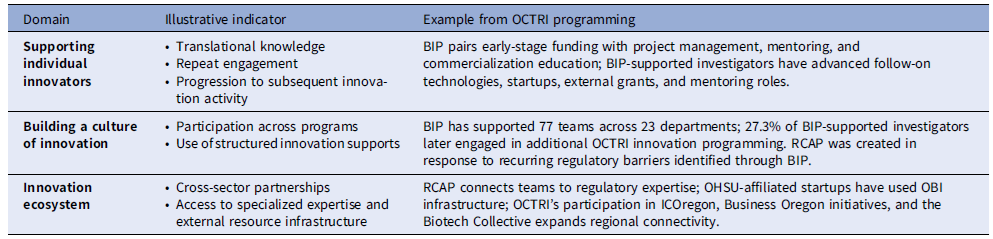
Clarifying these dynamics allows institutions to assess progress in real time, allocate resources responsively, and strengthen the foundations that enable sustained translational activity. Table 1 synthesizes these examples by mapping selected indicators to each domain.
Applying the proposed innovation evaluation domains to OCTRI program examples

Table 1. Long description
Table 1 has three columns. They are Domain, Illustrative Indicator, and Example from Oregon Clinical and Translational Research Institute programming. The first row is Supporting Individual Innovators. The indicators are translational knowledge, repeat engagement, and progression to subsequent innovation activity. The Biomedical Innovation Program pairs early stage funding with project management, mentoring, and commercialization education. Supported investigators have advanced follow on technologies, startups, external grants, and mentoring roles. The second row is Building a Culture of Innovation. The indicators are participation across programs and use of structured innovation supports. The Biomedical Innovation Program has supported 77 teams across 23 departments. Of its supported investigators, 27.3 percent later engaged in additional Oregon Clinical and Translational Research Institute innovation programming. The Regulatory Consultation and Assistance Program was created in response to recurring regulatory barriers identified through the Biomedical Innovation Program. The third row is Innovation Ecosystem. The indicators are cross sector partnerships and access to specialized expertise and external resource infrastructure. The Regulatory Consultation and Assistance Program connects teams to regulatory expertise. Oregon Health and Science University affiliated startups have used Oregon Bioscience Incubator infrastructure. Participation in Innovate Collaborate Oregon, Business Oregon initiatives, and the Biotech Collective expands regional connectivity.
The table illustrates how selected indicators can connect domain-level evaluation to programmatic learning, resource allocation, and institutional capacity building.
Redefining success
Traditional indicators such as ROI and licensing outcomes remain important, but provide an incomplete picture. Innovation programs operate upstream of commercial endpoints, where progress may be reflected in investigator capability, institutional learning, and ecosystem coordination. Evaluating innovation solely through downstream financial outcomes can obscure programmatic capacities that are relevant to translation.
For CTSA hubs and similar academic institutions, this challenge aligns with a shift in translational science toward understanding and strengthening mechanisms of translation instead of measuring outputs alone. Tracking repeat participation, regulatory engagement, and cross-sector partnerships can help institutions assess how translation is enabled and sustained.
The framework proposed here offers a conceptual and practice-oriented approach to evaluating programmatic value across three domains: supporting individual innovators, building a culture of innovation, and strengthening the innovation ecosystem. As illustrated through OCTRI’s programming, these domains can surface leading indicators of translational readiness before commercial outcomes are available, without treating those indicators as causal proof of downstream success. Future research should test whether indicators across the three domains are associated with later commercialization, implementation, or broader outcomes. Testable hypotheses include whether repeat engagement with innovation programming is associated with follow-on funding or successful exit; whether early regulatory consultation is associated with reduced development delays; and whether stronger ecosystem connectivity is associated with partnerships, investment, or sustained project progression.
Redefining success in academic biomedical innovation does not require abandoning economic measures. It requires recognition that institutional learning, coordinated support structures, and sustained engagement across investigators are measurable outcomes. Evaluation that captures these dimensions strengthens accountability and supports continued translational impact over time.
Acknowledgments
The authors thank Matt Honore, Program Administrator at the OCTRI, and Mary Samuels, Senior Scientist at OCTRI, for their review of program evaluation content and editorial feedback. The authors also thank Penelope Hogarth, MD, Professor of Molecular & Medical Genetics and Neurology at OHSC, for her review and factchecking of the rare disease section.
The authors acknowledge the use of artificial intelligence (AI)–assisted editorial tools to support language refinement and structural clarity during manuscript preparation. All authors take full responsibility for the scientific content of this manuscript and confirm that it adheres to the Journal of Clinical and Translational Science authorship policy.
Author contributions
Claudia Nakama: Conceptualization, Data curation, Investigation, Writing-original draft, Writing-review & editing, Jonathan Jubera: Conceptualization, Writing-original draft, Writing-review & editing, Melissa Mudd: Conceptualization, Writing-review & editing, Christopher Sagar: Visualization, Cynthia Morris: Conceptualization, Writing-review & editing, Aditi Martin: Conceptualization, Supervision, Writing-original draft, Writing-review & editing.
Funding statement
The projects described are supported by the National Center for Advancing Translational Sciences, National Institutes of Health, through Grant Award Number UL1TR002369. The content is solely the responsibility of the authors and does not necessarily represent the official views of the NIH.
Competing interests
The authors declare that they have no competing financial interests related to the content of this manuscript. The authors are affiliated with the Oregon Clinical and Translational Research Institute (OCTRI), the Division of Informatics, Clinical Epidemiology and Translational Data Science, and Collaborations and Entrepreneurship at Oregon Health & Science University (OHSU), which administer and support innovation programming described in this manuscript. These affiliations reflect institutional roles in program development and evaluation but did not involve any financial compensation, equity interests, or personal commercial benefit tied to specific projects discussed herein.
No author has received consulting fees, honoraria, equity holdings, or other financial interests from companies referenced in illustrative examples within this manuscript. The content represents an academic analysis of programmatic evaluation approaches and does not constitute endorsement of any specific commercial entity.



 Open access

