INTRODUCTION
The aim of this paper is to study an emerging construction in contemporary French, viz the Noun + Noun construction (NN) where the second N is the head of the noun phrase (NP). Examples are provided in (1) below without any discussion – they will be discussed in detail in the following section:
- (1)
a. la Star Academy/Académie (name of a TV show on TF1)
b. un job salon (name of a job fair held in Lille)
c. la Marcelle solidarité (title of a TV documentary, France 3)
d. le droite test (La Méthode Cauet, quiz show)
e. la grève attitude (Libération)
f. le jeune voyageur service (SNCF)
In particular, we investigate two specific cases of this construction, viz with the head nouns academy/académie and attitude. We argue in this paper that such constructions are not borrowed from English and show that they are actually expanding beyond particular usage to a more general pattern, on its way to grammaticalizing into a construction in its own right. We also suggest that the type of preposing which is the focus of this study might be related to a more general trend in contemporary French and might lead researchers to reconsider the longstanding question of the diachronic evolution of French adjectives from prenominal to postnominal position.
The paper is organized as follows. In section 1 general comments on French and English are made, which concern the position of the head in noun phrases. In section 2 the data are described, their history in the French language traced, and a semantic analysis of the relation between the two Ns investigated on the basis of attested examples found in the French media (traditional and internet). In section 3 the natural question concerning the official or temporary character of such constructions is discussed. Finally, in section 4, the question of the nature of the construction (morphological or syntactic) is investigated.
1 ENGLISH AND FRENCH: LEFT-HEADED VS. RIGHT-HEADED NOUN PHRASES
One of the main differences between English and French concerns the position of the head noun (N) in noun phrases. In English, nouns systematically appear to the right side with modifiers (adjectives, modifying attributive nouns) preceding them.Footnote 2 In contemporary French, head nouns can appear to the right or to the left of modifiers. Although this seems to suggest that head-modifier order is free, the position of modifiers is generally constrained and for the most part postnominal;Footnote 3 a different position can trigger a different meaning. Among the modifiers, only attributive adjectives can be preposed (un bel homme; une grande table). Various phonological, morphological, semantic and weight-related factors have been suggested to account for the position of adjectives.Footnote 4 Moreover, many researchers have pointed to the diachronic evolution from adjective preposing to adjective postposing between Old French and Present-Day French (e.g. Damourette and Pichon, Reference Damourette and Pichon1911–1930; Wilmet, Reference Wilmet1981), although the reality of this evolution has been questioned recently (see Manguin, Reference Manguin, Purnelle, Fairon and Dister2004 and Noailly, Reference Noailly1999).
As for structures of the type N(-)N, which are the focus in this paper, the opposition between English and French is clear-cut: the head in English is systematically on the right side (regressive order or head-final, NN) while in French it is systematically on the left side (progressive order or head-first, NN)Footnote 5. Examples (2) and (3) illustrate this opposition:
- (2)
a. a police car
b. a housewife
c. toothpaste
- (3)
a. un homme-grenouille
b. un oiseau-mouche
c. un chou-fleur
This can easily be shown if we refer to the semantics of those compounds: toothpaste is a kind of paste, a police car is a specific kind of car while un homme-grenouille is a man and un oiseau mouche a bird. Further evidence comes from agreement phenomena in French, since it is the head that controls gender agreement, viz the noun on the left:
(4) a. Un/*une homme-grenouille a été découvert/*découverte mort/*morte ce matin dans le lac.
N+N phrasal structures, which are to be differentiated from lexical N+N compounds,Footnote 6 show the same opposition concerning the position of the head. In English, phrasal structures such as steel bridge for instance (Giegerich, Reference Giegerich2004), display the order modifier + head (NN). In French, N+N structures like visite éclair, assurance maladie, or taxe carbone, labeled ‘attributive nouns’ (substantifs epithètes) by Noailly (Reference Noailly1990, Reference Noailly1999), show the traditional order head+modifier (NN). The regressive order is ungrammatical in French (*éclair visite, *maladie assurance, *carbone taxe,), and this is also the case for nominal compounds (*grenouille-homme, *mouche-oiseau).
The head-first vs. head-final orders for English and French respectively thus seem to represent one of the fundamental differences between the two languages, just like, for instance, the fundamental opposition between English being a satellite-framed language and French being a verb-framed language (see e.g. Berman and Slobin, Reference Berman and Slobin1994). However, a look at contemporary French seems to suggest that some expressions display a regressive order for the head and its (thus preposed) modifier in an NN structure (see Loock, Reference Loock, Bertrand and Schaffner2009 for a simple description of the data and a consideration of pedagogically-related questions). While some examples are directly borrowed from English, others seem to suggest that the phenomenon is evolving independently from English.
2 THE DATA
In this section we present the data corresponding to head-final NN structures, distinguishing first between recognized borrowings from English that are listed in French dictionaries and unrecognized borrowings that have no official status in the French lexicon. We focus on the latter examples and we study how they show that the structure is expanding way beyond borrowing phenomena, with particular emphasis on N academy/académie and N attitude examples.
2.1 Recognized borrowings
In the twentieth century, French, like numerous other languages, borrowed many words from English. Among these borrowings are N+N structures (compound or phrasal) with a regressive order, which have naturally found their way into French dictionaries: airbag, corn flakes, businessman, tennis club, boat people. Some of them have been completely integrated with spelling or other modifications such as surprise partie (< surprise party) or tour opérateur (< tour operator).
These borrowings can be divided into two subtypes. Some of them, such as airbag or boat people, remain opaque constructions for speakers of French that have no particular knowledge of the English language. That is to say, speakers do not realize that the structure of these words, with the head on the right side, goes against one of the basic morphological rules of French, and thus the compounds are processed as undividable lexical entities. The best illustration of this is the agreement phenomenon with boat people, since French speakers (and the media), assuming it is a French-like compound, regularly make agreement between the verb and the left element, boat, the translation of which is masculine singular in French (bateau), instead of the right element people, the translation of which is masculine plural (gens):
(5) [Ahn Dao Traxel] avait été adoptée par Jacques et Bernadette Chirac à son arrivée en France en juillet 1979, à l'âge de 21 ans, après avoir quittée [sic] le Vietnam sur un (MASC) boat people. (Nouvel Observateur, November 2009)
(6) [Nguyen An Tinh] n'en eut que les miettes dont elle garda cependant précieusement le souvenir après la fuite sur un (MASC) boat people. (Le Figaro, 21 January 2010)Footnote 7
Some other N+N constructions with a regressive, English, word order are more transparent for French speakers, who seem to recognize their internal structure. This is the case of N+man compounds (e.g. businessman, barman) or N+club compounds (e.g. country club, football club, night club). The recognition of the morphological structure of these compounds is illustrated by their productivity:Footnote 8tennisman and pétanque club for instance have been coined in French without being borrowed from English, where these words do not exist.
The borrowed examples show that head-final, regressive NN compounds do exist in French. Although it is difficult to say when a borrowing is recognized as such by speakers, the second series of borrowings in particular shows that French speakers must have a certain awareness of their internal structure. Otherwise, there would be no productivity for the pattern independently of English.
2.2 Unrecognized borrowings
In addition to these examples, the French language has recently seen the appearance of unrecognized regressive N+N structures (NN), i.e. structures which are not listed in dictionaries and that are unequivocally condemned by prescriptivists and even by some linguists. This is because the examples are very recent, the result of voluntary wordplay apparently based on another language and whose systematicity within the French morphosyntactic system still remains to be proven. However, while some of the words used in the examples can be explained by the traditional morphological process of borrowing from English, others seem to have appeared and to be evolving independently of it. Below we provide a selection of the data that we wish to consider together with a gloss that makes explicit the semantic relationship between the head noun and the preposed modifying N. Further information is provided when necessary, since most examples include very specific aspects of French cultural life.
- (7)
a. la Star Academy/Académie = an academy that you join to become a star (name of a TV show)
b. un job salon = a fair where you collect information on jobs (name of a job fair in Lille, northern France)
c. le Bondy blog = the blog of the city of Bondy
d. le droite test = a test to determine whether you are right-wing or not (used on a French TV show to interview politicians and celebrities)
e. Sexe Intentions = intentions regarding sex (translated title of an American movie, Cruel Intentions)
f. la Neuf/Darty/Free. . . box = the box that provides internet access from Neuf/Darty/Free. . .
g. la grève attitude = the attitude of a person who is on strike (expression regularly used on strike days in France by the press)
h. la Marcelle solidarité = the kind of solidarity that is characteristic of a specific woman called Marcelle (an old lady involved in charity work; la Marcelle solidarité was the name of a TV documentary dedicated to her)
i. le jeune voyageur service = service offered to young travellers by the French national railway company SNCF
In all of these examples, the head noun appears on the right side and is modified by another noun that is preposed (NN structure). Naturally, most of these examples contain words that have been borrowed from English (star, academy, job, blog, test, box), but not exclusively. Le jeune voyageur service, for instance, is quite revealing. This service has been provided by the French national railway company SNCF since spring 2009 and is meant to be understood as a service that is available to the parents of young children who travel alone, without an adult to accompany them.Footnote 9 The film title Sexe Intentions is also revealing: instead of Cruelles Intentions, with perfectly grammatical preposed adjective, the translators have chosen an NN structure, which violates the morphological rules of French (the presence of –e at the end of sexe shows it is the French word that has been chosen) but probably makes the title more appealing for the target audience (teenagers) through the mimicking of English. The history of the example Star Academy/Académie is also interesting. The expression Star Academy was coined for a French reality-television show broadcast in France, where it is not unusual for titles of TV shows or series to include words and expressions of English origin. What is particularly interesting is that the concept was adapted by Quebec, a French-speaking region famously known for its (at least) official rejection of terms of English origin. The title was naturally ‘translated’. . . into Star Académie! The word academy was gallicized but the NN structure was not modified. In a similar way, Microsoft has translated the name of its search engine MSN Search for the Québec page. The official translation is MSN Recherche. While the term for a search is an MSN Search in English, in Québec French it is une MSN Recherche, not une recherche par MSN or even une recherche MSN.Footnote 10
2.3 From exceptional constructions to patterns
Such examples would be rather uninteresting and unrevealing if they were limited to those provided in (7). The use of NN structures by French speakers would then be analyzable as exceptional constructions involving English nouns and proper names that are limited in use and correspond to some sort of conscious word play outside syntactic constructions. However, some of these examples have become a sort of pattern (or even template) as the basis for the creation of multiple (endless?) combinations. If one can talk about productivity (see definition in footnote 7), is it still possible to consider such examples as deviations from the norm? This is what Noailly (Reference Noailly1990: 173ff) does when she discusses examples with a regressive order similar to those mentioned here. She provides examples like Jeune Afrique Economie, Québec science, Brest espoir, Gaz dépannage, brochette party, divorce boom, but considers them to be sporadic borrowings and ‘anomalies’ (her term) which violate the official progressive order of French. We take here the opposite position, that is to say, we claim such examples are revealing of a new strategy that speakers can resort to and of a new head-final structure that is not limited in use.
The data under study here were collected over the last few years (2004–2010) from the French media: traditional newspapers and magazines, radio, television and the internet. Examples were collected alongside the context they appeared in, as most of them correspond to titles, slogans, names of products or events. Although many were heard on television or on the radio, most of the examples in our corpus were actually found in writing, on the internet, in written advertisements, but also in quality newspapers such as Libération and Le Figaro. Automatic searches were also performed on the internet, using a search engine to collect examples corresponding to specific patterns, like the ones explored in the following two subsections. Although no precise statistics can be provided on the frequency of use for such head-final structures in contemporary French, it seems perfectly reasonable to qualify their use as frequent. In total we collected about 150 different examples, some of which are regularly used in the French media, like la grève attitude for instance.
Below we discuss two specific types of examples (la N academy/académie and la N attitude), which are so recurrent that they have become patterns allowing for productivity.
2.3.1 La Star Academy examples
The Star Academy example, the princeps occurrence, has become a pattern for what seems to be a potentially unlimited series of examples.Footnote 11 In Appendix 1 we provide a (selected) list of the nouns that can be found before the head noun Academy/Académie. Explanations are provided in a second column when necessary, as most examples refer to very specific aspects of contemporary French cultural life.
To complement Appendix 1, we provide in (8) below a series of contextualized, attested examples using some of the Ns provided in the table. They show that N Academy/Académie examples are not found exclusively in titles or slogans.
- (8)
a. La « greffe academy » est un canular. Le « Grote Donor Show » hollandais était une loterie virtuelle pour sensibiliser au manque de donneurs d'organes. (Le Soir, 1 June 2007)
b. La Russie qui a pratiqué un jeu offensif de grande qualité contre la Hollande, s'est fait éliminée [sic] par l'Espagne, c'est donc la fin de la tsar academy ! (internet forum)
c. La Science Académie existe depuis 2006. Elle est animée par des étudiants et des chercheurs de l'association Paris-Montagne qui souhaitent partager leur goût pour les sciences. (leaflet for a science camp)
d. La faluche academy, vidéo faite par les étudiants en médecine de Créteil pour le week-end d'intégration 2005. (video posted on an internet forum)
e. La sans-papiers Academy s'organise rue Charlot. Quelque 800 Africains occupent depuis mai la Bourse du travail du 3e arrondissement de Paris, créant des tensions avec les syndicats. (article on the official weblog of the city of Bondy)
f. Monsieur Estrosi n'est, au final, que la racine carrée de Monsieur Sarkozy. . . Le « gagnant », après vote du public, de la « Sarkozy Academy » ! (article on www.nicepremium.com, 21 August 2008)
Each of the ‘la N Academy/Académie’ examples refers to the existence of a competition between different contestants within a community often with educational purposes, as in the Star Academy TV show (2001–2008), where contestants competed with each other to become the sole winner of the show as the best singer. For instance, la portable academy refers to a selection that a user wants to make between different competing cellphones in order to pick the best one. The expression la Sarkozy Academy has been used on several blogs to refer to the different politicians that either belong to the French government or to the president's UMP party. La ventriloque academy is the name of a DVD that is supposed to teach you how to become a ventriloquist. The notion of competition is therefore not systematically present, but very often a derogatory interpretation is to be inferred as in la Sarkozy Academy or la sans-papiers Academy, a sort of sarcastic politically-incorrect parody of the TV show to elect the best illegal immigrant from those who wish to acquire the right to stay in France.
2.3.2 La grève attitude examples
Even more intriguing and symptomatic of a possible morphological innovation in French is the case of la grève attitude mentioned in (7). The French media regularly use expressions of the type ‘la N attitude’ to describe a type of attitude or behavior that is characteristic of either the activity (here, strike) or the person (President Sarkozy in la Sarkozy attitude for instance) denoted by the modifying preposed N. Appendix 2 provides a selected list of nouns that can appear in the preposed position to the head noun attitude, presented in alphabetical order. Note that in all the examples that were found in spoken French the noun attitude is always pronounced as the French word /atityd/ without any specific imitation of the English word.
As we did for the N Academy/Académie examples, we provide in (9) a series of contextualized, attested examples using some of the Ns to complement Appendix 2:
- (9)
a. La Velib'attitude dans le 3e. Avec plus de trois millions d'utilisateurs depuis son lancement le 15 juillet dernier, le fameux deux roues de JCDecaux séduit. (website of the 3rd district in Paris)
b. À l'époque, on parle même de « Jamelmania »: main droite fourrée dans la poche, les ados de tous milieux confondus prennent la Jamel attitude. (Pédagogies Magazine, April-May 2008)
c. Pour te montrer qu'on aime la France, je t'assure qu'on a adopté la triche attitude aussi. (internet forum)
d. Jouer de son côté garçonne ne signifie pas pour autant qu'on doit se lâcher et devenir vulgaire. Au contraire ! Baisse ta voix d'un cran, étudie ton vocabulaire, soigne ta diction. . . La “caillera attitude”, ça fait fuir les mecs ! (http://teemix.aufeminin.com/)
e. Nous voilà face au énième épisode de la Sarkozy attitude, une forme d'arrogance assumée, enrobée dans un faux parler vrai, qu'il trimballe de sommets internationaux en visites sur le terrain. (France Inter website, 20 April 2009)
f. Le bébé a la cote ! Jamais les naissances n'ont été aussi élevées depuis 1981, les publicités dragouillent sans complexe le baby-consumer et les nouveaux parents sont prêts à tout pour faire de leur enfant, un roi. La gazouillis attitude deviendrait-elle phénomène de mode ? (www.teva.fr, 14 November 2007)
The history of this construction is interesting and reveals a productivity that seems to have started independently of the English language. In 2004, a French singer appreciated mainly by teenage girls released a song entitled La positive attitude, to be understood as an optimistic attitude to life. In 2005, the then Prime Minister of France Jean-Pierre Raffarin quoted the lyrics of this song to invite the French people to adopt an optimistic attitude when facing the economic and social difficulties of the country at that time. As might be expected, the media made numerous comments about Mr. Raffarin's statement and rapidly the phrase la Raffarin attitude was all over the French media. La positive attitude is not morphologically exceptional: the adjective positive is preposed, which is indeed exceptional for this adjective (although it is often preposed when modified by an adverb: la très/bien positive attitude), but this combination nevertheless respects the rules of French morphology. The phrase la Raffarin attitude, on the other hand, does not conform to the standard norm: the proper name is preposed to the head noun attitude, meaning the kind of attitude adopted and promoted by Raffarin. Very rapidly, the proper name Raffarin was replaced either with other proper names or nouns within the phrase la N attitude. The productivity of the pattern has not slowed since then and new examples can regularly be seen or heard in the French media. As is shown by the list of Ns in Appendix 2, some of the Ns have an English origin (e.g. fashion, web, roll, smiley) but most of them come from French, formal and informal, and the history of the expression seems to indicate that the phenomenon has started independently of English.
The relation between the preposed N and attitude can sometimes be complex. For instance la planète attitude denotes the attitude of people who want to protect the planet; in the context where the example occurred, la Velib’ attitude (where Velib corresponds to the name of the self-service bicycle project in Paris) denotes the attitude of people who not only use the Velib bicycle service but adopt a way of life that is seen to be compatible with the use of the bicycle scheme (i.e. living in town, consuming organic food, being environmentally-conscious. . .). The phrase la cheval attitude is the title of a magazine dedicated to people who ride and/or are interested in horses. In a similar way, la pêche attitude and la sieste attitude denote the attitudes of people who enjoy fishing and taking siestas, respectively.
Based on the examples we have collected, it seems that the semantic relationship between attitude and its modifying preposed noun can be divided into three sub-types according to what is denoted:
1 the general attitude of N as established by the different characteristics of N. This is the case when N is a proper name for instance: la Jamel attitude is meant to describe the attitude of Jamel himself, a French humorist and comedian, through the sum of his characteristics.
2 the attitude of someone other than N as established by the different characteristics of N. In our corpus, this is the case of la Brice attitude for instance: the characteristics of Brice, a movie character, are used to define someone else's attitude, not Brice's.
3 the attitude of someone in relation to an object or an activity denoted by N. This is the case of la planète attitude and la Vélib’ attitude discussed above for instance. This also includes Ns that refer to a specific activity or entity through metonymy: gazouillis for instance refers to the noises made by babies and la gazouillis attitude refers to the attitude of people who have or admire babies.
The role of the preposed N is therefore attributive and qualifies the type of attitude designated by the characteristics of N. The N attitude is to be understood as an attitude similar to N's or typical of someone involved in or particularly interested in N.
It is interesting to note that in all the examples we have collected, N is a proper name or the name of a concrete object or activity. Abstract entities like liberté, attention or pensée seem to be impossible. All examples show the use of a referential noun that allows for the creation of a subcategory of attitude, either directly (la Jamel attitude is a specific kind of attitude, that has the characteristics of French comedian Jamel as opposed to other types or attitudes) or through metonymy (la gazouillis attitude).
Regarding this specific pattern, one important question that should be raised at this stage is why people use nouns when derived adjectives could be used, in conformity with a more ‘traditional’ French morphosyntax: la grève attitude could be seen as a synonym for l'attitude gréviste or la Sarkozy attitude a synonym for l'attitude sarkozienne/sarkoziste for instance. I follow Noailly (Reference Noailly1999), who explains the use of postnominal nouns as attributes (visite éclair or assurance maladie, examples given in section 1) as follows: (i) the French language allows for the existence of such constructions; (ii) something else/better is then said. One then needs to define the additional, connotational meaning that is brought by the use of such a structure instead of a noun+adjective combination. As we have noted, the use of the NN construction often conveys sarcasm, irony, or at least the negative evaluation of the speaker, which suggests a pragmatic function for the use of such constructions. Moreover, in some examples the preposed N cannot be replaced with an adjective, because it simply does not exist, or with a postposed attributive noun as defined by Noailly: ??l'attitude gazouillis, ??l'attitude triche, ??l'attitude malbouffe. . . The use of a prepositional phrase instead of preposed proper names provides a completely different meaning: l'attitude de Raffarin simply describes the attitude of the (former) Prime Minister but does not denote a specific kind of attitude such as that adopted and promoted by Raffarin, which the NN structure does express.
The reason why people use such structures can also be viewed from a wider theoretical perspective on linguistic change. According to Marchello-Nizia (Reference Marchello-Nizia2006: 24–25), linguistic changes in general, and grammaticalization in particular,Footnote 12 stem from pragmatic/semantic phenomena that are triggered by the social use of language: speakers want to attract their addressees’ attention or increase their expressivity. The idea is to use a linguistic resource that is different from what the grammar has to offer, so as to be noticed by the addressees. From a socio-linguistic perspective, it would be interesting to study the relationship between speakers using such non-standard structures and their addressees. This will be the object of future research.
3 TEMPORARY TREND OR INNOVATIVE MORPHOLOGICAL/SYNTACTIC CONSTRUCTION?
Given the recent appearance of these examples, it is very hard to determine whether they represent a temporary trend based on the mimicking of English for sociolinguistic purpose (voluntary deviation from the norm to attract the hearer's attention) or a more important linguistic phenomenon which is destined to evolve and spread.
Several indicators seem, however, to point in the direction of morphosyntactic innovation, first and foremost the productivity of the N Academy/Académie and N attitude expressions. Although demonstrating productivity would require a more rigorous approach with quantitative data in particular, our corpus shows that new examples, with new Ns occupying the preposed position, appear in the French media regularly. As productivity must also be considered as the capacity for the creation of new forms in addition to the collection of attested examples, it is important to note that it is not impossible to create new examples. If we use the noun linguistique in the expression la linguistique attitude, of which no examples can be found at the moment this article is being written, it is easy to understand the kind of attitude we mean to describe: an attitude that is typical of people interested in linguistics, such as paying attention to the way people speak. Moreover, the history of sequences based on the pattern la N attitude seems to suggest morphosyntactic innovation rather than borrowing from the English language – it is quite hard to translate some of the examples into English (e.g. ??the strike attitude, ??the planet attitude, ??the babbling attitude).
The existence of examples such as le jeune voyageur service, already discussed above, and la Marcelle solidarité seems to indicate that the phenomenon is evolving on its own, independently from English, even for wordplay. Also, the notion of borrowing has to be handled with caution. It is generally assumed that attributive nouns in NN structures as defined by Noailly (Reference Noailly1990) for instance (visite éclair; assurance maladie) represent a borrowing from English. Noailly, and also Arnaud (Reference Arnaud2008), have shown that this is not the case at all: Noailly found examples that date back to the 14th century, and Arnaud had more than 60 examples that existed in 1800.
Another recent phenomenon that has been briefly mentioned (e.g. Noailly, Reference Noailly1990), but not yet studied in depth, could be related to this use of preposed nouns as modifiers. Although no precise statistics have been compiled yet, some researchers have noticed that the general tendency to postpose adjectives in French may have started to go in the reverse direction, i.e. towards an increase in preposing. This seems to concern prepositional phrases as well:
- (10)
a. Dans un communiqué, le ministre de l'Intérieur dénonce « une vaine et ridicule tentative de polémique ». (Le Parisien, 10 September 2009)
b. Une séduisante et peu touristique région. (TGV magazine, 2008)
c. La police du Grand Paris amorce une inédite campagne d'immersion en banlieue. (Le Figaro, 17 October 2009).
d. une peu contestée réussite esthétique (Noailly, Reference Noailly1999)
e. l’infatigable et toujours fidèle Hillary Rodham Clinton (Noailly, Reference Noailly1999)
f. Chaque lundi jusqu'au 31 août, nous nous immergerons dans les très en vogue métiers de l'aide à domicile. (La Voix du Nord, August 10, 2009)
Following Noailly (Reference Noailly1990: 88 et seq.), we might refer to these as ‘unexpected’ preposings. However, in the absence of any quantitative study of this phenomenon, caution is called for, especially as some examples in (10) exhibit features that have been said to favour preposing (presence of très, of another modifier or of two or more adjectives). But it is interesting to note that the general view according to which the position of French adjectives went from preposing to postposing from a diachronic perspective has recently been questioned (see Manguin, Reference Manguin, Purnelle, Fairon and Dister2004, for instance). If the phenomenon were to be confirmed however, the use of NN structures in French could then be viewed as part of a more general phenomenon, viz the increase in modifier-preposing, as the result of the influence of English or not. It is also possible that the two phenomena are not interconnected; this question is left open for future research.
Within such a larger approach, it would then be interesting to include neoclassical compounds like phytothérapie or insectivore (see Adams Reference Adams1973, Bauer Reference Bauer1983, or Amiot and Dal Reference Amiot, Dal and Amiot2008 for French specifically) which also show a regressive order as opposed to ordinary compounds. Such a study could also include compounds like chiraco-gauchisme or la mitterrando-nostalgie, where the insertion of /o/ creates bound lexemes chiraco and mitterrando from the proper names Chirac and Mitterrand. These lexemes modify the N that appears on the right (leftism such as practised by Chirac; the nostalgia for the period when Mitterrand was president). Such compounds show a regressive order (see Amiot and Dal, Reference Amiot, Dal and Amiot2008 for more details).
4 SYNTACTIC OR MORPHOLOGICAL CONSTRUCTION?
Since the aim of this paper is to provide a description of a new phenomenon in contemporary French, we now tackle the question of the type of structure that is at stake here. Being the result of the combination of two lexical elements, NN structures such as those studied here are morphosyntactically ambiguous. Are they lexical compounds or syntactic phrases? NN structures have been a thorny problem for linguists as they question the border between morphology and syntax. If the structure represents a lexical compound then it is a morphological structure; if it represents a phrasal structure then it is a syntactic structure. Many linguists, morphologists and syntacticians have worked on NN structures, particularly in English, to devise tests differentiating lexical compounds from phrasal structures (Zwicky, Reference Zwicky and Levine1992; Fradin, Reference Fradin1999; Ten Hacken, Reference Ten Hacken1994; Giegerich, Reference Giegerich2004, Reference Giegerich, Lieber and Stekauer2010 to name but a few). The tests are not without problems (see for instance Giegerich, Reference Giegerich, Lieber and Stekauer2010 or Ten Hacken, Reference Ten Hacken1994) and seem in particular to be operational for English NN structures. In addition, Corbin (Reference Corbin1992) has convincingly shown that these tests reveal more about their interpretation (single lexical unit or not) than about their construction (compounding or syntactic construction).Footnote 13
In French the debate has for instance concerned VN structures like porte-plume, allume-cigare (Villoing, Reference Villoing2003) or the attributive nouns NN as defined by Noailly (Reference Noailly1990, Reference Noailly1999) or by Arnaud (Reference Arnaud2008) like visite éclair or assurance maladie (see above). In the case of VN structures, Villoing reaches the conclusion that they are compounds and not syntactic constructions while Arnaud cautiously refuses to conclude categorically on the morphological or syntactic status of attributive nouns, suggesting that the traditional tests do not fit left-headed languages like French and preferring the definition of a prototypical behavior, which seems to suggest that NN structures are lexical compounds anyway.
Bearing in mind their restrictions, which we do not have the space to discuss here, we apply the different discriminating tests below to our NN structures la N Academy/Académie and la N attitude. The acceptability of manipulated examples has been judged by 3 different informants, all of them native speakers of French between 20 and 30 years old.
4.1 Insertion test
The insertion of a modifier, an adjective or a noun, between the two Ns, is impossible in the case of lexical compounds (*a watch gifted maker vs. a steel suspension bridge):
Our data suggest that the preposed noun can be modified:
- (11)
a. la [grande générosité] attitude
b. le [jeune voyageur] service
If the head noun is modified, the modifier has to precede the preposed N, and it is the whole NN entity that is modified by the adjective:
- (12)
a. la pitoyable [Sarkozy attitude]
b. *la Sarkozy pitoyable attitude
c. Chapeau à toutes les deux, ça c'est de la belle [blog attitude]! (attested example from an internet weblog)
d. *Chapeau à toutes les deux, ça c'est de la blog belle attitude!
In the following attested example from the web, the use of the quotation marks indicates that the adjective grande bears on the whole N attitude string:
(13) Et après la grande “flip attitude” du départ, je suis très heureuse d'être là et pour rien au monde je ne laisserai ma place!!
4.2 Anaphora test
The anaphora test is meant to show that the preposed N has no referential value and cannot be used anaphorically, with an anaphoric pronoun. The NN structure then constitutes one single lexical unit:
- (14)
a. */??On s'est beaucoup moqué de la Raffarin attitude car il aurait vraiment mieux fait de se taire.
b. */??Il a adopté la Vélib’ attitude et le prend tous les matins pour aller jusque la gare.
c. *Bienvenue à la portable academy: nous allons vous aider à le choisir.
The unacceptability of these examples suggests that the preposed Ns have no referential value and the expressions constitute one lexical unit.
4.3 Head-deletion under coordination test
In a similar way, the head-deletion under coordination test, impossible for compounds, seems to fail, except that (16b) does not sound completely unacceptable (or at least not as bad as (16a) and (16c)):
- (15)
a. *Pierre a adopté la sieste attitude mais pas la travail ___.
b. *Pierre a adopté la Sarkozy attitude mais pas la Fillon___.
- (16)
a. * Il y a deux attitudes: la sieste ___ et la travail ___.
b. ?Il y a deux attitudes: la Sarkozy ___ et la Fillon ___.
c. *Il y a deux académies: la portable ___ et l'ordinateur ___.
However, the fact is that we have no attested examples similar to (16b) and cannot confirm its acceptability.
4.4 Double modification of the head test
The possibility of coordinating two modifying Ns before N is an indicator that the NN sequence is a syntactic construction, not a morphological compound:
- (17)
a. ??a [watch and clock] maker
b. [steel and aluminum] bridges (Giegerich, Reference Giegerich2004)
In the case of our French NN structures, coordination does not seem possible – we have not found any attested examples of the type [N et N] N, which, once again, points to the morphological nature of our NN constructions (18a-18b). However, coordination of the type la N et la N’ attitude (18c) does not seem completely impossible:
- (18)
a. ??/*des [Ségolène et Sarko] attitudes
b. ??/*les [blog et Facebook] attitudes
c. ?la Blog et la Facebook attitude
4.5 The inflection test
Another traditional test that is often mentioned as useful for determining whether English NN structures are compounds or phrases concerns plural formation. When the string is a lexical compound, the first N cannot bear the mark of the plural (*watches-maker; *detectives stories). This test has however been much debated and is considered not sufficiently operational as there seem to be numerous exceptions (cf. notion of plural attributives, see e.g. Jamet, Reference Jamet2006).
It is however interesting to note that in our la N attitude examples taken from French, which is of course a language where the plural marking of the modifiers cannot be compared with the situation in English, none of the examples we have collected shows a preposed N in its plural form (the only word that could be confused with a plural is djeun's, slang for young people, but ’s cannot be seen as a plural marker – un djeun's is a common thing to read/hear in contemporary French slang).Footnote 14 As far as the la N Academy/Académie examples are concerned, the use of the plural for the preposed N is possible: Appendix 1 provides two examples, politicards and producteurs.
4.6 The wh- movement of the head test
The purpose of this test (Ten Hacken, Reference Ten Hacken1994) is to determine whether the head or the modifying N can undergo wh-movement. Only phrasal structures can undergo wh-movement of the head:
- (19)
a. *What maker did you see? The watch-maker.
b. What bridge did you see? The steel bridge.Footnote 15
As far as our French NN examples are concerned, it seems intuitively possible for the head to undergo wh-movement, although once again we have no attested examples:
- (20)
- a.
A: ?De quelle attitude parles-tu ?
B: La Sarkozy/grève (attitude).
- a.
If attested, this would point, contrary to the results of the previous tests, to a syntactic construction and not a morphological construction.
4.7 Results
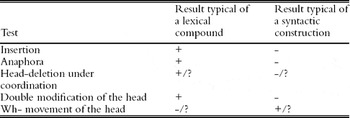
To conclude (only tentatively), it seems that most of the classical tests that have been used to determine whether an NN construction as defined here is a lexical compound or a syntactic construction point for the most part to the morphological construction. Table 1 sums up the results (the inflection test is not included as it is not considered relevant).
Morphological/Syntactic construction tests: a summary

Overall, the results are consistent. They would become inconsistent, however, if examples such as (20) and (16b) were attested, of which we have no evidence. The data have to be considered with caution, because of their relative newness in the language and their unrecognized status. In addition, while the results reveal that such constructions should be treated as lexical units, the traditional tests that have been used here do not categorically confirm that they are compounds (see Corbin Reference Corbin1992, on the fact that compounding and lexical units do not go hand in hand).Footnote 16
5 CONCLUSION
The aim of this paper was to present some contemporary data that are challenging for linguistic description. New words, new structures emerge in all natural languages of the world, arising from how speakers actually use the language. The difficult task here is that these newly emergent structures have not been described and have no recognized status (yet). At this stage, no one can tell what the future of NN constructions in French is. Perhaps it is only a temporary trend that will not endure apart from the isolated expressions that lexicographers will be prompt to classify (the expression la positive attitude was mentioned for the first time in a very recent dictionary of French expressions, Bernet et al., Reference Bernet, Rézeau and Artarit2008).
Given the newness of the phenomenon, our aim was first and foremost to describe the data and explore the different questions they pose: productivity, semantic interpretation, type of structure (morphological/syntactic). The data also questions further the general assumption that the French language does not allow preposed constructions, and should be studied alongside other constructions with a regressive order such as neoclassical compounds (see above).
All these questions naturally require further investigation, and many more questions remain to be addressed, such as (i) the frequency of such data in contemporary spoken and written French, (ii) how the structure has become part of the French system and the sociolinguistic motivation underlying its use, (iii) the type of productivity that is at stake and whether we are dealing with morphological templates or not, (iv) how the data discussed here can be related to other preposed constructions, (v) the confirmation of an increasing trend toward adjective preposing in present-day French and, finally (vi) the existence of such constructions in other Romance languages. All these issues are left for future research.
APPENDIX 1. EXAMPLES OF NS PREMODIFYING THE NOUN ACADEMY

APPENDIX 2. EXAMPLES OF NS PREMODIFYING THE NOUN ATTITUDE