Introduction
As the dynamics of today's world forces individuals to cross frontiers, thousands of children find themselves in schools where they must acquire such fundamental skills as reading in a language they do not speak at home. A common observation is that bilingual immigrant children perform worse in their new (or additional) language than their monolingual peers in reading acquisition (August and Hakuta, Reference August and Hakuta1997; Slavin and Cheung, Reference Slavin and Cheung2003). In light of this overall pattern of lower reading performance in young bilinguals, educators struggle to understand which of their bilingual students are normally developing bilingual readers and which have more fundamental language, reading, or possibly learning disabilities. To date, bilingual reading research has primarily focused on the development of a bilingual child's reading skills, per se (Oller and Eilers, Reference Oller and Eilers2002; Lopez and Tashakkori, Reference Lopez and Tashakkori2004). By contrast, monolingual reading research has had a more comprehensive and inclusive focus on the monolingual child's maturational milestones in early language development and the important ways that they are linked to the development of successful reading (Shapiro, Palmer, Antell, Bilker, Ross and Capute, Reference Shapiro, Palmer, Antell, Bilker, Ross and Capute1990). Language development and subsequent reading mastery in monolinguals, in turn, has been found to be highly sensitive to the age of first monolingual exposure (Lenneberg, Reference Lenneberg1967; Johnson and Newport, Reference Johnson and Newport1989; Mayberry and Eichen, Reference Mayberry and Eichen1991; Weber-Fox and Neville, Reference Weber-Fox, Neville and Birdsong1999; McDonald, Reference McDonald2000). In the present study, therefore, we ask whether the age of first bilingual exposure impacts reading development in bilingual children. We further investigate the novel hypothesis that children from monolingual English homes, who are being educated in bilingual programs, experience a reading development advantage as compared to monolingual children in monolingual reading programs.
Bilingual Age of Acquisition
The term “Age of Acquisition (AoA)” has been commonly applied to denote the age at which a monolingual individual first started learning a new or second language. This is not to be confused with another more broad use of the term “AoA” in child lexical (vocabulary) development, which is the age when a new word first enters the child's lexicon (Ellis and Lambon-Ralph, Reference Ellis and Lambon-Ralph2000). In this paper, the terms “bilingual AoA” and “age of first bilingual exposure” will be used interchangeably to mean the age when a bilingual child first began receiving intensive, systematic, and maintained exposure to his/her new language. It is common that young children born in a country may not be exposed to that country's majority language during the first years of life. Instead, they may be exposed first to a different language spoken within the family. Therefore, we do not use the terms “Age of Arrival” or “Age of Immigration”, as are sometimes used in studies of bilinguals, because these terms are not appropriate to our present populations of children under study.
Milestones and “sensitive periods” in language development
Timing in development – the regularity in the rate and nature by which specific behaviors or processes are expressed in the development of an organism – is a core construct in developmental biology and its importance as an index of biologically-controlled processes has been understood for decades (e.g. Lenneberg, Reference Lenneberg1967; Wolpert, Beddington, Brockes, Jessell, Lawrence and Meyerowitz, Reference Wolpert, Beddington, Brockes, Jessell, Lawrence and Meyerowitz1998). In early monolingual language development, social and conversational input factors are understood to have a robust impact on the frequency (number) of young children's vocabulary items but not on the age at which they hit universal linguistic milestones. Indeed, there is widespread agreement that monolingual babies achieve the first word milestone in production by approximately age 1;0, range 0;9 to 1;2 (e.g. Capute, Palmer, Shapiro, Wachtel, Schmidt and Ross, Reference Capute, Palmer, Shapiro, Wachtel, Schmidt and Ross1986; Vihman and McCune, Reference Vihman and McCune1994), first two-word combinations by approximately age 1;6, range 1;5 to 2;2 (e.g. Brown, Reference Brown1973; Bloom, Reference Bloom1975; Petitto, Reference Petitto1987), first 50-words (types) on average approximately age 1;7 (e.g. Nelson, Reference Nelson1973; Petitto, Reference Petitto1987; Charron and Petitto, Reference Charron and Petitto1991) – ages which are not modifiable to any great extent even in the face of intensive instruction and drilling. Said another way, the achievement of these overall language production milestones, particular grammatical word types, and other grammatical and syntactic knowledge is less amenable to environmental variation, less modifiable, and judged to be more governed by biological regulation than the number of children's vocabulary items, which is vulnerable to environmental factors such as drilling (see Goldin-Meadow, Reference Goldin-Meadow, Wanner and Gleitman1981 for the classic discussion of resilient and fragile properties of language in development). Importantly, an early age of first language exposure is considered to be essential in order for children to achieve each of these language milestones on the typical (healthy) developmental time course described above (Lenneberg, Reference Lenneberg1967; Mayberry and Eichen, Reference Mayberry and Eichen1991; Mayberry and Fischer, Reference Mayberry and Fischer1989; Neville, Coffey, Lawson, Fischer, Emmorey and Bellugi, Reference Neville, Coffey, Lawson, Fischer, Emmorey and Bellugi1997; Newport, Reference Newport1990).
Young bilingual children exposed to two languages from birth achieve each and every major linguistic milestone in their one language, on the same time table as their other language, and both languages proceed on the identical time table as observed in the monolingual child (Genesee, Reference Genesee1989; Pearson, Fernandez and Oller, Reference Pearson, Fernandez and Oller1993; Pearson, Reference Pearson1998; Petitto, Katerelos, Levy, Gauna, Tetreault and Ferraro, Reference Petitto, Katerelos, Levy, Gauna, Tetreault and Ferraro2001; Holowka, Brosseau-Lapré and Petitto, Reference Holowka, Brosseau-Lapré and Petitto2002; Kovelman and Petitto, Reference Kovelman and Petitto2002, Reference Kovelman and Petitto2003; Petitto and Holowka, Reference Petitto and Holowka2002). Unfortunately, the nature and time course of language development in children with varying ages of first bilingual language exposure (e.g., first bilingual exposure beginning several years after birth, and beyond), has received much less scientific attention even though this is a common state of affairs especially in today's mobile societies (Dulay and Burt, Reference Dulay and Burt1974; Wong Fillmore, Reference Wong Fillmore1976; Snow and Hoefnagel-Hoehle, Reference Snow and Hoefnagel-Hoehle1978; Shin and Milroy, Reference Shin and Milroy1999; Kovelman and Petitto, Reference Kovelman and Petitto2002, Reference Kovelman and Petitto2003). Despite this paucity of research, the age at which a bilingual child is introduced to a new (or additional) language has nonetheless been thought to impact ultimate dual language competence and proficiency, with persons with early exposure to two languages (“Early bilinguals”) achieving greater language mastery than persons with late bilingual exposure (“Late bilinguals”; Johnson and Newport, Reference Johnson and Newport1989; Thompson, Reference Thompson1991; Flege, Munro and MacKay, Reference Flege, Munro and MacKay1995; Flege, MacKay and Meador, Reference Flege, MacKay and Meador1999; Weber-Fox and Neville, Reference Weber-Fox, Neville and Birdsong1999; McDonald, Reference McDonald2000; Petitto et al., Reference Petitto, Katerelos, Levy, Gauna, Tetreault and Ferraro2001; Kovelman and Petitto, Reference Kovelman and Petitto2002; Petitto and Kovelman, Reference Petitto and Kovelman2003).
Behavioral research has shown that decline in adult bilinguals' linguistic competence in their new (additional) language may begin with first bilingual AoA as early as age 3 (Guion, Reference Guion2005). Consistent with this behavioral research, neuroimaging research has also shown that the brains of bilingual adults do not show a native-like pattern of activity in response to a new language acquired past age 3 (functional Magnetic Resonance Imaging, fMRI, study by Perani, Abutalebi, Paulesu, Brambati, Scifo and Cappa, Reference Perani, Abutalebi, Paulesu, Brambati, Scifo and Cappa2003), and others have reported non-native patterns with bilingual exposure past age 4 (e.g., an event-related potential, ERP, brain recording study by Weber-Fox and Neville, Reference Weber-Fox, Neville and Birdsong1999).
Taken together, such findings have led researchers to hypothesize that there is a “sensitive” period for language development (cf., Lenneberg, Reference Lenneberg1967). “Sensitive periods” represent select time periods in child development within which children have peaked sensitivity to particular information in the input over others, and, if exposed to the pertinent information during this time period, they will learn it most optimally. In bilinguals, for example, the degree of dual language mastery has been hypothesized to be strongly linked to the age at which children are first exposed to their two languages, with earlier dual language exposure thought to be developmentally optimal (e.g., Johnson and Newport, Reference Johnson and Newport1989; Mayberry and Fischer, Reference Mayberry and Fischer1989; Mayberry and Eichen, Reference Mayberry and Eichen1991; Neville et al., Reference Neville, Coffey, Lawson, Fischer, Emmorey and Bellugi1997; Petitto et al., Reference Petitto, Katerelos, Levy, Gauna, Tetreault and Ferraro2001; Sanders, Neville and Woldorff, Reference Sanders, Neville and Woldorff2002).
The overall existence of a biologically based “sensitive” period in bilingual and/or second language learning has been questioned by a number of researchers (Birdsong and Mollis, Reference Birdsong and Molis2001; Snow and Galabudra, Reference Snow, Galaburda, Galaburda, Kosslyn and Christen2002). These researchers have outlined such evidence as: (a) in the early stages of new language learning, older learners improve faster than young learners (Snow and Hoefnagel-Hoehle, Reference Snow and Hoefnagel-Hoehle1978); (b) some adult learners can achieve native-like proficiency in their new language (White and Genesee Reference White and Genesee1996; Bialystok and Hakuta, Reference Bialystok and Hakuta1999); (c) it appears that there is a general decline in new language learning abilities with age, rather than a certain cut off point at which individuals lose the ability to achieve native-like performance in their new language (Birdsong and Mollis, Reference Birdsong and Molis2001); and (d) it is the number of years of exposure rather than bilingual AoA that is affecting any observed differences between children with early and late bilingual exposure (Cummins, Reference Cummins1991). Liu, Bates and Li (Reference Liu, Bates and Li1992) have also raised an important concern that early (AoA) bilingual exposure may harm the development of the home language (a phenomenon called “attrition” or “language loss”) in immigrant children, particularly when the intensity of exposure to the new language and the peer pressure to “fit-in” with their new culture supersedes the amount and quality of home language exposure. These researchers have also pointed out that young children are typically provided with better language learning conditions than adult learners. Therefore, it might be due to more intense language learning conditions that younger learners are observed to have greater ultimate success in language acquisition than older learners. Thus, there is a lively ongoing debate in the field as to whether (i) a “sensitive” period of bilingual language development really exists, and, if it does, (ii) what are its age boundaries (Flege, Yeni-Komshian and Liu, Reference Flege, Yeni-Komshian and Liu1999; Friederici, Steinhauer and Pfiefer, Reference Friederici, Steinhauer and Pfiefer2002; Hakuta, Bialystok and Wiley, Reference Hakuta, Bialystok and Wiley2003; Singleton and Ryan, Reference Singleton and Ryan2004)?
Brain maturation, language and cognitive development
Might the typical maturational changes observed in human monolingual language development also impact bilingual language development, such that optimal bilingual language and reading mastery occur best within particular “sensitive periods”? To address this question we study language and reading development in bilingual children who vary in their age of first bilingual language exposure. We specifically ask is there a difference in the nature of language and reading development in children whose age of first bilingual exposure begins at birth (until before age 3), as compared with children who were monolingual at birth and then exposed to a new language in a bilingual context from ages 3–4 years, or from ages 5–6 years. Importantly, the new question we ask here is whether reading development in each of a bilingual child's languages is impacted by the age of first bilingual exposure. To be clear, the specific ages of first bilingual exposure that we study correspond to major periods of brain development that have been linked to key language and cognitive milestones and sensitivities in child development (Petitto et al., Reference Petitto, Katerelos, Levy, Gauna, Tetreault and Ferraro2001).
Although childhood development is a multifaceted process that takes place over time, it is nonetheless marked by a series of developmental periods with important milestones and sensitivities that have been largely unexplored with respect to bilingual children's language and reading development. Particular brain changes enable the child to be better capable of processing, storing, and remembering information in their environment and thus to better direct and control their thoughts and behaviors. For example, brain mylenization (analogically, like the rubbery insulation around an electrical wire) is understood to promote more rapid transmission of neural activity along the brain's vast neural pathways. As with other maturational changes involving the body (e.g., from the baby's ability to sit up and crawl to walking), the maturational changes of the brain proceed along a regular timetable in development.
In addition to the classic language production milestones discussed above, all children learning any one of the world's natural languages acquire the lion's share of their linguistic competence in their native language by the age of 3 (Brown, Reference Brown1973; Werker and Tees, Reference Werker and Tees1992; Poeppel and Wexler, Reference Poeppel and Wexler1993), a period associated with major brain mylenization increases and advances in the brain's left hemisphere lateralization for language (Diamond, Reference Diamond, Stuss and Knight2002; Wolfe and Bell, Reference Wolfe and Bell2004). Increases in brain mylenization in the frontal lobe (forehead region) impact human “executive processing” (e.g., memory, attention, planning) and are reflected in the 3-year-old's major leap in attention development. This is demonstrated by stark improvement in children's performance on attention/inhibition, and rule-switching tasks, tasks that pose difficulties for adult individuals with frontal lobe brain damage (Damasio, Grabowski, Frank, Galaburda and Damasio, Reference Damasio, Grabowski, Frank, Galaburda and Damasio1994; Colvin, Dunbar and Grafman, Reference Colvin, Dunbar and Grafman2001). Following from additional increases in frontal lobe function around ages 5–6 years, with the increased relational analyses that are thereby made possible, begins the important near-final period in linguistic development by the end of which time children complete the acquisition of among the most complex grammatical principles of their native language, such as passive constructions and the complex relational use of pronominal and anaphoric referencing in English (Harris, Wexler and Holcomb, Reference Harris, Wexler and Holcomb2000). Ages 5–6 years not only constitute a time whereupon specific brain changes are linked with linguistic and cognitive milestones (above), but such advances in higher cognition, in turn, provide the foundation for affording the child greater social and personal independence. Indeed, this age period also marks a cultural milestone during which children across all cultures enter more public (external to the family) schooling and/or apprenticeship contexts (Cole, Cole and Lightfoot, Reference Cole, Cole and Lightfoot2005).
Brain, education, and child bilingualism
The new discipline of educational neuroscience (Goswami, Reference Goswami2004; Petitto and Dunbar, in press) is working to understand the complex relationship among brain development, child development, and educational practices. We now know that extensive training in reading changes neural organization in both typically and atypically developing readers (Petersson, Reis, Askelof, Castro-Caldas and Ingvar, Reference Petersson, Reis, Askelof, Castro-Caldas and Ingvar2000; Temple, Deutsch, Poldrack, Miller, Tallal, Merzenich and Gabrieli, Reference Temple, Deutsch, Poldrack, Miller, Tallal, Merzenich and Gabrieli2003). Early intensive musical training appears to afford important processing enhancements in the brains of children and adults not only involving their musical competence, but also involving their processing of other non-music auditory stimuli (Gaab, Tallal, Kim, Lakshminarayanan, Archie, Glover and Gabrieli, Reference Gaab, Tallal, Kim, Lakshminarayanan, Archie, Glover and Gabrieli2005; Ohnishi, Matsuda, Asada, Aruga, Hirakata, Nishikawa, Katoh and Imabayashi, Reference Ohnishi, Matsuda, Asada, Aruga, Hirakata, Nishikawa, Katoh and Imabayashi2001). Early language exposure in monolinguals, which is fundamental to normal human language development, has also been found to shape the way in which the brain processes linguistic information (Neville et al., Reference Neville, Coffey, Lawson, Fischer, Emmorey and Bellugi1997). The brain basis of development can be explored using both neuroimaging methods (e.g. with fMRI, ERP, functional Near Infrared Spectroscopy (fNIRS); e.g., Pena, Maki, Kovacic, Dehaene-Lambertz, Koizumi, Bouquet and Mehler, Reference Pena, Maki, Kovacic, Dehaene-Lambertz, Koizumi, Bouquet and Mehler2003; Petitto, Reference Petitto, Battro, Fischer and Léna2007) and using careful behavioral observations whereupon biological factors vary and environmental factors are maximally controlled. This was indeed one important design feature of the present study. While controlling for such important “environmental” factors as socio-economic status (SES), as well as formal educational and literacy environment of our young child participants, we sought to gain insight into possible maturational factors that may impact bilingual development by varying the child's age of first bilingual exposure. Thus we asked the following: Does reading development in a bilingual child's new language depend on the age at which the child was first exposed to it? Is dual language reading instruction optimal as compared to learning to read in only one language?
Language and reading development
It has been shown that young monolingual readers with poor reading skills also have lower scores on linguistic tasks that assess their language competence (Scarborough, Reference Scarborough, Neuman and Dickinson2001). Multiple aspects of language competence have been shown to impact a monolingual child's reading development, including semantics (knowledge about words and their meanings), phonology (knowledge about the restricted set of meaningless sounds of language), and morphosyntax (knowledge of the smallest meaningful parts of words, or the morphemes of language, and the rule-governed ways by which they are arranged in words and sentences; Adams, Reference Adams1994; Catts, Fey, Zhang and Tomblin, Reference Catts, Fey, Zhang and Tomblin1999; Reference Catts, Fey, Zhang and Tomblin2001; Berninger, Abbott, Billingsley and Nagy, Reference Berninger, Abbott, Billingsley, Nagy and Wolf2001; Wolf and Katzir-Cohen, Reference Wolf and Katzir-Cohen2001; Engen and Hoien, Reference Engen and Hoien2002; Frost, Madsbjerg, Niedersoe, Olofsson and Sörensen, Reference Frost, Madsbjerg, Niedersoe, Olofsson and Sörensen2005).
Unlike monolingual reading research, bilingual reading research has yielded conflicting findings on the extent to which bilinguals' language competence relates to bilingual reading skills, with some studies showing a strong relationship (Proctor, Carlo, August and Snow, Reference Proctor, Carlo, August and Snow2005) and other studies showing only minimal relationship (Durgunoglu, Nagy and Hancin-Bhatt, Reference Durgunoglu, Nagy and Hancin-Bhatt1993). Thus, it was our goal to explore the relationship between reading and language development as a function of age of first intensive, systematic, and maintained bilingual language exposure. Multiple aspects of bilingual language competence are considered in this investigation, including phonological, semantic, and morphosyntactic development.
Benefits of bilingualism and bilingual education
Metalinguistic awareness has been shown to develop faster and more effectively in young bilinguals as compared to young monolinguals (Bialystok, Reference Bialystok2001). One of the factors that might make possible a bilingual advantage for metalinguistic awareness is that young bilinguals must early on understand the arbitrary relationship between objects in the real word and their linguistic labels (the same dog can be called “dog” in English and “perro” in Spanish). Bilinguals learning to read in their two languages might also have an advantage in grasping the symbolic nature of sound-to-letter correspondence, as a plethora of sounds in their two languages corresponds in a very multifaceted manner to their two writing systems (Bialystok, Shenfield and Codd, Reference Bialystok, Shenfield and Codd2000).
Reading development is aided by metalinguistic skills (Bialystok, Reference Bialystok1991). One metalinguistic skill in particular, phonological awareness, is one of the key building blocks of reading development (Ziegler and Goswami, Reference Ziegler and Goswami2005). Therefore, we ask if there might be an advantage for children from monolingual homes to be educated in bilingual schools, whereupon the native language in the monolingual child's home is the official language of their country. Previous studies have investigated whether children from monolingual homes benefit from education delivered solely (exclusively) in the new language in an “immersion” context. A significant number of studies on this question have been conducted in Canada, where middle-class monolingual English families occasionally send their children to French or French Immersion schools, with the primary language of instruction being French (Rubin and Turner, Reference Rubin and Turner1989; Bruck and Genesee, Reference Bruck and Genesee1995). In the Canadian studies, children from monolingual English homes schooled in French programs were compared to monolingual English children schooled in English only. Initially, results suggested that in kindergarten, children from monolingual English-speaking homes schooled primarily in French had a phonological awareness advantage over English-speaking kindergarteners schooled only in English (Rubin and Turner, Reference Rubin and Turner1989; Bruck and Genesee, Reference Bruck and Genesee1995).
However, in Grade 1, these English children receiving French education no longer showed a phonological awareness advantage over their peers receiving monolingual English education. Instead, these children from monolingual English-speaking homes educated in French developed a phonological awareness pattern that was typical for French children learning French. This French phonological awareness pattern observed in these English children was not superior to English-speaking and reading children. It was simply different (Bruck and Genesee, Reference Bruck and Genesee1995; Bialystok, Majumder and Martin, Reference Bialystok, Majumder and Martin2003); precisely as they should have, these English children learning to read in French looked like French children learning to read in French! Was the phonological awareness advantage observed in the kindergarten group (above) robust, and would it have persisted if these children had received 50/50 bilingual reading instruction in French and English rather than almost uniquely monolingual French instruction? The question of a possible existence of a phonological awareness advantage is important, as this skill is one of the foremost foundational components of successful reading development (Adams, Reference Adams1994; Ziegler and Goswami, Reference Ziegler and Goswami2005).
A crucial comparison, then, is to investigate the presence or absence of a bilingual reading advantage in children from bilingual and monolingual homes who are attending bilingual schools, and to compare them to monolingual children in monolingual schools. However, children from bilingual immigrant families often can come from lower SES homes than the new host language community and they can have minimal home literacy exposure (van Steensel, Reference van Steensel2006). Because home literacy is a significant factor in early reading development (van Steensel, Reference van Steensel2006), we performed comparisons among groups of children with strongly matched SES (and similar home literacy environments) as well as comparisons across groups of children with high and low SES as a key tool to disambiguate SES from possible maturational age effects; indeed, this was another important design feature of the present study.
Here we investigate whether children from monolingual English-speaking homes can develop a long-standing phonological awareness advantage if educated in a truly bilingual educational environment, with largely 50% of instructional time devoted to each language. Bialystok, Luk and Kwan (Reference Bialystok, Luk and Kwan2005) investigated reading development in first graders from Spanish-speaking and Mandarin-speaking homes. These bilingual children attended regular English-only schools, but they were also receiving some formal reading instruction in their other/home language. Mandarin–English and Spanish–English bilinguals' phonological awareness performance was compared to that of English monolinguals schooled in English only. The researchers' findings are suggestive of the possibility that bilingual children who receive at least some formal and systematic reading instruction in both of their languages will have a phonological advantage over their monolingual peers schooled in English only, and that this bilingual phonological advantage can persist into grade 1. Would an equal amount of formal schooling in two languages result in a robust phonological awareness and reading development advantage beyond kindergarten and grade 1? In 50/50 Spanish–English bilingual schools, children from monolingual English homes are not only exposed to two languages orally from Spanish-speaking teachers and classmates, but are also introduced to printed material in both languages for an approximately equal amount of time. In this manner, children are provided with an extended opportunity for dual-language practice of their developing reading skills. We especially wanted to understand if simultaneous exposure to two reading systems in a 50/50 bilingual school environment allows its students to develop a phoneme awareness advantage and possibly other reading advantages.
The present study
The goal of the present study was to investigate how the age of first bilingual exposure might impact children's reading development in each of their two languages. Moreover, we investigated whether a 50/50 bilingual schooling environment can yield a phonological awareness advantage to its students. In order to investigate these questions, we studied children (grades 2–3) in 50/50 bilingual Spanish–English schools who were either from Spanish-speaking homes (new to English) or English-speaking homes (new to Spanish), as compared with English-speaking children in monolingual English schools. To gain a new window into the maturational (brain-based) factors that may be at work in childhood bilingual language development, we intentionally chose to study children whose age of first bilingual AoA corresponded to key time periods of brain development and myelinization (Diamond, Reference Diamond, Stuss and Knight2002): The children from Spanish-speaking homes in the bilingual schools were exposed to Spanish at birth and intensively exposed to English for the first time at either (i) before age 3 (“birth bilinguals”), (ii) between ages 3–4 years, or (iii) between ages 5–6 (systematically from kindergarten and socially onwards). Children from monolingual English homes in the bilingual schools were exposed to English at birth and intensively exposed to Spanish at school between the ages of 5–6 (systematically from kindergarten and socially onwards). And children from monolingual English homes in monolingual English schools were exposed to English from birth (and only English).
In order to fully address the questions raised here we used a standardized and widely used battery of reading assessment tools as well as a language competence and expressive proficiency measure that assesses multiple aspects of language knowledge.
We tested the hypothesis that children at different key ages of brain maturation, birth bilinguals (up to age 3), ages 3–4, and ages 5–6, will exhibit different patterns of reading performance. Here, Early bilinguals should outperform late bilinguals in the late bilinguals' new language. An alternative hypothesis that we tested was that bilingual children's reading performance should bear no relationship to the age of first bilingual language exposure. We further tested the hypothesis that bilingual AoA and bilingual reading exposure would afford bilingual school children from monolingual English homes a phonological awareness advantage as compared to their matched high SES peers receiving monolingual education. Alternatively, should bilingual instruction and bilingual school environment bear no lasting impact on its pupils' reading development, the bilingual school children from monolingual English homes should have the same reading performance in grades 2 and 3 as their peers in monolingual English schools.
Methods
Schools
Children were drawn from five schools, three bilingual schools and two monolingual schools. In the three bilingual schools, two groups of normally developing children participated in the present study: Children who were exclusively from English-speaking homes, and, separately, children who were exclusively from Spanish-speaking homes. In the two monolingual schools, we studied only normally developing children exclusively from English-speaking homes as an important comparison/control group for our bilingual school children.
Bilingual schools
One bilingual school was located in California and two in Connecticut. The students received instruction in each language 50% of the time beginning with kindergarten; each grade had at least one instructor for each language. The reason for choosing 50/50 schools was that not only do 50/50 bilingual schools offer a balanced academic program in two languages, the very make-up of the school is key: each classroom contains an approximately equal number of children from Spanish-speaking and from English-speaking homes. This bilingual student population provides the students with a rich dual-language context that optimally fosters bilingual language, academic, and socio-cultural development (Slavin and Cheung, Reference Slavin and Cheung2003).
California Bilingual School. The bilingual children from this school supplied participants to each of our experimental groups. Beginning in kindergarten, the students were exposed to printed material both in Spanish and in English. For children from English-speaking homes, formal reading instruction in English began in kindergarten, and formal reading instruction in Spanish began in grade 3. The order for language of reading instruction was reversed for children from Spanish-speaking homes (Spanish in kindergarten and English in grade 3). However, formal reading instruction aside, the children were introduced to reading and printed material in each language on a daily basis beginning with kindergarten, at ages 5–6 years (thereby representing the true age at which they were exposed to reading in both languages). We used a standardized measure of socio-economic status, establishing it on the basis of free and reduced lunches (Caldas and Bankston, Reference Caldas and Bankston1997). In the California bilingual school, 49% of all students received a free or reduced lunch; of all the children from Spanish-speaking homes, 89% were receiving free lunches, while only 11% from English-speaking homes were receiving free lunches.
Connecticut Bilingual Schools. Children with the earliest bilingual AoA (ages birth–3, or children coming from homes that systematically speak two languages from birth to before age 3) are far less frequent than children who begin their first systematic exposure to two languages between the ages of 4–6 (ages when children leave their monolingual Spanish or monolingual English-speaking homes and go to kindergarten and/or school where they are then exposed to their new/additional language for the first time). Therefore, to increase our sample of Early bilinguals (ages birth–3), we tested an additional sample of this group of children in two Connecticut bilingual schools that also offered bilingual 50/50 instruction beginning with kindergarten. Similar to the California bilingual school, in the two Connecticut bilingual schools, while formal reading instruction was first introduced in the children's dominant language (Spanish), and then in their other language (English), rich and varied printed material in Spanish and English was available to children beginning from kindergarten and beyond. All students of the Connecticut bilingual schools (100%) were receiving free or reduced lunch.
Monolingual schools
Two monolingual schools were located in New Hampshire and provided English-only instruction to its students who primarily came from monolingual English-speaking homes. In the two monolingual English schools, of all students combined, 14% were receiving free and reduced lunch, which was comparable to the SES status of children from English-speaking homes in the California bilingual school (11% on free and reduced lunch). In these monolingual schools, we observed children only from English-speaking homes.
Efforts to equate the schools and participants
The bilingual schools were carefully equated to the monolingual schools. California and New Hampshire schools, which contributed most of the data, used strictly a whole-word approach to the teaching of reading in English and in Spanish, in order to ensure that differences between schools were not due to the method of reading instruction. Connecticut schools used a more balanced approach to reading (using components of whole-word as well as components of phonics). The reason for choosing a whole-word approach to reading was that this approach is one of the most widely used for teaching reading in English across the USA. All schools were located in small city/town environments. Bilinguals schools were located within large Hispanic communities and monolingual schools were located within large predominantly monolingual, non-immigrant, English-speaking communities. Children from monolingual-English homes came from comparably high SES families, and children from bilingual Spanish-speaking homes came from low SES families. As discussed above, such SES differences were an intentional design feature to permit us to disambiguate SES from possible maturational age effects.
Quality and amount of language exposure for each language and age group
From videotaped structured interviews with each child (which were confirmed by parental responses about family language/literacy environment) we established that children with home exposure to Spanish all came from families where parents were native speakers of Spanish. Children with bilingual AoA before age 3 typically either had older siblings who were routinely speaking English at home with their parents and other siblings while both parents were Spanish-speaking, or they had bilingual Spanish–English speaking parents with one parent dominant in English and another parent dominant in Spanish. Children who started receiving systematic exposure to English after age 3 did so outside of their home, in daycares and at preschools. Children who were first exposed to Spanish at the bilingual school all had parents who were native speakers of English, with some of their parents having had school instruction in Spanish or other foreign languages, such as French, but that no other language but English was spoken in the home. Children with languages other than English or Spanish spoken at home were not included in this study.
Participants
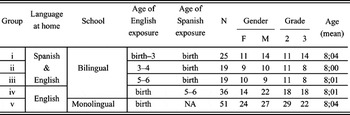
We studied five groups of children (N total = 150 children, 82 boys and 68 girls) in grades 2 and 3 (80 in grade 2 and 70 in grade 3), ages 7–9 at time of testing. The children were either in a bilingual school (50/50% Spanish–English program) or a monolingual school (English 100%). The children in the bilingual schools were grouped according to their age of first bilingual language exposure, with the age groups corresponding to key ages of brain maturation and myelinization.
Bilingual school groups
Group (i): Spanish–English exposure before age 3 (“birth bilinguals”)
Group (ii): Spanish in home, English exposure within ages 3–4 (e.g., through changes in family circumstances, or attendance at English daycares and/or preschools)
Group (iii): Spanish in home, English exposure within ages 5–6 (e.g., through kindergarten exposure and onwards as discussed above; monolingual Spanish at home and bilingual school)
Group (iv): English at home, Spanish exposure within ages 5–6 (e.g., through kindergarten exposure and onwards as discussed above; monolingual English at home and bilingual school)
Monolingual school group
Group (v): English only in home and English only in school (see Table 1).
Nearly all children from Spanish-speaking homes (groups i–iii) were from low SES families and received free or subsidized lunches, while children from monolingual English-homes (groups iv–v) were from high SES homes.
Participant groups and background information.

Background screening
The parents of all participants filled out an abbreviated Language Background and Use (LBU) Questionnaire that has been previously used in studies of adults and children (see Appendix; Petitto et al., Reference Petitto, Katerelos, Levy, Gauna, Tetreault and Ferraro2001; Holowka et al., Reference Holowka, Brosseau-Lapré and Petitto2002; Petitto and Holowka, Reference Petitto and Holowka2002; Kovelman, Baker and Petitto, Reference Kovelman, Baker and Petitto2008). Parents answered questions about at what age, and in which context (home, daycare, school), their child was first exposed to each of his or her languages and when (what age) their child first learned to read in those languages. The parents also answered if, and in what language(s), they typically read with their child. Built into our design for further validity and reliability, experimenters conducted structured and videotaped interviews at the beginning of each session, asking each child where he or she was born, what languages were spoken in the home by each family member, family members' fluency in each of their language(s), what language(s) the child used with each family member, and whether the child reads at home, in which language(s), alone, or/and with family members.
Phonological awareness tasks
We administered three phonological awareness tasks in English (all children, all schools) and in Spanish (bilingual school children): Initial phoneme deletion, Final phoneme deletion, and Phoneme segmentation. The goal of the tasks was to assess the children's ability to manipulate the sounds of their language. Both the Initial and Final phoneme deletion tasks consisted of 10 items each, for each language, and were selected from CORE's (1999) standardized Spanish–English reading assessment tools. The child was asked to delete a phoneme from the beginning (Initial phoneme deletion task) or end of a word (Final phoneme deletion task), and asked to say the word that remained (e.g., in the Initial phoneme deletion task, if one was asked to delete the first phoneme in the word “Sam”, one should answer “am”). To optimize statistical interpretation of the data in the present analysis, we combined the children's performance scores on the two phonological deletion tasks given the similar nature of the two tasks (i.e., the two tasks are components of the “elision” phonological awareness construct; note that we do not morph any other task results, as each of the tasks was theoretically motivated and carefully selected). The phoneme segmentation task consisted of the original 22 standardized Yopp-Singer (Yopp, Reference Yopp1995) items as well as the matched and standardized Spanish items from Reading Success Network (1997). During the task a child was presented with a word and asked to articulate each phoneme (e.g., “dog” = /d/ /o/ /g/). Both the Phoneme deletion and Phoneme segmentation tasks have been established to be reliable measures of children's phonological awareness and strong predictors of reading competence at later ages (Bruce, Reference Bruce1964; Adams, Reference Adams1994; Ziegler and Goswami, Reference Ziegler and Goswami2005).
Reading tasks
We administered four reading tasks in English (all children, all schools) and in Spanish (bilingual school children): Regular word, Irregular word, Pseudoword, and Passage comprehension. The goal of the Regular word reading task was to assess the children's ability to read words with easy sound-to-letter correspondence; the task consisted of 10 test items chosen from CORE's (1999) standardized Spanish–English reading assessment tools. The goal of the Irregular word reading task was to assess the children's ability to read words with difficult sound-to-letter correspondence; the task consisted of 10 test items chosen on the basis of both CORE (1999) and Woodcock Language Proficiency Battery–Revised (WLPB-R; Woodcock, Reference Woodcock1991) standardized Spanish–English reading tasks. The goal of the Pseudoword reading task, which was taken directly from the WLPB-R (Woodcock, Reference Woodcock1991), was to assess children's ability to apply sound-to-letter correspondence reading rules to unfamiliar/non-existent words; the task consisted of 30 items. The goal of the Passage Comprehension task, also taken directly from the WLPB-R (Woodcock, Reference Woodcock1991), was to assess children's ability to understand text.
Language task
Children's competence in English and in Spanish was assessed using a standardized Language Competence/Expressive Proficiency (LCEP) task, which has been successfully used to assess children's and adults' expressive language proficiency across 6 different languages (English, French, Spanish, American Sign Language, Langue des signes quebecoise, and Nicaraguan Sign Language; Senghas and Kegl, Reference Senghas and Kegl1994; Petitto, Zatorre, Gauna, Nikelski, Dostie and Evans, Reference Petitto, Zatorre, Gauna, Nikelski, Dostie and Evans2000; Kovelman et al., 2006). The goal of the task is to assess a person's language competence, language expression (production/performance), and proficiency. The task includes a fun 1.5-minute cartoon with a series of events that the participant is instructed to watch and then to describe to an experimenter.
Procedure
Bilingual school students had two 30-minute testing sessions (one in English and separately one in Spanish, with the order counterbalanced and results compared to ensure that bilingual children's performance could not be attributed to practice with the tasks) and monolingual school students had one session (in English). During each session the tasks were administered in the same order: Initial deletion, Final deletion, Phoneme segmentation, Pseudowords, Regular words, Irregular words, Passage comprehension, and Language Competence/Expressive Proficiency Task. Native speakers of English administered English sessions, and native speakers of Spanish administered Spanish sessions. The testers used only one language throughout the session. All sessions were video-recorded for data transcription and/or coding, analysis, and reliability checks.
Data transcription, coding, and analyses
Background screening
All of the background information for each participant collected from the school, parental LBU questionnaires, and video-recorded structured interviews with the child were entered into a digital participant database. Group assignment was conducted on the basis of this information.
Phonological awareness and reading tasks
The testing experimenters coded the children's responses during the session. For reliability purposes fifty-five percent of all sessions were also coded off-line, using the video-recording, by a coder other than the one who conducted the session with the child; importantly, this person was also a native speaker of the language of the session. Average reliability between the coders was 97% (SD = 2.7%); any disagreements between the on-line and off-line coders were discussed until there was 100% agreement. All analyses were conducted on the number of items answered correctly by the child for each task.
Language Competence/Expressive Proficiency Task (LCEP)
A 1.5-minute cartoon video was run on PC and Macintosh computers with 15-inch monitors using QuickTime and Windows Media Players (Figure 1). Children's video-taped narratives in each language were first transcribed by native Spanish and by native English-speakers using the CLAN program and CHILDES, as well as additional standard guidelines for transcribing bilingual children's speech (Deuchar and Quay, Reference Deuchar and Quay1999; MacWhinney, Reference MacWhinney2000; Petitto et al., Reference Petitto, Katerelos, Levy, Gauna, Tetreault and Ferraro2001; Holowka et al., Reference Holowka, Brosseau-Lapré and Petitto2002; Petitto and Kovelman, Reference Petitto and Kovelman2003). The transcripts were then subjected to reliability analyses and to rigorous linguistic coding in accordance with LCEP coding guidelines (Senghas and Kegl, Reference Senghas and Kegl1994; Petitto et al., Reference Petitto, Katerelos, Levy, Gauna, Tetreault and Ferraro2001; Holowka et al., Reference Holowka, Brosseau-Lapré and Petitto2002). A group of transcribers different from the above re-transcribed forty-five percent of the same LCEP narratives for reliability purposes. Average reliability between the transcribers was 97% (SD = 3.6%); any disagreements between the first and second set of transcribers were discussed until there was 100% agreement. Once the transcripts were completed and checked for reliability, coders with expertise in linguistics, who were also native speakers of English and separately of Spanish, coded the children's speech.
Language Competence/Expressive Proficiency Task. Sample frames/events from the cartoon.

Transcripts were coded for the grammaticality (correct/incorrect phonological, semantic, and morpho-syntactic) content of each linguistic “utterance” (phrases, clauses, or sentences) produced by the participant, as well as how many story events were produced (MacWhinney, Reference MacWhinney2000). For example, many children produced an utterance that was similar to this one: “he was climbing up the mountain”. This utterance would qualify as a “correct” utterance (not containing any grammatical or semantic errors). If the child said: “he climbing up the mountain”, the utterance would be coded as containing an error and missing an auxiliary verb. Grammaticality analyses provide vital information about the underlying systematic principles or rules that bind an individual speaker's utterances; hence, this task provided a general measure of the child's linguistic knowledge or “competence”. Analyses of how many story events were produced by an individual speaker, as compared to other speakers, provides an index of each speaker's language production and proficiency. It further permitted us to assess whether the participants in our study had an equal – and equally high – level of language capacity (competence, performance, and fluency). For English, an “utterance” had to include an overt noun and verb. For Spanish, a pro-drop language, each “utterance” had to include either an overt noun and a verb or just a verb with the proper noun (subject) information embedded in its form. In order to make the analysis more inclusive of what the child produced, all utterances were included even if the child paraphrased him- or herself to describe the same cartoon action in a different way and/or more than once. Identical utterances when the child repeated him- or herself exactly were coded only once. This stringent coding method yielded a total number of utterances produced by each child in each language, a total number of utterances produced correctly, a total number of utterances that contained errors, and, finally, a total number of utterances that contained only unique error types (unique error type constituted same word with the same mistake, e.g., “flied” repeated twice counted as one type of error). The analysis was conducted on the percent of correct utterances expressed by the child during the task (estimated from the total number of utterances minus the utterances with unique error types, divided by the total number of utterances; Petitto et al., Reference Petitto, Zatorre, Gauna, Nikelski, Dostie and Evans2000; Kovelman et al., 2006).
Results
Bilingual AoA and reading
English reading tasks
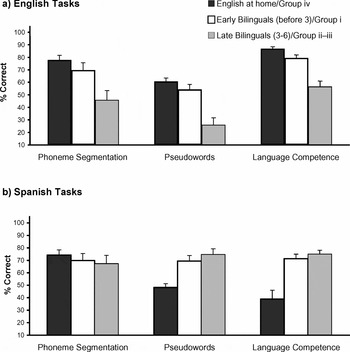
Age of first exposure to English had a significant impact on children's reading performance in English – and this held for each task – as was revealed by a 4 (bilingual school groups i–iv, between-subject factor) × 6 (4 reading and 2 phonological awareness tasks, multivariate dependent variables) MANOVA (Wilks' Lambda F(18,255) = 7.2, p < 0.01; see Table 2 for participants' scores). The results can be seen in Figure 2a, which shows that in English, children from monolingual-English homes and Early bilinguals (group i, age 0–3) performed equally well on English tasks, and these two groups also outperformed Late bilinguals (groups ii–iii, ages 3–6). Figure 2 (a and b) shows only a subset of tasks, including Phonological Segmentation (based on the Yopp-Singer task), Pseudowords (based on the WLPB-R), and Language Comprehension, however, the pattern in Figure 2 is true for all other tasks (see Table 2 for scores). There was a significant group difference (i.e., Early vs. Late) for each task, as revealed by univariate F-values (Phoneme deletion F = 13.4, p < 0.0001; Phoneme segmentation F = 6.0, p < 0.01; Pseudowords F = 17.1, p < 0.0001; Regular word F = 9.8, p < 0.001; Irregular word F = 8.0, p < 0.001; Passage comprehension F = 17.2, p < 0.0001 and df = 2,95). Results of a MANCOVA, which controlled for SES (groups (i–iii) being of low SES and group (iv) being of high SES), were identical (Wilks' Lambda F(12,180) = 5.1, p < 0.0001). Given the large number of comparisons in this paper, the criteria for significance was set at p < 0.01. Tukey Honestly Significant Difference (HSD) post-hoc comparisons for the MANOVA showed that Early bilinguals (group i) performed as well on all phonological awareness and reading tasks as children from monolingual English-speaking homes (group iv), except that group (iv) performed better than group (i) on the Passage comprehension task. Children with early exposure to English (groups (i) and (iv)) outperformed late bilinguals (groups (ii–iii), exposure to English at 3–6) on every single task in English. Thus, children in the bilingual school who had first exposure to English before age 3 had the best reading performance in this language.
Participant groups' average performance on each task (standard deviations in brackets). Phoneme awareness and reading task scores are presented as raw numbers of correct items and LCEP scores are presented as % correct and number of events.

(a) In English, group (iv) performed the same as group (i) and better than groups (ii–iii) on phoneme awareness, reading and language tasks; (b) in Spanish, groups (i) and (ii) performed the same and better than group (iv) on reading and language tasks; all groups performed equally high on Spanish phoneme awareness (p < 0.01).

Spanish reading tasks
Age of first exposure to Spanish had a significant impact on children's reading performance in Spanish – particularly regarding their high performance on the Spanish reading tasks, but less so on the Spanish phonological awareness tasks – as was revealed by a 4 (bilingual school groups, between-subject factor) × 6 (4 reading and 2 phonological awareness tasks, multivariate dependent variables) MANOVA (Wilks' Lambda F(18,252) = 4.6, p < 0.0001; see Figure 2b, Table 2 for scores). The results can be seen in Figure 2b, which shows that in Spanish, children from monolingual-English homes (group iv) performed equally well as children from Spanish-speaking homes (groups i–iii) on Phoneme Awareness tasks, however these late learners of Spanish (Spanish at 5–6) performed worse on reading and language comprehension tasks as compared to the early learners of Spanish (Spanish at 0–3). There was a significant group difference for reading tasks (Pseudowords F = 12.2, p < 0.0001; Regular word F =11.0, p < 0.0001; Irregular word F = 6.1, p < 0.001; Passage comprehension F = 22.4, p < 0.0001, and df = 3,94), but not for phoneme awareness tasks (Phoneme deletion F < 0.1, Phoneme segmentation F < 0.4 and df = 3,94). According to the Tukey HSD post-hoc comparisons, all children from Spanish-speaking homes (groups i–iii) performed equally well on the Spanish tasks. Tukey HSD post-hoc comparisons revealed no significant differences between any of the groups on Spanish phonological awareness tasks (p > 0.01). This means that children from monolingual English-speaking homes (group iv; first exposure to Spanish in bilingual school at ages 5–6) performed just as well on the phonological awareness tasks in Spanish as the children from Spanish-speaking homes. Children from English-speaking homes did perform worse on the reading tasks (p < 0.01). Thus, children from monolingual English homes with late exposure to Spanish (group iv) demonstrated high performance on phonological awareness tasks in their new language (Spanish), while native Spanish-speakers performed equally well on all Spanish tasks.
Bilingual AoA and language
Language Competence/Expressive Proficiency Task (LCEP)
There was a significant impact of bilingual AoA on children's competence in Spanish and in English, as revealed by two 4 (bilingual school groups, between-subject factor) × 2 (grade, between-subject factor) ANOVAs, one ANOVA for English and one ANOVA for Spanish language performance (Figure 2; English LCEP F(3,89) = 19.8, p < 0.0001; Spanish LCEP F(3,74) = 10.8, p < 0.0001). The findings for the English LCEP task were equally significant with the ANCOVA where SES was taken into account (F(2,89) = 17.4, p < 0.0001). There was no significant effect of grade (p > 0.01), and Tukey HSD analysis revealed the following: In English, children from monolingual English homes (group iv) exhibited the same equally high performance as Early bilinguals (group i), and each of these groups (exposure to English before 3, groups (i) and (iv)) performed significantly better than Late bilinguals (exposure to English 3–6, groups (ii–iii); p < 0.01). In Spanish, all bilinguals from Spanish-speaking homes (groups i–iii) performed equally well, and they performed better than children from monolingual English homes (group iv).
In summary, only Early bilinguals (age 0–3, group i) had an overall monolingual-like performance in English, and Early bilinguals also showed the same performance in Spanish as the native Spanish-speakers with late exposure to English.
A relatively high proportion of the children from English-speaking homes (group iv) did not produce utterances in Spanish that would qualify as containing at least a single linguistic/semantic “utterance” according to our highly stringent linguistic coding criteria (see Methods). In particular, 16 children did not produce linguistic utterances in Spanish: 1 child from a Spanish-speaking home (group ii) and 15 children from English-speaking homes (group iv). Interestingly, of these 15 children from monolingual English-speaking homes, nearly all (n = 13), were 2nd graders. This constituted over 2/3 of all 2nd graders in this group (n = 18 in grade 2). Thus, we observed that many English-speaking children learning a less socially dominant language (in this case Spanish), could not or would not express themselves in Spanish, while Spanish-speaking children learning the more socially dominant language, in this case English, produced a large amount of events in English (Table 2). Two children (group i) were not included in this English Language Competence/Expressive Proficiency task data analysis, as due to equipment failure we did not have a recording of both of the children's language narratives in English, and one of the children's narrative in Spanish.
Reading and language correlation
We conducted Pearson correlation analyses for the cumulative phonological awareness score, cumulative reading score and the Language Competence/Expressive Proficiency task score for each language. The cumulative scores were computed by summing the scores for each category of phonological awareness and reading, respectively, for each language, for each child. For English, Pearson correlation analyses showed that there were significantly strong relationships between language competence and phonological awareness (r(80) = 0.42, p < 0.01), language and reading proficiency (r(80) = 0.70, p < 0.01), and reading proficiency and phonological awareness (r(81) = 0.42, p < 0.01). For Spanish, there was a similar pattern (language and reading r(81) = 0.48, p < 0.01; language and phonological awareness r(65) = 0.29, p < 0.01), except that there was no significant relationship between language competence and phonological awareness scores (r(65) = −0.05, p > 0.05), because children from monolingual English homes showed surprisingly high performance on Spanish phoneme awareness tasks despite their relatively poor command of Spanish. When the children from monolingual English homes were removed from the Spanish tasks' correlation analysis, the correlation between language proficiency, phonological awareness and reading becomes just as significant as the one reported here for English (p < 0.01).
Bilingual schooling for monolingual children
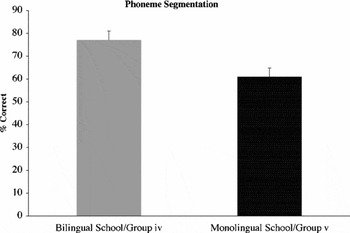
Is there an advantage to educating children from monolingual English homes in a bilingual school? A 2 (groups iv–v, between-subject factor) × 7 (one language, two phonological awareness and four reading tasks; multivariate dependent variables) × 2 (grades 2–3, between-subject factor) MANOVA revealed that children from monolingual English homes in bilingual schools (group iv) outperformed their age/grade-matched peers in monolingual schools (group v) on the most complex phonological awareness task, Phoneme Segmentation (univariate F(1,83) = 8.43, p < 0.01). Bilingual school children's better performance on the Phoneme Segmentation task is shown in Figure 3. The overall MANOVA results indicated no group differences (Wilks' Lambda F(7,78) = 1.6, p > 0.15). However, there was a significant grade improvement (Wilks' Lambda F(7,78) = 3.6, p < 0.01). In particular, third graders outperformed second graders on Irregular words and Passage comprehension tasks (F(1,83) = 15.1, p < 0.001 and 8.5, p < 0.01, respectively). There were no significant interactions. Remarkably, the type of schooling (bilingual versus monolingual) had an effect on phonological awareness in children from monolingual English homes. To be sure, these children from monolingual English homes in bilingual school programs outperformed their English peers in English even though the latter comparison group was attending English-only school programs.
Bilingual school students from monolingual English-speaking homes, high SES, significantly outperformed matched monolingual school students, also high SES, on a challenging phoneme awareness task (p < 0.01).

Discussion
In this study we asked whether the age of first bilingual language exposure impacts reading development in young bilinguals learning to read in each of their two languages. We also explored whether children from monolingual English-speaking families in bilingual schools showed a reading advantage over their age/grade-matched peers in monolingual schools. We found a relationship between the age of first bilingual exposure and bilingual reading development: Early bilinguals (before age 3) had excellent, monolingual-like, reading performance in both languages, and later-exposed bilinguals (ages 3–6) had less optimal reading performance in their new language only. This relationship was true for each of the language groups in the bilingual school (English at home, Spanish at home). Moreover, we obtained a detailed account of reading, phonological awareness, and language development in bilingual children exposed to a new language at varying ages after birth. Surprisingly, schooling in two languages afforded children from monolingual English homes – who were attending bilingual Spanish–English schools – an advantage in phonological awareness over their monolingual peers who attended English-only schools, with phonological awareness being one of the strongest precursor skills for reading.
Age of exposure and reading
To the best of our knowledge, this is the first study to consider the age of first bilingual exposure as a factor in dual-language reading development in bilingual children. In our study, Early bilinguals were the only group to have high reading performance in both of their languages. On English reading tasks, Early bilinguals performed overall just as well as their classmates from monolingual English-speaking homes, and on Spanish reading tasks they performed just as well as children who were monolingual in Spanish until age 5–6. Early bilinguals showed higher performance on the Passage Comprehension task as compared to Late bilinguals, but they also had lower performance than children from monolingual-English homes. Passage comprehension is the task where all reading skills are thought to come together to yield text comprehension. This observation might be due to low home literacy exposure and lower experience with text in our Early bilinguals from low SES immigrant homes. Later bilinguals performed less optimally on reading tasks in their new language (English) as compared to Early bilinguals. Many previous studies have found that overall bilingual children from immigrant families perform worse than their monolingual peers (August and Hakuta, Reference August and Hakuta1997; Verhoeven, Reference Verhoeven2000; Droop and Verhoeven, Reference Droop and Verhoeven2003; Slavin and Cheung, Reference Slavin and Cheung2003). Here we observed that the young child's age of first bilingual exposure is an important predictor of reading success or lack of success in young bilinguals: Early bilinguals can be overall expected to perform just as well as their monolingual peers on a variety of reading tasks, including phonological awareness, phonological decoding and word-recognition. Thus, one important implication of our findings is that when evaluating whether a bilingual child has normal reading development in a language, the age of the child's first exposure to that language should be considered.
SES versus maturational factors in bilingual reading development
A novel goal of this research was to explore the relevance of biological factors while we applied rigorous methods to control for the socio-cultural and socio-economic status of our participants. In our study, children with home exposure to Spanish all came from the same socio-cultural and socio-economic background (immigrant families from Latin America with low SES) and were educated within the same type of dual-language program. The only difference between these children was that some of them were first introduced to English within the first 3 years of life, others between ages 3–4, and yet others between ages 5–6. And yet, despite all these similarities in SES, involving practice, instruction, home, school, and socio-cultural environments, we nonetheless observed statistically significant differences between the groups depending upon whether they had early versus late exposure to English. When only low SES children were compared to each other (using Tukey HSD post-hoc comparisons), remarkably, it was the low SES children with early bilingual AoA who outperformed low SES children with late bilingual AoA. We therefore do hope to have added to the bilingual literature this new lens – indeed, the surprising lens afforded by the “age effect”. This present example suggests that the biologically governed “age effect” can potentially afford such a powerful positive impact on reading and language development that it may possibly ameliorate the negative effect of low SES on literacy.
Phonological awareness advantage of balanced bilingual education
Remarkably, as can be seen in Figure 3, children from monolingual-English homes in bilingual schools outperformed their peers from monolingual schools on a challenging phonological awareness task. These children also demonstrated native-like performance on all phonological awareness tasks in Spanish. Note that both groups of children from monolingual English homes (including those children in the bilingual and the monolingual schools) came from primarily middle class families with equally high SES. Phonological awareness is one of the most important reading skills that young readers have to master during the first years of reading acquisition (Adams, Reference Adams1994). Previous bilingual reading studies have identified the phenomenon of transfer of phonological awareness skills from one of the child's languages to another (Durgunoglu et al., Reference Durgunoglu, Nagy and Hancin-Bhatt1993; Dickinson, McCabe, Clark-Chiarelli and Wolf, Reference Dickinson, McCabe, Clark-Chiarelli and Wolf2004; Leafstedt and Gerber, Reference Leafstedt and Gerber2005). However, here we observed that children from monolingual English homes did not only transfer their phonological awareness skills from English to Spanish, they actually showed a significant improvement in their phonological awareness skills in their native English.
Our findings of a phonological advantage are predominantly based on one phonological awareness task, albeit among the most complex phonological tasks used with children. Might the observed phonological awareness advantage be due to factors other than bilingual instruction, but rather level of proficiency or our testing methods? For instance, the study by Bialystok et al. (Reference Bialystok, Majumder and Martin2003) showed a phonological awareness advantage only for Spanish–English and not for Chinese–English bilinguals. Bialystok et al. (Reference Bialystok, Majumder and Martin2003) explained the disparity of their findings in terms of possible group differences in English proficiency and the nature of the tasks used in the study. However, there is also an important study by Eviatar & Ibrahim (Reference Eviatar and Ibrahim2000), who studied Arabic-speaking children who received bilingual reading instruction in spoken Arabic as well as literary Arabic. These Arabic children receiving bilingual reading instruction showed the same phonological awareness advantage as Russian–Hebrew bilinguals, fluent/frequent speakers of both of their languages and learning to read in those languages. Thus, bilingual reading instruction alone in itself might be an important factor in boosting phonological awareness competence. Future research might consider expanding the testing repertoire to include a wider variety of complex phonological awareness tasks, include other languages and orthographies, and possibly include other tasks of metalinguistic awareness related to reading to further explore the nature of this phenomenon.
Age of exposure and language development
Studies of bilingual children's language development have shown that early bilingual exposure is most optimal for comparable dual language mastery (e.g., Pearson et al., Reference Pearson, Fernandez and Oller1993; Petitto et al., Reference Petitto, Katerelos, Levy, Gauna, Tetreault and Ferraro2001; Kovelman and Petitto, Reference Kovelman and Petitto2002) and here we observed that this pattern is further paralleled in bilingual children's reading development with respect to the age of first bilingual exposure. Early bilinguals performed the same as native speakers of Spanish and of English on the standardized Language Competence/Expressive Proficiency assessment. Late bilinguals performed less optimally in their new language.
The issue of the impact of the “age of first bilingual exposure” has been greatly explored in bilingual adults; however, the present study is one of very few studies to investigate this question in child bilinguals (Petitto et al., Reference Petitto, Katerelos, Levy, Gauna, Tetreault and Ferraro2001; Kovelman and Petitto, Reference Kovelman and Petitto2002; Petitto and Kovelman, Reference Petitto and Kovelman2003; Singleton and Ryan, Reference Singleton and Ryan2004). Our findings are in agreement with adult behavioral and neuroimaging studies, suggesting that early bilingual exposure yields the best language competence (Johnson and Newport, Reference Johnson and Newport1989; Weber-Fox and Neville, Reference Weber-Fox, Neville and Birdsong1999, Reference Weber-Fox and Neville2001; McDonald, Reference McDonald2000; Kovelman et al., 2006). In particular, behavioral results obtained here support electrophysiological (ERP) data showing that “late” bilinguals exposed to a new language – even as early as age 4 – had a non-native brain response to grammatical structures in their new language (Weber-Fox and Neville, Reference Weber-Fox and Neville2001). Moreover, consistent with previous research, including our own, birth bilinguals showed evidence of normal, monolingual-like development in each of their languages (Genesee, Reference Genesee1989; Pearson et al., Reference Pearson, Fernandez and Oller1993; Pearson, Reference Pearson1998; Petitto et al., Reference Petitto, Katerelos, Levy, Gauna, Tetreault and Ferraro2001; Holowka et al., Reference Holowka, Brosseau-Lapré and Petitto2002; Petitto and Holowka, Reference Petitto and Holowka2002; Petitto and Kovelman, Reference Petitto and Kovelman2003). In sum, contrary to the popular perception that all young children can simply “absorb like a sponge” a new language, we show that the age of first bilingual exposure is an important factor in understanding the pattern of dual language and reading development in children.
Importantly, note that our results do not suggest that children exposed to a new language after age 3 will never acquire language and literacy competence in their new language. Our present findings are concerned only with bilinguals with dual language exposure before age 6, and tested during grades 2–3 (ages 7–9). A key part of this research was to provide a first-time detailed account (a helpful tool) to identify the level of typical/atypical reading and linguistic mastery that one may expect from bilingual children across varying ages of first bilingual language exposure. There is evidence to suggest that at around grade 5 differences in reading performance between bilingual and monolingual children may begin to disappear (Oller and Eilers, Reference Oller and Eilers2002). How long does it take a “Late” bilingual to become as proficient in reading and speaking his or her new language as their monolingual peers? Here we showed that young bilinguals with as many as 7 years of new language exposure (e.g., first exposure from age 3 and up to age 9/3rd grade) were still catching up with their monolingual peers. Indeed, previous research agrees that some child bilinguals might require at least 5 or more years to master their new language (e.g., Hakuta, Goto Butler and Witt, Reference Hakuta2000). Unrealistic expectations set by educators and policy makers who underestimate how long it takes for bilingual children to achieve native-like mastery in their new language puts normally developing bilingual children in danger of being misdiagnosed with a speech pathology or learning disability (Hakuta et al., Reference Hakuta2000; Paradis, Reference Paradis2005). The important observation in our study is that the age of first bilingual exposure can be used as a tool in evaluating whether a young bilingual has a reading or language problem versus whether the child is a typically developing dual language learner. Early bilinguals can be expected to perform just as well as their monolingual peers. By contrast, Late bilinguals in grades 2–3 may initially have less optimal performance in their new language, but should eventually catch up to their monolingual peers.
How can one have confidence that it is the age of first bilingual language exposure – and not the amount of years of exposure to the new language – that resulted in the present observed increased reading and linguistic competence in young bilinguals (Cummins, Reference Cummins1991)? If it was strictly the years of language exposure that made the difference in children's performance, we should have seen a greater difference between bilinguals with exposure to English at ages 3–4 and bilinguals with exposure to English at ages 5–6. Instead, we observed a stark qualitative difference between monolingual and Early bilinguals versus all Late bilinguals. Much of first language development is achieved by age 3 (Brown, Reference Brown1973; Hoff, Reference Hoff2004). This result is consistent with similar observations with adult bilinguals, showing that it is the age and the intensity of exposure that make the difference, rather than years of training (Chee, Soon and Lee, Reference Chee, Soon and Lee2001; Perani et al., Reference Perani, Abutalebi, Paulesu, Brambati, Scifo and Cappa2003). Our results show that children who begin learning English after this pivotal age 3 will experience a significant shift in how long it will take them to catch up to monolingual peers speaking their new language. The extra 2–3 years of exposure to English did not appear to make a difference in performance between the two Late bilingual groups (ages 3–4 and 5–6). Thus, our results support the idea that there might be a “sensitive” period for bilingual language development during childhood that may begin as early as 3–4 years of age (Weber-Fox and Neville, Reference Weber-Fox and Neville2001), and that this “sensitive” period is governed by maturational, rather than environmental, constraints (Petitto et al., Reference Petitto, Katerelos, Levy, Gauna, Tetreault and Ferraro2001; Kovelman and Petitto, Reference Kovelman and Petitto2002; Petitto, Reference Petitto and McGilvray2005).
Late learners of Spanish
Children from English-speaking homes whose new language was Spanish performed worse in select reading and language tasks in their new language Spanish, as compared to their classmates from Spanish-speaking homes learning their new language English. This result does not come as a surprise, given that social factors play an integral role in children's language development (Hakuta and Garica, Reference Hakuta and Garcia1989; Genesee and Gándara, Reference Genesee and Gándara1999). Bilingual children have been previously observed to have high sensitivity to the socio-cultural status of each of their languages (Mills, Reference Mills2001). This perceived socio-cultural status may then have an impact on the children's language use and language development in English versus in Spanish (Kimberg and Serdyukov, Reference Kimberg and Serdyukov2004), in addition to other factors involving, for example, the greater frequency and amount of exposure to English in a typical young child's life in the United States (Pearson, Fernandez, Lewedeg and Oller, Reference Pearson, Fernandez, Lewedeg and Oller1997). In our study, native Spanish-speakers, in learning English, were learning a socially dominant language, the official language of the United States, whereas native English-speakers, in learning Spanish, were learning a minority language, one that they were less likely to hear on a regular basis. The implication of such findings is that in evaluating bilingual children's reading and language achievement, the socio-cultural relevance of each individual language should be taken into consideration before judging the young bilingual's development in either language as typical or atypical (deviant or delayed).
Language and reading
The observed correlation between bilingual children's language and reading performance supports the idea that there is an inherent link between the two. Previous bilingual research has mostly emphasized the relationship between vocabulary and reading development (Muter and Diethelm, Reference Muter and Diethelm2001; Bialystok et al., Reference Bialystok, Luk and Kwan2005). Here, we observed a strong relationship between the cumulative score of bilingual language competence, expression, proficiency (including multiple aspects of semantic, morphological and syntactic production), and reading competence. Our findings support the idea that language competence as a whole correlates with reading proficiency.
Significance
We hope that parents, educators, and educational policy makers will find our evidence helpful when making decisions on an optimal educational environment for both bilingual and monolingual children. Our findings do not merely show that balanced 50/50 bilingual language exposure and bilingual education can promote normal language and reading development, we also demonstrate a fundamental reading advantage for monolingual and bilingual students in a bilingual educational setting. Moreover, as the bilingual population of students continues to grow, there is an increased need for norms on bilingual language and reading development and very little information has been available (Holm and Dodd, Reference Holm and Dodd2001; Glennen, Reference Glennen2002). How does one decide if a young student with limited language proficiency in one of his or her languages suffers from a learning or reading disability or is a normally developing bilingual? Here, we hope to have provided the educational and medical community with basic guidelines on what level of dual language and reading competence might be expected of a bilingual child, particularly with regard to the child's age of first bilingual exposure. Thus, we hope to have offered evidence attesting to the benefit of dual language education, as well as provided basic tools for assessing developmental reading and language milestones in bilingual children with varying ages of first bilingual language exposure.
Future directions
We hope that our work has aided in the understanding of reading development in bilinguals, and that it has also inspired future research venues. For example, would our findings generalize to bilinguals learning other pairings of languages and other alphabets? There is indeed evidence supporting the idea that learners of a new language will benefit with respect to speed and success of acquisition of grammatical principles that overlap between their two linguistic systems (Hernandez & Li, Reference Hernandez and Li2007). While the “age of first bilingual acquisition” effect demonstrated here is likely independent of the particular language structures and grammars being learned, the transfer of phonological awareness from one language to another may be impacted by how close or distant the two phonological systems are, as well as the transparency of their orthographic systems – topics that warrant further investigation. Further, is the transfer of phonological awareness that we observed due entirely to the acquisition of two reading systems at the same time and early in development (as is suggested here), or is it because our English speakers (with deep orthography) were acquiring Spanish (with shallow orthography). There is some evidence about the role of orthographic transparency in bilingual phonological awareness, suggesting that there might be facilitation from shallow orthographies (Eviatar & Ibrahim, Reference Eviatar and Ibrahim2000; Bialystok et al., Reference Bialystok, Majumder and Martin2003). However, there are many other aspects of language structure that may also be at work in bilingual language and reading acquisition, including whether the two languages vary in “analytic” versus “synthetic” language structures (i.e., word order/syntax rich, less marked morphologically, versus, morphologically/inflectionally rich, less marked for word order/syntax, respectively). While it is indeed intriguing that our English children showed phonological facilitation involving another language that has a shallow orthography (Spanish) and vice versa, it would be premature to conclude that “shallow” orthography is “easy” – and, thus, this factor can explain away all other factors (age of first bilingual acquisition). Regarding “deep” and “shallow” orthographies as being “hard” versus “easy”, these are relative constructs that must be carefully scrutinized when recalling that the “high” versus “low” classification of the world's languages from the early 1900s have been abandoned. We now understand the high–low language classification to be an incorrect characterization of languages. This is because all languages possess complex grammatical structures and reflect the extraordinarily complex processing universal to natural language.
Prior research has shown that bilingual children can reach monolingual-like reading mastery in later grades (Hakuta et al., Reference Hakuta2000; Oller and Eilers, Reference Oller and Eilers2002). How soon and under what circumstances would all young bilinguals achieve monolingual-like reading competence in both of their languages? Other factors, such as type of reading instruction (e.g., whole-word versus phonic based approaches) and nature of dual reading exposure (sequential exposure to two reading systems versus exposure to two reading systems at the same time) may also be components of successful bilingual reading development and worthy of further investigation, and are indeed among those that we are presently investigating (Slavin and Cheung, Reference Slavin and Cheung2003; Berens, Kovelman and Petitto, Reference Berens, Kovelman and Petitto2007). Moreover, inclusion of a monolingual Spanish control group (which was not available to us) could provide additional insights.
Conclusions
The present study provides support for the hypothesis that the age of first bilingual language exposure – and not just the length of bilingual exposure, the child/family's socio-economic status, or the level of language proficiency – indeed impacts reading and language development in young bilinguals. The findings indeed suggested that early bilingual exposure had such a powerful positive impact on reading and language development that it may possibly have ameliorated the negative effect of low SES on literacy. The present study further supports the conclusion that bilingual programs that provide children with rich, balanced language, and reading exposure in each of the children's two languages provide students with the opportunity to develop language and reading mastery in these languages with equally high competence. Another tantalizing suggestion that follows from the present study is that balanced bilingual exposure may also provide children from monolingual English homes with a distinct reading advantage whereby they may develop a key component of successful reading, phonological awareness, ahead of their peers in monolingual programs.
Appendix: Language & Background Questionnaire
This questionnaire was filled out by all parents. The parents of Spanish-speaking children received the very same questionnaire in English as well as in Spanish and were free to choose whether to answer in English or in Spanish.
1 Where did your child first learn English? (Please circle one)

2 Does your child read in Spanish? (Please circle one)
If yes, at what age did your child start reading in Spanish? (Please circle one)
3 Does your child read in English? (Please circle one)
If yes, at what age did your child start reading in English? (Please circle one)
4
If yes, please circle all languages that apply.