INTRODUCTION
Animals frequently host organisms on their surface. Some of these external associates are not necessarily parasitic for the host, e.g. bird feather mites seem to be merely commensal (Blanco and Tella, Reference Blanco and Tella2001; Blanco et al. Reference Blanco, de la Puente, Corroto, Baz and Colas2001) which makes it necessary to demonstrate a cost in order to consider them being parasitic (Barclay, Reference Barclay1988; de Lope et al. Reference de Lope, Gonzales, Perez and Møller1993; Lehmann, Reference Lehmann1993; Lafferty and Kuris, Reference Lafferty and Kuris1999; Saino et al. Reference Saino, Calza, Ninni and Møller1999; Sanz et al. Reference Sanz, Arriero, Moreno and Merino2001; Møller et al. Reference Møller, de Lope and Saino2004). Living on the host, at least for some portion of their life, ectoparasites should, by definition, incur some costs to their host (Loye and Zuk, Reference Loye and Zuk1991; Price et al. Reference Price, Hellenthal, Palma, Johnson and Clayton2003). Examples of avian ectoparasites are chewing lice, insects belonging to 2 suborders, namely Amblycera, which occur on feathers and skin, and Ischnocera, which are restricted to feathers (Clayton et al. Reference Clayton, Adams, Bush, Atkinson, Thomas and Hunter2008). Amblyceran lice can cause extensive damage to feathers and skin resulting in excessive preening and scratching behaviour. Allergic reactions, dermatitis, puritis, insomnia and transmission of pathogens have also been described (Price and Graham, Reference Price and Graham1997; Prelezov et al. Reference Prelezov, Groseva and Goudaheva2006). Host anaemia due to blood feeding (Marshall, Reference Marshall1981; Price and Graham, Reference Price and Graham1997) and even severe haemorrhagic ulcerative stomatitis and death have been reported (Samuel et al. Reference Samuel, Williams and Rippin1982; Dik, Reference Dik2006). In contrast Ischnoceran chewing lice, mainly forage on dead material like feathers or skin products (Marshall, Reference Marshall1981; Clayton et al. Reference Clayton, Adams, Bush, Atkinson, Thomas and Hunter2008; Vas et al. Reference Vas, Csörgö, Møller and Rózsa2008), therefore their negative impact on the host was thought to be less pronounced than that of Amblyceran lice. However, there has been only 1 study which recognized that they may cause thermoregulatory stress (Booth et al. Reference Booth, Clayton and Block1993) and 1 study identified them as possible vectors of filarial worms (Barlett, Reference Barlett1993). Furthermore, Ischnoceran lice may influence mate choice (Clayton, Reference Clayton1990), display behaviour (Garamszegi et al. Reference Garamszegi, Heylen, Møller, Eens and de Lope2005), and reduce survival in wild birds (Clayton et al. Reference Clayton, Lee, Tompkins and Brodie1999). In rock pigeons (Columba livia), Ischnoceran lice Columbicola columbae and Campanulotes compar feed on abdominal contour feathers and reduce the density of plumage. It was demonstrated that feather damage due to chewing lice led to an increase in the host's metabolic rate by measuring an increase in thermal conductance. Over a longer time-period, this led to a chronic decline in host body mass (Booth et al. Reference Booth, Clayton and Block1993). Such energetic effects are mainly due to the fact that the host seems to compensate for the cost of parasitism by increasing its metabolic rate (Booth et al. Reference Booth, Clayton and Block1991, Reference Booth, Clayton and Block1993) which may also be responsible for a significant drop in overwinter survival (Clayton et al. Reference Clayton, Lee, Tompkins and Brodie1999) and a drop in the rate of male courtship display (Clayton, Reference Clayton1990). In contrast, such a decrease may also be due to a direct negative effect of the chewing lice on the host's activity level. Feather damage may also increase feather breakage (Kose et al. Reference Kose, Mand and Møller1999) and affect the permeability of feathers to air, thus modifying aerodynamic efficiency (Bonser, Reference Bonser2001). Furthermore, grooming costs to control lice might not be trivial in terms of time and energy because the time and resources withdrawn due to increased grooming could be invested into other activities such as growth, maintenance, or reproduction (Møller, Reference Møller, Clayton and Moore1997) e.g. increased grooming may reduce the time for foraging, defence of territories, or vigilance to avoid predators (Redpath, Reference Redpath1988; Walther and Clayton, Reference Walther and Clayton2005).
In the European bee-eater, we found a significant difference in average Ischnoceran chewing lice intensity between colony sites, which increased with colony size (Hoi et al. Reference Hoi, Darolova, König and Kristofik1998). Transmission of chewing lice usually requires physical contact between birds such as between mates (Hillgarth, Reference Hillgarth1996; Tompkins et al. Reference Tompkins, Jones and Clayton1996). In fact, we found a significant relationship in chewing lice intensity between pair members, but not between parents and their offspring (Darolova et al. Reference Darolova, Hoi, Kristofik and Hoi2001), suggesting mainly horizontal transmission between adult bee-eaters. Thus, it would be important to identify the costs of ischonceran lice for the European bee-eater, because they may be an important determinant of sociality (decision for solitary versus colonial breeding).
In this study, we examined whether feather-eating lice may have a negative short-term effect on the condition and health of adult European bee-eaters during a very energy-demanding period, namely, during breeding. Therefore, we experimentally manipulated the loads of Meropoecus meropis and Brueelia apiastri, both chewing lice (Phthiraptera: Ischnocera), and the most common host-specific ectoparasites on adult European bee-eaters (Krištofík et al. Reference Krištofík, Mašán and Šustek1996).
We focused on the consequences of hosting chewing lice to adult European bee-eaters, examining whether there was an effect on body mass and different blood parameters associated with health and condition. We predicted that an increase in louse load may lead to a progressive decrement in body mass due to higher energetic demands (resulting from reduced insulation or resources taken by the parasites) which may not be easily compensated during the period of intensive parental care.
Since our experiment was set up immediately after egg laying and we manipulated the ectoparasite loads of adult bee-eaters (usually, nestling ectoparasites are different from those of adults), we focused on the effect of parasitism for the parent birds and consequently, the condition of adults at the end of the breeding period and shortly prior to migration.
MATERIALS AND METHODS
Study area and species
Free-living European bee-eaters were studied in south-western Slovakia (18°20′38·88″–18°45′44·15″E, 47°45′01·32″–47°56′50·48″N) in the breeding season of 2000 and 2001. Being long distance migrants with over-wintering areas in East and South Africa, European bee-eaters arrive at their breeding grounds at the beginning of May and usually start digging new horizontal burrows into sand banks (Cramp, Reference Cramp1985).
At our study sites, these burrows are approximately 1 m in depth and excavated mainly by means of the bill that is consequently worn down by up to 1 cm (unpublished data). In the study area, brood size varies from 2 to 7 chicks, with 5 being the most frequent (average ±s.e.). In our study, the average (±s.e.) clutch size was 4·9±0·23 (n=124), and the average number of nestlings was 4·1±0·17 (Hoi et al. Reference Hoi, Hoi, Kristofik and Darolova2002). European bee-eaters are socially monogamous, and males provide females with food mainly during the fertile period (Cramp, Reference Cramp1985). The extra-pair rate seems to be rather low (Lessells et al. Reference Lessells, Avery and Krebs1994), suggesting genetic monogamy. The species breeds solitarily as well as in colonies (Cramp, Reference Cramp1985; Hoi et al. Reference Hoi, Hoi, Kristofik and Darolova2002). In our study population, the percentage of solitary breeding pairs, which means that the nearest neighbour is at least 1 km away (Hoi et al. Reference Hoi, Hoi, Kristofik and Darolova2002), was approximately 13%.
Nestling European bee-eaters have one predominant ectoparasite, the blood sucking fly Carnus hemapterus, which exclusively parasitizes chicks (Hoi et al. Reference Hoi, Krištofík, Darolová and Hoi2010). On the contrary, adults are parasitized by 2 main ectoparasites, both of them chewing lice namely Meropoecus meropis and Brueelia apiastri which rarely occur on chicks. Of all adult bee-eaters 94·3% are infested by M. meropis with in average (s.e.) 18·1±1·3 specimens per host individual. Prevalence of B. apiastri is 69·9% and their average (s.e.) intensity is 11·2±1·1. Only 13·7% of nestling bee-eaters are infested, with the latter in very low numbers (Krištofík et al. Reference Krištofík, Mašán and Šustek1996; Hoi et al. Reference Hoi, Darolova, König and Kristofik1998). Other ectoparasites like 3 mite species or 4 flea species do, on rare occasions, occur on adults (Krištofík et al. Reference Krištofík, Mašán and Šustek1996) but have not been found on our study individuals.
For our study, adults were trapped in clap-traps attached at the entrance holes of their burrows. For identification, adults were provided with a metal ring using the Slovak ringing scheme. Bill-, wing-, and tail length were measured according to Svensson (Reference Svensson1992). The fleshy tarsus was not very appropriate for an accurate measurement in this species and therefore was excluded from this analysis. We further measured the length of the pin-tail, which is the length from the tip of the elongated pin feathers to the tip of the normal tail feathers. Bill- and pin-tail length were measured with callipers to the nearest 0·1 mm and wing and tail length with a ruler to the nearest 1 mm. Furthermore, we determined body mass with an electronic balance to the nearest 0·1 g. Finally, we took a blood sample of about 80 μl from the brachial vein to determine sedimentation rate and haematocrit level. All measurements and blood samples were taken in June and July.
Experimental design of chewing lice manipulation
Starting early in June (in both years, 3–6 June) we trapped birds during incubation and recaptured them again exactly 1 month later (3–6 July) during the nestling period. The experimental design consisted of 3 different treatment groups as follows (1) Removal group: all chewing lice were removed with forceps by carefully checking every feather of the head, throat and belly of the birds (Darolova et al. Reference Darolova, Hoi, Kristofik and Hoi2001; Hoi et al. Reference Hoi, Darolova, König and Kristofik1998) and, afterwards, birds were additionally fumigated with a pyrethrum (0·04%) and piperonyl butoxide (0·1%) solution, a veterinary product developed for small birds (passerines). Field studies revealed no negative effect e.g. on the colonial bank swallow, breeding in similar soil cavities than the European bee-eaters (Szép and Møller, Reference Szép and Møller2000). Since no other ectoparasite species has been detected on our study individuals, no other ectoparasite could have been inadvertently killed by the fumigant and consequently influenced our results. In total, 16 males (8 males per year in 2000 and 2001) and 11 females (6 in 2000 and 5 in 2001) were treated. We found no evidence for a negative effect of fumigation. (2) Control group: all chewing lice were removed (see above) and returned. In total, 9 males (5 in 2000 and 4 in 2001) and 9 females (5 in 2000 and 4 in 2001) were treated in this way. (3) Infested group: 40 additional lice (80% M. meropis and 20% B. apiastri) were added to the existing lice on the birds. In comparison, the maximal combined number of both chewing lice species found on an individual was 67 specimens. Thus manipulation increases parasite intensity near to the maximum infestation intensity found for European bee-eaters. In total, 9 males (5 in 2000 and 4 in 2001) and 11 females (6 in 2000 and 5 in 2001) were treated in this way. Transferred lice were in good condition since they immediately grasp a feather and move towards the feather shaft. To quantify the two haematological measures we followed the method of Harrison and Harrison (Reference Harrison and Harrison1986). We first placed the capillary tubes in an upright position into a refrigerated box (4°C). After 4 h, we measured the length of the column containing plasma and the total length of the tube containing blood. We expressed the sedimentation rate/h as the overall percentage of the length of the tube containing plasma divided by 4. Since the sedimentation rate depends on proteins in the blood as well as on haematocrit, we regressed the sedimentation rate to the haematocrit and used the residuals from this regression for statistical analysis. After estimating sedimentation, blood samples were centrifuged for 6 min at 2376 g and the length of the tube containing erythrocytes was measured. We expressed the haematocrit as the percentage of the tube containing packed red cells.
Statistical analyses
Prior to treatment, there were no differences in morphological parameters (wing-, bill-, tail- and pintail length) and body mass between the 3 treatment groups (ANOVA: males for all parameters P>0·3, females for all parameters P>0·2). Furthermore, the treatment dates did not differ between the 3 treatment groups (ANOVA: F=0·26, d.f.=4, 63, P>0·8).
To detect possible temporal patterns of the investigated parameters, including body mass, different morphological and haematological parameters independent of any treatment effect, we compared all measurements (dependent variables) between June and July (repeated factors) and sex and year as covariates for the control group.
We examined the effect of chewing lice on male and female bee-eaters using body mass, sedimentation rate and haematocrit level. To detect an effect of chewing lice, we used (i) body mass changes as Δ body weight (=body mass June−body mass July), (ii) Δ sedimentation rate (=sedimentation rate June− sedimentation rate July) and (iii) Δ haematocrit level (=haematocrit level June−haematocrit level July). We used these 3 parameters as dependent variables, respectively, in a GLM with treatment, sex and brood size as independent factors and year was introduced as covariate parameter. To examine interactions between the different treatment groups more closely, we used post-hoc comparisons in a multiple design (Conover, Reference Conover1980).
Furthermore to get an idea about the effect size of parasite infestation on body mass loss of male and female bee-eaters separately, we determined the % reduction in body mass of the infested group relative to the initial body mass of our population at the start of the experiment (body mass in June for all males: 57·1 g±0·62, n=34; for all females: 63·6 g±0·9, n=31) and adjusted for the mean body mass loss of the control group.
RESULTS
We found no temporal patterns in the control group when comparing June and July measurements regarding all morphological parameters (including bill-, wing-, tail- and pin-tail length: for all P>0·3) and sedimentation rate (F=0·5, P>0·5, d.f.=1, 18). However, body mass, independent of sex, decreased significantly from June to July (F=10·5, P<0·0001, d.f.=1, 18), whereas haematocrit levels, in contrast, increased significantly from June to July (F=5·2, P<0·0001, d.f.=1, 18). Sex-specific differences were not found for any of the investigated parameters (for all investigated parameters: P>0·1), nor were differences seen between years (for all investigated parameters: P>0·4).
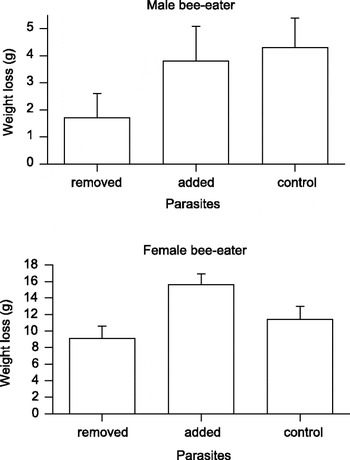
Examining the effect of experimentally manipulating the chewing lice abundance on Δ body mass, our results revealed that body mass is not effected by brood size (F=0·23, P>0·7, d.f.=5, 62) and year (F=0·02, P>0·9, d.f.=2, 62) or any interaction term (for all: P>0·5) but Δ body mass was influenced by the chewing lice treatment (F=5·06, P=0·01, d.f.=2, 62) and differed between the sexes (F=64·5, P<0·0001, d.f.=1, 62; Fig. 1).
Furthermore, there was a significant interaction between the experimental treatment and sex (F=5·2, P=0·031, d.f.=2, 62). Post-hoc single pairwise comparisons suggested that the differences between the treatment groups were mainly due to differences between the ‘removed’ and ‘infested’ groups in females (P<0·05) and between the ‘control’ and ‘removed’ groups in males (P<0·05). In both sexes, body mass loss was least severe when chewing lice were removed (Fig. 1). However, an experimental increase in the louse load resulted in significantly greater weight losses for females but not for males. Mean±s.e. body mass reduction, relative to the initial body mass at the start of the experiment (June measurement see Materials and Methods section) was 3·3%±0·6 for control males and 8·9%±0·7 for control females. After mean adjustment for this body mass reduction of the control group our results for males from the infested group revealed still 4·6%±0·3 of reduction in body mass due to experiment. In females, mean ±s.e. body mass reduction due to the experiment, was 15·6%±0·8.
Changes in body weight (Δ body weight=weight June−weight July) for adult male and female bee-eaters after parasites were removed (‘removed group’, n=16 males and 11 females), added (‘infested group’, n=9 males and 11 females) or removed and added again (‘control group’, n=9 males and 9 females). Given are means ±s.e.

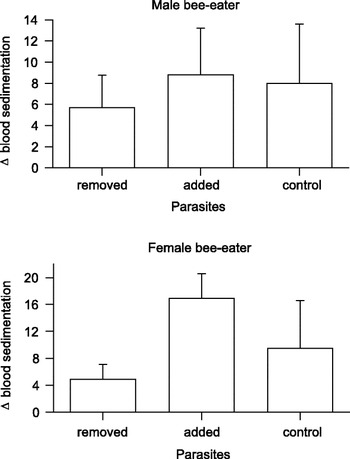
Examining the sedimentation rate again, our experimental data revealed that the Δ sedimentation rate was influenced by sex (F=4·8, P=0·041, d.f.=1, 62) and almost significantly by our treatment (F=2·7, P=0·07, d.f.=2, 62; Fig. 2), but there was no significant interaction between experimental treatment and sex (F=2·05, P=0·19, d.f.=2, 62). Post-hoc single pairwise comparisons suggested that the differences between the treatment groups were mainly due to differences between the ‘removed’ and ‘infested’ groups and the ‘control’ and the ‘infested’ groups in females (P<0·05) but not in males. Again, neither brood size (F=0·72, P>0·4, d.f.=5, 62), year (F=0·17, P>0·8, d.f.=2, 62) nor any interaction term (for all P>0·6) was significant.
Change in sedimentation rate (Δ sedimentation rate=sedimentation rate July−sedimentation rate June) for adult male and female bee-eaters after parasites were removed (‘removed group’, n=16 males and 11 females), added (‘infested group’, n=9 males and 11 females) or removed and added again (‘control group’, n=9 males and 9 females). Given are means ±s.e.

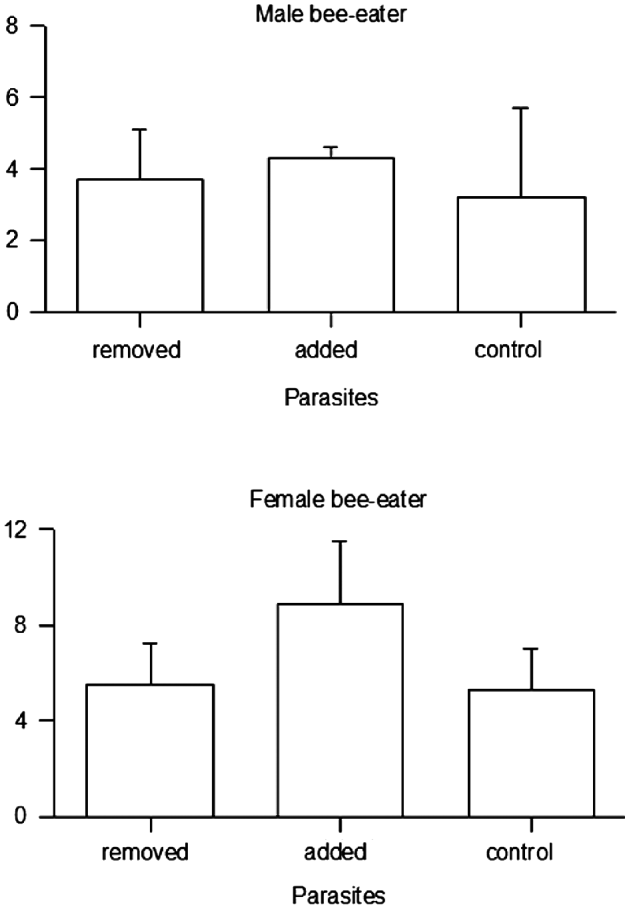
Regarding Δ haematocrit, we found a significant effect of chewing lice manipulation (F=3·81, P=0·04, d.f.=2, 62; Fig. 3), but no difference between sexes (F=0·18, P>0·6, d.f.=1, 62), and no interaction between sex and treatment (F=0·76, P>0·4, d.f.=2, 62). Post-hoc single pairwise comparisons between treatment groups revealed that for females, the haematocrit level of the ‘removed’ group was significantly lower than of the ‘infested’ group (P=0·043, Fig. 3). Brood size (F=0·88, P>0·4, d.f.=2, 62) and year (F=0·95, P>0·3, d.f.=2, 62) and their interactions were not significant (for all: P>0·4).
Changes in haematocrit (Δ haematocrit= haematocrit July−haematocrit June) for adult male and female bee-eaters after parasites were removed (‘removed group’, n=16 males and 11 females), added (‘infested group’, n=9 males and 11 females) or removed and added again (‘control group’, n=9 males and 9 females). Given are means ± s.e.
DISCUSSION
Our results suggest that chewing lice have a negative effect on male and female European bee-eaters. Both sexes significantly lost body weight during the breeding season, females significantly more so than males. More importantly, our results revealed an effect of our chewing lice treatment on weight loss. The effect on body weight was more pronounced than for the other dependent variables (sedimentation rate and haematocrit levels). In fact our results show that 15% body mass reduction in females and more than 4% in males seems to be a direct consequence of the increased chewing lice infestation. This is not surprising since chewing lice eat feathers, and they can cause quite a reduction in feather mass (Clayton, Reference Clayton1990, Reference Clayton, Loye and Zuk1991; Booth et al. Reference Booth, Clayton and Block1993). Barnett (Reference Barnett1970) furthermore demonstrated a dramatic decrease in cold tolerance with a decrease in feathers for house sparrows Passer domesticus. Loss of tissue (feather mass) consequently means a reduction in body insulation (Calder and King, Reference Calder and King1974), and this may further lead to a progressive decrement in body mass, but may in turn negatively effect disease resistance. There seems to be no evidence for direct costs (loss of energy) due to resources used up by chewing lice (Møller, Reference Møller, Clayton and Moore1997). The effect on body mass of European bee-eaters more likely reflects the increased metabolic demands due to their lower insulation capacity caused by chewing lice (Booth et al. Reference Booth, Clayton and Block1993). In comparison body mass reduction as a result of experimentally increased chewing lice infestation in pigeons from October to February resulted in a body mass reduction of 2·5% (calculated from data given by Booth et al. (Reference Booth, Clayton and Block1993). Thus the effect of chewing lice via feather loss on European bee-eaters is much stronger than for pigeons, probably because they are more temperature sensitive and prefer a warmer climate. Their core breeding area is the Mediterranean region but in the last decades with the recent increase in temperature due to climate change they expand to more temperate regions in the north. Cold spells are still more frequent (also during our 2 breeding seasons) and may be partly responsible for the strong effect found. Another factor which may have influenced the results and may explain the big difference to the pigeon results is the period of manipulation. The experiment was done during the very energy demanding reproductive period including the incubation and nestling phase. The fact that only females incubate may also explain the stronger effect of our manipulation on female bee-eaters.
However, beside a decrease in body insulation, feather damage by chewing lice may also negatively affect flight performance of birds (Barbosa et al. Reference Barbosa, Merino, de Lope and Møller2002).
Our results also suggest a reduction in disease resistance in adult bee-eaters. An effect on the immune system was indicated by our chewing lice treatments. Sedimentation rate increases in a wide range of infectious and inflammatory diseases due to an increase in blood-circulating fibrinogen and γ-globulins (Gustaffson et al. Reference Gustaffson, Nordling, Andersson, Sheldon and Quarnstrøm1994). Also, in our bee-eaters, the sedimentation rate significantly increased in relation to chewing lice infestation.
Finally, male and female haematocrit levels tended to be affected by our treatment. Haematocrit values tended to be highest in infested individuals. The haematocrit level has been mainly suggested as an index of metabolic activity, but also as an indicator of general health status (Carpenter, Reference Carpenter1975; Gessaman et al. Reference Gessaman, Johnson and Hoffman1986; Harrison and Harrison, Reference Harrison and Harrison1986; Potti et al. Reference Potti, Moreno, Merino, Frias and Rodriguez1999). Our treatment effect can be interpreted either as individuals increasing their foraging activity to compensate for resources lost to chewing lice, or to increasing the metabolic rate to compensate for losses due to reduced body insulation.
Can Ischnoceran lice influence bee-eaters' reproductive success? A comparative investigation (Møller, Reference Møller, Clayton and Moore1997) revealed that the timing of reproduction and/or reproductive success are most frequently influenced by parasites (Harriman and Alisauskas, Reference Harriman and Alisauskas2010). A negative effect of parasites on the timing of reproduction was found by Sanz et al. (Reference Sanz, Arriero, Moreno and Merino2001) and Descamps et al. (Reference Descamps, Blondel, Lambrechts, Hurtrez-Bousses and Thomas2002). Chick growth (Chapman and George, Reference Chapman, George, Loye and Zuk1991; Merino and Potti, Reference Merino and Potti1995), mortality (Dudaniec et al. Reference Dudaniec, Kleindorfer and Fessl2006), or survival (Chapman and George, Reference Chapman, George, Loye and Zuk1991; Merino and Potti, Reference Merino and Potti1995) are also known to be influential parameters. Furthermore, there seems to be a relationship between parental performance and the metabolic rate, and some studies have revealed that a reduction in metabolic efficiency directly affects parental performance (Schall et al. Reference Schall, Bennet and Putman1982; Thompson, Reference Thompson, Barnard and Behnke1990; Chapman and George, Reference Chapman, George, Loye and Zuk1991; McKilligan, Reference McKilligan1996). If this were the case, then feather-eating lice (Ischnocera) might influence the parental performance of an individual bee-eater by manipulating its energetic demands. However, our experiment was not designed to detect an influence on the timing of breeding, chick development or survival. We were not able to examine the importance of chewing lice on the timing of breeding, since our experiment manipulated lice loads after the start of incubation and we further manipulated only one adult per brood and therefore the other parent could compensate (increase parental investment) for a possible decrease in care by the manipulated bird. Our results, in fact, did not reveal an effect of brood size on parental performance.
In conclusion, we have shown that there are conditions and health consequences for male and female bee-eaters, which may further result in reduced survival probability. European bee-eaters are long-distance migrants and they leave the breeding grounds soon after the completion of their breeding duties. The consequences could be that individuals with lower weight (i) suffer a higher risk of dying during migration, (ii) need to replace body mass during migration, which results in longer stopover times and longer travel times until they arrive at the wintering grounds and/or, (iii) need to delay their departure from the breeding grounds until they reach the body mass they need for starting migration. At the moment, we can only speculate about potential influences and it remains to be investigated as to how these differences in condition and health may affect migration and, consequently, survival.
ACKNOWLEDGEMENTS
We would like to thank R. Hengsberger for her help with this manuscript and S. Magee for constructive comments. A. Darolová and J. Krištofík were financially supported by a grant of the Slovak Ministry of Education (No. 95/5305/360). H. Hoi was funded by the Exchange programme of the Slovak and Austrian Academy of Sciences.