Introduction
As our society ages, it is anticipated that there will be a rise in the number of people vulnerable to abuse. Elder abuse is now a priority of both the UK government and the US federal government. We know that people with dementia are particularly vulnerable and frequently abusedReference Cooper, Katona, Finne-Soveri, Topinkova, Carpenter and Livingston1, Reference Cooper, Selwood and Livingston2 and the consequences of abuse for the older person include distress, physical and mental ill-health, reduced survival, institutionalization and financial loss. People with dementia require an increased amount of care and most are looked after by family members with dedication and often little support, but a small minority are abused.Reference Cooper, Selwood, Blanchard, Walker, Blizard and Livingston3 Most perpetrators of abuse are family members.Reference Nelson4 This article reviews the background, prevalence and risk factors for abuse and also discusses detection, prevention and management.
Definition of elder abuse
The UK Department of Health5 in their ‘No Secrets’ report define abuse as a violation of a vulnerable older person's human and civil rights by another person(s). It may be physical, verbal or psychological, an act of neglect or an omission to act, or persuading someone to enter into a financial or sexual transaction to which he or she has not consented, or cannot consent. This definition specifies that these acts are abuse when they happen to a ‘vulnerable person’. Older people are more likely to be vulnerable as they are more likely to experience physical and cognitive impairments, but there is nothing inherently different about how abuse should be identified and managed in younger and older adults, and they are protected by the same legislation.6 Like domestic violence, elder abuse can also occur in an older person who is physically well and has mental capacity.
It is interesting to note that not everyone agrees with the government definition of elder abuse and a recent study asking for the views of health professionals, family carers and medical students found that they had different views from each other and from government guidelines.Reference Selwood, Cooper and Livingston7 A vignette was given to family and professional carers and they were asked to rate thirteen management strategies for behavioural difficulties in a person with dementia on a Likert scale ranging from good idea to abusive. Some of these strategies were abusive according to the Department of Health's ‘No Secrets’ definition. Significantly more professionals than family carers identified correctly that preventing someone moving by putting a table over their lap was an abusive strategy. In contrast, significantly more family carers identified that the neglect item of accepting someone was not clean was abusive. There was no significant difference in the proportion of each group who reported that locking someone in the house alone was abusive and approximately 60% of both family carers and professionals thought that this was an abusive strategy.
These findings suggest that there remain a variety of views about what constitutes elder abuse and future consultations should ensure that the often unheard views of family carers are taken into consideration.
Types of abuse
Abuse is usually categorized into six types:
1 Verbal and psychological abuse: screaming and shouting at an older person, calling them names, threatening, humiliating or ‘scapegoating’ them.
2 Physical abuse: non-accidental use of force against an older person. This may include hitting, shoving or handling roughly in other ways. It also includes inappropriate use of medication or inappropriate restraint or confinement (such as locking someone in the house for several hours so they could not get out in an emergency).
3 Neglect: ignoring medical or physical care needs, failure to provide access to appropriate health or social care, or withholding of the necessities of life, such as medication, adequate nutrition and heating.
4 Financial abuse: unauthorized use of an older person's funds or property.
5 Sexual abuse: sexual contact with an older person to which they have not consented, were pressured into consenting to, or cannot consent.
6 Discriminatory abuse: Harassment, slurs or other abusive behaviour towards an older person because of age, race, gender, disability, sexual preferences or other personal characteristics.
Measures of abuse
We often artificially dichotomize abuse although it is more useful and accurate to think of it as a spectrum of behaviours. Most people think that behaviour has to reach a certain threshold of severity or frequency to constitute abuse. Shouting at someone angrily once, for example, may be accepted within all emotional relationships and, while the parameters change when one member is dependent and vulnerable, this does not mean that such actions automatically constitute abuse. Most abuse measures use cut-off points for how frequently a behaviour must be reported to be considered abusive. Detecting and actively managing abuse that is less severe in nature and frequency may lead to help being given before the problem becomes more serious.
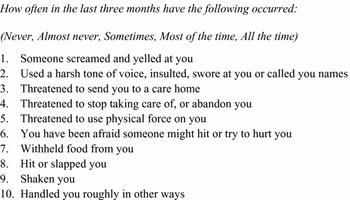
The Pillemer criteria define abuse caseness as verbal or neglectful acts occurring ≥10 times a year, and physical or financially abusive acts at least once a year.Reference Pillemer and Finkelhor8 The Modified Conflict Tactics Scale (MCTS) asks how often in the past three months the care recipient has experienced five psychologically and five physically abusive acts, on a Likert scale from 0 (never) to 4 (all the time) (see Fig 1). It defines an ‘abuse case’ as an abusive act happening at least sometimes (a score of 2 or more) in the last three months.Reference Beach, Schulz, Williamson, Miller, Weiner and Lance9, Reference Cooper, Manela, Katona and Livingston10 The scale has subscales for psychological and physical abuse. It can also be easily modified in order to ask carers about whether they have acted in any of these abusive ways towards the care recipient. The MCTS is a brief instrument that is acceptable to carersReference Cooper, Selwood, Blanchard, Walker, Blizard and Livingston3 and has excellent psychometric properties,Reference Cooper, Maxmin, Selwood, Blanchard and Livingston11 suggesting that it could be used routinely in clinical practice with carers of people with dementia to detect clinically concerning cases of abuse, many of which are currently being missed.
The Modified Conflict Tactics Scale.Reference Beach, Schulz, Williamson, Miller, Weiner and Lance9

There are also objective measures that can be used to assess abuse. The Minimum Data Set Abuse screen (MDS-A) is an observer-rated elder abuse screen for which reliability has been demonstrated.Reference Morris, Fries, Steel, Ikegami, Bernabei and Carpenter12 Older people being screened for abuse are interviewed and screened positive for possible abuse if any of the following abuse indicators are observed or reported by the participant: (a) the older person expresses, either verbally or through behaviour, fear towards a family member or carer; (b) if unusually poor hygiene putting them at risk of health/psychosocial consequences is observed; (c) unexplained injuries, broken bones or burns, that do not fit the realm of reasonable possibility given the circumstances; (d) an untreated or not appropriately acknowledged serious situation or conditions; (e) physical restraint (e.g. limbs restrained, used bed rails, constrained to chair when sitting).
Prevalence of elder abuse
Elder abuse in dementia is inherently difficult to study. It is a hidden offence, perpetrated against vulnerable people with memory impairment, by those on whom they depend. Prevalence estimates are influenced, and possibly underestimated, by the fact that many people with dementia are unable, frightened or embarrassed to report its presence. There are a wide range of prevalence figures in the literature, possibly because of the different populations studied and the methods used to measure abuse. A recent systematic review looking at the prevalence of elder abuse and neglect either reported by older people themselves, or family and professional caregivers or investigated using objective measures revealed the following findings.Reference Cooper, Selwood and Livingston2
All older people
In general older population surveys evaluated as being of a high standard and using abuse measures for which reliability and validity had been assessed, 6.3% of older people reported significant abuse, most of which is psychological, verbal and/or financial abuse, in the last monthReference Oh, Kim, Martins and Kim13 and 5.6% of couples that their relationship had been physically violent in the last year.Reference Harris14
Vulnerable populations
Around a quarter of vulnerable older people (e.g. those with physical and/or cognitive impairment and receiving home care services) report significant levels of psychological abuse.Reference Beach, Schulz, Williamson, Miller, Weiner and Lance9, Reference Wang, Lin and Lee15 When health professionals or researchers look for evidence of abuse objectively, as opposed to asking older people about it, they find less evidence of abuse and it is likely that this is because they are detecting more serious physical abuse or neglect because they can see evidence of it. Two studies using the MDS abuse screen found prevalence rates of approximately 5%.Reference Cooper, Katona, Finne-Soveri, Topinkova, Carpenter and Livingston1, Reference Shugarman, Fries, Wolf and Morris16
Abuse by family carers
We recently surveyed family carers of people with dementia referred to secondary psychiatric care.Reference Cooper, Selwood, Blanchard, Walker, Blizard and Livingston3 Nearly half of these carers reported any abusive acts over the last three months, using the MCTS, and a third reported that abusive acts were happening ‘at least sometimes’. One previous study found (using the severe violence subscale of the Conflict Tactics Scale) that 5% of carers reported physical abuse in the year since diagnosis.Reference Paveza, Cohen, Eisdorfer, Freels, Semla and Ashford17 Five other studies involving carers of people with dementia defined abuse according to the Pillemer criteria, with 37–55% reporting any abuse.Reference Compton, Flanagan and Gregg18, Reference Pot, van Dyck, Jonker and Deeg19, Reference Cooney, Howard and Lawlor20, Reference Homer and Gilleard21, Reference Cooney and Mortimer22 The act of abuse does not imply intent, and in many cases the carers may not have viewed their own actions in this light.
Abuse by professionals
In one study that used a valid and reliable measure to look at elder abuse by professionals, 16% of a random sample of nurses and care attendants who had been working at one of several long-term care facilities in Taiwan for at least 6 months reported committing significant psychological abuse.Reference Wang23 Other studies have shown that approximately 80% of nursing home staff have observed abusive behaviour in the last yearReference Pillemer and Moore24, Reference Goergen25 but only 2% of these cases are reported to the home management.Reference Jogerst, Daly, Dawson, Peek-Asa and Schmuch26
The over-prescription and use of as required medication is a form of abuse that has received considerable attention of late. 100,000 older people in UK care homes are prescribed antipsychotic drugs, often in the absence of psychotic symptoms.
Abuse reported to authorities
The number of abuse cases reported to authorities is low, for example only 1% of people aged 60 years and over are reported to Adult Protective Services in the USA.27 This is unsurprising as only the most serious cases are reported, but does suggest that many cases of abuse by professional and family carers go unrecognized (even by the perpetrator), unreported and undetected.
Identifying those more likely to abuse and be abused
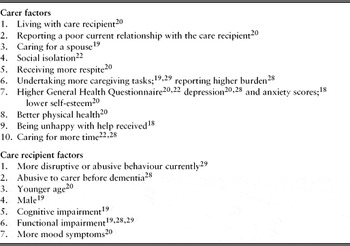
The causes of abuse are complex and varied, and usually a combination of factors lead to abusive behaviour. Table 1 summarizes factors previously associated with abuse reported by family carers.Reference Cooper, Manela, Katona and Livingston10
Factors associated with abuse reported by family carers identified by systematic review

Abuse by family carers
In the West,Reference Pillemer and Finkelhor8, Reference Podkieks30 older people are most likely to report abuse from a spouse rather than other family carers. Spouses caring for their partner are also more likely to report behaving abusively than other family carers.Reference Pot, van Dyck, Jonker and Deeg19 However, in surveys in IndiaReference Chokkanathan and Lee31 and South Korea,Reference Oh, Kim, Martins and Kim13 more perpetrators of abuse are adult children. This probably reflects cultural differences in family structure, with adult children providing more care to older people in Eastern countries, and spouses in the West. Family carers who live with the person they care for and have fewer breaks are more likely to report acting abusively.Reference Cooney, Howard and Lawlor20 Financial abuse seems to be the exception to this rule, with more distant relatives, friends and neighbours being more likely to be the perpetrators.Reference Podkieks30
In some cases, abusive behaviour appears to be part of a pattern of abuse resulting from poor relationships between families that preceded old age. Half of USA older couples reporting physical violence say that the abuse began more than 10 years ago.Reference Harris14 Abuse is not a one-way phenomenon. Being on the receiving end of abuse is one of the most important predictors of carers acting abusively.Reference Pillemer and Suitor29 A poor relationship between the carer and care recipient is associated with abuse. Relationships that were previously psychologically or physically bilaterally violent may become abusive if the care recipient no longer has the mental capacity to decide whether or not to stay in a violent relationship or the physical capacity to leave it and live independently.
Family carers who are more anxious and depressed are more likely to act abusively towards the person they care for,Reference Compton, Flanagan and Gregg18, Reference Cooney, Howard and Lawlor20, Reference Coyne, Reichman and Berbig28 as are those who use unhelpful coping strategies such as substance use and denial in response to stress, or resent their caring role. Carer stress is less likely to explain other types of abuse (financial and sexual abuse), which could not be perceived as reactions to the high stress of caring. Providing care is physically and emotionally demanding. Family carers admit to abuse even when told that confidentiality will not apply if someone is being harmed, suggesting that they want help to stop the abuse.Reference Cooper, Selwood, Blanchard, Walker, Blizard and Livingston3
Abuse by professionals
Particularly high rates of abuse have been reported in care homes. Some of this is by staff and some by other residents.Reference Lachs, Williams, O'Brien, Hurst and Horwitz32 Professional carers who report high levels of carer stress and burnout are more likely to report acting abusively.
A minority of abuse is sadistic in nature. There is very little evidence about who is most likely to perpetrate or be a victim of this type of abuse, which is probably common in the most severe abuse cases. In a USA nursing home survey, staff were more likely to commit physical abuse if they viewed the patients as childlike and in need of discipline, or if the member of staff frequently thought about resigning.Reference Pillemer and Moore24 Feelings emanating from the staff member's experiences of caring and being cared for within their own family may affect how they behave in their professional caring role, including whether they behave abusively. Sado-masochistic traits may come to the fore in the unequal power relationship between patients and staff.33
Staff who see abuse may leave it unreported and unchallenged for many reasons including empathy with the perpetrators, fear of recrimination, inability to recognize abuse or know what to do, or belief that procedures designed to deal with it are inappropriate and punitive.Reference Kitchen, Richardson and Livingston34
The best available evidence for institutional characteristics associated with abuse comes from inquiries conducted into abuse scandals. Prominent recent inquiries include an investigation into physical and emotional abuse of patients by care staff on Rowan Ward in Manchester, UK in 2002,35 and physical mistreatment of older people who were mentally frail by staff at Beech House in London, UK, over a 3-year period (1993–1996).36 The following were thought to be important factors in fostering an environment in which abuse could occur and remain undetected for some time:
1 A poor and institutionalized environment.
2 Low staffing levels, high use of bank and agency staff.
3 Little staff development and poor supervision.
4 A lack of knowledge of incident reporting.
5 Closed inward looking culture.
6 Weak management at ward and locality level.
7 Low staff morale.
8 Lack of involvement by relatives in care delivery, decision making and evaluation of service.
Other factors that increase the chances of abuse
People who lack a close confidant and are more socially isolated are more at risk of abuse. Financial abuse seems to be more common in unmarried people,Reference Podkieks30 perhaps because shared financial arrangements between couples protect against exploitation. From current evidence, men and women are equally likely to be perpetrators of elder abuse.Reference Pillemer and Finkelhor8, Reference Chokkanathan and Lee31 This is surprising as violence in other settings is more commonly perpetrated by men, and indicates that elder abuse is not simply another manifestation of antisocial behaviour.
Some surveys have found that abuse is more commonly perpetrated against those who are poorer and less well educated, perhaps because they are most vulnerable. Others suggest this is because people experiencing socioeconomic adversity are more likely to be in contact with services and therefore abuse is more likely to be detected. We speculate it may also be because they have fewer resources to buy help or other coping strategies available.
Illness and dependency because of physical or cognitive impairment in the care recipient also predisposes to abuse. As well as requiring more care, they are less able to leave or report an abusive situation. Older people with mental health problems, who are more depressed or have suicidal thoughts also report more abuse. This may be because being abused is distressing or because those with mental health problems are more vulnerable to abuse.
Detection of abuse
The best way of detecting verbal, psychological and less severe abuse is to ask older people and their carers about it in a sensitive and non-judgmental way. However, detecting abuse in people with more severe dementia can be difficult if the person is unable to say what is happening. Being alert for signs of abuse such as changes in behaviour, unexplained injuries, evidence of neglect, fearfulness or other indicators of distress and any previous history of allegations is also important in clinical settings. Unexplained bruising, especially if the distribution is inconsistent with the history or likely causes of accidental bruising, finger marks, burns or untreated sores may be evidence of physical abuse. Abuse is often witnessed, especially in care homes, and training staff about signs of abuse and how to report it as well as publicising whistle-blowing policies may help to increase the reporting of abuse.
Detecting serious neglect is likely to be evident from visiting an older person and carrying out a medical examination. Risk markers to be alert for are inappropriate or dirty clothing; poor personal hygiene; evidence of malnourishment or dehydration; poor skin integrity; bruising or lacerations; contractures; urine burns/excoriations; diarrhoea or faecal impaction; reports of being left in an unsafe situation and reports of inability to get needed medications (adapted from the Elder Assessment InstrumentReference Fulmer, Paveza, Abraham and Fairchild37). These markers do not differentiate between a person who has a previously unidentified need for increased care, is refusing to accept care that is offered, and someone who is being neglected, and urgent social investigation will be needed to explore the situation.
Abuse is often known about by other professionals or family members, but it may go unacknowledged if they feel there are no better management options. Training professionals that abuse by family carers is often associated with stress, and that increasing support may decrease abuse and enable continued care at home, may help to allay some of these fears. If professionals think that reporting abuse is likely to help the older person they are more likely to do so.
There are several important ways of detecting abuse within care organizations. It is important to have a whistle-blowing policy that is well publicised. In UK law there is no protection of anonymity for staff who raise concerns about malpractice at work (whistle-blowing) as those who have allegations made against them have a right to know what has been said and to respond. There is, however, protection against victimization and loss of employment as a result of raising a genuine concern.
It is also important to train staff about what constitutes abuse, how to recognize it and who to report this to. An educational intervention increased staff knowledge about how to detect and manage abuse, while giving staff the same information in a written format did not.Reference Richardson, Kitchen and Livingston38 Care organizations should ensure that any concerns reported are fully investigated with clear policies and lines of responsibility for doing this.
Management of abuse
In the United Kingdom, the lead agency for responding to all allegations of abuse against ‘vulnerable’ adults is social services. Health and social care professionals have a responsibility to act on any suspicion or evidence of significant abuse or neglect. Some types of abuse, including assault (sexual or physical) and theft and fraud, are criminal offences and should be reported to the police. The extent of abuse is often not clear initially so it is best to err on the side of caution and refer if uncertain. Referrals should be made if it is possible that significant harm might be occurring, or there is a future risk of significant harm. The Law Commission suggests that ‘“harm” should be taken to include not only ill treatment (including sexual abuse and all forms of ill treatment which are not physical), but also the impairment of, or an avoidable deterioration in, physical or mental health.’
The Protection of Vulnerable Adults (POVA) scheme was introduced for registered care homes and domiciliary care services in 2004.39 If there are reasonable grounds to suspect that an employee or ex-employee is guilty of harming or placing at risk of harm a vulnerable adult, a POVA list referral should be made by their employer. This is in addition to usual disciplinary procedures. If appropriate, this person will then be put on the POVA list, to prevent them securing further work with vulnerable adults. Similarly, if there are reasonable grounds to suspect that a health or social care professional has placed a vulnerable adult at significant risk of harm, this should be reported to their regulatory body.
Prevention of abuse
Many of the measures discussed above to detect abuse, such as training staff how to recognize abuse and report it are also likely to prevent abuse.Reference Cooper and Livingston40 A recent meta-analysis found that professionals consistently underestimated the prevalence of elder abuse. A third of health care professionals working with older people had detected a case of older adult abuse in the last year, and about half of detected abuse cases were reported. Given the high prevalence of elder abuse, this suggests that a large proportion of cases of elder abuse are undetected.Reference Cooper, Selwood and Livingston41
Regular supervision of staff is important, both because people are less likely to commit abusive acts if they are likely to be detected and because many staff referred for disciplinary procedures due to allegations of abuse often do not realize that their acts would be perceived in this light.
Work is underway to register all people working in domiciliary or residential care settings with vulnerable adults with the General Social Care Council (GSCC). The GSCC promotes and facilitates ongoing training, and enforces accountability and compliance with their code of practice. Alongside the POVA list, registration will help prevent people who have been found guilty of abuse or neglect being retained in the workforce.
Operational guidelines should be in place within care organizations to maintain best practice in relation to challenging behaviour, medication, personal and intimate care, control and restraint, handling user's money and risk assessment and management.
People may be appropriately on antipsychotic or sedative medication, but in many cases, this is not appropriate. There is evidence that antipsychotic prescription reduces survival in people with dementia.Reference Ballard, Hanney, Theodoulou, Douglas, McShane and Kossakowski42 Regular review of medications and monitoring use of as required medication is therefore an important way of preventing and detecting abuse. This would include adhering to the National Service Framework target that all people over 75 years of age should normally have their medicines reviewed at least annually, and those taking four or more medicines should have a review every six months.43
We know that abusive behaviour is associated with carer burden, use of unhelpful coping strategies, carer psychological morbidity, being abused by the person with dementia and caring for more hours. These suggest a range of interventions that may help to reduce abuse, including respite and other social services, behaviour management for the person with dementia and interventions to change the coping style or reduce the distress of family carers.
A recent study was carried out asking family carers who had reported abusive behaviour in the previous three months which interventions they felt might prevent abuse. They prioritized medication for memory, good communication from professionals, written advice on memory problems, home care, residential respite and sitting services.Reference Selwood, Cooper, Owens, Blanchard and Livingston44
Conclusion
Elder abuse frequently goes unreported and undetected, and yet prevalence studies show that in the general older population, 6% of older people have experienced abuse in the last month and this rises to approximately 25% in vulnerable populations such as people with dementia. Worryingly, approximately 80% of nursing home staff have observed abusive behaviour in the last year, although only 2% of these cases are reported to the home management. There are brief scales available to measure abuse in people with dementia that are valid and reliable and their use routinely in clinical practice should help to identify clinically concerning levels of abuse. Prevention is also a key area and more support for family carers as well as training and education for professional carers is an important consideration.
Conflicts of interest
The authors report no conflicts of interest.