1. Introduction
Around the turn of the twentieth century, experimental results from several areas of physics began to indicate that there were serious problems with existing theories’ treatments of physical phenomena in certain contexts. In response to one of these issues, Max Planck introduced a hypothesis about the behavior of radiation in a blackbody and its interaction with matter. This “quantum” hypothesis was then adapted to apply to other phenomena and eventually led to the development of quantum mechanics. In this article, I am concerned with a very general form of the quantum hypothesis (QH): this is the idea that radiation energy cannot always be treated in a continuous manner as in classical physics but that, instead, radiation of frequency ν sometimes acts as though it is composed of packets of size hν, where h refers to the universal physical constant called Planck’s constant. Despite the absence of a coherent theory that incorporated QH, and despite its inconsistency with well-established physics, it was taken by several scientists to be a promising starting point for the development of a more adequate theory. In this article I argue that they had reasonable grounds for doing so in part because of the unificatory power of QH.
The idea that unification is a virtue of a scientific theory has a long history in philosophy of science and has been presented in several guises, ranging from accounts focused on the common causal origins of various phenomena to those emphasizing a common explanatory basis and various combinations thereof. Examples include Whewell on the consilience of inductions (Reference Whewell and Butts1989), Salmon on common causes (Reference Salmon1984), and Janssen on common origin inferences (Reference Janssen2002), among others. While the details of such discussions differ, it is clear that some version of unification has played a role in several important episodes of scientific theorizing. While the history of quantum theory is well documented (e.g., Klein Reference Klein1961, Reference Klein1965, Reference Klein1966; Jammer Reference Jammer1966; ter Haar Reference ter Haar1967) and there have been excellent discussions of the justification of particular aspects of the theory (Norton Reference Norton1987, Reference Norton1993), an explicit analysis of the unificatory power of the early QH has not yet been provided. It is important to understand how unification was operative in this particular context, since its presence in an early stage of scientific theory pursuit provided a clue that the hypothesis was promising before a coherent theory was constructed and alternative methods of justification were available.
The article proceeds as follows: I first give an outline of Bayesian unification in terms of informational relevance and comment briefly on how I take this concept to differ from a common cause argument. I then consider some of the central applications of QH between 1900 and 1913, and I use the Bayesian framework to defend the idea that QH has unificatory power, thus making it a promising hypothesis to pursue. In particular, I argue that the best way to understand the unification present during this period is in terms of informational relevance. In brief, on the assumption of QH, observations performed on various diverse physical phenomena can be thought of as measuring or constraining the numerical value of h, and these agreeing measurements of h render the physical phenomena relevant to one another by providing information about the value one is likely to obtain in the various cases.
2. Unification
As previously mentioned, there are several different ways to conceive of unification. I propose that the unificatory power of QH should be understood in terms of informational relevance. My claim is not that this necessarily captures scientists’ actual motivations for deeming QH promising but that we can retrospectively identify the fact that QH possessed the kind of unificatory power I will describe. Here, I have adopted the Bayesian explication of unification given by Myrvold (Reference Myrvold2003). He shows that on a particular understanding of what it means for a hypothesis to unify phenomena, its ability to do so contributes directly to its support.
Myrvold begins with a common definition of the informational relevance of a proposition p 1 to another proposition p 2, conditional on background b:

He then defines the quantity U as a measure of the extent to which a hypothesis h unifies p 1 and p 2:

This generalizes straightforwardly to a set of propositions p 1 … pn.Footnote 1 He then shows that on two common candidates for the degree to which evidence supports a hypothesis, the quantity U contributes directly to the support of h by the evidence. Consider, for example, the “degree of confirmation.”Footnote 2 The degree of confirmation, measured by

, is identical to the definition of the informational relevance of e to h, so we can consider the informational relevance as a measure of evidential support. We thus obtain for the informational relevance of evidence e 1 and e 2 to hypothesis h:

Myrvold explains the significance as follows: “The degree of support provided to h by e 1 and e 2 taken together is the sum of three terms: the degree of support of h by e 1 alone, the degree of support of h by e 2 alone, and an additional term that is simply the degree of unification of the set {e 1, e 2} by h. An analogous result holds for larger bodies of evidence” (Reference Myrvold2003, 412). Thus, the ability of a hypothesis to unify previously unrelated phenomena contributes directly to the likelihood of that hypothesis given the evidence.
In what follows, I provide details of how the case under consideration provides an example of this feature. Briefly, the physical phenomena to be discussed were not clearly relevant to one another before the postulation of QH. However, on the assumption of such a hypothesis, numerical values of quantities obtained from observations of those phenomena could be used to calculate the numerical value of h. All of these calculations agree to within an order of magnitude. The measured value of h via one type of phenomenon thus provided information about the measured value of h via a different phenomenon when assuming QH.
The explication of unification in terms of informational relevance certainly does not preclude the existence of a common cause argument, such as the one given by Salmon (Reference Salmon1984) in his reconstruction of Jean Perrin’s determination of Avogadro’s constant. However, I would argue that characterizing the unificatory power of QH as being due to a common cause would be to overstate the strength of the information available, since at the time in question, it was not at all clear how quantization might be occurring, and no account of the underlying mechanisms was forthcoming. Despite this, it is clear that QH did possess unificatory power in the informational relevance sense, and this minimal sense is all that is required to provide the hypothesis with some confirmational force.
3. Uses of the Quantum Hypothesis
3.1. Blackbody Radiation
Planck’s constant, h, was first introduced by Planck in his work on blackbody radiation (Reference Planck1900). He began by interpolating an expression for the equilibrium entropy on the basis of existing laws that were only partially empirically adequate. With this expression, he was able to determine a radiation formula that correctly described the entire emission spectrum of blackbody radiation,

. The interpretation of this formula led him to posit a QH, that energy of frequency ν is absorbed and emitted in packets of size hν. The formula for energy distribution could then be written as

Planck then used this empirically confirmed radiation formula to estimate the size of h. He first calculated the amount of radiation in air according to the formula and compared this value with that obtained by Kurlbaum in his experimental work (Reference Kurlbaum1898). Planck then drew on observations made by Otto Lummer and Ernst Pringsheim, who were able to determine the wavelength of the maximum energy in air of blackbody radiation. The result was a numerical value for the parameter h, h = 6.55 × 10⁻²⁷ erg × sec.
Near the beginning of his work on blackbody radiation, Planck was focused on providing observationally motivated descriptions of phenomena using a general model of ‘resonators’, while hoping that electron theory would later be able to fill in the gaps, so to speak, on how absorption and emission of discrete energy amounts was taking place. As Gearhart has pointed out (Reference Gearhart2002, 200), Planck repeatedly stressed the need for a physical interpretation of the constants he introduced. In fact, there has been much debate on how Planck actually understood the various derivations he gives of the QH. For instance, Kuhn (Reference Kuhn1978) among others has argued that Planck was not literally considering quantized energy elements in his Reference Planck1900 and Reference Planck1901 papers but was thinking in terms of continuous energy amounts and using the mathematical apparatus of quantized energy as a calculational convenience. This is in opposition to historians such as Klein (Reference Klein1961), who have argued for a more robust understanding of Planck’s “energy quanta.” It is worth noting that Planck’s own understanding of what exactly is being quantized is not crucial to the point being made here; regardless of how and why absorption and emission may occur, what is important for our purposes is that we can understand how QH had unificatory power by examining its application in various phenomena.
3.2. Light Quanta
Although Einstein was aware of Planck’s work on blackbody radiation, his own work in radiation theory stemmed from a slightly different motivation, and he was in fact reluctant to fully accept Planck’s conclusions, as Einstein believed they diverged further from classical theory than Planck himself was aware. Einstein’s argument for quantization was based on an analogy with thermodynamic phenomena, and it led him to conclude that “monochromatic radiation of low density … behaves, in a thermodynamic sense, as if it consisted of mutually independent radiation quanta of magnitude  ” (Reference Einstein1905, 143; translation from ter Haar Reference ter Haar1967, 102).Footnote 3
This article is perhaps best known for Einstein’s treatment of the photoelectric effect in producing “cathode rays,” or beams of electrons. One instance was the emission of such rays from a metallic surface after the absorption of incident ultraviolet light, first observed in 1887 and studied further in subsequent years by Philipp Lenard among others, whose experiments are the ones referred to by Einstein. Einstein hypothesized that light quanta penetrating the surface layer of bodies have energy that is transformed into electron kinetic energy within the substance. Electrons then escape the surface with a certain kinetic energy having produced some quantity of work.
We can consider the equation Einstein describes in terms of our discussion of informational relevance by considering how the experiments done on the photoelectric effect yield information about the size of h. In particular, one can derive a relation between the energy of electrons and the size of h on the basis of the kinetic energy of the electrons being emitted. Einstein reasoned that ΠE = Rhν/k − P′, where the body under investigation is charged to positive potential Π, E is the charge of a gram equivalent of an ion, and P′ is the potential of negative electricity. Experiments on the photoelectric effect provided observed values for the unknowns in this relation. Known quantities could then be inserted into this formula: R is a known constant, E = 9.6 × 10³, P′ = 0, corresponding to the stopping voltage, and ν = 1.03 × 10¹⁵, where ν corresponds to frequencies of ultraviolet light. The order of magnitude of Π according to Lenard’s results was 107. Einstein calculated the theoretical value of ΠE according to his theoretical assumptions and found that his theoretical value of Π was in good accord with the experimental results of Lenard. This provided a constraint for the value of h, even though at the time it could only have been given within an order of magnitude. Because Einstein’s β was equivalent to h/k and the order of magnitude of β was 10−11, the measured value of a body’s resistance in cases of the photoelectric effect constrained h to be of order of magnitude 10−27.
Let us now explain how the Bayesian framework applies by showing how the various experiments provide information about h. First, note that by beginning with QH and the empirically confirmed expression of the blackbody radiation spectrum, one can calculate the average energy of the resonators Planck was considering in order to obtain the radiation formula equation (4). However, this equation refers only to the form of a family of equations, where the value of h is not yet determined. Thus, let e 1 be the proposition expressing the results of Lummer and Pringsheim’s work determining the maximum wavelength of blackbody radiation in air at a given temperature, λmT = 0.294 cm K. Let e 2 be the proposition that an experiment on the photoelectric effect would yield a result such that Π is of the order of magnitude 107. From e 1, in conjunction with QH as applied in deriving equation (4), one calculates that h = 6.55 × 10⁻²⁷ erg × sec. Similarly, the results of e 2 in conjunction with QH yield the result that h is of the order of magnitude 10−27.
Before the suggestion of QH, there was no way to use e 1 to yield information about e 2. Thus, the informational relevance of e 1 to e 2 on background b, given by equation (1), was very low. After all, experiments on blackbody radiation had no theoretical bearing on the behavior of cathode rays, so implicitly conditionalizing on a background excluding QH, Pr(e 2|e 1) should be the same as Pr(e 2), thus assigning I(e 2, e 1) the value 0. Compare this with the informational relevance value on the assumption of QH: this is given by the expression  . The value of Pr(e 2∣QH) is the probability that Lenard’s results would obtain, which does not have a particularly high value if considered against a general background. However, once we consider e 1 as well, we can calculate a value for h from the blackbody spectrum, thus constraining the value we should obtain from experiments on the photoelectric effect. This yields a very high value for Pr(e 2∣e 1&QH), arguably a value very close to 1, thus making the value of the informational relevance of e 1 to e 2 quite high.
Now recall that the unificatory power of QH is given by equation (2), which measures the difference between the relevance of e 1 to e 2, when including QH in our background knowledge and when excluding it. This nonzero value contributes directly to the degree of confirmation of QH by e 1 and e 2 as measured by equation (3). Thus, QH gained confirmational power not only from the results of the individual experiments but directly from the way in which it made these phenomena informationally relevant to one another.
Interestingly, Einstein had different ideas in mind for the understanding of quantization than did Planck; Einstein talked in terms of quantization of light, whereas Planck is more noncommittal about the ontological implications of QH. For instance, 9 years after his introduction of h, Planck writes:
Previous electron theories suffer from an essential incompleteness which demands a modification, but how deeply this modification should go into the structure of the theory is a question upon which views are still widely divergent. … [Some physicists, including Einstein] even believe that the propagation of electromagnetic waves in a pure vacuum does not occur precisely in accordance with the Maxwellian field equations, but in definite energy quanta hν. I am of the opinion, on the other hand, that at present it is not necessary to proceed in so revolutionary a manner, and that one may come successfully through by seeking the significance of the energy quantum hν solely in the mutual actions with which the resonators influence one another. (Reference Planck and Wills1909/1915, 68)
For this reason, a strong ‘common cause’ account of the spectrum of blackbody radiation and the various light phenomena mentioned here would be difficult to provide. QH itself does not posit any mechanisms that can be understood as causes; quantization might stem from the actions of resonators or the constitution of light, among other possibilities. Nevertheless, we can see that the phenomena discussed above became relevant to one another on the assumption of even something as general as QH, and different interpretations of its cause do not detract from its unificatory power.
3.3. Spectral Phenomena
QH and the value of h were also crucial in early characterizations of the structure of the atom, as well as the behavior of line spectra, specifically when heated gases produce lines of different colors. It was observed that the radiation emitted from these heated gases was not of a continuous spectrum, as classical mechanics would lead one to expect. Rather, the emitted radiation was of a number of specific frequencies, as manifested in a number of discrete lines on the spectrum. Balmer’s formula,

, described the emission spectrum of hydrogen gas, where n = 2, m is an integer ≥ 2, and B is a constant. Written in terms of frequency and explicit values for the constant, and generalized to allow for different integers for n and m, this becomes

This formula had no known connection with the other phenomena discussed above until Niels Bohr developed a model of the atom that was able to account for the observed line spectra of hydrogen gas. On his model, electrons moved in stationary orbits associated with set amounts of energy. On transition from one energy level to another, an electron would emit a discrete amount of energy, hν. Thus, the spectral lines produced by a gas when heated corresponded to the differences between discrete energy levels as the electrons moved from one level to another. There were problems with this model since it postulated the existence of stationary states, contrary to certain laws of classical electrodynamics, so it was not fully acceptable as given, but importantly, we can see how Bohr’s model contributed to the unificatory power of QH by incorporating it in a novel way.
Bohr calculated relations between several observable quantities on the basis of Planck’s radiation theory using h. These calculations, with observed quantities, fit with the order of magnitude of h. We can reinterpret this as a way to turn the observed line spectra into information about the size of h: it was already known that Balmer’s formula could be used to describe emission spectra. According to Bohr’s calculations,

The observed value was 3.290 × 10¹⁵.
We can reverse the calculation in order to see how such an experiment would have constrained the value of h. We use the same experimental values that Bohr used for the charge of the electron e = 4.7 × 10⁻¹⁰ and the ratio of the charge to mass e/m = 5.31 × 10¹⁷, as well as the observed value of 3.290 × 10¹⁵, and solve for h in the expression above. The result is h = 6.38 × 10⁻²⁷, which we see is remarkably close to Bohr’s calculated value as given in equation (6). In this way, we see how Balmer’s formula carried information about the size of h, which was also given by the blackbody spectrum.
In order to make the informational relevance explicit, let us take e 1, as above, to be the statement of Lummer and Pringsheim’s results on the maximum wavelength of blackbody radiation in air, λmT = 0.294 cm K. Let e 2 here be that the constant in equation (5), in front of the brackets, takes on a value around 3.290 × 10¹⁵. As before, a value of this constant without the assumption of QH could a priori have taken on an infinite range of values, and the result of measurements on blackbody radiation would not be expected to be informative about this. Thus, the informational relevance of e 1 to e 2 was low, if not zero. However, by assuming QH, the blackbody spectrum provides information about the size of h, thus constraining the possible values that the constant could take. This makes it much more likely that the value of the constant should be the one found, assuming that values close to the one calculated using Planck’s radiation theory would be more likely than those that do not provide numerical agreement. This makes the informational relevance of e 1 to e 2 quite high on the assumption of QH, in contrast to its value without the assumption of QH. This yields a nonzero value for the unificatory power of QH with respect to e 1 and e 2, again contributing directly to the degree of confirmation of QH by those phenomena. This is true even when we consider the fact that Bohr’s QH was expressed in terms of energy levels rather than physical resonators or the constitution of light.
After Bohr’s success with the hydrogen spectrum, other phenomena related to atomic spectra were used as explicit tests for the value of h. Franck and Hertz (Reference Franck and Hertz1914) performed experiments on the energy of electrons colliding with molecules of an inert gas or metal vapor. In particular, their experiments with mercury vapor were able to help determine the value of h. Here, electrons of a certain kinetic energy were introduced into mercury vapor. It was known that at relatively high energies, the mercury gas became ionized. However, below this level but at certain energy thresholds, the electrons lost their kinetic energy; this was attributed to inelastic collisions between the free electrons and those bound to mercury atoms. The fact that these only occurred at discrete levels of energy of the introduced electrons was evidence for the idea that the mercury gas atoms could only absorb energy in those discrete quantities. These energy levels corresponded to the observed spectrum lines emitted by mercury gas.
Since the experiment involved only quantities that were predetermined or measurable such as the energy of the introduced electrons, the voltage drop corresponding to the loss of the electrons’ kinetic energy, and the frequency of emitted energy in the spectrum, these results were used to calculate a value for Planck’s constant. Franck and Hertz calculated that h had the value 6.59 × 10⁻²⁷. An analysis of the informational relevance of this experiment can be made analogously to those given above.
3.4. Summary of Informational Relevance
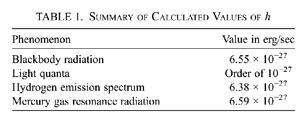
I have presented several phenomena that were unified by QH. I have also emphasized the importance of constraining and measuring the numerical value of Planck’s constant that was an integral feature of QH. Table 1 summarizes the values obtained from each of the phenomena discussed above. These measurements are significant because they demonstrate the idea that various observations, understood in terms of constraining information about a parameter, are able to render previously unrelated phenomena relevant to one another by yielding information implicitly contained in those observations. By increasing the informational relevance of each phenomenon to the other, the unificatory power of QH is raised. The above discussion considered only pairwise informational relevance relations, but the generalization to several phenomena yields the following equation (taking each e below to represent the results of experiments from the four phenomena listed in the table):

Thus, the unificatory power of the QH from the Bayesian perspective is nonzero, and the degree of confirmation of QH is increased not only by the individual phenomena but by the fact that QH makes those phenomena relevant to one another.
Summary of Calculated Values of h

| Phenomenon | Value in erg/sec |
|---|---|
| Blackbody radiation | 6.55 × 10⁻²⁷ |
| Light quanta | Order of 10−27 |
| Hydrogen emission spectrum | 6.38 × 10⁻²⁷ |
| Mercury gas resonance radiation | 6.59 × 10⁻²⁷ |
4. Conclusion
In this article, I have argued that the type of unification displayed by the old quantum theory can be understood in terms of the Bayesian notion of informational relevance, which yields the result that this unificatory power contributes to the confirmation of the QH over and above the evidence taken individually. I claimed that, in some cases, an account of the mechanisms that would explain the observed behavior was not available, which makes a causal story for such unification more difficult to provide. While not denying that causal explanations have their place in theoretical justification, I hope to have shown that there is at least one case in which even when such explanations are not available to us, there is an alternative sense of unification that has epistemic force. Thus, despite the lack of an acceptable quantum theory during these years, there was at least one good epistemic reason for scientists of the time to pursue the QH.