1 Introduction
In an effort to understand the canonical model of
 $\overline{M}_{g}$
, Hassett and Keel introduced the log minimal model program for
 $\overline{M}_{g}$
, henceforth the Hassett–Keel program. For any
 $\unicode[STIX]{x1D6FC}\in \mathbb{Q}\cap [0,1]$
such that
 $K_{\overline{{\mathcal{M}}}_{g}}+\unicode[STIX]{x1D6FC}\unicode[STIX]{x1D6FF}$
is big, Hassett defined
 $$\begin{eqnarray}\displaystyle \overline{M}_{g}(\unicode[STIX]{x1D6FC}):=\text{Proj}\,\bigoplus _{m\geqslant 0}\text{H}^{0}(\overline{{\mathcal{M}}}_{g},\lfloor m(K_{\overline{{\mathcal{M}}}_{g}}+\unicode[STIX]{x1D6FC}\unicode[STIX]{x1D6FF})\rfloor ), & & \displaystyle\end{eqnarray}$$
and asked whether the spaces
 $\overline{M}_{g}(\unicode[STIX]{x1D6FC})$
admit a modular interpretation [Reference HassettHas05]. In [Reference Hassett and HyeonHH09, Reference Hassett and HyeonHH13], Hassett and Hyeon carried out the first two steps of this program by showing that
 $$\begin{eqnarray}\overline{M}_{g}(\unicode[STIX]{x1D6FC})=\left\{\begin{array}{@{}ll@{}}\overline{M}_{g}\quad & \text{if }\unicode[STIX]{x1D6FC}\in (9/11,1],\\ \overline{M}_{g}^{\,ps}\quad & \text{if }\unicode[STIX]{x1D6FC}\in (7/10,9/11],\\ \overline{M}_{g}^{\,c}\quad & \text{if }\unicode[STIX]{x1D6FC}=7/10,\\ \overline{M}_{g}^{\,h}\quad & \text{if }\unicode[STIX]{x1D6FC}\in (7/10-\unicode[STIX]{x1D716},7/10),\end{array}\right.\end{eqnarray}$$
where
 $\overline{M}_{g}^{\,ps}$
,
 $\overline{M}_{g}^{\,c}$
, and
 $\overline{M}_{g}^{\,h}$
are the moduli spaces of pseudostable (see [Reference SchubertSch91]), c-semistable, and h-semistable curves (see [Reference Hassett and HyeonHH13]), respectively. Additional steps of the Hassett–Keel program for
 $\overline{M}_{g}$
are known when
 $g\leqslant 6$
[Reference HassettHas05, Reference Hyeon and LeeHL10, Reference Hyeon and LeeHL14, Reference FedorchukFed12, Reference Casalaina-Martin, Jensen and LazaCJL12, Reference Casalaina-Martin, Jensen and LazaCJL14, Reference MüllerMül14, Reference Fedorchuk, Smyth, Hassett, McKernan, Starr and VakilFS13]. In these works, new projective moduli spaces of curves are constructed using geometric invariant theory (GIT). Indeed, one of the most appealing features of the Hassett–Keel program is the way it ties together different compactifications of
 $M_{g}$
obtained by varying the parameters implicit in Gieseker and Mumford’s classical GIT construction of
 $\overline{M}_{g}$
[Reference MumfordMum77, Reference GiesekerGie82]. We refer the reader to [Reference MorrisonMor09] for a detailed discussion of these modified GIT constructions.
This is the first paper in the trilogy in which we develop new techniques for constructing moduli spaces without GIT and apply them to construct the third step of the Hassett–Keel program for
 $\overline{M}_{g}$
, a flip replacing Weierstrass genus
 $2$
tails by ramphoid cusps. In fact, we give a uniform construction of the first three steps of the Hassett–Keel program for
 $\overline{M}_{g}$
, as well as an analogous program for
 $\overline{M}_{g,n}$
. To motivate our approach, let us recall the three-step procedure used to construct
 $\overline{M}_{g}$
and establish its projectivity intrinsically.
-
(1) Prove that the functor of stable curves is a proper Deligne and Mumford stack
 $\overline{{\mathcal{M}}}_{g}$
[Reference Deligne and MumfordDM69].
-
(2) Use the Keel–Mori theorem to show that
$\overline{{\mathcal{M}}}_{g}$
has a coarse moduli space
$\overline{{\mathcal{M}}}_{g}\rightarrow \overline{M}_{g}$
[Reference Keel and MoriKM97]. -
(3) Prove that some line bundle on
$\overline{{\mathcal{M}}}_{g}$
descends to an ample line bundle on
$\overline{M}_{g}$
[Reference KollárKol90, Reference CornalbaCor93].


This is now the standard procedure for constructing projective moduli spaces in algebraic geometry. It is indispensable in cases where a global quotient presentation for the relevant moduli problem is not available, or where the GIT stability analysis is intractable, and there are good reasons to expect both these issues to arise in further stages of the Hassett–Keel program for
 $\overline{M}_{g}$
. Unfortunately, this procedure cannot be used to construct the log canonical models
 $\overline{M}_{g}(\unicode[STIX]{x1D6FC})$
because potential moduli stacks
 $\overline{{\mathcal{M}}}_{g}(\unicode[STIX]{x1D6FC})$
may include curves with infinite automorphism groups. In other words, the stacks
 $\overline{{\mathcal{M}}}_{g}(\unicode[STIX]{x1D6FC})$
may be non-separated and therefore may not possess a Keel–Mori coarse moduli space. The correct fix is to replace the notion of a coarse moduli space by a good moduli space, as defined and developed by Alper [Reference AlperAlp13, Reference AlperAlp10, Reference AlperAlp14].
In the second paper of this trilogy, we prove a general existence theorem for good moduli spaces of non-separated algebraic stacks [Reference Alper, Fedorchuk and SmythAFS17, Theorem 1.2] that can be viewed as a generalization of the Keel–Mori theorem [Reference Keel and MoriKM97]. This allows us to carry out a modified version of the standard three-step procedure in order to construct moduli interpretations for the log canonical modelsFootnote 1
 $$\begin{eqnarray}\displaystyle \overline{M}_{g,n}(\unicode[STIX]{x1D6FC}):=\text{Proj}\,\bigoplus _{m\geqslant 0}\text{H}^{0}(\overline{{\mathcal{M}}}_{g,n},\lfloor m(K_{\overline{{\mathcal{M}}}_{g,n}}+\unicode[STIX]{x1D6FC}\unicode[STIX]{x1D6FF}+(1-\unicode[STIX]{x1D6FC})\unicode[STIX]{x1D713})\rfloor ) & & \displaystyle\end{eqnarray}$$
in the final part of this trilogy [Reference Alper, Fedorchuk and SmythAFS16]. Specifically, for all
 $\unicode[STIX]{x1D6FC}>2/3-\unicode[STIX]{x1D716}$
, where
 $0<\unicode[STIX]{x1D716}\ll 1$
, we:
-
(1) construct an algebraic stack
$\overline{{\mathcal{M}}}_{g,n}(\unicode[STIX]{x1D6FC})$
of
$\unicode[STIX]{x1D6FC}$
-stable curves (Theorem A); -
(2) construct a good moduli space
$\overline{{\mathcal{M}}}_{g,n}(\unicode[STIX]{x1D6FC})\rightarrow \overline{\mathbb{M}}_{g,n}(\unicode[STIX]{x1D6FC})$
(Theorem B); -
(3) show that
$K_{\overline{{\mathcal{M}}}_{g,n}(\unicode[STIX]{x1D6FC})}+\unicode[STIX]{x1D6FC}\unicode[STIX]{x1D6FF}+(1-\unicode[STIX]{x1D6FC})\unicode[STIX]{x1D713}$
on
$\overline{{\mathcal{M}}}_{g,n}(\unicode[STIX]{x1D6FC})$
descends to an ample line bundle on
$\overline{\mathbb{M}}_{g,n}(\unicode[STIX]{x1D6FC})$
, and conclude that
$\overline{\mathbb{M}}_{g,n}(\unicode[STIX]{x1D6FC})\simeq \overline{M}_{g,n}(\unicode[STIX]{x1D6FC})$
(Theorem C).


The definition of
 $\unicode[STIX]{x1D6FC}$
-stability changes when
 $\unicode[STIX]{x1D6FC}$
passes through one of the three critical values:
 $\unicode[STIX]{x1D6FC}_{1}=9/11$
,
 $\unicode[STIX]{x1D6FC}_{2}=7/10$
, and
 $\unicode[STIX]{x1D6FC}_{3}=2/3$
. We often denote a critical value by
 $\unicode[STIX]{x1D6FC}_{c}$
without specifying the index
 $c$
. With this terminology, we prove the following result (see Theorem 2.7) in this paper.
Theorem A. For
 $\unicode[STIX]{x1D6FC}\in (2/3-\unicode[STIX]{x1D716},1]$
, the stack
 $\overline{{\mathcal{M}}}_{g,n}(\unicode[STIX]{x1D6FC})$
of
 $\unicode[STIX]{x1D6FC}$
-stable curves is algebraic and of finite type over
 $\text{Spec}\,\mathbb{C}$
. Furthermore, for each critical value
 $\unicode[STIX]{x1D6FC}_{c}\in \{9/11,7/10,2/3\}$
, we have open immersions
 $$\begin{eqnarray}\overline{{\mathcal{M}}}_{g,n}(\unicode[STIX]{x1D6FC}_{c}+\unicode[STIX]{x1D716}){\hookrightarrow}\overline{{\mathcal{M}}}_{g,n}(\unicode[STIX]{x1D6FC}_{c}){\hookleftarrow}\overline{{\mathcal{M}}}_{g,n}(\unicode[STIX]{x1D6FC}_{c}-\unicode[STIX]{x1D716}).\end{eqnarray}$$
In our second paper, we prove that these stacks admit good moduli spaces.
Theorem B [Reference Alper, Fedorchuk and SmythAFS17, Theorem 1.1].
For every
 $\unicode[STIX]{x1D6FC}\in (2/3-\unicode[STIX]{x1D716},1]$
,
 $\overline{{\mathcal{M}}}_{g,n}(\unicode[STIX]{x1D6FC})$
admits a good moduli space
 $\overline{\mathbb{M}}_{g,n}(\unicode[STIX]{x1D6FC})$
, which is a proper algebraic space over
 $\text{Spec}\,\mathbb{C}$
. Furthermore, for each critical value
 $\unicode[STIX]{x1D6FC}_{c}$
, there exists a diagram

where
 $\overline{{\mathcal{M}}}_{g,n}(\unicode[STIX]{x1D6FC}_{c})\rightarrow \overline{\mathbb{M}}_{g,n}(\unicode[STIX]{x1D6FC}_{c})$
,
 $\overline{{\mathcal{M}}}_{g,n}(\unicode[STIX]{x1D6FC}_{c}+\unicode[STIX]{x1D716})\rightarrow \overline{\mathbb{M}}_{g,n}(\unicode[STIX]{x1D6FC}_{c}+\unicode[STIX]{x1D716})$
, and
 $\overline{{\mathcal{M}}}_{g,n}(\unicode[STIX]{x1D6FC}_{c}-\unicode[STIX]{x1D716})\rightarrow \overline{\mathbb{M}}_{g,n}(\unicode[STIX]{x1D6FC}_{c}-\unicode[STIX]{x1D716})$
are good moduli spaces, and where
 $\overline{\mathbb{M}}_{g,n}(\unicode[STIX]{x1D6FC}_{c}+\unicode[STIX]{x1D716})\rightarrow \overline{\mathbb{M}}_{g,n}(\unicode[STIX]{x1D6FC}_{c})$
and
 $\overline{\mathbb{M}}_{g,n}(\unicode[STIX]{x1D6FC}_{c}-\unicode[STIX]{x1D716})\rightarrow \overline{\mathbb{M}}_{g,n}(\unicode[STIX]{x1D6FC}_{c})$
are proper morphisms of algebraic spaces.
In our third paper, we identify these good moduli spaces with the appropriate log canonical models.
Theorem C [Reference Alper, Fedorchuk and SmythAFS16, Theorem 1.1].
For
 $\unicode[STIX]{x1D6FC}>2/3-\unicode[STIX]{x1D716}$
, the following statements hold.
-
(1) The line bundle
$K_{\overline{{\mathcal{M}}}_{g,n}(\unicode[STIX]{x1D6FC})}+\unicode[STIX]{x1D6FC}\unicode[STIX]{x1D6FF}+(1-\unicode[STIX]{x1D6FC})\unicode[STIX]{x1D713}$
descends to an ample line bundle on
$\overline{\mathbb{M}}_{g,n}(\unicode[STIX]{x1D6FC})$
. -
(2) There is an isomorphism
$\displaystyle \overline{\mathbb{M}}_{g,n}(\unicode[STIX]{x1D6FC})\simeq \overline{M}_{g,n}(\unicode[STIX]{x1D6FC})$
.


Putting this all together, we have the following result.
Main Theorem (of the trilogy). There exists a diagram

where:
-
(1)
$\overline{{\mathcal{M}}}_{g,n}(\unicode[STIX]{x1D6FC})$
is the moduli stack of
$\unicode[STIX]{x1D6FC}$
-stable curves and, for
$c=1,2,3$
; -
(2)
$i_{c}^{+}$
and
$i_{c}^{-}$
are open immersions of algebraic stacks; -
(3) the morphisms
$\unicode[STIX]{x1D719}_{c}$
and
$\unicode[STIX]{x1D719}_{c}^{-}$
are good moduli spaces; -
(4) the morphisms
$j_{c}^{+}$
and
$j_{c}^{-}$
are projective morphisms induced by
$i_{c}^{+}$
and
$i_{c}^{-}$
, respectively.


When
 $n=0$
, the above diagram constitutes the steps of the Hassett–Keel program for
 $\overline{M}_{g}$
. In particular,
 $j_{1}^{+}$
is the first contraction,
 $j_{1}^{-}$
is an isomorphism,
 $(j_{2}^{+},j_{2}^{-})$
is the first flip, and
 $(j_{3}^{+},j_{3}^{-})$
is the second flip.
Remark 1.1. The theorem is degenerate in several special cases: for
 $(g,n)=(1,1)$
,
 $(1,2)$
,
 $(2,0)$
, the divisor
 $K_{\overline{{\mathcal{M}}}_{g,n}}+\unicode[STIX]{x1D6FC}\unicode[STIX]{x1D6FF}+(1-\unicode[STIX]{x1D6FC})\unicode[STIX]{x1D713}$
hits the edge of the effective cone at
 $9/11,7/10$
, and
 $7/10$
, respectively, and hence the diagram should be taken to terminate at these critical values. Furthermore, when
 $g=1$
and
 $n\geqslant 3$
, or
 $(g,n)=(3,0),(3,1)$
,
 $\unicode[STIX]{x1D6FC}$
-stability does not change at the critical value
 $\unicode[STIX]{x1D6FC}_{3}=2/3$
, so the morphisms
 $(i_{3}^{+},i_{3}^{-})$
and
 $(j_{3}^{+},j_{3}^{-})$
are isomorphisms. Finally, for
 $(g,n)=(2,1)$
,
 $j_{3}^{+}$
is a divisorial contraction and
 $j_{3}^{-}$
is an isomorphism.
Remark.
For
 $\unicode[STIX]{x1D6FC}>9/11$
, we simply obtain the Deligne–Mumford spaces. When
 $n=0$
and
 $\unicode[STIX]{x1D6FC}\in (2/3,9/11)$
, the stacks
 $\overline{{\mathcal{M}}}_{g}(\unicode[STIX]{x1D6FC})$
have been constructed using GIT. In these cases, our definition of
 $\unicode[STIX]{x1D6FC}$
-stability agrees with the GIT semistability notions studied in the work of Schubert, Hassett, Hyeon, and Morrison [Reference SchubertSch91, Reference Hassett and HyeonHH09, Reference Hassett and HyeonHH13, Reference Hyeon and MorrisonHM10]. Namely,
 $\overline{{\mathcal{M}}}_{g}(\unicode[STIX]{x1D6FC})$
is the stack of weakly pseudostable, pseudostable, c-semistable, and h-semistable curves for
 $\unicode[STIX]{x1D6FC}=9/11$
,
 $\unicode[STIX]{x1D6FC}\in (7/10,9/11)$
,
 $\unicode[STIX]{x1D6FC}=7/10$
, and
 $\unicode[STIX]{x1D6FC}\in (2/3,7/10)$
, respectively.
We should remark that the major work of the present paper is not simply a proof of Theorem A, but also a precise local description of the maps between the stacks
 $\overline{{\mathcal{M}}}_{g,n}(\unicode[STIX]{x1D6FC})$
. The key idea is that at each critical value
 $\unicode[STIX]{x1D6FC}_{c}\in \{9/11,7/10,2/3\}$
, the inclusions
 $$\begin{eqnarray}\displaystyle \overline{{\mathcal{M}}}_{g,n}(\unicode[STIX]{x1D6FC}_{c}+\unicode[STIX]{x1D716}){\hookrightarrow}\overline{{\mathcal{M}}}_{g,n}(\unicode[STIX]{x1D6FC}_{c}){\hookleftarrow}\overline{{\mathcal{M}}}_{g,n}(\unicode[STIX]{x1D6FC}_{c}-\unicode[STIX]{x1D716}) & & \displaystyle \nonumber\end{eqnarray}$$
can be locally modeled by an intrinsic variation of GIT problem. This is made precise in Definition 3.14 and Theorem 3.17, which is the main result of § 3. This theorem is also the key ingredient in our proof of Theorem B.
1.1 Geometry of the second flip
Let us conclude by briefly describing the geometry of the second flip. At
 $\unicode[STIX]{x1D6FC}_{3}=2/3$
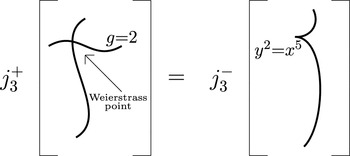
, the locus of curves with a genus 2 Weierstrass tail (i.e. a genus
 $2$
subcurve nodally attached to the rest of the curve at a Weierstrass point), or more generally a Weierstrass chain (see Definition 2.3), is flipped to the locus of curves with a ramphoid cusp (
 $y^{2}=x^{5}$
). The fibers of
 $j_{3}^{+}$
correspond to varying moduli of Weierstrass chains, while the fibers of
 $j_{3}^{-}$
correspond to varying moduli of ramphoid cuspidal crimpings. See Figure 1.
Curves with a nodally attached genus
 $2$
Weierstrass tail are flipped to curves with a ramphoid cuspidal (
 $y^{2}=x^{5}$
) singularity.

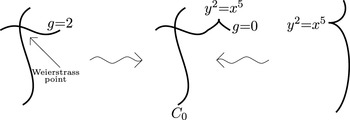
Moreover, if
 $(K,p)$
is a fixed curve of genus
 $g-2$
, all curves obtained by attaching a Weierstrass genus 2 tail at
 $p$
or imposing a ramphoid cusp at
 $p$
are identified in
 $\overline{M}_{g,n}(2/3)$
. This can be seen on the level of stacks since, in
 $\overline{{\mathcal{M}}}_{g,n}(2/3)$
, all such curves admit an isotrivial specialization to the curve
 $C_{0}$
, obtained by attaching a rational ramphoid cuspidal tail to
 $K$
at
 $p$
. See Figure 2.
The curve
 $C_{0}$
is a nodal union of a genus
 $g-2$
curve
 $K$
and a rational ramphoid cuspidal tail. All curves obtained by either attaching a Weierstrass genus 2 tail to
 $K$
at
 $p$
, or imposing a ramphoid cusp on
 $K$
at
 $p$
, isotrivially specialize to
 $C_{0}$
. Observe that
 $\text{Aut}(C_{0})$
is not finite.

1.2 Outline of the paper
Let us now give a more detailed outline of the contents of this paper. Section 2 is devoted to the notion of
 $\unicode[STIX]{x1D6FC}$
-stability. Namely, in § 2.1, we define
 $\unicode[STIX]{x1D6FC}$
-stable curves and, in § 2.2, we show that
 $\unicode[STIX]{x1D6FC}$
-stability is a deformation open condition and conclude that the moduli stacks of
 $\unicode[STIX]{x1D6FC}$
-stable curves are algebraic (Theorem 2.7). After collecting some elementary facts about families of
 $\unicode[STIX]{x1D6FC}$
-stable curves in § 2.3, we give in § 2.4 a characterization of the closed points of the stack
 $\overline{{\mathcal{M}}}_{g,n}(\unicode[STIX]{x1D6FC}_{c})$
at each critical value
 $\unicode[STIX]{x1D6FC}_{c}$
. We prove that the closed points of
 $\overline{{\mathcal{M}}}_{g,n}(\unicode[STIX]{x1D6FC}_{c})$
are precisely the
 $\unicode[STIX]{x1D6FC}_{c}$
-closed curves (Definition 2.21 and Theorem 2.22). In § 2.5, we define the combinatorial type of an
 $\unicode[STIX]{x1D6FC}_{c}$
-closed curve (only for
 $\unicode[STIX]{x1D6FC}_{c}=2/3$
), mainly for the purpose of establishing the notation that will be used to carry out the variation of geometric invariant theory (VGIT) calculations of § 3.
In § 3, we develop the machinery of local quotient presentations and local variation of GIT. In § 3.1, we recall some basic facts about variation of GIT quotients for the action of a reductive group on an affine scheme. In § 3.2, we define the VGIT chambers associated to a local quotient presentation. In § 3.3, we write out explicit coordinates for the deformation space
 $\text{Def}(C)$
of an
 $\unicode[STIX]{x1D6FC}_{c}$
-stable curve
 $C$
and describe the natural action of
 $\text{Aut}(C)$
on
 $\text{Def}(C)$
in these coordinates. This sets us up for a major invariant theory computation in § 3.4, where we verify that the VGIT chambers associated to the local quotient presentation
 $[\text{Def}(C)/\text{Aut}(C)]\rightarrow \overline{{\mathcal{M}}}_{g,n}(\unicode[STIX]{x1D6FC}_{c})$
do indeed cut out the inclusions
 $\overline{{\mathcal{M}}}_{g,n}(\unicode[STIX]{x1D6FC}_{c}+\unicode[STIX]{x1D716}){\hookrightarrow}\overline{{\mathcal{M}}}_{g,n}(\unicode[STIX]{x1D6FC}){\hookleftarrow}\overline{{\mathcal{M}}}_{g,n}(\unicode[STIX]{x1D6FC}_{c}-\unicode[STIX]{x1D716})$
(Theorem 3.17).
1.3 Notation
We work over a fixed algebraically closed field
 $\mathbb{C}$
of characteristic 0. An
 $n$
-pointed curve
 $(C,\{p_{i}\}_{i=1}^{n})$
is a connected, reduced, proper one-dimensional
 $\mathbb{C}$
-scheme
 $C$
with
 $n$
distinct smooth marked points
 $p_{i}\in C$
. A curve
 $C$
has an
 $A_{k}$
-singularity at
 $p\in C$
if
 $\widehat{{\mathcal{O}}}_{C,p}\simeq \mathbb{C}[[x,y]]/(y^{2}-x^{k+1})$
. An
 $A_{1}$
- (respectively,
 $A_{2}$
-,
 $A_{3}$
-,
 $A_{4}$
-) singularity is also called a node (respectively, cusp, tacnode, ramphoid cusp). We use the notation
 $\unicode[STIX]{x1D6E5}=\text{Spec}\,R$
and
 $\unicode[STIX]{x1D6E5}^{\ast }=\text{Spec}\,K$
, where
 $R$
is a discrete valuation ring with fraction field
 $K$
; we set
 $0$
,
 $\unicode[STIX]{x1D702}$
, and
 $\bar{\unicode[STIX]{x1D702}}$
to be the closed point, the generic point, and the geometric generic point respectively of
 $\unicode[STIX]{x1D6E5}$
. We say that a flat family
 ${\mathcal{C}}\rightarrow \unicode[STIX]{x1D6E5}$
is an isotrivial specialization if
 ${\mathcal{C}}\times _{\unicode[STIX]{x1D6E5}}\unicode[STIX]{x1D6E5}^{\ast }\rightarrow \unicode[STIX]{x1D6E5}^{\ast }$
is isotrivial.
2
$\unicode[STIX]{x1D6FC}$
-stability

In this section, we define
 $\unicode[STIX]{x1D6FC}$
-stability (Definition 2.5) and show that it is an open condition. We conclude that
 $\overline{{\mathcal{M}}}_{g,n}(\unicode[STIX]{x1D6FC})$
, the stack of
 $n$
-pointed
 $\unicode[STIX]{x1D6FC}$
-stable curves of genus
 $g$
, is an algebraic stack of finite type over
 $\mathbb{C}$
(see Theorem 2.7). We also give a complete description of the closed points of
 $\overline{{\mathcal{M}}}_{g,n}(\unicode[STIX]{x1D6FC}_{c})$
for
 $\unicode[STIX]{x1D6FC}_{c}\in \{2/3,7/10,9/11\}$
(Theorem 2.22).
2.1 Definition of
$\unicode[STIX]{x1D6FC}$
-stability

The basic idea is to modify Deligne–Mumford stability by designating certain curve singularities as ‘stable’ and certain subcurves as ‘unstable’. We begin by defining the unstable subcurves associated to the first three steps of the Hassett–Keel program for
 $\overline{{\mathcal{M}}}_{g,n}$
.
Definition 2.1 (Tails and bridges; see Figure 3).
(1) An elliptic tail is a one-pointed curve
 $(E,q)$
of arithmetic genus
 $1$
which admits a finite degree-2 map
 $\unicode[STIX]{x1D719}:E\rightarrow \mathbb{P}^{1}$
ramified at
 $q$
.
(2) An elliptic bridge is a two-pointed curve
 $(E,q_{1},q_{2})$
of arithmetic genus
 $1$
which admits a finite degree-2 map
 $\unicode[STIX]{x1D719}:E\rightarrow \mathbb{P}^{1}$
such that
 $\unicode[STIX]{x1D719}^{-1}(\{\infty \})=\{q_{1}+q_{2}\}$
.
(3) A Weierstrass genus-
 $2$
tail (or simply Weierstrass tail) is a one-pointed curve
 $(E,q)$
of arithmetic genus
 $2$
which admits a finite degree-2 map
 $\unicode[STIX]{x1D719}:E\rightarrow \mathbb{P}^{1}$
ramified at
 $q$
.
We use the term
 $\unicode[STIX]{x1D6FC}_{c}$
-tail to mean an elliptic tail if
 $\unicode[STIX]{x1D6FC}_{c}=9/11$
, an elliptic bridge if
 $\unicode[STIX]{x1D6FC}_{c}=7/10$
, and a Weierstrass tail if
 $\unicode[STIX]{x1D6FC}_{c}=2/3$
.
An elliptic tail, elliptic bridge, and Weierstrass tail.

Unfortunately, we cannot describe our
 $\unicode[STIX]{x1D6FC}$
-stability conditions purely in terms of tails and bridges. As already seen in [Reference Hassett and HyeonHH13], an additional layer of combinatorial description is needed, and this is encapsulated in our definition of chains. In addition, when describing tails and chains as subcurves, it is important to specify the singularities along which the tail or chain is attached. This motivates the following several definitions.
Definition 2.2. A gluing morphism
 $\unicode[STIX]{x1D6FE}:(E,\{q_{i}\}_{i=1}^{m})\rightarrow (C,\{p_{i}\}_{i=1}^{n})$
between two pointed curves is a finite morphism
 $E\rightarrow C$
, which is an open immersion when restricted to
 $E-\{q_{1},\ldots ,q_{m}\}$
. We do not require the points
 $\{\unicode[STIX]{x1D6FE}(q_{i})\}_{i=1}^{m}$
to be distinct or to be marked points of
 $C$
.
Definition 2.3 (Chains).
An elliptic chain of length
 $r$
is a two-pointed curve
 $(E,p_{1},p_{2})$
which admits a surjective gluing morphism
 $$\begin{eqnarray}\unicode[STIX]{x1D6FE}:\coprod _{i=1}^{r}(E_{i},q_{2i-1},q_{2i})\rightarrow (E,p_{1},p_{2})\end{eqnarray}$$
such that:
-
(1)
$(E_{i},q_{2i-1},q_{2i})$
is an elliptic bridge for
$i=1,\ldots ,r$
; -
(2)
$\unicode[STIX]{x1D6FE}(q_{2i})=\unicode[STIX]{x1D6FE}(q_{2i+1})$
is an
$A_{3}$
-singularity of
$E$
for
$i=1,\ldots ,r-1$
; -
(3)
$\unicode[STIX]{x1D6FE}(q_{1})=p_{1}$
and
$\unicode[STIX]{x1D6FE}(q_{2r})=p_{2}$
.


A Weierstrass chain of length
 $r$
is a one-pointed curve
 $(E,p)$
which admits a surjective gluing morphism
 $$\begin{eqnarray}\unicode[STIX]{x1D6FE}:\coprod _{i=1}^{r-1}(E_{i},q_{2i-1},q_{2i})\coprod (E_{r},q_{2r-1})\rightarrow (E,p)\end{eqnarray}$$
such that:
-
(1)
$(E_{i},q_{2i-1},q_{2i})$
is an elliptic bridge for
$i=1,\ldots ,r-1$
and
$(E_{r},q_{2r-1})$
is a Weierstrass tail; -
(2)
$\unicode[STIX]{x1D6FE}(q_{2i})=\unicode[STIX]{x1D6FE}(q_{2i+1})$
is an
$A_{3}$
-singularity of
$E$
for
$i=1,\ldots ,r-1$
; -
(3)
$\unicode[STIX]{x1D6FE}(q_{1})=p$
.


An elliptic (respectively, Weierstrass) chain of length
 $1$
is an elliptic bridge (respectively, Weierstrass tail).
Curve (A) (respectively, (B)) is an elliptic (respectively, Weierstrass) chain of length 4.

Definition 2.4 (Tails and chains with attaching data; see Figure 4).
Let
 $(C,\{p_{i}\}_{i=1}^{n})$
be an
 $n$
-pointed curve. We say that
 $(C,\{p_{i}\}_{i=1}^{n})$
has:
-
(1) an
$A_{k}$
-attached elliptic tail if there is a gluing morphism
$\unicode[STIX]{x1D6FE}:(E,q)\rightarrow (C,\{p_{i}\}_{i=1}^{n})$
such that:-
(a)
$(E,q)$
is an elliptic tail; -
(b)
$\unicode[STIX]{x1D6FE}(q)$
is an
$A_{k}$
-singularity of
$C$
, or if
$k=1$
we allow
$\unicode[STIX]{x1D6FE}(q)$
to be a marked point;
-
-
(2) an
$A_{k_{1}}/A_{k_{2}}$
-attached elliptic chain if there is a gluing morphism
$\unicode[STIX]{x1D6FE}:(E,q_{1},q_{2})\rightarrow (C,\{p_{i}\}_{i=1}^{n})$
such that:-
(a)
$(E,q_{1},q_{2})$
is an elliptic chain; -
(b)
$\unicode[STIX]{x1D6FE}(q_{i})$
is an
$A_{k_{i}}$
-singularity of
$C$
, or if
$k_{i}=1$
we allow
$\unicode[STIX]{x1D6FE}(q_{i})$
to be a marked point (
$i=1,2$
);
-
-
(3) an
$A_{k}$
-attached Weierstrass chain if there is a gluing morphism
$\unicode[STIX]{x1D6FE}:(E,q)\rightarrow (C,\{p_{i}\}_{i=1}^{n})$
such that:-
(a)
$(E,q)$
is a Weierstrass chain; -
(b)
$\unicode[STIX]{x1D6FE}(q)$
is an
$A_{k}$
-singularity of
$C$
, or if
$k=1$
we allow
$\unicode[STIX]{x1D6FE}(q)$
to be a marked point.
-


This definition entails an essential, systematic abuse of notation: when we say that a curve has an
 $A_{1}$
-attached tail or chain, we always allow the
 $A_{1}$
-attachment points to be marked points.
We can now define
 $\unicode[STIX]{x1D6FC}$
-stability. See Figure 5 for examples.
Definition 2.5 (
$\unicode[STIX]{x1D6FC}$
-stability).

For
 $\unicode[STIX]{x1D6FC}\in (2/3-\unicode[STIX]{x1D716},1]$
, we say that an
 $n$
-pointed curve
 $(C,\{p_{i}\}_{i=1}^{n})$
is
 $\unicode[STIX]{x1D6FC}$
-stable if
 $\unicode[STIX]{x1D714}_{C}(\sum _{i=1}^{n}p_{i})$
is ample and:
-
for
$\unicode[STIX]{x1D6FC}\in (9/11,1]$
:
$C$
has only
$A_{1}$
-singularities; -
for
$\unicode[STIX]{x1D6FC}=9/11$
:
$C$
has only
$A_{1},A_{2}$
-singularities; -
for
$\unicode[STIX]{x1D6FC}\in (7/10,9/11)$
:
$C$
is
$\frac{9}{11}$
-stable and does not contain: -
$\bullet$
-
$A_{1}$
-attached elliptic tails;
-
for
$\unicode[STIX]{x1D6FC}=7/10$
:
$C$
has only
$A_{1},A_{2},A_{3}$
-singularities and does not contain: -
$\bullet$
-
$A_{1},A_{3}$
-attached elliptic tails;
-
for
$\unicode[STIX]{x1D6FC}\in (2/3,7/10)$
:
$C$
is
$\frac{7}{10}$
-stable and does not contain: -
$\bullet$
-
$A_{1}/A_{1}$
-attached elliptic chains;
-
for
$\unicode[STIX]{x1D6FC}=2/3$
:
$C$
has only
$A_{1},A_{2},A_{3},A_{4}$
-singularities and does not contain: -
$\bullet$
-
$A_{1},A_{3},A_{4}$
-attached elliptic tails;
-
$\bullet$
-
$A_{1}/A_{1},A_{1}/A_{4},A_{4}/A_{4}$
-attached elliptic chains;
-
for
$\unicode[STIX]{x1D6FC}\in (2/3-\unicode[STIX]{x1D716},2/3)$
:
$C$
is
$\frac{2}{3}$
-stable and does not contain: -
$\bullet$
-
$A_{1}$
-attached Weierstrass chains.


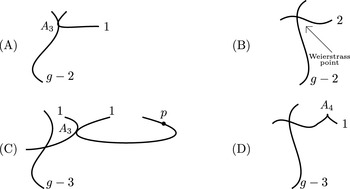
Curve (A) has an
 $A_{3}$
-attached elliptic tail; it is never
 $\unicode[STIX]{x1D6FC}$
-stable. Curve (B) has an
 $A_{1}$
-attached Weierstrass tail; it is
 $\unicode[STIX]{x1D6FC}$
-stable for
 $\unicode[STIX]{x1D6FC}\geqslant 2/3$
. Curve (C) has an
 $A_{1}/A_{1}$
-attached elliptic chain of length
 $2$
; it is
 $\unicode[STIX]{x1D6FC}$
-stable for
 $\unicode[STIX]{x1D6FC}\geqslant 7/10$
. Curve (D) has an
 $A_{1}/A_{4}$
-attached elliptic bridge; it is never
 $\unicode[STIX]{x1D6FC}$
-stable.

A family of
 $\unicode[STIX]{x1D6FC}$
-stable curves is a flat and proper family whose geometric fibers are
 $\unicode[STIX]{x1D6FC}$
-stable. We let
 $\overline{{\mathcal{M}}}_{g,n}(\unicode[STIX]{x1D6FC})$
denote the stack of
 $n$
-pointed
 $\unicode[STIX]{x1D6FC}$
-stable curves of arithmetic genus
 $g$
.
Remark.
Our definition of an elliptic chain is similar, but not identical, to the definition of an open tacnodal elliptic chain appearing in [Reference Hassett and HyeonHH13, Definition 2.4]. Whereas open tacnodal elliptic chains are built out of arbitrary curves of arithmetic genus
 $1$
, our elliptic chains are built out of elliptic bridges. Nevertheless, it is easy to see that our definition of
 $(7/10-\unicode[STIX]{x1D716})$
-stability agrees with the definition of h-semistability in [Reference Hassett and HyeonHH13, Definition 2.7].
It will be useful to have a uniform way of referring to the singularities allowed and the subcurves excluded at each stage of the Hassett–Keel program. Thus, for any
 $\unicode[STIX]{x1D6FC}\in (2/3-\unicode[STIX]{x1D716},1]$
, we use the term
 $\unicode[STIX]{x1D6FC}$
-stable singularity to refer to any allowed singularity at the given value of
 $\unicode[STIX]{x1D6FC}$
. For example, a
 $\frac{2}{3}$
-stable singularity is a node, cusp, tacnode, or ramphoid cusp. Similarly, we use the term
 $\unicode[STIX]{x1D6FC}$
-unstable subcurve to refer to any excluded subcurve at the given value of
 $\unicode[STIX]{x1D6FC}$
. For example, a
 $\frac{2}{3}$
-unstable subcurve is an
 $A_{1}$
,
 $A_{3}$
, or
 $A_{4}$
-attached elliptic tail, or an
 $A_{1}/A_{1}$
,
 $A_{1}/A_{4}$
, or
 $A_{4}/A_{4}$
-attached elliptic chain. With this terminology, we may say that a curve is
 $\unicode[STIX]{x1D6FC}$
-stable if it has only
 $\unicode[STIX]{x1D6FC}$
-stable singularities and has no
 $\unicode[STIX]{x1D6FC}$
-unstable subcurves. Furthermore, if
 $\unicode[STIX]{x1D6FC}_{c}\in \{9/11,7/10,2/3\}$
is a critical value, we use the term
 $\unicode[STIX]{x1D6FC}_{c}$
-critical singularity to refer to the newly allowed singularity at
 $\unicode[STIX]{x1D6FC}=\unicode[STIX]{x1D6FC}_{c}$
and
 $\unicode[STIX]{x1D6FC}_{c}$
-critical subcurve to refer to the newly disallowed subcurve at
 $\unicode[STIX]{x1D6FC}=\unicode[STIX]{x1D6FC}_{c}-\unicode[STIX]{x1D716}$
. Thus, a
 $\frac{2}{3}$
-critical singularity is a ramphoid cusp, and a
 $\frac{2}{3}$
-critical subcurve is an
 $A_{1}$
-attached Weierstrass chain.
Before plunging into the deformation theory and combinatorics of
 $\unicode[STIX]{x1D6FC}$
-stable curves necessary to prove Theorem 2.7 and carry out the VGIT analysis in § 3, we take a moment to contemplate the features of
 $\unicode[STIX]{x1D6FC}$
-stability that underlie our arguments and to give some intuition behind the items of Definition 2.5. The following are the properties of
 $\unicode[STIX]{x1D6FC}$
-stability that are desired and that we prove to be true for all
 $\unicode[STIX]{x1D6FC}\in (2/3-\unicode[STIX]{x1D716},1]$
:
-
(1)
$\unicode[STIX]{x1D6FC}$
-stability is deformation open; -
(2) the stack
$\overline{{\mathcal{M}}}_{g,n}(\unicode[STIX]{x1D6FC})$
of all
$\unicode[STIX]{x1D6FC}$
-stable curves has a good moduli space; and -
(3) the line bundle
$K_{\overline{{\mathcal{M}}}_{g,n}(\unicode[STIX]{x1D6FC})}+\unicode[STIX]{x1D6FC}\unicode[STIX]{x1D6FF}+(1-\unicode[STIX]{x1D6FC})\unicode[STIX]{x1D713}$
on
$\overline{{\mathcal{M}}}_{g,n}(\unicode[STIX]{x1D6FC})$
descends to an ample line bundle on the good moduli space.


We will verify (1) in Proposition 2.15, thus obtaining Theorem 2.7. For instance, it is the removal of curves containing
 $\frac{2}{3}$
-unstable subcurves at
 $\unicode[STIX]{x1D6FC}=2/3$
that will allow us to conclude that the locus of
 $A_{1}$
-attached Weierstrass tails is closed in
 $\overline{{\mathcal{M}}}_{g,n}(2/3)$
.
The existence of a good moduli space in (2) requires that the automorphism of every closed
 $\unicode[STIX]{x1D6FC}$
-stable curve is reductive. We verify this necessary condition in Proposition 2.6, and use it in the proofs of Theorem 3.17 and the existence of good moduli spaces in [Reference Alper, Fedorchuk and SmythAFS17].
Statement (3) implies that the action of the stabilizer of any point on the fiber of the line bundle
 $K_{\overline{{\mathcal{M}}}_{g,n}(\unicode[STIX]{x1D6FC})}+\unicode[STIX]{x1D6FC}\unicode[STIX]{x1D6FF}+(1-\unicode[STIX]{x1D6FC})\unicode[STIX]{x1D713}$
is trivial. As explained in [Reference Alper, Fedorchuk and SmythAFS14], this condition places strong restrictions on which curves with
 $\mathbb{G}_{m}$
-action can be
 $\unicode[STIX]{x1D6FC}$
-stable: for example, the
 $\unicode[STIX]{x1D6FC}$
-invariant of a nodally attached
 $A_{3/4}$
-atom is not
 $2/3$
, which provides another heuristic for why we disallow
 $A_{1}/A_{4}$
-attached elliptic chains at
 $\unicode[STIX]{x1D6FC}=2/3$
.
Proposition 2.6. The connected component of the identity
 $\text{Aut}(C,\{p_{i}\}_{i=1}^{n})^{\circ }$
is a torus for every
 $\unicode[STIX]{x1D6FC}$
-stable curve
 $(C,\{p_{i}\}_{i=1}^{n})$
. Consequently,
 $\text{Aut}(C,\{p_{i}\}_{i=1}^{n})$
is reductive.
Proof. For an
 $\unicode[STIX]{x1D6FC}$
-stable curve, the only irreducible components with a positive-dimensional automorphism group are rational curves with two special points. The connected component of the automorphism group of such a component is either
 $\{1\}$
or
 $\mathbb{G}_{m}$
. The claim follows.◻
Remark.
We should note that Proposition 2.6 uses features of
 $\unicode[STIX]{x1D6FC}$
-stability that hold only for
 $\unicode[STIX]{x1D6FC}>2/3-\unicode[STIX]{x1D716}$
. We expect that for lower values of
 $\unicode[STIX]{x1D6FC}$
, the yet-to-be-defined
 $\unicode[STIX]{x1D6FC}$
-stability will allow for
 $\unicode[STIX]{x1D6FC}$
-stable curves with non-reductive stabilizers. However, we believe that for a correct definition of
 $\unicode[STIX]{x1D6FC}$
-stability, it will still hold to be true that the stabilizers of all closed points in
 $\overline{{\mathcal{M}}}_{g,n}(\unicode[STIX]{x1D6FC})$
will be reductive.
2.2 Deformation openness
Our first main result is the following theorem.
Theorem 2.7. For
 $\unicode[STIX]{x1D6FC}\in (2/3-\unicode[STIX]{x1D716},1]$
, the stack
 $\overline{{\mathcal{M}}}_{g,n}(\unicode[STIX]{x1D6FC})$
of
 $\unicode[STIX]{x1D6FC}$
-stable curves is algebraic and of finite type over
 $\text{Spec}\,\mathbb{C}$
. Furthermore, for each critical value
 $\unicode[STIX]{x1D6FC}_{c}$
, we have open immersions
 $$\begin{eqnarray}\overline{{\mathcal{M}}}_{g,n}(\unicode[STIX]{x1D6FC}_{c}+\unicode[STIX]{x1D716}){\hookrightarrow}\overline{{\mathcal{M}}}_{g,n}(\unicode[STIX]{x1D6FC}_{c}){\hookleftarrow}\overline{{\mathcal{M}}}_{g,n}(\unicode[STIX]{x1D6FC}_{c}-\unicode[STIX]{x1D716}).\end{eqnarray}$$
Let
 ${\mathcal{U}}_{g,n}(A_{\infty })$
be the stack of flat, proper families of curves
 $(\unicode[STIX]{x1D70B}:{\mathcal{C}}\rightarrow T,\{\unicode[STIX]{x1D70E}_{i}\}_{i=1}^{n})$
, where the sections
 $\{\unicode[STIX]{x1D70E}_{i}\}_{i=1}^{n}$
are distinct and lie in the smooth locus of
 $\unicode[STIX]{x1D70B}$
, the line bundle
 $\unicode[STIX]{x1D714}_{{\mathcal{C}}/T}(\sum _{i=1}^{n}\unicode[STIX]{x1D70E}_{i})$
is relatively ample, and the geometric fibers of
 $\unicode[STIX]{x1D70B}$
are
 $n$
-pointed curves of arithmetic genus
 $g$
with only
 $A$
-singularities. Since
 ${\mathcal{U}}_{g,n}(A_{\infty })$
parameterizes canonically polarized curves,
 ${\mathcal{U}}_{g,n}(A_{\infty })$
is algebraic and of finite type over
 $\mathbb{C}$
. For example, the proof of [Reference EdidinEdi00, Theorem 3.2] goes through with minor modifications to show that
 ${\mathcal{U}}_{g,n}(A_{\infty })$
is a quotient of a locally closed subscheme of an appropriate Hilbert scheme of some projective space
 $\mathbb{P}^{N}$
by
 $\text{PGL}(N+1)$
.
Let
 ${\mathcal{U}}_{g,n}(A_{\ell })\subset {\mathcal{U}}_{g,n}(A_{\infty })$
be the open substack parameterizing curves with at worst
 $A_{1},\ldots ,A_{\ell }$
-singularities. We will show that each
 $\overline{{\mathcal{M}}}_{g,n}(\unicode[STIX]{x1D6FC})$
can be obtained from a suitable
 ${\mathcal{U}}_{g,n}(A_{\ell })$
by excising a finite collection of closed substacks. As a result, we obtain a proof of Theorem 2.7.
Definition 2.8. Let
 ${\mathcal{T}}^{A_{k}},{\mathcal{B}}^{A_{k_{1}}/A_{k_{2}}},{\mathcal{W}}^{A_{k}}$
denote the following constructible subsets of
 ${\mathcal{U}}_{g,n}(A_{\infty })$
:
 $$\begin{eqnarray}\displaystyle {\mathcal{T}}^{A_{k}} & := & \displaystyle \text{locus of curves containing an }A_{k}\text{-attached elliptic tail},\nonumber\\ \displaystyle {\mathcal{B}}^{A_{k_{1}}/A_{k_{2}}} & := & \displaystyle \text{locus of curves containing an }A_{k_{1}}/A_{k_{2}}\text{-attached elliptic chain},\nonumber\\ \displaystyle {\mathcal{W}}^{A_{k}} & := & \displaystyle \text{locus of curves containing an }A_{k}\text{-attached Weierstrass chain}.\nonumber\end{eqnarray}$$
With this notation, we can describe our stability conditions (set-theoretically) as follows:
 $$\begin{eqnarray}\displaystyle \displaystyle \overline{{\mathcal{M}}}_{g,n}(9/11+\unicode[STIX]{x1D716}) & = & \displaystyle {\mathcal{U}}_{g,n}(A_{1}),\nonumber\\ \displaystyle \displaystyle \overline{{\mathcal{M}}}_{g,n}(9/11) & = & \displaystyle {\mathcal{U}}_{g,n}(A_{2}),\nonumber\\ \displaystyle \displaystyle \overline{{\mathcal{M}}}_{g,n}(9/11-\unicode[STIX]{x1D716}) & = & \displaystyle \overline{{\mathcal{M}}}_{g,n}(9/11)-{\mathcal{T}}^{A_{1}},\nonumber\\ \displaystyle \displaystyle \overline{{\mathcal{M}}}_{g,n}(7/10) & = & \displaystyle {\mathcal{U}}_{g,n}(A_{3})-\mathop{\bigcup }_{i\in \{1,3\}}{\mathcal{T}}^{A_{i}},\nonumber\\ \displaystyle \displaystyle \overline{{\mathcal{M}}}_{g,n}(7/10-\unicode[STIX]{x1D716}) & = & \displaystyle \overline{{\mathcal{M}}}_{g,n}(7/10)-{\mathcal{B}}^{A_{1}/A_{1}},\nonumber\\ \displaystyle \displaystyle \overline{{\mathcal{M}}}_{g,n}(2/3) & = & \displaystyle {\mathcal{U}}_{g,n}(A_{4})-\mathop{\bigcup }_{i\in \{1,3,4\}}{\mathcal{T}}^{A_{i}}-\mathop{\bigcup }_{i,j\in \{1,4\}}{\mathcal{B}}^{A_{i}/A_{j}},\nonumber\\ \displaystyle \displaystyle \overline{{\mathcal{M}}}_{g,n}(2/3-\unicode[STIX]{x1D716}) & = & \displaystyle \overline{{\mathcal{M}}}_{g,n}(2/3)-{\mathcal{W}}^{A_{1}}.\nonumber\end{eqnarray}$$
Here, when we write
 $\overline{{\mathcal{M}}}_{g,n}(9/11)-{\mathcal{T}}^{A_{1}}$
, we mean of course
 $\overline{{\mathcal{M}}}_{g,n}(9/11)-({\mathcal{T}}^{A_{1}}\cap \overline{{\mathcal{M}}}_{g,n}(9/11))$
, and similarly for each of the subsequent set-theoretic subtractions.
We must show that at each stage the collection of loci
 ${\mathcal{T}}^{A_{k}}$
,
 ${\mathcal{B}}^{A_{k_{1}}/A_{k_{2}}}$
, and
 ${\mathcal{W}}^{A_{k}}$
that we excise is closed. We break this analysis into two steps: in Corollaries 2.11 and 2.12, we analyze how the attaching singularities of an
 $\unicode[STIX]{x1D6FC}$
-unstable subcurve degenerate and, in Lemmas 2.13 and 2.14, we analyze degenerations of
 $\unicode[STIX]{x1D6FC}$
-unstable curves. We combine these results to prove the desired statement in Proposition 2.15.
Definition 2.9 (Inner/outer singularities).
We say that an
 $A_{k}$
-singularity
 $p\in C$
is outer if it lies on two distinct irreducible components of
 $C$
, and inner if it lies on a single irreducible component. (Note that, if
 $k$
is even, then any
 $A_{k}$
-singularity is necessarily inner.)
Suppose that
 ${\mathcal{C}}\rightarrow \unicode[STIX]{x1D6E5}$
is a family of curves with at worst
 $A$
-singularities, where
 $\unicode[STIX]{x1D6E5}$
is the spectrum of a discrete valuation ring. Denote by
 $C_{\bar{\unicode[STIX]{x1D702}}}$
the geometric generic fiber and by
 $C_{0}$
the central fiber. We are interested in how the singularities of
 $C_{\bar{\unicode[STIX]{x1D702}}}$
degenerate in
 $C_{0}$
. By deformation theory, an
 $A_{k}$
-singularity can deform to a collection of
 $\{A_{k_{1}},\ldots ,A_{k_{r}}\}$
-singularities if and only if
 $\sum _{i=1}^{r}(k_{i}+1)\leqslant k+1$
. In the following proposition, we refine this result for outer singularities.
Proposition 2.10. Let
 $p\in C_{0}$
be an
 $A_{m}$
-singularity, and suppose that
 $p$
is the limit of an outer singularity
 $q\in C_{\bar{\unicode[STIX]{x1D702}}}$
. Then
 $p$
is outer (in particular,
 $m$
is odd) and each singularity of
 $C_{\bar{\unicode[STIX]{x1D702}}}$
that approaches
 $p$
must be outer and must lie on the same two irreducible components of
 $C_{\bar{\unicode[STIX]{x1D702}}}$
as
 $q$
. Moreover, the collection of singularities approaching
 $p$
is necessarily of the form
 $\{A_{2k_{1}+1},A_{2k_{2}+1},\ldots ,A_{2k_{r}+1}\}$
, where
 $\sum _{i=1}^{r}(2k_{i}+2)=m+1$
, and there exists a simultaneous normalization of the family
 ${\mathcal{C}}\rightarrow \unicode[STIX]{x1D6E5}$
along this set of generic singularities.
Proof. Suppose that
 $q$
is an
 $A_{2k_{1}+1}$
-singularity. We may take the local equation of
 ${\mathcal{C}}$
around
 $p$
to be
 $$\begin{eqnarray}y^{2}=(x-a_{1}(t))^{2k_{1}+2}\mathop{\prod }_{i=2}^{r}(x-a_{i}(t))^{m_{i}}\quad \text{where }2k_{1}+2+\mathop{\sum }_{i=2}^{r}m_{i}=m+1.\end{eqnarray}$$
By assumption, the general fiber of this family has at least two irreducible components. It follows that each
 $m_{i}$
must be even. Thus, we can rewrite the above equation as
 $$\begin{eqnarray}\displaystyle y^{2}=\mathop{\prod }_{i=1}^{r}(x-a_{i}(t))^{2k_{i}+2}, & & \displaystyle\end{eqnarray}$$
where
 $k_{1},k_{2},\ldots ,k_{r}$
satisfy
 $\sum _{i=1}^{r}(2k_{i}+2)=m+1$
. It now follows by inspection that
 $C_{\bar{\unicode[STIX]{x1D702}}}$
contains outer singularities
 $\{A_{2k_{1}+1},A_{2k_{2}+1},\ldots ,A_{2k_{r}+1}\}$
joining the same two irreducible components of
 $C_{\bar{\unicode[STIX]{x1D702}}}$
and approaching
 $p\in C_{0}$
. Clearly, the normalization of the family (2.1) exists and is a union of two smooth families over
 $\unicode[STIX]{x1D6E5}$
.◻
Using the previous proposition, we can understand how the attaching singularities of a subcurve may degenerate.
Corollary 2.11. Let
 $(\unicode[STIX]{x1D70B}:{\mathcal{C}}\rightarrow \unicode[STIX]{x1D6E5},\{\unicode[STIX]{x1D70E}_{i}\}_{i=1}^{n})$
be a family of curves in
 ${\mathcal{U}}_{g,n}(A_{\infty })$
. Suppose that
 $\unicode[STIX]{x1D70F}$
is a section of
 $\unicode[STIX]{x1D70B}$
such that
 $\unicode[STIX]{x1D70F}(\bar{\unicode[STIX]{x1D702}})\in {\mathcal{C}}_{\bar{\unicode[STIX]{x1D702}}}$
is a disconnecting
 $A_{2k+1}$
-singularity of the geometric generic fiber. Then
 $\unicode[STIX]{x1D70F}(0)\in C_{0}$
is also a disconnecting
 $A_{2k+1}$
-singularity.
Proof. By assumption,
 $\unicode[STIX]{x1D70F}(\bar{\unicode[STIX]{x1D702}})$
is outer and joins two irreducible components that do not meet elsewhere. By Proposition 2.10,
 $\unicode[STIX]{x1D70F}(0)$
cannot be a limit of any singularities of
 ${\mathcal{C}}_{\bar{\unicode[STIX]{x1D702}}}$
other than
 $\unicode[STIX]{x1D70F}(\bar{\unicode[STIX]{x1D702}})$
and so must remain an
 $A_{2k+1}$
-singularity. The normalization of
 ${\mathcal{C}}$
along
 $\unicode[STIX]{x1D70F}$
now separates
 ${\mathcal{C}}$
into two connected components. Thus,
 $\unicode[STIX]{x1D70F}(0)$
is disconnecting.◻
Corollary 2.12. Let
 $(\unicode[STIX]{x1D70B}:{\mathcal{C}}\rightarrow \unicode[STIX]{x1D6E5},\{\unicode[STIX]{x1D70E}_{i}\}_{i=1}^{n})$
be a family of curves in
 ${\mathcal{U}}_{g,n}(A_{\infty })$
. Suppose that
 $\unicode[STIX]{x1D70F}_{1}$
,
 $\unicode[STIX]{x1D70F}_{2}$
are sections of
 $\unicode[STIX]{x1D70B}$
such that
 $\unicode[STIX]{x1D70F}_{1}(\bar{\unicode[STIX]{x1D702}}),\unicode[STIX]{x1D70F}_{2}(\bar{\unicode[STIX]{x1D702}})\in {\mathcal{C}}_{\bar{\unicode[STIX]{x1D702}}}$
are
 $A_{2k_{1}+1}$
and
 $A_{2k_{2}+1}$
-singularities of the geometric generic fiber. Suppose also that the normalization of
 ${\mathcal{C}}_{\bar{\unicode[STIX]{x1D702}}}$
along
 $\unicode[STIX]{x1D70F}_{1}(\bar{\unicode[STIX]{x1D702}})\cup \unicode[STIX]{x1D70F}_{2}(\bar{\unicode[STIX]{x1D702}})$
consists of two connected components, while the normalization of
 ${\mathcal{C}}_{\bar{\unicode[STIX]{x1D702}}}$
along either
 $\unicode[STIX]{x1D70F}_{1}(\bar{\unicode[STIX]{x1D702}})$
or
 $\unicode[STIX]{x1D70F}_{2}(\bar{\unicode[STIX]{x1D702}})$
individually is connected. Then we have two possible cases for the limits
 $\unicode[STIX]{x1D70F}_{1}(0)$
and
 $\unicode[STIX]{x1D70F}_{2}(0)$
:
-
(1)
$\unicode[STIX]{x1D70F}_{1}(0)$
and
$\unicode[STIX]{x1D70F}_{2}(0)$
are distinct
$A_{2k_{1}+1}$
and
$A_{2k_{2}+1}$
-singularities, respectively; or -
(2)
$\unicode[STIX]{x1D70F}_{1}(0)=\unicode[STIX]{x1D70F}_{2}(0)$
is an
$A_{2k_{1}+2k_{2}+3}$
-singularity.


Proof. Our assumptions imply that the singularities
 $\unicode[STIX]{x1D70F}_{1}(\bar{\unicode[STIX]{x1D702}})$
and
 $\unicode[STIX]{x1D70F}_{2}(\bar{\unicode[STIX]{x1D702}})$
are outer and are the only two singularities connecting the two connected components of the normalization of
 ${\mathcal{C}}_{\bar{\unicode[STIX]{x1D702}}}$
along
 $\unicode[STIX]{x1D70F}_{1}(\bar{\unicode[STIX]{x1D702}})\cup \unicode[STIX]{x1D70F}_{2}(\bar{\unicode[STIX]{x1D702}})$
. By Proposition 2.10, these two singularities cannot collide with any additional singularities of
 ${\mathcal{C}}_{\bar{\unicode[STIX]{x1D702}}}$
in the special fiber. If
 $\unicode[STIX]{x1D70F}_{1}(\bar{\unicode[STIX]{x1D702}})$
and
 $\unicode[STIX]{x1D70F}_{2}(\bar{\unicode[STIX]{x1D702}})$
themselves do not collide, we have case (1). If they do collide, then, applying Proposition 2.10 once more, we have case (2).◻
Lemma 2.13 (Limits of tails and bridges).
-
(1) Let
$({\mathcal{H}}\rightarrow \unicode[STIX]{x1D6E5},\unicode[STIX]{x1D70F}_{1})$
be a family in
${\mathcal{U}}_{1,1}$
whose generic fiber is an elliptic tail. Then the special fiber
$(H,p)$
is an elliptic tail. -
(2) Let
$({\mathcal{H}}\rightarrow \unicode[STIX]{x1D6E5},\unicode[STIX]{x1D70F}_{1},\unicode[STIX]{x1D70F}_{2})$
be a family in
${\mathcal{U}}_{1,2}$
whose generic fiber is an elliptic bridge. Then the special fiber
$(H,p_{1},p_{2})$
satisfies one of the following conditions: -
(a)
$(H,p_{1},p_{2})$
is an elliptic bridge; -
(b)
$(H,p_{1},p_{2})$
contains an
$A_{1}$
-attached elliptic tail.
-
-
(3) Let
$({\mathcal{H}}\rightarrow \unicode[STIX]{x1D6E5},\unicode[STIX]{x1D70F}_{1})$
be a family in
${\mathcal{U}}_{2,1}$
whose generic fiber is a Weierstrass tail. Then the special fiber
$(H,p)$
satisfies one of the following conditions: -
(a)
$(H,p)$
is a Weierstrass tail; -
(b)
$(H,p)$
contains an
$A_{1}$
or
$A_{3}$
-attached elliptic tail, or an
$A_{1}/A_{1}$
-attached elliptic bridge.
-


Proof. We prove case (3), leaving (1) and (2) to the reader. Observe that the special fiber
 $(H,p)$
is a curve of arithmetic genus
 $2$
with
 $\unicode[STIX]{x1D714}_{H}(p)$
ample and
 $h^{0}(\unicode[STIX]{x1D714}_{H}(-2p))\geqslant 1$
by semicontinuity. Since
 $\unicode[STIX]{x1D714}_{H}(p)$
has degree three,
 $H$
has at most three components, and the possible topological types of
 $H$
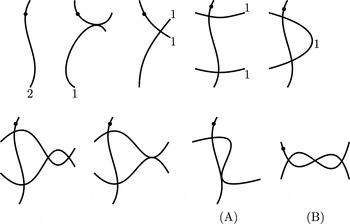
are listed in Figure 6. One sees immediately that if
 $H$
does not contain an
 $A_{1}$
or
 $A_{3}$
-attached elliptic tail or an
 $A_{1}/A_{1}$
-attached elliptic bridge, there are only three possibilities for the topological type of
 $H$
: either
 $H$
is irreducible or
 $H$
has topological type (A) or (B). However, topological types (A) and (B) do not satisfy
 $h^{0}(\unicode[STIX]{x1D714}_{H}(-2p))\geqslant 1$
. Finally, if
 $(H,p)$
is irreducible, then it must be a Weierstrass tail. Indeed, the linear equivalence
 $\unicode[STIX]{x1D714}_{H}\sim 2p$
follows immediately from the corresponding linear equivalence on the general fiber.◻
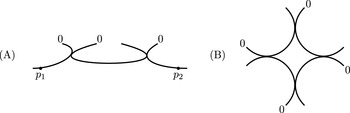
Topological types of curves in
 ${\mathcal{U}}_{2,1}(A_{\infty })$
. For convenience, we have suppressed the data of inner singularities, and we record only the arithmetic genus of each component and the outer singularities (which are either nodes or tacnodes, as indicated by the picture). Components without a label have arithmetic genus
 $0$
.

Lemma 2.14 (Limits of chains).
-
(1) Let
$({\mathcal{H}}\rightarrow \unicode[STIX]{x1D6E5},\unicode[STIX]{x1D70F}_{1},\unicode[STIX]{x1D70F}_{2})$
be a family in
${\mathcal{U}}_{2r-1,2}$
whose generic fiber is an elliptic chain of length
$r$
. Then the special fiber
$(H,p_{1},p_{2})$
satisfies one of the following conditions: -
(a)
$(H,p_{1},p_{2})$
contains an
$A_{1}/A_{1}$
-attached elliptic chain of length
${\leqslant}r$
; -
(b)
$(H,p_{1},p_{2})$
contains an
$A_{1}$
-attached elliptic tail.
-
-
(2) Let
$({\mathcal{H}}\rightarrow \unicode[STIX]{x1D6E5},\unicode[STIX]{x1D70F})$
be a family in
${\mathcal{U}}_{2r,1}$
whose generic fiber is a Weierstrass chain of length
$r$
. Then the special fiber satisfies one of the following conditions: -
(a)
$(H,p)$
contains an
$A_{1}$
-attached Weierstrass chain of length
${\leqslant}r$
; -
(b)
$(H,p)$
contains an
$A_{1}/A_{1}$
-attached elliptic chain of length
${<}r$
; -
(c)
$(H,p)$
contains an
$A_{1}$
or
$A_{3}$
-attached elliptic tail.
-


Proof. We prove case (2), leaving (1) to the reader. To begin, let
 $\unicode[STIX]{x1D70E}_{1}$
be the section picking out the marked points, and let
 $\unicode[STIX]{x1D70F}_{1},\ldots ,\unicode[STIX]{x1D70F}_{r-1}$
be the sections picking out the attaching tacnodes in the general fiber. By Corollary 2.11, the limits
 $\unicode[STIX]{x1D70F}_{1}(0),\ldots ,\unicode[STIX]{x1D70F}_{r-1}(0)$
remain tacnodes, so the normalization
 $\unicode[STIX]{x1D719}:\widetilde{{\mathcal{H}}}\rightarrow {\mathcal{H}}$
along
 $\unicode[STIX]{x1D70F}_{1},\ldots ,\unicode[STIX]{x1D70F}_{r-1}$
is well defined. We obtain
 $r-1$
families of two-pointed curves of arithmetic genus
 $1$
and a single family of one-pointed curves of genus 2:
 $$\begin{eqnarray}\widetilde{{\mathcal{H}}}=\coprod _{i=1}^{r-1}({\mathcal{E}}_{i},\unicode[STIX]{x1D70E}_{2i-1},\unicode[STIX]{x1D70E}_{2i})\coprod ({\mathcal{E}}_{r},\unicode[STIX]{x1D70E}_{2r-1})\quad \text{where }\unicode[STIX]{x1D719}^{-1}(\unicode[STIX]{x1D6FE}_{i})=\{\unicode[STIX]{x1D70E}_{2i},\unicode[STIX]{x1D70E}_{2i+1}\}.\end{eqnarray}$$
Denote the central fiber of
 $\widetilde{{\mathcal{H}}}/\unicode[STIX]{x1D6E5}$
by
 $\coprod _{i=1}^{r-1}(E_{i},q_{2i-1},q_{2i})\coprod (E_{r},q_{2r-1})$
. The relative ampleness of
 $\unicode[STIX]{x1D714}_{{\mathcal{H}}/\unicode[STIX]{x1D6E5}}(\unicode[STIX]{x1D70E}_{1})$
implies that
 $\unicode[STIX]{x1D714}_{E_{1}}(q_{1}+2q_{2})$
is ample on
 $E_{1}$
,
 $\unicode[STIX]{x1D714}_{E_{i}}(2q_{2i-1}+2q_{2i})$
is ample on
 $E_{i}$
for
 $i=2,\ldots ,r-1$
, and
 $\unicode[STIX]{x1D714}_{E_{r}}(2q_{2r-1})$
is ample on
 $E_{r}$
. It follows that either
 $(E_{i},q_{2i-1},q_{2i})$
is an elliptic bridge for each
 $1\leqslant i\leqslant r-1$
and
 $(E_{r},q_{2r-1})$
is a Weierstrass tail, or one of the following must hold:
-
(a)
$(E_{r},q_{2r-1})=(\mathbb{P}^{1},q_{2r-1},p_{2r-1})\cup (E_{r}^{\prime },q_{2r-1}^{\prime })/(p_{2r-1}\sim q_{2r-1}^{\prime })$
, where
$(E_{r}^{\prime },q_{2r-1}^{\prime })$
is a Weierstrass tail or, for some
$1\leqslant i\leqslant r-1$
: -
(b)
$(E_{i},q_{2i-1},q_{2i})=(\mathbb{P}^{1},q_{2i-1},p_{2i-1})\cup (E_{i}^{\prime },q_{2i-1}^{\prime },q_{2i})/(p_{2i-1}\sim q_{2i-1}^{\prime })$
, where
$(E_{i}^{\prime },q_{2i-1}^{\prime },q_{2i})$
is an elliptic bridge; -
(c)
$(E_{i},q_{2i-1},q_{2i})=(E_{i}^{\prime },q_{2i-1},q_{2i}^{\prime })\cup (\mathbb{P}^{1},p_{2i},q_{2i})/(q_{2i}^{\prime }\sim p_{2i})$
, where
$(E_{i}^{\prime },q_{2i-1},q_{2i}^{\prime })$
is an elliptic bridge; -
(d)
$(E_{i},q_{2i-1},q_{2i})=(\mathbb{P}^{1},q_{2i-1},p_{2i-1})\cup (E_{i}^{\prime },q_{2i-1}^{\prime },q_{2i}^{\prime })\cup (\mathbb{P}^{1},p_{2i},q_{2i})/(p_{2i-1}\sim q_{2i-1}^{\prime },q_{2i}^{\prime }\sim p_{2i})$
, where
$(E_{i}^{\prime },q_{2i-1}^{\prime },q_{2i}^{\prime })$
is an elliptic bridge.


In the case (a) (respectively, (b)), we say that
 $E_{r}$
(respectively,
 $E_{i}$
) sprouts on the left. In the case (c) (respectively, (d)), we say that
 $E_{i}$
sprouts on the right (respectively, sprouts on the left and right). Note that if
 $E_{r}$
(respectively,
 $E_{1}$
) sprouts at all, then
 $E_{r}$
(respectively,
 $E_{1}$
) contains an
 $A_{1}$
-attached Weierstrass tail (respectively,
 $A_{1}/A_{1}$
-attached elliptic bridge). Similarly, if
 $E_{i}$
sprouts on both the left and right
 $(2\leqslant i\leqslant r-1)$
, then
 $E_{i}$
contains an
 $A_{1}/A_{1}$
-attached elliptic bridge. Thus, we may assume without loss of generality that
 $E_{1}$
and
 $E_{r}$
do not sprout and that some
 $E_{i}$
 $(2\leqslant i\leqslant r-1)$
sprouts on the left or right, but not both. We now observe that any collection
 $\{E_{s},\ldots ,E_{s+t}\}$
such that either
 $E_{s}$
sprouts on the left or
 $s=1$
, either
 $E_{s+t}$
sprouts on the right or
 $s+t=r$
, and
 $E_{k}$
does not sprout for
 $s<k<s+t$
, contains an
 $A_{1}/A_{1}$
-attached elliptic chain of length
 $t$
.◻
Proposition 2.15. Using the notation introduced in Definition 2.8, we have:
-
(1)
${\mathcal{T}}^{A_{1}}\cup {\mathcal{T}}^{A_{m}}$
is closed in
${\mathcal{U}}_{g,n}(A_{\infty })$
for any odd
$m$
; -
(2)
${\mathcal{B}}^{A_{1}/A_{1}}$
is closed in
${\mathcal{U}}_{g,n}(A_{\infty })-\bigcup _{i\in \{1,3\}}{\mathcal{T}}^{A_{i}}$
; -
(3)
${\mathcal{T}}^{A_{m}}$
is closed in
${\mathcal{U}}_{g,n}(A_{m})$
for any even
$m$
; -
(4)
${\mathcal{B}}^{A_{m}/A_{m}}$
and
${\mathcal{B}}^{A_{1}/A_{m}}$
are closed in
${\mathcal{U}}_{g,n}(A_{m})-{\mathcal{T}}^{A_{1}}-{\mathcal{B}}^{A_{1}/A_{1}}$
for any even
$m$
; -
(5)
${\mathcal{W}}^{A_{m}}$
is closed in
${\mathcal{U}}_{g,n}(A_{\infty })-\bigcup _{i\in \{1,3\}}{\mathcal{T}}^{A_{i}}-{\mathcal{B}}^{A_{1}/A_{1}}$
for any odd
$m$
.


Proof. The given loci are obviously constructible, so it suffices to show that they are closed under specialization. For (1), let
 $({\mathcal{C}}\rightarrow \unicode[STIX]{x1D6E5},\{\unicode[STIX]{x1D70E}_{i}\}_{i=1}^{n})$
be a family in
 ${\mathcal{U}}_{g,n}(A_{\infty })$
whose generic fiber lies in
 ${\mathcal{T}}^{A_{2k+1}}$
. Possibly after a finite base change, let
 $\unicode[STIX]{x1D70F}$
be the section picking out the attaching
 $A_{2k+1}$
-singularity of the elliptic tail in the generic fiber. By Corollary 2.11, the limit
 $\unicode[STIX]{x1D70F}(0)$
is also an
 $A_{2k+1}$
-singularity. Consider the normalization
 $\widetilde{C}\rightarrow {\mathcal{C}}$
along
 $\unicode[STIX]{x1D70F}$
. Let
 ${\mathcal{H}}\subset \widetilde{{\mathcal{C}}}$
be the component whose generic fiber is an elliptic tail and let
 $\unicode[STIX]{x1D6FC}$
be the preimage of
 $\unicode[STIX]{x1D70F}$
on
 ${\mathcal{H}}$
. Then
 $\unicode[STIX]{x1D714}_{{\mathcal{H}}}((k+1)\unicode[STIX]{x1D6FC})$
is relatively ample. We conclude that either
 $\unicode[STIX]{x1D714}_{H_{0}}(\unicode[STIX]{x1D6FC}(0))$
is ample, or
 $\unicode[STIX]{x1D6FC}(0)$
lies on a rational curve attached nodally to the rest of
 $H_{0}$
. In the former case,
 $(H_{0},\unicode[STIX]{x1D6FC}(0))$
is an elliptic tail by Lemma 2.13, so
 $C_{0}$
contains an elliptic tail with
 $A_{2k+1}$
-attaching, as desired. In the latter case,
 $H_{0}$
contains an
 $A_{1}$
-attached elliptic tail. We conclude that
 $C_{0}\in {\mathcal{T}}^{A_{1}}\cup {\mathcal{T}}^{A_{2k+1}}$
, as desired.
For (2), let
 $({\mathcal{C}}\rightarrow \unicode[STIX]{x1D6E5},\{\unicode[STIX]{x1D70E}_{i}\}_{i=1}^{n})$
be a family in
 ${\mathcal{U}}_{g,n}(A_{\infty })$
whose generic fiber lies in
 ${\mathcal{B}}^{A_{1}/A_{1}}$
. Possibly after a finite base change, let
 $\unicode[STIX]{x1D70F}_{1}$
and
 $\unicode[STIX]{x1D70F}_{2}$
be the sections picking out the attaching nodes of a length-
 $r$
elliptic chain in the general fiber. By Proposition 2.10,
 $\unicode[STIX]{x1D70F}_{1}(0)$
and
 $\unicode[STIX]{x1D70F}_{2}(0)$
either remain nodes or, if
 $r=1$
, can coalesce to form an outer
 $A_{3}$
-singularity. In either case there exists a normalization of
 ${\mathcal{C}}$
along
 $\unicode[STIX]{x1D70F}_{1}$
and
 $\unicode[STIX]{x1D70F}_{2}$
. Since
 $C_{\bar{\unicode[STIX]{x1D702}}}$
becomes separated after normalizing along
 $\unicode[STIX]{x1D70F}_{1}$
and
 $\unicode[STIX]{x1D70F}_{2}$
, we conclude that the limit of the elliptic chain is a connected component of
 $C_{0}$
attached either along two nodes or, only when
 $r=1$
, along a separating
 $A_{3}$
-singularity. In the former case,
 $C_{0}$
has an elliptic chain by Lemma 2.14. In the latter case,
 $C_{0}$
has an arithmetic genus
 $1$
connected component
 $A_{3}$
-attached to the rest of the curve, so that
 $C_{0}\in {\mathcal{T}}^{A_{1}}\cup {\mathcal{T}}^{A_{3}}$
.
For (3) and (4), we argue as in (1) and (2), respectively, making use of the observation that in
 ${\mathcal{U}}_{g,n}(A_{m})$
, the limit of an
 $A_{m}$
-singularity must be an
 $A_{m}$
-singularity. The proof of (5) is essentially identical to that of (1), using Lemma 2.13.◻
Proof of Theorem 2.7.
For
 $\unicode[STIX]{x1D6FC}_{c}\in \{9/11,7/10,2/3\}$
, Proposition 2.15 implies that
 $\overline{{\mathcal{M}}}_{g,n}(\unicode[STIX]{x1D6FC}_{c})$
is obtained by excising closed substacks from
 ${\mathcal{U}}_{g,n}(A_{2})$
,
 ${\mathcal{U}}_{g,n}(A_{3})$
,
 ${\mathcal{U}}_{g,n}(A_{4})$
, respectively. Next, observe that the locus of curves with
 $\unicode[STIX]{x1D6FC}_{c}$
-critical singularities is closed in
 $\overline{{\mathcal{M}}}_{g,n}(\unicode[STIX]{x1D6FC}_{c})$
. Using the fact that
 $$\begin{eqnarray}\overline{{\mathcal{M}}}_{g,n}(\unicode[STIX]{x1D6FC}_{c}+\unicode[STIX]{x1D716})=\overline{{\mathcal{M}}}_{g,n}(\unicode[STIX]{x1D6FC}_{c})\smallsetminus \{\text{curves with }\unicode[STIX]{x1D6FC}_{c}\text{-critical singularities}\},\end{eqnarray}$$
we conclude that
 $\overline{{\mathcal{M}}}_{g,n}(\unicode[STIX]{x1D6FC}_{c}+\unicode[STIX]{x1D716}){\hookrightarrow}\overline{{\mathcal{M}}}_{g,n}(\unicode[STIX]{x1D6FC}_{c})$
is an open immersion. Finally, applying Proposition 2.15 once more, we see that each
 $\overline{{\mathcal{M}}}_{g,n}(\unicode[STIX]{x1D6FC}_{c}-\unicode[STIX]{x1D716})$
is obtained by excising closed substacks from
 $\overline{{\mathcal{M}}}_{g,n}(\unicode[STIX]{x1D6FC}_{c})$
. This finishes the proof.◻
2.3 Properties of
$\unicode[STIX]{x1D6FC}$
-stability

In this section, we record several elementary properties of
 $\unicode[STIX]{x1D6FC}$
-stability that will be needed in subsequent arguments. Recall that if
 $(C,\{p_{i}\}_{i=1}^{n})$
is a Deligne–Mumford stable curve and
 $q\in C$
is a node, then the pointed normalization
 $(\widetilde{C},\{p_{i}\}_{i=1}^{n},q_{1},q_{2})$
of
 $C$
at
 $q$
is Deligne–Mumford stable. The same statement holds for
 $\unicode[STIX]{x1D6FC}$
-stable curves.
Lemma 2.16. Suppose that
 $(C,\{p_{i}\}_{i=1}^{n})$
is an
 $\unicode[STIX]{x1D6FC}$
-stable curve and
 $q\in C$
is a node. Then the pointed normalization
 $(\widetilde{C},\{p_{i}\}_{i=1}^{n},q_{1},q_{2})$
of
 $C$
at
 $q$
is
 $\unicode[STIX]{x1D6FC}$
-stable.
Proof. This follows immediately from the definition of
 $\unicode[STIX]{x1D6FC}$
-stability.◻
Unfortunately, the converse of Lemma 2.16 is false. Nodally gluing two marked points of an
 $\unicode[STIX]{x1D6FC}$
-stable curve may fail to preserve
 $\unicode[STIX]{x1D6FC}$
-stability if the two marked points are both on the same component or both on rational components (see Figure 7). The following lemma says that these are the only problems that can arise.
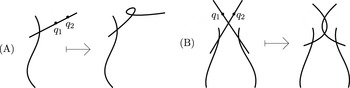
In (A), two marked points on a genus
 $0$
tail (respectively, two conjugate points on an elliptic tail) are glued to yield an elliptic tail (respectively, a Weierstrass tail). In (B), two marked points on distinct rational components are glued to yield an elliptic bridge.

Lemma 2.17.
-
(1) If
$(\widetilde{C}_{1},\{p_{i}\}_{i=1}^{n},q_{1})$
and
$(\widetilde{C}_{2},\{p_{i}\}_{i=1}^{n},q_{2})$
are
$\unicode[STIX]{x1D6FC}$
-stable curves, then is
$$\begin{eqnarray}(\widetilde{C}_{1},\{p_{i}\}_{i=1}^{n},q_{1})\cup (\widetilde{C}_{2},\{p_{i}\}_{i=1}^{n},q_{2})/(q_{1}\sim q_{2})\end{eqnarray}$$
$\unicode[STIX]{x1D6FC}$
-stable.
-
(2) If
$(\widetilde{C},\{p_{i}\}_{i=1}^{n},q_{1},q_{2})$
is an
$\unicode[STIX]{x1D6FC}$
-stable curve, then is
$$\begin{eqnarray}(\widetilde{C},\{p_{i}\}_{i=1}^{n},q_{1},q_{2})/(q_{1}\sim q_{2})\end{eqnarray}$$
$\unicode[STIX]{x1D6FC}$
-stable provided one of the following conditions hold:
-
∙
$q_{1}$
and
$q_{2}$
lie on disjoint irreducible components of
$\widetilde{C}$
; -
∙
$q_{1}$
and
$q_{2}$
lie on distinct irreducible components of
$\widetilde{C}$
, and at least one of these components is not a smooth rational curve.
-


Proof. Let
 $C:=(\widetilde{C},q_{1},q_{2})/(q_{1}\sim q_{2})$
, and let
 $\unicode[STIX]{x1D719}:\widetilde{C}\rightarrow C$
be the gluing morphism which identifies
 $q_{1},q_{2}$
to a node
 $q\in C$
. It suffices to show that if
 $E\subset C$
is an
 $\unicode[STIX]{x1D6FC}$
-unstable curve, then
 $\unicode[STIX]{x1D719}^{-1}(E)$
is an
 $\unicode[STIX]{x1D6FC}$
-unstable subcurve of
 $\widetilde{C}$
. The key observation is that any
 $\unicode[STIX]{x1D6FC}$
-unstable subcurve
 $E$
has the following property: if
 $E_{1},E_{2}\subset E$
are two distinct irreducible components of
 $E$
, then the intersection
 $E_{1}\cap E_{2}$
never consists of a single node. Furthermore, if one of
 $E_{1}$
or
 $E_{2}$
is irrational, then the intersection
 $E_{1}\cap E_{2}$
does not contain any nodes. For elliptic tails, this statement is vacuous since elliptic tails are irreducible. For elliptic and Weierstrass chains, it follows from examining the topological types of elliptic bridges and Weierstrass tails (see Figure 6). From this observation, it follows that no
 $\unicode[STIX]{x1D6FC}$
-unstable
 $E\subset C$
can contain both branches of
 $q$
. Indeed, the hypotheses of (1) and (2) each imply that either the two branches of the node
 $q\in C$
lie on distinct irreducible components whose intersection is precisely
 $q$
, or else that that the two branches lie on distinct irreducible components, one of which is irrational. Thus, we may assume that
 $E\subset C$
is disjoint from
 $q$
or contains only one branch of
 $q$
.
If
 $E\subset C$
is disjoint from
 $q$
, then
 $\unicode[STIX]{x1D719}^{-1}$
is an isomorphism in a neighborhood of
 $E$
and the statement is clear. If
 $E\subset C$
contains only one branch of the node
 $q$
, then
 $q$
must be an attaching point of
 $E$
. We may assume without loss of generality that
 $E$
contains the branch labeled by
 $q_{1}$
. Now
 $\unicode[STIX]{x1D719}^{-1}(E)\rightarrow E$
is an isomorphism away from
 $q_{1}$
and sends
 $q_{1}$
to the node
 $q$
. Since an
 $\unicode[STIX]{x1D6FC}$
-unstable curve with nodal attaching is also
 $\unicode[STIX]{x1D6FC}$
-unstable with marked point attaching,
 $\unicode[STIX]{x1D719}^{-1}(E)$
is an
 $\unicode[STIX]{x1D6FC}$
-unstable subcurve of
 $\widetilde{C}$
.◻
Corollary 2.18. Suppose that
 $(C,\{p_{i}\}_{i=1}^{n},q_{1})$
is
 $\frac{2}{3}$
-stable and
 $(E,q_{1}^{\prime })$
is a Weierstrass chain. Then
 $(C\cup E,\{p_{i}\}_{i=1}^{n})/(q_{1}\sim q_{1}^{\prime })$
is
 $\frac{2}{3}$
-stable.
Proof. This follows immediately from Lemma 2.17. ◻
Next, we consider a question which does not arise for Deligne–Mumford stable curves: suppose that
 $(C,\{p_{i}\}_{i=1}^{n})$
is an
 $\unicode[STIX]{x1D6FC}$
-stable curve and
 $q\in C$
is a non-nodal singularity with
 $m\in \{1,2\}$
branches. When is the pointed normalization
 $(\widetilde{C},\{p_{i}\}_{i=1}^{n},\{q_{i}\}_{i=1}^{m})$
of
 $C$
at
 $q$
 $\unicode[STIX]{x1D6FC}$
-stable? One obvious obstacle is that
 $\unicode[STIX]{x1D714}_{\widetilde{C}}(\sum _{i=1}^{n}p_{i}+\sum _{i=1}^{m}q_{i})$
need not be ample. Indeed, one or both of the marked points
 $q_{i}$
may lie on a smooth
 $\mathbb{P}^{1}$
meeting the rest of the curve in a single node. We thus define the stable pointed normalization of
 $(C,\{p_{i}\}_{i=1}^{n})$
to be the (possibly disconnected) curve obtained from
 $\widetilde{C}$
by contracting these semistable rational curves. This is well defined except in several degenerate cases: first, when
 $(g,n)=(1,1),(1,2),(2,1)$
, the stable pointed normalization of a cuspidal, tacnodal, and ramphoid cuspidal curve is a point. In these cases, we regard the stable pointed normalization as being undefined. Second, in the tacnodal case, it can happen that
 $(\widetilde{C},\{p_{i}\}_{i=1}^{n},\{q_{i}\}_{i=1}^{m})$
has two connected components, one of which is a smooth two-pointed
 $\mathbb{P}^{1}$
. In this case, we define the stable pointed normalization to be the curve obtained by deleting this component and taking the stabilization of the remaining connected component.
In general, the stable pointed normalization of an
 $\unicode[STIX]{x1D6FC}$
-stable curve at a non-nodal singularity need not be
 $\unicode[STIX]{x1D6FC}$
-stable. Nevertheless, there is one important case where this statement does hold, namely when
 $\unicode[STIX]{x1D6FC}_{c}$
is a critical value and
 $q\in C$
is an
 $\unicode[STIX]{x1D6FC}_{c}$
-critical singularity.
Lemma 2.19. Let
 $(C,\{p_{i}\}_{i=1}^{n})$
be an
 $n$
-pointed curve with
 $\unicode[STIX]{x1D714}_{C}(\sum _{i=1}^{n}p_{i})$
ample and suppose that
 $q\in C$
is an
 $\unicode[STIX]{x1D6FC}_{c}$
-critical singularity. Then the stable pointed normalization of
 $(C,\{p_{i}\}_{i=1}^{n})$
at
 $q$
is
 $\unicode[STIX]{x1D6FC}_{c}$
-stable if and only if
 $(C,\{p_{i}\}_{i=1}^{n})$
is
 $\unicode[STIX]{x1D6FC}_{c}$
-stable.
Proof. This follows from the definition of
 $\unicode[STIX]{x1D6FC}$
-stability by an elementary case-by-case analysis.◻
2.4
$\unicode[STIX]{x1D6FC}_{c}$
-closed curves

In Theorem 2.22, we will give an explicit characterization of the closed points of
 $\overline{{\mathcal{M}}}_{g,n}(\unicode[STIX]{x1D6FC}_{c})$
for a critical value
 $\unicode[STIX]{x1D6FC}_{c}\in \{9/11,7/10,2/3\}$
as
 $\unicode[STIX]{x1D6FC}_{c}$
-closed curves, which we proceed to define.
Definition 2.20 (
$\unicode[STIX]{x1D6FC}_{c}$
-atoms; see Figure 8).

(1) A
 $\frac{9}{11}$
-atom is a one-pointed curve of arithmetic genus
 $1$
obtained by gluing
 $\text{Spec}\,\mathbb{C}[x,y]/(y^{2}-x^{3})$
and
 $\text{Spec}\,\mathbb{C}[n]$
via
 $x=n^{-2}$
,
 $y=n^{-3}$
, and marking the point
 $n=0$
.
(2) A
 $\frac{7}{10}$
-atom is a two-pointed curve of arithmetic genus
 $1$
obtained by gluing
 $\text{Spec}\,\mathbb{C}[x,y]/(y^{2}-x^{4})$
and
 $\text{Spec}\,\mathbb{C}[n_{1}]\coprod \text{Spec}\,\mathbb{C}[n_{2}]$
via
 $x=(n_{1}^{-1},n_{2}^{-1})$
,
 $y=(n_{1}^{-2},-n_{2}^{-2})$
, and marking the points
 $n_{1}=0$
and
 $n_{2}=0$
.
(3) A
 $\frac{2}{3}$
-atom is a one-pointed curve of arithmetic genus
 $2$
obtained by gluing
 $\text{Spec}\,\mathbb{C}[x,y]/(y^{2}-x^{5})$
and
 $\text{Spec}\,\mathbb{C}[n]$
via
 $x=n^{-2}$
,
 $y=n^{-5}$
, and marking the point
 $n=0$
.
We will often abuse notation by simply writing
 $E$
to refer to the
 $\unicode[STIX]{x1D6FC}_{c}$
-atom
 $(E,q)$
if
 $\unicode[STIX]{x1D6FC}_{c}\in \{2/3,9/11\}$
(respectively,
 $(E,q_{1},q_{2})$
if
 $\unicode[STIX]{x1D6FC}_{c}=7/10$
).
Every
 $\unicode[STIX]{x1D6FC}_{c}$
-atom
 $E$
satisfies
 $\text{Aut}(E)\simeq \mathbb{G}_{m}$
, where the action of
 $\mathbb{G}_{m}=\text{Spec}\,\mathbb{C}[t,t^{-1}]$
is given by
 $$\begin{eqnarray}\displaystyle \begin{array}{@{}rl@{}}\text{for }\unicode[STIX]{x1D6FC}_{c}=9/11:\quad & x\mapsto t^{-2}x,\quad y\mapsto t^{-3}y,\quad n\mapsto tn,\\ \text{for }\unicode[STIX]{x1D6FC}_{c}=7/10:\quad & x\mapsto t^{-1}x,\quad y\mapsto t^{-2}y,\quad n_{1}\mapsto tn_{1},\quad n_{2}\mapsto tn_{2},\\ \text{for }\unicode[STIX]{x1D6FC}_{c}=2/3:\quad & x\mapsto t^{-2}x,\quad y\mapsto t^{-5}y,\quad n\mapsto tn.\end{array} & & \displaystyle\end{eqnarray}$$
A
 $\frac{9}{11}$
-atom,
 $\frac{7}{10}$
-atom, and
 $\frac{2}{3}$
-atom, respectively.

In order to describe the closed points of
 $\overline{{\mathcal{M}}}_{g,n}(\unicode[STIX]{x1D6FC}_{c})$
precisely, we need the following terminology. We say that
 $C$
admits a decomposition
 $C=C_{1}\cup \cdots \cup C_{r}$
if
 $C_{1},\ldots ,C_{r}$
are proper subcurves whose union is all of
 $C$
, and either
 $C_{a}\cap C_{b}=\varnothing$
or
 $C_{a}$
meets
 $C_{b}$
nodally. When
 $(C,\{p_{i}\}_{i=1}^{n})$
is an
 $n$
-pointed curve, and
 $C=C_{1}\cup \cdots \cup C_{r}$
is a decomposition of
 $C$
, we always consider each
 $C_{a}$
as a pointed curve by taking as marked points the subset of
 $\{p_{i}\}_{i=1}^{n}$
supported on
 $C_{a}$
and the attaching points
 $C_{a}\cap (\overline{C\backslash C_{a}})$
.
Definition 2.21 (
$\unicode[STIX]{x1D6FC}_{c}$
-closed curves).

Let
 $\unicode[STIX]{x1D6FC}_{c}$
be a critical value. We say that an
 $n$
-pointed curve
 $(C,\{p_{i}\}_{i=1}^{n})$
is
 $\unicode[STIX]{x1D6FC}_{c}$
-closed if there is a decomposition
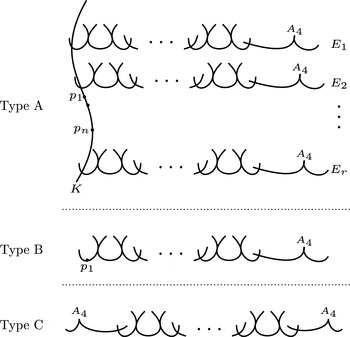
 $C=K\cup E_{1}\cup \cdots \cup E_{r},$
where:
-
(1)
$E_{1},\ldots ,E_{r}$
are
$\unicode[STIX]{x1D6FC}_{c}$
-atoms; -
(2)
$K$
is an
$(\unicode[STIX]{x1D6FC}_{c}+\unicode[STIX]{x1D716})$
-stable curve containing no nodally attached
$\unicode[STIX]{x1D6FC}_{c}$
-tails; -
(3)
$K$
is a closed curve in the stack of
$(\unicode[STIX]{x1D6FC}_{c}+\unicode[STIX]{x1D716})$
-stable curves.


We call
 $K$
the core of
 $(C,\{p_{i}\}_{i=1}^{n})$
, and we call the decomposition
 $C=K\cup E_{1}\cup \cdots \cup E_{r}$
the canonical decomposition of
 $C$
. As always, we consider
 $K$
as a pointed curve marked by the union of
 $\{p_{i}\}_{i=1}^{n}\cap K$
and
 $K\cap (\overline{C\smallsetminus K})$
; we allow the possibility that
 $K$
is disconnected or empty.
We can now state the main result of this section.
Theorem 2.22 (Characterization of
$\unicode[STIX]{x1D6FC}_{c}$
-closed curves).

Let
 $\unicode[STIX]{x1D6FC}_{c}$
be a critical value. An
 $\unicode[STIX]{x1D6FC}_{c}$
-stable curve
 $(C,\{p_{i}\}_{i=1}^{n})$
is a closed point of
 $\overline{{\mathcal{M}}}_{g,n}(\unicode[STIX]{x1D6FC}_{c})$
if and only if
 $(C,\{p_{i}\}_{i=1}^{n})$
is
 $\unicode[STIX]{x1D6FC}_{c}$
-closed.
To prove the above theorem, we need several preliminary lemmas. We state these results for every critical value
 $\unicode[STIX]{x1D6FC}_{c}\in \{9/11,7/10,2/3\}$
, but, just as in the case of the theorem, we provide a proof only for
 $\unicode[STIX]{x1D6FC}_{c}=2/3$
. The cases of larger critical values are easier, and can also be deduced from the description of c-semistable curves of Hassett and Hyeon [Reference Hassett and HyeonHH13] in the case of
 $\unicode[STIX]{x1D6FC}_{c}=7/10$
and the description of weakly pseudostable curves of Hyeon and Morrison [Reference Hyeon and MorrisonHM10] in the case of
 $\unicode[STIX]{x1D6FC}_{c}=9/11$
.
Lemma 2.23. An
 $\unicode[STIX]{x1D6FC}_{c}$
-tail is closed in the stack of
 $\unicode[STIX]{x1D6FC}_{c}$
-stable curves if and only if it is an
 $\unicode[STIX]{x1D6FC}_{c}$
-atom.
Proof for
$\unicode[STIX]{x1D6FC}_{c}=2/3$
.

First, we show that if
 $(E,q)$
is any Weierstrass tail, then
 $(E,q)$
admits an isotrivial specialization to a
 $\frac{2}{3}$
-atom. To do so, we can write any Weierstrass tail as a degree-
 $2$
cover of
 $\mathbb{P}^{1}$
given by an equation
 $$\begin{eqnarray}y^{2}=x^{5}+a_{3}x^{3}+a_{2}x^{2}+a_{1}x+a_{0},\quad \text{where }a_{i}\in \mathbb{C}\text{ and}\end{eqnarray}$$
where the marked point
 $q$
corresponds to
 $x=\infty$
. For any
 $\unicode[STIX]{x1D706}\in \mathbb{C}^{\ast }$
, acting by
 $\unicode[STIX]{x1D706}\cdot (x,y)=(\unicode[STIX]{x1D706}^{-2}x,\unicode[STIX]{x1D706}^{-5}y)$
, we see that this cover is isomorphic to
 $$\begin{eqnarray}y^{2}=x^{5}+\unicode[STIX]{x1D706}^{4}a_{3}x^{3}+\unicode[STIX]{x1D706}^{6}a_{2}x^{2}+\unicode[STIX]{x1D706}^{8}a_{1}x+\unicode[STIX]{x1D706}^{10}a_{0}.\end{eqnarray}$$
Letting
 $\unicode[STIX]{x1D706}\rightarrow 0$
, we obtain an isotrivial specialization of
 $(E,q)$
to the double cover
 $y^{2}=x^{5}$
, which is a
 $\frac{2}{3}$
-atom.
Next, we show that if
 $(E,q)$
is a
 $\frac{2}{3}$
-atom, then
 $(E,q)$
does not admit any non-trivial isotrivial specializations in
 $\overline{{\mathcal{M}}}_{2,1}(2/3)$
. Let
 $({\mathcal{E}}\rightarrow \unicode[STIX]{x1D6E5},\unicode[STIX]{x1D70E})$
be an isotrivial specialization in
 $\overline{{\mathcal{M}}}_{2,1}(2/3)$
with generic fiber isomorphic to
 $(E,q)$
. Let
 $\unicode[STIX]{x1D70F}$
be the section of
 ${\mathcal{E}}\rightarrow \unicode[STIX]{x1D6E5}$
which picks out the unique ramphoid cusp of the generic fiber. Since the limit of a ramphoid cusp is a ramphoid cusp in
 $\overline{{\mathcal{M}}}_{2,1}(2/3)$
,
 $\unicode[STIX]{x1D70F}(0)$
is also a ramphoid cusp. Now let
 $\unicode[STIX]{x1D70F}:\widetilde{{\mathcal{E}}}\rightarrow {\mathcal{E}}$
be the simultaneous normalization of
 ${\mathcal{E}}$
along
 $\unicode[STIX]{x1D70F}$
, and let
 $\tilde{\unicode[STIX]{x1D70F}}$
and
 $\tilde{\unicode[STIX]{x1D70E}}$
be the inverse images of
 $\unicode[STIX]{x1D70F}$
and
 $\unicode[STIX]{x1D70E}$
, respectively. Then
 $(\widetilde{{\mathcal{E}}}\rightarrow \unicode[STIX]{x1D6E5},\tilde{\unicode[STIX]{x1D70F}},\tilde{\unicode[STIX]{x1D70E}})$
is an isotrivial specialization of two-pointed curves of arithmetic genus
 $0$
with smooth general fiber. The fact that
 $\unicode[STIX]{x1D714}_{{\mathcal{E}}/\unicode[STIX]{x1D6E5}}(\unicode[STIX]{x1D70E})$
is relatively ample on
 ${\mathcal{E}}$
implies that
 $\unicode[STIX]{x1D714}_{\widetilde{{\mathcal{E}}}/\unicode[STIX]{x1D6E5}}(3\tilde{\unicode[STIX]{x1D70F}}+\tilde{\unicode[STIX]{x1D70E}})$
is relatively ample on
 $\widetilde{{\mathcal{E}}}$
, which implies that the special fiber of
 $\widetilde{{\mathcal{E}}}$
is irreducible. It follows that
 $(\widetilde{{\mathcal{E}}}\rightarrow \unicode[STIX]{x1D6E5},\tilde{\unicode[STIX]{x1D70F}},\tilde{\unicode[STIX]{x1D70E}})$
is trivial. Finally, since the generic fiber of
 ${\mathcal{E}}$
has trivial crimping at the ramphoid cusp, we conclude that
 ${\mathcal{E}}$
is isotrivial.◻
Lemma 2.24. Suppose that
 $(C,\{p_{i}\}_{i=1}^{n})$
is a closed point of
 $\overline{{\mathcal{M}}}_{g,n}(\unicode[STIX]{x1D6FC}_{c}+\unicode[STIX]{x1D716})$
. Then
 $(C,\{p_{i}\}_{i=1}^{n})$
remains closed in
 $\overline{{\mathcal{M}}}_{g,n}(\unicode[STIX]{x1D6FC}_{c})$
if and only if
 $(C,\{p_{i}\}_{i=1}^{n})$
contains no nodally attached
 $\unicode[STIX]{x1D6FC}_{c}$
-tails.
Proof for
$\unicode[STIX]{x1D6FC}_{c}=2/3$
.

To lighten notation, we often omit marked points
 $\{p_{i}\}_{i=1}^{n}$
in the rest of the proof. First, we show that if
 $(C,\{p_{i}\}_{i=1}^{n})$
has an
 $A_{1}$
-attached Weierstrass tail, then it does not remain closed in
 $\overline{{\mathcal{M}}}_{g,n}(2/3)$
. Suppose that we have a decomposition
 $C=K\cup Z$
, where
 $(Z,q)$
is an
 $A_{1}$
-attached Weierstrass tail. By Lemma 2.23,
 $(Z,q)$
admits an isotrivial specialization to a
 $\frac{2}{3}$
-atom
 $(E,q_{1})$
. We may glue this specialization to the trivial family
 $K\times \unicode[STIX]{x1D6E5}$
to obtain a non-trivial isotrivial specialization
 $C{\rightsquigarrow}K\cup E$
, where
 $E$
is nodally attached at
 $q_{1}$
. By Lemma 2.17,
 $K\cup E$
is
 $\frac{2}{3}$
-stable, so this is a non-trivial isotrivial specialization in
 $\overline{{\mathcal{M}}}_{g,n}(2/3)$
.
Next, we show that if
 $(C,\{p_{i}\}_{i=1}^{n})$
has no
 $A_{1}$
-attached Weierstrass tails, then it remains closed in
 $\overline{{\mathcal{M}}}_{g,n}(2/3)$
. In other words, if there exists a non-trivial isotrivial specialization
 $C{\rightsquigarrow}C_{0}$
, then
 $C$
necessarily contains a nodally attached Weierstrass tail. To begin, note that the special fiber
 $C_{0}$
of the non-trivial isotrivial specialization
 ${\mathcal{C}}\rightarrow \unicode[STIX]{x1D6E5}$
must contain at least one ramphoid cusp. Otherwise,
 $({\mathcal{C}}\rightarrow \unicode[STIX]{x1D6E5},\{\unicode[STIX]{x1D70E}_{i}\}_{i=1}^{n})$
would constitute a non-trivial isotrivial specialization in
 $\overline{{\mathcal{M}}}_{g,n}(2/3+\unicode[STIX]{x1D716})$
, contradicting the hypothesis that
 $(C,\{p_{i}\}_{i=1}^{n})$
is closed in
 $\overline{{\mathcal{M}}}_{g,n}(2/3+\unicode[STIX]{x1D716})$
. For simplicity, let us assume that the special fiber
 $C_{0}$
contains a single ramphoid cusp
 $q$
. Locally around this point, we may write
 ${\mathcal{C}}$
as
 $$\begin{eqnarray}y^{2}=x^{5}+a_{3}(t)x^{3}+a_{2}(t)x^{2}+a_{1}(t)x+a_{0}(t),\end{eqnarray}$$
where
 $t$
is the uniformizer of
 $\unicode[STIX]{x1D6E5}$
at
 $0$
and
 $a_{i}(0)=0$
. By [Reference Casalaina-Martin and LazaCL13, § 7.6], after possibly a finite base change, there exists a (weighted) blow-up
 $\unicode[STIX]{x1D719}:\widetilde{{\mathcal{C}}}\rightarrow {\mathcal{C}}$
such that the special fiber
 $\widetilde{C}_{0}$
is isomorphic to the normalization of
 $C$
at
 $q$
attached nodally to a curve
 $T$
, where
 $T$
is defined by an equation
 $y^{2}=x^{5}+b_{3}x^{3}z^{2}+b_{2}x^{2}z^{3}+b_{1}xz^{4}+b_{0}z^{5}$
on
 $\mathbb{P}(2,5,2)$
for some
 $[b_{3}:b_{2}:b_{1}:b_{0}]\in \mathbb{P}(4,6,8,10)$
(depending on the
 $a_{i}(t)$
) and such that
 $T$
is attached to
 $C$
at
 $[x:y:z]=[1:1:0]$
. Evidently,
 $T$
is a genus
 $2$
double cover of
 $\mathbb{P}^{1}$
via the projection
 $[x:y:z]\mapsto [x:z]$
and
 $[x:y:z]=[1:1:0]$
is a ramification point of this cover. It follows that
 $\widetilde{C}_{0}$
has a Weierstrass tail.
Now let
 $\widetilde{{\mathcal{C}}}\rightarrow \widetilde{{\mathcal{C}}}^{s}$
be the stabilization morphism contracting all rational curves in the central fiber that meet the rest of
 $\widetilde{C}_{0}$
in only two nodes. The central fiber of
 $\widetilde{{\mathcal{C}}}^{s}$
is now isomorphic to the nodal union of the stable pointed normalization of
 $C_{0}$
at
 $q$
and the Weierstrass tail
 $T$
. By Lemma 2.19 and Corollary 2.18,
 $(\tilde{{\mathcal{C}}}_{0}^{s},\{p_{i}\}_{i=1}^{n})$
is
 $\unicode[STIX]{x1D6FC}_{c}$
-stable. Since it contains no ramphoid cusps, it is also
 $(\unicode[STIX]{x1D6FC}_{c}+\unicode[STIX]{x1D716})$
-stable. By hypothesis,
 $(C,\{p_{i}\}_{i=1}^{n})$
is closed in
 $\overline{{\mathcal{M}}}_{g,n}(\unicode[STIX]{x1D6FC}_{c}+\unicode[STIX]{x1D716})$
, so the family
 $(\widetilde{{\mathcal{C}}}^{s}\rightarrow \unicode[STIX]{x1D6E5},\{\unicode[STIX]{x1D70E}_{i}\}_{i=1}^{n})$
must be trivial. This implies that the generic fiber
 $(C,\{p_{i}\}_{i=1}^{n})$
must have a nodally attached Weierstrass tail.◻
The following lemma says that one can use isotrivial specializations to replace
 $\unicode[STIX]{x1D6FC}_{c}$
-critical singularities and
 $\unicode[STIX]{x1D6FC}_{c}$
-tails by
 $\unicode[STIX]{x1D6FC}_{c}$
-atoms.
Lemma 2.25. Let
 $(C,\{p_{i}\}_{i=1}^{n})$
be an
 $n$
-pointed curve and let
 $E$
be the
 $\unicode[STIX]{x1D6FC}_{c}$
-atom.
-
(1) Suppose that
$q\in C$
is an
$\unicode[STIX]{x1D6FC}_{c}$
-critical singularity. Then there exists an isotrivial specialization
$C{\rightsquigarrow}C_{0}=\widetilde{C}\cup E$
to an
$n$
-pointed curve
$C_{0}$
which is the nodal union of
$E$
and the stable pointed normalization
$\widetilde{C}$
of
$C$
at
$q$
along the marked point(s) of
$E$
and the preimage(s) of
$q$
in
$\widetilde{C}$
. -
(2) Suppose that
$C$
decomposes as
$C=K\cup Z$
, where
$Z$
is an
$\unicode[STIX]{x1D6FC}_{c}$
-tail. Then there exists an isotrivial specialization
$C{\rightsquigarrow}C_{0}=K\cup E$
to an
$n$
-pointed curve
$C_{0}$
which is the nodal union of
$K$
and
$E$
along the marked point(s) of
$E$
and
$K\cap Z$
.


Proof for
$\unicode[STIX]{x1D6FC}_{c}=2/3$
.

For (1), let
 $C\times \unicode[STIX]{x1D6E5}$
be the trivial family, let
 $\widetilde{{\mathcal{C}}}\rightarrow C\times \unicode[STIX]{x1D6E5}$
be the normalization along
 $q\times \unicode[STIX]{x1D6E5}$
, and let
 $\widetilde{{\mathcal{C}}}^{\prime }\rightarrow \widetilde{{\mathcal{C}}}$
be the blow-up of
 $\widetilde{C}$
at the point lying over
 $(q,0)$
. Let
 $\unicode[STIX]{x1D70F}$
denote the strict transform of
 $q\times \unicode[STIX]{x1D6E5}$
on
 $\widetilde{{\mathcal{C}}}^{\prime }$
, and note that
 $\unicode[STIX]{x1D70F}$
passes through a smooth point of the exceptional divisor. A local calculation shows that there exists a finite map
 $\unicode[STIX]{x1D713}:\widetilde{{\mathcal{C}}}^{\prime }\rightarrow {\mathcal{C}}^{\prime }$
such that
 $\unicode[STIX]{x1D713}$
is an isomorphism on
 $\widetilde{{\mathcal{C}}}^{\prime }-\unicode[STIX]{x1D70F}$
, so that
 ${\mathcal{C}}^{\prime }$
has a ramphoid cusp along
 $\unicode[STIX]{x1D713}\circ \unicode[STIX]{x1D70F}$
, and the ramphoid cuspidal rational tail in the central fiber is an
 $\unicode[STIX]{x1D6FC}_{c}$
-atom, i.e. has trivial crimping. Blowing down any semistable rational curves in the central fiber of
 ${\mathcal{C}}^{\prime }\rightarrow \unicode[STIX]{x1D6E5}$
(these appear, for example, when
 $q$
lies on an unmarked
 $\mathbb{P}^{1}$
attached nodally to the rest of the curve), we arrive at the desired isotrivial specialization. For (2), note that there exists an isotrivial specialization
 $(Z,q_{1}){\rightsquigarrow}(E,q_{1})$
by Lemma 2.23. Gluing this to the trivial family
 $(K\times \unicode[STIX]{x1D6E5},q_{1}\times \unicode[STIX]{x1D6E5})$
gives the desired isotrivial specialization.◻
Proof of Theorem 2.22 for
$\unicode[STIX]{x1D6FC}_{c}=2/3$
.

First, we show that every
 $\frac{2}{3}$
-closed curve
 $(C,\{p_{i}\}_{i=1}^{n})$
is a closed point of
 $\overline{{\mathcal{M}}}_{g,n}(2/3)$
. Let
 $({\mathcal{C}}\rightarrow \unicode[STIX]{x1D6E5},\{\unicode[STIX]{x1D70E}_{i}\}_{i=1}^{n})$
be any isotrivial specialization of
 $(C,\{p_{i}\}_{i=1}^{n})$
in
 $\overline{{\mathcal{M}}}_{g,n}(2/3)$
; we will show that it must be trivial. Let
 $C=K\cup E_{1}\cup \cdots \cup E_{r}$
be the canonical decomposition and let
 $q_{i}=K\cap E_{i}$
. Each
 $q_{i}$
is a disconnecting node in the general fiber of
 ${\mathcal{C}}\rightarrow \unicode[STIX]{x1D6E5}$
, so
 $q_{i}$
specializes to a node in the special fiber by Corollary 2.11. Possibly after a finite base change, we may normalize along the corresponding nodal sections to obtain isotrivial specializations
 ${\mathcal{K}}$
and
 ${\mathcal{E}}_{1},\ldots ,{\mathcal{E}}_{r}$
. By Lemma 2.16,
 ${\mathcal{K}}$
is a family in
 $\overline{{\mathcal{M}}}_{g-2r,n+r}(2/3)$
and
 ${\mathcal{E}}_{1},\ldots ,{\mathcal{E}}_{r}$
are families in
 $\overline{{\mathcal{M}}}_{2,1}(2/3)$
. Since
 ${\mathcal{K}}$
contains no Weierstrass tails in the general fiber, it is trivial by Lemma 2.24. The families
 ${\mathcal{E}}_{1},\ldots ,{\mathcal{E}}_{r}$
are trivial by Lemma 2.23. It follows that the original family
 $({\mathcal{C}}\rightarrow \unicode[STIX]{x1D6E5},\{\unicode[STIX]{x1D70E}_{i}\}_{i=1}^{n})$
is trivial, as desired.
Next, we show that if
 $(C,\{p_{i}\}_{i=1}^{n})\in \overline{{\mathcal{M}}}_{g,n}(2/3)$
is a closed point, then
 $(C,\{p_{i}\}_{i=1}^{n})$
must be
 $\frac{2}{3}$
-closed. First, we claim that every ramphoid cusp of
 $C$
must lie on a nodally attached
 $\frac{2}{3}$
-atom. Indeed, if
 $q\in C$
is a ramphoid cusp that does not lie on a nodally attached
 $\frac{2}{3}$
-atom, then Lemma 2.25 gives an isotrivial specialization
 $(C,\{p_{i}\}_{i=1}^{n}){\rightsquigarrow}(C_{0},\{p_{i}\}_{i=1}^{n})$
in which
 $C_{0}$
sprouts a nodally attached
 $\frac{2}{3}$
-atom at
 $q$
. Note that
 $(C_{0},\{p_{i}\}_{i=1}^{n})$
is
 $\frac{2}{3}$
-stable by Lemma 2.19 and Corollary 2.18, so this gives a non-trivial isotrivial specialization in
 $\overline{{\mathcal{M}}}_{g,n}(2/3)$
. Second, we claim that
 $C$
contains no nodally attached Weierstrass tails that are not
 $\frac{2}{3}$
-atoms. Indeed, if it does, then Lemma 2.25 gives an isotrivial specialization
 $(C,\{p_{i}\}_{i=1}^{n}){\rightsquigarrow}(C_{0},\{p_{i}\}_{i=1}^{n})$
that replaces this Weierstrass tail by a
 $\frac{2}{3}$
-atom. Note that
 $(C_{0},\{p_{i}\}_{i=1}^{n})$
is
 $\frac{2}{3}$
-stable by Lemma 2.16 and Corollary 2.18, so this gives a non-trivial isotrivial specialization in
 $\overline{{\mathcal{M}}}_{g,n}(2/3)$
. It is now easy to see that
 $C$
is
 $\frac{2}{3}$
-closed. Indeed, if
 $E_{1},\ldots ,E_{r}$
are the nodally attached
 $\frac{2}{3}$
-atoms of
 $C$
, then the complement
 $K$
has no ramphoid cusps and no nodally attached Weierstrass tails. Since
 $K$
is
 $\frac{2}{3}$
-stable and has no ramphoid cusps, it is
 $(\frac{2}{3}+\unicode[STIX]{x1D716})$
-stable. Furthermore,
 $K$
must be closed in
 $\overline{{\mathcal{M}}}_{g,n}(2/3+\unicode[STIX]{x1D716})$
, since a non-trivial isotrivial specialization of
 $K$
in
 $\overline{{\mathcal{M}}}_{g,n}(2/3+\unicode[STIX]{x1D716})$
would induce a non-trivial, isotrivial specialization of
 $(C,\{p_{i}\}_{i=1}^{n})$
in
 $\overline{{\mathcal{M}}}_{g,n}(2/3)$
. We conclude that
 $(C,\{p_{i}\}_{i=1}^{n})$
is
 $\frac{2}{3}$
-closed, as desired.◻
2.5 Combinatorial type of an
$\unicode[STIX]{x1D6FC}_{c}$
-closed curve

In the previous section, we saw that every
 $\unicode[STIX]{x1D6FC}_{c}$
-stable curve which is closed in
 $\overline{{\mathcal{M}}}_{g,n}(\unicode[STIX]{x1D6FC}_{c})$
has a canonical decomposition
 $C=K\cup E_{1}\cup \cdots \cup E_{r}$
, where
 $E_{1},\ldots ,E_{r}$
are the
 $\unicode[STIX]{x1D6FC}_{c}$
-atoms of
 $C$
. We wish to use this decomposition to compute the local VGIT chambers associated to
 $C$
. For the two critical values
 $\unicode[STIX]{x1D6FC}_{c}\in \{7/10,9/11\}$
, the pointed curve
 $K$
does not have infinitesimal automorphisms and does not affect this computation. However, if
 $\unicode[STIX]{x1D6FC}_{c}=2/3$
, then
 $K$
may have infinitesimal automorphisms due to the presence of rosaries (see Definition 2.26), which leads us to consider a slight enhancement of the canonical decomposition. Once we have taken care of this wrinkle, we define the combinatorial type of an
 $\unicode[STIX]{x1D6FC}_{c}$
-closed curve in Definition 2.31. The key point of this definition is that it establishes the notation that will be used in carrying out the local VGIT calculations in § 3.
Definition 2.26 (Rosaries; see Figure 9).
We say that
 $(R,r_{1},r_{2})$
is a rosary of length
 $\ell$
if there exists a surjective gluing morphism
 $$\begin{eqnarray}\unicode[STIX]{x1D6FE}:\coprod _{i=1}^{\ell }(R_{i},q_{2i-1},q_{2i}){\hookrightarrow}(R,r_{1},r_{2})\end{eqnarray}$$
satisfying:
-
(1)
$(R_{i},q_{2i-1},q_{2i})$
is a two-pointed smooth rational curve for
$i=1,\ldots ,\ell$
; -
(2)
$\unicode[STIX]{x1D6FE}(q_{2i})=\unicode[STIX]{x1D6FE}(q_{2i+1})$
is an
$A_{3}$
-singularity of
$R$
for
$i=1,\ldots ,\ell -1$
; -
(3)
$\unicode[STIX]{x1D6FE}(q_{1})=r_{1}$
and
$\unicode[STIX]{x1D6FE}(q_{2\ell })=r_{2}$
.


We say that
 $(C,\{p_{i}\}_{i=1}^{n})$
has an
 $A_{k_{1}}/A_{k_{2}}$
-attached rosary of length
 $\ell$
if there exists a gluing morphism
 $\unicode[STIX]{x1D6FE}:(R,r_{1},r_{2}){\hookrightarrow}(C,\{p_{i}\}_{i=1}^{n})$
such that:
-
(a)
$(R,r_{1},r_{2})$
is a rosary of length
$\ell$
; -
(b) for
$j=1,2$
,
$\unicode[STIX]{x1D6FE}(r_{j})$
is an
$A_{k_{j}}$
-singularity of
$C$
, or if
$k_{j}=1$
we allow
$\unicode[STIX]{x1D6FE}(r_{j})$
to be a marked point of
$(C,\{p_{i}\}_{i=1}^{n})$
.


We say that
 $C$
is a closed rosary of length
 $\ell$
if
 $C$
has an
 $A_{3}/A_{3}$
-attached rosary
 $\unicode[STIX]{x1D6FE}:(R,r_{1},r_{2}){\hookrightarrow}C$
of length
 $\ell$
such that
 $\unicode[STIX]{x1D6FE}(r_{1})=\unicode[STIX]{x1D6FE}(r_{2})$
is an
 $A_{3}$
-singularity of
 $C$
.
Curve (A) is a rosary of length
 $3$
. Curve (B) is a closed rosary of length
 $4$
.

Remark 2.27. An
 $A_{1}/A_{1}$
-attached rosary of even length is an elliptic chain and thus can never appear in an
 $\unicode[STIX]{x1D6FC}$
-stable curve for
 $\unicode[STIX]{x1D6FC}<7/10-\unicode[STIX]{x1D716}$
.
Remark 2.28. Note that if
 $(R,r_{1},r_{2})$
is a rosary, then
 $\text{Aut}(R,r_{1},r_{2})\simeq \mathbb{G}_{m}$
. Hassett and Hyeon showed that all infinitesimal automorphisms of
 $(7/10-\unicode[STIX]{x1D716})$
-stable curves are accounted for by rosaries [Reference Hassett and HyeonHH13, § 8]. In fact, it is easy to see that if
 $(C,\{p_{i}\}_{i=1}^{n})$
is a closed
 $(7/10-\unicode[STIX]{x1D716})$
-stable curve with
 $\text{Aut}(C,\{p_{i}\}_{i=1}^{n})^{\circ }\simeq \mathbb{G}_{m}^{d}$
, then there exists a decomposition
 $C=C_{0}\cup R_{1}\cup \cdots \cup R_{d}$
, where each
 $R_{i}$
is an
 $A_{1}/A_{1}$
-attached rosary of length
 $3$
.
In order to compute the local VGIT chambers for an
 $\unicode[STIX]{x1D6FC}_{c}$
-closed curve
 $C$
, we introduce the notion of an
 $\unicode[STIX]{x1D6FC}_{c}$
-link, which is simply a connected component
 $E$
of
 $C$
satisfying the following three conditions: (i)
 $E$
contains an
 $\unicode[STIX]{x1D6FC}_{c}$
-atom, (ii)
 $\text{Aut}(C)^{\circ }$
acts non-trivially on every irreducible component of
 $E$
, and (iii)
 $E$
is
 $A_{1}$
-attached to the rest of the curve. Clearly, a
 $\frac{9}{11}$
-link is simply a
 $\frac{9}{11}$
-atom, and a
 $\frac{7}{10}$
-link is a chain of nodally attached
 $\frac{7}{10}$
-atoms. We proceed to give an explicit description of
 $\frac{2}{3}$
-links.
Definition 2.29 (Links).
A
 $\frac{2}{3}$
-link of length
 $\ell$
is a one-pointed curve
 $(E,p)$
which admits a decomposition
 $$\begin{eqnarray}E=R_{1}\cup \cdots \cup R_{\ell -1}\cup E_{\ell }\quad \text{such that:}\end{eqnarray}$$
-
(1)
$q_{j}:=R_{j}\cap R_{j+1}$
, for
$j=1,\ldots ,\ell -2$
, and
$q_{\ell -1}:=R_{\ell -1}\cap E_{\ell }$
is a node of
$E$
; -
(2)
$q_{0}:=p$
is a marked point of
$R_{1}$
; -
(3)
$(R_{j},q_{j-1},q_{j})$
is a rosary of length
$3$
for
$j=1,\ldots ,\ell -1$
, and
$(E_{\ell },q_{\ell -1})$
is a
$\frac{2}{3}$
-atom.


When we refer to a
 $\frac{2}{3}$
-link
 $(E,p)$
as a subcurve of a larger curve, we always take it to be
 $A_{1}$
-attached at
 $p$
.
A
 $\frac{2}{3}$
-link of length
 $3$
. Each component above is a rational curve.

Now let
 $C=K\cup E_{1}\cup \cdots \cup E_{r}$
be the canonical decomposition of an
 $\unicode[STIX]{x1D6FC}_{c}$
-closed curve
 $C$
, where
 $K$
is the core and each
 $E_{i}$
is an
 $\unicode[STIX]{x1D6FC}_{c}$
-atom (see Definition 2.21). Then each
 $\unicode[STIX]{x1D6FC}_{c}$
-atom of an
 $\unicode[STIX]{x1D6FC}_{c}$
-closed curve is a component of a unique
 $\unicode[STIX]{x1D6FC}_{c}$
-link of maximal length. When
 $\unicode[STIX]{x1D6FC}_{c}=2/3$
, we make the following definition.
Definition 2.30 (Secondary core).
Suppose that
 $C=K\cup E_{1}\cup \cdots \cup E_{r}$
is the canonical decomposition of an
 $\unicode[STIX]{x1D6FC}_{c}$
-closed curve
 $C$
. For each
 $\unicode[STIX]{x1D6FC}_{c}$
-atom
 $E_{i}$
, let
 $L_{i}$
be the maximal-length
 $\unicode[STIX]{x1D6FC}_{c}$
-link containing
 $E_{i}$
. We call
 $K^{\prime }:=\overline{C\smallsetminus (L_{1}\cup \cdots \cup L_{r})}$
the secondary core of
 $C$
, which we consider as a curve marked with the points
 $(\{p_{i}\}_{i=1}^{n}\cap K^{\prime })\cup (K^{\prime }\cap (\overline{C\smallsetminus K^{\prime }}))$
. The secondary core has the property that any
 $A_{1}/A_{1}$
-attached rosary
 $R\subseteq K^{\prime }$
satisfies
 $R\cap L_{i}=\varnothing$
for
 $i=1,\ldots ,r$
.
We can now define combinatorial types of
 $\frac{2}{3}$
-closed curves. We refer the reader to Figure 11 for a graphical accompaniment of the following definition. One can define analogous notions for
 $\unicode[STIX]{x1D6FC}_{c}=9/11,7/10$
but we refrain from introducing them as they are only necessary in the proofs of the statements in § 3, which we will always prove only for the case of
 $\unicode[STIX]{x1D6FC}_{c}=2/3$
, leaving the easier cases of larger critical values to the reader.
Combinatorial types of
 $\frac{2}{3}$
-closed curves.

Definition 2.31. A
 $\frac{2}{3}$
-closed curve
 $(C,\{p_{i}\}_{i=1}^{n})$
has combinatorial type as follows.
-
(A) If the secondary core
$K^{\prime }$
is non-empty. In this case, we write where, for
$$\begin{eqnarray}C=K^{\prime }\cup L_{1}\cup \cdots \cup L_{r},\end{eqnarray}$$
$i=1,\ldots ,r$
,
$L_{i}=\bigcup _{j=1}^{\ell _{i}-1}R_{i,j}\cup E_{i}$
is a
$\frac{2}{3}$
-link of length
$\ell _{i}$
. In particular,
$E_{i}$
is a
$\frac{2}{3}$
-atom and each
$R_{i,j}$
is a length-
$3$
rosary such that
$R_{i,1}$
meets
$K^{\prime }$
at a node
$q_{i,0}$
,
$R_{i,j}$
meets
$R_{i,j+1}$
at a node
$q_{i,j}$
, and
$R_{i,\ell _{i}-1}$
meets
$E_{i}$
at a node
$q_{i,\ell _{i}-1}$
. We denote the tacnodes of the rosary
$R_{i,j}$
by
$\unicode[STIX]{x1D70F}_{i,j,1}$
and
$\unicode[STIX]{x1D70F}_{i,j,2}$
, and the unique ramphoid cusp of
$E_{i}$
by
$\unicode[STIX]{x1D709}_{i}$
.
-
(B) If
$n=1$
,
$g=2\ell$
, and
$(C,p_{1})$
is a
$\frac{2}{3}$
-link of length
$\ell$
, i.e.
$C=R_{1}\cup \cdots \cup R_{\ell -1}\cup E_{\ell }$
, where
$R_{1},\ldots ,R_{\ell -1}$
are rosaries of length
$3$
with
$p_{1}\in R_{1}$
and
$E_{\ell }$
is a
$\frac{2}{3}$
-atom. For
$j=1,\ldots ,\ell -1$
, we label the tacnodes of
$R_{j}$
as
$\unicode[STIX]{x1D70F}_{j,1}$
and
$\unicode[STIX]{x1D70F}_{j,2}$
, the node where
$R_{j}$
intersects
$R_{j+1}$
as
$q_{j}$
, the node where
$R_{\ell -1}$
intersects
$E_{\ell }$
as
$q_{\ell -1}$
, and the unique ramphoid cusp of
$E_{\ell }$
as
$\unicode[STIX]{x1D709}$
. -
(C) If
$n=0$
,
$g=2\ell +2$
, and
$C$
is the nodal union of two
$\frac{2}{3}$
-links, i.e.
$C=E_{0}\,\cup \,R_{1}\,\cup \,\cdots \,\cup \,R_{\ell -1}\,\cup \,E_{\ell }$
, where
$E_{0},E_{\ell }$
are
$\frac{2}{3}$
-atoms and
$R_{1},\ldots ,R_{\ell -1}$
are rosaries of length
$3$
. For
$j=1,\ldots ,\ell -2$
,
$R_{j}$
intersects
$R_{j+1}$
at a node
$q_{j}$
,
$E_{0}$
intersects
$R_{1}$
at a node
$q_{0}$
, and
$R_{\ell -1}$
intersects
$E_{\ell }$
at a node
$q_{\ell -1}$
. We label the ramphoid cusps of
$E_{0},E_{\ell }$
as
$\unicode[STIX]{x1D709}_{0},\unicode[STIX]{x1D709}_{\ell }$
, and the tacnodes of
$R_{j}$
as
$\unicode[STIX]{x1D70F}_{j,1}$
and
$\unicode[STIX]{x1D70F}_{j,2}$
.


3 Local description of the flip
In this section, we give an étale local description of the open immersions
 $$\begin{eqnarray}\overline{{\mathcal{M}}}_{g,n}(\unicode[STIX]{x1D6FC}_{c}+\unicode[STIX]{x1D716}){\hookrightarrow}\overline{{\mathcal{M}}}_{g,n}(\unicode[STIX]{x1D6FC}_{c}){\hookleftarrow}\overline{{\mathcal{M}}}_{g,n}(\unicode[STIX]{x1D6FC}_{c}-\unicode[STIX]{x1D716})\end{eqnarray}$$
from Theorem 2.7 at the critical value
 $\unicode[STIX]{x1D6FC}_{c}$
. Our main result says that, étale locally around any closed point of
 $\overline{{\mathcal{M}}}_{g,n}(\unicode[STIX]{x1D6FC}_{c})$
, these inclusions are induced by a variation of GIT problem. In § 3.1, we collect several basic facts concerning local variation of GIT that will be used in subsequent sections. In § 3.2, we develop the necessary background material on local quotient presentations and local VGIT in order to state our main result (Theorem 3.17). In § 3.3, we describe explicit coordinates on the formal miniversal deformation space of an
 $\unicode[STIX]{x1D6FC}_{c}$
-closed curve. In § 3.4, we use these coordinates to compute the associated VGIT chambers and thus conclude the proof of Theorem 3.17.
In this section, just as in § 2.4, we only prove the statements for
 $\unicode[STIX]{x1D6FC}_{c}=2/3$
, as the reader should have no difficulty in proving the
 $\unicode[STIX]{x1D6FC}_{c}=9/11,7/10$
cases. Moreover, in a few instances where the conclusion is purely of local interest in this text, we only include the statement in the case of
 $\unicode[STIX]{x1D6FC}_{c}=2/3$
. Our focus on
 $\unicode[STIX]{x1D6FC}_{c}=2/3$
is justified as this is the most difficult case and the larger critical values are well understood by the work of Hassett and Hyeon [Reference Hassett and HyeonHH09, Reference Hassett and HyeonHH13].
3.1 Preliminary facts about local VGIT
Here, we collect several basic facts concerning variation of GIT for the action of a reductive group on an affine scheme that will be needed in subsequent sections. In particular, we formulate a version of the Hilbert–Mumford criterion that will be useful for computing the VGIT chambers associated to an
 $\unicode[STIX]{x1D6FC}_{c}$
-closed curve. We refer the reader to [Reference ThaddeusTha96, Reference Dolgachev and HuDH98] for the general setup of variation of GIT.
Recall that if
 $G$
is a reductive group acting on an affine scheme
 $X=\text{Spec}\,A$
by
 $\unicode[STIX]{x1D70E}:G\times X\rightarrow X$
, then there is a natural correspondence between
 $G$
-linearizations of the structure sheaf
 ${\mathcal{O}}_{X}$
and characters
 $\unicode[STIX]{x1D712}:G\rightarrow \mathbb{G}_{m}=\text{Spec}\,\mathbb{C}[t,t^{-1}]$
. Precisely, a character
 $\unicode[STIX]{x1D712}$
defines a
 $G$
-linearization
 ${\mathcal{L}}$
of the structure sheaf
 ${\mathcal{O}}_{X}$
as follows. The element
 $\unicode[STIX]{x1D712}^{\ast }(t)\in \unicode[STIX]{x1D6E4}(G,{\mathcal{O}}_{G}^{\ast })$
induces a
 $G$
-linearization
 $\unicode[STIX]{x1D70E}^{\ast }{\mathcal{O}}_{X}\rightarrow p_{2}^{\ast }{\mathcal{O}}_{X}$
defined by
 $p_{1}^{\ast }(\unicode[STIX]{x1D712}^{\ast }(t))^{-1}\in \unicode[STIX]{x1D6E4}(G\times X,{\mathcal{O}}_{G\times X}^{\ast })$
. We can now associate to
 $\unicode[STIX]{x1D712}$
the semistable loci
 $X_{{\mathcal{L}}}^{ss}$
and
 $X_{{\mathcal{L}}^{-1}}^{ss}$
(cf. [Reference MumfordMum65, Definition 1.7]). The following definition describes explicitly the change in semistable locus as we move from
 $\unicode[STIX]{x1D712}$
to
 $\unicode[STIX]{x1D712}^{-1}$
in the character lattice of
 $G$
.
Definition 3.1 (VGIT
$(+)/(-)$
-chambers).

Let
 $G$
be a reductive group acting on an affine scheme
 $X=\text{Spec}\,A$
. Let
 $\unicode[STIX]{x1D712}:G\rightarrow \mathbb{G}_{m}$
be a character and set
 $$\begin{eqnarray}A_{n}:=\{f\in A\mid \unicode[STIX]{x1D70E}^{\ast }(f)=\unicode[STIX]{x1D712}^{\ast }(t)^{-n}f\}=\unicode[STIX]{x1D6E4}(X,{\mathcal{L}}^{\otimes n})^{G}.\end{eqnarray}$$
We define the VGIT ideals associated to
 $\unicode[STIX]{x1D712}$
to be
 $$\begin{eqnarray}I_{\unicode[STIX]{x1D712}}^{+}:=(f\in A\mid f\in A_{n}\text{ for some }n>0)\quad \text{ and }\quad I_{\unicode[STIX]{x1D712}}^{-}:=(f\in A\mid f\in A_{n}\text{ for some }n<0).\end{eqnarray}$$
The VGIT
 $(+)$
-chamber and
 $(-)$
-chamber of
 $X$
associated to
 $\unicode[STIX]{x1D712}$
are the open subschemes
 $$\begin{eqnarray}X_{\unicode[STIX]{x1D712}}^{+}:=X\smallsetminus \mathbb{V}(I_{\unicode[STIX]{x1D712}}^{+}){\hookrightarrow}X\quad \text{ and }\quad X_{\unicode[STIX]{x1D712}}^{-}:=X\smallsetminus \mathbb{V}(I_{\unicode[STIX]{x1D712}}^{-}){\hookrightarrow}X.\end{eqnarray}$$
Since the open subschemes
 $X_{\unicode[STIX]{x1D712}}^{+}$
,
 $X_{\unicode[STIX]{x1D712}}^{-}$
are
 $G$
-invariant, we also have stack-theoretic open immersions
 $$\begin{eqnarray}[X_{\unicode[STIX]{x1D712}}^{+}/G]{\hookrightarrow}[X/G]{\hookleftarrow}[X_{\unicode[STIX]{x1D712}}^{-}/G],\end{eqnarray}$$
which we will refer to as the VGIT
 $(+)/(-)$
-chambers of
 $[X/G]$
associated to
 $\unicode[STIX]{x1D712}$
.
Remark 3.2. For an alternative characterization of
 $X_{\unicode[STIX]{x1D712}}^{+}$
, note that
 $\unicode[STIX]{x1D712}$
defines an action of
 $G$
on
 $X\times \mathbb{A}^{1}$
via
 $g\cdot (x,s)=(g\cdot x,\unicode[STIX]{x1D712}(g)s)$
. Then
 $x\in X_{\unicode[STIX]{x1D712}}^{+}$
if and only if the orbit closure
 $\overline{G\cdot (x,1)}$
does not intersect the zero section
 $X\times \{0\}$
.
It follows from the above definitions and [Reference MumfordMum65, Theorem 1.10] that the natural inclusions of VGIT
 $(+)/(-)$
-chambers induce projective morphisms of GIT quotients, as in the next proposition.
Proposition 3.3. Let
 ${\mathcal{L}}$
be the
 $G$
-linearization of the structure sheaf on
 $X$
corresponding to a character
 $\unicode[STIX]{x1D712}$
. Then there are natural identifications of
 $X_{\unicode[STIX]{x1D712}}^{+}$
and
 $X_{\unicode[STIX]{x1D712}}^{-}$
with the semistable loci
 $X_{{\mathcal{L}}}^{ss}$
and
 $X_{{\mathcal{L}}^{-1}}^{ss}$
, respectively. There is a commutative diagram

where
 $X\rightarrow \text{Spec}\,A_{0}$
,
 $X_{\unicode[STIX]{x1D712}}^{+}\rightarrow X_{\unicode[STIX]{x1D712}}^{+}//G$
and
 $X_{\unicode[STIX]{x1D712}}^{-}\rightarrow X_{\unicode[STIX]{x1D712}}^{-}//G$
are GIT quotients. The restriction of
 ${\mathcal{L}}$
to
 $X_{\unicode[STIX]{x1D712}}^{+}$
(respectively,
 ${\mathcal{L}}^{-1}$
to
 $X_{\unicode[STIX]{x1D712}}^{-}$
) descends to the line bundle
 ${\mathcal{O}}(1)$
on
 $X_{\unicode[STIX]{x1D712}}^{+}//G$
(respectively,
 ${\mathcal{O}}(1)$
on
 $X_{\unicode[STIX]{x1D712}}^{-}//G$
) relatively ample over
 $\text{Spec}\,A_{0}$
. In particular, for every point
 $x\in X_{\unicode[STIX]{x1D712}}^{+}\cup X_{\unicode[STIX]{x1D712}}^{-}$
, the character of
 $G_{x}$
corresponding to
 ${\mathcal{L}}|_{BG_{x}}$
is trivial.
Definition 3.4. Recall that given a character
 $\unicode[STIX]{x1D712}:G\rightarrow \mathbb{G}_{m}$
and a one-parameter subgroup
 $\unicode[STIX]{x1D70C}:\mathbb{G}_{m}\rightarrow G$
, the composition
 $\unicode[STIX]{x1D712}\circ \unicode[STIX]{x1D70C}:\mathbb{G}_{m}\rightarrow \mathbb{G}_{m}$
is naturally identified with the integer
 $n$
such that
 $(\unicode[STIX]{x1D712}\circ \unicode[STIX]{x1D70C})^{\ast }t=t^{n}$
. We define the pairing of
 $\unicode[STIX]{x1D712}$
and
 $\unicode[STIX]{x1D70C}$
as
 $\langle \unicode[STIX]{x1D712},\unicode[STIX]{x1D70C}\rangle =n.$
Proposition 3.5 (Affine Hilbert–Mumford criterion).
Suppose that
 $G$
is a reductive group over
 $\text{Spec}\,\mathbb{C}$
acting on an affine scheme
 $X=\text{Spec}\,A$
of finite type over
 $\text{Spec}\,\mathbb{C}$
. Let
 $\unicode[STIX]{x1D712}:G\rightarrow \mathbb{G}_{m}$
be a character. Let
 $x\in X(\mathbb{C})$
. Then
 $x\notin X_{\unicode[STIX]{x1D712}}^{+}$
(respectively,
 $x\notin X_{\unicode[STIX]{x1D712}}^{-}$
) if and only if there exists a one-parameter subgroup
 $\unicode[STIX]{x1D70C}:\mathbb{G}_{m}\rightarrow G$
with
 $\langle \unicode[STIX]{x1D712},\unicode[STIX]{x1D70C}\rangle >0$
(respectively,
 $\langle \unicode[STIX]{x1D712},\unicode[STIX]{x1D70C}\rangle <0$
) such that
 $\lim _{t\rightarrow 0}\unicode[STIX]{x1D70C}(t)\cdot x$
exists.
Proof. Consider the action of
 $G$
on
 $X\times \mathbb{A}^{1}$
induced by
 $\unicode[STIX]{x1D712}$
as in Remark 3.2. Then
 $x\notin X_{\unicode[STIX]{x1D712}}^{+}$
if and only if
 $\overline{G\cdot (x,1)}\cap (X\times \{0\})\neq \varnothing$
. By the Hilbert–Mumford criterion [Reference MumfordMum65, Theorem 2.1], this is equivalent to the existence of a one-parameter subgroup
 $\unicode[STIX]{x1D70C}:\mathbb{G}_{m}\rightarrow G$
such that
 $\lim _{t\rightarrow 0}\unicode[STIX]{x1D70C}(t)\cdot (x,1)\in X\times \{0\}$
. We are done by observing that
 $\lim _{t\rightarrow 0}\unicode[STIX]{x1D70C}(t)\cdot (x,1)=\lim _{t\rightarrow 0}(\unicode[STIX]{x1D70C}(t)\cdot x,t^{\langle \unicode[STIX]{x1D712},\unicode[STIX]{x1D70C}\rangle })\in X\times \{0\}$
if and only if
 $\lim _{t\rightarrow 0}\unicode[STIX]{x1D70C}(t)\cdot x$
exists and
 $\langle \unicode[STIX]{x1D712},\unicode[STIX]{x1D70C}\rangle >0$
.◻
The following are three immediate corollaries of Proposition 3.5.
Corollary 3.6. Let
 $G_{i}$
be reductive groups acting on affine schemes
 $X_{i}$
of finite type over
 $\text{Spec}\,\mathbb{C}$
and
 $\unicode[STIX]{x1D712}_{i}:G_{i}\rightarrow \mathbb{G}_{m}$
be characters for
 $i=1,\ldots ,n$
. Consider the diagonal action of
 $G=\prod _{i}G_{i}$
on
 $X=\prod _{i}X_{i}$
and the character
 $\unicode[STIX]{x1D712}=\prod _{i}\unicode[STIX]{x1D712}_{i}:G\rightarrow \mathbb{G}_{m}$
. Then
 $$\begin{eqnarray}\displaystyle & \displaystyle X\smallsetminus X_{\unicode[STIX]{x1D712}}^{+}=\mathop{\bigcup }_{i=1}^{n}X_{1}\times \cdots \times (X_{i}\smallsetminus (X_{i})_{\unicode[STIX]{x1D712}_{i}}^{+})\times \cdots \times X_{n}, & \displaystyle \nonumber\\ \displaystyle & \displaystyle X\smallsetminus X_{\unicode[STIX]{x1D712}}^{-}=\mathop{\bigcup }_{i=1}^{n}X_{1}\times \cdots \times (X_{i}\smallsetminus (X_{i})_{\unicode[STIX]{x1D712}_{i}}^{-})\times \cdots \times X_{n}. & \displaystyle \nonumber\end{eqnarray}$$
Corollary 3.7. Let
 $G$
be a reductive group over
 $\text{Spec}\,\mathbb{C}$
acting on an affine scheme
 $X=\text{Spec}\,A$
of finite type over
 $\text{Spec}\,\mathbb{C}$
. Let
 $\unicode[STIX]{x1D712}:G\rightarrow \mathbb{G}_{m}$
be a character. Let
 $Z\subseteq X$
be a
 $G$
-invariant closed subscheme. Then
 $Z_{\unicode[STIX]{x1D712}}^{+}=X_{\unicode[STIX]{x1D712}}^{+}\cap Z$
and
 $Z_{\unicode[STIX]{x1D712}}^{-}=X_{\unicode[STIX]{x1D712}}^{-}\cap Z$
.
Corollary 3.8. Let
 $G$
be a reductive group with character
 $\unicode[STIX]{x1D712}:G\rightarrow \mathbb{G}_{m}$
. Suppose that
 $G$
acts on an affine scheme
 $X=\text{Spec}\,A$
of finite type over
 $\text{Spec}\,\mathbb{C}$
. Let
 $G^{\circ }$
be the connected component of the identity and
 $\unicode[STIX]{x1D712}^{\circ }=\unicode[STIX]{x1D712}|_{G^{\circ }}$
. Then the VGIT chambers
 $X_{\unicode[STIX]{x1D712}}^{+},X_{\unicode[STIX]{x1D712}}^{-}$
for the action of
 $G$
on
 $X$
are equal to the VGIT chambers
 $X_{\unicode[STIX]{x1D712}^{\circ }}^{+},X_{\unicode[STIX]{x1D712}^{\circ }}^{-}$
for the action of
 $G^{\circ }$
on
 $X$
.
Lemma 3.9. Let
 $G$
be a reductive group with character
 $\unicode[STIX]{x1D712}:G\rightarrow \mathbb{G}_{m}$
and
 $h:\text{Spec}\,A=X\rightarrow Y=\text{Spec}\,B$
be a
 $G$
-invariant morphism of affine schemes of finite type over
 $\text{Spec}\,\mathbb{C}$
. Assume that
 $A=B\otimes _{B^{G}}A^{G}$
. Then
 $h^{-1}(Y_{\unicode[STIX]{x1D712}}^{+})=X_{\unicode[STIX]{x1D712}}^{+}$
and
 $h^{-1}(Y_{\unicode[STIX]{x1D712}}^{-})=X_{\unicode[STIX]{x1D712}}^{-}$
.
Proof. We use Proposition 3.5. If
 $x\notin X_{\unicode[STIX]{x1D712}}^{+}$
, then there exists
 $\unicode[STIX]{x1D70C}:\mathbb{G}_{m}\rightarrow G$
with
 $\langle \unicode[STIX]{x1D712},\unicode[STIX]{x1D70C}\rangle >0$
such that
 $x_{0}=\lim _{t\rightarrow 0}\unicode[STIX]{x1D70C}(t)\cdot x$
exists. It follows that
 $h(x_{0})=\lim _{t\rightarrow 0}\unicode[STIX]{x1D70C}(t)\cdot h(x)$
exists, and so
 $h(x)\notin Y_{\unicode[STIX]{x1D712}}^{+}$
. We conclude that
 $h^{-1}(Y_{\unicode[STIX]{x1D712}}^{+})\subseteq X_{\unicode[STIX]{x1D712}}^{+}$
. Conversely, suppose that
 $h(x)\notin Y_{\unicode[STIX]{x1D712}}^{+}$
. Then there exists
 $\unicode[STIX]{x1D70C}:\mathbb{G}_{m}\rightarrow G$
with
 $\langle \unicode[STIX]{x1D712},\unicode[STIX]{x1D70C}\rangle >0$
such that
 $\lim _{t\rightarrow 0}\unicode[STIX]{x1D70C}(t)\cdot h(x)$
exists. Since
 $\lim _{t\rightarrow 0}\unicode[STIX]{x1D70C}(t)\cdot h(x)$
exists and since both
 $\text{Spec}\,A\rightarrow \text{Spec}\,A^{G}$
and
 $\text{Spec}\,B\rightarrow \text{Spec}\,B^{G}$
are GIT quotients, there is a commutative diagram

Since the square is Cartesian, the map
 $\mathbb{G}_{m}=\text{Spec}\,\mathbb{C}[t,t^{-1}]\rightarrow \text{Spec}\,A$
given by
 $t\mapsto \unicode[STIX]{x1D70C}(t)\cdot x$
extends to
 $\text{Spec}\,\mathbb{C}[t]\rightarrow \text{Spec}\,A$
. It follows that
 $x\notin X_{\unicode[STIX]{x1D712}}^{+}$
. We conclude that
 $X_{\unicode[STIX]{x1D712}}^{+}\subseteq h^{-1}(Y_{\unicode[STIX]{x1D712}}^{+})$
.◻
Lemma 3.10. Let
 $G$
be a reductive group acting on a smooth affine variety
 $W=\text{Spec}\,B$
over
 $\text{Spec}\,\mathbb{C}$
. Let
 $w\in W$
be a fixed point of
 $G$
. Let
 $\unicode[STIX]{x1D712}:G\rightarrow \mathbb{G}_{m}$
be a character. There are a Zariski-open affine neighborhood
 $W^{\prime }\subseteq W$
containing
 $w$
and a
 $G$
-invariant étale morphism
 $h:W^{\prime }\rightarrow T=\text{Spec}\,\mathbb{C}[T_{W,w}]$
, where
 $T_{W,w}$
is the tangent space at
 $w$
, such that
 $$\begin{eqnarray}h^{-1}(T_{\unicode[STIX]{x1D712}}^{+})=W_{\unicode[STIX]{x1D712}}^{\prime +},\quad h^{-1}(T_{\unicode[STIX]{x1D712}}^{-})=W_{\unicode[STIX]{x1D712}}^{\prime -}.\end{eqnarray}$$
Proof. The maximal ideal
 $\mathfrak{m}\subseteq B$
of
 $w\in W$
is
 $G$
-invariant. Since
 $G$
is reductive, there exists a splitting
 $\mathfrak{m}/\mathfrak{m}^{2}{\hookrightarrow}\mathfrak{m}$
of the surjection
 $\mathfrak{m}\rightarrow \mathfrak{m}/\mathfrak{m}^{2}$
of
 $G$
-representations. The inclusion
 $\mathfrak{m}/\mathfrak{m}^{2}{\hookrightarrow}\mathfrak{m}\subseteq B$
induces a morphism on algebras
 $\text{Sym}^{\ast }\mathfrak{m}/\mathfrak{m}^{2}\rightarrow B$
which is
 $G$
-equivariant, which in turn gives a
 $G$
-equivariant morphism
 $h:\text{Spec}\,B\rightarrow T$
étale at
 $w\in W$
. By applying Luna’s fundamental lemma (see [Reference LunaLun73]), there exists a
 $G$
-invariant open affine variety
 $W^{\prime }=\text{Spec}\,B^{\prime }\subseteq \text{Spec}\,B$
containing
 $w$
such that the diagram

is Cartesian with
 $\text{Spec}\,{B^{\prime }}^{G}\rightarrow \text{Spec}\,\mathbb{C}[T_{W,w}]^{G}$
étale. By Lemma 3.9, the induced map
 $h|_{W^{\prime }}:W^{\prime }\rightarrow T$
satisfies
 $h|_{W^{\prime }}^{-1}(T_{\unicode[STIX]{x1D712}}^{+})=W_{\unicode[STIX]{x1D712}}^{\prime +}$
and
 $h|_{W^{\prime }}^{-1}(T_{\unicode[STIX]{x1D712}}^{-})=W_{\unicode[STIX]{x1D712}}^{\prime -}$
.◻
3.2 Local quotient presentations
Definition 3.11. Suppose that
 ${\mathcal{X}}$
is an algebraic stack of finite type over
 $\text{Spec}\,\mathbb{C}$
and let
 $x\in {\mathcal{X}}(\mathbb{C})$
be a closed point. We say that
 $f:{\mathcal{W}}\rightarrow {\mathcal{X}}$
is a local quotient presentation around
 $x$
if:
-
(1) the stabilizer
$G_{x}$
of
$x$
is reductive; -
(2)
${\mathcal{W}}=[\text{Spec}\,A\,/\,G_{x}]$
, where
$A$
is a
$\mathbb{C}$
-algebra of finite type; -
(3)
$f$
is étale and affine; -
(4) there exists a point
$w\in {\mathcal{W}}(\mathbb{C})$
such that
$f(w)=x$
and
$f$
induces an isomorphism
$G_{w}\simeq G_{x}$
.


We sometimes write
 $f:({\mathcal{W}},w)\rightarrow ({\mathcal{X}},x)$
as a local quotient presentation to indicate the chosen preimage of
 $x$
. We say that
 ${\mathcal{X}}$
admits local quotient presentations if there exist local quotient presentations around all closed points
 $x\in {\mathcal{X}}(\mathbb{C})$
.
Lemma 3.12. For each
 $\unicode[STIX]{x1D6FC}>2/3-\unicode[STIX]{x1D716}$
,
 $\overline{{\mathcal{M}}}_{g,n}(\unicode[STIX]{x1D6FC})$
admits local quotient presentations.
Proof. By Proposition 2.6, stabilizers of
 $\unicode[STIX]{x1D6FC}$
-stable curves are reductive. Thus, the result follows directly from [Reference Alper, Hall and RydhAHR15, Theorem 1.2]. Alternatively, we can apply [Reference Alper and KreschAK16, § 3.3], after we observe that by Theorem 2.7, each
 $\overline{{\mathcal{M}}}_{g,n}(\unicode[STIX]{x1D6FC})$
can be realized as
 $[X/G]$
, where
 $X$
is a non-singular locally closed subscheme of the Hilbert scheme of some
 $\mathbb{P}^{N}$
and
 $G=\text{PGL}(N+1)$
(cf. the proof of [Reference EdidinEdi00, Theorem 3.2]).◻
Next, we show how to use the data of a line bundle
 ${\mathcal{L}}$
on a stack
 ${\mathcal{X}}$
to define VGIT chambers associated to every local quotient presentation of
 ${\mathcal{X}}$
. In this situation, note that if
 $x\in {\mathcal{X}}(\mathbb{C})$
is any point, then there is a natural action of the automorphism group
 $G_{x}$
on the fiber
 ${\mathcal{L}}|_{BG_{x}}$
that induces a character
 $\unicode[STIX]{x1D712}_{{\mathcal{L}}}:G_{x}\rightarrow \mathbb{G}_{m}$
.
Definition 3.13 (VGIT chambers of a local quotient presentation).
Let
 ${\mathcal{X}}$
be an algebraic stack of finite type over
 $\text{Spec}\,\mathbb{C}$
and let
 ${\mathcal{L}}$
be a line bundle on
 ${\mathcal{X}}$
. Let
 $x\in {\mathcal{X}}(\mathbb{C})$
be a closed point. If
 $f:{\mathcal{W}}=[\text{Spec}\,A\,/\,G_{x}]\rightarrow {\mathcal{X}}$
is a local quotient presentation around
 $x$
, we define the chambers of
 ${\mathcal{W}}$
associated to
 ${\mathcal{L}}$
to be the VGIT
 $(+)/(-)$
-chambers
 $$\begin{eqnarray}{\mathcal{W}}_{{\mathcal{L}}}^{+}{\hookrightarrow}{\mathcal{W}}{\hookleftarrow}{\mathcal{W}}_{{\mathcal{L}}}^{-}\end{eqnarray}$$
of
 ${\mathcal{W}}$
associated to the character
 $\unicode[STIX]{x1D712}_{{\mathcal{L}}}:G_{x}\rightarrow \mathbb{G}_{m}$
(see Definition 3.1).
Definition 3.14. Suppose that
 ${\mathcal{X}}$
is an algebraic stack of finite type over
 $\text{Spec}\,\mathbb{C}$
that admits local quotient presentations and
 ${\mathcal{L}}$
is a line bundle on
 ${\mathcal{X}}$
. We say that open substacks
 ${\mathcal{X}}^{+}$
and
 ${\mathcal{X}}^{-}$
of
 ${\mathcal{X}}$
arise from local VGIT with respect to
 ${\mathcal{L}}$
at a point
 $x\in {\mathcal{X}}$
if there exists a local quotient presentation
 $f:{\mathcal{W}}=[\text{Spec}\,A\,/\,G_{x}]\rightarrow {\mathcal{X}}$
around
 $x$
such that
 $f^{\ast }{\mathcal{L}}$
is the line bundle corresponding to the linearization of
 ${\mathcal{O}}_{\text{Spec}\,A}$
by
 $\unicode[STIX]{x1D712}_{{\mathcal{L}}}$
and such that there is a Cartesian diagram

The following key technical result allows us to check that two given open substacks
 ${\mathcal{X}}^{+}$
and
 ${\mathcal{X}}^{-}$
arise from local VGIT with respect to a given line bundle
 ${\mathcal{L}}$
on
 ${\mathcal{X}}$
by working formally locally.
Proposition 3.15. Let
 ${\mathcal{X}}$
be a smooth algebraic stack of finite type over
 $\text{Spec}\,\mathbb{C}$
that admits local quotient presentations. Let
 ${\mathcal{L}}$
be a line bundle on
 ${\mathcal{X}}$
. Let
 ${\mathcal{X}}^{+}$
and
 ${\mathcal{X}}^{-}$
be open substacks of
 ${\mathcal{X}}$
. Let
 $x\in {\mathcal{X}}(\mathbb{C})$
be a closed point and let
 $\unicode[STIX]{x1D712}:G_{x}\rightarrow \mathbb{G}_{m}$
be the character induced from the action of
 $G_{x}$
on the fiber of
 ${\mathcal{L}}$
over
 $x$
. Let
 $\text{T}^{1}(x)$
be the first-order deformation space of
 $x$
, let
 $A=\mathbb{C}[\text{T}^{1}(x)]$
, and let
 $\widehat{A}=\mathbb{C}[[\text{T}^{1}(x)]]$
be the completion of
 $A$
at the origin. The affine space
 $T=\text{Spec}\,A$
inherits an action of
 $G_{x}$
. Let
 $I_{{\mathcal{Z}}^{+}},I_{{\mathcal{Z}}^{-}}\subseteq \widehat{A}$
be the ideals defined by the reduced closed substacks
 ${\mathcal{Z}}^{+}={\mathcal{X}}\smallsetminus {\mathcal{X}}^{+}$
and
 ${\mathcal{Z}}^{-}={\mathcal{X}}\smallsetminus {\mathcal{X}}^{-}$
. Let
 $I^{+},I^{-}\subseteq A$
be the VGIT ideals associated to
 $\unicode[STIX]{x1D712}$
and corresponding to the
 $G_{x}$
-invariant closed subschemes
 $T\smallsetminus T_{\unicode[STIX]{x1D712}}^{+}$
and
 $T\smallsetminus T_{\unicode[STIX]{x1D712}}^{-}$
. If
 $I_{{\mathcal{Z}}^{+}}=I^{+}\widehat{A}$
and
 $I_{{\mathcal{Z}}^{-}}=I^{-}\widehat{A}$
, then
 ${\mathcal{X}}^{+}{\hookrightarrow}{\mathcal{X}}{\hookleftarrow}{\mathcal{X}}^{-}$
arise from local VGIT with respect to
 ${\mathcal{L}}$
at
 $x$
.
Proof. Let
 $f:({\mathcal{W}}=[W/G_{x}],w)\rightarrow ({\mathcal{X}},x)$
be a local quotient presentation around
 $x$
with
 $W=\text{Spec}\,B$
. By applying Lemma 3.10 to the action of
 $G_{x}$
on
 $W$
, we may assume that after shrinking
 ${\mathcal{W}}$
there is an induced
 $G_{x}$
-invariant étale morphism
 $h:W\rightarrow T=\text{Spec}\,A$
(where
 $A=\mathbb{C}[\text{T}^{1}(x)]$
) such that
 $h^{-1}(T_{\unicode[STIX]{x1D712}}^{+})=W_{\unicode[STIX]{x1D712}}^{+}$
and
 $h^{-1}(T_{\unicode[STIX]{x1D712}}^{-})=W_{\unicode[STIX]{x1D712}}^{-}$
. This provides a diagram

In particular,
 $I^{+}B$
and
 $I^{-}B$
are the VGIT ideals in
 $B$
corresponding to
 $(+)/(-)$
VGIT chambers. Since
 $I^{+}\widehat{A}=I_{{\mathcal{Z}}^{+}}$
and
 $I^{-}\widehat{A}=I_{{\mathcal{Z}}^{-}}$
, it follows that the ideals defining
 ${\mathcal{Z}}^{+},{\mathcal{Z}}^{-}$
and
 ${\mathcal{W}}\smallsetminus {\mathcal{W}}_{\unicode[STIX]{x1D712}}^{+},{\mathcal{W}}\smallsetminus {\mathcal{W}}_{\unicode[STIX]{x1D712}}^{-}$
must agree in a Zariski-open neighborhood
 $U\subseteq \text{Spec}\,B$
of
 $w$
. By shrinking further, we may assume that
 $U$
is an affine scheme such that
 $\unicode[STIX]{x1D70B}^{-1}(\unicode[STIX]{x1D70B}(U))=U$
, where
 $\unicode[STIX]{x1D70B}:\text{Spec}\,B\rightarrow \text{Spec}\,B^{G_{x}}$
, and that the pullback of
 ${\mathcal{L}}$
to
 $U$
is trivial. If we set
 ${\mathcal{U}}=[U/G_{x}]$
, then the composition
 ${\mathcal{U}}{\hookrightarrow}{\mathcal{W}}\rightarrow {\mathcal{X}}$
is a local quotient presentation. By applying Lemma 3.9, we obtain
 ${\mathcal{U}}^{+}={\mathcal{W}}^{+}\cap \,{\mathcal{U}}$
and
 ${\mathcal{U}}^{-}={\mathcal{W}}^{-}\cap \,{\mathcal{U}}$
, so that in
 ${\mathcal{U}}$
the ideals defining
 ${\mathcal{Z}}^{+},{\mathcal{Z}}^{-}$
and
 ${\mathcal{U}}\smallsetminus {\mathcal{U}}^{+}$
,
 ${\mathcal{U}}\smallsetminus {\mathcal{U}}^{-}$
agree. Moreover, the pullback of
 ${\mathcal{L}}$
to
 ${\mathcal{U}}$
is clearly identified with the linearization of
 ${\mathcal{O}}_{U}$
by
 $\unicode[STIX]{x1D712}$
. Therefore,
 ${\mathcal{U}}\rightarrow {\mathcal{X}}$
has the desired properties.◻
We now explain how Proposition 3.15 is used in our situation. On the stack
 $\overline{{\mathcal{M}}}_{g,n}(\unicode[STIX]{x1D6FC})$
, there is a natural line bundle to use in conjunction with the VGIT formalism, namely the line bundle
 $\unicode[STIX]{x1D6FF}-\unicode[STIX]{x1D713}$
. Since this line bundle is defined over
 $\overline{{\mathcal{M}}}_{g,n}(\unicode[STIX]{x1D6FC})$
for each
 $\unicode[STIX]{x1D6FC}$
, there is an induced character
 $\unicode[STIX]{x1D712}_{\unicode[STIX]{x1D6FF}-\unicode[STIX]{x1D713}}:\text{Aut}(C,\{p_{i}\}_{i=1}^{n})\rightarrow \mathbb{G}_{m}$
for any
 $\unicode[STIX]{x1D6FC}$
-stable curve
 $(C,\{p_{i}\}_{i=1}^{n})$
.
Definition 3.16 (Ideals
$I^{+},I^{-}$
and
$I_{{\mathcal{Z}}^{+}},I_{{\mathcal{Z}}^{-}}$
).


If
 $(C,\{p_{i}\}_{i=1}^{n})$
is an
 $\unicode[STIX]{x1D6FC}_{c}$
-closed curve, we set
 $A=\mathbb{C}[\text{T}^{1}(C,\{p_{i}\}_{i=1}^{n})]$
and
 $\widehat{\text{Def}}(C,\{p_{i}\}_{i=1}^{n}):=\text{Spf}\,\widehat{A}=\text{Spf}\,\mathbb{C}[[\text{T}^{1}(C,\{p_{i}\}_{i=1}^{n})]]$
. The affine space
 $T=\text{Spec}\,A$
inherits an action of
 $\text{Aut}(C,\{p_{i}\}_{i=1}^{n})$
, and we define
 $I^{+}$
and
 $I^{-}$
to be the VGIT ideals in
 $A$
associated to the character
 $\unicode[STIX]{x1D712}_{\unicode[STIX]{x1D6FF}-\unicode[STIX]{x1D713}}$
(see Definition 3.1). We also define
 $I_{{\mathcal{Z}}^{+}},I_{{\mathcal{Z}}^{-}}\subseteq \widehat{A}$
to be the ideals defined by the reduced closed substacks
 ${\mathcal{Z}}^{+}:=\overline{{\mathcal{M}}}_{g,n}(\unicode[STIX]{x1D6FC}_{c})\smallsetminus \overline{{\mathcal{M}}}_{g,n}(\unicode[STIX]{x1D6FC}_{c}+\unicode[STIX]{x1D716})$
and
 ${\mathcal{Z}}^{-}:=\overline{{\mathcal{M}}}_{g,n}(\unicode[STIX]{x1D6FC}_{c})\smallsetminus \overline{{\mathcal{M}}}_{g,n}(\unicode[STIX]{x1D6FC}_{c}-\unicode[STIX]{x1D716})$
.
The main result of this section simply says that the VGIT chambers associated to
 $\unicode[STIX]{x1D6FF}-\unicode[STIX]{x1D713}$
locally cut out the inclusions
 $\overline{{\mathcal{M}}}_{g,n}(\unicode[STIX]{x1D6FC}_{c}+\unicode[STIX]{x1D716}){\hookrightarrow}\overline{{\mathcal{M}}}_{g,n}(\unicode[STIX]{x1D6FC}_{c}){\hookleftarrow}\overline{{\mathcal{M}}}_{g,n}(\unicode[STIX]{x1D6FC}_{c}-\unicode[STIX]{x1D716})$
.
Theorem 3.17. Let
 $\unicode[STIX]{x1D6FC}_{c}$
be a critical value. Then the open substacks
 $$\begin{eqnarray}\overline{{\mathcal{M}}}_{g,n}(\unicode[STIX]{x1D6FC}_{c}+\unicode[STIX]{x1D716}){\hookrightarrow}\overline{{\mathcal{M}}}_{g,n}(\unicode[STIX]{x1D6FC}_{c}){\hookleftarrow}\overline{{\mathcal{M}}}_{g,n}(\unicode[STIX]{x1D6FC}_{c}-\unicode[STIX]{x1D716})\end{eqnarray}$$
arise from local VGIT with respect to
 $\unicode[STIX]{x1D6FF}-\unicode[STIX]{x1D713}$
at every closed point
 $(C,\{p_{i}\}_{i=1}^{n})\in \overline{{\mathcal{M}}}_{g,n}(\unicode[STIX]{x1D6FC}_{c})$
.
The proof of Theorem 3.17 occupies the remainder of § 3. As discussed at the beginning of this section, we supply details only for the case of
 $\unicode[STIX]{x1D6FC}_{c}=2/3$
, leaving the cases
 $\unicode[STIX]{x1D6FC}_{c}=9/11,7/10$
to the reader. The outline of the proof, keeping the notation of Definition 3.16, is as follows. In § 3.3, we construct, for any
 $\unicode[STIX]{x1D6FC}_{c}$
-closed curve
 $(C,\{p_{i}\}_{i=1}^{n})$
, coordinates in
 $\widehat{A}$
and describe the ideals
 $I_{{\mathcal{Z}}^{+}}$
and
 $I_{{\mathcal{Z}}^{-}}$
. In § 3.4, we use this coordinate description to compute the VGIT ideals
 $I^{+}$
and
 $I^{-}$
. In Proposition 3.26, we prove that
 $I_{{\mathcal{Z}}^{+}}=I^{+}\widehat{A}$
and
 $I_{{\mathcal{Z}}^{-}}=I^{-}\widehat{A}$
, so that Theorem 3.17 follows from Proposition 3.15.
3.3 Deformation theory of
$\unicode[STIX]{x1D6FC}_{c}$
-closed curves

In this subsection, we let
 $\text{T}^{1}(C,\{p_{i}\}_{i=1}^{n})$
denote the first-order deformation space of
 $(C,\{p_{i}\}_{i=1}^{n})$
and
 $\text{T}^{1}(\widehat{{\mathcal{O}}}_{C,\unicode[STIX]{x1D709}})$
the first-order deformation space of a singularity
 $\unicode[STIX]{x1D709}\in C$
. Finally, we let
 $\text{Aut}(C,\{p_{i}\}_{i=1}^{n})^{\circ }$
denote the connected component of the identity of the automorphism group of
 $(C,\{p_{i}\}_{i=1}^{n})$
. We sometimes write
 $\text{T}^{1}(C)$
(respectively,
 $\text{Aut}(C)^{\circ }$
) for
 $\text{T}^{1}(C,\{p_{i}\}_{i=1}^{n})$
(respectively,
 $\text{Aut}(C,\{p_{i}\}_{i=1}^{n})^{\circ }$
) if no confusion is likely.
Our goal in this section is to describe coordinates on the formal deformation space of an
 $\unicode[STIX]{x1D6FC}_{c}$
-closed curve
 $(C,\{p_{i}\}_{i=1}^{n})$
in which the ideals
 $I_{{\mathcal{Z}}^{+}}$
and
 $I_{{\mathcal{Z}}^{-}}$
can be described explicitly, and which simultaneously diagonalize the natural action of
 $\text{Aut}(C,\{p_{i}\}_{i=1}^{n})^{\circ }$
. We begin by describing the action of
 $\text{Aut}(E)$
on
 $\text{T}^{1}(E)$
for a single
 $\unicode[STIX]{x1D6FC}_{c}$
-atom
 $E$
(Lemma 3.18) and a single rosary of length
 $3$
(Lemma 3.19). Then we describe the action of
 $\text{Aut}(C,\{p_{i}\}_{i=1}^{n})$
on
 $\text{T}^{1}(C,\{p_{i}\}_{i=1}^{n})$
for each combinatorial type of an
 $\unicode[STIX]{x1D6FC}_{c}$
-closed curve
 $(C,\{p_{i}\}_{i=1}^{n})$
(Proposition 3.20). Finally, we pass from coordinates on the first-order deformation space to coordinates on the formal deformation space
 $\widehat{\text{Def}}(C,\{p_{i}\}_{i=1}^{n})$
(Proposition 3.23).
Suppose that
 $(E,q)$
is a
 $\frac{2}{3}$
-atom (see Definition 2.20) with the singular point
 $\unicode[STIX]{x1D709}\in E$
. By (2.2), we may fix the isomorphisms
 $\text{Aut}(E)\simeq \mathbb{G}_{m}=\text{Spec}\,\mathbb{C}[t,t^{-1}]$
,
 $\widehat{{\mathcal{O}}}_{E,\unicode[STIX]{x1D709}}\simeq \mathbb{C}[[x,y]]/(y^{2}-x^{5})$
, and
 $\widehat{{\mathcal{O}}}_{E,q}\simeq \mathbb{C}[[n]]$
, so that the action of
 $\text{Aut}(E)$
is given as follows:
 $$\begin{eqnarray}\displaystyle x\mapsto t^{-2}x,\quad y\mapsto t^{-5}y,\quad n\mapsto tn. & & \displaystyle\end{eqnarray}$$
We have an exact sequence of
 $\text{Aut}(E)$
-representations
 $$\begin{eqnarray}\displaystyle 0\rightarrow \text{Cr}^{1}(E)\xrightarrow[{}]{~\unicode[STIX]{x1D6FC}~}\text{T}^{1}(E)\xrightarrow[{}]{~\unicode[STIX]{x1D6FD}~}\text{T}^{1}(\widehat{{\mathcal{O}}}_{E,\unicode[STIX]{x1D709}})\rightarrow 0, & & \displaystyle \nonumber\end{eqnarray}$$
where
 $\text{Cr}^{1}(E)$
denotes the space of first-order deformations that induce trivial deformations of
 $\widehat{{\mathcal{O}}}_{E,\unicode[STIX]{x1D709}}$
. In fact, since the pointed normalization of
 $E$
has no non-trivial deformations, we may identify
 $\text{Cr}^{1}(E)$
with the space of crimping deformations as defined in [Reference van der WyckvdW10, § 1.7], i.e. deformations that fix the pointed normalization and the analytic isomorphism type of the singularity
 $\unicode[STIX]{x1D709}$
.
Lemma 3.18. We have
 $\text{T}^{1}(E)\simeq \text{Cr}^{1}(E)\oplus \text{T}^{1}(\widehat{{\mathcal{O}}}_{E,\unicode[STIX]{x1D709}})$
and there are coordinates
 $c$
on
 $\text{Cr}^{1}(E)$
and
 $s_{0},s_{1},s_{2},s_{3}$
on
 $\text{T}^{1}(\widehat{{\mathcal{O}}}_{E,\unicode[STIX]{x1D709}})$
with weights
 $1$
and
 $-10,-8,-6,-4$
, respectively.
Proof. By the deformation theory of hypersurface singularities, we have
 $\text{T}^{1}(\widehat{{\mathcal{O}}}_{E,\unicode[STIX]{x1D709}})\simeq \mathbb{A}^{4}=\text{Spec}\,\mathbb{C}[s_{0},s_{1},s_{2},s_{3}]$
with the universal first-order deformation given by
 $$\begin{eqnarray}\text{Spec}\,\mathbb{C}[x,y,\unicode[STIX]{x1D700}]/(y^{2}-x^{5}-s_{3}\unicode[STIX]{x1D700}x^{3}-s_{2}\unicode[STIX]{x1D700}x^{2}-s_{1}\unicode[STIX]{x1D700}x-s_{0}\unicode[STIX]{x1D700},\unicode[STIX]{x1D700}^{2}).\end{eqnarray}$$
Since the universal first-order deformation is equivariant under the
 $\mathbb{G}_{m}$
-action given by
 $x\mapsto t^{-2}x,y\mapsto t^{-5}y$
, we conclude that
 $\mathbb{G}_{m}$
acts by
 $s_{k}\mapsto t^{2k-10}s_{k}$
.
Let
 $s$
be the uniformizer at the preimage of
 $\unicode[STIX]{x1D709}$
on the normalization of
 $E$
. From [Reference van der WyckvdW10, Example 1.78], we have
 $\text{Cr}^{1}(E)\simeq \mathbb{A}^{1}=\text{Spec}\,\mathbb{C}[c]$
with the universal first-order crimping deformation given by
 $$\begin{eqnarray}\text{Spec}\,\mathbb{C}[(s+c\unicode[STIX]{x1D700}s^{2})^{2},(s+c\unicode[STIX]{x1D700}s^{2})^{5},\unicode[STIX]{x1D700}]/(\unicode[STIX]{x1D700}^{2}).\end{eqnarray}$$
Since
 $s\mapsto t^{-1}s$
under the
 $\mathbb{G}_{m}$
-action on the normalization of
 $E$
, we conclude that
 $\mathbb{G}_{m}$
acts by
 $c\mapsto tc$
.◻
Now let
 $(R,r_{1},r_{2})$
be a rosary of length
 $3$
(see Definition 2.26). Denote the tacnodes of
 $R$
by
 $\unicode[STIX]{x1D70F}_{1}$
and
 $\unicode[STIX]{x1D70F}_{2}$
, so that
 $\unicode[STIX]{x1D70F}_{i}$
lies on the same irreducible component of
 $R$
as
 $r_{i}$
. We fix an isomorphism
 $\text{Aut}(R,r_{1},r_{2})\simeq \mathbb{G}_{m}=\text{Spec}\,\mathbb{C}[t,t^{-1}]$
such that
 $\mathbb{G}_{m}$
acts on
 $\widehat{{\mathcal{O}}}_{R,\unicode[STIX]{x1D70F}_{i}}=\mathbb{C}[[x_{i},y_{i}]]/(y_{i}^{2}-x_{i}^{4})$
via
 $x_{1}\mapsto t^{-1}x_{1},y_{1}\mapsto t^{-2}y_{1}$
and
 $x_{2}\mapsto tx_{2},y_{2}\mapsto t^{2}y_{2}$
, and acts on
 $\widehat{{\mathcal{O}}}_{R,r_{i}}=\mathbb{C}[[n_{i}]]$
via
 $n_{1}\mapsto tn_{1}$
and
 $n_{2}\mapsto t^{-1}n_{2}$
.
Lemma 3.19. We have
 $\text{T}^{1}(R,r_{1},r_{2})=\text{T}^{1}(\widehat{{\mathcal{O}}}_{R,\unicode[STIX]{x1D70F}_{1}})\oplus \text{T}^{1}(\widehat{{\mathcal{O}}}_{R,\unicode[STIX]{x1D70F}_{2}})$
and there are coordinates on
 $\text{T}^{1}(\widehat{{\mathcal{O}}}_{R,\unicode[STIX]{x1D70F}_{1}})$
(respectively,
 $\text{T}^{1}(\widehat{{\mathcal{O}}}_{R,\unicode[STIX]{x1D70F}_{2}})$
) with weights
 $-2,-3,-4$
(respectively,
 $2,3,4$
).
Proof. This follows from the fact that the universal first-order deformation of a tacnode is
 $$\begin{eqnarray}\text{Spec}\,\mathbb{C}[x,y,\unicode[STIX]{x1D700}]/(y^{2}-x^{4}-s_{2}^{\prime }\unicode[STIX]{x1D700}x^{2}-s_{1}^{\prime }\unicode[STIX]{x1D700}x-s_{0}^{\prime }\unicode[STIX]{x1D700},\unicode[STIX]{x1D700}^{2})\end{eqnarray}$$
and the fact that
 $R$
has no non-trivial crimping deformations.◻
The above two lemmas immediately imply a description for the action of
 $\text{Aut}(C,\{p_{i}\}_{i=1}^{n})^{\circ }$
on
 $\text{T}^{1}(C,\{p_{i}\}_{i=1}^{n})$
for any
 $\unicode[STIX]{x1D6FC}_{c}$
-closed curve when
 $\unicode[STIX]{x1D6FC}_{c}=2/3$
.
Proposition 3.20 (Diagonalized coordinates on
$\text{T}^{1}(C,\{p_{i}\}_{i=1}^{n})$
).

Depending on the combinatorial type of an
 $\frac{2}{3}$
-closed curve
 $(C,\{p_{i}\}_{i=1}^{n})$
from Definition 2.31, the following statements hold.
Type A. There exist decompositions
 $$\begin{eqnarray}\displaystyle \text{Aut}(C,\{p_{i}\}_{i=1}^{n})^{\circ }=\text{Aut}(K^{\prime })^{\circ }\times \mathop{\prod }_{i=1}^{r}\text{Aut}(L_{i})=\text{Aut}(K^{\prime })^{\circ }\times \mathop{\prod }_{i=1}^{r}\biggl[\mathop{\prod }_{j=1}^{\ell _{i}-1}\text{Aut}(R_{i,j})\times \text{Aut}(E_{i})\biggr], & & \displaystyle \nonumber\end{eqnarray}$$
 $$\begin{eqnarray}\displaystyle \text{T}^{1}(C,\{p_{i}\}_{i=1}^{n}) & = & \displaystyle \text{T}^{1}(K^{\prime })\oplus \bigoplus _{i=1}^{r}\text{T}^{1}(L_{i})\oplus \bigoplus _{i=1}^{r}\text{T}^{1}(\widehat{{\mathcal{O}}}_{C,q_{i,0}})\nonumber\\ \displaystyle & = & \displaystyle \text{T}^{1}(K^{\prime })\oplus \bigoplus _{i=1}^{r}\biggl[\bigoplus _{j=1}^{\ell _{i}-1}\text{T}^{1}(R_{i,j})\oplus \bigoplus _{j=0}^{\ell _{i}-1}\text{T}^{1}(\widehat{{\mathcal{O}}}_{C,q_{i,j}})\oplus \text{T}^{1}(E_{i})\biggr],\nonumber\end{eqnarray}$$
where
 $\text{Aut}(K^{\prime })^{\circ }$
acts trivially on
 $\bigoplus _{i=1}^{r}\text{T}^{1}(L_{i})\oplus \bigoplus _{i=1}^{r}\text{T}^{1}(\widehat{{\mathcal{O}}}_{C,q_{i,0}})$
and
 $\prod _{i=1}^{r}\text{Aut}(L_{i})$
acts trivially on
 $\text{T}^{1}(K^{\prime })$
. For
 $1\leqslant i\leqslant r$
,
 $1\leqslant j\leqslant \ell _{i}-1$
, let
 $t_{i,j}$
denote the coordinate on
 $\text{Aut}(R_{i,j})\simeq \mathbb{G}_{m}$
, and let
 $t_{i}=t_{i,\ell _{i}}$
denote the coordinate on
 $\text{Aut}(E_{i})\simeq \mathbb{G}_{m}$
. Then there exist coordinates
 $$\begin{eqnarray}\begin{array}{@{}lllll@{}}\text{`rosary'} & \mathbf{r}_{i,j}=(r_{i,j,k})_{k=0}^{2},~\mathbf{r}_{i,j}^{\prime }=(r_{i,j,k}^{\prime })_{k=0}^{2} & \text{on} & \text{T}^{1}(R_{i,j}) & \text{for }1\leqslant i\leqslant r,1\leqslant j\leqslant \ell _{i},\\ \text{`singularity'} & \mathbf{s}_{i}=(s_{i,k})_{k=0}^{3} & \text{on} & \text{T}^{1}(\widehat{{\mathcal{O}}}_{C,\unicode[STIX]{x1D709}_{i}}) & \text{for }1\leqslant i\leqslant r,\\ \text{`crimping'} & c_{i} & \text{on} & \text{Cr}^{1}(E_{i}) & \text{for }1\leqslant i\leqslant r,\\ \text{`node'} & n_{i,j} & \text{on} & \text{T}^{1}(\widehat{{\mathcal{O}}}_{C,q_{i,j}}) & \text{for }1\leqslant i\leqslant r,0\leqslant j<\ell _{i}\end{array}\end{eqnarray}$$
such that the action of
 $\prod _{i=1}^{r}\text{Aut}(L_{i})$
on
 $\text{T}^{1}(C)$
is given by
 $$\begin{eqnarray}\begin{array}{@{}lllllllll@{}}r_{i,j,k} & \mapsto & t_{i,j}^{k-4}r_{i,j,k}, & \quad r_{i,j,k}^{\prime } & \mapsto & t_{i,j}^{4-k}r_{i,j,k}^{\prime }, & \quad s_{i,k} & \mapsto & t_{i,\ell _{i}}^{2k-10}s_{i,k},\\ c_{i} & \mapsto & t_{i,\ell _{i}}c_{i}, & \quad n_{i,0} & \mapsto & t_{i,1}n_{i,0}, & \quad n_{i,j} & \mapsto & t_{i,j}^{-1}t_{i,j+1}n_{i,j}\quad (0<j<\ell _{i}).\end{array}\end{eqnarray}$$
Note that we need not specify the action of
 $\text{Aut}(K^{\prime })^{\circ }$
on
 $\text{T}^{1}(C)$
, as this will be irrelevant for the calculation of the VGIT chambers associated to
 $(C,\{p_{i}\}_{i=1}^{n})$
.
Type B. There exist decompositions
 $$\begin{eqnarray}\displaystyle & \displaystyle \text{Aut}(C,\{p_{i}\}_{i=1}^{n})^{\circ }=\mathop{\prod }_{i=1}^{\ell -1}\text{Aut}(R_{i})\times \text{Aut}(E_{\ell }), & \displaystyle \nonumber\\ \displaystyle & \displaystyle \text{T}^{1}(C,\{p_{i}\}_{i=1}^{n})=\bigoplus _{i=1}^{\ell -1}[\text{T}^{1}(R_{i})\oplus \text{T}^{1}(\widehat{{\mathcal{O}}}_{C,q_{i}})]\oplus \text{T}^{1}(E_{\ell }). & \displaystyle \nonumber\end{eqnarray}$$
For
 $1\leqslant i\leqslant \ell -1$
, let
 $t_{i}$
be the coordinate on
 $\text{Aut}(R_{i})\simeq \mathbb{G}_{m}$
, and let
 $t_{\ell }$
be the coordinate on
 $\text{Aut}(E_{\ell })\simeq \mathbb{G}_{m}$
. Then there are coordinates
 $$\begin{eqnarray}\begin{array}{@{}lllll@{}}\text{`rosary'} & \mathbf{r}_{i}=(r_{i,k})_{k=0}^{2},~\mathbf{r}_{i}^{\prime }=(r_{i,k}^{\prime })_{k=0}^{2} & \text{on} & \text{T}^{1}(R_{i}) & \text{for }1\leqslant i\leqslant \ell -1,\\ \text{`singularity'} & \mathbf{s}=(s_{k})_{k=0}^{3} & \text{on} & \text{T}^{1}(\widehat{{\mathcal{O}}}_{C,\unicode[STIX]{x1D709}}),\\ \text{`crimping'} & c & \text{on} & \text{Cr}^{1}(E_{\ell }),\\ \text{`node'} & n_{i} & \text{on} & \text{T}^{1}(\widehat{{\mathcal{O}}}_{C,q_{i}}) & \text{for }1\leqslant i\leqslant \ell -1\end{array}\end{eqnarray}$$
such that the action of
 $\text{Aut}(C)^{\circ }$
on
 $\text{T}^{1}(C)$
is given by
 $$\begin{eqnarray}\begin{array}{@{}lllllllll@{}}r_{i,k} & \mapsto & t_{i}^{k-4}r_{i,k}, & \quad r_{i,k}^{\prime } & \mapsto & t_{i}^{4-k}r_{i,k}^{\prime }, & s_{k} & \mapsto & t_{\ell }^{2k-10}s_{k},\\ c & \mapsto & t_{\ell }c, & \quad n_{i} & \mapsto & t_{i}^{-1}t_{i+1}n_{i}\,\,(1\leqslant i\leqslant \ell -1).\end{array}\end{eqnarray}$$
Type C. There exist decompositions
 $$\begin{eqnarray}\displaystyle & \displaystyle \text{Aut}(C)^{\circ }=\text{Aut}(E_{0})\times \text{Aut}(E_{\ell })\times \mathop{\prod }_{i=1}^{\ell -1}\text{Aut}(R_{i}), & \displaystyle \nonumber\\ \displaystyle & \displaystyle \text{T}^{1}(C)=\text{T}^{1}(E_{0})\oplus \text{T}^{1}(E_{\ell })\oplus \bigoplus _{i=1}^{\ell -1}\text{T}^{1}(R_{i})\oplus \bigoplus _{i=0}^{\ell -1}\text{T}^{1}(\widehat{{\mathcal{O}}}_{C,q_{i}}). & \displaystyle \nonumber\end{eqnarray}$$
Let
 $t_{0},t_{\ell }$
be coordinates on
 $\text{Aut}(E_{0})\simeq \mathbb{G}_{m}$
and
 $\text{Aut}(E_{\ell })\simeq \mathbb{G}_{m}$
and, for
 $1\leqslant i\leqslant \ell -1$
, let
 $t_{i}$
be the coordinate on
 $\text{Aut}(R_{i})\simeq \mathbb{G}_{m}$
. Then there are coordinates
 $$\begin{eqnarray}\begin{array}{@{}lllll@{}}\text{`rosary'} & \mathbf{r}_{i}=(r_{i,k})_{k=0}^{2},~\mathbf{r}_{i}^{\prime }=(r_{i,k}^{\prime })_{k=0}^{2} & \text{on} & \text{T}^{1}(R_{i}) & \text{for }1\leqslant i\leqslant \ell -1,\\ \text{`singularity'} & \mathbf{s}_{i}=(s_{i,k})_{k=0}^{3} & \text{on} & \text{T}^{1}(\widehat{{\mathcal{O}}}_{C,\unicode[STIX]{x1D709}_{i}}) & \text{for }i=0,\ell ,\\ \text{`crimping'} & c_{i} & \text{on} & \text{Cr}^{1}(E_{i}) & \text{for }i=0,\ell ,\\ \text{`node'} & n_{i} & \text{on} & \text{T}^{1}(\widehat{{\mathcal{O}}}_{C,q_{i}}) & \text{for }0\leqslant i\leqslant \ell -1\end{array}\end{eqnarray}$$
such that the action of
 $\text{Aut}(C)^{\circ }$
on
 $\text{T}^{1}(C)$
is given by
 $$\begin{eqnarray}\begin{array}{@{}lllllllllllll@{}}r_{i,k} & \mapsto & t_{i}^{k-4}r_{i,k}, & ~r_{i,k}^{\prime } & \mapsto & t_{i}^{4-k}r_{i,k}^{\prime }, & ~s_{i,k} & \mapsto & t_{i}^{2k-10}s_{i,k},\\ c_{i} & \mapsto & t_{i}c_{i}, & ~n_{0} & \mapsto & t_{0}t_{1}n_{0}, & ~n_{i} & \mapsto & t_{i}^{-1}t_{i+1}n_{i}\,(0<i<\ell ) & ~n_{\ell }, & \mapsto & t_{\ell -1}t_{\ell }n_{0}. & \end{array}\end{eqnarray}$$
It is evident that the coordinates of Proposition 3.20 on
 $\text{T}^{1}(C,\{p_{i}\}_{i=1}^{n})$
diagonalize the natural action of
 $\text{Aut}(C,\{p_{i}\}_{i=1}^{n})^{\circ }$
. However, we need slightly more. We need coordinates that diagonalize the natural action of
 $\text{Aut}(C,\{p_{i}\}_{i=1}^{n})^{\circ }$
and that cut out the natural geometrically defined loci on
 $\widehat{\text{Def}}(C,\{p_{i}\}_{i=1}^{n})=\text{Spf}\,\mathbb{C}[[\text{T}^{1}(C,\{p_{i}\}_{i=1}^{n})]]$
. Namely, for
 $\unicode[STIX]{x1D6FC}_{c}=2/3$
, the
 $\{\mathbf{s}_{i}\}$
coordinates should cut out the locus of formal deformations preserving the singularities and the
 $\{n_{i,j},\mathbf{r}_{i,j+1}^{\prime },\mathbf{r}_{i,j+2}^{\prime },\ldots ,\mathbf{r}_{i,\ell _{i}-1}^{\prime },c_{i}\}$
coordinates should cut out the locus of formal deformations preserving a Weierstrass chain. This is almost a purely formal statement (see Lemma 3.22 below); however, there is one non-trivial geometric input. We must show that the crimping coordinate which defines the locus of ramphoid cuspidal deformations with trivial crimping can be extended to a global coordinate which vanishes on the locus of Weierstrass tails. This is essentially a first-order statement, which we prove below in Lemma 3.21.
The
 $\frac{2}{3}$
-atom
 $E$
defines a point in
 ${\mathcal{Z}}^{+}\cap {\mathcal{Z}}^{-}\subseteq \overline{{\mathcal{M}}}_{2,1}(2/3)$
(we keep the notation of
 ${\mathcal{Z}}^{+},{\mathcal{Z}}^{-}$
from Definition 3.16). If we denote this point by
 $0$
, we have natural inclusions of
 $\text{Aut}(E)$
-representations
 $$\begin{eqnarray}\displaystyle i:\text{T}_{{\mathcal{Z}}^{+},0}^{1}{\hookrightarrow}\text{T}_{\overline{{\mathcal{M}}}_{2,1}(2/3),0}^{1}=\text{T}^{1}(E)\quad \text{and}\quad j:\text{T}_{{\mathcal{Z}}^{-},0}^{1}{\hookrightarrow}\text{T}_{\overline{{\mathcal{M}}}_{2,1}(2/3),0}^{1}=\text{T}^{1}(E). & & \displaystyle \nonumber\end{eqnarray}$$
On the other hand, recall that we have the exact sequence of
 $\text{Aut}(E)$
-representations
 $$\begin{eqnarray}\displaystyle 0\rightarrow \text{Cr}^{1}(E)\xrightarrow[{}]{~\unicode[STIX]{x1D6FC}~}\text{T}^{1}(E)\xrightarrow[{}]{~\unicode[STIX]{x1D6FD}~}\text{T}^{1}(\widehat{{\mathcal{O}}}_{E,\unicode[STIX]{x1D709}})\rightarrow 0, & & \displaystyle\end{eqnarray}$$
where
 $\text{T}^{1}(\widehat{{\mathcal{O}}}_{E,\unicode[STIX]{x1D709}})$
denotes the space of first-order deformations of the singularity
 $\unicode[STIX]{x1D709}\in E$
, and
 $\text{Cr}^{1}(E)$
denotes the space of first-order crimping deformations. The key point is that the tangent spaces of the global stacks
 ${\mathcal{Z}}^{-}$
and
 ${\mathcal{Z}}^{+}$
are naturally identified as deformations of the singularity and the crimping, respectively.
Lemma 3.21. With notation as above, there exist isomorphisms of
 $\text{Aut}(E)$
-representations
 $$\begin{eqnarray}\text{T}_{{\mathcal{Z}}^{-},0}^{1}\simeq \text{T}^{1}(\widehat{{\mathcal{O}}}_{E,\unicode[STIX]{x1D709}})\quad \text{and}\quad \text{T}_{{\mathcal{Z}}^{+},0}^{1}\simeq \text{Cr}^{1}(E)\end{eqnarray}$$
inducing a splitting of (3.3) with
 $j=\unicode[STIX]{x1D6FC}$
and
 $i=\unicode[STIX]{x1D6FD}^{-1}$
.
Proof. It suffices to show that the composition
 $\unicode[STIX]{x1D6FD}\circ j:\text{T}_{{\mathcal{Z}}^{-},0}^{1}\rightarrow \text{T}^{1}(\widehat{{\mathcal{O}}}_{E,\unicode[STIX]{x1D709}})$
is an isomorphism, and that the composition
 $\unicode[STIX]{x1D6FD}\circ i:\text{T}_{{\mathcal{Z}}^{+},0}^{1}\rightarrow \text{T}^{1}(\widehat{{\mathcal{O}}}_{E,\unicode[STIX]{x1D709}})$
is zero.
As we have already observed in the proof of Lemma 2.23, every Weierstrass tail can be written as a double cover of
 $\mathbb{P}^{1}$
defined by an equation
 $y^{2}=x^{5}+a_{3}x^{3}+a_{2}x^{2}+a_{1}x+a_{0}$
, and can be isotrivially specialized to the
 $\frac{2}{3}$
-atom
 $y^{2}=x^{5}$
. It follows that
 ${\mathcal{Z}}^{-}\simeq [\mathbb{A}^{4}/\mathbb{G}_{m}]$
, where the universal family is given by taking the quotient of (an appropriate compactification of)
 $$\begin{eqnarray}\text{Spec}\,\mathbb{C}[x,y,a_{0},a_{1},a_{2},a_{3}]/(y^{2}-x^{5}-a_{3}x^{3}-a_{2}x^{2}-a_{1}x-a_{0})\rightarrow \text{Spec}\,\mathbb{C}[a_{3},a_{2},a_{1},a_{0}]\end{eqnarray}$$
by
 $\text{Aut}(E)\simeq \mathbb{G}_{m}=\text{Spec}\,\mathbb{C}[t,t^{-1}]$
acting by
 $x\rightarrow t^{-2}x$
,
 $y\mapsto t^{-5}x$
, and
 $a_{k}\mapsto t^{2k-10}a_{k}$
. In particular,
 $\mathbb{G}_{m}$
acts on
 $\text{T}^{1}({\mathcal{Z}}^{-})$
with weights
 $-4$
,
 $-6$
,
 $-8$
,
 $-10$
. It is also clear from the above global description that the first-order deformations of
 $E$
in
 ${\mathcal{Z}}^{-}$
are in bijection with the first-order deformations of
 $\widehat{{\mathcal{O}}}_{E,\unicode[STIX]{x1D709}}$
. We conclude that
 $\unicode[STIX]{x1D6FD}\circ j$
is an isomorphism.
By definition, every first-order deformation of
 $E$
in
 ${\mathcal{Z}}^{+}$
preserves the ramphoid cusp. It follows that the composition
 $\unicode[STIX]{x1D6FD}\circ i:\text{T}_{{\mathcal{Z}}^{+},0}^{1}\rightarrow \text{T}^{1}(\widehat{{\mathcal{O}}}_{E,\unicode[STIX]{x1D709}})$
is zero.◻
Lemma 3.22. Let
 $V$
be a finite-dimensional representation of a torus
 $G$
, let
 $X=\text{Spf}\,\mathbb{C}[[V]]$
, and let
 $\mathfrak{m}\subseteq \mathbb{C}[[V]]$
be the maximal ideal. Suppose that we are a given a collection of
 $G$
-invariant formal smooth closed subschemes
 $Z_{i}:=\text{Spf}\,\mathbb{C}[[V]]/I_{i}\,(i=1,\ldots ,r)$
which intersect transversely at
 $0$
, and a basis
 $x_{1},\ldots ,x_{n}$
for
 $V$
such that:
-
(1)
$x_{1},\ldots ,x_{n}$
diagonalize the action of
$G$
; -
(2)
$I_{i}/\mathfrak{m}I_{i}$
is spanned by a subset of
$x_{1},\ldots ,x_{n}$
.


Then there exist coordinates
 $X\simeq \text{Spf}\,\mathbb{C}[[x_{1}^{\prime },\ldots ,x_{k}^{\prime }]]$
such that:
-
(1)
$x_{1}^{\prime },\ldots ,x_{n}^{\prime }$
diagonalize the action of
$G$
; -
(2)
$x_{1}^{\prime },\ldots ,x_{n}^{\prime }$
reduce modulo
$\mathfrak{m}$
to
$x_{1},\ldots ,x_{n}$
; -
(3)
$I_{i}$
is generated by a subset of
$x_{1}^{\prime },\ldots ,x_{n}^{\prime }$
.


Proof. Let
 $x_{i,1},\ldots ,x_{i,d_{i}}$
be a diagonal basis for
 $I_{i}/\mathfrak{m}I_{i}$
as a
 $G$
-representation. Consider the surjection
 $I_{i}\rightarrow I_{i}/\mathfrak{m}I_{i}$
and choose an equivariant section, i.e. choose
 $x_{i,1}^{\prime },\ldots ,x_{i,d_{i}}^{\prime }$
such that each spans a one-dimensional subrepresentation of
 $G$
. By Nakayama’s lemma, these elements generate
 $I_{i}$
. Repeating this procedure for each
 $Z_{i}$
, we obtain
 $x_{i,j}^{\prime }$
for
 $i=1,\ldots ,r$
and
 $j=1,\ldots ,d_{i}$
. Since the
 $Z_{i}$
intersect transversely, these coordinates induce linearly independent elements of
 $V$
. Thus, they may be completed to a diagonal basis, and this gives the necessary coordinate change.◻
Proposition 3.23 (Explicit description of
$I_{{\mathcal{Z}}^{+}}$
,
$I_{{\mathcal{Z}}^{-}}$
).


Let
 $(C,\{p_{i}\}_{i=1}^{n})$
be an
 $\unicode[STIX]{x1D6FC}_{c}$
-closed curve. There exist coordinates
 $\mathbf{r}_{i,j}$
,
 $\mathbf{r}_{i,j}^{\prime }$
,
 $\mathbf{s}_{i}$
,
 $c_{i}$
, and
 $n_{i,j}$
on
 $\widehat{\text{Def}}(C,\{p_{i}\}_{i=1}^{n})$
such that the action of
 $\text{Aut}(C,\{p_{i}\}_{i=1}^{n})^{\circ }$
on
 $\widehat{\text{Def}}(C,\{p_{i}\}_{i=1}^{n})=\text{Spf}\,\widehat{A}$
is given as in Proposition 3.20, and such that the ideals
 $I_{{\mathcal{Z}}^{+}}$
,
 $I_{{\mathcal{Z}}^{-}}$
are given as follows.
 $\bullet$
Type A:
 $I_{{\mathcal{Z}}^{+}}=\bigcap _{i=1}^{r}(\mathbf{s}_{i})$
and
 $$\begin{eqnarray}I_{{\mathcal{Z}}^{-}}=\mathop{\bigcap }_{i=1}^{r}\mathop{\bigcap }_{j=0}^{\ell _{i}-1}(n_{i,j},\mathbf{r}_{i,j+1}^{\prime },\mathbf{r}_{i,j+2}^{\prime },\ldots ,\mathbf{r}_{i,\ell _{i}-1}^{\prime },c_{i}).\end{eqnarray}$$
 $\bullet$
Type B:
 $I_{{\mathcal{Z}}^{+}}=(\mathbf{s})$
and
 $$\begin{eqnarray}I_{{\mathcal{Z}}^{-}}=\mathop{\bigcap }_{i=1}^{\ell -1}(n_{i},\mathbf{r}_{i+1}^{\prime },\mathbf{r}_{i+2}^{\prime },\ldots ,\mathbf{r}_{\ell -1}^{\prime },c)\cap (\mathbf{r}_{1}^{\prime },\mathbf{r}_{2}^{\prime },\ldots ,\mathbf{r}_{\ell -1}^{\prime },c).\end{eqnarray}$$
 $\bullet$
Type C:
 $I_{{\mathcal{Z}}^{+}}=(\mathbf{s}_{0})\cap (\mathbf{s}_{\ell })$
and
 $$\begin{eqnarray}I_{{\mathcal{Z}}^{-}}=\mathop{\bigcap }_{i=0}^{\ell -1}(n_{i},\mathbf{r}_{i},\mathbf{r}_{i-1},\ldots ,\mathbf{r}_{1},c_{0})\cap \mathop{\bigcap }_{i=0}^{\ell -1}(n_{i},\mathbf{r}_{i+1}^{\prime },\mathbf{r}_{i+2}^{\prime },\ldots ,\mathbf{r}_{\ell -1}^{\prime },c_{\ell }).\end{eqnarray}$$
Proof. We prove the statement when
 $(C,\{p_{i}\}_{i=1}^{n})$
is a
 $\frac{2}{3}$
-closed curve of combinatorial type A; the other cases are similar and left to the reader. Let
 $\widehat{\text{Def}}(C,\{p_{i}\}_{i=1}^{n})=\text{Spf}\,\widehat{A}\rightarrow \overline{{\mathcal{M}}}_{g,n}(2/3)$
be a miniversal deformation space of
 $(C,\{p_{i}\}_{i=1}^{n})$
. For
 $i=1,\ldots ,r$
, we define:
-
∙
$Z_{i}^{+}=\text{Spf}\,\widehat{A}/I_{Z_{i}^{+}}$
is the locus of deformations preserving the
$i$
th ramphoid cusp
$\unicode[STIX]{x1D709}_{i}$
; -
∙
$Z_{i}^{-}=\text{Spf}\,\widehat{A}/I_{Z_{i}^{-}}$
is the locus of deformations preserving the
$i$
th Weierstrass tail.


Since
 $Z_{i}^{+}$
(respectively,
 $Z_{i}^{-}$
) are smooth,
 $G$
-invariant, formal closed subschemes of
 $\text{Spf}\,\widehat{A}$
, the conormal space of
 $Z_{i}^{+}$
(respectively,
 $Z_{i}^{-}$
) is canonically identified with
 $I_{Z_{i}^{+}}/\mathfrak{m}_{\widehat{A}}I_{Z_{i}^{+}}$
(respectively,
 $I_{Z_{i}^{-}}/\mathfrak{m}_{\widehat{A}}I_{Z_{i}^{-}}$
). Thus, in the notation of Proposition 3.20, we have
 $$\begin{eqnarray}I_{Z_{i}^{+}}/\mathfrak{m}_{\widehat{A}}I_{Z_{i}^{+}}\simeq \text{T}^{1}(\widehat{{\mathcal{O}}}_{E_{i},\unicode[STIX]{x1D709}_{i}})^{\vee }.\end{eqnarray}$$
Moreover, if
 $\ell _{i}=1$
, we have
 $$\begin{eqnarray}I_{Z_{i}^{-}}/\mathfrak{m}_{\widehat{A}}I_{Z_{i}^{-}}\simeq \text{Cr}^{1}(E_{i})^{\vee }\oplus \text{T}^{1}(\widehat{{\mathcal{O}}}_{E_{i},q_{i}})^{\vee }\end{eqnarray}$$
using Lemma 3.21 to identify
 $\text{Cr}^{1}(E_{i})^{\vee }$
as the conormal space of the locus of deformations of
 $E_{i}$
for which the attaching point remains Weierstrass.
If
 $\ell _{i}>1$
, we define:
-
∙
$T_{i,j}=\text{Spf}\,\widehat{A}/I_{T_{i,j}}$
as the locus of deformations preserving the tacnode
$\unicode[STIX]{x1D70F}_{i,j,2}$
for
$j=1,\ldots ,\ell _{i}-2$
; -
∙
$W_{i}=\text{Spf}\,\widehat{A}/I_{W_{i}}$
as the closure of the locus of deformations preserving the tacnode
$\unicode[STIX]{x1D70F}_{i,\ell _{i}-1,2}$
such that the tacnodally attached genus
$2$
curve is attached at a Weierstrass point; -
∙
$N_{i,j}=\text{Spf}\,\widehat{A}/I_{N_{i,j}}$
as the locus of deformations preserving the node
$q_{i,j}$
for
$j=0,\ldots ,\ell _{i}-1$
.


We observe that for each
 $i$
with
 $\ell _{i}>1$
,
 $W_{i}$
is a smooth,
 $G$
-invariant formal subscheme, and there is an identification
 $$\begin{eqnarray}I_{W_{i}}/\mathfrak{m}_{\widehat{A}}I_{W_{i}}\simeq \text{Cr}^{1}(E_{i})^{\vee }\oplus \text{T}^{1}(\widehat{{\mathcal{O}}}_{C,\unicode[STIX]{x1D70F}_{i,\ell _{i}-1,2}})^{\vee }.\end{eqnarray}$$
If we choose coordinates
 $c_{i}\in \text{Cr}^{1}(E_{i})^{\vee }$
and
 $s_{i,0},s_{i,1},s_{i,2},s_{i,3}\in \text{T}^{1}(\widehat{{\mathcal{O}}}_{C,\unicode[STIX]{x1D70F}_{i,\ell _{i}-1,2}})^{\vee }$
cutting out
 $W_{i}$
and a coordinate
 $n_{i,\ell _{i}-1}$
cutting out
 $N_{i,\ell _{i}-1}$
, then it is easy to check that
 $Z_{i}^{-}$
is necessarily cut out by
 $c_{i}$
and
 $n_{i,\ell _{i}-1}$
.
Formally locally around
 $(C,\{p_{i}\}_{i=1}^{n})$
,
 ${\mathcal{Z}}^{+}$
and
 ${\mathcal{Z}}^{-}$
decompose as
 $$\begin{eqnarray}\displaystyle & \displaystyle {\mathcal{Z}}^{+}\times _{\overline{{\mathcal{M}}}_{g,n}(2/3)}\text{Spf}\,\widehat{A}=Z_{1}^{+}\cup \cdots \cup Z_{r}^{+}, & \displaystyle \nonumber\\ \displaystyle & \displaystyle {\mathcal{Z}}^{-}\times _{\overline{{\mathcal{M}}}_{g,n}(2/3)}\text{Spf}\,\widehat{A}=\mathop{\bigcup }_{i=1}^{r}\biggl(Z_{i}^{-}\cup \mathop{\bigcup }_{j=0}^{\ell _{i}-2}\biggl(W_{i}\cap \mathop{\bigcap }_{k=j+1}^{\ell _{i}-2}T_{i,k}\cap N_{i,j}\biggr)\biggr). & \displaystyle \nonumber\end{eqnarray}$$
For each
 $i=1,\ldots ,r$
, we consider the cotangent space of
 $Z_{i}^{+}$
and either the cotangent space of
 $Z_{i}^{-}$
if
 $\ell _{i}=1$
or the set of cotangent spaces of
 $T_{i,j},W_{i},N_{i,j}$
if
 $\ell _{i}>1$
. Since this collection of subspaces of
 $\text{T}^{1}(C,\{p_{i}\}_{i=1}^{n})$
, as
 $i$
ranges from
 $1$
to
 $r$
, is linearly independent, we may apply Lemma 3.22 to this collection of formal closed subschemes to obtain coordinates with the required properties.◻
3.4 Local VGIT chambers for an
$\unicode[STIX]{x1D6FC}_{c}$
-closed curve

In this section, we explicitly compute the VGIT ideals
 $I^{+},I^{-}\subseteq A$
(cf. Definition 3.16) for any
 $\unicode[STIX]{x1D6FC}_{c}$
-closed curve. The main result (Proposition 3.26) states that the VGIT ideals agree formally locally with the ideals
 $I_{{\mathcal{Z}}^{+}}$
,
 $I_{{\mathcal{Z}}^{-}}$
. By Proposition 3.15, this suffices to establish Theorem 3.17. In order to carry out the computation of
 $I^{+}$
and
 $I^{-}$
, we must do two things: first, we must explicitly identify the character
 $\unicode[STIX]{x1D712}_{\unicode[STIX]{x1D6FF}-\unicode[STIX]{x1D713}}:\text{Aut}(C,\{p_{i}\}_{i=1}^{n})\rightarrow \mathbb{G}_{m}$
for any
 $\unicode[STIX]{x1D6FC}_{c}$
-closed curve. Second, we must compute the ideals of positive and negative semi-invariants with respect to this character.
Definition 3.24. Let
 $E_{1},\ldots ,E_{r}$
be the
 $\unicode[STIX]{x1D6FC}_{c}$
-atoms of
 $(C,\{p_{i}\}_{i=1}^{n})$
, and let
 $t_{i}\in \text{Aut}(E_{i})$
be the coordinate specified in (2.2). Let
 $$\begin{eqnarray}\unicode[STIX]{x1D712}_{\star }:\text{Aut}(C,\{p_{i}\}_{i=1}^{n})^{\circ }\rightarrow \mathbb{G}_{m}=\text{Spec}\,\mathbb{C}[t,t^{-1}]\end{eqnarray}$$
be the character defined by
 $t\mapsto t_{1}t_{2}\cdots t_{r}.$
Note that
 $\unicode[STIX]{x1D712}_{\star }$
is trivial on automorphisms fixing the
 $\unicode[STIX]{x1D6FC}_{c}$
-atoms.
Proposition 3.25. Let
 $\unicode[STIX]{x1D6FC}_{c}$
be a critical value and let
 $(C,\{p_{i}\}_{i=1}^{n})$
be an
 $\unicode[STIX]{x1D6FC}_{c}$
-closed curve. Then there exists a positive integer
 $N$
such that
 $\unicode[STIX]{x1D712}_{\unicode[STIX]{x1D6FF}-\unicode[STIX]{x1D713}}|_{\text{Aut}(C,\{p_{i}\}_{i=1}^{n})^{\circ }}=\unicode[STIX]{x1D712}_{\star }^{N}$
for every
 $\unicode[STIX]{x1D6FC}_{c}$
-closed curve
 $(C,\{p_{i}\}_{i=1}^{n})$
. In particular,
 $I_{\unicode[STIX]{x1D712}_{\unicode[STIX]{x1D6FF}-\unicode[STIX]{x1D713}}}^{\pm }=I_{\unicode[STIX]{x1D712}_{\star }}^{\pm }$
.
Proof. We prove the case when
 $\unicode[STIX]{x1D6FC}_{c}=2/3$
for an
 $\unicode[STIX]{x1D6FC}_{c}$
-closed curve
 $(C,\{p_{i}\}_{i=1}^{n})$
of Type A. Let
 $C=K^{\prime }\cup L_{1}\cup \cdots \cup L_{r}$
be the decomposition of
 $C$
as in Definition 2.31, and suppose that the rank of
 $\text{Aut}(K^{\prime })$
is
 $d$
. By Remark 2.28, there exist length-
 $3$
rosaries
 $R_{1}^{\prime },\ldots ,R_{d}^{\prime }$
such that
 $\text{Aut}(K^{\prime })^{\circ }\simeq \prod _{i=1}^{d}\text{Aut}(R_{i}^{\prime })$
. Thus, we have
 $$\begin{eqnarray}\displaystyle \text{Aut}(C)^{\circ }=\text{Aut}(K^{\prime })^{\circ }\times \mathop{\prod }_{i=1}^{r}\text{Aut}(L_{i})=\mathop{\prod }_{i=1}^{d}\text{Aut}(R_{i}^{\prime })\times \mathop{\prod }_{i=1}^{r}\biggl[\mathop{\prod }_{j=1}^{\ell _{i}-1}\text{Aut}(R_{i,j})\times \text{Aut}(E_{i})\biggr]. & & \displaystyle \nonumber\end{eqnarray}$$
Given any one-parameter subgroup
 $\unicode[STIX]{x1D70C}:\mathbb{G}_{m}\rightarrow \text{Aut}(C)$
, we have that
 $\langle \unicode[STIX]{x1D712}_{\unicode[STIX]{x1D6FF}-\unicode[STIX]{x1D713}},\unicode[STIX]{x1D70C}\rangle$
is the character of the induced action of
 $\mathbb{G}_{m}$
on the fiber of the line bundle
 $\unicode[STIX]{x1D6FF}-\unicode[STIX]{x1D713}$
over the point
 $[C]$
. The paper [Reference Alper, Fedorchuk and SmythAFS14] explains how to systematically compute such characters. In particular, let
 $\unicode[STIX]{x1D70C}_{i}^{\prime }:\mathbb{G}_{m}\rightarrow \text{Aut}(C)$
(respectively,
 $\unicode[STIX]{x1D70C}_{i,j}$
,
 $\unicode[STIX]{x1D711}_{i}$
) be the one-parameter subgroup corresponding to
 $\text{Aut}(R_{i}^{\prime })\subset \text{Aut}(C)$
(respectively,
 $\text{Aut}(R_{i,j}),\text{Aut}(E_{i})\subset \text{Aut}(C)$
). Then, by [Reference Alper, Fedorchuk and SmythAFS14, §§ 3.1.2–3.1.3], we have
 $$\begin{eqnarray}\langle \unicode[STIX]{x1D712}_{\unicode[STIX]{x1D6FF}-\unicode[STIX]{x1D713}},\unicode[STIX]{x1D70C}_{i}^{\prime }\rangle =0,\quad \langle \unicode[STIX]{x1D712}_{\unicode[STIX]{x1D6FF}-\unicode[STIX]{x1D713}},\unicode[STIX]{x1D70C}_{i,j}\rangle =0,\quad \langle \unicode[STIX]{x1D712}_{\unicode[STIX]{x1D6FF}-\unicode[STIX]{x1D713}},\unicode[STIX]{x1D711}_{i}\rangle =39.\end{eqnarray}$$
On the other hand, the definition of
 $\unicode[STIX]{x1D712}_{\star }$
obviously implies that
 $$\begin{eqnarray}\langle \unicode[STIX]{x1D712}_{\star },\unicode[STIX]{x1D70C}_{i}^{\prime }\rangle =0,\quad \langle \unicode[STIX]{x1D712}_{\star },\unicode[STIX]{x1D70C}_{i,j}\rangle =0,\quad \langle \unicode[STIX]{x1D712}_{\star },\unicode[STIX]{x1D711}_{i}\rangle =1.\end{eqnarray}$$
It follows that
 $\unicode[STIX]{x1D712}_{\unicode[STIX]{x1D6FF}-\unicode[STIX]{x1D713}}=\unicode[STIX]{x1D712}_{\star }^{39}$
, as desired.◻
Proposition 3.25 and Corollary 3.8 imply that we can compute the VGIT ideals
 $I^{-}$
and
 $I^{+}$
as the ideals of semi-invariants associated to
 $\unicode[STIX]{x1D712}_{\star }$
. In the following proposition, we compute these explicitly, and show that they are identical to the ideals
 $I_{{\mathcal{Z}}^{+}}$
and
 $I_{{\mathcal{Z}}^{-}}$
, as described in Proposition 3.23.
Proposition 3.26 (Description of VGIT ideals).
Let
 $(C,\{p_{i}\}_{i=1}^{n})$
be an
 $\unicode[STIX]{x1D6FC}_{c}$
-closed curve for the critical value
 $\unicode[STIX]{x1D6FC}_{c}\in \{2/3,7/10,9/11\}$
. Then
 $I^{+}\widehat{A}=I_{{\mathcal{Z}}^{+}}$
and
 $I^{-}\widehat{A}=I_{{\mathcal{Z}}^{-}}$
.
We first handle the special case when
 $C$
has one nodally attached
 $\frac{2}{3}$
-link of length
 $\ell$
, i.e.
 $C$
is a
 $\frac{2}{3}$
-closed curve of combinatorial type
 $A$
with
 $r=1$
. Using Proposition 3.20, we have
 $$\begin{eqnarray}\text{Aut}(C)^{\circ }=\text{Aut}(K^{\prime })^{\circ }\times \text{Aut}(L_{1})^{\circ },\quad \text{T}^{1}(C)=\text{T}^{1}(K^{\prime })\oplus \text{T}^{1}(L_{1})\oplus \text{T}^{1}(\widehat{{\mathcal{O}}}_{C,q_{0}})\end{eqnarray}$$
with coordinates
 $t_{1},\ldots ,t_{\ell }$
on
 $\text{Aut}(L_{1})$
, coordinates
 $\mathbf{r}_{j}=(r_{j,0},r_{j,1},r_{j,2}),\mathbf{r}_{j}^{\prime }=(r_{j,0}^{\prime },r_{j,1}^{\prime },r_{j,2}^{\prime })$
,
 $n_{j}$
(
 $j=1,\ldots ,\ell -1$
),
 $\mathbf{s}=(s_{0},s_{1},s_{2},s_{3})$
,
 $c$
on
 $\text{T}^{1}(L_{1})$
, and a coordinate
 $n_{0}$
on
 $\text{T}^{1}(\widehat{{\mathcal{O}}}_{C,q_{0}})$
, so that the action of
 $\text{Aut}(L_{1})^{\circ }$
on
 $\text{T}^{1}(L_{1})\oplus \text{T}^{1}(\widehat{{\mathcal{O}}}_{C,q_{0}})$
is given by
 $$\begin{eqnarray}\begin{array}{@{}lllllllll@{}}r_{j,k} & \mapsto & t_{j}^{k-4}r_{j,k}, & r_{j,k}^{\prime } & \mapsto & t_{j}^{4-k}r_{j,k}^{\prime }, & s_{k} & \mapsto & t_{\ell }^{2k-10}s_{k},\\ c & \mapsto & t_{\ell }c, & n_{0} & \mapsto & t_{1}n_{0}, & n_{j} & \mapsto & t_{j}^{-1}t_{j+1}n_{j}\quad (0<j<\ell ).\end{array}\end{eqnarray}$$
The character
 $\unicode[STIX]{x1D712}_{\star }$
is given by
 $$\begin{eqnarray}\text{Aut}(C)^{\circ }\simeq \mathbb{G}_{m}^{\ell }\rightarrow \mathbb{G}_{m},\quad (t_{1},\ldots ,t_{\ell })\mapsto t_{\ell }.\end{eqnarray}$$
Lemma 3.27. With the above notation, the vanishing loci of
 $I^{+}$
and
 $I^{-}$
are
 $$\begin{eqnarray}V(I^{+})=V(\mathbf{s}),\quad V(I^{-})=\mathop{\bigcup }_{j=0}^{\ell -1}V(n_{j},\mathbf{r}_{j+1}^{\prime },\mathbf{r}_{j+2}^{\prime },\ldots ,\mathbf{r}_{\ell -1}^{\prime },c).\end{eqnarray}$$
Remark.
For instance, if
 $\ell =2$
,
 $V(I^{-})=V(n_{1},c)\cup V(n_{0},\mathbf{r}_{1}^{\prime },c)$
.
Proof. The first equality is obvious. We use the Hilbert–Mumford criterion to verify the second. Suppose that
 $x\in V(n_{j},\mathbf{r}_{j+1}^{\prime },\ldots ,\mathbf{r}_{\ell -1}^{\prime },c)$
for some
 $j=0,\ldots ,\ell -1$
. If we set
 $$\begin{eqnarray}\unicode[STIX]{x1D706}=(\underbrace{0,\ldots ,0}_{j},\underbrace{-1,-1,\ldots ,-1}_{\ell -j}),\end{eqnarray}$$
then
 $\langle \unicode[STIX]{x1D712}_{\star },\unicode[STIX]{x1D706}\rangle =-1<0$
and
 $\lim _{t\rightarrow 0}\unicode[STIX]{x1D706}(t)\cdot x$
exists. Therefore,
 $x\in V(I^{-})$
. Conversely, suppose that
 $x\in V(I^{-})$
and
 $\unicode[STIX]{x1D706}=(\unicode[STIX]{x1D706}_{i}):\mathbb{G}_{m}\rightarrow \mathbb{G}_{m}^{\ell }$
is a one-parameter subgroup with
 $\langle \unicode[STIX]{x1D712}_{\star },\unicode[STIX]{x1D706}\rangle =\unicode[STIX]{x1D706}_{\ell }<0$
such that
 $\lim _{t\rightarrow 0}\unicode[STIX]{x1D706}(t)\cdot x$
exists. Clearly, we may assume that
 $\unicode[STIX]{x1D706}_{\ell }=-1$
. First, it is clear that
 $c(x)=0$
. If
 $n_{\ell -1}(x)=0$
, then
 $x\in V(n_{\ell -1},c)$
. Otherwise, as the limit exists,
 $\unicode[STIX]{x1D706}_{\ell -1}\leqslant -1$
, so that
 $\mathbf{r}_{\ell -1}^{\prime }(x)=0$
. If
 $n_{\ell -2}(x)=0$
, then
 $x\in V(n_{\ell -2},\mathbf{r}_{\ell -1}^{\prime },c)$
. Continuing by induction, we see that there must be some
 $j=0,\ldots ,\ell -1$
with
 $x\in V(n_{j},\mathbf{r}_{j+1}^{\prime },\mathbf{r}_{j+2}^{\prime },\ldots ,\mathbf{r}_{\ell -1}^{\prime },c)$
, which establishes the lemma.◻
Proof of Proposition 3.26 for
$\unicode[STIX]{x1D6FC}_{c}=2/3$
.

Let
 $(C,\{p_{i}\}_{i=1}^{n})$
be an
 $\unicode[STIX]{x1D6FC}_{c}$
-closed curve and consider the action of
 $\text{Aut}(C,\{p_{i}\}_{i=1}^{n})^{\circ }$
on
 $\text{T}^{1}(C,\{p_{i}\}_{i=1}^{n})$
described in Proposition 3.20. We split the proof into the types of
 $\unicode[STIX]{x1D6FC}_{c}$
-closed curves according to Definition 2.31.
 $\bullet \;\unicode[STIX]{x1D6FC}_{c}=2/3$
of Type A. By Corollary 3.6, it is enough to consider the case when
 $r=1$
, which is the example worked out in Lemma 3.27.
 $\bullet \;\unicode[STIX]{x1D6FC}_{c}=2/3$
of Type B. The action here is the same action as in Lemma 3.27 restricted to the closed subscheme
 $V(n_{0})$
, so this case follows from Corollary 3.7 and Lemma 3.27.
 $\bullet \;\unicode[STIX]{x1D6FC}_{c}=2/3$
of Type C. This case can be handled by an argument similar to the proof of Lemma 3.27.◻


Acknowledgements
We thank Brendan Hassett and Ian Morrison for their enthusiastic and long-standing support of this project. In particular, we are grateful to Ian Morrison for detailed comments and suggestions on the earlier version of this paper. We also thank Joe Harris, David Hyeon, Johan de Jong, Seán Keel, and Ravi Vakil for many useful conversations and suggestions. Finally, we thank the anonymous referee whose feedback greatly improved the exposition. This project originated from the stimulating environment of the MSRI’s Algebraic Geometry program in 2009. The first author was partially supported by an NSF Postdoctoral Research Fellowship and the ARC grant DE140101519. The second author was partially supported by the NSF grant DMS-1259226, a Sloan Research Fellowship, and the ANU MSRVP fund. The third author was partially supported by the NSF grant DMS-0901095 and the ARC grant DE140100259.