How is institutional formation gendered, and does it make a difference? Inspired by new institutionalism's generic claim that “the organisation of political life makes a difference” (March and Olsen Reference March and Olsen1984), we ask, how does the gendered organization of political life make a difference? The purpose of this article is to build a conceptual framework for understanding the gendered character (and effects) of institutional formation. We test the framework through a case study of Police and Crime Commissioners in England and Wales (which were introduced in 2012) and consider its potential for further development and wider utility in research on gender and institutional design and change.
Our starting premise is that institutions shape political behavior and outcomes, bringing stability and predictability to political life. We understand institutions to be “the rules of the game” (formal and informal) within which political actors operate. As such, institutions distribute power, differentially constraining and enabling actors. The emergence of “feminist institutionalism” draws attention to the gendered nature of these power settlements (and the struggles around them) and the ways in which institutions shape political behavior and outcomes in gendered ways (Krook and Mackay Reference Krook and Mackay2011). Following Beckwith (Reference Beckwith2005), we understand gender as both a category and a process. As a category, gender involves the mapping of socially constructed and politically relevant institutional roles and practices as “masculine” and “feminine.” As a process, gender refers to the differential effects of institutions upon women and men and to the agency of masculine and feminine actors in seeking to produce “favorable gender outcomes” (Beckwith Reference Beckwith2005, 131).
To date, research has focused primarily on institutional arrangements designed to promote gender equity and women's interests, such as women's policy agencies (Outshoorn and Kantola Reference Outshoorn and Kantola2007) or electoral gender quotas and recruitment initiatives (Krook and Norris Reference Krook and Norris2013). Such a focus reflects the concern of feminist institutionalists not only to illuminate, but also to change the status of women (Lovenduski Reference Lovenduski, Krook and Mackay2011, vii). Yet a major research agenda remains on the ways in which the organization of political life more generally is gendered (Acker Reference Acker1990) and how gender is implicated in processes of institutional design and change. As Fiona Mackay (Reference Mackay, Lena Krook and Mackay2011, 181, 193) notes, “apparently gender-neutral political institutions have differential effects on women and men.” Gender remains a “relevant analytical category,” even in institutional contexts where women or women's agency is absent.
In empirical work, however, it is difficult to identify the relationship between gendered institutional arrangements and gendered outcomes. We cannot assume that the gendered organization of political life will produce gendered outcomes, or what the nature of these outcomes will be. We must guard against the conflation of gender as a category and a process and recognize that gender may act as either an independent or a dependent variable in research on gender and political institutions. This article seeks to add analytical clarity to the debate by distinguishing between the various ways in which gender is implicated in institutional design, operation, and change. Separating out these relationships allows us also to consider how they are interrelated and iterative. Greater analytical clarity may serve not only to strengthen research designs, but also to inform strategies for institutional change by identifying focal points for both resistance and reform.
The article has three main ambitions. First, we aim to make a theoretical contribution by specifying the mechanisms through which institutions are gendered. What are the microfoundations to the proposition that political institutions are gendered? How is it that gender becomes inscribed within the design and operation of political institutions? Second, we aim to contribute to the development of a distinctive methodology for feminist institutionalism. What (mix of) methods do we need to identify and measure the operation of these mechanisms? How can we operationalize key concepts and construct appropriate indicators? Third, we aim to make an empirical contribution by testing our theoretical and methodological claims in the context of a case study of institutional design, specifically the introduction of elected Police and Crime Commissioners in England and Wales. Researching a new institution provides the opportunity to study rules in formation, including their interaction with preexisting and related institutions at both the local and national level (including the Home Office and local police committees and constabularies).
The article starts by presenting the analytical framework. We go on to outline the case study and establish propositions and indicators. Our early research findings suggest a link between gendered processes of institutional creation and gendered policy outcomes, taking violence against women and girls (VAWG) as an example. We conclude by identifying a role for both cross-sectional quantitative and qualitative analysis in a mixed-methods design in order to establish more clearly the relationships between institutional rules and gendered outcomes.
HOW ARE POLITICAL INSTITUTIONS GENDERED? A FOUR-FOLD ANALYTICAL FRAMEWORK
Rather than subscribing to a particular “school” of institutionalism, we work with core concepts that reflect points of convergence across institutionalist scholarship (Chappell and Waylen Reference Chappell and Waylen2013, 604; Lowndes and Roberts Reference Lowndes and Roberts2013, 11). We seek to contribute to key dilemmas, which are common across “institutionalisms,” regarding agency, power, and the dynamics of change. Institutions are the “rules of the game” that are recognized within a political community, shape behavior in a relatively predictable and stable manner, and are subject to some form of third-party enforcement—whether formal or informal (Lowndes and Roberts Reference Lowndes and Roberts2013, 51). For our purposes, political institutions can be seen as “gender regimes” (Connell Reference Connell2002), reflecting but also helping to constitute the roles, relations, and identities of women and men in the political arena, whom we define expansively to include voters, campaigners, service users, public servants, or politicians. Although “gendered” is typically used by feminists in a pejorative fashion, reflecting what Amy Mazur (Reference Mazur2002, 10) calls “masculine approaches to the affairs of government,” it is actually a relational concept. Theoretically, an institutional arrangement may be gender neutral or gendered in such a way as to privilege either men's or women's interests. Our task here is to consider how it is that gender is implicated in political institutions. We present below a four-fold framework that identifies key analytical dimensions for research on the gendering of institutions. We argue that it is necessary to look at four sets of variables: rules about gender; rules that have gendered effects (but are not specifically about gender); the gendered actors who work with rules; and gendered policy outcomes. We consider these in turn below.
Rules about Gender
Institutions express “prescriptions” about what actions are “required, prohibited or permitted,” and the sanctions authorized if rules are not followed (Ostrom Reference Ostrom and Sabatier1999, 38). To understand how institutions shape gendered behavior (and outcomes), we need to focus on what Ostrom calls “rules in use.” These are not the same as “rules in form” but constitute some mix of formal and informal prescriptions. Rules shape behavior by constraining some actors and empowering others, with respect to the roles they may play, the types of actions they may take, and the type of rewards they may expect. (As such, institutions constitute power settlements, which are inevitably contested.) Analytically, the simplest way in which political institutions are gendered is through the existence of rules about gender (i.e., rules that specify and allocate particular roles, actions, or benefits for women and men). An example would be the UK's Sex Discrimination Act 2002, which permits a political party to select candidates on the basis of a single sex short list (Durose and Gains Reference Durose, Gains, Annesley, Gains and Rummery2007). From a feminist viewpoint, such rules may be “positive” as in the case of gender quotas, affirmative action, or maternity arrangements or “negative” as in the historical exclusion of women from voting or property rights.
Rules that have Gendered Effects
Here we are concerned with rules that are not specifically about gender but that have gendered effects, largely because of their interaction with institutions outside the political domain. Seemingly neutral rules about where and when meetings are held (for instance) may disadvantage those with caring responsibilities, predominantly women; an evening meeting may be hard for women with caring responsibilities to attend, or for women who are fearful of traveling at night. Informal rules about the appropriate age for a specific role may have gendered effects because women are more likely than men to have taken career breaks and may be older than their male counterparts when competing for the same job. Informal rules about what makes a good leader—like their physical presence or capacity for adversarial debate—may disadvantage those women who favor more low-key or collaborative styles as well as those who wish to engage in traditional leadership roles but are deemed unsuitable because of embedded assumptions about how women should behave. More broadly, the institutions of the welfare state have included rules specifically about gender (e.g., different pension entitlements for women and men), but also rules that have wider gendered effects because of their interaction with rules about the sexual division of labor in the home and family (e.g., in relation to childcare). (The relationship is reciprocal, however; changing political institutions can destabilize the gendered nature of institutions in the wider society and economy, whether through changing incentives, providing “nudges,” or expressing new values.) Political institutions are not insulated from the wider institutional environment, and institutional interconnections are an important source of gendered effects. Surfacing these interactions is crucial to understanding how politics is gendered.
Gendered Actors Working with Rules
Mapping institutional rules is not sufficient for our purposes. As Colin Crouch (Reference Crouch2005, 19) puts it, institutional effects are generated by “real human individuals.” We can add that these are gendered actors. Actors occupy male or female (or transexual) bodies, their values and attitudes reflect different positions on a masculine/feminine spectrum, and they hold different perspectives on the gender power balance and possibilities for change (in the context of intersectional identities). Institutions matter in political life because of the way in which they shape behavior (otherwise they remain only “rules in form”), but actors are not institutional automatons. Actors design institutions and also interpret, apply, and adapt rules on a day-to-day basis in the context of changing environments. The sociological concept of “institutional work” (Lawrence, Suddaby, and Leca Reference Lawrence, Suddaby and Leca2011) seeks to break down any binary distinction between rule makers and rule takers by focusing on the agency involved in institutional creation, maintenance, and disruption (change and/or resistance). But does it matter who does this work? One of the insights of new institutionalism (vis-à-vis its forebears) is that institutions and actors are mutually constitutive (Hay and Wincott Reference Hay and Wincott1998); but theoretically, these actors remain undifferentiated, and the relevance of their specific attributes is underinvestigated.
The longstanding interest of feminist political science in “the politics of presence” (Phillips Reference Phillips1995) provides a way in, but research shows no guaranteed relationship between “descriptive representation—the direct placement of women in positions or power—and substantive representation—the incorporation of women-friendly issues into the policy process” (Mazur Reference Mazur2002, 38, 197). Female actors may adopt masculine styles and/or pursue non- or antifeminist goals (the “Thatcher counterfactual”), and there is recognition in the literature that male “critical actors” can act for women (Childs and Krook Reference Childs and Lena Krook2009). For our framework, the key is the interaction between (inevitably) gendered actors and institutional rules. We also recognize that gendered actors may work collectively as well as individually and across institutional boundaries (within alliances or policy networks) (Annesley and Gains Reference Annesley and Gains2010).
Gendered Outcomes of Action Shaped by Rules
Gendered outcomes might be good or bad from a feminist viewpoint, favoring men's or women's interests, or rather the balance between them. Indeed, the way in which “women's interests” are constructed depends heavily upon the political and institutional context (Chappell and Hill Reference Chappell and Hill2006) and may not map on to feminist aspirations. Several different, and only partially overlapping, types of outcomes are relevant: policies for which women voters express stronger preferences, policies directed specifically at women voters, and policies advocated by feminists aimed at achieving gender equality (Annesley and Gains Reference Annesley and Gains2014, 4). While we cannot assume any particular relationship between gendered institutions and gendered policy outcomes, we can investigate the capacity of institutional design to make gender equity commitments “stick.” Are Htun and Weldon (Reference Htun and Weldon2010, 212) right to argue that “institutional capacity affects policy no matter who is governing”? We need to consider the extent to which traditional gender norms, embodied in informal rules and institutional legacies, compromise the impact of innovations like gender quotas or women-friendly family policies and the efforts of feminist actors working with these new rules. Asking “whether, how and why nominally feminist policies are feminist in action,” Mazur argues that we need to know more about the link with “the specific design of state institutions” (Mazur Reference Mazur2002, 172, 177). At the same time, prowomen policy outcomes may arise from traditional institutional setups. (How, otherwise, could feminist institutional designs arise?) So, the gendered character of policy outcomes cannot be read off from the design of the institutional apparatus.
We propose, therefore, that research designs need to distinguish between the four variables in our framework and consider the relationship between gendered outcomes, institutional rules (about gender and with gendered effects), and gendered actors who work with rules. The analytical dimensions are not mutually exclusive. Studying gendered outcomes might involve examining policy reforms that were designed to introduce new rules to promote gender equality. Such rules might encourage more diverse representation in political organizations by drawing in more women actors. These actors might in turn challenge rules with gendered effects, such as the timing of meetings or dominant styles of political leadership. Our framework recognizes the difficulty of tracing causal relationships between gendered processes and the outcomes of institutional design and change; the four dimensions constitute potential points of entry within different research strategies. Because gender can be considered as both a dependent and an independent variable, we argue that research strategies are needed to address questions of causation in a way that recognizes iterative relationships and issues of sequencing. Clarifying these relationships is necessary to build an understanding of complex processes of gendered institutional change; it is also important for those who seek to manipulate institutional design in the direction of gender equality and feminist principles.
Next we show how our framework can be operationalized in case study research. We illustrate the relationship between gendered rules, actors, and outcomes in the newly established institution of directly elected Police and Crime Commissioners in the UK.
POLICE AND CRIME COMMISSIONERS IN ENGLAND AND WALES: AN INSTITUTION IN FORMATION
Police and Crime Commissioners (PCCs) were first elected in November 2012 following the enactment of the Police Reform and Social Responsibility Act 2012. Elections were held in 41 police force areas across England and Wales. The creation of a directly elected public official who oversees the work of local policing is not only new, but also unusual in a UK political landscape, which does not have a tradition of presidential or mayoral elections. The introduction of this new office was part of a more general commitment by the incoming Coalition Government for encouraging democratic engagement with local decision making (Green Reference Green2012). PCCs are not able to interfere directly in operational policing decisions; rather, their key role is to set the police and crime priorities for the area they serve. These priorities, published annually in the Police and Crime Plan, must reflect consultation with the public and also take account of the UK Home Secretary's strategic policing requirements on issues deemed to have national significance or impact. To support the priorities identified in the Police and Crime Plan, PCCs can allocate funds for specific projects and also commission crime and disorder partnerships (which include other elected local actors and the third sector) to provide ancillary services (e.g., research, good practice pilots, public consultations).
The new role of a PCC replaced the previous oversight of local policing by indirectly elected local police committees whose (nominated) membership drew from locally elected councillors. Many of the new PCCs had served on police committees, and others had worked in police authorities or in the criminal justice system. Police committees did not have the same agenda-setting or resource allocation powers as the new PCCs or the political authority and legitimacy that flow from their separate electoral mandate. The work of the PCCs is subject to scrutiny by newly formed police and crime panels drawn from the same pool of locally elected councillors, plus co-optees from (for example) the community and voluntary sectors, the magistracy, and probation service. Membership includes many panelists who previously served on the old police committees. In summary, the establishment of Police and Crime Commissioners is an example of “layered” institutional change (Mahoney and Thelen Reference Mahoney, Thelen, Mahoney and Thelen2010, 15–16). There are new institutional rules supporting the election and duties of the commissioners, their relationships with other criminal justice actors, and scrutiny of their work. But these new institutional arrangements “layer” in between the existing national oversight of the Home Secretary, who has responsibility for national police policy and strategy, the preexisting local police forces, and the elected local authorities, who are the source of partnership relationships and scrutiny roles. And the actors involved in the new arrangements may have had long-standing engagement with these other institutions before the formation of the PCC arrangements. We suggest that actors adapting to these arrangements are therefore learning new rules but also “borrowing” and “remembering” old ones (Lowndes Reference Lowndes2005; Lowndes and Roberts Reference Lowndes and Roberts2013, 181).
An examination of the institutional arrangements supporting the work of PCCs is highly relevant for an exploration of how the gendered organization of political life makes a difference. First, policing is traditionally a very male environment (Westmarland Reference Westmarland2012); the great majority of actors with leadership roles in the police services are men (Tickle Reference Tickle2012). Indeed, only 6 of the 41 new PCCs are women. Second, the incidence, experience, reporting of, and impact of crime is highly gendered with longstanding gender differences in rates of criminal engagement, victimhood, and arrest. Home Office statistics show that in 2012, “1.2 million women suffered domestic abuse, over 400,000 women were sexually assaulted, 70,000 women were raped and thousands more were stalked” (Home Office 2013a). Men and boys can and do also suffer gendered violence, but most gendered violence involved male perpetrators and female victims (Home Office 2011, 1). Third, reducing violence against women and girls is one of the policing areas considered to require a national strategy and a nationally coordinated operational response (Home Office 2012).
Acknowledging the need for a localized response, PCCs are expected to respond to the national agenda while also having the power to set local priorities and disburse funds to support these priorities, for example, by funding alternatives to criminal justice approaches, supporting victims, and demanding action on the level and funding of specialized VAWG officers. The guidance for PCCs from the Home Secretary states: “VAWG is not a problem that can be resolved with national action alone; it needs concerted, joined-up working at a local level” (Home Office 2013b). All the new PCCs have been prompted to consider how to tackle the gendered problem of violence against women and girls (VAWG) by the national Home Office. As well as this “top down” pressure, all PCC candidates were lobbied extensively in their localities by the Women's Aid Federation of England on behalf of a national network of domestic and sexual violence services (Women's Aid 2012).
Earlier scholarship has highlighted the importance of both national women's movements and international agreements in the adoption of policy reforms to address VAWG (Montaya 2009; Weldon Reference Weldon2002). However, at the subnational level, examining how PCCs have responded to the problem of violence against women and girls presents an empirical and analytical puzzle. Our initial analysis of the policy priorities of the PCCs taken from their websites and online statements shows that, despite pressure to address the problem of VAWG both from the national Home Secretary and from local campaigners, only 6 of the 41 Commissioners mention violence against women and girls, and only 6 mention domestic violence as one of their priorities (Association of Police and Crime Commissioners 2012a). We argue that an examination of institutional rules is important for understanding this differentiated outcome in the first year of PCCs' operation. The establishment of institutional arrangements to support the work of PCCs presents a unique opportunity to operationalize our research framework and consider the interaction between rules about gender, rules with gendered effects, gendered actors working with rules, and the gendered outcomes of rule-shaped action. The section that follows describes how we operationalize our framework and establishes propositions about the relationship between institutional rules and the differentiated gendered outcomes of PCCs' work.
OPERATIONALIZING THE FRAMEWORK: INITIAL PROPOSITIONS, DATA, AND METHODS
Propositions Linking “Rules about Gender” and Gendered Outcomes
The most relevant “rules about gender” for our case are those promoting gender equality, embodied in the 2010 Equalities Act (Annesley and Gains Reference Annesley and Gains2014). These rules give all public sector bodies, including the new PCCs, an overarching duty to get rid of unlawful discrimination and harassment and to promote equal opportunities. To fulfil this duty, and as part of the arrangements for transparency and accountability, PCCs must make available details of their office staffing, including data about equalities (Association of Police and Crime Commissioners 2012b). The Association of Police and Crime Commissioners advises a more expansive engagement with the equality duty, suggesting that PCCs should oversee the work of chief constables who are required to deliver more specific duties, namely to publish equalities information, demonstrate they have considered equalities implications in making decisions and formulating policies and practices, and publish equality objectives. PCCs must explain to the police and crime panel, through their annual report, how they are meeting their general equality duty (Association of Police and Crime Commissioners 2012b).
The ability of the PCCs to fulfil equalities duties is likely to be linked to the policy capacity of their PCC office. The potential importance of a policy capacity directed toward the achievement of policies to benefit women and gender equality is highlighted by Stetson and Mazur (Reference Stetson and Mazur1995), who examine the role of women's policy agencies in the provision of policy advice and research. Women's policy agencies can provide research capacity, organize internal lobbying efforts, and provide costings and other operational information to assist with the passage of legislative and institutional change. In the UK context, Annesley and Gains (Reference Annesley and Gains2010) show how the establishment of a women's policy agency and the employment of special advisers over time increased the effectiveness of feminist ministers. PCCs inherited staffing arrangements from the former police authorities but have the potential to adapt these arrangements and/or employ staff with specific policy briefs.
We anticipate that variations in how each PCC responds to their equalities duties will be linked to the likelihood of prioritizing policy actions aimed at reducing VAWG. At a most basic level, the equality duty can be met by reporting on the number and gender of staff in the PCC's office. Our first proposition is as follows:
-
• Where the PCC office has a gender policy capacity through the employment of an equalities adviser, then it is more likely that the plan will contain VAWG as a policy priority.
Additionally we expect that if a more expansive oversight of the Chief Constable's specific equalities duties has been undertaken (which may or may not rely on the PCC's own policy capacity), steps are more likely to be put forward to address gendered inequalities in crime, including a focus on VAWG. Therefore, we present our second proposition:
-
• Where a full equalities assessment has been undertaken and reported, PCCs are more likely to prioritize violence against women and girls in the annual Police and Crime Plan.
Propositions Linking “Rules with Gendered Effects” and Gendered Outcomes
Taking action on the problem of VAWG can challenge social norms around male privilege; as Htun and Weldon (Reference Htun and Weldon2012, 553) note, “it is difficult for legislators to take on social change issues without the political support of broader mobilisation.” In our case, we anticipate that the arrangements for the election (and exercise of authority once in office) associated with the role of PCCs are likely to have gendered consequences. In particular we anticipate that the direct election of the PCCs will have implications for deciding which policy outcomes are prioritized, due to the informal rules associated with party policies and electoral mandates. We envisage that PCCs from the established political parties are more likely to select priorities (expressed in their Police Crime Plan) that reflect their party's policy commitments because of their relatively strong party affiliation and adherence to central policy mandates. These factors may provide the broader political support and mobilization necessary to take on the problem of VAWG.
We propose that both the Labour and Conservative PCCs have a stronger motivation than the independent PCCs to prioritize VAWG. For Conservative PCCs this policy problem is one that is highlighted by the current Conservative Home Secretary (May Reference May2011). Labour PCCs are likely to be aware of a commitment by the national party hierarchy to make VAWG a policy priority and were asked to adopt a five-point plan on women's safety (Baroness Royall Reference Baroness2012). In contrast, the independent PCCs will not have to consider informal rules associated with partisan platforms and party loyalty when making either their manifesto promises or when forming the priorities in their Police and Crime Plan; hence they may be less likely to take on the problem of VAWG.
Thus, we present our third proposition:
-
• Independent PCCs who are not tied into national policy pledges are less likely than party candidates to prioritize violence against women and girls in the annual Police and Crime Plan.
We also anticipate that the operational and apparently gender-neutral rules that support the day-to-day running of the PCC office may reflect institutional arrangements from the pre-PCC era (given that staff and offices, for instance, have been automatically “inherited”). It is also likely that the ongoing development of such rules will reflect wider social and cultural gendered institutions. These arrangements may share characteristics with the exercise of leadership in other organizations, political or otherwise, for example, associated with gendered decision-making styles or networking expectations (Annesley and Gains Reference Annesley and Gains2010). Qualitative research, over a longer time period, is more appropriate for investigating such rules (Gains Reference Gains2011; Reference Gains, Hart and Rhodes2013). Hence we are not able, in this article, to test any proposition emerging from these considerations; rather, they provide part of our future research agenda.
Propositions Linking “Gendered Actors Working with Rules” and Gendered Outcomes
The nature of the relationship between the gender of political actors and the achievement of improvements in the representation of women, and policies for gender quality, has been a central concern of the gender and politics literature (Lovenduski Reference Lovenduski2005). Drawing on Pitkin's (Reference Pitkin1972) notion of substantive representation, recent scholarship has moved away from assuming an automatic link between policies to benefit women (or gender equality) and increases in the descriptive representation of women (for example, increased numbers of women to a “critical mass” in legislatures). The assumption that women will automatically act for women is problematized, with an acknowledgement that not all women will take this route and that male actors can also advocate for policies aimed at women or to improve gender equality. Recent literature focuses on the activities of “critical actors” rather than assuming women will advocate for policy change (Childs and Krook Reference Childs and Lena Krook2009). However, research findings consistently show improved outcomes for women where descriptive representation is improved, suggesting it is likely that at least some women political actors will seek to act for women either in pressurising decision makers in executives or directly through legislative activity (Annesley, Engeli, and Gains Reference Annesley, Engeli and Gains2011). In parliamentary settings, Annesley and Gains (Reference Annesley and Gains2010) argue for a focus on female executive actors, as these actors can access power resources to achieve policy change.
The new Police and Crime Commissioners, like other executive actors in the UK, are able to access power resources to direct at achieving policy change. They are able to claim political authority by being individually elected (albeit on a very small turnout), and they control a sizeable budget and have the ability to set local priorities. The logic of the gender and representation literature leads us to our fourth proposition:
-
• Female PCCs are more likely to prioritize violence against women and girls in their annual Police and Crime Plan.
The literature on executive actors also suggests that there are several factors that can enhance the capacity of executive actors to achieve their goals, notably working in a network of other critical actors who share these goals (Holli Reference Holli2008). In the UK, research shows the importance of New Labour feminist ministers networking with other female cabinet ministers and advisers to achieve their policy goals (Annesley Reference Annesley2010; Annesley and Gains Reference Annesley and Gains2010). Examining the way in which local domestic violence policies were developed in three localities, Abrar (Reference Abrar1996) draws attention to the importance of political support and also a strong local network of advocates, including support from women's officers in local authorities and the ability to bid for funding.
PCCs have two particularly close relationships in developing and achieving their policy priorities: with the Chief Constable for their locality, and with their Deputy PCC (whom they are empowered to appoint). The evidence in the literature that the gender of key actors is important leads us to a fifth proposition:
-
• Where actors in the close network of the PCC (like the Chief Constable or the Deputy PCC) are female, PCCs are more likely to prioritize violence against women and girls in the annual Police and Crime Plan.
DATA AND METHODS
To examine these propositions, we drew on the publically available information on the background, activities, and decisions of the PCCs' first year in office and the production of their first Police and Crime Plan and first annual report. Biographical information was available through a data set compiled by the Police Federation,Footnote 1 which showed gender, party, employment background, and any previous political or civic experience. The “Who's my PCC” website (sponsored by the Home Office) offered all 193 candidates, in each of the 41 areas holding elections, the chance to post a short 200-word manifesto setting out their priorities.Footnote 2 Once elected, the 41 successful PCCs all hosted websites providing details of their office arrangements and staffing, their consultation arrangements, and (once published) their Police and Crime Plan and annual report. Data on the local Chief Constable and the organization of the Police and Crime Panels in each area (in terms of staffing and appointments) were taken from the websites for each organization, respectively.
Our concern was to examine the relationship between the institutional rules that have emerged since the creation of the PCCs and the gendered outcome of whether PCCs prioritized the issue of VAWG in their Police and Crime Plan. Each PCC faces competing demands for what issues to prioritize in the plan for the locality as well as how to respond given the resources available. A prioritization of the issue of VAWG in the plan not only gives a political signal to the Chief Constable that this is an issue of concern, but might also involve targeted funding for related projects and partnerships offering support for victims or alternative treatments for offenders. The first Police and Crime Plans were highly varied in the way in which information was presented, and, in order to develop a robust indicator, different measures of what constituted a strong focus on VAWG were needed. Some commissioners had a specific section on VAWG with mentions of VAWG restricted to this section; this meant that they often had only a small number of “mentions” but a clear focus on VAWG. Others did not split the plan into sections but mentioned VAWG many times throughout the plan. To capture these differences and identify this outcome, we create a binary variable by examining three separate measures. First, for each locality we looked at whether VAWG was mentioned in the plan; second, whether the number of mentions was above the average number of mentions; and third, whether there was a specific section on VAWG in the plan (or one of the associated crimes covered under this heading, such as domestic violence). This compound indicator led to a possible score of 0–3, and those PCC plans that scored 2 or 3 were coded 1, while those with a score of 0 or 1 were coded 0 to create a variable VAWG a Priority Focus. We found that, by this measure, 16 of the 41 (39%) had a focus on VAWG as a priority.
To identify the influence of “rules about gender,” we created a second compound indictor that examined three separate measures to assess the extent to which PCCs exercised their equalities duties. First, we noted (yes/no) whether each PCC mentioned their equalities duties in their plan, with 18 (44%) of the 41 PCCs mentioning these duties. Second, we drew on information presented on PCC websites about their office staffing arrangements in order to identify whether the PCC employed an equalities adviser. This showed that 7 of the 41 PCCs have dedicated equalities support and one PCC has a dedicated domestic violence (DV) adviser (whom we included in this group), making 8 of the 41 (20%) of PCCs with a gender policy capacity. Finally, we examined whether the annual report commented on the incidence, or the performance of the police, in relation to the gendered nature of crime. This showed 15 of the 41 PCCs (37%) included this information. Scoring of these measures allowed us to create a binary variable where PCCs scoring 2 or 3 were coded as “strongly” meeting their equalities duties, and PCCs scoring 0 or 1 were coded as “weakly” meeting their equalities duties. According to this measure, 12 of the PCCs (29%) provided full equalities reporting. Party affiliation and gender of elite actors were taken from the Police Federation and PCC websites mentioned above.
In order to control for our dependent variable (having a priority focus on VAWG) being influenced by the level of VAWG in each PCC area,Footnote 3 we created a control variable derived from Crown Prosecution Service statistics on the number of VAWG convictions (Crown Prosecution Service 2013) per 1,000 population in each Police and Crime Commissioner area (Office of National Statistics, 2013). This showed that 17 (42%) PCC areas had a VAWG conviction rate below 1 per 1,000 population and 24 (59%) had a rate above 1 per 1,000 population. From this we created a binary variable of above 1/1,000 and below 1/1,000 and added this to the binary logistical regression model reported in findings below.
RESEARCH FINDINGS
In reporting our findings, we note that our small N (41) means we are not seeking to identify statistical significance in our results at this stage; rather, we present descriptive statistics and report on the relative odds of support for our propositions. We consider how we might further develop our analysis of these relationships in our conclusions.
Rules about Gender
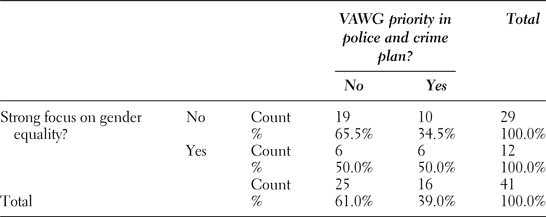
Just under half the PCCs (44%) mentioned their specific responsibilities toward promoting gender equality under the Equalities Act. Only 20% of PCCs employed either an equality policy adviser (or an adviser on VAWG), providing a gender policy capacity. Just over a third (36%) of PCCs specifically reported on either incidence or performance in relation to VAWG in their annual reports. We then scored whether the PCCs were performing their gender equality duties in either a strong or weak way, which showed that 29% of PCCs had a strong focus on their equalities duties. We next examined whether the operation of these rules about gender was associated with the prioritization of VAWG in the PCC policy priorities (see Table 1).
Cross-tabulation of PCCs with a strong focus on gender equality duties with PCCs giving VAWG priority in police and crime plan

Table 1 shows that, where PCCs had a weak gender equality focus, only a third prioritized VAWG in their plan; in contrast, half of the PCCs with a strong gender equality focus had VAWG as a priority. While our small N means we are not looking to establish the statistical significance of this relationship, we note that the odds of a PCC without a strong gender equality focus prioritizing VAWGs is .526 whereas the odds of a PCC with a strong gender equality focus prioritizing VAWGs is .64. Therefore the relative odds are 1.21, meaning that PCCs with a strong gender equality focus are 1.21 times as likely to prioritize VAWGs, slightly higher than evens.
Rules with Gendered Effects
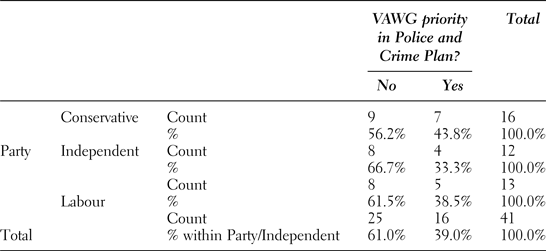
To examine the way in which the party rules and the rules of political conduct may relate to gendered outcomes, we examined both the party affiliations of the PCCs and their manifesto promises. Representing the Conservative Party were 16 PCCs; the Labour Party, 13; and Independents, 12 (30%). Examining initially whether the rules associated with party affiliation are associated with prioritizing VAWG, Table 2 shows a cross tabulation of party affiliation and focus on VAWG.
Crosstabulation of PCC party affiliation with PCCs giving VAWG priority in police and crime plan

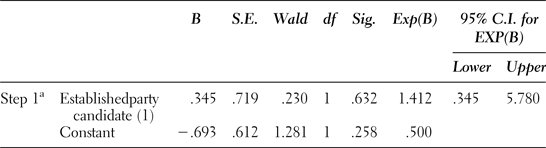
Table 2 shows that only a third of Independent PCCs had a priority on VAWG, a smaller percentage than either the Labour or Conservative PCCs. A calculation of the relative odds of PCCs from the different political affiliations making VAWG a priority shows that Independent PCCs are .8 times as likely to have VAWG as a priority (less than evens) compared to Labour, with Conservative PCCs being 1.2 times as likely as Labour to have that focus. As our proposition is that independent PCCs would be less likely than the established party candidates to make VAWG a priority, we combined Conservative and Labour PCCs and worked out the relative odds of this binary measure (established party PCCs versus independent PCCs). Once the established party candidates are considered together, a logistical regression on the relative odds of an established party candidate prioritizing VAWG finds that party candidates are 1.412 as likely to make this a focus in their plan (see Table 3).
Logistical regression: PCCs from established party & PCCs giving VAWG priority in police and crime plan

a. Variable(s) entered on step 1: established party candidate.
Gendered Actors Working with Rules
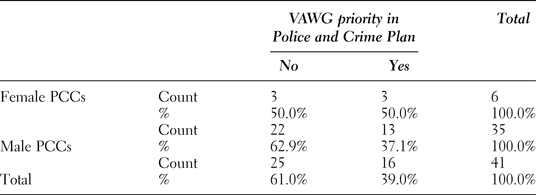
Finally we can examine whether female PCCs and other female actors in the PCCs' elite network are more likely to focus on the gendered nature of crime. Here the highly gendered nature of policing is apparent. Only 6 PCCs (14%) are female, 7 of the 16 appointed deputies (44%) are female, and 9 out of the 41 Chief Constables (22%) are female. Despite the number of female PCCs being so small, it is possible to see a difference in how female PCCs prioritized VAWG in Table 4.
Crosstabulation of gender of PCC with PCCs giving VAWG priority in police and crime plan

The findings in Table 4 show that the conditional probability of female PCCs prioritizing a focus on domestic violence in their Police and Crime Plan was .5 and the odds of this 1, compared with the conditional probability of male PCCs prioritizing a focus on this area of .37 and the odds of this being .59. The relative odds (female:male) are 1.69, suggesting that female PCCs were slightly higher than evens to have this issue as a priority.
An examination of whether having a female actor in the PCC elite network (made up of the PCC, the Deputy, or the Chief Constable) might help in giving a priority focus to VAWG shows that 20 of the 21 PCC areas have a female in one of these senior roles. However, demonstrating the highly gendered nature of the policing arena, only 2 of the 41 areas had more than one female actor in the elite network of the PCC, making it impossible to examine the proposition at this early stage.
Assessing the Relative Strengths of Institutional Relationships
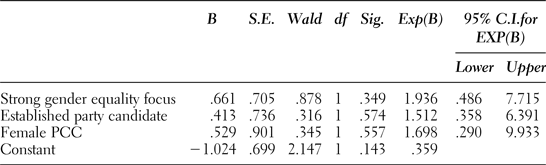
Following on from the analysis of each of the institutional variables above, we used binary logistical analysis to examine the relative likelihood of a PCC having prioritized VAWG in relation to a number of the most appropriate variables: the existence of a strong focus on equalities duties, whether the PCC is from an established party, and the gender of the PCC (see Table 5).
Factors associated with VAWG priority focus in police and crime plan

This analysis suggests that where gender equality duties are fully exploited, the PCC is almost twice as likely to prioritize gendered crime in the plan (exemplified here by a focus on VAWG), all other factors being held constant. Commissioners from established parties that have a policy commitment toward the reduction of VAWG are 1.5 times as likely as independent commissioners (who have no such party discipline) to prioritize VAWG (holding gender equality focus and the gender of PCC constant). And female commissioners are 1.7 times as likely as their male counterparts to make VAWG a policy priority, even holding party affiliation and gender equality capacity constant. We also checked the strength of these associations while controlling for the VAWG conviction rate in each PCC area. Including this control showed a strong association between the higher conviction rate and a priority focus on VAWG, with PCCs in areas with a higher rate three times more likely to have prioritized a focus on VAWG. However, including this control did not change the direction of the effect of the institutional associations we identified in our analysis. Including this control shows a slightly less strong relationship between an expansive gender equality focus and a VAWG prioritization (1.33 as likely); a slightly less strong relationship between being an established party PCC and having VAWG as a priority (1.33 as likely); but a stronger effect of the gender of actors, with female PCCs twice (2.00 as likely) to have this priority focus.
CONCLUSIONS
Elaborating and operationalizing our framework has enabled us to make three contributions. First, we make a theoretical contribution through specifying the microfoundations of how institutional rules can be associated with gender. We show how institutional rules about gender (including those devoted to achieving gender equality), seemingly neutral rules with gendered effects, and the gendered actors who work with these rules can all be related (positively or negatively) to the achievement (or not) of gendered outcomes.
Second, we operationalize our analytical framework to examine the work of PCCs in England and Wales, making an empirical contribution to understanding the gendered nature of these new and developing institutional arrangements. Our propositions were largely supported concerning the relationship between rules, actors, and outcomes. While all PCCs have formally to fulfil their equality duty, it was the PCCs with a strong interpretation of these duties who appeared more likely to prioritize VAWG in their police and crime plan. The existence of “rules about gender” was not, in itself, sufficient to stimulate action to tackle this gendered crime. Looking at other (interrelated) factors, our assumptions were borne out regarding the role of (nongendered) inherited and remembered institutional rules associated with party membership. The traditional party candidates were more likely to prioritize VAWG than independent candidates. And female PCCs who have the policy resources, authority, and agency to establish policing priorities were more likely to give priority to VAWG in their Police and Crime Plan than male PCCs.
Finally, we make a methodological contribution by arguing for a distinctive mixed-methods approach in operationalizing our framework. In taking forward this research we will strengthen the robustness of our findings by continuing to collect institutional indicators for the following three years of the four-year PCC election cycle, permitting the development of a cross-sectional data set with a larger N. This will also allow us to examine the development over time of new rules as they embed within this layered institution. We also intend to supplement this quantitative analysis with case study visits and interview and observation data. The collection of qualitative data will be important, particularly for uncovering what Ostrom (Reference Ostrom and Sabatier1999, 38) calls “rules in use” or “the particular ensemble of dos and don'ts” that are learned on the ground.
Our quantitative analysis has allowed us to survey the role of formal rules, as specified in legislation, manifestos, and reports. But it is of limited use in establishing how actors interpret rules in practice or for investigating the significance of informal rules that appear to be gender neutral but actually have gendered effects. Preliminary interviews have, for instance, suggested that the seemingly gender-neutral rules surrounding direct election (new for the criminal justice system in England and Wales) may have gendered effects. VAWG may prove less “attractive” to potential voters because of informal rules related to wider gender norms regarding “law and order” priorities. (As one informant explained, “Domestic violence is not a vote winner. People don't understand it, they don't want to engage with it, and it's not visible.”) A nonelected officer may be less likely to be influenced by such rules. At the same time, direct election has served in several cases to put VAWG “champions” in office and in control of significant budgets. Interviewees confirmed the importance of party platforms and personal commitments but drew our attention also to the importance of wider links to social movements and civil society projects. They revealed anxiety, however, as to the sustainability of policy change should PCC champions fail to be reelected, pointing to the importance of institutional change to secure their “legacy.” Those we have spoken with describe the surprise of “inheriting” existing institutional arrangements associated with the defunct Police Authority and their efforts to “chip away” and remake gendered rules. One of the PCCs put it to us like this: “We are new characters in a landscape. Have we made a difference? Yes, we have. Have we changed the world? No, we haven't. We need to work hard next year to get real change under our belts.” Our ongoing mixed-methods research will track this process.
This article has explored how the gendered organization of political life makes a difference. We have sought to identify those gendered institutional variables that influence outcomes, test their relative strength, and consider how they interrelate and iterate in practice. Through our case study, we have shown how institutional rules can both facilitate and constrain political demands to make a priority of tackling violence against women. Some of these rules are designed specifically to favor women's interests, while others appear gender neutral but have negative effects because of their articulation with institutional rules in wider society. Understanding the role of institutions in gendering political processes and outcomes has more than academic significance. It is central to strategies for challenging the discriminatory and exclusionary effects of dominant gender regimes and for creating more gender-just political institutions.