Shame was an important part of legal and community censure in premodern Britain. Judicially imposed and neighborhood-sanctioned shaming punishments, such as public whipping or the burning of effigies, were designed not just to humiliate and damage the reputation of offenders who had violated local standards and customs but also to fulfill a wider moral and legal purpose. Such punishments publicized scandal, served as a warning to others, and regulated and controlled the behavior of the local populace.Footnote 1 Crucially, popular participation in administering “rough music”—a folk practice examined by E. P. Thompson, in which humiliating punishments were handed out by local people against those who had violated community standards—helped to legitimize the workings of the criminal justice system and buttress the social order.Footnote 2 Shaming rituals were also extremely important within the religious courts of the Church of Scotland, where kirk session elders would use them to impose godly discipline on those who transgressed the church's strict moral code.Footnote 3
Whereas older histories have argued that such shaming rituals diminished and became less acceptable and less effective in the late eighteenth and nineteenth centuries with urban expansion, growing revulsion towards violence, and the church's dwindling hold over the behavior of the industrial masses, more recent research has pointed to the continuing importance of shame in modern society and its incorporation within new disciplinary cultures.Footnote 4 While much of this revisionist scholarship has looked at the role of shame in state-controlled institutions, such as prisons and asylums, more recent work has pointed to the ways in which it was embedded in print culture and functioned within the judicial sphere.Footnote 5 As David Nash and Anne-Marie Kilday have argued, the press played a central role in the construction, articulation, and promotion of values associated with cultures of shame and often legitimized court verdicts.Footnote 6 Not only did newspaper reports, as Shani D'Cruze has shown, cast aspersions on the accused's character and honor, but they also stigmatized victims—typically female—of physical and sexual violence by advancing judgments about their character, respectability, and morals.Footnote 7 As Jürgen Habermas has contended, the press in the nineteenth century was a crucial component in representing socially damaging forms of behavior in modern civil society, and it was potentially more powerful than other forms of public humiliation given the esteem in which the published word was held.Footnote 8
However, while historical scholarship in recent years has explored the role of shame in the media and in the judicial sphere of high courts, less attention has been given to exploring the links and interaction between these two domains and the cultural mores that underpinned the production and functioning of shaming practices in media reports of police court trials.Footnote 9 The paucity of scholarship on this topic is surprising. Police magistrates' courts not only dealt summarily with the vast majority of criminal prosecutions by the mid nineteenth century, their trials were also selectively reported in a wide array of media, including mainstream newspapers, Sunday tabloids and, most interestingly, specialist periodicals devoted entirely to covering such cases.Footnote 10 As Andy Croll has pointed out, scholars need to know more about the shaming “criteria employed in the composition of the reports of proceedings in the local police reports,” as the messages that were contained within them were not only a form of popular entertainment but also an important means by which power, control, and discipline was exerted over individuals, communities, and public spaces.Footnote 11
This article adds a new dimension to the growing historiography on shaming by examining the relationship between shame and police court media trial reports and by assessing the role of such coverage in serving as both a judicial and extrajudicial shaming resource. The first detailed study to explore the social, moral, and cultural factors and nuances that determined the construction and operation of shaming practices concerning the accused within nineteenth-century media coverage, this article considers the ways in which the media served as a form of both censure and censor by exposing and, in many cases, protecting the identities of those brought to trial.Footnote 12 In keeping with recent trends, it argues that many characteristics of premodern religious and judicial shaming practices shifted into areas of modernity, being relayed, supported, and influenced by new forms associated with the rise of modern print culture.Footnote 13 Indeed, it is shown that magistrates used the threat of naming and shaming in trial reports to both punish and attempt to affect future behavior, thereby firmly embedding the media within the disciplinary culture of magisterial justice. Far, though, from being the mere “mouthpiece” of the courts, as has been argued for eighteenth-century high-court trials, trial reports sometimes “censured” defenders in a manner that went beyond court judgments and had potentially significant implications for community sanction.Footnote 14 The media, it is argued, served as an extension of the disciplinary apparatus, with editors both applying their own and recording magisterial assumptions about the guilt of the accused by identifying people whom they believed had escaped conviction through insufficient evidence or legal technicalities, and whose perceived immoral or illegal actions needed to be publicized. Magistrates and the media enjoyed a mutually reinforcing relationship that spoke not just to shared values but also to each other's inherent support for what they regarded as “common-sense” justice, which was deployed through print when “legal justice” was perceived to have been thwarted.
The construction of shaming in trial reports, it is shown here, helped to mirror and even define middle-class parameters of acceptable feminine and masculine conduct and understandings of childhood while also reflecting changing conceptions of what was perceived to constitute shameful behavior per se. But, crucially, while shaming through trial coverage continued into modernity, it did so in a manner that was discriminatory and that exposed the confines of print culture as a judicial and extrajudicial resource. Given the increasing power of the printed word to shape reputations, the limits on who was named and shamed, and for what, were often set along social, cultural, and commercial lines, to the extent that media coverage was as concerned with protecting the identities and reputations of some as it was with exposing those of others.
■■■
Police courts were introduced in Scottish towns in the first half of the nineteenth century under local and national police legislation. Designed to provide magistrates with greater summary powers and to facilitate a larger volume of prosecutions, they quickly became an integral cog in the machinery of the Scottish criminal justice system, dealing with more crimes and offenses than did any other criminal court.Footnote 15 Such was their importance and such was the level of popular interest in their business that the proceedings of police court trials were published in a variety of media forms, which would ensure that their shaming impact was potentially wide-ranging and extremely powerful.
This article is based primarily on police court trials that were published in local periodicals entitled Police Reports of Cases Tried before the Glasgow, Gorbals and Calton Police Courts (hereafter Police Reports) and the Police Intelligencer, or Life in Edinburgh (hereafter Police Intelligencer), the latter of which was preceded for a short time by the Report of Interesting Proceedings in the [Edinburgh] Police Court (which has also been examined).Footnote 16 Reflecting growing media and public interest in crime and criminal justice affairs, the periodicals were devoted solely to summary trials before local magistrates and were part of a burgeoning “unstamped” press that emerged in the second quarter of the nineteenth century.Footnote 17 Glasgow's Police Reports was published weekly from 1829 (purchase price, two pence); Edinburgh's Police Intelligencer was published daily (one penny) from 1831. Both are likely to have continued for several years in line with similar periodicals in the United Kingdom at that time, although editions have been found only for 1829 (Police Reports) and 1831–32 (Police Intelligencer).Footnote 18 John Brownlie, a writer and middle-class temperance reformer, edited the Police Reports, which was printed by a local publisher. Messrs Forbes and Kay, who ran a small commercial publishing house in Edinburgh, compiled and printed the Police Intelligencer.Footnote 19
Trial accounts gave lucid, sometimes amusing, and sometimes disturbing descriptions of selected trials, often accompanied by a moralistic social commentary. Coverage was selective, both in terms of the content of the reports and the cases covered. Despite police courts in Glasgow and Edinburgh hearing approximately twenty cases per day, on average approximately five trials would be selected for publication, with editors choosing those that were perceived to be amusing and those that reinforced stereotypes and conveyed moral messages.Footnote 20 Both periodicals were published primarily as commercial enterprises rather than as official court proceedings; nonetheless, the use of the word “police” in the titles gave the Police Reports and Police Intelligencer an air of judicial authority and added weight and significance to their accompanying commentaries. Indeed, it is clear that they sought to serve a wider “judicial” or “moral” purpose. The Police Intelligencer published trial reports with the specific purpose of alerting the wider community to potential dangers, while warning criminals of the penalty that awaited them if they broke the law.Footnote 21 John Brownlie, for instance, emphasized that his periodical intended to “warn others” about the dangers of alcohol and immoral behavior.Footnote 22 Trial accounts were fairly short, often a paragraph or two in length, and typically prioritized the magisterial voice over others. As summary courts, police courts' powers of punishment were limited to sixty days' imprisonment or a fine of ten pounds, which ensured that a significant proportion of police court business—and media trial coverage—concerned the less serious crimes and offenses of petty theft, assault, prostitution, begging, drunk and disorderly conduct, and public uncleanliness. In other words, they often concerned perceived immoral behavioral offenses in which the capacity for public shaming was arguably most acute.
Unlike London's Proceedings of the Old Bailey—which published trial accounts from London's main criminal court—the Police Reports and Police Intelligencer were printed independently of local government and were not subject to contracted civic publishing restrictions in terms of what they could and what they could not report.Footnote 23 Although there were suggestions that civic leaders were able to exert influence over newspaper coverage of police court trial reports, no claims of magisterial intervention have been found against the Police Reports and Police Intelligencer (although there is evidence, explored below, that magistrates were willing to utilize the media as a form of censure).Footnote 24 This, of course, does not necessarily mean that there was no direct judicial influence over trial reports, but, given the independent status of both periodicals, the capacity for magistrates to exert concerted pressure is likely to have been limited. Magistrates could—as they did with the emergence of a more sensationalist and critical Sunday tabloid press by mid-century—threaten to deny journalists access to court records for inaccurately reporting on trial proceedings, but they could not deny access to the court itself, which was a public forum (except in rare and exceptional circumstances involving ‘sensitive’ cases that were tried behind closed doors).Footnote 25 For the most part, the periodicals' reporting of police court business is likely to have reflected the shared social, moral, cultural, and commercial values of editors and magistrates, as well as their close working and social connections, rather than any direct institutionalized control over media coverage.Footnote 26
Periodicals similar to Glasgow's Police Reports and Edinburgh's Police Intelligencer were published in other towns but these have not been as well preserved.Footnote 27 In order to ensure a broad geographical and temporal spread, this article draws upon a sample of trial reports in the mainstream (broadsheet) press in Aberdeen and Dundee over the course of the nineteenth century. It also examines trial reports in local and national broadsheet newspapers published in Glasgow and Edinburgh, as these often covered cases from other parts of the country, as well as cases in their own cities. These newspaper reports were similar in style, tone, and substance to those in the periodicals and were also highly selective in their coverage, typically reporting on three or four cases per week.
The newspapers were aimed primarily at a middle-class market and were beyond the financial reach of the bulk of the urban poor. As the Police Reports and Police Intelligencer were cheaper and sought to disseminate moral messages to the urban populace, it is likely they were directed at a wider range of readers.Footnote 28 Writing at the turn of the twentieth century about the Police Intelligencer, W. J. Couper alluded to the periodical's cheapness and accessibility to the urban masses by commenting upon its less than flattering appearance and content: “This was another of the sordid papers that delighted to record the proceedings of the Police Court. It was miserably printed, and occasionally relieved its gloomy pages by inserting popular songs.”Footnote 29 As is explored below, some reports recorded members of the accused, from poor backgrounds, pleading that their names be withheld from trial reports, which speaks to the capacity of periodicals to reach a broad audience. Literacy rates in urban Scotland were extremely high by the 1830s, with those who could not read potentially having access to media coverage through word of mouth or through second or third parties.Footnote 30 No information on the extent of circulation is known, but similar publications were popular among both lower- and middle-class readers in nineteenth-century Scotland.Footnote 31 Joel Wiener estimates that popular English police gazettes, such as the People's Hue and Cry and People's Police Gazette, ran to estimated weekly distributions as high as 30,000 to 40,000.Footnote 32
The magistrates who presided over Scotland's police courts were lay justices drawn from mainly middle-class business backgrounds, and they held views similar to those of many editors about the nature of summary justice. Both magistrates and the broadsheet media examined in this study opposed the introduction of stipendiary magistrates until the late nineteenth century and believed passionately that the law should be administered in a discretionary manner according to their own notions of “common-sense justice.”Footnote 33 As the Caledonian Mercury noted in 1855, “it is not always requisite, nor would it be expedient, to abide by the strict letter of the law,” especially in adjudicating on family disputes.Footnote 34 It went on:
What is really requisite to constitute eligibility for such an office, is parental feeling and common sense . . . A power of spontaneously appreciating the merits of a case from incidental hints, the general demeanor of the accuser and accused, the harmonies or discords of circumstance and testimony, and the analogies of experience, must form substantially the media for the formation of an opinion upon the bearings of a particular case; rather than the residuary conclusion from a scrupulously careful balance of contending facts, and a cautious sifting of evidence.Footnote 35
In other words, sensitivity to individual circumstances and to community feelings were particular qualities, and a necessary component, of discretionary justice. Significantly, these were traits the media would, on occasion, seek to convey and safeguard on the relatively rare occasions when journalists and editors believed the community had not been well served by judicial judgments.
■■■
Shaming rituals were an extremely important part of the religious discipline imposed by the Church of Scotland in premodern society. Those who were found to have broken the church's strict moral code were publicly rebuked before local congregations and forced to endure the indignity of a range of humiliating practices, the most common of which were wearing a sackcloth or sitting on a stool of repentance until absolved. As Leah Leneman and Rosalind Mitchison have argued, the Calvinist teaching of the church, allied with an elaborate network of religious courts (kirk sessions), enabled kirk elders to regulate the behavior of their parishioners much more tightly than was possible in the Anglican Church in England. Indeed, it is possible that this made shaming as a form of religious censure even more common and more powerful in eighteenth-century Scotland than was the case for her southern neighbor.
Although urban expansion and a rise in religious nonconformity posed significant challenges for godly discipline in the nineteenth century, public shaming continued to function and flourish as a form of punishment—both in the courtroom and in media representations of courtroom discourse.Footnote 36 In trial reports, editors sometimes offered their own moral opprobrium as a supplement to court rulings, thereby extending the role of the media as an apparatus of discipline. In 1829, the Police Reports commented that John Carslaw had been charged with “beating and abusing his wife” in a “most shameful manner.”Footnote 37 On other occasions, reports specifically highlighted magisterial criticism of behavior that was deemed to be disgraceful and dishonorable. Indeed, the frequency with which the magisterial voice was recorded alluding to the shame that the accused should feel for his or her indiscretions points not only to the continuing belief in media and judicial public penance as a form of discipline but also to the reciprocal relationship and shared values that existed between bailies (magistrates), journalists, and editors. The 1829 Police Reports, for instance, published the following case in which a mother was questioned about the behavior of her daughter, who had been charged with stealing three handkerchiefs from a shop:
Superintendent: “Your daughter's cloke is very convenient in secreting stolen goods.”
Magistrate: “Are you not ashamed to train up your child in such a detestable manner? Both you and her must go the Bridewell for 6 weeks.”Footnote 38
In publishing selective comments from magistrates, such reports gave resonance to the moral opprobrium contained within the media coverage and helped to create the impression that bailies and the periodical spoke with the same voice, especially when magisterial condemnation of offenders was accompanied by press disapprobation.
Among the cases that received some of the most critical attention from the courts and the media were those whose victims were seen as unequal counterparts, such as very old men, young boys and girls, and women. Indeed, in its reporting of the magisterial condemnation of certain forms of behavior, the media helped to mirror, and possibly even mold, changing conceptions of what was perceived to be “shameful,” not least in terms of growing intolerance towards violence inflicted upon the “vulnerable.” Although recent research has suggested that moral condemnation of domestic violence in the media and judicial sphere was less influenced by a reconceptualization of masculinity than was once thought, there is sufficient evidence of it being labeled as “shameful” to suggest that attitudes against working-class male abusers were hardening in certain circles, especially if victims were women who conformed to middle-class ideals of femininity (discussed more fully below, in the next section).Footnote 39 Cases involving the neglect or abuse of children seemed to invite particular remark by magistrates and journalists, reflecting what Joanne Bailey has argued was the emergence of new sensibilities for the protection of children.Footnote 40 For instance, a schoolmaster who appeared before the Glasgow Police Court in 1829, charged with excessively beating an orphan boy in his care, was fined and received a stern rebuke from the magistrate which the Police Reports considered worthy of reproducing in the weekly circular of police court cases: “this conduct, said the worthy Magistrate, was truly shameful, and unlike a person of his appearance, looking forward to the church.”Footnote 41 At stake here was not a clash between the disciplinary cultures of the school and the court, with magistrates themselves occasionally sentencing juvenile offenders to corporal punishment—a practice that became formally enshrined in national legislation from the mid-century onwards.Footnote 42 Indeed, the magistrate in this case acknowledged “that schoolmasters have a right to chastise children, in a moderate way.”Footnote 43 The issue was that the level of punishment inflicted went “far beyond the bounds of sound discretion,” with the degree of shamefulness being exacerbated by a man of his class, station, and persuasion losing his temper against someone of unequal status whom he was expected to protect.Footnote 44 Unusually for police court trial reports, the reporter made a point of recording in detail how the schoolmaster had “disciplined” the boy and the extent of the latter's wounds. The boy was struck “immoderately with a pair of taws, or strap, on various occasions” and given “an extravagant whipping,” to the extent that he had “many blue and black marks on the body and face . . . and the left arm bore many marks of violence.”Footnote 45 What the court and the media were articulating was the bounds of acceptable and unacceptable levels of violence—and with it what constituted shameful behavior against a minor.
The media were also keen to point out shameful behavior that traditionally had formed the bulk of kirk session business. According to Callum Brown, the first few decades of the nineteenth century were “a new puritan age, as families and communities pressed individuals to obey very strict conventions of behavior”—and some police court trial reports, it is shown, were at the forefront in propagating this.Footnote 46 Brownlie's Police Reports, in particular, gave much exposure to trials involving profanation of the Sabbath, immoral sexual behavior, and drunkenness. His musings on judicial proceedings were often couched in religious discourse and highlighted, in particular, the dangers of sin, alcohol, and immorality. In 1829, when reporting Benjamin Dalrymple's conviction for disorderly conduct, Brownie deemed it relevant to describe Darlymple as a “continual Sabbath-breaker.”Footnote 47 Indeed, magistrates and the media appear to have worked together to publicize deviant behavior that offended the Church of Scotland's strict moral code. Press reports were particularly concerned with exposing magistrates' criticism of immoral behavior that ran counter to the church's teachings. In 1829, for instance, William Trevan, who was charged with lounging at half-past one o'clock in the morning with a prostitute on a stair at St. Andrew's Square in Glasgow, “was ordered [by the magistrate] to go away and think shame of himself.”Footnote 48 What is particularly interesting about such judicial and media condemnation is that magistrates were seeking penance from offenders: they were expected, as the above example reveals, to feel shame themselves. What was being propagated was a form of censure that was very much in keeping with the internalized, self-reinforcing notions of godly discipline that, in keeping with wider developments throughout the Europe, became especially forceful in Scotland in the late eighteenth and early nineteenth centuries as the moral authority of the ancien regime switched to the individual.Footnote 49
Indeed, the tone of trial reports could, on occasion, appear almost confessional; offenders lamented their behavior and, following a rebuke from the magistrate, promised not to repeat it. In 1830, for instance, the Report of Interesting Proceedings published the case of Marian Anderson, who was charged with interrupting passengers on the city's South Bridge. Although the charge was proven, the periodical reported, “From the seeming contrition of the defender, the Magistrate was pleased to dismiss her.”Footnote 50 On the other hand, the refusal to display and express shame could bring an unwanted judicial outcome for offenders. In 1880, for instance, the Dundee and Argus Courier published an article under the heading “Breaking a Lamp to Get to Jail,” in which it recounted the short proceedings of a middle-aged man, John Mitchell, of no fixed residence, who was charged in the Glasgow Police Court with willfully and maliciously breaking two pieces of glass in a public street lamp. On being asked by the magistrate, stipendiary John Gemmell, why he had committed the offense, Mitchell replied, “just to get lodgings and something to eat.” Gemmell responded, “As you are not ashamed to say it would be a benefit to you to be sent to prison, I am not going to send you there. You may go.”Footnote 51
It was the possibility that courtroom participants would have their indiscretions revealed in the press that, arguably, made shaming such a potent form of punishment. Indeed, the chances of being publicly exposed in print resulted in some offenders attempting to withhold their identities or giving false names in court.Footnote 52 Others were more forceful in their actions. In 1830, the Report of Interesting Proceedings, in an article entitled “A Cyprian's Request to the Reporter,” recorded Christy Anderson, “a lusty Cyprian” (slang for prostitute), exclaiming, ‘I say you Reporter, do not put my name in your hanged Reports!’”Footnote 53 Significantly, the reporter's decision to ignore her plea—and record information which, as the next section shows, was by no means included for everyone—was indicative of the contempt that the courtroom reporter showed not just to Anderson but to women like her.
Although impossible to prove conclusively, the tendency of magistrates to deliver what was akin to a religious form of censure suggests that they were acutely aware of the shaming potential of the press and utilized it as an informal judicial resource in order to get their messages across to the widest possible audience. There were certainly a number of recorded instances when magistrates threatened to expose the identities of those who breached local police laws. In 1811, for instance, magistrates in Edinburgh, after discovering several deficiencies in verifying bakers' weights, resolved to punish such infractions in a way that demonstrated the close relationship that existed between punishment and publicity: they decided “to keep a register of the defaulters' names in a book, and to publish such as shall in future be convicted of selling this necessary article short of the standard weight.”Footnote 54 Similarly, ten farmers prosecuted in the Glasgow Police Court in 1821 for selling underweight butter in the “Bazaar” were warned by the sitting magistrate “that in the event of their again attempting to impose on the public, their names would be published in the newspapers.”Footnote 55 It is not known whether magistrates were threatening to utilize newspaper trial reports or notices, but the former seems most likely given that the intimations were made in the press's coverage of police court cases. Moreover, it is significant that in these examples the newspapers protected the identities of those convicted. Although the threat is likely to have been more the potential loss of business rather than shame per se, the cases nonetheless reveal the ways in which the courts used the media not only to support and circulate their judgments but also to embed it as an instrument of law and order. There were even suggestions that judicial punishments were handed down with one eye to the media. When in 1830 the Report of Interesting Proceedings published the case of a newspaper porter charged with striking his wife in an “outrages” manner in their home, the justice “ordered the defender to be confined in the Police Office till the day of publication of the newspaper which he is engaged to deliver.”Footnote 56 The implication was that the defender was to be detained either so he could not exert influence over either the content of the media report, or to intensify his depth of shame by having to deliver the newspaper that criticised him.
Among the reading public there was a perception that magistrates were able to exert influence over whether the identity of the accused was revealed. In 1890, for instance, the Aberdeen Weekly Journal picked up a story from the Evening Express, in which it reported that at Banff Police Court,
an inhabitant of the burgh who is not a stranger at the bar of justice, but who has the misfortune to possess a sobriquet, appealed to the Baillie to use his influence with the reporters to keep the obnoxious nickname from appearing in print. The reason he gave was that “he was as much entitled to his proper name as any other decent man who appeared before his Honour.”Footnote 57
The fact that his name and nickname were withheld suggests his appeal was successful.
Significantly, Brownlie, the editor of the Police Reports, used the threat of being named and shamed to shape the future behavior of both the accused and the complainer. In 1829, he published the case of “a married man of rather superior appearance” who charged a prostitute with stealing two shillings from him in a house. After detailing the magistrate's condemnation of the married man's behavior, Brownlie ended his commentary with the following: “This accuser's name will be inserted if ever he again appears on a similar charge.”Footnote 58 Similar sentiments about the shaming impact of trial reports were expressed in the broadsheet press. In 1833, the Aberdeen Journal reported, “In the Police Court, On Monday, a young man was charged with exercising the functions of the canine species, and biting [and severely wounding] a woman! in a pub fight. . . . Out of pity, we do not give his name, nor anymore particulars.”Footnote 59 It was a comment that spoke volumes about the shaming and disciplinary power of the printed word.
Influenced in many ways by Scotland's strong religious tradition, shaming, therefore, was also embedded within the judicial sphere of the nineteenth-century police court and found expression in a media willing to relay magisterial “sermons” concerning the behavior of the urban masses. Indeed, the willingness of journalists to report on the shame that magistrates' expected the accused to feel, allied with magistrates' willingness to use the media to threaten those who transgressed local laws, points to a close working relationship between the courts and those who reported in, and edited, Scotland's mainstream newspapers and police court periodicals. As the next sections shows, by referring to circumstances in which people were expected to feel shame, the media helped reflect changing middle-class views on what was deemed to be shameful, especially on issues relating to cruelty and violence. Who would be named and who would be shamed, though, would be determined not simply by the offense committed or by changing sensibilities towards certain forms of behavior. It would also be affected by a range of issues that spoke to class, status, honor, and gender.
■■■
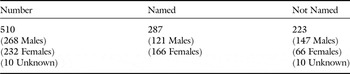
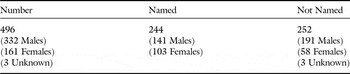
As the above examples suggest, editors exercised much discretion when it came to the identity of courtroom participants. While some defenders were named, others were identified only by their sex, occupation, status, appearance, age, nationality, or criminal past (typically only one or two of these).Footnote 60 Of 510 people charged in the Edinburgh Police Court who had their cases covered in the Police Intelligencer between 18 August 1831 and 11 October 1832, 287 (56 percent) had their names revealed and 223 (44 percent) did not (see Table 1).Footnote 61 Similarly, in the Police Reports' coverage of Glasgow Police Court trials published between 6 July and 12 September 1829, 244 accused (59 percent) were named and 252 (51 percent) were not (see Table 2).Footnote 62 Within the broadside newspapers, practice varied: the conservative newspaper Glasgow Herald, for instance, selectively identified the accused in a manner similar to that of the periodicals; the liberal Scotsman, though, was among the most reluctant of all the leading newspapers to record the names of the accused. More often than not, the Scotsman would publish such information in order to send out a message to the business community about a person convicted of swindling or fraud, typically citing magisterial warnings that similar behaviors would be strongly punished.Footnote 63
The Number of Accused Named and Not Named* in Police Intelligencer Trial Reports, 18 August 1831 to 11 October 1832.Footnote 64

* Note: Figures for Table 1 and Table 2 relate only to those cases, which represented the vast majority of cases in which the specific number of persons on each charge was recorded in the trial reports. The few instances where it was stated that “a group” or “a number” of people were charged have not been included as the numbers involved are not known. However, not only was it unusual for this to be recorded, such cases were typically given very little coverage in the periodicals.
The Number of Accused Named and Not Named in Police Reports Trial Reports, 6 July to 12 September 1829.Footnote 65

It was, however, rare for the accused who were named to have their addresses revealed (house numbers were never included), which should caution against overstating the capacity of readers to put a face to a name in what were large, populous cities. Only one in every ten of the people named in the Police Intelligencer made reference to the defender's street or court, one in ten to their stair or close, and one in twenty to their district. One in five made no reference to the accused's place of residence at all.Footnote 66 The remainder identified the location in which the crime or offense occurred, reflecting the periodical's interest in letting middle-class readers know about thefts in their area, or the location of disorderly houses and brothels that were shaming the wider neighborhood.
The fact that the media chose to specifically identify so few general places of residence suggests that media censure, perhaps leading to community reprimand, was not the overriding concern of trial coverage in many cases. Nonetheless, that editors chose to withhold the names—and thereby protect the reputations—of some people not only suggests that they were willing to use court trial reports to serve as a wider form of judicial discipline but also alludes to the capacity of readers within limited catchment areas and specific social circles to be able to identify the people profiled. Those who had their names and general locations revealed tended to be charged with crimes perceived to be especially heinous or immoral (see below), or damaging to the wider business community. In 1832, for instance, the Scotsman took the unusual step of publishing the watchmaker James Wilson's address in a trial report after he pleaded guilty to several breach-of-trust charges.Footnote 67 That being identified in trial reports could have a potentially devastating impact on the accused's, or his employer's, future career path or business was illustrated in 1836 when Samuel Young, coal merchant, published a letter in the Scotsman refuting some of the allegations that had been made against his weigher in a trial report (published the previous week) under the heading “Fraud in Coals.”Footnote 68 In the business community, reputation directly affected livelihood, and trial reports were clearly a very powerful way of smearing someone's trustworthiness.
What is especially significant is that guilt was by no means the determining factor in the decisions made by editors to publish a person's identity. Of the 287 named persons who were charged in the Edinburgh Police Court, 154 (54 percent) were convicted; the others were either dismissed, remanded, or had their cases remitted to a higher court. Similarly, of the 244 persons named in the Glasgow Police Court, 164 were convicted (67 percent). As the examples below reveal, trial reports, especially those published in the Police Reports and Police Intelligencer, were especially concerned with naming those accused of immoral behavior or violence against the vulnerable. Those charged with drunk and disorderly conduct and offenses deemed to be immoral, most notably the soliciting of sex, were most likely to be named, reflecting the periodicals' tough stance against sinful behavior and the continuing influence of religion on shaming practices.
However, while trial reports pointed out certain actions as being “shameful,” the decision to name or not name those charged often transcended the nature of the offense itself. It also spoke to a raft of factors relating to the character, honor, position, and gender of those concerned—and, significantly, the values that governed their expected behavior. In premodern Scotland, women were more likely than men to be the subject of a wide range of shaming punishments. This was especially true for those deemed guilty of offending against femininity.Footnote 69 Interestingly, this pattern was replicated in police court trial reports, with female defenders being more likely to be named than men. Almost three-quarters of the 232 women who were charged in the trial reports had their identities revealed; many of them were described as prostitutes, keepers of disorderly houses, or petty thieves. This figure compared with less than half of the 268 men (see, again, Table 1).Footnote 70 It was a similar situation with the Police Reports, although the gender differential was smaller (see, again, Table 2). Of the 332 male defenders who were recorded, 141 (42 percent) were named and 191 (58 percent) were not. The corresponding percentages for female defenders were 64 percent and 36 percent (of the 161 women recorded).Footnote 71 Both periodicals also appear to have been more likely to identify repeat offenders by name, although the selective nature of court reporting and the absence of comparative court records makes it impossible to establish this conclusively. Nonetheless, the fact that editors sometimes threatened to reveal the identity of offenders if they came before the court again indicates that at least some first-time offenders were given greater protection from editors than repeat ones. The media were especially concerned with labeling certain offenders as criminally deviant and constructing entertaining criminal narratives around them.
Sometimes reports gave only the nationality of the accused, not because the editor wanted to protect them, but because the information they provided reinforced stereotypes as to their perceived criminality. This was especially common for Irish defenders.Footnote 72 All forms of media displayed a keen interest in protecting the identity and reputation of men of a certain social standing. Occupational profiles, allied with press assumptions about—and descriptors of—appearance often determined whether identities were revealed. Indeed, some people whose names were withheld were identified only as “respectable looking,” illustrating the importance of appearance, dress, and demeanor for media coverage.Footnote 73 Safeguarding the career paths of young professional men was of particular concern. In 1829, the Police Reports published the case of two “dandy clerks” charged with fighting on the streets on Sunday morning who were not only sent on their way by the magistrate but also had their reputations protected by the journal, which warned that “if these two dandies again appear in the office, their names will be inserted in the Reports.”Footnote 74 The periodical also often hid the identity of men employed in the trades, perhaps reflecting their importance within the city's municipal sphere of governance. Businessmen nearly always had their names withheld.Footnote 75
Young offenders were more likely to be brought before a police court than any other judicial forum, which meant that reports of trial proceedings would play an important role in reflecting and defining notions of childhood, youth, and adulthood through the ways in which they sought to portray the youthful indiscretions of some offenders while exposing the hardened criminality of others. Ideas of childhood, as well as juvenile delinquency, were ambiguously defined in Scots Law in the nineteenth century.Footnote 76 Opinion on the conceptual foundations of the age of criminal responsibility varied among legal commentators, giving police courts a great deal of leeway in applying such ideas before police returns and national legislation started to make definitions and practices more universal.Footnote 77 The criminality of non-adult offenders depended upon many things beyond biological age, regardless of what age cut-off legal tracts suggested. Children under seven years of age could be, and were, charged with crimes and offenses in police courts, while those who were biologically and legally adult could be, and were, treated as non-adult by procurators and magistrates if they saw fit. While media reports often revealed the identity of impoverished young offenders—some as young as six years old—university students from affluent backgrounds were afforded special protection. Indeed, one of the interesting features about the Scottish police court experience is how “youth” could, in cases involving “elite” young men, be used as a defense and justification for lenient treatment—a privilege not afforded to prepubescent offenders from humble social backgrounds. In January 1850, for instance, the Caledonian Mercury reported that the Edinburgh Police Court “was crowded in every part” when a group of male students was charged with obstructing the police on a public footpath near South Bridge. Mr. Neaves, the public prosecutor, presented the case to the judge lightly as nothing “more than one arising from youthful indiscretion. . . . Great allowance must be made certainly for the exuberance of youthful spirits.” The students' lawyer, Mr, Logan,
trusted the Magistrate would see his way to impose a modified pecuniary penalty; not that the payment of even the maximum fine was of vital consideration to persons in the situation of the accused, but because such a modified penalty would express to the public, what he doubted not the Magistrate personally felt, that the gentlemen at the bar had been guilty of no offense, which seriously affected their character, whether as peaceable citizens or members of the University.Footnote 78
Significantly, the newspaper supported the right of these young men to differentiated treatment by not publishing the names of the offenders.Footnote 79 It presented the firm view of middle-class offenders that this court was beneath them, publicizing the students' objections to having been “confined in cells appropriated to common felons.”Footnote 80 As Elizabeth Foyster has argued for the early modern period, such arguments implied a view that saw these youths as the elite in training, for whom allowances were to be made in their development of character and prospective future position.Footnote 81
Unlike poor non-adult offenders, those from “elite” backgrounds were likely perceived as having a superior capacity for betterment.Footnote 82 On the rare occasions when the names of university students were provided, the media went to great lengths to record the voice of the magistrate, who often downplayed the nature of the offense as youthful high jinx. When in 1878, for instance, Edinburgh students Philip Warburton, Robert McLagan, and John Gibson Bryce were charged in the Edinburgh Police Court with disorderly conduct for violent and anti-social behavior, the Evening Telegraph quoted the sitting bailie as saying that “a certain amount of effervescence might be expected from educated young men . . . [and he] . . . trusted that when they were a little older, they would have more sense.”Footnote 83 How the collective behavior of these offenders was interpreted by the court, and portrayed in the media, was markedly different from judgments and representations involving young working-class offenders, in ways that implied less the severity of the offense or the age of the perpetrators than their class identity and their potential future contribution to the community. In contrast to student offenders, young working-class offenders were often portrayed in the media as adults by a pattern of behavior that spoke to their hardened and mature characters. In 1877, for instance, the Evening Standard chose to quote the fiscal's characterization of eight-year-old John Drummond, who appeared in the Greenock Police Court for stealing money in a boarding house with another boy, as one who “smoked, chewed tobacco, drank whisky, and was the leader of a gang of expert child thieves.”Footnote 84 This was, significantly, a selective style of reporting that underpinned who was named and who was not and, in the process, ensured that the media helped to reflect and define childhood as something more than biological age. It was also about character, class, and life experiences—factors that, in the eyes of editors (though not explicitly the law), ensured that some juveniles were worthy of, and received, a childhood and protection from the media, while others did not.
Social background also mattered when it came to protecting women's identity, at least for those who conformed to middle-class ideals of femininity. When women from middle-class backgrounds were brought before the court, the media drew on the words of magistrates to highlight how unusual and out of character the appearance was, which for the editor might have helped to justify withholding the defender's identity. The broadsheet press, in mirroring the views and values of magistrates, saw it as their duty to protect the reputations and futures of young women who were deemed worthy. In 1831, the Police Intelligencer reported the case of an unnamed girl, a milkmaid, who was charged with stealing money that had been entrusted to her by Mr. Ramsay, cowfeeder, in the following manner:
A decent looking man, her father, and a woman, stepped forward to the bar, when the poor girl, in a paroxysm of insensibility, clung to the woman and cried bitterly. The court, and particularly, the worthy Magistrate, seemed to feel intensely for the situation of the poor girl and her parents. When the agitation and seeming penitence of the defender had subsided, the Magistrate warned her father to keep a strict look out after his daughter, who did not seem to be yet lost to the better feelings of rectitude and virtue.Footnote 85
The combination of the parent's “respectable” background, the accused's vulnerability and remorse, and the sympathy of the “worthy” magistrate was enough to ensure that the latter's identity was not exposed in print.
Even a woman's attractiveness could influence journalistic and editorial decisions. In 1832, the Police Intelligencer reported the case of “a young beaux [sic], dressed in the military academy uniform, quite smart, and a young Belles [sic], dressed in silk of Lincoln green, who simpered and smiled as she skipped to the bar,” who were charged with “stealing a black cloth vest, from a lockfast trunk, in the duty house corner of the North Bridge.” The report went on: “This was a strange case, alleged to have been committed by such a fashionable and sprightly couple, caused many a neck to be stretched and many a mouth to gape amongst the auditory, to witness the result of the inquiry.” Significantly, it ended with the following remark: “We was [sic] happy to learn that the supposed theft turned out to be a frolic, although one of a very dangerous nature. Dismissed, not guilty.”Footnote 86 Not only did the journalist take the unusual step of stating how pleased he was that the accused had been dismissed, his decision to take the equally unusual position of recording “not guilty” after “dismissed” (the overwhelming majority of reports simply stated “dismissed”) removed any blemish on the defenders' characters that might have been implied by their appearance in court.
Such protection, though, did not extend to women who subverted contemporary expectations of maternal care by assaulting or neglecting their children.Footnote 87 In 1865, for instance, the Caledonian Mercury described Anne Boyd, charged with theft in the Edinburgh Police Court, as “An Inhuman Mother” for kicking her seven-year-old daughter in the street.Footnote 88 Similarly, morally “deviant” women, in the editors' eyes, were in need of correction. Jess Williamson and Ann Findlay, described as “dashy Cyprians,” had their names exposed in the Police Intelligencer for being drunk and disorderly and using wicked and obscene language in a public place.Footnote 89 Although an attractive appearance could sometimes be a signifier of respectability in itself, for women labeled as prostitutes it could, in the words of Shane D'Cruze, be a sign of their “always-ready sexualised femininity.”Footnote 90 Moreover, as Melanie Tebbutt has shown, the naming and labeling of a woman as a prostitute, or any questioning of her sexual morality, had the potential to do great damage to her reputation. A woman's sexual conduct, allied with her capacity to maintain a clean household, was a major arbiter of her standing within her own community.Footnote 91
Yet there was a double standard in the periodicals' exposé of immoral behavior. While they were particularly concerned with revealing the identities of women they perceived to be lewd and licentious, their male “clients” in the majority of cases had their names withheld. On occasion, the media even expressed sympathy for men for having fallen into such “bad” company. In an 1829 case involving “Walker, prostitute, charged with stealing a pair of boots and spurs from a man,” the Police Reports revealed the name of the accused woman but not the complainer and lamented, “It was a shame for him, a married man, and the father of no less than ten children, to be drinking with a common prostitute.”Footnote 92 Despite Brownlie's self-proclaimed desire to use the Police Reports to expose immorality, it was the behavior of society's sprawling urban poor that he was most interested in disclosing.
The protection of anonymity was not extended to working-class men to anywhere near the same extent as it was to those from the middle classes. As with working-class women, editors were less concerned with respecting the lives and reputations of men from poorer backgrounds. The lives and experiences of society's underclass were not, in the eyes of editors, private. Rather, they were a form of amusement and anxiety. In his Secret Memoirs, the Glasgow policeman Samuel Rodger alluded to the class bias that existed not only in bringing people before the courts but also in representing trial proceedings. Reporting on how a closed court had been held for “a young swell” who had “committed one of the most immoral acts which is possible for a man to commit in the presence of ladies,” Rodger pointed out how young middle-class men often escaped being brought before the police court, as well as the fascination journalists had in reporting the crimes and offenses of the lower orders:
Now just you compare this with the way the case would have been conducted if it has been a young workman who had went up to a big swell's window and done what this fellow did. Why, he would have been tried in open court with 4 or 5 newspaper reporters taking down every word as minutely as possible, and in little more than 24 hours, this young man's name and everything about him and what he had done would be read over at least half the English speaking world. The swells [affluent middle-class gents], after reading it in their morning paper would shrug their shoulders and say, “O, these horrid drunken working men.”Footnote 93
Rodger's comment points up not just the role and wide-ranging reach of the media in shaming individuals but also its capacity to reinforce perceptions of class boundaries and the potential damage that naming and shaming could have on certain social groups. While being exposed in print could damage people from all walks of life, the selective nature of reporting suggests that editors and journalists believed that it was the middle classes, and middle-class males in particular, who had the most to lose from being named and shamed. Respectability, in other words, was in the eyes of the media more important to the middle classes, or those who aspired to become middle class, than it was for the lower orders who had little dignity to lose. Indeed, there were even suggestions in the media's coverage of the demeanor and behavior of the accused that some of the lower orders wore a courtroom appearance as a source of pride and badge of honor. Although the media stopped short of explicitly stating this, the manner in which it highlighted the accused's lack of contrition and sarcastic responses likely helped to forge in the minds of readers the impression that a courtroom trial was anything but a harrowing and humiliating experience for certain members of the community. See, for instance, the case involving William McKinnon, Michael Collins, and two other unnamed boys charged in the Glasgow Police Court in 1829 with pickpocketing, “who, when placed at the bar, displayed a good deal of levity,” according to the Police Reports.Footnote 94
Having said that, while there was undoubtedly a middle-class bias when it came to protecting the identities of offenders, editorial decisions were also often affected by cultural and moral variables and nuances that governed expected behavior for different social groups. Violence against “vulnerable” groups provides a good case in point. Men—even middle-class educated professionals—who had been reduced to the bestial, especially in such a calculating way, were afforded no cover of anonymity. In 1840, the Aberdeen Journal covered the case of apothecary William Alexander, who was fined three guineas, or sentenced to sixty days' imprisonment, in the local police court for pouring turpentine into a dog's eyes, ears, and nose because it would not leave his shop. Appalled by the conduct of Mr. Alexander, the editor recorded in detail the moral condemnation of the sitting magistrate, who claimed that “a more disgraceful and dastardly piece of cruelty had never come before that Court.”Footnote 95
Annemarie Hughes has contended that the press in Scotland offered little discursive condemnation of domestic assault over the period 1850 to 1950.Footnote 96 At first glance, it seems that the Scottish media did indeed provide little overt commentary on such offenses and the men who committed them. Names were often withheld, especially if the abuser was from a poorer background, in which case his behavior was presumably deemed to be normative for a person of his class. However, although the number of reports was small, representing a small proportion of police court business, and was balanced by cases in which the identities of abusers were protected, there were, nonetheless, a number of instances in which men from different social backgrounds were not afforded the privilege of privacy when their offenses were deemed to be excessive or directed at victims “worthy” of protection. In 1829, for instance, the Police Reports identified John McGonach, charged in the Gorbals Police Court of being drunk and disorderly and striking his wife, as an abusive husband.Footnote 97 Bailie McLellan said, as the Police Reports recorded:
this was a most distressing case, and he was sure, that there was not a person in court, who did not sympathize. We have before us a well-doing virtuous woman, joined with a cruel husband—a woman willing to do well, provided she is allowed peace and quietness, and I am sure, said he, from the modesty of this woman, matters must have gone a great length before she complained.Footnote 98
This comment indicated much about the magistrate's middle-class expectations of femininity, constituted by perseverance, modesty, and forbearance in the face of male violence and unreasonable action. Bailie McLellan continued:
your conduct, sir; has been brutal; your wife, whom you are bound to cherish; and protect by the laws of God and man, has been barbarously used by you, by her appearance this day at the bar, shows your hands have not been idle. . . . you ought to be proud, sir, to have such a well-doing wife; none but a brute would act in the way you have done towards her.Footnote 99
The victim, in this case, possessed the qualities that made her worthy of middle-class men's protection. She was the archetypal domestic “angel.” Bailie McLellan then dismissed the case as a first offense after the victim agreed to take back her husband and the financial hardship that imprisonment would bring was revealed, but not before the accused was threatened with Bridewell upon repeat of the violence. Perhaps more significantly, the editor of the Police Reports determined that McGonach no longer had a right to anonymity. Just as he failed to uphold the middle-class values of protection towards his wife, he lost his right to that class's protection of his own honor and respectability.
Indeed, the media played an important role in deciding the boundaries of middle-class respectability in its use of selective anonymity. In 1831, Andrew Neilson, a master tailor, appeared before Bailie Morton in the Edinburgh Police Court on his fourth charge of domestic violence towards his wife. The Police Intelligencer framed the case by remarking upon the wife's demeanor: “a woman who has all the appearance of being sober, quiet, and industrious.”Footnote 100 In this case, it was the accused's “unnatural conduct” towards his wife, allied with the fact he was a serial offender, that formed the basis of the trial report and the magistrate's and periodical's condemnation. He was sentenced to sixty days in Bridewell, and was to be fed on bread and water only for half his sentence, representing the toughest penalty the court could administer.
Jennifer Davis, in her study of nineteenth-century London police courts, concludes that abused wives brought charges as a strategy to shame abusive husbands by exposing their conduct to judicial, public, and, sometimes, media scrutiny.Footnote 101 To what extent female complainers in Scotland brought charges against violent husbands in the hope that media trial reports would fulfill a similar function is impossible to determine, although it is unlikely to have been their main motivation given that cases of domestic violence were, as Hughes has rightly pointed out, so infrequently recorded in the media. Nonetheless, the selective reporting of such behavior at the very least offered the potential that it could be exposed in print and that the media could be used as an informal means of censure. Indeed, in this respect, media coverage of police court trials fulfilled a role similar to that of church courts, with Anna Clark showing that victims of domestic abuse in Glasgow in the late eighteenth and early nineteenth centuries often sought to humiliate domestic abusers through kirk session shaming and therefore effect a change in the latter's behavior.Footnote 102
Through deciding who was named and shamed, and in providing accompanying commentaries advancing magisterial condemnation of specific forms of behavior, police court trial reports played an important role in determining what was shameful behavior, who perpetuated it, and who its victims were. A complex range of factors determined who was named and shamed and who had their identities protected, of which the nature of the offense committed was just one. What was considered shameful behavior worthy of media censure cannot be separated from who was involved—both as perpetrator and victim. While violence inflicted by rougher sections of society was perceived to be somewhat expected, and therefore not worthy of detailed moral condemnation, the violence inflicted by men in positions of authority could—especially if it involved an “unacceptable” level of violence against a vulnerable person—be more routinely labeled as shameful because it was not in keeping with a person of such status. Instances of middle-class shaming, though, were fairly infrequently recorded in the media. To some degree, this reflected the fact that the overwhelming majority of people prosecuted in police courts were from poorer backgrounds; but it also spoke to the desire of the media to protect the reputations of affluent men whose behavior, while regrettable, was not perceived to warrant the censure of public humiliation in print culture. Unlike the vast majority prosecuted in police courts, such persons were deemed to have honor, the loss of which would be extremely damaging to their reputations. Shaming, as it was administered in the identification of persons named in police court trials, was a fluid concept subject to the moral, social, cultural, and commercial values of editors. It was one which, as a consequence, was somewhat restricted in its disciplinary potential mainly to the poorer urban masses and to those of respectable backgrounds whose behavior was deemed to be particularly unworthy of a person of such status.
■■■
It was not only the media's capacity to reveal the names of the accused and their alleged offenses that had the potential to humiliate and embarrass, but also the way in which court appearances were represented. The media often recorded courtroom personnel mocking and ridiculing the dress, intelligence, and speech of defenders, which, significantly, was often accompanied by an equally damning commentary from journalists and editors that effectively amounted to character assassination. In 1831, the Police Intelligencer described Jean Miller, charged with being drunk and disorderly, as “a termagant of an obnoxious appearance.”Footnote 103 “Craw” was an especially common colloquialism given by journalists and editors to women who spoke too much, and “blackguard” a common title for young men perceived to be involved in immoral and criminal activities.Footnote 104 The use of such nicknames helped to make the accused, and sometimes complainers, caricatures for their readers, promoting a kind of Dickensian fictionalization of the lives of society's “underbelly.” Such portrayals also helped readers to form an opinion not just about the guilt of the accused but also about their criminal pasts. In 1831, the Police Intelligencer referred to Tom Innes, charged with “wickedly and feloniously attacking a gentleman belonging to Leith, in Prince's Street,” as “Gallows Tom,” leaving the reader with little doubt as to his recidivism or where, in the journalist's opinion, he was headed.Footnote 105
Significantly, trial reports highlighted previous convictions even when charges were dismissed.Footnote 106 Sometimes this was done in order to encourage victims to pursue judicial action, thereby illustrating the media's determination to act as a judicial resource while imposing its own judgments about courtroom proceedings and its participants. For instance, after Jane Smith, described by the Report of Interesting Proceedings in 1830 as “a female pickpocket,” had the charges of theft against her dropped after the victim (a “gentleman”) did not come forward, the periodical made the following plea: “We would advise gentlemen who suffer from the loss of property abstracted from them by female thieves, to throw off their false shame, and come forward and give evidence against the depredators.”Footnote 107 On other occasions, the naming of persons who had charges against them dismissed might well have been done to warn the community about those who were perceived to have committed particularly heinous acts. Child stripping—the stealing of a child's clothes off his or her back—was perceived to be one such crime, of which there had been 309 recorded reports to police in Glasgow in 1880.Footnote 108 According to Donald MacRaild and Frank Neal, newspaper reports of this act in Glasgow and Edinburgh were among the highest in the United Kingdom.Footnote 109 To some extent the product of poverty, the crime was facilitated by the physical landscape of these cities, with tenement housing—and the closes and alleyways that characterized it—providing darkened, enclosed spaces that reduced the likelihood of an offender being spotted. Media reports nearly always identified by name those—invariably women—accused of stripping children of their clothing, often with an accompanying moral condemnation. Even the Scotsman fell into line, identifying in 1826, “Mary Malone, charged with stripping a child in a close late at night in the middle of winter, leaving the boy screaming for help” and describing her as “being most discreditable to the female character.”Footnote 110 Inflammatory language was often deployed, which left the reader in little doubt as to the shameful and odious nature of the crime. In 1832, the Police Intelligencer reported that “Mary Stodart, a noted child stripper, was charged with the cruel and petty act of stealing a pair of shoes from a child's feet, at the Old Buildings, Castle Hill.” Even though the charge was dismissed, the report spoke to the accused's criminal character and presumed guilt: “A little girl who had charge of the girl, said that the prisoner took off the shoes for the purpose of cleaning them. Unfortunately, the proof was not sufficiently strong to convict the hard hearted monster, and she was consequently dismissed.”Footnote 111
Naming and portraying working-class women in such ways brought with it the potential for punishment as significant, if not more so, than the court could administer—namely, the wrath of, and potential alienation from, the local community. As Ellen Ross has shown, neighborhood support was an important survival strategy for working-class women, and a woman's reputation within her own community often determined her access to support networks.Footnote 112 Crimes such as child stripping could be perceived as crimes against both femininity and the community and could, crucially, lead to a woman being ostracized and denied access to the financial and child support on which she depended. It also raised the possibility of vigilante justice and the enforcement of the “unwritten law” involving community sanction.Footnote 113 MacRaild and Neil, for instance, found that media reports of child stripping occasionally led to public reprisals as crowds gathered “baying for revenge.”Footnote 114 Given their shared values with magistrates, editors were unlikely to have condoned physical acts of aggression against perpetrators of such crimes that might have followed the publication of such trials. Nonetheless, in the manner in which they reported such offenses as being abhorrent, and in exposing the identities of those involved, the media provided a mechanism for informal community action outside the judicial sphere. And, importantly, the fact that journalists chose to portray some offenders in such a negative way suggests that vigilante justice through community alienation might have been their intention.
Trial reports also made a point of recording the identity of those accused of grave robbing or of being in possession of dead bodies.Footnote 115 Such offenses were given much media coverage following the infamous murders in Edinburgh in 1828 by Burke and Hare, who killed at least sixteen victims and sold their corpses to the Edinburgh anatomist Dr. Robert Knox for dissection.Footnote 116 In 1829, the Police Reports covered the trial of William Bell, who was charged with having “violated the sepulchres of the dead, and having in his possession the bodies of an old man and women suspected to have been exhumated.”Footnote 117 Bell was dismissed after “no proof having been adduced” against him, but not before the periodical made the point of recording and accepting uncritically the police superintendent's “own knowledge” that Bell “was the daily and nightly associate of Gillies and his companions, the noted body snatchers, and that he made his bread by resurrection.”Footnote 118 The reporter also offered his own commentary, noting that Bell “and his associates are grossly culpable in this affair,” although tellingly, the periodical withheld the identity of the “demonstrator of a lecturer on anatomy” whom Bell claimed had hired him.Footnote 119
In naming those who were perceived to have “escaped justice,” editors did not always record the voice of the magistrate or senior police officers alluding to the perceived guilt of those who had been acquitted, which points to the media's capacity to form its own opinions on judicial matters. Indeed, trial reports sometimes openly criticized not only magisterial judgments but also sentences.Footnote 120 However, such reports were very much the exception. More often than not, trial coverage that identified the names of those who had been acquitted, or who had received what the media perceived to be lenient punishments, would contextualize magisterial judgments in order to justify them. In quoting magisterial frustration at the unwillingness of victims to give evidence in court against defenders whom bailies believed were guilty, the media effectively absolved from blame those who staffed the benches of police courts, while at the same time justifying the media's own form of censure by identifying those who had been acquitted. Domestic violence cases, once again, provide a good case in point. A common trope in such trial reports was to record the voice of the victim requesting that the abuser be dismissed. In 1830, the Report of the Interesting Proceedings published the following case of James McDonald, charged with assaulting his wife in their house in Edinburgh:
Captain Stuart (public prosecutor; to the complainer)—What do you wish to be done with your husband?
Complainer—Nothing, sir!
Captain Stuart—I think you ought to wish to get something done to him. . . . the complainer having withdrawn the charge, the defender was dismissed.Footnote 121
In publishing the defender's name in the above case, and in recording the public prosecutor's voice, the report not only administered its own form of punishment, it also helped to legitimize it. Indeed, such trial reports pointed to a mutually reinforcing relationship between the media and the courts in shaming defenders who, in the eyes of magistrates and editors, had escaped justice due to legal technicalities or social circumstances.
The media, therefore, acted as a form of censure in exposing the people whom it believed were guilty but had escaped conviction, or whose crime or offense needed to be brought to the attention of the community. Although often in line with magisterial opinion, editors applied their own assumptions about judicial outcomes and guilt, and by association, the character of the accused, regardless of the court's actual findings. Doing this gave them power of adjudication over the accused and served as a continuation of premodern forms of community shaming in that it did not necessarily require formal judicial sanction. It was, though, a form of reporting that was very much subject to the moral and cultural values of editors and magistrates, with the media being happy to condemn and punish irrespective of formal judicial judgments, but less so social status. The sanctity of character was as every bit as important, if not more so, in media circles as it was in judicial ones.
■■■
In a comment that spoke volumes about the shaming power of the media, policeman Samuel Rodger claimed in his Secret Memoirs that the Lord Provost and senior police officers in Glasgow in the late nineteenth century would go to great lengths to ensure that trials that could damage the reputation of the city were never pursued for fear of media exposure. In discussing the Lord Provost's attitude towards brothels, he noted,
[I] Have heard him tell the Superintendent to do anything or everything he liked to these places, “BUT FOR HEAVEN SAKE KEEP THEM OUT OF THE COURT, for you know if you bring them there the Newspaper Reporters will get a hold of it, and then we will appear worse than the common burghs in the country.” Yes I must admit that as far as the swells who took anything to do with the public matters of the Burgh were concerned the only God they appeared to stand in awe of were the Newspaper Reporters.Footnote 122
Far from becoming less relevant in the nineteenth century, shaming within the judicial sphere, as it could be conveyed through media trial reports, continued to be a powerful disciplinary tool in densely populated industrial centers. Not only did it function as an important part of judicial discourse within the courtroom—both in terms of what magistrates expected offenders to feel and in potentially affecting judicial outcomes—it also found powerful expression in a burgeoning print culture on law and order matters. Through its coverage of police court trial reports, the media became an important, if informal and highly selective, form of “judicial” censure in the way that it sought to ridicule, humiliate, and embarrass those in a legal setting. In some ways, shaming emerged as an important part in the disciplinary culture of police courts—and one akin, in terms of potential impact on the offender, to that of a Church of Scotland kirk session.
Brown has argued that between 1780 and 1830 the source of moral enforcement and censure in Scotland switched from the Church of Scotland to public discourse, including the media.Footnote 123 It is certainly the case that Scotland's strong Calvinist tradition influenced the content of some trial coverage and the media's shaming potential, especially Brownlie's Police Reports, which was open about its moral influences and perceived role. However, while more detailed research on media trial shaming in other countries is required before definitive conclusions can be drawn, it would be misleading to dismiss the Scottish experience as being exceptional because of the country's religious mores. Aside from the fact that what limited work has been done in this area shows that media shaming was by no means restricted to Scotland, the Scottish press was by no means all under the influence of rigid Presbyterian doctrine.Footnote 124 Indeed, some of the more liberal newspapers, such as the Scotsman, were often critical of what they viewed as puritanical influences on civic life.Footnote 125 In the construction of shaming in trial reports, religious concerns were always balanced, and checked, by the commercial, social, and cultural imperatives of editors and by evolving sensibilities as to what was perceived to constitute shameful behavior—a perception that could take on different meanings for people in different walks of life.
In protecting the identities of some offenders and exposing those of others, the media recognized its importance as a disciplinary and shaming tool—albeit one that was, in editors' eyes, perceived as potentially much more damaging to men of a certain social standing than those from the urban masses. Indeed, given the value the middle class placed on the printed word as authoritative knowledge, the belief that some people, especially men of property, had more to lose from being named and shamed is likely to have played an important role in accounting for the selective nature of trial coverage.Footnote 126 Selective naming and shaming helped to send out social, moral, and cultural messages, construct and shape a discourse and narrative about social and ethnic groups, and establish acceptable and unacceptable behavior. But, in the discriminatory manner in which people were named and shamed, it is clear that these boundaries were fluid and sometimes loosely defined—often reflecting not just the prejudices and biases of magistrates, but also their perceptions of who was capable of feeling shame, who had honor to protect and lose, and the wider social impact shameful behavior might have on those deemed to be guilty of it.
While scholars have rightly acknowledged the continuing role of shame in print culture in the nineteenth century, and the support that the mainstream media typically afforded judicial outcomes, it was the media's capacity to offer its own censure that transcended court judgments that made it such a powerful tool.Footnote 127 In exerting its own moral condemnation of those found innocent of the charges against them, the press emerged as a powerful discursive resource on criminal justice affairs—and one that, through trial by media, had the potential to damage a person's reputation and career path, and even provoke vigilante justice. Although editors named and shamed those who had been acquitted without recording magisterial opinion on the accused's character, the fact that they also identified those whom bailies perceived to be guilty but for whom evidence was deemed to be insufficient to secure a conviction points to a mutually reinforcing relationship that spoke not just to shared values, but also to each other's inherent support for what they regarded as “common-sense” lay justice. Indeed, the willingness of editors to smear the reputations of those who had charges against them dismissed offered the possibility that the written word could help promote the “community justice” of the “unwritten law” when “justice” had not been well served by legal technicalities and procedures.Footnote 128
Although drawing heavily on many characteristics of pre-industrial shaming practices, the nineteenth-century media's range and concentration of power and influence set it apart from earlier forms of such censure. The impact of trial coverage on an individual's reputation was potentially much longer lasting and wider-ranging than premodern forms of shaming given the diffusion of newspapers in the nineteenth century and the permanence of the printed word.Footnote 129 Trial reports, arguably, also had more authority and legitimacy among the middle classes, given the significance the bourgeoisie attached to the printed word as the most culturally valued resource for broadcasting information. More importantly, media coverage of police court trials heralded a switch in the balance of power in terms of those who could humiliate and those who could not—a transition that was symbolic of a gradual transfer in moral authority from church courts to the public sphere, and the media's role in it.Footnote 130 Whereas in the eighteenth century the “rough music” of preindustrial punishment described by Thompson required a degree of community participation for shaming to be effective, in the nineteenth century it could be achieved by journalists—albeit with the involvement of a reading public—writing a few damaging sentences. The “rough music” of community sanction might have lingered into the nineteenth century and beyond, as Carolyn Conley has claimed, but when smearing reputations, it was journalists and editors who were often calling the tune.Footnote 131