Over recent years, historians of Europe and North America have been in the process of discovering the history of consumers and consumption. This process largely originated in the work of Neil McKendrick, whose seminal paper proposing the concept of a “consumer revolution” in eighteenth-century England argued that, although earlier periods had undoubtedly experienced the spread of the commercial market economy, the century that gave birth to the Industrial Revolution witnessed a change in attitudes toward material goods across a wide sweep of English society so dramatic as to justify the revolutionary label and to constitute “a necessary analogue to the industrial revolution” (1982, 9). Just as subsequent work has tended to downplay the revolutionary nature of the Industrial Revolution, so has it also spread the consumer revolution out over much more of the premodern period, but it has not undermined the thesis that developments on the demand side cannot be ignored in analysis of the historical changes that surrounded industrialization in “the West.”
As a result, a burgeoning literature has emerged on the origins of “the consumer” and the historical conditions surrounding the growth of consumption in the industrialized nations of Europe and North America. Much of this work has concerned the part played by emerging individualism, status differentiation, and “modernization” in determining what people consumed and has largely fallen within the sphere of cultural and social historians. Those in the economic field, on the other hand, have tended to remain wedded to traditional utility-maximizing theories of consumer behavior and the belief that income alone is what matters in determining consumption patterns, thereby leaving themselves free to concentrate on production, technology, and the “supply side” in general. A consequence of this is that consumption history has tended to focus on the goods embodying fashion and status that are associated with the emergence of the consumer as part of the process of social and cultural modernization pioneered in the Western industrial world, rather than on the “ordinary consumption” that is of greatest significance to an economic understanding of the changing patterns of everyday life and their relation to economic growth and industrialization.
In this climate, work on Japan's economic history has continued to concentrate, for the most part, on the supply side, and, insofar as it has considered final consumption, the question has remained “how much?” (very often with the underlying query “enough?”), rather than “what?” or “why?” This has meant leaving in a historical limbo the Japanese consumers widely recognized, by the 1980s, as the world's most avid connoisseurs of fashion, product differentiation, and branding, but typically treated, in the by-now substantial but predominantly anthropological literature on contemporary Japanese consumer culture, as springing fully formed onto the global stage of postmodern consumerism.Footnote 1 Meanwhile, the absence of the consumer in the historical study of Japan has meant that comparative surveys of the literature on the history of consumption have been forced, often reluctantly, to assume that the “consumer revolution,” whatever it was and whenever it occurred, was an exclusively Western phenomenon (Glennie Reference Glennie and Miller1995, 191).Footnote 2 There are now a number of notable studies of elite consumption in Ming-period China (e.g., Brook Reference Brook1999; Clunas Reference Clunas1991), and Kenneth Pomeranz, for one, has attempted comparisons of consumption levels of some more basic consumer goods, such as textiles, sugar, and consumer durables, in the preindustrial period, principally for Western Europe and China but also, where possible, for Japan (2000, chap. 3). But without serious consideration of the circumstances surrounding the growth of consumption in the one non-Western country to achieve significant industrial development before World War II, the historical role of the everyday consumption activities of Japanese people continues to be invisible, and the hypothesis that it was only in “the West” that the emergence of the consumer represented an integral part of the industrialization process remains untested.
This paper therefore aims to take a first step toward discovering the origins of “the Japanese consumer” and the part played by growth and change in consumption in Japan's economic history in light of the issues that have emerged from studies of Europe and North America. After outlining the possible causes of the reluctance to recognize the consumer in Japan's past, I shall first summarize those issues that seem most relevant to the Japanese case before attempting to bring together the main features of the nature and growth of consumption in preindustrial and industrializing Japan. These will then be demonstrated through a more detailed focus on the “ordinary” consumption of food and drink products, in particular sake, the brewing of which represented a major industry through to the interwar period at least, and beer, the drink that was eventually to overtake it as the everyday accompaniment to Japanese social life. The analysis is based, for the present, on a necessarily eclectic range of sources, but the hope is that the raising of the issue might inspire further research that could reveal in greater depth and detail the birth of the consumer in Japan.
The Invisible Consumer in Japan's Economic History
The reluctance to acknowledge the historical existence of consumers in Japan may in part be attributable to the assumption, originally part of the adaptation of the Marxist theoretical framework to Japanese conditions, of the “narrowness” (kyōai) of the domestic market. This “narrowness” was a function of the “agricultural problem” and the persistence of the “semifeudal” landlord/tenant system in the countryside and was seen as helping to explain the contradictions and peculiarities of Japanese capitalism and imperialism (Ishii Reference Ishii, Yamaguchi and Kanji1986, 1–3). Hence, even more perhaps than in the England described by McKendrick (Reference McKendrick, McKendrick, Brewer and Plumb1982, 30), belief in a prelapsarian myth of the self-sufficient farming household and stress on the suffering that commercialization and industrialization may have brought for the working class tended to preclude consideration of the historical processes through which ordinary people came to relate to goods as consumers. Hence, it is still the case that, for example, Shimbo Hiroshi and Hasegawa Akira's authoritative account of the development of the market economy during the Tokugawa period talks not of consumer goods, but of “daily necessities” or “goods necessary in daily life.”Footnote 3 Despite evidence of the undoubtedly growing quantity and variety of goods available and the flexibility in the concept of a “necessity,” economic historians have continued, for the most part, to assume that Japanese people of the past, in their consumption activities, were simply engaged in the process of acquiring “daily necessities.”Footnote 4
This assumption may also reflect the long-term “official” or ideological view in Japan that consumption is bad and that frugality, saving, and self-sufficiency are good. Simon Partner (Reference Partner2001), in his work on the lifestyle improvement movements before and after World War II, shows how the official ideology, especially for rural areas, emphasized thrift, elimination of “waste,” home or cooperative production, and, in general, hostility to consumption, particularly if, like expenditure on food and drink at weddings and funerals, it was “irrational.” Farmers were not to be consumers (in the modern sense); they were there to work and eat and clothe themselves in a rational, healthy, hygienic way that would make their lives better, not to derive enjoyment, status, or personal satisfaction from the consumption of things. Partner himself remains somewhat in thrall to the idea that farm households were essentially producing rather than consuming organizations, continuing to puzzle over the fact that “economic logic would indicate the purchase of value-adding, or at least labor-saving, machinery before that of entertainment products. But most farm families purchased a television set before they bought a washing machine or a mechanical cultivator” (2001, 516).
The view that it is only though the purchase of “rational,” “modern” goods that people become valid consumers can also be found pervading the academic work that does exist on Japanese consumption history, reflecting the equation of consumerism with Western-style modernity on which much consumption history in general is based.Footnote 5 In practice, there is now a growing body of research on how the urban middle classes in Japan by the interwar period were coming to act as consumers. However, this is demonstrated through their consumption of Western-style goods and is treated as part of an educative, modernizing process, promoted in particular by the “modern” retail organization of the department store, rather than as the purchase of goods for comfort, pleasure, or status that is seen as driving the early growth of consumption in the West. Louise Young (Reference Young1999), for instance, describes the relation between consumer goods and the definition of modernity in Taishō and early Shōwa Japan and sees this as linked to the emergence of the urban middle classes as they adopted the “salaryman lifestyle,” rather than as the kind of widespread “consumer revolution” envisaged in the literature on the West. Sheldon Garon's work on prewar and wartime savings campaigns (Reference Garon and Minichiello1998, Reference Garon2000) shows how the idea that consumption was bad—“luxury is the enemy”—did not so much squash the emerging consumer society of the Taishō period as validate “rational” consumption—largely of Western-style products that the urban middle class saw as being “modernizing”—and denigrate “traditional” consumption, which involved indigenous forms of food and drink and consumption for pleasure. As evidence presented later will suggest, such campaigns do not, in fact, seem to have done much to inhibit increases in the consumption of not very rational “luxuries” such as alcoholic drink, but they did serve to take such kinds of everyday, “nonmodern,” often indigenous goods out of the official discourse on consumption.
This move provides contemporary economists, such as Charles Yuji Horioka, with a neat way of avoiding the possibility that Japanese people in the past might have been engaged in expanding the kinds of ordinary consumption that underlay the emergence of the consumer in preindustrial Europe (see Horioka Reference Horioka and Gordon1993, 273–79). This involves making the assumption that, in general, Japanese-style goods are “necessities,” the purchases of which increase little as incomes rise, while Western-style goods are “luxuries,” bought only when incomes are high enough to allow the purchase of more than necessities. As in much of the growing literature on consumer culture in other parts of present-day Asia, growth and change in consumption—that is, the increasing acquisition of “luxuries”—are thus assumed to be a consequence of globalization, precluding the possibility of the birth of the ordinary consumer of “indigenous” products prior to or alongside the Western impact.Footnote 6 Consequently, Japan is presumed not to have experienced the growth and change in consumption now catalogued for preindustrial Europe, but rather to have launched into industrialization without the “necessary analogue” of a consumer revolution.
The Consumer Revolution in Europe and North America
By contrast, a wide range of studies of Britain and other parts of Europe have now come to show that the takeoff of industrial growth beginning in the mid-eighteenth century was preceded by a significant period of expansion in the demand for marketed consumer goods.Footnote 7 The goods involved fall into three broad categories:
• Food and drink products, especially the “new groceries” and “drug foods”—tea, coffee, chocolate, sugar, tobacco—increasingly imported from what became colonial possessions.
• Clothing, including items made from new, cheaper materials, such as muslin, which enabled people to buy and discard fashionable clothes more often, and accessories—hats, shoes, ribbons, fans, buckles, watches—by means of which even those on quite low incomes could enjoy fashion.
• Relatively cheap and disposable household goods—cups and saucers, cutlery, curtains and bedding, individual tables and chairs, mirrors, clocks—often associated with new kinds of eating and drinking and the accompanying social interaction.
Many of these sorts of goods had clearly once been luxury products appreciated and consumed only by those of high economic or social status, and, for McKendrick, the consumer revolution was driven by emulation of the conspicuous consumption of luxury goods that had once defined such status. Its origins could therefore be traced back to the growth of concern with the “world of goods” observed among the elite of late medieval Europe, as a result of which status came to be defined and reflected in the connoisseurship of goods. However, the spread of demand for new and fashionable items to wider areas of society depended on a range of factors, including urbanization, increased social mobility, expanding trade and colonization, and a widening communications network, as well as rising incomes, which produced social, cultural, and economic changes of a new order. In this context, the motives for increased acquisition of goods could be seen to go beyond mere emulation and to encompass the search for the means to define new identities and ways of life, as individuals or within society. Although, to some extent, consumers were substituting commercially produced items for things they would once have made for themselves, the variety of products involved demonstrates how, for the “middling sort”—the middle-income commercial groups seeking to establish themselves as the “polite society” of the growing towns and cities—and even for those below them on the social scale, consumer goods were coming to embody both the “decencies” of family life and the expression of individuality in a fluid, commercial society. As a result, Paul Glennie suggests, “widespread cultures of consumption nearly always preceded mass markets for consumer goods rather than the other way about” (1995, 177–78).
At the same time, growth in consumption in the forms that it took could not be divorced from the shifting patterns of work and family organization and, in particular, from changes in the role of women within the household and the labor force. The growth of rural manufacturing in significant areas of preindustrial Europe offered households new sources of income, frequently through the increased utilization of the labor time of women, while encouraging and enabling them to substitute a greater range of market-supplied goods for homemade items now too time-consuming to produce. Jan de Vries's (Reference de Vries, John and Porter1993) model of the “industrious revolution” postulates a preindustrial household that actively engages in specialization and production for the market in order to be able to purchase more varied and better-quality goods than subsistence production can offer.Footnote 8 By the eighteenth century in England, more and more households of “middling” rank were coming to define themselves by means of the household goods with which the “domestic sphere” of the housewife was furnished, while throughout society the luxuries of previous generations were being transformed into everyday necessities. In eighteenth-century Paris, men and women of all ranks acquired what Cissie Fairchilds has labeled “populuxe” goods—cheap copies of the fans, snuff boxes, umbrellas, watches, and numerous clothing accessories that had once been aristocratic luxuries—while workers in the years preceding the Revolution rioted over the prices of the sugar and coffee that made up the working man's now essential breakfast-time café-au-lait (Fairchilds Reference Fairchilds, John and Porter1994; Jones and Spang Reference Jones, Rebecca, Maxine and Clifford1999). The mass markets for consumer goods on which industrial revolutions ultimately depended thus appeared to have their origins in the consumption strategies of preindustrial households, as they engaged with expanding markets for goods and labor, incorporated new products into their everyday lives, and derived new meanings from the goods with which they surrounded themselves.
The issues raised by the historical study of consumption therefore operate on various levels. In macro terms, they suggest some kind of relationship between growth and change in consumer demand and the conditions determining the nature and timing of industrialization. At the micro level, they bring to the foreground the circumstances under which households came to substitute market-supplied goods for home-produced ones and to embrace new products as increasingly “necessary” elements in their lifestyles. They thus oblige the economic historian to come to grips with the wider social and cultural context within which consumption took place, and they present considerable challenges to historical ingenuity with regard to sources and evidence. However, once it is accepted that an understanding of economic growth and change involves knowing not just how much was produced and sold, but also what, when, how, and why output was acquired by consumers, then the consumption genie is out of the bottle and there is no avoiding the complex interdisciplinary issues that it presents to the historian of economic life.
The Birth of the Consumer in Preindustrial Japan
Any search for the historical origins of the consumer in Japan must surely begin with the significant growth in the populations of towns and cities that set in after the establishment of the Tokugawa regime. By 1800, Japan possessed more large cities than any other country in the world, and its urban populations had come to rely almost entirely on the market for their supplies of consumer goods. By the second half of the Tokugawa period, Osaka and Edo had food markets offering wide varieties of fish, fruit, and vegetables, a huge array of specialist and general stores, and market provision of all kinds of service and leisure activity, from restaurants and teahouses to hairdressers, takeaway food purveyors, doctors, and bankers (see, e.g., Hanley Reference Hanley1997, 83; McClain Reference McClain, McClain and Osamu1999; Nakai and McClain Reference Nobuhiko, McClain. and Hall1991). The goods on offer were frequently differentiated and branded according to producer, region of origin, wholesaler, or retailer, and advertising was widespread (see, e.g., Jansen Reference Jansen and Jansen1989, 69; Nishiyama Reference Nishiyama and Gerald1997, 167–71; Shively Reference Shively, McClain and Whitney Hall1991, 736–37). The quantities of goods produced in or shipped to the major cities, and their huge range of prices and qualities, indicate that the possibility of consumer choice reached down from the daimyō and rich merchants able to demonstrate their status and taste by purchases of luxury craft products to the artisans, traders, laborers, and servants who made up the mass of the urban population.
Outside the great cities, and especially in rural areas, subsistence production of course remained much more significant, with farm households continuing to produce and process much of their own grain, pulses, and vegetables until well into the twentieth century. Nonetheless, with the shift in the locus of economic growth into the countryside as the Tokugawa period progressed, the range of goods and services available in the markets and shops of rural towns significantly increased, and village shops competed with itinerant peddlers to supply goods to the rural population. As rising agricultural productivity lifted growing numbers of people above subsistence level, consumption of processed food and drink products, sometimes homemade but increasingly purchased, began to expand. An official reporting on the condition of the countryside in the late Tokugawa period in Kazusa-han (part of present-day Chiba Prefecture) describes the recent growth in the numbers of commercial outlets for miso, tofu, and other products that rural people once made for themselves, while cheaper versions of the Japanese-style cakes, once craft-produced in small quantities for the upper classes, were now widely sold in town and country (Sasama Reference Sasama1979, 23, 63–65). Tea, which had once only been available either in luxury powdered form or as poor-quality, homegrown and sun-dried leaves, had become part of everyday life, marketed in shops and by peddlers within distribution networks reaching down through the castle towns to the villages (Nakai and McClain Reference Nobuhiko, McClain. and Hall1991, 545–46; Pratt Reference Pratt1999, 52). In such ways, by the second half of the Tokugawa period, consumption of the food products that had once distinguished the cuisine of the urban upper classes was spreading into rural areas.
Meanwhile, the range of household goods, clothing, and accessories available to consumers steadily expanded: The long lists of goods shipped into and out of Osaka in 1714 include, on the out-shipments side, entries such as the 1.7 million folding fans and more than half a million pairs of leather sandals that must have been reaching a market well beyond the upper classes (McClain Reference McClain, McClain and Osamu1999, 62–63); by the late eighteenth century, village stores were selling paper, ceramic goods, cooking utensils, footwear, hair accessories, and much more, besides the range of processed food products (Hanley and Yamamura Reference Hanley and Kozo1977, 196–97); specialist retailers of, for example, tea kettles and teapots sent their traveling salesmen around the villages (Narimatsu Reference Narimatsu, Akira, Osamu and Shinya1989, 178). And, as has been well documented, the significant growth in textile output both before and after the opening to trade in the mid-nineteenth century was in large part consumed domestically, in the form of both luxury silk for the better-off and the cotton cloth and off-the-peg clothes that households of all kinds substituted for home-produced alternatives (Tanimoto and Saitō Reference Tanimoto, Saitō, Yamamoto and Mataji1989). Changing fashions in kimono materials and accessories spread out from the cities, finding their way into the trousseaux of brides from aspiring households in many parts of the countryside (Tamura Reference Tamura2004, chap. 5).
McKendrick's analysis of the English case provides a number of clues as to the routes by which the knowledge of new goods and tastes that underlay the growth and spread of consumption activity might have been transmitted from city to countryside. Tokugawa-period Edo paralleled eighteenth-century London as a metropolitan center to which a relatively large proportion of the population traveled at some time. The London “season,” which drew the aristocracy, along with large retinues of servants and hangers-on, from their country residences to the capital for part of each year, has obvious parallels with the sankin kōtai system, both representing mechanisms whereby the tastes and fashions of the city, at the level of the “mass market” consumer as well as that of the status-conscious upper classes, were transported back to rural or small-town homes.Footnote 9 Those traveling to Edo ate out in the growing number of inns and restaurants and took their new food tastes home with them when they returned (Hanley Reference Hanley1997, 83). Shopping was clearly a significant activity for sankin kōtai participants: The scholarly and better-off collected scrolls, calligraphy, and books, while everyone brought back, as souvenirs or gifts, more ordinary items such as cloth and clothing, footwear, chopsticks, ceramics and lacquerware, and processed foodstuffs such as tea, in many cases of particular “branded” types presumably not available at home (Vaporis Reference Vaporis1997).Footnote 10 Servants taken to the great households in Edo engaged in tea drinking, smoking, samisen playing, and theatergoing, as they learned consumption habits from their masters (Leupp Reference Leupp1992, 121–22). Consequently, they returned to the countryside suffering from beriberi as a result of the vitamin-deficient, white-rice-based urban diet, and while they may have recovered their health, their distaste for “lower-class” rural meals was presumably there to stay.
Although Ben Fine and Ellen Leopold (Reference Fine and Ellen1990) have criticized McKendrick on the grounds that there is insufficient evidence that emulation of the consumption patterns of the upper classes can bear the weight placed on it in his analysis, in the Japanese case, the well-documented spread of elements of the “samurai lifestyle,” particularly with regard to food and drink, clothing accessories, and household goods, suggests a process—the gradual transformation of high-class items into mass-market (though not necessarily mass-produced) necessities—in which less well-off transmitters of consumer taste, such as servants, could have played a part. Tokugawa Japan, like eighteenth-century England, was a society in which communications and market networks were developing and spreading, while the clearly defined status distinctions of earlier times were breaking down, so that, as the potential for social, as well as geographic, mobility grew, goods took on increasing meaning as indicators of status, taste, and sophistication within wider sections of a fluid society. Repeated sumptuary laws clearly failed to halt the spread of the goods that had distinguished the samurai—silk clothes, white rice, refined sake, tea—among better-off commoners, while “populuxe” adaptations of the fans, combs, hair ornaments, footwear, and umbrellas that had once demonstrated samurai status were widely acquired. Hence, complaints that “serving girls dressed as well as did their employers” or that, in 1830s Sendai, even servants and the landless had haori, umbrellas, tabi, and clogs and ordinary people “seem better dressed than their superiors” (quoted in Jansen Reference Jansen and Jansen1989, 67, 79), echo English tourists' observations of the shifting relations of goods to status in prerevolutionary Paris.Footnote 11 Meanwhile, just as in England, writers and thinkers on the one hand delighted in descriptions and analysis of goods and on the other deplored the spread of “luxury” and its effect on the social order.Footnote 12
Nonetheless, despite the role of “samurai-style” goods in the growth of consumption, in Japan, as in the Britain described by Fine and Leopold, it is not clear that consumers were simply motivated by a desire to live like the samurai upper class or to become part of its society. In fact, by the latter half of the Tokugawa period, it was the urban merchant classes who were acting as the leaders of fashion, developing their own styles of elegant dining, clothing, and entertainment that many samurai simply could not afford to follow. There emerged the tsū, the connoisseur or man of the world, and the sui, the dandy or fashionable man about town, who were essentially nonaristocratic models devised to guide the deployment of consumer goods as expressions of taste and style (Maruyama Reference Maruyama, Ishikawa and Noboru1999, 186). Meanwhile, in the countryside, while the better-off and “middling sort” certainly remodeled their houses along samurai-style lines, bought “prohibited” silk to wear on special occasions, and engaged in the travel and leisure pursuits—tea ceremony, martial arts, poetry and letter writing—that were technically aristocratic and samurai preserves, they do not seem to have sought thereby to “break into” the world of the political elite (Platt Reference Platt2000; Pratt Reference Pratt1999). Certainly, village headmen did seem to feel it necessary to lay on sophisticated banquets, involving the kinds of seasonal specialties available in the city, to impress visiting government officials.Footnote 13 But at other times, as in the case of the entertainment put on by the head of a merchant family in Kyūshū in 1858 to show off the china and tea ceremony items brought back as souvenirs of a trip to Edo and Osaka, it was local elite society, in particular the other members of his tea ceremony group, who were meant to be impressed (Maruyama Reference Maruyama, Ishikawa and Noboru1999, 187). Thus, rural elite consumption, at least, seems to have been driven by some combination of the desire to be incorporated into local elite society, the need to mark status distinctions within the village, and an individual concern for self-cultivation.
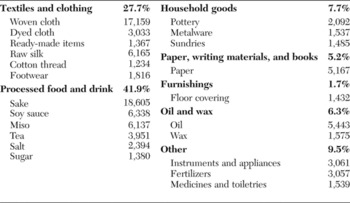
One consequence of this diffusion of consumption activity through urban and, to some extent, rural society was the significant share that manufactured consumer goods had come to represent, by the time of the Meiji Restoration, in the total output of the economy. Table 1 uses data assembled by Yamaguchi Kazuo (1963) from the government-organized survey of national output of 1874 known as the Fuken Bussanhyō, within which manufactured goods represented 30 percent of the total output recorded. The considerable extent of double-counting of both inputs and final output in the tables makes economic analysis of the data problematic, but nonetheless they do indicate that almost all of the manufactured output produced took the form of goods (or inputs into them) destined for private household consumption via the domestic market. They also demonstrate the wide range of goods available but confirm that processed food and drink products, most notably sake, represent by far the most important category of product. Alongside these, however, are all kinds of household goods, including both furniture and fittings and the smaller-scale items of pottery, lacquerware, bamboo, and paper that accompanied changes in eating styles and home improvements in general. Given that an unknown but surely significant share of the output of agriculture and the natural resources sector took the form of inputs into food processing and other areas of manufacturing, the data suggest that the growth in demand for consumer goods that continued through the later Tokugawa years and into the Meiji period constituted a major driving force behind economic growth in general.
Output of manufactured goods recorded in the Fuken Bussanhyō of 1874. (Percentage of product category in total manufacturing output. Value in thousand yen of output of all individual items with total output valued at over one million yen.)

Source: Adapted from Yamaguchi (Reference Yamaguchi1963, table 28).
The Growth of Consumption in Industrializing Japan: Food and Household Goods
Susan B. Hanley (Reference Hanley, Jansen and Rozman1986) makes a convincing case for the continuity in Japanese lifestyles through the Meiji transition and on to the end of the nineteenth century at least, as rising incomes continued to be spent principally on goods of the kinds once enjoyed only by the samurai. However, this basic continuity was bound up with the increasing and spreading use of commercial consumer goods, as the infrastructure of the market economy developed, and did accommodate the acquisition of new products as luxuries and accessories within an otherwise “traditional” consumption pattern. Transmission both of goods themselves and of knowledge about them was widened and speeded up by developments in communications during the second half of the nineteenth century. Travel about the country may still have represented the main transmission route, but whereas this had once taken the form of sankin kōtai and pilgrimages by road and sea, it now involved business and shopping or sightseeing trips by rail. The head of a well-to-do landowning household in Tōhoku experienced Western-style food and train travel on a three-month excursion to take in an industrial exhibition in Tokyo, and came home with Western-style clothes and hats, umbrellas, spectacles, toothpaste, and some more expensive items—a quartz vase, a clock—as souvenirs; his counterpart in the Kinai countryside made use of an employee's business trips to Osaka to acquire the new products not yet to be found in local shops (Nakanishi Reference Nakanishi, Kanji, Akira and Haruhito2000, 242–44, 257–60). By the turn of the century, such households were subscribing to the local and national newspapers that represented the main vehicles for advertising commercial products. Meanwhile, outside the rural elite, as cash incomes rose and employment opportunities for women in particular increased with the growth in textile production for export and the home market, consumption of commercially produced and often higher-quality versions of processed food and drink products once made at home continued to expand.
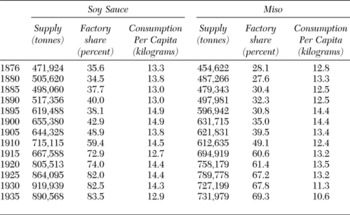
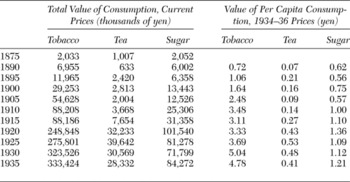
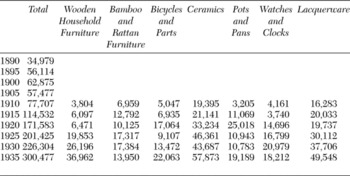
Tables 2, 3, and 4 demonstrate these developments and take the story on through the pre–World War II period, bringing together available data on changes in the consumption of some of the Japanese equivalents of the sorts of goods that have been of interest to historians of consumption in Europe and North America. These data are largely taken from Shinohara Miyohei's estimates contained in volume 6 of the Chōki Keizai Tōkei series (1967), and those for the period before 1910 are based on original sources different from those used for later figures, so the series are not strictly continuous. Nonetheless, they indicate broad trends and phases, with consumption in all cases tending to expand up to the years of the Matsukata deflation in the 1880s and again during the boom years around World War I, before being hit by the Great Depression and subsequently by the effects of the war economy.
Supply and per capita consumption of miso and soy sauce, 1876–1935. (Five-year averages centered on years shown.)

Source: Shinohara (Reference Shinohara1967, tables 54, 55, 56, 57); population figures from Andō (Reference Andō1979, 4–5).
Note: Home production of miso and soy sauce is estimated on the basis of consumption of salt.
Conversion rates for soy sauce are from Ioku (Reference Ioku, Reiko and Masatoshi1999, 237): 9 kilograms of soy sauce = 8.8 liters = about 5 shō.
Consumption of tobacco, tea, and sugar by value, 1875–1935.

Source: Shinohara (Reference Shinohara1967, tables 48, 47, 73, 74, 75, 76); population figures from Andō (Reference Andō1979, 4–5); consumer price index 1934–36 = 100, from Ohkawa and Shinohara (Reference Ohkawa and Miyohei1979, table A50).
Real expenditure on furniture and utensils, total and selected items, 1890–1935 (1934–36 prices, thousands of yen).

Source: Shinohara (Reference Shinohara1967, tables 86, 87); price index from Ohkawa and Shinohara (Reference Ohkawa and Miyohei1979, table A50).
Table 2 picks out miso and soy sauce as examples of “traditional” processed food products and demonstrates how, in the cases of products such as these, which could be made at home, the significant change lay less in growth in per capita consumption and more in the switch from homemade to purchased, factory-produced, and generally better-quality alternatives. However, the development of consumption differed even between two seasoning products that both came to be regarded as “necessities” in the Japanese lifestyle. Miso is relatively easy to make at home and, although it was marketed quite early on, it was apparently still regarded, well into the Meiji period, as rather shameful not to make one's own miso, even in big cities such as Osaka and Kyoto, though less so in Tokyo, where miso shops sold a range of differentiated regional varieties and brands (Sasama Reference Sasama1979, 58–59).Footnote 14 Home production therefore continued to provide a relatively large share of what was consumed, and it seems plausible to argue that, as appears to have been the case with products such as bread, butter, and cheese in parts of seventeenth- and eighteenth-century England (Overton et al. Reference Overton, Whittle, Dean and Andrew2004, 63–64), it was poorer households without servants and suitable kitchen facilities who relied on “shop-bought” products, while the better-off made their own.
Soy sauce, on the other hand, is the result of a more complex production process, making it harder to produce a good-quality product at home, and it was not, in fact, widely used as a seasoning until the later Tokugawa period (Hayashi Reference Hayashi, Yamaguchi and Kanji1986, 237).Footnote 15 In eastern Japan, it was a commercial rather than a homemade product from the start, while home production remained more common in the west (Ioku Reference Ioku, Reiko and Masatoshi1999, 239–40). As with miso, some increase in per capita consumption is observable in the late nineteenth century, but more striking is the relatively rapid switch to factory-made products.Footnote 16 Most soy sauce was consumed within the region of production, and local differences in style and taste encouraged loyalty to local products: Soy sauce produced in, for instance, Fukuoka, a major producing area distributing to other parts of northern Kyūshū, was distinctively sweet and differentiated from both Kansai and Kantō products (Ioku Reference Ioku, Reiko and Masatoshi1999, 241). However, larger-scale producers did start to emerge during the Tokugawa period in the production areas supplying the big cities, selling high-quality and branded products eventually aimed at the national market (Fruin Reference Fruin1983, 14–23). Hence, while the use of commercially produced soy sauce had become widespread by the time of the World War I boom, urban consumers and the rural better-off distinguished themselves through their consumption of high-quality, branded products (Ishii Reference Ishii, Yamaguchi and Kanji1986, 32–36).
Table 3 illustrates the rapid growth in expenditure on sugar, tobacco, and tea, examples of the “drug foods” of the consumer revolution in Europe. Tea and tobacco had both been grown for home consumption during the Tokugawa period, and the increase in expenditure reflects both rising consumption and the switch to higher-quality commercial products.Footnote 17 Commercial sugar production developed in a number of domains during the Tokugawa period, and the sugar trade through Osaka was booming by the early nineteenth century (Roberts Reference Roberts1998, 190). However, domestically produced sugar was relatively expensive and mainly consumed as medicine or given as a gift by the better-off, although restaurants and confectioners used it from quite early on.Footnote 18 After the opening of the ports, imported sugar, which was cheaper and purer, made higher levels of consumption, initially predominantly in confectionery but by the end of the nineteenth century also as seasoning, much more widely possible (Sasama Reference Sasama1979, 25–27). According to Ishii's estimates, annual per capita consumption of sugar in Japan was about 2 kin or around 2.5 pounds in the late Tokugawa period, about the level estimated for Europe in the eighteenth century, though half of Pomeranz's estimate of Chinese consumption at that time (2000, 118–22).Footnote 19 It had reached 5 kin (6.6 pounds) by 1885–88 and around 10 kin (13 pounds) by the World War I period, rising further to around 20 kin (26 pounds) during the interwar period (Ishii Reference Ishii, Yamaguchi and Kanji1986, 36).Footnote 20 This is well below levels in the United States and United Kingdom at the time, but not strikingly different from those of continental Europe.Footnote 21 Thus, although per capita consumption never reached the levels of countries where much sugar came to be used to sweeten tea and coffee, it continued to increase, suggesting that the link between sugar consumption and industrialization was not a purely “Western” phenomenon.
Meanwhile, Table 4 shows similar expansion in real expenditure on furniture and household utensils, indicating that Japanese consumers, like their Western counterparts, increasingly sought to acquire the equipment that went with emerging forms of eating and drinking, leisure, and social life, and thereby to demonstrate and enjoy new items embodying fashion and status. Ōkado Masakatsu provides survey evidence from a number of villages over the course of the Meiji period, not just of widening possession of a range of clothing items and accessories—hats, shawls, watches, and so on—but also of home improvements, such as tiled roofs and tatami-floored rooms, and of facilities and consumables for social occasions, including guest rooms, “best” clothes, and wedding banquets (Ōkado Reference Ōkado, Kanji, Akira and Haruhito2000, 348–49). At the same time, the table also provides some evidence of the selective introduction into the consumption patterns of initially urban but in due course also better-off rural households of some new, typically Western-style, goods. The clocks and bicycles that appear in the table were acquired alongside a range of more basic items—toothpaste, soap, matches, lamps, pens—as comfort- or status-enhancing add-ons to ways of life and patterns of consumption that otherwise retained much continuity.
Something of the role of such new products in the emerging consumption patterns of the second half of the nineteenth century is revealed in Nakanishi Satoru's (2000) collection of budget details for rural households, ranging from substantial business families to solid owner-farmers and from those in the vicinity of towns and cities to those much more isolated, which charts the initial acquisition of Western-style items in eating and drinking, dressing, and furnishing. Western-style clothing materials—velvet, muslin, calico—were relatively common, small-scale, early purchases, but it was accessories—hats, shoes, handkerchiefs, umbrellas—that seem to have been the crucial symbols of “civilization and enlightenment.” Western-style food and drink products—beef, milk, a bottle of wine, “lemon soda biscuits”—gradually appear as exotic items for special occasions. Gadgets and more expensive household goods—clocks, glass bowls, cameras—were acquired first by the rich with urban connections and eventually by local commercial and landowning households, depending on the development of communications with the towns and cities. This suggests a pattern whereby Western-style goods entered the consumption repertoire of the “middling sort” as relatively inexpensive ornaments, accessories, and gadgets that demonstrated style and fashion, as well as respectability and conformity to national modernization goals, without disrupting the basic structure of ordinary, though increasingly commercialized, consumption. It thus seems to represent an element in the development of the consumer in Japan that predates and is different from the growth of “modern,” “rational,” department store-led, middle-class urban consumption of the Western lifestyle that the literature describes for the 1920s and onward.
Nonetheless, with the takeoff of industrialization beginning in the 1890s and especially the World War I boom, the analysis of consumption patterns and their transmission and change becomes more complex. Many new goods became available; communications expanded greatly, with the railway, the development of printed media, and eventually radio; new forms of advertising and retail establishment appeared; and ways of life changed as more and more people moved into urban areas, formed nuclear households, and took up new types of employment. Within this environment there emerged the urban middle-class households who were encouraged, as the literature on the emerging consumer culture of the interwar period demonstrates, to use goods to create “rational” lifestyles centering on the model of the housewife and the modern home.Footnote 22
However, analysis of such trends largely ignores the growth in consumption of “ordinary” goods, many of them “indigenous,” and the large areas of most people's lives that were not what the department stores and lifestyle magazines were concerned with. The economic importance of such areas of everyday life is indicated by the fact that, despite the growth of modern, heavy-industrial, and military-related output, domestic consumption continued to represent the major source of demand for Japanese producers. Over the pre–World War II period as a whole, on average 60 percent to 70 percent of the overall growth of expenditure in the economy was accounted for by growth in personal consumption expenditure, and although consumption's contribution did decline over time, it was only in the depths of the interwar depression that investment or exports contributed more to growth (Ohkawa and Shinohara Reference Ohkawa and Miyohei1979, table 1.7). The activities of Japanese people as they developed into consumers, substituting purchased products for homemade ones, increasing their expenditure on desirable food and drink items, acquiring furniture, utensils, clothing, and accessories, and diversifying their consumption patterns to include new, sometimes imported or at least foreign-style goods, cannot be ignored, any more than can those of their counterparts in earlier industrializing economies, as a factor in the continuing growth of the economy.
Drink and Development: The Consumption of Sake and Beer
In the literature on Europe, one approach that has been used in the historical analysis of consumption under the more complex circumstances of the industrializing economy involves abandoning generalization and focusing in on particularly significant products. In the Japanese case, a number of products might be considered in this way, but, for comparative historical purposes, the consumption of alcoholic drinks is a quite widely studied phenomenon that Japan shares with most other now-industrial societies.Footnote 23 Moreover, as a case study in consumption history, it demonstrates how a “traditional” product, sake, developed into a consumer good, alongside which a new, imported product, beer, came to enter the repertoire of consumer choices, under the circumstances of an urbanizing and industrializing economy and society. It therefore provides a convenient route into more detailed consideration, in light of experience elsewhere, of the particular ways in which consumption grew and changed, conditioned by past developments, over the course of Japan's pre–World War II industrialization and “internationalization.”
There is a good deal of evidence that preindustrial Europeans consumed what would nowadays be considered enormous amounts of alcohol, in the form of wine, ale, and cider, and that they derived significant proportions of the calories they needed for their labor from alcoholic drinks (Martin Reference Martin2001, 28–37). Hence, although it was once commonly thought that industrialization produced higher levels of drunkenness, as workers drowned the sorrows that alienated industrial work produced, developments in alcohol consumption were probably more a matter of forms and contexts than of quantity (Brennan Reference Brennan1989). Whereas once watered-down wine and home-brewed ale had been consumed with meals in the home or at social gatherings in public spaces, branded and location-specific wine and mass-produced beer, not to mention gin, rum, and absinthe, came to be purchased and drunk in bars and cafés, or in a solitary quest for oblivion. The “peasant pattern” of drinking, involving large amounts on special occasions, alongside regular consumption of weak forms of alcohol as “food,” gave way to the urban “middle-class pattern” of smaller amounts of stronger and/or more refined products drunk more regularly in small and more private gatherings.
In Japan, methods for making rice wine were probably known from not long after rice itself was introduced, and there are records of its use in rituals and as a medicine from early times. By the Heian period, court brewers were producing differentiated forms of sake to be drunk by different levels of the nobility at different kinds of ceremony, and by the fourteenth century, it was being produced commercially in the countryside for consumption on market days and at other public events (Kondo Reference Kondo1996, 21–22; Smith Reference Smith and Tobin1992, 149). Home brewing to produce unrefined sake, known as doburoku, was also widespread by the Tokugawa period, and sake held a virtual monopoly over forms of alcohol consumption at all levels of society.Footnote 24
By the nineteenth century, small-scale commercial breweries producing refined sake were common throughout the country, and larger-scale breweries had also developed in specialist sake-producing areas to supply the major cities. The persistence of home brewing, even after it was made illegal in 1900, complicates analysis of trends in production and consumption, and it is clear that when taxes on “official” sake were raised, or when incomes were falling as during the 1880s, rural households would revert to increasingly secret home brews. Estimates for 1889–91 give the value of sake produced for home use as approximately a fifth of that of commercially produced refined sake, at a time when its share of total consumption was likely to have been rising in response to increases in sake taxation (Umemura et al. Reference Umemura1983, tables 1–3; see also Tanimoto Reference Tanimoto, Shunsuke, Kōnosuke and Osamu1996, 258). Nonetheless, there is no doubt that, as with soy sauce, the commercial refined product was preferred, when circumstances allowed, although, again as with soy sauce, up to the interwar period at least, most sake was brewed by small-scale local breweries and consumed in its area of production, so that regional product differentiation was widespread (Tanimoto and Saitō Reference Tanimoto, Saitō, Yamamoto and Mataji1989, 270).
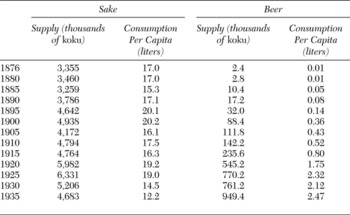
Table 5 presents data on sake consumption and demonstrates that consumption per capita, though very susceptible to fluctuations in incomes and taxation, reached peak levels in the late nineteenth and early twentieth century, which it maintained until the onset of the Depression in the late 1920s. As a result, sake brewing, its market benefiting also from the effects of population growth, continued to represent a major industry through to World War II and beyond. While the world around them was transformed by economic growth and industrialization, Japanese consumers continued to drink sake, but the observed growth in consumption appears to have been achieved not simply through the higher levels of drinking made possible by rising incomes, but also through developments in the ways in which consumers fitted the “traditional,” but increasingly commercialized, product that was sake into their changing everyday lives.
Total supply and per capita consumption of sake and beer, 1876–1935 (five-year averages centered on years shown).

Source: Shinohara (Reference Shinohara1967, tables 58, 59, 62, 63); population figures from Andō (Reference Andō1979, 4–5).
Notes: Data are for refined sake and do not include doburoku.
1 koku = 180 liters
Mass public drinking of sake on special occasions was a custom that clearly continued through and even beyond the Tokugawa period. The late-Tokugawa village headman described by Brian Platt organized an annual pilgrimage to a local shrine that “expanded into village-wide feasting, drinking, and socializing” (2000, 65 n. 73). The villagers of Suye Mura, studied by John Embree in the 1930s, could still remember when the village traditionally got together to brew sake for communal events, though the practice had to be abandoned when home brewing became regulated and taxed (see Embree Reference Embree1964, 282). At the same time, however, home-brewed sake continued to be consumed at a private level in the countryside, as a convenient (and congenial) source of energy. An interview (recorded in Shinohara Reference Shinohara1967, 79–80) with an old Tōhoku farmer, recalling his youth in the early Meiji period, reveals how he would get up at three in the morning to go to work in the rice fields, knocking off at eleven, when it got too hot. When asked what he did then, he replied that he went home, drank doburoku, and went to sleep, and Shinohara points out how “rational” this was, as a means of generating the energy needed for hard agricultural labor. Well before this, however, sake, whether homemade or produced in local breweries, was clearly a significant element in the diets of those living and working in rural areas. Tax records for fishing villages in Fukuoka domain as early as 1776 show that, in this commercialized area inhabited by fishermen and sailors, most villages contained at least one tax-paying “drinking place,” and many also supported breweries (Kalland Reference Kalland1995, 83). The village of Kumagawa, in the Hachiōji area north of Edo, contained 144 households in 1829 and supported six establishments serving sake and one selling it retail (Pratt Reference Pratt1999, 169–70).
As the Tokugawa period progressed, however, in the cities and among the rural elite, more varied and sophisticated forms of sake consumption were clearly beginning to emerge. Sake continued to represent the ceremonial drink at banquets and other formal occasions, but among a widening stratum of society, and, with the development of restaurants and teahouses, it also came to accompany meals of a less grand sort. The rural elite household entertaining visiting officials ordered sake from local suppliers, alongside food for the meals. In the report on Bakumatsu-period Kazusa-han mentioned earlier, the writer bemoans the tendency for high and low to hold banquets involving much eating and drinking (Sasama Reference Sasama1979, 23). Meanwhile, a retired village teacher is plied with sake by his former pupils, as they watch a local performance of kyōgen; his son spends his own retirement teaching, writing poetry and drinking sake with his friends (Platt Reference Platt2000, 60, 55–6). In Edo, growing numbers of izakaya bars served light meals accompanied by sake—drunk from specially produced ceramic flasks and cups—to the mass market of single men congregating in the city (Kanzaki Reference Kanzaki, Umesao and Shūji2000, 146–48). By the second half of the eighteenth century, izakaya were spreading out along the main roads (Watanabe Reference Watanabe1964, 212, 216), while, at the higher end of the market, an official on his travels records drinking a flask of sake with his lunch at a teahouse (Hanley Reference Hanley1997, 88).
By 1910, Nakano Makiko, a Kyoto housewife who kept a diary through that year, was recording frequent occasions for sake consumption, ranging from formal drinking ceremonies at weddings, through meals accompanied by sake for the staff of her husband's pharmacy business, to small social gatherings at home when guests got drunk and disgraced themselves (Nakano Reference Nakano and Kazuko1995). However, Makiko also explicitly notes how a visiting relative from the country, portrayed as something of a jovial farmer, drank sake with his breakfast—”it seems that he always drinks in the morning”—persisting in a country custom that appeared rustic in the sophisticated context of urban society in Kyoto (Nakano Reference Nakano and Kazuko1995, 121, 221).
The drinking of sake at social gatherings by a widening range of urban and better-off rural consumers opened the way to product differentiation as a means of establishing status and taste. In late nineteenth-century rural Tōhoku, as with tobacco, better-off households could be distinguished by the quality of the sake they drank. Poorer households were said to drink it only in the old-fashioned way at ceremonies or festivals, although no doubt a blind eye was still being turned to their everyday, homemade doburoku (Nakanishi Reference Nakanishi, Kanji, Akira and Haruhito2000, 254). After the turn of the century, sake became increasingly a branded and advertised drink, differentiated according to quality and region of origin (Kondo Reference Kondo1996, 49–50). For the growing urban population in particular, what had once been an essential accompaniment to communal life and work had become a differentiated product to be consumed with friends in bars or restaurants or in the privacy of an individual home.
It was against this background of changing drinking habits, in the context of the shifting patterns of social activity consequent on urbanization and industrialization, that Japanese people first encountered the new product that was beer. Drinkers in Japan do not appear to have tasted beer until their first nineteenth-century interactions with Westerners, at home and abroad. Thereafter, imported bottled beer became available in liquor stores in Tokyo and Yokohama, and by the 1890s, Japanese breweries were being established, supplying beer that could be sold by the glass. Beer was initially relatively expensive and its consumption confined to expatriates and members of the modern bureaucratic and military elite in the big cities (Kirin Bīru Reference Kirin Bīru1984, 73). The development of the railway network, however, helped to promote awareness of it, as it was standardly sold in buffet cars on trains and in bars at stations. It became associated with eating Western-style food, initially in expensive restaurants serving “proper” foreign food, but in due course in cheaper venues where meat was served.
By the turn of the century, however, breweries were establishing “beer halls,” where Japanese-produced beer was sold in German-style glass tankards, at first in the big cities but in due course elsewhere. In comparison with the sake-serving izakaya, where patrons typically sat on cushions around a Japanese-style table, drinking from ceramic flasks and cups, beer halls, with their Western-style decor and packed customers, sitting close together on chairs at long tables and drinking beer served in glasses, appear to have created a bustling and informal atmosphere.Footnote 25 While other “foreign” alcoholic drinks, such as wine or brandy, remained exotic luxuries, consumed only in more consciously “modern” environments, the beer hall and other kinds of eating and drinking establishments selling beer appear to have offered venues more clearly adapted to the changing forms of everyday social life in urbanizing and industrializing Japan.Footnote 26
From the turn of the century onward, therefore, beer appears to have been shedding the connotations of its foreign origins and beginning its march toward status as a mass-market product and a necessary element in the Japanese lifestyle. For Nakano Makiko, recording an occasion when “we went ‘modern,’” entertaining with “München beer and bananas” (Nakano Reference Nakano and Kazuko1995, 149), beer still, in 1910, retained its association with Western style, but, as the rapid growth in per capita consumption shown in table 5 suggests, it was coming to be much more widely consumed, as appropriate occasions and environments for beer drinking became more common. In the cities at least, beer became the drink for “modern” public occasions—celebrations of the return of soldiers from the Russo-Japanese War, outdoor gatherings in parks, opening ceremonies for bridges and railway lines—where it was beginning to accompany Japanese-style takeaway food as well as Western-style snacks (Kirin Bīru Reference Kirin Bīru1984, 138–41). Following the World War I boom, with the explosion in the numbers of cafés and other leisure facilities for the emerging urban middle classes, the practice of drinking with colleagues after work began to develop among business and bureaucratic salaryman groups. Beer drinking was central to these activities, and terms such as “the beer party” (bīru-tō) were apparently coined to refer to the members of the “new middle classes” who amused themselves on their way home from work (Kirin Bīru Reference Kirin Bīru1984, 162–63). Although a bottle of beer remained a relatively expensive item, beer production expanded spectacularly in the years between World War I and the onset of the Great Depression, as demand in the beer halls and cafés, for gifts and entertainment at home, and even to wash down ordinary middle-class meals expanded. The salaryman taking a bottle of beer with his meal (Western- or Japanese-style) in a cafeteria or at home became a familiar cartoon figure;Footnote 27 a café was not a café without furnishings supplied by a beer company (Kirin Bīru Reference Kirin Bīru1984, 164–65).
Beer consumption was slower to take off outside the cities, and its spread was closely connected to the expansion of the railway network. While members of the rural elite were buying occasional bottles of wine or brandy in the 1880s and 1890s, it was typically not until after the turn of the century, when railway lines reached their villages that they became regular beer drinkers.Footnote 28 Beer halls began to appear in the provinces from 1914 onward, and beer production approximately tripled in volume over the course of the World War I boom, as consumption spread out from the cities to regions like northern Kyūshū, caught up in the spurt of industrial growth. Sake production also grew during the boom and continued to dwarf that of beer, but the peak in per capita consumption was not greatly different from that of previous boom times and the postwar decline was noticeable, whereas beer consumption, though small by comparison, grew explosively during the boom and continued to expand through the interwar years.Footnote 29 In rural areas, beer remained far from an everyday drink, even for the elite,Footnote 30 but by the interwar period, brands of beer were being advertised nationwide, in newspapers and on posters and daily objects such as matchboxes, so that, although consumption was still largely concentrated in urban areas, the product awareness on which a mass market depended was being created throughout the country.
The experiences of beer and sake over the course of Japan's pre–World War II history thus demonstrate that growth and change in the consumption of basic consumer goods such as alcoholic drinks were inextricably bound up with the processes through which everyday lives, as well as incomes, were transformed in the course of economic development. On the basis of their changing relationship to sake as an increasingly commercialized consumer good, drinkers added beer to their repertoire of alcoholic drinks, reflecting the changing patterns of their lives as they adapted to life and work in the industrial cities. While consumption of beer and of sake both increased, the circumstances under which more was drunk were different. As with many other Japanese-style goods, there remained occasions, by no means all of them straightforwardly “traditional,” when sake was appropriate, and economic and social change enabled more and more of the population to enjoy, at home or in small-scale gatherings in bars and restaurants, increasingly differentiated forms of the refined product that had once been the privilege of the elite. At the same time, however, they began to incorporate the “foreign” product that was beer, alongside sake, into their accepted consumption patterns, using it to accompany the new patterns of social activity that economic change was producing. By the postwar period, beer had become the “necessity,” having shed all its foreign connotations, but both drinks had come to fulfill their distinctive roles within the everyday lives of modern Japanese consumers.
Conclusion
The emergence of the consumer in pre–World War II Japan was something that even contemporaries whose careers depended on it found difficult to acknowledge. Hamada Masuji, a pioneer of advertising design in the interwar period, argued in his writings that the purpose of commercial art was “the spiritual elevation of commerce,” which would “enhance the prosperity and livelihood of the masses,” rather than the creation of desires for “unnecessary” goods, a position which, as Gennifer Weisenfeld points out (Reference Weisenfeld, Tipton and Clark2000, 83), he was never able to reconcile with the fact that it was precisely the expansion of the consumer market that opened up the field for commercial design. This reluctance to recognize the historical existence of the Japanese consumer has contributed to the neglect of the role played by major industries outside the modern sector in Japan's development and of the influence of changing patterns of everyday domestic life on the path that the Japanese economy took.
In many respects, the emergence of the consumer in Japan bears broad similarities to the parallel but earlier processes in Europe and North America. Although the goods involved were often, though not always, quite different, their purchase and diffusion seem to have been driven by many similar forces, including initial emulation of the elite, the development of “populuxe” copies, and the eventual emergence of patterns of consumption in which goods were used by the rising middle class as symbols of status, respectability, and newfound comfort, converting former luxuries into the necessities of modern Japanese life. New products—not to the same extent the imported “drug foods” that trade and imperialism brought to Europeans and Americans, but rather Western-style gadgets, accessories, and forms of processed food and drink—were incorporated into changing lifestyles, but alongside the development—much more significant for the growth of consumption and the economy as a whole—of “traditional” products as the consumer goods of everyday life.
If this is so, then it would follow that the growth of consumption and the emergence of the consumer need to be seen as part of the process of economic development that leads to and, in due course, sustains industrialization beyond, as well as within, the cradle of the industrial revolution in Europe and North America. As the example of beer suggests, increasing interaction with the outside world introduced Japanese consumers to new products embodying Western-style modernity that they were eventually to “domesticate” as their own. However, such products represented only one element in the increasingly differentiated array of consumer goods available to them as their incomes rose. Within this array, the “traditional,” “indigenous” products that constituted the major part of the economy's output had already established themselves and continued to develop alongside “modern,” “Western” products in response to the changing conditions of consumers' working and family lives.
The shoppers who throng the temples of consumerism in present-day Tokyo and Osaka are thus heirs to their own long history, predating the nineteenth-century Western impact and continuing to condition the growth of consumption and the emergence of the consumer through the course of modern industrialization. To see that history solely in terms of the impact of Western-style modernity is not only to neglect a central element in long-term economic development in Japan, and perhaps in other industrializing parts of Asia, as earlier in the West, but also to ignore a key factor determining the ways in which Japanese people have come to live their lives as consumers in the modern world.