Implications
In a context in which sustainable strategies are demanded, obtaining productive but also balanced and functional animals is crucial. In this sense, understanding the way animals acquire and allocate resources is becoming highly relevant, as well as finding out how to modulate it. In the first work of this series we found that by modifying the energy source of the diet we could alter partition of energy between milk and body reserves of different genetic types. In this work, we have evaluated how these changes impact on productivity, functionality and fitness of each genetic type. This information could be used to develop specific nutritional strategies for each genetic type in order to maximize their productivity while maintaining their functionality.
Introduction
To better estimate the response per generation to artificial selection, animals within selection programmes are usually raised in highly stable environments. However, focusing on one environment could underestimate the factors that occur over the whole range of environments (Lewontin, Reference Lewontin1974), triggering a situation where specialized animals could be favoured (Kolmodin et al., Reference Kolmodin, Strandberg, Jorjani and Danell2003). The net result would be a specialization process that could alter the way selected animals acquire and allocate resources (Savietto et al., Reference Savietto, Friggens and Pascual2015). In fact, current genetic types are the consequence of their whole genetic background (e.g. criteria used to select animals for the generation 0 of the line and criteria used during the selection process; Ragab and Baselga, Reference Ragab and Baselga2011; Mínguez et al., Reference Mínguez, Sanchez, EL Nagar, Ragab and Baselga2015). Moreover, selection exclusively for productive criteria could be accompanied by undesirable negative side effects in behavioural, physiological or immunological traits (Rauw et al., Reference Rauw, Kanis, Noordhuizen-Stassen and Grommers1998). Consequently, strategies addressed to obtain productive but also balanced and functional animals under commercial conditions could be a more sustainable strategy in the long term. These strategies could be related to genetic selection, but also to specific-nutrition for each genetic type according to their genetic background.
This is the last of three consecutive scientific papers that aim to evaluate the effect of energy source of the diet on different genetic types. The main hypothesis of the series is that varying the main energy source of the diet we could alter the way each genetic type acquires and allocates resources over time, impacting in the immunological status of females or their fitness and productivity. In the first paper, we investigated the way three genetic types differing greatly in their genetic background acquire and allocate resources when fed with diets specially designed to influence either the milk production or body reserves (Arnau-Bonachera et al., Reference Arnau-Bonachera, Cervera, Blas, Larsen, Martínez-Paredes, Ródenas and Pascual2017). In the second paper, we investigated parameters related to the immune system of these genetic types across time and how previous diets affected them (Penadés et al., Reference Penadés, Arnau-Bonachera, García-Quirós, Viana, Selva, Corpa and Pascual2017). In this work, we aimed to evaluate: (i) The effects of energy source of the diet and genetic type on productive, functional and fitness traits. (ii) The impact of feed energy source on these traits for each genetic type over time according to its genetic background.
Material and methods
The experimental procedure was approved by the Animal Welfare Ethics Committee of the Universitat Politècnica de València (UPV) and carried out following Spanish Royal Decree 53/2013 on the protection of animals used for scientific purposes and the recommendations of the European Group on Rabbit Nutrition (Fernández-Carmona et al., Reference Fernández-Carmona, Blas, Pascual, Maertens, Gidenne and García2005).
Animals
A total of 203 female rabbits were used from their first artificial insemination (AI; 19 weeks old) until their sixth parturition (from December 2011 to April 2013). Rabbit females belonged to three genetic types developed at the Institute for Animal Science and Technology of the UPV, differing greatly on their breeding goals. Line H (n=66), founded by hyper-prolific criteria at birth and selected by litter size at weaning; line LP (n=67), founded by functional hyper-longevity characterized by a high robustness; line R (n=70), selected for average daily gain during the growing period. For a further description of the lines, see (Arnau-Bonachera et al., Reference Arnau-Bonachera, Cervera, Blas, Larsen, Martínez-Paredes, Ródenas and Pascual2017).
Diets
Two experimental diets were formulated and pelleted, according to the recommendations of De Blas and Mateos (Reference De Blas and Mateos2010) for reproductive rabbit does, enhancing major differences in energy source. CS diet was prepared promoting cereal starch (237 g of starch and 21 g of ether extract (EE) per kg dry matter (DM)), whereas in the AF diet part of the starch was replaced by animal fat (105 g of starch and 86 g of EE per kg DM). Nevertheless, both diets were design to be isoenergetic and isoproteic (on average 11.3 MJ of digestible energy and 126 g of digestible protein per kg DM). For a further description of the diets, see Arnau-Bonachera et al. (Reference Arnau-Bonachera, Cervera, Blas, Larsen, Martínez-Paredes, Ródenas and Pascual2017).
Experimental procedure
Animals were housed under conventional environmental conditions (average daily temperatures varying from 13.3°C to 26.1°C), with an alternating cycle of 16 h of light and 8 h of darkness. At 19 weeks of age, all the female rabbits were inseminated (with pooled semen from their respective lines), and housed in individual cages (700×500×320 mm). Although not all the females began the experiment at the same time (231 days between the first and the last female), most of them did so during the first 3 months, when the lowest temperatures of the experiment were recorded (for details, see Arnau-Bonachera et al., Reference Arnau-Bonachera, Cervera, Blas, Larsen, Martínez-Paredes, Ródenas and Pascual2017). The entry of animals from each of the three genetic types was distributed over time similarly. Despite unintended, this procedure implied that it was not possible to separate properly the effect of first reproductive cycle from the effect of low temperature. At day 28 of gestation we provided cages with a nest for litters. After the first parturition, the animals from the three genetic types were randomly assigned to one of the reproductive diets. Until this point, all the animals had received the same commercial diet for reproductive rabbit does. Both experimental diets were provided ad libitum and the animals from each group (within genetic type and reproduction diet) were homogeneously distributed across the experimental farm. Litters were standardized to eight to nine kits at first parturition and nine to 11 onwards. This procedure was performed to equalize the energetic effort during lactation among females, in order to compare each genetic type under similar lactational effort. This procedure also allows us to decrease the data coefficient of variation which increases the statistical accuracy of the estimates (Fernández-Carmona et al., Reference Fernández-Carmona, Blas, Pascual, Maertens, Gidenne and García2005). Females were inseminated at 11 days postpartum (dpp) and litters were weaned at 30 dpp. Status at palpation at 11 days after insemination was recorded to evaluate whether the female had conceived or not. Non-pregnant females were re-inseminated 10 days after palpation, up to a maximum of three times.
Traits
Individual adult life weight (AW; 110 records from 110 females) was considered for females reaching the sixth parturition as the average weight at effective insemination of fourth, fifth and sixth reproductive cycles. Maturity of females at effective insemination was calculated for females reaching the sixth parturition as the weight at that insemination divided by their AW (617 records from 110 females). Interval between parturitions was determined as the days between two consecutive parturitions (854 records from 203 females). Conception rate was the percentage of females getting pregnant at first attempt (854 records from 203 females). Productivity of females (203 records from 203 females) was calculated as the cumulated number of weaned offspring divided by the time (expressed in years) the female stayed in the experiment (from first parturition to death or the end of the experiment at sixth parturition). Survival rate of females was evaluated as the percentage of females at parturition of each reproductive cycle compared with the initial number of females (203 records from 203 females). Litter size traits were total born, born alive, stillborn (851 records from 203 females), standardized at birth and weaned (660 records from 203 females). Individual weight of the offspring was calculated as the litter weight divided by the litter size for total born (851 records from 203 females), born alive (792 records from 203 females), stillborn (383 records from 203 females), standardized at birth (707 records from 203 females) and weaned (657 records from 203 females). Maturity of the offspring was calculated as the individual weight of the offspring divided by adult weight of their mother for total born (616 records from 110 females), born alive (581 records from 110 females), stillborn (269 records from 110 females), standardized at birth (503 records from 110 females) and weaned (479 records from 110 females). Survival rate of the offspring was recorded for each kit at parturition (8395 kits) and during lactation (6769 kits). The cumulated number of offspring per female was evaluated for born alive and weaned (203 records from 203 females).
Statistical analysis
For the statistical analysis we considered as main effects: Genetic type (GT g ; three levels; H, LP, R), energy source of the diet (ES d ; two levels: AF, CS) and reproductive cycle (RC r ; 5 levels; 1st, 2nd, 3rd, 4th, 5th). Depending on the evaluated trait, we used one of the six models listed below. In these models we included some or all of the main effects described above and their interactions as fixed effects. In these models y (with the corresponding subscript) represents one record of a given trait and e (with the corresponding subscript) the random residual term.
Adult live weight, productivity of females, cumulated offspring born alive and cumulated offspring weaned were analysed using a linear model (equation (1); Proc GLM of SAS).
 $$y_{{gd}} \,{\equals}\,{\rm GT}_{g} \,\left| {{\rm ES}_{d} {\plus}e_{{gd}} } \right.\,\left( {{\rm generalized}\,{\rm linear}\,{\rm models}} \right)$$
Interval between parturitions, litter size traits, individual weight and maturity of the offspring traits were analysed using a linear mixed model (equation (2); Proc Mixed of SAS). The error (e gdri ) and permanent effect of the female (p i ) were included as random effects, considering that the residuals could be decreasingly correlated among reproductive cycles (assuming that the higher the lag between parturitions, the lower the correlation between residuals; Littell et al., Reference Littell, Henry and Ammerman1998).
 $$y_{{gdri}} \,{\equals}\,{\rm GT}_{g} \,\left| {{\rm ES}_{d} \,\left| {{\rm RC}_{r} {\plus}p_{i} {\plus}e_{{gdri}} } \right.} \right.\,\left( {{\rm linear}\,{\rm mixed}\,{\rm models}} \right)$$
Maturity of females at effective insemination was also analysed using a linear mixed model equation (3), but considering that variance could change across reproductive cycles, and residuals were correlated assuming that the higher the lag was between parturitions, the lower would be the correlation between residuals (Proc Mixed of SAS).
 $$y_{{gdr}} \,{\equals}\,{\rm GT}_{g} \,\left| {{\rm ES}_{d} \left| {{\rm RC}_{r} {\plus}e_{{gdr}} } \right.} \right.\,\left( {{\rm linear}\,{\rm mixed}\,{\rm models}} \right)$$
Cumulated survival rate of the females was evaluated using a generalized linear mixed model equation (4), with a binomial probability distribution for the response and a logit transformation [ln(µ/(1−µ))] as the link function (Proc Glimmix of SAS).
 $$y_{{gdr}} \,{\equals}\,{\rm GT}_{g} \,\left| {{\rm ES}_{d} \left| {{\rm RC}_{r} {\plus}e_{{gdr}} \, \left( {{\rm generalized}\,{\rm linear}\,{\rm mixed}\,{\rm models}} \right)} \right.} \right.$$
Conception rate of females, was evaluated using a generalized linear mixed model equation (5), with a binomial probability distribution for the response and a logit transformation [ln(µ/(1−µ))] as the link function (Proc Glimmix of SAS). The error (e gdri ) and permanent effect of the female (p i ) were included as random effects.
 $$\eqalignno{ y_{{gdri}} \,&{\equals}\,{\rm GT}_{g} \left| {{\rm ES}_{d} } \right|{\rm RC}_{r} {\plus}p_{i} {\plus}e_{{gdri}} \,\cr&\left( {{\rm generalized}\,{\rm linear}\,{\rm mixed}\,{\rm models}} \right)$$
Survival rate of the offspring at parturition and during lactation were evaluated using a generalized linear mixed model equation (6), with a binomial probability distribution for the response and a logit transformation [ln(µ/(1−µ))] as the link function (Proc Glimmix of SAS). The error (e gdri ), the permanent effect of the female (p i ), and the effect of the litter in which the kit was raised (c l ), were included as random effects.
 $$\eqalignno{ y_{{gdril}} &\,{\equals}\,{\rm GT}_{g} \left| {{\rm ES}_{d} } \right|{\rm RC}_{r} {\plus}p_{i} {\plus}c_{l} {\plus}e_{{gdril}} \cr&\, \left( {{\rm generalized}\,{\rm linear}\,{\rm mixed}\,{\rm models}} \right)$$
Results
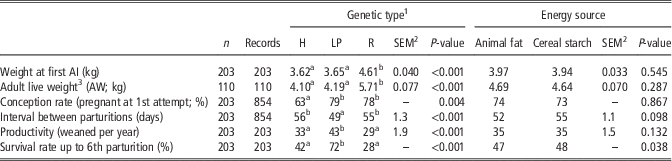
P-values for all the effects tested in the models are presented in Supplementary Material Tables S1 and S2. Here we present means of the main effects and the most relevant interactions. Traits related to females according to the genetic type (H, LP, R) or diet (AF, CS) are presented in Table 1. R females surviving until sixth parturition presented an adult weight 37.6% heavier than H and LP females (P<0.05). Conception rate at first attempt was not different between LP and R females, but it was 15 percentage units lower in H females (P<0.05). Interval between parturitions was 6 days shorter for LP females compared with H and R females (P<0.05). Productivity and survival rate up to sixth parturition were higher for LP females (on average +12 weaned per year and +37 percentage units of survival rate compared with H and R females; P<0.05). Regarding the energy source of the diet, no significant differences were observed for these traits. However, some interactions of genetic type with the reproductive cycle and the diet are presented below.
Effect of genetic type and energy source on rabbit female traits

n=Number of animals; Records=number of observations per trait.
a,bMeans in a row within an effect not sharing superscript differ significantly (P<0.05).
1 Line H: maternal line characterized by prolificacy. Line LP: maternal line characterized by functional longevity. Line R: Paternal line characterized by daily gain during the growing period.
2 SEM: Pooled standard error of the means for traits analysed with linear mixed models.
3 AW calculated as the average weight at fourth, fifth and sixth insemination for females reaching sixth parturition.
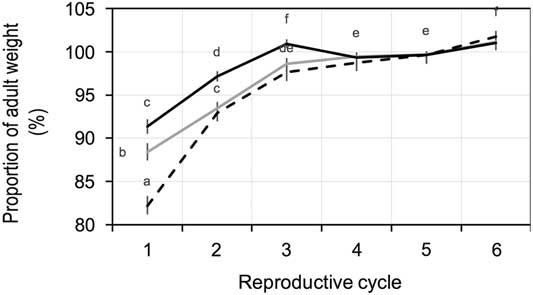
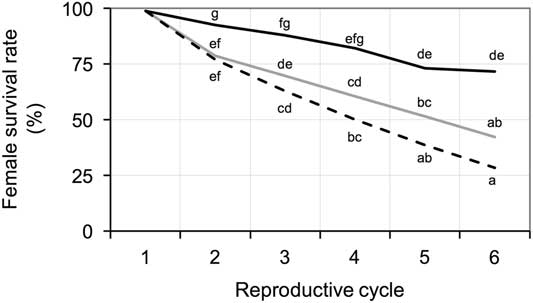
Figure 1 shows the evolution of females’ maturity (as proportion of weight compared with the AW at the effective insemination) depending on the genetic type. At first insemination, each genetic type presented a different proportion of its adult weight; Considering females ending the experiment, LP females presented at first insemination the highest proportion of their AW (+2.9 and +9.1 percentage units compared with H and R females; P<0.05), whereas H females presented a higher proportion compared with R females (+6.2 percentage units; P<0.05). Moreover, LP females reached the 95% of adult weight at second reproductive cycle, whereas H and R females did at third. Figure 2 shows the evolution of cumulated survival rate of females at parturition throughout the reproductive cycles depending on the genetic type. At second parturition, LP animals presented a significantly higher survival rate compared with H and R animals (94% v. 77% and 77%, respectively; P<0.05), and this difference was maintained or even increased from this point on (72% v. 42% and 29% at sixth parturition, respectively; P<0.05).
For rabbit females reaching the 5th reproductive cycle: Percentage of adult weight at insemination for the subsequent reproductive cycle depending on the genetic type (H in dark grey, LP in black, R in black dashed line). Adult weight calculated as the average weight at fourth, fifth and sixth insemination for females reaching sixth parturition. a,b,c,d,e,fMeans not sharing letter differs significantly (P<0.05).

Cumulated survival rate of rabbit females (%) at parturition in each reproductive cycle depending on genetic type (H in dark grey, LP in black, R in black dashed line). a,b,c,d,e,f,gMeans not sharing letter differs significantly (P<0.05).

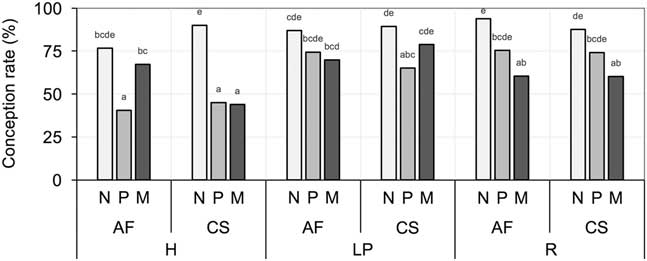
Conception rate at first attempt varied depending on genetic type, energy source and reproductive cycle (Figure 3). When nulliparous, no evidence for any difference among groups was found, but different patterns were observed from this point on. Conception rate of R females decreased over reproductive cycles (27 percentage points lower in multiparous compared to nulliparous, P<0.05) independently of the diet. Decrease in conception rate with time was less evident for LP females, except for primiparous fed with CS (−24 percentage points compared with nulliparous, P<0.05). Conception rate of H females was approximately halved from nulliparous to primiparous (on average from 85% to 43%, respectively; P<0.05). Later, this poor conception rate only increased in H females fed with AF (+27 percentage points when multiparous compared with primiparous, P<0.05).
Conception rate (pregnant at first attempt; %) of rabbit females for nulliparous (N, light grey) primiparous (P, medium grey) and multiparous (M, dark grey) depending on genetic type (H, LP, R) and energy source of the diet (AF, CS). a,b,c,d,eMeans not sharing lower case letter differ significantly (P<0.05).

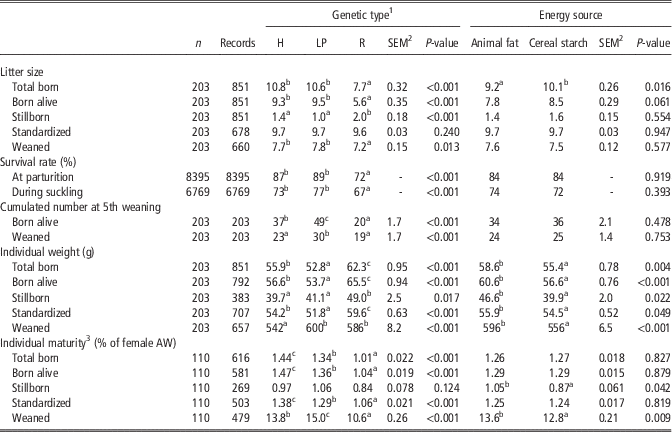
Traits related with the offspring according to the genetic type or diet are presented in Table 2. For litter size traits and compared with R females, females from maternal lines (H and LP) presented higher numbers of live born (on average 3.8 offspring more; P<0.05) and lower numbers of stillborn (on average 0.8 offspring less; P<0.05). Moreover, for the same standardized litter size at birth (on average 9.7 offspring), litters from the maternal lines also presented higher numbers of weaned kits (on average 0.55 offspring more; P<0.05). Survival rate of the offspring was higher for the maternal lines than for R animals (on average +16 percentage points at birth and +8 percentage points during suckling; P<0.05). At the end of the experiment, H females had 17 more offspring born alive than R females (P<0.05). Nevertheless, LP females presented the highest number of cumulated live born (+12 and +29 to H and R females, respectively; P<0.05) and weaned (on average +9; P<0.05). For traits related to the individual weight of the offspring, R females had heavier offspring throughout the cycle than H females. In contrast, LP females had the lightest offspring at birth (P<0.05), but they were as heavy as R at weaning. For individual maturity, R offspring always presented the lowest maturity rates throughout lactation (P<0.05). Compared with LP, H offspring presented a higher maturity rates at birth, but lower at weaning (P<0.05). Regarding the effect of diet, litters from females fed with CS had 0.9 total born more than those fed with AF (P<0.05). For the individual weight, the offspring of females fed with AF were always heavier than those of females fed with CS (8% heavier; P<0.05).
Effect of genetic type and energy source on offspring traits of rabbit females

n=Number of animals; Records=number of observations per trait.
a,b,cMeans in a row within an effect not sharing superscript differ significantly (P<0.05)
1 Line H: maternal line characterized by prolificacy. Line LP: maternal line characterized by functional longevity. Line R: Paternal line characterized by high daily gain during the growing period.
2 SEM: Pooled standard error of the means for traits analysed with linear mixed models.
3 Estimated exclusively with litters from females reaching the sixth parturition.
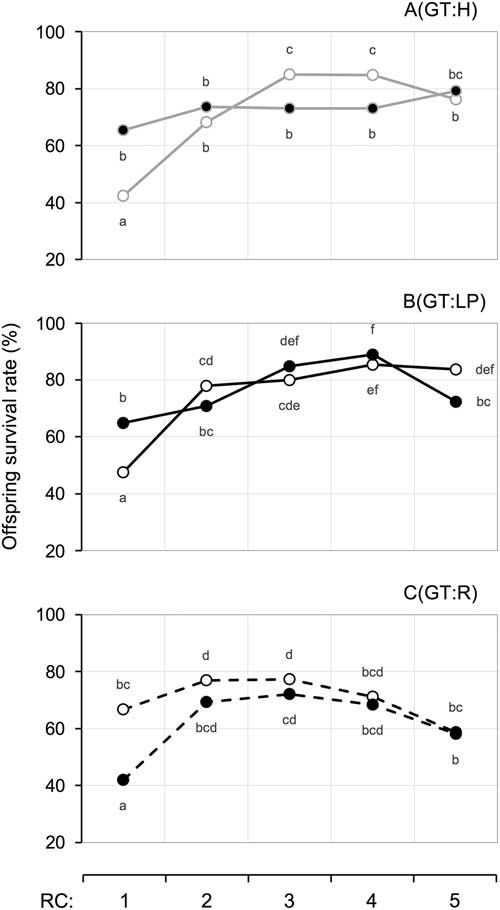
Despite no effect of energy source was observed for survival rate of the offspring during lactation, an interaction for this trait was observed between energy source, genetic type and reproductive cycle (Figure 4). In the first lactation, offspring survival rate in maternal lines with AF was quite poor (on average 45%) and much lower than those with CS (20 percentage units lower; P<0.05). On the contrary, survival of R offspring with AF was 25 percentage units higher to those with CS (P<0.05). From the second lactation on, survival of offspring with AF was higher or similar to those with CS, independently of genetic type. In general, offspring survival rate increased from the first and the second lactation, but decreased progressively from this point on in R offspring.
Offspring survival rate of rabbit females during lactation in each reproductive cycle (RC) according to the energy source of the diet [AF (○);CS (●)]. Panel A: Line H, Panel B: Line LP, Panel C: Line R. a,b,c,d,e,fMeans not sharing letter differ significantly (P<0.05).

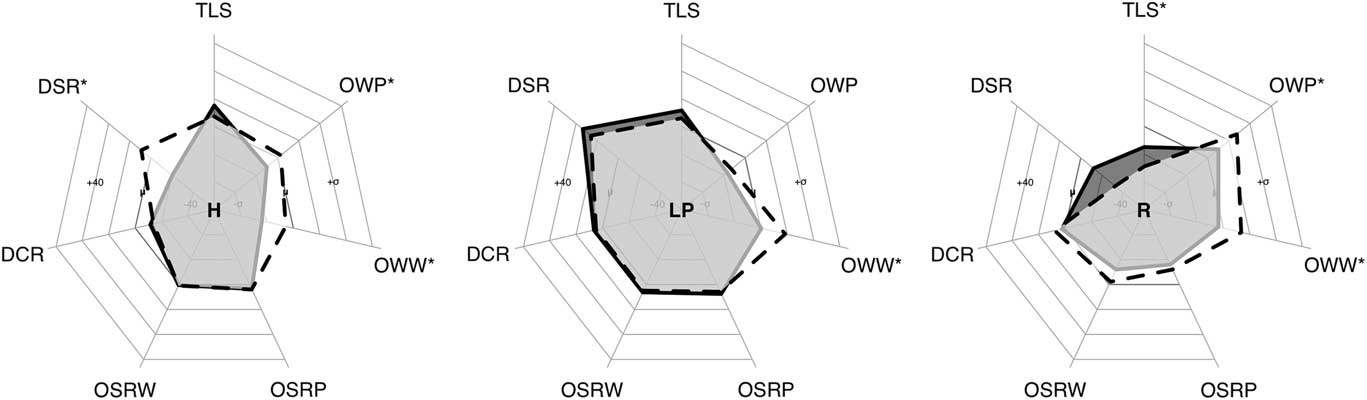
Finally, Figure 5 summarizes the live history traits for each genetic type according to the dietary energy source received. LP females were the least affected by diet, only differing in the higher maturity at weaning of their offspring when fed with AF (P<0.05). The survival rate of H females fed with AF until 6th parturition was 24 percentage units higher than those fed with AF (P<0.05). In addition, the offspring of H females fed with AF always presented higher maturity than those fed with CS (P<0.05). R females fed with CS had higher litter size, but were less mature, at parturition (P<0.05).
Live history traits of rabbit females for each genetic type (H, LP, R) depending on the energy source of the diet (AF: dashed line and white background, CS: solid line and grey background). Total litter size (TLS), Individual offspring weight at parturition (OWP) and individual offspring weight at weaning (OWW) expressed in standard deviation (σ) compared with the global mean (μ). Offspring survival rate at parturition (OSRP), offspring survival rate at weaning (OSRW), doe conception rate (DCR) and doe survival rate (DSR) expressed as rate (%) compared with the mean (μ). *Means for diets within a genetic type of the corresponding trait differ significantly (P<0.05).

Discussion
Energy source
In the present study, we observed that our animal fat enriched diet (AF) resulted in heavier and more mature offspring at weaning. It was the consequence of the higher milk yield of females fed with that diet (see first paper of the series; Arnau-Bonachera et al., Reference Arnau-Bonachera, Cervera, Blas, Larsen, Martínez-Paredes, Ródenas and Pascual2017), which increased the amount of milk available for each kit. Diet AF also affected the number and size of offspring at birth differently to our cereal starch diet (CS). While females fed on diet CS had more total born with lighter weight, females fed diet AF delivered fewer but heavier total born. Although the effect of energy source on litter size at birth has not been properly elucidated (Pascual et al., Reference Pascual, Cervera, Blas and Fernández-Carmona2003), Fortun-Lamothe et al. (Reference Fortun-Lamothe, Prunier, Bolet and Lebas1999) observed that when lactation and pregnancy overlap, rabbit females are unable to increase their energy intake to cover both functions and a competition between the gravid uterus and the mammary gland is then established. In this scenario, energy source would also have shifted energy partitioning at this point; when females were fed with a diet rich in an energy source that is primarily used by the mammary gland (diet AF), less energy would have been available for the initial gestation process (e.g. higher energy deficit; Fortun-Lamothe and Prunier, Reference Fortun-Lamothe and Prunier1999). Fewer offspring of bigger sizes were produced (Vicente et al., Reference Vicente, García-Ximénez and Viudes-de-Castro1995). Therefore, it seems that energy source of the diet also could alter the way concurrent lactating-gestating animals allocate resources when homeorhetic process are involved, affecting fitness traits.
Genetic type
Selection for post-weaning average daily gain is accompanied by an increasing of AW (Blasco et al., Reference Blasco, Piles and Varona2003). Consequently, females from paternal lines are heavier than females from the maternal lines (Pascual et al., Reference Pascual, Calle and Blasco2015). Apart from a greater BW, R females were also characterized in the present study by few offspring of higher weight (Vicente et al., Reference Vicente, García-Ximénez and Viudes-de-Castro1995), higher gestational losses (Vicente et al., Reference Vicente, Llobat, Viudes-de-Castro, Lavara, Baselga and Marco-Jiménez2012). Baselga (Reference Baselga2002a) reported 7.7 offspring born, 57 days between parturitions, 4300 g of live weight at first AI and 600 g of the offspring at weaning as mean values for this line. These results are in agreement with those shown in the present study. However, that work reported a lower proportion of stillbirths (11% v. 28%) and lower litter size at weaning (6.1 v. 7.2) compared with the present study. This discrepancy in the results could be related to the standardization of litters at birth we performed. We equalize litters to compare genetic types under similar lactational effort. However, when litters were standardized to 9.7 offspring, we forced R females to nurse many offspring of large size with non-adapted energy intake and milk output (Arnau-Bonachera et al., Reference Arnau-Bonachera, Cervera, Blas, Larsen, Martínez-Paredes, Ródenas and Pascual2017). In other words, we set the reproductive effort to be much greater than that initially set by R females’ genetic potential. All these facts highlight the difficulty of comparing such different genetic types, especially if we consider that the consequences of an increased reproductive effort also depend on genetic type (Theilgaard et al., Reference Theilgaard, Sánchez, Pascual, Friggens and Baselga2009). Consequently, this increased reproductive effort could be related with the low survival rate of the offspring observed for this line during lactation. Moreover, it could have altered energy balance while females were concurrently pregnant and lactating (Fortun-Lamothe et al., Reference Fortun-Lamothe, Prunier, Bolet and Lebas1999), increasing the risk of death of unborn offspring and accelerating senescence of females (decreasing conception rate of females and survival rate of the offspring during lactation with age). Females reached the first insemination with a lower maturity (interpreted as proportion of their AW; Figure 3). Both facts, increased reproductive effort and lower maturity at first insemination, could be related to the low survival rate of R females (Rosell and de la Fuente, Reference Rosell and de la Fuente2009).
In contrast, maternal lines were characterized by lower AW with larger litters but lighter offspring at birth, although it varied between genetic types. LP offspring were lighter than H offspring at birth but heavier at weaning, due to the higher milk yield of LP females (Savietto et al., Reference Savietto, Friggens and Pascual2015; Arnau-Bonachera et al., Reference Arnau-Bonachera, Cervera, Blas, Larsen, Martínez-Paredes, Ródenas and Pascual2017). Moreover, LP females were characterized by a high survival rate at the end of the experiment, which coincides with the results reported by Sánchez et al. (Reference Sánchez, de la Fuente and Rosell2008) and EL Nagar (Reference EL Nagar2015). On the other hand, Baselga (Reference Baselga2002b) reported for the H line, 10.5 offspring born, 46 days between parturitions, 3279 g at first insemination, 7.9% of stillbirths and 530 g of the offspring at weaning as mean values. Except for the large interval between parturitions we observed, which varied with reproductive cycle and diet (Figure 3), all results are in agreement with those shown in the present study. Therefore, we have shown that different genetic types had different features for fertility, number and size of the offspring and survival of females, suggesting that they prioritize different components of fitness.
Genetic type×energy source
We observed that different genetic types prioritized different components of fitness, which has been proposed as being shaped by their genetic background (conditions and criteria at foundation and during selection; Savietto et al., Reference Savietto, Friggens and Pascual2015). These priorities may arise because the environment limits the amount of resources an animal can acquire, which means they subsequently have to split them among fitness components (Beilharz and Nitter, Reference Beilharz and Nitter1998). As energy source can alter the way animals allocate energy, it could affect fitness components differently depending on the genetic type.
Paternal line
When R females were fed with a diet promoting milk yield (AF), it initially improved survival rate of the offspring during lactation (Figure 4) and their individual weight at weaning (Figure 5). In the first work of this series, we reported that R females increased their lactational effort as lactation progress more than maternal lines (Arnau-Bonachera et al., Reference Arnau-Bonachera, Cervera, Blas, Larsen, Martínez-Paredes, Ródenas and Pascual2017). We could not elucidate whether it was the consequence of selection for growth rate or the consequence of the standardization process we performed. Anyway, it seems that in that situation, the competition between mammary gland and gravid uterus would be higher for R females fed with AF than for maternal lines fed with the same diet, producing fewer but heavier offspring (Figure 5). Moreover, as the reproductive effort was set even further than they naturally would have done when they were fed with AF, it increased the negative effects of the excessive reproductive effort with age (e.g. higher decrease of survival rate of the offspring during lactation between second and fifth RC; Figure 4).
Maternal lines
The low survival rate of the offspring during suckling (<50%) of primipaorus females from the maternal lines fed with AF was directly related to the low milk yield of these females during this period (Arnau-Bonachera et al., Reference Arnau-Bonachera, Cervera, Blas, Larsen, Martínez-Paredes, Ródenas and Pascual2017). Considering the low temperature existing in the farm during that period, we could not elucidate properly whether these results were the consequence of the reproductive cycle, temperature or an interaction between them (see Arnau-Bonachera et al., Reference Arnau-Bonachera, Cervera, Blas, Larsen, Martínez-Paredes, Ródenas and Pascual2017). Anyway, the lower milk yield of females from the maternal lines fed AF under these conditions could be a strategy which improves fitness. For example, in poor or uncertain environments, animals that continue investing in the current litter are seriously penalized if doing so reduces their chances of survival. On the contrary, those animals reducing the investment in the current litter would live longer to explore more reproductive events, while waiting for better conditions (Hrdy, Reference Hrdy1979; Stearns, Reference Stearns1992). It seems that this strategy could have been an attempt by the maternal lines to cope with that challenging situation (low temperatures with incomplete development): females fed with AF did not live less than those fed with CS and they offset the lower survival rate during the first reproductive cycle with a higher rate in subsequent cycles.
Criteria at foundation and for selection of H females were focused on prolificacy. In a selection context where large litters in a short interval are demanded by farmers and breeders, females have little time to recover fat between weaning and the next parturition. In this context, it seems that H females tend to store body reserves whenever possible to cope with future reproduction (Arnau-Bonachera et al., Reference Arnau-Bonachera, Cervera, Blas, Larsen, Martínez-Paredes, Ródenas and Pascual2017) and to prevent risk arisen from poor body condition (Theilgaard et al., Reference Theilgaard, Baselga, Blas, Friggens, Cervera and Pascual2006; Sánchez et al., Reference Sánchez, Theilgaard, Mínguez and Baselga2012). However, when fed with a diet promoting the restoration of body reserves (CS) they could become overfat, increasing the risk of not getting pregnant (Figure 3) or death (Figure 5). Moreover, this situation could be especially risky if we consider that H females presented some symptoms of ageing of their immune system at second parturition, which increased with age (Penadés et al., Reference Penadés, Arnau-Bonachera, García-Quirós, Viana, Selva, Corpa and Pascual2017). Therefore, despite the results from the first reproductive cycle, fitness traits of H females were globally more favoured when fed with AF compared with CS (Figure 3), not affecting mean productivity at sixth parturition.
LP females have been selected for litter size at weaning over seven generations. However, due to the criteria used at the foundation of the line, there are two important goals for these animals, productivity and survival in commercial farms. Commercial farms are characterized by a great variability in their environmental control, size, management or reproductive rhythm (Rosell and de la Fuente, Reference Rosell and de la Fuente2009), leading to highly variable environments between and within farms. It has been proposed (Philippi and Seger, Reference Philippi and Seger1989; Olofsson et al., Reference Olofsson, Ripa and Jonzén2009) that in highly variable and unpredictable environments, strategies addressed to reduce risks could be better strategies than adaptive ones (generalist instead of specialist). For example, amongst other reasons, mammals accumulate reserves to cope with the uncertainty of food in the future. However, the probability of a female of not finding food in a farm is close to zero, so the accumulation of excess body reserves for their later utilization may not offset the risk of being too fat or too thin in the long term (Theilgaard et al., Reference Theilgaard, Baselga, Blas, Friggens, Cervera and Pascual2006). In other words, the uncertainty is not based on food availability.
By using a particular pattern for acquisition and allocation of resources (Arnau-Bonachera et al., Reference Arnau-Bonachera, Cervera, Blas, Larsen, Martínez-Paredes, Ródenas and Pascual2017), LP animals could have adopted this generalist safety as a way to be productive and cope with the uncertainty of farms conditions (Savietto et al., Reference Savietto, Friggens and Pascual2015). We reported that LP females had a great acquisition capacity, but they were able to adapt their energy intake and allocation of resources to changing requirements. This way, they could safeguard body condition and reach critical points of their life trajectory in good metabolic or immunological status (Arnau-Bonachera et al., Reference Arnau-Bonachera, Cervera, Blas, Larsen, Martínez-Paredes, Ródenas and Pascual2017; Penadés et al., Reference Penadés, Arnau-Bonachera, García-Quirós, Viana, Selva, Corpa and Pascual2017). For example, at second parturition, females are still growing and their acquisition capacity is not fully developed, but they are under highly productive conditions. Consequently, this point has been described as the moment with the highest risk for females to be removed from farms (Rosell and de la Fuente, Reference Rosell and de la Fuente2009). However, at this point, LP females presented high values of blood glucose, low levels of NEFA and BOHB (Arnau-Bonachera et al., Reference Arnau-Bonachera, Cervera, Blas, Larsen, Martínez-Paredes, Ródenas and Pascual2017) and higher counts of lymphocytes T and B (Penadés et al., Reference Penadés, Arnau-Bonachera, García-Quirós, Viana, Selva, Corpa and Pascual2017), which suggest a better metabolic and immunologic status at this point. Therefore, the main consequence of this low-risk strategy would be the highest survival rate at second parturition of LP females (Figure 2). Moreover, this higher survival remained until the end of the experiment independently of the diet (Figure 5). The higher proportion of weight compared with AW (used as indicator of degree of maturity) and the lower incidence of diet or reproductive cycle on fertility would also have reduced the risk of death or culling under farm conditions (Rosell and de la Fuente, Reference Rosell and de la Fuente2009). So, from all the possible strategies allowing animals to be productive, LP animals seem to use the one minimizing risks, which enabled them to survive and become highly productive in the long term with little influence of energy source of the diet.
Conclusions
Genetic types differing greatly in their genetic background seem to prioritize different fitness components. Females from the paternal line (R females) were characterized by greater adult weight and few but heavier offspring, although it seems they could be more immature at weaning. When R females were fed a diet with animal fat as main energy source, they invested more in the current litter, whereas when fed a diet with cereal starch as main energy source, it seems that they invested more in recovering for future reproduction. On the contrary, females from the maternal lines were smaller and had numerous but lighter offspring, but each genetic type used different strategies. The strategy used by H females makes them more sensitive to the energy source of the diet, increasing the risk of failing to ensure future reproduction when fed with cereal starch (low conception rate in multiparous females or higher mortality of females). However, the strategy used by LP females seems to be more generalist, allowing them to ensure high performance of the current litter without neglecting future reproduction and with less sensitivity to the energy source than for the other genetic types. Therefore, energy source of the diet, which affected to energy acquisition and allocation, also affected the fitness components. Moreover, the response to energy source varied with genetic types. It seems that more specialized genetic types, which base reproduction on body reserves, were more sensitive to energy source than the more generalist and robust type, which base reproduction on energy intake.
Acknowledgements
This study was supported by the Interministerial Commission for Science and Technology (CICYT) of the Spanish Government (AGL2014-53405-C2-1-P). The authors thank Juan Carlos Moreno for his technical support. Grants for Alberto Arnau from the Ministry of Economy and Finance (BES-2012-052345) are also gratefully acknowledged.
Supplementary materials
To view supplementary material for this article, please visit https://doi.org/10.1017/S1751731117003305