Working memory plays a fundamental role in text comprehension because readers must keep available previous information while incorporating new information as they read for comprehension. Daneman and Carpenter (Reference Daneman and Carpenter1980) investigated whether individual differences in working memory capacity related to individual differences in reading comprehension using a reading span task. In this task, participants read aloud sets of sentences that varied in size and were required to recall the last word of each sentence they read. They found high, positive correlations between their performance on the reading span task and three different measures of reading comprehension. Individuals with high working memory span scored higher on fact questions, on pronoun reference questions and also on the verbal Scholastic Aptitude Test (SAT).
The influence of working memory on language comprehension has been studied with monolinguals with a variety of reading skills. For example, Daneman and Carpenter (Reference Daneman and Carpenter1983) found that participants with high span were better at coping with garden path sentences, in which readers are led into an incorrect interpretation of the sentence and must re-analyze the sentence structure to find the correct interpretation (e.g. The horse raced past the barn fell; The horse [that was raced past the barn] fell). Participants with high span were also better at drawing inferences from text. Working memory has also been found to positively correlate with the ability to understand objective-relative sentences (e.g. The reporter that the senator attacked admitted the error) (King & Just, Reference King and Just1991).
Lexical disambiguation: The influence of individual differences in working memory
Researchers have also investigated the role of individual differences in working memory on the processing of lexical ambiguity. Miyake, Just and Carpenter (Reference Miyake, Just and Carpenter1994), proposed that readers with high span are able to maintain both interpretations of a homograph readily available, whereas readers with low span cannot do it so easily. They presented participants with sentences in which a homograph was preceded by neutral contexts and followed by a disambiguation cue later in the sentence (e.g. Since Ken really liked the boxer, he took a bus to the nearest pet store to buy the animal). When the homograph had one highly frequent meaning, participants with high span showed little effect of ambiguity on encountering the disambiguation cue, irrespective of which meaning of the homograph (dominant or subordinate) turned out to be correct. Participants with low span, on the other hand, showed a large ambiguity effect when the disambiguation cue was in favor of the subordinate meaning.
In an event related potential (ERP) study, Gunter, Wagner and Friederici (Reference Gunter, Wagner and Friederici2003) presented German-speaking participants characterized as having high or low working memory span with sentences containing a homonym. In all sentences, the homonym was followed three words later by a nominal disambiguation cue and a final disambiguation using a verb (e.g. Der Ton wurde vom Sänger gesungen, als . . . “The tone was by the singer sung, when . . .”). The ERP data revealed that for participants with low span the cueing towards the dominant or the subordinate meaning elicited equivalently large brain electrical activity suggesting that both meanings were active in working memory. For participants with high span, the dominant disambiguation cue elicited smaller brain electrical activity than the subordinate disambiguation cue, indicating that for these participants the dominant meaning was more active. Gunter et al. (Reference Gunter, Wagner and Friederici2003) suggested that this was evidence that supported inhibition as the underlying cognitive mechanism for participants with high span, because they were able to suppress the irrelevant meaning at the disambiguation point.
Consistent with these findings, Gadsby, Arnott and Copland (Reference Gadsby, Arnott and Copland2008) also found evidence for an inhibition mechanism underlying working memory capacity during lexical ambiguity resolution on a primed lexical decision task. Specifically, participants with high span exhibited a pattern of priming for congruent conditions and a lack of positive priming for incongruent conditions. In contrast, participants with low span showed priming for both congruent and incongruent conditions, but only for conditions in which the context was related to the dominant meaning of the homograph. Gadsby et al. (Reference Gadsby, Arnott and Copland2008) suggested that individuals with low working memory capacity have difficulty inhibiting inappropriate homograph meanings and proposed that these difficulties may vary as a function of context-meaning dominance. Thus, a key aspect of lexical disambiguation that is challenging for readers with fewer working memory resources is negotiating competition between multiple meanings. The relative time-course with which competing meanings are activated will influence the magnitude of the cost from this competition; the longer the competing meaning is activated and the time-course overlap sustained, the greater the cost. We next review a current monolingual model of homograph disambiguation that makes specific predictions regarding the extent to which alternative meanings will be co-activated in the same time-frame.
Lexical disambiguation: The role of time-course of meaning activation
According to the Re-ordered Access Model (Duffy, Morris, & Rayner, Reference Duffy, Morris and Rayner1988; Kambe, Rayner & Duffy, Reference Kambe, Rayner and Duffy2001; Sereno, Brewer & O'Donnell, Reference Sereno, Brewer and O'Donnell2003; Sereno, Rayner & Posner, Reference Sereno, Rayner and Posner1998), all meanings of a homograph are exhaustively activated, however, the time-course with which alternative homograph meanings are activated is influenced by two, key factors: (i) the relative dominance of the alternative meanings, and (ii) the relative contextual support for the meanings. More specifically, all other factors being equal, the relative dominance of the meanings will determine the order of their activation. Thus, in a neutral context alternative meanings will be co-activated in the same time-frame if they are of similar dominance (i.e. alternative meanings of a “balanced” homograph). If, on the other hand, one meaning is more dominant than the other (i.e. a “polarized” homograph), the weaker meaning will be activated at a later time-frame and will not directly compete with the dominant meaning during initial lexical access. This order of activation can be reversed if the preceding context biases a particular meaning. If the context biases a particular meaning of a balanced homograph, its time-course will be accelerated and thus bypass competition during stages of lexical access. Most critically for the present study, if the context biases the weaker meaning of a polarized homograph, its time-course will be accelerated, causing it to compete with the default-activated dominant meaning during initial lexical access. It is this precise effect (dubbed “the subordinate bias effect”) that we use as a vehicle in the present study for examining individual differences in bilingual lexical disambiguation.
Bilingual lexical access: Evidence of non-selectivity
The past ten years of cognitive psycholinguistic research has shown that bilingual lexical access is non-selective. In other words, despite a bilingual's intentions to perform language tasks in only one language, both languages are activated in parallel and thus influence language processing (e.g. Arêas da Luz Fontes & Schwartz, Reference Arêas da Luz Fontes and Schwartz2010; De Bruin, Dijkstra, Chwilla & Schriefers, Reference De Bruijn, Dijkstra, Chwilla and Schriefers2001; Dijkstra, De Bruin, Schriefers & Brinke, Reference Dijkstra, De Bruijn, Schriefers and Brinke2000; Dijkstra, Timmermans & Schriefers, Reference Dijkstra, Timmermans and Schriefers2000; Dijkstra & Van Hell, Reference Dijkstra and Van Hell2003; Gollan, Forster & Frost, Reference Gollan, Forster and Frost1997; Jared & Kroll, Reference Jared and Kroll2001; Van Heuven, Dijkstra, Grainger & Schriefers, Reference Van Heuven, Dijkstra, Grainger and Schriefers2001; Schwartz, Kroll & Diaz, Reference Schwartz, Kroll and Diaz2008). For example, cognate facilitation effects have been consistently observed across a diversity of tasks and paradigms (Dijkstra, Grainger & Van Heuven, Reference Dijkstra, Grainger and Van Heuven1999; Gollan et al., Reference Gollan, Forster and Frost1997; Kroll & Stewart, Reference Kroll and Stewart1994).
Non-selectivity has been shown to persist even in sentence processing tasks (Duyck, Van Assche, Drieghe & Hartsuiker, Reference Duyck, Assche, Drieghe and Hartsuiker2007; Elston-Güttler, Reference Elston-Güttler2000; Elston-Güttler & Friederici, Reference Elston-Güttler and Friederici2005; Libben & Titone Reference Libben and Titone2009; Schwartz & Kroll, Reference Schwartz and Kroll2006; Van Hell & De Groot, Reference Van Hell and De Groot2008). These studies taken together have shown one consistent finding: the simple presence of a language cue provided by a sentence context is not enough to eliminate non-selective, cross-language activation. For example, Duyck et al. (Reference Duyck, Assche, Drieghe and Hartsuiker2007), Libben and Titone (Reference Libben and Titone2009), Schwartz and Kroll (Reference Schwartz and Kroll2006) and Van Hell and De Groot (Reference Van Hell and De Groot2008) observed cognate facilitation when these cognate words were embedded in sentence contexts that provided little semantic information (i.e. low-constraint sentence). Using eye-tracking methodology, Libben and Titone (Reference Libben and Titone2009) also found cognate facilitation in high-constraint sentences, though this was only evident in measures tapping into earlier stages of lexical access (e.g. first fixation duration).
Non-selectivity can also be constrained by the surrounding, experimental language context. German–English bilinguals performed a second language lexical decision in which sentences ended in interlingual homographs (e.g. bald) and followed by a target that reflected the German meaning of the homograph (e.g. “soon”). Half of the participants saw a film in the non-target language (German) prior to completing the task (Elston-Güttler, Gunter & Kotz, Reference Elston-Güttler, Gunter and Kotz2005). Priming effects were only observed for participants that saw the German version of the film (the non-target first language), and only during the first half of the experiment. The authors suggested that during the first half of the experiment there still existed some residual information from the first language as participants' cognitive processing of interlingual homographs attempted to zoom into the new second language setting. However, with time and additional second language input, participants' processing of interlingual homographs was able to behave selectively eliminating first language influence.
Bilingual lexical disambiguation: The role of cross-language activation
The studies reviewed above suggest that the bilingual lexicon remains permeable to cross-language interactions, although the presence of a meaningful context can shorten the duration of this interactivity. Thus, in order to examine bilingual lexical disambiguation one must consider the existence of multiple languages, and their potential interactions. For example, the word novel in English has two possible meanings: a book or something new. However, the word novel is also a cognate with Spanish (e.g. novela). Therefore, when a Spanish–English bilingual encounters the word novel, all of its meanings in English are activated, as well as the representation of its Spanish cognate. This concurrent activation creates lexical ambiguities within languages as well as across languages. Elston-Güttler, Paulmann and Kotz (Reference Elston-Güttler, Paulmann and Kotz2005) examined whether the competitive dynamics between the multiple meanings of first language homonyms would influence processing in an exclusively second language task. They created prime–target pairs by translating German homonyms (e.g. Kiefer can be translated as either “pine” or “jaw”). One of the homonym translations was presented as the last word of the sentence and the other was presented as a follow-up lexical decision prime word followed by a target word. Low-proficiency German–English bilinguals showed strong overall interference from the first language in the ERP and reaction time data. High-proficiency bilinguals, on the other hand, showed no interference from the first language on either measure. The authors concluded that the ERP and reaction time effects observed for low-proficiency bilinguals in sentence context make a strong case for a highly integrated lexicon linked at the word form level and a fundamentally non-selective word-recognition system.
In its present form, the Re-ordered Access Model does not provide an account for how cross-language lexical activation may influence disambiguation of within-language homographs. In a recent study, Schwartz, Yeh and Shaw (Reference Schwartz, Yeh and Shaw2008) hypothesized that the activation of alternative meanings of homographs within a language would be further influenced by cross-language lexical activation.
To test this hypothesis, they compared bilinguals' processing of two types of polarized English homographs: noncognate homographs (e.g. fast/rápido) and homographs for which the dominant meaning was a cognate meaning and the subordinate meaning was a homographic meaning (e.g. novela in Spanish can only mean “a story”). The critical homographs were presented as primes after an all-English sentence that biased its subordinate meaning (e.g. She is a creative thinker and her ideas are often ___). The homograph prime (e.g. novel) was then followed by a target word that was related to the competing dominant meaning (e.g. BOOK). Bilinguals were asked to decide as quickly as possible whether the target word was related in meaning to the sentence they had just read (requiring suppression of the dominant meaning in order to make a “no” response). Participants exhibited longer reaction times and error rates when the last word of the sentence was a homonym and the follow-up target word was related to its dominant meaning (e.g. fast – SPEED; novel – BOOK). More interestingly, the relative cost of this ambiguity effect was greater when the homonym was also a cognate with Spanish (e.g. novel – BOOK). This suggests that the contextually irrelevant, dominant meaning received co-activation from both of the bilinguals' languages thus producing more interference during the disambiguation process.
In summary, research on bilingual lexical disambiguation demonstrates that access to the different meanings of a homonym is influenced by cross-language activation and that selection of a particular meaning involves inhibitory mechanisms. The extent to which working memory capacity could constrain this co-activation of languages or whether it could affect the direction (facilitation or interference) of the cross-language activation effect has not yet been studied. The goal of the present study was to examine whether individual differences in verbal working memory modulate the magnitude and direction of these influences.
The present study
The goal of the present study was to investigate the role of working memory during bilingual lexical disambiguation of cognate homonyms using the same semantic verification task as in Schwartz, Yeh and Shaw. (Reference Schwartz, Yeh and Shaw2008), in which participants have to reject irrelevant meanings of English cognate homonyms (e.g. arm). We hypothesized that only participants with high span would be able to take advantage of the earlier, stronger activation of cognates in working memory and show patterns of cognate facilitation. Participants with low span, on the contrary, would show patterns of cognate interference because they would not be able to handle cross-language activation as efficiently. In addition, we expected to replicate results from Gunter et al. (Reference Gunter, Wagner and Friederici2003) in which participants with high span were more efficient in inhibiting the inappropriate meaning of homonyms than participants with low span.
Methods
Participants
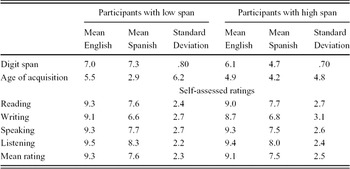
Two hundred and thirty nine undergraduate students from the University of Texas at El Paso were recruited from Introduction to Psychology and upper level Psychology courses. Participants whose self-assessed proficiency ratings on the Language History Questionnaire (LHQ) in both English and Spanish were at least a 5, on a scale from one to ten, were classified as bilingual. In a highly-bilingual community like El Paso, Texas self-assessed ratings of proficiency tend to be slightly lower because of a highly-proficient comparison peer group. Therefore, any participant whose rating in Spanish was slightly below five (3–4) but who also reported learning Spanish before the age of five and using Spanish on a daily basis was also classified as a bilingual and included in the analyses. This led to an exclusion of 69 participants, a rate of 28.9%. A summary of participants' data is shown in Table 1.
Language experience, digit spans and self-assessed proficiency ratings of the participants with low and high span. Self-assessed ratings were based on a scale 1–10.

In addition, only participants whose scores on the Spanish digit span task reflected high or low working memory capacity were included in the analyses. Participants at the intermediate level (n = 91) were also excluded, a rate of 38.1%. Therefore, the final group of Spanish–English bilingual students consisted of 79 participants. Participants were divided into two span groups based on their performance on the Spanish digit span task. Because an individual's average working memory span has been shown to be seven, plus or minus two digits, we classified participants who were able to recall five or fewer digits as participants with low span (n = 28), while participants who were able to recall seven or more items were classified as participants with high span (n = 51). Performance on the Spanish digit span task was used to classify participants because they provided a larger range of working memory span scores (very few participants had an English digit span of five or less).
Within each span group, we conducted paired t-tests to assess whether there was a difference in participants' English language skills and Spanish language skills.
Participants with high span reported learning Spanish at an earlier age (M = 2.9 years) than English (M = 5.6 years), t(45) = 3.72, p < .001. Nevertheless, their average proficiency self-ratings (averaged across reading, writing, speaking and listening comprehension) were higher in English (M = 9.3) than Spanish (M = 7.7), t(46) = 4.77, p < .001, and they reported using English (M = 7.9) more frequently than Spanish (M = 7.6), t(44) = 2.43, p < .05, suggesting that they had become more dominant in English.
Participants with low span reported learning Spanish (M = 4.2 years) and English (M = 4.9 years) at around the same age t(24) = 0.58, p > .05. They also reported slightly more frequent use of English (M = 7. 8) than Spanish (M = 7.3), t(25) = 1.93, p = .06. Similar to participants with high span, average proficiency self-ratings for participants with low span were higher in English (M = 9.1) than Spanish (M = 7.5), t(25) = 3.46, p < .05. One potential concern is that participants with low span in Spanish were less proficient in that language. However, independent sample t-tests showed that the groups were equivalent in their age of acquisition of each language, frequency of use of each language and language abilities in both English and Spanish. All p values exceeded .05.
Furthermore, we conducted an independent sample t-test comparing participants with high and low span performance on the digit span task in English to assess whether their working memory span in English was different. The two groups differed in performance on the English version of the digit span task, with participants with high span showing higher span in English (M = 7.0) than participants with low span (M = 6.1), t(69) = –4.82, p < .001. This suggests that participants' working memory capacity was constant across languages, such that participants with high span in Spanish were also high span in English, while participants with low span in Spanish also had lower span in English. Therefore, the individual differences on the Spanish digit span were not simply a reflection of proficiency differences in Spanish but rather more general differences in verbal working memory.
Tasks and materials
Semantic Verification Task
The first task which participants completed in the study was the Semantic Verification Task. In this task, participants were presented with a sentence frame with the last word missing (e.g. He is an original thinker and all of his ideas are exciting and ___). Participants then pressed the middle key of a response box when they were ready to read the last word of that sentence, the prime word (e.g. novel), which was followed by the target word (e.g. NEW) after a stimulus onset asynchrony (SOA) of 1250 milliseconds (ms). Finally, participants were asked to decide whether the target word was semantically related to the overall meaning of the previously presented sentence by pressing the “yes” or “no” keys on a response box. All prime words were presented in lowercase letters while target words were presented in uppercase letters.
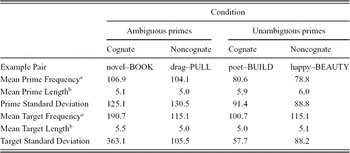
Stimulus words. The same critical stimuli as Schwartz, Yeh and Shaw (Reference Schwartz, Yeh and Shaw2008) were used. There were four groups of experimental English prime words, which were based on a 2 × 2 manipulation of ambiguity and cognate status with Spanish (see Table 2 for examples). This manipulation generated the following conditions: ambiguous–cognates, ambiguous–noncognates, unambiguous–cognates and unambiguous–noncognates. Ambiguous words here refer specifically to English homonyms. Prime words were matched for frequency and length: ambiguous cognate primes were matched with ambiguous noncognate primes, while unambiguous cognates were matched with unambiguous noncognates. Additionally, relatedness between prime and target pairs from the two ambiguous conditions was assessed (Nelson, McEvoy & Schreiber, Reference Nelson, McEvoy and Schreiber1998). Relatedness between primes and targets in the ambiguous–cognate condition (M = .21) did not differ from relatedness between primes and targets in the ambiguous–noncognate condition (M = .15), t(38) = .92, p > .05, suggesting that associations between primes and targets were similar across the critical conditions.
Lexical characteristics of prime and target words.

aFrequencies were obtained from the CELEX Lexical database.
bWord length was also obtained from the CELEX Lexical database.
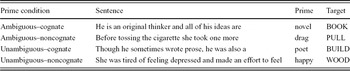
Stimulus sentences. Materials consisted of 160 sentences. Half of these sentences were experimental trials that to be correctly responded to, required a “no” response. The other half consisted of filler trials and required a “yes” response. Each sentence frame was presented on the computer screen with the last word missing. The word that was missing, the prime word, was from one of four possible conditions: ambiguous–cognate, ambiguous–noncognate, unambiguous–cognate and unambiguous–noncognate or a filler word for “yes” trials (see Table 3 for examples). The prime word was always the last word of the sentence followed by the target word. In the ambiguous, experimental trials, the meaning of the sentence always biased the subordinate meaning of the ambiguous word (e.g. novel – NEW). In the case of the unambiguous, control trials, the target was a word not related to the meaning of the sentence. In both cases, the correct answer was “no”. For the filler trials, the target word was related to the meaning of the sentence and required a “yes” response. Experimental and filler sentences were matched in length. Furthermore, to ensure that the presence of an ambiguous word would not cue a “no” response, filler trials also included ambiguous prime words.
Example sentences with prime and target words across the four conditions.

Digit Span Task
The second task completed by the participants was the Digit Span task. In the Digit Span Task, participants heard a sequence of numbers in a series that increased from three to eight digits and were asked to recall these numbers in order after each trial. There were two trials of each length of digits and after participants heard each of the trials, they were given as much time as they needed to recall the numbers and to type them in the space provided on the computer screen.
We calculated a digit span score for each participant by counting the number of total consecutive digits recalled without error. For example, if a participant recalled up to five digits and incorrectly recalled the following sixth digit, his or her span was identified as five. In addition, participants received half a point for each trial recalled after the first error. For example, if the participant missed both six digits, but was able to recall one of the seven-digit trials, he or she received half a point.
Participants completed two versions of the Digit Span Task, one in English and one in Spanish. The only difference between the two was that in the Spanish version the numbers were said in Spanish. However, instructions to the task were in English.
Procedure
When participants arrived at the laboratory, they were greeted in English and asked to sign an informed consent form. After agreeing to participate, the participant was taken to an individual testing room where he or she was seated in front of a computer.
The first task was the Semantic Verification Task. Instructions were presented on the computer screen as well as orally by the experimenter. The participant had a chance to complete 20 practice trials with feedback from the experimenter. Once the participant was ready to continue, he or she pressed the middle key on the response box and a fixation point appeared on the middle of the screen. The task was self-paced, so whenever the participant was ready he or she could press the middle key on the response box to see the next sentence. The sentence frame was then presented on the screen. The sentence always had the last word missing. To see the last word, participants pressed the response box when they were ready. The last word of the sentence (prime word) was then presented for 250 ms, followed by a blank screen for 1000 ms, which was then followed by a target word presented in all capital letters. The participant was then required to make a decision as to whether that target word was related to the meaning of the sentence previously read. “Yes” responses were made with a right-hand key press and “no” responses with a left-hand key press on a response box. After the response was made another fixation point appeared on the screen and the participant had to press the space bar to see the next sentence and so on. This continued for 160 trials until the task was complete.
After finishing the Semantic Verification Task, participants completed the English version of the Digit Span Task. Again, instructions were presented on a computer screen as well as orally. Participants were instructed to listen to all digits on each trial, to remember them in order and then type them on the space provided after each trial. The first trial consisted of three digits and it increased consistently by one digit until it reached eight digits. Digits ranged from one to eight, and digits within trials were randomized. Consecutive repetition of digits was allowed, such that participants could hear a trial such as “3477”. After data was collected, digit span trials that included consecutive repeated digits were dropped from analysis. This led to the exclusion of less than 1% of valid trials.
The next task was the Spanish version of the Digit Span Task. Instructions for this task were the same as the English version. Finally, participants completed the language history questionnaire. This questionnaire assessed their language background and abilities in English and Spanish. Participants self-reported their reading, writing, speaking and listening comprehension skills in both English and Spanish. They also reported how often and the contexts in which they speak each of the languages.
At the end of the experiment, participants received a debriefing form that explained more about the study. They were also given an opportunity to ask questions about the study.
Results
Data trimming procedures for semantic verification data
Mean reaction time (RT) for each participant was calculated for the correct trials. Any participant who had an error rate percentage greater than 80% on either of the two critical trials (ambiguous–cognate and ambiguous–noncognate) was excluded from further analyses (n = 4). In addition, participants who had an error rate percentage greater than 30% on the control trials (unambiguous–cognate and unambiguous–noncognate) were also excluded (n = 2). These conditions led to an exclusion of 7.6% of the participants (6/79). Therefore, data from 73 participants was analyzed in the following analyses. The error rate data was submitted to an arcsine transformation to ensure the variance across groups was homogeneous, (F(10,12538.11) = 0.58, p > .05). The accuracy data presented below is the arcsine-transformed data, however, for ease of interpretation we will refer to it as percentages.
Semantic verification data
Reaction time data
We submitted mean decision latencies on correct "no" trials to a 2 (digit span status) × 2 (ambiguity status) × 2 (cognate status) mixed ANOVA. Both ambiguity and cognate status were manipulated within subjects, while digit span status was used as a between-subjects variable. The main effect of ambiguity was not significant (F(1,71) = 1.20, MSE = 53270.3, p > .05), indicating that participants responded equally fast to targets preceded by an ambiguous prime (M = 1362.6) as to targets preceded by an unambiguous prime (M = 1331.8). The main effect of cognate status was significant (F(1,71) = 8.94, MSE = 17253.4, p < .05), reflecting participants' faster reaction times on targets preceded by a cognate prime (M = 1323.2) than on targets preceded by a noncognate prime (M = 1371.2).
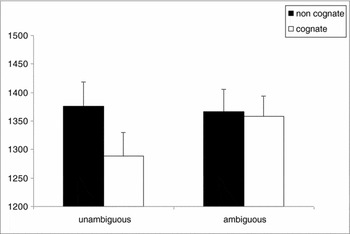
There was a significant interaction between ambiguity status and cognate status (F(1,71) = 4.45, MSE = 23239.1, p < .05) (see Figure 1). Follow-up paired t-tests revealed that this interaction was characterized by faster responses to trials with unambiguous cognate primes (M = 1293.8) than unambiguous–noncognate primes (M = 1372.1), t(72) = –3.70, p < .001. When targets were preceded by an ambiguous prime, no cognate facilitation was observed, t(72) = 0.028, p > .05. This finding is in line with findings from Schwartz, Yeh and Shaw (Reference Schwartz, Yeh and Shaw2008).
Mean decision latencies on correct trials for participants with low and high span across the four critical conditions.

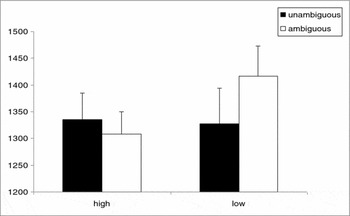
There was a significant interaction between ambiguity status and digit span status (F(1,71) = 4.29, MSE = 53270.3, p < .05). Follow-up paired t-tests revealed that participants with low span were slower to respond to targets preceded by an ambiguous prime (M = 1416) than to targets preceded by an unambiguous prime (M = 1327.7), t(25) = 2.29, p < .05. This difference was not significant for participants with high span, t(46) = –0.766, p > .05 (see Figure 2). This finding suggests that participants with low span had not yet resolved the competition between the homonyms' meanings at the time of the target presentation while those with high span had done so.
Mean decision latencies on correct trials for participants with low and high working memory on ambiguous and unambiguous conditions.

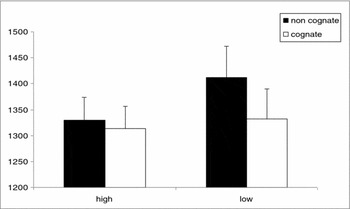
The interaction between cognate status and digit span status was also significant (F(1,71) = 4.0, MSE = 17253.4, p < .05). Follow-up paired t-tests revealed that participants with low span were faster to respond to targets preceded by a cognate prime (M = 1332.3) than to targets preceded by a noncognate prime (M = 1412.4), t(25) = –2.99, p < .05. This difference was not significant for participants with high span, t(46) = –0.849, p > .05 (see Figure 3). This finding suggests that greater working memory resources enabled bilingual participants with high span to process noncognates just as fast as cognates. Bilingual participants with low span, on the other hand, are faster to process cognates perhaps because cognates receive additional activation from the other language and thus can be processed faster than noncognates even by individuals with limited working memory resources.
Mean decision latencies on correct trials for participants with low and high working memory on the cognate and noncognate conditions.

The three-way interaction between ambiguity, cognate status and working memory capacity was not significant, p > .05.
Error rate data
We submitted mean percent error rates across "no" trials to a 2 (digit span status) × 2 (ambiguity status) × 2 (cognate status) mixed ANOVA. Again, digit span status was the between-subjects variable, and ambiguity status and cognate status were the within-subjects variables. The main effect of ambiguity was significant (F(1,71) = 91.19, MSE = .03, p < .01), revealing participants’ higher error rates on targets preceded by an ambiguous prime (M = .40) than on targets preceded by an unambiguous prime (M = .20). The main effect of cognate status was not significant (F(1,71) = 1.91, MSE = .017, p > .05), reflecting the fact that participants had similar error rates on targets preceded by a cognate prime (M = .31) and on targets preceded by a noncognate prime (M = .30).
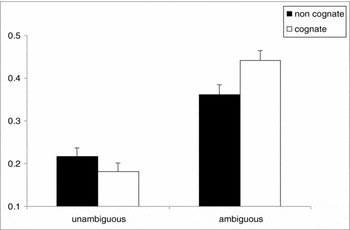
The interaction between ambiguity and cognate status was significant (F(1,71) = 16.15, MSE = .014, p < .001). This interaction reflected the fact that for the unambiguous prime conditions there was a cognate facilitation effect, whereas for the ambiguous prime conditions there was a cognate interference effect (see Figure 4). This is further replication of the Schwartz, Yeh and Shaw (Reference Schwartz, Yeh and Shaw2008) study.
Mean percent error rates for participants with low and high span across the four critical conditions.

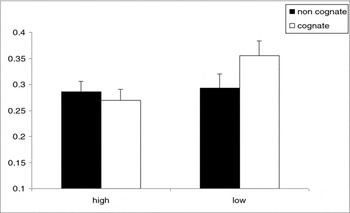
The interaction between cognate status and digit span status was also significant (F(1,71) = 5.96, MSE = .017, p < .05). Follow-up paired t-tests revealed that participants with low span made more errors on targets preceded by a cognate prime (M = .36) than on targets preceded by a noncognate prime (M = .30), t(25) = –.2.31, p < .05. This difference was not significant for participants with high span, t(46) = 0.91, p > .05 (see Figure 5). Thus, it appears that participants with low span experienced a cost due to the coactivation of cognate representations across languages. The reader will recall that these same participants exhibited faster decision latencies when the primes were cognates relative to noncognates. Taken together, this pattern suggests that the bilinguals with less verbal working memory relied heavily on superficial form-similarity of the primes to make a speeded response to targets but were unable to fully retrieve semantic representations of those primes before responding, thus inflating error rates.
Mean percent error rate for participants with low and high working memory on the cognate and noncognate conditions.

The three-way interaction between ambiguity, cognate status and working memory capacity was not significant, p > .05.
Discussion
The major finding from the present study is that verbal working memory resources influenced the extent to which bilingual lexical disambiguation is marked by effects of competition between lexical representations within and across languages. For example, bilinguals with low verbal working memory showed a significant cost in response times when making decisions to target words that were preceded by semantically-ambiguous primes. However, participants with high verbal working memory resources showed no such effect. Thus, greater verbal working memory feeds into the ability of bilingual readers to efficiently activate and discriminate amongst competing semantic representations.
Individual differences in verbal working memory also influenced performance when prime words were ambiguous across languages. Participants with low verbal working memory span showed a combination of faster response times and higher error rates for trials with cognate primes relative to noncognate primes. Due to their limited cognitive resources, these bilinguals were relying on superficial, form similarity of lexical representations across languages to make faster responses. However, this speeded response came with a cost in accuracy because they were unable to fully activate and make the finer-grained distinctions amongst the cognate representations across languages required to accurately reject follow-up targets as being related. Furthermore, the activation strength of cognates is greater than for noncognates because cognates have overlapping orthographic and semantic representations across languages. If cognates have greater activation than noncognates, then rejecting them requires more working memory resources. Thus, participants who have fewer resources available and thus have low working memory span, would have more difficulty in rejecting cognates than participants with high span, who have more resources available. It seems that the mere co-activation of both languages takes up enough working memory resources causing interference in processing for bilinguals with low span. Although the performance of the bilingual participants with low verbal working memory span was marked by a speed-accuracy tradeoff for the cognate prime conditions, it is important to note that it was not response times to cognates that were driving the cognate status by digit span interaction in the reaction time data (see Figure 3). Instead, it was the increased response times to noncognates that differed across the digit span groups.
The finding from the present study that individuals with low working memory span responded more slowly to ambiguous words than individuals with high working memory span replicates the Miyake et al. (Reference Miyake, Just and Carpenter1994) study, although using a different paradigm. Contrary to our study, which used biased sentences, Miyake et al. (Reference Miyake, Just and Carpenter1994) used neutral sentences. Miyake et al. (Reference Miyake, Just and Carpenter1994) proposed an activation hypothesis to explain the absence of an ambiguity effect in the high span group. Because the context preceding the ambiguous word was a neutral one, they suggested that participants with high span were able to activate all possible meanings and keep them available until the disambiguation region, while participants with low span had only the dominant meaning available at that point. Therefore, when the disambiguating region cued the subordinate meaning, participants with low span showed difficulty in selecting the subordinate meaning.
In the present study, however, the sentences were designed to bias the subordinate, less frequent meaning of the ambiguous word. In this case, the context preceding the ambiguous word allowed the subordinate meaning to receive some level of activation and compete with the dominant meaning. Therefore, because of our task demands, which required participants to reject a target related to the dominant meaning, it seems that an inhibition hypothesis would better explain our findings. It may be that in the present study, participants with high span did not show an ambiguity effect because they were better able to select the correct meaning early and inhibit the dominant meaning more efficiently than participants with low span. Participants with high span may inhibit dominant meanings more efficiently because they have more processing resources available during sentence comprehension. Participants with low span, on the other hand, could not reject the target related to the dominant meaning because both interpretations were still available and competing for activation.
The present study extends the monolingual findings of Gunter et al. (Reference Gunter, Wagner and Friederici2003) by demonstrating the role of working memory capacity in semantic disambiguation processes across languages. In both studies, participants with low span had trouble rejecting targets related to the dominant meaning, even when context allowed for early selection of the subordinate meaning. Participants with high span, on the other hand, were able to make the switch by quickly rejecting the dominant meaning because they had already suppressed the dominant meaning since the preceding context allowed for selection of the subordinate meaning. A key contribution of the present study is that individual differences in verbal working memory influence the ability to inhibit competing meanings across languages as well as within languages. When to-be-inhibited meanings are co-activated across languages, as is the case with cognates, readers with fewer working memory resources are at an even greater disadvantage due to the added magnitude of competitive activation.
The present study also converges with and extends the Re-ordered Access Model (Duffy et al., Reference Duffy, Morris and Rayner1988. As discussed in the introduction, this model assumes that the time-course with which homonym meanings become activated is influenced by two factors: (i) the relative frequency of the alternative meanings, and (ii) whether the context biases a certain meaning. This model would predict that the contextual support for subordinate meanings would not be sufficient to bypass competition from the more frequent, dominant meaning. The increased error rates for the ambiguous conditions support this claim. However, the magnitude of the cost of competition was greater for ambiguous cognates than noncognates. This suggests that cross-language activation of the cognate translations from the non-target language increased the strength of activation of the shared, dominant meanings. This finding highlights the importance of cross-language activation as a factor in bilingual sentence processing research. Broadly speaking, it suggests that to apply monolingual models of lexical ambiguity resolution to bilinguals, we have to consider cross-language activation. A bilingual version of this model should include cross-language lexical activation as a third factor (as previously suggested by Schwartz, Yeh & Arêas da Luz Fontes, Reference Schwartz, Yeh and Arêas da Luz Fontes2008), as well as account for individual differences in verbal working memory capacity.
Applications
Findings from this study highlight the impact that lexical ambiguity has on the reading process, particularly for bilingual readers. When there is a lack of a one-to-one mapping between form and meaning, processing efficiency is compromised. This effect is even greater when the mappings are across languages. Working memory is a fairly stable characteristic and not easily modified by instruction. Thus, it is critical that bilingual readers engage in activities that build underlying lexical representations. A highly detailed, accurate and well-entrenched lexical representation minimizes the processing costs associated with ambiguity and processing in a weaker language. Teachers can do this at both an implicit and explicit levels. Lexical knowledge is acquired implicitly through rich and varied reading experiences. Teachers can also help students navigate the ambiguity of the lexical code explicitly. One way this can be done is by raising students’ meta-cognitive awareness of the existence of cognates and homographs. Students can be asked to keep a list of cognates and homographs that they encounter during their readings in the second language. Making students aware of similarities and differences across their languages may increase their familiarity with the second language.