Introduction
Both the frequency of disasters and the population affected have increased during the last century, though the number of people killed because of disasters has decreased. 1 , 2 In Europe, disasters have killed more than 120,000 people and have affected 33 million during the last three decades. 3 To meet the multiple health needs of populations affected by disasters a well-prepared response system is necessary.Reference Daily, Padjen and Birnbaum 4
Education and training are key elements of disaster preparedness.Reference Daily, Padjen and Birnbaum 4 , 5 Knowledge of response, coordination, and integration of resources with other authorities are essential for each and every organization.Reference Huntington and Gavagan 6 Therefore, all professionals in different settings (eg, search and rescue, Emergency Medical Services, hospitals, fire brigades, etc) must be trained to contribute to disaster management activities and to practice standards of care with competency-based specialized knowledge and skills in critical situations.Reference Burkle 7 – Reference Walsh, Subbarao and Gebbie 9 The Hyogo Framework, a worldwide strategy in disaster risk reduction, emphasizes the transfer of knowledge and expertise to strengthen disaster preparedness for an effective response to disasters at all levels. 10
The essential role of first responders and managerial professionals during disasters underlines the need for standardized all-hazard disaster educational programs.Reference Archer and Seynaeve 11 , Reference Schultz, Koenig and Whiteside 12 As such, there have been both international and national attempts to develop educational curricula and materials for these professionals, with respect to disaster management.Reference Archer and Seynaeve 11 – Reference Subbarao, Lyznicki and Hsu 15 However, while the number of disaster management educational programs continues to grow, there are no common standards upon which these programs are based.Reference Daily, Padjen and Birnbaum 4
Disaster Training Curriculum (DITAC) is a research project funded by the European Commission under the 7th Framework Program. 16 Its goal is to develop a holistic and standardized training curriculum for first responders and strategic/tactical crisis managers in the 27 European Union (EU) member states. In order to best inform first responders, crisis managers, and policy makers, DITAC identified that it must begin with a comprehensive review of existing disaster medicine and management education and training assets at the postgraduate level within the EU. This paper represents the initial phase of the process to meet professional competency within all EU countries required by DITAC.
Methods
Step I
Two researchers representing the DITAC working group performed a web search of Google (Google Inc., Mountain View, California USA) and Bing (Microsoft Corporation, Redmond, Washington USA) search engines using the terms (expressed in both English and French): [disaster], [crisis], [management], [education], [master], [diploma], and [certificate]. Considering the study objectives, inclusion criteria were defined as follows:
-
1. A postgraduate program;
-
2. Delivered by either an accredited academic center, or a national or international governmental institution;
-
3. Conducted in EU member states;
-
4. Awarding a certificate recognized, at a minimum, at a national level.
Forty-one representatives from all the EU countries working for national institutions involved in disaster management, and belonging to either the European Master in Disaster Medicine degree program 17 faculty, or the alumni association who are involved in DITAC tasks, were contacted to submit additional relevant training courses that fulfilled the inclusion criteria. This process contributed 20 additional training courses that met the inclusion criteria and were integrated with the web search results.
Step II
A standardized online survey instrument was developed for the EU-based survey, hosted on SurveyMonkey (SurveyMonkey LLC, Palo Alto, California USA), and designed utilizing similar models from the 2011 Humanitarian Health Curriculum Survey issued by the Harvard Humanitarian Initiative for North America and the worldwide Enhancing Learning & Research for Humanitarian Assistance (ELRHA) scoping survey (2009 and 2011) of the International Working Forum on Humanitarian Professionalization. 18 , 19 The survey was used to capture program data from each identified course's official webpage. Data were then analyzed in terms of key aspects identified by a consortium panel of experts from various DITAC/EU participating academic institutions.
Step III
The DITAC consortium utilized a 3-round web-based Delphi method to review the survey instrument and finalize the captured content/information. Modular Object-Oriented Dynamic Learning Environment (MOODLE Pty Ltd, Perth, Western Australia Australia) licensed, free open-source software was used as an e-platform and served as a repository of content and communication center. 20
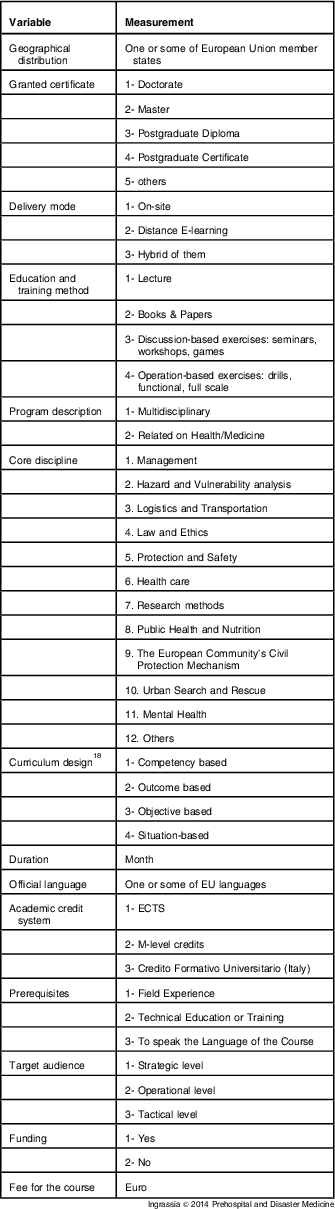
The expert panel achieved consensus on a survey instrument made of seven open-ended questions and 18 multiple-choice questions (12 allowed a single answer and six were multiple choices). All the items were associated with one or more of the key aspects shown in Table 1.
List of the Variables Evaluated in the Survey on Education and Training Initiatives, in Terms of Disaster Management, and in European Union Member States

Data Analysis
The official web pages of the identified training courses were analyzed using the online survey instrument to categorize the information provided. Data were coded on a master sheet using a Microsoft Office Excel spreadsheet (Version 12.0, Microsoft Corporation, Redmond, Washington USA) and expressed as frequencies.
Ethical Consideration
On the basis of evaluation and report of the ethical subcommittee of DITAC, in this study, data was collected from websites to retrieve information about relevant training programs. The information within this research is publicly available on the internet, and therefore, ethics committee approval was not necessary.
Results
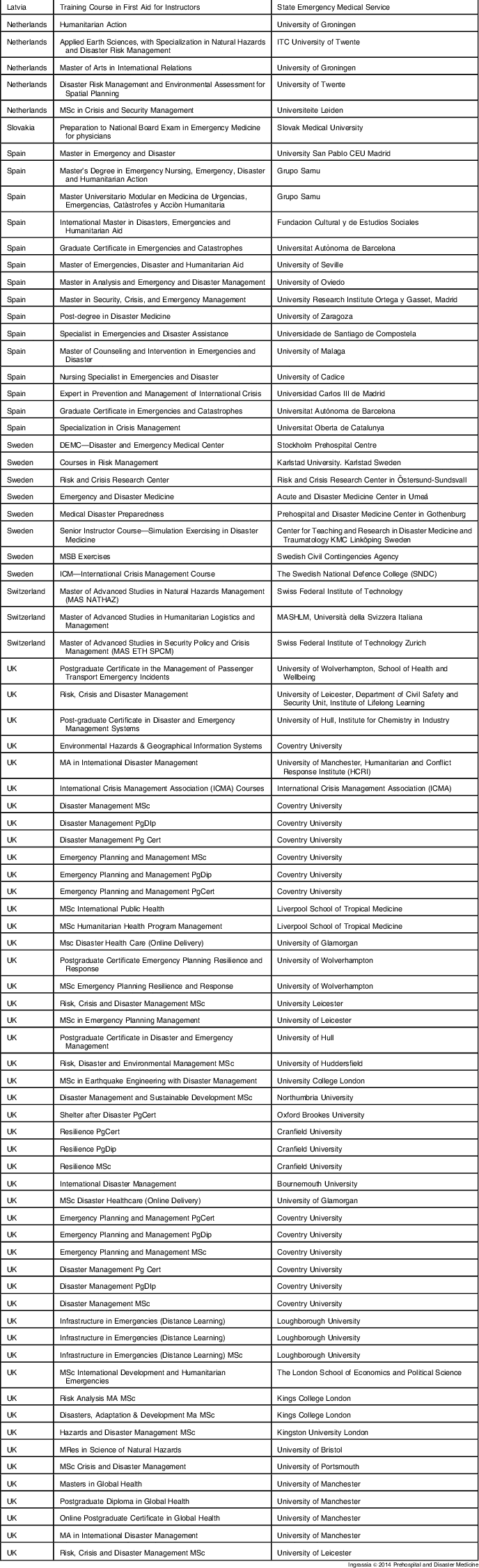
The review identified 140 educational and training initiatives (ETIs) which met the inclusion criteria in EU Member States (Table 2).
List of Identified Training and Educational Initiatives in European Union Member States in 2012

adelivered by two academic centers from two countries.
Geographical Distribution
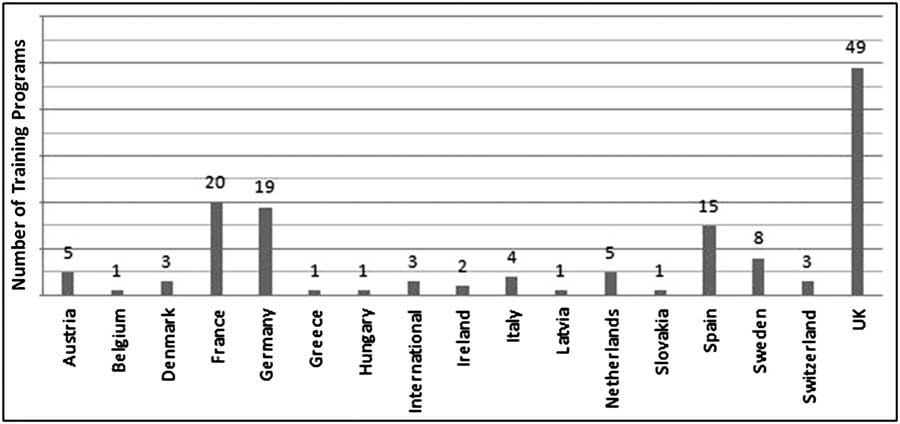
Thirty-five percent of the identified ETIs were based in the United Kingdom, 14% in France, and 13% in Germany. The remaining 38% were based in 13 EU member states, while no ETIs were available in 11 EU countries (Figure 1).
Geographical Distribution of Training Programs Distribution of identified educational and training programs in the European Union member states in 2012. One initiative is delivered by two academic centers from two countries (Italy and Belgium) International refers to international programs delivered by NATO.

Type of Certificate Granted
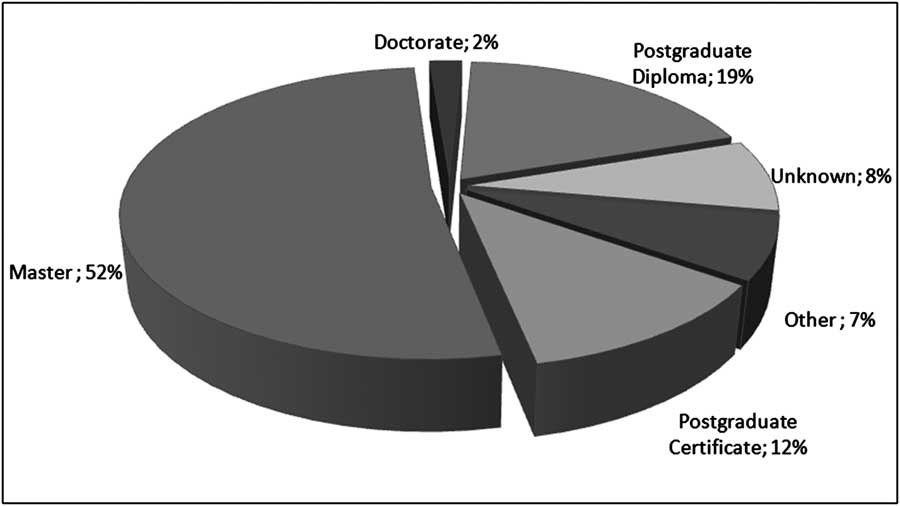
Out of 140 identified postgraduate ETIs, a master's degree was the most common certificate (52%) granted. Other types of certification (40%) also were granted, but particulars on these were not available (Figure 2).
Types of the Certification Granted by the Identified Education and Training Initiatives

Course Delivery Modality
On-site education was the most common delivery method for the ETI courses (67%). Both distance electronic learning (E-learning) (11%) and blended learning (14%) also were utilized. No information was provided in eight percent of the ETIs.
Education and Training Method
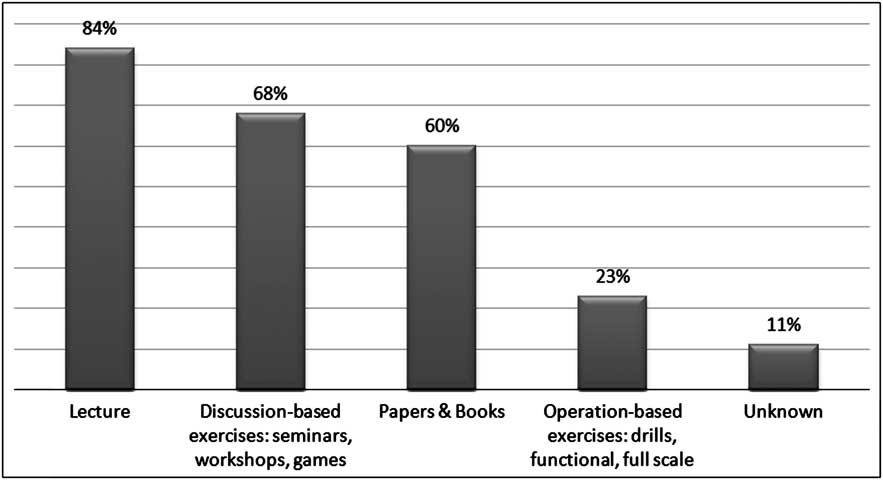
Frontal (face-to-face) lectures were used in 84% of the ETI programs. Discussion-based exercises, operation-based exercises, and required review of peer-reviewed publications and book chapters also were utilized (Figure 3). Furthermore, 66% of the ETIs used a combination of theoretical content and exercises (either discussion-based or operation-based). However, both discussion-based and operation-based exercises were found in only 17% of ETI programs.
Teaching Methods Used in the EU Education and Training Initiatives

Program Description and Core Discipline
Seventy-one percent of the ETIs offered a multidisciplinary disaster management program, while in 20%, the topic content was exclusively health related. No information was available for nine percent.
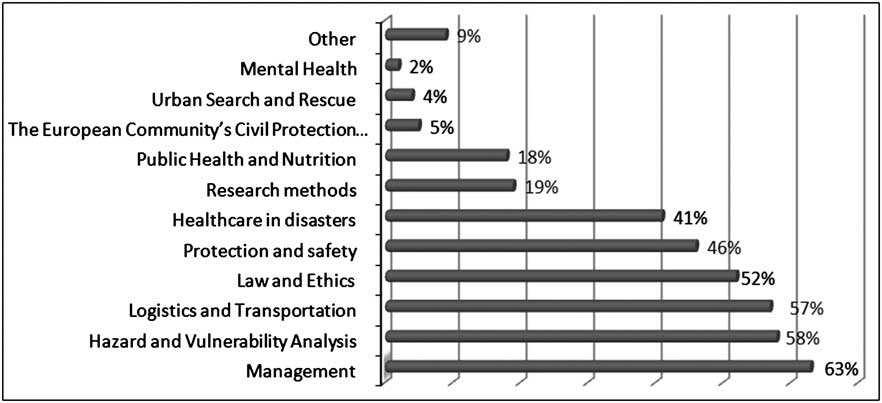
Analysis of core disciplines offered identified that “management” was the most common subject (63%), followed by “hazard and vulnerability analysis” (58%). Other commonly offered topics were “logistics and transportation”, “law and ethics”, and “protection and safety” (Figure 4).
Distribution of Core Disciplines Used by EU Education and Training Initiatives

Curriculum Design
Sixty-one percent of ETIs had competency-based designs, 35% had objective-based curriculum designs, and one percent had situation-based designs.
Duration
Seventy-three percent of ETIs were full-time programs and 26% were part-time. Time to completion was 6-12 months in 66%, 13-24 months in 14%, and 24+ months in nine percent. No information was available for 11%.
Official Languages
Programs usually employed their host country language (eg, Italian, Swedish, etc) as the official language of the initiative. However, English was the most common language used (54%), followed by French (14%), German (12%), and Spanish (9%).
Academic Credit System
This study revealed that 43% of the ETI used the European Credit Transfer and Accumulation System (ECTS) as the academic credit system. M-level credits and Credito Formativo Universitario were used in three percent. The range of granted credits was 15-180 credits; however no information on the academic credit system was available in 54%.
Participants’ Prerequisites
In 18% of the ETIs, the applicants were required to have previous field experience. Having previous technical education or training was a prerequisite in 26%, and 80% required their participants to speak proficiently the official language of the course.
Target Audience
In 29% of the ETIs, the target group was strategic-level (gold) managers who represented the leaders/commanders, who were in overall charge of each service, and who were responsible for formulating the strategy for disaster/crisis management. In 39%, the target group was tactical-level (silver) personnel who represent responders who attend the crisis scene and are charged with the responsibility of formulating the tactics to be adopted by their service. In 22%, the target audience was personnel at the level where immediate “hands-on” work is undertaken at the crisis scene (operational or bronze). In three percent, both silver and bronze groups were the target audience for training. There was no available information for seven percent.
Tuition and Funding
Sixty three percent of the ETIs reported that their funding is self-sustaining through tuition paid by students. The average cost of ETI program funding was 6750€, with a range of 15- 49300€. Four percent of the training programs did not charge students a fee. No information was available for 33%. Financial support, in the form of as a scholarships or loans, was available for 29% of applicants.
Discussion
With respect to disaster and crisis management, this study identified 140 ETIs in the 27 EU countries. However, such instruction is available in only 16 countries, with only eight having more than one ETI program. Considering the geographical area (4,325,000 km2) and the population (500 million) of the EU, and the high economical and human impact of disasters in this area, 3 there is lack of educational capability in the EU with respect to both the number of ETIs and their distribution. Recognizing that education and training are essential elements of capacity building in disaster management, 10 it is necessary to enhance this capacity in the EU, to establish more ETIs in member states, especially in disaster-prone areas. This also fulfills the initial phase in a broader professionalization process in order to guarantee that EU sponsored Foreign Medical Teams provide quality performance to global crises if called upon to respond.
Analysis showed that only 61% of the ETIs have a competency-based curriculum design. A competency-based approach is a necessity.Reference Frank, Snell and Cate 21 , Reference Seynaeve, Archer and Fisher 22 To be effective, education and training in disaster management require consensus on a set of core competencies, with curricula based on a well-defined package of knowledge and skills.Reference Burkle 7 , Reference Burkle, Walls and Heck 8 All professions in disaster management need staff competent in their specific areas of work, and the competency gaps must be integrated into training programs. The disaster training centers in the EU should have standardized, competency-based curricula and approach their ETI programs in order to fulfill professional needs.
Although one-fifth of the initiatives did focus on a unique subject, most of the ETIs were considered multidisciplinary disaster training programs. This is compatible with the international standards and guidelines on education and training in the field of disaster management, developed by the World Association for Disaster and Emergency Medicine (WADEM), which emphasizes that education and training programs should be multidisciplinary, case or scenario-based, and utilizing a modular approach.Reference Seynaeve, Archer and Fisher 22 The results of this study showed that one-quarter of the identified ETIs used a computer-assisted learning methodology in terms of crisis management. Currently, there are several software programs available to provide an E-learning opportunity for students and instructors. The benefits of E-learning outweigh the limitations. 23 Disaster management is particularly suitable for E-learning because of E-learning's capability to present to trainees virtual and simulated disaster scenarios and relevant educational content which are often difficult to get from usual training methodologies.Reference Della Corte, La Mura and Petrino 24 , Reference Gillett, Silverberg and Roblin 25 The use of E-learning methods by disaster training initiatives may enhance their capability to educate both managers and responders.
This study showed that the use of the operation-based learning is at low level compared to theory-based methods, including lectures, documents, and discussion. Education is best as a mixture of both theory and practice. However, available evidence is insufficient to determine whether a given training intervention (using lecture and documents in disaster preparedness) is effective in improving the knowledge and skills in disaster response.Reference Williams, Nocera and Casteel 26 Evidence-based disaster training and exercises can improve the effectiveness of disaster responders’ performances, which are based on knowledge and skill, and demonstrate the capabilities and competencies.Reference Williams, Nocera and Casteel 26 – 28 Currently, a balance between theory and practice seems insufficient in European ETI programs. Spending more time and resources on the operation-based exercises may repair this gap to enhance the efficacy of training.
Many existing academic training programs result in a degree (Master or Doctorate). These programs can be more comprehensive and contain most of the core competencies; the graduate staff also can be deeply involved in the research and education with respect to disaster management. On the other hand, to attend an extended training program might be difficult for many disaster responders and managers. However, the most crucial achievement of educational objectives is the demonstration of core competencies in the course content, which may, in and of themselves, be related to both duration and broader opportunities for content adequacy of the training programs. 28 To increase the amount of competency-based content, specific short-term training courses create a suitable balance between long-term and short-term initiatives, which can be chosen by responders and managers, while considering time and cost of the choices available.
This study showed that the survival of most of the ETIs was dependent on the fee paid by students. High course fee, in addition to other relevant costs, such as travel and accommodation, can be barriers for the trainees. Using distance E-learning methods can diminish these barriers. In addition, financial support from governmental or nongovernmental organizations, as a capacity building action, can encourage potential trainees to attend and assist the ETI to develop more standardized training approaches and content.
Two most common core disciplines of the evaluated initiatives were “management” and “hazard and vulnerability analysis.” Although hundreds of competencies for disaster management have been developed, the universal acceptance of these competencies have not been validated.Reference Daily, Padjen and Birnbaum 4 “Management” and leadership, as well as “hazard and vulnerability analysis,” are included as major components in the content of training curricula suggested by different studies.Reference Walsh, Subbarao and Gebbie 9 , Reference Schultz, Koenig and Whiteside 12 , Reference Subbarao, Lyznicki and Hsu 15 , Reference Hsu, Thomas and Bass 29 This study confirms these findings. However, it is worrisome that “mental health” was at a very low level of consideration in current ETI content in the EU. No one who experiences or responds to a disaster is untouched by its psychological impacts, 30 therefore considering “mental health” as a subject in both disaster preparedness programs and disaster training curricula is a necessity. A standardized competency set for disaster management should be developed to ensure acceptance by EU/ETI program planners.
This study showed that responders and managers of all three levels of response to disasters (strategic, tactical, and operational levels) were target groups of ETI programs in the EU. Although it seems that ETI could offer the courses on the basis of their institutional strengths or preferences, putting these three target groups together may enhance educational efficacy and result in higher coordination among different levels during disasters in some of the initiatives.
Few ETI programs in the EU consider prerequisites related to either previous field experience or technical education of the applicants. Some professionals may deal with basic emergencies in their routine work, and may also have disaster experience and knowledge; many others, however, may lack critical knowledge and experience with disasters.Reference Walsh, Subbarao and Gebbie 9 Considering training course content and objectives, the trainees should come together at the completion with a similar level of knowledge and skills. It is suggested that all initiatives clarify standardized prerequisites for the applicants. Most of the ETI are full-time programs. Although being full time can result in more attention and effort by the trainees, it may prohibit attendance of the managers and responders in these types of programs.
English was not the language of all ETI programs. All 27 EU countries speak different languages. However, all multinational training initiatives should include English in their programs. Traditionally, both English and French are the recognized United Nations health languages.
Based on survey responses in this study, ECTS was the most common credit system used. Each academic credit or credit hour is a unit that defines the quantity, level, and time of student learning foreseen by educational institutions. A standardized and common credit system facilitates comparison among the training initiatives and institutions, and also improves student learning and choice. It is recommended that ECTS should be used by all ETI programs as the standardized credit system in Europe.
Limitations
Despite performing an in-depth search using several means, some relevant training courses could have been missed. In addition, there was, at times, a high rate of data missed on the identified initiatives. This is probably due to the lack of a comprehensive database for training and educational initiatives both at the EU and the national level. However, this is the first comprehensive study in the EU, and the results can be useful to identify and include the missed data. Furthermore, during the second phase of this study, the managers or coordinators of the initiatives were contacted to complete the requested documentation.
Queries performed in English and French may not have retrieved results provided in other languages or websites without English or French keywords. However, the DITAC partners were asked to contribute information on programs that are running in other languages in their countries.
Data extrapolated from each website were analyzed and categorized on the basis of a questionnaire which had not been validated to ensure it reflected the real situation with respect to disaster management requirements. However, there was consensus of the experts on the questionnaire items, and the study benefitted from the worldwide ELRHA project that served as a model for this survey.
Conclusions
This survey showed that there are currently 140 ETI programs in the EU member states, with the majority based in just a few countries. Most involve competency-based curriculum design, and the most common disciplines addressed are management and hazard/risk assessment. An E-learning method is not widely used in the EU countries. Although all levels of disaster management are covered by the initiatives, a few involve a combination of these levels in the same program.
This survey brought the EU/ETI programs, with respect to disaster management, together for the first time. Moreover, it showed relevant gaps and barriers. Characteristics of current ETI were analyzed, and they can be used to develop standardized training programs, based on core competencies, for different professionals in disaster management. As an objective of DITAC, the professional experience and contribution of the training centers in the EU may be used in the development of disaster core curriculum and establish a consortium-wide website that contains standardized educational material and core competencies. While DITAC has as its final goal to ensure that all EU countries will have the capacity to respond to disaster and crisis events within the EU, a further, yet unstated, obligation is to guarantee that EU sponsored Foreign Medical Teams will also provide quality performance to global crises if called upon to respond. In this regard, this process fulfills the initial phase in a broader professionalization process in which the EU becomes both a partner and stakeholder with other regional initiatives under the ELRHA global network.