INTRODUCTION
Meaning in life (MiL) experience has been shown to be an important aspect of psychological well-being in healthy individuals as well as in cancer and palliative care patients (Lethborg et al., Reference Lethborg, Aranda and Cox2007; McKnight & Kashdan, Reference McKnight and Kashdan2009). MiL can be defined as “the cognizance of order, coherence, and purpose in one's existence, the pursuit and attainment of worthwhile goals, and an accompanying sense of fulfillment” (Wong & Fry, Reference Wong and Fry1998, p. 41); thus, it comprises a cognitive and a motivational component (providing a framework for meaning), and an emotional component (fulfillment) (Brandstätter et al., Reference Brandstätter, Baumann and Borasio2012). Several studies have shown that a loss of MiL entails psychological distress and even requests for euthanasia in patients suffering from incurable diseases (Kissane et al., Reference Kissane, Clarke and Street2001; Meier et al., Reference Meier, Emmons and Wallenstein1998; Moadel et al., Reference Moadel, Morgan and Fatone1999). Therefore, psychological interventions have been developed to sustain or enhance MiL in palliative care patients (Breitbart et al., Reference Breitbart, Rosenfeld and Gibson2010; Chochinov et al., Reference Chochinov, Hack and Hassard2005) as well as in healthy subjects suffering from loss of meaning (Frankl, Reference Frankl1958).
In a systematic review, 59 different instruments for assessment of MiL were found and differentiated into nomothetic (quantitative/deductive) and idiographic (free responses/inductive) approaches (Brandstätter et al., Reference Brandstätter, Baumann and Borasio2012). Nomothetic instruments present either theoretically derived a-priori categories or categories inductively derived from previous studies, but disregard further individual aspects of MiL experience. Therefore, researchers developed idiographic, open-response instruments allowing for assessment of individual MiL experiences. However, it can be challenging to categorize these individual experiences for interindividual comparisons.
In philosophy, there has been a longstanding debate around predefined categories and the construction of individual meaning dimensions: in this nominalism debate, rationalists propose existing categories independent of individuals, while empiricists argue that categories are individually constructed (Rodriguez-Pereyra, Reference Rodriguez-Pereyra and Zalta2008). In a pluralistic society, where traditional meaning beliefs have increasingly less impact, an individualized, idiographic approach may be especially suited.
In the Schedule for Meaning in Life Evaluation (SMiLE), an idiographic instrument, respondents are asked to list individual areas that provide meaning to their life before rating their current level of satisfaction and the importance of each area (Fegg et al., Reference Fegg, Kramer and l'Hoste2008). The SMiLE therefore pursues a qualitative/quantitative approach. It has been used to evaluate MiL in a representative sample of the German population (Fegg et al., Reference Fegg, Kramer and Bausewein2007) as well as in palliative care, in patients suffering from amyotrophic lateral sclerosis, progressive supranuclear palsy, and cancer (Fegg et al., Reference Fegg, Kramer and l'Hoste2008; Reference Fegg, Kögler and Brandstätter2010; Reference Fegg, Kögler and Abright2013; Stiefel et al., Reference Stiefel, Krenz and Zdrojewski2008). The psychometric properties of the SMiLE have been tested in several studies (Fegg et al., Reference Fegg, Kramer and l'Hoste2008; Stiefel et al., Reference Stiefel, Krenz and Zdrojewski2008).
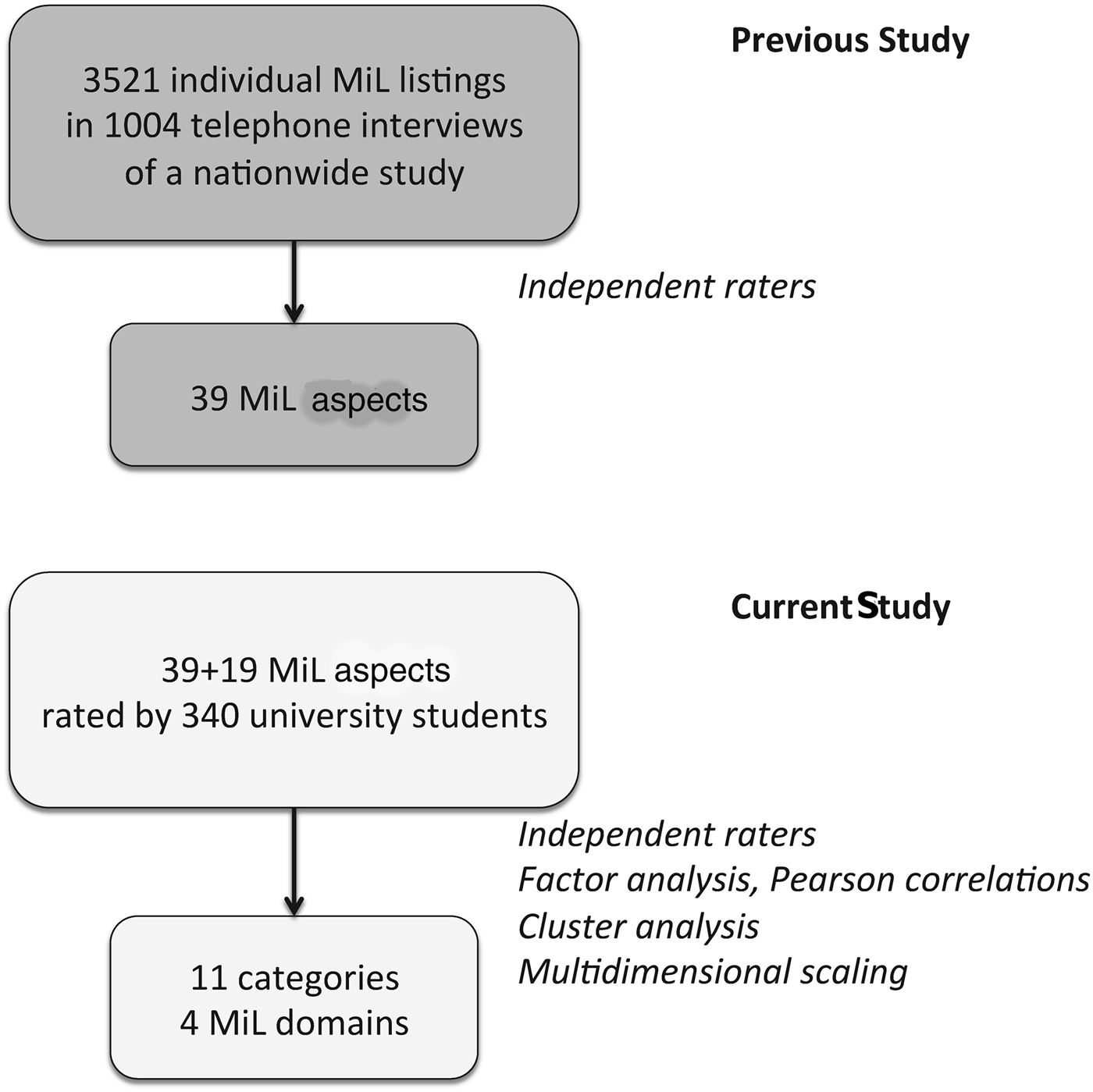
To categorize the individual listings of a representative SMiLE survey (1004 subjects with a total of 3521 individual listings), 39 a-posteriori MiL aspects had been developed by independent raters (Fegg et al., Reference Fegg, Kramer and Bausewein2007). Other studies using the SMiLE led to 19 additional aspects (58 meaning aspects in total; see Figure 1) (Kudla et al., Reference Kudla, Kujur and Tigga2014; Stiefel et al., Reference Stiefel, Krenz and Zdrojewski2008; Monforte-Royo et al., Reference Monforte-Royo, Tomás-Sábado and Villavicencio-Chávez2011; Brandstätter et al., Reference Brandstätter, Kögler and Baumann2014).
Study design.

The aims of our study were (1) to identify unidimensional categories subsuming the MiL aspects listed in SMiLE studies so far and (2) to develop an integrative model of individual MiL experience based on these categories.
METHODS
Study Design and Measures
In this cross-sectional pilot study, all medical students attending a palliative care lecture were asked to participate. The study was conducted following the guidelines of the research ethics committee of the University of Munich.
The questionnaire consisted of 58 MiL aspects that were found in previous SMiLE studies (n = 1004, Figure 1). All students rated the importance of these aspects for their individual MiL on an 8-point adjectival scale (0 not important to 7 extremely important). Therefore, the individual framework (but not fulfillment) component of MiL was focused on in this study. To avoid biases resulting from individual response tendencies, the ratings were corrected for scale use through subtraction of each person's mean importance score from their single importance ratings (Schwartz et al., Reference Schwartz, Verkasalo and Antonovsky1997). Thus, positive ratings indicate above-average importance, and negative ratings indicate lower importance ascribed to the single item compared to the averaged importance ratings of the respondent.
Statistical Evaluation
Pearson's correlations (in categories consisting of two items) and exploratory factor analysis with the principal components method (in categories consisting of three or more items) were utilized to test unidimensionality, that is, whether each category represents an independent part of MiL experience.
Thereafter, multidimensional scaling (MDS) was used to visualize proximities of the categories in an integrative model. MDS reduces the multidimensional space between the different categories into a two-dimensional map. Distances stand for observed between-object similarity: greater dissimilarity between two categories is shown by a larger distance between the two points representing these categories, and vice versa. The quality of MDS diagrams is expressed in its stress (S). The smaller the stress, the better the quality of the representation. In this study, MDS maps were accepted if S ≤ 0.1.
Hierarchical cluster analyses were employed to confirm the MDS findings and additionally investigate the similarity of MiL categories. The distances between different categories were calculated by average linkage between groups: categories with the smallest average distance to each other were combined into a new cluster.
PASW Statistics 17 and R 2.4.1 were used for statistical evaluations. Distances in the MDS analysis were calculated with PROXSCAL.
RESULTS
Respondents' Characteristics
A total of 340 medical students from the Ludwig Maximilian University of Munich took part in the study (response rate, 72.0%). Some 33 students were excluded because of major incomplete responses (more than two thirds missing). Two items (children and grandchildren) were excluded because of extensive missing data. In total, data for 307 participants were analyzed (inclusion rate = 90.3%). Missing data for the remaining items were imputed with the EM algorithm for incomplete categorical data (Schafer, Reference Schafer1996).
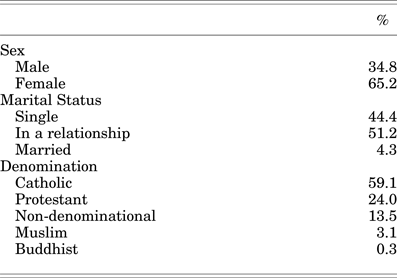
Table 1 provides an overview of the respondents' characteristics. The mean age of participants was 24.3±3.5 years (range, 20–48 years).
Respondents' characteristics (N = 307)
Item Characteristics
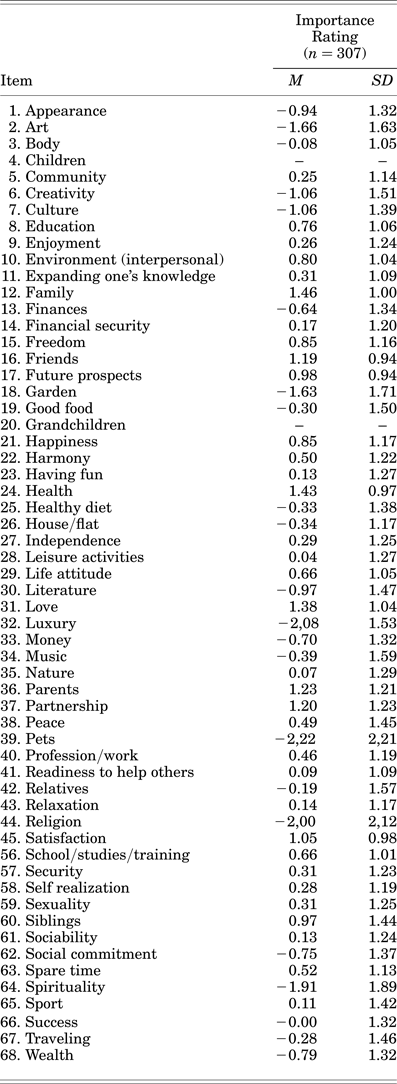
Table 2 shows the mean importance ratings of all MiL aspects. The most important aspects were family, health, love, parents, partnership, and friends, while the least important were garden, art, spirituality, religion, luxury, and pets (all in order of decreasing importance).
Means (M) and standard deviations (SD) of the importance ratings of MiL aspects (corrected for scale use)
Unidimensionality of Categories
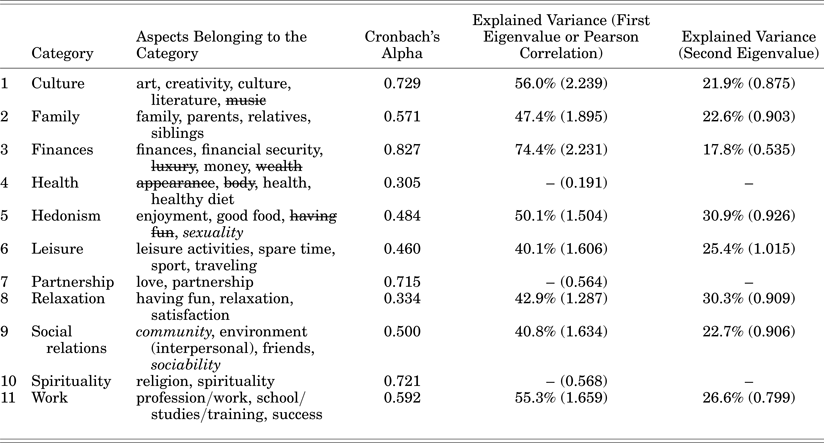
Two independent raters (VD, MF) developed 11 a-posteriori categories out of these aspects in a feedback process of development and discussion with the other authors (Table 3): culture, family, finances, health, hedonism, leisure, partnership, relaxation, social relations, spirituality and work. To represent independent aspects of MiL experience, these a-posteriori categories were tested for their unidimensionality: if they failed to be unidimensional, they were modified in an iterative process (discussion and review by VD, MF with factor analysis, Pearson correlation). During this process, some items were deleted (in the categories of finances, health, and culture), added (in the category of social relationship), or both (in the category of hedonism). Six categories did not have to be modified (family, partnership, work, leisure, relaxation, and spirituality), as they already met unidimensionality (Table 3).
Eleven unidimensional categories. Excluded items are crossed out. Added items are in italics
The final model included 11 categories with 34 aspects. Pearson coefficients, scree plots and Kaiser criteria of exploratory factor analyses confirmed the unidimensionality of these categories. Explained variances of the first principal components of each category were above 40% (Table 3). Some 22 aspects (plus children and grandchildren) were not assigned to the categories and were not included in the further analyses (41.4%). The internal consistency (Cronbach's alpha) of the categories can also be found in Table 3.
Multidimensional Scaling
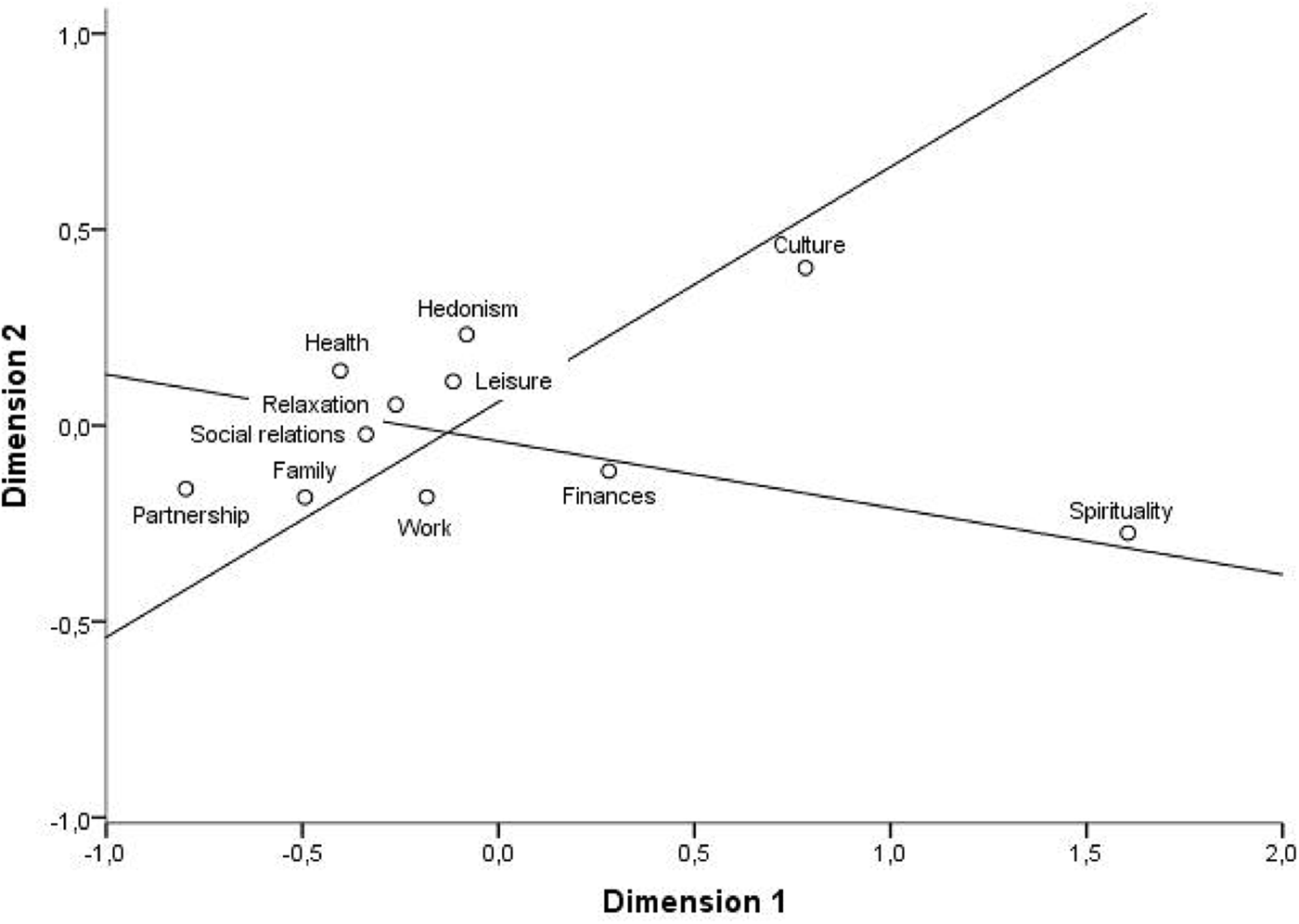
The proximities of the categories were analyzed with MDS. The MDS diagram (Figure 2) shows four areas in polar regions: (1) partnership, social relations, and family; (2) hedonism, leisure, relaxation, and health; (3) culture and spirituality; and (4) work and finances. Stress I (factor for best scaling = 1.004) was 0.06, Stress II (factor for best scaling = 1.004) was 0.1, and S Stress (factor for best scaling = 1.001) was 0.005.
Two-dimensional map of the 11 a posteriori categories (multidimensional scaling).
Cluster Analysis
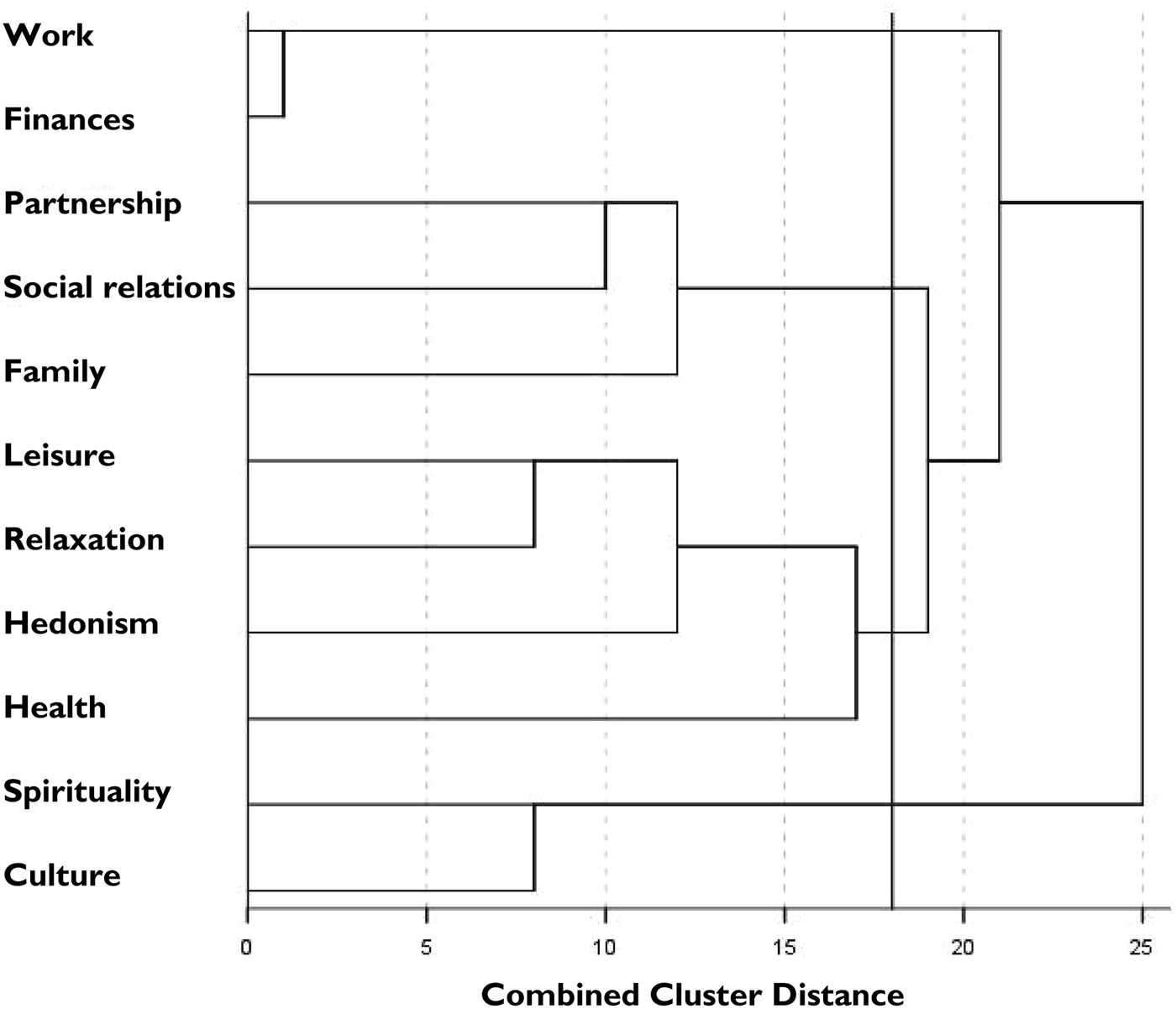
To confirm the MDS findings and to identify clusters of categories in the MDS map, an additional cluster analysis was performed. The dendrogram in Figure 3 visualizes the similarity of category subgroups and provides the splits in the MDS map resulting in four distinct clusters.
Cluster analysis dendrogram of the 11 categories.
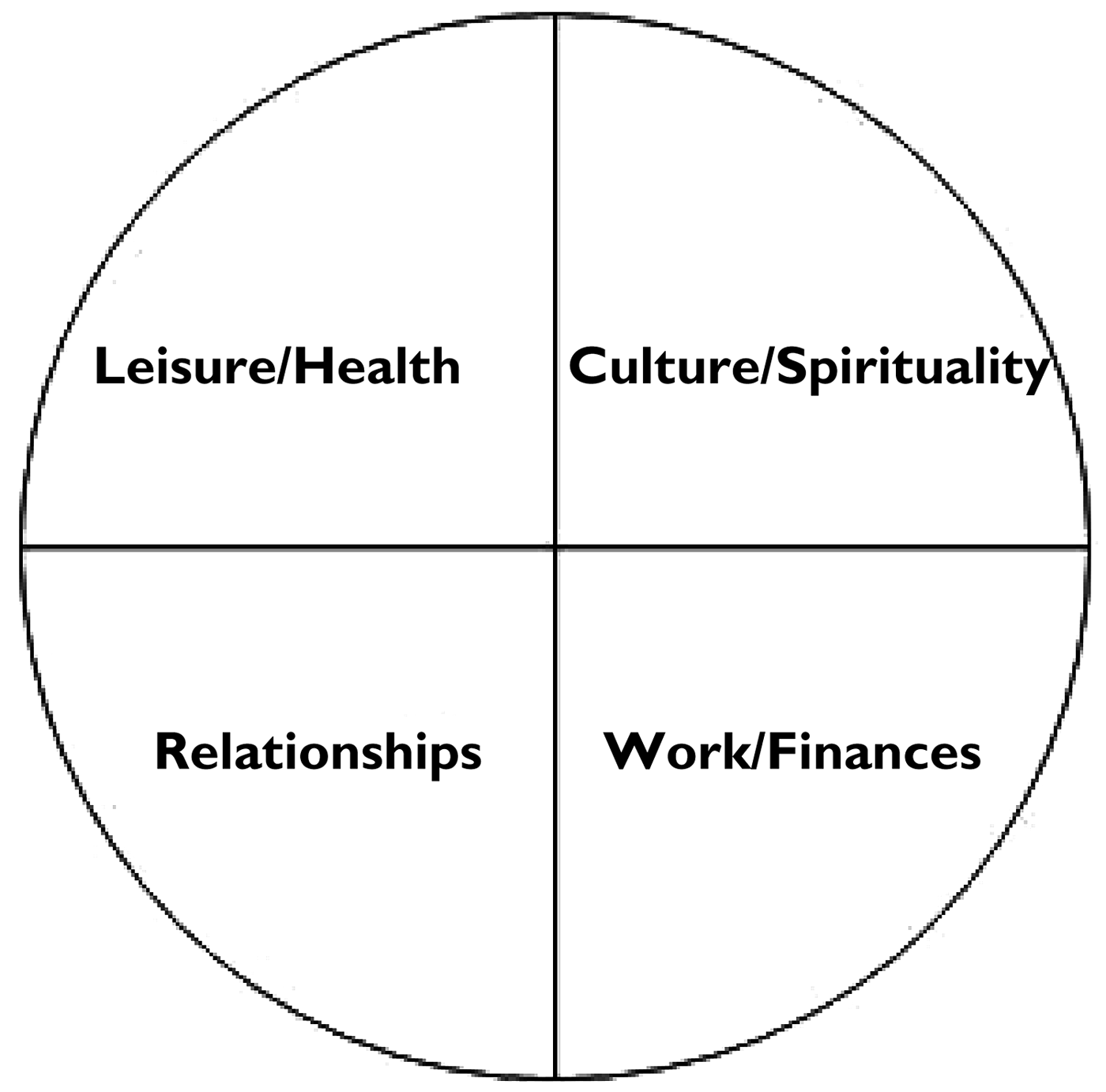
In summary, cluster analysis and MDS of the MiL categories resulted in a circumplex model of MiL consisting of four domains (Figure 4): (1) relationships, (2) leisure/health, (3) culture/spirituality, and (4) work/finances.
Circumplex model of MiL experience.
DISCUSSION
In a representative German survey, the individual responses to an open-format MiL questionnaire were assigned to 39 a-posteriori aspects (Fegg et al., Reference Fegg, Kramer and Bausewein2007). These aspects and 19 further aspects collected in additional studies were analyzed to identify a latent structure (Kudla et al., Reference Kudla, Kujur and Tigga2014; Stiefel et al., Reference Stiefel, Krenz and Zdrojewski2008; Monforte-Royo et al., Reference Monforte-Royo, Tomás-Sábado and Villavicencio-Chávez2011; Brandstätter et al., Reference Brandstätter, Kögler and Baumann2014). The final model comprised 11 independent higher-order MiL categories combined into a circumplex MiL model. This model consisted of four polar regions comprising 58.6% of all MiL aspects listed so far in studies using the SMiLE assessment: (1) relationships (including family, partner, and social relations); (2) leisure (including hedonism and relaxation) and health; (3) culture and spirituality; and (4) work and finances. The resulting four-quadrant model juxtaposes “relationships” versus “culture/spirituality” and “leisure/health” versus “work/finances,” indicating the dissimilarity of these domains in the two-dimensional space.
Other researchers used a predefined set of variables to assess MiL (DeVogler & Ebersole, Reference DeVogler and Ebersole1983; Ebersole & DePaola, Reference Ebersole and DePaola1987; Yalom, Reference Yalom1980; Reker & Wong, Reference Reker, Wong, Birren and Bengston1988): (1) relationships (to family members, partner, and friends); (2) hedonism/leisure activities/hobbies; (3) creativity (art/music); (4) belief/spirituality/religion; (5) material possessions; (6) altruism/service to others; and (7) self-realization/personal development. The last two categories were not reproduced in our study; work, home, health, and relaxation were additionally found. The current model results from a “bottom–up” approach, including individual responses to an idiographic MiL measure.
The number of content categories in other MiL studies varied from 7 to 13 (Brandstätter et al., Reference Brandstätter, Baumann and Borasio2012). There is considerable overlap between the meaning structure revealed in the current study and the categorization approaches applied by Prager (Reference Prager1996), Schnell (Reference Schnell2009), Burbank (Reference Burbank1992), and Takkinen and Ruoppila (Reference Takkinen and Ruoppila2001). Other authors have developed distinctly different categorization schemes (Pohlmann et al., Reference Pohlmann, Gruss and Joraschky2006; Wong, Reference Wong, Wong and Fry1998; Debats, Reference Debats1999; Dittmann-Kohli & Westerhof, Reference Dittmann-Kohli and Westerhof1997; DeVogler & Ebersole, Reference DeVogler and Ebersole1980), most notably including categories like beliefs, growth, personal well-being, service, self-actualization, and self-transcendence. Other instruments cover similar meaning areas without sorting them into categories (Prager, Reference Prager1996; Kernes & Kinnier, Reference Kernes and Kinnier2008). The areas of relationships and work/achievement/life task seem to be common to most approaches.
Our study was based on the importance university students ascribed to each MiL aspect for their overall MiL experience. It is possible that all four domains need to be somewhat fulfilled to achieve a certain level of life satisfaction or meaning fulfillment. Future studies should therefore investigate whether all four domains need to be covered as a prerequisite for MiL fulfillment. Coping studies, however, show that critical life events seem to provoke a “response shift,” for example, in patients suffering from incurable diseases (Sprangers & Schwartz, Reference Sprangers and Schwartz1999). Under extreme life circumstances (e.g., terminal disease), certain areas are focused upon by patients (e.g., close relationships), while other areas decrease in importance (e.g., wealth) (Fegg et al., Reference Fegg, Kramer and l'Hoste2008). Under these conditions, imbalances in the importance of the described MiL domains will arise during this adaptation process.
Our study has several limitations. The sample consisted of medical students with a specific educational level and age group. The findings are therefore not representative for healthy subjects or special populations (e.g., patient samples). We decided to test our method and statistical approach before enrolling a larger sample into a cost-intensive trial. Even in this particular sample, our results are comparable to other MiL studies. Two items (children and grandchildren) that had to be excluded might be subsumed into the category “family” in future investigations (Fegg et al., Reference Fegg, Kramer and l'Hoste2008).
Additional studies should investigate the validity of this model in other samples and add more dimensions if necessary. Studies should also include subjects suffering from meaning loss (e.g., palliative care patients and their caregivers) (Brandstätter et al., Reference Brandstätter, Kögler and Baumann2014). Furthermore, crosscultural designs including different countries, religions, and ethnicities could contribute to identifying potential universals in the experience of MiL. MiL aspects, categories, and domains may have to be amended in these contexts. A recent study using the SMiLE in India reported four additional culture-specific categories: passing on knowledge, social commitment, desires, and connection to community (Kudla et al., Reference Kudla, Kujur and Tigga2014).
An integrating MiL model may also be helpful in a psychotherapy context to support patients suffering from meaning loss: (1) patients might benefit from psychoeducation comprising the various Mil domains, (2) positive activity plans might be implemented to promote meaning-giving areas, and (3) imbalances can be identified and might be influenced using cognitive–behavioral or other psychological support.
Some 22 aspects (41.4%) were not assigned to categories, as they may reflect more subjective and non-universal aspects of MiL experience. It is important to keep in mind that MiL experience can still be described as individual experiences using idiographic approaches. The resulting categories and domains of this model only reflect the universal portion of MiL experience that can be used for interindividual comparisons. The strength of idiographic instruments is to explore individual experiences that will not comprehensively fit into classes, which will need to be reported in addition to the universal MiL aspects.
The current study shows that the chosen methodology was able to identify a latent MiL structure, and can now be applied to further studies. The new categories and the circumplex model may be a first step toward improving the understanding of prevalent MiL areas and to help integrate the large number of different approaches to this construct.
ACKNOWLEDGMENTS
The authors are grateful to Olga Hildebrandt for her statistical support.
CONFLICTS OF INTEREST
The authors declare that they have no conflicts of interest to declare.