Introduction
Patient choice is a concept linked with treatment decisions,Footnote 1 access to healthcare funding,Footnote 2 and the doctor-patient relationship.Footnote 3 This paper adopts a patient choice perspective to examine how the relationship between the National Health Service (NHS) and supplementary private healthcare sector has shaped the recent competition reforms of the English NHSFootnote 4 in the Health and Social Care Act 2012 (the 2012 Act)Footnote 5 and regs 11–13 of the National Health Service (Procurement, Patient Choice and Competition) (No 2) Regulations 2013 (the 2013 Regulations)Footnote 6 introduced by the Conservative/Liberal Democrat coalition government (2010–2015). This perspective not only helps explain why such reforms are difficult to implement, but also demonstrates that the NHS-private healthcare relationship is at its most beneficial when cast in collaborative, even symbiotic, rather than competitive, terms.
Interaction between the NHS and the private healthcare sector attracts regular media attention due to its wide relevanceFootnote 7 and the antithetical juxtaposition of universal access and a ‘two-tier’ system – with descriptions such as ‘going private’ (understood here as a patient opting for private rather than NHS treatment)Footnote 8 or ‘NHS privatisation’ (typically referencing the expansion of private sector delivery of NHS services from the early 2000s onwards).Footnote 9 Thus patient choice of NHS or private provider, specifically in the contexts of patients moving between the NHS and private healthcare sector and within NHS competition reforms, deserves more attention than it has hitherto received from the academic law community.Footnote 10 Questions of applicability of competition law to the NHSFootnote 11 have been considered, but movement between the NHS and private healthcare has been examined in the context of an overview of the NHS,Footnote 12 or from the perspective of allocation and public law rather than competition.Footnote 13 The private healthcare sector has also received little academic attentionFootnote 14 – although this may change with greater availability of information about private providersFootnote 15 following the Competition and Markets Authority (CMA)’s 2014 Private Healthcare Market Investigation.Footnote 16
This examination is timely given ongoing NHS cuts and calls for reform of the 2012 Act market regulation frameworkFootnote 17 following the renewed focus on integrated care models in the NHS Five Year Forward View introduced in October 2014 and current development of Sustainability and Transformation Partnerships (STPs). The current development of the private healthcare sector by the CMA, coupled with growing interest in this by the Care Quality Commission (CQC)Footnote 18 and recent concerns about patient safetyFootnote 19 may also have implications for patient choice.
The paper proceeds as follows. Section 1 sets the scene by outlining the relationship between the NHS and private healthcare in terms of ‘going private’ and ‘NHS privatisation’. Section 2 builds on this by setting out two frameworks for patient choice within English healthcare: between the NHS and private healthcare, and within the NHS. Section 3 analyses the contested relationship between patient choice and competition. Section 4 examines patient choice within the context of the 2012 Act reforms and the CMA's 2014 Private Healthcare Market Investigation. The paper concludes by highlighting implications for the provision of services to patients and the surrounding policy regarding patient choice arising from the predominance of patient choice between the NHS and private healthcare.
1. Setting the scene: ‘going private’ and ‘NHS privatisation’ – the controversial relationship between the NHS and private healthcare in England
Recent competition reforms of the English NHS can be understood by reference to accessing healthcare provision, and to controversies attached to the underlying commitment to the principle of universal access. To this end, two colloquialisms – ‘going private’ and ‘NHS privatisation’ – are used to frame the discussion, although the defining lines between these may be more blurred in practice.Footnote 20
‘Going private’ refers to the situation where a patient entitled to NHS treatment decides to pay to receive treatment from an NHS or private provider, typically to avoid lengthy waiting lists, but may include instances where patients pay for treatment not available on the NHS. This can involve patients using private medical insurance (PMI), or their own resources as ‘self-pay’ patients. Patient choice and movement between the NHS and private healthcare sector involves a change in classification – from ‘NHS patients’ to ‘private patients’. This is in line with the need, found in legislationFootnote 21 and policy guidance, to maintain a strict separation between the two, and to avoid perceptions of NHS funding being used to subsidise private care.
This type of patient choice is governed by Department of Health (DoH)Footnote 22 policy guidance developed during the New Labour era (1997–2010). However, following the 2012 Act reforms, these policy documents have shaped more recent NHS EnglandFootnote 23 guidance and are currently being adopted by the Clinical Commissioning Groups (CCGs)Footnote 24 established by the 2012 Act. This raises questions about the fitness for purpose of this guidance in an environment which has seen at least two significant changes in the past ten years.
First, the 2012 Act reforms included the establishment of NHS England and NHS Improvement,Footnote 25 with the aim of reducing day-to-day governmental oversight of the NHS. Nevertheless, the government sets the overall policy direction for NHS England via the NHS Mandate. It is to be noted that, as recently as March 2018,Footnote 26 the Conservative government demonstrated commitment to the founding principles of the NHS – namely, as a service based on clinical need, not the ability to pay.
However, the existence of these agencies and plans to develop new care models (such as Accountable Care Organisations) have raised questions about how such commitment can play out in practice and the future extent of the Secretary of State for Health's duty to promote a comprehensive health serviceFootnote 27 in the unfolding post-2012 Act landscape.Footnote 28
Secondly, the private healthcare sector has been undergoing development in two – related, yet discrete – ways: by the 2012 Act potentially providing for the expansion of Private Patient Units (PPUs) operated by NHS Foundation Trusts,Footnote 29 and by the CMA's 2014 Market Investigation. The use of NHS facilities to treat private patients is not new: a ‘peculiarly British compromise’Footnote 30 of ‘pay-beds’ in NHS hospitalsFootnote 31 was reached by provision being made by the National Health Service Act 1946, s 5 for consultants to continue private practice alongside their NHS workload in order to implement the NHS.Footnote 32 A more recent development is the CMA taking enforcement action against NHS providers operating in the private healthcare market, evidenced in 2017 with regard to providing information to facilitate choice by private patients.Footnote 33
This places doctors advising patients about moving from the NHS to the private sector in a more complicated regulatory landscape than that envisaged by the policy documents now used by the CCGs. Furthermore, the DoH/CCGs and the CMA appear to continue to produce guidance and frameworks largely independent of each other, when clearly there is a need for each to acknowledge the other to a greater extent.
This development of patient choice and movement between the NHS and private healthcare sector has produced a complex dynamic. It is true that Hirschman's modelFootnote 34 can be used to a limited extent to analyse patients demonstrating ‘loyalty’ to the NHS, expressing ‘voice’ to encourage responsiveness, or ultimately opting for ‘exit’ by ‘going private’. This appears consistent with wider social trends towards consumerism, and perceptions in other public-private systems that private sector competition produces better quality of careFootnote 35 may hold in England as well. However, the model does not allow for the underlying link found in advertisements for PPUs in NHS Foundation Trust hospitals: ‘by choosing to go private you can also help the NHS’,Footnote 36 and considerations that the framework underpinning patient movement and referral between the NHS and private healthcare is such as to inhibit clear directions of travel towards either consumerism or mutualism.Footnote 37 Furthermore, the idea of ‘going private’ becomes simplistic in light of the reverse direction of travel: when private patients are transferred to NHS hospitals. Such movement from the private healthcare sector to the NHS may be motivated more by clinical need – for example because an emergency situation arises – than consumer behaviour. Nevertheless, metrics relating to such referrals are to be included in information made available to private patients,Footnote 38 which may suggest that these may influence a patient's choice of a specific private provider, or even the decision to ‘go private’.
This wider relationship between the NHS and the private healthcare sector and patient choice within this has provided a backdrop for implementing competition reforms, in particular the expansion of private sector delivery of NHS services – or ‘NHS privatisation’ – in the early twenty-first century.Footnote 39 Indeed the link was made explicit by Tony Blair:
The overriding principle is clear. We should give poorer patients … the same range of choice [ie of a private provider] the rich have always enjoyed.Footnote 40
Thus under New Labour's choice and competition agenda,Footnote 41 NHS patients were encouraged to exercise choice of an NHS or private provider in respect of a first outpatient appointment for elective referrals, to support the expansion of private sector delivery of NHS services.Footnote 42 This policy was subsequently put on a statutory footing – thus ‘juridified’Footnote 43 – by the coalition government enacting the 2013 Regulations.Footnote 44 Patient choice was further ‘enshrined’ by the NHS ConstitutionFootnote 45 under New Labour, and this document has been retained and updated by subsequent governments, most recently in 2015.
However, what might be considered ‘NHS privatisation’ extends beyond patient choice policies, further blurring the distinction with the concept of ‘going private’. This is because ‘privatisation’ can be considered a misnomer insofar as a distinction can be drawn between private providers undertaking work for the NHS, and an NHS provider being taken into private ownership.Footnote 46 Examples of the former can be seen from the inception of the NHS in 1948, and include elective, diagnostic, musculoskeletal, pharmaceutical and children's services,Footnote 47 supporting the view that the relationship between the NHS and private healthcare sector is at its best when cast in a collaborative light. Perhaps the closest example of the latter is still to be found in recent experiments with franchising arrangements which met with limited success.Footnote 48 Insofar as NHS patients may not be aware that a private provider is delivering the service they are receiving, such examples of public-private interaction need to be seen ultimately as separate from patient choice within the contexts either of ‘going private’ or ‘NHS privatisation’.
By examining patient choice in the context of recent NHS competition reforms (‘NHS privatisation’) and the wider relationship between the NHS and the private healthcare sector (‘going private’), this paper builds on Whiteman's and Sheppard's conceptions of patient choice as, respectively, ‘fallacious’Footnote 49 or ‘functional’,Footnote 50 to show how the present narrow, competition-related understanding of patient choice can be considered fallacious and yet functional.
Patient choice can be considered ‘fallacious’ in the context of ‘going private’, because the choice may not necessarily be between two identical treatment options. In this sense a patient paying for drugs not available on the NHS can be distinguished from a patient paying for a scan in order to avoid NHS waiting lists. Patient choice can also be considered ‘fallacious’ in the context of ‘NHS privatisation’ because the availability of such choice in a given region may be restricted, or because, as will be seen, motivation for implementing patient choice policies may lie as much with a private provider as a patient.
Patient choice can perhaps most obviously be considered ‘functional’ in the context of ‘NHS privatisation’ as providing the necessary demand function to balance the expanded private sector supply of NHS services, thus underpinning competition reforms both under New Labour and subsequently the 2012 Act. However, the ‘functionality’ of patient choice in maintaining, and even developing, the wider relationship between the private healthcare sector and the NHS should not be underestimated. The symbiotic nature of this relationship may be attributed in part to the supplementary nature of private healthcare and PMI,Footnote 51 which creates a situation in which governmental support for the NHS may influence access to private healthcare. This has been recognised previously by the competition authority:
The NHS dominates healthcare in the UK. Without it private elective and acute healthcare would not exist in its present form, and it must be seen in this context.Footnote 52
More recently, private healthcare companies have also effectively acknowledged this by using income from NHS contracts to compensate for a decline in private patient numbers during the economic crisis.Footnote 53 Indeed, at the time of writing (September 2018), the additional dynamic of the NHS supporting private healthcare providers by encouraging CCGs to refer NHS patients has featured in the general media.Footnote 54
This background of interaction between the NHS and the private healthcare sector, and its influence on recent competition reforms, means discussion of patient choice can now be structured around two frameworks.
2. Conceptualising patient choice within two frameworks
This section builds on the foregoing by outlining two frameworks for patient choice: between the NHS and the private healthcare sector, and choice within the NHS, which can be linked to ‘going private’ and ‘NHS privatisation’, respectively.
(a) Patient choice between the NHS and private healthcare sector – the ‘NHS patient – private patient’ framework
Patient choice between the NHS and private healthcare sector has been governed by successive sets of rules from the mid-1980s onwards,Footnote 55 and finds its current expression in NHS England guidanceFootnote 56 which acknowledges earlier DoH policy documentation.Footnote 57 There are two aspects to this guidance, namely, clarification of when (and where) patients may choose to move between the NHS and private healthcare sector, and who may be involved in giving effect to the choice.
Overall, much is made of the underlying principles of the NHS as a service based on clinical need, not the ability to pay, and the consequent need to avoid real or perceived instances of private healthcare being subsidised by the NHS. NHS England conceptualises this as ‘co-funding of NHS care’,Footnote 58 which is prohibited, and is defined as
… any arrangement under which the cost of an episode of care within the NHS (for example an out-patient visit, an operation, etc) is part funded by an NHS commissioner and part funded privately by the patient.
Thus, prima facie, a patient is not permitted to receive both NHS and private treatment within a single episode of care. This appears to reflect a previous policy direction, namely, that ‘either NHS care or private care’ is available, and patients lose their entitlement to NHS care while they are purchasing additional treatment.Footnote 59 However, the present situation appears more nuanced, such that at least two permutationsFootnote 60 are conceivable for patients to receive NHS and private care at the same time: either in the same setting, or in a separate setting. A clear example of receiving NHS and private care in the same setting would be ‘top-up’ payments to receive drugs not routinely available on the NHS following recommendations expanding access to private drugs for NHS cancer patients.Footnote 61 With regard to receiving NHS and private care in different settings, NHS England guidance is explicit that:
If a patient is an in-patient at an NHS hospital, any privately-funded care must be delivered to the patient in a separate building or separate part of the hospital, with a clear division between the privately-funded and NHS-funded elements of the care, unless separation would pose overriding concerns regarding patient safety.Footnote 62
The separation of treatment setting also means a differentiation in patient status: patients who have started private treatment (‘private patients’) are able to move back into the NHS (and be classified as ‘NHS patients’), and are treated as if they had commenced their treatment with the NHS.Footnote 63
Whilst distinctions between treatment settings and patient status are key to patient choice within the ‘NHS patient-private patient’ framework, other factors are involved. Notably, DoH guidance about managing the separation of NHS and private healthcare further distinguishes between a doctor (consultant) initiating discussions about providing private services for NHS patients, and a patient seeking information about how to access a private treatment option.Footnote 64 It states unequivocally that:
In the course of their NHS duties and responsibilities consultants should not initiate discussions about providing private services for NHS patients, nor should they ask other NHS staff to initiate such discussions on their behalf.Footnote 65
Guidance by the British Medical Association (BMA)Footnote 66 reflects this, elaborating that
‘… it is not appropriate for consultants to:
• use their NHS patient lists to initiate discussion about their private practice;
• suggest to patients who are placed on a waiting list for NHS treatment that the treatment could be provided more quickly on a private basis;
• raise the issue of private practice obliquely, for example by handing the patient a business card containing the address of both the NHS hospital and the doctor's private consulting rooms, or adding the private clinic address to NHS letterheads’.
However, once a patient initiates discussions about private treatment, both the DoH and BMA guidance make clear that NHS doctors should provide full and accurate information about the private services they or their NHS organisation can provide.Footnote 67 Thus, consistent with the rules about keeping NHS and private treatment as separate as possible, the onus appears to be on the patient to exercise choice of NHS or private provider.
Despite this apparent clarity, the extent to which such distinctions are maintained in practice appears unclear. Indeed, the BMA acknowledges that, from a patient's perspective, maintaining a strict separation between NHS and private healthcare (in terms of what can be said in what context) may appear unduly bureaucratic.Footnote 68 As part of the research underpinning what became the CMA's Private Healthcare Market Investigation, data was collected from a sample of 40 patients about ‘the patient journey’ from the NHS into the private healthcare sector. Within this sample, four ‘pathways’ were identified: led by GPs; NHS hospitals; PMI companies; and patients themselves. The following trends were observed: the GP-led pathway comprised 19 patients, the self-led pathway 12 patients, the NHS hospital-led pathway five patients and the PMI pathway four patients.Footnote 69 Whilst the sample size may raise questions, the study is useful for testing assumptions about when and how patients access private healthcare, since information about this within the English context is limited.Footnote 70 It is unsurprising that most patients should opt for the ‘GP-led’ pathway in view of the ‘gatekeeper’ function which GPs serve within English healthcare. In other words, the GP would make a referral of a patient to a private provider, and it may typically be only at that stage that the patient contacts their PMI provider.Footnote 71 In contrast, it appears possible for ‘self-pay’ patients to contact a private provider directly.Footnote 72 More notable is the relatively limited role for consultants in facilitating a patient journey from the NHS into private healthcare,Footnote 73 and the discrepancy between ‘self-pay’ patients and PMI companies. The limited function of PMI companies can perhaps be explained by the link established between NHS use of private providers (leading to a decrease in waiting times) and decreased demand for PMI,Footnote 74 coupled with more general considerations such as the risk rating of insurance premiums and eligibility requirements.Footnote 75
The foregoing gives an insight into the complexity of NHS-private healthcare interactions in view of the hurdle of the ‘co-funding’ prohibition. A recent Private Member's BillFootnote 76 proposes to permit ‘co-funding’, and this may appear to offer a ‘quick fix’ to the seemingly intractable problem of managing access to both NHS and private healthcare. However, in view of the wider regulatory landscape encompassing both the NHS and private healthcare sector, and the sensitivities attached to the NHS in particular, this should be treated with significant caution.
(b) Patient choice within the NHS – the ‘NHS patient choice’ framework
This framework is concerned with the scope for NHS patients to exercise choice of provider within their NHS treatment. It is underpinned by related, yet discrete, narratives emerging from legislation and policy documentation, specifically the NHS Constitution and the 2013 Regulations relating to patient choice.
(i) The NHS Constitution
NHS patients have ‘rights’, including choice, enshrined in the NHS Constitution.Footnote 77 The rights regarding ‘informed choice’ can be linked to a wider legal basis with regard to patients choosing GP practice, expressing a preference for a particular doctor within a GP practice, and having access to transparent data to facilitate choice.Footnote 78 Of particular relevance to the present discussion is the ‘right’ for NHS patients to make choices about the services commissioned by NHS bodies,Footnote 79 and the suggestion that the options available will develop over time and depend on individual needs.Footnote 80 This suggests a clear focus on patients, but does not clarify the nature of the choice available, and appears constrained by NHS England guidance:
Choice does not mean that a patient can change commissioning policy by seeking to extend the range of treatments the NHS is prepared to commission or fund for that patient or for patients generally.Footnote 81
(ii) The 2013 regulations
The rights of NHS patients to choose an NHS or private provider are also protected in the context of competition reforms by the 2013 Regulations which create standing for a potentially wide group of possible complainants – ‘providers, patients and other third parties’ – to ask NHS Improvement to investigate a decision by a CCG or NHS England.Footnote 82 The 2013 Regulations comprise a frameworkFootnote 83 establishing a general procurement objective and requirements which is supplemented by specific provisions relating to procurement, patient choice and competition. The provisions relating to procurementFootnote 84 and anticompetitive behaviourFootnote 85 in particular, have raised questions about whether these comply with EU law,Footnote 86 with it being suggested that the procurement provisions offer at most an alternative recourseFootnote 87 to general public procurement rules for disgruntled bidders.
The patient choice regulations relate to choice of primary care providerFootnote 88 and choice of alternative provider,Footnote 89 and are linked to duties enshrined in the National Health Service Commissioning Board and Clinical Commissioning Groups (Responsibilities and Standing Rules) Regulations 2012 (the 2012 Regulations).Footnote 90 The 2013 Regulations grant NHS Improvement power to investigate a complaint under certain Standing Rules (SRs) of the 2012 Regulations.Footnote 91 These SRs impose on CCGs and NHS England duties which enshrine previous patient choice policies, namely, patients requiring an elective referral must be offered a choice of provider in respect of their first outpatient appointment,Footnote 92 and arrangements must be made to ensure that the availability of this particular choice is publicised and promoted.Footnote 93 There is also a transitional provision relating to the responsibilities of CCGs where such choice is not offered.Footnote 94
Whilst these duties are wide-ranging, specific exceptions apply to the duty to publicise and promote the availability of choice,Footnote 95 namely in respect of cancer services subject to the two-week maximum waiting time, maternity services or mental health services,Footnote 96 or any service requiring urgent care.Footnote 97 Additionally, such choice is not extended to any person detained under the Mental Health Act 1983, detained in or on temporary release from prison, or serving as a member of the armed forces.Footnote 98
At the time of writing (September 2018), no recourse has been had to the 2013 Regulations governing patient choice of primary care provider or alternative provider.Footnote 99 The sole case to date involving the 2012 RegulationsFootnote 100 regarding the commissioning of elective services in the North-West of EnglandFootnote 101 is discussed in Section 4 below.
(c) Overview – where can choice between the NHS and private healthcare be exercised in light of the two frameworks?
The ability of patients to exercise choice of NHS or private provider has changed over time and continues to develop as boundaries between NHS and private healthcare become more porous. As scope for movement between the NHS and private healthcare (and indeed, the development of competition reforms) can vary across England, the present discussion is concerned with the general principles, rules and relevant law underpinning this movement, with general distinctions being drawn between primary and secondary healthcare provision.
(i) Primary healthcare provision – choice of general practitioner
From the inception of the NHS, the ‘gatekeeper’ function of GPs in accessing healthcare services established a need for patients to register with a GP practice. Indeed, the launch of the NHS was accompanied by the exhortation to ‘Choose Your Doctor Now’,Footnote 102 although this was understood in terms of forming an associational relationship that was professionally-oriented and long term,Footnote 103 rather than being linked with consumerism or development of competition. Nevertheless, choice of GP can be linked to both frameworks.
Within the ‘NHS patient – private patient’ framework, treatment of patients who pay to see a GP appears governed by the general DoH rules about separating NHS and private patients. This would suggest that a GP who sees private patients outside of NHS surgery times is not in breach of the rules discussed previously, since the separation between NHS and private patients is maintained. This appears to be the logic underpinning the recent creation of a GP practice catering exclusively for private patients.Footnote 104 Nevertheless, the subject appears particularly controversial,Footnote 105 and arguably rightly so in view of the GPs’ gatekeeper function, insofar as it may be difficult to distinguish between acting in a patient's best interests from a purely clinical perspective and avoiding any suggestion of benefits accruing to a GP or a private healthcare provider. Indeed, it is worth noting that referrals by GPs to private providers have been linked to questions of corruption regarding benefit and incentive schemes operated by the latter,Footnote 106 and to competition problems in the private healthcare sector.Footnote 107
Within the ‘NHS patient choice’ framework, competition reforms have also included examination of general practice with a view to improving the information available to patients and seeking to ensure that patients can exercise choice of GP.Footnote 108 Research conducted for NHS Improvement suggested that convenience, access and quality are key considerations for patients in selecting a GP.Footnote 109 This is significant in view of concerns that patients sometimes go to Accident and Emergency departments for relatively minor complaints, or when no GP appointment is readily available.Footnote 110 The preservation of patient choice is also identified as a factor that NHS Improvement will consider when reviewing whether collaborations between GP practices, or between GP practices and hospitals breach competition law, the public procurement rules or the 2013 Regulations.Footnote 111
(ii) Secondary healthcare provision: patient choice beyond GP referral
Choice within the ‘NHS patient – private patient’ framework is subject to a particular separation of NHS and private treatment. Examples given by DoH guidance suggest that, in practice, the circumstances in which a clear separation can be drawn are varied and flexible, ranging from a patient choosing to pay for an unfunded (private) cancer drug to be taken either in addition to, or concurrently with NHS chemotherapy treatment,Footnote 112 to a patient accessing private physiotherapy following a hip replacement operation on the NHS.Footnote 113 Consensus on where such a separation cannot be drawn emerges with the example of a patient needing a cataract operation and their request to insert a multifocal lens not routinely available on the NHS being declined.Footnote 114
Choice of NHS or private provider within the ‘NHS patient choice’ framework is more restricted, and limited to NHS patients exercising choice of provider in respect of a first outpatient appointment regarding elective care, or in instances where waiting times have been exceeded, as demonstrated by recourse under the 2013 Regulations.Footnote 115 Nevertheless, it appears that there is a greater onus on doctors to make patients aware of their ‘right’ to choose. Information about providers is available online as part of online booking systems such as the NHS e-Referral service,Footnote 116 as well as more generally via portals such as iwantgreatcare.org.
The foregoing discussions reveal certain common features in the guidance underpinning the ‘NHS patient – private patient’ and ‘NHS patient choice’ frameworks. For example, while questions of when and where patients may exercise choice are addressed to a certain extent, questions of who is the real agent exercising choice may emerge. Thus in the ‘NHS patient – private patient’ framework, the dynamic within the doctor-patient relationship may be questioned on a strict interpretation of the guidance, whereas in the ‘NHS patient choice’ framework, patients represent only one complainant with standing under the 2013 Regulations. Against these considerations, it is possible to examine how patient choice relates to competition.
3. Unpacking the relationship between patient choice and competition
As noted above, the New Labour patient choice policies provided a demand function to the supply function of expanding private sector delivery of NHS services. Although this suggests a clear link between patient choice and competition, the reality is more nuanced. Indeed, there may be more of a logical connection between patient choice and competition with regard to the ‘NHS patient – private patient’ framework than the ‘NHS patient choice’ framework. Factors examined here in determining this, include: the reconception of patients as ‘consumers’, and whether the CMA regards patients as the only healthcare ‘consumers’ in need of protection against anticompetitive behaviour; whether patient choice is a prerequisite for competition; and whether there is a link between patient choice and competition law (understood here as the provisions governing anticompetitive agreements and abuse of dominance).Footnote 117 This wide-ranging discussion requires a move beyond the two frameworks as follows.
(a) From two frameworks to four categories: who is the ‘consumer’ in English healthcare?
Reconceptualising patients as ‘consumers’ in NHS competition reforms raises at least two concerns. One is recognised in the context of citizenship, namely that ‘we do not come to the marketplace as equals’.Footnote 118 This reflects the controversies attached to the ‘NHS patient – private patient’ framework, notably the potential conflict arising from ongoing commitment to maintaining NHS healthcare provision on the basis of clinical need, not the ability to pay. A second concern is a shift in status from passive patients to active consumers,Footnote 119 which has implications for the doctor-patient relationship in both frameworks. Within the ‘NHS patient – private patient’ framework, the aforementioned DoH guidance may be interpreted as casting doctors in a somewhat paternalistic light by delineating a framework for sharing information with patients. This appears out of step with more recent developments – the 2012 Act reforms and CMA development of the private healthcare market – which appear to strengthen the patient's position. Further, this may be concerning since this guidance was produced against the backdrop of competition as conceived by New Labour, yet appears to be replicated without revision by CCGs in the post-2012 Act environment. Alternatively, the DoH and BMA guidance may be considered to strengthen a patient's hand in seeking access to private healthcare, with the doctor being re-cast as facilitator.
In contrast, within the ‘NHS patient choice’ framework, the doctor's role may clearly be construed as more paternalistic – by making patients aware that they may choose a private provider in certain circumstances. This is consistent with the logic that a ‘patients-as-consumers’ narrative may be misplaced in the context of the NHS, which – in contrast to the private healthcare market – can at most share only some standard market characteristics, with provider exit proving most controversial.
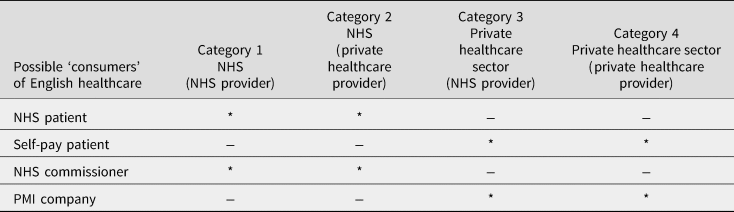
The ‘patients as consumers’ narrative is further complicated by the consumer function of NHS commissioners and PMI companies. Whilst the CMA distinguishes broadly between the NHS and private healthcare sector, two further permutations are necessary to reflect complex interactions: private providers treating NHS patients, and NHS providers treating private patients.Footnote 120 Who the ‘consumer’ is within these four categoriesFootnote 121 can be summarised as follows:
Table 1 shows that NHS patients may be considered consumers of NHS providers such as NHS Trusts or NHS Foundation Trusts (category 1), or of private healthcare providers who deliver NHS services (category 2). Categories 1 and 2 equate to the ‘NHS patient choice’ framework outlined above. NHS commissioners – NHS England for specialist services, and CCGs – are similarly consumers for categories 1 and 2. Conversely, PMI companies and private patients who use their own means (‘self-pay patients’) are consumers of the private healthcare market, whether treated by NHS providers or private healthcare providers in categories 3 and 4, respectively. Thus the ‘NHS patient – private patient’ framework reflects movement by a patient from categories 1 and 2 to categories 3 and 4, and the associated change in status (from ‘NHS patient’ to ‘private patient’) according to the aforementioned DoH and NHS England guidance.
Overview of possible candidates for the ‘consumer’ who exercises choice and where within the ‘four categories of English healthcare’.

Table 1 also suggests a distinction between NHS patients and private patients on the one hand, and NHS Commissioners and PMI companies on the other. This is deliberate since the latter are effectively acting as agents for patients to exercise choice – ‘choice’ as exercised by private or NHS patients themselves is restricted, respectively, to a relatively small selection of PMI providers operating across the UKFootnote 122 or to the NHS Commissioner available in a given geographical region.
Although PMI providers can be considered consumers of private healthcare, the focus here is on NHS patients, self-pay patients and NHS commissioners, as these have all been considered to serve a function analogous to consumers in the context of NHS competition reforms. Thus, in the context of the New Labour reforms, emphasis was placed on protecting both NHS patients and commissioners from anticompetitive behaviour.Footnote 123 The CMA has recognised ‘the NHS’ (explicitly comprising NHS commissioners, but presumably extending to NHS patients) as the ‘end customer’ in cases where large pharmaceutical companies have been found to engage in anticompetitive behaviour, for example by overcharging the NHS for particular drugs.Footnote 124 By recognising NHS commissioners as end customers, it appears possible to interpret this as relating, at least indirectly, to NHS patients. Nevertheless, a distinction perhaps emerges in arguments about NHS (commissioners) countervailing buyer power to constrain anticompetitive behaviour by suppliers in such cases.Footnote 125 Indeed, the explicit CMA recognition of NHS patients (as distinct from NHS commissioners) as consumers appears limited to using the ‘relevant patient benefits’ exceptionFootnote 126 to approve NHS Foundation Trust mergers against the backdrop of the current NHS policy focus on integrated care.
The foregoing discussion demonstrates that choice may be exercised not only by patients, but also by other parties acting as agents on behalf of patients, prompting questions of how patient choice links first to competition, as distinct from competition law, and then how patient choice relates to competition law.
(b) Is patient choice really connected to competition, as distinct from competition law?
Although patient choice between NHS and private healthcare provider is linked to the competition reforms of the ‘NHS patient choice’ framework above, it should properly be linked with the ‘NHS patient – private patient’ framework.Footnote 127 Indeed, the concept of prohibited ‘co-funding’ is key to understanding the controversy surrounding NHS competition reforms, since it raises the clear possibility of NHS core principles being undermined by different forms of cross-subsidy of private healthcare. Certainly the connection of patient choice and competition can depend upon the type of competition at issue,Footnote 128 competition in the market and competition for the market being most relevant here.
Competition in the market for healthcare provision involves patients playing a direct role in choosing a healthcare provider. Within English healthcare, this is most evident within the ‘NHS patient – private patient’ framework insofar as patients actively choose to ‘exit’ the NHS in favour of private provision. The extent to which NHS patients can choose a provider in respect of a first outpatient appointment may also be considered a limited form of competition in the market in the context of the ‘NHS patient choice’ framework.
In contrast, competition for the market of healthcare provision includes procurement activity in which providers bid for contracts awarded by NHS commissioners. This comprises much of the competition within the NHS.Footnote 129 The relationship between patient choice and competition for the market is contentious and the two may conflict,Footnote 130 as evidenced by the choice available to NHS patients being restricted to the (NHS or private) provider chosen by the NHS commissioner.
From the foregoing it can be inferred that it is possible to have provider competition without patient choice, and conversely, patient choice with limited (or no) provider competition. Thus, ‘patient choice can be seen either as having intrinsic value or as being instrumental to the attainment of policy goals’.Footnote 131 Intrinsic value may be illustrated by the option to receive different treatment, or the same treatment more quickly within the ‘NHS patient – private patient’ framework as this sees (private) provider competition ‘driven by a desire to promote choice for patients: choice of hospital or individual physician, choice of delivery setting and choice of treatment’.Footnote 132 Patient choice as instrumental to the attainment of policy goals clearly finds reflection in the competition reforms within the ‘NHS patient choice’ framework. Thus patient choice is linked with competition (both for or in the market, as the 2013 Regulations combine both aspects) because ‘competition between providers of healthcare only makes sense if there is choice on the demand side’.Footnote 133 Furthermore, patient choice has been considered secondary to the ultimate purpose of competition for NHS-funded services which is to stimulate greater efficiency and quality in their provision.Footnote 134 This can further be linked to the 2012 Act reforms by the coalition government's ultimate commitment to competition as a means to an end, not an end in itself.Footnote 135
However, even if a link between patient choice and competition can be established, it may be the case – counterintuitively – that the relationship between patient choice and competition law remains opaque.
(c) How does patient choice relate to competition law?
The provisions governing anticompetitive agreements and abuse of dominance form a generic framework within both EU and UK competition law.Footnote 136 In general terms, the prohibition on anticompetitive agreementsFootnote 137 is concerned with avoiding (healthcare) providers forming cartels and being able to fix prices or share information which would prove detrimental to consumers (patients). The prohibition on abuse of dominanceFootnote 138 seeks to restrict the individual or collective power of healthcare providers to act independently to the detriment of patients or their competitors. Distinctions emerge, however, in the extent of applicability of competition law to, respectively, healthcare providers and purchasers at EU levelFootnote 139(and thus also national level),Footnote 140 and to the private healthcare sector and the NHS at a national level.Footnote 141
The stated goal of EU competition law – and guiding principle for the CMAFootnote 142 – is enhancing consumer welfare,Footnote 143 but this concept remains a subject for discussion among competition lawyers.Footnote 144 In general terms, it is possible to equate enhancement of consumer welfare with lower prices or higher quality goods. However, its relevance to healthcare provision, and the English system in particular, remains unclear, but explains some of the concerns about the 2012 Act reforms leading to competition on price and a ‘race to the bottom’ regarding quality, which are surely to be distinguished from patient choice.
An alternative goal of ‘consumer choice’ has been formulated in the United States context,Footnote 145 with healthcare identified as a sector where choice is valued. Whether the ‘NHS patient – private patient’ framework can be interpreted as a model of competition in which the overall aim is to provide patients with choice is a moot point. Certainly the supplementary nature of private healthcare appears to support this, and its continued coexistence with the NHS may suggest that patients who are able to move between the two value this choice. Further, the CMA has recognised complex interactions between the private healthcare market and the NHS, which can be described simply and briefly as encompassing both private sector delivery of NHS services to treat NHS patients and NHS providers treating private patients (categories 2 and 3 in Table 1 above).
In view of the lack of understanding about what enhancing consumer welfare may mean in practical terms in the context of (English) healthcare, it is unsurprising that the relevance of patient choice to competition cases concerning healthcare providers should be equally unclear. Certainly it has been noted with regard to decisions at EU level that little reference is made to the effect of anticompetitive behaviour on patients as ‘end consumers’ of healthcare.Footnote 146
Overall, it appears that despite the bracketing together of ‘choice and competition’ under New Labour policies to legitimise the expansion of private sector delivery of NHS services, the two concepts may become increasingly separate following the 2012 Act reforms.
4. Patient choice in English healthcare and competition reforms
Recent competition reforms affect patient choice in English healthcare in two ways. First, in response to controversy surrounding the 2012 Act reforms, a version of New Labour patient choice policies was enshrined by the 2013 Regulations. This has been described as a ‘juridification’ of public policy,Footnote 147 and entails differing implications for patients to exercise choice. Secondly, a lesser-noted reform is found in the CMA's current development of the private healthcare market, and the operation of NHS providers within this. Taken together, these reforms prompt questions about the role of patients within, respectively, the ‘NHS patient choice’ framework and the ‘NHS patient – private patient’ framework following the 2012 Act reforms and the CMA's 2014 private healthcare market investigation.
(a) The 2012 Act reforms: a confused narrative about the role of patients in competition in English healthcare?
The competition provisions of the 2012 Act set out a framework comprising oversight and enforcement powers in respect of anticompetitive behaviour under general competition law,Footnote 148 market investigations,Footnote 149 mergers involving NHS Foundation Trusts,Footnote 150 and the ‘NHS-specific’ regime of the aforementioned 2013 Regulations.Footnote 151 Of these, only the 2013 Regulations make specific provision for patient choice. Thus far, only one case (involving CCGs in the North-West of England) has considered the patient choice regulations.
This case involved Spire, a private provider, alleging that the Blackpool CCG and Fylde and Wyre CCG had actively referred NHS patients away from its hospital, based on patient referral trends in previous years. Whilst the complaint incorporated all three patient choice standing rules (SRs) under the 2012 Regulations,Footnote 152 NHS Improvement established that there had only been a breach in respect of SRs 39 and 42 – choice of provider for first outpatient appointment, and publicity and promotion of the availability of choice, respectively. In respect of SR 39, NHS Improvement accepted undertakings for the CCGs concerned to ensure that GPs report the number of patients offered choice at their practice, and to take steps if areas for improvement are identified by annual patient surveys.Footnote 153 In respect of SR 42, NHS Improvement accepted undertakings by the CCGs to promote patient choice on the websites of the CCG and GP, and in GP premises, as well as producing promotional materials and conducting other promotional activities.
However, it is notable that Spire acknowledged that it could not be certain that patients would have chosen its hospital,Footnote 154 as this raises interesting considerations about the incorporation of private providers in delivering NHS services and patient switching behaviour. Offering NHS patients the opportunity to use private facilities may not be sufficient if patient choice of hospital is based primarily on convenience and an NHS provider requires less travel time. Polarised views about private healthcare and the NHS may also prove sufficient for some patients to favour a particular provider.
It might be considered that this case simply illustrates the highly formalistic approach of the 2012 Regulations and the 2013 Regulations as regards patient choice. However, it also gives insight into who would make use of the provisions, with the limited probability that it may be individual patients who pursue their entitlement to adequate information for making meaningful choices. Interestingly, such considerations also come into play with the CMA's current development of the private healthcare market.
(b) The CMA's 2014 private healthcare market investigation – providing information as a first step to promoting patient choice?
The CMA defines the private healthcare market in terms of NHS providers treating private patients via PPUs and private providers treating private patients (categories 3 and 4 in Table 1 above). NHS activity undertaken by private providers (category 2 in Table 1 above) is not included, although the CMA recognises that this forms part of the business model of some private providers.Footnote 155
The CMA's 2014 market investigation identified various aspects where there is an adverse effect on competition which hinders the market from working effectively. For the purposes of the present discussion, these related to the limited availability of information available to private patients which was considered to inhibit their ability to make choices between NHS and private providers. The CMA's remedy was to appoint the Private Healthcare Information Network (PHIN) as an ‘Information Organisation’ and to impose requirements on NHS and private providers to supply information. The intention is for data to be collated and made available on PHIN's website for private patients to access. Information to be provided comprises a range of performance measures disaggregated by procedure at both hospital and consultant level.Footnote 156 These relate, inter alia, to infection rates, mortality rates, unplanned patient transfers (from a private healthcare facility to an NHS facility), and procedure-specific measures of improvement in health outcomes.
At the time of writing (September 2018), the CMA has taken action against seven NHS Trusts and NHS Foundation TrustsFootnote 157 by issuing directions requiring these, inter alia, to share relevant data with PHIN, pay subscriptions to PHIN and start systematic collection of patient reported outcome measures (PROMs) specified by PHIN.Footnote 158 This intervention by the CMA intervention on behalf of patients as consumers of healthcare may be welcome as a step to facilitating patient choice in general terms, but may ultimately only benefit a minority of private patients, rather than the majority of the patient body (NHS patients).
Conclusions
This paper started from the premise that the concept of patient choice can offer mutual insights into movement between the NHS and private healthcare and recent competition reforms which have thus far been underexplored. By juxtaposing the ‘NHS patient-private patient’ and ‘NHS patient choice’ frameworks it has been possible to facilitate understanding and progress discussions of the complex and controversial subject of private healthcare and NHS interaction. This has led to three main insights.
First, the NHS patient-private patient framework as a basis for competition reforms (and the NHS patient choice framework) is problematic. Patients making choices between competing NHS and private alternatives does not provide a complete picture of varying availability across England. The NHS-private healthcare relationship is inescapably symbiotic and the development of future policy for providing services to patients needs to recognise this and acknowledge the collaborative elements: private providers need NHS work, and the NHS relies on private providers. Furthermore, implying that the ‘NHS patient -private patient’ framework represents a ‘model of competition’ must be accepted as reductive and simplistic, and future policy may need to acknowledge this.
Secondly, the question has been raised as to whether the DoH guidance shaped under New Labour offers a suitable basis for shaping current NHS England and CCG guidance regarding patient movement between the NHS and private healthcare sector. The intervening events of the 2012 Act reforms and 2014 CMA market investigation may suggest that the existing policy is less relevant in view of the refocusing each has entailed. It would be surprising if guidance which is now a decade old (or more) remains fit for purpose. Indeed, perhaps the NHS’ 70th anniversary offers a good opportunity to revisit the idea of GPs as gatekeepers giving advice to patients concerning the available options. The BMA has suggested that maintaining a strict separation between NHS and private healthcare may appear unduly bureaucratic. Furthermore, the argument that it may be difficult to distinguish between acting in a patient's best interests from a purely clinical perspective and avoiding any suggestion of benefits accruing to a GP or private provider may seem less persuasive if the alternative is to leave patients to muddle through without relevant, comprehensible information on which to base meaningful choices.
Finally, raising awareness of the distinction between competition (law) and patient choice is significant – and especially so when it can be suggested that the knitting together of the two may increasingly unravel following the 2012 Act reforms and the CMA's 2014 market investigation. This is not to deny that competition may help in driving up standards. Rather, the question is whether it is at the level of individual patient choice that improved standards can be set in motion. The Blackpool and Fylde and Wyre CCGs case suggests that private providers, not individual patients, may seek to ensure that adequate information is publicised regarding choice in the NHS patient choice framework, and the absence of further cases under the 2013 Regulations raises questions about how this can develop. The CMA's remedy of appointing PHIN and enforcing collection of data regarding private healthcare providers may similarly be considered limited – if ever intended to provide a comprehensive solution to facilitating patient choice in the NHS patient-private patient framework.
Author ORCIDs
Mary Guy, 0000-0003-0242-6366.