Introduction
This article reports on part of a research project dealing with the process of decision-making with regard to home care services for older people in Sweden, and brings the question of choice and control for older users to the fore.
A policy shift has taken place in Sweden towards more individualised elder-care with an emphasis on consumer choice (Government Bill 2008/09:29, 2009/10:116; Szebehely and Trydegård Reference Szebehely and Trydegård2012). On an ideological level this denotes a shift of focus from equality and solidarity to freedom of choice. Similar policies are seen in many other welfare states, such as the personalisation of social care in the United Kingdom (UK) and consumer-directed care in the United States of America (USA) (Lymbery Reference Lymbery2014; O'Rourke Reference O'Rourke2016; Ottmann, Allen and Feldman Reference Ottmann, Allen and Feldman2013; Wiener, Anderson and Khatutsky Reference Wiener, Anderson and Khatutsky2007). The policy intention is to give older people and other users increased choice and control over their everyday lives and the performance of care and services. Increased competition between providers is also expected to result in increased quality of the services provided (Moberg, Blomqvist and Winblad Reference Moberg, Blomqvist and Winblad2016; O'Rourke Reference O'Rourke2016; Pearson, Ridley and Hunter Reference Pearson, Ridley and Hunter2014; Szebehely and Trydegård Reference Szebehely and Trydegård2012). During the same period as the introduction of individualisation and marketisation of elder-care, reduced public resources and restrictions on expenditure have taken place in Sweden, as well as in many other countries (Lymbery Reference Lymbery2014; Szebehely and Trydegård Reference Szebehely and Trydegård2012). Thus, warnings have been given that the outcomes of individualised elder-care and consumer choice may differ from what was intended when it coincides with a long-term decline in resources (Glendinning Reference Glendinning2012; Lymbery Reference Lymbery2014; Rodriques and Glendinning Reference Rodrigues and Glendinning2015). However, knowledge about how the current Swedish policy of individualised elder-care works for older people who use home care services is scarce and thus we seek to contribute empirical findings to a debate often characterised by ideological argument.
The aim of the present study is to investigate how older users of home care services view and experience their opportunities of exerting influence and having choice and control in their everyday living, in terms of receiving preferred services that are flexible and responsive to their actual needs and priorities.
The Swedish elder-care context
Sweden is often characterised as a universal welfare state, with a system of support that is publicly financed through the tax system. The intention is to provide benefits and services, directed towards and used by all citizens regardless of socio-economic status, corresponding to the lifetime needs of its citizens (Esping-Andersen Reference Esping-Andersen1990; Sipilä Reference Sipilä1997). Older people's right to elder-care is established in legislation at the national level, through the Social Services Act (SFS 2001:453). Grounded on a prioritised policy of offering home care services that contribute and encourage older people to stay in their own homes for as long as possible, a significant reduction has taken place in available places in institutional settings relative to the increasing number of older adults (Dunér and Nordström Reference Dunér and Nordström2010; Szebehely and Trydegård Reference Szebehely and Trydegård2012).
Based on national policy and legislation, local authorities in 290 self-governing municipalities are responsible for the organisation of elder-care at the local level. In 2008, the Act on Free Choice Systems (Government Bill 2008/09:29) presented opportunities for municipalities to introduce provider choice, allowing users to choose between various authorised private and public providers of home care services. However, as opposed to direct payments in the UK and consumer-directed care in the USA, the Swedish free choice systems do not give older service users access to cash payments. Instead, the local municipal authorities make agreements with a varying number of public and/or private agencies providing care and services, which older people can choose between. As of April 2016, 158 Swedish municipalities have already implemented Systems of Choice and 18 were planning to do so (SALAR). In municipalities that have not introduced free choice systems, they have developed their own models of individualised elder-care within publicly provided home care services. Regardless of how municipalities have organised their elder-care, discretion is delegated to care managers by the municipal board of social welfare, and they are expected to make assessments and decisions according to more or less formalised local guidelines (Dunér and Nordström Reference Dunér and Nordström2006; Dunér and Wolmesjö Reference Dunér and Wolmesjö2015). If eligibility criteria are met, the care manager determines the type (home care services or institutional care) and amount (of different services or time allocated) of social care that can be granted (Dunér and Nordström Reference Dunér and Nordström2006, Reference Dunér and Nordström2010).
Previous research
Marketisation and consumer choice in elder-care have attracted both advocates and opponents. In policy analysis and ideological arguments, advocates have stressed the potential to empower older users, and increase both the quality and cost-effectiveness of social care (Duffy Reference Duffy2008; Ministry of Health and Social Affairs 2007; Moberg, Blomqvist and Winblad Reference Moberg, Blomqvist and Winblad2016; Woolham et al. Reference Woolham, Daly, Sparks, Ritters and Steils2016). Opponents have raised concerns about the risks of eroding the principle of universalism and of increasing inequality, as users with better finances and education may benefit the most from consumer choice (Clarke Reference Clarke2006, Reference Clarke2007; Rostgaard Reference Rostgaard2006; Szebehely and Trydegård Reference Szebehely and Trydegård2012). In addition, it has been suggested that current policies are a means of introducing neo-liberal ideologies into welfare services and of reducing user choice to the choice of provider as well as promoting choice as the preferred strategy for control (Clarke Reference Clarke2006; Rostgaard Reference Rostgaard2006; Roulstone and Morgan Reference Roulstone and Morgan2009; Woolham et al. Reference Woolham, Daly, Sparks, Ritters and Steils2016). Thus, some authors have emphasised that increased choice and control for older service users does not necessarily involve the marketisation of social care (Clarke Reference Clarke2006; Ottmann, Allen and Feldman Reference Ottmann, Allen and Feldman2013; Rostgaard Reference Rostgaard2006).
Studies from the perspective of older people have shown that when becoming users of home care services, older people want to maintain control of their everyday lives (Dunér and Nordström Reference Dunér and Nordström2005; Glendinning Reference Glendinning2008; Gunnarsson Reference Gunnarsson2009; Vernon and Qureshi Reference Vernon and Qureshi2000). Glendinning (Reference Glendinning2008) showed that older users' choices and decisions are constantly renegotiated due to changing circumstances and priorities. Furthermore, older people stress the importance of relational aspects, personalised and responsive care and services, and control over how and when services are delivered (Gabriel and Bowling Reference Gabriel and Bowling2004; Tester et al. Reference Tester, Hubbard, Downs, MacDonald and Murphy2004; Woolham et al. Reference Woolham, Daly, Sparks, Ritters and Steils2016). However, evidence from evaluations of personal budgets in the UK has suggested that the outcomes for older people are less favourable than for younger adults (Hatton and Waters Reference Hatton and Waters2012; Moran et al. Reference Moran, Glendinning, Wilberforce, Stevens, Netten, Jones, Manthorpe, Knapp, Fernandez, Challis and Jacobs2013; Netten et al. Reference Netten, Jones, Knapp, Fernandez, Challis, Glendinning, Jacobs, Manthorpe, Moran, Stevens and Wilberforce2012; Woolham et al. Reference Woolham, Daly, Sparks, Ritters and Steils2016). Still, some older service users have reported good levels of satisfaction with consumer-directed care in the USA as well as with personal budgets in the UK (Kane and Kane Reference Kane and Kane2001; Newbronner et al. Reference Newbronner, Chamberlain, Bosanquet, Bartlett, Sass and Glendinning2014; Ottmann, Allen and Feldman Reference Ottmann, Allen and Feldman2013; Rodrigues and Glendinning Reference Rodrigues and Glendinning2015; Wiener, Anderson and Khatutsky Reference Wiener, Anderson and Khatutsky2007). It has also been shown that older people often prefer fewer options, and tend to make active choices to a lesser extent than younger people (Mikels, Reed and Simon Reference Mikels, Reed and Simon2009; Reed, Mikels and Simon Reference Reed, Mikels and Simon2008). Previous studies also show that some older people, especially those with the highest care needs, have limited abilities to act as rational consumers (Glendinning Reference Glendinning2008; Lloyd Reference Lloyd2010; Lymbery Reference Lymbery2014; Meinow, Parker and Thorslund Reference Meinow, Parker and Thorslund2011). In such situations, support for decision-making may be required to allow users continued opportunities for choice and control (Glendinning Reference Glendinning2008; Mahoney et al. Reference Mahoney, Desmond, Simon-Rusinowitz and Loughlin2002; Newbronner et al. Reference Newbronner, Chamberlain, Bosanquet, Bartlett, Sass and Glendinning2014). Studies from the Swedish welfare context have shown that older people tend to adapt to the care managers' decisions about their home care services as well as the staff's ways of performing the care and services (Dunér and Nordström Reference Dunér and Nordström2005, Reference Dunér and Nordström2010; Gunnarsson Reference Gunnarsson2009; Janlöv, Hallberg and Petersson Reference Janlöv, Hallberg and Petersson2006; Persson and Berg Reference Persson and Berg2008). Moreover, paternalistic attitudes from staff together with organisational conditions may restrict older users' choice and control (Berglund et al. Reference Berglund, Dunér, Blomberg and Kjellgren2012; Dunér and Nordström Reference Dunér and Nordström2010; Olaison and Cedersund Reference Olaison and Cedersund2006; Persson and Wästerfors Reference Persson and Wästerfors2009).
There are very few studies evaluating the Swedish free choice system from the perspective of older service users. However, existing studies suggest that older people tend not to see the value of choosing between various, more or less anonymous, service provider agencies and very few change their initial choice of provider of elder-care (Edebalk and Svensson Reference Edebalk and Svensson2010; National Board of Health and Welfare 2015; Vamstad Reference Vamstad2016). In a recent study of older users of Swedish home care services with free choice systems, 13 per cent claimed that they did not know that they could choose their provider, and almost 25 per cent reported that the municipal authorities had in fact made the choice (Vamstad Reference Vamstad2016). However, other findings have implied that older people, especially those with higher income and educational levels, appreciate the opportunity to choose the provider of their care and services (Hjalmarsson and Norman Reference Hjalmarsson and Norman2004; National Board of Health and Welfare 2011, 2015). Furthermore, many users of home care services did not find the information received gave a sufficient basis for their choice of provider (Hjalmarsson and Norman Reference Hjalmarsson and Norman2004; National Board of Health and Welfare 2011, 2015), and an analysis of the information from providers showed that it provided little guidance for users to make informed choices (Moberg, Blomqvist and Winblad Reference Moberg, Blomqvist and Winblad2016). However, no previous Swedish studies have included the views and experiences of older users of home care services in municipalities which have adopted different models for organising their home care services.
Methods
Design and setting
The empirical data of this article derive from a larger study conducted in the local elder-care authorities of three municipalities in south-western Sweden, investigating current practices of elder-care from the perspectives of both users and staff. In the present article, we focus solely on the perspective of older users of home care services. The participating municipalities were strategically selected to reflect diverse current models for organising home care services in Sweden. The ‘traditional municipality’ is a rural municipality with approximately 13,000 inhabitants, in which home care services are both publicly funded and provided. The ‘provider choice municipality’ is a small town municipality with around 39,000 inhabitants. Their home care services are publicly funded but older users can choose between seven or eight different providers, both private and public.Footnote 1 The ‘service choice municipality’ is a district in a larger city with slightly over 500,000 inhabitants. Here, home care services are publicly funded and provided, but allow older people to choose what services they want to be performed within a specified time-frame. Thus, the design of the study enabled a comparison of the views and experiences of older users in municipalities which have adopted different models of home care services.
Sample and data
The empirical data consisted of responses to a postal survey (N = 2,792) and reports from qualitative interviews (N = 28) with older users of home care services in the three participating municipal elder-care authorities.
The postal survey data were received from the Swedish National Board of Health and Welfare. These data are compiled from a survey called ‘What do older people think about their elder-care?’, seeking to give older people, policy makers and researchers a general idea about the quality of elder-care. We identified the data corresponding to users of home care services in the three municipalities participating in our study and performed additional data extraction and analysis corresponding to the aims of our study. A 28-item questionnaire was directed to a nationwide sample of older persons over 65 years using elder-care services, of whom 150,957 older persons received home care services (National Board of Health and Welfare 2012). The overall response rate was 70 per cent (N = 61,600). Among those, 2,792 lived in our three selected municipalities (traditional model N = 98, provider choice model N = 218 and service choice model N = 2,476; the number of participants roughly represents the differences in municipality size). We identified five questions that mirrored the aim of our study, for further analysis: ‘Could you choose the provider for your home care services? (Yes, No or I don't know)’, ‘Did you get the care provider you wanted? (Yes, No or No preference)’, ‘Is the care manager's decision about your elder-care adjusted for your personal needs? (Yes, Partly, No or I don't know)’, ‘Do the staff respect your wishes and views of how elder-care is to be performed? (five-point scale from Always to Never)’ and ‘Overall, how satisfied are you with your elder-care? (five-point scale from Very satisfied to Very dissatisfied)’.
We also performed 28 qualitative interviews with older users of home care services (Kvale and Brinkman Reference Kvale and Brinkman2009; Silverman Reference Silverman2006). Eleven interviews were performed in the traditional municipality, ten in the provider choice municipality and seven in the service choice municipality. The first and second author conducted the interviews, which lasted for 30 minutes to an hour. We used a thematic interview guide exploring older people's experiences of available choice and control over what care and services they received, who provided their home care and how the home care was performed. All but two interviews were audio recorded and transcribed verbatim. One of the interview participants did not want her interview to be recorded and in another case the audio recording failed. For the interviews that were not recorded we took notes both during and after the interviews. Information about who uses home care services is protected by secrecy and we were thus not able to contact potential interview participants directly. The participants were recruited through one of the care managers in each municipality, by asking older home care users for their approval for a researcher to contact them for an interview. To be included in the study participants should be 65 years or older, having been in contact with a care manager for a new or revised decision within the last six months and having no or only mild cognitive difficulties. All participants received both oral and written information about the study and signed an informed consent form. One of the home care users wanted her daughter to be present and participate in the interview. The daughter received both oral and written information and consented orally to participate. We preserve the anonymity of the participants as all reported names and places are pseudonyms. The study has received ethical approval from the Regional Ethical Review Board (223–13).
Analysis
The survey results were analysed using descriptive statistics.
The qualitative interviews were analysed in several steps, using thematic content analysis (Emerson, Fretz and Shaw Reference Emerson, Fretz and Shaw1995; Silverman Reference Silverman2006). First, the interview transcripts were read through several times and sequences relevant to the aim of the present study were highlighted. Next, these sequences were brought together in emerging empirical themes. In the Results section, these themes are illustrated by citations from the interviews. Finally, themes connected to our conceptual framework were identified and discussed in relation to findings in previous research. The first two steps of the analysis were performed in Swedish and the emerging empirical themes were later translated to English. The final analysis was performed in English. Regular discussions between all authors took place throughout the entire analysis process.
Conceptual framework for the analysis
The conceptual framework outlined below was adopted to guide our analysis of existing conditions relating to older people's influence on Swedish home care services. It will also enable us to examine and discuss critically the impact of consumerist understandings of choice and control, reduced to the choice of services and providers, and autonomy, as minimal reliance on others (Clarke Reference Clarke2006; O'Rourke Reference O'Rourke2016; Vamstad Reference Vamstad2016).
Autonomy
Autonomy is a contested concept, as it is often defined as an individual ability to govern oneself without outside domination. According to this approach, individuals are autonomous or not autonomous. Two dimensions of individual autonomy can be distinguished: executional autonomy, which is understood as the capacity to independently execute the actions decided, and decisional autonomy, which is the capacity to make decisions and be in control of one's life (Boyle Reference Boyle2005; Collopsy Reference Collopsy, Gamroth, Semradec and Tornquist1995). In the context of the present study, autonomy has the meaning of exerting influence and having choice and control in one's everyday living. However, an overly strong emphasis on individual autonomy may be a barrier to older people and other disabled people who are assumed to have difficulties making choices or who require support from others to be in control of their lives. Another approach is therefore to view autonomy as a situational phenomenon according to which people are autonomous when the situation allows but in which social structures, norms and attitudes can form obstacles to autonomy. This view is in line with more relational approaches to autonomy that focus on solidarity, interdependence and relationships (Barron Reference Barron2001; Fine and Glendinning Reference Fine and Glendinning2005; Kittey Reference Kittey2011). Here it is important to recognise how older people, their relatives and elder-care staff are situated in relation to each other, to society and to the welfare system in order to understand the opportunities of individuals, including the opportunities for autonomy, choice and control (Donchin Reference Donchin, Mackenzie and Stoljar2000; Mackenzie and Stoljar Reference Mackenzie and Stoljar2000).
Choice, exit, voice and loyalty
In the literature, ‘choice’ and ‘voice’ are often suggested as approaches for achieving the policy intentions of increased service quality and responsiveness to user preferences and individual needs (Greener Reference Greener2008; Van de Bovenkamp et al. Reference Van de Bovenkamp, Vollaard, Trappenburg and Grit2013). Understood as user strategies, ‘choice’ and ‘voice’ link to the ways that Hirschman (Reference Hirschman1970) suggested that individuals could influence organisations to improve their products or services – ‘exit’, ‘voice’ and ‘loyalty’. Hirschman's framework of consumer strategies on a market is often applied, albeit slightly modified, in the analysis of user behaviour in so-called quasi markets where the main buyer (municipality) and the end user (the older user of home care services) are two different actors (Vamstad Reference Vamstad2016). In this article, we will analyse how older users of Swedish home care services view and experience their possibilities for and actual use of ‘exit’, ‘choice’, ‘voice’ and ‘loyalty’ as strategies for choice and control (Greener Reference Greener2008; Hirschman Reference Hirschman1970; Van de Bovenkamp et al. Reference Van de Bovenkamp, Vollaard, Trappenburg and Grit2013). The ‘choice’ strategy may be available to older people as a means to get the services they want, and sometimes also a provider of their preference. If several providers are available, older people are expected to use the strategy of ‘exit’ from a provider who does not meet their expectations or quality standards, and to choose a competitor. If the user maintains a service provider in spite of its low quality, it may be understood in terms of ‘loyalty’. ‘Loyalty’ may thus reduce the use of ‘exit’ and instead increase the importance of ‘voice’ as a strategy for choice and control. ‘Voice’ is understood as attempts to influence or alter from within how services are provided.
Views and experiences of available choice and control
Views of older users
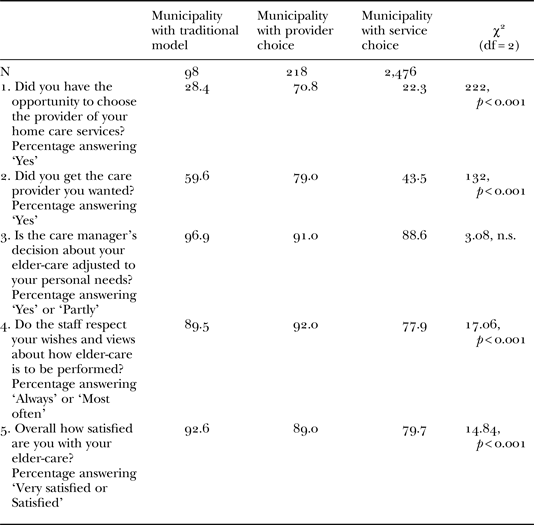
Older home care users' views of available choice and control were captured through responses to a postal survey. The sample consisted of 2,792 users of home care services from our three municipalities. Of them, 68.8 per cent were women; 14.4 per cent were between 65 and 74 years old, 12 per cent were between 75 and 79 years old and 73.6 per cent were over 80 years old (the exact age was concealed from us due to participant anonymity issues in small municipalities); 87 per cent were born in Sweden; 50 per cent had compulsory education (six to nine years in school), 35 per cent had upper secondary school (two or three years after compulsory education) and 15 per cent had a higher education (community college, college or university). In Table 1, the results from the five survey questions for each participating municipality are presented.
Available choice, responsiveness of decisions and performance of care and services, and overall satisfaction with care and services

Notes: N = 2,792. df: degrees of freedom. n.s.: not significant.
When comparing the results between the municipalities, the municipality with provider choice had the highest percentage of positive results in three of the analysed questions, i.e. whether they had the possibility to choose provider, whether they got the provider they wanted and whether the staff respected their wishes and views. The traditional model had the most positive results in two of the questions, i.e. whether the care managers' decisions were adjusted to their personal needs and overall satisfaction with their elder-care. The municipality with service choice scored lowest in all five questions. Of the participants from the municipality with the provider choice model, 70.8 per cent responded that they had had the opportunity to choose the provider of their home care services. Moreover, 22.3 per cent of the participants from the municipality with the service choice model and 28.4 per cent of the participants from the municipality with the traditional model stated that they had had this chance. Additionally, 79 per cent of the users in the municipality with provider choice stated that they got the provider they wanted, as did 43.5–59.6 per cent of the users in the municipalities that did not have provider choice.
Users of home care services in the municipality with the traditional model had the highest rating for the care manager decisions' responsiveness to their personal needs, whereas home care recipients in the municipality with a service choice model had the lowest rating. However, users of home care services in the municipality with the provider choice model had the highest rating for whether the staff respected their views of how home care was to be performed, and in the municipality with a service choice model the users had the lowest ratings. Finally, in the municipality with a traditional model the users were most satisfied with overall quality of the services and in the municipality with a service choice model they were least satisfied. However, in all municipalities across the social care models, a majority of older users were positive about their home care services.
It may be worth noticing here that different models for the home care services were not the only difference between the participating municipalities. As described in the Methods section of this paper, the municipality with the service choice model is a large city, while the other two municipalities were one small town at commuting distance from the big city and one rural municipality characterised by small villages. Hence, the views of older service users may vary in respect to a number of factors that lie outside the scope of the present study.
Older users' experiences
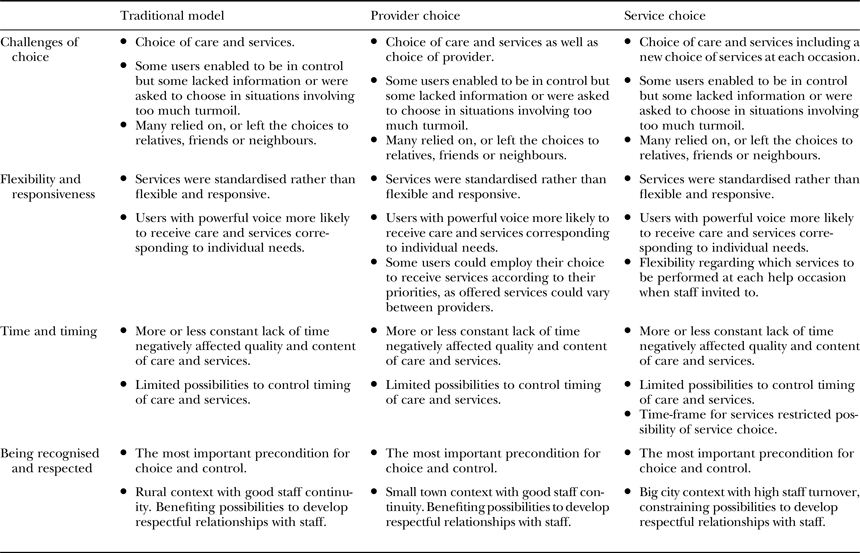
In the interviews, we were able to obtain an in-depth understanding of how participants perceived the possibilities for choice and control when receiving home care services. The 28 interview participants were between 72 and 98 years old, all but one were Swedish-born and one was born in another European country and moved to Sweden as a child; 18 were women and ten were men, and they were of varied socio-economic backgrounds. Most of the participants lived alone but two lived together with their partners. The amount of home care services they received varied between once every third week to several times each day. As shown in the survey results (Table 1), most users of home care and services stated that they were satisfied. This was also the most frequent first response to our interview questions and Judith, an 83-year-old woman in the traditional municipality, said: ‘It's very good so there's nothing I would like to change. You shouldn't change something that works fine’. But when we continued to ask about the possibilities for choice and control, a more complex picture emerged. A summary of the qualitative findings per municipality is presented in Table 2. Four central aspects of choice and control emerged in the accounts of the participants' experiences: ‘challenges of choice’, ‘flexibility and responsiveness', ‘time and timing’ and ‘being recognised and respected’.
Summary of key themes and findings per municipality

Challenges of choice
When home care services are initiated, people are supposed to choose what care and services they wish to receive. In municipalities with free choice systems, older people are also expected to make a choice of provider for their home care services, as was the case for the participants from the provider choice municipality in our study. The choices of providers as well as care and services could be amended later due to changes in the circumstances or preferences of the older users.
Some of the participants described that they were fully informed about the options they had and thus made very active and conscious choices of providers and/or services. In the provider choice municipality, Bertil, a 90-year-old man, pointed out the motives for his choice of provider for home care services:
There were many companies to choose from but the other ones were from out of town, or only had congealed food that they delivered once a month. I wasn't interested in that…
Another motive for choosing a private provider of home care services was that they could offer tax-subsidised services, such as extra house cleaning, which was not available through the municipal choice.Footnote 2 However, some participants very consciously chose the municipal provider since they did not support the privatisation of welfare.
Nevertheless, some users of home care services also felt that it was very unclear to them what choices they had. Many of them had no previous experience, and very limited knowledge, of home care services and thus found it difficult to know what care and services to ask for. Judith said:
I didn't know what home care service was. They had to tell me what I could get and what I needed at the home visit when I got home [from hospital]. I had never had anything to do with home care. I thought it seemed very good.
In many interviews it became evident that these initial choices were characterised by great uncertainty. The participants' experiences reflect the fact that people are asked to make their first choices about provider and/or content of the home care services in very confusing situations involving a great deal of turmoil. Charlotte, an 86-year-old woman in the provider choice municipality, described when she had to make her choices:
I: Do you remember the care-planning meeting at the hospital?
Charlotte: No, I don't have any memories of that. My children took care of everything.
I: Were you aware of the choice of provider and services they made for you?
Charlotte: No, I had no idea. I knew that they looked after it so I got meals.
Many of the participants consequently described how they relied on their relatives in helping them to make good choices. Other interviewees also described how they made their choices based on recommendations from friends or neighbours. Astrid, an 87-year-old woman in the provider choice municipality, was one of them: ‘Through acquaintances … she said “if you're going to choose someone choose ‘Niceservice’, then you can have it your way”’.
In the municipality with the service choice model, users were supposed to have the option to choose which specific services they wanted to be performed at each occasion, within a given time-frame. However, some of the users, like Ylva an 84-year-old woman, did not seem to know of these opportunities:
I: This house cleaning service that you have, if you wanted them to clean anything in particular, or if you wanted them to help you with anything else?
Ylva: I haven't thought of that…
I: But you have received information about the opportunity to swap the house cleaning help with other chores that you want to be performed?
Ylva: No, no one has told me. But there's no need. I'm happy with the help I have.
Flexibility and responsiveness
In the interviews, the experiences of the participants varied regarding how flexible and responsive the home care services offered were in relation to their own needs, priorities and preferences. Some users, across all municipalities involved, described how the care and services they received reflected their own perceived individual needs. Bertil was one of them and described the help he was offered:
Yeah, I could get anything I needed, much more than I actually wanted. I could get anything I wanted, no problem.
He continued to add that he would not have settled with less: ‘I got what I wanted but if I hadn't then I would have protested. Then I think they would have given me what I wanted’.
However, some of the participants also described restricted opportunities to obtain care and services that reflected their own preferences. Verner, a 93-year-old man in the service choice municipality, described how he had home care services with grocery shopping and got the groceries delivered to his home. However, he would have preferred to be assisted to go to the shop, so that he could see for himself what he wanted to buy and also get out of his apartment:
I lack the chance to stroll around in the shop and pick the food I want … I don't think you can get that help … it would take too much time if they were to accompany me.
Likewise, Charlotte explained that she wanted help with ironing but the staff were not allowed to perform this task. Mikael, an 88-year-old man in the traditional municipality, who wanted house cleaning every week said: ‘It's not possible, house cleaning is only every third week’.
Thus, the interviewees described opportunities to get home care services according to their individual needs but stated that services were standardised rather than flexible and responsive to their preferences and priorities.
Time and timing
Another aspect of choice and control that emerged in the interviews related to the time available for care and services and the timing of the help. The participants described how the quality and content of their home care services were negatively affected by the stressful working conditions of the home care staff and the constant lack of time. Olivia, an 87-year-old woman in the traditional municipality, told about the experiences of herself and her husband:
If there's anything negative to say it's that they [the home help staff] are too few … I think it's a pity, we used to love the woodland and the water. He's in a big and comfortable wheelchair but he never gets out. They don't have time to go out with him.
Other users described how the time-frame for their home care services restricted their options according to the service choice model and said that their prospective choices did not lead to genuinely perceived opportunities. Åsa, a 95-year-old woman, found it difficult to swap her house cleaning with other chores:
Yes, they are supposed to help me with something else if I need it … But it depends on what it's like here, there's always dust and then I lose hair, so the vacuum cleaner is full of hair…
In addition, as Ulrika, an 86-year-old woman in the service choice municipality explained, the staff did not always invite the users of home care services to exercise control over the time they were supposed to have available:
Ulrika: No, they don't often stay for the full time.
I: And can you tell them that they have to, or tell them what you want them to do?
Ulrika: I'm supposed to, but I have difficulties doing so…
Thus, a recurring theme in the interviews was the meagre time the staff had for their visits. As Verner expressed it: ‘They come in and oops they're gone again. Put my shoe on and then leave’. Also Nils, a 98-year-old man in the municipality with service choice, pointed to the lack of time: ‘The girls do their very best but they need more hours to sit down and chat with me’.
Moreover, many of the participating older users of home care services were frustrated about the limited possibilities for controlling the timing of their care and services. For many, this inhibited them from planning their everyday activities as they would have liked. Vera, an 89-year-old woman in the service choice municipality, described her experiences:
The timing of the help is not always as it should be … they're supposed to come on Mondays but sometimes it has been on Sundays … Yes, I want to have the help in the morning and most often they come in the morning but it has been other times as well … so you can't rely on them coming at the time we have agreed.
Other interviewees, like Astrid, an 87-year-old woman in the provider choice municipality, did not seem to mind changes in the timing as long as the provider kept them informed about it and communicated respectfully: ‘They come, and they're on time. They call if they're delayed and sometimes they ask if I can wait ’til the next day’.
Being recognised and respected
Many interviewees stressed the importance of mutual trust and respect between them and the home care staff as regards their opportunities for choice and control. One of them was Ymer, an 84-year-old man in the municipality with service choice, who said: ‘It doesn't work otherwise. Talking behind your back. No, plain communication is a necessity … It's a bit like marriage, you have to give and take’. This trust and respect was something that often evolved over time. Ymer continued to explain the lengthy process he had gone through in order to get the care and services performed the way he wanted:
Everything is fine now, we have reached the point where it's the way I want it. It wasn't that way from the start … We have refined the care plan, the times and got to know one another … It has to be good chemistry, you know.
For Harriet, an 86-year-old woman in the municipality with provider choice, good communication also involved a mutual sense of humour that benefited her relationship with the staff: ‘We go on like this, we joke, I think it's funny and they think it's funny and I laugh with them too’.
However, according to the participants, staff continuity was a precondition for developing a trusting and respectful relationship, and in the interviews it became clear that this was often lacking. Verner, who had home care services several times each day, explained:
That's the drawback of it, too many different staff are coming … It's a big disadvantage … you have to tell every new person how the help should be performed, and where things are … and they all work in different ways. My sister lives in another part of the city and it's the same.
As indicated in the above excerpt, however, this might be a more prominent feature of the home care services in a bigger city. Some of the participants from the two smaller municipalities in our study had more positive experiences. One of them, Axel, a 92-year-old man in the provider choice municipality said: ‘“Wellcleaning” have very nice staff, I'm used to them and know them all’. Thus, he points to the fact that a small private provider can be an advantage when it comes to staff continuity. However, Lena, an 80-year-old woman in the traditional municipality, also experienced continuity with her staff from the municipal provider, and instead she emphasised the advantage of living in a small village: ‘We live in Little Village and it's a huge difference when you know everyone. And it's almost always the same girls who come’.
To be listened to also meant being recognised as a person for many of the participants, and this appeared to be an important aspect of choice and control. However, the interviewees' experiences varied. Some of the users had made complaints about their home care services and felt that they had been listened to. Bertil was one of them, and he explained:
I complained once, about a month ago, then they rescheduled the programme … two days afterwards I had my old girls back again.
Others were more resigned and did not anticipate that their opinions would be recognised. Karl, a 72-year-old man in the traditional municipality, said:
No, I don't think you have a say as a retired person. Not much. Maybe if you ask them about something, they'll help you … Well, maybe you have some influence but most often it's the staff.
Another aspect of the relationship between users and staff of home care services was the consideration the participants expressed towards the staff. Many of them described how they worried about the staff and their stressful working conditions. As a result, they held back their own demands and expectations and adapted to the help they could get, even if they were not fully satisfied. Fanny said: ‘No, I'm reluctant to bother them. Instead I do as much as I can myself’. But some of the older users of home care services also pointed to the reciprocal character of their relationship with the staff, and Lena said: ‘If you treat them with respect and they respond with respect it will work out fine. I think that's something very good’. Correspondingly, Olivia felt that the staff gave more time than they really had and said:
But they do, I think they do more than they actually can, to take time for a little chat or to help with our hearing aids and so on.
Opportunities for autonomy
The experiences of the participants in our study ranged from being active and enabled to pick and choose between providers and services, and having the resources to develop mutually respectful relationships with staff, to being more or less passive dependants having to rely on the decisions and benevolence of family members, care managers and staff in elder-care authorities and public as well as private providers of home care services. Two themes connected with participants' opportunities for autonomy and control were identified: ‘experiences of being in control’ and ‘experiences of lacking control’.
Experiences of being in control
The experiences of being in control relied mostly on participants' individual ability to be autonomous and to exercise decisional autonomy (Boyle Reference Boyle2005; Collopsy Reference Collopsy, Gamroth, Semradec and Tornquist1995). These users of home care services described making informed and active choices of providers and/or services, demanding to be listened to and being able to negotiate help according to their individual needs and preferences. Thus, they had the opportunity to use both ‘choice’ and ‘voice’ as strategies for choice and control of their situation (Greener Reference Greener2008; Hirschman Reference Hirschman1970; Vamstad Reference Vamstad2016; Van de Bovenkamp et al. Reference Van de Bovenkamp, Vollaard, Trappenburg and Grit2013). Through the opportunity for service choice they were able to obtain services according to their individual preferences. However, only one of our participants, even among the most active and capable of those who were not fully content with the provider of their initial choice, had used the ‘exit’ strategy and made a new ‘choice’ (Greener Reference Greener2008; Hirschman Reference Hirschman1970). Some of the participants also described how they were enabled to be autonomous and in control regardless of their individual abilities (Barron Reference Barron2001; Fine and Glendinning Reference Fine and Glendinning2005). They were invited and supported to be in control; available options were presented to them and they were asked about what care and services they wanted and how they wanted them to be performed. Thus, they could be understood as having been enabled to have both ‘choice’ and ‘voice’ in order to exercise control over their situation. Here, the importance of supportive formal as well as informal relationships, solidarity and interdependence came to the fore, highlighting the significance of relational autonomy (Donchin Reference Donchin, Mackenzie and Stoljar2000; Fine and Glendinning Reference Fine and Glendinning2005; Kittey Reference Kittey2011; Mackenzie and Stoljar Reference Mackenzie and Stoljar2000; Woolham et al. Reference Woolham, Daly, Sparks, Ritters and Steils2016). In line with earlier studies, our findings point to the importance of individual as well as external resources for older people's opportunities to exert influence and have choice and control in their everyday living (Dunér and Nordström Reference Dunér and Nordström2005, Reference Dunér and Nordström2010; Glendinning Reference Glendinning2008; Newbronner et al. Reference Newbronner, Chamberlain, Bosanquet, Bartlett, Sass and Glendinning2014; Torres and Hammarström Reference Torres and Hammarström2010).
Experiences of lacking control
The participants also told of experiences of lacking opportunities to be in control and obtain help according to their own needs and preferences. For some, these experiences occurred in spite of their individual ability to raise their ‘voice’ (Hirschman Reference Hirschman1970; Van de Bovenkamp et al. Reference Van de Bovenkamp, Vollaard, Trappenburg and Grit2013), as they were not listened to and were thus denied actual influence or control. Here, organisational conditions such as high staff turnover, guidelines prescribing standardised services and staff routines constrained the opportunities for older users of home care services to achieve autonomy, regardless of their individual abilities (Barron Reference Barron2001; Donchin Reference Donchin, Mackenzie and Stoljar2000; Mackenzie and Stoljar Reference Mackenzie and Stoljar2000). These findings reflect what has been found in many previous studies in the Swedish elder-care context (Berglund et al. Reference Berglund, Dunér, Blomberg and Kjellgren2012; Dunér and Nordström Reference Dunér and Nordström2010; Janlöv, Hallberg and Petersson Reference Janlöv, Hallberg and Petersson2006; Persson and Berg Reference Persson and Berg2008). In our study, however, the restricting conditions prevailed in slightly different versions, in all participating municipalities and thus regardless of local ways of organising the home care services. Consequently, the use of ‘exit’ was ineffective, since these restrictions were defined by municipal guidelines and thus affected all involved providers equally (Greener Reference Greener2008; Hirschman Reference Hirschman1970; Van de Bovenkamp et al. Reference Van de Bovenkamp, Vollaard, Trappenburg and Grit2013). Instead, the users restrained their expectations and adapted to perceived possibilities and prevailing conditions and guidelines, often out of ‘loyalty’ to the staff (Dunér and Nordström Reference Dunér and Nordström2005; Gunnarsson Reference Gunnarsson2009; Hirschman Reference Hirschman1970; Van de Bovenkamp et al. Reference Van de Bovenkamp, Vollaard, Trappenburg and Grit2013). These findings further underline the relational aspects of home care services (Donchin Reference Donchin, Mackenzie and Stoljar2000; Mackenzie and Stoljar Reference Mackenzie and Stoljar2000).
In the interviews, the older users expressed how the absence of information and/or situations of frailty and vulnerability could form obstacles to autonomy (Barron Reference Barron2001; Donchin Reference Donchin, Mackenzie and Stoljar2000; Mackenzie and Stoljar Reference Mackenzie and Stoljar2000). Some participants lacked information about their opportunities to choose providers and services, which constrained their usage of the ‘choice’ strategy (Greener Reference Greener2008; Hjalmarsson and Norman Reference Hjalmarsson and Norman2004; Moberg, Blomqvist and Winblad Reference Moberg, Blomqvist and Winblad2016; National Board of Health and Welfare 2011, 2015; Van de Bouvenkamp et al. Reference Van de Bovenkamp, Vollaard, Trappenburg and Grit2013). Others described how they were not able to assert an opinion, due to the turmoil and stressful nature of the situation when they started with home help services, and thus were inhibited from exerting ‘choice’ or ‘voice’. Lack of opportunities for supported ‘choice’ and ‘voice’, particularly for those with the most complex needs, more or less forced these older users into passivity (Kane and Kane Reference Kane and Kane2001; Lloyd Reference Lloyd2010; Meinow, Parker and Thorslund Reference Meinow, Parker and Thorslund2011; Newbronner et al. Reference Newbronner, Chamberlain, Bosanquet, Bartlett, Sass and Glendinning2014). These findings point to the importance of viewing ‘choice’ as a process also involving ‘voice’ rather than a one-off occasion, stressing the significance of time and staff responsiveness in order to enable autonomy leading to care and services according to needs and preferences.
Limitations
This study has limitations. As none of the users of home care services participating in the interviews in this study had dementia or more than very mild cognitive difficulties, we are not aware of how representative the qualitative findings are for users with the most complex and extensive needs. There were some proxy answers in the survey, some made with help from the care staff and some made with help from family or friends. Relying on staff or relatives as reporters of older people's own views must be carried out with caution. Nevertheless, proxy answers are a means to include views that would otherwise not be present, as users with the most complex and extensive needs are often unable to participate actively in this type of research. As one might have anticipated, surveys completed with help from staff tended to be marginally more positive and those completed with help from family or friends tended to be marginally more negative, compared to the responses when the older persons stated that they had filled out the survey themselves.
Concluding summary
Our findings point to similarities rather than differences between the views and experiences of older users in the three participating local municipal elder-care authorities with different models for their home care services. Thus, these findings can hopefully guide policy makers in refining home care services' modes of working irrespective of preferred model. The survey results demonstrated that something which seems obvious from an objective standpoint can be subjectively less clear when it comes to the users' actual views of the various service models. Similar results have previously been reported by Vamstad (Reference Vamstad2016). This might be explained as a consequence of the lack of information provided to users of home care services in the provider choice municipality about their ‘choice’ options and their status as consumers in a market (Moberg, Blomqvist and Winblad Reference Moberg, Blomqvist and Winblad2016; Vamstad Reference Vamstad2016). Furthermore, participants in the other two municipalities who stated that they could choose the provider of their home care may believe that they did just this, as they actually wanted the only available provider. In both the survey results and the findings from the qualitative interviews, the main differences that could be observed were those between the small town or rural municipalities and the big city municipality, in favour of the former two. In the interviews, the importance of supportive relationships, and thus the interdependence between older people and their formal as well as informal support network, became clear. Thus, efforts to facilitate staff continuity and prevent high staff turnover need to be prioritised. This involves, among other things, improving the working conditions of the staff and thus permitting them to perform flexible care and services according to the individual needs and preferences of older users. Extended time-frames for performing home help services together with less-standardised services will make possible true individualisation and empowerment of older users of home care services. Moreover, there is reason to believe that this would also smooth out the differences between rural or small town and big city municipalities in favour of older users in the latter.
Finally, simplistic consumerist understandings of older home care users as benefit-maximising consumers in a market appear at best naive and at worst cynical. To secure genuinely individualised home care services which fulfil the users' actual needs and preferences requires improvements that go well beyond the rhetorical promises often ascribed to free choice systems.
Acknowledgements
The authors wish to express their gratitude to the participants for sharing their experiences with us. This research was supported by FORTE, the Swedish Research Council for Health, Working Life and Welfare, under grant numbers 2012-0175 and 2013-2300 (AGECAP). The funding body has no role in design, execution, analysis and/or interpretation of reported data. The study has received ethical approval from the Regional Ethical Review Board (223–13).