1 Introduction
It is well-known that Kripke’s [Reference Kripke19] fixed-point theory is built on monotonic valuation schemes. In this theory, an initial partial predicate is iterated by an operation called a “jump.” This iterative process generates an increasing sequence of partial predicates, eventually reaching a fixed point which serves as the extensional interpretation of the truth predicate. The monotonicity of the valuation scheme itself is crucial when applying the jump operation. Without it, the aforementioned sequence of partial predicates cannot be guaranteed to be monotonically increasing, and thus, its fixed point would not be granted to exist. For example, under the classical two-valued scheme, iterative application of Kripke’s jump to the empty set generally does not yield a monotonically increasing sequence. At best, it might exhibit some periodicity, and even this requires a definite and fixed rule at all limit stages.Footnote 1
As far as the above non-monotonic sequence of sentences is concerned, a discovery from Leitgeb [Reference Leitgeb20] is particularly inspiring for this paper. By introducing a notion of dependence relation, Leitgeb proposes an increasing sequence of sets of sentences. In this sequence, the sentences appearing at each successor stage are precisely those that depend on the sentences from the preceding stage. Leitgeb finds that by imposing each term in this sequence on the corresponding stage of the previously mentioned non-monotonic sequence, the resulting sequence becomes monotonic. This allows for a reconstruction of fixed points for the truth predicate even within classical two-valued semantics. As Leitgeb [Reference Leitgeb20, p. 171] himself notes, his increasing sequence of sentences “is defined by a ‘jump’ operation roughly in line with Kripke [21] [i.e., [Reference Kripke19] in our references], but on the basis of a classical valuation mapping
$Val$
 rather than a three-valued one.” Later, Schindler points out that Leitgeb’s construction of fixed points can even be embedded into Kripke’s theory via a new valuation scheme called the Leitgeb valuation scheme.Footnote
2
Inspired by Leitgeb’s theory, we wonder whether the fixed points can be constructed under non-monotonic valuation schemes. The question, more specifically, is whether it is possible to introduce appropriate dependence relations in three-valued semantics so that we could also construct fixed points for the truth predicate under any three-valued valuation scheme, including non-monotonic ones, in a similar way as Leitgeb has done under the classical two-valued valuation.
This paper will generalize Leitgeb’s dependence relation from two-valued to three-valued semantics. This generalization is, in fact, a special case of the generalization of Leitgeb’s dependence relations proposed in Rivello [Reference Rivello25, Reference Rivello26]. It is worth noting that Rivello focuses more on exploring the general mathematical properties of dependence relations, so his generalization is, in his own words, “a general notion of ‘functional’ dependence.” (Rivello [Reference Rivello26, pp. 1241–1242]) While this paper’s research is still technical, it is not art for art’s sake, nor does it seek to maximize generality. Instead, its technical inquiry remains closely connected to philosophical concepts, such as “truth” and “self-reference.” The main goal of this paper is to use a semantic dependence relation that is moderately general and formally compatible with Kripke’s theory of truth. To this end, the semantic dependence relation used in this paper is introduced based on partial predicates rather than on functions. Our focus is to explore how to generally define a monotonic “jump” operator under such a dependence relation, thereby establishing an increasing sequence of interpretations for the truth predicate.Footnote 3
The novel jump is obtained by imposing a dependence scope on Kripke’s jump operation, and it is termed the dependence jump. A derived notion is the conditional dependence jump which is based on the conditional dependence relation. We compare the least fixed points of these two jumps with those from Kripke’s original jump. This comparison covers both monotonic valuation schemes (such as Kleene’s strong three-valued, weak three-valued scheme, and van Fraassen’s [Reference van Fraassen12] supervaluation scheme and non-monotonic valuation schemes (exemplified by Łukasiewicz’s and Gödel’s three-valued schemes). Our comparison aims to reveal the connections and distinctions among these fixed points.
The present semantic dependence is designed to be as close to Leitgeb’s original one as possible, which offers a technical advantage for another philosophically-driven problem: characterizing self-referentiality of sentences. For a long time, Kripke’s fixed-point theory has lacked a formal tool to characterize self-referentiality of sentences. Specifically, while it is a simple observation that the liar sentence is self-referential, the problem of how to formally define the notion of self-referentiality so that we can decide whether the liar sentence and the like are self-referential based on three-valued semantics has not been addressed so far. To characterize self-referentiality, we need to articulate the semantic dependence relation (or reference relation) between sentences. On this point, Yablo [Reference Yablo29] provides a definition of dependence relation, which, to the best of the author’s knowledge, seems to be currently the only attempt to define a dependence relation between sentences under a three-valued semantics. Unfortunately, in Yablo’s paper, this relationship was only used to reformulate Kripke’s groundedness and paradoxicality. It remains unclear whether this dependence relation can be applied to analyze self-referentiality of sentences.
As we will see, it becomes straightforward to define the notion of self-referentiality under any three-valued semantics once the semantic dependence is available in the corresponding semantics. In fact, ever since Leitgeb proposed his semantic dependence, many logicians, including Leitgeb himself, have used this notion to conduct extensive research on self-referentiality of sentences—their research is naturally based on two-valued semantics.Footnote 4 This paper will show the reader that, just as the Leitgeb’s dependence relation can be used to characterize self-referentiality of sentences in two-valued semantics, with our generalized notion of dependence, we can carry out a similar characterization in three-valued semantics. This allows us to analyze the similarities and differences in self-referentiality under different valuation schemes, just as we can analyze the similarities and differences between minimal fixed points under different valuation schemes. This is actually two of fundamental tasks to be completed in this paper. This research endeavors to add new perspectives on the semantics of the truth predicate and to furnish new instruments for the analysis of self-referential sentences within Kripke’s fixed-point theory.
The remainder of this paper is structured as follows.
$\S $
 2 provides the definition of dependence relation in three-valued valuation setting and its fundamental properties.
$\S $
 3 defines a novel jump operation based on dependence relation, thereby presenting an iterative process of approaching fixed points under arbitrary three-valued valuations.
$\S $
 4 makes it clear how to characterize self-referentiality in three-valued semantics. These three sections constitute the foundational part of our theory, where concepts and basic properties are independent of valuation schemes. Subsequent sections, starting with
$\S $
 5, address features related to specific valuation schemes.
$\S $
 5 examines further properties of dependence relation that hold when valuations satisfy normality and monotonicity. Building on this,
$\S $
 6 explores the connections and distinctions among the least fixed points of Kripke’s jump, the dependence jump proposed in this paper, and the conditional dependence jump under different valuation schemes. Comparisons are also made regarding the groundedness, paradoxicality, and self-referentiality of sentences. §7 summarizes the main results of this paper and discusses future research.
2 Partial predicates and dependence relations
Let
$\mathcal {L}$
 be the first-order language for Peano arithmetic, where the logical symbols include the standard connectives (negation, conjunction, disjunction, implication and bi-conditional), quantifiers (existential and universal), and individual variables, while the non-logical symbols are the functional symbols for the successor, addition, multiplication, and the zero symbol. We will work in the language
$\mathcal {L}_T$
 obtained from
$\mathcal {L}$
 by augmenting a unary predicate symbol T. The symbol T, central to our study, is intended to be interpreted as the truth predicate (“
$\ldots $
 is true”) within
$\mathcal {L}_T$
 . Unless otherwise specified, all sentences (closed formulas) mentioned hereafter belong to
$\mathcal {L}_T$
 . For convenience, we will abuse the notation
$\ulcorner{A}\urcorner$
 which denotes the Gödel number of A and the corresponding numeral in
$\mathcal {L}$
 as well.
For instance, the sentence
$T\left (\ulcorner{A}\urcorner\right )$
 is abbreviated as
$T\,\ulcorner{A}\urcorner$
 , where “
$\ulcorner{A}\urcorner$
 ” actually refers to the numeral corresponding to the Gödel code of A. In contrast, for a set
$\Sigma $
 of sentences, the symbol “
$\ulcorner{A}\urcorner$
 ” in the notation
$\ulcorner{\Sigma}\urcorner = \{\ulcorner{A}\urcorner \mid A \in \Sigma \}$
 is the Gödel number itself of A. It is important to note that we usually identify a sentence A with its Gödel number
$\ulcorner{A}\urcorner$
 , and thus we sometimes use
$\Sigma $
 to stand for
$\ulcorner{\Sigma}\urcorner$
 . For example, in the equation
$\Sigma \cap X^{+} = \Sigma \cap Y^{+}$
 of Definition 2.2, the symbol
$\Sigma $
 actually stands for
$\ulcorner{\Sigma}\urcorner$
 as previously defined.
We fix the structure of natural numbers,
$\mathfrak {N} =\left <\mathbb {N}, ', +, \cdot , 0 \right>$
 , as the model for
$\mathcal {L}$
 , which is also called the ground model for
$\mathcal {L}_T$
 . In
$\mathcal {L}_T$
 , for self-referential sentences such as the liar sentence, we construct them according to the method presented by Burgess [Reference Burgess7, p. 664]. Specifically, Gödel’s diagonalization allows us to construct a term t such that its interpretation in the model
$\mathfrak {N}$
 is precisely the Gödel number of the sentence
$\neg T(t)$
 . Let L be
$\neg T(t)$
 . Note that the interpretation of t depends only on
$\mathfrak {N}$
 ; thus, regardless of any interpretation of T and any three-valued valuation scheme
$\rho $
 used to define the valuation
$\mathcal {V}_{(\mathfrak {N}, X)}^{\rho }$
 (see below), the equation
$\mathcal {V}_{(\mathfrak {N}, X)}^{\rho }(L)=\mathcal {V}_{(\mathfrak {N}, X)}^{\rho }(\neg T\, \ulcorner{L}\urcorner)$
 always holds. In this sense, L is interpreted as the liar sentence under any three-valued valuation and any interpretation of T.
For simplicity, we use
$A\equiv B$
 to denote that
$\mathcal {V}_{(\mathfrak {N}, X)}^{\rho }(A)=\mathcal {V}_{(\mathfrak {N}, X)}^{\rho }(B)$
 holds for any valuation scheme
$\rho $
 and any interpretation of T. All self-referential sentences can be constructed by methods similar to the above one used for the liar sentence, and all these sentences satisfy specific equations according to the relation
$\equiv $
 .
To interpret sentences in
$\mathcal {L}_T$
 , an interpretation of T must also be provided. The following definition origins from [Reference Kripke19, p. 702].
Definition 2.1. A pair
$X=(X^{+},X^{-})$
 is called a partial predicate if its two components
$X^{+}$
 and
$X^{-}$
 are both subsets of
$\mathbb {N}$
 and their intersection is empty, i.e.,
$X^{+} \cap X^{-} = \emptyset $
 . In particular, those with the additional condition
$X^{+} \cup X^{-} = \mathbb {N}$
 (i.e., the extension and anti-extension are complementary with respect to
$\mathbb {N}$
 ) are called the total predicates.
Let
$X=(X^{+},X^{-})$
 and
$Y=(Y^{+},Y^{-})$
 be two partial predicates. Their intersection is defined as
$X\cap Y=(X^{+}\cap Y^{+},X^{-}\cap Y^{-})$
 , which is clearly still a partial predicate. Similarly, the union of partial predicates can be defined, but the union of partial predicates is not necessarily a partial predicate. If the union of two partial predicates is still a partial predicate, then these two partial predicates are called compatible. Two partial predicates are equal if they are identical in each component; that is,
$X=Y$
 if and only if
$X^{+}=Y^{+}$
 and
$X^{-}=Y^{-}$
 . The inclusion relation between partial predicates is defined similarly. For convenience, when a sentence is said to appear in a partial predicate X, it means that its Gödel number belongs to
$X^{+}$
 or
$X^{-}$
 .
As Kripke proposed, any partial predicate
$X=(X^{+},X^{-})$
 can be taken as an interpretation for T, where
$X^{+}$
 and
$X^{-}$
 are, respectively, called the extension and anti-extension of T.Footnote
5
Thus, with
$\mathfrak {N}$
 fixed as a standard model for
$\mathcal {L}$
 , a pair of the form
$\mathcal {M} =(\mathfrak {N}, X)$
 can serve as a model for
$\mathcal {L}_T$
 for any partial predicate X. Given a three-valued valuation scheme
$\rho $
 , a valuation function
$\mathcal {V}_{\mathcal {M}}^{\rho }$
 from the set of sentences to the three-value set
$\left \{0, 1, i\right \}$
 can be defined according to this scheme (see also
$\S $
 5.1). Note that, since the ground model is always
$\mathfrak {N}$
 , the valuation
$\mathcal {V}_{\mathcal {M}}^{\rho }$
 will henceforth be abbreviated as
$\mathcal {V} _X^{\rho }$
 .
In this paper, the three-valued valuation scheme
$\rho $
 can be Kleene’s strong three-valued scheme (
$ \kappa $
 ), Kleene’s weak three-valued scheme (
$ \mu $
 ), van Fraassen’s supervaluation scheme (
$\sigma $
 ), or any other schemes including those non-monotonic ones, such as Łukasiewicz’s three-valued scheme and Gödel’s three-valued scheme (denoted by
$\upsilon $
 and
$\gamma $
 , respectively, in this paper). For simplicity, we will explicitly indicate the three-valued scheme in the superscript of the valuation
$\mathcal {V}$
 only when necessary. For example, the interpretation of the atomic sentence
$T\, \ulcorner{A}\urcorner$
 is independent of three-valued schemes:
$\mathcal {V}_X(T\, \ulcorner{A}\urcorner) =1$
 if and only if
$\ulcorner A\urcorner \in X^+$
 ;
$\mathcal {V}_X(T\, \ulcorner{A}\urcorner) =0$
 if and only if
$\ulcorner A\urcorner \in X^-$
 ; otherwise,
$\mathcal {V}_X(T\, \ulcorner{A}\urcorner) =i$
 . In such a case, there is no need to articulate what three-valued scheme we employ.
We now introduce an auxiliary concept to extend Leitgeb’s [Reference Leitgeb20] notion of semantic dependence to three-valued semantics. For brevity, given a partial predicate
$X=(X^{+},X^{-})$
 and a set
$\Sigma $
 of sentences, we use
$X\cap \Sigma $
 to denote the partial predicate
$(X^{+}\cap \Sigma ,X^{-}\cap \Sigma )$
 . Accordingly, for two partial predicates X and Y, by
$X\cap \Sigma =Y\cap \Sigma $
 we mean
$\Sigma \cap X^{+} = \Sigma \cap Y^{+}$
 and
$\Sigma \cap X^{-} = \Sigma \cap Y^{-}$
 .
Definition 2.2. Two partial predicates X and Y agree on a set
$\Sigma $
 of sentences if
$X\cap \Sigma =Y\cap \Sigma $
 .
Leitgeb’s idea is that a sentence depends on a set
$\Sigma $
 of sentences if and only if the truth value of that sentence “depends on the presence or absence of the sentences that are contained in
$\Phi $
 [
$\Sigma $
 ] in/from the extension of the truth predicate.” In other words, the truth value of that sentence does not vary unless the extension of the truth predicate varies as far as the members of
$\Sigma $
 are concerned. Since the interpretation of T in two-valued semantics only involves its extension, Leitgeb’s dependence notion is based only upon a requirement for the extension of T. However, in three-valued semantics, we need to impose the above requirement simultaneously on both the extension and anti-extension of T. At this point, we can immediately see that the definition of agreement that we just introduce is precisely formulated to address the requirement in the three-valued context: X and Y agreeing on
$\Sigma $
 means that these two predicates have no difference in their extensions and anti-extensions, respectively, with respect to the members of
$\Sigma $
 . Thus, the following definition becomes straightforward.Footnote
6
Definition 2.3. A sentence A depends on a set
$\Sigma $
 of sentences, if for any partial predicates X and Y agreeing on
$\Sigma $
 , we have
$\mathcal {V}_{X}(A) = \mathcal {V}_{Y}(A)$
 .
It must be pointed out that Rivello [Reference Rivello25, Reference Rivello26] has generalized Leitgeb’s semantic dependence to a general notion of dependence in functional terms. Rivello’s functional dependence is based on the “valuation systems.” By transforming partial predicates into three-valued functions, the current notion of dependence is, in fact, the one on a special case of valuation systems.Footnote 7 However, as mentioned in the introduction, Rivello seeks to explore the most general mathematical properties of dependence relation, while our main objective is not to study the dependence relation itself. Rather, we use the counterpart of Leitgeb’s dependence relation in the three-valued setting to construct monotonically increasing sequences for the truth predicate, thereby ensuring the existence of Kripkean fixed points even under non-monotonic valuation schemes. For this purpose, we define the dependence relation based on partial predicates, which makes it formally closer to Leitgeb’s original notion of semantic dependence and more compatible with Kripke’s theory of truth.
We return to Definition 2.3. If X and Y are total predicates, then we can easily see that either of the two conditions
$\Sigma \cap X^{+} = \Sigma \cap Y^{+}$
 and
$\Sigma \cap X^{-} = \Sigma \cap Y^{-}$
 implies the other. Therefore, the condition for the notion of agreement between total predicates can be reduced to one that involves only the extensional component. In this sense, the dependency relation proposed by Leitgeb [Reference Leitgeb20, p. 161] is a special case of the aforementioned definition (of course, only classical two-valued valuation is applicable in this case). In subsequent discussions of Leitgeb’s dependency relation, we will continue to employ his original notation, where the subscript of the valuation
$\mathcal {V}$
 remains the extensional part of the total predicate.
The following lemma provides an equivalent characterization of the dependency relation.
Lemma 2.4.
A depends on
$\Sigma $
 , iff
$\mathcal {V}_{X}(A) = \mathcal {V}_{X\cap \Sigma }(A)$
 holds for any partial predicate X.
A fundamental property of the dependency relation presented by Leitgeb [Reference Leitgeb20, p. 162] under the classical two-valued semantics is that the collection of all sets of sentences on which a given sentence depends forms a filter, which is called its “dependence filter.” The next lemma demonstrates that this result can be analogously extended to the dependency relation we give in this paper. The proofs of Lemma 2.4 and 2.5 are similar to those in the two-valued setting and are thus omitted.
Lemma 2.5. Let A be a sentence, and
$\Sigma $
 and
$\Gamma $
 be sets of sentences.
-
(1) Any sentence depends on the set of (codes of) all sentences.Footnote 8
-
(2) If A depends on $\Sigma $
 and
$\Sigma \subseteq \Gamma $
, then A depends on
$\Gamma $
.
-
(3) If A depends on $\Sigma $
and also on
$\Gamma $
, then A depends on
$\Sigma \cap \Gamma $
.


Finally, it is worth emphasizing that the dependency relation introduced in this paper, as a generalization of Leitgeb’s dependency relation, applies to any three-valued valuation scheme, regardless of whether it is monotonic or not. Indeed, the fundamental properties of the dependency relation remain independent of the specific details governing three-valued valuations. To maintain terminological clarity, we usually refer to the relation simply as “depend on”; the more specific term “
$ \rho $
 -depend on” is reserved for contexts where it is necessary to explicitly identify the underlying valuation scheme
$\rho $
 . In subsequent sections, we will demonstrate that this independence extends to crucial concepts, such as fixed points and self-referentiality.
3 Jumps and fixed points related to dependence
We define an operation
$\mathfrak {D}$
 (called dependence operation) on sets of sentences as follows:

By Lemma 2.5, this operation is monotonic: if
$\Sigma \subseteq \Gamma $
 , then
$\mathfrak {D}(\Sigma )\subseteq \mathfrak {D}(\Gamma )$
 . Thus, starting from the empty set, we have the following increasing sequence:
$\Phi _0 = \emptyset $
 ;
$\Phi _{\alpha +1} = \mathfrak {D}(\Phi _{\alpha })$
 ; and
$\Phi _{\alpha } = \bigcup _{\beta < \alpha } \Phi _{\beta }$
 for a limit ordinal
$\alpha $
 . Then, starting from the empty predicate, i.e.,
$(\emptyset , \emptyset )$
 , we can obtain a sequence of partial predicates as follows:
$\Theta _0 = (\emptyset , \emptyset )$
 ;
$\Theta _{\alpha +1}$
 is

and
$\Theta _{\alpha }$
 is defined as
$\bigcup _{\beta < \alpha } \Theta _{\beta }$
 for a limit ordinal
$\alpha $
 . It can be proved that the sequence
$\Theta _{\alpha }$
 (
$\alpha \geq 0$
 ) is also monotonic. Therefore, there exists an ordinal
$\alpha $
 such that for any
$\beta \geq \alpha $
 ,
$\Theta _{\beta }=\Theta _{\alpha }$
 . The partial predicate
$\Theta _{\alpha }$
 is considered a fixed point, denoted as
$\Theta _{\mathrm {lf}}$
 .
We construct the fixed point above in nearly the same way as Leitgeb [Reference Leitgeb20, p. 167ff.] has done.Footnote
9
The main difference lies in that we adjust the process carried out in two-valued semantics to a three-valued setting. Actually, if the dependence relation on which the above definition is based were Leitgeb’s original dependence relation, the sequence
$\Theta _{\alpha }$
 would only need to retain its extensional part, and the resulting fixed point would be a set of sentences, denoted by Leitgeb himself as
$\Gamma _{\mathrm {lf}}$
 .
In this paper, we approach fixed points along Kripke’s lines of thought: we first define a jump operation on partial predicates, then induce an increasing sequence of partial predicates, and thereby generally construct fixed points.
Definition 3.1. For a partial predicate
$X=(X^{+},X^{-})$
 , we define
$J(X)$
 as the partial predicate with the following extension and anti-extension:


We call
$J(X)$
 the jump of X (relative to the dependence operation
$\mathfrak {D}$
 ).
The operation resulting from removing the restriction
$\mathfrak {D}(X^+ \cup X^-)$
 in the above definition, due to Kripke [Reference Kripke19], is the commonly known Kripke jump. We will refer to the jump given in Definition 3.1 as a dependence jump.
For a partial predicate
$X=(X^{+},X^{-})$
 , a new valuation
$\mathcal {V}^{\prime }_{X}$
 can be induced from the valuation
$\mathcal {V}_{X}$
 as follows:
$\mathcal {V}^{\prime }_{X}(A)=1$
 , if
$A \in \mathfrak {D}\left (X^{+}\cup X^{-}\right )$
 and
$\mathcal {V}_{X}(A)=1$
 ;
$\mathcal {V}^{\prime }_{X}(A)=0$
 , if
$A \in \mathfrak {D}\left (X^{+}\cup X^{-}\right )$
 and
$\mathcal {V}_{X}(A)=0$
 ; otherwise,
$\mathcal {V}^{\prime }_{X}(A)=i$
 . Correspondingly, we can define a jump operation J in a more Kripkean style as follows: The extension of
$J(X)$
 is the set
$\left \{A \mid \mathcal {V}^{\prime }_{X}(A)=1\right \}$
 , and its anti-extension is
$\left \{A \mid \mathcal {V}^{\prime }_{X}(A)=0\right \}$
 . Evidently, the jump operation defined in this way is equivalent to Definition 3.1.
Note that Definition 3.1 is formulated for three-valued valuation schemes. The operations J and
$\mathfrak {D}$
 , like the valuation
$\mathcal {V}$
 , both implicitly carry a specific three-valued scheme notation as a superscript, which has been omitted. To facilitate later comparison, we here provide the corresponding definition for the classical two-valued scheme:


According to Lemma 2.5 (for the two-valued setting), it can be easily proved that
$J^{\tau }$
 is monotonic. Furthermore, similar to the process of inducing a new valuation
$\mathcal {V}^{\prime }_{X}$
 from
$\mathcal {V}_{X}$
 , a valuation
$\mathcal {V}^*_{X}$
 can be induced from
$\mathcal {V}_{X^+}^{\tau }$
 as follows:
$\mathcal {V}^*_{X}(A)=1$
 , if
$A \in \mathfrak {D}^{\tau }\left (X^{+}\cup X^{-}\right )$
 and
$\mathcal {V}_{X^+}^{\tau }(A)=1$
 ;
$\mathcal {V}^*_{X}(A)=0$
 , if
$A \in \mathfrak {D}^{\tau }\left (X^{+}\cup X^{-}\right )$
 and
$\mathcal {V}_{X^+}^{\tau }(A)=0$
 ; otherwise,
$\mathcal {V}^*_{X}(A)=i$
 . Correspondingly, a jump operation
$J^*$
 can be defined in Kripke’s style as follows: The extension of
$J^*(X)$
 is the set
$\left \{A \mid \mathcal {V}^*_{X}(A)=1\right \}$
 , and its anti-extension is
$\left \{A \mid \mathcal {V}^*_{X}(A)=0\right \}$
 . Evidently,
$J^*$
 is identical to
$J^{\tau }$
 defined by Equations (3) and (4).Footnote
10
Next, we prove that the jump operation defined in Definition 3.1 meets monotonicity.
Lemma 3.2. Let J be defined as in Definition 3.1. If
$X\subseteq Y$
 , then
$J(X)\subseteq J(Y)$
 .
Proof. To prove
$J(X)\subseteq J(Y)$
 , it suffices to show that
$\mathcal {V}_X(A)=\mathcal {V}_Y(A)$
 for any
$A\in \mathfrak {D}\left (X^{+}\cup X^{-}\right )$
 . Since A depends on
$X^{+}\cup X^{-}$
 , it follows from Lemma 2.4 that
$\mathcal {V}_Y(A)=\mathcal {V}_{Y\cap \left (X^{+}\cup X^{-}\right )}(A)$
 . Furthermore, from the condition
$X\subseteq Y$
 , it can be easily seen that
$Y^+\cap \left (X^{+}\cup X^{-}\right )=X^{+}$
 and
$Y^-\cap \left (X^{+}\cup X^{-}\right )=X^{-}$
 . Therefore, we obtain
$\mathcal {V}_Y(A)=\mathcal {V}_{X}(A)$
 .
We know that if the valuation scheme underlying
$\mathcal {V}_X$
 is monotonic, then the jump defined in Definition 3.1 is monotonic even without the restriction condition “
$ A\in \mathfrak {D}\left (X^{+}\cup X^{-}\right )$
 .” However, for non-monotonic schemes, it is necessary to employ the restriction scope
$\mathfrak {D}\left (X^{+}\cup X^{-}\right )$
 ; otherwise, the jump does not necessarily meet the monotonicity. Here, we give an example to illustrate the necessity of the condition “
$A\in \mathfrak {D}\left (X^{+}\cup X^{-}\right )$
 ” in Definition 3.1.
Consider sentences A and B satisfying the equivalences
$A\equiv (T\, \ulcorner{A}\urcorner \to T\, \ulcorner{B}\urcorner)$
 and
$B\equiv \neg (T\, \ulcorner{A}\urcorner\to T\, \ulcorner{B}\urcorner)$
 under Łukasiewicz’s three-valued scheme (see
$\S $
 5.1). Let X be the empty predicate
$(\emptyset , \emptyset )$
 . We can easily verify that
$\mathcal {V}_X^{\upsilon }(A)=1$
 and
$\mathcal {V}_X^{\upsilon }(B)=0$
 (see Table 3 for the valuational rule of Łukasiewicz’s implication). Were there no restriction “
$A \in \mathfrak {D}\left (X^{+}\cup X^{-}\right )$
 ” in Definition 3.1, then A and B would be in
$J(X)^+$
 and
$J(X)^-$
 , respectively. Consequently, we could have
$\mathcal {V}_{J(X)}^{\upsilon }(A)=0$
 . This leads to
$A\in J(J(X))^-$
 . In this case, the operation J is no longer monotonic.
Definition 3.3. A partial predicate X is sound (with respect to the jump J) if
$X\subseteq J(X)$
 . For any sound partial predicate X and any ordinal
$\alpha $
 , the partial predicate
$X_{\alpha }$
 is recursively defined as follows:
$X_{0} = X$
 ;
$X_{\alpha +1} = J(X_{\alpha })$
 ; and
$X_{\alpha } = \bigcup _{\beta < \alpha } X_{\beta }$
 for a limit ordinal
$\alpha $
 .
By Lemma 3.2, the above sequence of partial predicates is increasing. From this, by the unboundedness of ordinals, the following theorem can be immediately obtained.Footnote 11
Theorem 3.4. The sequence of partial predicates
$X_{\alpha }$
 (
$\alpha \geq 0$
 ), generated from a sound partial predicate X by iteratively applying the jump J, eventually reaches a fixed point. That is, there exists an ordinal
$\alpha $
 such that
$J\left (X_{\alpha }\right )= X_{\alpha }$
 .
Let X be the empty predicate, then it is easy to show by induction that the sequence of the partial predicates
$X_{\alpha }$
 (
$\alpha \geq 0$
 ) is the same as the sequence of
$\Theta _{\alpha }$
 (
$\alpha \geq 0$
 ) mentioned at the beginning of this section. Thus, the least fixed point of the jump operator J is identical to the fixed point
$\Theta _{\mathrm {lf}}$
 .
In general, we can denote the fixed point in Theorem 3.4 as
$X_{\infty }$
 . Besides the least fixed point just mentioned, other fixed points can be obtained by choosing other sound partial predicates as starting points. For example, by adding truth-teller sentences to the extension or anti-extension of the empty predicate, respectively, we can obtain two mutually incompatible fixed points. A fixed point compatible with any other fixed point is called an intrinsic fixed point. The union of all intrinsic fixed points is still a fixed point, which is known as the largest intrinsic fixed point. These concepts are, of course, the same as those in Kripke’s theory. Of course, when we speak of “largest” or “least,” the comparisons are all made under the same valuation scheme.
Finally, every fixed point satisfies Tarski’s T-schema in the sense that for any sentence A, the equation
$\mathcal {V}_{X_{\infty }}(T\, \ulcorner{A})\urcorner =\mathcal {V}_{X_{\infty }}(A)$
 holds. It is particularly noteworthy that Theorem 3.4 is formally the same as the fixed point theorem in Kripke’s theory, but the fixed points obtained in this theorem are applicable to all three-valued valuation schemes. In particular, this theorem shows that, by means of the restriction via dependence relation, we can construct fixed points satisfying the T-schema even under non-monotonic valuation schemes. Under Łukasiewicz’s three-valued scheme, we can even obtain the T-schema in a stronger sense:
$\mathcal {V}_{X_{\infty }}(T\, \ulcorner{A}\urcorner \leftrightarrow A)=1$
 holds. This is not available in Kripke’s original fixed-point theory. This appears to be a more straightforward means of maintaining standard conditional reasoning within the language—without the need to introduce additional conditional connectives—while ensuring the existence of fixed points as the extension of the truth predicate. This issue goes beyond the scope of the present paper. We hope to investigate it further in future research.
4 Self-referential sentences
In Kripke’s theory, sentences in the least fixed point (either its extension or anti-extension) are referred to as “grounded.” This is because their truth or falsity can ultimately be traced back to the facts in the ground model. Another well-known definition in Kripke’s theory is that of paradoxical sentences, which are defined as those belonging to no fixed point. These definitions also apply to the current setting, and won’t be repeated here. This section will focus solely on how to define the notion of self-referentiality, a concept unavailable in Kripke’s fixed-point theory due to the absence of a suitable dependence relation.
First, the definition of direct self-referentiality is essentially the same as the one that Leitgeb provides in classical two-valued semantics.Footnote 12 For convenience, whenever a sentence depends on a set of sentences, we say that this set is a dependence set of this sentence.
Definition 4.1. A sentence is directly self-referential, if it always belongs to its dependence sets.
To taken an example, let us see why the liar sentence is directly self-referential. Let L be the liar sentence (see
$\S $
 2). It suffices to show that for any set of sentences
$\Sigma $
 , if the liar sentence L is not in
$\Sigma $
 , then L cannot depend on
$\Sigma $
 . In fact, consider the partial predicate
$Y=(\{L\}, \emptyset )$
 . From the equivalence
$\mathcal {V}_{Y}(L)=\mathcal {V}_{Y}(\neg T\, \ulcorner{L}\urcorner)$
 , it follows
$\mathcal {V}_{Y}(L)=0$
 . At the same time, it’s clear that
$\mathcal {V}_{Y\cap \Sigma }(L)=i$
 . Therefore, the sentence L does not depend on
$\Sigma $
 . This proves that the liar sentence is directly self-referential.
It is worth pointing out that L depends on
$\{L\}$
 . For this, only note that for any partial predicate
$X=(X^+, X^-)$
 , if
$L\in X^+$
 , then
$\mathcal {V}_{X}(L)=\mathcal {V}_{X\cap \{L\}}(L)=0$
 ; if
$L\in X^-$
 , then
$\mathcal {V}_{X}(L)=\mathcal {V}_{X\cap \{L\}}(L)=1$
 ; otherwise,
$\mathcal {V}_{X}(L)=\mathcal {V}_{X\cap \{L\}}(L)=i$
 . To sum up, we can conclude that the liar sentence “essentially” depends on
$\{L\}$
 in the sense that this set is the least one among all the dependence sets of L. This is a known fact that Leitgeb [Reference Leitgeb20, p. 163] has observed in the classical two-valued semantics. We prove it again in the three-valued setting. This proof holds for all three-valued valuation schemes in which the negation
$\neg $
 meets the conditions
$\neg 0=1$
 ,
$\neg 1=0$
 , and
$\neg i=i$
 .
Next, we present a general definition of self-referentiality. To this end, we need the concept of “choice function” proposed by Beringer and Schindler [Reference Beringer, Schindler, Arazim and Dančák4].
Definition 4.2. A function f from sentences to sets of sentences is a dependence choice function if A depends on
$f(A)$
 for any sentence A. From this, we define a binary relation
$\prec _f$
 on sentences:
$A\prec _f B$
 , if B belongs to
$f(A)$
 .
The following definition is given in much the same way as the one by Hsiung [Reference Hsiung16, p. 894]. The key difference lies in its underlying semantics: our current definition is set within a three-valued framework, not the classical two-valued semantics.
Definition 4.3. A sentence A is self-referential if, for any dependence choice function f, there is a finite sequence of sentences starting and ending at A as follows:
$A=A_0\prec _f A_1\prec _f\ldots \prec _f A_n=A$
 . In particular, if for any dependence choice function, there exists a sequence of length 1 satisfying the above condition (i.e.,
$A=A_0\prec _f A_1=A$
 ), then A is called directly self-referential; otherwise, it is called indirectly self-referential.
By fixing a choice function, we induce a directed graph (or “network”) over the set of all sentences. In this network, a sentence is related to another if and only if the latter is selected by the choice function from the dependence set of the former. Intuitively, this allows us to trace patterns of semantic dependence. From this perspective, to say that a sentence is self-referential means that, in every such dependency network induced by a choice function, there exists a finite cycle containing that sentence.
The notion of direct self-referentiality in Definition 4.3 is clearly equivalent to that in Definition 4.1. An example of an indirectly self-referential paradox is the card paradox, which involves sentences
$L_0$
 and
$L_1$
 satisfying
$L_0 \equiv \neg T\, \ulcorner{L_1}$
 and
$L_1 \equiv T\, \ulcorner{L_0}\urcorner$
 . We leave the readers to verify that both of these sentences are indeed indirectly self-referential.
According to the present definition, self-referentiality is characterized in terms of finite dependency cycles. We now turn to a paradox that arises in the absence of such cycles. For a long time, it was widely believed that self-referentiality is a necessary condition for paradoxes. The discovery of Yablo’s paradox, however, brought significant controversy to this consensus.Footnote 13 Setting aside these controversies, we now verify that, according to the criteria given in Definition 4.3, Yablo’s paradox is indeed non-self-referential.
Yablo’s paradox consists of infinitely many sentences, denoted by
$A_0$
 ,
$A_1$
 ,
$A_2$
 , and so on. In this sequence of these sentences, each sentence asserts that its subsequent sentences are all false. In
$\mathcal {L}_T$
 , these sentences can be formalized as satisfying the equivalence
$A_n \equiv \forall x>n\,\neg T\, \ulcorner{A_{\dot{x}}}\urcorner$
 (
$n\geq 0$
 ). This equivalence includes Feferman’s [Reference Feferman10] dot notation
$\dot {x}$
 , which allows variables even hidden within the numeral of a Gödel number to be brought within the scope of a quantifier (thus making it possible to substitute a term into this occurrence of this variable x).
By Definition 2.3, it’s straightforward to prove that for any natural number k, the Yablo sentence
$A_k$
 depends on the set
$\left \{A_i \mid i> k\right \}$
 , and this set is the least dependence set of
$A_k$
 .Footnote
14
Now, let’s take a dependence choice function f such that for any natural number k,
$f(A_k)$
 is precisely the set
$\left \{A_i \mid i> k\right \}$
 . We prove that no finite sequence of sentences can form a cycle from
$A_0$
 to itself according to the relation
$\prec _f$
 . Assume, for contradiction, that there exists a sequence of length n for some
$n\geq 1$
 :
$A_0=B_0\prec _f B_1\prec _f\ldots \prec _f B_n=A_0$
 . Then, by our setting of f, there must exist natural numbers
$k_1, k_2, \ldots , k_{n-1}$
 such that
$0< k_1 < k_2 <\cdots <k_{n-1}$
 and
$B_i=A_{k_i}$
 holds for all
$1\leq i< n$
 . However, since
$A_{k_{n-1}}\prec _f A_0$
 , it implies that
$A_0$
 belongs to the dependence set of
$A_{k_{n-1}}$
 , which is impossible. Thus,
$A_0$
 is not self-referential. Similarly, we can prove that every other sentence in Yablo’s paradox is not self-referential.
It should be noted that in the above verification, we does not intend to settle the debate on the (non-)self-referentiality of Yablo’s paradox. The moral of presenting this verification is to show that the intuitively non-self-referential feature of Yablo’s sentences can be rigorously formalized within Kripke’s fixed-point theory—provided, of course, that a suitable dependence relation is available in such a three-valued theory of truth.
5 Dependence relation and valuation schemes
In the preceding three sections, we have established the core concepts and fundamental properties independent of any specific valuation schemes, thereby providing a general framework for incorporating Leitgeb’s dependence relation into Kripke’s fixed point theory. From now on, our focus will shift to exploring the specific features and implications that arise when these general notions are applied to different valuation schemes.
5.1 Some three-valued valuation schemes
In this section, we present five well-known three-valued valuation schemes. For simplicity, we will henceforth take equivalence as a defined symbol, i.e.,
$A \leftrightarrow B$
 is defined as
$(A \to B) \wedge (B \to A)$
 . Therefore, in any valuation scheme, the interpretation of equivalence is determined by the interpretations of conjunction and implication.
Recall that Kleene’s weak scheme is usually denoted by
$\mu $
 . Under this scheme, the valuation
$\mathcal {V}_X^{\mu }$
 is defined as follows. The interpretation of atomic sentences
$T\, \ulcorner{A}\urcorner$
 has already been mentioned in
$\S $
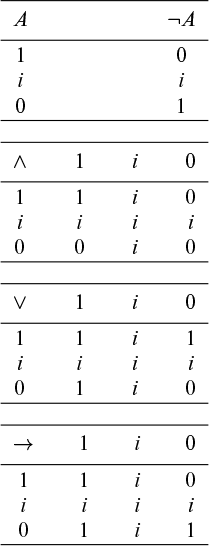
 2. The rules involving the connectives (negation, disjunction, conjunction, and implication) are illustrated in Table 1, while the rules for the universal and existential quantifiers are natural extensions of the rules for conjunction and disjunction. For example,
$\mathcal {V}_X^{\mu }(\forall x A)=1$
 if and only if
$\mathcal {V}_X^{\mu }(A(n))=1$
 for every natural number n;
$\mathcal {V}_X^{\mu }(\forall x A)=0$
 if and only if
$\mathcal {V}_X^{\mu }(A(n))$
 is either 0 or 1 for every natural number n and 0 for at least a number n; otherwise,
$\mathcal {V}_X^{\mu }(\forall x A)=i$
 .Footnote
15
Connectives in Kleene’s weak scheme

Table 1 Long description
The image consists of four truth tables arranged horizontally.
1. Negation table: The first column A has values 1, i, 0. The second column, not A, has corresponding values 0, i, 1.
2. Conjunction table: The header row and first column both list values 1, i, 0. The resulting grid is:
- Row 1 (1): 1, i, 0
- Row 2 (i): i, i, i
- Row 3 (0): 0, i, 0.
3. Disjunction table: The header row and first column both list values 1, i, 0. The resulting grid is:
- Row 1 (1): 1, i, 1
- Row 2 (i): i, i, i
- Row 3 (0): 1, i, 0.
4. Implication table: The header row and first column both list values 1, i, 0. The resulting grid is:
- Row 1 (1): 1, i, 0
- Row 2 (i): i, i, i
- Row 3 (0): 1, i, 1.
In all tables, any operation involving the value i results in i.
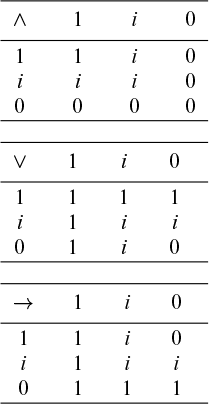
Kleene’s strong scheme has the same interpretation for negation as Kleene’s weak scheme. The interpretations for the other connectives in Kleene’s strong scheme are shown in Table 2. Note that in both Kleene’s strong and weak schemes, the implication
$A\to B$
 can be defined as
$\neg A\vee B$
 . The rule for the universal quantifier is as follows:
$\mathcal {V}_X^{\kappa }(\forall x A)=1$
 if and only if
$\mathcal {V}_X^{\kappa }(A(n))=1$
 for every natural number n;
$\mathcal {V}_X^{\kappa }(\forall x A)=0$
 if and only if
$\mathcal {V}_X^{\kappa }(A(n))=0$
 for some number n; otherwise,
$\mathcal {V}_X^{\kappa }(\forall x A)=i$
 .
Conjunction, disjunction and implication in Kleene’s strong scheme

Table 2 Long description
The image contains three truth tables for three-valued logic using the values 1, i, and 0.
Table 1: Conjunction (wedge symbol).
Headers: Row values are 1, i, 0; Column values are 1, i, 0.
- Row 1: 1 wedge 1 is 1, 1 wedge i is i, 1 wedge 0 is 0.
- Row 2: i wedge 1 is i, i wedge i is i, i wedge 0 is 0.
- Row 3: 0 wedge 1 is 0, 0 wedge i is 0, 0 wedge 0 is 0.
Table 2: Disjunction (vee symbol).
Headers: Row values are 1, i, 0; Column values are 1, i, 0.
- Row 1: 1 vee 1 is 1, 1 vee i is 1, 1 vee 0 is 1.
- Row 2: i vee 1 is 1, i vee i is i, i vee 0 is i.
- Row 3: 0 vee 1 is 1, 0 vee i is i, 0 vee 0 is 0.
Table 3: Implication (right arrow symbol).
Headers: Row values are 1, i, 0; Column values are 1, i, 0.
- Row 1: 1 arrow 1 is 1, 1 arrow i is i, 1 arrow 0 is 0.
- Row 2: i arrow 1 is 1, i arrow i is i, i arrow 0 is i.
- Row 3: 0 arrow 1 is 1, 0 arrow i is 1, 0 arrow 0 is 1.
Kleene’s strong and weak schemes are two of well-known monotonic schemes (a concept we will explain later). We now introduce two non-monotonic three-valued schemes. The first is Łukasiewicz’s three-valued scheme, which we denote it with the letter
$\upsilon $
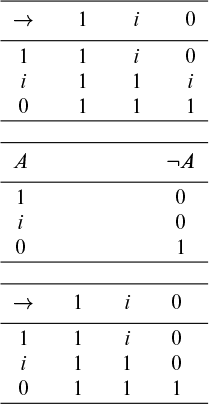
 . This scheme has the same interpretations as Kleene’s scheme for negation, conjunction and disjunction. Here, we only list the interpretation of the implication under Łukasiewicz’s scheme, which is shown on the top of Table 3. The other non-monotonic scheme that we consider in this paper is Gödel’s three-valued scheme, which we denote with
$\gamma $
 .Footnote
16
In Gödel’s three-valued logic, the disjunction and conjunction connectives are interpreted exactly as they are in Kleene’s strong three-valued logic. The middle and bottom of Table 3 show the negation and implication of Gödel’s three-valued scheme.
Implication in Łukasiewicz’s scheme, negation and implication in Gödel’s scheme (from left to right)

Table 3 Long description
The image contains three truth tables for three-valued logic using values 1, i, and 0.
Table 1: Implication in Lukasiewicz's scheme.
- Header row: arrow symbol, 1, i, 0.
- Row 1: 1 yields 1, i, 0.
- Row 2: i yields 1, 1, i.
- Row 3: 0 yields 1, 1, 1.
Table 2: Negation in Godel's scheme.
- Header row: A, neg A.
- Row 1: 1 yields 0.
- Row 2: i yields 0.
- Row 3: 0 yields 1.
Table 3: Implication in Godel's scheme.
- Header row: arrow symbol, 1, i, 0.
- Row 1: 1 yields 1, i, 0.
- Row 2: i yields 1, 1, 0.
- Row 3: 0 yields 1, 1, 1.
We define a binary relation
$\leq $
 on
$\{0, 1, i\}$
 as the least reflexive relation satisfying
$i \leq 0$
 and
$i \leq 1$
 .Footnote
17
The following result is folklore and the proof is omitted.Footnote
18
Lemma 5.1. For any sentence A and any partial predicate X,
$\mathcal {V}_X^{\mu }(A)\leq \mathcal {V}_X^{\kappa }(A)\leq \mathcal {V}_X^{\upsilon }(A)\leq \mathcal {V}_X^{\gamma }(A)$
 .
Finally, we review the rules for van Fraassen’s supervaluation scheme (
$\sigma $
 ), which is defined via the classical two-valued scheme (
$ \tau $
 ). For any sentence A and partial predicate X, the supervaluation
$\mathcal {V}_X^{\sigma }$
 is defined as follows:
$\mathcal {V}_X^{\sigma }(A)=1$
 , if for any total predicate
$Y\supseteq X$
 , we have
$\mathcal {V}_{Y^+}^{\tau }(A)=1$
 ;
$\mathcal {V}_X^{\sigma }(A)=0$
 , if for any total predicate
$Y\supseteq X$
 , we have
$\mathcal {V}_{Y^+}^{\tau }(A)=0$
 ; otherwise,
$\mathcal {V}_X^{\sigma }(A)=i$
 . Informally, the supervaluation scheme provides a way to assign a truth value even when there’s partial information, by considering all possible ways to complete that information to a classical two-valued interpretation.
5.2 Normal valuation schemes and dependence relation
In the above valuation schemes, the interpretation of connectives has a common characteristic: when restricted to the two classical truth values (true and false), the interpretation of each connective is equivalent to its classical two-valued counterpart. This property is commonly referred to as “normality.”Footnote 19 At the level of valuation, it means that a normal valuation collapses into a classical two-valued valuation provided the third value is absent. Based on this, we introduce the following concept.
Definition 5.2. A valuation scheme
$\rho $
 is normal if, for any total predicate X and any sentence A,
$\mathcal {V}_X^{\rho }(A)=\mathcal {V}_{X^+}^{\tau }(A)$
 .
The following result can be obtained through a routine induction on the structures of sentences.
Lemma 5.3. The valuation schemes
$\kappa $
 ,
$\mu $
 ,
$\sigma $
 ,
$\upsilon $
 and
$\gamma $
 are normal.
It’s worth noting that the above result for the case of the supervaluation case is straightforward. Moreover, we have an even stronger result.
Lemma 5.4. For any partial predicate X and any sentence A, if
$\mathcal {V}_X^{\sigma }(A)$
 is true or false, then
$\mathcal {V}_X^{\sigma }(A)=\mathcal {V}_{X^+}^{\tau }(A)$
 .
Proof. Let
$X'$
 be the total predicate with
$X^{+}$
 as its extension (and thus, its anti-extension is the complement of
$X^{+}$
 with respect to
$\mathbb {N}$
 ). Clearly,
$X\subseteq X'$
 . Without loss of generality, assume
$\mathcal {V}_X^{\sigma }(A)=1$
 (the case for
$\mathcal {V}_X^{\sigma }(A)=0$
 can be similarly proved). Then, by the rules of the supervaluation scheme, we can easily see that
$\mathcal {V}_{X'}^{\sigma }(A)=1.$
 (This shows the monotonicity of
$\sigma $
 . See also Lemma 5.9.) From Lemma 5.3, it follows that
$\mathcal {V}_{X^{\prime +}}^{\tau }(A)=1$
 , which is equivalent to
$\mathcal {V}_{X^+}^{\tau }(A)=1$
 . This yields
$\mathcal {V}_X^{\sigma }(A)=\mathcal {V}_{X^+}^{\tau }(A)$
 .
The definition of dependence is based upon a valuation scheme. So, when discussing dependence under different valuation schemes, we can use a prefix notation “
$ \rho $
 -” to explicitly indicate the underlying valuation scheme. We now give a basic property of semantic dependence for normal schemes. For a set
$\Sigma $
 , a partition of
$\Sigma $
 is defined as a partial predicate X such that the union of the extension and anti-extension of X is exactly
$\Sigma $
 .
Lemma 5.5. For any normal scheme
$\rho $
 , if a sentence
$A \rho $
 -depends on
$\Sigma $
 , then for every partition X of
$\Sigma $
 , the value of
$\mathcal {V}^{\rho }_X(A)$
 must belong to
$\{0, 1\}$
 .
Proof. Fix a total predicate
$Y\supseteq X$
 . Since X is a partition of
$\Sigma $
 , we can see that X and Y agree on
$\Sigma $
 . Since
$A \rho $
 -depends on
$\Sigma $
 , we know
$\mathcal {V}^{\rho }_X(A)=\mathcal {V}^{\rho }_Y(A)$
 . By Definition 5.2, we have
$\mathcal {V}^{\rho }_Y(A)=\mathcal {V}^{\tau }_{Y^+}(A)$
 . It follows immediately that
$\mathcal {V}^{\rho }_X(A)$
 must be true or false.
The converse of the above lemma is not necessarily true. For example, consider the sentence
$\neg M$
 , where M is the truth-teller sentence. We can easily see that it must be false when T is interpreted as the empty predicate under Łukasiewicz’s scheme. However, the smallest set on which
$\neg M$
 depends under Łukasiewicz’s scheme is not the empty set but the singleton
$\{M\}$
 .Footnote
20
Proposition 5.6. For any normal scheme
$\rho $
 , if a sentence
$A \rho $
 -depends on
$\Sigma $
 , then
$A \tau $
 -depends on
$\Sigma $
 .
Proof. To prove that
$A \tau $
 -depends on
$\Sigma $
 , we fix arbitrarily a set
$\Gamma $
 of sentences. We need to show that
$\mathcal {V}_{\Gamma }^{\tau }(A)=\mathcal {V}_{\Gamma \cap \Sigma }^{\tau }(A)$
 . Consider the total predicate
$(\Gamma , \overline {\Gamma })$
 , where
$\overline {\Gamma }$
 denotes the complement of
$\Gamma $
 to
$\mathbb {N}$
 . Note the following three facts:


Equations (5) and (6) follow from Lemma 5.3, while Equation (7) holds because
$A \rho $
 -depends on
$\Sigma $
 .
We notice that
$\overline {\Gamma \cap \Sigma }\cap \Sigma =\overline {\Gamma }\cap \Sigma $
 . Given that
$A \rho $
 -depends on
$\Sigma $
 , the right-hand side of Equation (7) is equal to the left-hand side of Equation (5). We thus get
$\mathcal {V}_{\Gamma }^{\tau }(A)=\mathcal {V}_{\Gamma \cap \Sigma }^{\tau }(A)$
 .
Proposition 5.7. A sentence
$A \sigma $
 -depends on
$\Sigma $
 iff
$A \tau $
 -depends on
$\Sigma $
 .Footnote
21
Proof. We only prove the sufficiency. Assume
$A \tau $
 -depends on
$\Sigma $
 . To show that
$A \sigma $
 -depends on
$\Sigma $
 , let X be a partial predicate. We aim to prove that
$\mathcal {V}_X^{\sigma }(A)=\mathcal {V}_{X\cap \Sigma }^{\sigma }(A)$
 . We consider two cases:
Case 1: If
$\mathcal {V}_X^{\sigma }(A)=T$
 or F, then by Lemma 5.4, we have
$\mathcal {V}_X^{\sigma }(A)=\mathcal {V}_{X^+}^{\tau }(A)$
 and
$\mathcal {V}_{X\cap \Sigma }^{\sigma }(A)=\mathcal {V}_{X^+\cap \Sigma }^{\tau }(A)$
 . Since
$A \tau $
 -depends on
$\Sigma $
 , it follows that
$\mathcal {V}_{X^+}^{\tau }(A)=\mathcal {V}_{X^+\cap \Sigma }^{\tau }(A)$
 . Therefore,
$\mathcal {V}_X^{\sigma }(A)=\mathcal {V}_{X\cap \Sigma }^{\sigma }(A)$
 .
Case 2: If
$\mathcal {V}_X^{\sigma }(A)=i$
 , then noting that
$X\cap \Sigma \subseteq X$
 , the monotonicity of the supervaluation scheme (see Lemma 5.9) immediately implies
$\mathcal {V}_{X\cap \Sigma }^{\sigma }(A)\leq \mathcal {V}_X^{\sigma }(A)$
 . Consequently,
$\mathcal {V}_{X\cap \Sigma }^{\sigma }(A)$
 must also evaluate to i.
Proposition 5.6 shows that dependence relations defined under normal three-valued valuation schemes are to some degree a weakening of the dependence relation in the classical two-valued scheme. Conversely, Proposition 5.7 demonstrates that the semantic dependence relation under the supervaluation scheme is essentially equivalent to that under the classical two-valued scheme.
For all valuation schemes except the supervaluation scheme, this weakening is strict, as illustrated by the following example: some sentence depends on a set under the two-valued scheme but this dependence relation fails under these three-valued valuation schemes. Consider the sentence
$A=T\, \ulcorner{0=0}\urcorner \vee \neg T\, \ulcorner{0=0}\urcorner$
 . In the two-valued scheme, it is clear that A depends on the empty set. However, for the schemes
$\rho =\kappa , \mu $
 ,
$\upsilon $
 or
$\gamma $
 , A does not
$\rho $
 -depend on the empty set. To see this, let X be the partial predicate
$(\{0=0\}, \emptyset )$
 . Then, A gets the value
$1$
 when T is interpreted as X, but has the third value (i) when interpreted as
$X\cap \emptyset $
 (i.e., the empty predicate). Therefore, A does not
$\rho $
 -depends on the empty set.
5.3 Monotonic valuation schemes and conditional dependence
For
$n\geq 1$
 , an n-ary three-valued function is a function from
$\{0, 1, i\}^n$
 to
$\{0, 1, i\}$
 . We say that an n-ary three-valued function h is monotonic if, for any
$x_k$
 ,
$y_k$
 with
$x_k\leq y_k$
 (
$1\leq k\leq n$
 ), we have
$h(x_1, \ldots , x_n)\leq h(y_1, \ldots , y_n)$
 . This definition can be naturally extended to the valuation schemes.Footnote
22
Definition 5.8. A valuation scheme
$\rho $
 is monotonic if, for any partial predicates
$X\subseteq Y$
 and any statement A, we have
$\mathcal {V}_X^{\rho }(A)\leq \mathcal {V}_Y^{\rho }(A)$
 .
The following fact is well-known, and its proof is omitted.
Lemma 5.9. The valuation schemes
$\kappa $
 ,
$\mu $
 , and
$\sigma $
 are all monotonic.
For monotonic schemes, Kripke jump is already monotonic even without the restriction of the condition
$A \in \mathfrak {D}(X^+ \cup X^-)$
 in Definition 3.1. Now, a natural question arises: are the dependence jump and the Kripke jump always the same for a monotonic valuation scheme? The answer is no. For instance, consider the sentence
$A = T\, \ulcorner{0=0}\urcorner \vee T\, \ulcorner{L}\urcorner$
 (where L is the liar sentence) and the partial predicate
$X=(\{0=0\}, \emptyset )$
 . Under Kleene’s strong scheme, the extension of the Kripke jump of X clearly includes A. However, A is not in the extension of its dependence jump because A doesn’t depend on the set
$\{0=0\}$
 , and the least set that it depends on is
$\{0=0, A\}$
 .
Recall that for any partial predicates X and Y, by
$X \subseteq Y$
 , we mean that the extension and anti-extension of X are, respectively, included in those of Y. We now present a stronger notion of dependence, under which the dependence jump and the Kripke jump will be proven to be always identical.
Definition 5.10. A sentence A depends on a set
$\Sigma $
 of sentences given a partial predicate Z, if for any partial predicates
$X\supseteq Z$
 and
$Y\supseteq Z$
 that agree on
$\Sigma $
 , we have
$\mathcal {V}_{X}(A) = \mathcal {V}_{Y}(A)$
 .Footnote
23
It should be noted that in this definition, when applying the classical two-valued scheme and using only the extensions of the partial predicates X, Y, and Z, we get the notion of conditional dependence brought forth by Leitgeb [Reference Leitgeb20, p. 189]. If X, Y, and Z are all total predicates, this definition is reduced to the “double-conditional” dependence introduced independently by Leitgeb [Reference Leitgeb, Dimitracopoulos, Newelski and Normann21, p. 83], Meadows [Reference Meadows23, p. 236] and Bonnay and van Vugt [Reference Bonnay, van Vugt, Achourioti, Galinon, Fernández and Fujimoto6, p. 364].
Lemma 5.11. For any partial predicate X, a sentence A depends on the set
$X^+\cup X^-$
 given X, iff for any partial predicate
$Y\supseteq X$
 , we have
$\mathcal {V}_{X}(A) = \mathcal {V}_{Y}(A)$
 .
Proof. The necessity is obvious. For the converse, let
$Y_1, Y_2\supseteq X$
 be arbitrary partial predicates. They trivially agree on
$X^+\cup X^-$
 . Since
$Y_1, Y_2\supseteq X$
 , it immediately follows that
$\mathcal {V}_{Y_1}(A) = \mathcal {V}_{Y_2}(A)= \mathcal {V}_{X}(A)$
 .
Lemma 5.12. For a monotonic valuation scheme
$\rho $
 , if
$\mathcal {V}_X^{\rho }(A)$
 is true or false, then A necessarily depends on
$X^+\cup X^-$
 given the partial predicate X.
Proof. Fix a partial predicate
$Y\supseteq X$
 . By monotonicity,
$\mathcal {V}_Y^{\rho }(A)\geq \mathcal {V}_X^{\rho }(A)$
 . However, since
$\mathcal {V}_X^{\rho }(A)$
 is either
$0$
 or
$1$
 ,
$\mathcal {V}_Y^{\rho }(A)$
 must also be
$0$
 or
$1$
 , respectively. In other words,
$\mathcal {V}_Y^{\rho }(A)=\mathcal {V}_X^{\rho }(A)$
 . From Lemma 5.11, it immediately follows that A depends on
$X^+\cup X^-$
 given the partial predicate X.
In Equations (1) and (2) of Definition 3.1, if we replace the condition
$A\in \mathfrak {D} (X^+\cup X^-)$
 (i.e., A depends on
$X^+\cup X^-$
 ) with the condition that A depends on
$X^+\cup X^-$
 given the partial predicate X, the resulting jump is called a conditional dependence jump. Now, Lemma 5.12 actually states that a conditional dependence jump is equivalent to a corresponding Kripke jump for the same monotonic valuation scheme. From this, the following result can be straightforwardly derived.
Proposition 5.13. For a monotonic valuation scheme
$\rho $
 , the two sequences of partial predicates starting from any partial predicate X—one iterated by the Kripke jump and the other by the conditional dependence jump—are identical (i.e., they are equal term by term).
6 Comparisons
In this section, we explore the connections and distinctions between various least fixed points. Specifically, we’ll compare the least fixed points generated by Kripke’s original jumps with those derived from the dependence jump proposed in this paper, as well as the conditional dependence jump, all considered under different valuation schemes. Furthermore, this section will extend these comparisons to examine how self-referential sentences are categorized across these distinct theoretical approaches.
6.1 Comparison of least fixed points
To compare the least fixed points under various valuation schemes, we use
$K_{\mathrm {lf}}^{\rho }$
 ,
$D_{\mathrm {lf}}^{\rho }$
 , and
$C_{\mathrm {lf}}^{\rho }$
 to represent the least fixed points of the Kripke jump (denoted by
$J_K^{\rho }$
 ; see the notes below Definition 3.1), the dependence jump (denoted by
$J_D^{\rho }$
 ; see Definition 3.1), and the conditional dependence jump (denoted by
$J_C^{\rho }$
 ; see the notes above Proposition 5.13), respectively, under valuation scheme
$\rho $
 . It is worth noting that
$K_{\mathrm {lf}}^{\rho }$
 is defined only for monotonic schemes
$\rho $
 , whereas
$D_{\mathrm {lf}}^{\rho }$
 and
$C_{\mathrm {lf}}^{\rho }$
 are well-defined for any valuation scheme.
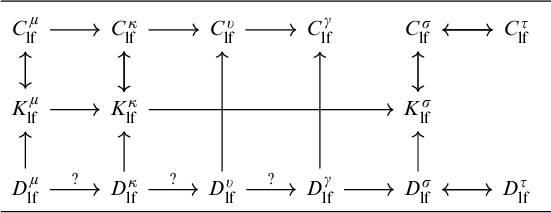
About the Kripke least fixed points, it’s well-known that
$K_{\mathrm {lf}}^{\mu }\subsetneq K_{\mathrm {lf}}^{\kappa } \subsetneq K_{\mathrm {lf}}^{\sigma }$
 .Footnote
24
The following observations about the Kripke least fixed points and Leitgeb’s least fixed point
$\Gamma _{\mathrm {lf}}$
 are attributed to Leitgeb [Reference Leitgeb20, p. 185]:
$\Gamma _{\mathrm {lf}}\subsetneq {K_{\mathrm {lf}}^{\sigma }}^+$
 , and
$\Gamma _{\mathrm {lf}}$
 is incomparable to
${K_{\mathrm {lf}}^{\kappa }}^+$
 (and thus, to
${K_{\mathrm {lf}}^{\mu }}^+$
 ). Additionally, it was independently proved by Meadows [Reference Meadows23, p. 237] and Bonnay and van Vugt [Reference Bonnay, van Vugt, Achourioti, Galinon, Fernández and Fujimoto6, p. 365] that
$C_{\mathrm {lf}}^{\tau } = K_{\mathrm {lf}}^{\sigma }$
 .
We begin by noting an observation connecting the least fixed point of
$J^{\tau }_D$
 and Leitgeb’s least fixed point
$\Gamma _{\mathrm {lf}}$
 , which we attribute to Schindler [Reference Schindler27].
Proposition 6.1.
${D_{\mathrm {lf}}^{\tau }}^+=\Gamma _{\mathrm {lf}}$
 . That is, the extension of the fixed point of
$J^{\tau }_D$
 is precisely Leitgeb’s least fixed point
$\Gamma _{\mathrm {lf}}$
 .
Proof. As we’ve pointed out below Definition 3.1, that
$J^{\tau }_D$
 is identical to
$J^*$
 , a jump based on the Leitgeb valuation scheme
$\mathcal {V}_X^{*}$
 . Since it has been proved in [Reference Schindler27, p. 67] that the extension of the least fixed point of
$J^*$
 is
$\Gamma _{\mathrm {lf}}$
 , it follows that the extension of the least fixed point of
$J^{\tau }_D$
 must also be
$\Gamma _{\mathrm {lf}}$
 .
The following fact establishes the equivalence between the dependence jump under two-valued semantics and the one under supervaluation semantics and is helpful for comparing the least fixed points.
Lemma 6.2. For any partial predicate X,
$J^{\sigma }_D(X)=J^{\tau }_D\left (X\right )$
 .
Proof. By Definition 3.1,
${J^{\sigma }_D(X)}^+$
 is the set

As explained below the same definition,
${J^{\tau }_D\left (X\right )}^+$
 is the set

The conclusion then immediately follows from Lemma 5.4 and Proposition 5.7.
Theorem 6.3.
$D_{\mathrm {lf}}^{\mu }\subsetneq D_{\mathrm {lf}}^{\tau }$
 ,
$D_{\mathrm {lf}}^{\kappa }\subsetneq D_{\mathrm {lf}}^{\tau }$
 , and
$D_{\mathrm {lf}}^{\sigma }= D_{\mathrm {lf}}^{\tau }$
 . Furthermore, the fixed points
$D_{\mathrm {lf}}^{\mu }$
 ,
$D_{\mathrm {lf}}^{\kappa }$
 , and
$D_{\mathrm {lf}}^{\sigma }$
 are properly included in
$K_{\mathrm {lf}}^{\mu }$
 ,
$K_{\mathrm {lf}}^{\kappa }$
 , and
$K_{\mathrm {lf}}^{\sigma }$
 , respectively.
Proof. The equality
$D_{\mathrm {lf}}^{\sigma }=D_{\mathrm {lf}}^{\tau }$
 follows straightforwardly from Lemma 6.2. By Proposition 5.6, we know that
$D_{\mathrm {lf}}^{\mu }\subseteq D_{\mathrm {lf}}^{\tau }$
 and
$D_{\mathrm {lf}}^{\kappa }\subseteq D_{\mathrm {lf}}^{\tau }$
 . For monotonic
$\rho $
 , the relation
$D_{\mathrm {lf}}^{\rho }\subseteq K_{\mathrm {lf}}^{\rho }$
 is an immediate consequence of Definition 3.1. We now only need to prove that these inclusions are proper.
Consider the sentence
$(0=0)\vee L$
 (denoted by A), where L is the liar sentence. It is clear that
$A \ \tau $
 -depends on the empty set, but the least
$\mu $
 -dependence set of A is
$\{L\}$
 . This implies that A belongs to
$D_{\mathrm {lf}}^{\tau }$
 but not to
$D_{\mathrm {lf}}^{\mu }$
 , which establishes
$D_{\mathrm {lf}}^{\mu }\subsetneq D_{\mathrm {lf}}^{\tau }$
 . By the way, the sentence A also belongs to
$D_{\mathrm {lf}}^{\kappa }$
 , which means
$D_{\mathrm {lf}}^{\mu }\neq D_{\mathrm {lf}}^{\kappa }$
 . However, it is currently unknown whether
$D_{\mathrm {lf}}^{\mu }\subseteq D_{\mathrm {lf}}^{\kappa }$
 holds.
Note that the sentence
$T\, \ulcorner{L}\urcorner \vee \neg T\, \ulcorner{L}\urcorner \tau $
 -depends on the empty set, but its least
$\kappa $
 -dependence set is
$\{L\}$
 . From this, it is not difficult to prove
$D_{\mathrm {lf}}^{\kappa }\subsetneq D_{\mathrm {lf}}^{\tau }$
 .
Let B be the sentence
$T\, \ulcorner{0=0}\urcorner \vee T\, \ulcorner{L}\urcorner$
 . Its least
$\sigma $
 -dependence set is
$\{0=0, L\}$
 . According to Definition 3.1, the sentence B does not occur in
$D_{\mathrm {lf}}^{\sigma }$
 . However, it is not difficult to see that this sentence belongs to
$K_{\mathrm {lf}}^{\kappa }$
 (and thus also to
$K_{\mathrm {lf}}^{\sigma }$
 ). From this, we can deduce
$D_{\mathrm {lf}}^{\kappa }\subsetneq K_{\mathrm {lf}}^{\kappa }$
 and
$D_{\mathrm {lf}}^{\sigma }\subsetneq K_{\mathrm {lf}}^{\sigma }$
 .
Finally, to show that the inclusion of
$D_{\mathrm {lf}}^{\mu }$
 in
$K_{\mathrm {lf}}^{\mu }$
 is proper, consider the sentence
$\exists x T(x)$
 . We can see that its least
$\tau $
 -dependence set is
$\mathbb {N}$
 .Footnote
25
Therefore, this sentence will not belong to
$D_{\mathrm {lf}}^{\mu }$
 , but it clearly belongs to
$K_{\mathrm {lf}}^{\mu }$
 . It is noteworthy that using the sentence
$\exists x T(x)$
 , we can similarly prove that
$D_{\mathrm {lf}}^{\kappa }\subsetneq K_{\mathrm {lf}}^{\kappa }$
 and
$D_{\mathrm {lf}}^{\sigma }\subsetneq K_{\mathrm {lf}}^{\sigma }$
 .
We take the opportunity to point out that since
$D_{\mathrm {lf}}^{\tau }=D_{\mathrm {lf}}^{\sigma }\subsetneq K_{\mathrm {lf}}^{\sigma }$
 , it follows that
${D_{\mathrm {lf}}^{\tau }}^+\subsetneq {K_{\mathrm {lf}}^{\sigma }}^+$
 , which means
$\Gamma _{\mathrm {lf}}\subsetneq {K_{\mathrm {lf}}^{\sigma }}^+$
 . This latter relation has already been proven by Leitgeb [Reference Leitgeb20, pp. 185–187]. However, the present proof establishes the relationship through a new fixed point
$D_{\mathrm {lf}}^{\sigma }$
 , which reveals why the supervaluation scheme is so special among all monotonic schemes. We will prove that
$K_{\mathrm {lf}}^{\sigma }=C_{\mathrm {lf}}^{\sigma }=C_{\mathrm {lf}}^{\tau }$
 .
We now prove that Proposition 5.7 can be extended to conditional dependence.
Proposition 6.4. For any partial predicate X, any sentence A, and any set
$\Sigma $
 of sentences, if
$\mathcal {V}_X^{\sigma }(A)=0$
 or
$1$
 , then
$A \sigma $
 -depends on
$\Sigma $
 given condition X, iff
$A \tau $
 -depends on
$\Sigma $
 given condition X.
Proof. We deduce the right side from the left side. Assume partial predicates
$Y_1, Y_2\supseteq X$
 satisfy
$Y_1\cap \Sigma =Y_2\cap \Sigma $
 . From the left-hand condition, we know
$\mathcal {V}_{Y_1}^{\sigma }(A)=\mathcal {V}_{Y_2}^{\sigma }(A)$
 . Since
$\mathcal {V}_X^{\sigma }(A)$
 is true or false, and given that the supervaluation scheme is monotonic,
$\mathcal {V}_{Y_1}^{\sigma }(A)$
 and
$\mathcal {V}_{Y_2}^{\sigma }(A)$
 will be true or false, accordingly. Thus, by Lemma 5.4, we immediately get
$\mathcal {V}_{Y_1^+}^{\tau }(A)=\mathcal {V}_{Y_2^+}^{\tau }(A)$
 . The converse can be proven similarly.
Theorem 6.5.
$C_{\mathrm {lf}}^{\mu }\subsetneq C_{\mathrm {lf}}^{\kappa } \subsetneq C_{\mathrm {lf}}^{\sigma }=C_{\mathrm {lf}}^{\tau }$
 . Furthermore, they are equal to
$K_{\mathrm {lf}}^{\mu }$
 ,
$K_{\mathrm {lf}}^{\kappa }$
 , and
$K_{\mathrm {lf}}^{\sigma }$
 , respectively.
Proof. By Proposition 5.13, we see the equality
$C_{\mathrm {lf}}^{\rho }=K_{\mathrm {lf}}^{\rho }$
 holds for monotonic valuation schemes
$\rho $
 . Combining this with the known results
$K_{\mathrm {lf}}^{\mu }\subsetneq K_{\mathrm {lf}}^{\kappa } \subsetneq K_{\mathrm {lf}}^{\sigma }$
 , we can conclude that
$C_{\mathrm {lf}}^{\mu }\subsetneq C_{\mathrm {lf}}^{\kappa } \subsetneq C_{\mathrm {lf}}^{\sigma }$
 . Finally, the equality
$C_{\mathrm {lf}}^{\sigma }=C_{\mathrm {lf}}^{\tau }$
 is straightforward from Proposition 6.4.
The above comparison of least fixed points only involves monotonic three-valued valuations and classical valuations. We now turn to the relationship between these fixed points and the least fixed point of the dependence jump under Łukasiewicz’s and Gödel’s three-valued schemes. (Recall that
$\upsilon $
 stands for Łukasiewicz’s scheme and
$\gamma $
 for Gödel’s.)
Theorem 6.6.
$D_{\mathrm {lf}}^{\upsilon }, D_{\mathrm {lf}}^{\gamma }\subsetneq D_{\mathrm {lf}}^{\tau }$
 (and thus,
$D_{\mathrm {lf}}^{\upsilon }, D_{\mathrm {lf}}^{\gamma }\subsetneq D_{\mathrm {lf}}^{\sigma }$
 ),
$D_{\mathrm {lf}}^{\upsilon }\subsetneq C_{\mathrm {lf}}^{\upsilon }$
 and
$D_{\mathrm {lf}}^{\gamma }\subsetneq C_{\mathrm {lf}}^{\gamma }$
 . Both
$D_{\mathrm {lf}}^{\upsilon }$
 and
$D_{\mathrm {lf}}^{\gamma }$
 are incomparable with
$K_{\mathrm {lf}}^{\kappa }$
 and
$K_{\mathrm {lf}}^{\mu }$
 (and therefore, with
$C_{\mathrm {lf}}^{\kappa }$
 and
$C_{\mathrm {lf}}^{\mu }$
 as well).
$C_{\mathrm {lf}}^{\upsilon }$
 and
$C_{\mathrm {lf}}^{\gamma }$
 are incomparable with
$C_{\mathrm {lf}}^{\tau }$
 .
Proof. As we showed
$D_{\mathrm {lf}}^{\mu }\subseteq D_{\mathrm {lf}}^{\tau }$
 in Theorem 6.3, we can, by Proposition 5.6, similarly prove
$D_{\mathrm {lf}}^{\upsilon }, D_{\mathrm {lf}}^{\gamma }\subseteq D_{\mathrm {lf}}^{\tau }$
 . Let L be the liar sentence. By appealing to the sentence
$0=0\vee L$
 , we can also prove that
$D_{\mathrm {lf}}^{\upsilon }$
 (
$D_{\mathrm {lf}}^{\gamma }$
 ) and
$D_{\mathrm {lf}}^{\tau }$
 are not equal.
Additionally, the sentence
$T\, \ulcorner{L}\urcorner \leftrightarrow T\, \ulcorner{L}\urcorner \upsilon $
 -depends on the empty set, implying its presence in the extension of
$D_{\mathrm {lf}}^{\upsilon }$
 . However, this sentence clearly belongs to neither
$K_{\mathrm {lf}}^{\kappa }$
 nor
$K_{\mathrm {lf}}^{\mu }$
 . On the other hand, as previously noted, the sentence
$\exists x T(x)$
 belongs to both
$K_{\mathrm {lf}}^{\kappa }$
 and
$K_{\mathrm {lf}}^{\mu }$
 , but not to
$D_{\mathrm {lf}}^{\upsilon }$
 . Therefore,
$D_{\mathrm {lf}}^{\upsilon }$
 is incomparable with both
$K_{\mathrm {lf}}^{\kappa }$
 and
$K_{\mathrm {lf}}^{\mu }$
 . The incomparability of
$D_{\mathrm {lf}}^{\gamma }$
 with
$K_{\mathrm {lf}}^{\kappa }$
 and
$K_{\mathrm {lf}}^{\mu }$
 can be similarly proved.
Since dependence implies conditional dependence, it follows that
$D_{\mathrm {lf}}^{\upsilon }\subseteq C_{\mathrm {lf}}^{\upsilon }$
 . Furthermore, by Definition 3.3, taking X to be the empty predicate, it’s straightforward to prove by induction that for
$\alpha \geq 1$
 , the sentence
$\exists x T(x)$
 belongs to
$X_{\alpha }^{\upsilon }$
 using Lemma 5.11. Therefore, this sentence also belongs to
$C_{\mathrm {lf}}^{\upsilon }$
 . However, we already know that the sentence
$\exists x T(x)$
 does not belong to
$D_{\mathrm {lf}}^{\upsilon }$
 . Thus, we obtain
$D_{\mathrm {lf}}^{\upsilon }\subsetneq C_{\mathrm {lf}}^{\upsilon }$
 . This proof is applicable to the case of Gödel’s scheme.
As to the comparison of
$C_{\mathrm {lf}}^{\upsilon }$
 and
$C_{\mathrm {lf}}^{\tau }$
 , only note that the sentence
$T\, \ulcorner{L}\urcorner \leftrightarrow T\, \ulcorner{L}\urcorner$
 belongs to the former but not the latter, while
$T\, \ulcorner{M}\urcorner \vee \neg T\, \ulcorner{M}\urcorner$
 belongs to the latter but not the former, where M is the truth-teller sentence (see the notes above Proposition 5.6). Therefore,
$C_{\mathrm {lf}}^{\upsilon }$
 and
$C_{\mathrm {lf}}^{\tau }$
 are incomparable.
The reader may have noticed that the above theorem does not explicitly address the interrelations among
$D_{\mathrm {lf}}^{\mu }$
 ,
$D_{\mathrm {lf}}^{\kappa }$
 ,
$D_{\mathrm {lf}}^{\upsilon }$
 , and
$D_{\mathrm {lf}}^{\gamma }$
 . In the proof of Theorem 6.3, we noted that it remains an open question whether
$D_{\mathrm {lf}}^{\mu } \subseteq D_{\mathrm {lf}}^{\kappa }$
 . A plausible conjecture is that the following chain of inclusions holds:
$D_{\mathrm {lf}}^{\mu }\subseteq D_{\mathrm {lf}}^{\kappa }\subseteq D_{\mathrm {lf}}^{\upsilon }\subseteq D_{\mathrm {lf}}^{\gamma }$
 .
6.2 Comparison of sentence properties
According to Kripke’s idea, a sentence is grounded if it belongs to the least fixed point (either its extension or anti-extension). Since the least fixed point depends on the valuation scheme and the jump operation, we can say that a sentence is grounded with respect to a certain valuation scheme and jump operation—or more concisely, is
$\rho $
 -grounded with respect to a certain jump operation. This allows us to compare grounded sentences based on these two parameters: the valuation scheme and the jump operation. For instance, since
$D_{\mathrm {lf}}^{\kappa }\subsetneq K_{\mathrm {lf}}^{\kappa }$
 , any sentence grounded by the dependence jump under Kleene’s strong scheme must also be grounded by the Kripke jump under the same scheme, but not vice versa. Similarly,
$D_{\mathrm {lf}}^{\kappa }\subsetneq D_{\mathrm {lf}}^{\sigma }$
 implies that a
$\kappa $
 -grounded sentence formed by the dependence jump is necessarily also a
$\sigma $
 -grounded sentence formed by the same jump, but the converse may not hold.
Of special interest is the equality
$K_{\mathrm {lf}}^{\sigma }=C_{\mathrm {lf}}^{\tau }$
 . This fact shows that the least fixed point of conditional dependence in classical two-valued semantics is identical to the least fixed point obtained in Kripke’s theory under the supervaluation scheme. This is a fact already proven by Meadows [Reference Meadows23, p. 237] and Bonnay and van Vugt [Reference Bonnay, van Vugt, Achourioti, Galinon, Fernández and Fujimoto6, p. 365]. As previously mentioned, the proof provided here is achieved by bridging through
$C_{\mathrm {lf}}^{\sigma }$
 . By introducing (conditional) dependence relation within three-valued semantics, we articulate why
$K_{\mathrm {lf}}^{\sigma }=C_{\mathrm {lf}}^{\tau }$
 within a clearer context.
Just as we compare grounded sentences, we can do the same for paradoxical sentences. First, let’s define the paradoxical sentences based on the valuation scheme and jump operation. If a sentence is undefined in any fixed point formed by the dependence jump under valuation scheme
$\rho $
 , then we say that this sentence is
$\rho $
 -paradoxical according to the dependence jump. If, in this definition, we consider monotonic valuation schemes and replace the dependence jump with the Kripke jump, we then obtain the well-known paradoxical sentences in Kripke’s theory.
According to Lemma 5.12, under any monotonic valuation scheme, the conditional dependence jump and the Kripke jump are essentially the same. Consequently, any fixed point formed by the conditional dependence jump is also a fixed point formed by the Kripke jump, and vice versa. From this, we can immediately conclude that for any monotonic valuation scheme
$\rho $
 , the
$\rho $
 -paradoxical sentences generated by the conditional dependence jump are the same as those generated by the Kripke jump. Furthermore, Lemma 6.2 shows that the dependence jump under the supervaluation scheme is equal to that under two-valued semantics, implying that their fixed points are also equivalent. Therefore, the
$\sigma $
 -paradoxical sentences and
$\tau $
 -paradoxical sentences generated by the dependence jump are also completely identical.
For any monotonic valuation scheme
$\rho $
 , it’s clear from Definition 3.1 that any
$\rho $
 -fixed point formed by the dependence jump is included in the
$\rho $
 -fixed point formed by the Kripke jump starting from the same partial predicate. This immediately implies that the set of
$\rho $
 -paradoxical sentences obtained via the Kripke jump always includes the set of
$\rho $
 -paradoxical sentences obtained via the dependence jump. Moreover, this is a proper inclusion. In fact, for any monotonic scheme
$\rho $
 , the sentence
$\exists x T(x)$
 is
$\rho $
 -paradoxical under the dependence jump, but not under the Kripke jump. This can be easily verified by referring to the discussion about
$\exists x T(x)$
 in the proof of Theorem 6.3. There are, of course, other counterexamples; for the Kleene strong three-valued valuation case, one can use the sentence
$T\, \ulcorner{0=0}\urcorner \vee T\, \ulcorner{L}\urcorner$
 .
Finally, we compare self-referentiality of sentences. For simplicity, the following discussion is only limited to dependence relations and does not involve conditional dependence.
Proposition 6.7. For any normal valuation scheme
$\rho $
 , if a sentence is
$\tau $
 -self-referential, then it must also be
$\rho $
 -self-referential. Furthermore,
$\sigma $
 -self-referentiality is equivalent to
$\tau $
 -self-referentiality.
Proof. Fix an arbitrary
$\rho $
 -dependence choice function f. According to Proposition 5.6, it is also a
$\tau $
 -dependence choice function. Assume A is
$\tau $
 -self-referential. Then, starting from A, there must exist a finite
$\prec _f^{\tau }$
 -sequence:
$A=A_0\prec _f^{\tau } A_1\prec _f^{\tau }\ldots \prec _f^{\tau }A_n=A$
 . Since f is a
$\rho $
 -dependence choice function, we can see that
$A=A_0\prec _f^{\rho } A_1\prec _f^{\rho }\ldots \prec _f^{\rho }A_n=A$
 also holds. Therefore, A is
$\rho $
 -self-referential. As for the equivalence of
$\sigma $
 -self-referentiality and
$\tau $
 -self-referentiality, it can be proven by Proposition 5.7.
Since the usual three-valued schemes are normal, it can be said that
$\tau $
 -self-referentiality is the strongest form of self-referentiality, and its extension is the smallest. Let A be a sentence satisfying
$A\equiv T\, ulcorner{A}urcorner \vee \neg T\, ulcorner{A}urcorner$
 .Footnote
26
Note that this sentence
$\tau $
 -depends on the empty set, but for any aforementioned three-valued scheme
$\rho $
 (including Łukasiewicz’s scheme and Gödel’s scheme), the least set that it
$\rho $
 -depends on is
$\{A\}$
 . Therefore, the sentence A is not
$\tau $
 -self-referential, but it is
$\rho $
 -self-referential.
7 Concluding remarks
This paper extends Leitgeb’s dependence relation, which is originally developed within classical two-valued semantics, to three-valued valuation schemes. By doing so, we are able to define an operation analogous to the Kripkean jump—which we call the dependence jump—under any three-valued valuation scheme (including non-monotonic ones). The dependence jump always satisfies monotonicity, even for non-monotonic valuation schemes. Consequently, fixed points can be constructed through iterations of the dependence jump under any three-valued valuation scheme.
As far as fixed points are concerned, this paper specifically focuses on least fixed points. Table 4 illustrates the relationships among all least fixed points discussed here. In the middle row of the table, we list the least fixed points of the Kripke jump under valuation schemes
$\mu $
 ,
$\kappa $
 , and
$\sigma $
 . The bottom row displays the least fixed points of the dependence jump, which are generated under the previous monotonic valuation schemes, classical two-valued schemes, Łukasiewicz’s scheme, and Gödel’s scheme. The top row contains the least fixed points of the dependence jump determined by conditional dependence. In this table, the extension of the fixed point increases along the direction of the arrows. A double arrow represents equality.
Comparison of least fixed points

Table 4 Long description
The diagram consists of three rows of mathematical terms.
Row 1 contains six terms: C sub l f super mu, C sub l f super kappa, C sub l f super upsilon, C sub l f super gamma, C sub l f super sigma, and C sub l f super tau. Right-pointing arrows connect mu to kappa, kappa to upsilon, and sigma to tau. A left-pointing arrow connects tau back to sigma.
Row 2 contains three terms: K sub l f super mu, K sub l f super kappa, and K sub l f super sigma. A right-pointing arrow connects mu to kappa. A long diagonal arrow points from K sub l f super kappa to D sub l f super sigma in the third row. Vertical arrows point upward from K sub l f super mu to C sub l f super mu, from K sub l f super kappa to C sub l f super kappa, and from K sub l f super sigma to C sub l f super sigma.
Row 3 contains six terms: D sub l f super mu, D sub l f super kappa, D sub l f super upsilon, D sub l f super gamma, D sub l f super sigma, and D sub l f super tau. Right-pointing arrows with question marks connect mu to kappa, kappa to upsilon, and upsilon to gamma. Solid right-pointing arrows connect gamma to sigma and sigma to tau. A left-pointing arrow connects tau back to sigma. Vertical arrows point upward from D sub l f super mu to K sub l f super mu, from D sub l f super kappa to K sub l f super kappa, from D sub l f super upsilon to C sub l f super upsilon, from D sub l f super gamma to C sub l f super gamma, and from D sub l f super sigma to K sub l f super sigma.
Additionally, a downward arrow points from C sub l f super mu to K sub l f super mu, and from C sub l f super kappa to K sub l f super kappa.
By utilizing the notion of dependence, we are able to formally characterize self-referentiality of sentences within three-valued semantics. This extends work previously limited to two-valued semantics to a broader scope. An observation of special interest is that among the notions of self-referentiality for different valuation schemes, the one under two-valued semantics is the strongest. That is, compared to self-referentiality under three-valued semantics, self-referentiality under classical semantics encompasses the fewest sentences. In this sense, Kripke’s fixed-point theory, when incorporated with Leitget’s theory of dependence, offers a wider space for considering self-referentiality of sentences. This, of course, is a technical result about the extension of self-referentiality. Which type of self-referentiality better aligns with our conceptual intuition is a question not explored in this paper and seems to be worth further investigation.
There are several technical problems remaining to be solved. The question mark in Table 4 highlights a previously mentioned problem: Is the least fixed point of the dependence jump based on Kleene’s weak valuation included in that based on Kleene’s strong valuation? (See the Appendix for a reason why we need to make more efforts to solve this question). The relationships between these two fixed points and the least fixed point of the dependence jump based on Łukasiewicz’s three-valued valuation and Gödel’s three-valued valuation are also left for future research.
Finally, two points are worth special mention. First, in Definition 3.1, a slight variant of the jump can be obtained by modifying Equations (1) and (2) as follows:

It follows from Lemma 2.4 that such a jump satisfies monotonicity. Furthermore, since dependence relations are preserved under inclusion (see Lemma 2.5), the partial predicate obtained from any partial predicate X by the aforementioned jump is always a sub-predicate of the partial predicate obtained from X by the original jump of Definition 3.1. Therefore, the fixed points of the aforementioned jump are always sub-predicates of the fixed points of the original jump.
Another point is that while this paper only extends Leitgeb’s dependence relation to three-valued semantics, it can be further generalized to valuation schemes with more than three values. This would simply require proportionally increasing the number of components in the partial predicate. As for what new results concerning semantic dependence relations can be developed under these valuation schemes, that is left for future investigation.
Appendix
The purpose of this appendix is to compare the current notion of dependence and Rivello’s. We begin by introducing the concept of valuation systems, which Rivello proposes in his work [Reference Rivello25, p. 126] as the basis for Rivello’s definition of the dependence relation.
Definition A.1. A valuation system is a triple of the form
$\langle \mathcal {F}, \mathcal {F}', \Lambda \rangle $
 , where both
$\mathcal {F}$
 and
$\mathcal {F}'$
 are non-empty sets of functions and
$\Lambda $
 is a function from
$\mathcal {F}$
 to
$\mathcal {F}'$
 .
For our current purpose, we will only consider the valuation system with the restriction
$\mathcal {F}=\mathcal {F}'$
 . For brevity, we denote the system
$\langle \mathcal {F}, \Lambda \rangle $
 rather than
$\langle \mathcal {F}, \mathcal {F}, \Lambda \rangle $
 . Let
$\mathcal {D}$
 be the union of
$\text {dom}(p)$
 for all
$p\in \mathcal {F}$
 . For
$X\subseteq \mathcal {D}$
 ,
$p, q\in \mathcal {F}$
 , and
$A\in \mathcal {D}$
 , we say that p and q agree on X if
$p\restriction _X=q\restriction _X$
 holds whenever
$X\subseteq \text {dom}(p)\cap \text {dom}(q)$
 . The following definition of the dependence relation is due to Rivello [Reference Rivello25, p. 127] (see also Rivello [Reference Rivello26, p. 1242]). As usual, when
$A\in \text {dom}(p),$
 we also write
$p(A)\downarrow $
 .
Definition A.2. Let
$\langle \mathcal {F}, \Lambda \rangle $
 be a valuation system, and let
$\mathcal {D}=\bigcup \{\text {dom}(p)\,\mid \, p\in \mathcal {F}\}$
 . For
$X\subseteq \mathcal {D}$
 and
$A\in \mathcal {D}$
 , we say that
$A \Lambda $
 -depends on
$\Sigma $
 , if for any
$p, q\in \mathcal {F}$
 that agree on
$\Sigma $
 , we have
$\Lambda (p)(A)\downarrow $
 ,
$\Lambda (q)(A)\downarrow $
 , and
$\Lambda (p)(A)=\Lambda (q)(A)$
 .
Partial predicates can be expressed equivalently as functions mapping into the set of three truth values. Following Rivello’s approach, we consider the valuation system
$\langle \mathcal {F}, \Lambda \rangle $
 , where
$\mathcal {F}$
 is the set of all functions from the sentences of
$\mathcal {L}_T$
 to
$\{0, 1, i\}$
 . Given a valuation scheme
$\rho $
 , the function
$\Lambda $
 is defined by
$\Lambda (p)=\mathcal {V}^{\rho }_{K_p}$
 for each
$p\in \mathcal {F}$
 , where
$K_p$
 is the partial predicate with extension
$\{A \mid p(A)=1\}$
 and anti-extension
$\{A \mid p(A)=0\}$
 . Since p, q and their images
$\Lambda (p), \Lambda (p)$
 are all total functions, the definability conditions, such as
$\Sigma \subseteq \text {dom}(q)$
 and
$A\in \text {dom}(q),$
 are trivially satisfied. Within this framework, a sentence
$A \Lambda $
 -depends on
$\Sigma $
 , iff for any
$p, q\in \mathcal {F}$
 ,
$p\restriction _{\Sigma }=q\restriction _{\Sigma }$
 implies
$\mathcal {V}^{\rho }_{K_p}(A)=\mathcal {V}^{\rho }_{K_q}(A)$
 .
For partial predicates
$X, Y$
 , let
$p, q\in \mathcal {F}$
 be their corresponding three-valued functions. Specifically, p is defined such that
$p(A)=1$
 if
$A\in X^+$
 ,
$p(A)=0$
 if
$A\in X^-$
 , and
$p(A)=i$
 otherwise. It is evident that
$X\cap \Sigma =Y\cap \Sigma $
 , iff
$p\restriction _{\Sigma }=q\restriction _{\Sigma }$
 ;
$K_{p}=X$
 and
$K_{q}=Y$
 . Consequently, a sentence
$A \rho $
 -depends on
$\Sigma $
 , iff it
$\Lambda $
 -depends on
$\Sigma $
 . We thus incorporate the dependence relation presented in this paper as a special case within Rivello’s general concept of dependence.
One may represent partial predicates as partial functions. Let
$\mathcal {F}$
 be the set of all two-valued partial functions defined on the set of sentences of
$\mathcal {L}_T$
 . Given a valuation scheme
$\rho $
 , let
$\mathscr {V}^{\rho }_{X}$
 be the same as
$\mathcal {V}^{\rho }_{X}$
 , except that
$\mathscr {V}^{\rho }_{X}(A)$
 is undefined iff
$\mathcal {V}^{\rho }_{X}=i$
 . Note that
$\mathscr {V}^{\rho }_{X}$
 is thus a partial function on sentences of
$\mathcal {L}_T$
 . For each
$p\in \mathcal {F}$
 , we continue to use
$K_p$
 to denote the partial predicate with extension
$\{A \mid p(A)=1\}$
 and anti-extension
$\{A \mid p(A)=0\}$
 . We can see that a sentence
$A \Lambda $
 -depends on
$\Sigma $
 if, for any
$p, q\in \mathcal {F}$
 with
$\Sigma \subseteq \text {dom}(p)\cap \text {dom}(q)$
 ,
$p\restriction _{\Sigma }=q\restriction _{\Sigma }$
 implies that
$\Lambda (p)(A)\downarrow $
 ,
$\Lambda (q)(A)\downarrow $
 , and
$\Lambda (p)(A)=\Lambda (q)(A)$
 . We must emphasize that the conditions
$\Lambda (p)(A)\downarrow $
 and
$\Lambda (q)(A)\downarrow $
 are essential to Rivello’s notion of dependence. In this setting, it is clear that the present dependence relation cannot be reduced to Rivello’s notion within the valuation system
$\langle \mathcal {F}, \Lambda \rangle $
 . In fact, to the concept of
$\Lambda $
 -dependence just introduced on the basis of partial functions, the corresponding dependence relation formulated in terms of partial predicates should be stated as follows.Footnote
27
Definition A.3. A sentence
$A \rho $
 -depends on a set
$\Sigma $
 of sentences in Rivello’s sense, if for any partial predicates X and Y satisfying
$\Sigma \subseteq (X^+\cup X^-)\cap (Y^+\cup Y^-)$
 ,
$X\cap \Sigma =Y\cap \Sigma $
 implies that
$\mathscr {V}^{\rho }_{X}(A)\downarrow $
 ,
$\mathscr {V}^{\rho }_{Y}(A)\downarrow $
 , and
$\mathscr {V}^{\rho }_{X}(A) = \mathscr {V}^{\rho }_{Y}(A)$
 .
A fact analogous to Lemma 2.4, which provides an equivalence condition for Definition A.3, is as follows.
Lemma A.4.
$A \rho $
 -depends on
$\Sigma $
 in Rivello’s sense, iff for any partial predicate X satisfying
$\Sigma \subseteq X^{+}\cup X^{-}$
 , we have
$\mathscr {V}^{\rho }_{X}(A)\downarrow $
 ,
$\mathscr {V}^{\rho }_{X\cap \Sigma }(A)\downarrow $
 , and
$\mathscr {V}^{\rho }_{X}(A) = \mathscr {V}^{\rho }_{X\cap \Sigma }(A)$
 .
As to the aforementioned dependence relations, we can prove that among the three items in Lemma 2.5, the second one holds.Footnote
28
To see this, we first observe that for any partial predicate X, if
$\Gamma \subseteq X^+\cup X^-$
 , then
$\Sigma \subseteq \Gamma $
 implies
$\Sigma \subseteq X^+\cup X^-$
 , which further entails
$\Sigma \subseteq (X^+\cap \Gamma )\cup (X^-\cap \Gamma )$
 .Thus, according to the dependence of A on
$\Sigma $
 , we can derive that
$\mathscr {V}^{\rho }_{X}(A)\downarrow $
 ,
$\mathscr {V}^{\rho }_{X\cap \Sigma }(A)\downarrow $
 , and
$\mathscr {V}^{\rho }_{X}(A) = \mathscr {V}^{\rho }_{X\cap \Sigma }(A)$
 , as well as
$\mathscr {V}^{\rho }_{X\cap \Gamma }(A)\downarrow $
 ,
$\mathscr {V}^{\rho }_{X\cap \Gamma \cap \Sigma }(A)\downarrow $
 , and
$\mathscr {V}^{\rho }_{X\cap \Gamma }(A) = \mathscr {V}^{\rho }_{X\cap \Gamma \cap \Sigma }(A)$
 . From these, it follows that
$\mathscr {V}^{\rho }_{X}(A)\downarrow $
 ,
$\mathscr {V}^{\rho }_{X\cap \Gamma }(A)\downarrow $
 , and
$\mathscr {V}^{\rho }_{X}(A) = \mathscr {V}^{\rho }_{X\cap \Gamma }(A)$
 . Therefore, A depends on
$\Gamma $
 . The first item holds under the condition that
$\rho $
 is normal; under this condition, it can be guaranteed that the valuation
$\mathscr {V}^{\rho }_{X}$
 is defined everywhere whenever X is a total predicate. It is still unknown whether the third item holds for the dependence relation in Rivello’s sense.
When
$\rho $
 is monotonic, we have the following characterization of
$\rho $
 -dependence relation in Rivello’s sense, which is due to Rivello [Reference Rivello25, p. 130].
Lemma A.5. For any monotonic valuation scheme
$\rho $
 , a sentence
$A \rho $
 -depends on
$\Sigma $
 in Rivello’s sense, iff
$\mathcal {V}^{\rho }_X(A)$
 must be either true or false for any partition X of
$\Sigma $
 .
Proof. When X is a partition of
$\Sigma $
 , it is clear that
$\Sigma \subseteq X^{+}\cup X^{-}$
 . So, if
$A \rho $
 -depends on
$\Sigma $
 , then
$\mathcal {V}^{\rho }_X(A)$
 is defined. Conversely, suppose X is a partial predicate satisfying
$\Sigma \subseteq X^{+}\cup X^{-}$
 . Then
$X\cap \Sigma $
 is a partition of
$\Sigma $
 , and so
$\mathcal {V}^{\rho }_{X\cap \Sigma }(A)$
 is defined. By the monotonicity of
$\rho $
 , it follows that
$\mathcal {V}^{\rho }_{X}(A)$
 is also defined and, moreover,
$\mathcal {V}^{\rho }_{X}(A)=\mathcal {V}^{\rho }_{X\cap \Sigma }(A)$
 .
A corollary of the above lemma is that if a sentence
$A \mu $
 -depends on
$\Sigma $
 in Rivello’s sense, then it
$\kappa $
 -depends on
$\Sigma $
 in Rivello’s sense. From this, we can affirmatively answer the comparability question for the least fixed points under Kleene’s weak and strong schemes:
$D_{\mathrm {lf}}^{\mu }\subseteq D_{\mathrm {lf}}^{\kappa }$
 . In contrast, for the dependence relation proposed in this paper, Lemma A.5 remains unknown. The presence of i as a third value rather than a truth gap makes the proof of necessity no longer non-trivial, while the absence of restrictions (
$\Sigma \subseteq X^{+}\cup X^{-}$
 ) on the extension and anti-extension of partial predicates renders the proof of sufficiency more challenging. To address the comparability question of these fixed points, we need to make further efforts.
At last, we point out that the notion of conditional dependence in Definition 5.10 can be framed into Rivello’s dependence. For this purpose, again, we need to employ the third value rather than the truth gap. Fix a valuation scheme
$\rho $
 and a partial predicate Z. Let
$\mathcal {F}$
 be the set of all functions p from the set of sentences of
$\mathcal {L}_T$
 to
$\{0, 1, i\}$
 such that
$K_p\supseteq Z$
 where
$K_p$
 be the predicate defined as above. Let
$\mathcal {V}^{\rho }$
 be the operation on
$\mathcal {F}$
 defined by
$\mathcal {V}^{\rho }(p)= \mathcal {V}^{\rho }_{K_p}$
 . Now, the conditional dependence of Definition 5.10 is equivalent to the one based on the valuation system
$\left \langle \mathcal {F}, \mathcal {V}^{\rho }\right \rangle $
 . That is to say, a sentence
$A \rho $
 -depends on
$\Sigma $
 given Z, iff A depends on
$\Sigma $
 in the setting
$\left \langle \mathcal {F}, \mathcal {V}^{\rho }\right \rangle $
 .
Note that, in order to treat the dependence relation in this paper as a special case of Rivello’s notion, we have employed three-valued total functions rather than two-valued partial functions as the basic elements of the valuation systems. If we only allow partial functions appearing in valuation systems (e.g., in a Kripkean valuation system, cf. Rivello [Reference Rivello25, p. 130]), then Rivello’s notion of dependence seems to be closer to the notion of conditional dependence in this paper. The similarity is apparent in two aspects: first, in that both Definitions A.3 and 5.10 require the partial predicates X and Y to satisfy specific conditions; and second, in that under monotonic valuations, the two dependence relations share similar equivalent characterizations (cf. Lemmas 5.12 and A.5).
What is more, consider the valuation system
$\left \langle \mathcal {F}, \mathcal {V}^{\rho }\right \rangle $
 , where
$\mathcal {F}$
 is the set of all partial functions p from the set of sentences of
$\mathcal {L}_T$
 to
$\{0, 1\}$
 , and
$\mathscr {V}^{\rho }$
 is the (partial) valuation that we have defined above. Now, by fixing Z in Definition 5.10 such that the union of its extension and anti-extension includes
$\Sigma $
 . For any
$p, q\in \mathcal {F}$
 , the condition
$\Sigma \subseteq \text {dom}(p)\cap \text {dom}(q)$
 is guaranteed by the supposition
$\Sigma \subseteq Z^+\cup Z^-$
 . Thus, a sentence
$\rho $
 -depends on
$\Sigma $
 given the partial predicate Z, iff for any
$p, q\in \mathcal {F}$
 , if
$p\restriction _{\Sigma }=q\restriction _{\Sigma }$
 , then whenever
$\mathscr {V}^{\rho }(p)(A)\downarrow $
 and
$\mathscr {V}^{\rho }(q)(A)\downarrow $
 , it must follow that
$\mathscr {V}^{\rho }(p)(A)=\mathscr {V}^{\rho }(q)(A)$
 . Note that
$\mathscr {V}^{\rho }(p)(A)\downarrow $
 and
$\mathscr {V}^{\rho }(q)(A)\downarrow $
 do not appear in conjunction with
$\mathscr {V}^{\rho }(p)(A)=\mathscr {V}^{\rho }(q)(A)$
 , but rather serve as conditions for the latter. In this sense, the conditional dependence relation is only close to, but not equivalent to, Rivello’s dependence relation.
Acknowledgments
The author is grateful to all participants in the “Bit by Bit” Seminar for helpful discussions, and to the anonymous referee for valuable comments and suggestions.
Funding
This research was supported by the National Social Science Foundation of China (Grant No. 24AZX018) and the Major Interdisciplinary Cultivation Project in Philosophy and Social Sciences at South China Normal University.