



1 Introduction
Let q and
 $n_1^{}, \dots , n_q^{}$
be positive integers. Let
 $\mathbb {K}$
be an infinite field. Consider the multiprojective space
 $\mathbb {V} = \mathbb {P}^{n_1} \times \dots \times \mathbb {P}^{n_q}$
over
 $\mathbb {K}$
. The coordinate ring of
 $\mathbb {V}$
is the
 $\mathbb {Z}^q$
-graded algebra
 $$\begin{align*}\mathbb{S} = \mathbb{K}[x_{ij}^{} \mid 1 \le i \le q, \ 0 \le j \le n_i^{}]. \end{align*}$$
We have
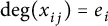 $\deg (x_{ij}^{}) = e_i^{}$
, where
 $e_i^{} \in \mathbb {Z}^q$
is the i
th basis element. Let M be a finitely generated
 $\mathbb {Z}^q$
-graded
 $\mathbb {S}$
-module. The Hilbert function
 $\operatorname {\mathcal {H}}_M^{} \colon \mathbb {Z}^q \to \mathbb {Z}$
of M is defined by
 $\operatorname {\mathcal {H}}_M^{}(a) = \dim _{\mathbb {K}}^{}(M_a^{})$
. Let
 $X \subset \mathbb {V}$
be a zero-dimensional subscheme and let
 $I(X) \subset \mathbb {S}$
be the ideal generated by the
 $\mathbb {Z}^q$
-homogeneous forms in
 $\mathbb {S}$
that vanish on X. The Hilbert function
 $\operatorname {\mathcal {H}}_X^{}$
of X is defined to be the Hilbert function of
 $\mathbb {S} / I(X)$
.
The exploration of the Hilbert functions in the multiprojective setting is a natural extension of the rich theory of Hilbert functions of zero-dimensional subschemes of
 $\mathbb {P}^n$
. The simplest case, when
 $\mathbb {V} = \mathbb {P}^1 \times \mathbb {P}^1$
, was first investigated by Giuffrida et al. in [Reference Giuffrida, Maggioni and Ragusa11]. This exploration was then continued by many authors. The case of
 $\mathbb {P}^1 \times \mathbb {P}^1$
remains the most assiduously studied case (see [Reference Carlini, Catalisano and Oneto3, Reference Catalisano, Geramita, Gimigliano, Ciliberto and Geramita4, Reference Favacchio and Guardo7, Reference Giuffrida, Maggioni and Zappalà12–Reference Guardo and Van Tuyl17, Reference Marino21, Reference Marino22, Reference Van Tuyl26]). For other ambient spaces
 $\mathbb {V,}$
we refer to [Reference Ballico and Guardo1, Reference Catalisano, Geramita, Gimigliano, Ciliberto and Geramita4, Reference Favacchio, Guardo and Migliore8, Reference Favacchio and Migliore9, Reference Van Tuyl25, Reference Van Tuyl26]. The theory now follows three broad directions of development: Hilbert functions of sets of points, as in [Reference Favacchio, Guardo and Migliore8, Reference Guardo and Van Tuyl16, Reference Guardo and Van Tuyl17, Reference Marino21, Reference Marino22]; Hilbert functions of sets of fat points, as in [Reference Carlini, Catalisano and Oneto3, Reference Catalisano, Geramita, Gimigliano, Ciliberto and Geramita4, Reference Favacchio and Guardo7, Reference Guardo13–Reference Guardo and Van Tuyl15, Reference Sidman and Van Tuyl24]; and Hilbert functions of ACM schemes, as in [Reference Favacchio, Guardo and Migliore8, Reference Favacchio and Migliore9, Reference Guardo13, Reference Guardo and Van Tuyl14, Reference Guardo and Van Tuyl16, Reference Guardo and Van Tuyl17, Reference Marino21, Reference Marino22, Reference Van Tuyl26].
In connection with the first and third directions of development, we mention two fundamental results belonging to Van Tuyl. According to [Reference Van Tuyl25], if X is reduced and
 $\mathbb {K}$
is algebraically closed, then
 $\operatorname {\mathcal {H}}_X^{}$
is uniquely determined by its restriction to a rectangular region of the form
 $R = [0, r_1^{}] \times \cdots \times [0, r_q^{}] \subset \mathbb {Z}^q$
. More precisely, R is a relevant domain for
 $\operatorname {\mathcal {H}}_X^{}$
in the sense of Definition 2.1 and Lemma 2.2. Our first achievement is the generalization of this result to the case of an arbitrary zero-dimensional subscheme
 $X \subset \mathbb {V}$
over an arbitrary infinite ground field
 $\mathbb {K}$
(see Theorem 4.4). If
 $\mathbb {K}$
is algebraically closed, then, according to [Reference Van Tuyl26], the functions
 $\operatorname {\mathcal {H}}_X^{}$
, where X runs through the zero-dimensional reduced ACM subschemes of
 $\mathbb {V}$
, are precisely the functions
 $\mathcal {H}$
whose difference
 $\operatorname {\Delta } \mathcal {H}$
, defined at Equation (1), is the Hilbert function of an artinian
 $\mathbb {Z}^q$
-graded quotient of
 $\mathbb {S} / (x_{1 0}^{}, \dots , x_{q 0}^{})$
. Our second achievement is the generalization of this result to the case of an arbitrary zero-dimensional subscheme
 $X \subset \mathbb {V}$
over an arbitrary infinite ground field
 $\mathbb {K}$
(see Theorem 6.6).
We give three proofs to Theorem 4.4. The first proof consists of comparing the cohomology of the twists of
 $\mathcal {I}_X^{}$
with the cohomology of the twists of the ideal sheaf of X in a smaller ambient space
 $W_i^{} \subset \mathbb {V}$
. Here,
 $W_i^{}$
is obtained from
 $\mathbb {V}$
by replacing
 $\mathbb {P}^{n_i}$
with the projection of X onto
 $\mathbb {P}^{n_i}$
(see Lemma 4.1). The second proof, located in Section 7, applies only in the case when
 $\mathbb {K}$
is algebraically closed,
 $\mathbb {V} = (\mathbb {P}^1)^q$
and X is ACM or sub-ACM (meaning
 $\operatorname {depth}(\mathbb {S} / I(X)) = q - 1$
). The technique we use draws on the technique of Giuffrida et al., who dealt with the case when
 $\mathbb {V} = \mathbb {P}^1 \times \mathbb {P}^1$
. The key ingredients here are the constraints satisfied by the Hilbert function of an ACM or sub-ACM scheme (see Propositions 7.1 and 7.2). The third proof of Theorem 4.4, located in Section 9, applies only in the case when
 $\mathbb {K}$
is infinite and
 $\mathbb {V} = (\mathbb {P}^1)^q$
. It is based on Macaulay’s theorem and on a vanishing criterion for the difference
 $\operatorname {\Delta } \operatorname {\mathcal {H}}_{\mathbb {S} / J}$
of the Hilbert function of the quotient of
 $\mathbb {S}$
by a monomial ideal (see Proposition 8.4). We think that approaching Theorem 4.4 from three different angles provides a clearer picture of the subtleties that arise in the study of multiprojective Hilbert functions.
An important consequence of Theorem 4.4 is an upper estimate on the regularity index of
 $\mathbb {S} / I(X)$
, regarded as a
 $\mathbb {Z}$
-graded
 $\mathbb {S}$
-module, in terms of the regularity indices of the projections of X onto the components
 $\mathbb {P}^{n_i}$
of
 $\mathbb {V}$
(see Corollary 4.7).
Van Tuyl’s method for proving his version of Theorem 6.6 consists of finding a regular sequence
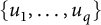 $\{ u_1^{}, \dots , u_q^{} \}$
for
 $\mathbb {S} / I(X)$
, as in Proposition 5.6. We adapt Van Tuyl’s argument to the case when
 $X \subset \mathbb {V}$
is an arbitrary zero-dimensional subscheme and
 $\mathbb {K}$
is an arbitrary infinite field.
In this article, we also consider quasi-rectangular domains, that is, finite unions of rectangular domains, which are relevant to
 $\operatorname {\mathcal {H}}_X^{}$
in the sense of Definition 2.1. The third achievement of this article is Proposition 9.5, which gives sufficient conditions for the existence of quasi-rectangular relevant domanins that are strictly contained in R. The problem of describing all quasi-rectangular domains
 $Q \subset R$
that are relevant for
 $\operatorname {\mathcal {H}}_X^{}$
remains open. An important class of schemes X for which this problem has been settled is the class of ACM subschemes of
 $(\mathbb {P}^1)^q$
(see Corollary 6.7).
We now present the outline of the article. In Section 2, we gather a few elementary facts about relevant domains. In Section 3, we examine complete intersections and we collect a few well-known facts about Hilbert functions of finite subschemes of
 $\mathbb {P}^n$
. These facts will be needed in the proof of our first main theorem, concerning the rectangular relevant domain, to which Section 4 is devoted. In Section 5, whose role is to prepare the ground for the next two sections, we construct regular sequences for
 $\mathbb {S} / I(X)$
and for
 $I(X)$
in the case when X is ACM or sub-ACM. Section 6 contains our second main theorem, concerning ACM schemes. In Section 7, we combine the results of Section 5 with Lemma 3.5 in order to obtain inequalities involving the partial difference functions of
 $\operatorname {\mathcal {H}}_X^{}$
and
 $\operatorname {\mathcal {H}}_{I(X)}^{}$
. As an application, we obtain our second proof of Theorem 4.4. In Section 8, we find a formula for
 $\operatorname {\Delta } \operatorname {\mathcal {H}}_{\mathbb {S} / J}^{}$
, where J is a monomial ideal. This leads us to our vanishing criterion for
 $\operatorname {\Delta } \operatorname {\mathcal {H}}_{\mathbb {S} / J}^{}$
. Section 9 contains our third proof of Theorem 4.4 and our procedure for detecting quasi-rectangular relevant domains.
2 Relevant domains
Let q be a positive integer. Given
 $a = (a_1^{}, \dots , a_q^{})$
and
 $b = (b_1^{}, \dots , b_q^{})$
in
 $\mathbb {Z}^q$
, we write
 $a \le b$
if
 $a_i^{} \le b_i^{}$
for all indices
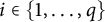 $i \in \{ 1, \dots , q \}$
. Let
 $e_i^{} = (0, \dots , 1, \dots , 0)$
be the element of
 $\mathbb {Z}^q$
that has entry
 $1$
on position i and entries
 $0$
elsewhere. Let
 $\mathcal {F} \colon \mathbb {Z}^q \to \mathbb {Z}$
be a function. We introduce the difference function
 $\operatorname {\Delta } \mathcal {F} \colon \mathbb {Z}^q \to \mathbb {Z}$
by the formula
 $$ \begin{align} \operatorname{\Delta} \mathcal{F}(a) = \mathcal{F}(a) + \sum_{1 \le p \le q} (-1)^p \sum_{1 \le i_1 < \dots < i_p \le q} \mathcal{F}(a - e_{i_1}^{} - \dots - e_{i_p}^{}). \end{align} $$
In this article, we only consider functions
 $\mathcal {F}$
that vanish on the complement of the positive quadrant
 $\mathbb {Z}_+^q = \{ a \in \mathbb {Z}^q \mid a \ge 0 \}$
because we are chiefly interested in Hilbert functions of ideals in
 $\mathbb {S}$
. For such functions, we can recover
 $\mathcal {F}$
from
 $\operatorname {\Delta } \mathcal {F}$
as follows:
 $$ \begin{align} \mathcal{F}(a) = \sum_{0 \le b \le a} \operatorname{\Delta} \mathcal{F}(b) \quad \text{for all} \quad a \in \mathbb{Z}_+^q. \end{align} $$
Given
 $r, s \in \mathbb {Z}^q$
such that
 $r \le s$
, we write
 $[r, s] = \{ a \in \mathbb {Z}^q \mid r \le a \le s \}$
. A rectangular domain in
 $\mathbb {Z}^q$
has the form
 $R = [0, r]$
, for some
 $r \in \mathbb {Z}_+^q$
. A quasi-rectangular domain
 $Q \subset \mathbb {Z}^q$
is a finite union of rectangular domains. The boundary
 $B_Q^{}$
of Q is defined to be the boundary of Q inside
 $\mathbb {Z}_+^q$
:
 $$\begin{align*}B_Q^{} = \{ a \in Q \mid a + e_{i_1}^{} + \dots + e_{i_p}^{} \notin Q \ \text{for some indices} \ 1 \le i_1 < \dots < i_p \le q \}. \end{align*}$$
In particular, for
 $R = [0, r]$
,
 $ B_R^{} = \{ a \in R \mid a_i^{} = r_i^{} \ \text {for some index} \ 1 \le i \le q \}. $
Definition 2.1 Under the above notation, a quasi-rectangular domain Q is said to be relevant to
 $\mathcal {F}$
if
 $\operatorname {\Delta } \mathcal {F}(a) = 0$
for all
 $a \in \mathbb {Z}^q \setminus Q$
.
Lemma 2.2 A rectangular domain
 $[0, r] \subset \mathbb {Z}^q$
is relevant to
 $\mathcal {F}$
if and only if for every i in
 $\{1, \dots , q \}$
and for every
 $a \in \mathbb {Z}^q$
such that
 $a_i^{} \ge r_i^{}$
, we have
 $\mathcal {F}(a) = \mathcal {F}(a_1^{}, \dots , r_i^{}, \dots , a_q^{})$
.
Proof Assume that
 $R = [0, r]$
is relevant to
 $\mathcal {F}$
and choose
 $a \in \mathbb {Z}_+^q$
such that
 $a_i^{} \ge r_i^{}$
. Equation (2) can be rewritten as
 $$\begin{align*}\mathcal{F}(a) = \sum_{0 \le b_1 \le a_1} \!\!\! \cdots \!\!\! \sum_{0 \le b_i \le r_i} \!\!\! \cdots \!\!\! \sum_{0 \le b_q \le a_q} \!\!\! \operatorname{\Delta} \mathcal{F}(b) + \sum_{0 \le b_1 \le a_1} \!\!\! \cdots \!\!\! \sum_{r_i < b_i \le a_i} \!\!\! \cdots \!\!\! \sum_{0 \le b_q \le a_q} \!\!\! \operatorname{\Delta} \mathcal{F}(b). \end{align*}$$
The first summation equals
 $\mathcal {F}(a_1^{}, \dots , r_i^{}, \dots , a_q^{})$
, again by virtue of Equation (2). The second summation vanishes because
 $\operatorname {\Delta } \mathcal {F}(b) = 0$
if b lies outside R.
Conversely, assume that for every index
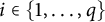 $i \in \{1, \dots , q \}$
and for every
 $a \in \mathbb {Z}^q$
such that
 $a_i^{} \ge r_i^{}$
, we have the equation
 $\mathcal {F}(a) = \mathcal {F}(a_1^{}, \dots , r_i^{}, \dots , a_q^{})$
. This is equivalent to saying that for every index
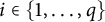 $i \in \{1, \dots , q \}$
and for every
 $a \in \mathbb {Z}^q$
such that
 $a_i^{}> r_i^{}$
, we have the equation
 $\mathcal {F}(a) = \mathcal {F}(a - e_i^{})$
. Choose
 $a \in \mathbb {Z}_+^q \setminus R$
. There is an index i such that
 $a_i^{}> r_i^{}$
. Equation (1) can be rewritten in the form
 $$ \begin{align*} \operatorname{\Delta} \mathcal{F}(a) &= \big(\mathcal{F}(a) - \mathcal{F}(a - e_i^{}) \big) \\ & + \sum_{1 \le p \le q - 1} (-1)^p \!\!\! \sum_{\substack{1 \le j_1 < \dots < j_p \le q \\ j_1, \dots, j_p \neq i}} \big(\mathcal{F}(a - e_{j_1}^{} - \dots - e_{j_p}^{}) - \mathcal{F}(a - e_i^{} - e_{j_1}^{} - \dots - e_{j_p}^{}) \big). \end{align*} $$
All terms in parentheses vanish, hence,
 $\operatorname {\Delta } \mathcal {F}(a) = 0$
. Thus, R is relevant to
 $\mathcal {F}$
.
Lemma 2.3 Assume that the rectangular domain
 $[0, r]$
is relevant to
 $\mathcal {F}$
. Then we have the equation
 $\mathcal {F}(a) = \mathcal {F}(r)$
for all
 $a \in \mathbb {Z}^q$
such that
 $a \ge r$
.
Proof Applying Lemma 2.2 repeatedly, we obtain the equations
 $$\begin{align*}\mathcal{F}(a) = \mathcal{F}(r_1^{}, a_2^{}, \dots, a_q^{}) = \mathcal{F}(r_1{}, r_2^{}, a_3^{}, \dots, a_q^{}) = \dots = \mathcal{F}(r).\\[-34pt] \end{align*}$$
Remark 2.4 The above lemmas show that, if R is relevant to
 $\mathcal {F}$
, then
 $\mathcal {F}|_{B_R}^{}$
determines the function
 $\mathcal {F}$
on the complement of R. The same is true for a relevant quasi-rectangular domain Q. Take for instance
 $Q = [0, s] \setminus [r, s]$
in
 $\mathbb {Z}^2$
, where
 $0 < r_1^{} < s_1^{}$
,
 $0 < r_2^{} < s_2^{}$
, and take
 $a \in [r, s]$
. We have the equation
 $$\begin{align*}\mathcal{F}(a) = \mathcal{F}(a_1^{}, r_2^{} - 1) + \mathcal{F}(r_1^{} - 1, a_2^{}) - \mathcal{F}(r_1^{} - 1, r_2^{} - 1) \end{align*}$$
and
 $(a_1^{}, r_2^{} - 1)$
,
 $(r_1^{} - 1, a_2^{})$
, respectively,
 $(r_1^{} - 1, r_2^{} - 1)$
lie on
 $B_Q^{}$
.
Given
 $a \in \mathbb {Z}_+^q$
we write
 $| a | = a_1^{} + \dots + a_q^{}$
. Let
 $\mathcal {F} \colon \mathbb {Z}^q \to \mathbb {Z}$
be a function that vanishes on the complement of
 $\mathbb {Z}_+^q$
. Let
 $\overline {\mathcal {F}} \colon \mathbb {Z}_+ \to \mathbb {Z}$
be given by the formula
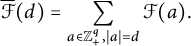 $$\begin{align*}\overline{\mathcal{F}}(d) = \sum_{a \in \mathbb{Z}_+^q, | a | = d} \mathcal{F}(a). \end{align*}$$
Lemma 2.5 Let
 $\mathcal {F} \colon \mathbb {Z}^q \to \mathbb {Z}$
be a function that vanishes on the complement of
 $\mathbb {Z}_+^q$
. Assume that
 $[0, r]$
is relevant to
 $\mathcal {F}$
. Then, the restriction of
 $\overline {\mathcal {F}}$
to
 $[| r |, \infty )$
is a polynomial function in the variable d, with rational coefficients and with dominant term
 $\mathcal {F}(r) d^{q - 1} / (q - 1)!$
Proof Let us write
 $R = [0, r]$
and
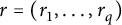 $r = (r_1^{}, \dots , r_q^{})$
. Given
 $b \in B_R^{}$
, there is an integer
 $p = p_b^{} \in \{ 1, \dots , q \}$
and there are indices
 $1 \le i_1^{} < \dots < i_p^{} \le q$
such that
 $b_i^{} < r_i^{}$
for all
 $i \in \{ 1, \dots , q \} \setminus \{ i_1^{}, \dots , i_p^{} \}$
and
 $b_{i_1}^{} = r_{i_1}^{}$
,
 $\dots $
,
 $b_{i_p}^{} = r_{i_p}^{}$
. We consider the set
 $$\begin{align*}A(b) = \{ a \in \mathbb{Z}_+^q \mid a_{i_1}^{} \ge r_{i_1}^{}, \dots, a_{i_p}^{} \ge r_{i_p}^{}, \, a_i^{} = b_i^{} \ \text{for} \ i \in \{ 1, \dots, q \} \setminus \{ i_1^{}, \dots, i_p^{} \} \}. \end{align*}$$
According to Lemma 2.2,
 $\mathcal {F}(a) = \mathcal {F}(b)$
for all
 $a \in A(b)$
. For
 $d \ge | b |,$
consider the set
 $$\begin{align*}A_d^{}(b) = \{ a \in A(b) \mid | a | = d \}. \end{align*}$$
We now recall the fact that, for a fixed nonnegative integer s, the number of integer solutions to the equation
 $c_1^{} + \dots + c_p^{} = s$
, with unknowns
 $c_i^{} \ge 0$
, is
 ${s + p - 1 \choose p - 1}$
. For
 $a \in A_d^{}(b),$
we have the equation
 $(a_{i_1}^{} - r_{i_1}^{}) + \dots + (a_{i_p}^{} - r_{i_p}^{}) = d - | b |$
, hence
 $$\begin{align*}| A_d^{}(b) | = {d - | b | + p - 1 \choose p - 1}. \end{align*}$$
Assume now that
 $d \ge | r |$
. The decomposition
 $\{ a \in \mathbb {Z}_+^q \mid | a | = d \} = \bigsqcup _{b \in B_R} A_d^{}(b)$
leads us to the following expression for
 $\overline {\mathcal {F}}(d)$
:
 $$\begin{align*}\sum_{\substack{a \in \mathbb{Z}_+^q \\ | a | = d}} \mathcal{F}(a) = \sum_{b \in B_R} \sum_{a \in A_d(b)} \!\! \mathcal{F}(a) = \sum_{b \in B_R} \mathcal{F}(b) | A_d^{}(b) | = \sum_{b \in B_R} \mathcal{F}(b) {d - | b | + p_b^{} - 1 \choose p_b^{} - 1}. \end{align*}$$
The r.h.s. is a polynomial function in d with rational coefficients. The assertion about the dominant term follows from the fact that
 $p_r^{} = q$
while
 $p_b^{} < q$
for
 $b \in B_R^{} \setminus \{ r \}$
.
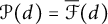
Definition 2.6 The polynomial
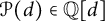 $\mathcal {P}(d) \in \mathbb {Q}[d]$
of Lemma 2.5, satisfying the relation
 $\mathcal {P}(d) = \overline {\mathcal {F}}(d)$
for
 $d \ge | r |$
, will be called the Poincarè polynomial associated to
 $\mathcal {F}$
.
Lemma 2.7 Let
 $\mathcal {F} \colon \mathbb {Z}^q \to \mathbb {Z}$
be a function that vanishes on the complement of
 $\mathbb {Z}_+^q$
. Assume that the rectangular domain
 $R = [0, r]$
is relevant to
 $\mathcal {F}$
. Assume, in addition, that there is an integer
 $0 \le \tau < | r |$
such that
 $\mathcal {F}$
is constant on the set
 $T = \{ a \in R \mid | a | \ge \tau \}$
. Then,
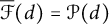 $\overline {\mathcal {F}}(d ) = \mathcal {P}(d)$
for
 $d \ge \tau $
, where
 $\mathcal {P}$
is the Poincarè polynomial associated to
 $\mathcal {F}$
.
Proof We adopt the notation from the proof of Lemma 2.5. For
 $d \ge \tau ,$
we denote
 $$\begin{align*}C_d^{} = \{ a \in \mathbb{Z}_+^q \mid | a | = d \} \setminus \bigcup_{b \in B_R \setminus T} A_d^{}(b). \end{align*}$$
By hypothesis,
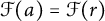 $\mathcal {F}(a) = \mathcal {F}(r)$
if
 $a \in T$
. According to Lemma 2.2,
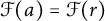 $\mathcal {F}(a) = \mathcal {F}(r)$
if a lies in
 $A(b)$
for some
 $b \in B_R^{} \cap T$
. Thus,
 $\mathcal {F}(a) = \mathcal {F}(r)$
if
 $a \in C_d^{}$
. For
 $d \ge \tau ,$
we calculate
 $$ \begin{align*} \overline{\mathcal{F}}(d) & = \sum_{a \in \mathbb{Z}_+^q, | a | = d} \mathcal{F}(a) \\ & = \sum_{a \in C_d} \mathcal{F}(a) + \sum_{b \in B_R \setminus T} \sum_{a \in A_d(b)} \mathcal{F}(a) \\ & = \mathcal{F}(r) | C_d^{} | + \sum_{b \in B_R \setminus T} \mathcal{F}(b) | A_d^{}(b) | \\ & = \mathcal{F}(r) \left[ {d + q - 1 \choose q - 1} - \sum_{b \in B_R \setminus T} {d - | b | + p_b^{} - 1 \choose p_b^{} - 1} \right] \\ & \quad + \sum_{b \in B_R \setminus T} \mathcal{F}(b) {d - | b | + p_b^{} - 1 \choose p_b^{} - 1}. \end{align*} $$
This is a polynomial expression in the variable d, which, in view of Lemma 2.5, must coincide with
 $\mathcal {P}(d)$
.
3 Generalities concerning Hilbert functions
We let
 $\mathbb {V} = \mathbb {P}^{n_1} \times \dots \times \mathbb {P}^{n_q}$
be a multiprojective space over an infinite field
 $\mathbb {K}$
. We let
 $X \subset \mathbb {V}$
be a zero-dimensional subscheme with ideal sheaf
 $\mathcal {I}_X^{}$
and structure sheaf
 $\mathcal {O}_X^{}$
. It is customary to denote
 $\operatorname {length}(X) = \dim _{\mathbb {K}}^{} \operatorname {H}^0(\mathcal {O}_X^{})$
. We choose
 $a \in \mathbb {Z}^q$
. From the short exact sequence,
 $$\begin{align*}0 \longrightarrow \mathcal{I}_X^{} \longrightarrow \mathcal{O}_{\mathbb{V}}^{} \longrightarrow \mathcal{O}_X^{} \longrightarrow 0 \end{align*}$$
we obtain the exact sequence in cohomology
 $$\begin{align*}0 \longrightarrow I(X)_a^{} \longrightarrow \mathbb{S}_a^{} \longrightarrow \operatorname{H}^0(\mathcal{O}_X^{}) \longrightarrow \operatorname{H}^1(\mathcal{I}_X^{}(a)) \longrightarrow \operatorname{H}^1(\mathcal{O}_{\mathbb{V}}^{}(a)). \end{align*}$$
The group on the right vanishes if a lies in the positive quadrant. Thus,
 $$ \begin{align} \operatorname{\mathcal{H}}_X^{}(a) = \operatorname{length}(X) - \dim_{\mathbb{K}}^{} \operatorname{H}^1(\mathcal{I}_X^{}(a)) \quad \text{if} \quad a \in \mathbb{Z}_+^q. \end{align} $$
Lemma 3.1 Assume that
 $[0, r]$
is relevant to
 $\operatorname {\mathcal {H}}_X^{}$
. Then,
 $\operatorname {\mathcal {H}}_X^{}(a) = \operatorname {length}(X)$
if
 $a \ge r$
.
Proof It is well-known that
 $\operatorname {H}^1(\mathcal {I}_X^{}(a))$
vanishes if
 $a_1^{}, \dots , a_q^{}$
are sufficiently large (see [Reference Hartshorne19, Theorem III.5.2]). Consequently, in view of Equation (3),
 $\operatorname {\mathcal {H}}_X^{}(a) = \operatorname {length}(X)$
if
 $a_1^{}, \dots , a_q^{}$
are sufficiently large. We saw in Lemma 2.3 that
 $\operatorname {\mathcal {H}}_X^{}$
is constant on
 $[r, \infty )$
. We conclude that
 $\operatorname {\mathcal {H}}_X^{}$
takes the value
 $\operatorname {length}(X)$
on
 $[r, \infty )$
.
It is well-known that
 $\operatorname {\mathcal {H}}_X^{}$
has a relevant domain when
 $\mathbb {V}$
is a projective space. The following proposition is a straightforward consequence of [Reference Geramita and Maroscia10, Proposition 1.1].
Proposition 3.2 Let
 $Z \subset \mathbb {P}^n$
be a zero-dimensional subscheme. Then, there is an integer
 $r \ge 0$
such that
 $\operatorname {\mathcal {H}}_Z^{}$
increases on the interval
 $[0, r]$
and is constant on the interval
 $[r, \infty )$
. Thus,
 $[0, r]$
is the smallest relevant domain for
 $\operatorname {\mathcal {H}}_X^{}$
.
Notation 3.3 The integer
 $r = \operatorname {rin}(Z)$
is known as the regularity index of Z.
Notation 3.4 Let S be a
 $\mathbb {K}$
-algebra and let M be an S-module. Consider elements
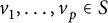 $v_1^{}, \dots , v_p^{} \in S$
. Denote by
 $\{ \epsilon _1^{}, \dots , \epsilon _p^{} \}$
the standard basis of the
 $\mathbb {K}$
-vector space
 $E = \mathbb {K}^p$
. Consider the element
 $\mathbf {v} = \epsilon _1^{} \otimes v_1^{} + \dots + \epsilon _p^{} \otimes v_p^{} \in E \otimes _{\mathbb {K}}^{} S$
. The sequence
 $$\begin{align*}0 \to M \overset{\cdot \mathbf{v}}{\longrightarrow} E \otimes M \to \dots \wedge^k E \otimes M \overset{\cdot \mathbf{v}}{\longrightarrow} \wedge^{k + 1} E \otimes M \to \dots \wedge^{p - 1} E \otimes M \overset {\cdot \mathbf{v}}{\longrightarrow} \wedge^p E \otimes M \end{align*}$$
is the Koszul complex associated with
 $v_1^{}, \dots , v_p^{}$
and M, denoted
 $K(v_1^{}, \dots , v_p^{}) \otimes M$
.
Lemma 3.5 We let M be a
 $\mathbb {Z}^q$
-graded
 $\mathbb {S}$
-module. We assume that
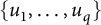 $\{ u_1^{}, \dots , u_q^{} \}$
is M-regular with
 $u_i^{} \in \operatorname {span} \{ x_{ij}^{} \mid 0 \le j \le n_i^{} \}$
. Then,
 $\operatorname {\Delta } \operatorname {\mathcal {H}}_M^{}$
is the Hilbert function of
 $M / (u_1^{}, \dots , u_q^{}) M$
.
Proof We denote by
 $\{ \epsilon _1^{}, \dots , \epsilon _q^{} \}$
the standard basis of the
 $\mathbb {K}$
-vector space
 $E = \mathbb {K}^q$
. For each
 $k \in \{ 1, \dots , q \},$
we endow
 $\wedge ^k E \otimes _{\mathbb {K}}^{} M$
with a
 $\mathbb {Z}^q$
-grading as follows: if
 $h \in M$
is
 $\mathbb {Z}^q$
-homogeneous and
 $1 \le i_1^{} < \dots < i_k^{} \le q$
, then
 $$\begin{align*}\deg(\epsilon_{i_1}^{} \wedge \dots \wedge \epsilon_{i_k}^{} \otimes h) = \deg(h) + \!\!\!\!\! \sum_{i \in \{ 1, \dots, q \} \setminus \{ i_1^{}, \dots, i_k^{} \}} \!\!\!\!\! e_i^{}. \end{align*}$$
The Koszul complex
 $K(u_1^{}, \dots , u_q^{}) \otimes M$
introduced at Notation 3.4 becomes a complex of
 $\mathbb {Z}^q$
-graded
 $\mathbb {S}$
-modules. According to [Reference Eisenbud5, Corollary 17.5],
 $K(u_1^{}, \dots , u_q^{}) \otimes M$
is exact, by virtue of the fact that
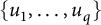 $\{ u_1^{}, \dots , u_q^{} \}$
is M-regular. We have an isomorphism
 $M \simeq \wedge ^q E \otimes M$
of
 $\mathbb {Z}^q$
-graded
 $\mathbb {S}$
-modules given by
 $h \mapsto \epsilon _1^{} \wedge \dots \wedge \epsilon _q^{} \otimes h$
. The cokernel of the last map in the Koszul complex is thus isomorphic to
 $M / (u_1^{}, \dots , u_q^{}) M$
. The lemma follows from the additivity of the Hilbert function on short exact sequences.
Recall that the projection
 $\mathrm {pr}_i^{}(X)$
onto
 $\mathbb {P}^{n_i}$
of a subscheme
 $X \subset \mathbb {V}$
is the subscheme of
 $\mathbb {P}^{n_i}$
defined by the ideal
 $I(X) \cap \mathbb {S}_i^{}$
. Here,
 $\mathbb {S}_i^{} = \mathbb {K}[x_{ij}^{} \mid 0 \le j \le n_i^{}]$
. Recall that a zero-dimensional subscheme
 $X \subset \mathbb {V}$
is called a complete intersection if
 $I(X)$
is generated by a regular sequence of length
 $n_1^{} + \dots + n_q^{}$
.
Proposition 3.6 A zero-dimensional subscheme
 $X \subset \mathbb {V}$
is a complete intersection if and only if each
 $Z_i^{} = \mathrm {pr}_i^{}(X)$
is a complete intersection in
 $\mathbb {P}^{n_i}$
and
 $X = Z_1^{} \times \dots \times Z_q^{}$
.
Proof Assume that X is a complete intersection, so
 $I(X)$
is generated by a regular sequence
 $\{ f_1^{}, \dots , f_n^{} \}$
, where
 $n = n_1^{} + \dots + n_q^{}$
. Write
 $d_k^{} = (d_k^1, \dots , d_k^q) = \deg (f_k^{})$
. Arguing as in the proof of Lemma 3.5, we can show that
 $K(f_1^{}, \dots , f_n^{}) \otimes \mathbb {S}$
is a resolution of
 $\mathbb {S} / I(X)$
, hence, by the additivity of the Hilbert function on short exact sequences,
 $$\begin{align*}\operatorname{\mathcal{H}}_X^{}(a) = \operatorname{\mathcal{H}}_{\mathbb{S}}^{}(a) + \sum_{1 \le p \le n} (- 1)^p \!\!\!\!\! \sum_{1 \le k_1 < \dots < k_p \le n} \operatorname{\mathcal{H}}_{\mathbb{S}}^{}(a - d_{k_1}^{} - \dots - d_{k_p}^{}). \end{align*}$$
Assume now that
 $a = (a_1^{}, 0, \dots , 0)$
. We have the equation
 $$ \begin{align} \operatorname{\mathcal{H}}_{Z_1}^{}(a_1^{}) = \operatorname{\mathcal{H}}_X^{}(a) = \operatorname{\mathcal{H}}_{\mathbb{S}_1}^{}(a_1^{}) + \sum_{1 \le p \le n} (- 1)^p \!\!\!\!\! \sum_{1 \le k_1 < \dots < k_p \le n} \operatorname{\mathcal{H}}_{\mathbb{S}}^{}(a - d_{k_1}^{} - \dots - d_{k_p}^{}). \end{align} $$
Put
 $\{ g_1^{}, \dots , g_m^{} \} = \{ f_1^{}, \dots , f_n^{} \} \cap \mathbb {S}_1^{}$
and write
 $e_k^{} = \deg (g_k^{}) \in \mathbb {Z}$
for
 $1 \le k \le m$
. Notice that
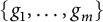 $\{ g_1^{}, \dots , g_m^{} \}$
is
 $\mathbb {S}_1^{}$
-regular, hence,
 $m \le n_1^{}$
. Let
 $Z \subset \mathbb {P}^{n_1}$
be the subscheme defined by the ideal
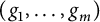 $(g_1^{}, \dots , g_m^{})$
. If for some indices
 $1 \le \mu \le p$
and
 $2 \le i \le q,$
we have
 $d_{k_\mu }^i> 0$
, then
 $\operatorname {\mathcal {H}}_{\mathbb {S}}^{}(a - d_{k_1}^{} - \dots - d_{k_p}^{}) = 0$
. Discarding the superfluous terms, we can rewrite Equation (4) in the form
 $$\begin{align*}\operatorname{\mathcal{H}}_{Z_1}^{}(a_1^{}) = \operatorname{\mathcal{H}}_{\mathbb{S}_1}^{}(a_1^{}) + \sum_{1 \le p \le m} (- 1)^p \!\!\!\!\! \sum_{1 \le k_1 < \dots < k_p \le m} \operatorname{\mathcal{H}}_{\mathbb{S}_1}^{}(a_1^{} - e_{k_1}^{} - \dots - e_{k_p}^{}). \end{align*}$$
The r.h.s. equals
 $\operatorname {\mathcal {H}}_Z^{}(a_1^{})$
because
 $K(g_1^{}, \dots , g_m^{}) \otimes \mathbb {S}_1^{}$
is exact. Thus,
 $\operatorname {\mathcal {H}}_{Z_1}^{} = \operatorname {\mathcal {H}}_Z^{}$
. By construction,
 $Z_1^{}$
is a subscheme of Z, hence,
 $Z = Z_1^{}$
, and hence,
 $m = n_1^{}$
. Moreover,
 $Z_1^{}$
is a complete intersection. The same argument works for all
 $Z_i^{}$
, so each of them is a complete intersection. We have proved that
 $I(X) = I(Z_1^{}) + \dots + I(Z_q^{})$
, hence
 $X = Z_1^{} \times \dots \times Z_q^{}$
.
Notation 3.7 We assume that the zero-dimensional subscheme
 $Z \subset \mathbb {P}^n$
is a complete intersection. Say
 $I(Z) = (f_1^{}, \dots , f_n^{})$
. We write
 $$\begin{align*}\delta(Z) = \begin{cases} \deg(f_1^{}) - 1 & \text{if } n = 1, \\ \deg(f_1^{}) + \dots + \deg(f_n^{}) - 2 & \text{if } n \ge 2. \end{cases} \end{align*}$$
We assume that the zero-dimensional subscheme
 $X \subset \mathbb {V}$
is a complete intersection. As per Proposition 3.6, each
 $Z_i^{} = \mathrm {pr}_i^{}(X)$
is a complete intersection, so we may write
 $$\begin{align*}\delta(X) = (\delta(Z_1^{}), \dots, \delta(Z_q^{})). \end{align*}$$
In the following proposition, we collect several well-known properties of the regularity index. For the convenience of the reader, we include their proofs. Let us recall that the Castelnuovo–Mumford regularity
 $\operatorname {reg}(\mathcal {S})$
of a coherent sheaf
 $\mathcal {S}$
on a projective space is the smallest integer
 $\rho $
such that
 $\operatorname {H}^m(\mathcal {S}(\rho - m)) = \{ 0 \}$
if
 $m \ge 1$
. The Castelnuovo–Mumford regularity
 $\operatorname {reg}(Z)$
of a subscheme Z of a projective space is
 $\operatorname {reg}(\mathcal {I}_Z^{})$
.
Proposition 3.8 Let
 $Z \subset \mathbb {P}^n$
be a zero-dimensional subscheme of length s and regularity index
 $\operatorname {rin}(Z)$
. Then, the following statements hold true:
-
(i)
 $\operatorname {\mathcal {H}}_Z^{}(a) = s$
for
$a \ge \operatorname {rin}(Z)$
;
-
(ii)
$\operatorname {H}^1(\mathcal {I}_Z^{}(a)) = \{ 0 \}$
for
$a \ge \operatorname {rin}(Z)$
; -
(iii)
$\operatorname {H}^m(\mathcal {I}_Z^{}(a)) = \{ 0 \}$
for
$m \ge 2$
and
$a \ge -n$
; -
(iv)
$\operatorname {rin}(Z) \le s - 1$
; -
(v)
$\operatorname {rin}(Z) = s - 1$
if
$n = 1$
; -
(vi)
$\operatorname {rin}(Z) + 1 = \operatorname {reg}(Z)$
; -
(vii)
$\operatorname {rin}(Z) \le \delta (Z)$
if Z is a complete intersection (see Notation 3.7).












Proof Write
 $r = \operatorname {rin}(Z)$
. To prove statement (i), we apply Proposition 3.2 and Lemma 3.1. In light of Equation (3), we have
 $\dim _{\mathbb {K}}^{} \operatorname {H}^1(\mathcal {I}_Z^{}(a)) = s - \operatorname {\mathcal {H}}_Z^{}(a) = 0$
for
 $a \ge r$
. This proves (ii). To prove statement (iii), we employ the exact sequence
 $$\begin{align*}0 \longrightarrow \mathcal{I}_Z^{} \longrightarrow \mathcal{O}_{\mathbb{P}^n}^{} \longrightarrow \mathcal{O}_Z^{} \longrightarrow 0. \end{align*}$$
Applying the long exact cohomology sequence, we obtain the exact sequence
 $$\begin{align*}\operatorname{H}^{m - 1}(\mathcal{O}_Z^{}) \longrightarrow \operatorname{H}^m(\mathcal{I}_Z^{}(a)) \longrightarrow \operatorname{H}^m(\mathcal{O}_{\mathbb{P}^n}^{}(a)). \end{align*}$$
The group on the left vanishes because
 $\mathcal {O}_Z^{}$
has support of dimension zero. The group on the right vanishes for
 $a \ge -n$
. Thus, the group in the middle also vanishes.
(iv) According to Proposition 3.2,
 $\operatorname {\mathcal {H}}_Z^{}$
increases on the interval
 $[0, r]$
. By definition,
 $\operatorname {\mathcal {H}}_Z^{}(0) = 1$
, hence,
 $\operatorname {\mathcal {H}}_Z^{}(r) \ge r + 1$
, and hence, in view of statement (i),
 $s \ge r + 1$
.
(v) For
 $0 \le a \le s - 1,$
we have
 $\operatorname {\mathcal {H}}_Z^{}(a) = a + 1$
because there are no forms of degree a vanishing on a subscheme
 $Z \subset \mathbb {P}^1$
of length s. Thus,
 $\operatorname {\mathcal {H}}_Z^{}$
increases on the interval
 $[0, s - 1]$
forcing the inequality
 $s - 1 \le r$
. The reverse inequality was obtained at (iv).
(vi) From statements (ii) and (iii), we see that
 $\operatorname {H}^m(\mathcal {I}_Z^{}(r + 1 - m)) = \{ 0 \}$
if
 $m \ge 1$
. From the definition of r and from Equation (3), it follows that
 $\operatorname {H}^1(\mathcal {I}_Z^{}(r - 1)) \neq \{ 0 \}$
.
(vii) In the case when
 $n = 1,$
we have
 $r = s - 1 = \delta (Z)$
. Assume that
 $n \ge 2$
. Write
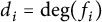 $d_i^{} = \deg (f_i^{})$
. The hypothesis that
 $\{ f_1^{}, \dots , f_n^{} \}$
be a regular sequence implies that
 $K(f_1^{}, \dots , f_n^{}) \otimes \mathbb {S}$
is a resolution of
 $\mathbb {S} / I(Z)$
. Consult the proof of Lemma 3.5. Thus,
 $$\begin{align*}\operatorname{\mathcal{H}}_Z^{}(a) = \operatorname{\mathcal{H}}_{\mathbb{S}}^{}(a) + \sum_{1 \le p \le n} (- 1)^p \!\!\!\!\! \sum_{1 \le k_1 < \dots < k_p \le n} \operatorname{\mathcal{H}}_{\mathbb{S}}^{}(a - d_{k_1}^{} - \dots - d_{k_p}^{}). \end{align*}$$
Differentiating both sides, we obtain the equation
 $$\begin{align*}\operatorname{\Delta} \operatorname{\mathcal{H}}_Z^{}(a) = {a + n - 1 \choose n - 1} + \sum_{1 \le p \le n} (- 1)^p \!\!\!\!\! \sum_{1 \le k_1 < \dots < k_p \le n} {a - d_{k_1}^{} - \dots - d_{k_p}^{} + n - 1 \choose n - 1}. \end{align*}$$
We need to prove that
 $\operatorname {\Delta } \operatorname {\mathcal {H}}_Z^{}(a) = 0$
for
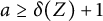 $a \ge \delta (Z) + 1$
, that is, we need to prove the combinatorial equation
 $$ \begin{align} {a + n - 1 \choose n - 1} = \sum_{1 \le p \le n} (- 1)^{p + 1} \!\!\!\!\! \sum_{1 \le k_1 < \dots < k_p \le n} {a - d_{k_1}^{} - \dots - d_{k_p}^{} + n - 1 \choose n - 1} \end{align} $$
for
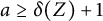 $a \ge \delta (Z) + 1$
. Put
 $A = \{ 1, 2, \dots , a + 1 \}$
. For
 $1 \le k \le n$
, consider mutually disjoint subsets
 $D_k^{} \subset A$
with
 $d_k^{}$
elements. Such subsets exist because, by hypothesis,
 $a + 1 \ge d_1^{} + \dots + d_n^{}$
. Let
 $\mathcal {C}$
be the set of repeat combinations of
 $n - 1$
elements chosen in A. Let
 $\mathcal {C}_k^{}$
be the set of repeat combinations of
 $n - 1$
elements chosen in
 $A \setminus D_k^{}$
. The l.h.s. of Equation (5) equals
 $\left | \mathcal {C} \right |$
and
 $$\begin{align*}{a - d_{k_1}^{} - \dots - d_{k_p}^{} + n - 1 \choose n - 1} = \left| \mathcal{C}_{k_1}^{} \cap \dots \cap \mathcal{C}_{k_p}^{} \right|. \end{align*}$$
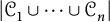
Applying the inclusion–exclusion principle, we deduce that the r.h.s. of Equation (5) equals
 $\left | \mathcal {C}_1^{} \cup \dots \cup \mathcal {C}_n^{} \right |$
. Equation (5) reduces to proving that
 $\mathcal {C} = \mathcal {C}_1^{} \cup \dots \cup \mathcal {C}_n^{}$
. Take
 $(c_1^{}, \dots , c_{n - 1}^{}) \in \mathcal {C}$
. By construction, the sets
 $D_1^{}, \dots , D_n^{}$
are mutually disjoint, hence, there is k such that
 $c_i^{} \notin D_k^{}$
for all indices
 $1 \le i \le n - 1$
. Thus,
 $(c_1^{}, \dots , c_{n - 1}^{}) \in \mathcal {C}_k^{}$
.
4 The rectangular relevant domain
Let
 $\mathbb {V} = \mathbb {P}^{n_1} \times \dots \times \mathbb {P}^{n_q}$
be a multiprojective space over an infinite field
 $\mathbb {K}$
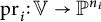
. Let
 $\mathrm {pr}_i^{} \colon \mathbb {V} \to \mathbb {P}^{n_i}$
be the projection onto the i
th component. Let
 $X \subset \mathbb {V}$
be a zero-dimensional subscheme and let
 $Z_i^{} = \mathrm {pr}_i^{}(X)$
be the zero-dimensional subscheme of
 $\mathbb {P}^{n_i}$
defined by the ideal
 $I(Z_i^{}) = I(X) \cap \mathbb {K}[x_{ij}^{} \mid 0 \le j \le n_i^{}]$
. Write
 $s_i^{} = \operatorname {length}(Z_i^{})$
. As per Notation 3.3, write
 $r_i^{} = \operatorname {rin}(Z_i^{})$
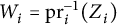
. Let
 $W_i^{} = \mathrm {pr}_i^{-1}(Z_i^{})$
be the pull-back scheme, i.e., the subscheme of
 $\mathbb {V}$
defined by the ideal of
 $\mathbb {S}$
generated by
 $I(Z_i^{})$
. Note that X is a subscheme of
 $W_i^{}$
. We denote by
 $\mathcal {I}_{X, W_i}^{}$
the ideal sheaf of X in
 $\mathcal {O}_{W_i}^{}$
.
Our purpose in this section is to prove that the domain
 $[0, r_1^{}] \times \dots \times [0, r_q^{}]$
is relevant for
 $\operatorname {\mathcal {H}}_X^{}$
. As mentioned in the introduction, a similar result was proved by Van Tuyl. See the comments below Corollary 4.6. Van Tuyl’s approach was based on his version of Proposition 4.2. Our approach is to replace the ambient space
 $\mathbb {V}$
with
 $W_i^{}$
. Our main technical tool is the following lemma.
Lemma 4.1 Let
 $X \subset \mathbb {V}$
be a zero-dimensional subscheme. Fix an arbitrary index i in
 $\{1, \dots , q \}$
and let
 $W_i^{}$
and
 $r_i^{}$
be as defined above. Let
 $a \in \mathbb {Z}^q$
satisfy the conditions
 $a \ge 0$
and
 $a_i^{} \ge r_i^{}$
. Then,
 $\operatorname {H}^1(\mathcal {I}_X^{}(a)) \simeq \operatorname {H}^1(\mathcal {I}_{X, W_i}^{}(a - a_i^{} e_i^{}))$
.
Proof By symmetry, we may assume that
 $i = 1$
. By virtue of the Künneth formula,
 $$\begin{align*}\operatorname{H}^m(\mathcal{I}_{W_1}^{}(a)) \simeq \bigoplus_{m_1 + \dots + m_q = m} \operatorname{H}^{m_1}(\mathcal{I}_{Z_1}^{}(a_1^{})) \otimes \operatorname{H}^{m_2}(\mathcal{O}_{\mathbb{P}^{n_2}}^{}(a_2^{})) \otimes \cdots \otimes \operatorname{H}^{m_q}(\mathcal{O}_{\mathbb{P}^{n_q}}^{}(a_q^{})). \end{align*}$$
By hypothesis,
 $a_1^{} \ge r_1^{}$
, hence, in view of Proposition 3.8,
 $\operatorname {H}^{m_1}(\mathcal {I}_{Z_1}^{}(a_1^{})) = \{ 0 \}$
for
 $m_1^{} \ge 1$
. By hypothesis,
 $a_2^{} \ge 0, \dots , a_q^{} \ge 0$
, hence, the higher cohomology groups of
 $\mathcal {O}_{\mathbb {P}^{n_2}}^{}(a_2^{}), \dots , \mathcal {O}_{\mathbb {P}^{n_q}}^{}(a_q^{})$
also vanish. We deduce that
 $\operatorname {H}^m(\mathcal {I}_{W_1}^{}(a)) = \{ 0 \}$
for
 $m \ge 1$
. From the short exact sequence
 $$\begin{align*}0 \longrightarrow \mathcal{I}_{W_1}^{} \longrightarrow \mathcal{I}_X^{} \longrightarrow \mathcal{I}_{X, W_1}^{} \longrightarrow 0 \end{align*}$$
of sheaves on
 $\mathbb {V,}$
we obtain the long exact sequence
 $$\begin{align*}\{ 0 \} = \operatorname{H}^1(\mathcal{I}_{W_1}^{}(a)) \longrightarrow \operatorname{H}^1(\mathcal{I}_X^{}(a)) \longrightarrow \operatorname{H}^1(\mathcal{I}_{X, W_1}^{}(a)) \longrightarrow \operatorname{H}^2(\mathcal{I}_{W_1}^{}(a)) = \{ 0 \}. \end{align*}$$
The middle arrow becomes an isomorphism. The line bundle
 $\mathcal {O}_{\mathbb {P}^{n_1}}^{}(a_1^{})$
is trivial on
 $Z_1^{}$
because the latter is supported on finitely many points. We obtain the isomorphism
 $\mathcal {I}_{X, W_1}^{}(a) \simeq \mathcal {I}_{X, W_1}^{}(0, a_2^{}, \dots , a_q^{})$
, which leads us to the desired isomorphism
 $$\begin{align*}\operatorname{H}^1(\mathcal{I}_X^{}(a)) \simeq \operatorname{H}^1(\mathcal{I}_{X, W_1}^{}(0, a_2^{}, \dots, a_q^{})).\\[-34pt] \end{align*}$$
Proposition 4.2 Let
 $X \subset \mathbb {V}$
be a zero-dimensional subscheme. Assume that the ground field
 $\mathbb {K}$
is algebraically closed. Fix an arbitrary index
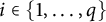 $i \in \{1, \dots , q \}$
and assume that
 $Z_i^{}$
is reduced, say
 $Z_i^{} = \{ P_1^{}, \dots , P_m^{} \}$
. For each index
 $k \in \{ 1, \dots , m \}$
consider the scheme
 $$\begin{align*}\mathbb{W}_k^{} = \mathrm{pr}_i^{-1}(P_k^{}) \simeq \mathbb{P}^{n_1} \times \dots \times \widehat{\mathbb{P}}{}^{n_i} \times \dots \times \mathbb{P}^{n_q}. \end{align*}$$
Set
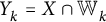 $Y_k^{} = X \cap \mathbb {W}_k^{}$
. Let
 $\operatorname {\mathcal {H}}_{Y_k}^{}$
be the Hilbert function of
 $Y_k^{}$
as a subscheme of
 $\mathbb {W}_k^{}$
, the latter being regarded as a multiprojective space. Let
 $a \in \mathbb {Z}^q$
satisfy the conditions
 $a \ge 0$
and
 $a_i^{} \ge r_i^{}$
. Then,
 $$\begin{align*}\operatorname{\mathcal{H}}_X^{}(a) = \sum_{1 \le k \le m} \operatorname{\mathcal{H}}_{Y_k}^{}(a_1^{}, \dots, \widehat{a}_i^{}, \dots, a_q^{}). \end{align*}$$
Proof From the decomposition
 $W_i^{} = \mathbb {W}_1^{} \sqcup \dots \sqcup \mathbb {W}_m^{}$
, we obtain the decomposition
 $$\begin{align*}\operatorname{H}^1(\mathcal{I}_{X, W_i}^{}(a - a_i^{} e_i^{})) \simeq \bigoplus_{1 \le k \le m} \operatorname{H}^1(\mathcal{I}_{Y_k, \mathbb{W}_k}^{}(a_1^{}, \dots, \widehat{a}_i^{}, \dots, a_q^{})). \end{align*}$$
Applying Equation (3) and Lemma 4.1, we calculate
 $$ \begin{align*} \operatorname{\mathcal{H}}_X^{}(a) & = \operatorname{length}(X) - \dim_{\mathbb{K}}^{} \operatorname{H}^1(\mathcal{I}_X^{}(a)) \\ & = \operatorname{length}(X) - \dim_{\mathbb{K}}^{} \operatorname{H}^1(\mathcal{I}_{X, W_i}^{} (a - a_i^{} e_i^{})) \\ & = \sum_{1 \le k \le m} \operatorname{length}(Y_k^{}) - \sum_{1 \le k \le m} \dim_{\mathbb{K}}^{} \operatorname{H}^1(\mathcal{I}_{Y_k, \mathbb{W}_k}^{}(a_1^{}, \dots, \widehat{a}_i^{}, \dots, a_q^{})) \\ & = \sum_{1 \le k \le m} \operatorname{\mathcal{H}}_{Y_k}^{}(a_1^{}, \dots, \widehat{a}_i^{}, \dots, a_q^{}).\\[-40pt] \end{align*} $$
The above result, in the particular case when X is reduced and
 $a_i^{} \ge s_i^{} - 1$
, was obtained by Van Tuyl using different methods. Consult [Reference Van Tuyl25, Proposition 4.2].
Definition 4.3 Let
 $X \subset \mathbb {V}$
be a zero-dimensional subscheme. For each
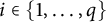 $i \in \{ 1, \dots , q \}$
, let
 $Z_i^{}$
be the projection of X onto
 $\mathbb {P}^{n_i}$
. Recall Notation 3.3. The tuple
 $$\begin{align*}\operatorname{rem}(X) = (\operatorname{rin}(Z_1^{}), \dots, \operatorname{rin}(Z_q^{})) \end{align*}$$
will be called the regularity multi-index of X. We write
 $R(X) = [0, \, \operatorname {rem}(X)]$
.
Theorem 4.4 We assume that the ground field is infinite. We let
 $X \subset \mathbb {P}^{n_1} \times \dots \times \mathbb {P}^{n_q}$
be a zero-dimensional subscheme. We assert that
 $R(X) = [0, \, \operatorname {rem}(X)]$
is the smallest rectangular relevant domain for
 $\operatorname {\mathcal {H}}_X^{}$
.
Proof Write
 $\operatorname {rem}(X) = (r_1^{}, \dots , r_q^{})$
. Consider
 $a \in \mathbb {Z}_+^q$
satisfying the condition
 $a_i^{} \ge r_i^{}$
for some index
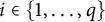 $i \in \{ 1, \dots , q \}$
. According to Lemma 4.1, the expression
 $\dim _{\mathbb {K}}^{} \operatorname {H}^1(\mathcal {I}_X^{}(b))$
remains constant as
 $b_i^{}$
varies in the interval
 $[r_i^{}, \infty )$
and
 $b_j^{}$
are nonnegative fixed integers for all indices
 $j \in \{ 1, \dots , q \} \setminus \{ i \}$
. Thus,
 $$\begin{align*}\dim_{\mathbb{K}}^{} \operatorname{H}^1(\mathcal{I}_X^{}(a)) = \dim_{\mathbb{K}}^{} \operatorname{H}^1(\mathcal{I}_X^{}(a_1^{}, \dots, r_i^{}, \dots, a_q^{})). \end{align*}$$
Applying Equation (3), we calculate
 $$ \begin{align*} \operatorname{\mathcal{H}}_X^{}(a) & = \operatorname{length}(X) - \dim_{\mathbb{K}}^{} \operatorname{H}^1(\mathcal{I}_X^{}(a)) \\ & = \operatorname{length}(X) - \dim_{\mathbb{K}}^{} \operatorname{H}^1(\mathcal{I}_X^{}(a_1^{}, \dots, r_i^{}, \dots, a_q^{})) \\ & = \operatorname{\mathcal{H}}_X^{}(a_1^{}, \dots, r_i^{}, \dots, a_q^{}). \end{align*} $$
From Lemma 2.2, we deduce that
 $R(X)$
is relevant to
 $\operatorname {\mathcal {H}}_X^{}$
. We cannot shrink
 $R(X)$
to a smaller rectangular relevant domain because, as seen at Proposition 3.2, the function
 $\operatorname {\mathcal {H}}_X^{}(a_i^{} e_i^{}) = \operatorname {\mathcal {H}}_{Z_i}^{}(a_i^{})$
increases on the interval
 $[0, r_i^{}]$
.
The above result, in the particular case when
 $\mathbb {V} = \mathbb {P}^1 \times \mathbb {P}^1$
and
 $\mathbb {K}$
is algebraically closed, was obtained by Giuffrida et al. We refer to [Reference Giuffrida, Maggioni and Ragusa11, Remark 2.8 and Theorem 2.11]. Guardo and Van Tuyl gave a different proof to Giuffrida’s result in the particular case when X is a union of fat points. Consult [Reference Guardo and Van Tuyl14, Corollary 3.4].
Proposition 4.5 Let
 $X \subset \mathbb {P}^{n_1} \times \dots \times \mathbb {P}^{n_q}$
be a zero-dimensional subscheme of length s and regularity multi-index
 $\operatorname {rem}(X)$
. For each
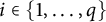 $i \in \{ 1, \dots , q \}$
, let
 $s_i^{}$
be the length of the projection of X onto
 $\mathbb {P}^{n_i}$
. Then, the following statements hold true:
-
(i)
$\operatorname {\mathcal {H}}_X^{}(a) = s$
for
$a \ge \operatorname {rem}(X)$
; -
(ii)
$\operatorname {H}^1(\mathcal {I}_X^{}(a)) = \{ 0 \}$
for
$a \ge \operatorname {rem}(X)$
; -
(iii)
$\operatorname {H}^m(\mathcal {I}_X^{}(a)) = \{ 0 \}$
for
$m \ge 2$
and
$a \ge 0$
; -
(iv)
$\operatorname {rem}(X) \le (s_1^{} - 1, \dots , s_q^{} - 1)$
; -
(v)
$\operatorname {rem}(X) = (s_1^{} - 1, \dots , s_q^{} - 1)$
if
$\mathbb {V} = (\mathbb {P}^1)^q$
. Thus,
$R(X) = [0, s_1^{} - 1] \times \dots \times [0, s_q^{} - 1]$
; -
(vi)
$\operatorname {rem}(X) \le \delta (X)$
if X is a complete intersection (see Notation 3.7).












Proof Statement (i) follows from Theorem 4.4 and Lemma 3.1. To prove (ii) and (iii), we argue precisely as in the proof of Proposition 3.8(ii and iii). Statements (iv) and (v) follow from their counterparts at Proposition 3.8. Statement (vi) follows from Propositions 3.6 and 3.8(vii).
Proposition 4.5(i), in the particular case when X is a union of fat points and
 $\mathbb {K}$
is algebraically closed, was obtained by Sidman and Van Tuyl (see [Reference Sidman and Van Tuyl24, Proposition 4.4]).
Complete intersection schemes contained in a simplicial toric variety were studied in [Reference Şahin and Soprunov23]. Restricting [Reference Şahin and Soprunov23, Theorem 3.16] to the case when the ambient space is a multiprojective space, we obtain the following result: “Let X be a zero-dimensional complete intersection scheme contained in a multiprojective space of dimension n defined over an algebraically closed field. Assume that
 $I(X) = (f_1^{}, \dots , f_n^{})$
. Then,
 $\operatorname {\mathcal {H}}_X^{}(a) = \operatorname {length}(X)$
for
 $a \ge \deg (f_1^{}) + \dots + \deg (f_n^{})$
.” In Proposition 4.5, we proved that the equation
 $\operatorname {\mathcal {H}}_X^{}(a) = \operatorname {length}(X)$
holds for the improved bound
 $a \ge \delta (X)$
.
Corollary 4.6 Let
 $X \subset \mathbb {P}^{n_1} \times \dots \times \mathbb {P}^{n_q}$
be a zero-dimensional subscheme. For each index
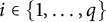 $i \in \{ 1, \dots , q \}$
, let
 $s_i^{}$
be the length of the projection of X onto
 $\mathbb {P}^{n_i}$
. Then, the rectangular domain
 $[0, s_1^{} - 1] \times \dots \times [0, s_q^{} - 1]$
is relevant to
 $\operatorname {\mathcal {H}}_X^{}$
.
The corollary follows from Theorem 4.4 and Proposition 4.5(iv). The above result, in the particular case when X is reduced and
 $\mathbb {K}$
is algebraically closed, was obtained by Van Tuyl. Consult [Reference Van Tuyl25, Proposition 4.6(ii) and Corollary 4.7].
Let M be a finitely generated
 $\mathbb {Z}^q$
-graded
 $\mathbb {S}$
-module. The canonical
 $\mathbb {Z}$
-grading on
 $\mathbb {S}$
is given by the degree of a polynomial. Given
 $a \in \mathbb {Z}^q$
, write
 $| a | = a_1^{} + \dots + a_q^{}$
. We note that M is also a
 $\mathbb {Z}$
-graded
 $\mathbb {S}$
-module by setting
 $M_d^{} = \oplus _{| a | = d}^{} M_a^{}$
. The Hilbert function of this module is the function
 $\overline {\operatorname {\mathcal {H}}}_M^{} \colon \mathbb {Z} \to \mathbb {Z}$
given by
 $$\begin{align*}\overline{\operatorname{\mathcal{H}}}_M^{} (d) = \sum_{| a | = d} \operatorname{\mathcal{H}}_M^{}(a). \end{align*}$$
There exists a polynomial
 $\mathcal {P}_M^{}$
in one variable, with rational coefficients, called the Hilbert–Poincarè polynomial of M, such that
 $\overline {\operatorname {\mathcal {H}}}_M^{} (d) = \mathcal {P}_M^{}(d)$
for d sufficiently large (see [Reference Eisenbud5, Theorem 1.11]). The regularity index
 $\operatorname {rin}(M)$
of M is the smallest integer with the property that
 $\overline {\operatorname {\mathcal {H}}}_M^{} = \mathcal {P}_M^{}$
on
 $[\operatorname {rin}(M), \infty )$
. Given a subscheme
 $X \subset \mathbb {V}$
, we put
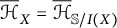 $\overline {\operatorname {\mathcal {H}}}_X^{} = \overline {\operatorname {\mathcal {H}}}_{\mathbb {S} / I(X)}^{}$
,
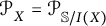 $\mathcal {P}_X^{} = \mathcal {P}_{\mathbb {S} / I(X)}^{}$
, and
 $\operatorname {rin}(X) = \operatorname {rin}(\mathbb {S} / I(X))$
. These concepts become more familiar once we slightly change the point of view. Write
 $n = n_1^{} + \dots + n_q^{} + q - 1$
and let
 $\mathbb {P}^n$
have the coordinate ring
 $\mathbb {S}$
, equipped with its
 $\mathbb {Z}$
-grading. Let
 $\overline {X} \subset \mathbb {P}^n$
be the subscheme defined by the ideal
 $I(X)$
. If X is reduced, then
 $\overline {X}$
is an arrangement of
 $(q - 1)$
-dimensional planes in
 $\mathbb {P}^n$
. Clearly,
 $\overline {\operatorname {\mathcal {H}}}_X^{}$
is the usual Hilbert function of
 $\overline {X}$
,
 $\mathcal {P}_X^{}$
is the usual Hilbert–Poincarè polynomial of
 $\overline {X}$
, and
 $\operatorname {rin}(X) = \operatorname {rin}(\overline {X})$
.
Corollary 4.7 Let
 $X \subset \mathbb {V}$
be a zero-dimensional subscheme. Recall from Definition 4.3 the regularity multi-index
 $\operatorname {rem}(X)$
. We assert that
 $\operatorname {rin}(X) \le | \operatorname {rem}(X) |$
. We further assert that
 $\mathcal {P}_X^{}(d)$
has dominant term
 $\operatorname {length}(X) d^{q - 1} / (q - 1)!$
Proof Clearly, the Poincarè polynomial associated to
 $\operatorname {\mathcal {H}}_X^{}$
, introduced at Definition 2.6, coincides with
 $\mathcal {P}_X^{}$
. We apply Lemma 2.5 to
 $\operatorname {\mathcal {H}}_X^{}$
and to its relevant domain
 $[0, \operatorname {rem}(X)]$
. We deduce that
 $\mathcal {P}_X^{} = \overline {\operatorname {\mathcal {H}}}_X^{}$
on
 $[| \operatorname {rem}(X) |, \, \infty )$
, and that
 $\mathcal {P}_X^{}$
has dominant term
 $\operatorname {\mathcal {H}}_X^{}(\operatorname {rem}(X)) d^{q - 1} / (q - 1)!$
It follows that
 $\operatorname {rin}(X) \le | \operatorname {rem}(X) |$
. In accordance with Proposition 4.5(i),
 $\operatorname {\mathcal {H}}_X^{}(\operatorname {rem}(X)) = \operatorname {length}(X)$
. This proves the second assertion.
Lemma 4.8 Let
 $X \subset \mathbb {V}$
be a zero-dimensional subscheme of length s. Assume that there is an integer
 $0 \le \tau < | \operatorname {rem}(X) |$
such that
 $\operatorname {\mathcal {H}}_X^{}(a) = s$
if
 $a \in R(X)$
and
 $| a | \ge \tau $
. Then,
 $\operatorname {rin}(X) \le \tau $
.
Proof We apply Lemma 2.7 to the function
 $\mathcal {F} = \operatorname {\mathcal {H}}_X^{}$
. The hypothesis of Lemma 2.7 is satisfied because
 $\operatorname {\mathcal {H}}_X^{}$
takes the value s on the region
 $\{ a \in R(X) \mid | a | \ge \tau \}$
. We deduce that
 $\overline {\operatorname {\mathcal {H}}}_X^{}(d) = \mathcal {P}_X^{}(d)$
for
 $d \ge \tau $
, forcing the inequality
 $\operatorname {rin}(X) \le \tau $
.
Proposition 4.9 Let
 $X \subset \mathbb {P}^1 \times \mathbb {P}^1$
be a zero-dimensional subscheme of length s and let
 $\overline {X} \subset \mathbb {P}^3$
be the associated one-dimensional subscheme. Then,
 $\operatorname {rin}(X) \le s - 1$
, that is,
 $\operatorname {rin}(\overline {X}) \le \deg (\overline {X}) - 1$
.
Proof According to Corollary 4.7,
 $\deg (\overline {X}) = s$
, hence, the two inequalities above are equivalent. Assume that
 $| \operatorname {rem}(X) | \le s - 1$
. Applying Corollary 4.7, we get the inequalities
 $\operatorname {rin}(X) \le | \operatorname {rem}(X) | \le s - 1$
. Assume now that
 $s - 1 < | \operatorname {rem}(X) |$
. According to [Reference Maican20, Corollary 4.5],
 $\operatorname {\mathcal {H}}_X^{}(a) = s$
if
 $a \in R(X)$
and
 $| a | \ge s - 1$
. Applying Lemma 4.8 with
 $\tau = s - 1,$
we obtain the inequality
 $\operatorname {rin}(X) \le s - 1$
.
Let Y be a projective scheme. The inequality
 $\operatorname {rin}(Y) \le \deg (Y) - 1$
is satisfied in the case when Y is zero-dimensional, as per Proposition 3.8(iv). This inequality is also satisfied in the case when
 $Y = \overline {X}$
, as in Proposition 4.9. The question whether the inequality is satisfied for arbitrary Y remains open.
5 Regular sequences in the case of ACM and sub-ACM schemes
In this section, we assume that the ground field
 $\mathbb {K}$
is infinite. Let
 $\mathfrak {m}$
be the maximal ideal of
 $\mathbb {S}$
generated by all the variables. The depth of a
 $\mathbb {Z}^q$
-graded
 $\mathbb {S}$
-module M is the maximal length of an M-regular sequence contained in
 $\mathfrak {m}$
. Let
 $X \subset \mathbb {V}$
be a zero-dimensional subscheme. Since
 $\mathbb {K}$
is infinite, there exists a non-constant
 $\mathbb {Z}^q$
-homogeneous form that does not vanish at any point of
 $\operatorname {red}(X)$
. This form is a non-zerodivisor of
 $\mathbb {S} / I(X)$
. Thus, we have the inequalities
 $1 \le \operatorname {depth}(\mathbb {S} / I(X)) \le \dim (\mathbb {S} / I(X)) = q$
. We recall that X is said to be arithmetically Cohen–Macaulay (ACM) if
 $\operatorname {depth}(\mathbb {S} / I(X)) = q$
. If
 $q = 1$
, then X must be ACM. We say that X is sub-ACM if
 $q \ge 2$
and
 $\operatorname {depth}(\mathbb {S} / I(X)) = q - 1$
.
Notation 5.1 Throughout this section, we shall employ the following notation:
 $$ \begin{align*} U & = \operatorname{span} \{ x_{ij}^{} \mid 1 \le i \le q, \ 0 \le j \le n_i^{} \}, \\ U_i^{} & = \operatorname{span} \{ x_{ij}^{} \mid 0 \le j \le n_i^{} \}, \\ U_i^0 & = \{ u_i^{} \in U_i^{} \mid u_i^{} \ \text{does not vanish at any point of} \ \operatorname{red}(X) \}. \end{align*} $$
Remark 5.2 The spaces
 $U_i^0$
are non-empty and each
 $u_i^{} \in U_i^0$
is a non-zerodivisor for
 $\mathbb {S} / I(X)$
. Indeed, for each closed point
 $P \in \mathbb {V}$
,
 $I(P) \cap U_i^{}$
is a proper vector subspace of
 $U_i^{}$
. A vector space over an infinite field cannot be a finite union of proper subspaces, hence,
 $U_i^0 \neq \emptyset $
. The ideals
 $I(P)$
with
 $P \in \operatorname {red}(X)$
are the associated primes of X, hence,
 $u_i^{}$
is a non-zerodivisor of
 $\mathbb {S} / I(X)$
.
Remark 5.3 If
 $\mathbb {K}$
is algebraically closed and
 $\operatorname {red}(X) = \{ P_1^{}, \dots , P_m^{} \}$
, then, for each index
 $k \in \{ 1, \dots , m \}$
, there are vector subspaces
 $U_{ki}^{} \subset U_i^{}$
of codimension one such that
 $I(P_k^{}) = (U_{ki}^{} \mid 1 \le i \le q)$
. We have
 $U_i^0 = U_i^{} \setminus \bigcup _{1 \le k \le m} U_{ki}^{}$
.
In the case when
 $\mathbb {K}$
is algebraically closed and X is reduced and ACM, Van Tuyl proved that we can choose a regular sequence
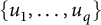 $\{ u_1^{}, \dots , u_q^{} \}$
for
 $\mathbb {S} / I(X)$
with
 $u_i^{} \in U_i^{}$
. Consult [Reference Van Tuyl26, Proposition 3.2]. The aims of this section are, first, to generalize this result to the case when X is an arbitrary zero-dimensional ACM subscheme and
 $\mathbb {K}$
is an arbitrary infinite field (Proposition 5.6), second, to obtain a version of this result for sub-ACM schemes (Proposition 5.9), and, third, to show that the
 $u_i^{}$
above can be chosen generically (Proposition 5.10). These results and their corollaries will be used in Sections 6 and 7.
Lemma 5.4 Assume that
 $\mathbb {K}$
is infinite. Write
 $\mathbf {x} = (x_1^{}, \dots , x_m^{})$
and
 $\mathbf {y} = (y_1^{}, \dots , y_n^{})$
. Let
 $\mathfrak {p} \subset \mathbb {K}[\mathbf {x}, \mathbf {y}]$
be a prime ideal. We assert that
 $\operatorname {ht}(\mathfrak {p}) \ge \operatorname {ht}(\mathfrak {p} \cap \mathbb {K}[\mathbf {x}]) + \operatorname {ht}(\mathfrak {p} \cap \mathbb {K}[\mathbf {y}])$
.
Proof Put
 $k = \dim \mathbb {K}[\mathbf {x}] / \mathfrak {p} \cap \mathbb {K}[\mathbf {x}]$
and
 $l = \dim \mathbb {K}[\mathbf {y}] / \mathfrak {p} \cap \mathbb {K}[\mathbf {y}]$
. The assertion is equivalent to the inequality
 $\dim \mathbb {K}[\mathbf {x}, \mathbf {y}] / \mathfrak {p} \le k + l$
(see [Reference Eisenbud5, Corollary 13.4]). Applying the Noether normalization theorem [Reference Eisenbud5, Theorem 13.3] we deduce that there are linearly independent one-forms
 $u_1^{}, \dots , u_k^{} \in \mathbb {K}[\mathbf {x}]$
, respectively,
 $v_1^{}, \dots , v_l^{} \in \mathbb {K}[\mathbf {y}]$
such that
 $\mathbb {K}[\mathbf {x}] / \mathfrak {p} \cap \mathbb {K}[\mathbf {x}]$
is integral over
 $\mathbb {K}[\mathbf {u}]$
and
 $\mathbb {K}[\mathbf {y}] / \mathfrak {p} \cap \mathbb {K}[\mathbf {y}]$
is integral over
 $\mathbb {K}[\mathbf {v}]$
. Here
 $\mathbf {u} = (u_1^{}, \dots , u_k^{})$
and
 $\mathbf {v} = (v_1^{}, \dots , v_l^{})$
. The extension of algebras
 $\mathbb {K}[\mathbf {u}, \mathbf {v}] / \mathfrak {p} \cap \mathbb {K}[\mathbf {u}, \mathbf {v}] \subset \mathbb {K}[\mathbf {x}, \mathbf {y}] / \mathfrak {p}$
is integral, hence, the two algebras have the same dimension (see [Reference Eisenbud5, Theorem A, p. 286]). Thus,
 $\dim \mathbb {K}[\mathbf {x}, \mathbf {y}] / \mathfrak {p} \le \dim \mathbb {K}[\mathbf {u}, \mathbf {v}] = k + l$
.
Lemma 5.5 Let
 $X \subset \mathbb {V}$
be a zero-dimensional subscheme. Choose
 $u_i^{} \in U_i^0$
. Then,
 $(U_i^{})$
is contained in
 $\operatorname {rad}((u_i^{}) + I(X))$
.
Proof Recall that
 $I(X) \cap \mathbb {K}[x_{ij}^{} \mid 0 \le j \le n_i^{}]$
defines a zero-dimensional subscheme
 $Z_i^{}$
in
 $\mathbb {P}^{n_i}$
. By hypothesis,
 $u_i^{}$
does not vanish at any point of
 $\operatorname {red}(Z_i^{})$
, hence,
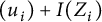 $(u_i^{}) + I(Z_i^{})$
defines the empty subscheme in
 $\mathbb {P}^{n_i}$
. Thus,
 $(U_i^{}) \subset \operatorname {rad}((u_i^{}) + I(Z_i^{})) \subset \operatorname {rad}((u_i^{}) + I(X))$
.
Proposition 5.6 We assume that
 $\mathbb {K}$
is infinite. We let
 $X \subset \mathbb {V}$
be a zero-dimensional ACM subscheme. Then, there are
 $u_i^{} \in U_i^{}$
such that
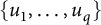 $\{ u_1^{}, \dots , u_q^{} \}$
is regular for
 $\mathbb {S} / I(X)$
.
Proof Set
 $\mathbf {x}_i^{} = (x_{i0}^{}, \dots , x_{i n_i})$
. Performing induction on k, we will construct a regular sequence
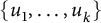 $\{ u_1^{}, \dots , u_k^{} \}$
for
 $\mathbb {S} / I(X)$
with
 $u_i^{} \in U_i^0$
. To start the induction, choose
 $u_1^{}$
in
 $U_1^0$
and recall Remark 5.2. For the induction step, assume that
 $k \in \{ 1, \dots , q - 1 \}$
and that
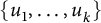 $\{ u_1^{}, \dots , u_k^{} \}$
has already been constructed. Write
 $J = (u_1^{}, \ldots, u_k^{}) + I(X)$
. Choose a prime ideal
 $\mathfrak {p}$
that is associated to J. By hypothesis,
 $\mathbb {S} / I(X)$
is Cohen–Macaulay of dimension q, hence,
 $\mathbb {S} / J$
is Cohen–Macaulay of dimension
 $q - k$
. According to [Reference Eisenbud5, Corollary 18.14], J is unmixed, hence,
 $\dim (\mathfrak {p}) = q - k$
and
 $\operatorname {ht}(\mathfrak {p}) = n_1^{} + \dots + n_q^{} + k$
. According to Lemma 5.5,
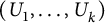 $(U_1^{}, \dots , U_k^{})$
lies in
 $\operatorname {rad}(J)$
, so it is contained in
 $\mathfrak {p}$
. We claim that
 $\operatorname {ht}(\mathfrak {p} \cap \mathbb {K}[\mathbf {x}_i^{}]) = n_i^{}$
for each index
 $i \in \{ k + 1, \dots , q \}$
. Indeed, the inequalities
 $\operatorname {ht}(\mathfrak {p} \cap \mathbb {K}[\mathbf {x}_i^{}]) \ge n_i^{}$
follow from the fact that
 $\mathfrak {p} \cap \mathbb {K}[\mathbf {x}_i^{}]$
contains the ideal of the projection of X onto
 $\mathbb {P}^{n_i}$
. According to Lemma 5.4, we have the inequality
 $$\begin{align*}\operatorname{ht}(\mathfrak{p}) \ge \sum_{1 \le i \le q} \operatorname{ht}(\mathfrak{p} \cap \mathbb{K}[\mathbf{x}_i^{}]) \quad \text{or, equivalently}, \ \sum_{k + 1 \le i \le q} n_i^{} \ge \sum_{k + 1 \le i \le q} \operatorname{ht}(\mathfrak{p} \cap \mathbb{K}[\mathbf{x}_i^{}]). \end{align*}$$
This proves the claim. The claim implies that
 $U_{k + 1}^{}$
is not contained in
 $\mathfrak {p}$
. The same is true for all associated primes of J. Since
 $\mathbb {K}$
is infinite, we can choose
 $u_{k + 1}^{} \in U_{k + 1}^0$
such that
 $u_{k + 1}^{}$
does not lie in any associated prime of J. Thus,
 $u_{k + 1}$
is a non-zerodivisor for
 $\mathbb {S} / J$
, hence,
 $\{ u_1^{}, \dots , u_{k + 1}^{} \}$
is regular relative to
 $\mathbb {S} / I(X)$
.
Lemma 5.7 We assume that
 $\mathbb {K}$
is algebraically closed. We let
 $X \subset \mathbb {V}$
be a zero-dimensional subscheme. We write
 $\operatorname {red}(X) = \{ P_1^{}, \dots , P_m^{} \}$
. We choose
 $p \in \{ 1, \dots , q \}$
and
 $u_i^{} \in U_i^0$
for
 $1 \le i \le p$
. Then, the ideals
 $\mathfrak {p}_k^{} = (U_1^{}, \dots , U_p^{}) + I(P_k^{})$
for
 $1 \le k \le m$
are the minimal prime ideals containing
 $(u_1^{}, \dots , u_p^{}) + I(X)$
.
Proof In view of Remark 5.3, we have
 $\mathfrak {p}_k^{} = (U_1^{}, \dots , U_p^{}) + (U_{k, p+1}^{}, \dots , U_{k, q}^{})$
. This is clearly a prime ideal. Some of these ideals may coincide, however, if
 $\mathfrak {p}_k^{} \neq \mathfrak {p}_l^{}$
, then
 $\mathfrak {p}_k^{} \nsubseteq \mathfrak {p}_l^{}$
and
 $\mathfrak {p}_l^{} \nsubseteq \mathfrak {p}_k^{}$
. The lemma reduces to proving that
 $$\begin{align*}\bigcap_{1 \le k \le m} \mathfrak{p}_k^{} = \operatorname{rad}((u_1^{}, \dots, u_p^{}) + I(X)). \end{align*}$$
The inclusion “
 $\supset $
” is obvious, so we focus on proving the reverse inclusion. We denote by
 $\mathfrak {r}$
the ideal on the r.h.s. Take
 $f \in \bigcap _{1 \le k \le m} \mathfrak {p}_k^{}$
and write
 $f = g + h$
, where g lies in the ideal
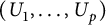 $(U_1^{}, \dots , U_p^{})$
and h is a polynomial in the variables
 $x_{ij}^{}$
,
 $p + 1 \le i \le q$
,
 $0 \le j \le n_i^{}$
. According to Lemma 5.5,
 $(U_1^{}, \dots , U_p^{}) \subset \mathfrak {r}$
, hence,
 $g \in \mathfrak {r}$
. By construction,
 $$\begin{align*}h \in \bigcap_{1 \le k \le m} (U_{ki}^{} \mid p + 1 \le i \le q) \subset \bigcap_{1 \le k \le m} I(P_k^{}) = \operatorname{rad}(I(X)) \subset \mathfrak{r}. \end{align*}$$
We conclude that f lies in
 $\mathfrak {r}$
.
Lemma 5.8 Let S be a
 $\mathbb {Z}$
-graded
 $\mathbb {K}$
-algebra and let M be a
 $\mathbb {Z}$
-graded S-module. Let
 $\{ v_1^{}, \dots , v_p^{} \} \subset S$
be an M-regular sequence such that all
 $v_i^{}$
are homogeneous of the same degree. Consider a non-singular matrix
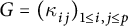 $G = (\kappa _{ij}^{})_{1 \le i, j \le p}^{}$
with entries in
 $\mathbb {K}$
. Then,
 $\{ \kappa _{i1}^{} v_1^{} + \dots + \kappa _{ip}^{} v_p^{} \mid 1 \le i \le p \}$
constitutes an M-regular sequence.
Proof If G is lower-triangular, then the lemma follows from the definition of an M-regular sequence. According to [Reference Eisenbud5, Corollary 17.5 and Theorem 17.6], a sequence
 $\{ w_1^{}, \dots , w_p^{} \} \subset S$
of homogeneous elements is M-regular if and only if the Koszul complex
 $K(w_1^{}, \dots , w_p^{}) \otimes M$
, introduced at Notation 3.4, is exact. Permutations of
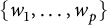 $\{ w_1^{}, \dots , w_p^{} \}$
yield isomorphic Koszul complexes. Thus, every permutation of
 $\{ v_1^{}, \dots , v_p^{} \}$
remains an M-regular sequence. The lemma follows from the fact that the lower triangular matrices and the row permutations generate
 $\operatorname {GL}_p^{}(\mathbb {K})$
.
Proposition 5.9 Assume that
 $\mathbb {K}$
is algebraically closed. Assume that
 $q \ge 3$
. Let
 $X \subset \mathbb {V}$
be a zero-dimensional sub-ACM subscheme. For
 $1 \le i \le q,$
choose
 $u_i^{} \in U_i^0$
. Then, there is an index
 $p \in \{ 2, \dots , q \}$
and there are scalars
 $\kappa _i^{} \in \mathbb {K}$
for
 $i \in \{ 2, \dots , q \} \setminus \{ p \}$
such that
 $\{ u_1^{} \} \cup \{ u_i^{} + \kappa _i^{} u_p^{} \mid i \in \{ 2, \dots , q \} \setminus \{ p \} \}$
is a regular sequence for
 $\mathbb {S} / I(X)$
.
Proof Write
 $\operatorname {red}(X) = \{ P_1^{}, \dots , P_m^{} \}$
. According to Lemma 5.7,
 $\mathfrak {p}_k^{} = (U_1^{}) + I(P_k^{})$
for
 $1 \le k \le m$
are the minimal prime ideals containing
 $(u_1^{}) + I(X)$
. We denote
 $U' = \operatorname {span} \{ u_2^{}, \dots , u_q^{} \}$
. Performing induction on
 $l \in \{ 2, \dots , q - 1 \}$
, we will construct a regular sequence
 $\{ u_1^{}, v_2^{}, \dots , v_l^{} \}$
for
 $\mathbb {S} / I(X)$
with
 $v_i^{} \in U'$
. To start the induction, we consider the set
 $\mathfrak {A}_1^{}$
of associated primes to
 $(u_1^{}) + I(X)$
. We claim that
 $U'$
is not contained in any
 $\mathfrak {p} \in \mathfrak {A}_1^{}$
. To prove this, we argue by contradiction. Assume that
 $U' \subset \mathfrak {p}$
and that
 $\mathfrak {p} \in \mathfrak {A}_1^{}$
. This ideal must contain one of the minimal associated primes to
 $(u_1^{}) + I(X)$
, say
 $\mathfrak {p}_k^{} \subset \mathfrak {p}$
. Thus,
 $U_1^{} \subset \mathfrak {p}$
and
 $U_{ki}^{} \subset \mathfrak {p}$
for
 $2 \le i \le q$
. It follows that
 $$ \begin{align*} U & = U_1^{} + U_2^{} + \dots + U_q^{} \\ & = U_1^{} + \operatorname{span} \{ u_2^{}, U_{k2}^{} \} + \dots + \operatorname{span} \{ u_q^{}, U_{kq}^{} \} \\ & = U_1^{} + U_{k2}^{} + \dots + U_{kq}^{} + U' \subset \mathfrak{p}, \end{align*} $$
hence,
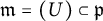 $\mathfrak {m} = (U) \subset \mathfrak {p}$
, so every element of
 $\mathfrak {m}$
is a zerodivisor for
 $\mathbb {S} / ((u_1^{}) + I(X))$
. On the other hand, by Remark 5.2,
 $u_1^{}$
is a non-zerodivisor for
 $\mathbb {S} / I(X)$
, hence,
 $$\begin{align*}\operatorname{depth}(\mathbb{S} / ((u_1^{}) + I(X))) = \operatorname{depth}(\mathbb{S} / I(X)) - 1 = q - 2 \ge 1. \end{align*}$$
We have reached a contradiction, which proves the claim. We obtain a regular sequence
 $\{ u_1^{}, v_2^{} \}$
relative to
 $\mathbb {S} / I(X)$
by choosing
 $v_2^{} \in U' \setminus \bigcup _{\mathfrak {p} \in \mathfrak {A}_1} (\mathfrak {p} \cap U')$
.
We now perform the induction step. Assume that
 $l \in \{ 2, \dots , q - 2 \}$
and that
 $\{ u_1^{}, v_2^{}, \dots , v_l^{} \}$
has already been constructed. We denote by
 $\mathfrak {A}_l^{}$
the set of associated primes to the ideal
 $(u_1^{}, v_2^{}, \dots , v_l^{}) + I(X)$
. Arguing as above, we can prove that
 $U'$
is not contained in any
 $\mathfrak {p}$
from
 $\mathfrak {A}_l^{}$
. Indeed,
 $\mathfrak {p}_k^{} \subset \mathfrak {p}$
for some k, so, if
 $U' \subset \mathfrak {p}$
, then
 $U \subset \mathfrak {p}$
. It would follow that every element of
 $\mathfrak {m}$
is a zerodivisor for
 $\mathbb {S} / ((u_1^{}, v_2^{}, \dots , v_l^{}) + I(X))$
. On the other hand, this ring has depth
 $q - 1 - l \ge 1$
. This would yield a contradiction. Choosing
 $v_{l + 1}^{} \in U' \setminus \bigcup _{\mathfrak {p} \in \mathfrak {A}_l} (\mathfrak {p} \cap U'),$
we obtain a regular sequence
 $\{ u_1^{}, v_2^{}, \dots , v_{l + 1}^{} \}$
relative to
 $\mathbb {S} / I(X)$
. This completes the induction step.
Thus far, we have constructed an
 $\mathbb {S} / I(X)$
-regular sequence
 $\{ u_1^{}, v_2^{}, \dots , v_{q - 1}^{} \}$
such that
 $v_2^{}, \dots , v_{q - 1}^{}$
are linearly independent vectors in
 $U'$
. Write
 $v_l^{} = \sum _{2 \le i \le q} \lambda _{li}^{} u_i^{}$
. The matrix
 $\Lambda = (\lambda _{li}^{})_{2 \le l \le q - 1, \, 2 \le i \le q}^{}$
has maximal rank. To simplify notation, we assume that the minor obtained by deleting the last column of
 $\Lambda $
is non-zero. We now apply Lemma 5.8 to the
 $\mathbb {Z}$
-graded ring
 $\mathbb {S}$
, to the
 $\mathbb {Z}$
-graded module
 $M = \mathbb {S} / ((u_1^{}) + I(X))$
and to the M-regular sequence
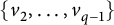 $\{ v_2^{}, \dots , v_{q - 1}^{} \}$
. We take G to be the inverse of
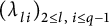 $(\lambda _{li}^{})_{2 \le l, \, i \le q - 1}^{}$
. We obtain an M-regular sequence of the form
 $\{ u_i^{} + \kappa _i^{} u_q^{} \mid 2 \le i \le q - 1 \}$
. In general, if the minor obtained by deleting column p of
 $\Lambda $
is non-zero, then we obtain a regular sequence as in the proposition.
Proposition 5.10 Assume that
 $\mathbb {K}$
is algebraically closed. Let
 $X \subset \mathbb {V}$
be a zero-dimensional ACM subscheme. For
 $1 \le i \le q,$
choose
 $u_i^{} \in U_i^0$
. Then,
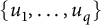 $\{ u_1^{}, \dots , u_q^{} \}$
is
 $\mathbb {S} / I(X)$
-regular.
Proof Performing induction on i, we will show that
 $\{ u_1^{}, \dots , u_i^{} \}$
is
 $\mathbb {S} / I(X)$
-regular. By Remark 5.2,
 $u_1^{}$
is a non-zerodivisor for
 $\mathbb {S} / I(X)$
. Assume that
 $i \in \{1, \dots , q -1 \}$
and that
 $\{ u_1^{}, \dots , u_i^{} \}$
is
 $\mathbb {S} / I(X)$
-regular. By hypothesis,
 $\mathbb {S} / I(X)$
is Cohen–Macaulay, hence,
 $\mathbb {S} / ((u_1^{}, \dots , u_i^{}) + I(X))$
is also Cohen–Macaulay. Per [Reference Eisenbud5, Corollary 18.14], this ring is unmixed. Thus, the associated primes of
 $(u_1^{}, \dots , u_i^{}) + I(X)$
are precisely the minimal primes. According to Lemma 5.7, they are of the form
 $\mathfrak {p}_k^{} = (U_1^{}, \dots , U_i^{}) + I(P_k^{})$
. By construction,
 $u_{i + 1}^{}$
lies outside all ideals
 $\mathfrak {p}_k^{}$
, hence,
 $u_{i + 1}^{}$
is a non-zerodivisor of
 $\mathbb {S} / ((u_1^{}, \dots , u_i^{}) + I(X))$
, and hence,
 $\{ u_1^{}, \dots , u_{i + 1}^{} \}$
is regular relative to
 $\mathbb {S} / I(X)$
.
Lemma 5.11 Let S be a commutative ring and let
 $I \subset S$
be an ideal. Assume that the sequence
 $\{ u_1^{}, \dots , u_p^{} \} \subset S$
is
 $S / I$
-regular. Then,
 $(u_1^{}, \dots , u_p^{}) I = (u_1^{}, \dots , u_p^{}) \cap I$
.
Proof The inclusion “
 $\subset $
” is obvious, so we concentrate on proving the reverse inclusion. We perform induction on p. Assume that
 $p = 1$
. Take
 $f \in (u_1^{}) \cap I$
and write
 $f = u_1^{} g$
. In
 $S / I,$
we have the relations
 $u_1^{} \hat {g} = \hat {u}_1^{} \hat {g} = \hat {f} = 0$
. By hypothesis,
 $u_1^{}$
is a non-zerodivisor for
 $S / I$
, hence,
 $\hat {g} = 0$
, that is,
 $g \in I$
, and hence,
 $f \in (u_1^{}) I$
. Assume that
 $p> 1$
and that the lemma is true for the
 $S / I$
-regular sequence
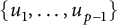 $\{ u_1^{}, \dots , u_{p - 1}^{} \}$
. Take
 $f \in (u_1^{}, \dots , u_p^{}) \cap I$
and write
 $f = u_1^{} g_1^{} + \dots + u_p^{} g_p^{}$
. In
 $S / ((u_1^{} + \dots + u_{p - 1}^{}) + I),$
we have the relations
 $ u_p^{} \hat {g}_p^{} = \hat {u}_p^{} \hat {g}_p^{} = \hat {f} - \hat {u}_1^{} \hat {g}_1^{} - \dots - \hat {u}_{p - 1}^{} \hat {g}_{p - 1}^{} = 0. $
By hypothesis,
 $u_p^{}$
is a non-zerodivisor for
 $S / ((u_1^{} + \dots + u_{p - 1}^{}) + I)$
, hence,
 $\hat {g}_p^{} = 0$
. Write
 $g_p^{} = u_1^{} h_1^{} + \dots + u_{p - 1}^{} h_{p - 1}^{} + h_p^{}$
, where
 $h_p^{} \in I$
. From the relation
 $$\begin{align*}f - u_p^{} h_p^{} = u_1^{} (g_1^{} + u_p^{} h_1^{}) + \dots + u_{p - 1}^{} (g_{p - 1}^{} + u_p^{} h_{p - 1}^{}), \end{align*}$$
we see that
 $f - u_p^{} h_p^{} \in (u_1^{}, \dots , u_{p - 1}^{}) \cap I$
. By the induction hypothesis, this ideal coincides with
 $(u_1^{}, \dots , u_{p - 1}) I$
. We conclude that
 $f \in (u_1^{}, \dots , u_p^{}) I$
.
Lemma 5.12 Let S be a commutative ring and let
 $I \subset S$
be an ideal. Assume that the sequence
 $\{ u_1^{}, \dots , u_{p + 1}^{} \} \subset S$
is regular and that
 $\{ u_1^{}, \dots , u_p^{} \}$
is
 $S / I$
-regular. Then,
 $\{ u_1^{}, \dots , u_{p + 1}^{} \}$
is also I-regular.
Proof By hypothesis,
 $u_1^{}$
is a non-zerodivisor in S, hence,
 $u_1^{}$
is a non-zerodivisor for I. Take
 $i \in \{ 1, \dots , p \}$
. We apply Lemma 5.11 to the
 $S / I$
-regular sequence
 $\{ u_1^{}, \dots , u_i^{} \}$
. We deduce that
 $I / (u_1^{}, \dots , u_i^{})I$
is isomorphic, as an S-module, to an ideal of
 $S / (u_1^{}, \dots , u_i^{})$
. By hypothesis,
 $u_{i + 1}^{}$
is a non-zerodivisor for
 $S / (u_1^{}, \dots , u_i^{})$
, hence,
 $u_{i + 1}^{}$
is a non-zerodivisor for
 $I / (u_1^{}, \dots , u_i^{})I$
.
Proposition 5.13 Assume that
 $\mathbb {K}$
is algebraically closed. Let
 $X \subset \mathbb {V}$
be a zero-dimensional sub-ACM subscheme. For
 $1 \le i \le q$
, choose
 $u_i^{} \in U_i^0$
. Then,
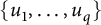 $\{ u_1^{}, \dots , u_q^{} \}$
is
 $I(X)$
-regular.
Proof We assume that
 $q = 2$
. According to Remark 5.2,
 $\{ u_1^{} \}$
is regular for
 $\mathbb {S} / I(X)$
. Clearly,
 $\{ u_1^{}, u_2^{} \}$
is
 $\mathbb {S}$
-regular. From Lemma 5.12, we deduce that
 $\{ u_1^{}, u_2^{} \}$
is
 $I(X)$
-regular. We assume that
 $q \ge 3$
. As in Proposition 5.9, we consider an
 $\mathbb {S} / I(X)$
-regular sequence
 $$\begin{align*}\{ w_1^{}, \dots, w_{q - 1}^{} \} = \{ u_i^{} + \kappa_i^{} u_p^{} \mid i \in \{ 2, \dots, q \} \setminus \{ p \} \}. \end{align*}$$
Here,
 $\kappa _1^{} = 0$
. We set
 $w_q^{} = u_p^{}$
. Clearly,
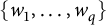 $\{ w_1^{}, \dots , w_q^{} \}$
is
 $\mathbb {S}$
-regular. From Lemma 5.12, we deduce that
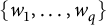 $\{ w_1^{}, \dots , w_q^{} \}$
is also
 $I(X)$
-regular. Let us now consider the column vectors
 $\mathbf {u} = (u_1^{}, \dots , u_q^{})^{\small \mathrm {T}}$
and
 $\mathbf {w} = (w_1^{}, \dots , w_q^{})^{\small \mathrm {T}}$
. By construction, we have
 $\mathbf {w} = \Lambda \mathbf {u}$
for some
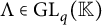 $\Lambda \in \operatorname {GL}_q^{}(\mathbb {K})$
. We apply Lemma 5.8 to the
 $I(X)$
-regular sequence
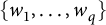 $\{ w_1^{}, \dots , w_q^{} \}$
. We take
 $G = \Lambda ^{-1}$
. We conclude that
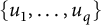 $\{ u_1^{}, \dots , u_q^{} \}$
is regular relative to
 $I(X)$
.
Proposition 5.14 We assume that
 $\mathbb {K}$
is algebraically closed. We let
 $X \subset \mathbb {V}$
be a zero-dimensional ACM subscheme. For
 $1 \le i \le q,$
we choose
 $u_i^{} \in U_i^0$
. For
 $1 \le i \le q,$
we choose
 $v_i^{} \in U_i^{} \setminus \mathbb {K} u_i^{}$
. Then,
 $\{ u_1^{}, \dots , u_q^{}, v_i^{} \}$
is
 $I(X)$
-regular for every index i.
Proof According to Proposition 5.10,
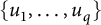 $\{ u_1^{}, \dots , u_q^{} \}$
is regular relative to
 $\mathbb {S} / I(X)$
. Clearly,
 $\{ u_1^{}, \dots , u_q^{}, v_i^{} \}$
is
 $\mathbb {S}$
-regular. The proposition follows from Lemma 5.12.
Proposition 5.15 Assume that
 $\mathbb {K}$
is infinite. Assume that
 $X \subset \mathbb {V}$
is a zero-dimensional ACM subscheme. Then, there are
 $u_i^{} \in U_i^{}$
and
 $v_i^{} \in U_i^{} \setminus \mathbb {K} u_i^{}$
such that
 $\{ u_1^{}, \dots , u_q^{}, v_i^{} \}$
is
 $I(X)$
-regular for every index i.
Proof Proposition 5.6 provides an
 $\mathbb {S} / I(X)$
-regular sequence
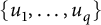 $\{ u_1^{}, \dots , u_q^{} \}$
. Clearly,
 $\{ u_1^{}, \dots , u_q^{}, v_i^{} \}$
is
 $\mathbb {S}$
-regular. The proposition follows from Lemma 5.12.
Proposition 5.16 Assume that
 $\mathbb {K}$
is infinite. Let
 $X \subset \mathbb {V}$
be a zero-dimensional subscheme. For
 $1 \le i \le q$
, choose
 $u_i^{} \in U_i^0$
and
 $v_i^{} \in U_i^{} \setminus \mathbb {K} u_i^{}$
. Then, for all indices i and j,
 $\{ u_i^{}, v_j^{} \}$
is regular relative to
 $I(X)$
.


6 Finite ACM schemes
In this section, we assume that the ground field
 $\mathbb {K}$
is infinite. We recall from Section 5 the notion of an ACM zero-dimensional scheme. Lemma 6.3 provides a class of examples of such schemes. We recall that all zero-dimensional subschemes
 $X \subset \mathbb {P}^n$
are ACM. The investigation of the next simplest case, when
 $\mathbb {V} = \mathbb {P}^1 \times \mathbb {P}^1$
, was begun by Giuffrida et al. in [Reference Giuffrida, Maggioni and Ragusa11]. For a summary of results in this case, we refer to the monograph [Reference Guardo and Van Tuyl18]. For later use, we cite at Theorem 6.2 some of the results in [Reference Giuffrida, Maggioni and Ragusa11, Section 4].
Notation 6.1 The characteristic function
 $\mathcal {X}_T^{} \colon \mathbb {Z}^q \to \{ 0, 1 \}$
of a subset
 $T \subset \mathbb {Z}^q$
is given by
 $\mathcal {X}_T^{}(a) = 1$
if
 $a \in T$
and
 $\mathcal {X}_T^{}(a) = 0$
if
 $a \in \mathbb {Z}^q \setminus T$
.
Theorem 6.2 (Giuffrida et al.)
Consider the biprojective space
 $\mathbb {V} = \mathbb {P}^1 \times \mathbb {P}^1$
over
 $\mathbb {C}$
, with
 $\mathbb {Z}^2$
-graded coordinate ring
 $\mathbb {C}[x_0^{}, x_1^{}, y_0^{}, y_1^{}]$
. Let
 $X \subset \mathbb {V}$
be a zero-dimensional subscheme. Recall the relevant domain
 $R(X) = [0, s_1^{} - 1] \times [0, s_2^{} - 1]$
from Proposition 4.5(v). Then, the following statements are equivalent:
-
(i) X is ACM;
-
(ii) there is an integer
$m \ge 0$
and there are mutually incomparable elements
$c_1^{}, \dots , c_m^{}$
in
$R(X)$
, such that the quasi-rectangular domain satisfies the condition
$$\begin{align*}Q(X) = R(X) \setminus \bigcup_{1 \le k \le m} [c_k^{}, (s_1^{} - 1, s_2^{} - 1)] \subset \mathbb{Z}^2 \end{align*}$$
$\operatorname {\Delta } \operatorname {\mathcal {H}}_X^{} = \mathcal {X}_{Q(X)}^{}$
(see Notation 6.1);
-
(iii) there are homogeneous forms
$\xi _1^{}, \dots , \xi _{m + 1}^{} \in \mathbb {C}[x_0^{}, x_1^{}]$
and
$\upsilon _1^{}, \dots , \upsilon _{m + 1}^{} \in \mathbb {C}[y_0^{}, y_1^{}]$
such that
$I(X) = (\upsilon _1^{} \cdots \upsilon _k^{} \xi _{k + 1}^{} \cdots \xi _{m + 1}^{} \mid 0 \le k \le m + 1)$
.


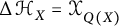



Moreover,
 $\deg (\upsilon _1^{} \cdots \upsilon _k^{} \xi _{k + 1}^{} \cdots \xi _{m + 1}^{}) = c_k^{}$
, where
 $c_0^{} = (s_1^{}, 0)$
and
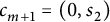 $c_{m + 1}^{} = (0, s_2^{})$
.
As per Definition 2.1,
 $Q(X)$
is a relevant quasi-rectangular domain for
 $\operatorname {\mathcal {H}}_X^{}$
, in fact, the smallest possible quasi-rectangular relevant domain.
Other characterizations of the ACM property for zero-dimensional subschemes
 $X \subset \mathbb {P}^1 \times \mathbb {P}^1$
are known in the case when X is reduced (see [Reference Van Tuyl26, Theorem 4.8], [Reference Marino21, Corollary 7.5], [Reference Marino22, Theorem 6.7], [Reference Guardo and Van Tuyl16, Theorem 4.3] and [Reference Guardo and Van Tuyl17, Theorem 8]), and in the case when X is a union of fat points (see [Reference Guardo13, Theorem 2.1] and [Reference Guardo and Van Tuyl14, Theorem 4.8]). For other ambient spaces, the focus has been entirely on reduced ACM schemes (see [Reference Guardo and Van Tuyl16, Theorems 4.5 and 5.7], [Reference Favacchio, Guardo and Migliore8, Theorem 3.16], and [Reference Favacchio and Migliore9, Proposition 3.2 and Theorem 3.7]).
We consider the algebra
 $\mathbb {C}[x_0^{}, x_1^{}, y_0^{}, y_1^{}] / (x_0^{}, y_0^{}) = \mathbb {C}[x_1^{}, y_1^{}]$
and we equip it with the inherited
 $\mathbb {Z}^2$
-grading:
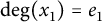 $\deg (x_1^{}) = e_1^{}$
and
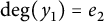 $\deg (y_1^{}) = e_2^{}$
. Condition (ii) from Theorem 6.2 is equivalent to saying that
 $\operatorname {\Delta } \operatorname {\mathcal {H}}_X^{}$
is the Hilbert function of an artinian quotient of
 $\mathbb {C}[x_1^{}, y_1^{}]$
by a monomial ideal, i.e., an artinian
 $\mathbb {Z}^2$
-graded quotient of
 $\mathbb {C}[x_1^{}, y_1^{}]$
. This statement was partially generalized by Van Tuyl in [Reference Van Tuyl26]. The algebra
 $$\begin{align*}\mathbb{S}_0^{} = \mathbb{S} / (x_{10}^{}, \dots, x_{q0}^{}) = \mathbb{K}[x_{ij}^{} \mid 1 \le i \le q, \ 1 \le j \le n_i^{}] \end{align*}$$
inherits the
 $\mathbb {Z}^q$
-grading:
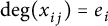 $\deg (x_{ij}^{}) = e_i^{}$
. According to [Reference Van Tuyl26, Theorem 3.11], if
 $\mathbb {K}$
is algebraically closed and if
 $X \subset \mathbb {V}$
is zero-dimensional reduced and ACM, then
 $\operatorname {\Delta } \operatorname {\mathcal {H}}_X^{}$
is the Hilbert function of an artinian
 $\mathbb {Z}^q$
-graded quotient of
 $\mathbb {S}_0^{}$
. Conversely, for any artinian
 $\mathbb {Z}^q$
-graded quotient A of
 $\mathbb {S}_0^{}$
, there exists a zero-dimensional reduced ACM subscheme
 $X \subset \mathbb {V}$
such that
 $\operatorname {\Delta } \operatorname {\mathcal {H}}_X^{} = \operatorname {\mathcal {H}}_A^{}$
. The aim of this section is to provide a version of this result that does not require X to be reduced or
 $\mathbb {K}$
to be algebraically closed.
Lemma 6.3 Assume that the subscheme
 $X \subset \mathbb {V}$
is concentrated at a point and that
 $I(X)$
is a monomial ideal. Then, X is ACM.
Proof By hypothesis,
 $\operatorname {red}(X) = \{ P \}$
for a closed point
 $P \in \mathbb {V}$
. By the multiprojective version of Hilbert’s Nullstellensatz,
 $I(P) = \operatorname {rad}(I(X))$
. As the radical of a monomial ideal,
 $I(P)$
itself is monomial. But
 $I(P)$
is also a prime ideal, hence,
 $I(P)$
is generated by a subset of the set of variables. Say
 $I(P) = (x_{ij}^{} \mid 1 \le i \le q,\ 1 \le j \le n_i^{})$
. If
 $x_{i0}^{} \zeta \in I(X)$
for a monomial
 $\zeta $
, then, since
 $x_{i0}^{}$
does not vanish at P,
 $\zeta $
must lie in
 $I(X)$
. This shows that the minimal generators of
 $I(X)$
are monomials in the same variables that generate
 $I(P)$
. It has now become clear that
 $\{ x_{i0}^{} \mid 1 \le i \le q \}$
is a regular sequence for
 $\mathbb {S} / I(X)$
, hence,
 $\operatorname {depth}(\mathbb {S} / I(X)) \ge q$
, and hence,
 $\operatorname {depth}(\mathbb {S} / I(X)) = q$
.
In the sequel, we will need Macaulay’s theorem (see [Reference Eisenbud5, Theorem 15.3]). This theorem is usually stated for homogeneous ideals of polynomial rings, but it can easily be extended to the
 $\mathbb {Z}^q$
-graded setting.
Notation 6.4 Let us fix a monomial well-ordering on
 $\mathbb {S}$
. This is a well-ordering “
 $\le $
” on the set
 $\mathbb {M}$
of monic monomials of
 $\mathbb {S}$
which is compatible with multiplication: if
 $\zeta _1^{}$
,
 $\zeta _2^{}$
, and
 $\zeta $
lie in
 $\mathbb {M}$
and
 $\zeta _1^{} < \zeta _2^{}$
, then
 $\zeta _1^{} \zeta < \zeta _2^{} \zeta $
. We say that a monomial
 $\zeta \in \mathbb {M}$
occurs in a polynomial
 $f \in \mathbb {S}$
if
 $\kappa \zeta $
is one of the monomials of f for some
 $\kappa \in \mathbb {K} \setminus \{ 0 \}$
. For
 $f \in \mathbb {S} \setminus \{ 0 \},$
we denote by
 $\operatorname {lead}(f)$
the largest monomial that occurs in f. For an ideal
 $I \subset \mathbb {S,}$
we introduce the leading ideal
 $\operatorname {lead}(I) = ( \operatorname {lead}(f) \mid f \in I)$
.
Theorem 6.5 (Macaulay)
Let
 $I \subset \mathbb {S}$
be a
 $\mathbb {Z}^q$
-homogeneous ideal. We choose a monomial well-ordering on
 $\mathbb {S}$
. Then,
 $\operatorname {lead}(I)$
is
 $\mathbb {Z}^q$
-homogeneous and has the same Hilbert function as I.
Theorem 6.6 Assume that
 $\mathbb {K}$
is infinite. Let
 $X \subset \mathbb {V}$
be a zero-dimensional ACM subscheme. We assert that
 $\operatorname {\Delta } \operatorname {\mathcal {H}}_X^{} = \operatorname {\mathcal {H}}_A^{}$
for an artinian
 $\mathbb {Z}^q$
-graded quotient A of
 $\mathbb {S}_0^{}$
. Conversely, for any artinian
 $\mathbb {Z}^q$
-graded quotient A of
 $\mathbb {S}_0^{}$
, we assert that there exists a zero-dimensional ACM subscheme
 $X \subset \mathbb {V}$
such that
 $\operatorname {\Delta } \operatorname {\mathcal {H}}_X^{} = \operatorname {\mathcal {H}}_A^{}$
.
Proof Assume that X is ACM. According to Proposition 5.6, there exists a regular sequence
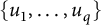 $\{ u_1^{}, \dots , u_q^{} \}$
relative to
 $\mathbb {S} / I(X)$
with
 $u_i^{} \in U_i^{}$
. In view of Lemma 3.5,
 $\operatorname {\Delta } \operatorname {\mathcal {H}}_X^{}$
is the Hilbert function of
 $A = \mathbb {S} / ((u_1^{}, \dots , u_q^{}) + I(X))$
. Performing a linear change of coordinates on each
 $\mathbb {P}^{n_i}$
, we may assume that
 $u_i^{} = x_{i0}^{}$
, therefore, A can be regarded as a
 $\mathbb {Z}^q$
-graded quotient of
 $\mathbb {S}_0^{}$
. According to Theorem 4.4,
 $\operatorname {\mathcal {H}}_A^{}$
vanishes outside a rectangular domain, hence,
 $\dim _{\mathbb {K}}^{} A$
is finite, and hence, A is an artinian
 $\mathbb {K}$
-algebra.
Conversely, we assume that we are given an artinian
 $\mathbb {Z}^q$
-graded algebra
 $A = \mathbb {S}_0^{} / I_0^{}$
. We recall Notation 6.4. We choose a monomial well-ordering on
 $\mathbb {S}_0^{}$
and we apply Theorem 6.5 to the
 $\mathbb {Z}^q$
-homogeneous ideal
 $I_0^{}$
. We find a monomial ideal
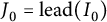 $J_0^{} = \operatorname {lead}(I_0^{})$
such that
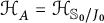 $\operatorname {\mathcal {H}}_A^{} = \operatorname {\mathcal {H}}_{\mathbb {S}_0 / J_0}$
. In particular,
 $\mathbb {S}_0^{} / J_0^{}$
is an artinian algebra, hence,
 $\operatorname {rad}(J_0^{}) = (x_{ij}^{} \mid 1 \le i \le q, \, 1 \le j \le n_i^{})$
. Let
 $J \subset \mathbb {S}$
be the ideal generated by
 $J_0^{}$
. Since J is generated by monomials that do not involve the variables
 $x_{i0}$
,
 $1 \le i \le q$
, it is obvious that J is saturated. Thus,
 $J = I(X)$
for a zero-dimensional subscheme
 $X \subset \mathbb {V,}$
which is concentrated on the point given by the ideal
 $(x_{ij}^{} \mid 1 \le i \le q, \, 1 \le j \le n_i^{})$
. In view of Lemma 6.3, X is ACM. Since J is generated by monomials that do not involve the variables
 $x_{i0}$
,
 $1 \le i \le q$
, it is obvious that
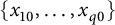 $\{ x_{10}^{}, \dots , x_{q0}^{} \}$
is
 $\mathbb {S} / J$
-regular. In view of Lemma 3.5,
 $\operatorname {\Delta } \operatorname {\mathcal {H}}_X^{}$
must be the Hilbert function of
 $\mathbb {S} / ((x_{10}^{}, \dots , x_{q0}^{}) + J) = \mathbb {S}_0^{} / J_0^{}$
.
The first assertion, in the particular case when
 $\mathbb {K} = \overline {\mathbb {K}}$
and X is reduced, was obtained by Van Tuyl in [Reference Van Tuyl26, Theorem 3.11]. The converse assertion, in the particular case when
 $\mathbb {K} = \overline {\mathbb {K}}$
, already follows from op.cit. Van Tuyl proved that for any
 $A,$
we can find a zero-dimensional reduced ACM subscheme
 $X \subset \mathbb {V}$
such that
 $\operatorname {\Delta } \operatorname {\mathcal {H}}_X^{} = \operatorname {\mathcal {H}}_A^{}$
.
Corollary 6.7 Assume that
 $\mathbb {K}$
is infinite. Let
 $X \subset (\mathbb {P}^1)^q$
be a zero-dimensional ACM subscheme. We assert that there exists a quasi-rectangular domain
 $Q(X) \subset \mathbb {Z}^q$
such that
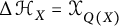 $\operatorname {\Delta } \operatorname {\mathcal {H}}_X^{} = \mathcal {X}_{Q(X)}^{}$
(see Notation 6.1). Conversely, for any quasi-rectangular domain
 $Q \subset \mathbb {Z}^q$
, there exists a zero-dimensional ACM subscheme
 $X \subset (\mathbb {P}^1)^q$
such that
 $\operatorname {\Delta } \operatorname {\mathcal {H}}_X^{} = \mathcal {X}_Q^{}$
.
Proof Note that
 $\mathbb {S}_0^{} = \mathbb {K} [x_{i1}^{} \mid 1 \le i \le q]$
, where
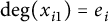 $\deg (x_{i1}^{}) = e_i^{}$
for all i. An ideal of
 $\mathbb {S}_0^{}$
is
 $\mathbb {Z}^q$
-homogeneous if and only if it is monomial. If
 $A = \mathbb {S}_0^{} / I_0^{}$
is an artinian quotient by a monomial ideal, then
 $I_0^{}$
must contain minimal generators of the form
 $x_{11}^{s_1}, \dots , x_{q1}^{s_q}$
. Let
 $c_1^{}, \dots , c_m^{}$
be the degrees of the remaining minimal generators of
 $I_0^{}$
, if any. Write
 $$\begin{align*}Q = [0, s_1^{} - 1] \times \dots \times [0, s_q^{} - 1] \setminus \bigcup_{1 \le k \le m} [c_k^{}, (s_1^{} - 1, \dots, s_q^{} - 1)]. \end{align*}$$
We have
 $\operatorname {\mathcal {H}}_A^{} = \mathcal {X}_Q^{}$
Conversely, for any quasi-rectangular domain
 $Q \subset \mathbb {Z}^q$
, we can find an artinian
 $\mathbb {Z}^q$
-graded quotient
 $A = \mathbb {S}_0^{} / I_0^{}$
such that
 $\operatorname {\mathcal {H}}_A^{} = \mathcal {X}_Q^{}$
.
The first assertion, in the particular case when
 $\mathbb {K} = \overline {\mathbb {K}}$
and X is reduced, was obtained by Van Tuyl in [Reference Van Tuyl26, Corollary 3.14]. The converse assertion, in the particular case when
 $\mathbb {K} = \overline {\mathbb {K}}$
, already follows from op.cit. Van Tuyl proved that for any
 $Q,$
we can find a zero-dimensional reduced ACM subscheme
 $X \subset (\mathbb {P}^1)^q$
such that
 $\operatorname {\Delta } \operatorname {\mathcal {H}}_X^{} = \mathcal {X}_Q^{}$
.
7 Further constraints on the Hilbert functions
In this section, we assume that the ground field
 $\mathbb {K}$
is infinite. This section is devoted to a better understanding of the problem of classification of the functions
 $\mathbb {Z}^q \to \mathbb {Z}$
that arise as Hilbert functions of zero-dimensional subschemes
 $X \subset \mathbb {V}$
. The classical theorem [Reference Bruns and Herzog2, Theorem 4.2.10] of Macaulay provides a classification of the Hilbert functions of
 $\mathbb {Z}$
-graded
 $\mathbb {K}$
-algebras. The recent theorem [Reference Favacchio6, Theorem 4.8] of Favacchio provides a classification of the Hilbert functions of
 $\mathbb {Z}^2$
-graded
 $\mathbb {K}$
-algebras. Invoking Theorem 6.6, we obtain a characterization of the functions
 $\operatorname {\mathcal {H}}_X^{}$
, for zero-dimensional subschemes
 $X \subset \mathbb {P}^n$
and for zero-dimensional ACM subschemes
 $X \subset \mathbb {P}^{n_1} \times \mathbb {P}^{n_2}$
. Yet the problem of describing the functions
 $\operatorname {\mathcal {H}}_X^{}$
in the case when
 $X \subset \mathbb {P}^{n_1} \times \mathbb {P}^{n_2}$
is sub-ACM or in the case when
 $q \ge 3$
remains open. In this section, we make progress on this problem by exhibiting certain conditions that the functions
 $\operatorname {\mathcal {H}}_X^{}$
and
 $\operatorname {\mathcal {H}}_{I(X)}^{}$
must satisfy. These constraints are formulated in terms of the partial difference functions, defined below. The emphasis will be on ACM and sub-ACM schemes. All constraints will arise in the manner of Theorem 6.6, by exploiting the regular sequences from Section 5, and then by applying Lemma 3.5. At the end of the section, we give a second proof to Theorem 4.4 in the particular case when
 $\mathbb {V} = (\mathbb {P}^1)^q$
and X is ACM or sub-ACM. Let
 $\mathcal {F} \colon \mathbb {Z}^q \to \mathbb {Z}$
be a function. For
 $1 \le i \le q,$
we consider the partial difference function
 $$\begin{align*}\operatorname{\Delta}_i^{} \mathcal{F} \colon \mathbb{Z}^q \longrightarrow \mathbb{Z} \quad \text{given by} \quad \operatorname{\Delta}_i^{} \mathcal{F}(a) = \mathcal{F}(a) - \mathcal{F}(a - e_i^{}). \end{align*}$$
We will use the abbreviation
 $\operatorname {\Delta }_{i_1 \dots i_p}^{} \mathcal {F} = \operatorname {\Delta }_{i_1}^{} \dots \operatorname {\Delta }_{i_p}^{} \mathcal {F}$
. Recalling Equation (1), we notice that
 $\operatorname {\Delta } \mathcal {F} = \operatorname {\Delta }_{1, \dots , q}^{} \mathcal {F}$
and that
 $\operatorname {\Delta } \operatorname {\Delta }_i^{} \mathcal {F} = \operatorname {\Delta }_{1, \dots , q, i}^{} \mathcal {F}$
. Differentiating the equation
 $$ \begin{align} \operatorname{\mathcal{H}}_{\mathbb{S}}^{}(a) = \prod_{1 \le i \le q} {a_i^{} + n_i^{} \choose n_i^{}} \ \ \text{yields the equation} \ \ \operatorname{\Delta} \operatorname{\mathcal{H}}_{\mathbb{S}}^{}(a) = \prod_{1 \le i \le q} {a_i^{} + n_i^{} - 1 \choose n_i^{} - 1}. \end{align} $$
Assume that
 $\mathcal {F}$
vanishes on the complement of
 $\mathbb {Z}_+^q$
. Fix indices
 $1 \le i_1^{} < \dots < i_p^{} \le q$
. By analogy with Equation (2), we have the formula
 $$ \begin{align} \operatorname{\Delta}_{i_1, \dots, i_p}^{} \mathcal{F}(a) = \!\!\!\!\! \sum_{\substack{0 \le b \le a \\ b_{i_1}^{} = a_{i_1}^{}, \dots, b_{i_p}^{} = a_{i_p}^{}}} \!\!\!\!\! \operatorname{\Delta} \mathcal{F}(b) \quad \text{for all} \quad a \in \mathbb{Z}_+^q. \end{align} $$
Proposition 7.1 Assume that
 $\mathbb {K}$
is algebraically closed. Assume that the zero-dimensional subscheme
 $X \subset \mathbb {V}$
is sub-ACM. Then, the following statements hold true:
-
(i)
$\operatorname {\Delta } \operatorname {\mathcal {H}}_{I(X)}^{} \ge 0$
; -
(ii)
$\operatorname {\Delta } \operatorname {\mathcal {H}}_{I(X)}^{}(a)> 0$
if
$I(X)_a^{} \neq \{ 0 \}$
; -
(iii)
$\operatorname {\Delta } \operatorname {\mathcal {H}}_X^{} \le \operatorname {\Delta } \operatorname {\mathcal {H}}_{\mathbb {S}}^{}$
; -
(iv) if
$\operatorname {\Delta } \operatorname {\mathcal {H}}_X^{}(a) = \operatorname {\Delta } \operatorname {\mathcal {H}}_{\mathbb {S}}^{}(a)$
for some
$a \in \mathbb {Z}_+^q$
, then
$\operatorname {\mathcal {H}}_X^{} = \operatorname {\mathcal {H}}_{\mathbb {S}}^{}$
on
$[0, a]$
; -
(v)
$\operatorname {\Delta }_{i_1 \dots i_p}^{} \operatorname {\mathcal {H}}_{I(X)}^{} \ge 0$
for all indices
$1 \le i_1^{} < \dots < i_p^{} \le q$
; -
(vi)
$\operatorname {\Delta }_{i_1 \dots i_p}^{} \operatorname {\mathcal {H}}_{I(X)}^{}(a)> 0$
if
$I(X)_a^{} \neq \{ 0 \}$
and
$1 \le i_1^{} < \dots < i_p^{} \le q$
.


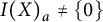







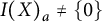

Proof Recall Notation 5.1. As per Proposition 5.13, we can construct
 $I(X)$
-regular sequences
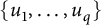 $\{ u_1^{}, \dots , u_q^{} \}$
with generic
 $u_i^{} \in U_i^{}$
. We write
 $N = I(X) / (u_1^{}, \dots , u_q^{}) I(X)$
. By applying Lemma 3.5, we deduce that
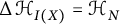 $\operatorname {\Delta } \operatorname {\mathcal {H}}_{I(X)}^{} = \operatorname {\mathcal {H}}_N^{}$
. This function takes, of course, only nonnegative values. We have proved statement (i). The same argument applies to statement (v), except that this time we consider the
 $I(X)$
-regular sequence
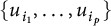 $\{ u_{i_1}^{}, \dots , u_{i_p}^{} \}$
.
If
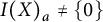 $I(X)_a^{} \neq \{ 0 \}$
, then we can choose
 $u_i^{}$
such that the subvariety given by the ideal
 $(u_1^{}, \dots , u_q^{})$
is not contained in the zero-set of
 $I(X)_a$
. Thus,
 $N_a^{} \neq \{ 0 \}$
, hence,
 $\operatorname {\Delta } \operatorname {\mathcal {H}}_{I(X)}^{}(a)> 0$
. This proves statement (ii). The same argument applies to statement (vi), except that this time we consider the ideal
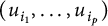 $(u_{i_1}^{}, \dots , u_{i_p}^{})$
. Statement (iii) follows from the equation
 $\operatorname {\Delta } \operatorname {\mathcal {H}}_X^{} = \operatorname {\Delta } \operatorname {\mathcal {H}}_{\mathbb {S}}^{} - \operatorname {\Delta } \operatorname {\mathcal {H}}_{I(X)}^{}$
and from (i).
Assume that
 $\operatorname {\Delta } \operatorname {\mathcal {H}}_X^{}(a) = \operatorname {\Delta } \operatorname {\mathcal {H}}_{\mathbb {S}}^{}(a)$
for some
 $a \in \mathbb {Z}_+^q$
. Thus,
 $\operatorname {\Delta } \operatorname {\mathcal {H}}_{I(X)}^{}(a) = 0$
. From part (ii), we deduce that
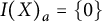 $I(X)_a^{} = \{ 0 \}$
. A fortiori,
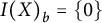 $I(X)_b^{} = \{ 0 \}$
for
 $b \in [0, a]$
, hence,
 $\operatorname {\mathcal {H}}_{I(X)}^{} = 0$
on
 $[0, a]$
, and hence,
 $\operatorname {\mathcal {H}}_X^{} = \operatorname {\mathcal {H}}_{\mathbb {S}}^{}$
on
 $[0, a]$
. This proves statement (iv).
Proposition 7.2 Assume that
 $\mathbb {K}$
is algebraically closed. Assume that the zero-dimensional subscheme
 $X \subset \mathbb {V}$
is ACM. As provided in Theorem 6.6, let A be an artinian algebra such that
 $\operatorname {\Delta } \operatorname {\mathcal {H}}_X^{} = \operatorname {\mathcal {H}}_A^{}$
. Then, the following statements hold true:
-
(i)
$\operatorname {\Delta } \operatorname {\Delta }_i^{} \operatorname {\mathcal {H}}_{I(X)}^{} \ge 0$
for all indices
$i \in \{ 1, \dots , q \}$
; -
(ii)
$\operatorname {\Delta } \operatorname {\Delta }_i^{} \operatorname {\mathcal {H}}_{I(X)}^{}(a)> 0$
if
$I(X)_a^{} \neq \{ 0 \}$
and
$n_i^{} \ge 2$
; -
(iii)
$\operatorname {\Delta }_i^{} \operatorname {\mathcal {H}}_A^{} \le \operatorname {\Delta } \operatorname {\Delta }_i^{} \operatorname {\mathcal {H}}_{\mathbb {S}}^{}$
for all indices
$i \in \{ 1, \dots , q \}$
; -
(iv) if
$n_i^{} \ge 2$
and
$\operatorname {\Delta }_i^{} \operatorname {\mathcal {H}}_A^{}(a) = \operatorname {\Delta } \operatorname {\Delta }_i^{} \operatorname {\mathcal {H}}_{\mathbb {S}}^{}(a)$
for some
$a \in \mathbb {Z}_+^q$
, then
$\operatorname {\mathcal {H}}_X^{} = \operatorname {\mathcal {H}}_{\mathbb {S}}^{}$
on
$[0, a]$
; -
(v)
$\operatorname {\Delta } \operatorname {\mathcal {H}}_{I(X)}^{} \ge 0$
; -
(vi)
$\operatorname {\Delta } \operatorname {\mathcal {H}}_{I(X)}^{}(a)> 0$
if
$I(X)_a^{} \neq \{ 0 \}$
; -
(vii)
$\operatorname {\mathcal {H}}_A^{} \le \operatorname {\Delta } \operatorname {\mathcal {H}}_{\mathbb {S}}^{}$
; -
(viii) if
$\operatorname {\mathcal {H}}_A^{}(a) = \operatorname {\Delta } \operatorname {\mathcal {H}}_{\mathbb {S}}^{}(a)$
for some
$a \in \mathbb {Z}_+^q$
, then
$\operatorname {\mathcal {H}}_X^{} = \operatorname {\mathcal {H}}_{\mathbb {S}}^{}$
on
$[0, a]$
; -
(ix)
$\operatorname {\Delta }_{i_1 \dots i_p}^{} \operatorname {\mathcal {H}}_{I(X)}^{} \ge 0$
for all indices
$1 \le i_1^{} < \dots < i_p^{} \le q$
; -
(x)
$\operatorname {\Delta }_{i_1 \dots i_p}^{} \operatorname {\mathcal {H}}_{I(X)}^{}(a)> 0$
if
$I(X)_a^{} \neq \{ 0 \}$
and
$1 \le i_1^{} < \dots < i_p^{} \le q$
.

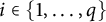

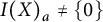


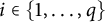





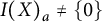







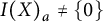

Statements (i), (iii), (v), (vii), and (ix) also hold true under the weaker hypothesis that
 $\mathbb {K}$
be infinite.
Proof Consider the
 $I(X)$
-regular sequence
 $\{ u_1^{}, \dots , u_q^{}, v_i^{} \}$
from Proposition 5.15. Write
 $N = I(X) / (u_1^{}, \dots , u_q^{}, v_i^{}) I(X)$
. By analogy with Lemma 3.5, we can prove that
 $\operatorname {\Delta } \operatorname {\Delta }_i^{} \operatorname {\mathcal {H}}_{I(X)}^{} = \operatorname {\mathcal {H}}_N^{}$
. This function takes only nonnegative values, proving statement (i). Assume that
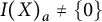 $I(X)_a^{} \neq \{ 0 \}$
and
 $n_i^{} \ge 2$
. According to Proposition 5.14,
 $u_1^{}, \dots , u_q^{}$
and
 $v_i^{}$
can be chosen generically. We choose them in such a way that the subvariety given by the ideal
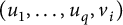 $(u_1^{}, \dots , u_q^{}, v_i^{})$
is not contained in the zero-set of
 $I(X)_a^{}$
. Thus,
 $N_a^{} \neq \{ 0 \}$
, hence,
 $\operatorname {\mathcal {H}}_N^{}(a)> 0$
. This proves statement (ii). Statement (iii) follows from the equation
 $\operatorname {\Delta }_i^{} \operatorname {\mathcal {H}}_A^{} = \operatorname {\Delta } \operatorname {\Delta }_i^{} \operatorname {\mathcal {H}}_{\mathbb {S}}^{} - \operatorname {\Delta } \operatorname {\Delta }_i^{} \operatorname {\mathcal {H}}_{I(X)}^{}$
and from (i). To prove the remaining statements, we can argue as in the proof of Proposition 7.1. Note also that (v) follows from the formula
 $$\begin{align*}\operatorname{\Delta} \operatorname{\mathcal{H}}_{I(X)}^{} = \sum_{0 \le k \le a_i} \operatorname{\Delta} \operatorname{\Delta}_i^{} \operatorname{\mathcal{H}}_{I(X)}^{}(a - k e_i^{}) \end{align*}$$
and from (i). In the case when
 $n_i^{} \ge 2$
, statement (vi) follows from the above formula and from (i) and (ii). Statement (ix) follows from Equation (7) and from (v). Statement (x) follows from Equation (7) and from (v) and (vi).
Corollary 7.3 Assume that
 $\mathbb {K}$
is algebraically closed. Assume that the zero-dimensional subscheme
 $X \subset (\mathbb {P}^1)^q$
is ACM or sub-ACM. Then, the following statements hold true:
-
(i)
$\operatorname {\Delta } \operatorname {\mathcal {H}}_X^{}(a) \le 1$
for all
$a \in \mathbb {Z}_+^q$
; -
(ii) if
$\operatorname {\Delta } \operatorname {\mathcal {H}}_X^{}(a) = 1$
for some
$a \in \mathbb {Z}_+^q$
, then
$\operatorname {\Delta } \operatorname {\mathcal {H}}_X^{} = 1$
on
$[0, a]$
.
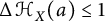

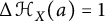


Proof Substituting
 $n_i^{} = 1$
into Equation (6), we obtain
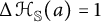 $\operatorname {\Delta } \operatorname {\mathcal {H}}_{\mathbb {S}}^{} (a) = 1$
for
 $a \in \mathbb {Z}_+^q$
. Substituting this expression into Propositions 7.1(iii) and 7.2(vii) yields statement (i). Substituting this expression into Propositions 7.1(iv) and 7.2(viii) yields (ii).
In the case when X is ACM, the above corollary also follows from Corollary 6.7. The above result, in the particular case when
 $\mathbb {V} = \mathbb {P}^1 \times \mathbb {P}^1$
, was obtained by Giuffrida et al. Consult [Reference Giuffrida, Maggioni and Ragusa11, Proposition 2.7].
Proposition 7.4 Assume that
 $\mathbb {K}$
is algebraically closed. Let
 $X \subset \mathbb {V}$
be a zero-dimensional subscheme. Then, the following statements hold true:
-
(i)
$\operatorname {\Delta }_{ij}^{} \operatorname {\mathcal {H}}_{I(X)}^{} \ge 0$
for all indices
$1 \le i \le j \le q$
; -
(ii)
$\operatorname {\Delta }_{ij}^{} \operatorname {\mathcal {H}}_{I(X)}^{}(a)> 0$
if
$I(X)_a^{} \neq \{ 0 \}$
and
$1 \le i < j \le q$
; -
(iii)
$\operatorname {\Delta }_{ii}^{} \operatorname {\mathcal {H}}_{I(X)}^{}(a)> 0$
if
$I(X)_a^{} \neq \{ 0 \}$
and
$n_i^{} \ge 2$
; -
(iv)
$\operatorname {\Delta }_{ij}^{} \operatorname {\mathcal {H}}_X^{} \le \operatorname {\Delta }_{ij}^{} \operatorname {\mathcal {H}}_{\mathbb {S}}^{}$
for all indices
$1 \le i < j \le q$
; -
(v) if
$\operatorname {\Delta }_{ij}^{} \operatorname {\mathcal {H}}_X^{}(a) = \operatorname {\Delta }_{ij}^{} \operatorname {\mathcal {H}}_{\mathbb {S}}^{}(a)$
for some
$a \in \mathbb {Z}_+^q$
and indices
$1 \le i < j \le q$
, then
$\operatorname {\mathcal {H}}_X^{} = \operatorname {\mathcal {H}}_{\mathbb {S}}^{}$
on
$[0, a]$
; -
(vi) if
$n_i^{} \ge 2$
and
$\operatorname {\Delta }_{ii}^{} \operatorname {\mathcal {H}}_X^{}(a) = \operatorname {\Delta }_{ii}^{} \operatorname {\mathcal {H}}_{\mathbb {S}}^{}(a)$
for some
$a \in \mathbb {Z}_+^q$
, then
$\operatorname {\mathcal {H}}_X^{} = \operatorname {\mathcal {H}}_{\mathbb {S}}^{}$
on
$[0, a]$
; -
(vii)
$\operatorname {\Delta }_i^{} \operatorname {\mathcal {H}}_X^{} \ge 0$
for all indices
$i \in \{ 1, \dots , q \}$
.
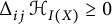


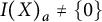


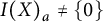









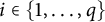
Statements (i), (iv), and (vii) also hold true under the weaker hypothesis that
 $\mathbb {K}$
be infinite.
Proof We use the
 $I(X)$
-regular sequence
 $\{ u_i^{}, v_j^{} \}$
provided by Proposition 5.16 and we repeat the arguments from the proof of Proposition 7.1. Statement (vii) follows from the fact that
 $\{ u_i^{} \}$
is regular for
 $\mathbb {S} / I(X)$
(see Remark 5.2).
As an application of the above results, we will give a second proof to a particular case of Theorem 4.4. We formulate this as a separate proposition.
Proposition 7.5 Assume that
 $\mathbb {K}$
is algebraically closed. Assume that the zero-dimensional subscheme
 $X \subset (\mathbb {P}^1)^q$
is ACM or sub-ACM. For
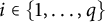 $i \in \{ 1, \dots , q \}$
, let
 $s_i^{}$
be the length of the projection of X onto the ith copy of
 $\mathbb {P}^1$
. Then,
 $[0, s_1^{} - 1] \times \dots \times [0, s_q^{} - 1]$
is the smallest rectangular relevant domain for
 $\operatorname {\mathcal {H}}_X^{}$
.
Proof In view of Lemma 2.2, we must show that
 $\operatorname {\mathcal {H}}_X^{}(a) = \operatorname {\mathcal {H}}_X^{}(a - (a_i^{} - s_i^{} + 1) e_i^{})$
if
 $a_i^{} \ge s_i^{} - 1$
. Equivalently, we must show that
 $\operatorname {\Delta }_i^{} \operatorname {\mathcal {H}}_X^{}(a) = 0$
if
 $a_i^{} \ge s_i^{}$
. By symmetry, it is enough to prove that
 $\operatorname {\Delta }_1^{} \operatorname {\mathcal {H}}_X^{}(a) = 0$
if
 $a \in \mathbb {Z}_+^q$
and
 $a_1^{} \ge s_1^{}$
. Given
 $a \in \mathbb {Z}_+^q$
, put
 $\sigma (a) = a_2^{} + \dots + a_q^{}$
. We perform induction on
 $\sigma (a)$
. To begin the induction, assume that
 $\sigma (a) = 0$
. Write
 $Z_1^{} = \mathrm {pr}_1^{}(X)$
. According to Proposition 3.8(i and v), we have the equation
 $\operatorname {\mathcal {H}}_X^{} (b_1^{}, 0 , \dots , 0) = \operatorname {\mathcal {H}}_{Z_1}^{}(b_1^{}) = s_1^{}$
for
 $b_1^{} \ge s_1^{} - 1$
. This leads to the desired outcome
 $\operatorname {\Delta }_1^{} \operatorname {\mathcal {H}}_X^{}(a) = 0$
. We now perform the induction step. Assume that
 $\sigma (a)> 0$
. To simplify notation, assume that
 $a_2^{}, \dots , a_p^{}$
are positive and
 $a_{p + 1}^{}, \dots , a_q^{}$
are zero for some
 $p \in \{ 2, \dots , q \}$
. From the definition of the partial difference functions, we get
 $$\begin{align*}\operatorname{\Delta}_1^{} \operatorname{\mathcal{H}}_X^{}(a) = \operatorname{\Delta}_{1, \dots, p}^{} \operatorname{\mathcal{H}}_X^{}(a) + \sum_{1 \le k \le p - 1} \operatorname{\Delta}_{1, \dots, k}^{} \operatorname{\mathcal{H}}_X^{}(a - e_{k + 1}^{}). \end{align*}$$
Since
 $\sigma (a - e_{k + 1}^{}) < \sigma (a)$
,
 $\operatorname {\Delta }_{1, \dots , k}^{} \operatorname {\mathcal {H}}_X^{}(a - e_{k + 1}^{})$
is a finite sum of expressions of the form
 $\pm \operatorname {\Delta }_1^{} \operatorname {\mathcal {H}}_X^{}(b)$
, with
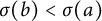 $\sigma (b) < \sigma (a)$
and with
 $b_1^{} = a_1^{}$
. By the induction hypothesis, these expressions vanish. We obtain the equations
 $$ \begin{align*} \operatorname{\Delta}_1^{} \operatorname{\mathcal{H}}_X^{}(a) & = \operatorname{\Delta}_{1, \dots, p}^{} \operatorname{\mathcal{H}}_X^{}(a) \\ & = (a_{p + 1}^{} + 1) \cdots (a_q^{} + 1) - \operatorname{\Delta}_{1, \dots, p}^{} \operatorname{\mathcal{H}}_{I(X)}^{}(a) \\ & = 1 - \operatorname{\Delta}_{1, \dots, p}^{} \operatorname{\mathcal{H}}_{I(X)}^{}(a). \end{align*} $$
We know that
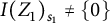 $I(Z_1^{})_{s_1}^{} \neq \{ 0 \}$
. It follows that
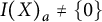 $I(X)_a^{} \neq \{ 0 \}$
. Since we are assuming that X is ACM or sub-ACM, we may apply Propositions 7.1(vi) and 7.2(x) in order to obtain the inequality
 $\operatorname {\Delta }_{1, \dots , p}^{} \operatorname {\mathcal {H}}_{I(X)}^{}(a)> 0$
. A fortiori,
 $\operatorname {\Delta }_1^{} \operatorname {\mathcal {H}}_X^{}(a) \le 0$
. According to Proposition 7.4(vii), the reverse inequality
 $\operatorname {\Delta }_1^{} \operatorname {\mathcal {H}}_X^{}(a) \ge 0$
is also satisfied. We obtain the desired outcome
 $\operatorname {\Delta }_1^{} \operatorname {\mathcal {H}}_X^{}(a) = 0$
. This concludes the induction step.
The above line of argument, in the particular case when
 $\mathbb {V} = \mathbb {P}^1 \times \mathbb {P}^1$
, is due to Giuffrida et al. Consult [Reference Giuffrida, Maggioni and Ragusa11, Remark 2.8 and Theorem 2.11]. We have adapted their proof to the case of arbitrary q. In the case when
 $q = 2,$
there is no restriction on X because every zero-dimensional subscheme
 $X \subset \mathbb {P}^1 \times \mathbb {P}^1$
is ACM or sub-ACM.
8 A vanishing result for
$\operatorname {\Delta } \operatorname {\mathcal {H}}$

In this section, we take
 $\mathbb {V} = (\mathbb {P}^1)^q$
and
 $\mathbb {S} = \mathbb {K}[x_1^{}, y_1^{}, \dots , x_q^{}, y_q^{}]$
, where
 $\deg (x_i^{}) = \deg (y_i^{}) = e_i^{}$
. We saw in Theorem 6.2 and in Corollary 6.7 that zero-dimensional ACM subschemes
 $X \subset \mathbb {V}$
that are not complete intersections have a quasi-rectangular relevant domain
 $Q(X),$
which is strictly contained in the rectangular relevant domain
 $R(X)$
introduced in Theorem 4.4. This section and the next are devoted to finding a procedure (Proposition 9.5) for constructing a quasi-rectangular relevant domain
 $D(X) \subset R(X)$
that applies to schemes X which are not necessarily ACM. We restrict our attention only to schemes X for which
 $I(X)$
is a monomial ideal. The domain
 $D(X)$
may coincide with
 $R(X)$
or may be strictly contained in
 $R(X)$
, depending on the scheme. At the end of Section 9, we shall give examples in which
 $D(X)$
is strictly contained in
 $R(X)$
.
In this section, we do some preparatory work. We obtain a vanishing criterion for
 $\operatorname {\Delta } \operatorname {\mathcal {H}}_{\mathbb {S} / J}^{}$
, where
 $J \subset \mathbb {S}$
is a monomial ideal. In order to achieve this, we need to take two preliminary steps. First, in Equation (9), we obtain a combinatorial formula for
 $\operatorname {\Delta } \operatorname {\mathcal {H}}_{\mathbb {S} / J}^{}$
. This formula actually holds for any
 $\mathbb {Z}^q$
-graded polynomial ring, i.e., for arbitrary values of
 $n_1^{}, \dots , n_q^{}$
. The second step, Lemma 8.3, is also combinatorial and breaks down if there are more than two variables of degree
 $e_i^{}$
. This is the technical reason why our ambient space needs to be a product of projective lines.
We find it convenient to work with the function
 $\operatorname {\mathcal {H}}_J^{}$
. Substituting
 $n_i^{} = 1$
into Equation (6), we get
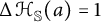 $\operatorname {\Delta } \operatorname {\mathcal {H}}_{\mathbb {S}}^{}(a) = 1$
for
 $a \in \mathbb {Z}_+^q$
. A fortiori,
 $$ \begin{align} \operatorname{\Delta} \operatorname{\mathcal{H}}_{\mathbb{S} / J}^{}(a) = 1 - \operatorname{\Delta} \operatorname{\mathcal{H}}_J^{}(a) \quad \text{for} \quad a \in \mathbb{Z}_+^q. \end{align} $$
Notation 8.1 Let
 $J \subset \mathbb {S}$
be a monomial ideal. Let
 $\mathbb {M}$
be the set of monic monomials of
 $\mathbb {S}$
. Let
 $\Gamma (J) = \{ f_1^{}, \dots , f_m^{} \} \subset \mathbb {M}$
be the set of minimal generators of J. Fix
 $a \in \mathbb {Z}^q$
. For all integers
 $p \in \{ 1, \dots , m \},$
we write
 $$\begin{align*}\Gamma_a^p(J) = \{ (f_{k_1}^{}, \dots, f_{k_p}^{}) \mid 1 \le k_1^{} < \dots < k_p^{} \le m, \ \deg(\operatorname{lcm}(f_{k_1}^{}, \dots, f_{k_p}^{})) \le a \}. \end{align*}$$
Lemma 8.2 We consider
 $a \in \mathbb {Z}_+^q$
. We adopt the above notation. We assert that
 $$ \begin{align} \operatorname{\Delta} \operatorname{\mathcal{H}}_{\mathbb{S} / J}^{}(a) = 1 + \sum_{p \ge 1} (-1)^p \left| \Gamma_a^p(J) \right|. \end{align} $$
Proof Write
 $d_{k_1 \dots k_p}^{} = (d_{k_1 \dots k_p}^1, \dots , d_{k_1 \dots k_p}^q) = \deg (\operatorname {lcm}(f_{k_1}^{}, \dots , f_{k_p}^{}))$
. By definition,
 $$\begin{align*}\operatorname{\mathcal{H}}_J^{}(b) = \big| \bigcup_{1 \le k \le m} \{ \zeta \in \mathbb{M} \mid f_k^{} \ \text{divides} \ \zeta, \ \deg(\zeta) = b \} \big| \end{align*}$$
for
 $b \in \mathbb {Z}^q$
. Applying the inclusion–exclusion principle, we obtain the formula
 $$\begin{align*}\operatorname{\mathcal{H}}_J^{}(b) = \sum_{1 \le p \le m} (-1)^{p+1} \sum_{1 \le k_1^{} < \dots < k_p^{} \le m} \big| \{ \zeta \in \mathbb{M} \mid f_{k_1}^{}, \dots, f_{k_p}^{} \ \text{divide} \ \zeta, \ \deg(\zeta) = b \} \big|. \end{align*}$$
Ignoring the empty sets on the r.h.s., we calculate
 $$\begin{align*}\operatorname{\mathcal{H}}_J^{}(b) = \sum_{1 \le p \le m} (-1)^{p+1} \sum_{\substack{1 \le k_1^{} < \dots < k_p^{} \le m \\ d_{k_1 \dots k_p} \le b}} (b_1^{} - d_{k_1 \dots k_p}^1 + 1) \cdots (b_q^{} - d_{k_1 \dots k_p}^q + 1). \end{align*}$$
Assume now that
 $b = a + c$
, where
 $c_i^{} \in \{ -1, 0 \}$
for all indices
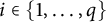 $i \in \{ 1, \dots , q \}$
. If
 $d \in \mathbb {Z}^q$
satisfies the conditions
 $d \le a$
and
 $d \nleq b$
, then there is i such that
 $d_i^{} = a_i^{} = b_i^{} + 1$
, forcing the equation
 $(b_1^{} - d_1^{} + 1) \cdots (b_q^{} - d_q^{} + 1) = 0$
. Thus, on the r.h.s. of the above formula, we can add all the terms for which
 $d_{k_1 \dots k_p}^{} \le a$
but
 $d_{k_1 \dots k_p}^{} \nleq b$
, i.e., we can replace b by a under the summation sign:
 $$\begin{align*}\operatorname{\mathcal{H}}_J^{}(b) = \sum_{1 \le p \le m} (-1)^{p+1} \sum_{\substack{1 \le k_1^{} < \dots < k_p^{} \le m \\ d_{k_1 \dots k_p} \le a}} (b_1^{} - d_{k_1 \dots k_p}^1 + 1) \cdots (b_q^{} - d_{k_1 \dots k_p}^q + 1). \end{align*}$$
This equation holds for
 $b = a + c$
for all possible
 $c \in \{ -1, 0 \}^q$
, hence, we may apply the
 $\operatorname {\Delta }$
operator calculated at a to both sides:
 $$ \begin{align*} \operatorname{\Delta} \operatorname{\mathcal{H}}_J^{}(a) & = \sum_{1 \le p \le m} (-1)^{p+1} \!\!\!\!\! \sum_{\substack{1 \le k_1^{} < \dots < k_p^{} \le m \\ d_{k_1 \dots k_p} \le a}} \!\!\!\!\! \operatorname{\Delta} \big((b_1^{} - d_{k_1 \dots k_p}^1 + 1) \cdots (b_q^{} - d_{k_1 \dots k_p}^q + 1)\big)|_{b = a} \\ & = \sum_{1 \le p \le m} (-1)^{p+1} \!\!\!\!\! \sum_{\substack{1 \le k_1^{} < \dots < k_p^{} \le m \\ d_{k_1 \dots k_p} \le a}} \!\!\!\!\! 1 \quad = \sum_{1 \le p \le m} (-1)^{p+1} \left| \Gamma_a^p(J) \right|. \end{align*} $$
To conclude the proof of the lemma, we employ Equation (8).
Lemma 8.3 We assume that
 $2 \le p \le m$
. We recall Notation 8.1. We assert that
 $$ \begin{align*} \Gamma_a^p(J) & = \big\{ (f_{k_1}^{}, \dots, f_{k_p}^{}) \mid 1 \le k_1^{} < \dots < k_p^{} \le m, \ (f_{k_\mu}^{}, f_{k_\nu}^{}) \in \Gamma_a^2(J) \\ &\quad \text{for all indices} \ \ 1 \le \mu < \nu \le p \big\}. \end{align*} $$
Proof Assume that
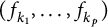 $(f_{k_1}^{}, \dots , f_{k_p}^{})$
lies in
 $\Gamma _a^p(J)$
. Then, for all indices
 $1 \le \mu < \nu \le p$
,
 $$\begin{align*}\deg(\operatorname{lcm}(f_{k_\mu}^{}, f_{k_\nu}^{})) \le \deg(\operatorname{lcm}(f_{k_1}^{}, \dots, f_{k_p}^{})) \le a. \end{align*}$$
This proves the inclusion “
 $\subset $
.” Conversely, assume that
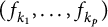 $(f_{k_1}^{}, \dots , f_{k_p}^{})$
belongs to the set on the r.h.s. For each index
 $\mu \in \{ 1, \dots , p \},$
write
 $f_{k_\mu }^{} = x_1^{\alpha _{\mu 1}} y_1^{\beta _{\mu 1}} \cdots x_q^{\alpha _{\mu q}} y_q^{\beta _{\mu q}}$
. For all indices
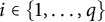 $i \in \{ 1, \dots , q \}$
put
 $\alpha _i^{} = \max _{1 \le \mu \le p} \alpha _{\mu i}^{}$
and
 $\beta _i^{} = \max _{1 \le \mu \le p} \beta _{\mu i}^{}$
. Thus,
 $$\begin{align*}\operatorname{lcm}(f_{k_1}^{}, \dots, f_{k_p}^{}) = x_1^{\alpha_1} y_1^{\beta_1} \cdots x_q^{\alpha_q} y_q^{\beta_q}. \end{align*}$$
For a fixed index
 $i \in \{ 1, \dots , q \},$
choose indices
 $\mu , \nu \in \{ 1, \dots , p \}$
such that
 $\alpha _i^{} = \alpha _{\mu i}^{}$
and
 $\beta _i^{} = \beta _{\nu i}^{}$
. If
 $\mu = \nu $
, then
 $\alpha _i^{} + \beta _i^{} = \alpha _{\mu i}^{} + \beta _{\mu i}^{} = \deg (f_{k_\mu }^{})_i^{} \le a_i^{}$
. If
 $\mu \neq \nu $
, then we have
 $\alpha _i^{} + \beta _i^{} = \alpha _{\mu i}^{} + \beta _{\nu i}^{} = \deg (\operatorname {lcm}(f_{k_\mu }^{}, f_{k_\nu }^{}))_i^{} \le a_i^{}$
. Since i was chosen arbitrarily, we get
 $$\begin{align*}\deg(\operatorname{lcm}(f_{k_1}^{}, \dots, f_{k_p}^{})) = (\alpha_1^{} + \beta_1^{}, \dots, \alpha_q^{} + \beta_q^{}) \le a. \end{align*}$$
Thus,
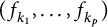 $(f_{k_1}^{}, \dots , f_{k_p}^{})$
must lie in
 $\Gamma _a^p(J)$
. This proves the reverse inclusion “
 $\supset $
.”
Proposition 8.4 Let
 $J \subset \mathbb {K}[x_1^{}, y_1^{}, \dots , x_q^{}, y_q^{}]$
be a monomial ideal. Consider
 $a \in \mathbb {Z}_+^q$
and let
 $\{ g_1^{}, \dots , g_n^{} \}$
be the set of minimal generators of J whose degree is less or equal to a. If
 $n = 1$
, then
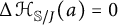 $\operatorname {\Delta } \operatorname {\mathcal {H}}_{\mathbb {S} / J}^{}(a) = 0$
. If
 $ n \ge 2$
and
 $\deg (\operatorname {lcm}(g_1^{}, g_l^{})) \le a$
for all indices
 $l \in \{ 2, \dots , n \}$
, then, again,
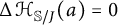 $\operatorname {\Delta } \operatorname {\mathcal {H}}_{\mathbb {S} / J}^{}(a) = 0$
.
Proof We recall Notation 8.1. By hypothesis,
 $(g_1^{}, g_l^{})$
lies in
 $\Gamma _a^2(J)$
for all indices l in
 $\{ 2, \dots , n \}$
. In view of Lemma 8.3, for
 $2 \le p \le n,$
we can write
 $\Gamma _a^p(J) = \Phi ^p \sqcup \Psi ^p$
, where
 $$\begin{align*}\Phi^p = \{ (g_1^{}, g_{l_2}^{}, \dots, g_{l_p}^{}) \mid 2 \le l_2^{} < \dots < l_p^{} \le n, \ (g_{l_2}^{}, \dots, g_{l_p}^{}) \in \Gamma_a^{p - 1}(J) \} \end{align*}$$
and
 $$\begin{align*}\Psi^p = \{ (g_{l_1}^{}, \dots, g_{l_p}^{}) \in \Gamma_a^p(J) \mid 2 \le l_1^{} < \dots < l_p^{} \le n \}. \end{align*}$$
We notice that
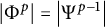 $\left | \Phi ^p \right | = \left | \Psi ^{p - 1} \right |$
, where, by convention,
 $\Psi ^1 = \{ g_2^{}, \dots , g_n^{} \}$
. We also notice that
 $\Psi ^n = \emptyset $
. Applying Equation (9), we calculate
 $$ \begin{align*} \operatorname{\Delta} \operatorname{\mathcal{H}}_{\mathbb{S} / J}^{}(a) & = 1 + \sum_{1 \le p \le n} (-1)^p \left| \Gamma_a^p(J) \right| \\ & = 1 - \left| \Gamma_a^1(J) \right| + \sum_{2 \le p \le n} (-1)^p (\left| \Phi^p \right| + \left| \Psi^p \right|) \\ & = 1 - n + \sum_{2 \le p \le n} (-1)^p \left| \Psi^{p - 1} \right| + \sum_{2 \le p \le n - 1} (-1)^p \left| \Psi^p \right| \\ & = 1 - n + \left| \Psi^1 \right| + \sum_{2 \le p \le n - 1} (-1)^{p + 1} \left| \Psi^p \right| + \sum_{2 \le p \le n - 1} (-1)^p \left| \Psi^p \right| \\ & = 1 - n + (n - 1) + \sum_{2 \le p \le n - 1} ((-1)^{p + 1} + (-1)^p) \left| \Psi^p \right| \\ & = 0. \end{align*} $$
In the case when
 $n = 1$
, we can notice directly that
 $\left | \Gamma _a^1(J) \right | = 1$
and
 $\left | \Gamma _a^p(J) \right | = 0$
for
 $p \ge 2$
. Substituting these values into Equation (9) yields the equation
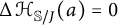 $\operatorname {\Delta } \operatorname {\mathcal {H}}_{\mathbb {S} / J}^{}(a) = 0$
.
9 Finite subschemes of a product of projective lines
In this section, we assume that
 $\mathbb {K}$
is infinite and that
 $\mathbb {V} = (\mathbb {P}^1)^q$
, where
 $q \ge 2$
. We write
 $\mathbb {S} = \mathbb {K}[x_1^{}, y_1^{}, \dots , x_q^{}, y_q^{}]$
, where
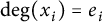 $\deg (x_i^{}) = e_i^{}$
and
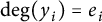 $\deg (y_i^{}) = e_i^{}$
. Let
 $X \subset \mathbb {V}$
be a zero-dimensional subscheme. We recall from Section 4 that
 $s_i^{}$
denotes the length of the projection
 $Z_i^{}$
of X onto the i
th component of
 $\mathbb {V}$
. Our first goal is to give a different proof for the fact that the domain
 $[0, s_1^{} - 1] \times \dots \times [0, s_q^{} - 1]$
is relevant to
 $\operatorname {\mathcal {H}}_X^{}$
. Our second goal is to give a procedure for detecting quasi-rectangular domains that are relevant to
 $\operatorname {\mathcal {H}}_X^{}$
. All results of this section are applications of Theorem 6.5 and Proposition 8.4.
Lemma 9.1 We adopt the above notation. We consider the lexicographic monomial ordering on
 $\mathbb {S}$
such that
 $x_1^{}> y_1^{} > \dots > x_q^{} > y_q^{}$
. We assume that
 $y_1^{}$
does not vanish at any point of
 $\operatorname {red}(X)$
. We assert that
 $x_1^{s_1}$
is a minimal generator of
 $\operatorname {lead}(I(X))$
(see Notation 6.4). We further assert that every other minimal generator of
 $\operatorname {lead}(I(X))$
has the form
 $x_1^{\alpha _1} x_2^{\alpha _2} y_2^{\beta _2} \cdots x_q^{\alpha _q} y_q^{\beta _q}$
with
 $0 \le \alpha _1^{} \le s_1^{} - 1$
.
Proof We set
 $J = \operatorname {lead}(I(X))$
. We claim that
 $y_1^{}$
does not divide any minimal generator of J. To prove this claim, we argue by contradiction. Assume that there exists a minimal generator g of J of the form
 $g = x_1^{\alpha _1} y_1^{\beta _1} \cdots x_q^{\alpha _q} y_q^{\beta _q}$
with
 $\beta _1^{}> 0$
. Write
 $g = \operatorname {lead}(f)$
for some
 $\mathbb {Z}^q$
-homogeneous polynomial
 $f \in I(X)$
. For any other monomial
 $\zeta = x_1^{\gamma _1} y_1^{\delta _1} \cdots x_q^{\gamma _q} y_q^{\delta _q}$
occurring in
 $f,$
we have the inequality
 $\alpha _1^{} \ge \gamma _1^{}$
because
 $g> \zeta $
and we have the equation
 $\alpha _1^{} + \beta _1^{} = \gamma _1^{} + \delta _1^{}$
because
 $\deg (g) = \deg (\zeta )$
. It follows that
 $\beta _1^{} \le \delta _1^{}$
. Since
 $\zeta $
was chosen arbitrarily, it follows that f is divisible by
 $y_1^{\beta _1}$
. Since
 $y_1^{}$
does not vanish at any point of
 $\operatorname {red}(X)$
, it follows that
 $f / y_1^{\beta _1}$
lies in
 $I(X)$
. Thus,
 $g / y_1^{\beta _1} = \operatorname {lead}(f / y_1^{\beta _1})$
belongs to J. This contradicts the fact that g is a minimal generator of J and concludes the proof of the claim. The ideal
 $J_1^{} = J \cap \mathbb {K}[x_1^{}, y_1^{}]$
is a
 $\mathbb {Z}$
-homogeneous ideal of the
 $\mathbb {Z}$
-graded ring
 $\mathbb {S}_1^{} = \mathbb {K}[x_1^{}, y_1^{}]$
. According to Theorem 6.5,
 $\operatorname {\mathcal {H}}_{\mathbb {S} / J}^{} = \operatorname {\mathcal {H}}_X^{}$
hence,
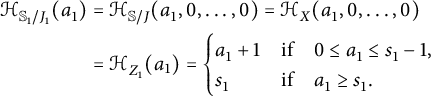 $$ \begin{align*} \operatorname{\mathcal{H}}_{\mathbb{S}_1 / J_1}^{}(a_1^{}) & = \operatorname{\mathcal{H}}_{\mathbb{S} / J}^{}(a_1^{}, 0, \dots, 0) = \operatorname{\mathcal{H}}_X^{}(a_1^{}, 0, \dots, 0) \\ & = \operatorname{\mathcal{H}}_{Z_1}^{}(a_1) = \begin{cases} a_1^{} + 1 & \text{if} \quad 0 \le a_1^{} \le s_1^{} - 1, \\ s_1^{} & \text{if} \quad a_1^{} \ge s_1^{}. \end{cases} \end{align*} $$
It follows that
 $J_1^{}$
is generated by a single monomial of degree
 $s_1^{}$
, which, according to the above claim, is not divisible by
 $y_1^{}$
. We deduce that
 $J_1^{}$
is generated by
 $x_1^{s_1}$
. This monomial must be a minimal generator of J. Every other minimal generator of J is not divisible by
 $y_1^{}$
or by
 $x_1^{s_1}$
, so it has the form given in the lemma.
As an application of our methods, we obtain a third proof for a particular case of Theorem 4.4. We formulate this as a separate proposition.
Proposition 9.2 Assume that
 $\mathbb {K}$
is infinite. Let
 $X \subset (\mathbb {P}^1)^q$
be a zero-dimensional subscheme. For each
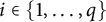 $i \in \{ 1, \dots , q \}$
, let
 $s_i^{}$
be the length of the projection of X onto the i
th copy of
 $\mathbb {P}^1$
. Then,
 $R(X) = [0, s_1^{} - 1] \times \dots \times [0, s_q^{} - 1]$
is the smallest rectangular relevant domain for
 $\operatorname {\mathcal {H}}_X^{}$
.
Proof We must show that
 $\operatorname {\Delta } \operatorname {\mathcal {H}}_X^{}$
vanishes on the complement of
 $R(X)$
, i.e., we must show that
 $\operatorname {\Delta } \operatorname {\mathcal {H}}_X^{}(a) = 0$
if
 $a_i^{} \ge s_i^{}$
for some index
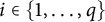 $i \in \{ 1, \dots , q \}$
. By symmetry, it is enough to consider only the case when
 $i = 1$
. Performing, if necessary, a linear change of coordinates on the first copy of
 $\mathbb {P}^1$
, we may assume that
 $y_1^{}$
does not vanish at any point of
 $\operatorname {red}(X)$
. We choose a monomial ordering on
 $\mathbb {S}$
as in Lemma 9.1 and we consider the ideal
 $J = \operatorname {lead}(I(X))$
(see Notation 6.4). According to Theorem 6.5,
 $\operatorname {\mathcal {H}}_X^{} = \operatorname {\mathcal {H}}_{\mathbb {S} / J}^{}$
, so the theorem reduces to showing that
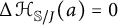 $\operatorname {\Delta } \operatorname {\mathcal {H}}_{\mathbb {S} / J}^{}(a) = 0$
if
 $a_1^{} \ge s_1^{}$
and
 $a \ge 0$
. This will follow from Proposition 8.4.
We now verify the hypotheses of Proposition 8.4. Consider the set
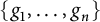 $\{ g_1^{}, \dots , g_n^{} \}$
of minimal generators of J whose degree is less or equal to a. According to Lemma 9.1,
 $x_1^{s_1}$
is a minimal generator of J. By hypothesis
 $\deg (x_1^{s_1}) = (s_1^{}, 0, \dots , 0) \le a$
, so we may take
 $g_1^{} = x_1^{s_1}$
. Applying again Lemma 9.1, we see that for each index
 $l \in \{ 2, \dots , n \},$
we may write
 $g_l^{} = x_1^{\alpha _1} x_2^{\alpha _2} y_2^{\beta _2} \cdots x_q^{\alpha _q} y_q^{\beta _q}$
with
 $0 \le \alpha _1^{} \le s_1^{} - 1$
. Thus,
 $\operatorname {lcm}(g_1^{}, g_l^{}) = x_1^{s_1} x_2^{\alpha _2} y_2^{\beta _2} \cdots x_q^{\alpha _q} y_q^{\beta _q}$
. We have
 $\deg (\operatorname {lcm}(g_1^{}, g_l^{})) \le a$
because
 $s_1^{} \le a_1^{}$
and
 $\alpha _j^{} + \beta _j^{} \le a_j^{}$
for all indices
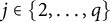 $j \in \{ 2, \dots , q \}$
, by virtue of the fact that
 $\deg (g_l^{}) \le a$
. The hypotheses of Proposition 8.4 are thus satisfied and we conclude that
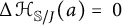 $\operatorname {\Delta } \operatorname {\mathcal {H}}_{\mathbb {S} / J}^{}(a) =~0$
.
Remark 9.3 Let
 $I \subset \mathbb {S}$
be a
 $\mathbb {Z}^q$
-homogeneous ideal. Let F and G be two finite sets of generators of I consisting of
 $\mathbb {Z}^q$
-homogeneous non-zero polynomials. We assume that F is minimal, i.e., no proper subset of F can generate I. We assert that for every
 $f \in F,$
there is
 $g \in G$
such that
 $\deg (f) = \deg (g)$
. Indeed, write
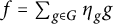 $f = \sum _{g \in G} \eta _g^{} g$
. For each
 $g \in G,$
write
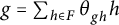 $g = \sum _{h \in F} \theta _{gh}^{} h$
. We may assume that all
 $\eta _g^{}$
and
 $\theta _{gh}^{}$
are
 $\mathbb {Z}^q$
-homogeneous. We claim that there is
 $g \in G$
such that
 $\eta _g^{} \neq 0$
and
 $\theta _{gf}^{} \neq 0$
. If this were not the case, then f would be a combination of elements in
 $F \setminus \{ f \}$
, which would contradict the minimality of F. We have the relations
 $\deg (f) = \deg (\eta _g^{}) + \deg (g)$
and
 $\deg (g) = \deg (\theta _{gf}) + \deg (f)$
, hence,
 $\deg (f) \ge \deg (g) \ge \deg (f)$
.
Lemma 9.4 Let
 $X \subset (\mathbb {P}^1)^q$
be a zero-dimensional subscheme. We assume that
 $I(X)$
is a monomial ideal. We assert that the set of minimal generators of
 $I(X)$
is of the form
 $\{ f_1^{}, \dots , f_q^{}, g_1^{}, \dots , g_n^{} \}$
, where
 $n \ge 0$
,
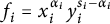 $f_i^{} = x_i^{\alpha _i} y_i^{s_i - \alpha _i}$
for all indices
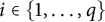 $i \in \{ 1, \dots , q \}$
, and
 $\deg (g_l^{}) \le (s_1^{} - 1, \dots , s_q^{} - 1)$
for all indices
 $l \in \{ 1, \dots , n \}$
.
Proof We let
 $f_i^{}$
be the sole generator of
 $I(X) \cap \mathbb {K}[x_i^{}, y_i^{}]$
and we let
 $g_1^{}, \dots , g_n^{}$
be the minimal generators of
 $I(X)$
that do not lie in any
 $\mathbb {K}[x_i^{}, y_i^{}]$
. We concentrate on proving the inequalities
 $\deg (g_l^{}) \le (s_1^{} - 1, \dots , s_q^{} - 1)$
, the rest of the lemma being obvious. Since
 $\mathbb {K}$
is infinite, we can find
 $\kappa _1^{} \in \mathbb {K} \setminus \{ 0 \}$
such that
 $z_1^{} = \kappa _1^{} x_1^{} + y_1^{}$
does not vanish at any point of
 $\operatorname {red}(X)$
. Regarding
 $\mathbb {S}$
as a polynomial ring in
 $x_1^{}$
,
 $z_1^{}$
,
 $x_2^{}$
,
 $y_2^{}, \dots , x_q^{}$
,
 $y_q^{}$
, we consider the lexicographic ordering on
 $\mathbb {S}$
such that
 $x_1^{}> z_1^{} > x_2^{} > y_2^{} > \dots > x_q^{} > y_q^{}$
. Put
 $J = \operatorname {lead}(I(X))$
, as in Notation 6.4. According to Lemma 9.1,
 $x_1^{s_1} = \operatorname {lead}(f_1^{})$
is a minimal generator of J and every other minimal generator h of J satisfies the condition
 $\deg (h)_1^{} \le s_1^{} - 1$
. Let G be a Gröbner basis of
 $I(X)$
containing
 $f_1^{}$
and consisting of
 $\mathbb {Z}^q$
-homogeneous polynomials, such that
 $\operatorname {lead}(G)$
is the set of minimal generators of J. For every
 $g \in G \setminus \{ f_1^{} \},$
we have the relations
 $\deg (g)_1^{} = \deg (\operatorname {lead}(g))_1^{} \le s_1^{} - 1$
. We apply Remark 9.3 to the set F of minimal generators of
 $I(X)$
and to G. For each
 $g_l^{}$
, there is
 $g \in G$
such that
 $\deg (g_l^{}) = \deg (g)$
. Since
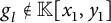 $g_l^{} \notin \mathbb {K}[x_1^{}, y_1^{}]$
, it follows that
 $g \neq f_1^{}$
, hence,
 $\deg (g_l^{})_1^{} = \deg (g)_1^{} \le s_1^{} - 1$
.
In the same manner, for all indices
 $l \in \{ 1, \dots , n \}$
and
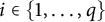 $i \in \{1, \dots , q \}$
, by replacing the variable
 $y_i^{}$
with a suitable variable
 $z_i^{} = \kappa _i^{} x_i^{} + y_i^{}$
, chosen so as not to vanish at any point of
 $\operatorname {red}(X)$
, we can prove the inequality
 $\deg (g_l^{})_i^{} \le s_i^{} - 1$
.
Let X be as above. Recall, from Proposition 4.5(v), the rectangular relevant domain
 $$\begin{align*}R(X) = [0, s_1^{} - 1] \times \dots \times [0, s_q^{} - 1] = [0, \operatorname{rem}(X)] \subset \mathbb{Z}^q. \end{align*}$$
If
 $n = 1$
, we put
 $R_1^{} = [\deg (g_1^{}), \operatorname {rem}(X)]$
. If
 $n> 1$
, for each index
 $l \in \{1, \dots , n \}$
, we put
 $$\begin{align*}R_l^{} = \bigcap_{k \in \{ 1, \dots, n \} \setminus \{ l \}} [\deg(\operatorname{lcm}(g_k^{}, g_l^{})), \, \operatorname{rem}(X)]. \end{align*}$$
Proposition 9.5 Assume that
 $\mathbb {K}$
is infinite. Let
 $X \subset (\mathbb {P}^1)^q$
be a zero-dimensional subscheme. Assume that
 $I(X)$
is a monomial ideal and that X is not a complete intersection. Then, the quasi-rectangular domain
 $$\begin{align*}D(X) = R(X) \setminus \bigcup_{1 \le l \le n} R_l^{} \subset \mathbb{Z}^q \end{align*}$$
is a relevant domain for
 $\operatorname {\mathcal {H}}_X^{}$
. If
 $I(X)$
has
 $q + 1$
minimal generators, then
 $D(X) \neq R(X)$
.
Proof We adopt the notation of Lemma 9.4. We have the inequality
 $n \ge 1$
because X is not a complete intersection. We must show that
 $\operatorname {\Delta } \operatorname {\mathcal {H}}_X^{}(a) = 0$
for all
 $a \in \mathbb {Z}^q \setminus D(X)$
. We already know from Theorem 4.4 that
 $R(X)$
is a relevant domain for
 $\operatorname {\mathcal {H}}_X{}$
, hence, we may assume that
 $a \in R(X)$
, that is,
 $a \in R_l^{}$
for some index
 $l \in \{ 1, \dots , n \}$
. Relabeling
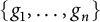 $\{ g_1^{}, \dots , g_n^{} \}$
, if necessary, we may take
 $l = 1$
. We desire to apply Proposition 8.4 to
 $J = I(X)$
. We now verify the hypotheses of Proposition 8.4. By the construction of
 $R_1^{}$
,
 $a \ge \deg (\operatorname {lcm}(g_1^{}, g_k^{})) \ge \deg (g_k^{})$
for all indices
 $k \in \{ 2, \dots , n \}$
and
 $a \ge \deg (g_1^{})$
. Since a belongs to
 $R(X)$
,
 $a \ngeq \deg (f_i^{})$
for all indices
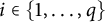 $i \in \{ 1, \dots , q \}$
. From Lemma 9.4, we deduce that
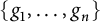 $\{ g_1^{}, \dots , g_n^{} \}$
is the set of minimal generators of
 $I(X)$
whose degree is less or equal to a. The inequality from Proposition 8.4 is satisfied by the definition of
 $R_1^{}$
. Thus, the hypotheses of Proposition 8.4 are satisfied and we conclude that
 $\operatorname {\Delta } \operatorname {\mathcal {H}}_X^{}(a) =~0$
.
If
 $I(X)$
has
 $q + 1$
minimal generators, that is, if
 $n = 1$
, then, in view of Lemma 9.4,
 $R_1^{} \neq \emptyset $
, forcing
 $D(X)$
to be strictly contained in
 $R(X)$
.
If
 $n> 1$
, then each
 $R_l^{}$
may be empty, i.e.,
 $D(X)$
may coincide with
 $R(X)$
. We finish this section with two examples in which
 $n> 1$
, X is non-ACM and
 $D(X) \neq R(X)$
.
Example 9.6 Take
 $X \subset \mathbb {P}^1(\mathbb {C}) \times \mathbb {P}^1(\mathbb {C})$
to be the union of two multiple points with ideals
 $(x_1^{\alpha _1}, x_1^{} x_2^{}, x_2^{\alpha _2})$
, respectively,
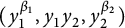 $(y_1^{\beta _1}, y_1^{} y_2^{}, y_2^{\beta _2})$
. Here,
 $\alpha _1^{}, \alpha _2^{}, \beta _1^{}, \beta _2^{} \ge 2$
. We have
 $$\begin{align*}I(X) = (x_1^{\alpha_1} y_1^{\beta_1}, \, x_2^{\alpha_2} y_2^{\beta_2}, \, g_1^{}, \dots, g_7^{}), \end{align*}$$
where
 $$ \begin{align*} g_1^{} & = x_1^{\alpha_1} y_1^{} y_2^{}, & g_2^{} & = x_1^{\alpha_1} y_2^{\beta_2}, & g_3^{} & = x_1^{} y_1^{\beta_1} x_2^{}, & g_4^{} & = x_1^{} y_1^{} x_2^{} y_2^{}, \\ g_5^{} & = x_1^{} x_2^{} y_2^{\beta_2}, & g_6^{} & = y_1^{\beta_1} x_2^{\alpha_2}, & g_7^{} & = y_1^{} x_2^{\alpha_2} y_2^{}. \end{align*} $$
We have the equations
 $s_1^{} = \alpha _1^{} + \beta _1^{}$
and
 $s_2^{} = \alpha _2^{} + \beta _2^{}$
. We have the equations
 $$ \begin{align*} \operatorname{lcm}(g_1^{}, g_3^{}) & = x_1^{\alpha_1} y_1^{\beta_1} x_2^{} y_2^{}, & \deg(\operatorname{lcm}(g_1^{}, g_3^{})) & = (\alpha_1^{} + \beta_1^{}, 2), \\ \operatorname{lcm}(g_2^{}, g_6^{}) & = x_1^{\alpha_1} y_1^{\beta_1} x_2^{\alpha_2} y_2^{\beta_2}, & \deg(\operatorname{lcm}(g_2^{}, g_6^{})) & = (\alpha_1^{} + \beta_1^{}, \alpha_2^{} + \beta_2^{}), \\ \operatorname{lcm}(g_5^{}, g_7^{}) & = x_1^{} y_1^{} x_2^{\alpha_2} y_2^{\beta_2}, & \deg(\operatorname{lcm}(g_5^{}, g_7^{})) & = (2, \alpha_2^{} + \beta_2^{}). \end{align*} $$
None of the expressions on the r.h.s. is less or equal to
 $(s_1^{} - 1, s_2^{} - 1)$
. We deduce that
 $R_1^{}$
,
 $R_3^{}$
,
 $R_2^{}$
,
 $R_6^{}$
,
 $R_5^{}$
, and
 $R_7^{}$
are empty. We have the equations
 $$ \begin{align*} \operatorname{lcm}(g_4^{}, g_1^{}) & = x_1^{\alpha_1} y_1^{} x_2^{} y_2^{}, & \operatorname{lcm}(g_4^{}, g_2^{}) & = x_1^{\alpha_1} y_1^{} x_2^{} y_2^{\beta_2}, & \operatorname{lcm}(g_4^{}, g_3^{}) & = x_1^{} y_1^{\beta_1} x_2^{} y_2^{}, \\ \operatorname{lcm}(g_4^{}, g_5^{}) & = x_1^{} y_1^{} x_2^{} y_2^{\beta_2}, & \operatorname{lcm}(g_4^{}, g_6^{}) & = x_1^{} y_1^{\beta_1} x_2^{\alpha_2} y_2^{}, & \operatorname{lcm}(g_4^{}, g_7^{}) & = x_1^{} y_1^{} x_2^{\alpha_2} y_2^{}. \end{align*} $$
From these, we obtain the relations
 $$ \begin{align*} \max_{k = 1, 2, 3, 5, 6, 7} \deg(\operatorname{lcm}(g_4^{}, g_k^{}))_1^{} & = 1 + \max \{ \alpha_1^{}, \beta_1^{} \} \le s_1^{} - 1, \\ \max_{k = 1, 2, 3, 5, 6, 7} \deg(\operatorname{lcm}(g_4^{}, g_k^{}))_2^{} & = 1 + \max \{ \alpha_2^{}, \beta_2^{} \} \le s_2^{} - 1. \end{align*} $$
We deduce that
 $R_4^{}$
is not empty. In fact,
 $$\begin{align*}R_4^{} = [1 + \max \{ \alpha_1^{}, \beta_1^{} \}, \, \alpha_1^{} + \beta_1^{} - 1] \times [1 + \max \{ \alpha_2^{}, \beta_2^{} \}, \, \alpha_2^{} + \beta_2^{} - 1]. \end{align*}$$
We conclude that
 $$\begin{align*}D(X) = [0, \, \alpha_1^{} + \beta_1^{} - 1] \times [0, \, \alpha_2^{} + \beta_2^{} - 1] \setminus R_4^{}. \end{align*}$$
If X were ACM, then, in view of Theorem 6.2(iii), the degrees of
 $g_1^{}, \dots , g_7^{}$
would be incomparable. However,
 $\deg (g_4^{}) = (2, 2) \le \deg (g_2^{}) = (\alpha _1^{}, \beta _2^{})$
. Thus, X is not ACM.
Example 9.7 Take
 $X \subset \mathbb {P}^1(\mathbb {C}) \times \mathbb {P}^1(\mathbb {C})$
to be the union of three multiple points with ideals
 $(x_1^{\alpha _1}, x_2^{\alpha _2})$
,
 $(x_1^\alpha , y_2^\beta )$
, respectively,
 $(y_1^{\beta _1}, y_2^{\beta _2})$
. We assume that
 $\alpha _1^{} < \alpha $
and
 $\beta < \beta _2^{}$
. We have
 $$\begin{align*}I(X) = (x_1^\alpha y_1^{\beta_1}, \, x_2^{\alpha_2} y_2^{\beta_2}, \, g_1^{}, \, g_2^{}, \, g_3^{}), \end{align*}$$
where
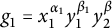 $g_1^{} = x_1^{\alpha _1} y_1^{\beta _1} y_2^\beta $
,
 $g_2^{} = x_1^{\alpha _1} y_2^{\beta _2}$
and
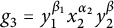 $g_3^{} = y_1^{\beta _1} x_2^{\alpha _2} y_2^\beta $
. We note that
 $s_1^{} = \alpha + \beta _1^{}$
and
 $s_2^{} = \alpha _2^{} + \beta _2^{}$
. We have the relations
 $$ \begin{align*} \operatorname{lcm}(g_1^{}, g_2^{}) & = x_1^{\alpha_1} y_1^{\beta_1} y_2^{\beta_2}, & \deg(\operatorname{lcm}(g_1^{}, g_2^{})) & = (\alpha_1^{} + \beta_1^{}, \beta_2^{}) \le (s_1^{} - 1, s_2^{} - 1), \\ \operatorname{lcm}(g_1^{}, g_3^{}) & = x_1^{\alpha_1} y_1^{\beta_1} x_2^{\alpha_2} y_2^\beta, & \deg(\operatorname{lcm}(g_1^{}, g_3^{})) & = (\alpha_1^{} + \beta_1^{}, \alpha_2^{} + \beta) \le (s_1^{} - 1, s_2^{} - 1), \\ \operatorname{lcm}(g_2^{}, g_3^{}) & = x_1^{\alpha_1} y_1^{\beta_1} x_2^{\alpha_2} y_2^{\beta_2}, & \deg(\operatorname{lcm}(g_2^{}, g_3^{})) & = (\alpha_1^{} + \beta_1^{}, \alpha_2^{} + \beta_2^{}) \nleq (s_1^{} - 1, s_2^{} - 1). \end{align*} $$
We deduce that
 $R_2^{}$
and
 $R_3^{}$
are empty and that
 $$\begin{align*}R_1^{} = [\alpha_1^{} + \beta_1^{}, \, \alpha + \beta_1^{} - 1] \times [\max \{ \beta_2^{}, \alpha_2^{} + \beta \}, \, \alpha_2^{} + \beta_2^{} - 1]. \end{align*}$$
We conclude that
 $$\begin{align*}D(X) = [0, \, \alpha + \beta_1^{} - 1] \times [0, \, \alpha_2^{} + \beta_2^{} - 1] \setminus R_1^{}. \end{align*}$$
Assume that X were ACM. Then, as mentioned at Theorem 6.2(iii), there would exist homogeneous forms
 $\xi _1^{}$
,
 $\xi _2^{}$
,
 $\xi _3^{}$
,
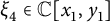 $\xi _4^{} \in \mathbb {C}[x_1^{}, y_1^{}]$
and
 $\upsilon _1^{}$
,
 $\upsilon _2^{}$
,
 $\upsilon _3^{}$
,
 $\upsilon _4^{} \in \mathbb {C}[x_2^{}, y_2^{}]$
such that
 $$\begin{align*}I(X) = (\xi_1^{} \xi_2^{} \xi_3^{} \xi_4^{}, \ \upsilon_1^{} \xi_2^{} \xi_3^{} \xi_4^{}, \ \upsilon_1^{} \upsilon_2^{} \xi_3^{} \xi_4^{}, \ \upsilon_1^{} \upsilon_2^{} \upsilon_3^{} \xi_4^{}, \ \upsilon_1^{} \upsilon_2^{} \upsilon_3^{} \upsilon_4^{}). \end{align*}$$
We choose
 $\kappa $
and
 $\lambda $
in
 $\mathbb {C}^*$
such that
 $\upsilon _i^{}(\kappa , \lambda ) \neq 0$
for
 $i = 1, 2, 3, 4$
. We reduce the above equality of ideals modulo
 $(x_2^{} - \kappa , \ y_2^{} - \lambda )$
. It follows that
 $\mathbb {C}[x_1^{}, y_1^{}]$
is generated by the polynomials
 $\xi _1^{} \xi _2^{} \xi _3^{} \xi _4^{}$
,
 $\xi _2^{} \xi _3^{} \xi _4^{}$
,
 $\xi _3^{} \xi _4^{}$
, and
 $\xi _4^{}$
. This is absurd. Thus, X is not ACM.



