Childhood adversity encompasses “experiences that are likely to require significant adaptation by an average child and that represent a deviation from the expectable environment” (McLaughlin, Reference McLaughlin2016, p. 363). Empirical evidence supports the dimensional model of adversity and psychopathology (DMAP; Sheridan & McLaughlin, Reference Sheridan and McLaughlin2016; for a review, see McLaughlin et al., Reference McLaughlin, Colich, Rodman and Weissman2020), which differentiates between two forms of childhood adversity: life-threatening events (e.g., violence exposure) and deprivation (e.g., institutionalization and neglect). Whereas DMAP’s dimension of deprivation focuses almost exclusively within the early childhood caregiver context, a plethora of other ongoing, nonviolent risk factors within the familial, community, and school environments negatively impact children and adolescents (e.g., Evans & De France, Reference Evans and De France2021; Thompson et al., Reference Thompson, Coleman, O’Connor, Farrell and Sullivan2020). We assert that nonviolent risk factors often associated with economic disadvantage, such as suboptimal psychosocial and physical conditions, are a form of deprivation and can be conceptualized as an extension of the original work on the early childhood-caregiver dimension of deprivation. This form of deprivation may be particularly salient among racial- and ethnic-minority groups, given their increased exposure to institutional inequities, racial bias, and structural racism (Carter, Reference Carter2007; Jones et al., Reference Jones, Dovidio and Vietze2013).
According to the cultural ecological model (Garcia Coll et al., Reference Garcia Coll, Lamberty, Jenkins, McAdoo, Crnic, Wasik and Vasquez Garcia1996), it is vital that researchers consider the unique roles of social stratification and other community factors that have a significant impact on low-income, minority youth. Using samples of predominately African American adolescents, multiple qualitative studies have identified specific nonviolent, negative life events that are associated with living in under-resourced communities, including crowding, noise, suboptimal sleeping environments, perceived poor teacher quality, fluidity and instability of family and community residents, witnessing of illegal activities, and lack of community services (Allison et al., Reference Allison, Burton, Marshall, Perez-Febles, Yarrington, Krish and Merriwether-DeVries1999; Evans, Reference Evans2004; Farrell et al., Reference Farrell, Ampy and Meyer1998; Farrell et al., Reference Farrell, Erwin, Allison, Meyer, Sullivan, Camou, Kliewer and Esposito2007). The cultural ecological model has also been supported by quantitative studies that have indicated that these types of nonviolent, negative life events are associated with post-traumatic stress (PTS) and externalizing symptoms among predominantly African American samples of adolescents (Liu et al., Reference Liu, Bolland, Dick, Mustanski and Kertes2016; Thompson et al., Reference Thompson, Coleman, O’Connor, Farrell and Sullivan2020).
Experiencing nonviolent, negative life events throughout childhood and adolescence may be more salient risk factors for developing psychopathology than exposure to violence. In a prior study based on data used in the current study, we found that violence exposure accounted for little to no variance in PTS, after controlling for nonviolent, negative life events (Author Reference). This is consistent with the theory of stress sensitization (Harkness et al., Reference Harkness, Bruce and Lumley2006; Weissman, Lambert et al., Reference Weissman, Lambert, Rodman, Peverill, Sheridan and McLaughlin2020), which posits that early adversity sensitizes individuals to later stress, increasing their risk for later psychopathology after experiencing events that are often deemed minor or less severe stressors. We also found that a higher frequency of nonviolent, negative life events was associated with adolescents’ reports of externalizing symptoms, even after controlling for violence exposure. Although these findings underscore the importance of using a contextualized approach that examines the separate and combined effects of violence exposure and nonviolent, negative life events, we did not address the possibility of co-occurring symptoms, such as PTS and externalizing symptoms or broader set of externalizing symptoms (e.g., aggression and substance use).
A critical issue concerns associations between violent and nonviolent negative life events and various patterns of symptomatology. Studies by transdiagnostic researchers have found that associations between certain risk factors (e.g., family substance use and family conflict) and specific domains of internalizing and externalizing symptoms are attenuated, and at times, no longer significant after accounting for shared variance across internalizing and externalizing domains (Brislin et al., Reference Brislin, Martz, Joshi, Duval, Gard, Clark and Sripada2020). This suggests that previously held notions about the associations between adversity and symptomatology may be challenged when researchers differentiate between youth who report domain-specific versus co-occurring symptoms across domains. The current study addressed this issue by examining how violent and nonviolent negative life events are similarly and differentially associated with distinct patterns of psychopathology. Further examination of these associations may inform intervention efforts targeting youth living in under-resourced communities who present with varying symptomatology after exposure to a range of adverse events.
Examining patterns of PTS and externalizing symptoms
The majority of the transdiagnostic work aiming to account for associations among a range of internalizing and externalizing symptom domains have used variable-centered approaches, such as higher order and bifactor analyses (i.e., the “p” factor; for a review, see Smith et al., Reference Smith, Atkinson, Davis, Riley and Oltmanns2020). However, they assume that a population is homogeneous with respect to interrelations among the variables within a factor. In other words, they do not consider the extent to which there may be widely different patterns across individuals that account for those relations (e.g., high substance use and high PTS versus high aggression and high PTS). Moreover, findings have been mixed on whether PTS symptoms fit within a general latent factor framework (Weissman et al., Reference Weissman, Bitran, Miller, Schaefer, Sheridan and McLaughlin2019; Weissman, Nook et al., Reference Weissman, Nook, Dews, Miller, Lambert, Sasse, Somerville and McLaughlin2020).
Finite mixture modeling approaches have become an increasingly popular method for identifying subgroups of youth with distinct symptom profiles (Collins & Lanza, Reference Collins and Lanza2010). Finite mixture modeling techniques identify subgroups with internal homogeneity and external heterogeneity (Nylund-Gibson & Hart, Reference Nylund-Gibson, Hart, Sloboda and Petras2014). That is, they identify groups of individuals who have similar profiles but are distinct from other groups in substantively qualitative ways. The identification of symptom profiles may be particularly useful for designing specially tailored interventions that maximize treatment response (Lanza & Rhoades, 2011; Nylund-Gibson & Hart, Reference Nylund-Gibson, Hart, Sloboda and Petras2014).
Prior examinations of symptom profiles among youth exposed to childhood adversity have been limited in several ways. Most importantly, they often focus on patterns of (a) PTS symptoms without considering co-occurring externalizing symptoms (Ayer et al., Reference Ayer, Cisler, Danielson, Amstadter, Saunders and Kilpatrick2011; Guffanti et al., Reference Guffanti, Geronazzo-Alman, Fan, Duarte, Musa and Hoven2016) or (b) co-occurring internalizing and externalizing symptoms without examining PTS (Renner et al., Reference Renner, Boel-Studt and Whitney2018; Yates & Grey, Reference Yates and Grey2012). This is a critical gap in the literature, given the link between PTS and aggression (Thompson & Farrell, Reference Thompson and Farrell2019; Wolfe et al., Reference Wolfe, Wekerle, Scott, Straatman and Grasley2004), delinquency (Ford, Reference Ford2002), and substance use (Allwood et al., Reference Allwood, Esposito-Smythers, Swenson and Spirito2014), which were established using variable-centered approaches.
We are aware of only two studies that examined subgroupings of adolescent psychopathology that included both PTS and externalizing symptoms (Crum et al., Reference Crum, Cornacchio, Coxe, Green and Comer2018; Martinez-Torteya et al., Reference Martinez-Torteya, Miller-Graff, Howell and Figge2017). Although their samples were quite different demographically, both studies found support for at least one subgroup of individuals with co-occurring PTS and externalizing symptoms. This suggests robustness in findings across different sample characteristics. However, they both used total scores for externalizing symptoms, and thus, did not examine patterns across various symptoms (e.g., frequencies in aggression versus delinquency versus substance use). Martinez-Torteya and colleagues also included neighborhood quality (e.g., adults set good examples for children in this neighborhood) as one of the domains of functioning rather than as a predictor of these patterns, which could have obscured the unique patterns of psychopathology.
The extent to which youth present with distinct patterns of PTS, aggression, delinquency, and substance use remains unclear. Numerous blueprints have been developed to provide child-serving systems with key considerations for providing “trauma-informed care,” a term used to describe practices that take the effects of childhood adversity into account (e.g., Clements et al., Reference Clements, Haas, Cyphers, Hoots and Barnet2020; Overstreet & Chafouleas, Reference Overstreet and Chafouleas2016). However, until researchers gain a more nuanced understanding of adolescents’ distinct patterns of co-occurring PTS and externalizing symptoms, prevention and intervention efforts will not effectively target the range of symptomatology associated with childhood adversity. Therefore, a better understanding of co-occurring PTS and externalizing symptoms is needed for screening, assessment, and treatment of trauma-related symptomatology.
Sex differences
There is mixed evidence to support examining sex difference in the relations between childhood adversity and psychopathology among adolescents. Within a prior study based on data used in the current study, male early adolescents reported higher frequencies of violence exposure, whereas female early adolescents reported higher frequencies of nonviolent, negative life events (Author reference). Compared with males, female adolescents are at higher risk for developing PTS after exposure to either interpersonal or noninterpersonal life-threatening events (for a meta-analysis, see Alisic et al., Reference Alisic, Zalta, van Wesel, Larsen, Hafstad, Hassanpour and Smid2014). Although male adolescents are more likely to engage in in externalizing behaviors (for a review, see Card et al., Reference Card, Stucky, Sawalani and Little2008), fewer sex differences have been found among African American adolescents (Bradshaw et al., Reference Bradshaw, Schaeffer, Petras and Ialongo2010; Farrell et al., Reference Farrell, Goncy, Sullivan and Thompson2018). Much less is known about whether frequencies of co-occurring PTS and externalizing symptoms differ across sex, although there is some support to suggest that there is a link between PTS and aggression among both male and female adolescents (Allwood & Bell, Reference Allwood and Bell2008; Thompson & Farrell, Reference Thompson and Farrell2019). Furthermore, very little research has examined sex as a moderator between childhood adversity and psychopathology (Fowler et al., Reference Fowler, Tompsett, Braciszewski, Jacques-Tiura and Baltes2009). One prior study did not find any sex differences in the associations between childhood adversity and separate constructs of PTS, aggression, delinquency, and substance use (Author reference). However, it remains unknown whether sex differences exist among these relations after accounting for comorbidities across the six outcomes.
Current study
Establishing whether experiencing violent and other nonviolent, negative life events are similarly or differentially associated with co-occurring symptoms has important implications for understanding the etiology of psychopathology among early adolescents living within under-resourced, historically excluded communities. The current study builds upon prior work in several ways. Rather than use a variable-centered approach that masks heterogeneity in symptom patterns, we used finite mixture modeling to identify unique patterns of PTS, aggression, delinquency, and substance use. Second, we expanded the definition of childhood adversity outlined in DMAP (Sheridan & McLaughlin, Reference Sheridan and McLaughlin2016) to include a broader array of non-caregiver experiences identified as stressful among predominantly low-income, African American samples of adolescents (Allison et al., Reference Allison, Burton, Marshall, Perez-Febles, Yarrington, Krish and Merriwether-DeVries1999; Farrell et al., Reference Farrell, Ampy and Meyer1998; Farrell et al., Reference Farrell, Erwin, Allison, Meyer, Sullivan, Camou, Kliewer and Esposito2007). Because previous studies have indicated that violent victimization and witnessing violence represent distinct forms of threatening events (Vermeiren et al., Reference Vermeiren, Schwab-Stone, Deboutte, Leckman and Ruchkin2003) that differ in their associations with PTS and externalizing symptoms (Cyr et al., Reference Cyr, Chamberland, Clément, Wemmers, Collin-Vézina, Lessard and Damant2017; Thompson et al., Reference Thompson, Coleman, O’Connor, Farrell and Sullivan2020), we examined them as separate constructs. The current study addressed the following research questions.
Research Question 1a: Are there distinct patterns of re-experiencing symptoms, emotional numbing, hyperarousal, physical aggression, delinquency, and substance use among a predominantly low-income, African American sample of early adolescents living in under-resourced neighborhoods with high rates of violence? Based on prior studies examining co-occurring PTS and externalizing symptoms (Crum et al., Reference Crum, Cornacchio, Coxe, Green and Comer2018; Martinez-Torteya et al., Reference Martinez-Torteya, Miller-Graff, Howell and Figge2017), we hypothesized four subgroups of adolescents with distinct symptom profiles: low symptoms, high PTS, high externalizing symptoms, and co-occurring PTS and externalizing symptoms. We considered frequencies within symptom profiles (e.g., higher aggression versus higher delinquency; higher emotional numbing versus higher hyperarousal) to be exploratory.
Research Question 1b: Does subgroup membership differ as a function of sex? Based on prior literature (Alisic et al., Reference Alisic, Zalta, van Wesel, Larsen, Hafstad, Hassanpour and Smid2014; Card et al., Reference Card, Stucky, Sawalani and Little2008), we hypothesized that female adolescents would be more likely to be represented in a high PTS subgroup and that male adolescents would be more likely to be represented in a high externalizing symptoms subgroup. However, we considered the examination of sex differences within a co-occurring PTS and externalizing symptoms subgroup as exploratory.
Research Question 2a: How are the three forms of childhood adversity (i.e., violent victimization; witnessing violence; and nonviolent, negative life events) associated with subgroup membership? Based on empirical evidence supporting graded-dose responses (Copeland et al., Reference Copeland, Keeler, Angold and Costello2007), we hypothesized that higher frequencies of all three forms of childhood adversity would be associated with higher odds of belonging to a co-occurring PTS and externalizing symptoms subgroup and lower odds of belonging to a low symptoms subgroup compared with other symptom profiles. Based on our prior work (Author Reference) and the stress sensitization theory (Harkness et al., Reference Harkness, Bruce and Lumley2006; Weissman, Lambert et al., Reference Weissman, Lambert, Rodman, Peverill, Sheridan and McLaughlin2020), we hypothesized that a higher frequency of nonviolent, negative life events would be associated with subgroups characterized with high PTS symptoms compared to low symptoms and externalizing symptoms-only subgroups, even after controlling for both forms of violence exposure.
Research Question 2b: Do the associations between the three forms of childhood adversity and subgroup membership differ as a function of sex? We considered this aim to be exploratory, which precluded specific hypotheses regarding the nature of the interaction.
Method
Settings and participants
The current study was conducted through analysis of data from a project that evaluated the Olweus Bullying Prevention Program (OBPP; Olweus & Limber, Reference Olweus and Limber2010) using a multiple baseline design that randomized the order and timing of initiating the intervention at three schools across 8 years from 2010 to 2018 (see Author reference). The OBPP was implemented in one of the schools beginning in the second year, in a second school beginning in the third year, and in the third school beginning in the sixth year. The schools were selected based on their location in neighborhoods with high levels of violence. The majority of students (i.e., 74% to 85%) were eligible for the federal free/reduced lunch program. Student assent and active parent permission were obtained for approximately 80% of all those eligible. The project recruited a random sample of 669 English-speaking students from grades 6 to 8 at each school in Year 1 and recruited random samples of additional participants each year to include a new sample of entering 6th graders and 7th and 8th graders to replace students who left the study.
The current study was based on cross-sectional data from 2,722 students who completed measures at one or more waves during the 8 years of the project. The final sample had a mean age of 12.9 (SD = 1.10). School records identified 51% of the sample as female and 49% as male. Seventeen percent self-identified their ethnicity as Hispanic or Latinx. The majority of participants (i.e., 80%) endorsed African American or Black as the sole category (i.e., 72%) or as one of several categories (8%). Eleven percent did not endorse any of the racial categories; most of these (i.e., 91%) described themselves as Hispanic or Latinx. The remainder of participants described themselves as White (5%), Asian (1%), American Indian or Alaska Native (1%), and Native Hawaiian or Other Pacific Islander (1%). Less than half of the students (41%) lived with a single mother, 26% with both biological parents, 23% with a parent and step-parent, 7% with a relative without a parent, and 3% with their father without a mother or stepmother. Almost three-quarters (70%) completed measures while at a school that was implementing the intervention.
Procedures
Students were given information about the study and informed consent forms to take to their parents. Participants received a $5 gift card for returning the consent form whether or not parents provided consent. Data were collected every 3 months throughout the study, except in the fall of Years 1 and 6 and summer of Year 8. The project used a planned missing data design (Graham et al., Reference Graham, Taylor, Cumsille, Collins and Sayer2001) to reduce participant fatigue and testing effects given the large number of waves of data collection. Each participant was randomly assigned to complete measures at two of the four waves during each year they participated (i.e., two waves per year for up to six waves across three grades). This resulted in data that were missing completely at random, which removed parameter estimate bias (Little & Rhemtulla, Reference Little and Rhemtulla2013). The present study was based on a cross-sectional dataset that included one randomly selected wave from each participant using an algorithm to balance the sample across waves and grades. Participants completed measures using a computer-assisted, self-administered interview in the schools during the school year and individually in their homes during the summer. They received a $10 gift certificate at each wave for completing any part of the survey. The University’s Institutional Review Board reviewed and approved all procedures.
Measures of violent and nonviolent childhood adversity
The frequency of interpersonal violence, including both violent victimization and witnessing violence, was assessed using items from the Survey of Children’s Exposure to Community Violence (SCEV; Richters & Saltzman, Reference Richters and Saltzman1990). The SCEV is one of the most frequently used measures to assess children and adolescents’ exposure to violence, with strong support for its construct validity (see meta-analysis by Fowler et al., Reference Fowler, Tompsett, Braciszewski, Jacques-Tiura and Baltes2009). We assessed the frequency in which a child had been victimized by violence (10 items; e.g., “How many times have you been chased by gangs or older kids”) or witnessed violence (10 items; e.g., “How many times have you seen someone else being attacked or stabbed with a knife?”) in the past three months. Respondents indicated on a 6-point scale from Never to 20 or more times. This version has been used in prior variable-centered studies investigating the relations between violence and adolescent adjustment (Author References). Ratings were averaged across items to create separate witnessing and victimization scores, such that higher scores indicated a greater frequency of witnessing or being a victim of violence. Cronbach’s alpha for the Witnessing Violence and Violent Victimization scales were .86 and .71, respectively. Test-retest reliabilities for the Witnessing Violence and Violent Victimization scales in a prior study were .87 and .72, respectively (Author Reference).
The Urban Adolescents Negative Life Experiences Scale (UANLES) was used to measure how frequently participants experienced a variety of nonviolent, negative life events. Items were drawn from three sources that focused on predominantly African American samples of youth living in urban areas. This included 11 items from the Urban Adolescents Life Experiences Scale (Allison et. al., Reference Allison, Burton, Marshall, Perez-Febles, Yarrington, Krish and Merriwether-DeVries1999) that had the broadest negative impact on development, 8 items from the Interpersonal Problem Solving Inventory for Urban Adolescents (Farrell et al., Reference Farrell, Ampy and Meyer1998), and 7 items from a qualitative study by Farrell and colleagues (Reference Farrell, Erwin, Allison, Meyer, Sullivan, Camou, Kliewer and Esposito2007) that identified problems in the family, peer, school, and neighborhood domains. Respondents rated how often each item had happened to them in the past 3 months. For 20 items (e.g., “Someone in your family or living in your house was drunk or high” and “You didn’t get enough to eat”), frequencies were rated on a 5-point scale ranging from Never to Almost every day. For six less frequent problem situations (e.g., “Lose a job” and “Move – change where you live”), respondents were asked whether the event occurred during the last 3 months using Yes or No response choices. Support for the construct validity of the UANLES was found in two studies of the same data used in the current study (Author References). Cronbach’s alpha was .81 for the current study. Test-retest reliability in a prior study was .81 (Author Reference).
Measures of PTS symptoms
The Checklist of Children’s Distress Symptoms (CCDS; Richters & Martinez, Reference Richters and Martinez1993) was designed to assess the type and frequency of symptoms experienced by youth who live with long-term exposure to community violence. The CCDS is a 28-item measure based on diagnostic criteria for post-traumatic stress disorder (PTSD) described in the Diagnostic and Statistical Manual of Mental Disorders, Third Edition (DSM-III-R; APA, 1987). The scale is composed of three subscales: (a) re-experiencing symptoms (e.g., “How often do certain people, places, or things remind you of something bad that happened?”); (b) emotional numbing, which includes items related to avoidance (e.g., “How often do you try very hard not to think about something bad or frightening that happened to you?”) and negative cognition and mood (e.g., “How often do you not care about anything, even things that you used to care about?”); and (c) hyperarousal (e.g., “How often do you watch things around you real closely in order to protect yourself from something bad happening?”). Responses were recoded to be more clinically meaningful based on recommendations by Mash and Barkley (Reference Mash and Barkley2007), such that ratings of 1 (Never), 2 (Seldom), and 3 (Once in a while) indicated absence or sub-clinical frequency of a symptom (coded 0), and ratings of 4 (A lot of the time) and 5 (Most of the time) indicated the presence of a symptom at clinically significant levels (coded 1). A factor analysis using a subsample from the current dataset found support for a three-factor structure using the binary coding (Author reference). Within the current study, Cronbach’s alpha for the Re-experiencing, Emotional Numbing, and Hyperarousal scales were .77, .84, and .72, respectively.
Measures of externalizing symptoms
The Problem Behavior Frequency Scale – Adolescent Report (PBFS-AR; Farrell et al., Reference Farrell, Thompson, Mehari, Sullivan and Goncy2020) includes subscales that assess the frequency of aggression, drug use, delinquency, and victimization. Students report how frequently specific behaviors occurred in the past 30 days using an operationally defined 6-point frequency scale (1 = Never, 2 = 1–2 times, 3 = 3–5 times, 4 = 6–9 times, 5 = 10–19 times, 6 = 20 or more times). Based on an item response theory analysis of the measure, Farrell et al. (Reference Farrell, Thompson, Mehari, Sullivan and Goncy2020) recommended recoding each item into a 4-point scale by combining the highest three categories. The measure has demonstrated strong measurement invariance across sex and grade, and support was found for concurrent validity of the PBFS-AR based on its relations with school office discipline referrals (Farrell et al., Reference Farrell, Thompson, Mehari, Sullivan and Goncy2020). The physical aggression (e.g., “Hit or slapped someone”), substance use (e.g., “Use marijuana [pot, hash, reefer, K2]”), and delinquency (e.g., “Taken something from a store without paying for it [shoplifted]”) subscales were used in the current study. Cronbach’s alpha for the Physical Aggression, Substance Use, and Delinquency scales were .77, .85, and .79, respectively.
Data analysis
All analyses were conducted using Mplus Version 8.0 (Muthén & Muthén, Reference Muthén and Muthén2017). Full information maximum likelihood estimation was used to address missing data. To address our first research question, latent profile analyses (LPAs) were used to identify subgroups of early adolescents based on their composite scores on the three PTS and three externalizing subscales. We followed best practices for LPAs as outlined by Masyn (Reference Masyn and Little2013). The optimum number of profiles was determined based on theory, group size considerations, stabilization of the best log likelihood (LL), and comparison of fit indices, including the LL, the Akaike information criterion (AIC), Bayesian information criterion (BIC), the bootstrap likelihood ratio test (BLRT), and the Vuong-Lo-Mendell-Rubin Likelihood Ratio Test (VLMR-LRT). Smaller AIC and BIC values indicated better fit, and significant BLRT and VLMR-LRT indicated an improvement in fit. Cohen’s ds were calculated to examine separation among the best fitting profile.
To address our second research question, we used a three-step approach for latent class regression analysis via the R3STEP command in Mplus (Asparouhov & Muthén Reference Asparouhov and Muthén2014). This method accounts for classification uncertainty in an individual’s likely latent subgroup membership, which reduces bias in model parameter estimates and standard errors as opposed to hard classification of cases. To examine whether controlling for each of the childhood adversity indicators affected their unique associations with subgroup membership, we ran a set of logistic regressions. We began by examining the individual effect of each of the three forms of child adversity in separate models in which subgroup membership was regressed on a specific form of childhood adversity (Models 1a, 1b, and 1c). We then ran a model in which subgroup membership was regressed on all three forms of child adversity simultaneously (Model 2). All models controlled for sex, grade, ethnicity (i.e., Hispanic/Latinx versus Non-Hispanic/Latinx), and intervention status. We used odds ratios and probability of group membership as our effect sizes. We used a two-tailed α of .05 for all significance testing. However, given the large number of pairwise comparisons within these models, we used the Benjamini-Hochberg procedure to limit the family-wise Type 1 error rate (Benjamini & Hochberg, Reference Benjamini and Hochberg1995). We examined the effects across sex using Wald tests.
Results
Descriptive statistics
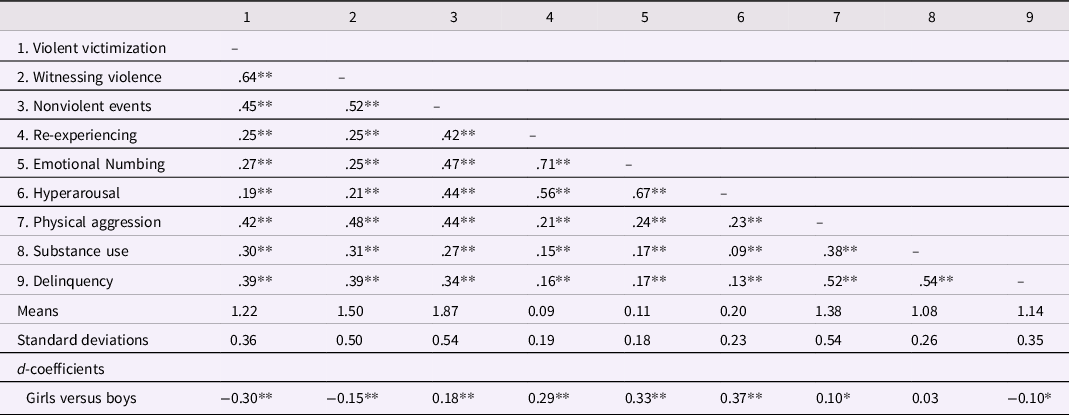
Means, standard deviations, and correlations among all variables are reported in Table 1. As expected, violent victimization and witnessing violence were highly correlated (r = .64), and each was moderately to highly correlated with nonviolent, negative life events (rs = .45 and .52, respectively). The three PTS symptoms were highly correlated (rs = .56–.71), and the three externalizing symptoms were moderately to highly correlated (rs = .38–.54). There were low correlations between the PTS and externalizing symptoms (rs = .09–.24). The three forms of childhood adversity were each slightly to moderately correlated with PTS and externalizing symptoms (rs = .19–.48).
Correlations, unstandardized means, standard deviations, and sex differences
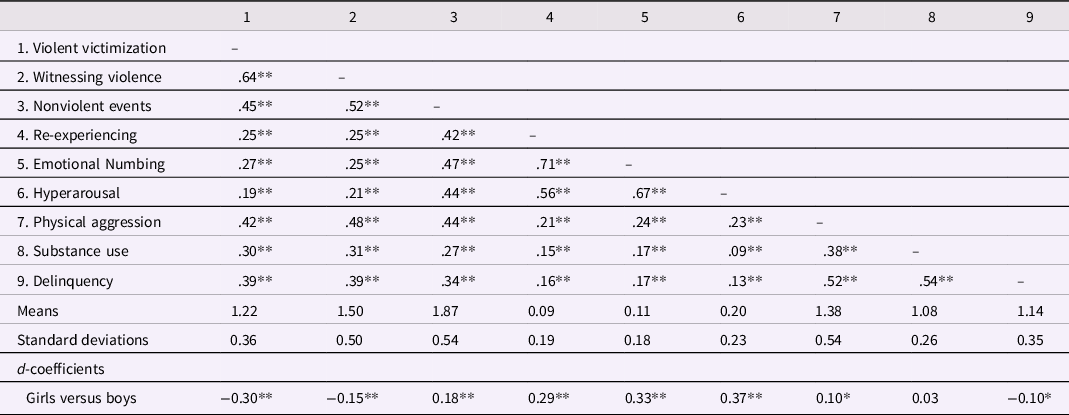
Note. N = 2,722.
* p < .01. **p < .001.
Table 1 also reports d coefficients representing mean differences across sex. Female adolescents reported significantly lower frequencies of both violent victimization and witnessing violence (ds = −.30 and −.15, respectively), but higher frequencies of nonviolent, negative life events (d = .18). Female adolescents also reported slightly to moderately higher frequencies of PTS (ds = .10 to .33), slightly higher frequencies of physical aggression (d = .10), and slightly lower frequencies of delinquency (d = −.10). There were no significant sex differences in substance use frequency.
Model fit indices for PTS-externalizing symptoms subgroups
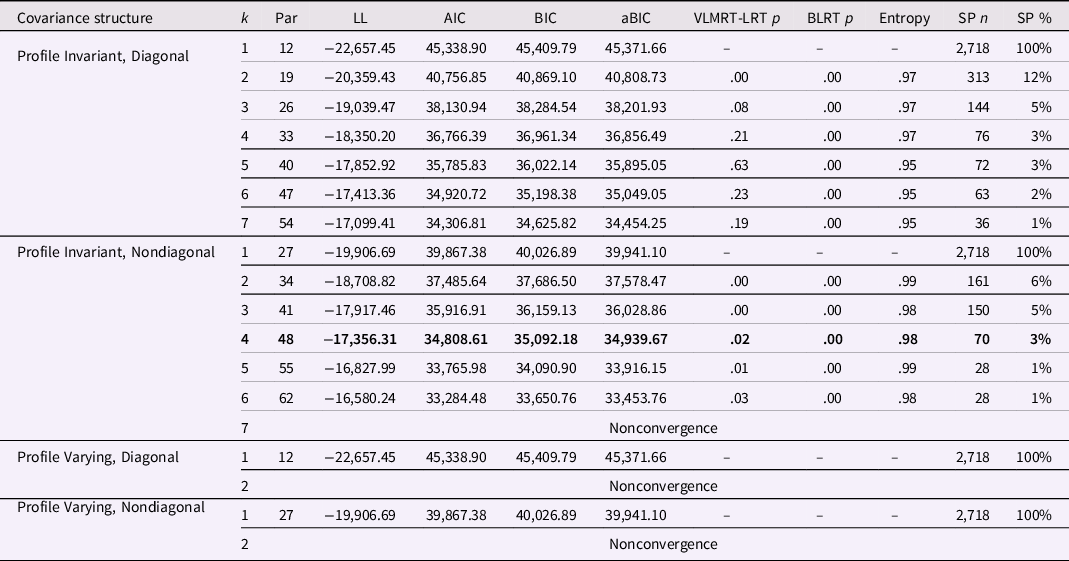
To address our first research aim, LPAs were used to test a series of models specifying increasing numbers of latent profiles (i.e., subgroups) ranging from one through seven across covariance structures that differed in whether indicator variables were allowed to covary (i.e., diagonal versus nondiagonal) and whether the variances and/or covariances were allowed to vary across subgroups (i.e., class varying or class invariance, respectively) (see Table 2). Models in which the variances and covariances were allowed to vary across profiles did not successfully converge to a solution when more than one profile was specified. Based on the AIC, BIC, aBIC, and correct model probabilities, models with a non-diagonal, profile-invariant structure were chosen for further inspection.
Fit Indices for latent profile analysis models assuming different covariance structures
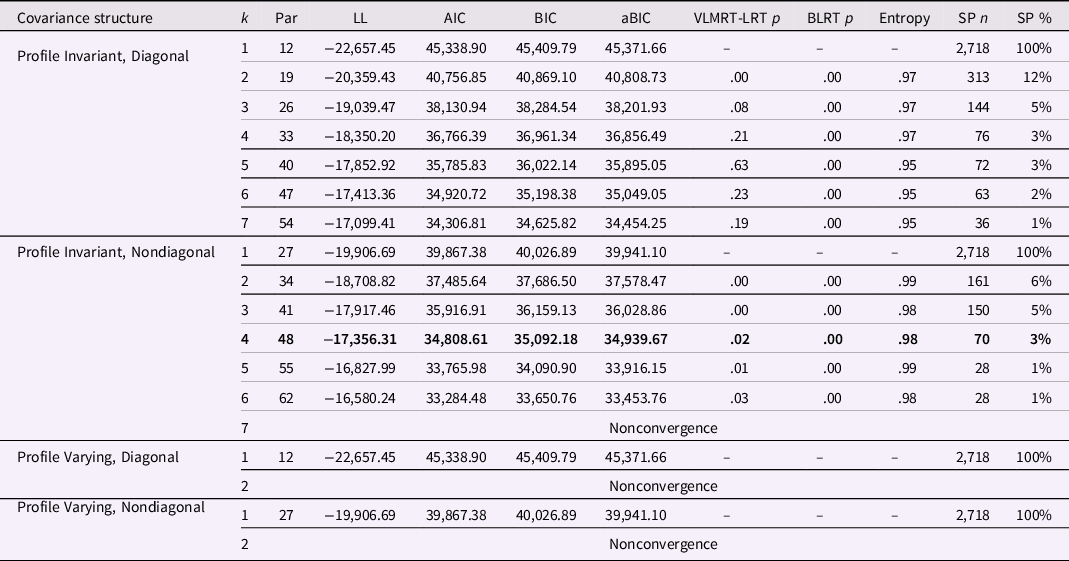
Note. N = 2,718. Bolded row indicates selected model. BIC = Bayesian information criterion; BLRT = bootstrap likelihood ratio test; k = number of profiles; LL = log likelihood; Par = number of parameters; SP = smallest profile; VLMR-LRT = Vuong–Lo–Mendell–Rubin likelihood ratio test. VLMR-LRT and entropy are not applicable for one-profile models.
The VLMR-LRT and BLRT were both significant across all non-diagonal, profile-invariant models. The LL, AIC, BIC, and aBIC continued to decrease within the non-diagonal, profile-invariant models, with a more gradual decrease starting at the five-profile model. The smallest subgroup within the five-profile non-diagonal, profile-invariant model included only 1.0% of the overall sample (n = 28). In comparison, the smallest subgroup within the four-profile solution was approximately 3% of the sample (n = 70). Although 5% is often used as a “rule-of-thumb” for cut-off thresholds (Hipp & Bauer, Reference Hipp and Bauer2006), Masyn (Reference Masyn and Little2013) suggests that overall sample size (i.e., power), separation of profiles, and generalizability to other samples should be considered rather than concrete “rules” regarding subgroup proportions. We deemed it appropriate to include a profile with at least 2% of the sample, given prior adolescent prevalence rates of PTSD (McLaughlin et al., Reference McLaughlin, Koenen, Hill, Petukhova, Sampson, Zaslavsky and Kessler2013), substance use disorder (Substance Abuse and Mental Health Services Administration [SAMHSA] 2012), and lifetime comorbidities with PTSD (Copeland et al., Reference Copeland, Keeler, Angold and Costello2007). Thus, the four-profile nondiagonal profile-invariant model was selected for further inspection. Overall, the four profiles had a high degree of separation (i.e., d > |2.0|; Masyn, Reference Masyn and Little2013) with respect to at least one indicator. The four-profile solution also demonstrated average posterior profile probabilities above .96, indicating low levels of classification error.
Description of the four-profile solution
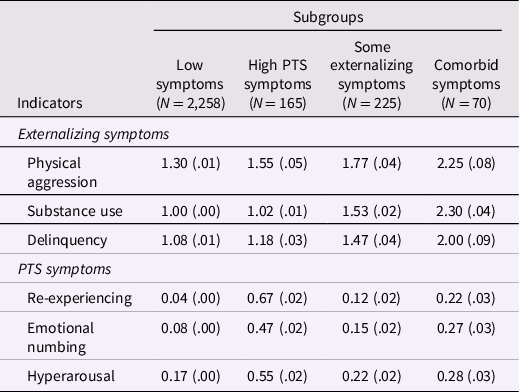
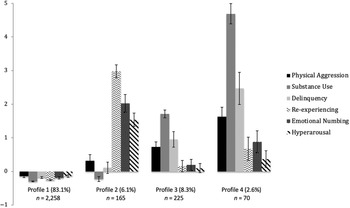
Consistent with Hypothesis 1a, we found support for a model specifying four profiles, consisting of (a) low symptoms, (b) PTS, (c) externalizing symptoms, and (d) co-occurring PTS and externalizing symptoms. The unstandardized means are reported in Table 3, and z scores for all four profiles are graphically depicted in Figure 1. The unstandardized means for the dichotomous PTS symptoms represent the proportion of items endorsed at clinically significant levels, whereas the unstandardized means for the externalizing symptoms ranged from 1 to 4 (Never to 6 or more times in the past three months). Both approaches are provided to distinguish between a subgroup’s average reported frequencies for each construct (i.e., unstandardized means) versus the number of standard deviations below or above the sample mean (i.e., z scores).
Unstandardized means (standard error) across the four profiles of PTS and externalizing symptoms
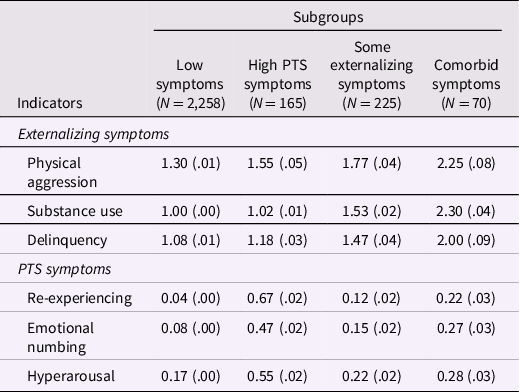
Note. N = 2,718. Physical aggression, substance use, and delinquency were measured on a four-point scale from 1 to 4 (Never to 6 or more times in the past three months). Re-experiencing, emotional numbing, and hyperarousal were dichotomous, indicating the number of items endorsed at clinically significant levels. PTS = post-traumatic stress.
Full sample four-profile solution depicted by z scores. Profile 1 = low symptoms. Profile 2 = high post-traumatic stress symptoms. Profile 3 = some externalizing symptoms. Profile 4 = comorbid symptoms.
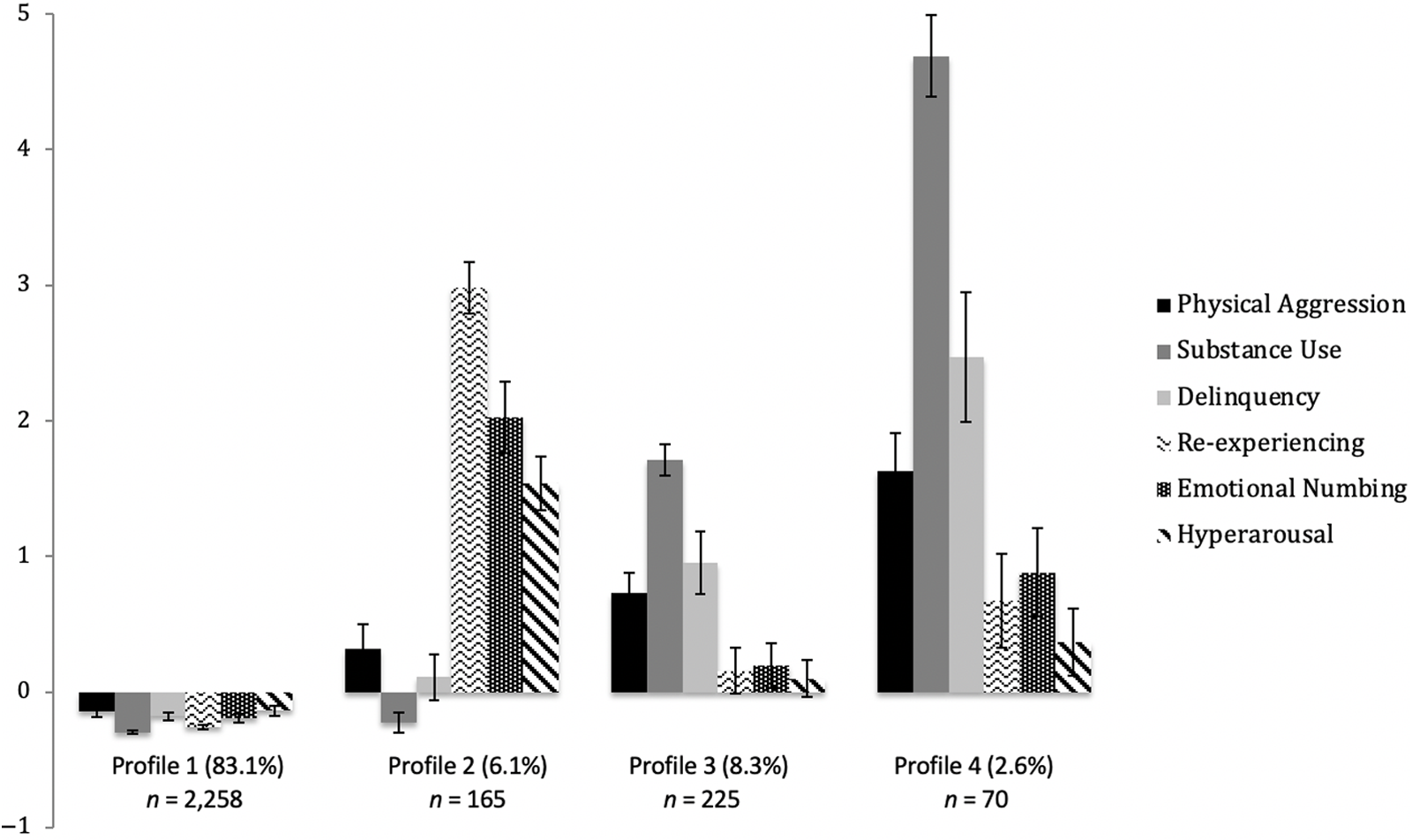
Profile 1 (83%) was labeled Low Symptoms, as adolescents reported very few symptoms (zs ranged from −.14 to −.30). Profile 2 (6%), labeled High PTS Symptoms, had significantly elevated PTS symptoms (zs ranged from 1.54 to 2.98) but slightly below to slightly above average externalizing symptoms (zs ranged from −0.23 to .31). On average, adolescents in this group reported clinically significant levels of PTS on 4 to 6 items on each of the PTS subscales. Profile 3 (8%) was labeled Some Externalizing Symptoms and included youth who reported engaging in slightly to moderately higher externalizing symptoms than the overall mean (zs ranged from .73 to 1.71) but minimal PTS symptoms (zs ranged from .10 to .20). Profile 4 (3%) was labeled Comorbid Symptoms and included youth with significantly higher reported frequencies of externalizing symptoms, particularly substance use (zs ranged from 1.6 to 4.7), and slightly to moderately elevated levels of PTS (zs ranged from 0.37 to 0.88) compared with the overall sample. Although adolescents within this subgroup reported the highest frequencies of substance use compared with all other subgroups, they reported using substances, on average, one to two times per month. Additionally, adolescents endorsed between 1 and 4 of the items on the PTS subscales at clinically significant levels within the Comorbid Symptoms subgroup.
Comparison of posterior profile probabilities within the overall sample revealed significant sex differences in subgroup membership, χ2 (3) = 28.17, p < .001. Consistent with Hypothesis 1b, relative to girls, male adolescents had higher odds of being in the Some Externalizing Symptoms subgroup (OR = 1.11, p < .001) and lower odds of being in the High PTS subgroup (OR = −0.40, p < .001). We considered the examination of other sex differences to be explorative. Relative to females, male adolescents had higher odds of being in the Low Symptoms subgroup (OR = 1.33, p < .001) and lower odds of being in the Comorbid Symptoms subgroup (OR = −0.63, p < .001). There were no differences in subgroup membership associated with intervention status, χ2 (3) = 5.98, p = .11.
Subgroup differences in childhood adversity
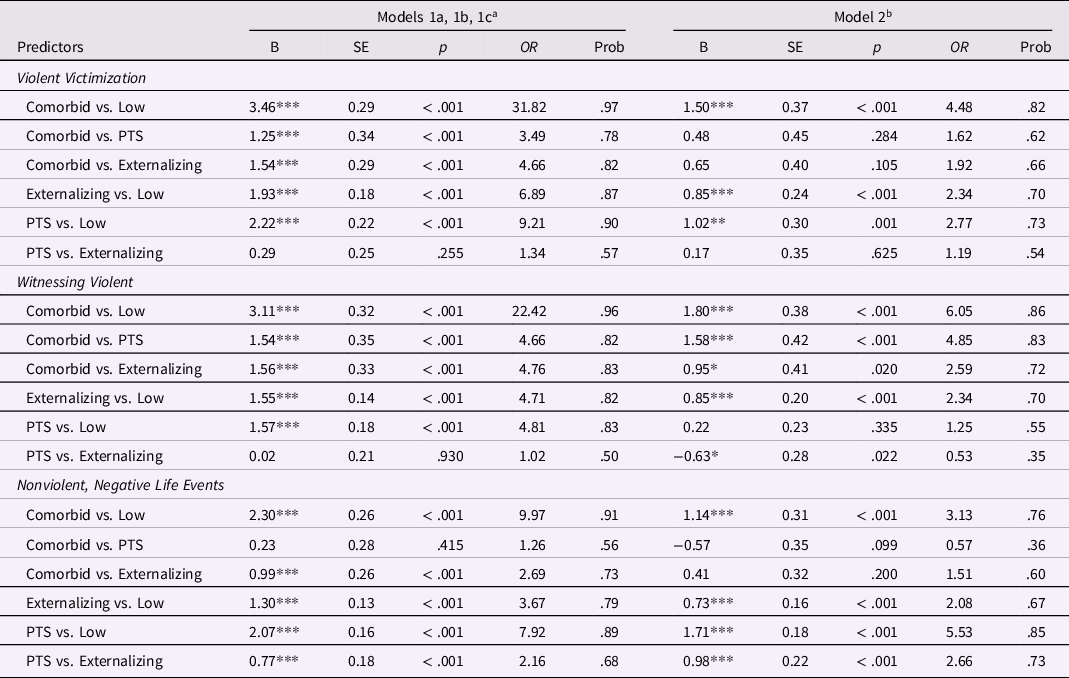
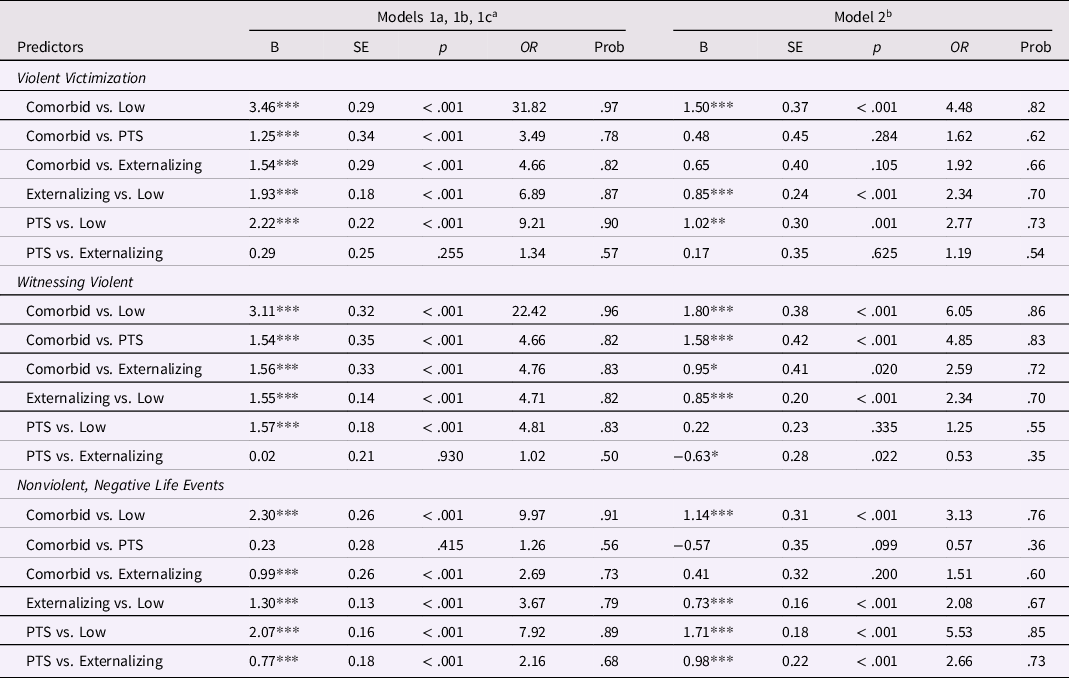
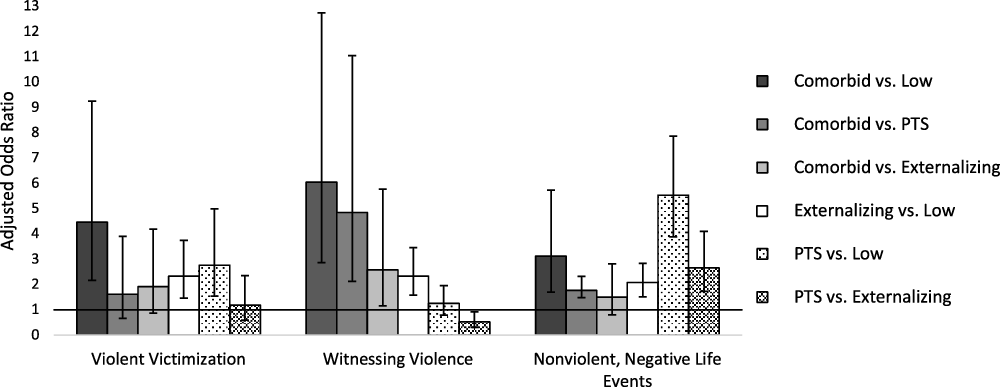
To examine whether experiencing violent and other nonviolent, negative life events were similarly or differentially associated with subgroup membership (Research Question 2a), we ran logistic regressions models in which subgroup membership was predicted by violent victimization (Model 1a), witnessing violence (Model 1b), and nonviolent negative life events (Model 1c) (see Table 4). Each model controlled for demographic covariates. We also ran a model that included the covariates and all three adversity variables (Model 2) to determine unique associations between each childhood adversity variable after controlling for the other two adversity variables (see also Figure 2). Multinomial logistic regressions revealed significant differences in the relative odds of belonging to one subgroup as compared with another, per a one-unit increase in scores on the three childhood adversity indicators. We then examined whether sex moderated these associations using Wald tests, which were considered exploratory in nature (Research Question 2b).
Relations between childhood adversity and subgroup membership
Note. Ns ranged from 2512 to 2478 due to listwise deletion.
a Coefficients for models 1a, 1b, and 1c are based on separate models for each predictor without controlling for other childhood adversity variables.
b Coefficients for Model 2 are based on a single model that included all three childhood adversity variables. B = Unstandardized regression coefficients derived from multinomial regression estimates. OR = odds ratio; Prob = probability; PTS = post-traumatic stress; SE = standard error. Second subgroup listed for each comparison serves as the reference group. Sex, grade, ethnicity, and intervention status were included as covariates in all models but are not included in the table. All significant results remained significant at p < .05 using the Benjamini–Hochberg’s adjustment for multiple hypothesis testing.
* p < .05. **p < .01. ***p < .001.
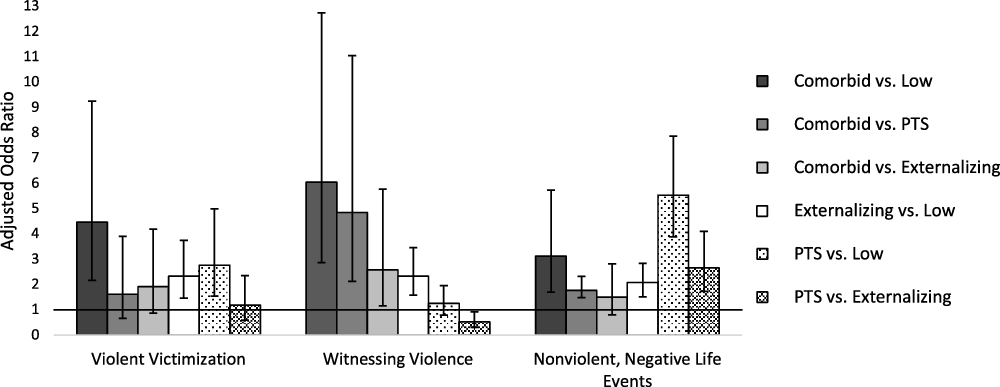
Adjusted odds ratios (AORs) and 95% confidence intervals for relations between childhood adversity and subgroup membership. Second subgroup listed for each comparison serves as the reference group. AORs greater than 1 indicate increased odds of subgroup membership, whereas AORs less than 1 indicate decreased odds of subgroup membership. Covariates in the model included the other two forms of childhood adversity, sex, grade, ethnicity, and intervention status. PTS = post-traumatic stress.
Community violence
As predicated by Hypothesis 2a, increases in the frequencies of violent victimization and witnessing violence were each associated with increases in the odds of belonging to the Comorbid Symptoms subgroup compared with the three other subgroups (see models 1a and 1b in Table 4; ORs = 3.49 to 31.82, ps < .001) and with increases in the odds of belonging to the Some Externalizing Symptoms and High PTS Symptoms subgroups compared with the Low Symptoms subgroups (ORs = 4.71 to 9.21, ps < .001). Frequencies of violent victimization and witnessing violence did not differentiate between the High PTS and Some Externalizing Symptoms subgroups (ps = .26 and .93, respectively).
However, within the full model that included both forms of community violence and nonviolent, negative life events (see Model 2 in Table 4 and Figure 2), frequencies of violent victimization no longer differentiated between the Comorbid versus Some Externalizing Symptoms subgroups (p = .11) or between the Comorbid versus High PTS Symptoms subgroups (p = .28). Within this model, frequencies of witnessing violence no longer differentiated between the High PTS and Low Symptoms subgroups (p = .34). Regarding Research Question 2b, the associations between community violence exposure and subgroup membership did not differ as a function of sex in the full model, Wald χ2 (3) = 2.33, p = 0.51 and Wald χ2 (3) = 0.68, p = 0.88, for violent victimization and witnessing violence, respectively.
Nonviolent, negative life events
We found partial support for Hypothesis 2a in relation to the associations between nonviolent, negative life events and subgroup membership. Prior to controlling for the two forms of violence exposure (see Model 1c in Table 4), a higher frequency of nonviolent, negative life events was associated with an increase in the odds of belonging to the Comorbid Symptoms subgroup compared with the Some Externalizing and Low Symptoms subgroups (ORs = 2.69 and 9.97, respectively, ps < .001). However, in contrast to our hypothesis, no differences were found in the odds of being to the Comorbid versus High PTS subgroups (p = .42).
We also found that a higher frequency of nonviolent, negative life events was associated with an increase in the odds of belonging to the Some Externalizing Symptoms and High PTS Symptoms subgroups compared with the Low Symptoms subgroups (ORs = 3.67 and 7.92, respectively, ps < .001). As predicted, a higher frequency of nonviolent, negative life events was associated with an increase in the odds of belonging to the High PTS Symptoms subgroup compared with the Some Externalizing subgroup, regardless of whether violence exposure was included in the model (ORs = 2.16 and 2.66 in Model 1c and Model 2, respectively, ps < .001).
After controlling for both forms of violence exposure in the full model (see Model 2 in Table 4 and Figure 2), frequency of nonviolent, negative life events no longer differentiated between the Comorbid and Some Externalizing Symptoms subgroups (p = .20). Regarding Research Question 2b, the interaction effect between sex and violent nonviolent, negative life events on subgroup membership was not significant in the full model, Wald χ2 (3) = 2.93, p = 0.40.
Discussion
The purpose of the current study was to examine (a) whether there were subgroups of youth with distinct patterns of PTS (i.e., re-experiencing symptoms, emotional numbing, and hyperarousal), aggression, delinquency, and substance use among a predominately low-income, African American sample of early adolescents living in neighborhoods with high rates of violence and (b) whether frequencies of multiple forms of childhood adversity, including both violent and nonviolent events, were similarly or differentially associated with subgroup membership. Sex differences were also examined. This study differed from previous studies in several ways. It broadened the focus of childhood adversity to include nonviolent, negative life events commonly experienced by adolescents exposed to community violence. It also examined the associations between childhood adversity and varying patterns of PTS and externalizing symptoms, rather than separate, variable-centered symptom domains. The examination of patterns of PTS and externalizing symptoms was our attempt to unpack the constellation of symptoms associated with childhood adversity among a predominantly low-income, African American sample of early adolescents.
Overall, our hypotheses were supported. Consistent with a prior study (Crum et al., Reference Crum, Cornacchio, Coxe, Green and Comer2018), we identified four distinct subgroups of youth who reported (a) low symptoms, (b) externalizing symptoms, (c) PTS symptoms, and (d) co-occurring PTS and externalizing symptoms. Relative to males, female adolescents had higher odds of being in the comorbid and PTS-only subgroups. In contrast, male adolescents had higher odds of being in the externalizing symptoms-only and low symptoms subgroups, relative to females. We also found that exposure to violent and nonviolent, negative life events had differential associations with subgroup membership. In general, a higher frequency of violence exposure, particularly witnessing violence, was associated with increased odds of belonging to subgroups with externalizing symptoms, whereas a higher frequency of nonviolent, negative life events was associated with increased odds of belonging to subgroups with PTS symptoms. The associations between the three forms of childhood adversity and subgroup membership did not differ as a function of sex.
Our first research aim focused on the examination of distinct patterns of PTS and externalizing symptoms. Overall, our findings highlight the use of finite mixture modeling to examine the heterogeneity in psychopathology across individuals. An important advancement in understanding the etiology of mental disorders has been higher order and general latent factor analyses aimed to better account for the shared variance across psychiatric domains (e.g., the “p” factor; for a review, see Smith et al., Reference Smith, Atkinson, Davis, Riley and Oltmanns2020). However, in contrast to the majority of this work, the use of latent profiles allowed us to examine additional heterogeneity across symptom profiles that can go undetected within higher-order and general latent factor analyses. For example, our findings revealed that adolescents reported higher rates of substance use and delinquency compared with aggression across both subgroups reporting externalizing symptoms, with the highest rates among youth who also reported some co-occurring PTS symptoms. Adolescents within the comorbid subgroup reported, on average, using illegal substances approximately 1 to 2 days in the preceding 30 days. Although this may appear low, initiation and experimentation of illegal substances in early adolescence increases overall risk for later substance dependence (King & Chassin, Reference King and Chassin2007), with even greater risk for dependence among adolescents with co-occurring psychopathology (Gray & Squeglia, Reference Gray and Squeglia2018).
Childhood adversity and patterns of co-occurring symptoms
Findings from our second research aim highlight the ways in which multiple forms of violent and nonviolent childhood adversity are differentially associated with psychopathology among early adolescents. Witnessing violence was the only form of childhood adversity that was associated with an increased likelihood of belonging to the Comorbid and Some Externalizing Symptoms subgroups compared to the High PTS Symptoms subgroup, after controlling for the other forms of childhood adversity. These findings suggest that witnessing violence may be a particularly salient risk factor for externalizing symptoms, above and beyond violent victimization. The ways in which violent victimization and witnessing violence differentially influence underlying mechanisms associated with psychopathology may partially explain our findings. For example, Schwartz and Proctor (Reference Schwartz and Proctor2000) found that violent victimization predicted increased frequencies of aggression through emotion dysregulation, whereas witnessing violence predicted increased frequencies of aggression through problematic social-cognitive processes, such as hostile attribution bias and perceived efficacy of the use of aggression. Thus, impairments in social-cognitive processes associated with witnessing violence may lead to greater frequencies of externalizing symptoms than symptoms of PTS.
Experiencing nonviolent, negative life events was the only form of childhood adversity that was associated with an increased likelihood of belonging to the PTS Symptoms subgroup compared to the Some Externalizing Symptoms subgroup. Although threat of death or injury is required to meet criteria for PTSD (APA, 2013), nonviolent, negative life event that are often associated with poverty (e.g., food insecurity, lack of supervision, family turmoil, and substandard housing), may be more salient risk factors for ongoing or severe PTS symptoms compared with the threatening event(s) that might have initiated the onset of symptoms in the first place. This is consistent with prior studies that have found that nonviolent, negative life events trigger or exacerbate depressive episodes among those who have experienced childhood abuse and neglect (Harkness et al., Reference Harkness, Bruce and Lumley2006; Weissman, Lambert et al., Reference Weissman, Lambert, Rodman, Peverill, Sheridan and McLaughlin2020). Our findings suggest that this process, known as stress sensitization, is likely associated with early adolescents’ PTS symptoms as well. The associations between nonviolent, negative life events and the Comorbid and High PTS Symptoms subgroups also provide support for expanding the definition of childhood adversity beyond threat and deprivation (i.e., neglect) used in DMAP (Sheridan & McLaughlin, Reference Sheridan and McLaughlin2016) to include other nonviolent, negative life events that are more common among adolescents living in under-resourced communities.
Future directions
Based on the findings from this study, we recommend that future work focus on the longitudinal relations among the different forms of childhood adversity and comorbid psychopathology. The three forms of childhood adversity we examined most likely influence one another to create additive risk for psychopathology. It is currently unclear whether different patterns or trajectories of violent and nonviolent adverse events predict different patterns of co-occurring symptomatology. For example, the Pathologic Adaptation Model (Ng-Mak et al., Reference Ng-Mak, Salzinger, Feldman and Stueve2002) argues that youth may show “pathologic adaptation” after repeated exposure to violence, which results in reduced symptoms of internalizing symptoms but increased engagement in risky behaviors, such as aggression. Based on the finding that the Comorbid Symptoms subgroup had significantly higher rates of externalizing symptoms compared with the externalizing-only subgroup but lower rates of PTS compared with the PTS-only subgroup, we hypothesize that increases in violence exposure may shift some adolescents from the High PTS to Comorbid Symptoms subgroup across time (i.e., a reduction in PTS symptoms and an increase in externalizing symptoms).
Relatedly, we recommend follow-up studies that examine how youth transition between the subgroups beyond early adolescence. Using longitudinal data across later time points in adolescence and adulthood, this could be examined through the use of a latent transition mixture model (Nylund-Gibson et al., Reference Nylund-Gibson, Grimm, Quirk and Furlong2014). This type of analysis would provide additional insight into stability over time and whether belonging to one subgroup is a risk factor for transitioning into another. Consistent with a developmental psychopathology perspective (Cicchetti & Rogosch, Reference Cicchetti and Rogosch2002), we speculate that there are multiple etiological pathways in which co-occurring symptoms develop over time (i.e., equifinality). Consistent with the self-medication hypothesis (Khantzian & Albanese, Reference Khantzian and Albanese2008), adolescents may be using substances as a maladaptive way to cope with and avoid symptoms of PTS. Second, co-occurring PTS and externalizing symptoms may put adolescents at even greater risk for substance use than either PTS or externalizing symptoms alone (Chassin et al., Reference Chassin, Colder, Hussong, Sher and Cicchetti2016). Experience-driven risk models provide a third explanation, such that using substances puts adolescents at greater risk for PTS (Davis et al., Reference Davis, Diguiseppi, De Leon, Prindle, Sedano, Rivera, Henwood and Rice2019) and externalizing symptoms (Hawes et al., Reference Hawes, Trucco, Duperrouzel, Coxe and Gonzalez2019). Further examination of these associations using longitudinal analyses has the potential to provide further insight in the timing and onset of symptoms, as well as how comorbidities develop across later periods of adolescence and into adulthood.
Our findings also have important implications for future intervention development and clinical work. Given that the current study found multiple symptom profiles among a sample of middle school youth, prevention and early identification efforts focused on reducing PTS, aggression, delinquency, and substance use should start during elementary school rather than middle or high school. We also recommend that future intervention efforts take a more transdiagnostic approach by targeting a wider range of symptomatology. Findings are still mixed on whether current interventions aimed to reduce PTSD are also effective in reducing co-occurring externalizing symptoms (Ramirez de Arellano et al., Reference Ramirez de Arellano, Lyman, Jobe-Shields, George, Dougherty, Daniels and Delphin-Rittmon2014). Similarly, the field of youth violence prevention research has often failed to consider the effects of violence using a childhood adversity lens, such as rarely examining whether these types of programs reduce PTS symptoms (Farrington et al., Reference Farrington, Gaffney, Lösel and Ttofi2017). The increasing focus on examining symptom profiles pre- and post-intervention could make great strides in transitioning to transdiagnostic prevention and intervention efforts, particularly towards more data-driven, individualized treatment planning.
Limitations
Several limitations within the current study warrant discussion. The study’s sample was mostly comprised of African American (80%) and Hispanic or Latinx (17%) middle school students living in urban, under-resourced neighborhoods with high levels of violence. Although we believe these characteristics to be strengths of the study, our findings may not generalize to other populations. Relatedly, our sample was not sufficiently diverse to allow us to examine race, ethnicity, or socioeconomic status as possible moderators of relations between childhood adversity and subgroup membership.
The constructs used in the current study were based on adolescents’ self-report, which leads to the possibility of measurement bias. Incorporating parent and teacher reports could provide a more valid picture of adolescents’ overall functioning. In addition, the measures of violent victimization and witnessing violence did not identify the perpetrators or victims. We were therefore unable to differentiate between family violence (e.g., witnessing domestic violence) versus peer or community violence. In addition, the measure used to assess PTS symptoms was based on DSM-III criteria for PTSD, and only included two questions on avoidant behaviors. We were consequently unable to separate the emotional numbing subscale into two separate constructs of avoidance and negative alterations in cognitions and mood consistent with the DSM-5 (APA, 2013). We also chose to dichotomize the PTS subscales. We believe this was needed to distinguish between normative development and psychopathology. For example, it is typical for youth to feel nervous, daydream, have trouble sleeping, and avoid things “once in a while.” By dichotomizing the subscales, symptom profiles were characterized by the number of items in which adolescents reported clinically significant symptoms of PTS. Nonetheless, this decision increased the risk of losing information across the spectrum of responses. The current study was also cross-sectional. It remains unclear, for example, whether symptom profiles change as youth enter middle to late adolescence. Moreover, causation could not be explored. It is likely that bidirectional associations exist between childhood adversity and symptom profiles.
Finally, model sensitivity to sampling fluctuation limits the generalizability of the study. This is particularly true given that three out of the four subgroups each had less than 10% of the sample. Rather than abide by a “5% rule of thumb,” Masyn (Reference Masyn and Little2013) argued that overall sample size (i.e., power), separation of profiles, and generalizability to other samples should be main considerations rather than the use of rigid guidelines on subgroup proportions. Given the low prevalence rates of psychopathology, particularly comorbidity rates, the smallest subgroup is arguably not merely a subgroup of outliers that should be collapsed into another subgroup, but represents a subgroup of adolescents experiencing more severe symptoms of psychopathology that is worth investigating. Moreover, adolescents within this group did not report unreasonably high levels of symptoms (e.g., used substances one to two times per month), providing further evidence that the subgroup does not represent extreme responding on a measure. Replication is needed, however, to determine whether similar subgroups would be found in other samples.
Conclusions
The present findings contribute to the transdiagnostic literature of psychopathology by identifying distinct patterns of PTS and externalizing symptoms among a predominantly low-income, African American sample of early adolescents. The current findings underscore the notion that subgroups of early adolescents exhibit a range of symptomatology that cut across diagnostic nosology. In particular, substance use among middle school students may be indicative of other co-occurring emotional and behavioral problems. We found differential associations between multiple forms of childhood adversity and symptom profiles, underscoring the importance of screening for a wide array of adverse events, including both violent and nonviolent experiences. Our findings support the notion that understanding the effects of violence on psychopathology must be examined within the context of other nonviolent, negative life events experienced by youth living in under-resourced, urban communities. Interventions aimed to address childhood adversity may be most effective when modules aimed to address both PTS and externalizing symptoms are incorporated, supporting the case for assessment-driven, flexibly tailored treatment planning.
Acknowledgments
Erin L. Thompson is now at the Center for Children and Families, Department of Psychology, Florida International University.
Funding statement
This study was funded by the National Institute of Child Health and Human Development Grant 1R01HD089994; the National Center for Injury Prevention and Control, Centers for Disease Control and Prevention, CDC Cooperative Agreement 5U01CE001956; the National Institute of Justice Grant 2014-CK-BX-0009; and the National Institute on Drug Abuse Grant 5T32DA043449-02. The findings and conclusions in this report are those of the authors and do not necessarily represent the official position of the National Institute of Child Health and Human Development, the Centers for Disease Control and Prevention, the National Institute of Justice, or the National Institute on Drug Abuse.
Conflicts of interest
None.