Attention deficits and motor activity excesses in young children are of considerable interest, certainly at preschool age and later (Campbell, Shaw, & Gilliom, Reference Campbell, Shaw and Gilliom2000), and perhaps even in toddlerhood if measured well (Shaw, Owens, Giovannelli, & Winslow, Reference Shaw, Owens, Giovannelli and Winslow2001). Such problems can even include diagnosed attention-deficit/hyperactivity disorder (ADHD). It is important to understand the mechanisms by which such behavior problems develop in order to improve early assessment, prevention, and treatment. A risk factor with a possible mechanistic role in the development of behavior problems is deficient abilities related to language. The present study examined the role of language ability in the development of inattentive–hyperactive (I-H) behavior problems by testing whether language serves a self-regulatory function across development and whether self-regulation accounts for the association between language ability and later I-H behavior problems.
Previous studies have shown that language deficits are associated with ADHD (Baker & Cantwell, Reference Baker and Cantwell1992; Tirosh & Cohen, Reference Tirosh and Cohen1998), externalizing problems (Petersen et al., Reference Petersen, Bates, D'Onofrio, Coyne, Lansford and Dodge2013), conduct problems (Beitchman et al., Reference Beitchman, Wilson, Johnson, Atkinson, Young and Adlaf2001; Petersen et al., Reference Petersen, Bates, D'Onofrio, Coyne, Lansford and Dodge2013; St. Clair, Pickles, Durkin, & Conti-Ramsden, Reference St. Clair, Pickles, Durkin and Conti-Ramsden2011), and delinquency (Brownlie et al., Reference Brownlie, Beitchman, Escobar, Young, Atkinson and Johnson2004; Lynam, Moffitt, & Stouthamer-Loeber, Reference Lynam, Moffitt and Stouthamer-Loeber1993; Stattin & Klackenberg-Larsson, Reference Stattin and Klackenberg-Larsson1993). Studies have shown that language ability is associated with later behavior problems, controlling for prior levels of behavior problems (Lindsay, Dockrell, & Strand, Reference Lindsay, Dockrell and Strand2007; Petersen et al., Reference Petersen, Bates, D'Onofrio, Coyne, Lansford and Dodge2013; St. Clair et al., Reference St. Clair, Pickles, Durkin and Conti-Ramsden2011), suggesting that language ability plays a role in developmental process. Following children in two samples from ages 4 to 12 and 7 to 13, Petersen et al. (Reference Petersen, Bates, D'Onofrio, Coyne, Lansford and Dodge2013) found that language ability more strongly predicted later I-H and externalizing behavior problems than the converse. That study opens the question of mechanisms by which language becomes adjustment. For reasons to be explained, we expect that self-regulation development might be a major mechanism.
The developmental process by which behavior problems may develop as a result of language deficits is unclear. Keenan and Shaw (Reference Keenan and Shaw1997, Reference Keenan, Shaw, Lahey, Moffitt and Caspi2003) proposed that language skills may prevent the development of behavior problems by allowing children to communicate their needs and have them met and eliciting inductive parenting rather than punishment. A related mechanism suggested is that language deficits would impair peer acceptance (Menting, van Lier, & Koot, Reference Menting, van Lier and Koot2011).
Vygotsky (Reference Vygotsky, Vygotsky, Hanfmann and Vakar1962) and Luria (Reference Luria and Tizard1961) proposed that language serves a self-regulatory function by guiding goal-directed behavior to facilitate problem solving. Specifically, the use of private or self-directed speech was considered by Vygotsky as a means to guide one's behavior on difficult tasks. In addition to private speech, other aspects of language such as language ability may be important factors in the development of problem solving and regulatory skills. Theoretically, children with better language ability have better internal representational abilities of caregivers' regulatory speech (Vallotton & Ayoub, Reference Vallotton and Ayoub2011). Thus, children with better language skills may be more effective at using private speech as a self-guiding tool and may show earlier internalization of private speech and regulatory mechanisms, resulting in better self-regulation and adjustment. Research has found, for example, that intelligent children show more advanced development of private speech than do less intelligent children (Berk, Reference Berk, Llyod and Fernyhough1999). Because children with higher intelligence tend to have better language ability, we would expect that children with better language ability would have achieved more advanced development of private speech, as well, and improved self-regulation and behavioral adjustment as a result.
Previous studies suggest that language ability may be related to self-regulation. For instance, Wolfe and Bell (Reference Wolfe and Bell2004) found that language ability was positively associated with performance on tasks involving working memory and inhibitory control, as well as with parents' ratings of the child's temperamental effortful control, which reflects the ability to suppress a dominant response in favor of a subdominant one (Rothbart & Bates, Reference Rothbart, Bates, Eisenberg, Damon and Lerner2006). In addition, language ability has been associated with regulation of attention (Kopp, Reference Kopp1982; Rodriguez, Mischel, & Shoda, Reference Rodriguez, Mischel and Shoda1989) and emotion (Roben, Cole, & Armstrong, Reference Roben, Cole and Armstrong2013), and with delayed gratification among impulsive children (Rodriguez et al., Reference Rodriguez, Mischel and Shoda1989) and among adolescents with Down syndrome (Cuskelly & Stubbins, Reference Cuskelly and Stubbins2006). Vocabulary has been shown to predict later growth in self-regulation, even controlling for general cognitive abilities (Vallotton & Ayoub, Reference Vallotton and Ayoub2011). Research on the role of language in self-regulation has been extended to the study of differences in monolinguals' and bilinguals' executive control. For instance, Bialystok and Viswanathan (Reference Bialystok and Viswanathan2009) showed that bilinguals have better inhibitory control and cognitive flexibility than do monolinguals. Research on variations in first exposure to language among children with cochlear implants has shown that language exposure promotes the development of behavioral regulation. Specifically, length of use of the implant, presumably marking earlier language exposure, has been associated with the ability to regulate and delay behavioral responses (Horn, Davis, Pisoni, & Miyamoto, Reference Horn, Davis, Pisoni and Miyamoto2005). Moreover, differences in language ability account for the higher levels of behavior problems among children with hearing loss compared to hearing children (Stevenson, McCann, Watkin, Worsfold, & Kennedy, Reference Stevenson, McCann, Watkin, Worsfold and Kennedy2010).
Improved language ability could promote the development of self-regulation for several biological reasons. First, motor and language systems are closely coupled in brain activation patterns and their development. Processing action-related language activates motor and premotor cortices (van Elk, van Schie, Zwaan, & Bekkering, Reference van Elk, van Schie, Zwaan and Bekkering2010). Spoken language processing may influence the development of fine motor skills (Horn, Pisoni, & Miyamoto, Reference Horn, Pisoni and Miyamoto2006). Second, language processes are associated with neural circuits in the frontal lobe, including the frontopolar, medial frontal, and dorsolateral prefrontal cortices (Lee et al., Reference Lee, Kang, Oh, Kang, Soo Lee and Lee2005), that underlie aspects of self-regulation (Pisoni et al., Reference Pisoni, Conway, Kronenberger, Horn, Karpicke, Henning, Marschark and Hauser2008).
With language appearing to have a meaningful role in children's development of self-regulation, it is not surprising that language deficits are present in many social, emotional, and behavioral disorders. A recent meta-analysis supports the association between language deficits and behavior problems (Yew & O'Kearney, Reference Yew and O'Kearney2013). Delayed expressive language in children, for example, has been associated with many behavioral problems and delays in social-cognitive development (Carson, Perry, Diefenderfer, & Klee, Reference Carson, Perry, Diefenderfer and Klee1999). From the complementary perspective, language deficits are particularly common in ADHD and autism (Joseph, McGrath, & Tager-Flusberg, Reference Joseph, McGrath and Tager-Flusberg2005). Two groups of researchers have even suggested that language deficits may mediate the executive dysfunctions common in autism (Liss et al., Reference Liss, Fein, Allen, Dunn, Feinstein and Morris2001; Russell, Jarrold, & Hood, Reference Russell, Jarrold and Hood1999). Barkley (Reference Barkley1997a) has argued that the deficits in attention and self-regulation found in ADHD may partly arise from children's impairment in the ability to internalize language in the form of private speech. Thus, language may be important for regulating attention and behavior. Past research, however, despite a number of encouraging findings, has not established language as causal in the development of self-regulation and behavior problems.
The present study focuses on language ability as a possible longitudinal predictor of self-regulation. Self-regulation is considered a broad construct encompassing physiological, attentional, cognitive, emotional, and behavioral regulatory processes that promote adaptive or goal-directed behavior (Berger, Reference Berger2011; Calkins & Fox, Reference Calkins and Fox2002). The present study examines self-regulation tasks that all require inhibitory control, a form of behavioral regulation that is considered a central aspect of self-regulation (Kochanska, Murray, Jacques, Koenig, & Vandegeest, Reference Kochanska, Murray, Jacques, Koenig and Vandegeest1996). Inhibitory control has been defined as “the ability to inhibit responses to irrelevant stimuli while pursuing a cognitively represented goal” (Carlson & Moses, Reference Carlson and Moses2001, p. 1033). It is considered a developmental skill that promotes goal-directed (Luna & Sweeney, Reference Luna and Sweeney2004) and adaptive social behavior (Carlson & Moses, Reference Carlson and Moses2001).
Self-regulation deficits are considered an intermediate phenotype of many externalizing behavior problems (Young et al., Reference Young, Friedman, Miyake, Willcutt, Corley and Haberstick2009) including I-H behavior problems and ADHD (Barkley, Reference Barkley1997b; Doyle et al., Reference Doyle, Faraone, Seidman, Willcutt, Nigg and Waldman2005; Slaats-Willemse, Swaab-Barneveld, de Sonneville, van der Meulen, & Buitelaar, Reference Slaats-Willemse, Swaab-Barneveld, de Sonneville, van der Meulen and Buitelaar2003). In addition, self-regulation skills are crucial for school readiness (Ursache, Blair, & Raver, Reference Ursache, Blair and Raver2012). In support of the hypothesis that self-regulation is important for behavioral adjustment, aspects of self-regulation including inhibitory control have been found to relate to key aspects of behavioral adjustment. Inhibitory control has been associated with theory of mind (Carlson & Moses, Reference Carlson and Moses2001) and social–emotional competence (Rhoades, Greenberg, & Domitrovich, Reference Rhoades, Greenberg and Domitrovich2009). Deficits in inhibitory control have been linked to aggressive behavior (Raaijmakers et al., Reference Raaijmakers, Smidts, Sergeant, Maassen, Posthumus and van Engeland2008), ADHD (Johnstone, Barry, Markovska, Dimoska, & Clarke, Reference Johnstone, Barry, Markovska, Dimoska and Clarke2009; Oosterlaan, Logan, & Sergeant, Reference Oosterlaan, Logan and Sergeant1998), and substance-use disorders (Ivanov, Schulz, London, & Newcorn, Reference Ivanov, Schulz, London and Newcorn2008). Furthermore, inhibitory control has a unique association with early academic ability independent of general intelligence (Blair & Razza, Reference Blair and Razza2007). For these reasons, it is important to examine factors in the development of inhibitory control.
In sum, language ability is associated with later self-regulation and I-H behavior problems, and self-regulation is considered an intermediate phenotype of I-H behavior problems. Thus, it is plausible that self-regulation constructs may account for the association between language ability and later I-H behavior problems. Studies should test the developmental mechanisms of I-H behavior problems to specify the developmental process and steps along the causal chain that could be targets of intervention. For example, if language serves a regulatory function, interventions might seek to improve children's language skills or use of private speech in addition to self-regulation skills, directly.
Prior studies dealing with language, self-regulation, and behavior problems have key limitations. The majority of prior studies examining the association between language and self-regulation have been cross-sectional, and among those that were longitudinal, most have failed to control for prior levels of self-regulation (when language predicts subsequent self-regulation; but see Bivens & Berk, Reference Bivens and Berk1990; Vallotton & Ayoub, Reference Vallotton and Ayoub2011), and most failed to test the converse association that better self-regulation skills may promote better language acquisition. Longitudinal testing of links from language to later self-regulation controlling for continuity of self-regulation, and vice versa, will help to clarify the role of language in the development of self-regulation.
Few studies have examined the association between language ability and behavior problems controlling for prior levels of behavior problems (Yew & O'Kearney, Reference Yew and O'Kearney2013), so it is not clear whether language ability predicts cross-age changes in behavior problems. Moreover, few studies have examined possible mediators of the effect of language ability on later behavior problems. We know of only one study that has examined mediators of the link between language skills and behavior problems, finding that peer rejection mediated the association between receptive language skills and externalizing behavior problems (Menting et al., Reference Menting, van Lier and Koot2011). To our knowledge, no studies have tested whether growth of self-regulation mediates the effect of language ability on later behavior problems. In addition, no studies have examined mediators of the effect of language ability on later behavior problems in the context of a longitudinal panel model, which provides a stronger test of causal mediation than do cross-sectional approaches (Cole & Maxwell, Reference Cole and Maxwell2003).
Finally, few studies have examined language ability in relation to self-regulation and I-H behavior problems in the late toddler years, a period of rapid growth in self-regulation abilities (Posner & Rothbart, Reference Posner and Rothbart2000) and receptive and expressive language skills (Ganger & Brent, Reference Ganger and Brent2004). Examining I-H behavior problems in toddlers allows earlier identification of risk for I-H behavior problems before the behavior problems become engrained and more difficult and costly to treat. We focused on I-H behavior problems because previous research suggests that language ability is more strongly related to I-H behavior problems than to other behavior problems such as general externalizing problems (e.g., Petersen et al., Reference Petersen, Bates, D'Onofrio, Coyne, Lansford and Dodge2013).
The present study examined the longitudinal relation between language ability, self-regulation (especially inhibitory control), and I-H behavior problems in children across ages 30, 36, and 42 months. The study used cross-lagged panel models to test the hypothesis that language ability predicts subsequent self-regulation, while controlling for prior levels of self-regulation and simultaneously testing the converse (self-regulation predicting subsequent language controlling for prior language). Testing both directions allowed us to approximate the direction of effect between language ability and self-regulation. Longitudinal panel models also examined whether language ability predicted later I-H behavior problems (controlling for prior levels of I-H behavior problems) and whether individual differences in self-regulation mediated this association. It is important to consider such questions, because the findings might help guide choices about which children will be identified for prevention of disinhibitory behavior problems and what child abilities will be emphasized in interventions.
Based on the general hypothesis that language serves a regulatory function, the present study tested five specific hypotheses:
Hypothesis 1:
Language ability would be associated with later self-regulation.
Hypothesis 2:
The direction of effect would be stronger from language ability to later self-regulation than vice versa.
Hypothesis 3:
Language ability would be associated with later I-H behavior problems.
Hypothesis 4:
Self-regulation would be associated with later I-H behavior problems.
Hypothesis 5:
Individual differences in self-regulation would mediate the effect of language ability on later I-H behavior problems.
Method
Participants
Children and their families (N = 159) were recruited from the Bloomington, Indiana area to participate in a study with assessments of language ability, self-regulation, and I-H behavior problems at three ages: 30, 36, and 42 months. All assessments were conducted within 2 weeks of the child's target age. A portion of the sample (30%) involved planned missingness (i.e., were purposefully not assessed at all 3 ages), while other forms of missingness included inability or refusal to play the behavioral tasks and the family moved or was unable to be contacted. The planned missingness of this study is not a problem because modern missing data methods using structural equation modeling handle planned missingness well (Little, Reference Little2013). Children were included in the analyses for the present report if they had scores for language ability and self-regulation at two or more measurement occasions, resulting in a final sample of 120. Participants were recruited through a developmental research database and through recruitment via the local housing authority. Of the final sample, 51 (43%) children were female, and 69 (56%) were male.
A primary caregiver (usually the mother) reported on the child's behavior problems. Among the primary caregivers, 118 (98%) were female, 85% were Caucasian, 7% were Hispanic, 2% were African American, 1% were Asian American, 3% were of mixed race, and 2% were of “other” ethnicity. Parents included 116 mothers, 2 fathers, 1 adoptive mother, and 1 grandmother, and 98% were biological parents. Parents ranged in age from 20 to 48 years old (M = 33.34, SD = 5.66). The majority (76%) had a college degree, 14% had completed some college, 6% had obtained a high school diploma only, 2% had obtained a GED only, and 2% had completed some high school. The majority of parents were married (93%), whereas 4% were single, 1% were separated, and 2% were divorced. The average number of children living in the home was 1.96 (SD = 0.84). Thirty-two percent of children were firstborn. The Hollingshead Four-Factor Index of Social Status (Hollingshead, Reference Hollingshead1975) ranged from 11 to 66 (M = 47.81, SD = 14.22), suggesting a sample with some variation in socioeconomic status (SES), but with a solid middle-class core.
In addition to collecting parent reports of behavior problems, with the parents' permission, we asked secondary caregivers to rate behavior problems. Secondary caregivers were persons (over age 18) not living with the child who spent the most time with the child (and at least 10 hr) in the past 30 days. Parents did not name a secondary caregiver at ages 30, 36, and 42 months for 55%, 44%, and 35% of the children, respectively. Of the children whose parents named a secondary caregiver, 93%, 84%, and 84% of their secondary caregivers participated at 30, 36, and 42 months. Of these, 45% of secondary caregivers were teachers, 27% were other relatives, 22% were babysitters, and 6% had other connections to the child, as we learned from the 80% of the sample completed after revising the protocol to ask the caregiver's role.
Measures
Language ability
Language ability was measured as the average of the ability scores (not age-normed T scores) on two language subtests, verbal comprehension (receptive language) and naming vocabulary (expressive language), of the Differential Ability Scales (Elliott, Reference Elliott, Flanagan, Genshaft and Harrison1997). The association between the verbal comprehension and naming vocabulary subtests was significant at 30 months, r (97) = .55, p < .001; 36 months, r (108) = .46, p < .001; and 42 months, r (100) = .52, p < .001. The language ability averages correspond to T scores of 48.35, 53.81, and 54.90 at 30, 36, and 42 months, respectively, that is, comparable to the center of the national normative sample. In total, 111 (93%) children had language ability scores at 30 months, 112 (93%) at 36 months, and 104 (87%) at 42 months. Of children with language ability scores, children two or more standard deviations below the population mean (i.e., T score ≤ 30) numbered 3 (3%) at 30 months, 2 (2%) at 36 months, and 1 (1%) at 42 months (5 unique children). To examine the specificity of the role of language ability (as opposed to general intelligence) in the development of self-regulation and I-H behavior problems, we also considered nonverbal ability. Nonverbal ability was computed as the average of the ability scores on two nonlanguage subtests, block building and picture similarities. The correlation between language and nonverbal ability scores was .52, .57, and .49 (ps < .001) at 30, 36, and 42 months, respectively.
Self-regulation
Self-regulation was measured by three different behavioral tasks: bird/alligator, grass/snow, and the shapes task. These tasks were chosen because they (or similar variants) are widely used and are thought to reflect important aspects of self-regulation. Garon, Bryson, and Smith (Reference Garon, Bryson and Smith2008) described these or similar tasks as measures of complex response inhibition, where the child has to hold a rule in mind, respond according to the rule, and inhibit a prepotent response. Many inhibitory control and self-regulation tasks, however, are multidimensional and reflect other processes, including working memory (Wolfe & Bell, Reference Wolfe and Bell2007).
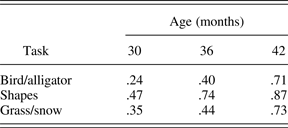
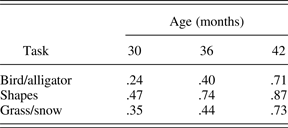
All of the cases were scored for reliability. Each case was coded by two or three trained, independent coders in each task. All coders were blind to study hypotheses. Interrater reliability was computed for each behavioral task using Cohen κ. Proportion correct statistics for each task at each age are presented in Table 1 to describe the developmental sensitivity of the different tasks for individual differences at each age.
Proportion correct for self-regulation tasks at each age
Bird/alligator (adapted from Kochanska et al., Reference Kochanska, Murray, Jacques, Koenig and Vandegeest1996; Reed, Pien, & Rothbart, Reference Reed, Pien and Rothbart1984) is a Simon-Says task where the child has to follow the directions given by the bird puppet, but ignore commands from the alligator. The children played several practice trials and then were presented with 12 trials, including 6 go (i.e., bird) trials and 6 no-go (i.e., alligator) trials. After 6 trials, the participants received a reminder of the rules. If participants successfully demonstrated action on the go trials and inhibition on the no-go trials, at 36 months, an additional 12 trials were presented with a rule switch where the alligator trials were go trials and the bird trials were no-go trials, and at 42 months, all children received the rule switch. Each no-go trial was scored on a 0 to 3 scale (0 = full commanded movement, 1 = partial movement, 2 = wrong movement, and 3 = no movement) according to the scoring system used by Carlson and Moses (Reference Carlson and Moses2001). The final bird/alligator score was the child's average score on all the no-go trials (0–3). The interrater reliability for bird/alligator was κ = 0.85. Children who had scores for bird/alligator numbered 77 (64%) at 30 months, 97 (81%) at 36 months, and 99 (83%) at 42 months.
Tasks like the bird/alligator task have been widely validated. The task was adapted from a comparable bear/dragon task, which has been widely used in studies of this age range. Variants of the bird/alligator task have been associated, either individually or as part of a composite with other inhibitory control tasks (e.g., Eisenberg et al., Reference Eisenberg, Edwards, Spinrad, Sallquist, Eggum and Reiser2013); theory of mind (e.g., Benson, Sabbagh, Carlson, & Zelazo, Reference Benson, Sabbagh, Carlson and Zelazo2013); delay of gratification (Moran, Lengua, & Zalewski, Reference Moran, Lengua and Zalewski2013); working memory (e.g., Carlson, Moses, & Breton, Reference Carlson, Moses and Breton2002); language ability (Albertson & Shore, Reference Albertson and Shore2008; Bernier, Carlson, Deschênes, & Matte-Gagné, Reference Bernier, Carlson, Deschênes and Matte-Gagné2012; Carlson, Mandell, & Williams, Reference Carlson, Mandell and Williams2004; Lengua, Honorado, & Bush, Reference Lengua, Honorado and Bush2007; Müller, Liebermann-Finestone, Carpendale, Hammond, & Bibok, Reference Müller, Liebermann-Finestone, Carpendale, Hammond and Bibok2012; Roebers & Schneider, Reference Roebers and Schneider2005); and parents' ratings of inhibitory control (Eisenberg et al., Reference Eisenberg, Edwards, Spinrad, Sallquist, Eggum and Reiser2013; Kochanska et al., Reference Kochanska, Murray, Jacques, Koenig and Vandegeest1996), executive attention (Jones, Rothbart, & Posner, Reference Jones, Rothbart and Posner2003), and externalizing problems (Moran et al., Reference Moran, Lengua and Zalewski2013; Orta, Corapci, Yagmurlu, & Aksan, Reference Orta, Corapci, Yagmurlu and Aksan2013).
In the shapes task (Kochanska, Murray, & Harlan, Reference Kochanska, Murray and Harlan2000), the child has to point to pictures of small fruit embedded within pictures of different, larger fruit. The child was presented with three pictures, in which each contained a small fruit in the middle of a larger fruit. In three of the trials, the child was asked to point to a large fruit out of the set (e.g., the large banana). After the three large fruit trials, the child was asked to point to a small fruit out of the set (e.g., the small apple) in three more trials. Each small fruit trial was scored from 0 to 2 (0 = incorrect, 1 = initially incorrect, but changed response to correct, 2 = correct). The final shapes task score was the average score on the small fruit trials (0–2). Interrater reliability for the shapes task was κ = 0.93. Children who had scores for the shapes task numbered 110 (92%) at 30 months, 110 (92%) at 36 months, and 105 (88%) at 42 months.
The shapes task has been used in numerous studies of this age range. The shapes task has been associated either individually or as part of a composite with other inhibitory control tasks (e.g., Kochanska, Coy, & Murray, Reference Kochanska, Coy and Murray2001); theory of mind (e.g., Müller et al., Reference Müller, Liebermann-Finestone, Carpendale, Hammond and Bibok2012); delay of gratification (e.g., Bernier, Beauchamp, Bouvette-Turcot, Carlson, & Carrier, Reference Bernier, Beauchamp, Bouvette-Turcot, Carlson and Carrier2013); working memory (Bernier, Carlson, Bordeleau, & Carrier, Reference Bernier, Carlson, Bordeleau and Carrier2010); language ability (Bernier et al., Reference Bernier, Carlson, Bordeleau and Carrier2010; Carlson et al., Reference Carlson, Mandell and Williams2004; Evans & Lee, Reference Evans and Lee2013; Lynn, Cuskelly, Gray, & O'Callaghan, Reference Lynn, Cuskelly, Gray and O'Callaghan2012); focused attention (Kochanska et al., Reference Kochanska, Murray and Harlan2000); compliance (Kochanska et al., Reference Kochanska, Coy and Murray2001); and parents' reports of executive attention (Gusdorf, Karreman, van Aken, Deković, & van Tuijl, Reference Gusdorf, Karreman, van Aken, Deković and van Tuijl2011), hyperactive problems (Gusdorf et al., Reference Gusdorf, Karreman, van Aken, Deković and van Tuijl2011), and externalizing problems (Karreman, van Tuijl, van Aken, & Deković, Reference Karreman, van Tuijl, van Aken and Deković2009).
In grass/snow (Carlson & Moses, Reference Carlson and Moses2001), the child has to touch a white square when hearing “grass” and a green square when hearing “snow.” The child is given several practice trials and is then presented with 12 trials, 6 of each color, and each trial is scored either correct (1) or incorrect (0). The final score represents the sum of all correct responses (0–12). Interrater reliability for grass/snow was κ = 0.94. Because of a change in the protocol, only a portion of the sample (96 children, 80%) was given the opportunity to play grass/snow. Therefore, analyses involving grass/snow only included these 96 cases. Children who had scores for grass/snow numbered 60 (63%) at 30 months, 77 (80%) at 36 months, and 82 (85%) at 42 months.
The grass/snow task has been used in many studies of this age range. The grass/snow task has been associated either individually or as part of a composite with other inhibitory control tasks (e.g., Lahat et al., Reference Lahat, Degnan, White, McDermott, Henderson and Lejuez2012), theory of mind (e.g., Lane et al., Reference Lane, Wellman, Olson, Miller, Wang and Tardif2013), working memory (e.g., Albertson & Shore, Reference Albertson and Shore2008), language ability (Albertson & Shore, Reference Albertson and Shore2008; Carlson et al., Reference Carlson, Mandell and Williams2004; Lahat et al., Reference Lahat, Degnan, White, McDermott, Henderson and Lejuez2012; Lengua et al., Reference Lengua, Honorado and Bush2007; Roebers & Schneider, Reference Roebers and Schneider2005), and parents' reports of inhibitory control (Eisenberg et al., Reference Eisenberg, Edwards, Spinrad, Sallquist, Eggum and Reiser2013; Olson et al., Reference Olson, Tardif, Miller, Felt, Grabell and Kessler2011) and externalizing problems (Olson et al., Reference Olson, Tardif, Miller, Felt, Grabell and Kessler2011).
I-H behavior problems
I-H behavior problems were taken from the attention problems subscale of the Child Behavior Checklist (CBCL 1 1/2–5; Achenbach & Rescorla, Reference Achenbach and Rescorla2000). The Achenbach scales are among the best normed and most widely used measures for behavior problems in this age range. They have good test–retest reliability and satisfactory content, criterion, and construct validity (Sattler & Hoge, Reference Sattler and Hoge2006). The attention problems subscale includes 5 summed items, including “can't concentrate” and “can't sit still” with a total possible score of 10. Parents and secondary caregivers rated whether a behavior was not true (0), somewhat or sometimes true (1), or very or often true (2). We refer to the attention problems subscale as measuring I-H problems. The attention problems subscale has been interpreted as a measure of ADHD symptoms because it assesses the three dimensions of ADHD symptoms: inattention, hyperactivity, and impulsivity (Lifford, Harold, & Thapar, Reference Lifford, Harold and Thapar2008). It is associated with other measures of ADHD, including the Conners Rating Scale (Conners, Reference Conners1973) and DSM-IV symptoms of ADHD (American Psychiatric Association, 2000; Derks et al., Reference Derks, Hudziak, Dolan, van Beijsterveldt, Verhulst and Boomsma2008). In addition, it has been shown to measure ADHD as well as the Conners Rating Scale does (Derks et al., Reference Derks, Hudziak, Dolan, van Beijsterveldt, Verhulst and Boomsma2008), with strong sensitivity and specificity (Chen, Faraone, Biederman, & Tsuang, Reference Chen, Faraone, Biederman and Tsuang1994).
When possible, secondary caregivers also filled out the CBCL. A majority (82 families, 68%) of the participating families had secondary caregivers fill out the CBCL at least once. Cronbach α ranged from 0.60 to 0.63 for the parent-reported I-H problems and from 0.36 to 0.76 for the secondary caregiver-reported I-H problems, depending on the age measured. The low to moderate internal consistencies were acceptable for the present purpose because we had no expectation that children so young would demonstrate as coherent and consistent a set of problem behaviors as older children, because of limited repertoire and limited opportunities for such behavior to be seen, and because they would work against our hypotheses by making it less likely to detect an association with other variables. Children who had scores for I-H problems numbered 117 (98%), 109 (91%), and 108 (90%) at 30, 36, and 42 months for parent-report problems, respectively, and 58 (48%), 57 (48%), and 49 (41%) at 30, 36, and 42 months for secondary caregiver-reported problems, respectively. Of children with I-H problem ratings, children ≥2 standard deviations above the population mean (i.e., T score ≥ 70) for either parents' or secondary caregivers' ratings numbered 1 (1%) at 30 months, 1 (1%) at 36 months, and 3 (3%) at 42 months.
Procedure
Assessment at each age (30, 36, and 42 months) consisted of a home visit and a lab visit 1 week later. During the home visit, graduate students or research assistants administered the Differential Ability Scale and gave the parent a questionnaire packet including the CBCL. During the lab visit, we collected the questionnaire packet and the child participated in the behavioral tasks with a woman experimenter. In total, the final behavioral battery included 19 tasks related to parent–child interaction, inhibitory control, attention, motor inhibition, regulation in reward situations, and emotion regulation. The present study focused only on the self-regulation tasks involving inhibitory control (bird/alligator, grass/snow, and the shapes task). Written informed consent was obtained from all parents and secondary caregivers. All of the authors complied with American Psychological Association ethical standards in their treatment of participants, and the work was approved by the relevant institutional review boards.
Missing data
We examined whether there was systematic missingness in scores for language ability, self-regulation, and behavior problems as a function of child sex and family SES. Children missing scores for language ability did not differ from children with language scores at 30 months, t (6.74) = 1.07, p = .321; 36 months, t (5.28) = –0.13, p = .903; or 42 months, t (14.58) = –0.84, p = .415, in terms of family SES. Males and females did not differ in rates of missingness for language ability scores at 30 months, χ2 (1) = 0.86, p = .353; 36 months (not enough missingness in language ability for χ2 test); or 42 months, χ2 (1) = 0.14, p = .704. Children missing scores for all self-regulation tasks did not differ from children with at least one self-regulation score at 30 months, t (1.01) = –1.19, p = .444; 36 months, t (6.42) = 0.20, p = .848; or 42 months, t (12.78) = –1.10, p = .291, in terms of family SES. Males and females did not differ in rates of missingness for self-regulation at 30 months (not enough missingness in self-regulation for χ2 (1); 36 months, χ2 (1) = 0.05, p = .820; or 42 months, χ2 (1) = 0.39, p = .530. Children missing parents' and secondary caregivers' ratings of I-H problems did not differ from children with at least one I-H problem rating at 30 months (not enough missingness in I-H problems for t test); 36 months, t (7.67) = 0.33, p = .747; or 42 months, t (8.45) = –0.67, p = .520, in terms of family SES. Males and females did not differ in rates of missingness for I-H problems scores at 30 months (not enough missingness in I-H problems for χ2); 36 months, χ2 (1) = 0.03, p = .867; or 42 months, χ2 (1) = 0.06, p = .806. In summary, there was no evidence of systematic missingness of language ability, self-regulation, or I-H behavior problems as a function of child sex or family SES. As a result, we did not include other covariates in the models to account for missingness.
Statistical analysis
Cross-lagged panel models tested the longitudinal association between language ability and self-regulation, and whether self-regulation mediated the effect of language ability on later I-H behavior problems. All path analysis models were fit using Mplus 6.12 (Muthén & Muthén, Reference Muthén and Muthén2011). Mplus implements full information maximum likelihood estimation, which is a robust estimation method when data are missing at random or completely at random. All models used maximum likelihood estimation with robust standard errors to account for the nonnormally distributed data, except for the longitudinal mediation models, which used maximum likelihood estimation with bootstrapping. Because of the relatively small sample size, the models included manifest variables only (no latent variables). We used raw scores rather than standardized scores for language ability, self-regulation, and I-H behavior problems to allow for growth (i.e., changes in means and variances) over time, in line with recommendations for analyzing longitudinal data (Willett, Singer, & Martin, Reference Willett, Singer and Martin1998).
Path analysis models, such as the models in the present study, tend to have few degrees of freedom. Root mean square error of approximation and related fit indices are poor indexes of model fit when models have few degrees of freedom, particularly for smaller sample sizes (Kenny, Kaniskan, & McCoach, Reference Kenny, Kaniskan and McCoach2012), as was the case in the present study. Thus, we followed Kenny et al.'s (Reference Kenny, Kaniskan and McCoach2012) recommendations not to use root mean square error of approximation, and rather to estimate additional paths to check for better model fit. We compared proposed models to models estimating additional paths using likelihood ratio tests from Satorra–Bentler scaled χ2 statistics for nonnormal outcomes (Satorra & Bentler, Reference Satorra, Bentler, von Eye and Clogg1994). To determine if the proposed model fit the data well, the proposed “simpler” model was tested against a saturated “full” model with no degrees of freedom and perfect fit. The full model estimated the additional covariance paths necessary for a saturated model (with all variances, covariances/regressions, and means freely estimated). If the full model fit better than the proposed simpler model, it suggested that the simpler model sacrificed accuracy for parsimony, and that additional paths (resulting in a saturated model) were necessary to account for the covariance structure of the data. We selected the full model as the baseline model if it had significantly better fit than the simpler model. Otherwise, we selected the simpler model as the baseline model for its parsimony. We then used the baseline model for subsequent analysis and interpretation.
To determine the direction of effect between language ability and self-regulation, we examined cross-lagged panel models of language ability and self-regulation. The proposed, simpler models included autoregressive paths of language ability and self-regulation across time, concurrent covariances between language ability and self-regulation, and cross-lagged regression paths from language to later self-regulation and from self-regulation to later language. The full, saturated model included the four additional within- and across-construct covariances. After selecting the simpler or full model as the baseline model, we compared the magnitude of each direction of effect: language ability to later self-regulation, and self-regulation to later language ability. We determined the direction of effect by comparing the magnitude of the regression coefficients for each direction of effect, and the model fit after successively constraining the regression paths to zero for each direction of effect.
We examined whether language ability had a direct effect on later I-H behavior problems by examining Pearson correlations. To determine whether self-regulation mediated the effect of language ability on later I-H behavior problems, we used a longitudinal mediation model recommended by Cole and Maxwell (Reference Cole and Maxwell2003). The proposed longitudinal mediation model examined whether (a) language ability predicted later self-regulation controlling for prior self-regulation, (b) self-regulation predicted later I-H behavior problems controlling for prior levels of I-H behavior problems, (c) language ability predicted later I-H behavior problems (controlling for prior levels of self-regulation and I-H behavior problems), and (d) whether the effect of language ability on later I-H behavior problems was mediated by self-regulation. The full model included other possible within- and across-construct covariances to account fully for the covariance structure. Indirect effects were tested by bootstrapping 95% confidence intervals (CIs) from 1,000 bootstrap samples, as recommended by Shrout and Bolger (Reference Shrout and Bolger2002) for tests of mediation with small to moderate sample sizes. We examined parent- and secondary caregiver-rated I-H behavior problems in separate models.
Results
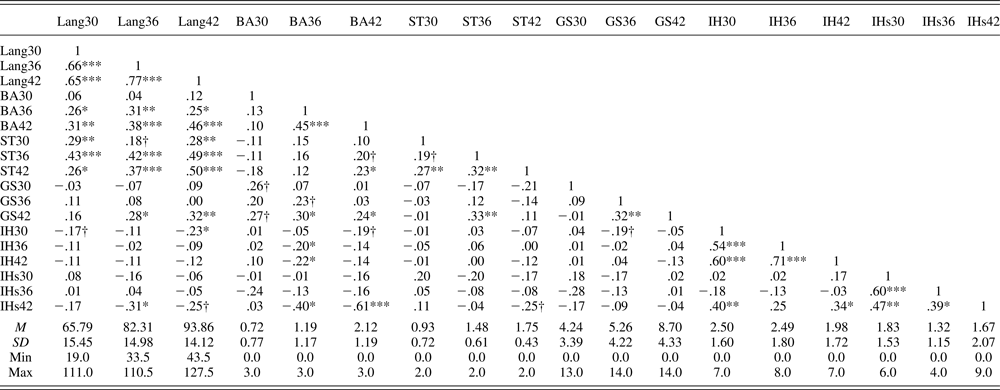
The Pearson correlations between variables in the study along with descriptive statistics (means, standard deviations, minimums, and maximums) are presented in Table 2. Cross-lagged models tested the longitudinal association between language ability and self-regulation as measured by the several behavioral tasks. We chose to analyze the behavioral tasks separately, rather than creating a composite self-regulation score because the tasks did not significantly correlate at all ages.
Table of Pearson correlations between model variables (two tailed) and descriptive statistics

Note: Lang, Language ability; BA, bird/alligator; ST, shapes task; GS, grass/snow; IH, inattentive-hyperactive problems, parent reported; IHs, inattentive-hyperactive problems, secondary caregiver reported.
†p < .10. *p < .05. **p < .01. ***p < .001.
Direction of effect between language ability and self-regulation
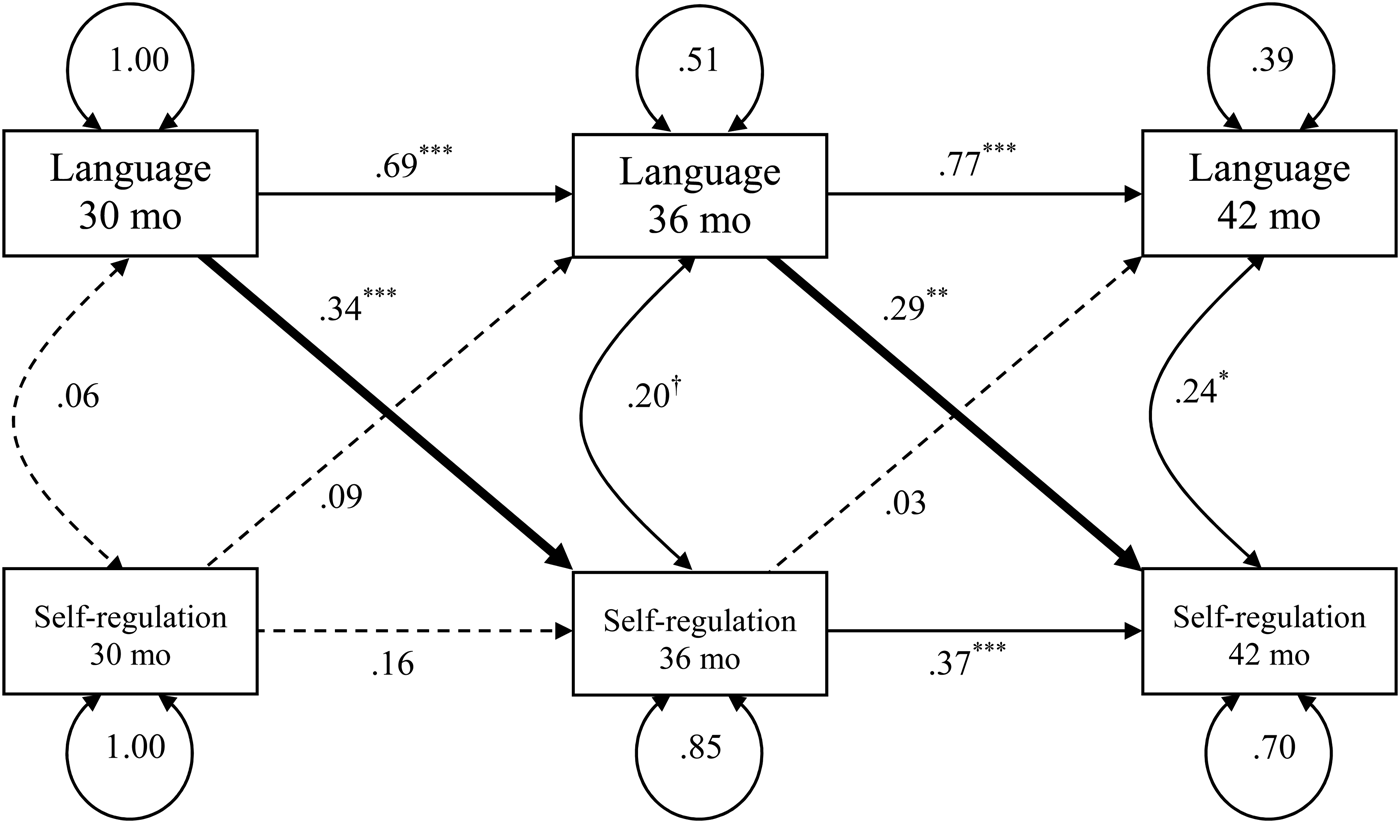
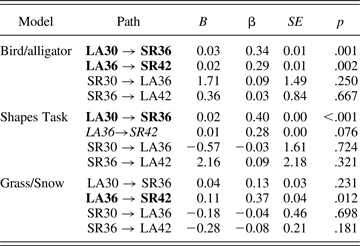
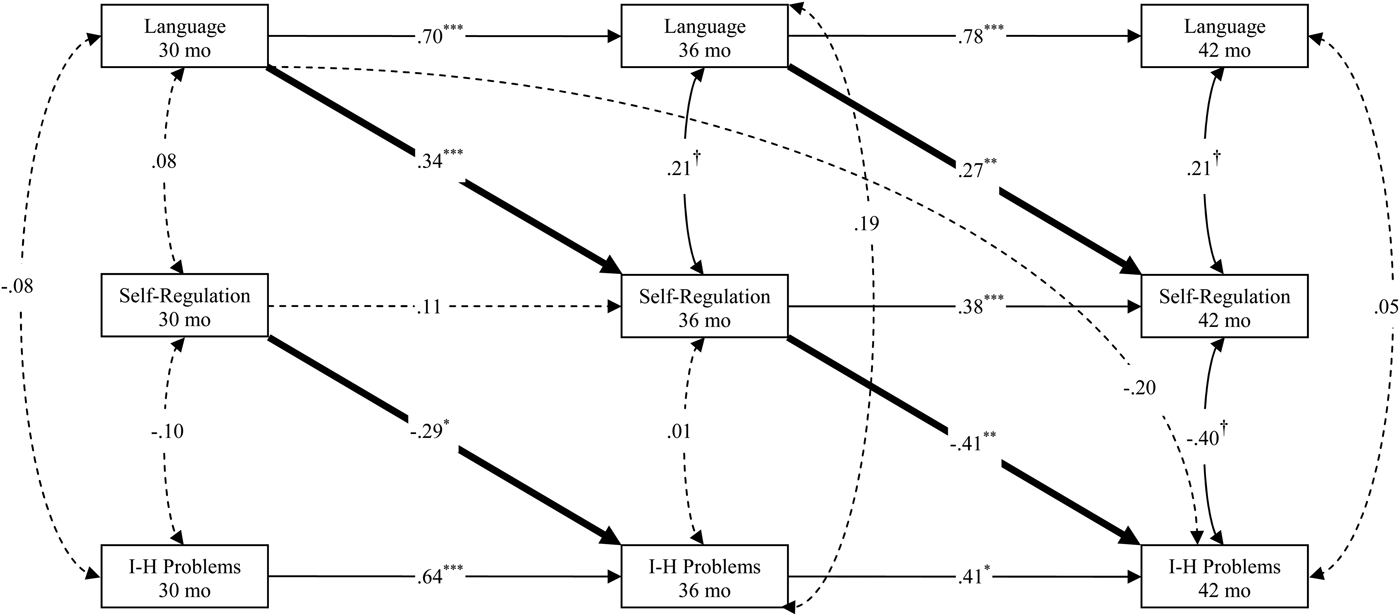
The model results are presented in Table 3. In the bird/alligator model, the full model was only marginally better at fitting the data than the proposed, simpler model, χ2 (4) = 8.21, p = .084, so for its parsimony we prefer the proposed model as the baseline model.Footnote 1 In this model (see Figure 1), language ability at 30 months was positively associated with later bird/alligator self-regulation at 36 months, even after controlling for prior levels of self-regulation. Language ability at 36 months also predicted later self-regulation at 42 months, controlling for self-regulation at 36 months. In other words, children with more advanced language ability had greater improvements in bird/alligator self-regulation than did children with less advanced language ability. The opposite direction of effect, self-regulation to later language ability, was nonsignificant at both ages. Constraining to zero the paths corresponding to the direction of effect from language ability to later self-regulation resulted in significantly worse model fit, χ2 (2) = 23.84, p < .001. Constraining the paths to zero from self-regulation to later language ability, however, did not significantly reduce model fit, χ2 (2) = 1.36, p = .506.
Cross-lagged model with language ability and self-regulation, as measured by the bird/alligator task. Estimates represent standardized regression coefficients. Bold lines represent significant cross-lagged paths. Dashed lines represent nonsignificant paths. †p < .10, *p < .05, **p < .01, ***p < .001.
Model results for cross-lagged parameter estimates
Note: LA, Language ability; SR, self-regulation. Beta estimates represent standardized regression coefficients. Paths in bold represent significant paths at the p < .05 level. Paths in italic represent paths at the p < .10 level.
Likelihood ratio tests revealed that the full model for the shapes task was better fitting than the simpler model, χ2 (4) = 12.14, p = .016, that is, some additional paths were needed for an optimal account of the data. The full model was selected as the baseline model. In this model, language ability at 30 and 36 months was positively associated with later shapes task self-regulation at 36 and 42 months, respectively. The converse was not true, however, because self-regulation at 30 and 36 months failed to predict subsequent language ability at 36 and 42 months. After constraining the paths to zero from language ability to later self-regulation, the model fit significantly worse, χ2 (2) = 17.80, p < .001. After constraining the paths to zero from self-regulation to later language ability, however, there was no significant change in model fit, χ2 (2) = 1.35, p = .510.
For grass/snow, the full model fit the data significantly better than the simpler model, χ2 (4) = 15.28, p = .004, so the full model was selected as the baseline model. In the grass/snow model, language ability at 36 months was positively associated with self-regulation at 42 months. The association between language ability at 30 months and self-regulation at 36 months was nonsignificant. In addition, self-regulation at 30 months was nonsignificant in predicting later language ability at 36 months. Self-regulation at 36 months was also nonsignificant in predicting later language ability at 42 months. With the paths from language ability to later self-regulation constrained to zero, the model fit significantly worse, χ2 (2) = 65.83, p < .001, but with paths from self-regulation to later language ability constrained to zero, there was no significant change in model fit, χ2 (2) = 1.69, p = .430.
To determine whether the stronger associations between language ability and later self-regulation than vice versa owed to the higher rank-order stability of the language ability measure, we examined the lagged associations in models without controls for prior levels, but still estimating the cross-time covariances. The findings were substantially similar, suggesting that the differences in lagged associations did not owe to differences in cross-time stability. We also examined the models when excluding the five children with language scores that were two or more standard deviations below the population mean. The findings remained substantially unchanged when excluding these outliers.
Direct effects of language ability on I-H behavior problems
We examined Pearson correlations to determine whether language ability had a direct effect on I-H behavior problems (Table 2). Considering parent-reported I-H problems, better language ability at 30 months was concurrently associated with fewer parent-reported I-H behavior problems, and language ability at 30 or 36 months did not predict later parent-reported I-H problems. Considering secondary caregiver-reported I-H problems, language ability at 30 months did not predict later reports of I-H problems at 36 or 42 months. Language ability at 36 months, however, was negatively associated with later I-H behavior problems at 42 months. Thus, there was some evidence that language ability came to be associated with later I-H behavior problems. Despite the lack of a statistically significant association between language ability at 30 months and I-H problems at 42 months, the effect was in the same direction as hypothesized.
Because of the association at a shorter time lag of 6 months (language ability at 36 months predicting secondary caregiver-reported I-H problems at 42 months), there was evidence of possible attenuation in the association with a longer time lag of 12 months. Researchers have argued that in the case of a distal effect of a predictor on an outcome, one need not establish that the predictor is associated with the outcome in order to test mediation (Shrout & Bolger, Reference Shrout and Bolger2002). In the case of a distal effect, Shrout and Bolger argued that mediation tests should be guided by theory of a mediating process. There is strong theoretical support underpinning the hypothesis that language serves a self-regulatory function, and that self-regulation deficits lead to behavior problems. Thus, we examined self-regulation at 36 months as a possible mediator of an effect from language ability at 30 months to I-H behavior problems at 42 months (i.e., an indirect effect from language ability to I-H behavior problems via self-regulation).
Longitudinal mediation model
To test the cross-lagged mediational model, we focused on the bird/alligator task, because of its consistent association with language ability, larger sample size than grass/snow, and stronger model fit than both the grass/snow and the shapes tasks in the simpler model relative to the full model (particularly for secondary caregiver-reported behavior problems). For the model predicting parent-reported I-H behavior problems, the full model was significantly better fitting than the simpler model, χ2 (13) = 27.17, p = .012. In summary, the findings offer possible support for the proposed mediational process from language ability to self-regulation to parent-reported I-H problems. Language ability was positively associated with later self-regulation from 30 to 36 months (β = 0.36, p = .001) and from 36 to 42 months (β = 0.25, p = .050). Self-regulation was not associated with later parent-reported I-H behavior problems from 30 to 36 months (β = –0.05, p = .610), but was associated from 36 to 42 months at a trend level (β = –0.19, p = .066). The effect of language ability at 30 months on parent-reported I-H behavior problems at 42 months was also not significant when including self-regulation as a mediator (β = 0.05, p = .603). The indirect effect of language ability at 30 months on parent-reported I-H behavior problems at 42 months via self-regulation at 36 months was not statistically significant at the .05 level (β = –0.07, p = .107), but was in the expected direction and the 95% CI only slightly overlapped zero (–0.15 to 0.01).
For the model predicting secondary caregiver-rated I-H behavior problems, the findings offer stronger support for the mediational hypotheses (Figure 2). We selected the simpler model over the full model for its parsimony, χ2 (13) = 17.83, p = .164. Language ability was positively associated with later bird/alligator self-regulation from 30 to 36 (p = .001) and from 36 to 42 (p = .005) months. Self-regulation was negatively associated with later I-H behavior problems from 30 to 36 (p = .020) and from 36 to 42 (p = .001) months. The effect of language ability at 30 months on I-H behavior problems at 42 months was not significant when including self-regulation as a mediator (p = .200). The indirect effect of language ability at 30 months on I-H behavior problems at 42 months via self-regulation at 36 months was significant (β = –0.14, 95% CI = –0.24 to –0.04, p = .007). Findings suggested that language ability had an indirect effect on later I-H behavior problems that was mediated by self-regulation. Specifically, children with poorer language ability developed poorer self-regulation relative to children with better language ability and, in turn, were reported to show more I-H behavior problems than did children with better self-regulation. The effect size of the mediation effect was calculated as the ratio of the indirect effect over the total effect from language ability at 30 months to I-H behavior problems at 42 months, which represents the proportion of effect mediated or P M (Shrout & Bolger, Reference Shrout and Bolger2002). The estimate of P M was .80, suggesting that 80% of the effect of language ability on later I-H behavior problems was mediated by self-regulation. By contrast, the P M of the nonsignificant mediation effect in the parent-reported model was .61. We reexamined the mediation models when excluding the 5 children with language scores that were two or more standard deviations below the population mean. The findings remained substantially unchanged when excluding these outliers.
Longitudinal mediation model between language ability, self-regulation (bird/alligator), and secondary caregiver-reported inattentive-hyperactive (I-H) behavior problems. Estimates represent standardized regression coefficients. Bold lines represent significant cross-lagged paths. Dashed lines represent nonsignificant paths. †p < .10, *p < .05, **p < .01, ***p < .001.
To examine the specificity of the role of language ability (as opposed to general intelligence) in the development of self-regulation and I-H behavior problems, we reexamined the mediation models using nonverbal ability instead of language ability. The indirect effect of nonverbal ability on later I-H behavior problems via self-regulation was not significant for parents' (β = 0.00, 95% CI = –0.04 to 0.05, p = .966) or secondary caregivers' (β = –0.04, 95% CI = –0.14 to 0.05, p = .405) ratings of I-H problems, suggesting that the mediating effect of self-regulation on I-H behavior problems was fairly specific to language ability.
For completeness, subsequent mediation analyses examined the grass/snow and shapes tasks. In the longitudinal mediation model with the shapes task, self-regulation did not mediate the effect of language ability on later parent-reported (β = –0.01, 95% CI = –0.08 to 0.07, p = .882) or secondary caregiver-reported (β = –0.02, 95% CI = –0.17 to 0.12, p = .769) I-H behavior problems. For grass/snow, self-regulation did not mediate the effect of language ability on later parent-reported (β = 0.00, 95% CI = –0.04 to 0.04, p = .994) or secondary caregiver-reported (β = 0.03, 95% CI = –0.11 to 0.17, p = .647) I-H behavior problems.
Discussion
Based on the general hypothesis that the development of language is involved in the development of self-regulation, the present study tested five hypotheses. The findings provided at least partial support. There was broad support for Hypothesis 1, that language ability would be associated with later self-regulation. We found that language ability was associated with changes in self-regulation, as measured by all three tasks (5 of 6 cross lags). There was also support in all three models for Hypothesis 2, that the direction of effect would be stronger from language ability to later self-regulation than vice versa. Self-regulation was not associated with later language ability (0 of 6 cross lags). There was limited support for Hypothesis 3, that language ability would be associated with later I-H behavior problems. Although language ability at 36 months predicted later secondary caregiver-reported I-H behavior problems at 42 months, language ability at 30 months did not significantly predict later I-H problems (although its effect was in the same direction).
Because of the theoretically informed hypothesis that language serves a self-regulatory function, we examined whether language ability might have an indirect effect on later I-H behavior problems through self-regulation deficits in a longitudinal mediation model. Findings from the bird/alligator mediation model demonstrated that language ability was associated with changes in self-regulation (Hypothesis 1) and that self-regulation was associated with changes in secondary caregiver-reported I-H problems (Hypothesis 4). Moreover, for secondary caregiver but not parent ratings of I-H problems, language ability at 30 months had an indirect effect on I-H behavior problems at 42 months through self-regulation at 36 months (Hypothesis 5), as measured by the bird/alligator task (but not the grass/snow or shapes tasks). In this bird/alligator model, self-regulation accounted for four-fifths of the effect of language ability on later I-H behavior problems. Children with poorer language ability developed poorer ability to inhibit responses relative to children with better language ability and in turn were reported to show more I-H behavior problems than did children with better self-regulation. Moreover, nonverbal ability did not have an indirect effect on later I-H behavior problems through self-regulation, suggesting that the mediating effect of bird/alligator self-regulation on I-H behavior problems was fairly specific to language ability (as opposed to general intelligence). Findings support the notion that language deficits may lead to I-H behavior problems by affecting later self-regulation difficulties. We have interpreted the pattern of findings even though it was not paralleled by results for two other measures thought to index self-regulation. The three tasks may measure different aspects of self-regulation, as evidenced by their lack of correlation at some ages.
How can it be said that the effect of language ability on I-H behavior problems was statistically mediated by bird/alligator self-regulation even though there was no direct effect of language ability at 30 months on I-H behavior problems at 42 months? Shrout and Bolger (Reference Shrout and Bolger2002) argued that one need not establish that a predictor is associated with an outcome in order to test mediation because mediational tests typically have stronger power to detect effects than simple bivariate associations, can elucidate suppression effects, and are particularly useful in developmental studies when the predictor and outcome are temporally distal, as was the case in the present study. Moreover, Kenny and Judd (Reference Kenny and Judd2014) showed that the power to detect the indirect effect is greater than the power to detect the direct effect. Thus, Shrout and Bolger argued that tests of mediation should be guided by theory rather than by an empirical association between the predictor and outcome.
Based on the strong theoretical hypothesis that language serves a regulatory function as well as prior findings that language deficits predict later behavior problems (Petersen et al., Reference Petersen, Bates, D'Onofrio, Coyne, Lansford and Dodge2013), we tested and found that language ability had an indirect effect on later I-H problems via bird/alligator self-regulation. Although we observed no evidence of suppression effects, the evidence suggests that the temporally distal nature of the direct effect of language ability on later I-H problems may have attenuated the direct effect. There are several reasons to expect that the effect of language ability on I-H behavior problems is theoretically distal in late toddlerhood (relative to the frequency of measurement in the present study). First, researchers have hypothesized (Frauenglass & Diaz, Reference Frauenglass and Diaz1985) and previous studies have shown (Bivens & Berk, Reference Bivens and Berk1990) that language has a delayed effect on self-regulation, as supported by findings in the present study that language ability predicts later changes in self-regulation.
Second, given the span of 12 months between assessments of the predictor and outcome in the mediation model of the present study, it is likely that the direct effect and the resulting mediation effect were more subtle than if the language predictor had been assessed closer to the time of the behavioral outcome. In support of the interpretation that the spacing of measurements may have attenuated the association between language ability and I-H behavior problems, there was a simple bivariate association between language ability at 36 months and secondary caregiver reports of I-H behavior problems at 42 months, but the 30-month language score did not predict to 42 months. There is considerable development in language ability and self-regulation from 30 to 42 months of age, which may have attenuated the hypothesized association.
Third, the deficits in language skills at 30 months of age may not be as diagnostic for the development of later I-H problems as deficits in language skills at later ages. Individual differences in language may not be as reliable and valid at 30 months as at later ages because language is so immature. Some children with deficits at earlier ages may catch up to their peers as part of normative individual differences in growth rates and trajectories. This is supported by evidence in the present study that individual differences in language ability appeared to become more stable in later ages. In addition, there may have been insufficient power to detect a direct effect association separated by 12 months, given not only the specific early stage of language development but also the relatively small sample of secondary caregivers and fairly weak internal consistency of I-H problems. Nevertheless, previous studies using similar models have shown that language ability predicts later changes in I-H problems among children (Petersen et al., Reference Petersen, Bates, D'Onofrio, Coyne, Lansford and Dodge2013).
For these reasons, and because of the theoretically informed hypothesis that language serves a self-regulatory function, in the present study it was important to examine the role that language ability plays in the development of I-H behavior problems by testing self-regulation as a more temporally and causally proximal mediating mechanism. The findings emphasize the importance of testing mediation longitudinally in the context of rapid developmental change, because assumptions of stationarity (i.e., constant relations among variables over time) are less likely to hold, which would bias findings in cross-sectional models (Maxwell & Cole, Reference Maxwell and Cole2007; Maxwell, Cole, & Mitchell, Reference Maxwell, Cole and Mitchell2011). The analyses were conservative and followed current best practices for analyzing mediation with longitudinal data and bootstrapping (Cole & Maxwell, Reference Cole and Maxwell2003; Little, Preacher, Selig, & Card, Reference Little, Preacher, Selig and Card2007; Shrout & Bolger, Reference Shrout and Bolger2002), which permits nonnormally distributed data and smaller sample sizes, providing further confidence in the mediational findings.
As a result, we conclude that self-regulation may mediate the effect of language ability on I-H behavior problems despite the absence of an observed direct effect of language ability on later I-H problems. Language, self-regulation, and I-H problems are constructs of emerging importance in late toddlerhood. The effects of language on later I-H behavior problems may not be evident until language skills have, with time, influenced developing self-regulation skills, which has been hypothesized and shown to be a delayed effect. The finding that language ability may ultimately have an effect on later I-H problems via self-regulation may reflect a developmental cascade, similar to other findings where the effects of a variable may not become known until later in development (Bornstein, Hahn, & Suwalsky, Reference Bornstein, Hahn and Suwalsky2013; Bornstein, Hahn, & Wolke, Reference Bornstein, Hahn and Wolke2012; Cox, Mills-Koonce, Propper, & Gariépy, Reference Cox, Mills-Koonce, Propper and Gariépy2010; Dodge, Greenberg, Malone, & Conduct Problems Prevention Research Group, Reference Dodge, Greenberg and Malone2008; Dodge et al., Reference Dodge, Malone, Lansford, Miller, Bates and Pettit2009; Lansford, Malone, Dodge, Pettit, & Bates, Reference Lansford, Malone, Dodge, Pettit and Bates2010; Masten et al., Reference Masten, Roisman, Long, Burt, Obradović and Riley2005).
The present study's findings suggest, although language ability at 30 months did not have a direct effect on later I-H behavior problems at 42 months, language ability did have an indirect effect on later I-H behavior problems through one of the self-regulation measures. Children with poorer language ability developed poorer self-regulation on the bird/alligator version of a Simon Says task (relative to children with better language ability) and in turn were reported to show more I-H behavior problems (than children with better self-regulation). These findings are consistent with the hypothesis that language serves a self-regulatory function in the late toddler years. However, the findings do not eliminate the possibility that language ability could serve multiple functions in the development of I-H behavior problems. Alternative hypotheses have been proposed, including language skills allowing children to communicate their needs and have them met, elicit inductive parenting rather than punishment, and develop social skills that are protective against peer rejection (Keenan & Shaw, Reference Keenan and Shaw1997, Reference Keenan, Shaw, Lahey, Moffitt and Caspi2003; Menting et al., Reference Menting, van Lier and Koot2011). Future studies should examine the aspects of language important for self-regulation of behavior (e.g., private speech, and expressive or receptive language). Given the modest associations between language ability and later I-H behavior problems, future studies might also examine moderators of the association to identify the children for whom lagging language abilities may matter most for the development of self-regulation deficits and behavior problems.
The finding that language skills were associated with the development of all three measures of self-regulation is consistent with previous studies (Berk, Reference Berk, Llyod and Fernyhough1999; Vallotton & Ayoub, Reference Vallotton and Ayoub2011). The lagged associations in the present study provide support for the idea proposed by previous researchers that language may have a delayed effect on self-regulation (Frauenglass & Diaz, Reference Frauenglass and Diaz1985), and previous findings of such an effect (Bivens & Berk, Reference Bivens and Berk1990). It is useful to note that the delayed association eliminates the counterinterpretation that the association between language ability and performance on the behavioral self-regulation tasks was solely a result of better comprehension of task rules. The finding that language ability predicted later self-regulation more strongly than the converse is consistent with previous findings in two samples that language predicts later I-H and externalizing behavior problems more strongly than the converse in 4- to 12- and 7- to 13-year-old children (Petersen et al., Reference Petersen, Bates, D'Onofrio, Coyne, Lansford and Dodge2013). Thus, the finding that language abilities may be important for regulating one's behavior may also be true in early childhood. Finally, the finding that language ability had an indirect effect on secondary caregivers' (e.g., teacher or babysitter) reports, but not parents' reports, of I-H behavior problems is consistent with prior findings of stronger associations between language scores and teacher-rated behavior problems than parent-rated behavior problems (Lindsay et al., Reference Lindsay, Dockrell and Strand2007; Petersen et al., Reference Petersen, Bates, D'Onofrio, Coyne, Lansford and Dodge2013). Functional impairment resulting from language and self-regulatory deficits appear to be greater in more structured nonfamily childcare and socialization contexts than in the home. Not all secondary caregivers in the present study were teachers, however, so other differences could be involved, such as minimization of child behavior problems by some parents during early childhood. Future studies should examine the role of language and self-regulation deficits on behavior problems in home and nonfamily caregiving and socialization contexts with observational methods to replicate and extend these findings.
The finding that language ability was fairly specific in its indirect effect on later I-H behavior problems is consistent with findings from previous studies that language ability has a unique association with behavior problems, controlling for aspects of nonverbal ability and general intelligence (Lynam et al., Reference Lynam, Moffitt and Stouthamer-Loeber1993; Petersen et al., Reference Petersen, Bates, D'Onofrio, Coyne, Lansford and Dodge2013; Vallotton & Ayoub, Reference Vallotton and Ayoub2011). Thus, language ability appears to be special in its association with behavior problems, particularly via self-regulation.
Even though there was stronger evidence that language ability was associated with later self-regulation than the converse, the present study does not rule out the possibility that the association between language ability and self-regulation may be transactional. It is possible that children with better language ability may develop better regulatory skills, which in turn allow them to control their behavior and focus their attention in a way that promotes their ability to learn language. Thus, although our findings suggest that language ability leads to changes in self-regulation more so than self-regulation leads to changes in language ability across intervals of 6 months to a year, we have not eliminated the possibility that, perhaps in shorter time frames, a child's self-regulation is also important for his or her language acquisition.
One limitation of the present study results from the extent of missingness in the secondary caregiver reports of attention problems, which may limit the power of the mediational analyses and the generalizability of the findings. About one-third of the families did not name a secondary caregiver for their child, presumably because they did not use any single secondary caregiver for more than 10 hr/month. This is plausible given the young age of the child (prior to typical preschool age) and the general prevalence in our sample of mothers who were not employed outside the home.
Another limitation is that scores on the various self-regulation tasks were not highly correlated at each age, and in some cases tasks were negatively though nonsignificantly associated (e.g., bird/alligator and the shapes task at 30 months), suggesting that the tasks may reflect different dimensions or combinations of self-regulation and other task demands (e.g., working memory). Nevertheless, language ability predicted subsequent self-regulation as measured by all three tasks separately, so language ability appears to be important for the development of self-regulation regardless of the measure used in the present study. However, the association depended on the child's age (e.g., language ability predicted subsequent self-regulation in the grass/snow task from 36 to 42 months but not from 30 to 42 months). Only one of the self-regulation tasks (bird/alligator) mediated the effect of language ability on later I-H behavior problems, suggesting that the tasks may not reflect the same aspect of self-regulation. Nevertheless, the bird/alligator task had a larger sample size than the grass/snow and stronger model fit than the shapes task and the grass/snow, which may partially explain the nonmediation with the other tasks.
The differences in findings may also be partially attributable to differences in the tasks' developmental sensitivity. Based on missing data (see Method section) and proportion correct statistics (see Table 1) potentially reflecting task difficulty, the different tasks appeared to have different timeframes of sensitivity to individual differences. At 30 and 36 months, the shapes task was sensitive to individual differences, but children began to reach the ceiling of the task at 42 months. In contrast, grass/snow was difficult for children at 30 months, which may be why it has the highest rate of missingness at 30 months, yet it tended to be sensitive to individual differences at 36 and 42 months. In contrast, bird/alligator tended to be sensitive to individual differences across the whole time frame, possibly because the puppets made the task more engaging for the children. Because children develop at different rates, we wanted a range of tasks that, as a whole, cover the range of ages and ability levels. Collectively, these three tasks appear to have accomplished this goal. Our findings may prove useful for understanding the developmental utility of these commonly used tasks. A final limitation deals with the correlational nature of the model design, which prevents us from ruling out the possibility that third variables could account for the associations among language ability, self-regulation, and I-H behavior problems.
The present study had several strengths. To our knowledge, the present study is the first to examine the longitudinal association between language ability and self-regulation in a cross-lagged model in order to clarify the developmental process. Second, the study incorporated several measures of self-regulation, with multiple behavioral tasks of self-regulation, building into the study a form of cross-validation of the association between language ability and aspects of self-regulation. Third, the study evaluated both parent and secondary caregiver ratings of child I-H behavior problems. Fourth, the study examined self-regulation as a mediator of the effect of language ability on later I-H behavior problems to clarify the developmental mechanisms.
Additional research is needed. The present study involved a community sample. Future studies are needed to examine the role of language and self-regulation across development in children with clinical levels of behavior problems. Of course, future longitudinal studies are needed of other kinds of representative, community sample, too. Future research might also explore the effect of language in self-regulation and behavioral adjustment through experimental tests. For example, language-oriented therapy could be the experimental variable, and language and adjustment changes in response could be measured. Language-oriented therapies are time-intensive (Law, Garrett, & Nye, Reference Law, Garrett and Nye2004), in part because of the extent of disparity in amount of language exposure between normal and at-risk children (Hart & Risley, Reference Hart and Risley1995), so cost-effectiveness would need to be considered at the same time. Findings from the present study, however, suggest that language training may not be sufficient for preventing I-H behavior problems because self-regulation may be more causally proximal. Therefore, interventions could target self-regulatory skills to prevent I-H behavior problems. One approach, Tools of the Mind, has focused on self-regulation training by incorporating aspects of Vygotskian theory, including social play, memory and attention training, and the promotion of private speech (Diamond, Barnett, Thomas, & Munro, Reference Diamond, Barnett, Thomas and Munro2007). Research on the Tools of the Mind curriculum has shown that it increases preschoolers' executive functions (for a review, see Bodrova & Leong, Reference Bodrova and Leong2009). Nevertheless, we cannot rule out the possibility that some aspects of language may be a necessary precursor for the development of self-regulation and adjustment. Future studies using finer-grained time scales or interventions will be necessary to clarify the developmental process among language ability, self-regulation, and behavior problems in order to identify the best target of intervention.
The present study is the first study to examine the longitudinal association between language and self-regulation in a cross-lagged model and to test self-regulation as a mediator of the effect of language ability on later I-H behavior problems. It provides support for a model in which children with poorer language ability develop poorer self-regulation and, as a result, impulsive and hyperactive behavior problems.