In 1874, a group of newsboys took on some of the wealthiest, most respected, and most powerful New Yorkers and emerged victorious. The Society for the Reformation of Juvenile Delinquents, a philanthropic organization that worked to guard public morals and championed Christian values, faced two challenges that year over the city's theatre licensing fee. Its prominent members and their financial power made the organization a formidable force in local city matters. As a result of the 1872 Act to Regulate Places of Public Amusement in the City of New York, theatre managers were required to pay $500 to the city for an operating license. The city gave the fees to the society, which it used to operate the city's House of Refuge. The society believed that theatres corrupted the city's youth and that, therefore, the theatres should help fund youth reform efforts. In its legal proceedings against theatres without licenses, the society typically targeted cheap entertainment establishments in poor neighborhoods. These playhouses “were not particularly powerful and presumably would not put up too strenuous a legal battle.”Footnote 1
Consequently, it is not surprising that the Society for the Reformation of Juvenile Delinquents went after the newsboys who started the Grand Duke Theatre in the Five Points, a working-class and immigrant neighborhood.Footnote 2 Sometime between 1871 and 1873, a group of newsboys between the ages of five and twenty rented out a Baxter Street basement and established their own commercial theatre. They fitted the basement with a curtain, footlights, and benches for seating more than two hundred. Charging five cents for general admission, the boys performed variety and minstrel hits from local theatres in addition to their own original pieces. Street children comprised the majority of the audience. Occasionally referred to as the Grand Duke's Opera House or the newsboys' theatre, the Grand Duke Theatre avoided major notice outside of its neighborhood until January 1874, when several newspapers wrote about the Five Points theatrical curiosity. The newspapers praised the professional quality of the performances and remarked on the theatre's importance as the first New York playhouse run by children and teenagers. The press coverage increased the number of adult visitors to the Grand Duke, but it also drew the attention and disapproval of the Society for the Reformation of Juvenile Delinquents. In February 1874, the society informed the newsboys that the law required them to pay $500 for a license. When the newsboys refused to pay and continued to perform, the local police closed the theatre in early March. The newsboys vowed to find a lawyer and fight for their theatre.Footnote 3
A few months later, in May, the Society for the Reformation of Juvenile Delinquents faced a second challenge to its authority and the theatre licensing law. The city's leading theatre managers, led by John Lester Wallack, refused to renew their licenses and launched a legal case against the city. The managers complained that their entertainments did not corrupt the city's youth, so they should not have to pay to reform them. However, the crux of their legal argument rested on their charge that the mayor and the city had acted unconstitutionally when they gave the public funds raised by the license fee to a private organization.Footnote 4
By the end of the year, both challenges were resolved. The newsboys continued to perform without paying the licensing fee, but Wallack and his fellow managers lost their case on appeal. A New York State Supreme Court judge ordered them to renew their licenses or halt all performances.Footnote 5 Since the courts typically sided with the society, it is not surprising that Wallack and the other New York City managers failed to convince the courts to declare the theatre licensing law unconstitutional, even with their wealth and social clout.Footnote 6 So why did the newsboys win? Why were the newsboys able to continue performing, even though their theatre's existence went against the fundamental principles of the society and the licensing law? If the licensing fee existed to help children tainted by the city's theatres, the society must have viewed a theatre run by children primarily for children as particularly dangerous. It had established legal precedent for shutting down theatres when managers refused to pay, and it outmatched the newsboys in wealth and social standing. Yet the newsboys still won.
The victory of the Grand Duke Theatre over the Society for the Reformation of Juvenile Delinquents may seem like a minor moment in American theatre history. It did not change the theatre licensing law or the society's dislike of performance. Yet since the conflict resulted in a historical record, it has the potential to reveal often obscured but ordinary relationships, strategies, and social group functions that characterized daily working-class life. In historian Carlos Ginzburg's conception, the newsboys' conflict with the society may be viewed as a “normal exception.”Footnote 7 The puzzling circumstances provide theatre historians with a way into the culture. As historian Robert Darnton notes, “When you realize that you are not getting something . . . you can see where to grasp a foreign system of meaning in order to unravel it.”Footnote 8 Exploring the puzzling circumstances surrounding the newsboys' victory offers theatre historians an opportunity to understand basic elements of the culture of working-class youth and its relationship to the theatre.
Tracing the Case
The remaining historical record does not state explicitly why the newsboys continued to perform and the Society for the Reformation of Juvenile Delinquents failed to pursue its charges against them. The newsboys did not leave any firsthand accounts. Typically in such cases the society would file a complaint and a suit with the New York Supreme Court, but the Division of Old Records in New York City holds no record of any case filed against the newsboys.Footnote 9 Newspapers usually covered the rulings in the cases the society filed, but they did not publish any report of an official ruling on the Grand Duke Theatre. The New York Clipper printed the only contemporary comment on the conflict's resolution. In mid-March, it reported that “several gentlemen have taken the matter in hand” and that it believed “the Grand Duke will probably be allowed to go on without paying.”Footnote 10 Who these gentlemen were and whether their efforts ultimately led to the settlement of the conflict is unclear. The New York Times speculated thirteen years later that Captain Kennedy, a policeman from the newsboys' ward, and his fellow officers possibly interceded on the boys' behalf.Footnote 11 The absence of court records and newspaper reports support that someone helped the newsboys and the society settle outside the courts, even though the person or persons' identities remain obscure. Because the courts consistently ruled in favor of the society and against the offending theatres, the society's choice to deal with the case outside the courts placed it at a distinct disadvantage. What did the society have to gain by dealing with the Grand Duke Theatre outside the legal system? And why did it allow the newsboys to continue performing?
In pursuing such questions, the only contemporary record available is the press, but using newspapers as historical evidence presents several challenges. The newspaper reports trap the newsboys and the events at the Grand Duke Theatre within middle-class perspectives and narrative conventions. The newspapers' agendas, whether they were political or commercial, shaped what and how they reported on the newsboys. It also is unclear which parts of the articles are accurate reports and which parts are fictionalizations. Despite these challenges, newspaper reports about the Grand Duke Theatre do provide vital evidence. The middle-class perspectives and narratives place the events “in a frame of reference”: “[A]ll story telling,” writes Darnton, “assumes a certain repertory of associations and responses on the part of its audience; and it provides meaningful shape to the raw stuff of experience.”Footnote 12 Thus, the newspapers' middle-class narratives provide access to cultural assumptions and values that help explain the Grand Duke Theatre conflict. It is even possible, claims Ginzburg, to “[dig] into the texts, against the intentions of whoever produced them,” and make “uncontrolled voices” emerge.Footnote 13 Although it is impossible to recover the “voices” of the newsboys, the newspapers and the evidential flaws they published help us investigate the winter of 1874 and why the newsboys emerged victorious when they challenged the Society for the Reformation of Juvenile Delinquents.
The Culture of Working-Class Male Youths and the Theatre: Another Look
Because the newsboys did not have financial or social power, their victory raises the issue of who or what was powerful enough to convince the society to leave them alone. At first glance, the most apparent reason for the newsboys' success appears to be outside pressure on the Society for the Reformation of Juvenile Delinquents. The press hints that someone of higher social standing intervened on the newsboys' behalf, but exactly who, if anyone, remains a mystery. The best indicator that the society experienced public pressure to drop the case appears in the press's defense of the Grand Duke Theatre.
At the end of February 1874, when the society first threatened to close the Grand Duke Theatre unless the newsboys paid the license fee, the press launched a staunch defense of the newsboys' theatre and an attack on the society. “The whole people cry shame upon this [action of the society],” declared the New York Commercial Advertiser.Footnote 14 Some reports expressed bafflement over the attention the society was devoting to the theatre, which showcased only “innocent amusement.”Footnote 15 The New York Evening Telegram mused, “One would imagine that so harmless an idea [as the Grand Duke Theatre] would be treated by the authorities as a joke [more] than anything else.”Footnote 16 The case received coverage outside New York City almost immediately after the society issued its first warning to the Grand Duke, including articles in newspapers in California, Colorado, Maine, Ohio, and Illinois.Footnote 17
The press launched two specific arguments against the Society for the Reformation of Juvenile Delinquents. Both challenged the function of the society and the assumption that a person's character directly correlated to his class. In February, the newsboys held benefit nights for the Sixth Ward poor, who were still dealing with the impact of the Panic of 1873. They raised $50. Pointing to the benefits, the press suggested that the goals of the newsboys' theatre were not very different from those of the society. The newsboys “elevated themselves to that ethereal plane where stand the philanthropists,” claimed the New York Evening Telegram. “They are now hand in hand with the Society for the Reformation of Juvenile Delinquents and we ask that the relationship be recognized.”Footnote 18 According to one report in the New York Sun, the newsboys also thought that the society's action did not acknowledge their contributions to the surrounding community. “Pretty rough, dough [though], boss,” a newsboy commented, “when we jest gin' a week's receipts to ther poor.”Footnote 19
The press juxtaposed the notion that the newsboys exhibited good character with its attack on the motives and morality of society members. The writers questioned whether the society's work actually helped poor children. The Sun advocated this position with the most insistence. Highlighting the situation's ridiculousness with the title “The Grand Duke Closed: Now Ask the Newsboys and Bootblacks to Pay the National Debt,” the writer described how “the feeling among the patrons of the establishment is strong, and many of them who have been objects of the care of the Society for the Reformation of Juvenile Delinquents have utterly and forever abjured all sympathy for that benevolent but somewhat shortsighted association, and declare that they will never, either as Arabs [i.e., street youths] or citizens in full feather, give to it one particle of moral support.”Footnote 20 In a brief article published in the Rochester Democrat and then reprinted in other upstate papers, another writer questioned, “A society for juvenile delinquents, is it? Really, this is a puzzle. And we can hardly be wrong in remarking that the boys had better be lost than be saved by any such Aminidab [sic] Sleek concern as that.”Footnote 21 Aminadab Sleek, a character in Morris Barnett's The Serious Family that was originated in New York by William E. Burton, represented pious hypocrisy. The charge undercut both the society's ability to carry out its mission and the character of its members. The press accused the society of attacking only people who could not fight back or afford the fee. Some even claimed that the society stole from honest money earners. The Chicago Inter Ocean viewed the society as a bully. “Now down comes a great stupid bullying policeman in the form of the SFTROIDS,” the paper complained, “demanding the money [for the license].”Footnote 22
The press suggested several solutions to the newsboys' situation, none of which involved the newsboys paying the fee. The Sun printed a quote, supposedly by a newsboy, that emphasized the absurdity and insurmountable challenge of the fee request. “You might as well expect us to buy out Comodore [sic] Vanderbilt, or to pay Mr. Stewart's taxes,” the newsboy complained, “or to cancel the national debt.”Footnote 23 The press argued that the society should drop the case completely. Others suggested that it should pay the fee on the boys' behalf or “let some noble-minded philanthropical individual perform the same gracious act.”Footnote 24
The press's attitude reflected the general views of newspapermen toward the society and the theatre licensing fee. In this context, the Grand Duke Theatre appears as an entertaining example that highlights the press's general objections. Similar arguments against the society and theatre licenses emerged during the court case between leading theatre managers of the city and the society in the spring and summer of 1874. In their coverage of the suit by Wallack and the other leading managers over the theatre license fee, the newspapers launched a similar attack on the society. The New York Times reiterated the argument that there seemed to be little connection between a decline in morals and the theatre: “For two years the tax has been submitted to, not without objection, but without open resistance.… The connection between the theatres and juvenile delinquency which should justify a tax on the former for the reformation of the latter has, no doubt, seemed obscure to many people besides the theatrical managers.… [T]his is manifestly too sweeping a charge to be otherwise than grossly unjust.”Footnote 25 The Times then reiterated the argument that some entertainments were innocent and pointed to the respect afforded to managers such as Wallack. One report even used the Grand Duke Theatre to remind its readers of the society's poor character. It asked its readers to recall how “the society which benefits by this obnoxious license act is the one which threatens to enforce its provisions on the little newsboys' Grand Duke's Theatre last winter.”Footnote 26 Clearly the paper viewed the Grand Duke Theatre as a way to generate support for the city's theatres among its readers.
The press had complicated motives for its defense of the city's theatres. Aside from genuinely disliking the fee, journalists may have feared a similar tax on newspapers for moral reasons. In the case of the newsboys, the press had a larger stake in the actions of moral reformers such as the society; the newsboys provided New York newspapers with cheap labor. Arguing for the self-sufficiency and good character of street children also implied that child laborers did not need help. Stalling reform of any kind helped preserve the papers' labor force, which provided profit for the papers, and relegated the newsboys to poor working and living conditions. The myth of the happy, self-sufficient newsboy, which the press and other popular media propagated for many years, proved difficult for child labor reformers to overcome when they pushed for child labor laws in subsequent decades.Footnote 27
There is no indication of broader protests against the society on behalf of the newsboys. Even if the society felt public pressure because of the news coverage or because of other advocates of the newsboys, the law was on its side. Why did the society bow to pressure in this instance? To understand the society's potential motives in settling the suit outside court, it is necessary to explore the middle-class narratives of the nineteenth-century poor. These narratives acted as powerful justifications for the actions of the Society for the Reformation of Juvenile Delinquents against working-class children and the theatre.
Mid-nineteenth-century reformist tracts, newspapers, and the slum genre of literature helped construct the myth of the Five Points. Charles Dickens's accounts of America and books such as George Foster's New York in Slices (1849) and James McCabe's Light and Shadows of New York Life (1872) became defining examples of the genre. The middle-class narratives frequently homogenize, simplify, and obscure the diverse and thriving culture of working-class neighborhoods. Categorizing the poor as terrifying Others who often had non-WASP ethnic and racial identities helped the middle class define its own identity. By referring to these problems with middle-class accounts, I do not mean to imply that extreme poverty and squalor did not exist in the Five Points. However, as historian Alan Mayne points out, the narratives and visual culture surrounding slums “sought to contain social contradictions by mobilizing public opinion around core principles about individual and collective behavior that purported to identify and explain the causes and effects of urban poverty, and that offered solutions for these social ills.”Footnote 28 The homogenization and exoticization of the poor advanced reformers' social and class agendas by justifying their interventions. Newspaper stories and novels about the working class were also popular among mainly middle-class readers, who both feared and were fascinated by the poor.Footnote 29 Alternate images of the working class threatened to undercut the ideologies that helped the middle class exert its influence in the daily lives of the poor.Footnote 30
The coverage of the newsboys perpetuated middle-class images of the Five Points neighborhood as a lurid and dangerous place and incorporated the Grand Duke Theatre into its lowly landscape. The articles reflected the “Urban Sketches” genre and the central role newspapers played in circulating these narratives and images. In newspaper articles, guidebooks, and novels, the general formula of this genre “involved bombarding readers with images (allegedly witnessed firsthand by the author) of the prosperous and energetic urban bourgeoisie contrasted against the poverty, vice, and immorality of the city's swelling underclasses.”Footnote 31 The genre also featured detailed descriptions of the poor and their environment. The coverage of the Grand Duke reflects these preoccupations. When the newspaper descriptions about the Grand Duke Theatre are viewed in dialogue, they provide a general picture of the newsboys and their theatre. At the same time, the newspapers present the newsboys as wretched, but entertaining, Others. Overall, the newspapers' narratives support middle-class arguments about the Five Points, the poor, and working-class children.Footnote 32
In “Urban Sketches” fashion, most Grand Duke Theatre articles are written from the perspective of an adventurous journalist who provides a first-person view of the new lower-class curiosity. After learning about the theatre's existence, the journalist gathers a group of “persons ever eager to find out anything new and particularly anxious to visit” the theatre.Footnote 33 The journalist reports on the whole experience of the evening. These reports imply that not only the theatrical performance but also the spectacle of the lower classes and their behavior are part of the evening's entertainment. Referring to the evening's mission as a search for “the genuine drama of the Five Points,” the writer for Frank Leslie's Illustrated Newspaper reminds his readers of how they should think about the neighborhood and, therefore, the Grand Duke Theatre. His writing exemplifies the language and imagery that typified these descriptions:
[The Grand Duke's Theatre is located] in the very centre of what was once noted the world over as being the spot of all others in the great metropolis where corruption, moral and physical, vice of every sort, and ignorance the most degraded, found their chosen home.… After a few minutes' travel through streets whose muddy depths were unfathomable—through a region where every house is now, or has been in its day, a resort for thieves, murderers, and criminals of every grade—where every dark corner or lonely alley might conceal a ruffian whose slung-shot or bludgeon had put many an unwary sailor or stranger “to sleep” till he was stripped and robbed—through a district which, in fact, well preserves its ancient reputation of being the most dangerous in any American city, the party at last reached the entrance to the “Grand Duke's Opera House.”Footnote 34
His walk through the neighborhood reflects how he is entering a new world and one that starkly contrasts with middle-class standards of cleanliness, Christian morality, and respectability. He also lures in his readers with promises of lurid tales that both disgust and tantalize.
As in many narratives of slumming, some reporters magnified the danger of the journey by donning of disguises and hiring protective escorts. The Brooklyn Daily Eagle correspondent “doffed our purple and fine linen, and assumed the garb of a newsboy or bootblack.”Footnote 35 His party hired a working-class guide “on whose valor and magnificent muscle, we relied upon [sic] to extricate us from any little unpleasantries.”Footnote 36 A journalist for Frank Leslie's hired a pair of detectives as guards.Footnote 37 The fact that these writers felt they needed protection to venture to the Grand Duke adds to the sense that readers gain access to an exclusive and exceptional experience.
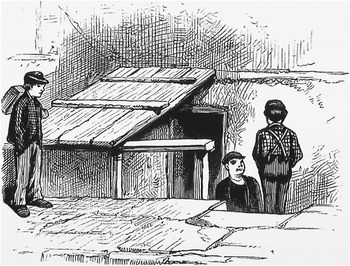
The writers emphasize their dangerous descent into the newsboys' world through their literal descent into the basement theatre (Figure 1) . The rickety staircase that leads from the street into the Grand Duke Theatre becomes a physical manifestation of the visitors' anxiety and the risk they take to experience this low-class entertainment. A visitor to the Grand Duke's “will climb down a ladder-like stairway, being careful about putting his feet where the steps are missing.”Footnote 38 The writers typically “managed to descend the stone steps, which were narrow, crooked, steep and very irregular” only “with great difficulty.”Footnote 39 Not everyone was so lucky, according to one report: “The crush [after the theatre doors were opened for the awaiting audience] was tremendous and those who fell down the eccentric steps were in a ratio of about one to three of those who climbed down.”Footnote 40
“‘Grand Entrance’ to the Theatre.” Exterior of Grand Duke's Opera House, Baxter Street at Worth, New York. From “‘The Drama in the Five Points,” Frank Leslie's Illustrated Newspaper, 17 January 1874, 316. Courtesy of the Library of Congress. The Frank Leslie's article and accompanying images emphasized the economic and cultural distance between the Grand Duke Theatre and the wealthier theatres outside of the Five Points. Writers often depicted the descent into the Grand Duke as a treacherous journey into an unknown, lowly world.

From the visitors' first glimpse of the Grand Duke Theatre, they draw comparisons between the newsboys' theatre and middle-class theatres. The comparison emphasizes the middle-class narrative that the urban poor are dirty, exotic, and unruly and reinforces the idea of a “civilized” norm that the working class is not following. In the point in his narrative when he reaches the theatre, the Brooklyn Daily Eagle reporter warns his readers to adjust their expectations: “[N]ow do not look so surprised my gentle reader, do not imagine a stately pile of brick or marble, an imposing entrance lobby, flashing lights, immense bill boards.… On the contrary, a dark, dingy wooden building, in front of which a cellar way, the steps of which realize with the greatest accuracy the term ‘a breakneck staircase.’”Footnote 41 The name of the theatre, the Grand Duke, further highlighted the contrast between the theatre's meager existance and its grander aspirations. After they enter the basement theatre, the visitors describe their surroundings and compare the stage, the audience, and the scenery to their experiences in other theatres. The fact that many of them use the same images, not only in 1874 but also in subsequent years, implies that there is some accuracy to the descriptions.
Reporters estimated that the theatre was about ten feet below the street and about twenty feet wide by thirty feet long. On one side of the room, the boys sat on wooden benches separated by a single aisle. Multiple writers said that the stage took up about a third of the room and, at least in 1874, was not raised. Some writers emphasized the claustrophobic nature of the space, pointing out that “the ceiling is so low that a tall man cannot keep his hat on and stand erect.”Footnote 42 The Brooklyn Daily Eagle correspondent wrote, “The ceiling has a tendency towards the stage of falling, which naturally causes one to experience a tremor at the prospect of being engulfed in the coal which is stored over your head.”Footnote 43 The small space seemed even more unbearable because of the theatre's tendency to overfill the audience. One visitor commented that “there were more of them than the seats would hold, and some of the overplus stood on a heap of coal in the corner, and stretched their necks to catch glimpses of the stage.”Footnote 44 Journalists also perceived the air as toxic. The Sun writer complained that the auditorium was “filled with tobacco smoke and the poison of repeatedly breathed air.”Footnote 45
Despite their limited resources, the newsboys made an organized attempt to outfit their basement with theatrical accoutrements. Describing the scenery as “primitive,” the Brooklyn Daily Eagle places the Grand Duke in line with the general degradation of the Five Points: “The drawing was fair, but the execution poor, the properties ditto, being apparently in the last stage of existence, the wardrobes of the actors barely holding together.”Footnote 46 The Sun also noted that the boys ignored “the restraints of convention” and created “scenery as the more pretentious theatres do not know of,” but unlike the Eagle correspondent, he found the boys' ingenuity and creativity entertaining. Admiring how they collected minstrel images to decorate the proscenium, he commented that the theatre and the scenery drawn on white muslin over wooden frames had “a lavishness of color and a boldness of conception that is a revelation in art to the most critical visitor.”Footnote 47 The newsboys also set up a system of footlights and a functional red drop curtain. The reporters commented positively on the curtain's system of pulleys and ropes that replicated “regular theatrical style.”Footnote 48
The writers frequently described the young staff, audience, and performers as dirty or “frowsy.” They were rowdy but were kept under control by the ticket seller, who rapped a stick, not unlike what happened in the galleries of theatres uptown. The writers remarked on how the newsboys attempted to imitate the theatre stars of the day, and many give them credit for good impersonations. The quality of boys' performances exceeded the low expectations of some journalists. They remarked with surprise at the boys' skill and how they expected some of the performers to launch successful variety careers.Footnote 49 However, the Sun highlighted moments of social dysfunction among the boys. One reporter noted that Ned Kerrigan, a star at the theatre, had recently been arrested for drunken behavior. When he showed up to the performance drunk, his behavior led to conflict with the orchestra that disrupted the performance multiple times.Footnote 50
Although narratives in the “Urban Sketches” style emphasized the poverty and danger of the working class, the positive images and the occasional praise of the newsboys featured in first-person accounts, newspaper articles, guidebooks, and stories served the middle-class myth of the spunky and resourceful newsboy.Footnote 51 This myth often focused on how the newsboy used his paper-selling skills to launch his own business. In the popular form of this narrative, such as the novels of Horatio Alger, newsboys were “incessantly starting embryonic businesses . . . and in turn initiating their peers into the possibilities of the capitalist system” and reinforcing “unswerving allegiance to the ideology and values of the American business system.”Footnote 52 These narratives suggest that this initiation into capitalist values would lead the newsboys to success and possibly to upward social mobility. This myth focused on individuals and on the exceptional potential of certain newsboys. In 1871, working-class writer Jennie Collins championed this myth when she described newsboys as “naturally the brightest, the shrewdest, and the wittiest [of their class.]”Footnote 53
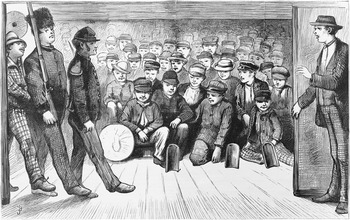
The sketches that accompanied the newspaper articles often reflected the myth of the resourceful newsboy. In these illustrations, the theatre space is depicted as small and the audience cramped, but the boys are not pictured as particularly dirty or uncivilized. In one sketch, they sit captivated by the action onstage where well-dressed boys perform a reenactment of “The Mulligan Guard,” a variety number recently made popular by the Irish American variety team Harrigan and Hart. Although the news accounts often describe chaos or unprofessional performers, the images show the boys perfectly imitating middle-class theatre behavior. The audience might be filled with newsboys, but it is ordered and attentive. However, the artists' ethnic prejudice is clearly evident, especially in their depictions of the Irish. For example, the artist of the “Mulligan Guard” image places a newsboy with simian features, a negative reference to the Irish, in the center of the audience (Figure 2).Footnote 54
“Interior of the Grand Duke's Theatre—the audience during the performance of the thrilling spectacle of the march of the ‘Mulligan Guards.’” From “The Drama in the Five Points,” Frank Leslie's Illustrated Newspaper, 17 January 1874, 316. Courtesy of the Library of Congress. The image implies that the boys performed the “Mulligan Guard” sketch in addition to the popular song and dance from the variety hit. The newsboys' version of the blackface character who carried the target and followed Harrigan and Hart's characters around stage appears to the far left.

These negative references did not prevent writers from viewing the boys as the embodiment of middle-class individualism. In some ways, the newsboys at the Grand Duke Theatre were an ideal example of entrepreneurship and of ways to incorporate newsboys into the capitalist market. They successfully used their own resources to start their own business. In March 1874, the press claimed that the boys' success had even inspired the creation of a competing theatre, the Grand Duchess. It is unclear if the Grand Duchess truly existed. However, by illustrating the boys' potential to inspire their community to engage in market competition, the mere suggestion supported the general newsboy myth. Visitors frequently remarked on the boys' potential to become the next Edwin Forrest or Edwin Booth. These comments highlight how some viewed the Grand Duke Theatre as a vehicle for the American Dream. This type of mythmaking is exemplified by Horatio Alger's choice to feature the theatre in his novel Julius the Street Boy.Footnote 55 As Karen Sánchez-Eppler and others have pointed out, Alger's novels do not show the boys moving from rags to riches. Typically, they leave their street jobs for a slightly better position that has no relation to the skills they use in the street trade they formerly practiced. As a result, the boys do not tend to change their class status drastically.
More than anything else, these middle-class accounts, newspaper reports, and stories were about the lifestyle of street children. According to Sánchez-Eppler, newsboys in particular were used literarily to “define and value middle-class childhood through the depiction of their antithesis.”Footnote 56 As middle-class childhood was increasingly defined by the lack of work and importance of play, the Grand Duke Theatre highlighted the contrast by reconfiguring even the newsboys' leisure time in the theatre as a new form of work. The newsboys' theatre became a complex symbol of working-class culture. It told a story about newsboys and leisure that simultaneously reinforced and challenged middle-class assertions. Understanding the relationship between working-class children and leisure is key to uncovering the potential motives behind the choices of the Society for the Reformation of Juvenile Delinquents.
Scholar Sánchez-Eppler explains that for Alger and other middle-class reformers, “the difference between clerk and street boy derives not from the difference in their earnings but from their different habits of expenditure.”Footnote 57 She argues that Alger and the reformers were preoccupied with “redirecting play” and often were “more troubled by [the street children's] choices in play than by their exploitation in work.”Footnote 58 Seeing children at play comforted middle-class reformers because the children still seemed capable of having fun, even if they lived in poor circumstances. At the same time, reformers also viewed working children at play as threatening and as using money irresponsibly. As a result, reformers made an effort to contain children's play.Footnote 59 They hoped to “replace their street-boy habits with habits more suited to life in a commercial industrial society and save their souls in the process if possible.”Footnote 60 In their attacks on the leisure of working-class children, reformers reserved much of their condemnation for the theatre.
Many middle-class organizations, including various Christian institutions, condemned the effect of the theatre on children. The theatre licensing act passed in 1872 cemented the negative connection between children and the theatre and gave organizations such as the Society for the Reformation of Juvenile Delinquents the backing of the city apparatuses.Footnote 61 Reformers believed that shows and audiences taught children immoral behavior. They also saw theatre as a foolish expenditure that led boys to spend their nights on the streets. One newspaper describes the choices newsboys had:
The cost of a bed and the cost of a cheap admission to the theatre . . . is the same. The theatre is not out till midnight, and then he has only three hours to wait, for he gets his early papers at 3 o'clock. If he goes to bed, he must get up in the middle of the night, or lose the most profitable part of his work. So, on the whole, he prefers the theatre, where he can have a warm seat for four hours, a great deal of gore, plenty of noise, and what he fondly supposes to be music.Footnote 62
The writer uses the choice between a bed and theatre to illustrate how the newsboys reject middle-class standards of family life in favor of an immoral and shoddy entertainment.
Reformers attempted to break children's connection to the theatre through a variety of methods. As “a means of preventing theater attendance,” Charles Loring Brace, the founder of the Children's Aid Society, gave boys free supper if they came to the Newsboys' Lodging House early and did not leave until the next day.Footnote 63 Reformers also tried to mark the distinction between the respectability of amateur performance in a private space and the danger of professional performance as a public spectacle. According to an account of the Newsboys' Lodging House by Brace, Mr. C. C. Wiegand, the superintendent of the house, made “a prolonged effort . . . to break up the theatre-going of the boys, by introducing private theatricals among them, [but] did not succeed.”Footnote 64 This account suggests that the Newsboys' Lodging House might have inadvertently contributed to street boys' desire to perform themselves.
Johnny Morrow's memoir, A Voice from the Newsboys (1860), provides the only extant published account by a newsboy from this period. He similarly discourages boys from attending the theatre.Footnote 65 Morrow approvingly comments that the Christian boarding house “now instead of charging the boys six cents for lodging alone, they charge eight cents, and give them a supper in addition. I am told also that this is used as a strong inducement to keep boys from the theatres; for if they go, they lose their supper, which to the hungry newsboy is a great loss.”Footnote 66 Later in the memoir, Morrow discusses how newsboys spend their money. Morrow claims that after paying for dinner, the boys had only fifty cents more than they had in the morning. He explains that the newsboy “can think of no better place of resort” than “the theatre, which uses up twelve cents of his earnings; and when that is over—there is nothing left but to crawl into some favorite spot to rest his weary bones!”Footnote 67 Morrow's memoir highlights in great detail the suffering, obstacles, and horrors many street children faced. However, the similarity of Morrow's comments to the language of moral reformers highlights the possibility that the “voice from the newsboy” is lost behind the “corrections” of his middle-class Christian editor. At least in the view of reformers and potentially in Morrow's view, some newsboys sacrificed the advantages of a warm meal and a bed by spending their small earnings on the theatre.
In spite of these efforts and warnings, street children were a visible and audible presence in nineteenth-century U.S. theatres. Writers in the “Urban Sketches” genre frequently included observations of street children attending the theatre. In the 1860s, one reporter highlighted how “street kids were regular habitués of Bowery theaters, museums, and similar entertainments, ‘infest[ing] the Bowery at all hours of the day and night.’”Footnote 68 During an investigation in 1882, George McDermott recorded “an audience in one theater consisting mostly of minors—at least two hundred children between seven and ten years of age, five hundred under fourteen.”Footnote 69 Reports suggest that the boys mostly frequented melodramas at the Bowery and Olympic Theatres and variety and vaudeville houses.Footnote 70 To moral reformers, the newsboys' visits to theatres ran the risk of causing moral degradation. Viewed through the framework of reformers, the newsboys' decisions to spend money at lower-class theatres also marked them as decidedly working class.
The critique of working-class childrens' attendance at theatres worked in tandem with the “Urban Sketches”–type narratives of utter poverty and vice. It also blamed the lower classes for their own condition. Rather than targeting social structure, exploitation of labor, and the class system, middle-class ideology asserted that irresponsible handling of money was partially responsible for the condition of the working class. To middle-class reformers, the fact that working-class people spent some of their limited income for leisure-time activities exemplified this issue. The Grand Duke Theatre exposed contradictions in the ideology of middle-class reformers and in propaganda about the city's poor. The newsboys who mounted and sustained the theatre offered an alternative, less intimidating narrative of working-class life that poked holes in the essence of the middle-class theory of working-class dysfunction and poverty. There is no denying that life was difficult for working-class children; I do not intend to romanticize working-class life. However, the tensions in the descriptions of the Grand Duke Theatre complicate our understanding of working-class children's lives and their relationship to the theatre. They also suggest why the Society for the Reformation of Juvenile Delinquents may have been anxious to let the conflict around the newsboys' theatre disappear.
In the formula of the newspaper coverage of the Grand Duke Theatre, discussion of prices and money played a regular role. The boys originally charged five cents for general admission, but the increasing numbers of adult visitors led the boys to change the pricing scale. Most of the seating remained only five cents, but they charged sixteen cents for the best seats and eight cents for reserved seats. Estimates of the profits for an ordinary evening ranged from one dollar to eleven dollars.Footnote 71 It is suggested that the basement cost a couple of dollars a month. Interviews with the Grand Duke's manager, Peter Connors, reveal that the boys had no problem paying the rent and splitting the money between performers. It is implied that the boys had extra funds to reinvest in the theatre. One report went so far as to state that “with the business avocation of the principals during the day and their ‘stake’ in the theatrical line,” the boys could at “the end of the year retire with a moderate competency.”Footnote 72 The image presented is not one of financial irresponsibility and ruin. They were able to pay their bills, take some money home, and still have some money to spare.
The newspapers' image of the Grand Duke Theatre highlighted the flaws in the moral arithmetic of the reformers. Looking at the typical theatre ticket prices, wages, and living costs reveals that street children were not necessarily spending all their hard-earned money on the theatre. They may have had some expendable income, however small. The cheapest seats at many variety and vaudeville houses cost only ten cents, even though some gallery seats cost as much as twenty cents. Attendance at a more legitimate playhouse would cost about twenty-five cents for the cheapest seats.Footnote 73 Boys in the street trades tended to make about twenty-five to fifty cents a day, which made attendance at most theatres affordable and left the boys a little money for food and other expenditures.Footnote 74 At the Lodging House, the boys paid six cents for a bed and four cents for a meal, which suggests that a boy could pay for a bed, dinner, and a theatre ticket.Footnote 75 There also is the presumption that boys in the street trades lived on the streets or helped support an ailing widowed mother. However, if a boy lived with his family and contributed only part of his income to the family expenses, a higher percentage of his income could possibly be spent at his discretion.
The archeological dig in the old Five Points supports the idea that some of the neighborhood's residents had expendable income. For example, the archaeologists found “evidence of material wealth in excess of expectations.” They uncovered “massive amounts of decorated ceramic teawares and tablewares, [and] glassware.”Footnote 76 In the materials dated to 1870, archaeologists found ornaments, flower pots, and figurines of dogs and shepherds. Scholar Rebecca Yamin, the editor of the seven-volume study about the dig and author of multiple academic publications about its implications, states that these finds suggest working class “attention to the aesthetics of living spaces” and “increasing participation in the consumer culture that made luxuries as well as necessities available even to people with limited incomes.”Footnote 77 Although the inhabitants of the tenements studied typified the Five Points residents in terms of ethnicity and occupation, archaeologists and historians do not suggest that all or most Five Points inhabitants had expendable income. Rather, Yamin argues that their research highlights the possibility that some members of the working class occasionally had expendable income that allowed them to participate in consumer culture.Footnote 78 In combination with the presentation of street children economics in the contemporary papers, these discoveries suggest an alternative image of working-class life that had the potential to disrupt the homogenized images of the poor in some middle-class narratives.
The conflict also troubled the assertion that the theatre hurt the morals of children, which was the justification the Society for the Reformation of Juvenile Delinquents made for the theatre license fee. Two points in particular threatened the society's overarching narrative. First, the boys did well enough financially that they could afford to donate profits to the poor. The boys were universally praised in the press for their actions to help members of their surrounding community. In a remark that was frequently echoed in the winter of 1874, the Evening Telegram explained, “In giving money to the poor [the newsboys] have shown their humanity. It is for those reasons that they should be supported, not crushed.”Footnote 79 The conflict with the society shone a spotlight on the ability of members of the working class to have a sense of community. This contrasted with the selfish individuality that characterized the images of drunks, criminals, negligent and violent parents, and irresponsible children.
That the performances at the Grand Duke Theatre were morally acceptable is implied by the complete lack of condemnation or critique. Although the appearance of the theatre was compared unfavorably to that of middle-class theatres, the newsboy performers were frequently complimented for their performances and their acting, singing, and dancing skills. “We have rarely seen the like better done,” praised the Brooklyn Daily Eagle.Footnote 80 The suitability of the boys' performances became a theme in later articles about the theatre. Interviews with theatre manager Peter Connors emphasized how the boys used clean language and never allowed girls in the theatre or onstage. One later account claimed that the manager “never allowed anything ‘wrong’ on stage, or any oaths or bad language in the house.”Footnote 81 Even when commenting on the drunkenness of Ned Kerrigan, the jig dancer, the writer praised the performer's skill. The boys' morality became a way to poke fun at a critic of the theatre, Rev. Talmage. In November 1874, the New York Herald published a group of letters in response to an antitheatre rant by Talmage. A letter from the manager of the Grand Duke claimed that “our establishment is a paragon of cleanliness in a moral as well as sanitary sense.”Footnote 82 He suggested that Talmage could learn some tips about the dramatic arts from visiting his theatre.
In addition to depicting the moral acceptability of performances, the coverage of the newsboys' theatre also rejected the individual as a key vehicle for representing the working class. In the process, it challenged middle-class myths about working-class immorality. Stories of individuals, such as Morrow's memoir A Voice from the Newsboys or Alger's novels Ragged Dick, Mark, the Match Boy, and Phil, the Fiddler, often propelled the newsboy myth. Emphasizing the experiences of individuals served reformers' goals by taking the focus off the social system that led to the conditions of the urban poor; such literature focused instead on the idea that social advancement depended on an individual's morality and work ethic.Footnote 83
Even though newspaper reports about the Grand Duke Theatre adhered to “Urban Sketches”–type narratives and the conventions of the newsboy myth, they also destabilized these narratives by emphasizing the group of newsboys as the story. In the process, details about working-class life brushed against middle-class ideologies and mythologies to provide an alternative, competing image of working-class life. Children and teenagers did not just passively absorb the theatre. They copied and adapted the acts, songs, and personas they portrayed for uses in the “discourses of everyday life.”Footnote 84 The popular theatre became a way for working-class youths to negotiate, establish, and reinforce ideas of working-class masculinity and fraternity. In effect, the Grand Duke Theatre illuminates a system of community, support, and well-being that competed with the institutions and habits middle-class reformers championed.
In the nineteenth century, moral reformers reframed the central characteristics and institutions of working-class male sociability as contributors to immoral habits and criminality. For working-class men, the saloon was key to masculinity and leisure. As moral reform tracts and reform plays such as The Drunkard warned, for some, habitual drinking led to alcoholism, a cycle of poverty, and abuse of wives and children. However, the saloon played a more complex role in working-class life. As Madelon Powers notes, “For them, to be manly was to display an unflinching sense of personal and group honor. This was observable in a group member's capacity for courage, physical prowess, and loyalty to his fellows.”Footnote 85 Leisure became one opportunity for working-class men to establish their place in this culture. Saloon culture facilitated the “interplay of market and communal orientations.”Footnote 86 When a man became a regular at the local saloon, it was expected that he would uphold a particular code of conduct that reflected loyalty and group solidarity, such as treating others to drinks and helping the other regulars through tough personal times by offering loans and support. Wagering and telling stories also were used to reinforce group bonds.Footnote 87 Unlike notions of middle-class masculinity that focused on individual achievement in the capitalist system, working-class masculinity depended on the group.
Although the boys of the Grand Duke Theatre were too young to participate in saloon culture, it still influenced their daily lives. Many working-class children rarely saw their fathers, who often went to work in the day and the saloon in the evenings. Aside from the effect of the saloon on family life, the evenings many fathers spent in the saloon emphasized the importance of male companionship. For children, the saloon became an alluring place that they hoped to enter one day. “The saloon offered a provocative model of manhood to emulate,” Powers notes, “and some young boys did apparently try to shape their personalities to suit the standards of masculinity they observed there.”Footnote 88 Newsboys who sold to saloons would have had access to saloon interiors and time, however brief, to observe the patrons' interactions.
Youth culture replicated some of the male social structure found in saloons and other areas of male working-class culture. Especially during their teenage years, boys tended to form clubs or gangs. These groups also became incorporated into middle-class narratives of working-class life. In narratives of the Five Points, gangs frequently become synonymous with criminal behavior. In Gangs of New York, Asbury claims that a gang of “juvenile terrorists” ran the Grand Duke Theatre, but this is one of Asbury's many claims that conflicts with the theatre's contemporary record.Footnote 89 Asbury's work contributed to the continuing association of gangs with vicious criminals. Yet most clubs or gangs were simply a group of friends. Powers describes how “the single greatest problem confronting these boyhood gangs was to find a meeting place where they could indulge in their favorite pastimes without fear of harassment from police, truant officers, or well-meaning reformers.”Footnote 90 For one group of friends, theatre was their favorite pastime, and they created a space of their own by renting a basement on Baxter Street.Footnote 91
A common trade also reinforced the bonds between the boys and contributed to their ideas of fraternity and community. The newsboy funeral, which Vincent DiGirolamo has analyzed in depth, provides one example of how trade unity shaped working-class male sociability. In the period 1850–1910, newsboys donated and raised money to support elaborate funerals for dozens of their fellow newsboys. One report described how “‘the surviving members of the fraternity gladly forego [sic] their meals for an entire day’” to fund a funeral or buy flowers for the gravesite.Footnote 92 Influenced by developing bourgeois ideals of commercialized funerals, the boys purchased flowers, coffins, plots, and gravestones, and coordinated and paid for hearses, undertakers, and ministers. After writing letters and resolutions of sympathy, the newsboys then marched in funeral processions through the city streets. These moments of public ritual and performance indicated how the “boys regarded themselves—and were regarded by others—as a ‘fraternity,’ as members of an organized body that had a right to mourn a fellow trader.”Footnote 93 The events also reflected working-class boys' notions of respectability, which involved “taking care of their own.”Footnote 94
The Grand Duke Theatre reflects a similar combination of bourgeois capitalism and fraternity. However, the financial organization of the Grand Duke Theatre conflicted with the capitalist system. The boys established a system in which each boy had a stake in the theatre company. As the 1874 newspaper reports noted, managers, dancers, star performers, treasurer, painters, and the ticket taker, among other positions, all earned the same amount. Manager Connors later explained, “There's no salaries. We takes the receipts of an evening and divides them up between us, each man gittin' the same as the rest.”Footnote 95 Their wage system reflected a collective organization as opposed to the hierarchical, capitalist wage system. The organization reflected the communal structure often found among men in saloons.
Accounts of the audience also convey the potential for a more egalitarian system among the newsboys. The press reports that the performers were all white and primarily Irish, although the group also included German, Italian, and British boys. The boys' surnames seem to support this picture. Aside from the manager Peter Connors, the boys who were repeatedly associated with the theatre in the press and in memoirs include assistant manager Henry Campora, performers Miles O'Reilly and Terry or Teddy Sullivan, and performer and playwright George Hawthorne. Richard Burke, Patrick Riley, and James Gillespie were minstrels. Dave Conroy took on multiple roles as actor, stage manager, playwright, and leader of the orchestra. Other frequent performers included John Daly, John Malia, Sam Bernard, and Frank Bush (more on these two later). The theatre's Baxter Street location, which it occupied for most of its existence, also reflected the mixing of various ethnic groups in the Five Points neighborhood.Footnote 96 Baxter Street was a primarily Irish and German block in the 1850s and 1860s, but by the 1870s, Italians and Polish Jews had moved there as well.Footnote 97 An Italian beer saloon or hall was located above the theatre.Footnote 98 Marriages and business partnerships across race and ethnicity were not uncommon, and families frequently rented to boarders from a different ethnic or racial group.Footnote 99
Famous Five Points public establishments and entertainments seem to have welcomed a diverse, albeit typically male, clientele.Footnote 100 DiGirolamo's research also provides evidence of interracial friendships among newsboys. New York newsboys held an elaborate funeral for Aaron Charity, a black newsboy, in the 1890s. At the Newsboys' Lodging House, “Charity's body was laid in state . . . where scores of his former colleagues filed past. … Two hired carriages carried a delegation of newsies to Mount Olivet Cemetery on Long Island, where Charity's body was interred in a private plot.”Footnote 101
Accounts of the theatre in the winter of 1874 support the notion that the members of the newsboys' theatre were multiethnic. Some suggest that the boys in the audience attended the Grand Duke frequently and knew the performers and management rather well, which implies a level of community among the street boys.Footnote 102 A reporter who visited the theatre several years later highlights the unsettling potential of the theatre to subvert middle-class social divisions, although he also exhibits ethnic, racial, and class prejudice:
The children, about thirty in number, were all bootblacks or newsboys, and all of them very dirty little people indeed. … There was one little group of Irish children, with soft, laughing blue eyes, dark hair, and ugly mouths, who clung together very much, and seemed to enjoy everything heartily. A German child, with long flaxen hair, fell asleep at an early stage of the proceedings, across the knees of a little Jew, whose almond shaped eyes were remarkably beautiful and intelligent. There was a French lad, who told me he had only been in America a year, and who spoke English quite well. … I saw two Italians, but the rest were almost all Irish, and there was only one little negro, who sat up in a corner.Footnote 103
Baffled by the presence of the black boy, the writer speculates, “I think he must have smuggled himself in, and was afraid of premature discovery.”Footnote 104 The idea that a black child might not feel out of place and threatened was confusing to the writer. It is completely possible that the boy did feel threatened. Racial prejudice and conflict played a significant role in the daily life of the working class. However, studies of race within the working class of New York City suggest that the relationships between white and black residents were more nuanced and occasionally amiable.Footnote 105 The evidence of how the Grand Duke regulated their theatre suggests that the ticket taker may have let the African American boy into the theatre. The fact that the boy's presence was not worthy of remark by the other newsboys, at least in the writer's narrative, hints that his presence might not have been unusual. Although it is difficult to state how interethnic and interracial relations worked at the Grand Duke Theatre, the image presented a more egalitarian vision of American life than that expressed in the views of reformers, many of whom were anti-Catholic.
The Grand Duke Theatre also reflected an alternative system of community support. The newspapers stated that the boys' efforts to raise money for the poor illustrated their humanity. The subtext was that the working class was not always considered kind or capable of considering other people. Yet the benefits the boys held illustrated community bonds that went beyond their small group of friends. In the winter of 1874, they held multiple benefits to help the poor in their surrounding neighborhood. Later in the year, they also “gave a two weeks performance at the parochial school in Macdougal street in aid of St. Anthony's Catholic Church.”Footnote 106 This performance indicated that at least some of the members of the Grand Duke, many of whom were Irish, envisioned themselves as part of a religious community as well.
Establishing their theatre also reconfigured how the boys conceived of their professional trade. Similarly to how the newsboys raised money to help their coworkers in need, the boys now envisioned their professional circle to include professional performers. When Dan Bryant, the famous minstrel performer, died and left his family with little money, the Grand Duke Theatre participated in the series of benefits the theatre profession held to help his family. The New York Sun celebrated the boys' contribution:
Perhaps the smallest but, not the least touching contribution to the Dan Bryant fund will be the proceeds of two Bryant benefits in the Grand Duke Opera House.… The boys come nobly to the rescue with their pennies, cheerfully adding their mite to the contributions of their big brothers … for every newsboy and boot black who could pay for his lodging and have five cents left in his pocket was at the door early to get a good seat.Footnote 107
Although they made only a fraction of the funds raised by the theatres uptown, the boys raised a total of twenty dollars for Bryant's widow and children.Footnote 108 The overlapping and primarily positive representation of community, trade, neighborhood, and religious networks portrayed a more complex image of working-class life than the criminal, selfish individualism propagated by reformers.
The content of the boys' shows gave them opportunities to express their own notions of identity, life, and labor, even if they were shaped by middle-class ideologies and theatrical conventions. The newsboys adapted these conventions to serve their own purposes and present alternative images of working-class childhood. The acts at the Grand Duke Theatre varied from a minstrel show structure to a variety structure. The newsboys most commonly performed minstrelsy and Irish sketches and songs, reflecting contemporary popular trends. They performed versions of sketches popular in minstrel houses, such as “Tom and Jerry,” “Sick Hamlet,” “Knock Me Down,” “The Rival Dancers,” “Laughing Gas,” and an adaptation of “Ambition,” written by Hawthorn. They also performed Harrigan and Hart hits such as “The Mulligan Guard” and “The Editor's Troubles.”
The boys' performance choices illustrate the complicated racial dynamics for working-class children. In combination with the proscenium, which was decorated with the faces of minstrel performers, the newsboys' strong preference for racial caricatures indicates the limits of any racial tolerance or friendship. Although the ethnic and racial composition of the newsboys' theatre points to potentially exceptional moments of collaboration and fraternity, the theatre also reinforced notions of racial difference. Even if a black newsboy did not feel threatened while sitting in the audience, the theatre's decorations and performances served as a persistent reminder of the fragility of racial harmony in the auditorium and the racial hatred that his fellow newsboys easily could direct his way. At least in the case described in the Spirit of the Times, the attraction of the newsboys' theatre seemed to outweigh the threat of racial violence.Footnote 109
The attraction of the interethnic and interracial audience to the theatre may have resulted from the newsboys' performances of the city's newest sketches and songs. One evening the theatre even apologized for the absence of some featured performers because they had gone to see the new Harrigan and Hart sketch. The boys planned to adapt the new show for their audiences. Connors apologized and supposedly explained, “We gits our pieces from the Theatre Comique and sich places, an' they're doin' a new piece there tonight—‘The Black Ball Sailors’—an' we must have it here. Yer knows that der public wants novelty, an' we're bound to give it till 'em.”Footnote 110 In copying sketches and songs from the Theatre Comique and other variety houses, the newsboys extended already established practices of appropriation and repetition by working-class youth. Anecdotes describe how newsboys whistled popular variety-show tunes as they worked, or sang the tunes on the steps of their tenement buildings. Newsboys in the gallery often committed comedic bits and song lyrics to memory and repeated them along with the performers onstage.Footnote 111
In the nineteenth century, the recirculation of the variety repertoire would not have been considered unusual. “No significant evidence” exists during these years “of any powerful norm against appropriation.”Footnote 112 Performing jokes and sketches written by others without acknowledging the source continued to be common through the demise of vaudeville in the 1930s.Footnote 113 It is possible that newsboys' performances did not bother the star performers because, in effect, the newsboys' imitations advertised the work to new potential audience members. The newsboys and their theatre also never proved a credible competitor for Edward Harrigan and Tony Hart, stars of the Theatre Comique, or for Tony Pastor, manager of Tony Pastor's New Theatre, so the boys' appropriation of sketches and songs provided no threat to the business of the major variety houses.
Borrowing variety sketches and songs illustrates one concrete way working-class youth used their theatre knowledge. Instead of functioning only as amusement, the sketches and songs suited the newsboys' own specific social and economic purposes. The audience members' exclamations of recognition, as noted by the press, imply that many in the audience had seen the sketches in the professional theatre and that this previous knowledge was key to their amusement. In addition to the simple enjoyment provided by the repetition of familiar acts, both the youths and visiting adults joyfully remarked the newsboys' credible impressions of star performers while acting or singing. The newsboys' exact commentary on the performers and their acts remains obfuscated by the nature of the evidence. However, it seems that part of the boys' excitement resulted from the novelty in seeing newsboys perform their own interpretations of popular variety work.Footnote 114
The newsboys' performances extended beyond imitations of popular acts. Newspaper reports hint that the newsboys wrote their own original sketches by naming playwrights as participants in the theatre. Only fragmentary evidence exists of the content of these plays, and most of it postdates the conflict with the society. The boys adapted Dion Boucicault's Streets of New York in their production The Streets of New York in 1876 and produced an act called “Clams; or, Life at Coney Island.” Another potential piece was entitled “Jimmy, the Sneide [sic], or the Baxter Street Duffer.”Footnote 115 A play entitled Hamlet involved characters named Hamlet, the President of the United States, Boss Tweed, and the newsboys.Footnote 116 The record might not have preserved their voices, but it seems that they inserted their own perspectives and creations into their performances. When questioned about scripted versus improvised jokes, Connors responded, “We gets off jokes we never are a thinkin' about when we go on the stage.”Footnote 117 The original sketches placed the boys, figuratively and literally, center stage.
In illustrating how the boys could act as central and deliberate actors in their own lives, the Grand Duke Theatre drew attention to the broader project of the Society for the Reformation of Juvenile Delinquents and other moral reformers. It exposed the contradictions in the ideology of middle-class reformers and in the propaganda they produced about the urban poor. In its unintentional presentation of alternative narratives of working-class community and values, the press and the Grand Duke Theatre undercut the very purpose of the society.
An 1877 defense of the Grand Duke Theatre explicitly refers to how it prompted people to reflect on the assumed connection between the theatre and juvenile delinquency, and brought attention to the contradictions in the society's philosophy. The vehement defense of the newsboys in the newspaper Spirit of the Times suggests that the newsboys' theatre's existence and success continued to irritate some reformers three years after the society agreed to let the theatre continue:
Our charitable folks are too much in the fashion of thinking that your poor little street arabs are necessarily juvenile criminals and sinners, and consequently to be much preached at and lectured at. They are nothing of the sort. The children—like all children, rich or poor—want amusement, and if they can get it of an evening, after a hard day's work, in a nice, clean, and neat little theatre, where plays suited to their age, and in which they can act are produced, it would be perhaps more salutary than to shut them up in a school-room to inspect moral copy-books. Anyway the Duke's theatre opens a field for reflection, and is unquestionably worthily conducted by poor lads, who deserve a little help.Footnote 118
“Nice, clean, and neat” might contrast with earlier accounts, but in many ways, the ultimate point the papers had made in 1874 remained the same three years later. The theatre was a way for children to add to their income responsibly and entertain themselves with “innocent” amusements that did not harm their material well-being or morality. The Grand Duke Theatre not only undercut the middle-class narratives and ideology of reformers; it also threatened to replace the prevalent images with an alternative idea of working-class children and masculinity.
The Society for the Reformation of Juvenile Delinquents may have been particularly sensitive to how it was represented to the public in 1874. The Panic of 1873 had created an increasing number of people in need of public assistance, and the great need had prompted the city to reassess its system. Many moral reformers attempted to convince the city to eliminate its municipal outdoor relief program, which allowed the poor to receive food and coal without entering institutions. Many moral reformers believed in scientific philanthropy, the “selective use of alms after an investigation disclosed the recipient's moral worth.”Footnote 119 They did not believe that outdoor relief sufficiently applied scientific philanthropy, and they believed that many poor people took advantage of the system. Charity reformers wanted public assistance funds to be placed in the hands of private charities. The crisis spurred by the Panic of 1873 convinced many in city government to consider the reformers' reasoning. The reformers and some members of the city government also hoped that private charity would break the ability of the Democratic Party political machine to use public assistance to court voters.Footnote 120
The tension over the relationship among public charity, the city, and its citizens emerged in Wallack's case against the Society for the Reformation of Juvenile Delinquents. The case reflects disagreements among the judges over the proper relationship between private charity and public funds. The first judge, Judge Donohue, ruled in favor of Wallack and the other managers. Judge Donohue warned, “It is a dangerous precedent to hold that the Legislature has the right to compel certain classes to support a private society that may, if it sees fit, do the work of the State.”Footnote 121 Judge Donohue's opinion was overturned on appeal. The new ruling explained that the defendant needed to prove only that the government can “provide for the administration of criminal justice toward youthful offenders” in order for the theatre license law to be ruled constitutional.Footnote 122 The judge also scoffed at the claim that the leading theatre managers should not be charged because their entertainments were not immoral. He argued that the law supports the public good “by preventing the degradation of all such performances in the public estimation.”Footnote 123
At a time when the Society for the Reformation of Juvenile Delinquents and charity reformers were conscious of the public debate over their role in city life, the publicity regarding the society's claim that the Grand Duke Theatre should pay $500 for a license did not work in the society's favor. An alternative, more positive image of working-class life emerged from the press coverage, one that had the potential to disrupt the justification for the society's existence. The society, however, could defend itself by defusing the conflict with the Grand Duke. As a result, the society retained its roles as an arbiter of working-class life and a vocal advocate for a conservative social agenda. The society could easily argue that its leniency toward the Grand Duke Theatre, as an exceptional theatre run by children, did not set a precedent for other working-class theatres. The defensive press coverage more or less disappeared, and the society retained its ability to collect the licensing fee from other theatres. Letting the newsboys win ultimately served the society's best interests.
The Grand Duke Theatre after 1874: The American Dream, Public Memory, and Working-Class Life
The newsboys' victory over the Society for the Reformation of Juvenile Delinquents was a limited one. The boys won the right to run their theatre without paying the theatre license fee and earned free publicity and support. Yet in many ways the boys were lucky. Without outside help or the society's decision to not pursue a lawsuit, it is unlikely that the situation would have been resolved in their favor.
The conflict's consequences extended beyond the winter of 1874. As the tensions over the Grand Duke Theatre dissipated, some boys began to see tangible benefits from the media attention. Newspaper coverage drew the attention of the professional theatre community. It was reported that Tony Pastor, Edward Harrigan, and Dan Bryant became particularly fond of the Grand Duke Theatre. As an 1887 New York Times article suggests, it is possible that actors such as Pastor and Harrigan made an effort to mentor the boys.Footnote 124 Although there is little contemporary evidence to suggest the extent of these relationships, it is likely that the boys' connections to the professional theatre community helped some of them advance quickly to the city's top variety venues.
In the midst of the conflict, the Grand Duke boys already were starting to perform in other theatres. In mid-March 1874, several boys performed in Brooklyn under the title Grand Duke Theatre Company. The Grand Duke Combination made multiple appearances in New York and Brooklyn variety theatres. John Mealia, Dave Conroy, John Daly, the Gormon Brothers, and Master Dunn performed at Tony Pastor's Opera House on the Bowery and at other prestigious variety theatres. Frank Bush became a popular ethnic monologist in variety and vaudeville, and Sam Bernard became a star with Weber and Fields.Footnote 125
As a result of the public attention and coverage during the winter of 1874, the press and the public developed a lasting interest in the newsboys' theatre that kept it alive in popular memory even after its demise. Newspapers reminisced about the Grand Duke Theatre when writing about former performers or when the city in 1887 demolished the Baxter Street building where the basement theatre had been located. In the twentieth century, the Grand Duke Theatre became a curious anecdote about working-class children in the 1870s. It was featured in novels, including Horatio Alger's turn-of-the-century Julius the Street Boy and Lyndsay Faye's The Gods of Gotham (2012), and histories such as Tyler Anbinder's Five Points (2002).Footnote 126
The material record created by the conflict and its consequences allows a glimpse into the remaining years of the Grand Duke Theatre. In spite of the fondness of professional theatre community and newspaper journalists for the newsboys' theatre, no evidence suggests they helped the Grand Duke when it faced economic trouble in the late 1870s. After the resolution of the conflict with the society, the press covered its entertainments sporadically and occasionally defended the theatre against moral reformers. Overflowing houses prompted the newsboys to rent a larger space on Water Street in 1878. However, when the theatre left the Five Points neighborhood, the newsboys left most of their audience behind too. The New York Sun and the New York Herald printed a report that illustrated the hard times the newsboys faced in 1878. They explained how one evening, Teddy Sullivan reportedly arrived at the station house drunk and asked “to be sent to the Commissioners of the Charities and Correction as he was not making any money at the Grand Duke Theatre, and was unable to obtain the necessities of life.” The next morning he “told the Judge that he felt more hopeful today, and that the theatrical season would soon be here now, and he believed that he could manage to eke out a living until then. The judge wanted to know why he felt so despondent last night, and he answered that business was so dull for a long time . . . [and] they hardly took in enough money to meet their expenses.”Footnote 127 Although the anecdote may or may not be true, it represented the journalists' belief that the downfall of the Grand Duke Theatre would hurt the boys financially and morally. After struggling to fill the seats in their new theatre during the 1878 season, the newsboys tried to move back to Five Points. The New York Herald featured an interview with manager Connors about his plans to reopen the theatre in October 1879. It is unclear if they ever found a new location.Footnote 128
During its brief existence, the Grand Duke Theatre was exceptional as the only theatre run for youth by youth and as a breeding ground for young theatrical talent. Ultimately, though, the Grand Duke Theatre's historical importance lies in the ways it provides a glimpse into the ordinary life of the working class. Although some boys acquired stable theatre jobs, they represented only a small percentage of the boys of the Grand Duke. Most of the newsboys did not experience the class mobility promised by the American Dream.
It is difficult to trace the lives of Grand Duke's newsboys, but one instance illustrates the grim reality they faced. In 1894, among its jumble of small, tight text, the New York Clipper printed a short notice in memoriam: “Pete Connors who formerly managed that unique place, the Grand Duke Opera House, Baxter Street . . . and was latterly a well-known newsdealer, died at his home in Spring Street, August 13.”Footnote 129 Twenty years after the theatre first came to the city's attention, the Grand Duke Theatre clearly held enough importance for the New York Clipper's working-class readers that the paper viewed Connors's death as printworthy. The mention of Connors's death attests to the lingering local celebrity of the Grand Duke's newsboys and the local pride of residents of the Five Points neighborhood in one of their own.
Connors's death certificate confirms the Clipper report and records his death at age thirty-two.Footnote 130 Connors remained in the news trade and lived not far from where he had spent his childhood. Unlike the more successful alumni of the Grand Duke, Connors's short life reflected the story of many working-class men and women, who lived their entire lives in poverty and squalor. If he had not been associated with the Grand Duke Theatre, it is unlikely that the papers would have remarked upon his death. Connors and the other newsboys may not have changed their class and social situations through their theatre; yet despite their economic disadvantages, they attempted to define popular performance on their own terms. Their actions challenge our ideas of youth theatre and the capacity of children and teenagers to understand and define their own leisure activities.