I. The Emergence of Multi-Drug Resistant Organisms (MDROs) as a Public Health Problem
The discovery of antimicrobial drugs such as penicillin provided treatment for large numbers of infections that were previously fatal.Reference Levy, Marshall, Lobanovska and Pilla1 Unfortunately, bacteria were soon identified that were not killed by these early antibiotics. These resistant bacteria were selected for and thrived as antibiotic use became more widespread. New classes of antibiotics were developed, and newly resistant bacteria emerged, leading to an arms race between man and microbe that continues to the present day.2 Additionally, antibiotics are added to animal feed, made available without a prescription in certain countries, and prescribed unnecessarily for viral infections where they are not effective.Reference Ventola3 These factors have contributed to an increase in human infections caused by multi-drug resistant organisms (MDROs), bacteria no longer killed by multiple classes of antibiotics. Examples of gram-positive MDROs include methicillin resistant Staphylococcus aureus (MRSA) and vancomycin resistant enterococcus (VRE). Gram-negative MDROs include extended-spectrum beta-lactamase (ESBL) producing Escherichia coli and carbapenem resistant enterobacteraciae (CRE). Unfortunately, there are now reports of gram-negative bacteria causing infections that are resistant to almost all available antibiotics.Reference Chen, Todd, Kiehlbauch, Walters, Kallen, Sonnevend, Ghazawi, Hashmey, Haidermota, Girgis, Alfaresi, Omar, Paterson, Zowawi and Pal4
In addition to causing serious illness, MDROs can also live within certain body sites such as the human gut and skin without causing signs and symptoms of illness or active infection that requires antibiotics. This is termed bacterial colonization at these sites and does not typically cause any health problems to the individual. While colonization with healthy bacteria can be beneficial, MDROs can spread to close contacts via touching of contaminated surfaces. These close contacts may be susceptible to disease from the same bacteria, especially if they have other chronic illnesses or problems with their immune systems. The spread of MDROs has been documented within both long-term care (LTC) facilities and acute care hospitals.Reference Sonnevend, Ghazawi, Hashmey, Haidermota, Girgis, Alfaresi, Omar, Paterson, Zowawi, Pal, Cassone, Mody, Guh, Bulens, Mu, Jacob, Reno, Scott, Wilson, Vaeth, Lynfield, Shaw, Vagnone, Bamberg, Janelle, Dumyati, Concannon, Beldavs, Cunningham, Cassidy, Phipps, Kenslow, Travis, Lonsway, Rasheed, Limbago and Kallen5 Hospitals and LTC facilities house large numbers of sick patients who often receive multiple courses of extended spectrum antibiotics. This is the ideal environment to select for MDROs. Hence, limiting hospital associated infections (HAIs) with these deadly organisms is a priority. In fact, leadership of the World Health Organization has expressed concern that we are entering a “post-antibiotic era” when effective therapy will not be available for serious life-threatening infections.6 This has led to a renewed interest in thinking about ways to reduce MDRO colonization and infection.
II. Antimicrobial Stewardship Programs as a Mechanism to Prevent the Spread of MDROs
Structure and Function of Antimicrobial Stewardship Programs (ASPs)
One standard approach to limit the spread of MDROs is to reduce the unnecessary use of antibiotics, especially antibiotics that are the last line of defense against MDRO infections. Appropriate antibiotic prescribing involves giving an antibiotic that kills the microbe causing the infection, administered by the correct route (e.g. oral, intravenous), at the proper dose, for the correct length of time, considering any unique patient characteristics such as allergy.Reference Dellit, Owens, McGowan, Gerding, Weinstein, Burke, Huskins, Peterson, Fish-man, Carpenter, Brennan, Billeter and Hooton7 Improved antibiotic utilization in hospitals has been accomplished in part via the formation of ASPs.
Since 2014, the CDC has recommended ASPs for all U.S. hospitals and identified seven core elements for an effective ASP.8 (Table 1) Guidelines for the formation and function of ASPs are also available from the Infectious Disease Society of America/Society for Hospital Epidemiologists.9 ASPs are led by a multidisciplinary team that includes a minimum of an infectious disease physician, infection preventionist, pharmacist, information technologist, and a clinical microbiologist.10 The ASP is charged with ensuring that antibiotic use in the hospital is for approved clinical indications with the correct dosing and duration of therapy. The overarching goal of these programs is appropriate antibiotic prescribing that results in optimal clinical outcomes, decreased antibiotic toxicity, and reduced numbers of MDROs.Reference Leuthner and Doern11
Selected elements of antimicrobial stewardship programs and how they relate to FMT

This goal is accomplished via several different mechanisms. Examples include careful selection of antibiotics on the pharmacy formulary, monitoring and restricting antibiotic prescribing, and developing guidelines for correct antibiotic use for common clinical infections (e.g. community acquired pneumonia).12 ASPs track antibiotic resistant rates for different bacteria to aid in clinical decision making and educate health care providers and patients regarding best practices to reduce the emergence of MDROs.13 This is often done through the creation of clinical pathways built into the electronic medical record that provide decision support to assist in antibiotic prescribing.
Legal Framework for ASPs
The Centers for Medicare & Medicaid Services (CMS) proposed adding an ASP requirement to the Conditions of Participation for hospitals in 2016.14 CMS issued a final rule for LTC facilities on October 4, 2016,15 that became effective in November 2017. CMS identified infection prevention and control as a critical issue for LTC facility residents because of an estimated 1.6-3.8 million HAIs in LTC facilities annually.16 By their estimate, these infections result in an estimated 150,000 hospitalizations; 388,000 deaths; and healthcare costs between $673 million and $2 billion.17 LTC residents may be more susceptible than individuals in other healthcare facilities because of their increased opportunities for exposure to infectious agents and likelihood of malnutrition, dehydration, comorbidities, and functional impairments as well as medications that diminish immunity or mobility.18
Effective January 1, 2017, the Joint Commission revised Medicaid Management Standard MM.09.01.01 for Critical Access Hospital, Hospital, and Nursing Care Center accreditation programs to require ASPs.19 While the Joint Commission is not a governmental entity with official regulatory power, accreditation by the Joint Commission is recognized by federal and state agenciesReference Wei20 as an indication that a facility meets or exceeds the standards21 required to participate in the federal and state Medicare and Medicaid programs. Of the more than 6,000 hospitals in the United States, approximately 4,000 are accredited by the Joint Commission.Reference Hyun22 For health care entities that choose to pursue Joint Commission accreditation, failure to meet a Joint Commission standard risks the entities' ability to continue to care for, and receive government reimbursement for, patients insured through Medicare and Medicaid. As a result, despite the technically “voluntary” nature of the Joint Commission's standards, they are understood by health care facilities as law. By January 1, 2017, Joint Commission-accredited hospitals and critical access hospitals were required to have ASPs in place “based on current scientific literature,”23 which included the development and implementation of infection prevention plans, in part through organization-approved multidisciplinary protocols (for example, clinical pathways).
Given the need for antibiotics in patients in hospitals and LTC facilities, even the most effective ASP will not fully eliminate MDROs. Since two primary goals of the ASP are to reduce antibiotic use and prevent the emergence of MDROs, fecal microbiota transplantation (FMT) has been proposed as a tool to aid in the fight against these difficult to treat bacteria.
More recently, CMS extended its timeline for publishing a final rule for hospitals until June 16, 2020 because it needed more time to fully consider and address the over 200 comments it received in response to its 2016 proposed rule.24 Once finalized, this rule will apply to all hospitals in the United States that receive payment from either the Medicare or Medicaid programs.
III. Is FMT a viable tool for ASPs to reduce the threat of MDROs?
Given the need for antibiotics in patients in hospitals and LTC facilities, even the most effective ASP will not fully eliminate MDROs. Since two primary goals of the ASP are to reduce antibiotic use and prevent the emergence of MDROs, fecal microbiota transplantation (FMT) has been proposed as a tool to aid in the fight against these difficult-to-treat bacteria.Reference Pettigrew, Johnson, Harris, Tosh and McDonald25 Maintaining the body's healthy normal flora is recognized as an underutilized mechanism to prevent MDRO colonization.26 As of now FMT is generally considered standard of care only for the treatment of recurrent or refractory Clostrioides (formerly Clostridium) difficile infections that do not respond to appropriate antibiotic therapy.Reference Mullish, Quraishi, Segal, McCune, Baxter, Marsden, Moore, Colville, Bhala, Iqbal, Settle, Kontkowski, Hart, Hawkey, Goldenberg and Williams27 Therefore, FMT use as a tool for ASPs would require an expansion of the current clinical indications for transplant. Additionally, ASPs have historically focused primarily on appropriate antibiotic administration. ASP utilization of FMT would require a shift in how hospitals and ASPs approach the problem of MDROs. Importantly, some hospitals already have FMT on formulary, making it readily available for delivery to patients with conditions other than recurrent or refractory C.difficile infections if approved by the ASP and hospital leadership.Reference Martin, Muñoz, Yoder, Allegretti, Smith and Kassam28
There are multiple clinical trials that support FMT as highly effective therapy for severe, recurrent or refractory C. difficile not cured by first-line antibiotics such as vancomycin.Reference van Nood, Vrieze, Nieuwdorp, Fuentes, Zoetendal, de Vos, Visser, Kuijper, Bartelsman, Tijssen, Speelman, Dijkgraaf, Keller, Shogbesan, Poudel, Victor, Jehangir, Fadahunsi, Shogbesan and Donato29 The preferred oral antibiotic for C.difficile infection, vancomycin, has a clinical effectiveness that ranges from 40-60% as defined by resolution of diarrhea and systemic symptoms.30 However, repeated courses of vancomycin for refractory disease that requires a longer antibiotic course or recurrent disease that returns after successful treatment can select for VRE, a common hospital acquired pathogen. When FMT is administered for recurrent C.difficile infection, cure rates are generally around 80%-90%.31 Although recent European guidelines do not recommend this approach,32 one way FMT could be deployed by an ASP to reduce MDRO selection would be its use as initial therapy for the first C.difficile infection or recurrence, in place of antibiotics. This would require a fundamental change in current practice and recommendations and requires additional evidence and clinical studies, but mathematical modeling suggests using FMT to treat primary C.difficile infection could reduce the prevalence of VRE carriers in hospitals.Reference Grima, Webb and D'Agata33 The expansion of FMT to treat other gastrointestinal infections, if efficacious, would reduce antibiotic use at the population level and theoretically reduce the selection of MDROs. Thus far there is little data in this area, with one study showing successful treatment for Salmonella fecal carriage in two patients after FMT.Reference Lahtinen34
A second way FMT might be used by an ASP is as a method to eliminate MDRO colonization of the gut, essentially replacing the population of MDRO with “healthy” bacteria that are more susceptible to antibiotic therapy.Reference Laffin, Millan, Madsen and Vehres-child35 Currently there is no effective way to eliminate MDRO colonization of the stool and this can be a risk factor for a future invasive infection.Reference Tacconelli, Mazzaferri, de Smet, Bragantini, Eggimann, Huttner, Kuijper, Lucet, Mutters, Sanguinetti, Schwaber, Souli, Torre-Cisneros, Price and Rodriguez-Bano36 Patients with invasive MDRO infections (e.g. bloodstream infections) have higher mortality rates, longer hospital stays, higher readmission rates, and cost more money to treat than those with infections caused by antibiotic susceptible bacteria.Reference Stewardson and Barrasa-Villar37 There is evidence that FMT can reduce antibiotic resistant bacteria in the gut. Healthy donors harbor fewer MDROs and antibiotic-resistant genes (ARGs) compared with patients who have been given multiple courses of antibiotics.Reference Millan38 In fact, patients treated with FMT for recurrent C. difficile have reduced numbers of ARGs in gut bacteria after FMT compared with prior to the transplant.39
Adverse Events from FMT
While generally considered a safe therapy, there are inherent risks in FMT therapy regardless of the clinical indication.Reference Wang, Xu, Wang, Cao, Piao, Khan, Yan, Cao, Wang, Baxter and Colville40 In addition to common adverse effects such as fever, abdominal pain, diarrhea, and bloating there are other considerations when discussing expanding FMT. The first is that stool is not a uniform product and clinical outcomes may depend on the donor.Reference Ma, Liu, Rhodes, Nie, Zhang, Rhodes, Sacks and Woodworth41 While healthy stool contains fewer ARGs than patients who have received multiple courses of antibiotics, the number is not zero and a recent study documents transmission of ARGs from the donor to the FMT recipient.Reference Leung, Vincent, Edens, Miller and Manges42 While it is currently difficult to identify all MDROs in donor stool, guidelines do recommend screening for ESBL and CRE to reduce this risk to the FMT recipient.43 In fact, a recent FDA safety alert reported invasive disease in two adults, including one death, as a result of an MDRO infection after FMT from the same donor.44 Importantly, the stool was not screened for MDROs prior to the transplant. There is also the risk of transmitting any other infectious agent to the recipient not screened for in the stool. Finally, the long-term effects of FMT are not understood and the microbes of the gut may influence diverse aspects of human health such as mood, weight, and allergy.45 These risk factors must be weighed with the potential benefits both for the patient and for the public (i.e. cure of infection, reducing antibiotic use and the transmission of MDROs).
IV. FMT Implementation Challenges for Health Care Facilities
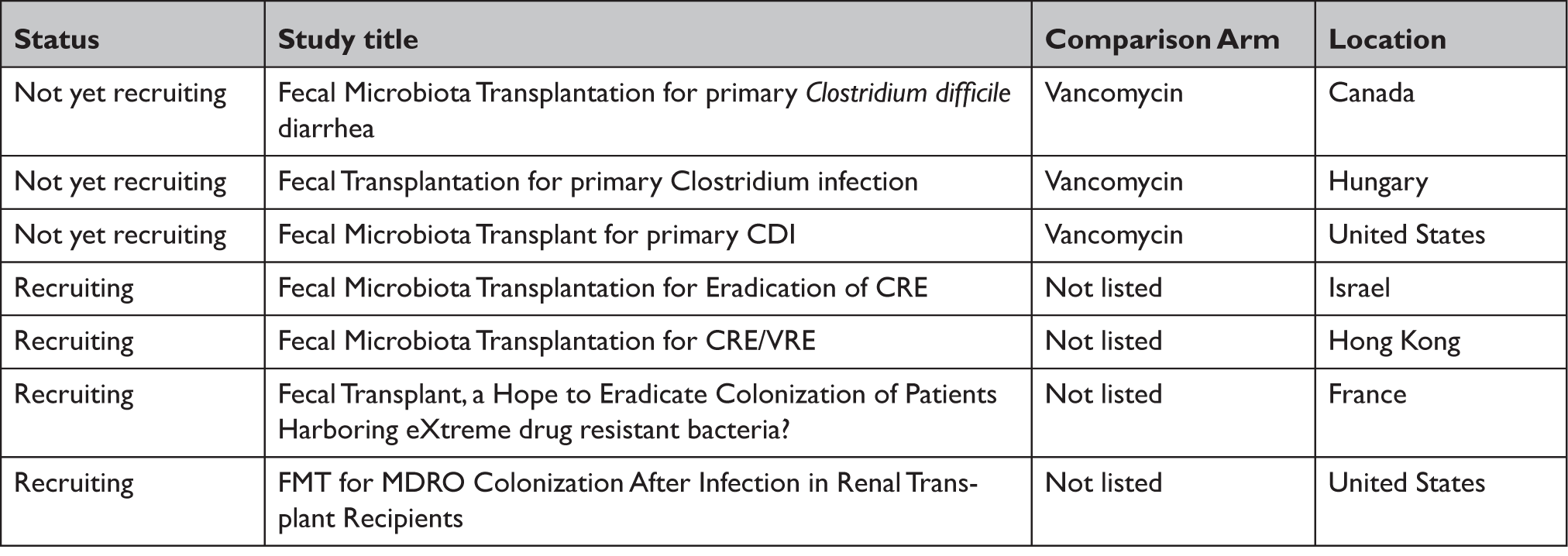
Expanding the clinical indications for FMT to decrease patient MDRO colonization requires additional clinical studies to determine whether this would be a safe and effective additional tool for ASPs. Fortunately, these studies are underway at several healthcare facilities (Table 2). An extension of FMT utilization has clinical, ethical, research, and public health implications. Variables an ASP must consider in standardizing FMT administration within a hospital include, but are not limited to, effective donor screening (whether by the hospital or other FMT supplier), the indication(s) for FMT, underlying clinical conditions where FMT is acceptable, patient age, adverse events of the FMT compared with the potential benefits, MDRO outcome measures to assess effectiveness and hospital infrastructure. Below we discuss two example cases where FMT might be utilized to reduce antibiotic use and/or the colonization of MDROs as a method to highlight the potential benefits and challenges of bringing FMT into an ASP program.
Selected Examples of Clinical Trials to Expand the Use of FMT *

* Clinical trials.gov accessed April 1, 2019.
Case 1. A 14-year-old female with leukemia is undergoing intense chemotherapy and has been re-admitted to the hospital several times in the last three months requiring multiple courses of extended-spectrum antibiotics for fever and neutropenia (low white blood cells). The patient recently was treated for a blood stream infection caused by a bacterium resistant to multiple classes of antibiotics and a surveillance stool culture confirms the patient is colonized with the same MDRO.
Case 2. A 73-year-old male presents from home with severe, new onset diarrhea after a course of antibiotics for pneumonia and is diagnosed with an initial case of C. difficile colitis. The patient has dementia and his spouse is acting as his healthcare proxy and primary caregiver at home.
For each case, we will consider the ethical implications of the proposed use, recognizing that a single case may implicate multiple overlapping ethical paradigms, including those currently framing clinical, organizational, and research ethics.
A. Clinical Ethics
“Clinical ethics” refers to a body of literature that looks at the ethical implications of clinician-patient encounters and is focused on the ethical treatment of the patient. Clinical ethics are currently most frequently discussed in terms of “principles” of beneficence, nonmaleficence, respect for patient autonomy and justiceReference Childress and Beauchamp46 and a deliberate and thoughtful consideration of a patient's medical indications, preferences, quality of life and contextual features.Reference Jonsen, Siegler and Winslade47 A clinician's decision to use FMT for clinical purposes, i.e., to cure or comfort a patient, requires a consideration of (1) whether the clinical benefit of the FMT outweighs the likely burden of the treatment, and (2) is consistent with the patient's preferences and values, taking into consideration the social, legal, spiritual, and financial implications for the patient.
Weighing the clinical benefit of FMT against the potential burdens can be difficult, especially in cases with limited evidence.Reference Ma, Liu, Rhodes, Nie and Zhang48 The scenario in Case 1 represents a novel therapeutic indication for FMT. Currently, there is no widely accepted therapy to eliminate MDRO colonization of the gut.Reference Tacconelli49 The clinical benefit of FMT for this 14-year-old with leukemia is theoretical, preventing an infection that may or may not occur. Importantly, previous colonization with an MDRO increases the risk for serious infection from the same bacteria.50 A common adverse effect of chemotherapy is to kill the healthy white blood cells required to fight bacteria, leaving oncology patients susceptible to severe infections. Patients who come into the hospital with fever and low white blood cells are given specific antibiotics, often guided by the ASP, for possible infection. If a patient is known to harbor a MDRO, they will instead get the extended-spectrum antibiotics. Breaking this cycle of extended-spectrum antibiotics to treat MDRO infections that then select for additional MDROs can best be accomplished by maintaining healthy, “normal” microbes in the gut.51
There are multiple examples of small-scale studies in the literature that describe mixed success with FMT to eliminate MDRO in the stool. For example, a recent French pilot study demonstrated eradication of CRE in only 25% (2/8) and elimination of VRE colonization in (38%) 3/8 of patients after FMT.Reference Davido, Batista, Michelon, Lepainteur, Bouchand, Lepeule, Salomon, Vittecoq, Duran, Escaut, Sobhani, Paul, Lawrence, Perronne, Chast and Dinh52 One patient with persistent VRE that remained colonized after FMT died from VRE in the bloodstream, demonstrating why strategies to eliminate these bacteria from the stool are urgently needed and also highlighting the potential limitations of FMT as a therapeutic intervention.53 Another study of 20 patients with blood disorders had a higher success rate, with 75% achieving MDRO decolonization without any serious adverse events.Reference Bilinski54 In both studies, some patients required multiple FMTs to clear the MDRO.55 There is currently not enough cumulative evidence to make a recommendation regarding the clinical utility of FMT for MDRO gut decolonization. Whether MDRO gut eradication is sustainable over a long period remains to be determined. For patients with frequent exposure to antibiotics and the healthcare system, the risk of re-colonization with an MDRO may make any intervention successful only in the short term. Whether a temporary eradication, such as while a patient is getting high risk chemotherapy, is worth the risk of FMT is likely to be patient specific. There are several clinical trials evaluating FMT for the decolonization of high-risk patients to prevent MDRO infection, including one enrolling renal transplant patients.56 (Table 2).
While the existing evidence suggests a relatively low risk profile for FMT when donors and samples are screened for MDRO colonization,57 for patients like the 14-year-old child with leukemia, FMT presents additional risk. Patients receiving chemotherapy can have a damaged gut lining such that bacteria can move more easily into the blood stream.Reference Rolston58 If the bacteria reach the blood stream the weak immune system cannot control the infection, with the potential for life-threatening illness. A review of existing scientific literature using FMT in immunocompromised patients, including those who have received stem cell transplants, finds it to be effective with a safety profile similar to immunocompetent patients.Reference Webb, Brunner, Ford, Gazdik, Petersen and Hoda59 For example, one study of eighty immunosuppressed patients reported no infections attributable to the FMT.Reference Kelly60 Another review of solid organ transplant recipients found the most common adverse effects were worsening of pre-existing inflammatory bowel disease (25%) and re-activation of existing cytomegalovirus infection (14%).Reference Cheng61 Again, no blood stream infections from the FMT were reported.62 However, the patients in the previously noted FDA safety alert were immunocompromised adults.
In Case 2, using FMT as therapy for primary severe C. difficile, the potential clinical benefit of FMT is not merely theoretical. This is the narrowest expansion of FMT because it is similar to the current clinical indication. The failure rate of antibiotics for C. difficile ranges from 40-60%. Patients who suffer recurrences must deal with debilitating symptoms and multiple courses of antibiotics. As with other populations, the scientific literature supports FMT as a safe therapy for elderly patients with C. difficile infection.Reference Friedman-Korn63 However, adverse effects for the patient in Case 2 would include exposure to an uncomfortable procedure or high pill burden potentially without his full understanding of why he was being subjected to these hardships. Unlike the patient in Case 1, the unknown long-term risks are less of a concern because of the decreased time that this patient will have for these risks to manifest. In Case 2, FMT is given as a single administration and does not require prolonged antibiotic therapy where adherence can be an issue.Reference El-Saifi, Moyle and Jones64 In other words, use of FMT may very well reduce the treatment burden on the patient (and his non-professional caregiver) when compared with 10 days of oral vancomycin given four times daily or an even longer slow taper of the drug.
A treatment failure described in the literature involves a patient discharged from the hospital on oral vancomycin.Reference Bunnell, Danziger and Johnson65 She returned to the hospital three days later with worsening diarrhea after she had difficulty filling the prescription. The high cost of the prescription (> $1000) required an insurance approval which took >48 hrs. during which time the patient was off antibiotics and the diarrhea returned.66 An economic analysis of FMT as primary treatment for C. difficile infection found FMT to be cheaper than vancomycin by about $200 dollars and also more effectiveReference Varier, Biltaji, Smith, Roberts, Jensen, LaFleur and Nelson67 The study concludes that FMT is the most cost-effective option for primary C.difficile infection, an added benefit to consider for both the patients and the health-care system.68
While non-professional home-based caregivers are frequently relied upon for providing medication to patients with dementia, the extra care requirements for effectively managing the spread of infection (both in terms of equipment and personal hygiene/care) may also require additional support that is not typically covered by health insurance.Reference Denton, Topping and Humphreys69 The challenges of filling the prescription soon after discharge and then administering it successfully over a prolonged period demonstrate why patients (and their caregivers) may prefer a single round of FMT treatment in the hospital.
There is limited published data regarding FMT as first line therapy for primary, severe C. difficile infection, replacing oral vancomycin. One small study compared 11 patients treated with antibiotics with nine patients receiving FMT for primary C. difficile infection.Reference Juul70 Antibiotics cured 45% of patients compared with 78% of patients receiving FMT.71 As of April 1, 2019, there were three clinical trials comparing FMT with antibiotics for primary C. difficile infection, although none were yet actively recruiting (Table 2).72
Once clinicians have evaluated the available treatment options (including FMT) for their likely clinical benefits and burdens, the shared decision-making model requires a conversation between the clinician and patient where the burden and risks of treatment are discussed to identify the therapy most likely to benefit the patient consistent with the best evidence and the patient's values.Reference Brody73 Early research on patients' acceptance of FMT as a treatment option suggests that many perceive FMT as “natural” and “organic,”Reference Kahn, Gorawara-Bhat, Rubin, Kahn, Vachon, Rodriquez, Goeppiger, Surma, Marks and Rubin74 but a meaningful minority of patients may have significant concern about the potential for disease transmission, means of administration, and perception of the treatment as “dirty” or otherwise contrary to their preferences.Reference Park, Mone, Price, Tzimas, Hirsh, Poles, Malter and Chen75 For patients with these concerns, the benefits and burdens of the current standards of care may be more acceptable than FMT, especially considering the limited data on the long-term and mental health effects of FMT.76
In Cases 1 and 2, this shared decision-making process is complicated by each of these patients' limited or lack of decision-making capacity. In Case 1, despite being a minor (and generally lacking the legal right to consent to or refuse treatment), the 14-year-old patient is presumed to have ethical decision-making capacity for most of her health care decisions.Reference Unguru and Diekema77 Her prior lived experience with cancer treatment means that she has a greater appreciation than many, if not most, people of the trade-off between clinical burden and benefit. So long as she is both able and willing, she should be given the opportunity to participate in the discussion of whether FMT should be used to potentially prevent additional infection.Reference Kahn, Nicholson and Gulati78 While there is early clinical data to suggest that FMT may prevent the Case 1 patient from a future MDRO infection, given the limited knowledge of long-term effects of FMT and the experimental nature of the use in Case 1, without both the patient's informed assent (if possible) and her parents' informed permission (i.e., legal consent), FMT use to prevent infection would be unethical.
Similarly, in Case 2, the 73-year-old patient should be given the opportunity to participate in the conversation regarding his care, if not to discuss the specifics of the treatment then to clarify his values and priorities. A diagnosis of dementia and designation of a health care proxy does not inherently mean that a patient lacks ethical decision-making capacity or is no longer able to contribute to the shared decision-making process.79 Additionally, as explained above, the potential clinical benefit of a single-day treatment administered in a hospital as opposed to a minimum of a 10-day course of an expensive prescription drug to be administered by non-professional home-based caregivers also implicates the patient's ability and willingness to swallow pills, any support (or lack thereof) provided for the patient's spouse in caring for the patient, and the financial resources of the couple. If the patient's priority is to return home, but the patient's spouse is concerned about whether they will be able to afford the vancomycin, successfully administer the full course of antibiotics, or otherwise handle the increased care burden that accompanies an infectious disease that presents with diarrhea in a patient with some level of cognitive impairment, then any increased clinical risk of FMT over the current standard of care may be outweighed by the reduced financial and emotional burden.
B. Organizational Ethics
“Organizational ethics” frame the nature and function of a health care organization or system,Reference Bean80 balancing “the ethical complexities of [] quality patient care with other important goals such as financial sustainability, staff well-being, and public accountability.”Reference Silva, Gibson, Sibbald, Connolly, Singer, Gibson, Sibbald, Connolly, Singer, Singer and Viens81 At present, ASPs are built into the expectations and requirements for health care organizations (hospitals and LTC facilities).Reference Jump, Gaur, Katz, Crnich, Dumyati, Ashraf, Frentzel, Schweon, Sloane and Nace82 As a result, the use of FMT as part of an ASP will implicate organizational ethics in addition to clinical and research ethics.
ASPs and other organizational or system policies to standardize or improve value-based care consider respect for the individual patient as only one factor in the ethical framework. In addition to providing quality patient care, health care organizations and systems are also responsible for improving the health of populations and reducing the per capita cost of health care.83 Bringing FMT under an ASP's authority is consistent with a health care organization's or system's responsibility for improving the health of populations provided that it is likely to reduce the incidence and prevalence of MDROs, extend the effective lifecycle of critical antibiotics, or better inform our understanding of the clinical safety and efficacy of FMT for future treatment decisions.Reference Tosh and McDonald84
Early antibiotic exposure increases the risk for atopic diseases later in life. In further alignment with the Triple Aim goal to improve population health, an ASP that reduces antibiotic exposure for the very young may reduce the risk for asthma, eczema, and allergy for these children.Reference O'Doherty, Virani and Wilcox85 Similarly, a health care organization or system may reduce the per capita cost of health care if FMT is likely to reduce a patient's length of hospital stay, likelihood of readmission, risk of contracting a HAI, or need to purchase an expensive antibiotic.Reference Waye, Atkins, Kao, Varier, Biltaji, Smith, Roberts, Jensen, LaFleur, Nelson, Varier, Biltaji, Smith, Roberts, Kyle Jensen, LaFleur and Nelson86 In fact, one study found a per patient savings of close to $30,000 with earlier FMT for C.difficile infection compared with FMT later in the course of hospitalization.Reference Waye, Atkins and Kao87 To the extent that the reduction in per capita cost of health care is likely to inure to the benefit of the hospital or system rather than the individual patient, there is a potential conflict of interest in the early adoption of FMT as part of an ASP, especially given the relatively coercive and paternalistic nature of clinical pathways to limit individual patient choice and autonomy. This might happen where orally administered FMT is less expensive for the hospital than a multiple-day course of oral vancomycin because the payment system for inpatient care tends to reflect the “average” costs of inpatient care. If there were evidence that adopting FMT as a recommended or required first-line treatment option as part of an ASP significantly increases the risk and burden to individual patients and confers the primary financial benefit to the system or organization, the decision could only be ethically justified by sound evidence that there will also be a significant public health benefit.
One way that an early adopter ASP could increase the likelihood of public benefit is to incorporate FMT as a formulary product subject to the same oversight and control by the ASP when used for prevention or treatment of infectious disease.88 Inherent in an ASP's work is systemic review of antimicrobial agent utilization and revision of clinical pathways for internal quality improvement purposes.
the role of the asp in evaluating an fmt initiative
Further clinical evidence is required to support FMT as a first line therapy for C.difficile colitis. If it were effective for this clinical scenario, though, FMT potentially accomplishes several goals of the ASP: (1) reduces the use of vancomycin and the number of patients colonized with VRE, (2) reduces the number of HAIs from VRE, (3) further decreases the use of extended-spectrum antibiotics, cost of care and selection for MDROs. As with Case 2, FMT use could be standardized across the institution as part of a clinical pathway for primary C. difficile infection where patients at high risk for antibiotic failure start treatment with FMT. Outcome measures that determine the success of FMT for initial cases of C. difficile should involve both the success of treatment for the patient as well as any potential impact on infections and antibiotic use for the hospital. Examples of measurable patient outcomes to assess whether FMT is successful compared with antibiotics include rates of cure, readmission rates, lengths of hospital stay, cost of care and adverse events including HAI or hospital-related disability. Examples of hospital outcome measures to determine whether earlier FMT is beneficial to the overall patient population are a reduction in the number of vancomycin doses given and decreased numbers of hospital acquired VRE infections.
The problem of eliminating MDRO from the gut has been difficult to solve. Current data that FMT will be a viable solution are limited and inconclusive with additional studies on-going. If clinical studies emerge to support this indication, it is an appealing use-case for an ASP to consider as one method to reduce the risk of invasive MDRO infection in high-risk patients. If FMT successfully reduced MDRO gut colonization it would accomplish several goals for both the patient and the hospital: (1) reduce the burden of MDRO colonization for some of the sickest patients in the hospital, (2) maintain patients on clinical pathways with standard antibiotic use, reducing use of the extended spectrum antibiotics, and (3) reduce the risk of invasive MDRO infection in a select group of patients. As with Case 1, the ASP could standardize care by introducing FMT into clinical pathways for patients with a history of MDRO infection who are at high risk for severe infection in the future. Monitored outcomes might include the number of invasive MDRO infections in FMT recipient patients and the number of prescriptions for extended spectrum antibiotics. Theoretical benefits beyond reduced risk of MDRO infection to the patient include decreasing MDRO transmission from patient to patient throughout the hospital and possibly a shorter hospital length of stay. This has the potential to drop overall hospital rates of MDRO infection. Fewer patients with MDROs would also reduce the number of patients on contact precautions where all healthcare personnel wear a gown and gloves prior to entering the room. These infection prevention requirements cost additional money and are a known barrier to care because providers are less likely to enter a room with precautions compared with a room that only requires hand washing.Reference Kullar, Vassallo, Turkel, Chopra, Kaye and Dhar89
C. Research Ethics
ASPs are actively engaged in the collection, review, and analysis of patient-specific data for purposes beyond the immediate clinical care of those patients. In other words, ASPs conduct “systematic investigation,”90 of “identifiable private information” belonging to “living individual[s],”91 all aspects of human subjects research that are subject to regulation by the federal government. Despite meeting many of the elements of what it means to be human subjects research governed by the federal Common Rule,92 an ASP's system evaluation and quality improvement is not traditionally considered to be human subjects research because it is not “designed to develop or contribute to generalizable knowledge,” but rather solely for localized ASP operations.93
Additionally, ASPs are not typically understood as conducting human subjects research because they are driving the standard of care within an organization, informed by evidence-based decisions pertaining to standardized FDA-approved products. Because of the continuing variability between stool samples and the lack of any FDA-approved product, the FDA expects that FMT in the United States will be performed under the regulatory framework of an Investigational New Drug (IND) application,94 including compliance with regulatory requirements for clinical investigations95 like informed consent96 and review by an institutional review board.97
The antimicrobial agents typically controlled by an ASP have all been FDA-approved for at least one indication but have not always used exclusively for FDA-approved or otherwise evidence-based indications (thus, the need for ASPs). Similarly, it is foreseeable that some physicians may use FMT for additional clinical indications not yet accepted as standard of care. An example might be an ill patient with inflammatory bowel disease who has not responded to multiple, FDA-approved standard therapies where there is some evidence FMT may be beneficial. These individual cases may not be published to contribute to the general knowledge.Reference Khoruts, Hoffmann and Palumbo98 Until such evidence exists to expand FMT as standard of care, any new use case should be considered experimental and treated as research,99 ideally part of a larger study. As a result, it should comply with the ethical (and federal regulatory) framework for clinical studies and INDs.100 Any ASP quality improvement or system evaluation efforts related to FMT utilization as a method to prevent or treat infectious diseases should be more widely disseminated than an ASP's typical scope may support. Any potential public health benefit of FMT use to reduce transmission of and infection by MDROs requires widespread dissemination of this information. This is likely to limit, perhaps appropriately, an ASPs willingness to implement routine use of FMT at the institutional level unless there is a clear distinction between standard of care (e.g. treatment for recurrent C.difficile infection) and research indications.
Because research requires (as much as possible) standardized interventions and methods, ASPs adopting FMT should rely primarily on a single source of product. Similarly, because ethical research requires the minimization of known risks, this single source should be one vetted for rigorous screening of donors using criteria currently established in the field.Reference Woodworth, Neish, Miller, Dhere, Burd, Carpentieri, Sitchenko and Kraft101 The recent FDA safety alert regarding the risk of transmitting MDROs during FMT from unscreened stool emphasizes the need for such careful screening of donor material as well as the value of continued research and the dissemination of new information about the risks and benefits of FMT as it becomes available. Additionally, because of the potential divergence between the researcher's and individual patient's interests, research ethics (and the current federal Common Rule)102 require external consideration/review of research protocols for equipoise (i.e., a state of genuine uncertainty regarding the comparative therapeutic merits of each arm in a trial), minimization of risk for subjects, written disclosure of foreseeable risks (including both physical and privacy risks), equitable and uncoerced recruitment of subjects, and research-specific informed consent (with the option of withdrawing at any time).Reference Freedman, Hey, Weijer, Taljaard and Kesselheim103 If there is substantial “off-label” use of FMT at an institution not being performed as part of clinical trials, an ASP could potentially step in via its formulary oversight to ensure FMT is dispensed only for approved indications.
In order for an ASP to ethically support the use of FMT in Case 1 or Case 2, or any other indication that is not currently standard of care, any ASP-approved indication or clinical pathway would also need to incorporate the research-specific informed consent components and institutional review board approval. Both children and adults with dementia are considered vulnerable populations that are often underrep-resented in biomedical research given their relative need for care and new therapies.Reference Jongsma, Bos and van de Vathorst104 “Their dependence and limited decision-making capacities increase their vulnerability, necessitating extra precautions when including them in clinical trials.”105 Research with incompetent research subjects is considered ethical only if the population is necessary for the research and cannot be conducted with competent subjects.106 Research that involves more than minimal risk to children, as Case 1 presents, may be justified by the prospect of direct benefit to the individual subjects (i.e., the potential prevention of MDRO infection). For this research, the Common Rule additionally requires that: (1) the relation of the anticipated benefit to the risk is at least as favorable to the subjects as that presented by available alternative approaches (i.e., the anticipated benefits and risks of FMT are at least as favorable as the current standard of care to prevent infection), and (2) “adequate provisions are made for soliciting the assent of the children and permission of their parents or guardians.”107 Although there are many studies of FMT in other pediatric populations (e.g., with C.difficile infection or inflammatory bowel disease), the research to support the use of FMT in children to reduce MDRO colonization comes primarily from competent adults and may not fully inform the risk and benefits of FMT in Case 1. Additionally, the patient's lack of legal right to consent in this situation (the source of her incompetence) does not necessarily reflect an ethical lack of capacity. She may be able, and should be encouraged, to evaluate whether she will assent to the research.
For Case 2, the Common Rule allows a subject's legally authorized representative, e.g., a health care proxy, to consent to participation in research, provided that the legally authorized representative is provided meaningful information about the research in language understandable to the representative and given sufficient opportunity to discuss and consider whether or not to consent to patient participation. The consent process must also minimize the possibility of coercion or undue influence.108 Here, the use of FMT for initial C. difficile may be researched in competent subjects; it is unlikely that a patient's diagnosis of dementia would uniquely affect his clinical response to FMT insofar as treating his C. difficile infection. To the extent, though, that a patient's likelihood of treatment failure on an extended course of vancomycin is increased by a concurrent diagnosis of dementia because of the reliance on non-professional home-based caregivers and possible difficulties with swallowing pills associated with dementia, the inclusion of patients like the 73-year-old in Case 2 may be ethically justified.
For the patients in both Case 1 and Case 2, the current Common Rule is silent on their ability to withdraw from the study. “Competent research subjects always have the possibility of withdrawing their consent at any time, for whatever reason.”109 Because the Case 1 and Case 2 patients both lack the legally recognized ability to consent, they should not be assumed to share the competent patient's agency. Instead, they must depend in large part on others for protecting their well-being during the trial.110 To the extent that incompetent research subjects can express their dissent, i.e., their wish to discontinue participation in the research, this wish should be respected.111 Additionally, inclusion of incompetent research subjects should explicitly require heightened monitoring for these subjects and they should be withdrawn if they appear unduly distressed.112
At this point, there is enough data for ASPs to ethically support FMT for recurrent and refractory C. difficile infections. Once on the formulary, though, ASPs may also restrict the use of a therapy to specific indications. FFor the cases presented above, ASPs should restrict use of FMT to structured research protocols that will improve general knowledge of the risks and benefits of FMT until more data is published to support its use as standard practice for a new clinical indication.
An important variable to consider in expanding the indications for FMT is which patient populations will be eligible for the transplant. Previous trials have included both immunocompetent and immunocom-promised patients as well as children suggesting these would be candidate populations for additional clinical indications for FMT. An ASP will have an important role in defining which patients within the hospital are eligible for FMT to reduce MDRO colonization. This decision making can be guided in part by the results of previously published papers and on-going clinical trials (Table 2) with careful attention to both the efficacy of and the adverse events from FMT.
Summary
There are many considerations when evaluating FMT as a tool for ASPs to reduce antibiotic use and MDRO colonization. Potential benefits to the patient include faster cures (less dependent on patient adherence and nutrition, and access to assistance for personal care), reduced antibiotic exposure, and less transmission of MDRO in the community and hospital. Benefits to the institution and the community might include reducing the burden of MDRO, reducing overall antibiotic exposure, and further reduction of antibiotic complications such as C. difficile infections. These potential benefits must be weighed against the risks which for the patient include the adverse effects that can be mild, discomfort of the FMT procedure, or severe, invasive infection from a donor MDRO resulting in death. There are also the potential unknown long-term effects of FMT on overall health that are of concern to younger patients. The true nature of the long-term benefits and risks of FMT in any of these areas require much additional study. Given the variability among donors and recipients the extended risk/benefit ratio for FMT is unlikely to be clear for some time.Reference Woodworth, Sitchenko, Carpentieri, Friedman-Moraco, Wang and Kraft113 At this point, there is enough data for ASPs to ethically support FMT for recurrent and refractory C. difficile infections. Once on the formulary, though, ASPs may also restrict the use of a therapy to specific indications. FFor the cases presented above, ASPs should restrict use of FMT to structured research protocols that will improve general knowledge of the risks and benefits of FMT until more data is published to support its use as standard practice for a new clinical indication.