Ita Segev stands onstage, blanketed in darkness. She stares head-on, reciting words as they are projected onto a back wall, attuning her audience to the lineage from which she has emerged. Segev conjures an impossible past: one that didn’t designate her gender at birth as male; one that isn’t predicated on the historic and ongoing violence and land-theft from Palestinians; one that doesn’t erase and rename that history as Israel’s. As Segev recites the text, her voice is distorted, modulated to sound both human and machinic. Segev’s speech is accompanied by a video that captures a Passover tradition — the counting of the plagues — refashioned by her to encompass both gendered and state-mandated travesties: plagues of singularity, narrativity, and citizenship.
Developed at Brooklyn Arts Exchange in 2018 and premiering at Gibney Dance on 3–5 October 2019, Knot in My Name is a transfeminine, anti-Zionist performance. Directed by Tristan Powell, it is an elaborate journey into a riddled psyche as it is attempting to synthesize the marginalization of transgender identity and a history of violent complicity in the occupation of Palestine. Embracing this abundance, Knot in My Name is at once a solo show, performance art, a dance and movement piece, and a political document, expressed through a synthesis of experimental and multimedia performance. Segev’s savvy use of technology elucidates mutually dependent investments in gender and nation. Collaborating with multimedia artist Matt Romein, Segev uses transaesthetic strategies to articulate novel modes of identification and subjectivity for performer and audience alike. Segev utilizes the mechanics of video projection, in particular, to deconstruct notions of a singular and cohesive body, the metonymic relationship imposed on citizens by their state, and the joint unfolding of transition and her migration to the United States.
Jian Chen and Lissette Olivares define “transmedia” as work that expresses transgender and gender-nonconforming experience whilst simultaneously transforming the relational boundaries between politics, aesthetics, and representation (2014:245). The traditional mediated narrative in which Segev intervenes is one where both transgender and Israeli experience are portrayed as religiously linear: from a state of bewilderment and disarray, a diasporic/dysphoric body forms anew, reassembled into the form it always intended to be, living happily ever after with no memory of its cast-off pasts. Breaking with this worn-out narrativization, Segev repeatedly presents a palimpsestic understanding of both nation and gender. Her image is always multiplied atop itself onstage, projected and distorted to convey the labor of making identity and the fragility of holding identity together. These dynamics are foregrounded in this adaptation of the “solo” show model, which Segev deforms by making all collaborators visible — including technical and musical support, her costume changers, who Segev refers to as care laborers to reflect their transcendence of the stagehand role, and an interjecting director — all helping Segev transition from scene to scene.
As the opening video comes to a close, Segev is revealed onstage. Romein approaches her with an iPhone, which Segev positions up close to her face. Assuming the role of her own ancestral grandmother, she wears a traditional Jewish headcover and a modest looking dress suit, speaking to herself through the camera and projected image. The audience is at once confronted with Segev’s physical body and the presence of her grandmother, mediated through projection. She deftly assumes the role of an elderly Jewish woman’s ghost, almost dead serious, creating a comedic splitting of the body and face as a conversation unfolds with a distant relative who is, coincidently, herself. Segev splices this speech with pregnant pauses where she looks out into the audience, allowing them to take in this split and laugh, never attempting to create a performative illusion of getting lost in character. This is a recurring gesture that Segev utilizes in order to queer the matter of representation, displaying it as bumpy and rambunctious guise, one that can never fully subsume the actor or the subject. This is not merely an enactment of transmedia, where “communications technology and the gendered body itself are virtual ‘prostheses’ that provide zones of active social interaction, boundary shifting, and communicated meaning” (Chen and Olivares Reference Chen and Olivares2014:246). By producing herself doubly Segev cracks representation open, reimagining her own heritage as a virtual prosthesis that disperses rather than reaches in one direction. Temporal and spatial boundaries interrupt one another, both at the level of the performance’s diegesis and the audience’s experience.
Via her ancestral grandmother, Segev affirms her own transidentity by claiming it as a “tiny seed,” passed down to her through generations, hidden “in a forest of deception.” Segev intentionally muddles together what is inherent and inherited, phantasmically reorienting the worn-out and predominant narrative of transfolk merely being born in the wrong body. The tiny seed as legacy upsets a neat dichotomy between nature and nurture, situating Segev’s transgression as spiritually guided. Tending to the seed, with its implications of caring for and stewarding land, simultaneously echoes her Israeli nationality.
The linkage between state and gender has been explored by Israeli queer theorists who have elucidated the historic investment in the construction of a strong national ethos through a remodeling of the Jewish man, from feminine and learned to masculine and land-working, making the transgender woman a grave transgressor and distinct enemy of the Israeli project as she returns to a disavowed past (Ziv Reference Ziv and Peele2007:128). Segev laces her performance with poignant critique that touches upon this transgressive marking, but she does not do it from the position of queer theory’s constitutive outside. Instead, she frames her gendered inheritance within a colonial logic that defines transwomanhood as part and parcel of this violent project of transformation.
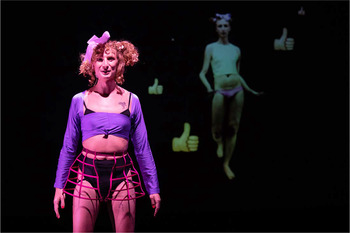
Segev performs this critique by assuming and discarding a plethora of personas that mediate and distort notions of coherence and linear narrativity within the Israeli foundational myth. As she disrobes from her great-grandmother’s garb and headscarf, Segev performs a transformation into an awakening baby bird. Chirping electronically through her rigged mic, she comes to life, wearing a short skirt and adorned with girlish pigtails. As she begins to speak, an exact avatar of her image, dressed in similar skimpy clothing, begins strutting back and forth on the screen behind her (fig. 1). In a saccharine valley-girl tone Segev begins to recall an encounter with a “hot boy in the mall.” But she keeps malfunctioning, failing to narrate her tale of infatuation. Her strutting avatar, an idealized projected image, begins to falter as well, overtaken by a grand spectacular bombardment of differently sized emojis, as well as images from Jerusalem’s Old City, Julia Roberts’s selfie-driven feminist activism on Instagram, and hard-core pornography. The avatar continues strutting back and forth as its limbs become loose; it limps and breaks down, failing to remain solid. It stumbles and collapses, dragging across the screen in an accelerated digital decay, as Segev’s live persona shuts down, too, reaching a moment of emotional overload.
Segev as her American girl persona, with her avatar double projected behind her. Ita Segev in Knot in My Name. Gibney Dance, New York, 2019. (Photo by Scott Shaw; courtesy of Ita Segev)

With a virtual image flailing behind her, and an assimilatory trans coming-of-age narrative crushed and distorted, Segev disfigures the desirable image of becoming girlish and American into an affective and virtual mush. By intentionally conflating gender and nation, Segev bolsters her critique of Israel as a robust extension of American imperialism. The American dream, as personified by Segev’s mimicry of the stereotypical teen girl, is a desire for the caricatured gender expectations that have been absorbed into the fabric of Israeli society. Seizing upon the speculative and unknown nature of gender transition, as elaborated by trans media theorist Micha Cárdenas, Segev uses transition as an interpretive lens from which to concurrently understand her migration. Cárdenas’s research focuses on the central role the virtual takes within the process of transformation initiated by transgender individuals. The virtuality of this process, Cárdenas argues, can never be fully known and is therefore always somewhat speculative:
A decision to become something else, other than what one is in the present moment, can therefore only be based on the limited knowledge of informed speculation. For transsexuals and transgender people, this is particularly evident in the process of deciding to change one’s gender or one’s body. Still, one must make a decision as to how to act, what to become. (Reference Cárdenas2010)
By translating her experiences of a complex childhood in Jerusalem for an American audience using American cultural references, Segev simultaneously reveals the location of American aspiration within Israeli culture, while regarding her transition and migration as coextensive and coarticulated. Segev chooses her body as the location in and through which to show a breakdown and alienation that is at the heart of the speculative processes of acting and becoming, of migration and transition.
Segev continues her persona transformation, rapidly vacillating between a hypermilitarized horny soldier-teen and the hypersexualized persona of an elderly sex worker who moonlights as a part-time talk-show host. Throughout, each new character introduced onstage comes with a complete transformation, from the lighting and use of projection to the wardrobe, makeup, and wigs: each persona embodied by Segev is a complete and drastic change from the one before.
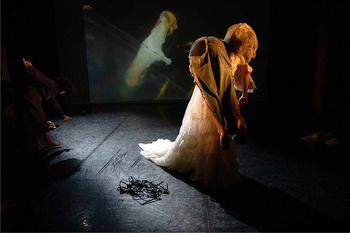
The first act ends with an abrupt and affective change. Assuming one last character, a virginal bride, Segev initiates a makeshift wedding ceremony, dressed in a white puffy gown and a seemingly endless veil, transforming one of her care laborers into her soldier-groom. However, instead of tying the knot and sealing it with a kiss, Segev hoists her groom over her shoulder while slowly marching towards the audience, struggling with the baggage she carries: her groom, a symbol of her gender and national background. Using projection, this moment creates another intentional dissociative moment of alienation for her audience (fig. 2). The camera is positioned behind her, so that she gets smaller onscreen and bigger in person. This allows for Segev to be seen from all sides as she struggles to leave the stage carrying the physical and symbolic weight of her past. Both transition and migration are ongoing, complex processes.
Segev dressed as a bride, carrying her Israeli soldier-groom. Ita Segev in Knot in My Name. Gibney Dance, New York, 2019. (Photo by Scott Shaw; courtesy of Ita Segev)

In her study of 1960s magazine covers that depict and capture planet earth from a transcendental position, media theorist Homay King argues:
Perspective is also associated with disembodiment. […S]patial distance becomes a metaphor for disconnection and indifference. The point of view in which the world appears as a distinct, independent entity is like that of the mirror stage, insofar as this viewing position, while joyful and satisfying to occupy, also entails an alienation and separation. (Reference King2015:6)
As perspective is gained, King remarks, one loses touch with their own subject position. By creating a visual moment of dissociation, Segev manipulates, by use of screen projection and camera angles, the static position of her audience.
After a manic performance portraying erratic and continuous change, Segev’s departure allows her audience to view her as a whole and complicated being, irreducible to the sum of her parts. Segev’s full picture, however, is never singular, and the joy of its recognition comes from seeing the fractures of a multifaceted image, bursting at the seams. She offers a depiction, nuanced and painful, of a transdiasporic citizen who carries the violence of homeland and transition.
Soft electronic music begins to fill the space as Segev reappears for the second act; wearing an off-white, calf-length, silk tank dress, she seems at ease. This is the first time the audience witnesses Segev out of character, presumably in her own skin, as she emerges back onstage with a different, softer affect. She begins moving around the stage in a free and improvisatory manner, marking the space with her body and with movements that fill up the stage. Concurrent with her movement, Segev tells the tale of a “trans girl who got onstage and simply rested.” After detailing the adversity, aggression, and violence this trans girl would have had to face if she wasn’t resting, Segev sits down. In that moment, a live projection of her appears on the screen behind her from an unseen camera on the side of the stage, capturing both her presence and the audience. Whereas in the first act the presence of the camera was highly visible, held either by Segev or a care laborer, this projection from the hidden camera makes clear to the audience they have been surveilled without their knowledge. The projection’s quality has also changed, taking on the familiar characteristics of security footage: black and white with a time and date stamp added atop the frame. The projection shuts off as Segev stands up and returns to her flowy movement around the stage. Moments later, as she lays down on the floor, the projection returns, this time displaying the feed of a camera located directly above her. The slow revelation of the hidden cameras deliberately destabilizes the contained space of the theatre that has been cultivated throughout the performance. This is a maneuver Segev uses to simulate the securitized and scrutinized quotidian reality within a militaristic state opting to use the panoptic force of surveillance. Segev’s poignant critique interrelates state and gender again through their potent conflation. As she discusses a yearning not to be obligated to perform and reperform her own transgender identity, she puts on display the surveilling and capturing of this identity by the state.Footnote 1
Segev doesn’t merely position herself as powerless, caught within this inevitable net(work), but instead offers a respite through a powerful reworking of this overdetermined relation between the state and its captured subjects. As the security feed keeps playing behind her, it becomes clear that a delay or purposeful time lag has been orchestrated to create a fissure of possibility between the live body present onstage and the body captured on camera. Theorizing similar disconnections, Jenny Sundén argues that “a glitch breakup is a passage or a period of profound disorientation and disconnection, to bodies and devices, and then often a moment of reorientation and reconnecting, if yet differently, as bodies, technologies, and affects are re-aligned” (Reference Sundén2018:72–73). So, too, has curator Legacy Russell, in her recent manifesto Glitch Feminism, aligned the glitch with transformative refusals of the violence of the gender binary. The glitch can function like “an activist prayer, a call to action, as we work toward fantastic failure, breaking free of an understanding of gender as something stationary” (Reference Russell2020:9). This use of alienation as an aesthetic tool manages to break open the closed-circuit feed by underlining the potentiality of slippage. The importance of gesture doubles down through delay, disrupting continuity and allowing for a new connectivity to emerge between performer and audience.
It almost feels like there is an electric fence inside my body, and if I go too close to it I might bzzzzz and I really don’t want to do that to myself onstage. But then I also know that all of you are paying for that fence, so it feels like it is my job to describe it to you. (Segev Reference Segev2019)
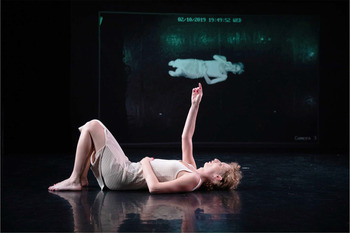
Segev delivers these words breathlessly; panting and nervous, she stares up at the camera above her. She exaggerates her hand gestures to emphasize, through the time lag, that she is in/directly speaking to her audience (fig. 3). Though the electric fence can be understood as a somatic experience pertaining to the fear of intimate disclosure, it is also a direct invocation of the billions of American dollars given to the state of Israel in military funding every single year that directly fund the ongoing Occupation. Segev confronts her audience with her twofold critique, alerting them to the flow of capital that fuels her exposure as a transgender performer and enables an atrocious reality sponsored by American empire. The time lag emphasizes each movement made by Segev, by doubling it while creating an extended form, allowing her audience to take in the duplicated gesture as dual criticism around gender and state.
Segev rests on the floor, accompanied by a time-lagged, projected double. Ita Segev in Knot in My Name. Gibney Dance, New York, 2019. (Photo by Scott Shaw; courtesy of Ita Segev)

Projections of Segev’s image begin to appear from different vantage points in the room, revealing additional hidden cameras as she begins to transform the stage into an army base. She shares, as delicately as possible, a personal experience of connection that occurred during her Israeli army service when she was assigned to guard an empty bunker. Unlike the performance’s first act, where Segev explored and exploded different personas, here she delves into her own history and complicity in an attempt to elaborate her ethics of resistance without embodying a character. An injury from training has made her what she deems a “weak soldier,” a valueless asset to the army, which tasks her with the Sisyphean duty of guarding a desolate bunker. Segev deliberately avoids representation by grammatically using and returning to present tenses, describing the surroundings to her audience rather than constructing an elaborate set. She begins each sentence with “this is” (for example: “This is a fence,” “this is a watch tower,” “this is an empty bunker”). The repetition doesn’t invoke representation but rather something more fleeting and phantasmatic. Throughout, the security footage is projected behind her. Its glitches continue to surveil and capture her every delayed movement while she continues to invoke those fleeting, immaterial presences.
Israeli depictions of Palestinians are common and are in fact the primary source of mainstream representations. They tend to remain within an extremely stereotypical framework — a predictable and repeated consequence of a ruling entity attempting to portray a minority presence from their own perspective, making the other a prop for their own savior complex. Segev is highly aware of the problematic nature of conjuring this perspective yet again onstage and avoids such stereotypical sensationalizing when describing her encounter with a Palestinian teen she was made to guard in the empty bunker. Concurrent with the switch to describing rather than embodying, Segev does not play the part of the Palestinian. Instead, she describes in third person an interaction in which a young teen is captured and detained as she is made to guard him. In the brief minutes they share, Segev unties him and gives him a cigarette, and recalls talking to him about the music they both like. Segev is uncomfortable with this retelling but returns to the significant “this is” to start each sentence, reminding her audience of its location in the present and blocking them from the possibility of being transported into some romantic, militaristic past. After these brief interactions, Segev explains that the Palestinian teen is taken away and that they never meet again.
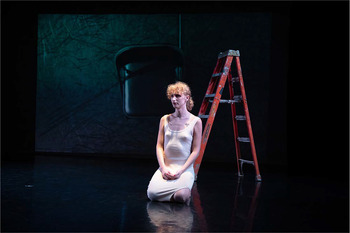
Moving away from the onstage area designated as the empty bunker, Segev now sits on the floor on the side of the stage (fig. 4). The camera from above now captures only an empty chair, signaling the missing representation of the Palestinian subject. The viewer is denied a fantasy of empathy: Segev doesn’t ask for it for herself, and she doesn’t invoke it for the plight of another. “For some years I didn’t really think about him, and I also didn’t think about a pretty deep part of myself” Segev confesses, alluding to both her gender identity and complicity in ongoing state-sanctioned violence through a maneuver of denial. “I spent so much time lying to myself in order to not lose access to the things that I ended up losing because of my lies. When I finally realized that I’m a girl, it made a lot of sense I couldn’t stop thinking of him” (Segev Reference Segev2019).
Segev, in the final scene of Knot in My Name, accompanied by an image of an empty chair that gestures to the absence of Palestinian representation within the context of the performance. Ita Segev in Knot in My Name. Gibney Dance, New York, 2019. (Photo by Scott Shaw; courtesy of Ita Segev)

As the second act ends, the terms of embodiment and disembodiment that were presented at the end of the first half have shifted again in profound ways. Whereas the first act is about the relationship between the audience’s gaze and Segev’s body and narrative — conveyed in particular through Segev’s ability to mark, wield, and navigate the violence that makes her story possible — the second act is about the audience witnessing a reckoning between Segev and herself. As the piece concludes the stage goes dark, but the multiple projections of the empty chair remain on screen, signifying the limits of Segev’s perspective. Segev foregrounds Palestinian freedom and self-determination as a political and ethical necessity, and offers a way that critical Israeli narratives are essential — but not central — to dismantling the Occupation. They are partial and distorted, as the technology of Knot in My Name has relayed all along. They are also the most fertile ground for a different concept of self, practice of politics, and vision of gender and nation.