John Morley, a British colonial officer who had served in northern Nigeria (1937–41) before taking up service with the British Military Administration of Eritrea (1941–4), was openly moved when soon after his arrival in Northeast Africa he encountered a group of Hausa pilgrims in the port of Massawa, more than 3,000 kilometers from home. In his diary, he reminisced about their surprise at meeting a European who could speak their language and recounted the trials of a group who had arranged to be smuggled out of Eritrea and into the Hejaz on the other side of the Red Sea. After having paid a boat owner/smuggler a large sum of money, the pilgrims set out to sea. Some hours later, they landed on a lonely shore in the dead of night ‘but when the day dawned and the dhow had gone they found they had been marooned on an uninhabited island, where they all died of thirst except for one man who by some miracle escaped and returned to Massawa to tell this tale’.Footnote 1 In a similar vein, C. S. Grisman, another British official who spent some time in Eritrea in 1947, also described the all too frequent ghastly episodes in which smugglers deceived pilgrims who tried to illicitly cross the Red Sea. He lamented those pilgrims who had ‘travelled from Lake Chad through swamp, forest, scrub and desert right to the shores of the Red Sea at Massawa, only to be cheated by the Arab captains of dhows and ferry boats, who took their passage money, then deposited them, ignorant and penniless, some fifty miles south along the Eritrean coast’.Footnote 2
This article sheds light on a little known aspect of the broader phenomenon of the West African pilgrimage to Mecca in the first half of the twentieth century. It explores the causes and consequences of British and Saudi efforts to enforce a regime of mobility, or to channel, regulate, and practically control the trans-Sahelian movement of West African so-called Takruri pilgrims on their way to Arabia and back to Africa.Footnote 3 These attempts to manage the West African hajj reflect broader trends of globalization between roughly the 1880s and the 1940s, such as the increasing and intensified rapidity and regulation of long-distance movement, processes that Valeska Huber has more fully described as the acceleration and deceleration of mobility.Footnote 4 Part and parcel of this process was the differentiation of types of mobilities that saw ‘archaic’ and ‘backward’ forms of mobility that opposed ‘modern’ ones. I argue that – beginning in the 1920s – Imperial Britain and the Saudi state (under the Wahhabis from 1924–5 onwards) imposed stricter regulatory measures on the movement of pilgrims to and from Mecca. British concerns revolved around a number of questions associated with the pilgrimage: sanitation, security, pan-Islamism, and the slave trade. The Saudis, for their part, instrumentalized the management of the hajj to further territorial consolidation, centralization, and the construction of political sovereignty, especially following the uniting of the kingdoms of Najd and Hijaz to form the Kingdom of Saudi Arabia in 1932. Restrictions on mobility across terrestrial or maritime borders led to the criminalization of those who transgressed them and the proliferation of illicit pilgrim smuggling operations.Footnote 5
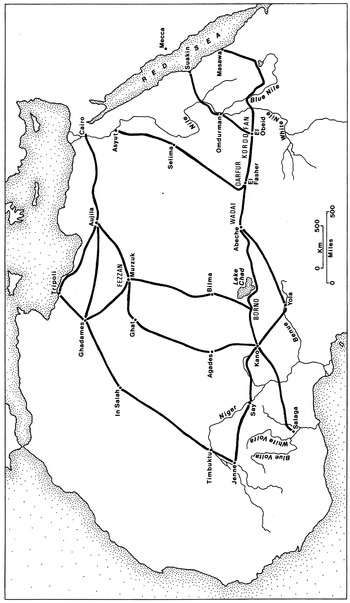
All Mecca-bound pilgrims were ordered to pass through quarantine stations, follow a set of regulated procedures, and cross the Red Sea on ‘mechanically propelled ships’ from the Sudanese port of Sawakin to Jeddah.Footnote 6 I nevertheless estimate that tens of thousands of West Africans who performed the hajj between the early 1920s and early 1950s subverted channeling measures; they crossed the Red Sea clandestinely on sailing boats from mostly out-of-the-way ‘illegal’ points of embarkation on the Eritrean coast to unauthorized spots on the Saudi and Yemeni littorals. This paper captures aspects of clandestine pilgrim flows and recovers the experiences of ‘invisible pilgrims’ who traveled in dire conditions on what came to be deemed alternate unauthorized circuits and passages. In general, these routes were sometimes collectively referred to in British colonial documentation as the ‘Massawa road’, and those intrepid pilgrims following them as undertaking the ‘dhow pilgrimage’.Footnote 7 Quite tellingly, Hausa-speaking Nigerians referred to those pilgrims who traveled clandestinely and evaded colonial control as satan hanya, or those who ‘stole the way’ to Mecca.Footnote 8 The article brings to light an inherently transcontinental phenomenon that ties West African pilgrims to Northeast Africa and the Red Sea region, in a way that positions the micro in the macro (see Figure 1). It inscribes the experiences of West African historical actors on multiple historiographic fields that are seldom tied to West Africa: Northeast African regional history, the colonial history of Italian Eritrea, and the Red Sea as a historical maritime space.
Traditional Pilgrim Routes to Mecca. Source: Map reproduced from C. Bawa Yamba, Permanent Pilgrims: the Role of Pilgrimage in the lives of West African Muslims in Sudan (Edinburgh: Edinburgh University Press, 1995), p. xiv, with written permission from the author.

A number of reasons account for the failure to obstruct illicit pilgrim passages: the extraordinary resoluteness of pilgrims determined to perform a sacred duty and seeking its attendant heavenly rewards; British, Italian, and Saudi vacillation; and most markedly, their inability to police the sea and its unchecked littorals. I contend that unauthorized pilgrim crossings were an integral part of illicit maritime activities in the lower Red Sea area. This is in part explained by the severe geography of the narrow Red Sea basin. Its arid, blazingly hot, and hard to access coasts, dotted by shallow coral reefs and shoals as well as its adverse winds, made navigation notoriously difficult. Historically, these conditions often crippled organized state-led efforts to control its traffic and explain why large parts of this maritime arena were animated by a variety of clandestine and ‘illegal’ activities. The period between the mid-nineteenth and mid-twentieth centuries was characterized by especially vigorous international political and commercial competition in the Red Sea area.Footnote 9 The result was a range of acts of resistance to interference, control, and exclusion: the transgression of colonial trade monopolies, efforts at customs evasion, and politically subversive operations which only spurred a host of illicit activities such as smuggling, contraband, slave trading, gun-running, and piracy.Footnote 10 It revealed the tenuous capacity of states in the region to effectively police their littorals, territorial waters, and labyrinthine archipelagos. Moreover, while the chief motivation for pilgrim diversion was to avoid paying the host of fees that ‘regular’ authorized passage imposed, illegal crossings from the Eritrean littorals were also governed by the exigencies of the growing labor market in Italian Eritrea and Imperial Italy's pro-Islamic attitudes and policies. These factors are all important in accounting for the flow of West Africans through Eritrea's coast. The Italian attitude to the ‘Takruri problem’ reflected efforts to balance a set of local and international interests, pressures, and constraints.
THE WEST AFRICAN PILGRIMAGE UNDER EUROPEAN COLONIALISM: THE LIMITS OF CONTROL
The centuries-long trans-Sahelian West African overland pilgrimage is a complex historical phenomenon that was shaped by a host of religious, political, economic, and social dynamics. Baz Lecocq has adopted a world historical perspective to show how, since the nineteenth century, the interconnectedness of ‘state rule, changing economies, motorized mass transport, and religion’ transformed the pilgrimage from West Africa.Footnote 11 One of the most salient characteristics of the West African hajj is that it was interwoven with multiple migratory flows, whose motivations were not purely spiritual aspirations to perform the pilgrimage.Footnote 12 One can cite, for example, the movement of people spurred by the eighteenth- and nineteenth-century West African jihads, or eastward migrations associated with West African millenarian tendencies and triggered by the Sudanese Mahdist movement in the late nineteenth century, or indeed the flight of West Africans east after the establishment of colonialism in northern Nigeria in 1903.Footnote 13 Other West Africans embarked on the ‘pilgrimage’ in search of labor, farming, or trade opportunities, and might have dissimulated their identities as pilgrims. Often pilgrimage and material pursuits were intertwined. Since the Maliki School of Islamic jurisprudence did not obligate Muslims to embark on the hajj to Mecca with all the means necessary for the return trip, it ‘formally’ allowed pilgrims to work on the road.Footnote 14 At times – either after performing the hajj or without ever having crossed the Red Sea – they ended up settling in Northeast Africa as ‘permanent pilgrims’ (borrowing from the title of a monograph on the subject), especially in Sudan but also some in Eritrea and northwest Ethiopia.Footnote 15
Early European efforts to control and bureaucratize the hajj were rooted in international apprehension about the spread of contagious diseases, especially cholera, which became a global concern in the middle decades of the nineteenth century. This brought into existence a series of control measures: the regulation of pilgrim traffic, the development of sanitary regulations for pilgrim vessels, and the establishment of quarantine stations in the Red Sea, notably in al-Tur and in Qamaran.Footnote 16 The participation of West Africans in the pilgrimage grew considerably throughout the first half of the twentieth century.Footnote 17 Increased security and improvements in transportation revolutionized the hajj (roads, rail, ship, and by the 1940s and 1950s, air travel) even if many continued to travel the thousands of kilometers on foot.Footnote 18 The steadily growing Trans-Sahelian flow of West Africans engendered myriad anxieties in the minds of colonial officials in Africa who sought to protect the territorial integrity of their boundaries, control the movements and whereabouts of their subjects, and who were concerned about subversive anti-colonial activities in areas outside their direct supervision. These new realities led to the development – by most European colonial powers – of specific policies concerning the hajj.Footnote 19 As Lecocq has cogently observed, the organization of the hajj by colonial authorities also reflected ‘the aspirations to rationalize and modernize the religious domain in Africa and the Middle East’.Footnote 20
Once Britain took control of Nigeria and the Sudan, it aspired to gain greater supervision of the traffic between West Africa and the Red Sea. With the palpable growth of the hajj in the 1910s and 1920s, a number of British colonial officials assessed pilgrim-migrant flows, identified concerns, risks and dangers, and made recommendations as to how to better administer, surveil, monitor, and ultimately instrumentalize the hajj within their broader ‘Islamic policies’. The reports – most notably by R. Palmer, G. Lethem, and C. A. Willis – reveal that to sanitary concerns were added other misgivings such as the perceived dangers associated with the potential resurgence of Mahdist activities in the Sudan, general worries about ‘pan-Islamism’, ‘Islamic fanaticism’, mass unruly migrations, labor migrancy, and those flows associated with persistent slave trafficking across the Sahel and the Red Sea.Footnote 21 The reports also drew attention to the more prosaic problems of insecurity along the routes, the high dues that pilgrims were expected to pay, and difficulties related to transportation, especially the Red Sea crossings. The Khedivial Mail Line steamers providing the service between Sawakin and Jeddah were reported to be too small, inefficient and infrequent, prompting many pilgrims to cross on overcrowded dhows lacking adequate sanitary conditions and all too often circumventing formal regulations, not the least of which was passing via quarantine stations.Footnote 22 From 1924, the Saudi authorities in western Arabia grew increasingly vexed by the phenomenon of pilgrims who crossed the Red Sea into the Hijaz from small, uncontrolled ports, circumventing their efforts to direct traffic exclusively through Jeddah. The Saudis escalated the pressure on the British who, rather than leading a proactive policy, increasingly reacted and followed Saudi directives. The requirement to cross the Red Sea on steamship alone led many pilgrims who sought to avoid paying for passports (mandatory by Saudi decree after 1926), quarantine dues and return deposits, to opt for a cheaper, if more perilous passage through the Eritrean coasts.Footnote 23
An abiding problem that Europeans had faced since their early efforts to control the hajj in the 1860s and 1870s were those pauper pilgrims who lacked the necessary funds allowing them to return home after performing the pilgrimage. The growth of participation in the hajj in the early twentieth century aggravated this problem, turning it into a taxing issue that Saudi and European colonial administrators were never able to address effectively. Every year, the authorities identified destitute pilgrims on both sides of the Red Sea: those who reached the Northeast African ports and lacked sufficient means to cross legally, and those in Mecca and Jeddah who could not pay their way back. Despite the establishment of a Nigerian Repatriation Fund in 1922, the sheer growing number of poor pilgrims participating in the hajj exacerbated the problem of destitution and increased the expenses associated with repatriation. The first of a series of mass deportations/repatriations took place in 1927 when 1186 destitute British West African pilgrims were shipped from Jeddah to Sawakin. A year later, the French Consul in Jeddah repatriated 150 French subjects via Massawa and in 1931, 500 were sent back to Massawa. The following year, 813 were sent back across the Red Sea, in 1934–5, 1,491 were repatriated, and in 1940, the number rose to 1,614. Later, in 1947 and 1953, the number of repatriated pilgrims amounted to 650 and 4,500 respectively.Footnote 24 The repatriation of destitute pilgrims would remain a vexing problem not only for the Saudis and the British, but also for the French and Italians until the early 1950s.
British concerns, Saudi pressures, and international sanitary injunctions (especially the 1926 International Sanitary Convention) culminated in the development of the ‘Nigerian Pilgrimage Scheme’.Footnote 25 Conceived in 1926 but only implemented in 1933–4, the Scheme bureaucratized the overland hajj and created a regime of mobility, which implicitly defined new categories of ‘legal’ and ‘illegal’ pilgrims. In summary, the Scheme required pilgrims to apply in West Africa for a passport, pay a deposit of five pounds sterling to cover passport dues, vaccination against cholera, inoculation against smallpox and quarantine fees, round-trip steamer transportation between Sawakin and Jeddah, and entrance fees to the Hijaz.Footnote 26 The major weakness of the Scheme was its implementation on a voluntary basis. A forceful imposition, it was thought – in line with experiences in India and the Strait Settlements – would run the risk of inducing resistance. Colonial officials therefore planned to make the Scheme compulsory only after it was in place and favored by the majority of pilgrims. In practice, since the scheme was voluntary, most pauper pilgrims circumvented the now ‘official’ route and refrained from crossing via Sawakin.Footnote 27 The occasionally detailed annual reports on the hajj produced by the British Legation in Jeddah between the mid-1920s and the early 1950s show that a vast number of West Africans who embarked on the hajj during those decades had subverted channeling measures and crossed the Red Sea illicitly.Footnote 28 The Nigerian Pilgrimage Scheme appears to have been a total failure with, for instance, only 69 pilgrims traveling under its auspices in 1934, 58 in 1935, 79 in 1937, 90 in 1938, 91 in 1939, 30 in 1940, and a mere 29 in 1941.Footnote 29
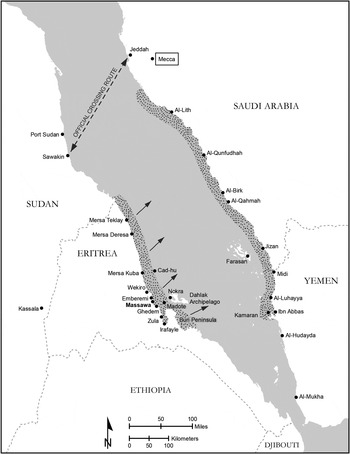
Every year the reports mention the alarming illegal traffic of sailing boats smuggling hundreds and thousands of what were now referred to as ‘clandestine’ pilgrims. Pilgrims crossed from Massawa and the coasts to the north and the south of it, namely – from north to south – Mersa Taklay, Mersa Deresa, Mersa Kuba, Wakiro, Emberemi, Gurgusum, Ghedem, Zula, Arafayli, and ports in the Buri Peninsula, to the Arabian coasts (southern Hijaz, ‘Asir and Yemeni Tihamah) and the ports and small harbors lying to the south of Jeddah, especially al-Lith, al-Qunfudha, al-Birka, al-Qahmah, Jizan, and the northern Yemeni littoral (See Figure 2).Footnote 30 The lines connecting these African and Arabian ports and harbors formed an alternative and clandestine system of pilgrim crossings, governed by an elaborate economy of sailing circuits, boats, crews, and evading strategies and tactics.
Licit and Illicit Red Sea Pilgrim Passages, 1920s–1950s. Source: Map drawn by Brian Edward Balsley, GISP.

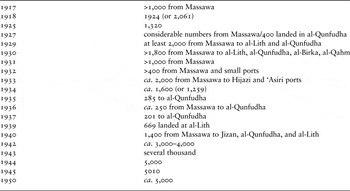
Drawing on more or less accurate exit records in Sawakin and quarantine entries in Jeddah the estimated total number of ‘licit’ pilgrims crossing from the Sudanese to the Saudi port between 1913 and 1948 (minus the five years with no data) amounts to 115, 278. While one should be cautious with such figures, the yearly average for licit crossings is therefore 3,718. On the other hand, the ‘Annual Reports on the Hajj’ issued by the British Legation in Jeddah (as well as other sources), allows us to form a sense of the scale of pilgrim smuggling and illegal passages. Between 1917 and 1950, these sources include intermittent records that should be taken with extreme caution. As a clandestine phenomenon par excellence, the desultory snippets of information on illicit passages cannot and do not aspire to represent their real extent with any accuracy.
Notwithstanding, I would very cautiously estimate the average of pilgrims crossing from unauthorized ports as lying somewhere between 1,500 and 3,000 per year, which gives us a tentative estimate of approximately 70,000 (or somewhere between 45,000 and 90,000) for thirty years between the early 1920s and early 1950s.Footnote 31
THE TAKRURIS, THE ERITREAN ‘LOOPHOLE’, AND THE ITALIAN COLONIAL ADMINISTRATION
The pilgrimage route through Massawa was not a new phenomenon. Mecca-bound pilgrims passed through the Eritrean port town for centuries. Historically, the choice of route and Red Sea outlet generally represented the path of least resistance: when obstacles, insecurity, conflict, or increased control in Sawakin were on the rise, pilgrims opted for the Eritrean coast, and vice versa. It does seem, however, that perhaps as early as the last decades of the nineteenth century and certainly in the early decades of the twentieth, the routes taken by Sahelian pilgrims began to change. The chief historical pre-twentieth century routes bifurcated at al-Ubayyd: (1) to Umdurman and Sawakin; and (2) via the Funj trade route through al-Ubayyd to Sennar, Metemma, Gondar, Axum, and finally Massawa (see Figure 1). Yet in the early twentieth century, many pilgrims continued from al-Ubayyd further east to Sennar, Gedaref, and Kassala (established in 1840), where the route bifurcated to: (1) Massawa via Keren; and (2) directly to Sawakin. There is no doubt that the construction of the railroad linking Sennar with Gedaref, Kassala and Hayya (in the proximity of Sawakin and Port Sudan) between 1923 and 1929 had a critical impact on pilgrims’ use of this route.
Rarely considered in the literature on the hajj, this section brings to light the importance of Italian Eritrea to the West African hajj. Once Italy consolidated its hold over Eritrea in the late nineteenth century, it also encountered the prickly problem of West Africans crossing into their newly-established territory on their way to the Red Sea coast. Territorial consolidation brought with it increased security to the routes crossing Eritrea and in the early years of the twentieth century, Italian officials estimated Muslim pilgrim departures from Massawa at around 1,500 per year, mostly West Africans. Pilgrims from Eritrea (and Ethiopia) were very few, several dozen at most. The Italian authorities were concerned about slave trafficking, and as the Ottomans and Egyptians before them, the Italians soon realized that policing the vast span of the Eritrean littoral was an almost-impossible mission. West African passages via Massawa were brisk to the point that a 1911 census of the town counted 659 ‘Sudanese and Takruris’ constituting 15 per cent of the total population of the port town. A transient population, most worked and waited for opportunities to cross the Red Sea, some eventually settling in the inland suburb of Amatere.Footnote 32
After the conquest of Libya in 1911, Italy further developed ‘Islamic policies’ in its colonies, including fresh attitudes toward the hajj which soon became a cornerstone of those policies.Footnote 33 Vexed by the growing problem of the intractable flows of West Africans across and via their territory, in 1916 the Italian authorities introduced – quite timidly and apparently inefficiently – measures that aimed to control movement. They also took measures to control the presence of ‘foreign’ pilgrims on their soil by entrusting the Massawa waqf council with the care of West Africans, for their lodging in the mosques of Hetumlo and Massawa, and for assisting in the issuing of passports.Footnote 34 In order to further regulate crossings from Eritrea, the Italian Consulate in Jeddah recommended that pilgrims purchase return tickets on steamers of the Marittima Italiana at a reduced price (similar to the case of the Khedivial Mail Line from Sawakin).Footnote 35 The intentions were perhaps appropriate, yet all in all the Italian authorities proved incapable of providing dependable transportation for pilgrims. Indeed, the Marittima Eritrea (a subsidiary of the Marittima Italiana) operated only until 1921 when it was shut down; the quarantine station at Gurgusum, north of Massawa, was closed in 1925, prompting pilgrims to opt for alternative transportation services with the cheaper sanbuqs.Footnote 36 Recognizing the weak Eritrean link in controlling pilgrim traffic across the Red Sea, between 1926 and the early 1930s, the British made efforts to ‘kill the sunbuq [sic] traffic from Massawa’ by exerting increasing pressure on the Italian authorities to bring regulations in Eritrea in line with those that were taking shape in the Sudan.Footnote 37 British and Saudi pressures bore fruit and in 1928, the Italians prohibited transportation to Jeddah unless by steamship. Italian tightening and deterrence measures reached a point where in 1931 they turned back boats reaching Massawa from unauthorized southern Hijazi ports.Footnote 38 The Saudis, who set up the directorate of coastguards in 1931, also began to actively fight the illegal traffic.Footnote 39 On several occasions in 1934 and 1935, they turned boats coming to al-Lith, al-Qunfudha, and other Arabian ports back to Massawa.Footnote 40
Responding to mounting pressures, the Italians argued that restrictions in accordance with the 1926 International Sanitary Convention could be enforced only on self-avowed pilgrims. The British found that ridiculous.Footnote 41 Be that as it may, the logic was somewhat skewed: if Massawa were to be ‘legalized’ – with all attendant fees – why would pilgrims agree to pay fees similar to those in Sawakin via the Eritrean port instead of securing cheaper and ‘irregular’ means of crossing? What was true for Sawakin would apply to Massawa. It was only in 1934–5, after the implementation of the Nigerian Pilgrimage Scheme, that the Italian government ordered its colonial officials to treat all travelers through Massawa as pilgrims and compelled them to purchase return tickets.Footnote 42 Mutual suspicions between the two colonial powers endured. Conceivably alluding to the Italian authorities’ privileged relationship with Massawa's Muslim commercial elites, the British believed that the Italians were not making every effort ‘to dislodge the powerful vested interests in Eritrea involved in this traffic’.Footnote 43 These suspicions were not unfounded since the documentation shows that a prominent merchant, notable and Muslim community leader in Massawa, Muḥammad Sālim Bā Ṭūq, provided government-sanctioned transportation for Takruri pilgrims to the Hijaz and Yemen on his boats from 1908 until 1935, the year of his death.Footnote 44 His son, Ḥasan Bā Ṭūq, continued the pilgrim transportation business until 1939; once the British occupied Eritrea in 1941, these services were suspended.Footnote 45
Two factors further elucidate Italian attitudes to the Takruri question between the mid-1930s and the end of Italian rule in 1941. Firstly, since most poor pilgrims had to work their way on the road both for subsistence and passage costs, pilgrim trajectories were also governed by labor opportunities (or ‘demand’, from the perspective of the colonial state).Footnote 46 This is especially important when considering the expanding labor market in Eritrea in the 1920s and 1930s. West Africans sought employment in the massive public works schemes launched in those years and especially in the aftermath of the Italo-Ethiopian conflict of 1935–6. They worked in road construction, the development of the port of Massawa, and myriad other jobs as manual laborers, porters, and peddlers in Eritrea's burgeoning urban sector, especially in Agordat, Keren, Asmara, and Massawa.Footnote 47 Observers noted that West Africans generally spoke well of the Italian administration.Footnote 48 West Africans also worked on colonial agricultural and irrigation schemes in Eritrea (for example, Tessenei and Om Hajer); compared to the Kunama and other local groups, transient Takruris were handier for intensive seasonal work in colonial agricultural enterprises.Footnote 49 French reports in the 1930s noted that pilgrims were drawn to Italian colonial infrastructural projects and plantations since the local population refused to work for them.Footnote 50 Some sources went as far as claiming that a number of Takruris joined the Italian colonial army as ‘askari’, which seems plausible, even though the numbers must have been quite low altogether.Footnote 51 Furthermore, West Africans settled and established villages in the western Eritrean plains, around the Gash river; in the mid-1940s they were reported to live in ‘thirty entirely Takruri settlements’ where they grew durra, maize, cotton, sesame, millet, groundnuts, tobacco, and vegetables.Footnote 52 Eritrea's appeal to West Africans for various labor opportunities in the second half of the 1930s is also reflected in the evolution of estimates of their numbers in the territory. In 1927, estimates put their number at approximately 3,000 (Lethem); that figure went up to 3,700 in 1931 (Pollera), 5,000 in 1940 (Ellero), and 8,000 for the very early 1940s (Trimingham), with a sharp drop to 2,500 in 1947 (Grisman), undoubtedly explained by British measures against pilgrim passages via Massawa.Footnote 53
A second critical factor in understanding Italian attitudes towards the Takruri question is Imperial Italy's construction as a ‘Muslim power’, especially following the Italo-Ethiopian war of 1935–6, its propaganda against Britain and France, and its unabashed efforts to appeal to the Muslim world. Fascist Italy developed a vigorous ‘pro-Islamic’ policy that aimed to show the Muslim world its benevolence towards Islam and its nine million Muslim subjects in north and northeast Africa. The hajj became the centerpiece of the Italian fascist pro-Islam propaganda campaign. The Italian authorities organized, promoted, and funded the hajj for their subjects, resulting in the significant increase of the numbers of pilgrims from Africa Orientale Italiana (AOI: Eritrea, Ethiopia and Somalia).Footnote 54 Epitomizing the cooption of northeast African Muslim elites in this context was Ḥasan Bey Muḥammad Sālim Bā Ṭūq (the same individual who provided transportation services to pilgrims), who arrived in Mecca for the 1937 hajj together with approximately 1,000 pilgrims who each received Frs.10,000 from the Italian authorities.Footnote 55 It is only logical that in this context the Italian authorities refrained from taking any measure that would appear as obstructing Islamic rituals, practices, or institutions, including strict action against illicit Takruri passage. All in all, the unruly flow of West Africans from the Sudan into Eritrea proved a challenge that the Italian authorities were unable – or indeed unwilling – to cope with effectively. They took some measures to limit Takruri crossings while seeking a balance between their labor needs in Eritrea, their political attitudes to Islam, and their complex relationship with local elites, on the one hand, and British, Saudi, and international sanitary organizations on the other.
Following Italy's defeat in the Battle of Keren in 1941, the British took over the administration of Eritrea. British policy remained inflexible: pilgrims were to cross exclusively from Sawakin to Jeddah on steamships and passage from Massawa was strictly prohibited. Unsurprisingly, the policy did not deter pilgrims and illegal crossings continued to the dismay of both the British and Saudi authorities. While the policy ‘from above’ was unequivocal, it is telling that some officers on the ground were far more skeptical about its utility and effectiveness. In a candid outburst of empathy towards the pilgrims, the Political Officer in Massawa in 1942 expressed his view on how to address and solve the problem (to little avail):
There is, I feel, some obligation on the part of the authorities to assist pilgrims by providing for them facilities for a cheap journey across the sea. … Provide the dhows and the pilgrims will make their own way with their own money under their own organization … Why not therefore extend to them a little more freedom of movement? If the Red Sea were not where it is no force would be able to stop them from moving forward. As a political scheme there is a good deal to be said for aiding them by free return passages in dhows … Have we not the goodwill of not only the pilgrims to win but of the whole of Islam?Footnote 56
The authorities remained adamant. In the course of the 1940s, Ḥasan Bā Ṭūq presented the British authorities several petitions requesting permission to re-establish pilgrim transportation services between Massawa and Jeddah (with recently-acquired motorized dhows). They were all rejected. In late April 1951, he wrote a last impassioned appeal in which he lamented the dismal consequences of the policy that prohibited pilgrims crossing from Massawa and described the deplorable hardships and exploitation of West Africans by unscrupulous smugglers.Footnote 57 Similarly, a month later, an anonymous individual addressed a letter to the British authorities in the Arabic section of the newspaper ‘Ethiopia’. Focusing on the plight of Eritrea's Muslims, the author of the letter vehemently demanded that the British Administration in Eritrea legalize Massawa as a port of pilgrim passage.Footnote 58
CHALLENGING PATHS TO MECCA: WAYWARD PILGRIMS AND ELUSIVE SMUGGLERS
In the remaining part of the article I reconstruct aspects of the structure and operation of the illegal routes and recover the experiences of pilgrims who evaded control by offering some snapshots, which at times evoke chilling images. Fragmentary details gleaned in the archives evince a brisk smuggling economy in the southern Red Sea area in the first half of the twentieth century. Coupled with the treacherous geography of the Red Sea basin (which made navigation in its waters challenging and gave local mariners a clear advantage), the absence of strong states left its littorals and archipelagos under-controlled and under-policed. Clandestine pilgrim crossings tapped into other illicit networks and circuits of smuggling and contraband usually operated by Yemenis, Eritreans, Sudanese, Somalis, and Hijazis. Illegal pilgrim smuggling was grafted onto existing networks that dealt in smuggling tobacco, pearls, grains, foods, and also slaves. To be sure, the line dividing illicit and licit trade operations in this context was often very thin; thus, pilgrims were sometimes passed by full-time contrabandists but could also be carried in boats that transported legitimate goods. A report from April 1948 stated that some boats came from Arabia to Sawakin and Port Sudan laden with commodities and on their return journey, they followed the coast down to Massawa where they collected illegal pilgrims and sailed back to Arabia.Footnote 59 Yemenis predominated in shipping and cabotage networks and operations in the lower Red Sea basin and Yemeni contraband boats were identified as the chief pilgrim smugglers from Eritrea's littorals.Footnote 60 A majority of boat owners, captains, and crew were indeed Yemenis from the Tihama and ‘Asiri coasts and the islands off the Arabian littorals, yet some captured smugglers were Eritrean, Sudanese and Nigerian.
Who were the pilgrims who embarked on the alternative so-called illegal routes? Those who were reported to ‘arrive yearly and disappear as silently as they arrived’.Footnote 61 As an illustrative example, a random sample based on a census made in Massawa in 1941 shows that of a total of 1,478 West Africans proceeding on the pilgrimage (and at the time stranded in Massawa), 1,244 (84 per cent) were from Nigeria, with 918 coming from Sokoto, Kano, Katsina, Yerwa (Bornu), and Zaria and the rest from other localities in Nigeria. All in all, of the 1,244 Nigerians, 524 were males, 341 were females, and 379 were children. The remaining 234 non-Nigerian pilgrims were from Chad (120 pilgrims), Niger (52), Mali (29), Upper Volta (Burkina Faso) (27), (French) Guinea (4 pilgrims), and the Gold Coast (Ghana) (2 pilgrims). The non-Nigerians included 175 males, 44 females, and 15 children.Footnote 62 Another detailed report about 114 individuals who were detained in Massawa after a botched sea crossing added to the mix pilgrims from what is today Senegal, Cameroon, and Darfur, as well as other parts of the Sudan. Many spent years on the road, working in the Gezira cotton fields of eastern Sudan, in the Red Sea port towns, and after the crossing, in Jeddah and Mecca, where they engaged in construction, water porterage, and other menial jobs.Footnote 63 A vast majority of the pilgrims were obviously destitute. Many came to Massawa with their last funds and had to somehow make enough money to pay smugglers. Of the group of 1,478 discussed above, only 63 claimed to have the 6 English pounds to cover pilgrimage fees – a number that would have been even smaller once the Saudi authorities quadrupled the fees from 6.30 Pounds to 25 Pounds in November 1941.Footnote 64
Pilgrims were described as extremely determined and religiously zealous. The spiritual reward for the hajj was a path to Paradise. The British officer who encountered the 63 men, women, and children who were caught at Mersa Ghedem, waiting for a boat that never came to ferry them across the Red Sea, chillingly noted in his report: ‘restrict them how you will, divert them where you choose, they will always get to Mecca – or die on the road’.Footnote 65 In much the same vein, another report stated that ‘it is impossible to prevent this traffic as the pilgrimage is the be all and the end of all their (the pilgrims) existence and they are prepared to undergo any amount of hardship in order to achieve it. To die in the attempt is the next best thing.’Footnote 66
The following cases offer a sample of high-resolution, if incomplete, snippets of information on the organization of passages, the risks involved, the identities of pilgrim smugglers, and the composition of boat crews. In late May 1944, a group of 192 West Africans (87 men, 77 women, and 28 children, mostly from northern Nigeria, French West Africa, and Darfur) were shipwrecked in the Dahlak archipelago and abandoned on Madote Island about 30 kilometers from Massawa. Fifteen children and two adults died of exhaustion and thirst. Three days after the shipwreck, the British authorities rescued the surviving 175 illegal crossers. An interrogation of some of the survivors revealed that they had arranged passage through Gurgusum, north of Massawa, with two individuals from Amatere to whom each adult paid 80 East African shillings. Not long after setting sail, their dhow struck a reef, was wrecked, and the party was cast up on Madote Island, not very far off the Eritrean coast. The boat captain, Muhammad Hadi, and two of his crew took to their small boat and disappeared. Eventually, the two individuals who connected the group with the boats, the boat captain, and his six-men-strong crew were arrested, tried, and sentenced to six months in prison and fined 84 pounds each.Footnote 67 Another case from 1948 is characteristic of the dangers and trials involved in clandestine crossing. In that case it was established that the Sarkin ZangoFootnote 68 of Massawa (a northern Nigerian individual in charge of the pilgrims’ resting area or lodge), was paid by about one hundred pilgrims to arrange for crossing. They were ordered to walk for several hours at night to a beach where they were to meet the boat and its crew. They then set sail with very little food or water; on reaching the Arabian coast the boatmen left them neck-deep in the seawater from where they were expected to finish the journey by swimming. Some were not as fortunate and died of thirst or hunger on the boat. After the crossing, pilgrims were often left in the scorching desert, where, disoriented, some got lost and died of thirst and exhaustion.Footnote 69
In a case from 1946 that ended equally tragically, this time on the Arabian littoral, a group of 70 pilgrims crossed the Red Sea from the Sudan illegally, landed some 65 kilometers south of Jeddah. They were put ashore with neither food nor water and were informed that Mecca was ‘just behind the hills’. The remains of some of them were later found on a roadside within 30 kilometers of Jeddah and within a few kilometers of the nearest water-well, which might have saved their lives. Those who arrived to Jeddah were taken into custody by the Saudi authorities but were eventually released and permitted to perform the pilgrimage.Footnote 70 In that same year, in June 1946, the Saudi authorities caught five sailing boats that landed in small harbors and ports south of Jeddah (Mersa Samina, Semaimah, Sarum, and Lith) and that carried a total of 252 pilgrims, most of whom carried neither passports nor other identification papers.Footnote 71 Such occurrences became routine for the Saudi authorities and in December of that year, they were investigating another group of illegal landings involving another five sailing boats carrying a total of 154 West Africans.Footnote 72 Obviously, all such activities were criminalized and when pilgrims were shipwrecked or found after having been abandoned on islands, they were sometimes tried for crossing borders illegally, sentenced, and imprisoned. In one case from early 1945, 18 people were sentenced in Massawa for attempting to leave Eritrea illegally.Footnote 73 Criminalization could go even further. When destitute pilgrims who were sent back to Massawa from Jeddah were unable to embark on their westward journey back home, the British authorities sometimes forced them to work in the Eritrean port town. In one memo from February 1942, an official stated that ‘if abled people refuse to work maybe (we should) take recourse to legal action as vagrants’.Footnote 74
Boat owners, captains, and crews were warned, charged, tried, sentenced, fined, imprisoned, and sometimes deported. So were the ringleaders and headmen of pilgrim parties. In a final example that provides some interesting details as to the composition of smuggling boat owners and crews, in October 1942, two boats that left with pilgrims from Embereme and Ghedem (respectively to the north and south of Massawa) were caught in Nokhra Island in Eritrean waters and their operators charged in court in Massawa. All in all, five individuals involved in this case were tried in the Civil Court of Massawa. The first boat's owner was a 25 year-old Yemeni from al-Luhayya who claimed to be a trader. The nakhuda (boat captain) was a 27 year-old Yemeni from the Farasan islands. The crew of the boat included a 14 year-old Yemeni from the small port of Maidi and a 49 year-old Yemeni residing in Edaga Be'rai in the Massawa mainland. The composition of the second boat was equally telling: the owner and acting captain was a 60 year-old Yemeni from Ibn Abbas, north of Hudayda, and the crew consisted of the 18 year-old son of the owner and also a 40 year-old and a 15 year-old both from Bin Abbas in Yemen. They received fines and prison terms, their boats were confiscated and three of the four boat crew members were deported back to Yemen.Footnote 75
CONCLUSION
Illegal pilgrim traffic and efforts to suppress it continued in the early 1950s. Wanting to step up their struggle against illegal traffic, the Saudis renounced pilgrimage dues from West Africans altogether and announced drastic punishments for dhow owners caught smuggling pilgrims.Footnote 76 The British, who also enforced stricter controls on the Sudanese borders, reported that there were some signs of reduction in illegal traffic in the early to mid-1950s.Footnote 77 These optimistic assessments aside, there is no doubt that some illegal traffic continued unabated, including the smuggling of slaves.Footnote 78
More broadly, the late 1940s and 1950s witnessed several processes of change that transformed the hajj from West Africa. The first were the gradual but momentous changes in transportation – more pilgrims took trucks and motorcars, and a privileged minority even began to fly to Saudi Arabia. In 1948, Kano merchants established the West African Pilgrims Association (WAPA), which organized pilgrim transportation with buses and lorries. In the early 1950s, WAPA formed ‘Hajjair (of West Africa) Limited’, a joint company with two expatriates using Super Trader Charter Airlines from London. Another organization, the Pilgrims Aid Society (PAS) also organized air travel in a West African Airways Corporation aircraft. In 1956, Hajjair was liquidated and another company operated with Sabena Airways until Nigerian Airways took over in 1967.Footnote 79 The second transformative process was decolonization and the withdrawal of colonial powers in the early 1950s from organizing and administering the hajj. The British left Eritrea in 1952, the Sudan became independent in 1956, and in Nigeria there was a gradual move towards self-governance. In the mid-1950s, Northern Nigerian leaders, such as Sir Ahmadu Bello, Sardauna of Sokoto, and Premier of Northern Nigeria (1954–66) began to be involved in the hajj and dealt directly with the Saudi authorities.Footnote 80
A number of reasons account for the overall failure to effectively control the West African hajj and curb illicit Red Sea passages between the mid-1920s and the 1950s. West African pilgrims who were unable to pay for regular passage were extraordinarily determined to perform one of the Five Pillars of Islam and reach Mecca, whatever the consequences. With its brisk smuggling economy and hard-to-access littorals, the lower Red Sea basin offered multiple opportunities to cross the sea. The British and Saudis proved unable to cope with this problem. They neither satisfactorily policed the waters and coasts, nor created effective deterrence from using illegal routes or incentives to use the ‘official’ ones. Balancing a set of political and economic interests both in Eritrea and on the broader regional scene, as well as maneuvering its relationship with Britain, Italy too was unable, or unwilling, to decisively tackle the Takruri quandary. The British, who administered Eritrea in the 1940s, had neither the political will nor the logistical resources to establish ‘legal’ passage via Massawa. They failed to make any significant effort to transform the situation and mostly complied with tortuous, at times tentative, Saudi directives that reflected the new challenges of efficiently managing the rapidly growing hajj. But the real protagonists of this story are the thousands of intrepid pilgrims who year after year trekked on those challenging paths towards Mecca. Quite strikingly, their tales evoke one of the most pressing issues in the world today – the phenomenon of irregular migration and human smuggling and trafficking, resulting from the ever more stiff regulation of transnational mobilities.
Records of illicit pilgrim crossings from Eritrea to Saudi Arabia (selected years between 1917–50). Note: The data are drawn from the sources referred to in fn. 31.