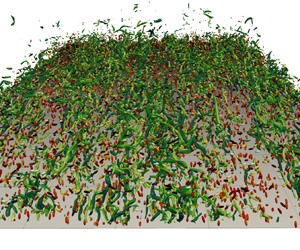



1. Introduction
The dynamics of particles in turbulent flows is of interest to understand a wide variety of natural phenomena, ranging from the dispersion of plankton in the marine environment (Font-Muñoz et al. Reference Font-Muñoz, Jordi, Anglès and Basterretxea2015) to the formation of ice crystals in mixed phase clouds (Naso et al. Reference Naso, Jucha, Lévêque and Pumir2018), as well as to optimize industrial processes such as papermaking (Lundell, Söderberg & Alfredsson Reference Lundell, Söderberg and Alfredsson2011). Non-spherical particles can be modelled by spheroids, and provide a better understanding of the two-phase flow characteristics than a spherical model (Voth & Soldati Reference Voth and Soldati2017). The challenge encountered in predicting the behaviour of such flows is linked to the particle shape, whose interaction with the fluid velocity and velocity-gradient fields results in complex translational and rotational dynamics.
Several experimental studies have been dedicated to understand the influence of turbulent fluid motion on particle orientation. For example, Bernstein & Shapiro (Reference Bernstein and Shapiro1994) observed that long fibres align along the mean velocity in a laminar duct flow, but did not observe this preferential alignment if the flow is turbulent. Parsheh, Brown & Aidun (Reference Parsheh, Brown and Aidun2005) analysed the influence of the turbulent intensity on the preferential orientation of rigid fibres in a planar contraction and concluded that preferential orientation is controlled by the mean velocity gradient rather than by the turbulent intensity. In an open channel, Abbasi Hoseini, Lundell & Andersson (Reference Abbasi Hoseini, Lundell and Andersson2015) observed that the preferential orientation relative to the mean flow and the turbulent events sampled by weakly inertial fibres strongly depends on their length. Capone, Felice & Pereira (Reference Capone, Felice and Pereira2021) noted a peak in the concentration of nylon fibres at a wall distance equivalent to half the particle length in a turbulent channel flow at  $Re_{\tau }=530$ (based on the wall-shear velocity
 $u_{\tau }$ and the channel half-width
 $\delta$), and reported that the mean angle between the fibres and the streamwise direction strongly varied with the distance from the wall. Shaik et al. (Reference Shaik, Kuperman, Rinsky and van Hout2020) measured the orientation and angular velocity of long, rigid nylon fibres (having an aspect ratio of
 $30.7$ and
 $47$) in a turbulent channel flow at
 $Re_{\tau }=435$. They found that the average orientation of such particles weakly depends on their length, but that longer particles exhibit higher tumbling rates. Alipour et al. (Reference Alipour, Paoli, Ghaemi and Soldati2021) reported a moderate influence of curvature on the orientation and angular velocity of weakly inertial, flexible rods at
 $Re_{\tau }=360$. Finally, Baker & Coletti (Reference Baker and Coletti2022) measured the preferential orientation and the tumbling rate of long (
 $50$ in wall units), inertial fibres in a turbulent channel flow at
 $Re_{\tau }=620$. They observed that the fibres major axis is preferentially aligned with the mean flow in the near-wall region, but that high tumbling rates occur intermittently due to the effect of the mean shear, the turbulent fluid velocity fluctuations and the particle–wall interactions.
Besides experimental studies, numerical simulations have proved to be a powerful tool to study the dynamics of non-spherical particles in a turbulent channel flow. The pioneering study of Zhang et al. (Reference Zhang, Ahmadi, Fan and McLaughlin2001) introduced a methodology based on direct numerical simulation (DNS) of the turbulent flow coupled with Lagrangian tracking of ellipsoidal particles, treated as material points under a one-way coupling assumption. Such a method requires modelling the force and torque applied by the flow on the ellipsoids. This is generally done by the theoretical formulas of Happel & Brenner (Reference Happel and Brenner1965) for the force and Jeffery (Reference Jeffery1922) for the torque. Such formulas have been successfully used to reproduce the orientational dynamics of weakly inertial rods in homogeneous isotropic turbulence (Parsa et al. Reference Parsa, Calzavarini, Toschi and Voth2012). This methodology was later extended to simulate more complex systems, such as dense suspensions where two-way (Zhao, Andersson & Gillissen Reference Zhao, Andersson and Gillissen2013) and four-way (van Wachem et al. Reference van Wachem, Zastawny, Zhao and Mallouppas2015; Zhao, George & van Wachem Reference Zhao, George and van Wachem2015a) coupling effects are important, or to model flexible fibres (Dotto, Soldati & Marchioli Reference Dotto, Soldati and Marchioli2019). To focus on the effect of turbulence on the particle dynamics, one-way particle–fluid coupling is adopted in the present study: the effect of the particle on the fluid flow is supposed negligible as well as the interparticle interactions.
In their study, Zhang et al. (Reference Zhang, Ahmadi, Fan and McLaughlin2001) simulated the turbulent flow in a channel at a friction Reynolds number  $Re_{\tau }=125$ to study the deposition of fibres modelled as prolate ellipsoids. Marchioli, Fantoni & Soldati (Reference Marchioli, Fantoni and Soldati2010) worked with a somewhat similar
 $Re_{\tau }=150$ and provided additional orientation and translational velocity statistics. The same methodology was used by Mortensen et al. (Reference Mortensen, Andersson, Gillissen and Boersma2008a) to study the influence of the particle aspect ratio and inertia on translational velocity and angular velocity statistics in a turbulent channel flow at
 $Re_{\tau }=180$. They found that translational velocity statistics are not significantly affected by particle shape, but that angular velocity statistics are strongly shape dependent in the near-wall region, where the mean velocity gradient causes periodic rotation of the ellipsoids. Marchioli, Zhao & Andersson (Reference Marchioli, Zhao and Andersson2016) analysed the relative rotation between the particle and fluid, and also noted an important influence of the aspect ratio. More recently, Zhao et al. (Reference Zhao, Challabotla, Andersson and Variano2019) mapped the ellipsoids rotation modes at different locations in the channel and noted that in the viscous sublayer the particles rotation plane depends on their aspect ratio and inertia. Finally, Challabotla, Zhao & Andersson (Reference Challabotla, Zhao and Andersson2016) and Arcen et al. (Reference Arcen, Ouchene, Khalij and Tanière2017) noted a strong influence of gravity on the preferential orientation and concentration of inertial ellipsoids at
 $Re_{\tau }=180$. These studies provided insight into the dynamics of inertial and ellipsoidal particles in a low-Reynolds-number turbulent channel flow.
Several groups also conducted studies at higher values of the Reynolds number. van Wachem et al. (Reference van Wachem, Zastawny, Zhao and Mallouppas2015) conducted four-way coupled large-eddy simulations of the flow in a horizontal channel at  $Re_{\tau }=600$. They analysed the particle shape effect, as well as the influence of the wall roughness. They notably found a significant effect on translational velocity statistics and concentration profiles. Ouchene et al. (Reference Ouchene, Polanco, Vinkovic and Simoëns2018) conducted DNS of the turbulent flow at
 $Re_{\tau }=1440$ to study acceleration statistics of inertial ellipsoids. While they noted a significant effect of the particles aspect ratio on these statistics, they did not examine the effect of the flow Reynolds number. The influence of this parameter on the dynamics of ellipsoidal particles has only been examined in a few studies. Zhao, Marchioli & Andersson (Reference Zhao, Marchioli and Andersson2014) computed the mean and root mean square (r.m.s.) of the slip velocity of inertial ellipsoids at
 $Re_{\tau }=150$,
 $180$ and
 $300$. They noted an increase of the magnitude of these properties, but did not generalize their conclusions to higher values of the flow Reynolds number. They indicated that simulations at higher values of the Reynolds number are required to confirm the influence of
 $Re_{\tau }$ on these statistics. Jie et al. (Reference Jie, Xu, Dawson, Andersson and Zhao2019) used pre-computed DNS flow fields at
 $Re_{\tau }=1000$ to examine the influence of this parameter on orientation and rotation statistics of inertialess ellipsoids in the channel core. They did not report an important effect of
 $Re_{\tau }$ on the preferential orientation, but observed a strong decrease of the ellipsoids rotation rate in the quiescent core at
 $Re_{\tau }=1000$. In a recent communication, Michel & Arcen (Reference Michel and Arcen2021b) examined the influence of
 $Re_{\tau }$ on the concentration profiles and orientation statistics of inertial ellipsoids. They noted that increasing the value
 $Re_{\tau }$ resulted in a stronger alignment between the particle major axis and vorticity vector in the channel core, as well as in a modification of the rotation orbits induced by Jeffery (Reference Jeffery1922)'s formula in the near-wall region, up to
 $Re_{\tau }=550$. A uniformization of the ellipsoids concentration profile was also noted as the Reynolds number increases, in a manner similar to that observed for inertial spheres by Bernardini (Reference Bernardini2014).
Numerical studies of the translational and rotational dynamics of inertial spheroidal particles were mainly focused on the influence of the particle shape and inertia at low Reynolds numbers. The present study aims at gaining more insight into the influence of  $Re_{\tau }$ on the statistical properties describing the translation and rotation of inertial ellipsoids in a turbulent channel flow. The methodology relies on DNS of the turbulent flow, coupled with Lagrangian particle tracking. To obtain reliable data, simulations are conducted until the particle distribution has reached a statistically steady state before computing the dispersed phase statistics (Michel & Arcen Reference Michel and Arcen2021a). Using this methodology, the concentration profiles and preferential orientation of inertial ellipsoids were examined up to
 $Re_{\tau }=550$ (Michel & Arcen Reference Michel and Arcen2021b). In the present study the dynamical quantities characterizing the interaction of the particles with the turbulent flow are analysed. Preferential concentration, translational velocity and angular velocity statistics are computed up to
 $Re_{\tau }=1000$ to analyse the dynamics of inertial ellipsoids in a fully turbulent channel flow. The paper is organized as follows. Equations of fluid and particle motion are presented in § 2, followed by the numerical set-up and simulation parameters in § 3. To quantify the influence of
 $Re_{\tau }$ on the dispersed phase dynamics, statistics about preferential concentration, translational velocity and angular velocity are then presented. Quadrant analysis is performed in § 4 to quantify preferential concentration. Translational velocity statistics are described in § 5, and angular velocity statistics are presented in § 6. Finally, the main findings are summarized in § 7
2. Governing equations
2.1. Fluid phase
The turbulent flow is described by the continuity and momentum conservation equations for a Newtonian, incompressible and isothermal fluid,
 \begin{gather} \boldsymbol{\nabla} \boldsymbol{\cdot} \boldsymbol{u} =0, \end{gather}
 \begin{gather} \frac{\partial \boldsymbol{u}}{\partial t} + (\boldsymbol{u} \boldsymbol{\cdot} \boldsymbol{\nabla}) \boldsymbol{u} =- \frac{1}{\rho_f}\boldsymbol{\nabla} p + \nu \nabla^2 \boldsymbol{u}, \end{gather}
where  $\boldsymbol {u}$ is the velocity field,
 $p$ the pressure field,
 $\rho _f$ the fluid density and
 $\nu$ the fluid kinematic viscosity.
2.2. Lagrangian particle tracking
Particles are modelled as prolate spheroids of aspect ratio  $\lambda =a/b > 1$,
 $a$ and
 $b$ being the lengths of the semi-major and semi-minor axes. The particle position and orientation are obtained by solving the following sets of equations:
 \begin{gather} \frac{\mathrm{d}\kern0.7pt \boldsymbol{x}_p}{\mathrm{d} t} = \boldsymbol{u}_p, \quad m_p \frac{ \mathrm{d} \boldsymbol{u}_p}{\mathrm{d} t} = \boldsymbol{F}, \end{gather}
 \begin{gather} \frac{\mathrm{d} \boldsymbol{q}_p}{\mathrm{d} t} = \frac{1}{2} \boldsymbol{q}_p \boldsymbol{\omega}'_p, \quad \boldsymbol{I}_I \frac{ \mathrm{d} \boldsymbol{\omega}'_p}{\mathrm{d} t} + \boldsymbol{\omega}'_p \times (\boldsymbol{I}_I \boldsymbol{\omega}'_p ) = \boldsymbol{T}'. \end{gather}
Here  $\boldsymbol {x}_p$ and
 $\boldsymbol {u}_p$ are the particle position and translational velocity, while
 $\boldsymbol {q}_p$ and
 $\boldsymbol {\omega }'_p$ are the unit quaternion describing the orientation of the particle and particle angular velocity vector, respectively;
 $m_p=\rho _p(4/3) {\rm \pi}a b^2$ is the particle mass,
 $\rho _p$ denotes its density and
 $\boldsymbol {I}_I$ is the particle inertia tensor;
 $\boldsymbol {F}$ is the fluid force and
 $\boldsymbol {T}'$ the torque acting on the particle. Note that translation equations are solved in the Eulerian frame
 $(x,y,z)$ while rotation equations are solved in the frame linked to the particle principal axes
 $(x',y',z')$. In this frame, the particle major axis is aligned with
 $x'$.
Particles are treated as material points, and the coupling between the fluid and particle phases is modelled and not directly solved. The force and torque models employed in the present study were obtained under the Stokes flow assumption. They are therefore valid if the particle Reynolds number  $Re_p = d_{eq} \|\boldsymbol {u}_r\| / \nu \ll 1$, where
 $d_{eq}=2 b \sqrt [3]{\lambda }$ is the diameter of the volume equivalent sphere, and
 $\boldsymbol{u}_r = \boldsymbol{\tilde{u}} - \boldsymbol{u}_p$ is the relative velocity between the particle and the fluid,
 $\boldsymbol{\tilde{u}} = \boldsymbol{u}(\boldsymbol{x}_p, t)$ being the fluid velocity at the particle position. In addition, the mass density is assumed to be homogeneously distributed within each particle. The additional gravitational torque that would arise in the presence of the gravity is therefore not considered. The force
 $\boldsymbol {F}$ is obtained by the formula from Happel & Brenner (Reference Happel and Brenner1965),
 \begin{equation} \boldsymbol{F}= \nu \rho_f (\boldsymbol{A}^{-1} \boldsymbol{K} \boldsymbol{A}) \boldsymbol{u}_r, \end{equation}
where  $\boldsymbol {A}$ is the direction cosine matrix that is used to express vectors and tensors from the Eulerian frame in the particle frame. This matrix is computed knowing the particle orientation, as described in Zhang et al. (Reference Zhang, Ahmadi, Fan and McLaughlin2001). Here
 $\boldsymbol {K}$ is the translational resistance tensor that describes the influence of particle shape on its translational motion. It is diagonal in the particle frame
 $(x',y',z')$ and, for prolate spheroids, the components are (Gallily & Cohen Reference Gallily and Cohen1979)
 \begin{gather} K_{x'x'} = \dfrac{8 {\rm \pi}b (\lambda^2 -1) } {\left[ \ln \left( \lambda + \sqrt{\lambda^2 -1} \right) \dfrac{2\lambda^2-1}{\sqrt{\lambda^2-1} }\right]-\lambda}, \end{gather}
 \begin{gather} K_{y'y'} = \dfrac{16 {\rm \pi}b (\lambda^2 -1) } {\left[ \ln \left( \lambda + \sqrt{\lambda^2 -1} \right) \dfrac{2\lambda^2-3}{\sqrt{\lambda^2-1} }\right]+\lambda}, \end{gather}
 \begin{gather} K_{z'z'} = K_{y'y'}. \end{gather}
Due to the product  $\boldsymbol {A}^{-1} \boldsymbol {K} \boldsymbol {A}$,
 $\boldsymbol {F}$ can be decomposed as
 $\boldsymbol {F}=\boldsymbol {F}_D + \boldsymbol {F}_L$. Here
 $\boldsymbol {F}_D$ is the drag force, the component of
 $\boldsymbol {F}$ collinear to
 $\boldsymbol {u}_r$, while
 $\boldsymbol {F}_L$ is the lift force, the component of
 $\boldsymbol {F}$ orthogonal to
 $\boldsymbol {u}_r$. This lift force is induced by the particle anisotropy and orientation and it is not related to the shear-induced lift, for which an expression was recently derived by Cui et al. (Reference Cui, Ravnik, Hriberšek and Steinmann2018). To retain the same framework as the one generally used (Mortensen et al. Reference Mortensen, Andersson, Gillissen and Boersma2008a; Marchioli et al. Reference Marchioli, Fantoni and Soldati2010; Siewert, Kunnen & Schröder Reference Siewert, Kunnen and Schröder2014b; Voth & Soldati Reference Voth and Soldati2017; Zhao et al. Reference Zhao, Challabotla, Andersson and Variano2019), the shear-induced lift is not included.
With  $\boldsymbol {F}$ known, the particle relaxation time can be obtained. It is the characteristic time required for a particle to adjust to a change in the flow characteristics. This time is not unique and several definitions are summed up by Siewert et al. (Reference Siewert, Kunnen, Meinke and Schröder2014a). In the present study we use the definition from Shapiro & Goldenberg (Reference Shapiro and Goldenberg1993), obtained by averaging
 $\boldsymbol {K}$ over an isotropic orientation distribution
 \begin{equation} \tau_p = \frac{2 \lambda \rho_p b^2}{9 \rho_f \nu} \frac{\ln (\lambda + \sqrt{\lambda^2 -1} )}{\sqrt{\lambda^2 -1}}. \end{equation}
When expressed in wall units (using  $u_{\tau }$ and
 $\nu$), this is the particle Stokes number: the ratio of the particle relaxation time to the viscous time scale of the flow (
 $\nu /u_{\tau }^{2}$).
The torque is modelled with the formula from Jeffery (Reference Jeffery1922),
 \begin{equation} \boldsymbol{T}' = \frac{16 {\rm \pi}\mu ab^2}{3} \begin{pmatrix} \dfrac{1}{ \beta_{0} } \left[ (\varOmega_{zy}' -\omega_{px}')\right] \\ \dfrac{1}{ \beta_{0} + \lambda^2 \alpha_{0}} \left[(1-\lambda^2) S_{xz}' +(1+\lambda^2)(\varOmega_{xz}' -\omega_{py}')\right] \\ \dfrac{1}{ \lambda^2 \alpha_{0} + \beta_{0}} \left[(\lambda^2-1 ) S_{yx}' +(\lambda^2+1)(\varOmega_{yx}'-\omega_{pz}')\right] \end{pmatrix}, \end{equation}
with  $\mu$ the fluid dynamic viscosity and
 $\omega '_{pi}$ the components of the particle angular velocity. Here
 $S'_{ij}$ and
 $\varOmega '_{ij}$ are the fluid rate-of-strain tensor and rate-of-rotation tensor at particle position, expressed in the particle frame
 $(x',y',z')$,
 \begin{equation} S'_{ij}=\tfrac{1}{2}\left(\partial u_i/ \partial x_j +\partial u_j / \partial x_i \right)', \quad \varOmega'_{ij}=\tfrac{1}{2}\left(\partial u_i / \partial x_j - \partial u_j / \partial x_i \right)'. \end{equation}
By definition, the components of the rate-of-rotation tensor are directly linked to the vorticity by the formula
 \begin{equation} \varOmega_{ij} =- \tfrac{1}{2} \epsilon_{ijk} \omega_{k}, \end{equation}
where  $\epsilon _{ijk}$ is the Levi–Civita tensor. The explicit expression of
 $\alpha _0$ and
 $\beta _0$ are given by Gallily & Cohen (Reference Gallily and Cohen1979). As previously explained, the present study is conducted in the same framework as the one generally used to examine the dynamics of inertial ellipsoids in a turbulent channel flow. The fluid inertia contribution is therefore neglected in the models of the hydrodynamic force and torque.
3. Simulation set-up
A finite difference DNS solver is used to compute the turbulent flow in a channel of width  $2\delta$ at three different Reynolds numbers. Periodic boundary conditions are applied in the
 $x$ and
 $z$ directions (statistically homogeneous directions) and a no-slip/no-penetration condition is enforced at
 $y = \pm \delta$. The numerical method is described by Michel & Arcen (Reference Michel and Arcen2021a), only its main characteristics are presented hereafter. Similarly to the finite difference code used by Vreman & Kuerten (Reference Vreman and Kuerten2014), the spatial derivatives appearing in (2.1) and (2.2) are approximated using fourth-order schemes in the streamwise and spanwise directions, while second-order schemes are used in the wall-normal direction. The time advancement is performed by a fully explicit third-order low-storage Runge–Kutta scheme (Le & Moin Reference Le and Moin1991), and the time step is obtained by fixing a constant Courant number of
 $0.5$. At each Runge–Kutta stage, the pressure–velocity coupling problem is solved using the pressure-correction method proposed by Timmermans, Minev & van de Vosse (Reference Timmermans, Minev and van de Vosse1996).
The mean flow is directed along  $x$, and statistical stationarity of the turbulent flow is enforced by keeping the flow rate constant. The flow characteristics are therefore specified by fixing the bulk Reynolds number,
 $Re_b=U_b \delta /\nu$, based on the mean bulk velocity
 $U_b$. The associated friction Reynolds number,
 $Re_{\tau }$, based on the wall-shear velocity, is computed a posteriori. Table 1 summarizes the values of
 $Re_b$ used to obtain the three target friction Reynolds numbers,
 $Re_{\tau }=180$,
 $550$ and
 $1000$, as well as the number of mesh points, grid spacing and averaged time step for each case. A preliminary study of the flow statistics has shown very good agreement with the statistics provided by Vreman & Kuerten (Reference Vreman and Kuerten2014) for
 $Re_{\tau }=180$, and by Lee & Moser (Reference Lee and Moser2015) for
 $Re_{\tau }=550$ and
 $1000$, respectively. The relative error on the mean and r.m.s. velocity and vorticity profiles did not exceed
 $1.5\,\%$.
Value of the bulk Reynolds number and corresponding friction Reynolds number, domain size, number of mesh point, grid spacing, temporal increment. The minimum and maximum values of Kolmogorov's length scale,  $\eta _{k,min}^+$ and
 $\eta _{k,max}^+$, were estimated using the data provided by Lee & Moser (Reference Lee and Moser2015). The superscript
 $+$ indicates a quantity expressed in wall units (normalized using
 $u_{\tau }$ and
 $\nu$).

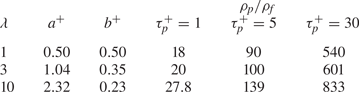
Particles are modelled as prolate spheroids. Three aspect ratios  $\lambda =1$,
 $3$ and
 $10$ are investigated as well as three relaxation times (2.9), in wall units
 $\tau _p^+=1,~5$ and
 $30$. Particle geometry was chosen so that the volume equivalent sphere diameter remains constant. With this definition, the ratio of the major axis length to the minimal value of Kolmogorov's length scale,
 $2a^+/\eta _{k,min}^+$, is lower than
 $1$ for
 $\lambda =1$ for the three values of
 $Re_{\tau }$ considered in the present study. For the ellipsoids, the ratio
 $2a^+/\eta _{k,min}^+$ varies between
 $1.35$ (
 $\lambda =3$ and
 $Re_{\tau }=180$) and
 $3.29$ (
 $\lambda =10$ and
 $Re_{\tau }=1000$). Jeffery's formula (2.10) can be reasonably employed to compute the torque acting on ellipsoidal particles under this condition (Ravnik, Marchioli & Soldati Reference Ravnik, Marchioli and Soldati2018). The particle parameters are provided in table 2. To focus on the effect of turbulence on the particle dynamics, the particle–fluid coupling is one way: the effect of the particles on the fluid dynamics is supposed negligible as well as interparticle interactions. Therefore, the results presented in this study apply to the dilute limit of particle-laden flows. The particle volume fraction is a function of the number of particles introduced in the computational domain, and this number was selected in order to get reliable statistics in the time window studied and to keep the computational cost affordable. Periodic boundaries are applied to the dispersed phase in the streamwise and spanwise directions. Wall-particle collisions are treated as elastic when the distance between the particle centre of mass and the wall is smaller than
 $d_{eq}/2$. Note that the particle orientation is not accounted for in the rebound treatment, and that only the wall-normal component of the particle translational velocity is reversed when a collision occurs. This approximation is commonly used to study the dynamics of ellipsoids in a turbulent channel flow (Mortensen et al. Reference Mortensen, Andersson, Gillissen and Boersma2008a; Zhao et al. Reference Zhao, Challabotla, Andersson and Variano2015b; Ouchene et al. Reference Ouchene, Polanco, Vinkovic and Simoëns2018; Zhao et al. Reference Zhao, Challabotla, Andersson and Variano2019). The equations governing the ellipsoidal translational and rotational motions are solved with the same third-order low-storage Runge–Kutta scheme as used in the fluid solver. The time step used to integrate in time the particle equations of motion is also similar to that used in the fluid solver. Its value is obtained from the formula
 $\Delta t = \min ( \Delta t_f ,\, \Delta t_{p,1} ,\, \Delta t_{p,2} )$, where
 $\Delta t_f$ is the time step provided by the flow solver with the previously mentioned Courant–Friedrichs–Lewy (CFL) condition. Here
 $\Delta t_{p,1}$ and
 $\Delta t_{p,2}$ are additional time step restrictions imposed to solve the particle equations of motion;
 $\Delta t_{p,1}= \tau _p^s/10$, where
 $\tau _p^s= (\rho _p d^2_{eq})/(18 \rho _f \nu )$ is the spherical particle relaxation;
 $\Delta t_{p,2}$ is an equivalent CFL condition for the particle phase that prevents particles crossing over more than one cell in one time step. The averaged time step is provided in table 1. The fluid velocity and velocity gradient necessary to compute the hydrodynamic actions on each particle are interpolated at the particle position using a tricubic Hermite interpolation and a trilinear interpolation, respectively.
Characteristics of prolate spheroids. The volume equivalent sphere diameter is constant and equal to  $d_{eq}^+=1$.

Here  $300\,000$ prolate spheroids are seeded uniformly in the turbulent flow field. The particle translational and rotational velocities are initially equal to that of the fluid at their position, while their orientation is randomized.
After the particles are released in the turbulent flow, their metrics are collected every  $200$ iterations, corresponding to an average time interval of
 $18$ in wall units. The same methodology as the one presented in Michel & Arcen (Reference Michel and Arcen2021a) was used to avoid the statistical bias due to transient effects. First, the temporal evolution of the entropy parameter (Picano, Sardina & Casciola Reference Picano, Sardina and Casciola2009) was computed to determine the time required by the particle distribution to reach a statistically steady state. Second, from this time, data were accumulated over an interval of duration of
 $20\,000$ in wall units to ensure that the sample used to compute statistics is large enough to be representative, even in regions of low particle concentration. For all three values of
 $Re_{\tau }$, the distribution of
 $\tau _p^+=1$ and
 $5$ particles reached steady state before
 $30\,000$ viscous time units. At
 $Re_{\tau }=1000$ however, a longer time (approximately
 $40\,000$ in wall units) was required for the distribution to reach steady state for the more inertial (
 $\tau _p^+=30$) particles. To our knowledge, this is the first time that such long simulations are realized to study the dynamics of prolate ellipsoids, at different values of the Reynolds number, in a turbulent channel flow.
4. Preferential concentration
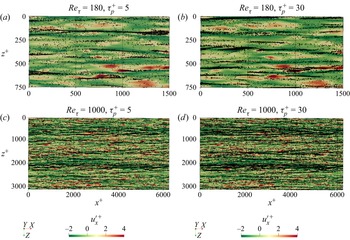
In a turbulent flow near solid boundaries, the spatial organization of the coherent vortices (Robinson Reference Robinson1991) induces a characteristic preferential concentration of inertial particles. Particularly, Kaftori, Hetsroni & Banerjee (Reference Kaftori, Hetsroni and Banerjee1995) showed that spherical, inertial particles accumulate in regions of negative streamwise fluid velocity fluctuation (the so-called low-speed streaks). Using DNS, this characteristic concentration was similarly observed for ellipsoidal particles by Zhang et al. (Reference Zhang, Ahmadi, Fan and McLaughlin2001) and Mortensen et al. (Reference Mortensen, Andersson, Gillissen and Boersma2008a), with a small influence of  $\lambda$. To illustrate this particle segregation, an instantaneous visualization of the fluctuation field,
 $u'^+_x$, as well as ellipsoids located in
 $1< y_p^+<5$ are presented in figure 1. It should be noted that this phenomenon could be emphasized using other techniques. Some of them were recently applied to experimental and DNS data for spherical particles (see, for instance, Fong, Amili & Coletti Reference Fong, Amili and Coletti2019; Jie et al. Reference Jie, Cui, Xu and Zhao2022). Results are given for
 $\lambda =3$ only because the influence of the aspect ratio is minor. From figure 1(a,b), small differences are visible between
 $\tau _p^+=5$ and
 $30$ ellipsoids at
 $Re_{\tau }=180$. In both cases, particle distribution is not random, and long particle streaks can be observed. There is a good agreement between the particle streaks and regions where the fluctuations of the streamwise velocity component are negative, corresponding to low-speed fluid streaks. More
 $\tau _p^+=30$ particles nonetheless appear to be located in regions of positive
 $u'^+_x$.
Visualization of the fluctuation of the streamwise component of the fluid translational velocity ( $u'^+_x$) in the
 $(x,z)$ plane at position
 $y^+=3$. The colouration represents the value of the fluctuations. The black dots represent the position of the centre of mass of
 $\lambda =3$ ellipsoids with position
 $1< y^+_p<5$. Results are shown for (a,c)
 $\tau _p^+=5$, (b,d)
 $\tau _p^+=30$, (a,b)
 $Re_{\tau }=180$, (c,d)
 $Re_{\tau }=1000$.

Figure 1(c,d) presents a similar visualization for the case  $Re_{\tau }=1000$. While the general appearance of the instantaneous flow seems more complex, due to the smaller size of the turbulent flow structures, a careful examination reveals that the main features observed at
 $Re_{\tau }=180$ are still visible. Long particle streaks can be observed, and these correspond to regions of negative
 $u'^+_x$. This qualitative independence of the preferential concentration to the Reynolds number was also observed by Bernardini (Reference Bernardini2014) for spherical particles. In addition, Bernardini noted that the spacing between the streaks remains constant, in wall units (
 $\delta _z^+\approx 120$), as the Reynolds number increases. This is similarly observed for the ellipsoids, and suggests that the universal organisation of inertial particles in the viscous sublayer does not depend on their shape.
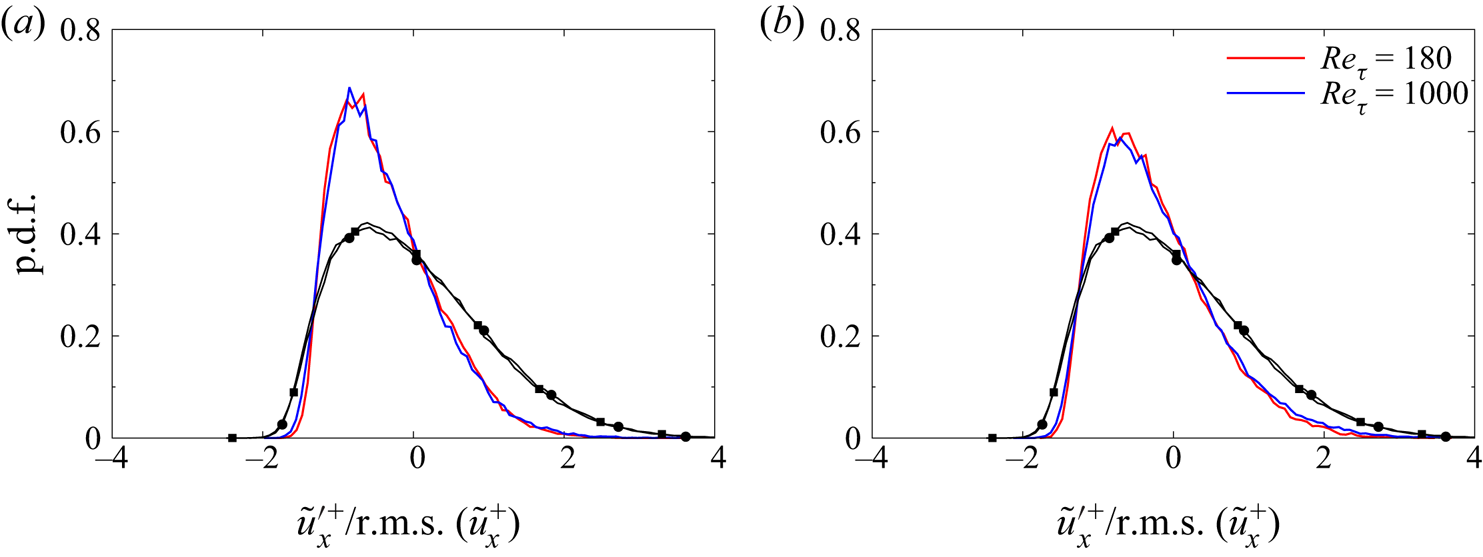
To highlight the preferential sampling of the flow by the particles, the probability density function (p.d.f.) of the fluctuation of the streamwise component of the fluid translational velocity conditioned at particle location,  $\tilde {u}'^+_x$, is presented in figure 2. This statistic was also selected by Marchioli & Soldati (Reference Marchioli and Soldati2002) to quantify the preferential concentration of inertial spheres in a turbulent channel flow at
 $Re_{\tau }=150$ and by Yuan et al. (Reference Yuan, Zhao, Challabotla, Andersson and Deng2018) for inertial ellipsoids at
 $Re_{\tau }=180$. To evaluate this quantity, the DNS fluid velocity field is first interpolated at the particle location using the method mentioned in § 3. Statistics are then extracted by averaging over time and over the particles located in the slab
 $4< y^+<5$. The p.d.f. of
 $u'^+_x$, the fluctuation of the streamwise component of the unconditioned fluid velocity is also presented. The peak of the p.d.f., both for
 $\tilde {u}'^+_x$ and
 $u'^+_x$, is visible for negative streamwise fluctuations, and it is higher for the fluid seen by the particles than for the unconditioned fluid. This corresponds to the characteristic particles accumulation in low-speed fluid streaks, which was observed in figure 1. The positive skew of the p.d.f. of
 $u'^+_x$ nonetheless indicates the rare occurrence of strong events associated to positive streamwise velocity fluctuations. The p.d.f. of the velocity fluctuations of the fluid seen by the particles exhibits a weaker skew, and the more intense events experienced by the particles depend on their relaxation time. For instance, the tail of the p.d.f. for
 $\tau _p^+=30$ particles (figure 2b) is longer than for
 $\tau _p^+=5$ (figure 2a), indicating a higher probability to experience strong positive streamwise velocity fluctuations. This trend reflects the different characteristics of the regions of the flow preferentially sampled by particles with respect to their relaxation time. Increasing the flow Reynolds number does not significantly alter the general shape of the p.d.f., but a higher probability of strong positive velocity fluctuation events can be noticed at higher
 $Re_{\tau }$, both for the fluid and for the fluid seen by the particles.
Probability density function (p.d.f.) of the fluctuation of the streamwise component of the fluid translational velocity sampled by the particles in the region  $4< y^+<5$. Results are shown for (a)
 $\tau _p^+=5$, (b)
 $\tau _p^+=30$. Black line with symbols: unconditioned fluid. Circles:
 $Re_{\tau }=180$; squares:
 $Re_{\tau }=1000$. The data are normalized by the velocity r.m.s.

To more finely quantify the influence of the flow Reynolds number on preferential concentration, we analyse how the fluctuations of the fluid seen by the particles are distributed in terms of the four types of turbulent events contributing to Reynolds shear stress. These are called the quadrants and are characterized by the sign of  $u'_x$ and
 $u'_y$ (Wallace, Eckelmann & Brodkey Reference Wallace, Eckelmann and Brodkey1972). The first quadrant (
 $Q_1$),
 $u'_x>0$ and
 $u'_y>0$, corresponds to the motion of a fluid parcel with high streamwise velocity towards the channel centre; the second quadrant (
 $Q_2$),
 $u'_x<0$ and
 $u'_y>0$, is associated to ejections of low-speed fluid towards the channel core; the third quadrant (
 $Q_3$),
 $u'_x<0$ and
 $u'_y<0$, corresponds to the motion of low-speed fluid towards the wall; the fourth quadrant (
 $Q_4$),
 $u'_x>0$ and
 $u'_y<0$, is representative of the motion of high speed fluid towards the wall (sweeps). From such an analysis, Marchioli & Soldati (Reference Marchioli and Soldati2002) showed that
 $Q_2$ and
 $Q_4$ events are strongly correlated to spherical particle motion toward and outward from the wall.
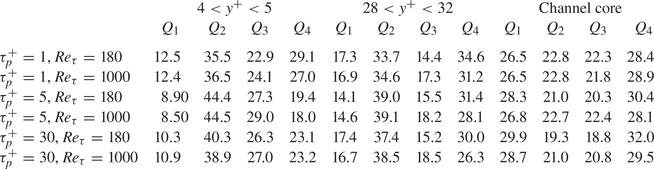
The average percentage of particles in each quadrant at different wall-normal locations in the channel is presented in table 3 for three values of the relaxation time. Only the results for  $\lambda =3$ are reported, because from a quantitative perspective, we did not notice important differences with the other aspect ratios. In the viscous sublayer (
 $4< y^+<5$), at
 $Re_{\tau }=180$ , most of
 $\tau _p^+=5$ and
 $30$ ellipsoids (
 $65\unicode{x2013}70\,\%$) sample
 $Q_2$ and
 $Q_3$ events, which correspond to regions where
 $u'_x<0$. This result is connected with the accumulation of
 $\tau _p^+=5$ and
 $30$ particles in the low-speed streaks that was observed in figure 1(a,b). The picture is different for
 $\tau _p^+=1$ ellipsoids, which preferentially sample
 $Q_2$ and
 $Q_4$ events. At a further distance from the wall, particles interact differently with the turbulent flow, and sample different regions. Results from the quadrant analysis at
 $y^+\approx 30$ are presented in table 3. In this region, a large fraction of the ellipsoids are surrounded by
 $Q_2$ and
 $Q_4$ events. This compares well with what Vinkovic et al. (Reference Vinkovic, Doppler, Lelouvetel and Buffat2011) observed for
 $\tau _p^+=5$ spherical particles in a channel at
 $Re_{\tau }=587$ around
 $y^+=38$. Note that the results presented in table 3 show that such events are also dominant for
 $\tau _p^+=1$ and
 $30$ in this region. Finally, in the channel core, ellipsoids preferentially sample
 $Q_1$ and
 $Q_4$ events. These correspond to regions where the fluctuations of the streamwise velocity are of a positive sign, and contrast with the preferential concentration in the near-wall and buffer regions. It is noteworthy to mention that the distribution of the fluctuations of the fluid velocity sampled at particle location is not isotropic in the channel core. This result compares well to the anisotropy of the fluid velocity distribution in the channel core reported by Kim, Moin & Moser (Reference Kim, Moin and Moser1987) at
 $Re_{\tau }=180$.
Quadrant analysis of the fluid seen by the particles for  $\lambda =3$ ellipsoids at different wall-normal locations in the channel. The channel core is defined as
 $170< y^+<180$ and
 $950< y^+<1000$ for
 $Re_{\tau }=180$ and
 $1000$, respectively.

The results presented in table 3 also show the influence of the Reynolds number on the properties of the fluid velocity seen by the particles. Increasing the value of  $Re_{\tau }$ does not deeply alter the distribution of the fluctuations of the velocity of the fluid seen by the particles. A finer comparison nonetheless reveals a complex evolution of the quadrant distribution, with different trends depending on the position in the channel and on the relaxation time. In the near-wall region the influence of
 $Re_{\tau }$ on the turbulent events surrounding the particles depends on the relaxation time. For example,
 $\tau _p^+=1$ ellipsoids experience more
 $Q_2$ (ejection) events at higher values of
 $Re_{\tau }$, while the probability of encountering such events decreases for
 $\tau _p^+=30$. Higher values of
 $Re_{\tau }$ are also associated with a decrease of the fraction of
 $Q_4$ (sweep) events sampled by
 $\tau _p^+=1$ ellipsoids in this region, but this is not the case for
 $\tau _p^+=30$. In the buffer layer results presented in table 3 show that the influence of
 $Re_{\tau }$ on the quadrants is similar for all relaxation times. The fraction of
 $Q_4$ events decreases, while that of
 $Q_3$ increases. Ellipsoids surrounded by fluid moving towards the wall therefore experience more negative streamwise velocity fluctuations at higher values of
 $Re_{\tau }$. Finally, in the channel core there is a weak influence of
 $Re_{\tau }$ on the turbulent events experienced by
 $\tau _p^+=1$ ellipsoids. For more inertial particles, however, a clear increase of the fraction of
 $Q_2$ and
 $Q_3$ events can be noticed, while the probability of
 $Q_1$ and
 $Q_4$ events decreases. This indicates that
 $\tau _p^+=5$ and
 $30$ ellipsoids are more likely to be surrounded by negative streamwise velocity fluctuations in the channel core at higher
 $Re_{\tau }$. This evolution is likely related to the interaction of these particles with very-large-scale motions (VLSM), which have a more important contribution to the turbulent flow dynamics as
 $Re_{\tau }$ increases (Balakumar & Adrian Reference Balakumar and Adrian2007). It was previously shown that these large-scale structures have a strong effect on the preferential concentration of spherical particles with a relaxation time ranging between
 $5 < \tau _p^+ < 300$ (Jie et al. Reference Jie, Cui, Xu and Zhao2022). This result seems to apply to ellipsoidal particles as well. Increasing the flow Reynolds number results in a more homogeneous distribution of the velocity fluctuations of the fluid seen by
 $\tau _p^+=5$ and
 $30$ particles in this region.
These observations show that increasing the flow Reynolds number has an effect on the fluid velocity fluctuations sampled by the particles, especially in the buffer region, and in the channel core for moderately inertial particles. To better understand the influence of  $Re_{\tau }$ on the particle dynamics, several statistics describing the particle and fluid translational velocity seen by the particles are analysed in the next section.
5. Translational velocity statistics
5.1. Mean fluid seen velocity and drift velocity
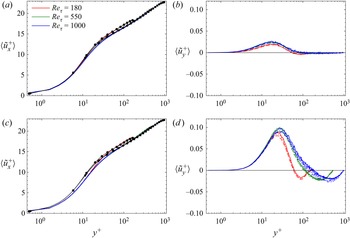
We now describe the statistical properties of the fluid velocity conditioned at particle location (also referred to as fluid velocity seen or sampled by the particles in the following). As previously explained, the DNS fluid velocity field is first interpolated at the particle location using the method mentioned in § 3 to evaluate this quantity. Statistics are then extracted by averaging over time and over the particles located in a given wall-normal slab whose thickness is provided by the Eulerian mesh. The average streamwise component of the fluid velocity seen by the particles is presented in figure 3(a,c) for relaxation times  $\tau _p^+=1$ and
 $30$, and for three aspect ratios. At
 $Re_{\tau }=180$, Mortensen et al. (Reference Mortensen, Andersson, Gillissen and Boersma2008b) did not notice a strong influence of
 $\lambda$ on this statistic, and this result was later confirmed by the experimental measurements of Abbasi Hoseini et al. (Reference Abbasi Hoseini, Lundell and Andersson2015). This statement remains valid at
 $Re_{\tau }=550$ and
 $1000$. In addition, the evolution of the streamwise component of the fluid velocity seen by the particles with
 $Re_{\tau }$ is analogous to that of the unconditioned fluid. In the viscous sublayer the average velocity, expressed in wall units, is independent of the Reynolds number, but the maximum value of
 $\langle \tilde {u}_x^+ \rangle$ increases in the channel core. These observations are valid for all the relaxation times considered.
Average value of the streamwise (a,c) and wall-normal (b,d) components of the translational velocity of the fluid at particle position, as a function of  $y^+$. Continuous line,
 $\lambda =1$; dotted line,
 $\lambda =3$; dashed line,
 $\lambda =10$. Results are shown for (a,b)
 $\tau _p^+=1$, (c,d)
 $\tau _p^+=30$. Black line with symbols: unconditioned fluid. Circles:
 $Re_{\tau }=180$; triangles:
 $Re_{\tau }=550$; squares:
 $Re_{\tau }=1000$.

The mean wall-normal component of the fluid velocity seen by the particles is presented in figure 3(b,d). The average  $\tilde {u}_y^+$ is not zero, because of the preferential particle segregation in the flow field. Increasing
 $Re_{\tau }$ has a notable influence on this statistic, which depends on the position in the channel and relaxation time. For
 $\tau _p^+=1$, the mean wall-normal velocity of the fluid seen by the particles increases with
 $Re_{\tau }$, everywhere in the channel. This can be noticed in the buffer region, where
 $\langle \tilde {u}_y^+ \rangle$ is maximum. It is interesting to observe that this result cannot be explained by the evolution of the quadrant distribution. For example, at
 $y^+=30$, results presented in table 3 indicate that
 $51\,\%$ of the
 $\tau _p^+=1$ particles sample regions of positive
 $\tilde {u}_y'^+$ at
 $Re_{\tau }=180$ (the sum of
 $Q_1$ and
 $Q_2$). This fraction is
 $51.5\,\%$ at
 $Re_{\tau }=1000$, and should not result in a visible increase of
 $\langle \tilde {u}_y^+ \rangle$. Therefore, the increase of
 $\langle \tilde {u}_y^+ \rangle$ with
 $Re_{\tau }$ observed in figure 3(b) is caused by the higher intensity of the fluctuations of the fluid seen by the particles. In the channel core, for
 $\tau _p^+=1$,
 $\langle \tilde {u}_y^+ \rangle$ is slightly negative at
 $Re_{\tau }=180$, and does not significantly vary with the Reynolds number.
For  $\tau _p^+=30$, figure 3(d) also shows that
 $\langle \tilde {u}_y^+ \rangle$ increases with
 $Re_{\tau }$ in the buffer region. Around
 $y^+=30$, the maximum of
 $\langle \tilde {u}_y^+ \rangle$ is higher for
 $Re_{\tau }=550$ and
 $1000$ than for
 $Re_{\tau }=180$. This is coherent with the increase of the number of events associated with positive
 $\tilde {u}'_y$ sampled by the particles at higher
 $Re_{\tau }$ (table 3). In the near-wall region and in the channel core, the average wall-normal velocity of the fluid seen by the particles does not vary with
 $Re_{\tau }$. This result was not expected from the results presented in table 3, because the quadrant analysis at
 $y^+=5$ indicates that the fraction of
 $\tau _p^+=30$ particles sampling
 $Q_1$ and
 $Q_2$ events is lower if the value of
 $Re_{\tau }$ is higher (
 $50.6\,\%$ at
 $Re_{\tau }=180$ and
 $49.8\,\%$ at
 $Re_{\tau }=1000$). The expected outcome would be a lower value of
 $\langle \tilde {u}_y^+ \rangle$ for higher
 $Re_{\tau }$. The fact that the mean value of the wall-normal velocity seen by the particles does not decrease indicates that the intensity of the turbulent events sampled by the particles increases with
 $Re_{\tau }$. Finally, in the near-wall region and in the channel core,
 $\langle \tilde {u}_y^+ \rangle$ is mostly unaffected by the value of
 $Re_{\tau }$.
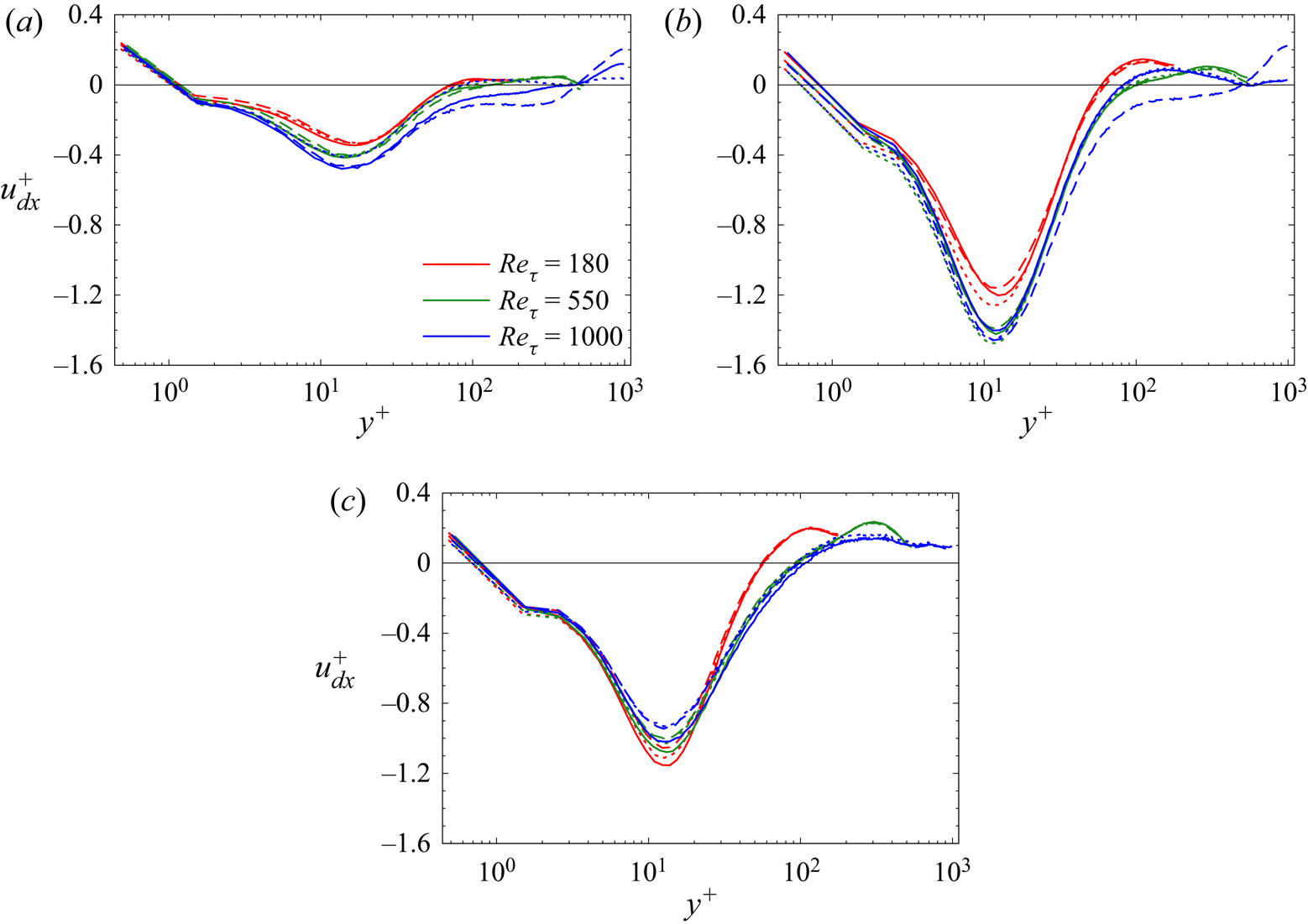
To obtain more information about the properties of the fluid sampled by the particles, the streamwise component of the translational drift velocity is presented in figure 4. The translational drift velocity corresponds to the average fluctuation of the velocity of the fluid sampled by the particles, computed by taking the unconditioned fluid velocity average as a reference,
 \begin{equation} u_{dx} =\langle \tilde{u}_{x}-\langle u_{x} \rangle \rangle. \end{equation}
In the channel at  $Re_{\tau }=180$, negative values of
 $u_{dx}^+$ up to
 $y^+\approx 50$ indicate that the particles sample regions of the flow where the streamwise velocity is lower than the average, that is, where the fluctuations of the streamwise velocity are negative. This observation is connected with the results presented in table 3: regardless of the relaxation time and aspect ratio, a majority of particles sample
 $Q_2$ and
 $Q_3$ events. Increasing the flow Reynolds number has a notable influence on
 $u_{dx}^+$, which is similar for all aspect ratios but differs as a function of the relaxation time.
Streamwise component of the translational drift velocity as a function of  $y^+$. Continuous line,
 $\lambda =1$; dotted line,
 $\lambda =3$; dashed line,
 $\lambda =10$. Results are shown for (a)
 $\tau _p^+=1$, (b)
 $\tau _p^+=5$, (c)
 $\tau _p^+=30$.

For  $\tau _p^+=1$ (figure 4a), the region of the channel for which
 $u_{dx}^+$ is negative increases with
 $Re_{\tau }$. In addition, a decrease of the drift velocity is observed in this region, indicating that ellipsoids see more negative fluctuations of the streamwise fluid velocity as the Reynolds number increases. This is connected with the results presented in table 3 at
 $y^+=5$ and
 $30$. There is a higher fraction of particles in
 $Q_2$ and
 $Q_3$ events at
 $Re_{\tau }=1000$ than at
 $Re_{\tau }=180$ at these two locations. Similar observations can be made for
 $\tau _p^+=5$ (figure 4b), although the influence of increasing from
 $Re_{\tau }=550$ to
 $Re_{\tau }=1000$ is less important for this relaxation time. A notable exception is for
 $\lambda =10$. For this aspect ratio, increasing the Reynolds number from
 $Re_{\tau }=550$ to
 $Re_{\tau }=1000$ results in a significant increase of the fraction of the channel where the drift velocity is negative for
 $\tau _p^+=5$. In consequence, the sign of the drift velocity differs from that observed for
 $\lambda =1$ and
 $3$ over a large fraction of the channel height. This result is remarkable because such influence of the aspect ratio is not visible at
 $Re_{\tau }=180$ and
 $550$. Therefore, there might be unexpected effects of the aspect ratio on the particle statistics at higher values of the Reynolds number. Such dependence of the drift velocity to the flow Reynolds number is likely due to the interaction of the ellipsoidal particles with the VLSM present in the flow at
 $Re_{\tau }=1000$. For instance, Wang & Richter (Reference Wang and Richter2019) reported that the VLSM have a strong influence on the streamwise drift velocity of inertial spherical particles in the outer region of an open channel flow. The present results suggest that the influence of the VLSM on the drift velocity additionally depends on the particle shape, especially for weak and moderate particle inertia. For
 $\tau _p^+=30$, such influence of the aspect ratio is not visible in figure 4(c). There is however a different evolution of
 $u_{dx}^+$ with the Reynolds number. The minimum value of the drift velocity increases with
 $Re_{\tau }$ for
 $\tau _p^+=30$, indicating a decrease of the preferential concentration of such particles in regions of negative streamwise fluid velocity fluctuations. This trend is the opposite of what was observed for smaller relaxation times. Finally, increasing the flow Reynolds number has a weak effect on
 $u_{dx}^+$ in the channel core and only results in a slight decrease of the drift velocity in this region.
5.2. Fluctuations of the particle and fluid seen velocities
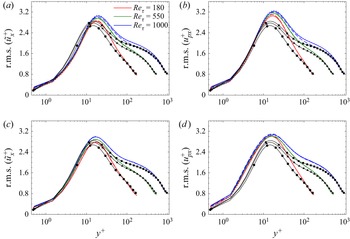
We now examine the influence of  $Re_{\tau }$ on the r.m.s. of the fluid seen and particle translational velocities. The r.m.s. of the streamwise component of the velocity of the fluid at particle position is presented in figure 5 for relaxation times
 $\tau _p^+=5$ (figure 5a) and
 $30$ (figure 5c). In a general manner, there is a similar evolution of r.m.s.(
 ${u}_x^+$) and r.m.s.(
 $\tilde {u}_x^+$): increasing the Reynolds number leads to higher velocity fluctuations, everywhere in the channel. A well-known effect of particle inertia observed both for spheres and ellipsoids (Mortensen et al. Reference Mortensen, Andersson, Gillissen and Boersma2008a) at
 $Re_{\tau }=180$ is that the r.m.s. of the fluid seen by the particles is higher than r.m.s.(
 $u_x^+$). Figure 5(a,c) shows that this observation does not depend on the Reynolds number, and neither does the position at which r.m.s.(
 $\tilde {u}_{x}^+$) becomes higher than r.m.s.(
 ${u}_{x}^+$). In figure 5(a) we can nonetheless observe that for
 $\tau _p^+=5$, r.m.s.(
 $\tilde {u}_x^+$) does not depend on
 $\lambda$ for
 $Re_{\tau }=180$ and
 $550$, but this is not the case for
 $Re_{\tau }=1000$. In the channel core the r.m.s. of the fluid seen by
 $\lambda =10$ and
 $\tau _p^+=5$ ellipsoids is nearly equal to that of the fluid for this Reynolds number. For
 $\tau _p^+=30$, these results weakly depend on the aspect ratio, up to
 $Re_{\tau }=1000$.
The r.m.s. of the streamwise component of the fluid translational velocity at particle position (a,c) and of the particle translational velocity (b,d) as a function of  $y^+$. Continuous line,
 $\lambda =1$; dotted line,
 $\lambda =3$; dashed line,
 $\lambda =10$. Results are shown for (a,b)
 $\tau _p^+=5$, (c,d)
 $\tau _p^+=30$. Black line with symbols: unconditioned fluid velocity. Circles:
 $Re_{\tau }=180$; triangles:
 $Re_{\tau }=550$; squares:
 $Re_{\tau }=1000$.

These results can be compared with the particle velocity r.m.s., which are presented in figure 5(b,d). In their study, Mortensen et al. (Reference Mortensen, Andersson, Gillissen and Boersma2008a) showed that r.m.s.( $u_{px}^+$) for ellipsoidal particles at
 $Re_{\tau }=180$ is greater than that of the fluid, everywhere in the channel. This is a well-known effect induced by the presence of a mean fluid velocity gradient, which was previously documented for spheres (see, for instance, Liljegren Reference Liljegren1993). The present results confirm this trend for higher values of the Reynolds number. Previously, we also remarked that r.m.s.(
 $\tilde {u}_x^+$) increases in a way similar to that of the fluid. This is the case for r.m.s.(
 ${u}_{px}^+$) as well. Nonetheless for
 $\tau _p^+=30$ (figure 5d), we remark that the increase of r.m.s.(
 ${u}_{px}^+$) is less pronounced than the increase observed for the fluid. To conclude, regardless of the Reynolds number, the effect of the aspect ratio on r.m.s.(
 $u_{px}^+$) is similar to that observed on r.m.s.(
 $\tilde {u}_x^+$). There is generally a weak effect of this parameter, except for the r.m.s. for
 $\lambda =10$ and
 $\tau _p^+=5$ in the central region of the channel at
 $Re_{\tau }=1000$.
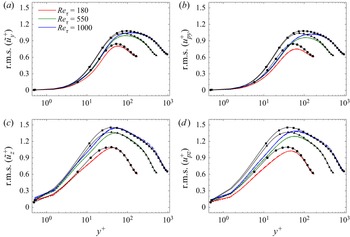
The wall-normal and spanwise components of the r.m.s. of the fluid translational velocity sampled at particle position are presented in figure 6(a,c) for  $\tau _p^+=5$. For all three Reynolds numbers considered, r.m.s.(
 $\tilde {u}_y^+$) and r.m.s.(
 $\tilde {u}_z^+$) are lower than those of the fluid. The influence of the aspect ratio on these components of r.m.s.(
 $\tilde {u}_i^+$) is minor at
 $Re_{\tau }=180$, and this statement remains true at
 $Re_{\tau }=550$ and
 $1000$ as well. Figure 6(b,d) indicates that the same conclusions apply to the r.m.s. of the wall-normal and spanwise components of the particle translational velocity. Results for
 $\tau _p^+=1$ and
 $\tau _p^+=30$ similarly reveal a weak influence of
 $\lambda$ for all the Reynolds numbers considered and are not presented for brevity reasons.
The r.m.s. of the fluid translational velocity at particle position (a,c) and of the particle translational velocity (b,d) as a function of  $y^+$ for particles with relaxation time
 $\tau _p^+=5$. Continuous line,
 $\lambda =1$; dotted line,
 $\lambda =3$; dashed line,
 $\lambda =10$. Results are shown for (a,b) wall-normal component; (c,d) spanwise component. Black line with symbols: unconditioned fluid. Circles:
 $Re_{\tau }=180$; triangles:
 $Re_{\tau }=550$; squares:
 $Re_{\tau }=1000$.

6. Angular velocity statistics
6.1. Mean particle and fluid seen angular velocities
To complete this study, we now examine the influence of  $Re_{\tau }$ on the angular velocity statistics.
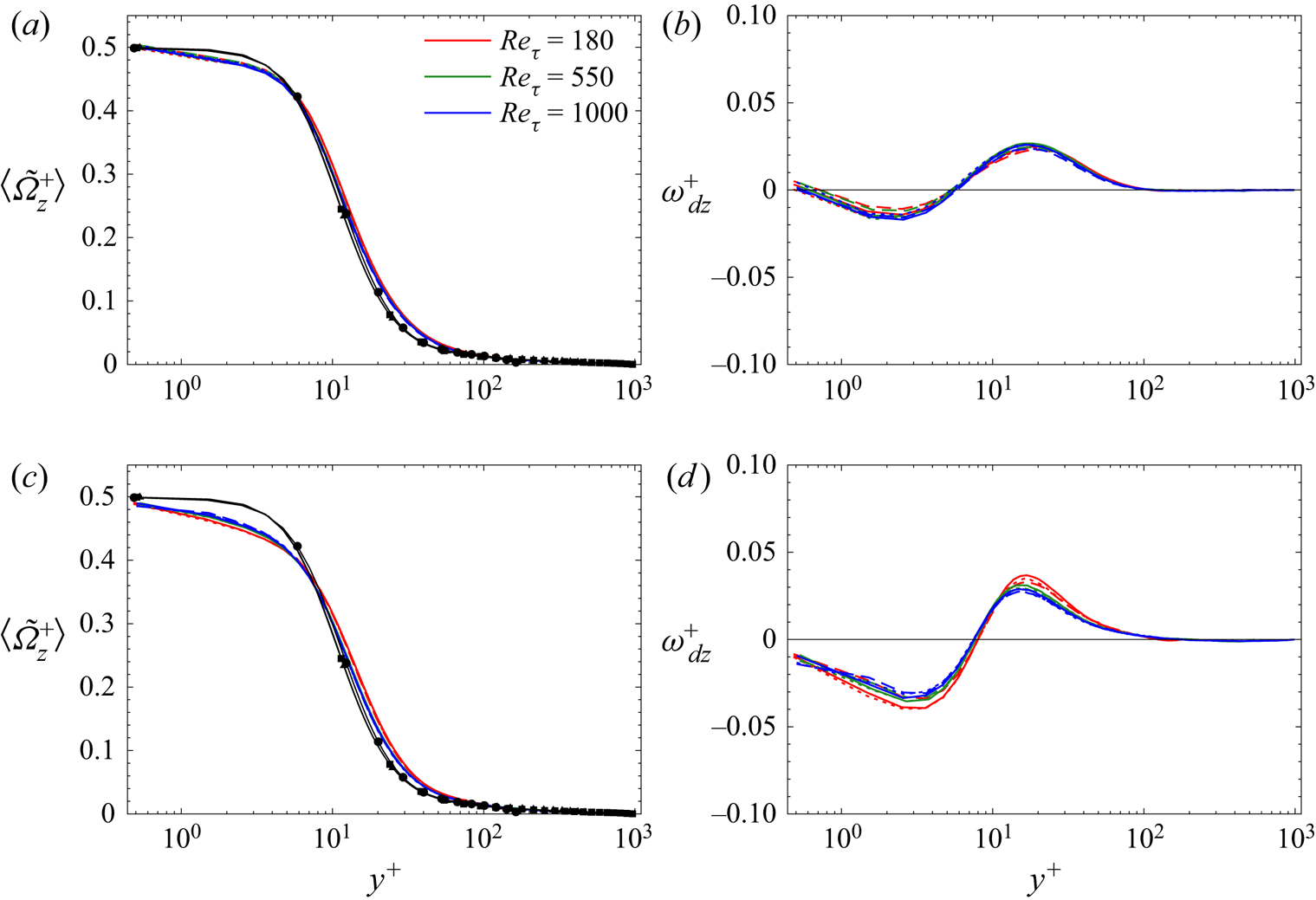
The mean angular velocity of the fluid seen by the particles is presented in figure 7(a,c) for  $\tau _p^+=1$ and
 $30$. The angular velocity of the fluid sampled by the particles is nearly the same as that of the fluid, regardless of the aspect ratio, relaxation time and Reynolds number. Nonetheless, in the viscous sublayer the mean angular velocity of the fluid seen by the particles is slightly lower than the average angular velocity of the fluid, while it is slightly higher around
 $y^+=30$. These differences are more important for
 $\tau _p^+=30$ than for
 $\tau _p^+=1$. Because the average angular velocity of the fluid seen by the particles only depends on the wall-normal derivative of
 $\langle \tilde {u}_x^+ \rangle$, it can be related to the preferential concentration. In the viscous sublayer the particles are located in low-speed streaks (table 3), corresponding to regions where
 $\langle \tilde {u}_x^+ \rangle < \langle {u}_x^+ \rangle$. The wall-normal derivative of the mean streamwise translational velocity of the fluid seen by the particles in this region is therefore lower than the one of the fluid. This explains the lower values of
 $\langle \tilde {\varOmega }_z^+ \rangle$ observed in figure 7(a,c) up to
 $y^+=8$. In the buffer region, figure 3(a,c) shows that
 $\langle \tilde {u}_x^+ \rangle$ increases more quickly than
 $\langle u_x^+ \rangle$. This is consistent with the values of
 $\langle \tilde {\varOmega }_z^+ \rangle$ being higher than
 $\langle {\varOmega }_z^+ \rangle$. Increasing the value of the Reynolds number does not strongly modify the mean angular velocity of the fluid, nor the mean angular velocity of the fluid sampled by the particles.
Average spanwise component of the angular velocity of the fluid at particle position (a,c) and angular drift velocity (b,d) as a function of  $y^+$. Continuous line,
 $\lambda =1$; dotted line,
 $\lambda =3$; dashed line,
 $\lambda =10$. Results are shown for (a,b)
 $\tau _p^+=1$, (c,d)
 $\tau _p^+=30$. Black line with symbols: unconditioned fluid. Circles:
 $Re_{\tau }=180$; triangles:
 $Re_{\tau }=550$; squares:
 $Re_{\tau }=1000$.

In order to highlight the differences between the angular velocity of the fluid seen by the particles and the mean fluid angular velocity, figure 7(b,d) presents the angular drift velocity, the average fluctuation of the angular velocity of the fluid conditioned at particle position, computed with the average fluid angular velocity as a reference,
 \begin{equation} \omega_{dz}=\langle \tilde{\varOmega}_z - \langle \varOmega_z \rangle \rangle. \end{equation}
For the two relaxation times considered, the angular drift velocity is negative in the viscous sublayer and positive in the buffer region. This is consistent with the observation previously reported from figure 7(a,c). In figure 7(b) we remark that increasing the flow Reynolds number has a minor effect on the angular drift velocity for  $\tau _p^+=1$ particles. For
 $\tau _p^+=30$ (figure 7d), the magnitude of
 $\omega _{dz}^+$ is lower for higher values of
 $Re_{\tau }$. On average, at higher
 $Re_{\tau }$, the angular velocity of the fluid seen by the particles is closer to that of the unconditioned fluid. Finally, the influence of the aspect ratio on the angular drift velocity is marginal, which confirms the previous remarks about the angular velocity of the fluid seen by the particles.
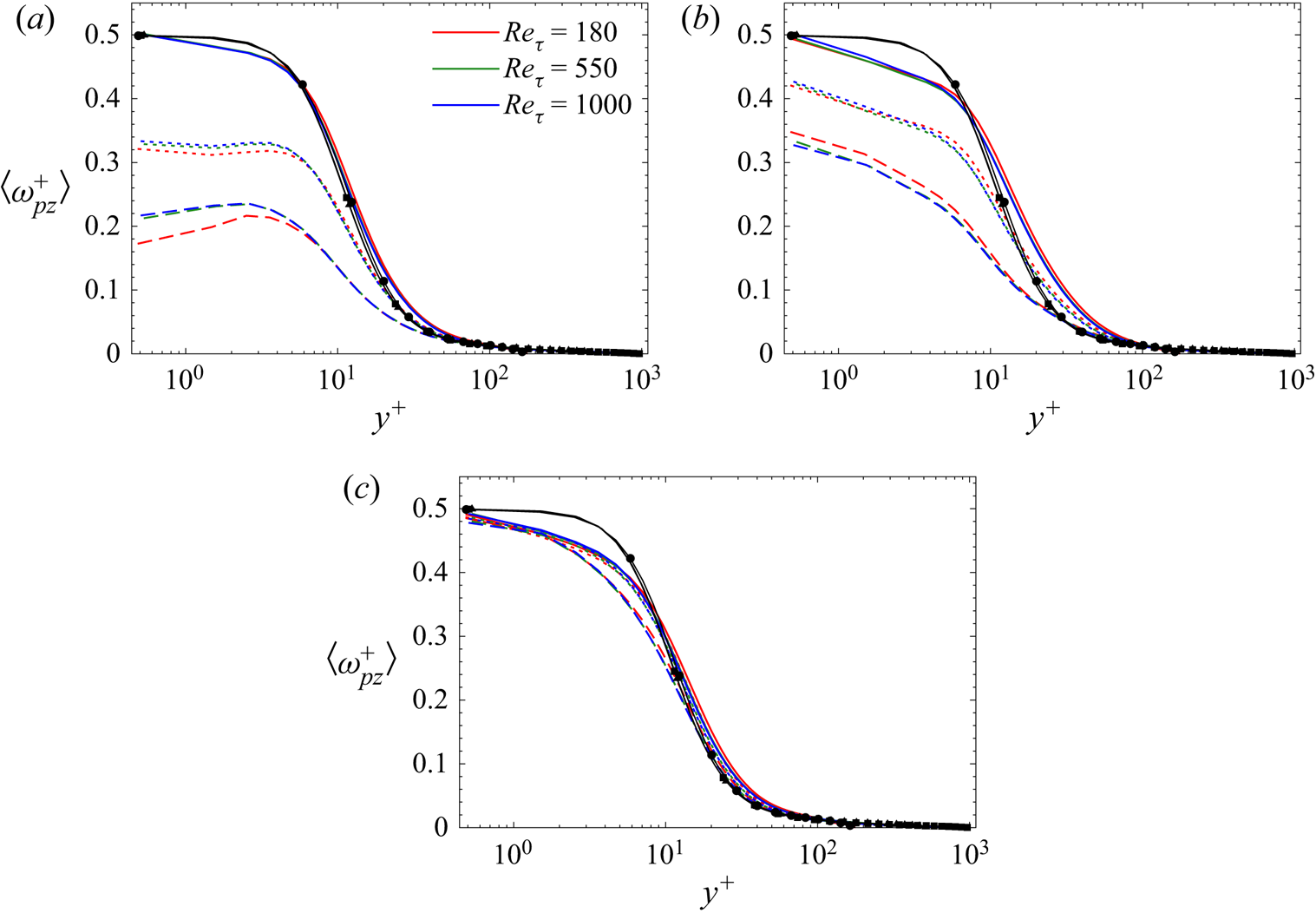
The ellipsoids mean angular velocity is presented in figure 8. In the near-wall region the particle mean angular velocity strongly depends on the aspect ratio and relaxation time. This is a consequence of the periodic rotation orbits caused by the mean velocity gradient in this region. The characteristics of the rotation orbits strongly vary with the particle shape and inertia (Lundell & Carlsson Reference Lundell and Carlsson2010; Zhao et al. Reference Zhao, Challabotla, Andersson and Variano2015b). For example,  $\lambda =10$ and
 $\tau _p^+=1$ particles have long rotation periods in the plane (
 $x,z$), where they spend extended periods of time spinning with their major axis aligned with the mean flow (Michel & Arcen Reference Michel and Arcen2021b). These conclusions, drawn up to
 $Re_{\tau }=550$, can be extrapolated up to
 $Re_{\tau }=1000$. On average, it results in a low mean spanwise angular velocity for high aspect ratios (figure 8a). Ellipsoids of relaxation time
 $\tau _p^+=30$, however, rotate around one of their minor axis and with a nearly constant angular velocity in the velocity-gradient
 $(x,y)$ plane (Michel & Arcen Reference Michel and Arcen2021b). Their average angular velocity is close to that of the spherical particles, and also close to the mean angular velocity of the fluid (figure 8c).
Average spanwise component of the particle angular velocity as a function of  $y^+$. Continuous line,
 $\lambda =1$; dotted line,
 $\lambda =3$; dashed line,
 $\lambda =10$. Results are shown for (a)
 $\tau _p^+=1$, (b)
 $\tau _p^+=5$, (c)
 $\tau _p^+=30$. Black line with symbols: unconditioned fluid. Circles:
 $Re_{\tau }=180$; triangles:
 $Re_{\tau }=550$; squares:
 $Re_{\tau }=1000$.

In the near-wall region there is a notable influence of the Reynolds number on the mean angular velocity of  $\lambda =10$ and
 $\tau _p^+=1$ ellipsoids. Figure 8(a) clearly shows the increase of the mean angular velocity of these particles with
 $Re_{\tau }$. There is an analogous influence of
 $Re_{\tau }$ on the angular velocity of
 $\lambda =3$ and
 $\tau _p^+=1$ ellipsoids, although less important. A possible explanation can be obtained by examining the influence of the Reynolds number on the rotation mode of the ellipsoids. In the near-wall region higher values of
 $Re_{\tau }$ increase the alignment of the particle major axis with the mean vorticity for
 $\tau _p^+=1$ (Michel & Arcen Reference Michel and Arcen2021b). This stronger alignment induces a higher average particle angular velocity. For
 $\tau _p^+=30$ ellipsoids, increasing
 $Re_{\tau }$ results in an increase of the mean angle between the particle major axis and the velocity-gradient plane (Michel & Arcen Reference Michel and Arcen2021b). While a decrease of the mean angular velocity of these particles could be expected, figure 8(c) suggests only minor changes of
 $\langle \omega _{pz}^+ \rangle$ with the flow Reynolds number for such ellipsoids. In figure 8(b), however, we note a slight decrease of the mean angular velocity of
 $\lambda =10$ and
 $\tau _p^+=5$ particles when
 $Re_{\tau }$ increases. These ellipsoids have a hybrid rotation mode, that share characteristics from both rotations of
 $\tau _p^+=1$ and
 $\tau _p^+=30$ ellipsoids. For moderate inertia, the modification of the rotation orbits when
 $Re_{\tau }$ increases therefore results in a reduction of the average angular velocity.
6.2. Fluctuations of the particle and fluid seen angular velocities
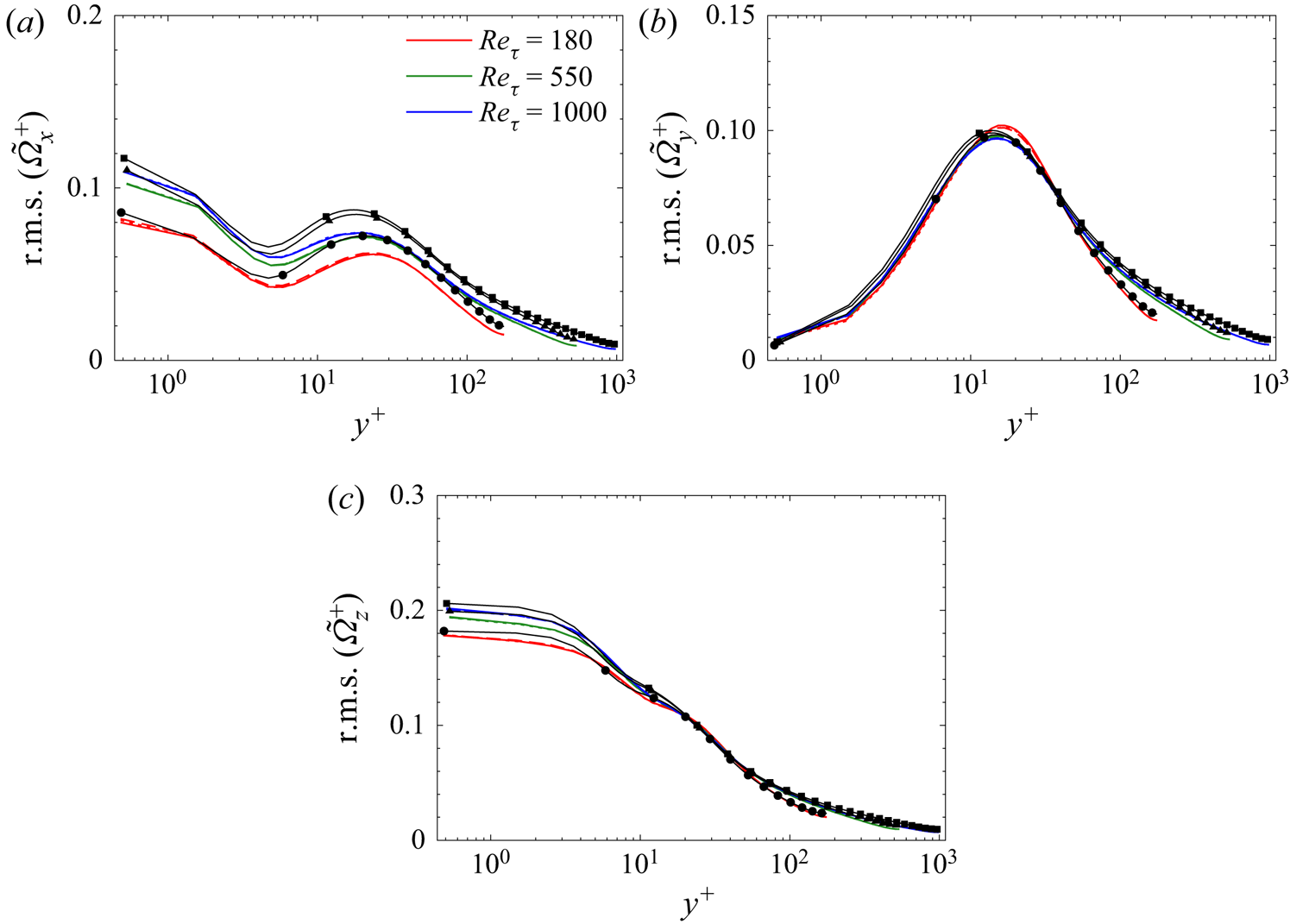
To conclude this study, we examine the effect of the flow Reynolds number on the fluctuations of the angular velocity. The r.m.s. of the three components of the angular velocity of the fluid sampled at particle position are presented in figure 9. Only the results for  $\tau _p^+=30$ are presented because the influence of
 $\tau _p^+$ on this statistic is minor. The intensity of r.m.s.(
 $\tilde {\varOmega }_x^+$) and r.m.s.(
 $\tilde {\varOmega }_z^+$) increases with the Reynolds number. This is clearly visible in the near-wall region and to a lesser extent in the buffer region. In contrast, r.m.s.(
 $\tilde {\varOmega }_y^+$) does not strongly vary with
 $Re_{\tau }$. This trend is similar to that observed for the r.m.s. of the angular velocity of the unconditioned fluid (black line with symbols). Similarly to Mortensen et al. (Reference Mortensen, Andersson, Gillissen and Boersma2008a), a minor influence of the aspect ratio on the r.m.s.(
 $\tilde {\varOmega }_i^+$) at
 $Re_{\tau }=180$ is noted. This weak effect of
 $\lambda$ persists for higher values of
 $Re_{\tau }$.
The r.m.s. of the streamwise (a), wall-normal (b) and spanwise (c) components of the angular velocity of the fluid at particle position as a function of  $y^+$ for particles with relaxation time
 $\tau _p^+=30$. Continuous line,
 $\lambda =1$; dotted line,
 $\lambda =3$; dashed line,
 $\lambda =10$. Black line with symbols: unconditioned fluid. Circles:
 $Re_{\tau }=180$; triangles:
 $Re_{\tau }=550$; squares:
 $Re_{\tau }=1000$.

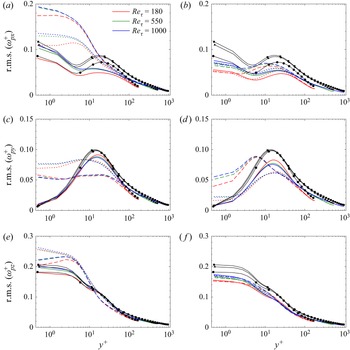
Figure 10 presents the three components of the r.m.s. of the particle angular velocity for  $\tau _p^+=1$ and
 $30$. These statistics strongly depend on the particle shape and relaxation time, and this is a direct consequence of the rotation induced by the mean velocity gradient. Spherical particles do not exhibit preferential rotation orbits and r.m.s.(
 $\omega _{pi}^+$) are close to those of the fluid in the near-wall region for these particles. This trend is less pronounced for
 $\tau _p^+=30$ than for
 $\tau _p^+=1$ and this is a pure consequence of their higher inertia. For spherical particles, the intensity of r.m.s.(
 $\omega _{px}^+$) and r.m.s.(
 $\omega _{pz}^+$) increases with
 $Re_{\tau }$. This is consistent with the evolution of the r.m.s. of the fluid angular velocity. The decrease of the maximum of r.m.s.(
 $\omega _{py}^+$) for higher values of
 $Re_{\tau }$ is however unexpected. It matches neither the evolution of r.m.s.(
 $\varOmega _{y}^+$) nor the evolution of r.m.s.(
 $\tilde {\varOmega }_{y}^+$).
The r.m.s. of the streamwise (a,b), wall-normal (c,d) and spanwise (e,f) components of the particle angular velocity as a function of  $y^+$. Continuous line,
 $\lambda =1$; dotted line,
 $\lambda =3$; dashed line,
 $\lambda =10$. Results are shown for (a,c,e)
 $\tau _p^+=1$, (b,d,f)
 $\tau _p^+=30$. Black line with symbols: unconditioned fluid. Circles:
 $Re_{\tau }=180$; triangles:
 $Re_{\tau }=550$; squares:
 $Re_{\tau }=1000$.

Concerning the ellipsoidal particles, it is known that they favour different rotation modes depending on their characteristics, which strongly influence the particle angular velocity r.m.s. All three components of the particle angular velocity r.m.s. exceed those of the fluid in the near-wall region for  $\tau _p^+=1$ ellipsoids, with a complex dependence of the angular velocity statistics to the aspect ratio. This is visible in figure 10(a) where r.m.s.(
 $\omega _{px}^+$) are the highest for
 $\lambda =10$ and in figure 10(c,e) where r.m.s.(
 $\omega _{py}^+$) and r.m.s.(
 $\omega _{pz}^+$) are maximum for
 $\lambda =3$. The decrease of the intensity of the r.m.s. of the wall-normal component of the angular velocity with the particle length was also observed experimentally by Abbasi Hoseini et al. (Reference Abbasi Hoseini, Lundell and Andersson2015) for weakly inertial fibres. The influence of the aspect ratio is less pronounced for
 $\tau _p^+=30$. Here r.m.s.(
 $\omega _{px}^+$) and r.m.s.(
 $\omega _{pz}^+$) follow the same evolution as r.m.s.(
 $\varOmega _{i}$), but have lower intensity. Only r.m.s.(
 $\omega _{py}^+$) for
 $\lambda =10$ strongly exceeds that of the fluid in the near-wall region. Everywhere in the channel, the main features characterizing the components of the ellipsoids angular velocity r.m.s. do not significantly vary between
 $Re_{\tau }=180$ and
 $Re_{\tau }=1000$. This effect was expected in the range
 $Re_{\tau }=180$ to
 $550$ since the ellipsoids rotation orbits only exhibit moderate variations (Michel & Arcen Reference Michel and Arcen2021b). The same trend is also noted from the analysis of the ellipsoids rotation orbits up to
 $Re_{\tau }=1000$ (not shown here). Higher values of
 $Re_{\tau }$ nonetheless result in an increase of r.m.s.(
 $\omega _{px}^+$) and r.m.s.(
 $\omega _{pz}^+$), hence to a higher spread of the ellipsoids angular velocity. A finer analysis also reveals a complex evolution of r.m.s.(
 $\omega _{py}^+$) with the Reynolds number. In figure 10(c), for example, the influence of
 $Re_{\tau }$ on the near-wall angular velocity r.m.s. for
 $\tau _p^+=1$ ellipsoids is more pronounced for
 $\lambda =3$ than for
 $\lambda =10$. This evolution is different from that of r.m.s.(
 $\tilde {\varOmega }_{y}^+$), and must therefore be associated to the influence of
 $Re_{\tau }$ on the ellipsoids rotation orbits. The effect of
 $Re_{\tau }$ on the rotation orbits of
 $\tau _p^+=1$ ellipsoids is more important for
 $\lambda =3$ (Michel & Arcen Reference Michel and Arcen2021b), hence a more visible effect on the angular velocity r.m.s. of such particles. For
 $\tau _p^+=30$ ellipsoids (figure 10d), higher values of
 $Re_{\tau }$ result in a more important increase of r.m.s.(
 $\omega _{py}^+$) for
 $\lambda =10$ rather than for
 $\lambda =3$. This is associated to the increase of the mean angle between the particle major axis and the velocity-gradient plane with the flow Reynolds number (Michel & Arcen Reference Michel and Arcen2021b). In general, it is difficult to predict the influence of
 $Re_{\tau }$ on the r.m.s.(
 ${\omega }_{py}^+$) due to the strong nonlinearity of the coupling between the three components of the particle angular velocity (2.4a,b).
7. Conclusion
Direct numerical simulation coupled with a Lagrangian particle tracking has been used to investigate the effect of the flow Reynolds number effect on the dynamics of inertial, prolate ellipsoids in a turbulent channel flow. Three values of the aspect ratio  $\lambda =1,3$ and
 $10$ and three values of the relaxation time
 $\tau _p^+=1,5$ and
 $30$ have been examined for a total of nine particle sets. For each set, simulations have been performed at three values of the Reynolds number
 $Re_{\tau }=180,550$ and
 $1000$, and conducted until the distribution of
 $300\,000$ particles has reached a statistically steady state.
First, the effect of the Reynolds number on the particle preferential concentration has been analysed by means of a quadrant analysis and visualizations. Increasing  $Re_{\tau }$ does not significantly modify the preferential concentration. Nevertheless, a careful analysis reveals a slight evolution of the particle distribution in each quadrant everywhere in the channel. This effect depends on the particle relaxation time in the near-wall region (
 $y^+<5$) and in the channel core, suggesting a different response of the particles to the fluid fluctuations. A notable increase of the average wall-normal component of the translational velocity of the fluid seen by
 $\tau _p^+=30$ particles is noticed, and this effect cannot be explained by the evolution of the quadrant distribution. It is a consequence of the intensification of the fluctuations of the wall-normal component of the fluid translational velocity sampled by the particles. Regardless of the particle shape and inertia, mean and r.m.s. properties of the translational velocity of the fluid seen by the particles evolve similarly to those of the fluid with
 $Re_{\tau }$. Their intensity increases, moderately in the viscous sublayer but strongly in the buffer region and in the channel core. At low and moderate values of the Reynolds number, particle translation statistics weakly depend on the aspect ratio, and the influence of this parameter is only slightly more pronounced at
 $Re_{\tau }=1000$. This result indicates that statistical properties about the translational velocity of ellipsoidal particles can be reasonably approximated by those of spherical particles up to
 $Re_{\tau }=1000$.
Finally, we examined the effect of  $Re_{\tau }$ on angular velocity statistics. Overall, the statistical properties of the angular velocity of the fluid seen by the particles have the same dependence to the flow Reynolds number than the fluid angular velocity. The average angular velocity and the r.m.s. of the wall-normal component weakly vary, while the r.m.s. of the streamwise and spanwise components increase with
 $Re_{\tau }$. Higher values of the flow Reynolds number also result in stronger fluctuations of the streamwise and spanwise components of the particle angular velocity. The influence of
 $Re_{\tau }$ on the r.m.s. of the wall-normal component of the ellipsoids angular velocity and on the average particle angular velocity is more complex, because it depends on the evolution of their favoured rotation orbits. These orbits vary with the particle shape and inertia, and depend on the local value of the ratio between a turbulent time scale and the viscous time scale (Zhao et al. Reference Zhao, Challabotla, Andersson and Variano2019). The stronger fluctuations of the turbulent shear at higher
 $Re_{\tau }$ noticeably affect the ellipsoids rotation statistics in the near-wall region. For example, the wall-normal component of the angular velocity r.m.s. for tumbling ellipsoids increases with
 $Re_{\tau }$. This is associated to the increase of the mean angle between the particle major axis and the velocity-gradient plane with the flow Reynolds number. In the viscous sublayer, alignment of weakly inertial ellipsoids with the direction of the mean vorticity increases with
 $Re_{\tau }$ and this is associated to an increase of their average angular velocity. The derivation of a model reproducing the Reynolds number dependence of the angular velocity statistics of non-spherical particles represents a notable challenge when the Lagrangian particle tracking is coupled with a Reynolds-averaged Navier–Stokes (RANS) approach. This study provides a first look into the Reynolds number effects on the dynamics of non-spherical particles in a turbulent channel flow. Further investigation is nonetheless still required, both numerically and experimentally, to confirm the dependence of the dispersed phase statistics to
 $Re_{\tau }$. Moreover, the fluid inertia contribution is neglected in the standard models of the hydrodynamic force and torque used in the present study. This shortcoming should be considered in the future using low-Reynolds-number approximations (Brenner Reference Brenner1961; Dabade, Marath & Subramanian Reference Dabade, Marath and Subramanian2015, Reference Dabade, Marath and Subramanian2016; Einarsson et al. Reference Einarsson, Candelier, Lundell, Angilella and Mehlig2015) and correlations derived at moderate Reynolds numbers from experiments and numerical simulations (Zastawny et al. Reference Zastawny, Mallouppas, Zhao and van Wachem2012; Ouchene et al. Reference Ouchene, Khalij, Arcen and Tanière2016; Sanjeevi, Kuipers & Padding Reference Sanjeevi, Kuipers and Padding2018; Fröhlich, Meinke & Schröder Reference Fröhlich, Meinke and Schröder2020).
Acknowledgements
High performance computing resources were partially provided by the EXPLOR centre hosted by the University de Lorraine.
Declaration of interests
The authors report no conflict of interest.