




No CrossRef data available.
Article contents
Physicians' practices related to the use of terminal sedation: Moral and ethical concerns
Published online by Cambridge University Press: 01 March 2004
Abstract
Objective: Although terminal sedation (TS) has generally been seen as legal and ethically acceptable, ethical and moral issues remain. Little is known about the use of TS in general clinical practice and about how TS is viewed by physicians, given moral and ethical concerns. The objectives of this study are (1) to describe attitudes of physicians regarding terminal sedation; (2) to explore demographic characteristics, such as age, gender, subspecialty, and number of years in practice, that might be related to the use of TS; and (3) to compare physicians who have and have not used TS on the degree to which they view TS as moral and consistent with their professional and personal ethics.
Methods: An anonymous survey of New Jersey physicians was conducted at the University of Medicine and Dentistry of New Jersey–School of Osteopathic Medicine. A 39-item questionnaire assessing general opinions about, experiences with, and religious, moral, ethical attitudes toward TS and other end-of-life treatments was utilized.
Results: A majority of physicians (73%) had used TS for a patient. Most (93%) said there were circumstances under which they would use TS. With regard to questions about whether TS would be “immoral,” “would violate my religious beliefs,” “would violate my professional ethics” and “is inconsistent with the physician's role of preserving life,” approximately 55% of those who have used TS disagreed; for those who have not used TS, approximately 35% disagreed.
Significance of results: Professional education and opportunities for discussion appear necessary to help reconcile the conflicts raised in the use of this end-of-life treatment strategy.
Information
- Type
- Research Article
- Information
- Copyright
- © 2004 Cambridge University Press
INTRODUCTION
Advances in technology have increased the ability of the medical profession to extend life and to treat a variety of illnesses that previously led to a certain, quick death. However, the emphasis on cure and saving life had led to relative neglect of the area of palliative care. Increasingly, there is momentum to reverse the neglect of that care strategy with greater emphasis on pain and symptom management and on family and patient support to help achieve more meaningful end-of-life experiences.
A number of options have been discussed in the literature, ranging from voluntary active euthanasia to the use of all available technology to maintain life (Goold et al., 1993; Quill et al., 1997). Although some strategies, such as euthanasia, have been considered since the beginning of medical treatment, consideration and discussion of other approaches are more recent.
Good end-of-life care consists of early access to quality care and treatment that addresses physical, psychological, social, and spiritual needs. In addition, the dying process must take into account the patient's unique values, needs, and preferences, allowing the patient to exercise personal autonomy (Metzger & Orloff Kaplan, 2001). Increasingly, patients are requesting that their physician participate in end-of-life care discussions as they identify the aspects of quality end-of-life care that they prefer (Schuit et al., 1999). Some patients may have seen a difficult death and choose not to die “that way.” Others may approach the end of life in fear of being powerless. More frequently, patients are exploring alternatives with their physicians and may ask for help in hastening death.
The debate about use of end-of-life care strategies centers on a number of issues. Moral, religious, and ethical concerns have been raised. Care strategies also vary along the continuum of physician involvement and patient decision-making capacity. Physician-assisted suicide is illegal in most states and is considered to be immoral by many (Quill et al., 2000; Cavalieri et al., 2002). Terminal sedation (TS) and voluntary stopping of eating and drinking (VSED) are two end-of-life treatment strategies that have been discussed in recent literature and are considered by many to be more morally acceptable and to be “relatively uncontroversial” (Jansen & Sulmasy, 2002).
Terminal sedation has been defined in several different ways. Jansen and Sulmasy (2002) have described it as sedation of the imminently dying with the following conditions: (1) The patient is close to death with one or more severe symptoms refractory to palliative care; (2) the symptoms have been “vigorously” treated; (3) the therapy has the side effect of sedation that is a foreseen but unintended outcome of the attempt to relieve symptoms; and (4) the therapy may be paired with “withholding or withdrawing of life-sustaining treatments.” Quill et al. (2000), have defined TS as sedating the patient to unconsciousness to relieve severe physical suffering and then allowing the patient to die of dehydration or some other intervening complication. In this definition, TS is aggressive symptom management along with withdrawal of life-sustaining therapy. A third definition is offered by Quill and Byock (2000): “the use of high doses of sedatives to relieve extremes of physical distress.” For patients at the end of life, the purpose of terminal sedation in this case is to “render the patient unconscious” to relieve suffering. There is not the intention to end the patient's life. Quill and Byock (2000) differentiate this sedation from the sedation that is a consequence of high-dose opioid medication used to relieve severe terminal pain.
TS has generally been seen as legal, ethically acceptable, and providing a mechanism to respond to severe suffering (Quill & Byock, 2000). The legality of TS has been affirmed by a recent Supreme Court decision that supports the right of terminally ill patients to receive treatment to relieve pain even to the point of unconsciousness (Burt, 1997; Vacco v. Quill, 1997; Washington v. Glucksberg, 1997). Because TS does not lead to immediate death and includes physician participation, there is time for reconsideration of the decision by family members and health care providers and assessment by the physician that the decision is voluntary and informed (Quill et al., 1997). However, ethical concerns remain. One ethical concern is that the treatment can be carried out without the consent of the patient. A second concern is that with terminal sedation, death is considered to be “foreseen” but not intended. The issue of intent is related to the principle of double effect. An act may be considered morally acceptable if (1) the act itself is good or morally neutral; (2) the good effect is intended, whereas the bad effect is foreseen, tolerated, permitted, but not intended; (3) the bad effect is not the means to the good effect; and (4) the good effect outweighs the bad effect (Beauchamp & Childress, 2001). The principle of double effect may lead to different evaluations of the same action by reasonable people who have different determinations of a bad versus a good effect or about the morality of an act. However, others question whether death is, in fact, intended and TS may then be seen as a method for hastening death. As such, it may constitute some form of euthanasia or assisted suicide. The physician could be viewed as contributing to the patient's death because the physician provides the sedation and participates in the withdrawal or withholding of other life-prolonging interventions. A question then arises as to whether physicians should be able to participate in the process, on the one hand, or should be required to support such requests, on the other hand (Quill & Byock, 2000). Even with the moral and ethical controversies, there is evidence that terminal sedation is openly practiced in palliative care and hospice settings, with its use reported in 0 to 44% of cases (Quill et al., 1997). Little is known about the use of TS in clinical practice and, more importantly, about how this treatment option is viewed by physicians who are likely to be administering it, given the moral and ethical concerns. The objectives of this study were (1) to describe the attitudes of a sample of physicians regarding terminal sedation; (2) to explore demographic characteristics, such as age, gender, subspecialty, and number of years in practice, that might be related to the use of terminal sedation; and (3) to compare physicians who have and have not used terminal sedation on the degree to which they view terminal sedation as moral and consistent with their professional and personal ethics.
METHODS
Subjects
A survey was mailed to 580 physicians currently practicing in the six southern counties of New Jersey. The master list was comprised of members of the New Jersey Association of Osteopathic Physicians and Surgeons or the New Jersey Medical Society or medical staff of hospitals in the targeted counties. Physicians were selected if they were listed in any of the following specialties: Oncology, Critical Care, Cardiology, or General Internal Medicine. One hundred and thirty-five physicians (23%) responded to the survey.
Procedure
The study was approved by the Institutional Review Board of the University of Medicine and Dentistry of New Jersey–School of Osteopathic Medicine. The surveys were mailed to the physicians with a cover letter signed by two of the authors (T.A.C. and H.B.) and a stamped, self-addressed return envelope. Physicians were asked to complete the surveys and return them by a designated date. There was no identifying information on the questionnaire; however, the return envelope was coded with a number. When the investigators received the questionnaire, it was separated from the envelope immediately. The number was recorded as received, and the responses on the questionnaire remained anonymous. Those who did not respond were sent a second questionnaire 2 weeks later.
Survey Instrument
The questionnaire was developed as part of a larger study on physician-assisted suicide, voluntary stopping of eating and drinking, and terminal sedation. The format used was based on surveys in published studies on the topic (Lee et al., 1996; Cavalieri et al., 2002). The questionnaire consisted of 39 items, divided into three sections. The first section contained eight questions regarding personal and professional demographics, such as age, gender, religion, and percent of time spent in direct patient care. The second section consisted of 10 multiple-choice questions evaluating general opinions regarding the acceptability of, and experience in the use of, terminal sedation, voluntary stopping of eating and drinking, and physician-assisted suicide. The remaining section asked about attitudes (e.g., religious, moral, and ethical/professional) regarding the three end-of-life care options and were rated on a 5-point scale ranging from strongly agree to strongly disagree.
Data were analyzed using SPSS 10.0 (SPSS, Inc., Chicago, IL). Chi-square analysis or t tests were used, as appropriate, to test for differences between the usage groups. A Mann Whitney U test was used to test for differences between the usage groups for the responses measured on an ordinal scale. A p value less than 0.05 was considered to be statistically significant.
RESULTS
General Attitudes toward Terminal Sedation (TS)
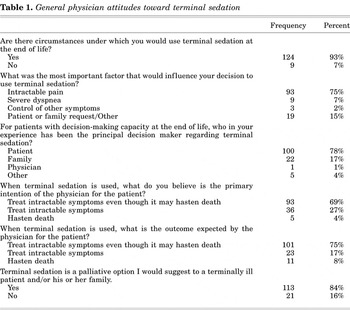
Ninety-three percent of the sample (124) said there were circumstances under which they would use terminal sedation (Table 1). Factors related to decisions about end-of-life care options include the deciding factor for its use, the principal decision maker, the intentions of the physician, and the actual expectations.
General physician attitudes toward terminal sedation

The primary deciding factor to use TS was intractable pain, endorsed by a large majority of respondents (75%); severe dyspnea was cited by only 7%. For patients with decision-making capacity, 78% of physicians said the patient was the principal decision maker and 17% said the family was. Only 1% identified the physician as the principal decision maker.
When asked about their intention in using TS, 69% of physicians responded that the principal intention was to treat intractable symptoms even though it might hasten death. Other responses were “treating intractable symptoms” (27%) or hastening death (4%). However, when asked about the expected outcome of terminal sedation, 75% of physicians responded that they expected it would be “treating intractable symptoms even though it may hasten death,” 17% expected TS to be “treating intractable symptoms,” and 8% expected it to hasten death. Despite these expectations, 84% of physicians said they would suggest terminal sedation as a palliative option.
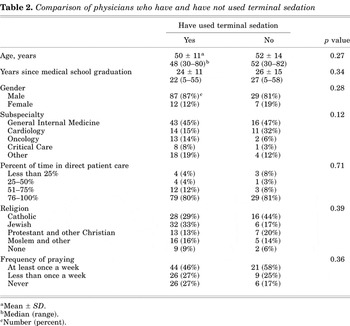
Of the 135 physicians who responded to the survey, 99 (73%) had used TS and 36 (27%) had not. Table 2 summarizes the demographic characteristics, by group. Use of terminal sedation was not associated with age, number of years since medical school graduation, gender, subspecialty, percent of time in direct patient care, religion, or frequency of praying.
Comparison of physicians who have and have not used terminal sedation

Attitudes by Use of Terminal Sedation
Moral, religious, and professional attitudes were assessed by use of terminal sedation in the past. The responses were rated on a 5-point scale, ranging from strongly disagree to strongly agree. However, for presentation purposes, the categories were collapsed into three—agree, neutral, and disagree.
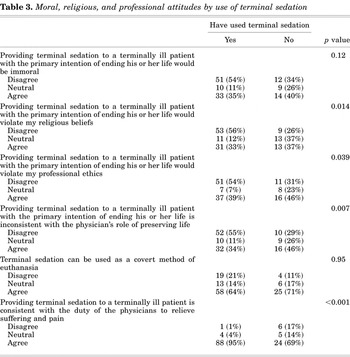
There were differences in opinion between those who had and had not used TS regarding whether “providing terminal sedation to a terminally ill patient with the primary intention of ending his or her life would be ‘immoral,’ ‘would violate my religious beliefs,’ ‘would violate my professional ethics,’ and ‘is inconsistent with the physician's role of preserving life.’” With regard to all four questions, approximately 55% of those who had used TS disagreed, 10% were neutral, and 35% agreed (e.g., see terminal sedation as immoral or unethical); the median response for those who had used TS was “disagree.” For those who had not used TS, approximately 35% disagreed, 25% were neutral, and 40% agreed; the median response for this group was “neutral.” The differences were not significant (p = 0.12) with regard to the “immoral” item, but were significant for the remaining questions (Table 3).
Moral, religious, and professional attitudes by use of terminal sedation

In general, those who used terminal sedation are more likely to view it as not problematic (i.e., to disagree that TS is immoral or against one's religious or ethical values) and less likely to rate it as neutral when compared to those who have not used TS. However, the rate of agreement that terminal sedation is immoral, against religious beliefs, or inconsistent with the physician's role of preserving life is not very different between those who have and have not used terminal sedation.
Two additional items asked whether terminal sedation can be used as covert euthanasia. There was no significant difference (p = 0.95) between the two groups in their responses to this item. Of those who used terminal sedation, 64% (58) agreed it can be used as covert euthanasia, as compared to 71% of those who had not used terminal sedation. The second item asked about the use of terminal sedation as consistent with their duty to relieve suffering and pain. Ninety-five percent (88) of those who had used terminal sedation agreed it is consistent with their duty to relieve suffering and pain, but only 69% (24) of those who had not used terminal sedation agreed (p < 0.001).
DISCUSSION
This study explored physicians' perceptions and use of terminal sedation. A majority of physicians (73%) had used TS for a patient; the percentage of those using it was unrelated to specialty. Further, the vast majority (93%) said there were circumstances under which they would use TS. It appears that terminal sedation is more acceptable as an end-of-life treatment when compared to physician-assisted suicide, for which reported rates of acceptable circumstances of use (if it were legal) have been reported to be about 38% (Cavalieri et al., 2002).
Some of the controversy surrounding TS relates to patient outcomes. TS provides a mechanism of pain relief but may also hasten death. Most physicians in this study identified that the primary factor in deciding to use terminal sedation was intractable pain, followed by dyspnea. TS would be used with the principal intention of “treating intractable symptoms even though it may hasten death,” and 75% reported that their expectation would be to treat the symptoms “even though it may hasten death.” Eight percent expected to be hastening death and 17% expected they would only be “treating intractable symptoms.” This view that physicians are treating the symptoms even though it may hasten death may be consistent with the concept that death may come unintentionally as the consequence of well-intentioned treatment. Some justify this outcome based on the principle of double effect. Others question the morality of hastening death, depending on the wishes of the patient (Quill et al., 1997).
The moral and ethical dilemma related to TS is further evidenced in responses from the physicians in this sample. There was a difference in the responses of those who had and had not used TS regarding their feeling that TS “when used on a terminally ill patient for the primary intention of ending his or her life is immoral, violates religious beliefs, violates professional ethics, and are inconsistent with the physician's role of preserving life.” However, in general, about 40% of physicians, regardless of whether or not they used TS, agreed with these statements. The group differences showed that more of those who used TS disagreed with these statements, whereas those who had not used TS were more often neutral. Further, most agreed it could be “covert euthanasia,” whether or not they has used TS. In spite of this, 95% of those who used it (and 69% who did not use it) agreed that using TS is consistent with their duty to relieve pain and suffering.
This study presents information about physician's attitudes and experiences with TS. The ethical dilemma for physicians revolves around the intended outcome of the treatment, that is, in addition to having the goal of relieving pain is there also an intention to end the patient's life? Quill et al. (1997) have written that “it seems implausible to claim that death is unintended and not merely foreseen.” In this study, a majority of physicians who had performed TS on patients did not see it as immoral or as a religious or ethical violation to use TS, even with the intention of ending the patient's life. Those who had not used TS were less likely to endorse those items. A sizeable minority of physicians, whether or not they had ever used TS, view it as immoral and against professional and personal beliefs, when it is done with the intention of ending the patient's life.
Although there are a number of discussions regarding the controversies related to TS, there has been little documentation of physicians' actual experiences and attitudes about this treatment option. Clearly, the use of terminal sedation is not without conflict for a number of physicians in spite of the recognition of the importance of its use in relieving pain. Professional education and opportunities for discussion appear to be needed to help reconcile the conflicts raised in the use of this end-of-life treatment strategy.
An important limitation to this study is the low response rate. However, the survey sent to physicians asked about three end-of-life options, including physician-assisted suicide. The percentage of those who would be willing to participate in physician-assisted suicide were it legal was 38%, a finding consistent with other studies (Cavalieri et al., 2002). This suggests that the sample, although small, may not be largely biased in its response pattern. Even if this sample over- or underrepresents participation in use of TS, the evidence of ethical conflicts in these findings is useful to highlight the need for increased opportunities for education and discussion regarding these procedures.
ACKNOWLEDGMENTS
The authors wish to acknowledge Janine Shinkle and Veronica Kramer-Feeley for their assistance in the preparation of the manuscript.
References
REFERENCES
Beauchamp, T.L. &
Childress, J.F.
(2001).
Principles of Biomedical Ethics.
New York:
Oxford University Press.
Burt, R.A.
(1997).
The Supreme Court speaks: Not assisted suicide but a constitutional
right to palliative care.
New England Journal of Medicine,
337,
1234–1236.Google Scholar
Cavalieri, T.A.,
Pomerantz, S.C.,
Ciesielski, & J.,
et al.
(2002).
Attitudes of osteopathic physicians toward physician assisted
suicide.
Journal of the American Osteopathic Association,
102,
27–34.Google Scholar
Goold, S.D.,
Arnold, R.M., &
Siminoff, L.A.
(1993).
Discussions about limiting treatment in a geriatric clinic.
Journal of the American Geriatrics Society,
41,
277–281.Google Scholar
Jansen, L.A. &
Sulmasy, D.P.
(2002).
Sedation, alimentation, hydration, and equivocation: Careful
conversation about care at the end of life.
Annals of Internal Medicine,
136,
845–849.Google Scholar
Lee, M.A.,
Nelson, H.D.,
Tilden, & V.P.,
et al.
(1996).
Legalizing assisted suicide: Views of physicians in Oregon.
New England Journal of Medicine,
334,
310–315.Google Scholar
Metzger, M. &
Orloff Kaplan, K.
(2001).
Transforming Death in America. Report Summary.
Washington DC:
Last Acts.
Quill, T.E. &
Byock, I.R.
(2000).
Responding to intractable terminal suffering: The role of terminal
sedation and voluntary refusal of foods and fluids.
Annals of Internal Medicine,
132,
408–414.Google Scholar
Quill, T.E.,
Lee, B.C., &
Nunn, S.
(2000).
Palliative treatments of last resort: Choosing the least harmful
alternative.
Annals of Internal Medicine,
132,
488–493.Google Scholar
Quill, T.E.,
Lo, B., &
Brock, D.W.
(1997).
Palliative options of last resort: A comparison of voluntarily
stopping eating and drinking, terminal sedation, physician-assisted
suicide, and voluntary active euthanasia.
JAMA,
278,
2099–2104.Google Scholar
Schuit, K.W.,
Bender, W.,
Meijler, & W.J.,
et al.
(1999).
Learning effects of a workshop in palliative cancer care for
general practitioners.
Journal of Cancer Education,
14,
18–22.Google Scholar
Vacco v. Quill, 117 S.Ct 2293
(1997).
Washington v. Glucksberg, 117 S.Ct. 2258
(1997).
General physician attitudes toward terminal sedation
Comparison of physicians who have and have not used terminal sedation
Moral, religious, and professional attitudes by use of terminal sedation
 You have
Access
- 10
- Cited by