In the meanwhile I go to China, in what capacity I do not know. Is it as a poet, or as a bearer of good advice and sound common sense?
—Rabindranath Tagore to Romain Rolland, 1924 (cited in Tagore Reference Tagore, Alam and Chakravarty2011, 186)Rabindranath Tagore's (1861–1941) 1924 tour in China has attracted numerous critical analyses throughout the years and continues to pique scholars’ curiosity. The literary luminary's attempt to raise support for his vision of an Asia-wide investment in spirituality in a rapidly materializing world remains a particularly fraught topic. Recently, Tagore's foray to China to form an alliance of Eastern spirituality has resurfaced in a controversy over a new translation of Stray birds (Tagore's own 1916 selective English translation of his Kanika), executed by the contemporary writer Feng Tang (Tagore Reference Tagore and Tang2015). Heavily criticized for inaccuracies in both content and form, the translation invoked such fury that Zhejiang Wenyi Publishing House eventually pulled it from the market in early 2016. Interestingly, the heated denouncements of the translation on both Indian and Chinese online media were infused with language that reinforced Tagore's status as a spiritual prophet—from denouncing Feng Tang as making a “mockery of Tagore” by grossly deviating from the original's “essence” (T. Sen Reference Sen2016), to using the term “blasphemous” (xiedu) to describe the translation as an offense against both Tagore's legacy and the history of translating Tagore in China (Xiao Reference Mingxu2015; Zhou Reference Huaizong2015). In an interview he gave to the New York Times, Dong Youchen, the chief editor of an ongoing and first-of-its-kind translation from Bengali of the complete works of Tagore, noted that the recent controversy involving Feng Tang's translation demonstrates the “special place Tagore holds in the hearts of Chinese readers,” because “he wrote with an Eastern sensibility that Chinese people even today can connect with” (Qin Reference Qin2016).Footnote 1
The 1924 visit thus provides us with an opportunity to shed new light on an enduring conversation about the significance of an “Eastern sensibility” for transregional identification, and, especially, the role of literature in facilitating this identification. In order to do this, we need to situate Tagore's experience in China and the Chinese experience of Tagore in its proper historical context—a global moment of intensive engagement with Asia as an imagined alternative to Western materialism between the two great wars. This moment was discursively grounded in an essentialized understanding of a singular Asian moral sensibility, which many believed could usher Asia into modernity on its own terms (Duara Reference Duara2001).Footnote 2
Recent scholarship on early twentieth-century pan-Asianism has focused attention on the role played by religious thought in envisioning an Asian way of life.Footnote 3 This contextualization adds new dimensions to a long-established understanding of the pan-Asian distinction between East and West, as one that contrasted Western “materialist” achievements in statecraft, science, and technology with Eastern “spiritualism,” a cultural identity epitomized in local traditions, craftsmanship, and artwork (Alitto Reference Alitto1986; Chatterjee Reference Chatterjee1993). In a recent essay on the impact of Quran translations on Japanese pan-Asianism before and after 1930, Hans Martin Krämer (Reference Krämer2014) reminds us that deliberations over defining an Asian spirit were couched in religious terminology, which always—whether discussing Islam or Buddhism—bore the distinctive marks of Christianity. Protestant missionaries played a key role in introducing the concept of “religion” as such to East Asia during the nineteenth century.Footnote 4 As a result, Christian notions of worship not only mediated different definitions of religion, but also contributed to the pliability of spirituality and its ability to serve both national and transregional identities. Yet scholarship on China's response to the Eastern spirituality ideal has generally focused on Chinese Marxists’ scathing critiques of Tagore's lectures in China as counter-modernist, apolitical, and abstract, while paying less attention to the ways in which a discourse on religion informed both these critiques and an array of enthusiastic responses that emerged from May Fourth Movement poets (Das Reference Das1993; Sun Reference Yixue2005; Wei Reference Liming and Chung2011; Zhang Reference Guanglin1994). Consider, for example, a special Tagore issue published in the influential Xiaoshuo yuebao (Fiction monthly) prior to the poet's arrival and poetry that came out just before and after his visit. These materials reveal that Tagore's pan-Asian thought informed important developments in the May Fourth project of shaping literature for the purpose of social transformation. As many studies have established, modern Chinese literature was formed from its earliest inception as a national salvation project.Footnote 5 The possibility of a Sino-Indian spiritual front induced prominent Chinese poets to envision poetry as a force of social cohesion that worked through emotional stimulation to forge interpersonal connections.
This article takes as its point of departure the question Tagore raised in his letter to Romain Rolland: did Tagore travel to China as a poet or a politician? This was, in fact, a rhetorical question: Tagore's own career testifies to the impossibility of separating these two roles. This article begins by situating the development of Tagore's politics of the East within a global discourse on religion and spirituality. It then moves on to examine the reception of this idea in China, by linking Tagore's presence to ideals of interpersonal communication manifested in writings by May Fourth writers, specifically Xu Zhimo 徐志摩 (1897–1931), Wang Tongzhao 王統照 (1897–1957), and Bing Xin 冰心 (1900–1999). Investigating the exchange with Tagore and his work as an event that deeply informed Chinese poetry enables a new understanding of the Eastern spirituality project not as a failure, but as a vehicle for the Chinese envisioning of pan-Asian poetics and literature as a project of salvation.
The Global Tagore
Tagore's development of an Eastern spirituality agenda dates back to his experience in the Swadeshi Movement's resistance to the 1905 partition of Bengal. The violent outcomes of that struggle and its failure had left the poet disillusioned with nationalism as an ideology capable of uniting a racially and culturally diverse India (Collins Reference Collins2012). By 1913, in his Nobel speech, Tagore had completely abandoned his previous patriotic stance. In its stead, he presented a full-fledged ideal of a spiritual Asia rising to counter a morally bankrupt, materialist West that was consumed by industrial greed and blind to the dehumanizing effect of “the machine.” For Tagore, the terminology of “the machine” carried both a literal meaning as the oppressive means of capitalist production and a figurative meaning referencing the array of apparatuses used by the modern state to control the spontaneous day-to-day interactions of communities (Chatterjee Reference Chatterjee2011).
“It is the East in me which gave to the West,” Tagore declared upon receiving the Nobel Prize. “For is not the East the mother of spiritual Humanity and does not the West, do not the children of the West amidst their games and plays when they get hurt, when they get famished and hungry, turn their face to that serene mother, the East?” (Tagore Reference Tagore, Alam and Chakravarty2011, 186). Broadcast on the eve of World War I, Tagore's speech sparked a hugely popular discourse worldwide in the aftermath of the Great War. Between 1913 and 1930, he became one of the most popular and widely read authors in the world. Tagore was arguably the “first international literary celebrity” (Tagore Reference Tagore, Alam and Chakravarty2011, xx), with followers from Europe to the United States and Latin America, and from East Asia to Africa and the Middle East: his poems were read, his plays performed, and his presence desired all over the world.
A major reason for Tagore's popularity in Europe and the United States was his reception as a representative of an Indian religious and cultural renaissance, a revival of the spirit in an industrializing world. Peter van der Veer demonstrates that “spirituality” emerged in the West during the second half of the nineteenth century to provide a distinctively modern alternative to institutional religion, one that promised to mitigate the drastic changes wrought by industrial production and the market economy. This new emphasis on religious sensibilities rather than a formal church per se—augmented by the simultaneous rise of the study of world religions—enabled the envisioning of Asia as the source of an original, uncontaminated religious essence (Van der Veer Reference Van der Veer2009). Indeed, one of the most attended speeches at the Parliament of World Religions at the 1893 World's Columbian Exposition was given by the revivalist Swami Vivekananda (1863–1902), father of “Hindu spirituality” and a major influence on Tagore. Identifying as the son of India, which was, in turn, proclaimed as the “mother of spiritual humanity,” Vivekananda predicted a global religious revival, an awakening to “the great central truth in every religion, to evolve God out of man” (cited in Jhunjhunwala Reference Jhunjhunwala2010, 102).
Much has been written on the ways in which Protestant evangelical theology and practice informed the Bengali Renaissance movement at large and Brahmo Samaj monotheistic attributes in particular (Hay Reference Hay1970; Kopf Reference Kopf1969; Pennington Reference Pennington2005). But it is important to keep in mind that the channels transmitting information between Protestantism and Hindu scriptural traditions worked both ways. Vivekananda's emphasis on the mutuality between God and man—perceived as the ubiquitous presence of the divine in every aspect of life—meshed well with American Protestants’ integration of religion and social reform, inspiring not a few American thinkers to develop a more general sense of “religion.” Vivekananda's popularity contributed greatly to the profound success of Tagore in the United States in the early twentieth century.
The pervasiveness of religious imagery in Tagore's poems and lectures—from the direct and extensive use of “God” to a tropology of deliverance grounded in light and music—was buttressed by his physical appearance. With his long hair, beard, turban, and white robes, Tagore's appearance invoked associations of biblical prophets and the Christian savior. Several Christian revival movements in Britain and the United States were openly inspired by Tagore's works. Kathi Kern (Reference Kern, Schmidt and Promey2012) notes that suffragist Clara Colby (1846–1916) saw Tagore as representing a mystical East capable of assuaging a spiritually impoverished West. With this perception, “Colby took her place in a long line of Americans—from Transcendentalists to Martin Luther King Jr.—who, in conversation with Indian writers, philosophers, and spiritual leaders, collaborated on essentializing a powerful, persistent idea of Indian Spirituality and its potential to transform the West” (165).
More often than not, “transforming the West” actually meant augmenting and improving upon Christian thought. One typical essay on Tagore's poetry published in 1914 in the Methodist Review, for example, marveled that “this singer whose religious life has been built upon the Vedas and the Upanishads … speak[s] with manifest authority and immediate appeal to the Christian mind” (Shepard Reference Shepard1914, 718). In England, W. B. Yeats, Tagore's co-translator and composer of the first English translation of his work Gitanjali in 1912, attributed to Tagore the capacity to bring English-speaking readers back from their modern secular existence to a connection with God. “We had not known that we loved God,” he asserts, “until we read Tagore. India has discovered the spontaneous soul, the divine that we lost touch with and is offering it to us here, through its literature” (Yeats Reference Yeats1913, xx).
The first introduction of Tagore to a Chinese audience in the second issue of Xin qingnian 新青年 (New youth) echoed this Anglo-American emphasis on the author's abundance of religious sensibilities:
Tagore, contemporary Indian poet, proponent of the Eastern Spiritual Civilization (dong yang zhi jingshen wenming 東洋之精神文明), Nobel Prize Laureate, renowned in Europe, viewed by Indian youth as an advanced thinker. His poetry abounds in ideals of religious philosophy (zongjiao zhexue zhi lixiang 宗教哲學之理想). (Chen Reference Duxiu1915, 2)Footnote 6
Between 1915, when the editor Chen Duxiu 陳獨秀 (1879–1942) wrote this introduction, and 1929, over ninety Chinese writers and critics translated and wrote about Tagore in over three hundred fifty essays published in various newspapers and journals. Five different publishing houses published eighteen translations of his books in over thirty-one editions (Yang Reference Mengya2006). These translations, done almost exclusively from English, often followed the Anglo-American habit of celebrating the universal sense of religion Tagore was seen as conveying, while disregarding his critique of nationalism and profit-driven imperialism.Footnote 7
The irony of his reception in Asia via Western Christian appropriations of his work did not escape Tagore. In 1920, a young PhD student at Columbia University, Feng Youlan 馮友蘭 (1895–1990), who would, a decade later, introduce premodern Chinese thought worldwide as philosophy, interviewed Tagore in New York. The topic of their conversation, which took place in English, was: “A Comparative View of East and West.”Footnote 8 As they were conversing, Feng asked Tagore how the poet could maintain that we must aspire to achieve spiritual completeness in this life, when Buddha himself had proclaimed the world an illusion and relinquished life. To this, Tagore responded with a warning to his younger interlocutor to refrain from understanding the East via the West:
Here you are simply buying into a mistaken Western preaching of Buddhism. Westerns don't understand Buddhism, and you can take Mrs. Rhys Davids as an example of that.Footnote 9 One must go to India and spend a few years there before they could try to explain these things. Buddha's saying that we must relinquish this world means that men are fettered by their corporeality, which is why everything is an illusion. If you want the truth in its entirety, you must first rid yourself of negative desires. Then the true mind (zhen xin 真心) realizes its full potential and a true and complete love emerges. Love (ai 愛) is the truth. Buddhism consists of two branches: Hinayana—“the smaller vehicle”, which teaches negative passivity (xiaoji 消極), and Mahayana—“the great vehicle”, which teaches positive activity (jiji 積極). Buddhism prioritizes love. We should like to ask, how could love be brought into effect with no activity? In days of antiquity many Buddhist monks sacrificed everything to preach. Could they do this without being active? Could they do this without love? (Feng Reference Youlan and Song1989, 404)
Nonetheless, Tagore relentlessly used the vast exposure he received as a prophet of modern spirituality to voice his criticism of the modern idea of the nation-state as fundamentally immoral and to form Asian-based alliances to stand in its place. Tagore articulated his earliest vision of a Sino-Indian alliance in 1916 during his lecture tour to Japan. The poet located China and India as contrasting with Japan's embrace of Western science and materialism:
The lamp of ancient Greece is extinct in the land where it was first lighted, the power of Rome lies dead and buried under the ruin of its vast empire. But the civilization, whose basis is society and the spiritual ideal of man, is still a living thing in China and in India. Though it may look feeble and small, judged by the standard of the mechanical power of modern days, yet like small seeds it still contains life and will sprout and grow, and spread its beneficent branches, producing flowers and fruits when its time comes and showers of grace descend upon it from heaven. (Tagore Reference Tagore2004, 41)
Such were the beginnings of Tagore's idea of a pan-Asian spiritual front that could stand as an alternative to Western materialist thought. Eight years would pass before Tagore would arrive to test the ground for actual Sino-Indian collaboration.
The Visitor
On April 12, 1924, the date Tagore disembarked in Shanghai, large crowds waited to welcome him upon his arrival. This enthusiastic welcome overshadowed, for a brief moment, crucial concerns that several leading Chinese intellectuals raised regarding the visit, particularly its timing. One year prior, on February 14, 1923, Zhang Junmai 張君勱 (1886–1969), a philosopher specializing in German New Idealism and French vitalism, delivered a talk at Tsinghua University titled “Life Philosophy” (Renshengguan 人生觀). In that talk, Zhang resisted what he saw as his country's adoption of a wholesale materialist view to understand the human situation. The particular nature of human life, he declared, is subjective and anchored in free will and intuition. For these reasons, scientific rationale could not account for the fullness of life. This provoked an immediate response from Ding Wenjiang 丁文江 (1887–1936), founder of the Chinese Geological Society. Ding described the scientific method (kexue fangfa 科學方法)—defined as “the classification of all the facts in the world and the search for order among them” (Ding Reference Wenjiang and Shi1977, 42)—as the only valid means to understand life. The exchange between the two intellectuals grew into a heated controversy, in which many of the major thinkers and cultural reformers in Republican China voiced their opinions on the fundamental question: can science explain the truth of life? The responses, in the form of journal and newspaper essays, were later collected and published in a volume entitled Kexue yu renshengguan 科學與人生觀 (Science and the philosophy of life; Hu [Reference Shi1924] Reference Shi1977).
Far from a narrow scholarly squabble, the debate touched upon fundamental questions concerning the fate of the nation: What is the best way to handle social divisions? Should the meaning of life in a modernizing China be defined in strictly objective, biological terms or should spiritual and subjective concerns be incorporated? Tagore's China tour, concurring with the publication of the first volume of essays pertaining to the debate, constituted a critical extension of the science and life deliberations. In his writings, Tagore persistently brought “life” to bear upon the problems of the modern era, and regarded “science” as an epistemological weapon of the national machine. He relentlessly historicized the introduction of “science” in order to unveil the nation—which he always wrote as “Nation,” with a capital N—as an instrument of imperialist pursuits. In 1917, he wrote in Nationalism in the West, which was translated into Chinese in 1923:
This government by the Nation is neither British nor anything else; it is an applied science and therefore more or less similar in its principals wherever it is used. It is like the hydraulic press, whose pressure is impersonal, and on that account completely effective…. Its one wish is to trade on the feebleness of the rest of the world, like some insects that are bred in the paralyzed flesh of victims kept just enough alive to make them toothsome and nutritious. Therefore it is ready to send its poisonous fluids into the vitals of the other living peoples, who, not being Nations, are harmless. For this the Nation has had and still has her richest pasture in Asia. Great China, rich with her ancient wisdom and social ethics, her discipline of industry and self control is like a whale awakening the lust of spoil in the heart of the Nation. She is already carrying in her quivering flesh harpoons sent by the unerring aim of the Nation, the creature of science and selfishness. (Tagore Reference Tagore2004, 18, 31)
If the science and life debates began as a domestic controversy, the arrival of Tagore—whose writings were already in circulation—redefined the stakes of the argument by locating the distinction between a positivist developmental understanding of life and a vitalist, spontaneous one as a distinction between “West” and “East,” respectively. Liang Qichao 梁启超 (1873–1929), one of the more outspoken critics of materialism, exhibited this new framing of the debate in a speech welcoming Tagore, in which Liang turned to India for an alternative ideal of civilization:
Over a period of 700 or 800 years, we [China and India] have lived like affectionate brothers, loving and respecting one another. And now we are told that, within recent years, we have at last come into contact with the civilized (!) races. Why have they come to us? They have come coveting our land and our wealth; they have offered us as presents cannon balls dyed in human blood; their factories have manufactured goods and machines which daily deprive our people of their crafts. If we can avail this occasion to renew the intimate relationship which we had in India and to establish a really constructive scheme of co-operation, then our welcome to Rabindranath Tagore will have real significance. (Tagore Reference Tagore1925, 5, 17–18, 21)
Liang thus echoed many of the issues Tagore raised throughout his lectures in China, particularly the devastation wreaked on human life by modern warfare technology and imperialist capitalism. But Liang's conviction of such a Sino-Indian brotherhood was not shared by many.
Particularly resentful toward Tagore's message were the Marxists, who raged when Tagore would turn to his audience and proclaim himself a revolutionary: “If you want to reject me, you are free to do so. But I have my right as a revolutionary to carry the flag of freedom of spirit into the shrine of your idols—material power and accumulation” (Tagore Reference Tagore1925, 33). Chen Duxiu, one of the die-hard materialists publishing within the science and life debates, blamed Tagore for deluding China's youth with Eastern spirituality, which threatened to reinstate the very institutions that the May Fourth Movement sought to leave behind. We already have enough confusion and meaningless discussions of “spirituality,” Chen admonished, and concluded: “Go back to India! We have enough freaks here in China as it is!” (cited in Chen Reference Duxiu and Song1989, 627). Qu Qiubai 瞿秋白 (1899–1935)—a leading figure in the Chinese Communist Party, poet, and prolific literary critic—was a bit more restrained in his wording, though no less critical (Qu Reference Qiubai and Song1989). Qu's objections were the following: Tagore objects to the idea of the nation-state and raises India as an exemplary country—a non-nation—that preserved its own inheritance in the face of Western materialism. But India is a British colony, Qu pointed out, and Indian troops actively assist British colonialism by maintaining order here in the Shanghai foreign concessions. The “nation-state” is thus an abstract concept to Tagore. If one wants to object to the nation-state, one must fight its foundation: the class system. Tagore offers no plan to organize resistance to the British rule among the Indian peasants. His “harmony of East and West” will never come true without class struggle. “Thanks, Tagore,” Qu concluded in a similar, only slightly more subtle manner than his comrade Chen, “We have enough Confuciuses and Menciuses here in China as it is” (cited in Chen Reference Duxiu and Song1989, 635). Before long, Liang Qichao was openly accused of conspiring with Zhang Junmai to bring Tagore to China so that the science opponents could have the last word in the debate (Das Reference Das1993, 242).
Tagore's failure to engage with his audience on a meaningful level disappointed him. On several occasions, a pamphlet denouncing Tagore was distributed at his lecture venues, making his final departure from China a bitter one. He commented upon leaving:
Some of your patriots were afraid that, carrying from India spiritual contagion, I might weaken your vigorous faith in money and materialism. I assure those who feel thus nervous that I am entirely inoffensive; I am powerless to impair their career of progress, to hold them back from rushing to the market place to sell the soul in which they do not believe. (Tagore Reference Tagore1925, 119–20)
These parting words reveal the poet's understanding that his message had been unheeded because it was perceived as an abstract, “spiritual” hindrance to a “career of progress.” Indeed, neither Tagore nor his avid Chinese supporters such as Liang Qichao provided a concrete plan of action. This lack of a political prescription, Partha Chatterjee (Reference Chatterjee2011, 277) argues, was the main reason Tagore's anti-colonial critique failed to arouse a substantial political movement. Recent studies, nevertheless, have pointed to the fact that although the idea of a Sino-Indian spiritual alliance failed as a viable political project, it did have a lasting impact on Chinese culture and art. Margherita Zanasi (Reference Zanasi2015) has linked the Nationalist Party Guomindang-led New Life Movement's promotion of anti-consumerism to the centrality of frugality in Gandhi's nonviolent resistance to the British Raj. Both anti-consumerism and nonviolence, she argues, were part of a mutual search for Eastern alternatives to Western liberalism. Peter Van der Veer's (Reference Van der Veer2014) recent work shows that “a global concept of spirituality,” the product of exchange between East and West from Walt Whitman and Kandinsky to Tagore and the Buddhist revivalist Taixu, proved useful to religious and cultural leaders in China and India in articulating the challenges of nation-building and international positioning. Chinese literature was a particularly productive site where the potential for Sino-Indian Eastern collaboration was not just debated, but actualized.
The Emotional Giant
Escorting Tagore during his visit and serving as his translator was Xu Zhimo, one of the leading poets of the May Fourth period. Upon returning from his studies at Cambridge University in 1923, Xu became one of the founders of the “Crescent Moon Society” (Xinyuepai 新月派, 1923–33)—a literary society whose name, it has been argued, was drawn from Tagore's collection of poems with that title.Footnote 10 In addition to interpreting for Tagore, Xu contributed several pieces to the Tagore issue published by Fiction monthly in preparation for the visit. His prose poem, titled “Tai shan richu” 泰山日出 (Sunrise over Mount Tai), illustrates the importance of Tagore's ideas for a Chinese envisioning of a Sino-Indian literary horizon. In the poem, during the experience of watching the sunrise atop the quintessentially Chinese historical landmark of Mount Tai, the speaker suddenly has a vision of being joined by Tagore, who, while not referenced directly in the text, is identified by Xu Zhimo in his introduction to the poem. At the very moment when light penetrates darkness, the imagined encounter dramatically commences:
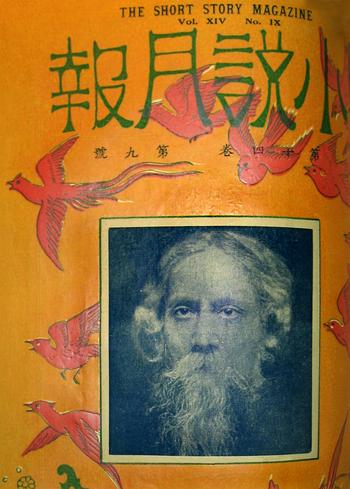
At the moment that the giant appears, the speaker's body becomes boundless; his being is transformed into something higher and vaster. Here, the giant's presence, in effect, enlarges the presence of the lyrical speaker. This description of Tagore as a mysterious giant with long, black hair and a beard joins a plethora of similar references to the poet's so-called mystical appearance. The cover of the special Tagore issue in which this poem was published depicts Tagore draped in long hair and beard, with his facial features immobile (see figure 1). The viewer is drawn immediately to his eyes, which suggest a trance-like emotional intensity.
Cover of Xiaoshuo yuebao (Fiction monthly) 14, no. 9 (1923), special issue on Tagore.

Emotional intensity is the key to understanding the greatness of the giant in this poem. Hoping, praying, waving his hands, and crying, the giant is motivated by an emotional outpouring of joy and sorrow. It is the giant's emotional capacity—expressed outwards in the tears that do not trickle down for nothing, and inward in the prayer that will not go unanswered—that brings the sunlight to shine upon the earth and effects the revival of the East, which becomes synonymous, in turn, with boundless sentiment. The poetic giant prays in such sentimental fervor that he unleashes a cascade of colors and lights upon the world—but he is not praying to God. His face is turned upward and eastward and it is the “East” that he is both praying to and for. This is a song of prayer completely devoid of divine presence. In God's stead, the ideal of a spiritual prayer grounded in emotional intensity enlarges and links together the two poets—metonymic of two Eastern cultures—ad infinitum.
The understanding of transregional connections as emotionally stimulated that Xu Zhimo invokes here draws heavily upon Tagore's oeuvre, with one important difference: Xu's was not a view of the East that resisted Western nationalism. Nothing in this poem or in Xu's other writings suggests an understanding of a mutual Eastern sensibility as an active resistance to colonial thought. Xu was more interested in a notion of the East as an emotional force that enables, through poetry, a human connection. In this way, Xu selectively related to Tagore's view of “science” as hindering the spontaneous flow of human interaction, but did not mention something Tagore himself relentlessly emphasized—that is, science's role as an epistemology in service of the nation.Footnote 11
Counter “science,” Tagore posited a paradigm he often referred to as “religion” to capture those dynamics that do facilitate spontaneous growth via unhindered sentiments (Tagore Reference Tagore2004, 30–31, 49–50). For Tagore, religion meant not a system (of doctrine, faith, or worship), but a human understanding of the universe that occurs through an emotional experience (rather than rational thought). Much like we see in the song of prayer that links the two giants in “Sunrise over Mount Tai,” Tagore believed that art carries the crucial responsibility of mediating and disseminating spontaneous growth. Personality (1917), which was translated into Chinese in 1921 and had appeared in five different editions by four different publishing houses by 1924 (Zhang Reference Guanglin1994, 224), offers a good example of this thinking:
The darkness of the cave has yielded its stillness to man's soul, and in exchange, has secretly been crowned with the wreath of art. Bells are ringing in temples, in villages, and populous towns, to proclaim that the infinite is not a mere emptiness to man. This encroachment of man's personality has no limit, and even the markets and factories of the present age, even the schools where children of man are imprisoned and jails where the criminals are, will be mellowed with the touch of art, and lose their distinction of rigid discordance with life. (Tagore Reference Tagore1917, 29)
Like the bells ringing in temples, Tagore believed that poetry reverberates and is capable of transforming the world through Eastern spirituality: “Let the awakening of the East impel us consciously to discover the essential and the universal meaning of our own civilization,” he urged his listeners in China (Tagore Reference Tagore1925, 157). The perception of art as reverberating inspired Xu Zhimo, as well as other poets of the May Fourth generation, to imagine poetry as an agent of social cohesion. Like the prayer of the emotional giant, the link these poets fashioned between emotional stimulation, song, and real-world resonance hinged upon a new concept of religion that emerged from reading a sentimental East in the writings of Tagore.
Religion Reconceived
We have seen that Tagore was first introduced in New youth in 1915 via his Western persona: a prophet of spiritual resurrection. Yet, by 1923, in the Tagore issue of Fiction monthly, a much more nuanced perception of religion's role in Tagore's spirituality had begun to take shape. In perhaps the most in-depth analysis of Tagore to be executed by a May Fourth writer, Wang Tongzhao (Reference Tongzhao1923, 14) argued: “We know that Tagore modified Indian philosophical thought in accordance with the present era. And yet, the core of Tagore's thought remains distinctly Indian, and has not been adjusted by outside influence.” Instead of collapsing Tagore into a Western Christian idea of “religion,” as Chen Duxiu did, Wang offered a careful analysis of Tagore's religious thought and its Indian origins:
Religion in India is different by nature from other religions. The definitions we always had for religion, though provided by different thinkers, all submit religion to the mystically divine (shenmi 神秘), and agree that religion means having only one faith. If we go back to the roots of this idea, it is an oppression of individual emotions and character and a subordination to a ruler (god). Like Muhammad and Jesus, other religions all manifest this important component. Only Indian religions are different. Already in antiquity, Indian religions did not believe in an omnipotent one God. While Indian religions advocated faith in many gods, the other [monotheistic] religions failed to recognize the divine in human personality (you shen de renge 有神的人格), and instead of nurturing human emotions and imagination, stifled them by subjecting them to the worship of the one. (4)
Here, Wang echoes Tagore's linking of Christianity to imperialist powers “making peace-offerings to each other's barking dogs with the meat which does not belong to them; holding down fallen races which struggle to stand upon their feet; with their right hands dispensing religion to weaker peoples, while robbing them with their left” (Tagore Reference Tagore2004, 84–85). By illuminating the imperialist introduced slippage between “religion” and “Christianity,” Wang suggested the need to move beyond an understanding of religion as monotheism, by and through reading Tagore. This invitation to turn to India in order to undo previous definitions of religions introduced by Western Christianity was a call to develop a new terminology to engage with religion and life through transregional cultural affinities.
During his visit, Tagore was asked to speak about his own religion. Wary that he might be perceived as a missionary, Tagore was reluctant. Finally, he explained that religion, to him, was not located in arguments but in realization, in the same way that a theory explaining what is light lies in a different realm than the actual perception of light. Tagore's focus on the realm of perception, on sensorial and emotional response, located “religion” as that which cannot be explained by a doctrine but only sensed and experienced. “My religion essentially is a poet's religion,” Tagore offered in response to audience questions in China. “Its touch comes to me through the same unseen and trackless channels as does the inspiration of my music” (Tagore Reference Tagore1925, 45). Tagore's notion of “The Poet's Religion” appealed to Wang Tongzhao and other leading voices of May Fourth poetry and criticism. There is more to poetry than aesthetics, Wang argued. Poetry connects the reader to the boundless universe, and binds readers to one another. If philosophy teaches us how to think, literature teaches us how to feel. Indeed, Wang suggested:
Once we thoroughly grasp this truth, as if it is burning in our mouths, we could then use the intensity of our emotional fervor, the light emanating from the flame in our hearts, to gasp in admiration, to volatize, to disseminate the pleasure I feel, so that others could, through writings and speech, unite their gratified soul (linghun 靈魂) with my own self (ziwo 自我). (Wang Reference Tongzhao1923, 7)
Broadening the concept of religion through Tagore, Wang urged, promises to open up a whole register of pleasure. “What is the truth of this world? It is not in the masses of substance, not in the number of things, but in their relatedness, which neither can be counted, nor measured, nor abstracted,” Tagore (Reference Tagore1922, 5) argued in The Poet's Religion, the Chinese version of which appeared in 1923. In “Sunrise over Mount Tai,” as well as in the critical writings of Wang Tongzhao and others, such as Zheng Zhenduo and Hu Yuzhi, the emotional effect of reading or singing poetry is understood as so volatile that it links the individual to others, creating a social harmony. New poetics thus emerged and self-identified as an Eastern vision of emotion, religion, and literature. The focus of these poetics on prioritizing relations over substance honed the Chinese conception of literature as creating a social impact. In the next section, I turn to the works of the female May Fourth writer Bing Xin, which demonstrate this ideal of pan-Asian poetics in their most fully realized form.
Poetry of the Interpersonal
Everyone who has read Bing Xin points out that she was influenced by Christianity and Tagore's philosophy. We can only take this idea as a half-truth. Generally speaking, a foreign ideology (sixiang 思想) cannot simply impact a person's mind with no background. Foreign ideology is like a seed. It must be dropped on amiable soil to sprout. This amiable soil is one's living environment. (Mao Dun Reference Dun and Boqun1984, 244)
Thus did the celebrated author and critic Mao Dun begin a biographical section on Bing Xin in a lengthy essay he wrote on her work in 1934. One of the most prolific writers of fiction and poetry in twentieth-century China, Bing Xin was deeply inspired by Tagore's poetry and noted as much on multiple occasions.Footnote 12 A sizable body of scholarship in China and the West has pointed out allusions to Tagore's work and life in Bing Xin's writings, from the late 1920s to the present.Footnote 13 Nonetheless, Mao Dun's caution regarding the notion of Tagore's “influence” on Bing Xin is worth recalling here. For analyzing a literary work as “influenced by Christianity or Tagore's philosophy” blinds us to the tensions from which literature often emerges, such as the tension between a foreign thought and one's own cultural context and upbringing. This very tension, Wang Tongzhao has suggested, kindled the transformation of the meaning of religion in China from a closed system of beliefs to an open channel of exchange with the universe. Reading Bing Xin with these paradigmatic shifts in mind reveals not so much Tagore's influence, but rather, what I term “pan-Asian poetics” as explaining intertextuality in Bing Xin's work, and the works of other May Fourth writers as well.
Though she shared, as Mao Chen (Reference Chen and Williams2010, 63) eloquently put it, the May Fourth writers’ “interest in influencing—and in some cases articulating—the attitudes of a socially engaged reader,” Bing Xin, like Xu Zhimo, did not openly support Tagore's resistance to nationalism. Instead, she engaged with Tagore's ideas on religion and art through her analysis of the act of reading in her essays and poems. In an essay titled “Letter to Tagore” dating to 1920, Bing Xin wrote:
Your absolute faith in “the harmony between the universe and the individual soul,” how you gather a “natural sense of beauty” and give it free rein in your poetry—these have seeped through the sea of my mind. And my thoughts, which I had no words to express, trembled like strings, sounding divine, faint music, with no notes or sound. (Bing Reference Xin1995, 16)
Here, Bing Xin imagines a dialogue, an act of reciprocal communication taking place via the poetic medium. Faith in the connection between man and the universe around him has seeped into her mind through her reading of Tagore's poetry. In response, her mind resonates back, now altered by spontaneous vibrations that reciprocate the communication delivered by the poetry she reads.
This belief in the power of poetic communication undergirds Bing Xin's own poetry, and demarcates a territory that is expressed through the May Fourth commitment to unite and strengthen Chinese society through poetry. This was a political commitment, yet, ever since renowned critic A Ying coined the term “philosophy of love” (ai de zhexue 愛的哲學) in reference to Bing Xin's poetics in 1930, her poetry has been viewed as subjective, apolitical, self-indulgent, and engrossed in abstract private emotions such as motherly love, love of nature, and Christian love of God (Huang Reference Ying and Ying1931). The resemblance of this reception to the criticism leveled at Tagore by other Marxist critics is, of course, not coincidental. Such casting of religious figuration as inherently apolitical—a view persistently voiced by Marxist thinkers during the May Fourth Movement—likely informed later conclusions that Tagore's visit was a colossal debacle. Yet, if we are to understand the role that thinking about religion assumed in pan-Asian aspirations, we need to locate Bing Xin's poetry within a view of religion that was not at all abstract, but rather a specific tool for exploring and constructing a literature of social cohesiveness.
Published in 1923, Fan xing 繁星 (Myriad stars) and Chun shui 春水 (Spring water) became immediately popular and are considered defining works of new poetry. More specifically, these poetry collections are exemplars of the short poem form (xiao shi 小詩)—a trend that was widespread for a brief period of time in China, from 1921 to 1924.
Short poems are composed of one to eight verse lines, which may or may not rhyme (Lü Reference Jin1982, 303). They are written in free verse with no specific meter. Thematically, the short poem portrays a specific moment within a sentimental experience: the fleeting moment of emotional eruption. The origin of the short poem form in China is a contested topic. Scholars dispute whether it was introduced through “foreign influence”—namely, the Japanese haiku and Tagore's early English translations of Gitanjali and Stray birds—or whether it is an originally Chinese form dating as early as the Shi jing 詩經 (Book of odes) and culminating during the Tang dynasty era (Fu Reference Zonghong1991, 108). While the moment of origin of the short poem form may not offer much help for examining the modern problem of emotional stimulation through poetry, it is certainly worth mentioning that English translators and promoters of Tagore's work in Europe and America, such as Ezra Pound and Yeats, were deeply engrossed in Japanese haiku in the 1910s. Investigating the form of the short poem thus sheds light on China's participation in a transnational network circulating ideas on poetic stimulation—not unlike the back-and-forth route of modern-day “spirituality” between the East and West.Footnote 14
The short poems in Bing Xin's collections read like snippets of personal experience. Many of them locate the speaker in a natural setting, the sensations of which stimulate a sense of profound understanding of the universe. The sound of the sea, the scent of a flower, the reflection of the moonlight, the touch of rain—all evoke in the speaker a knowledge of the forces that govern life, and of the poetic act as a never-ending attempt to capture the fleeting nature of life in its constant movement. The poems center around interactions: desired and missed encounters, pining for a connection with people, nature, and God. The moment of emotional eruption, the defining emblem of the short poem form, often arrives through the possibility of encounter and communication:
In this poem, an encounter with nature invokes a religious understanding of life as limitless. And yet, paradoxically, this understanding of limitlessness occurs through an intense feeling, erupting within a split second, of ephemerality. Momentary yet intensely experienced, the encounter with nature crystallizes a process of perception (I notice this flower and this stone—Bing Xin uses huaer 花兒 and shizi 石子 to distinguish their singleness) and realization (I will never see them again). The fleeting nature of this process is emphasized on a structural level as the lines exhibit enjambment, especially in the encounter itself: “You and I / Meet within limitless life.” Thematically speaking, the poem depicts an encounter between the speaker and nature, conveying a strong sense of human mutuality. Without turning the stone and the flower into metonymy or metaphors for people, Bing Xin manages to communicate a sense of human-to-human encounter. She does this by personifying the stone and the flower in a separate line, which immediately draws the reader's attention with its relative brevity: “You and I.” This line, the only line in the poem that exhibits enjambment, is thus highlighted as the center of the emotional action.
The majority of Bing Xin's short poems present a conversation, either with a human being, higher powers, or natural phenomena. Many of the poems strike a conversation with a character named “my friend,” in what seems like a direct address to the reader. Bing Xin borrowed this convention from Tagore, but her use of this address is distinct: she highlights not a one-way message, but an eagerness for connection and response, particularly present, for example, in the closing poem of Myriad Stars:
Extending an invitation to the reader to share the poetic space takes the effect of relations to an active sense of mutual creation. In Bing Xin's vision, the act of writing is always a relational endeavor—a desire to unite. The connection between the self and nature animates a constant inclination towards the interpersonal.Footnote 15 This idea was fundamentally religious in the sense that Wang Tongzhao referenced in his analysis of Tagore's religious poetics. God, in these poems, serves as means for reaching human resonance:
This poem demonstrates the active function of religion—albeit one not grounded in Christianity—which Bing Xin was often said to employ in her works. Here, it is the human soul that, through its connection to the quiet, still night, overcomes loneliness. Yet it is not the individual soul whose loneliness is abated through a connection to God; rather, loneliness vanishes from the universe at large. In its stead, people are connected to one another. Only one soul is needed to achieve the right sentiment and then draw others. The short poem, with its depiction of the moment of emotional upsurge in a structural combination of free verse and limited scope, enabled Bing Xin to investigate a flash-like experience of connecting with higher powers. In this way, Bing Xin turned emotional abundance into a means of effecting social cohesiveness.
One of the last poems Bing Xin wrote in 1925—a year after Tagore departed and as the form of the short poem began to decline in China (she would devote the remainder of her prolific career to writing fiction and essays)—is titled “Xiang si” 相思 (Yearning):
At first glance, the poem reads as a celebration of the subjective individual escaping from the “human chambers” but not from her own emotions. However, a closer look reveals something different. Even as the speaker attempts to leave the social realm and escape from thoughts of longing for another, she is struck by the mutuality that governs nature: the moonlight dialoging with the small path, the branches writing a lattice of intertwining lines. The world moves in connections. Not only does the universe abound in communication, but these communications become manifest through writing. The branches write a poem of longing on the ground in non-language. The poet uses words to relay her experience of nature, which serves in turn to bring her back to the realm of humans. The connection with nature reveals itself to be a means to the end of a fundamentally social human connection.
Conclusion
Situating Chinese new poetry's response to Rabindranath Tagore within the context of shifting ideas on religion and literary effect sheds light on the larger task that Republican-era literature took upon itself: to transform Chinese society. Tagore's notion that poetry mediates a religious connection between man and universe via emotional stimulation inspired May Fourth poets such as Bing Xin and Xu Zhimo to cultivate an interpersonal poetic form. This encapsulates Tagore's radical potential as both a poet and an advisor: an invitation to create an interpersonal, transregional community of readers; an Eastern alliance of spirituality resisting colonialism and nationalism. But was this potential realized, politically or poetically?
Bing Xin's development of the short poem through thematic and aesthetic employment of a worldwide resonance of individual emotional terrains, Xu Zhimo's imagination of the East rising in song of prayer, and Wang Tongzhao's vision of religion as opening a Sino-Indian literary front are just a few examples of how Chinese writers and poets engaged with Tagore's project of an Eastern spirituality. In this sense, 1920s Chinese literature shows a distinct move away from reading Tagore, and, for that matter, from reading “the East” through a generic prophetic image promoted by Anglo-American Christians in the post-Nobel excitement, and through which Tagore was first introduced to Chinese readers in 1915. It was first through Tagore, as Wang Tongzhao explained, that Indian thought became a viable horizon for the May Fourth literary imagination. Once this happened in the early 1920s, Chinese authors continued to draw upon Indian philosophy, literature, and folklore well into the 1930s.Footnote 16
It is, however, important to pay attention to the fact that while the legacy of Tagore's pan-Asianism profoundly inspired Chinese writers, they did not voice its most critical concern: denouncement of the nation as a viable category for modern societies. The Marxists misread Tagore's view of the East as abstract and apolitical. The poets grappled with it in a much more nuanced way, submitting to the notion of the spirit presiding over the machine and thus honing a fundamentally political idea of literature as vehicle for social cohesion. Yet even the most concretely explosive legacy Tagore helped to initiate in Chinese literary culture—namely, the shifting meaning of “religion” from its monotheistic imperial roots as grounded in faith to a transregional shared view of erupting sentiment—did not facilitate a truly radical vision of Chinese society disengaging from the political form of the nation-state. This should not come as a surprise. Such a vision did not materialize in India either, as Siddhartha Deb (Reference Deb2016) has most recently argued by tracing the roots of contemporary Hindu nationalism to a cynical reading of Vivekananda's call to the West to turn to India, “mother of spiritual humanity.” The historical pliability of such categories as “spirituality,” “humanity,” and, of course, the “East” still informs an interplay between national urgency and transregional aspirations in both China and India. Thus, while the May Fourth envisioning of pan-Asian poetics of social transformation remained indebted to their exchange with Tagore in writing and in person, the interplay between the national and the transregional—which Tagore dreamed of making irrelevant—remained steadfast, and continues to this day to arouse battles over the “true” meaning of Tagore's words and the relation between an “Eastern sensibility” and the “Chinese people.”
Acknowledgments
I am grateful to Lydia H. Liu for her insightful comments on an earlier draft of this article. I would also like to express my gratitude to the journal's anonymous reviewers for their invaluable feedback and suggestions for improvement.
 英 [