Every performance has a certain and inevitable end. Its transitoriness and uniqueness distinguish the art of theatre from any other art form that produces artefacts. Once the performance is over, it is irretrievable. Theatre emerges in the present and can never last.Footnote 1 For the spectator, however, a performance is more than presence and representation. As an ‘art of time’, theatre opens up a third temporal dimension between the present and representation. This temporal dimension unfolds a theatre of imagination, where scenes are composed of the digressions, associations, retrospections, expectations and anticipations of the spectator. Thus the spectator's view is bound to a constant process of creating fantasies and potential futures that accompany her ongoing perception. Referring quite freely to a famous Leibniz quote, one could say that all these potential, imaginary futures ‘strive with equal right for existence’.Footnote 2 The spectator is always ahead. When Herbert Blau states that ‘the brain is the best stage of all’,Footnote 3 we might add that the brain is also the first stage of all. Every spectator's perception is accompanied by a process of ‘presensing’ the future, an anticipation that provides the present with meaning.
One of these potential futures is the performance's end itself. Throughout any performance the spectator will be fully aware of its finiteness. The anticipation of a certain but temporally indefinite end underlies the reception of every theatre performance from the beginning. At times this anticipation will accidentally manifest itself in concrete thoughts, as when checking the time out of boredom, wondering when the show will finally come to an end, or estimating the intensity of the final applause.
Indeed, it is the applause that allows the end to become present and definite. The end of a performance marks a moment of liminality, a threshold between the temporality of the performance and the world ‘outside’. The show is and yet is not over: for one last time, the performers appear on stage, allowing the audience to become active once more as a collective before dispersing. The final applause always marks the climax and at the same time the end – the death – of the performance. With the last clap from the audience, it dies irrevocably.
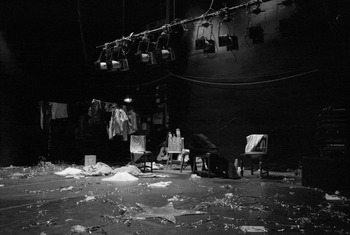
Stage before the final scene of Forced Entertainment's Bloody Mess, Photo: Hugo Glendinning, print permission by Sarah Cockburn.

If anticipation forms a part of every spectator's perception, the question arises to what extent anticipating the end of a performance may play a particular role in this matter, granting theatre the opportunity to reflect on temporality and existence. In principle, actors and spectators gather together for a period of shared time, which, due to its liminal and transitory quality, means that every performance bears the potential to trigger reflections on time and temporality.
The British group Forced Entertainment address the issue of transitoriness by introducing an element of pathos into the beginning or end of their productions. In Bloody Mess the final image, which eventually erases itself, is staged for the audience as a slow, prolonged death. The last moments of the performance are intentionally decelerated, allowing the spectator to intensively anticipate its ‘end’.
The title Bloody Mess could also aptly describe the state of the stage just before the final scene: hundreds of brightly coloured candies and pieces of popcorn lie strewn around. A couple of loudspeakers are set up arbitrarily onstage and many of the props have been scattered over the floor: a guitar, some dozen beer bottles, glitter wigs, two large silver paper stars and many costumes. Above all, traces of the thick fog that has continuously been put out by a fog machine in the past hour are clouding the air. The atmosphere confronting the audience is obviously apocalyptic. John Rowley, one of the performers, with his face painted as a clown, has just finished telling a story about the end of the world, weeping his last words, “Dust, just dust”, over and over into the microphone. Then, at last, Cathy Naden, another performer, stands up and slowly walks up the stage, standing alone in the limelight, facing the audience. There is no doubt that what follows will be the final monologue of the show:
This is the last thing that you see. You see me standing in the light. You're looking at me. You can see my face, you can see my lips, you can see my eyes. You can see that I'm thinking. But my eyes don't give anything away. My face is at a complete blank. It says nothing and it says everything. Both at the same time. It's the last thing you see.Footnote 4
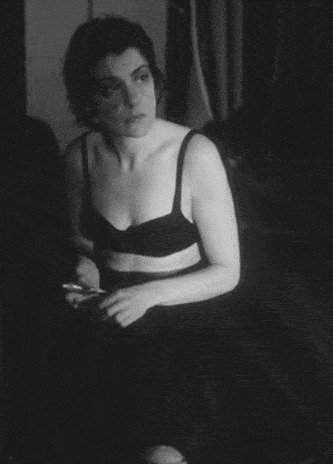
While she is speaking, the spotlights are slowly being switched off one by one. More and more of the stage is fading into the dark. The coloured glitter of the candy is turning grey; the performers in the background have become hard to make out. The performance is coming to an end. Finally, CathyFootnote 5 is standing alone in the last remaining spotlight, which is focused directly on her face. She speaks her final words:
And the lights are going out. And soon, perhaps much sooner than you expect, I vanish, I disapear, I am gone. I am gone forever. And I am never coming back.
[Pause]
This is the final moment. This is the last light.
The last light is switched off. The anticipated darkness is becoming present and the performance is over. The applause turns it into an event of the past.
Cathy Naden in Forced Entertainment's Bloody Mess. Photo: Hugo Glendinning, print permission by Sarah Cockburn.

Can this scene be described as just a humorous, ironic comment on the pathos of theatre? Is Forced Entertainment merely mocking the audience by exaggerating the end of their play? Or could it be that, despite its hint of sarcasm and the evident humour, the group illustrates something very elementary about theatre: the temporality of a performance as a reflection of the finiteness of existence itself?
In Being and Time, Martin Heidegger points out that death, as the end of our Being-in-the-world, has to be regarded as constitutionally belonging to existence itself, ab initio forming Dasein:
As long as Dasein is, there is in every case something still outstanding, which Dasein can be and will be. But to that which is thus outstanding, the ‘end’ itself belongs. The ‘end’ of Being-in-the-world is death. This end, which belongs to the potentiality-for-Being – that is to say, to existence – limits and determines in every case whatever totality is possible for Dasein.Footnote 6
Hence the possibility of death belongs to life itself: as soon as one is born, one is old enough to die. The future occurrence of death is certain, even though in the imagination death remains strangely indefinite – death cannot really be imagined, although we all know that it will catch up with us sooner or later. Accordingly, Heidegger defines death as ‘Dasein's ownmost possibility – non-relational, certain and as such indefinite, not to be outstripped’.Footnote 7
Is it possible to compare the end of a performance with the end of existence? This certainly seems risky, yet most of Heidegger's statements on death can also be applied to the ‘death’ of a performance. Thus the anticipated potentialities of the future, as demonstrated above, always belong to the current perception of the spectator, just as the anticipation of the performance's end belongs to the performance itself as ‘certain’ and ‘indefinite’ – as an end that is ‘not to be outstripped’. Does this end not also ‘limit and determine in every case whatever totality is possible’ for the performance?
To preclude any misunderstandings of the comparison, let me clarify that it is not my goal to use Heidegger's theses out of context, transforming and then applying them to a reflection on theatre. Rather, I wish to address the question of the extent to which theatre is able to reflect, within its own media, on what Heidegger calls ‘the temporality of Dasein’. If a performance is capable of demonstrating and presenting temporality and its certain and irrevocable end in a particularly evident way, theatre, more than any other art form, could afford the spectator the opportunity to experience what Heidegger calls the ‘anticipation (Vorlaufen) of death’.
Heidegger's ‘anticipation of death’ neither refers to suicidal thoughts nor to a consideration or meditation on death in general but, on the contrary, to a fundamental attitude towards life and death: ‘Anticipation, . . . unlike inauthentic Being-towards-death, does not evade the fact that death is not to be outstripped; instead, anticipation frees itself for accepting this’.Footnote 8 When Cathy speaks the final words of Bloody Mess and the spotlights are switched off, it is not particularly likely that this would stimulate meditations on death in the spectators. Rather, the ending reveals a fundamental principle of theatre that is inherent to every performance and, at the same time, reflects a basic principle of existence: the temporality of being. Nothing else is presented in this final scene – in fact, temporality itself becomes its protagonist: first of all, there is the stage as theatrical battlefield, which reflects the actions of the past two hours. Second, the slow switching-off of the spotlights visualizes the present passing of time. Third, there is the anticipation of the coming end as a certain and near future: ‘This is the last thing that you see . . . This is the final moment. This is the last light’. How could the anticipated end be staged more clearly? It is neither representation nor a dramatic plot that reflects temporality in this final sequence. Rather it is the bare presence of time elapsing that has been laid out by the mise en scène, thus enabling the audience to experience consciously the temporality of being.
According to Heidegger, temporality is not to be considered an objective order of the world. In fact, temporality and Dasein depend on each other and cannot be separated. Also, the temporality of theatre does not have much to do with an objective order of time passing. Instead, it always belongs to the performance itself as an existential principle: theatre could not exist without its temporal determination, the performance's emergence and contingency, its definite beginning and its certain, inevitable end. As a theatre of imagination, its scenes are moreover subjectively linked to the future and the past by the spectator's anticipation and retrospection. Due to the permanent process of ‘presensing’, the anticipating spectator is always ahead of him- or herself (sich-je-vorweg); the potentialities of being are already part of his or her present perception. Since the end of a performance belongs to the potentialities of its being from the very beginning, the realization of the finiteness and uniqueness of a theatre performance is predicated on this end and its anticipation. When, in Bloody Mess, the theatrical battlefield of the stage slowly disappears into the dark, this anticipation increasingly comes to the fore, literally overshadowing the past and present of the performance. All that is left for the anticipating spectator is the emergence of the future end.
Heidegger defines the temporality of Dasein with the term ‘care’ (Sorge), referring to a complex structure of existence that is being constituted between past (Gewesenheit), present and future, between Being and the potentiality-for-Being. On the one hand, man has always been thrown into the world (Geworfenheit as ever-past); on the other, he is responsible (or ‘answerable’) for the projection (Entwurf) of his life. He has the freedom to choose, he avails himself of the opportunities of a (future) potentiality-for-Being. Escaping into everyday life (present), he is constantly fleeing from his opportunities due to his Angst, fearing the possibilities of an uncertain future, of which death is always a distinct part. ‘Care’ therefore refers to both the anxiety of the uncertain and the worries of everyday life. In Heidegger's own words, this complex temporal structure of ‘care’ is thus defined as ‘ahead-of-itself-Being-already-in-(the world) as Being-alongside (entities encountered within-the-world)’.Footnote 9
It seems that the anticipating spectator can learn something about the temporally constituted Dasein as ‘care’ by facing the ‘death of a performance’ as it is staged in Bloody Mess. The exaggeratedly staged apocalyptic atmosphere towards the end of the performance highlights one genuine theatrical principle: the experience of transitoriness and finiteness reflecting the temporality of Dasein as a whole. By ‘presensing’ that the performance will end within the next moments, the spectator anticipates – but not necessarily consciously – that the world of everyday life and, moreover, his or her Being-in-the-world will also end. Thus the end of a performance, which is basically nothing but the end of a certain span of living time that is shared with others – spectators and performers – is able to provide a feeling of finiteness as ‘anticipation of death’. After all, is this feeling of finiteness, whenever the auditorium goes dark and the applause sets in, not one of the essentially fascinating elements of theatre? Is the spectator not confronted, even, with ‘care’ itself, which is being revealed as a temporal constitution of Dasein, when the last spotlight is switched off?
In The World in Pictures, Forced Entertainment resume their work on the topic of finiteness. Here again, one of the performers faces the audience alone towards the end of the show. This time it is Jerry Killick who addresses the spectators:
I'd like you to think back just one hour before the show started this evening. Maybe you were already on your way here – maybe you were walking through the rain. Or you took the U-Bahn. Think back to that U-Bahn ride – can you remember anybody who was on the train with you? Can you remember any faces? . . . Now think about tomorrow morning: you may have to get up to go to work or to study. But tomorrow evening it's pretty unlikely that any of you will be here. And by that time maybe you will have forgotton some of what you saw here this evening. And . . . in a month's time, maybe you will have forgotton quite a lot of what you saw here tonight. And . . . in a year's time, maybe you will be no longer talking to the people you came with tonight . . . And . . . in a five years’ time, maybe one or some of the people in this room would have died. It's possible . . . And . . . in a hundred years’ time, it's pretty safe to say that everybody here in this room will have died . . . And . . . in two hundred years’ time, our children and everybody that will remember us will have died. And . . . in a thousand years’ time it's pretty unlikely that this building will still be standing . . . And . . . in ten thousand years’ time, this whole city probably won't be here. It could be a desert or a body of water, or maybe not even that. Maybe just space. A vacuum.Footnote 10
The link between the finiteness of the performance and the end of our Being-in-the-world set up by the group in this scene needs no further explanation. The end of the show is directly associated with the future death of all of its participants. It is no coincidence that Jerry addresses the spectator's faculty of imagination. He demands that his audience project not only a future anticipating the end of the performance but also a future extending beyond this end, indeed beyond existence itself. Death is revealed as a potentiality of the future, which is always intertwined and entangled with a basic temporality and transitoriness of everyday life. By sharing a period of time, with a definite beginning and a certain, anticipated end, the audience and the performers face theatre as an ‘art of time’ – an art reflecting existential temporality. Thus the anticipating spectator is able to experience a fundamental constitution of existence by ‘presensing’ the end of the performance as a reflection of ‘whatever totality is possible for Dasein’.Footnote 11