


Ovarian cancer has the highest fatality:case ratio of all gynaecological malignancies because it is usually remains undetected until the advanced stages and tends to recur (Holschneider & Berek, Reference Holschneider and Berek2000; Parkin et al. Reference Parkin, Bray, Ferlay and Pisani2005). Relatively little is known regarding the aetiology of ovarian cancer. Therefore, prevention offers an approach to reducing ovarian cancer mortality. The incidence of ovarian cancer varies from country to country, with the highest rates reported in Western countries and lower rates observed in Asian and African countries (Stewart & Kleihues, Reference Stewart and Kleihues2003). Compared with Western countries, China has a relatively low incidence of about 6·2 per 100 000 women-years, which is about one-quarter of the incidence typically found in developed countries (International Agency for Research on Cancer, 2006). This suggests that dietary and lifestyle factors may play a role in ovarian cancer aetiology (Falk et al. Reference Falk, Fears and Xu2005).
There are major differences in the dietary patterns and lifestyles between women living in developed and developing countries. We have documented the plant-based dietary patterns and nutrient intake of adult women in southeast China (Zhang et al. Reference Zhang, Binns and Lee2002a), and reported an inverse association between consumption of fruits and vegetables and the risk of epithelial ovarian cancer (Zhang et al. Reference Zhang, Yang, Binns and Lee2002b). However, some studies did not support a significant inverse association between vegetable or fruit consumption and ovarian carcinoma risk (Mommers et al. Reference Mommers, Schouten, Goldbohm and van den Brandt2005; Schulz et al. Reference Schulz, Lahmann and Boeing2005). This may be a reflection of the fact that fruit and vegetable consumption may not accurately rank individuals according to specific carotenoids, a group of phytochemicals with potential anticarcinogenic properties (Nishino et al. Reference Nishino, Murakoshi, Mou, Wada, Masuda, Ohsaka, Satomi and Jinno2005). There has been considerable interest in the antioxidant and anticarcinogenic effects, and other potential mechanisms of carotenoids in the chemoprevention of cancer (Khachik et al. Reference Khachik, Beecher and Smith1995; Nishino et al. Reference Nishino, Tokuda and Murakoshi2000). However, only a limited number of studies have examined the relationship between intake of specific carotenoids and the risk of ovarian cancer. The results for each carotenoid have been inconsistent (Helzlsouer et al. Reference Helzlsouer, Alberg, Norkus, Morris, Hoffman and Comstock1996; Cramer et al. Reference Cramer, Kuper, Harlow and Titus-Ernstoff2001; McCann et al. Reference McCann, Freudenheim, Marshall and Graham2003; Tung et al. Reference Tung, Wilkens, Wu, McDuffie, Hankin, Nomura, Kolonel and Goodman2005; Koushik et al. Reference Koushik, Hunter and Spiegelman2006).
In view of the variation in the rate of ovarian cancer and dietary patterns from country to country, studies in a population characteristic of low incidence rate and plant-based dietary patterns such as Chinese women can provide useful information on ovarian cancer aetiology. We conducted a case–control study in southeast China to examine the association between intakes of the most common carotenoids in human diets, namely, α-carotene, β-carotene, β-cryptoxanthin, lutein and zeaxanthin combined, and lycopene, and the risk of epithelial ovarian cancer, which accounts for more than 90 % of all ovarian malignancies (Cotran et al. Reference Cotran, Kumar and Collins1999).
Methods
Study design and subjects
A hospital-based case–control study was conducted between 1999 and 2000 in Hangzhou, the capital city of Zhejiang province, located in southeast China. Inclusion criteria for cases were defined to be women less than 75 years of age, who had been residents of Zhejiang province for at least 10 years and who had been histopathologically diagnosed with epithelial ovarian cancer within the past 3 years. Cases were identified from medical records in the teaching hospitals, School of Medicine, Zhejiang University (Hangzhou, China). All the participating hospitals are public hospitals with 500–2000 beds and receive patients from all over the province. To ensure complete ascertainment of cases, all medical records and laboratory pathology reports were daily screened during the study period. Reports based on pathology specimens and blood samples were also collected for further confirmation of diagnosis. A total of 255 patients with epithelial ovarian cancer were identified and only one patient did not participate in the study. The proportion of non-responding patients among the cases was 0·4 %. Most of the cases (191 patients; 75·2 %) were recent patients recruited within 12 months from diagnosis.
During the same period, 652 controls were recruited and interviewed. The criteria for controls were the women residents of Zhejiang province with neither a malignancy nor bilateral oophorectomy. Women recruited as controls were matched with cases by age (within 5 years). The control group consisted of 340 hospital visitors and 261 out-patients recruited from the same hospitals where the cases were identified, and fifty-one women recruited from the community. The proportion of participation by selected controls was 96·6 %. To control for bias in selecting the hospital controls, a table of random numbers was used for selecting consulting rooms for out-patients and wards for hospital visitors. These locations were then visited and out-patients or hospital visitors meeting the selection criteria were interviewed. If no suitable subjects were found in the chosen room or ward, the adjacent room or ward was used instead. This systematic selection process was adopted throughout the entire recruitment period. All the out-patients recruited had only minor gynaecological diseases (84·7 % had vulvitis, vaginitis or cervicitis, 6·5 % had been diagnosed with urethritis and 5·7 % had menopausal symptoms). The sample of community controls was recruited from nine different districts of Hangzhou with the assistance from local community councils. The project was approved by the Chinese hospital authorities and the human research ethics committee of the investigators' institution.
Dietary assessment and interview
Subjects were briefed regarding the aims of the study, confidentiality and anonymity issues. An appointment for interview was made after obtaining their consent via an initial contact. A face-to-face interview was conducted in the hospital setting by M. Z. using a structured questionnaire and usually took 40–50 min. A valid and reliable questionnaire was used to collect the required information: (a) demographic and lifestyle characteristics, for example, area of residence, education, occupation, physical activity; (b) food consumption assessed by a FFQ; (c) factors relevant to hormonal status and others, including menstrual cycles, marriage and menopausal status, reproductive and lactation history, oral contraceptive usage, other factors relevant to hormonal status and family history of ovarian cancer. The questionnaire was prepared in English and translated into Chinese and checked (back translated) by professional Chinese translators.
Habitual dietary intake was assessed using a FFQ including 120 food items and eight vitamins or mineral supplements. This quantitative FFQ was adapted from a dietary questionnaire used for studying cancers in Shanghai, in order to ensure cultural relevance (Ji et al. Reference Ji, Chow, Yang, McLaughlin, Zheng, Shu, Jin, Gao, Gao and Fraumeni1998). Additional questions were taken from the Hawaii Cancer Research Survey (Thompson & Byers, Reference Thompson and Byers1994) and the Australian Health Survey 1995 (Australian Bureau of Statistics, 1995). The FFQ has been assessed in a pre-test and test-retest studies in Chinese women (Zhang et al. Reference Zhang, Binns and Lee2005). All of the participants in the preliminary test agreed that the FFQ was appropriate to assess their dietary practice, and 98 % further agreed that it covered the foods they often consumed. The intraclass correlation coefficients for intake of α-carotene, β-carotene, β-cryptoxanthin, lutein and zeaxanthin combined, and lycopene were 0.61, 0.71, 0.56, 0.61 and 0.83 respectively. The high coefficients for test–retest reliability suggested that the FFQ may be relied upon in assessing dietary intake.
The food frequency variables were categorised into never or hardly ever, once per month, two to three times per month, once per week, two to three times per week, four to six times per week, once per d, and two times or more per d. Information was also sought on the usual amount of each food consumed per meal. The quantitative variables were estimated in terms of a standard Chinese measure, the liang (equivalent to 50 g). To increase the accuracy of estimation, standard containers (small 200 ml, medium 400 ml, and large 600 ml bowls, and a 400 ml cup) were displayed during the interview. For seasonal vegetables and fruits, only the frequencies consumed during the available period were sought. For cooking oil, salt and sugar, the total household consumption was divided by the number of individuals sharing the meals. For some sweets and commercial items, the respondent was asked to report the number of units of food consumed on each occasion. Information on usual methods of food preparation or cooking such as steaming, boiling, stir-frying and deep-frying was also sought. Food consumption measured was based on their habitual diet and a ‘reference’ recall period was set as 5 years before diagnosis (cases) or interview (controls).
Data management and analysis
All data were checked at the end of each interview for completeness, before being coded and analysed using SPSS version 14.0 (SPSS Inc., Chicago, IL, USA). The frequency and quantity variables derived from the FFQ were converted into daily food consumption, with adjustments for the edible portions of foods, cooking methods used, seasonal factors and market availability (Whitemore et al. Reference Whitemore, Wu-Willians and Lee1990; Institute of Nutrition & Food Hygiene, Chinese Academy of Preventive Medicine, 1999). Total energy intake was obtained using Chinese food composition tables (Institute of Nutrition & Food Hygiene, Chinese Academy of Preventive Medicine, 1999). Intake of α-carotene, β-carotene, β-cryptoxanthin, lutein and zeaxanthin combined, and lycopene were calculated based on daily food consumption using a US Department of Agriculture nutrient database, which has been developed specifically for Chinese immigrants in America (Horn-Ross et al. Reference Horn-Ross, Barnes, Lee, Coward, Mandel, Koo, John and Smith2000). Because of laboratory-related technical difficulties in separating lutein and zeaxanthin, these two carotenoids were combined. The mean daily intakes of specific carotenoids were tabulated separately for case and control groups. The quantitative variables of specific carotenoid intake were also divided into quartiles based on the corresponding empirical distribution of controls. A variable of total carotenoid score was created and used to indicate total carotenoid intake, which was obtained by summing the quartile values for each specific carotenoid. We chose this method, rather than using intake in micrograms, because each specific carotenoid is consumed in varying quantities and it is untenable that any biochemical actions of diverse carotenoids would be identical on a microgram basis in a biologically complex system such as a cell. Some category variables were defined as: a total of twenty packs of cigarettes or more in a lifetime for tobacco smoking; and weekly metabolic equivalent task-hours for physical activity.
To assess the differences between the control groups, daily mean intake of specific carotenoids, demographic and lifestyle variables were initially compared between the two hospital control groups, and then compared between hospital and community controls. The consistency of exposure levels among the three groups would suggest that hospital bias was minimal. Conditional on nil significant difference between them, the control groups were then combined before comparison with the cases. Demographic characteristics, potential risk factors and intakes of specific carotenoids were compared between cases and controls using a t test for continuous variables and χ2 tests for categorical variables. OR and associated 95 % CI of epithelial ovarian cancer for the quartile daily intake of specific carotenoids and total carotenoids were estimated using unconditional logistic regression analyses and the lowest level was defined as the reference group. Univariate analysis was undertaken to screen potential explanatory variables for subsequent multivariate analysis. We first evaluated the risk of ovarian cancer associated with specific carotenoids and total carotenoids adjusting for age at interview (years, continuous), locality (urban, rural) and education (none, primary, secondary, tertiary). We further assessed ovarian cancer risk by adjusting for BMI (calculated as weight in kg divided by square of height in m 5 years ago, continuous), tobacco smoking (never, ever), tea drinking (never, ever), physical activity (weekly metabolic equivalent task-hours, continuous), parity (full-term pregnancy, continuous), oral contraceptive use (never, ever), hormone replacement therapy (never, ever), menopausal status (no, yes), family history of ovarian cancer (no, yes) and total energy intake (kJ, continuous). These variables were included in the models because they had either emerged as significant risk factors for ovarian cancer in some previous studies (McCann et al. Reference McCann, Freudenheim, Marshall and Graham2003; Mommers et al. Reference Mommers, Schouten, Goldbohm and van den Brandt2005) or were potential confounders based on the univariate analysis. Each quantitative variable of the intake of specific carotenoid and total carotenoid intakes was subjected to a linear trend test in terms of ovarian cancer risk. Finally, model adequacy was assessed using the Hosmer–Lemeshow goodness-of-fit statistic.
Results
When the two hospital control groups, separately and combined, and the community controls were compared, only a few independent variables were significantly different. Data from all three control groups were therefore combined to form a single control group in subsequent analyses. Results from recent patients and all cases were also similar (omitted for brevity but are available upon request). Therefore, we report the combined results of all cases below.
Table 1 contrasts selected characteristics of participants with and without epithelial ovarian cancer. There were no differences in mean age, locality of residence, tobacco smoking, alcohol consumption, BMI (5 years ago), age at menarche, menopausal status and hormone replacement therapy between cases and controls. Compared with the controls, patients with epithelial ovarian cancer tended to have a higher education, lower parities, less oral contraceptive use and physical activity, less energy intake and less tea drinking. More of them had apparent family susceptibility.
Selected characteristics of cancer cases and controls* (Number of subjects and percentages)

MET-hour, metabolic equivalent task-hour.
* Data missing for two controls on alcohol consumption, age at menarche, parity, menopausal status, hormone replacement therapy, oral contraceptive use and family history of ovarian cancer.
† Differences between cases and controls tested by two-sided t test for continuous variables and χ2 test for categorical variables.
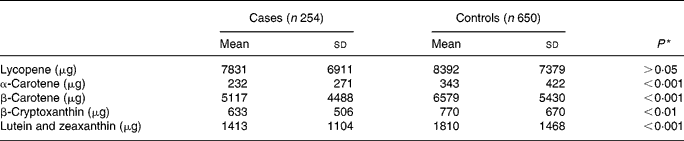
Table 2 summarises the mean daily intake of specific carotenoids in cases and controls. Compared with the controls, the cases with epithelial ovarian cancer had a lower intake of all of the specific carotenoids examined by the study. There was a statistically significant difference of mean daily intake of α-carotene, β-carotene, β-cryptoxanthin, and lutein and zeaxanthin (but not for lycopene) between cases and controls. In general, the correlation coefficients among the carotenoids were high and ranged from 0.31 to 0.71, except that lycopene poorly correlated with α-carotene and β-carotene where the correlation coefficients were 0.19 for both pairs.
Daily intake of specific carotenoids in cancer cases and controls (Mean values and standard deviations)
* Two-sided t test for difference between cases and controls.
Table 3 presents the adjusted OR and 95 % CI of epithelial ovarian cancer risk according to quartile intake of specific carotenoids and total carotenoid score from multivariate logistic regression analysis. The risk of epithelial ovarian cancer tended to decline with increasing intake of specific carotenoids except lycopene. In the final models, compared with the highest v. lowest quartile of intake, the adjusted OR were 0·39 (95 % CI 0·23, 0·66) for α-carotene, 0·51 (95 % CI 0·31, 0·84) for β-carotene, 0·51 (95 % CI 0·31, 0·83) for β-cryptoxanthin and 0·45 (0·27, 0·76) for lutein and zeaxanthin, with statistically significant linear trends. A substantial risk reduction of ovarian cancer was observed for total carotenoid intake. The adjusted OR was 0·33 (95 % CI 0·20, 0·56) for total carotenoid score with an inverse dose–response relationship; the corresponding linear trend was significant (P < 0·001). There was no relationship between intake of lycopene and ovarian cancer risk found in the study. Finally, the Hosmer–Lemeshow goodness-of-fit statistic ranged between 2·79 (P = 0·95) and 13·78 (P = 0·09), indicating no lack of fit for the logistic regression models.
Risk of epithelial ovarian cancer for quartile daily intakes of specific carotenoids (Adjusted odds ratios and 95 % confidence intervals)

* Estimates from separate unconditional logistic regression models included terms for age at interview, locality and education.
† Further adjusted for BMI, tobacco smoking, tea drinking, parity, oral contraceptive use, hormone replacement therapy, menopausal status, physical activity, family history of ovarian cancer and total energy intake.
‡ Two-sided test for linear trend across quantitative variables.
Discussion
The study investigated the hypothesis whether intake of the most common dietary carotenoids has an inverse association with the risk of epithelial ovarian cancer in Chinese women, a population with a lower rate of ovarian cancer and higher consumption of fruits and vegetables. We found that higher intakes of α-carotene, β-carotene, β-cryptoxanthin, lutein and zeaxanthin, and total carotenoids except lycopene were significantly associated with a lower risk of epithelial ovarian cancer. Since individual carotenoids vary widely in antioxidant capacity and most of the specific carotenoids found in the study were highly correlated, total carotenoids might be more important than any single carotenoid studied in isolation. Furthermore, the various carotenoids appear to neutralise different free radicals at different locations within membranes (Liu, Reference Liu2004). Carotenoids might also have other antimutagenic and anticarcinogenic properties (Micozzi et al. Reference Micozzi, Beecher, Taylor and Khachik1990; Nishino et al. Reference Nishino, Murakoshi, Mou, Wada, Masuda, Ohsaka, Satomi and Jinno2005). Therefore, they may work synergistically to reduce cancer risk.
The present results that a higher intake of carotenoids was inversely associated with lower risk of ovarian cancer are consistent with the findings in experimental studies. Carotenoids have been reported to possess antioxidative and anticarcinogenic effects in laboratory studies. Oxidative stress that increases DNA damage resulting in the malignant transformations of ovarian cells has been implicated in the pathogenesis of ovarian cancer (Murdoch & Martinchick, Reference Murdoch and Martinchick2004), while the antioxidant effects of carotenoids have been reported in vitro and in vivo during the past two decades (Khachik et al. Reference Khachik, Beecher and Smith1995; Nishino et al. Reference Nishino, Tokuda and Murakoshi2000). Therefore, a higher intake of carotenoids could be a part of a protective strategy to minimise oxidative damage and reduce the risk of ovarian cancer (Zhao et al. Reference Zhao, Aldini, Johnson, Rasmussen, Kraemer, Woolf, Musaeus, Krinsky, Russell and Yeum2006). Besides antioxidant effects, carotenoids have been reported to induct and stimulate intercellular communication via gap junctions, and inhibit activity of specific protein kinases, which play a role in the regulation of cell growth, differentiation and apoptosis (Tapiero et al. Reference Tapiero, Townsend and Tew2004; Kim et al. Reference Kim, Chongviriyaphan, Liu, Russell and Wang2006). However, epidemiological studies examining relationships between specific carotenoids and ovarian cancer risk have been limited and the results for each carotenoid have been inconsistent.
In agreement with the present results from Chinese women, several case–control investigations conducted in Western populations have reported a significant inverse association between carotenoids and ovarian cancer risk. Comparing the highest v. the lowest intake, Cramer et al. (Reference Cramer, Kuper, Harlow and Titus-Ernstoff2001) reported a 45, 40, 42 and 47 % reduced risk with total carotene, α-carotene, β-carotene, and lycopene respectively, but null findings associated with lutein and β-cryptoxanthin. McCann et al. (Reference McCann, Moysich and Mettlin2001) observed that there was a 36 and 32 % reduced risk for carotenoid and β-carotene. They subsequently reported a 67 % reduced risk for total carotenoids (McCann et al. Reference McCann, Freudenheim, Marshall and Graham2003). Bertone et al. (Reference Bertone, Hankinson, Newcomb, Rosner, Willet, Stampfer and Egan2001) and Bidoli et al. (Reference Bidoli, La Vecchia, Talamini, Negri, Parpinel, Conti, Montella, Carbone and Franceschi2001) found a 40 % lower risk of ovarian cancer experienced for lutein and zeaxanthin but not for α-carotene and β-carotene. Tung et al. (Reference Tung, Wilkens, Wu, McDuffie, Hankin, Nomura, Kolonel and Goodman2005) reported that a 34 % reduced risk was only associated with β-carotene but not with α-carotene, β-cryptoxanthin, lycopene, and lutein and zeaxanthin. In addition, β-carotene supplement use for a duration of ≥ 10 years v. never use was associated with a 69 % reduced risk of ovarian cancer in a case–control study (Pan et al. Reference Pan, Ugnat, Mao, Wen and Johnson2004). However, there was a null finding for carotenoid intake reported recently in a pooled analysis of ten cohort studies (Koushik et al. Reference Koushik, Hunter and Spiegelman2006).
The inconsistencies in the findings of specific carotenoids from epidemiological studies of ovarian cancer may be explained in part by the diversity in food intakes of different study populations. The present study found that lycopene was not associated with ovarian cancer. A possible explanation is that there was no sufficient variability in lycopene intake between cases and controls. The limitations inherent in quantifying dietary consumption may also account for some of these inconsistencies. The lack of consistency in the outcomes of observational studies may be due in part to individual variation in bioavailability of these nutrients due to the diverse food preparations or cooking methods. Also, some of the inconsistencies may be attributed to the lack of adjustment for important potential confounders of the diet–ovarian cancer relationship, such as energy intake, physical activity, menopausal status, and tobacco smoking, which limits the conclusions drawn from epidemiological studies.
Several issues of the study strengths and limitations should be considered when interpreting the findings. A major feature of the present study is that detailed information on food intake and dietary patterns as well as lifestyle and factors relevant to hormonal status was obtained. A validated and reliable instrument specifically targeted on adult Chinese women was used to collect the required information. In particular, the intake of vegetables (thirty-nine items) and fruits (eleven items) was intensively measured to capture primary sources high in carotenoids in the Chinese diet. Since Chinese women are typically responsible for buying foods and cooking for the household, the participants could reasonably provide information on the frequency and quantity of each food consumed per meal, using reference containers to estimate the weight of food items. In the preliminary test, face validity and content validity of the FFQ were verified. A subsequent test–retest further supported the reproducibility of the FFQ. Another feature of the study was the adjustment of energy intake and important confounders such as physical activity and tea drinking, which have found to be risk factors of ovarian cancer in the study population. Furthermore, strong correlations between FFQ measurements of fruits and vegetables and β-cryptoxanthin, α-carotene, and lycopene in plasma at individual subject levels have been documented in the literature. Al-Delaimy et al. (Reference Al-Delaimy, Ferrari and Slimani2005) have reported that intakes of specific fruits and vegetables as measured by FFQ are good predictors of individual plasma carotenoid levels, suggesting that FFQ are reasonably reliable instruments for dietary measurement in nutrition and cancer studies.
As far as potential sources of subject biases in case–control studies are concerned, selection bias appeared to be minimal in view of the low refusal rate and random selection for controls. The majority of cases were recently diagnosed, while the recruitment and identification procedures ensured that ascertainment of cases was maximised and complete. Recall bias was minimised by reporting habitual diet and by using a ‘reference’ recall period. Given the association between food consumption and ovarian cancer factors has not been firmly established and lack of mention of the association of dietary carotenoids and ovarian cancer in the popular media at the time of the interview, information bias in the subjects' responses is unlikely.
In conclusion, the present study suggests that a higher intake of dietary carotenoids can reduce the risk of ovarian cancer among Chinese women. Consumption of more vegetables and fruits rich in carotenoids can offer benefit in the prevention of ovarian cancer.
Acknowledgements
The authors acknowledge with gratitude the participation of the Chinese women as the subjects. We are grateful for the cooperation received from the participating hospitals and their staff. M. Z. is supported through a postdoctoral fellowship from the National Health and Medical Research Council (Australia, ID 303292).



