ALL POETS WELCOME?
Many New York poets writing during the 1960s and 1970s were excluded, for various overlapping reasons of politics, gender, sexuality, race, style, form, or content, from the key, if slightly nebulous, New York space of mainstream or prestige publishing. This exclusion was, at least to some extent, self-imposed – part of a resistance movement by experimental, iconoclastic writers against national guardians of culture, McCarthyite politics, and literary conservatism. The commercial hub of American publishing was located in mid-Manhattan, but as poet Jerome Rothenberg recalls, “the actual topography of the new poetry (circa 1960) was at a necessary distance” from mainstream publishing houses.Footnote 1 Instead, during the 1960s (a period characterized by the expansion of technology and the rise of numerous subcultures), downtown Manhattan became the home of the “mimeograph revolution,” a thriving noncommercial publishing scene almost completely removed from major publishers and bookstores.Footnote 2
The role played by what poet and editor Diane Di Prima calls this “big jam session” in diversifying and proliferating poetry in the wake of Donald Allen's influential anthology The New American Poetry, 1945–1960 (1960) and the new generation of poets (and types of poetry) that it heralded is reasonably well known.Footnote 3 But at a granular level the mimeograph revolution remains intriguingly resistant to scholarship, given the magazines’ simultaneously ephemeral, oppositional, and often ad hoc nature, not to mention the sheer scale of this transformation in poetry publishing – and all this in addition to the “fragmented field of enquiry” that is periodical studies more broadly.Footnote 4 For each magazine that has been preserved (and in some cases digitized), several more have either disappeared entirely or are not readily accessible. Those that have been preserved and are available to view in archives or online are often troublesome, by turns beguilingly and frustratingly resisting efforts to make sense of their order and content, rejecting or playing fast and loose with publication conventions or periodicity. The ephemeral, uncertain status of DIY-produced poetry magazines aligns them, in many ways, both with modernist magazines, only a handful of which have yet received significant scholarly attention, and with the zines produced during the 1980s and 1990s, which Janice Radway describes as “complex aesthetic performances that defy and disorient those who would try and make sense of them in conventional ways.”Footnote 5
It is perhaps unsurprising, therefore, that very little critical attention has been paid to the fact that, although these relatively widely read (at least in poetry circlesFootnote 6) and often enduringly influential poetry magazines and presses primarily published men's writing, many of their editors, coeditors, and producers were women. In spite of their roles at the helm of various important magazines, poet–editors including Diane Di Prima, Hettie Jones, and Anne Waldman were repeatedly excluded from and labeled in reductively gendered terms by the very poetic culture they were integral to shaping, promoting, and sustaining. For instance, just four out of forty-four poets included in Allen's canon-forming anthology were women, meaning that alongside the publicly vaunted group of primarily male New American Poets was created a generation of near-invisible women poets, sowing the seeds for their subsequent interventions into the narrative of communal creativity surrounding the mimeograph revolution.
There are clear parallels, of course, with the modernist era (and with subsequent modernist scholarship), when numerous women including Sylvia Beach, Harriet Monroe, Alice Corbin Henderson, Lola Ridge, Margaret Anderson, Jane Heap, Jessie Fauset, and Kay Boyle played important but comparatively unacknowledged roles as handmaidens or midwives to male writers, through convening salons, editing and publishing magazines, running bookstores and presses, and other formative acts of literary and iconoclastic scene-shaping labor. The impetus behind such work was the creation of “new opportunities for their voices to engage in conversation with the modernist world at large” by using “their publications as a means to create and preserve a sense of artistic community in the face of varying kinds of disruptive masculine authority.”Footnote 7 Although the determining contribution of women to the literature of 1920s London, Paris, and New York is now better known thanks to Jayne E. Marek, Barbara Green, Sharon Harris, Patricia Okker, Manushag N. Powell, Margaret Beetham, and Chris Mourant, it remains generally true of the mimeograph revolution that, as Marek puts it, “few literary historians treat women editors seriously.”Footnote 8
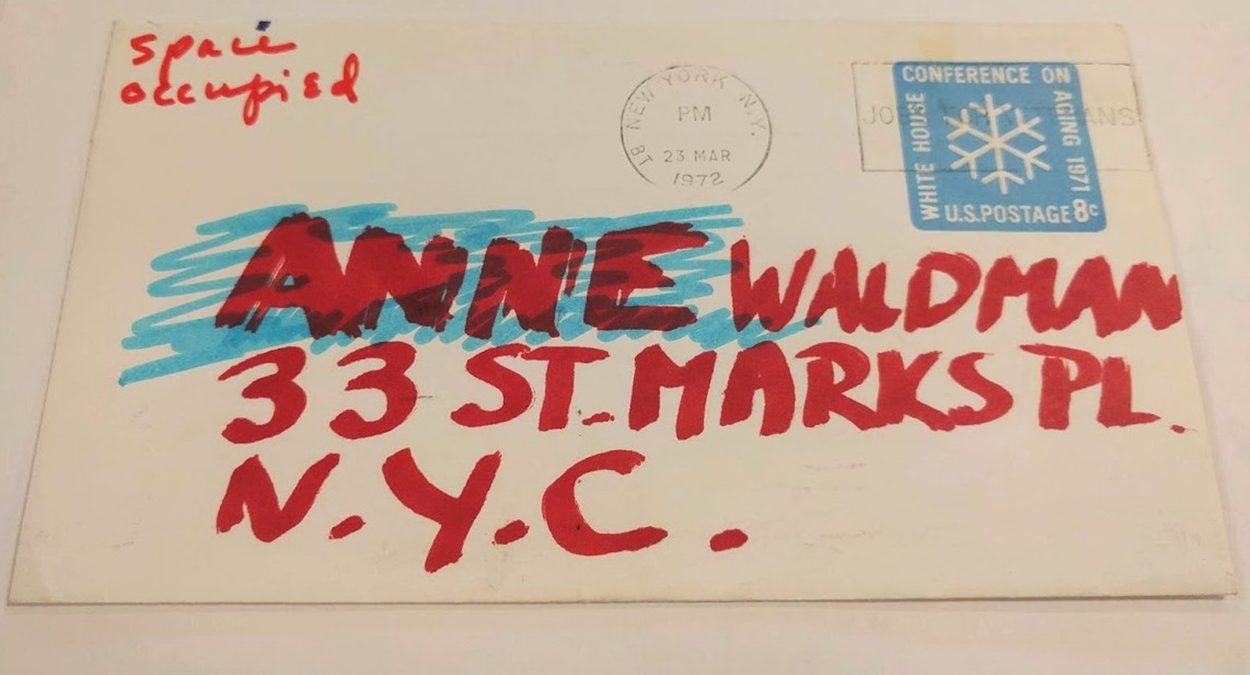
But, as Powell contends, “periodicals work as the connective tissue in studies of modern societies, pulling together seemingly disparate communities and interests. The women who run and read periodicals are indispensable components of those interstitial spaces that allow cultural moments to converge and interact.”Footnote 9 Poet and editor Anne Waldman's archive at the University of Michigan is rich in evidence of her role in facilitating the convergence of many such cultural moments, from the mid-1960s New York poetry scene to the present-day Naropa Institute. An item contained therein provides my conceptual–critical point of departure – an envelope, addressed to Waldman from fellow poet–editor Bernadette Mayer, marked in the top left corner, where a sender's name might otherwise be placed, with two words: space occupied (Figure 1). Both Waldman and Mayer were integral to the development of the New York poetry scene during the period: Waldman directed the Poetry Project at St. Mark's Church from 1968 to 1978, edited The World, coedited Angel Hair, and ran Angel Hair Press with Lewis Warsh; Mayer coedited 0–9 with Vito Acconci and United Artists with Lewis Warsh, ran United Artists press (also with Warsh), and was director of the Poetry Project from 1980 to 1984. Though ostensibly unconnected with the business of editing, these words – at once diffident in their corner positioning and emphatic in their fat, red lettering – function as a kind of signal between two women poet–editors to utilize and occupy “those interstitial spaces that allow cultural moments to converge and interact,” in the context of a complex cultural network that repeatedly made clear that there was little room for them. “Space,” here, is understood peripatetically; “composed of intersections of mobile elements,”Footnote 10 to borrow from Michel de Certeau, it is material, textual, cultural, and metaphorical. The space Mayer claimed, in red Sharpie in the corner of the envelope, metonymically refers to the intellectual and aesthetic mid-century New York space out of which she, Waldman, and other women poets felt crowded, and in which, subsequently, they enacted and articulated their existential materiality. It also, following feminist anthropologists Setha M. Low and Denise Lawrence-Zuniga, refers to “embodied space,” asserting the “importance of the body as a physical and biological entity, as lived experience, and as a center of agency, a location for speaking and acting on the world.”Footnote 11 Simply put, it denotes the ways in which women poets inhabited and experienced the Lower East Side poetry scene, both materially and textually (in its bars, cafes, and domestic settings as well as in its cultural productions), and the ways in which the scene was structured and delimited, both manifestly and less visibly, through gender.
“Space occupied”: envelope containing letter from Bernadette Mayer to Anne Waldman, Anne Waldman Papers, Box 14, University of Michigan Library (Special Collections Research Center). © Bernadette Mayer. Photograph © Rona Cran.

In what follows, focussing primarily on Diane Di Prima, Anne Waldman, and Hettie Jones, but also Maureen Owen and Bernadette Mayer, I explore the complex and often contradictory ways in which women poets used their involvement and visible participation in this burgeoning print subculture to confront their representation or lack thereof, in a literary and social environment in which, in spite of its inclusive credentials, their presence was resisted or negated. Rita Felski, in The Gender of Modernity, affirms that “gender affects not just the factual content of historical knowledge – what is included and what gets left out – but also the philosophical assumptions underlying our interpretations of the nature and meaning of social processes.”Footnote 12 This is strikingly true of the mimeograph revolution as it occurred in mid-century New York. As suggested by the title of Daniel Kane's All Poets Welcome: The Lower East Side Poetry Scene in the 1960s (2003), the Lower East Side poetry scene tends to be discussed in idealistic terms – it is usually framed as egalitarian, convivial, and welcoming to all. And while, to a degree, this is an accurate portrayal, there remains nonetheless a rift between the discourse that surrounds the scene and the specific material experiences of the people involved with it. This is because, some four decades on from the “bold … assertions” of modernist women poet–editors,Footnote 13 and in spite of significant changes to social expectations, the protagonists of urban literary culture continued, overwhelmingly, to be autonomous male subjects invested in ideals of literary, social, and political freedom – ideals which, as Felski argues, carry within them the “fear of a dependency aligned with the feminine.”Footnote 14 Consequently, in various nuanced ways women were excluded from critical aspects of the scene, leading them to use their editorial roles to creatively address and attempt to correct that exclusion.
This essay examines the extent to which the editorship of a mimeo (as little magazines during the period were known) enabled the consciousness and experience of women poets to take on material form and cultural value (in the poems and mimeos that were distributed throughout New York, and beyond), and explores the concomitant relationship between the burden of such editorial labor and the transcendence of patriarchal poetics. As Agatha Beins argues, DIY periodicals establish the “existence” not just of ideas or ideology, but of those people collectively (and physically) behind the enterprise, for whom the act of publishing is as much an activist maneuver as the articulation of political objectives.Footnote 15 Further, Richard Brodhead highlights the inescapable “network of relations” that surrounds literary and cultural production, emphasizing that “writing has no life separate from the particularized mechanisms that bring it to public life.”Footnote 16 I suggest, therefore, that in taking up a defined position within a social and poetic “network of relations,” women poet–editors worked to supplant assumptions about their nonparticipation within that network with demonstrable agency and action, and argue that the Lower East Side poetry scene was less a site of primarily male subjectivity and naturally occurring genius (as tends to be implied) than part of a self-creating process powered by the (often hidden) editorial and organizational labor of women. In other words, women's labor – creative, editorial, physical, affective – matters in this scene, in ways that have yet to be fully understood or critically appraised.
The transformation in publishing practices at mid-century was made possible by the concurrent explosion of mass media, in particular by the increased availability of mimeograph machines, which facilitated quick, cheap production and circulation. Partly due to their relative unwieldiness and partly due to their cost – they were reasonably cheap at around fifty dollars depending on their age and quality, but not so cheap as to enable widespread personal ownership – mimeograph machines were often located in shared spaces, including bookstores, libraries, or print co-ops, where they might be used after hours, enabling a variety of people to come and go, printing flyers, political handouts, posters, and, of course, books, pamphlets, and little magazines. This burgeoning print subculture was essential to shaping the counterpoetics of mid-century New York, bringing the New American Poetry to its public through the claiming of diverse forms of artistic territory. Implicit in the term “counterpoetics” is Nancy Fraser's conceptualization (in response to Jürgen Habermas) of “subaltern counterpublics … parallel discursive arenas where members of subordinated social groups invent and circulate counterdiscourses, which in turn permit them to formulate oppositional interpretations of their identities, interests, and needs.”Footnote 17 Inherently countercultural and crucial to community politics, the mimeograph revolution offered “underground, working-class, and activist groups” the opportunity to make heard “an affordable public voice and played an indispensable role in the formation of social movements and upstart literary projects,” to quote Roxanne Power Hamilton.Footnote 18 For groups to whom avenues of literary influence or cultural expression were restricted, the mimeograph revolution provided kinship, communication, and organizing power. Poets collated low-cost publications, featuring new and unknown voices alongside established figures, and gave them away for free or else sold them cheaply in Lower East Side cafes and bookshops, thus claiming, reclaiming, or demarcating poetic territory in new, countercultural ways. Such territory took the form of “embodied space,” namely “the location where human experience and consciousness take on material and spatial form,” or, as poet Amiri Baraka put it, “the zigs and zags of the literary scene as well as some word of the general New York creative ambience.”Footnote 19 As Hamilton writes, “these do-it-yourselfers created their own reading and publishing apparatus without waiting for those in positions of established authority, such as big house presses, to ‘discover’ the poets, one by one.”Footnote 20 In addition to suggesting elitism and permanency, the term “big house,” in American slang, refers to prison; such connotations are revealing in the context of this counterpoetic opposition to mainstream publishing, in which the mimeograph machine represented liberation from the cultural hegemony. Diane Di Prima used the back leaf of a 1971 edition of her anarchist sequence of poems Revolutionary Letters to restate this position, speaking to the collective energy that drove the mimeograph revolution as she emphasized, “This is a free book. These are free poems and may be reprinted anywhere by anyone … Power to the people's mimeo machines!”Footnote 21
“HIGH NOON ON THE STREETS OF THE LITERARY LIFE”
As noted above, however, narratives about nonconformist writing and publishing, whilst valuable, tend to obscure the pervasive structural inequalities present even in progressive communities. Fraser points out that “subaltern counterpublics … even those with democratic and egalitarian intentions are not always above practicing their own modes of informal exclusion and marginalization.”Footnote 22 This is certainly true of this counterpoetic community. The women who edited mimeos were themselves poets (often very good poets), but, by contrast with their male contemporaries, including Allen Ginsberg, Amiri Baraka, Ted Berrigan, and others, they were under-published in both mainstream and underground publications (or, indeed, not published at all), and underrepresented on the performed-poetry circuit, a crucial environment for poets hoping to establish a reputation in the community. Instead, thanks primarily to social and literary contexts that encouraged and empowered men to make remarks of this kind, they tended to be spoken of both in literature and in life as simply wives or girlfriends, rather than poets, seemingly “irredeemably stained by Jack Kerouac's fatal description” of countercultural women as “‘girls’ who ‘say nothing and wear black’.”Footnote 23 The Lower East Side poetry scene was “very much a boys’ community … almost a parody of machismo,” according to writer and editor Sara Blackburn, who found herself “known mostly as ‘wife of Paul’”; discussing this with Daniel Kane, she emphasized that she “didn't think it was funny.”Footnote 24 Hettie Jones, similarly, has for decades been referred to as “Amiri Baraka's ‘white wife’,” rather than as the established writer that she is.Footnote 25 Further examples include Lewis Warsh remarking that if Alice Notley “were really interested in being a ‘poet’ she wouldn't put all her energy in being Ted's girlfriend” (Notley was later nominated for a Pulitzer, among many other successes; she also married Ted [Berrigan]);Footnote 26 and Berrigan himself, reflecting on the 1965 Berkeley Poetry Conference, saying of the comparatively well-known Lenore Kandel (with whom he had read at the conference, on a panel introduced by Allen Ginsberg), “I did not know who this Lenore Kandel was, but I figured since she was a girl she couldn't be too good.”Footnote 27 As Joyce Johnson (who spent a couple of years dating Jack Kerouac) reflects, when it came to art, “decorative young women had their roles as muses and appreciators”; if they were lucky, like Carolyn Cassady (who recalled performing “household duties [while] the men would read each other excerpts from their writing in progress”), they might occasionally find themselves invited to take a break from “filling their coffee cups” and be included “in the group with smiles, pats and requests for opinions or to moderate an argument.”Footnote 28
Male writers within this countercultural milieu didn't seem interested in women's writing – an attitude perpetuated by Charles Olson's influential manifesto “Projective Verse” (1950) (with its numerous references to “men,” “boys,” “brothers,” and so on), in which, as Rachel Blau DuPlessis notes, “poetry and poetics are gendered male … and the speaking female is missing.”Footnote 29 Even publications edited or coedited by women seem to have perpetuated this systemic literary misogyny. As Warsh writes about Angel Hair, the influential magazine he co-helmed with Anne Waldman,
there was almost no feminist or multicultural consciousness at work, no conscious attempt to balance the number of male and female poets contributing to the magazine … Especially embarrassing is the dearth of women poets published in the magazine. To say that there were fewer women poets writing or that the most radical political groups at the time were sexist and homophobic is no excuse.Footnote 30
Women were primarily “muses and appreciators” or fillers of coffee cups. If, like Di Prima or Waldman, they asserted themselves as writers, hung out with the men at the bars and cafes where they drank and wrote and talked, and insisted on the right to publication and performance, they tended to be treated, on the whole, as tokenistic curiosities.Footnote 31 These attitudes were embodied in the underground press: to quote Warsh on Angel Hair again, “from the start, the contents of the magazine mirrored our social encounters as much as any fixed aesthetic.”Footnote 32 Di Prima recollects that as poets, women often felt invisible: it was “High Noon on the streets of the literary life,” and poets like her were “often not asked to literary events though [they] published with everyone in the usual places, worked side-by-side with the men putting out magazines and books, read[ing] here and there with them on the East Side or in the Village.”Footnote 33
If women's ambitions were recognized, they were often judged according to certain hitherto unspoken criteria. Hettie Jones, for instance, recalls her husband expressing frustration at her reluctance to perform and publish “in terms of the going (male) intellectual positions.”Footnote 34 Berrigan reflected, somewhat mystifyingly, that women poets didn't flourish on account of their failure to “convert … male information to female value.”Footnote 35 Certain topics were seemingly off-limits: while Notley praises Berrigan's openness toward anything she wanted to write about, she also recalls the reluctance of another poet, whom she doesn't name, to engage with her poetry about postpartum depression, and who instead suggested that she, in effect, “lighten up.”Footnote 36 Published work by women also tended to attract highly gendered or sexualized critical responses. In The Floating Bear #30 (1964), for example, Gilbert Sorrentino critiques editor Di Prima's prose for being “sometimes the equivalent of a ‘wiseguy’,” suggesting that she is “too concerned maybe, with not being a ‘lady writer’, so loses some of that gentleness possible.”Footnote 37 That he wrote this in a magazine that Di Prima edited, and that she included it, illuminates the structural, rather than personal, nature of the sexist environment in which she was working. Elsewhere, in the introduction to Femora 2 (1964), a male-edited magazine that only published women poets, Albert Ellis praises the “unusually heavy and heady potion of honest, gutsy female heterosexuality” that he finds in the issue, observing, “these poetesses like to be females; but they also like to have, both figuratively and literally, a good fucking time with males; and they do. Long may they continue to femorate and fuck.”Footnote 38
BUILDING A WORLD
Editing mimeos offered some women poets a chance to surmount, navigate, or radically challenge these gendered constructions of poetic and periodical culture – less to enact the kind of programmatic or collective sisterhood that was springing up elsewhere as second-wave feminism gained ground (also sustained by mimeo), than to nonetheless be, in spite of the sexist environment, “part of it all,” to quote Waldman.Footnote 39 This complicates, productively, the monolithic ideas that tend to define second-wave feminism (namely essentialist views on what a woman is or how a woman should behave, with little interest in difference); even, perhaps, the somewhat limiting notion of feminism as manifesting in “waves.” The feminist advances of the women poet–editors of the Lower East Side were concurrent with but distinct from activist feminism at mid-century, focussing less on women's rights than on the power associated with community formation and with working to claim what Yasmine Shamma calls “the generally male privilege of being read, primarily, as a poet.”Footnote 40 During the period, Waldman, Di Prima, Jones, and others rarely spoke publicly in terms of gender issues or women's liberation, though in their correspondence with other women and in much of their later work they demonstrate that their stance on gender was by no means unexamined. Although they rarely drew explicit connections between their writing and feminist activism, what they share with the women's liberation movement is a fundamental subscription to Robin Morgan's statement in the introduction to the 1970 anthology Sisterhood Is Powerful: “This book is an action” – a belief, to borrow from Harker and Farr, “that books could be revolutionary, that language could remake the world, and that writing mattered in a profound way.”Footnote 41
Unlike the Women in Print movement, which “aimed to capture women's experiences in durable – even beautiful – printed forms through a communications network free from patriarchal and capitalist control,”Footnote 42 the women poet–editors of the Lower East Side were uninterested in fostering a woman-centric network of readers, writers, publishers, and bookstores (and were steadfast in their resistance to the mainstream literary establishment, with which the Women in Print movement had “a symbiotic – sometimes codependent – relationship”).Footnote 43 Their loyalty in cultivating an alternative poetic communications circuit lay with a mixed-gender community of experimental, liberal-minded poets, notwithstanding its inherent male domination and attendant misogyny, rather than in the idea of “an identifiably separate feminist press.”Footnote 44 Beins notes that periodicals published by feminist collectives “constituted sites where readers formed relationships with the women's liberation movement” and “enlivened and animated feminism in that moment.”Footnote 45 By contrast, the periodicals published on the Lower East Side reflected the fact that, unlike many of their more vocally feminist peers, Waldman, Di Prima, Jones, and others thought of themselves primarily as writers rather than as activists (whilst remaining supportive of the movement), and had little inclination toward the establishment of an overtly feminist print culture. In her article on Edna St. Vincent Millay's “uncomfortable position in relation to modernism,” Sarah Parker suggests that “modernism's limitations,” and the limitations of modernist scholarship, are revealed by the received view of Millay as representing “the suppressed other of modernism.”Footnote 46 “Rather than trying to argue Millay into modernism,” Parker demonstrates “that putting poets firmly into categories – such as ‘experimental’ or ‘non-experimental’ – often creates a distorted impression of their wider oeuvre.”Footnote 47 This argument is true of the women poet–editors of the Lower East Side: to categorize them as the “suppressed other” of the women's movement or to focus on their lack of direct engagement with feminism is to neglect the extent to which they articulated and enacted what Olivia Wright terms “feminism through practice, where the vision of what feminism should encompass and represent is articulated through action as well as content and ideas.”Footnote 48
Mixed-gender friendships played a significant part in their rejection of the gendered separatism advocated by some sections of the women's movement. As Brian Glavey notes, “studies of postwar American poetry … have always told stories about friendship,” and “taking these dynamics seriously … has helped call attention to the way that poets’ personal allegiances and rivalries provide a forum for thinking about individuality, creativity, and personal autonomy” in relation to larger contexts and social systems.Footnote 49 It is important to note that the exclusions of women that we interpret, with scholarly objectivity and hindsight, as historical injustices took place within intimate social networks or structures, and appear to have been experienced and interpreted by those involved primarily as interpersonal imbalances rather than deliberate acts of misogyny. For example, Edmund Berrigan (Ted Berrigan and Alice Notley's son) recalls a panel discussion at the Naropa Institute in July 1992, during which a young woman “expressed that she was shocked by the sexist writing of Ted Berrigan that Joanne Kyger had presented in her class.” Anne Waldman immediately came to his defense, responding, “I knew Ted Berrigan intimately, and he was not a sexist!”Footnote 50 This exchange is indicative of what Marek identifies as “the unevenness of the particular influences of gender, its manifestations, social constructions, and personal formulations.”Footnote 51 It is also evidence of the systemic, structural prejudice that prevailed against women poets even in this intimate community, often tending to negate individual agency and the bonds of friendship.
As Notley suggests, there are (problematically for women) very close links between “power and community, and poetry has so little power anyway … and inside poetry there's so little turf,”Footnote 52 meaning that, inevitably, those people perceived to have less power to start with will often be granted only liminal status within the community. Male poets might not have taken women poets seriously, but they would pay attention, it seemed, to anyone who offered them the sense of legitimacy (and power, or turf) that came with publication (an indicator of the way in which notions of literary legitimacy were inevitably carried over from mainstream to DIY publishing). In a 1968 letter, the same Ted Berrigan who three years earlier had dismissed “girl” poets enthuses to Waldman that her magazine “The World is the greatest magazine in the world!” before continuing (with a degree of self-aggrandizement), “I am so inspired by The World that I hereby enclose my latest works and one old work.”Footnote 53 Ron Padgett also appears to have embraced Waldman-as-editor more enthusiastically than he did Waldman-as-poet, frequently submitting work and suggestions for content to Angel Hair and The World, and praising Waldman's editing in terms as effusive as Berrigan's: “The World is sheer genius, editing-wise and other.”Footnote 54 He nonetheless omitted her from his 1970 Anthology of New York Poets (which featured work by twenty-seven poets, but just one woman, Bernadette Mayer). Seemingly having received a review request for the anthology from Padgett, Waldman wrote back to say, “the Anthology is so beautiful, but I'm so pissed I'm not in it, I don't know if I can write any review at present.”Footnote 55 In Padgett's reply he admitted that the decision to leave her out was wrong, but suggested that at the time the book was assembled she was not yet “formed” as a poet. He then set the matter aside: “if I permitted myself to worry about your exclusion from the book I would go nuts with shame and guilt … I do feel bad you're not in. But how long can I continue feeling bad about it? I've had enough of that already.”Footnote 56 Such prevarications are typical of the ways in which, in New York at mid-century, women appear to have been afforded space and power in poetic society as organizers or facilitators, and, indeed, as friends, but less frequently as poets in their own right.
But the role of editor and the role of poet were nonetheless closely connected, and the labor of editorial work often led to important personal gains as an artist. By 1970, Berrigan was persuaded that Waldman was “easily the most exciting poet of her generation,” as he wrote in his blurb for her book Baby Breakdown. His effusion about her poetry (“full of life-giving energy, easy and graceful intimacy, a lovely proud dignity, and a willingness to see anything that happens through … Technically, she is impeccable”) seems at least partly contingent on her role in the Lower East Side community-building experiment. She is “a star,” he writes:
It seems she can do anything, and she has, and does. The poetry magazines she edits, Angel Hair, and The World, the magazine of the St Mark's Arts Project, are the best poetry magazines in America. In them, one finds some of the finest writing being done in America today, and perhaps no one but Anne could bring together such a diverse and vital selection of talented people, and make it all work as the community that the poetry world really is today.Footnote 57
“The struggle to construct a world so that we may be is a continual one,” suggests anthropologist Miles Richardson.Footnote 58 Waldman in particular embraced such a struggle with open arms, recognizing the intellectual, cultural, and spatial world-building capital that magazine editorship enabled her to claim. As Philpotts points out, and as Waldman certainly understood, the literary magazine “exists not only as a literary-aesthetic text and a material product, but also as a socio-cultural institution.”Footnote 59 Furthermore, as Powell writes, “periodicals can do almost anything”; not only did they bring about “modernism … the serial novel of the nineteenth century, the character-driven fiction of the eighteenth century, the public sphere, and many widespread conceptions of femininity (masculinity, too) that continue to pursue us today,” but they also “upend many of the assumptions about writing that disproportionately favor manly discourse.”Footnote 60 No wonder Waldman, Di Prima, and others wanted to play their part in periodical culture.
Periodical culture in mid-century New York comprised collaborative social and literary alliances that were galvanized by the need to share the labor of editing, proofing, printing, collating, stapling, labeling, and mailing magazines and books (much of which involved a serious physical as well as intellectual commitment). Putting issues together was often a social event, and certain New York spaces became increasingly identified with mimeos, and, consequently, with their editors, with people dropping into each other's apartments (little houses as opposed to big ones) or to the independent bookstores where mimeograph machines were often housed, to chat, write, and help out. In an interview with Stephanie Anderson, Hettie Jones, who coedited Yugen (1958–62) with her husband LeRoi Jones (later Amiri Baraka), responds to a question about the “sense of community” that was engendered by “having so many people's hands on the physical objects” (namely the books and magazines) by emphasizing, “that was the very idea.”Footnote 61 She recalls that they threw a release party for Yugen just once; they didn't need to throw parties, she said, because “our parties were generally the collating parties.”Footnote 62 Maureen Owen, similarly, reflects on the “generosity of participation that was so abundant on the Lower East Side.”Footnote 63 As the solo editor of Telephone (1969–84), a magazine that Owen envisioned as a kind of “alternate telephone book, a zine big enough to publish all the prodigiously powerful work [she] was hearing and seeing,” she simply couldn't have collated and circulated the issues alone (she could barely lift the hefty US Postal Service mail sack that regularly filled up with submissions to Telephone, the majority of which she tried to publish, refusing as far as possible to act as a cultural gatekeeper). She recalls,
Everyone who was local and in the issue would come and help to collate and bring friends. And then others would just come and join in. It was truly a community effort. We would buy pizza and cokes and wine, and it was a hands-on working party that would continue until the last copy of the issue was stapled and put on the stack. Then everyone would take copies to distribute around and even mail to folks out of town.Footnote 64
Di Prima, editor (also with Baraka, until 1963) of the Floating Bear (1961–71), reflects in her memoir Recollections of My Life as a Woman on the publication of her first book, This Kind of Bird Flies Backward, by the Jones's Totem Press in 1958:
we actually picked up the finished pages and covers, and carted them in a cab back to the apartment. For the next month or so whoever came to visit me wound up folding pages, or collating, or stapling, depending what stage things were at … We would sit there, talking, eating, writing together sometimes, and we slowly but inevitably folded, collated and stapled the nine hundred and fifty copies of the book.Footnote 65
In other words, what Baraka called the “general New York creative ambience” emerged, to a degree that has not yet been fully explored, as much from the now-legendary bars, cafes, and bookstores on the Lower East Side and its surrounds (the Cedar Tavern, Peace Eye bookstore, Les Deux Megots, etc.) as from the “embodied” domestic spaces associated with the production of the mimeos: from Hettie and LeRoi Jones's apartment (Yugen), from Diane Di Prima's apartment (Floating Bear), from Anne Waldman and Lewis Warsh's apartment (Angel Hair), and from Maureen Owen's apartment (Telephone).
As Luce Irigaray has suggested, illuminating the patriarchal privilege inherent in Heidegger's theorization of building, men can build in the world on the basis that women are integrally associated with the material aspects of nurture.Footnote 66 Eminent poet Charles Olson's praise for Di Prima's Floating Bear is a case in point. He told Di Prima
how important it was to him to know in those early days of the Bear, that he could send us a new piece of, say, The Maximus Poems, and within two weeks a hundred and fifty artists, many of them his friends, would read it. Would not only read it, but answer in their work – incorporate some innovation of line or syntax, and build on that.Footnote 67
Di Prima's generous reading of Olson's gratitude to her for the promotion and nurture of his work obscures the domestic setting in which the seed of such nurture was germinated, and enacts Iris Marion Young's assertion that house and home often “mean the confinement of women for the sake of nourishing male projects.” And yet, as Young continues (and as Di Prima's productive deployment of her home suggests), following bell hooks, “‘home’ can have a political meaning as a site of dignity and resistance.”Footnote 68 Felski, similarly, notes that a feminist reading of modern literature reveals that “the so-called private sphere, often portrayed as a domain where natural and timeless emotions hold sway, is shown to be radically implicated in … processes of social change.”Footnote 69
Waldman was keenly aware of the quietly political and change-making potentialities of her private space to enable her to occupy some of the wider intellectual space of the poetry scene. She recalls the crowds that would come to her apartment at 33 St. Mark's Place, after readings at the Poetry Project, including “occasionally some of the Velvet Underground and Andy Warhol crowd.”Footnote 70 A collaborative poem by Ted Berrigan and Dick Gallup, “80th Congress” (1967), captures the ambience:
Living it up at 33 St. Mark's Place meant, to Waldman, keeping “the ever-expanding literary scene a lively place”: “we talked about poetry constantly, wrote a lot, worked nonstop on the magazine and press. It was the most interesting and smartest thing we could be doing. We created a world in which we were purveyors, guardians, impresarios of a little slice of poetry turf.”Footnote 72
The technology of the mimeograph machine enabled women poets to claim that little slice of turf by carrying out a version of what Donna Haraway calls “networking” or “weaving”: reading, in other words, the “geometrics of difference and contradiction” or “webs of power and social life” inherent in their identities as editors, and gaining a “subtle understanding of emerging pleasures, experiences, and powers with serious potential for changing the rules of the game.”Footnote 73 Radway characterizes the creators of the zines that emerged in the ensuing two decades as “intersubjective,” and the term might also apply to the women poet–editors of the 1960s and 1970s – that is, they are constituted “in ways that highlight the interweaving of social subjects, their relations to and connections with others.”Footnote 74 Through assuming roles as editors, women poets made a choice to actively engage with, insert themselves into, and even shape their poetic communities, regardless of how determinedly, even hostilely, male those communities were. Waldman had made a vow in 1965, swearing that “beyond the practice of my own writing, I would work for and be part of a literary community that would honor its members and provide a network for their ongoing writing.”Footnote 75 Di Prima, as a teenager, had made a similar vow to poetry – “no day without a line,”Footnote 76 she wrote in her journal. The price of this, she discovered, was navigating but not complaining about the misogyny she faced as an adult artist. As she writes in a poem called “The Quarrel,” “I'll never say anything because it's so fucking uncool to talk about it.”Footnote 77 Both women were integral to shaping and promoting the very poetic culture from which they were systematically excluded: Di Prima through her editorship of the Floating Bear, and Waldman (inspired by the Bear) through her editorship first of Angel Hair and then of The World.
AFFECTIVE LABOR, OR, “I WORK MY ASS OFF FOR ALL THE POETS”
Waldman's poem “The Little Red Hen by the Little Red Hen” (a parody of a children's story about the frustrations and rewards of solo hard work and initiative) articulates her frustration with the male poets in her life as well as revealing her own energized self-sufficiency as editor and the labor that went into magazine editorship:
In the original story, the Little Red Hen finds a grain of wheat (“a perfect poem”) and works to turn it into a loaf of bread, asking for help from other animals in the barnyard at each step of the process (from planting to baking) but being repeatedly denied assistance. Help to eat the bread is immediately forthcoming at the end of the story, however; but the Little Red Hen rejects it and eats the bread herself. Waldman suggests, in her parody of this story, that the much-vaunted camaraderie of the Lower East Side poetry scene may not have been as straightforwardly collaborative and equitable as is often thought. Instead, she portrays a collaboratively minded and hardworking magazine editor whose call for helpers is shunned by a (nonetheless affectionately portrayed) male community of poets. The poem – gently, wittily, in true New York school style – reveals both the unseen nature of the Hen/Waldman's work for her poetic community (“behind the scenes … I work my ass off / for all the poets”) and the paucity of her ostensible reward (like Carolyn Cassady, she too is merely granted “a pat on the butt / when the sun goes down”). In light of the original story, however, the implication here is that the end result – the magazine and the cultural power it brought her seem to be Waldman's equivalent of the Hen's loaf of bread – offers a kind of private sustenance that she personally will benefit from. Just as the Hen's loaf of bread originates in a grain of wheat, so Waldman's mimeo originates in a poem: “write a perfect poem,” she instructs or invites her barnyard of poets, the ambiguous imperative tellingly enmeshing the authority of her editorship with its precarity. The poem also suggests the tensions and complexities inherent in Waldman's editorial role and vow to serve her poetic community: in aligning herself with the Hen who eats the whole loaf herself, and, in a moment of candor, complaining about having to “work my ass off,” she reveals the self-interest that partly motivates her, the unglamorous reality of her vow, and her feeling that in spite of working her ass off “for all the poets,” she nonetheless struggles to find acceptance as one of them herself.
Di Prima, similarly, goes to great lengths in her memoir to detail the processes by which the Floating Bear was produced, before writing,
I am telling all this, because I am thinking about and noticing how, though Roi and I coedited the Bear, and often it was he who got the credit for the whole thing, most of the actual physical work devolved upon me and those friends I could dig up to help me.Footnote 79
Hettie Jones, too, recalls how “laborious” the process of putting the magazine together was, involving “not only typing but designing,” as well the ubiquitous “stapling parties.”Footnote 80 Jennie Skerl notes that “physicality, the body as the focus of art, was … a mark of this avant-garde”;Footnote 81 but for women poet–editors and their obliging friends, whose bodies as well as minds were implicated in the work they did, bodily labor was also notably unmarked by the avant-garde. This is in contrast to the publishing history of the US women's liberation movement, which, as Beins argues, emphasized “those bodies ‘bent over the layout table’” in feminist periodicals that “highlighted the labors of publishing.”Footnote 82
Clearly, the labor of editing a little magazine was significant, both in terms of the intellectual and physical commitment (editing, typing of stencils, collating, etc.) and in the social, personal, and aesthetic hazards associated with it: editorial relationships in many contexts can be at once intimate and aggressive, confrontational and collaborative, while the editorial process requires an engagement with text that can feel simultaneously nurturing and violent, involving both construction and deconstruction (and even, sometimes, destruction). After all, affective labor – namely the “processes by which our laboring practices produce collective subjectivities, produce sociality, and ultimately produce society itself,” or “the labor of human contact and interaction, which involves the production and manipulation of affects,” in this case the emotional resources and communicative skills required for the correspondence, soliciting, socializing, and ego-soothing involved with editing – is still labor.Footnote 83 As Waldman's vow to “work for” her literary community suggests, putting together a magazine that kept large numbers of writers involved and informed was a kind of community service; a service that, if you happened to be the female half of the editorial team, was often self-sacrificial and not always sufficiently recognized or rewarded. When Hettie Jones moved away from editing Yugen, it was because she was “thinking of her own career,” finally, tired of “doing everything for everybody else,” tired of being “an energetic young person of twenty-seven, serving others.”Footnote 84 The burden of poetic dissemination could also be creatively restrictive: while Di Prima and Jones were typing, proofreading, painstakingly correcting mimeograph stencils for, printing, collating, and distributing the Floating Bear and Yugen, for instance, their coeditor LeRoi Jones had the time to write the original poetry and drama and forge the literary and political connections which made him famous – once again evoking Irigaray's critique of the maleness inherent in Heidegger's conception of dwelling and building.
Moreover, as Hamilton notes, in their roles as editors Waldman, Jones, Di Prima, and others “may have encountered the latent, if not express, attitude that community service is related to domestic and familial work.” As Hamilton explains, “care-taking professions have been feminized, hence culturally disempowered, in comparison to the grander pursuit of one's own place in Eliot's tradition of talented poet-individuals.”Footnote 85 With its connotations and practicalities of care, nurture, development, delivery, and service, editing a mimeo was all too conveniently coded as feminine labor, particularly as the role became more ubiquitous and communal, losing the godlike singularity and mystery of the male “make-it-new” editor. For some women writers, including the soon-to-be rock star Patti Smith, who was writing poetry in New York during the period but who refused on the whole to publish her work in little magazines, this kind of editorial labor – putting magazines together that contain poetry written by mostly male poets – was merely a different way of being a “muse and appreciator.”Footnote 86 Although Smith appreciated the efforts Waldman in particular went to with regard to shaping and promoting poetic culture (“I love you guys cause you keep poetry alive,” she wrote to Waldman),Footnote 87 the grubby, communal, physical labor of putting poetry magazines together seemed too great a distance from the loftier work of writing poetry. Writing, for Smith, was a sacred, solitary art made by sacred, solitary, male heroes like William Blake, Arthur Rimbaud, or Bob Dylan (as she asserted to Waldman, making an exception for “the Little Red Hen,” “I don't dig chicks”).Footnote 88
But although editing and organizing involved a good deal of menial labor, and was seen as a lesser role that men allowed women to star in without threatening their own claim on being poets, there is another way to think about this. Recent emphasis on the power of social networks and collaborative behaviors has revealed activities like editing and community formation to be more significant than was hitherto believed; the prior devaluing of these roles is a mistake based on ideas of individual genius, and the role of the editor and community builder has been historically vindicated, not least in light of the fact that the St. Mark's Poetry Project continues to flourish and is more significant as a long-running cultural event than any particular poem performed there. And as Powell observes, “even niche publications can matter to and alter cultural history when they are intellectually ambitious.”Footnote 89
Furthermore, Waldman, Di Prima, Jones, and others had little interest in sacred, solitary heroes. They were part of a generation of writers working toward what Adrienne Rich later called “re-vision,” aiming “not to pass on a tradition but to break its hold over us.”Footnote 90 They were also part of poetic generations – the Beats and the New York school – which viewed poetry as “communal, popular, and inseparable from the matrix of life.”Footnote 91 Years later, during a visit to the Metropolitan Museum, Di Prima came to a realization about the role her editorial labor had played in the formation of the Lower East Side poetry scene. Standing in a room full of ancient statues, she
saw clearly that there was no calling higher than this: to be an anonymous worker in the ranks, one of the unknown artists who from time immemorial and for all time to come have been making the beauty that is the leavening in our lives. A laborer in the ranks of artists and artisans … I saw there was no fame worthier than this.Footnote 92
In this scene, as Di Prima views the communal structures of creative production of an ancient workshop or guild, we might read the mimeograph revolution as a return to a much older way of making and disseminating art, rather than as a radical break from tradition. For Waldman and Di Prima, editing little magazines involved self-sacrifice, but it was also, for them, a means of occupying space and claiming power within a communal but male-dominated literary scene – a scene they wanted to engage and maintain identity with because, as Di Prima said to Waldman, it held “the information that makes you a proficient writer”; that makes, as Di Prima realized, “the beauty that is the leavening in our lives.” In other words, it facilitated “the passage of knowledge of craft from poet to poet,” which for her was essential if women who had committed their lives to poetry were going to “step into,” and thereby alter, “this male-dominated line of literary succession.”Footnote 93 As Sara Ahmed writes, “the work of inhabiting space involves a dynamic negotiation between what is familiar and unfamiliar.”Footnote 94 Due to structural inequalities, male poets had more cultural capital, and were better able to move through and take up space, “to inhabit the world as if it were home.”Footnote 95 In taking on editorial and service work, poets like Waldman and Di Prima were acting in their own justifiable self-interest by associating themselves with that readership and cultural capital. For them, editing was a means to an end that represented the opposite of erasure or self-effacement or remaining behind the scenes: it was about transcending patriarchal poetics through meaningful exchange with other practitioners (regardless of gender), other tireless laborers in the ranks of artists and artisans. As Di Prima put it, “I saw these guys, myself and the others, as artists simply. All the striving was for and of the Work, and I loved them for it.”Footnote 96
Waldman, Owen, and Jones give similar reasons for their commitment to editorial labor – namely the closeness that it enabled them with the poetry they printed, and the importance of this for the enrichment of their own careers and wider lives. Editing Angel Hair meant that it wasn't long before Waldman was “reading the work of all [her] new poetry friends who were regularly walking into the living room any hour of the day or night. Also giving readings, organizing and running countless poetry events.”Footnote 97 Owen, too, cherished the “heady involvement” and “physical infusion of energy” that she drew from typing and stenciling work for Telephone:
Often after typing a poem carefully onto the stencils, my attention so intently drawn in to each word and space and line break, I would have to get up and walk madly about the house reciting the poem now so embossed on my brain. I became one with the poem in a way that doesn't happen when one is just reading the work.Footnote 98
Jones, too, relished “being alone with the poems, and typing and retyping the poems.” She elaborates:
everything – as you can tell, everything was done by hand – and it was done by me by hand. So the poems were very personal to me … the act of typing and retyping. I got the rhythms of everyone's poems in my head … that was my favourite part.Footnote 99
The nature of editing little magazines is complex and inconsistent, characterized by a nuanced dynamic between self-assertion, self-sacrifice, self-interest, and self-effacement. Inherent in the editorial experiences of Di Prima, Waldman, Jones, Owen, and others is a delicate, often fraught, balance between the desire, as artist, to resist social and aesthetic erasure, and the nature of the role of editor as one that by necessity takes place behind the scenes. For some poets, the opportunities to claim poetic space and power through editorial work were negated, to a large extent, by the exhausting machismo of the literary scene. Jones, for instance, describes herself as “a very small person” who was “never really interested in drinking,” or “in hanging too much at the Cedar Bar, or any other place.”Footnote 100 This was particularly the case during her two pregnancies – but of course, as Felski points out, the exemplary hero of modern literary culture “is assumed to be an autonomous male free of familial and communal ties.”Footnote 101 Editing Yugen theoretically offered Jones redress from such social and creative exclusion, but in practice, for her, it simply meant more work and of the wrong kind, an endlessly invisible labor in which her extensive contributions were repeatedly obscured. The material dimension of mimeo production – the joy of creating and holding a physical object, of seeing “the beauty of the rich black ink lifting the poems off the white page”Footnote 102 – is tempered by the immateriality of editorship, in which (like the anonymous sculptors at the Met) the editor's role often goes unnoticed, their ephemeral act of selection or critique invisibly embedded in the writing readers read as belonging to the poets whose names appear in the magazine. Drinking at the Cedar was a crucial part not just of general acceptance in the Lower East Side literary community, but of editing a successful little magazine there. Her husband, rather than Hettie, “was the one who asked for contributions” to Yugen, and thus the one who chiefly made the decisions over content and editorial choices, leaving Hettie to deal with the manual labor. “He had the time” to ask for contributions, Hettie recalls (also suggesting that this was at least partly why “most of the people we published were men”).Footnote 103 She, by contrast, did not have the time: “my feelings – with never anything literary to them and all I ever wanted to write about – were left tangled for lack of time.”Footnote 104 In addition to her work assembling and distributing Yugen, Jones also edited and typed her husband's books, cared for their two children, and had a job reading manuscripts for Grove Press. Social exclusion and lack of time (as well as lack of space – her husband had a study in their apartment while she had a desk in their crowded living room) resulted in a long withdrawal from literary life. Although her husband was one of the most dynamic and well-known poets in New York, Jones's own poems “were kept mute in boxes” for years,Footnote 105 something she later said felt shameful.Footnote 106 She downgraded herself from editor to assistant editor after four issues of Yugen, citing a need to “withdraw a little bit from it,”Footnote 107 ironically signaling a desire to focus on her own career – to leave behind the self-effacement and self-sacrifice inherent in her iteration of editorial work, which, she said, “somehow left out the woman whose mouth I was trying to open.”Footnote 108
“SPACE OCCUPIED”: MATERIAL AND TEXTUAL LEGACIES
As Jones's experience, contrasted with Waldman's or Di Prima's, makes plain, the form and function of editorial labor are complex and often contradictory. But in spite of this, the editorship by women of little magazines during the mimeograph revolution resulted in an enduring occupation of cultural space in the name of both legacy and identity. Even if the specifics of the editors’ varying levels of contribution are, to a greater or lesser degree, obscured, the materiality of each printed run leaves a tangible record, the two hallowed words “edited by,” followed by a name – Anne Waldman, Diane Di Prima, Hettie Jones, Maureen Owen, Bernadette Mayer – gracing each issue, occupying cultural, social, and intellectual space. Mayer's “space occupied,” a metonymic substitution positioned on the envelope where her name might go, makes the point that names matter. As Audre Lorde said, “If we don't name ourselves, we are nothing.”Footnote 109 Names on printed paper, affectively encountered by readers throughout the city and beyond, create a material, textual, and influential inheritance that continues to endure (in contrast to the ephemeral bonhomie of the Cedar): in the boom in women-helmed zine publishing in the late twentieth century, in archives and special collections, online, and in auctions, where the magazines are often sought after by collectors who appreciate their worth, or where they are increasingly of interest to feminist scholars invested in illuminating what Kate Dossett calls “the gendered history of archives and their relationship to history making and feminist activism.”Footnote 110 Like a hieroglyph or an amulet – written signs that take the form of physical objects – a printed poetry magazine with a woman poet's name on it makes evident her material experience, affirming that she existed, if not always how. It also makes material her formative association with the poetry scene. Editing a mimeo is akin, in the way that it “provide[s] loci of identification and difference, allowing us to recover lines of connection, influence, conflict, and resistance,”Footnote 111 to the kind of autobiographical writing practiced by poets like Gertrude Stein and Frank O'Hara, who fully recognized “the name's ability to refer beyond the boundaries of the text.”Footnote 112 It too is “a project of name-dropping, of accruing capital”Footnote 113 through the association of one name with others, Di Prima with Baraka, O'Hara, Olson; Waldman with Berrigan, Ginsberg, Ashbery; both with those influential collective nouns, the Beats and the New York school.
Miles Richardson observes that “with the ability to make artifacts, we can fix our experience … and in so doing employ the material items to recall, reconstitute, and communicate our experience.”Footnote 114 It is telling, therefore, that several women poet–editors make specific reference to the materiality of the magazines they created, highlighting affective encounters in the process of recalling, reconstituting, and communicating their experiences as editors – from Jones's sense of the community spirit engendered by “having so many people's hands on the physical objects,”Footnote 115 to Owen's thrill at witnessing “the beauty of the rich black ink lifting the poems off the white page,”Footnote 116 to Mayer's preference for producing a magazine rather than books, “because you could really touch it more.”Footnote 117 As Ahmed writes, material objects enable us to better orient ourselves and thus to more effectively occupy space, because they “present themselves as tools to extend ‘the reach’ of our actions” – in other words, “objects around the body allow the body itself to be extended.”Footnote 118 Joyce Johnson recalls a feeling of anxiety on returning to her middle-class home on the Upper West Side following a day carousing with beatniks in Greenwich Village; she writes that “the anxiety is not so much over leaving as over an impending fading of identity.”Footnote 119 Editing a mimeo seems to be a related exercise in maintaining identity for women poets whose identity as such was repeatedly effaced, the existence of one magazine issue containing the promise of the next one, thereby extending the reach of their actions. It is an activity that speaks directly to those material, textual, and cultural spaces in which their presence was resisted or negated, that says, undeniably, I am here, or, later, I was there.