Introduction
Chronic fatigue syndrome (CFS) is a disorder characterized principally by severe and debilitating fatigue lasting more than 6 months and without an identified medical cause. Whilst the cause is uncertain and controversial, there is evidence for the efficacy of cognitive behaviour therapy (CBT) (Price et al. Reference Price, Mitchell, Tidy and Hunot2008; White et al. Reference White, Goldsmith, Johnson, Potts, Walwyn, DeCesare, Baber, Burgess, Clark, Cox, Bavinton, Angus, Murphy, Murphy, O'Dowd, Wilks, McCrone, Chalder and Sharpe2011) and graded exercise therapy (GET) (Edmonds et al. Reference Edmonds, McGuire and Price2004; White et al. Reference White, Goldsmith, Johnson, Potts, Walwyn, DeCesare, Baber, Burgess, Clark, Cox, Bavinton, Angus, Murphy, Murphy, O'Dowd, Wilks, McCrone, Chalder and Sharpe2011) in treating CFS symptoms and improving disability.
Cognitive and behavioural models have been proposed for understanding CFS (Deary et al. Reference Deary, Chalder and Sharpe2007). Cognitive and behavioural responses are considered to be particularly important in perpetuating fatigue and disability, and are the factors targeted in therapy.
Examples of cognitive responses in CFS include an attentional bias towards fatigue symptoms (i.e. symptom focusing; Moss-Morris & Petrie, Reference Moss-Morris and Petrie1997) and worrying about potential terrible consequences of symptoms leading to a worsening of the illness (i.e. catastrophizing; Knoop et al. Reference Knoop, Prins, Moss-Morris and Bleijenberg2010). Examples of behavioural responses include reducing activities to alleviate fatigue (i.e. avoidance and resting; Chalder et al. Reference Chalder, Power and Wessely1996) or alternating approach and avoidance behaviours in response to symptoms (i.e. all-or-nothing behaviour). Cognitive and behavioural responses to fatigue symptoms are sometimes linked to negative emotions. Activity avoidance, for instance, can result both from the belief that activity is damaging (i.e. fear avoidance) but may also result from the embarrassment of experiencing fatigue symptoms in a social context (i.e. embarrassment avoidance). A recent study found that embarrassment beliefs and avoidance behaviour were associated with not working in CFS (Knudsen et al. Reference Knudsen, Henderson, Harvey and Chalder2011).
One of the most consistent findings in CFS is a high level of psychiatric co-morbidity, in particular depression and anxiety (Skapinakis et al. Reference Skapinakis, Lewis and Mavreas2003). Patients with CFS and co-morbid psychiatric diagnoses have more symptoms and disability (Cella et al. Reference Cella, Sharpe and Chalder2011a). Both depression and anxiety have been associated with specific cognitions and behaviours. The cognitive model of depression, for instance, puts a specific emphasis on self-related negative cognitions (e.g. feeling worthless, useless), lack of motivation, passivity and withdrawal or avoidance (Young et al. Reference Young, Weinberger, Beck and Barlow2001). Also shame or embarrassment and its relationship with perceived low social status has been advanced as a core feature responsible of fostering negative emotional states such as depression (Gilbert, Reference Gilbert2000). CBT models for anxiety have instead stressed the role of catastrophic cognitions, negative expectations, attentional biases (e.g. self-focused attention) and behavioural avoidance (Rapee & Heimberg, Reference Rapee and Heimberg1997). Given this difference, it appears important to examine whether cognitions and behaviours in patients with CFS alone differ from those who have CFS with co-morbid depression or anxiety.
In this study we aimed to measure the prevalence of hypothesized cognitions and behaviours in patients with CFS and to explore the association with co-morbid anxiety and/or depressive disorders. Based on established models of depression and anxiety disorders we hypothesized that patients with CFS and depression would have more negative cognitions characterized by embarrassment and avoidance while those with co-morbid anxiety would report more symptom focusing and catastrophizing cognitions.
Method
Participants
The study data was from 640 adult patients who had been recruited into a randomized trial of treatments for CFS: Pacing, graded activity and cognitive behaviour therapy: a randomised evaluation (the PACE trial; White et al. Reference White, Goldsmith, Johnson, Potts, Walwyn, DeCesare, Baber, Burgess, Clark, Cox, Bavinton, Angus, Murphy, Murphy, O'Dowd, Wilks, McCrone, Chalder and Sharpe2011). The main inclusion criteria for entering the trial were: meeting the Oxford research diagnostic criteria for CFS (Sharpe et al. Reference Sharpe, Archard, Banatvala, Borysiewicz, Clare and David1991); a score of 6 or more on the Chalder Fatigue Questionnaire (Chalder et al. Reference Chalder, Berelowitz, Pawlikowska, Watts, Wessely, Wright and Wallace1993); and a score of 65 or less on the SF-36 physical function subscale (Ware, Reference Ware1992). The exclusion criteria were: a medical or psychiatric diagnosis that might adequately explain the fatigue (Sharpe et al. Reference Sharpe, Archard, Banatvala, Borysiewicz, Clare and David1991; Reeves et al. Reference Reeves, Lloyd, Vernon, Klimas, Jason, Bleijenberg, Evengard, White, Nisenbaum and Unger2003); the trial treatments were inappropriate to the patient's clinical needs (e.g. having co-morbid post-traumatic stress disorder); or having previously received a trial treatment in one of the PACE trial centres. Patients were recruited between March 2005 and November 2009. The baseline (pre-randomization) data were used in this study. Informed written consent was obtained from each patient for assessment and entry into the trial. The study was approved by the West Midlands Multicentre Research Ethics Committee (no. MREC 02/7/89).
Measures
Cognitive Behavioural Response Questionnaire (CBRQ)
The CBRQ (Skerrett & Moss-Morris, Reference Skerrett and Moss-Morris2006) is a self-rated questionnaire designed to measure patients' cognitive and behavioural responses to illness symptoms. From the questionnaire, five cognitive and two behavioural subscales can be derived. Cognitive subscales include symptom focusing, which assesses the attentional bias towards symptoms and fear avoidance, catastrophizing, damaging beliefs and embarrassment avoidance that assess the appraisal and interpretation of symptoms. The two behavioural subscales include all-or-nothing behaviour, assessing the tendency to alternate periods of intense activity with periods of extensive rest, and avoidance/resting, measuring resting and inactivity behaviour resulting from avoidance behaviour. All items are rated on a five-point Likert scale ranging from ‘strongly disagree’ to ‘strongly agree’. The scale has been used to assess beliefs in patients with multiple sclerosis (Skerrett & Moss-Morris, Reference Skerrett and Moss-Morris2006) and in patients with CFS (Knudsen et al. Reference Knudsen, Henderson, Harvey and Chalder2011).
Chalder Fatigue Scale
The Chalder Fatigue Scale (Chalder et al. Reference Chalder, Berelowitz, Pawlikowska, Watts, Wessely, Wright and Wallace1993) is an 11-item self-rated scale measuring symptoms of physical and mental fatigue. Each item has four response options ranging from ‘less than usual’ to ‘much more than usual’. Total fatigue scores can range from 0 to 33. The scale has been used in a large body of research including randomized controlled trials and has good psychometric proprieties (Cella & Chalder, Reference Cella and Chalder2010).
Work and Social Adjustment Scale (WSAS)
The WSAS (Mundt et al. Reference Mundt, Marks, Shear and Greist2002) is a five-item self-rated scale that measures patients' level of impairment in work, home management, relationships, and social and private life. Items are scored on an eight-point Likert scale ranging from ‘very severely impaired’ to ‘not impaired at all’. Total scores can range from 0 to 40. The WSAS has recently been shown to be reliable and valid in a CFS population (Cella et al. Reference Cella, Sharpe and Chalder2011a).
Structured Clinical Interview for DSM-IV (SCID)
The non-patient edition of the SCID with psychotic screen (SCID i/P; First et al. Reference First, Spitzer, Gibbon and Williams2002) was used to identify anxiety and depression diagnoses and also exclusionary psychiatric diagnoses (Sharpe et al. Reference Sharpe, Archard, Banatvala, Borysiewicz, Clare and David1991). Interviews were conducted by a trained clinical researcher and were audio-recorded for quality control. Quality control was assessed by senior mental health professionals listening particularly to early recordings, with feedback and review.
Patient labelling
For the purpose of the current study we labelled patients with current major or minor depressive disorder as the CFS depression group (CFS-Dep) and patients with a current diagnosis of obsessive compulsive disorder, post-traumatic stress disorder, any type of phobia and generalized anxiety disorder as the CFS anxiety group (CFS-Anx). Patients fulfilling both CFS-Dep and CFS-Anx criteria were the CFS-Dep&Anx group. Patients with no concomitant SCID diagnosis were labelled CFS.
Analysis
From the initial sample we initially derived four subgroups of patients according to the co-morbid SCID depression and anxiety diagnoses: CFS, CFS-Anx, CFS-Dep and CFS-Anx&Dep. The results on the assessment measures were inspected for deviation from normality. Differences between groups were assessed with multivariate variance analysis for continuous and with χ2 for categorical variables. Covariates were entered in the model to account for potential confounding effects where there was an indication of relevance from previous literature or previous analysis conducted as part of this study. Fisher's least significant difference post-hoc test was used to explore differences in the following comparisons: CFS v. CFS-Anx; CFS v. CFS-Dep; CFS v. CFS-Anx&Dep. Significance level was set at 0.01 to account for multiple comparisons and minimize the possibility of type I errors. All analyses were performed with SPSS version 17 (SPSS Inc., USA).
Results
Of the total sample, 54% had a diagnosis of CFS and no depression or anxiety disorder, 14% had CFS and one anxiety disorder, 14% had CFS and depressive disorder and 18% had CFS and both depression and anxiety disorders.
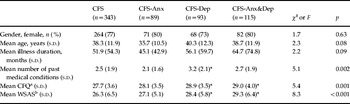
Demographic characteristics of the sample grouped by type of diagnostic co-morbidity are presented in Table 1.
Demographic and clinical characteristics of the sample divided by concurrent diagnosis

CFS, Chronic fatigue syndrome; CFS-Anx, CFS patients with a current diagnosis of obsessive compulsive disorder, post-traumatic stress disorder, any type of phobia and generalized anxiety disorder; CFS-Dep, CFS patients with current major or minor depressive disorder; CFS-Anx&Dep, CFS patients fulfilling both CFS-Dep and CFS-Anx criteria; s.d., standard deviation; CFQ, Chalder Fatigue Questionnaire; WSAS, Work and Social Adjustment Scale.
a Range 0–33. b Range 0–40.
* Mean value was significantly different from that of the CFS group (p < 0.01, Fisher's least significant difference post-hoc test).
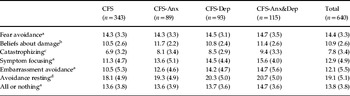
Table 2 shows the prevalence of the cognitive and behavioural scales in each subgroup as defined by concomitant diagnoses.
Cognitive and behavioural scores divided by co-morbid groups

CFS, Chronic fatigue syndrome; CFS-Anx, CFS patients with a current diagnosis of obsessive compulsive disorder, post-traumatic stress disorder, any type of phobia and generalized anxiety disorder; CFS-Dep, CFS patients with current major or minor depressive disorder; CFS-Anx&Dep, CFS patients fulfilling both CFS-Dep and CFS-Anx criteria.
Data are given as mean (standard deviation).
a Range 0–24. b Range 0–20. c Range 0–16. d Range 0–32.
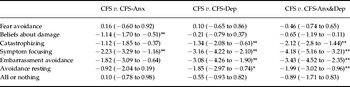
Table 3 shows the results of the multivariate analysis of variance, with WSAS and CFQ scores entered as covariates. WSAS was found to be a significant contributor to all the cognitive and behavioural subscales of the CBRQ except for all-or-nothing behaviour (F values between 10.9 and 53, all p < 0.001). The model mean differences and 95% confidence intervals are presented in Table 3. Compared with CFS alone, CFS-Anx patients reported more beliefs about damage [F(5, 627) = 54.9, p < 0.0001] and symptom focusing [F(5, 627) = 22.1, p < 0.0001]. CFS-Dep patients also reported more symptom focusing but unlike CFS-Anx patients reported more avoidance behaviour: embarrassment avoidance [F(5, 627) = 24.7, p < 0.0001] and avoidance resting [F(5, 627) = 22.1, p < 0.0001]. Finally, CFS-Anx&Dep patients reported both more symptom focusing and catastrophizing cognitions [F(5, 627) = 19.9, p < 0.0001], higher embarrassment avoidance and avoidance resting [F(5, 627) = 17.3, p < 0.0001] compared with CFS alone.
Multivariate analysis of variance showing differences between the reference group (i.e. CFS only) and CFS plus a co-morbid disorder group controlling for fatigue severity and level of functional impairment (WSAS)

CFS, Chronic fatigue syndrome; WSAS, Work and Social Adjustment Scale; CFS-Anx, CFS patients with a current diagnosis of obsessive compulsive disorder, post-traumatic stress disorder, any type of phobia and generalized anxiety disorder; CFS-Dep, CFS patients with current major or minor depressive disorder; CFS-Anx&Dep, CFS patients fulfilling both CFS-Dep and CFS-Anx criteria.
Data are given as mean difference (95% confidence interval).
* p < 0.001, ** p < 0.0001.
Discussion
This study investigated the cognitive and behavioural responses of patients with CFS and anxiety and depressive disorders. Overall, patients with psychiatric co-morbidity had more disability and fatigue and also more maladaptive cognitions and behaviours. Our hypothesis that patients with CFS and depression would have more negative cognitions characterized by embarrassment and avoidance was supported. We found an association between beliefs about damage in patients with anxiety, embarrassment and behavioural avoidance with depression and symptom focusing and catastrophizing with both. However, we did not find catastrophizing being a relevant cognitive feature in the CFS-Anx group.
Although one study showed no significant differences in outcome following CBT between participants with and without psychiatric diagnoses (Prins et al. Reference Prins, Bleijenberg, Rouweler and van der Meer2005) and the PACE trial found no difference in the pattern of outcomes in those with co-morbid depressive illness, a recent meta-analysis of all relevant trials showed that CBT achieved greater reductions in depression and anxiety than GET (Castell et al. Reference Castell, Kazantzis and Moss-Morris2011). This suggests that people with co-morbid anxiety and/or depression should be offered CBT ahead of GET. CBT has the added benefit of being able to target specific cognitions relevant to the individual.
Our results should be interpreted in the context of the study's strengths and limitations. The major strength of this study was the large sample size of CFS patients who had been recruited using the PACE trial criteria (White et al. Reference White, Goldsmith, Johnson, Potts, Walwyn, DeCesare, Baber, Burgess, Clark, Cox, Bavinton, Angus, Murphy, Murphy, O'Dowd, Wilks, McCrone, Chalder and Sharpe2011). All these patients had undergone in-depth medical assessment to exclude co-morbid medical conditions and a structured psychiatric interview (i.e. SCID) conducted by a trained assessor to identify associated psychiatric disorders. There were, however, limitations: the sample was recruited to meet the trial inclusion criteria and consequently may not fully represent patients seen in clinical practice. The CBRQ is a self-rated questionnaire and assesses only a limited number of cognitions and behaviours typically associated with psychosomatic complaints; it is possible that some other cognitive-behavioural aspects may be also important in discriminating between the groups of patients considered in our study. The current study did not examine medication use (e.g. antidepressants) in relation to co-morbid diagnosis. However, the paper reporting the main result from the PACE trial (White et al. Reference White, Goldsmith, Johnson, Potts, Walwyn, DeCesare, Baber, Burgess, Clark, Cox, Bavinton, Angus, Murphy, Murphy, O'Dowd, Wilks, McCrone, Chalder and Sharpe2011) showed no differences across treatment groups in proportions of patients prescribed antidepressants during the trial. Finally, it should be noted that the mean differences for some of the CBRQ subscales were modest and this limits the applicability that some of our findings may have for clinical practice. Also, this may suggest that whilst there is some association between specific cognitions and psychiatric co-morbidity in patients with CFS, other factors such as personality social support may also be important.
Our findings have some clinical implications. One potentially important clinical consequence of this finding is that longer or different treatment may be required for some patients to address mood- and anxiety-related cognitions as well as those typical of CFS. Whilst modifications of existing CBT treatments may enhance their effectiveness for specific subgroups of patients, such as those with depression or anxiety and CFS, we currently lack empirical evidence to support this. A second clinical implication relates to classification. A long-lasting debate exists among clinicians and researchers about the possibility and value of subclassifying patients with CFS (Wessely & White, Reference Wessely and White2004). Such subclassification could potentially contribute to improved treatment protocols (Cella et al. Reference Cella, Chalder and White2011b). The results of this study suggest that subdivision on the basis of co-morbid depression and anxiety may be a useful basis for such subclassification.
Acknowledgements
Funding for this study was provided by a grant awarded to P.D.W., M.S. and T.C. by the UK Medical Research Council, Department of Health for England, Scottish Chief Scientist Office, Department for Work and Pensions (MRC G0200434). T.C. receives salary support from the National Institute for Health Research (NIHR) Mental Health Biomedical Research Centre at the South London and Maudsley NHS Foundation Trust and King's College London. The views expressed are those of the author(s) and not necessarily those of the NHS, the NIHR or the Department of Health.
Declaration of Interest
P.D.W. has done voluntary and paid consultancy work for the UK Departments of Health and Work and Pensions and Swiss Re (a reinsurance company). M.S. has done voluntary and paid consultancy work for government and for legal and insurance companies, and has received royalties from Oxford University Press. T.C. has received royalties from Sheldon Press and Constable and Robinson.