Introduction
Food security exists when ‘people at all times can acquire safe, nutritionally adequate, and culturally acceptable foods in a manner than maintains human dignity.’ (Van Esterik Reference Van Esterik1999). To be food secure, individuals and households must be able reliably to access food, the availability of nutritious food must be sufficient, and it must be of a sufficient quality in terms of nutrition, safety, and cultural value (Kendall and others Reference Kendall, Olson and Frongillo1995; Gregory and others Reference Gregory, Ingram and Brklacich2005). Food availability refers to the availability of sufficient food, that is the overall ability of the food system to meet demand. Food access covers the ability of households and individuals to access adequate resources to acquire foods for a nutritious diet. Food quality concerns the ability to obtain food of sufficient nutritional and cultural value. As Ford (in press) notes, these components of food security are interrelated in often complex ways; for example, constrained access to food can also affect the availability and quality of food, and vice versa. Compromised food security is undesirable in and of itself, but has also been linked to negative health outcomes, with those who are food insecure more likely to feel unhealthy, be prone to infection, have chronic health problems, and experience psychological stress (Hamelin and others Reference Hamelin, Habicht and Beaudry1999; Hamelin and others Reference Hamelin, Beaudry and Habicht2002; McIntyre and Tarasuk Reference McIntyre and Tarasuk2004; Health Canada 2005; Lambden and others Reference Lambden, Receveur, Marshall and Kuhnlein2006).
There is a well established body of research on food security in agriculture based food systems (Gregory and others Reference Gregory, Ingram and Brklacich2005; Ericksen Reference Ericksen2008). Studies in the biophysical sciences, for example, have examined links between productivity, production and food security (Rosenzweig and Parry Reference Rosenzweig and Parry1994; Scmidhuber and Tubiello Reference Scmidhuber and Tubiello2007). In the social sciences, research has focused on access and quality of food, and the economic, political, and social conditions that influence the ability to manage stresses to the food system (Sen Reference Sen1981; Watts Reference Watts1983; Chambers Reference Chambers1989; Yaro Reference Yaro2004; Eakin and Luers Reference Eakin and Luers2006). This research focuses on the resources available to people to secure their livelihoods, and the political, social, economic, institutional, and biophysical processes that make some livelihoods more vulnerable than others, and how stresses emanating at multiple scales affect food security (Ford in press).
There have been few studies, however, of food security in ‘dual food systems’ composed of agricultural production and subsistence hunting and fishing (Chan Reference Chan2006; Furgal and Seguin Reference Furgal and Seguin2006; Power Reference Power2008; Ford in press). Food security research with Inuit communities in Canada, for instance, is a relatively new field, with food studies typically focusing on specific issues, including the impact of contaminants on the safety of traditional foods, changes in dietary preference, food sharing mechanisms, and the role of traditional foods in Inuit society (Collings and others Reference Collings, Wenzel and Condon1998; Searles Reference Searles2002; Gombay Reference Gombay2007; Kuhnlein and Receveur Reference Kuhnlein and Receveur2007). Efforts are being made to examine the extent to which food systems are able to satisfy nutritional, socio-cultural and economic needs of communities (Pratley Reference Pratley2005; Chan and others Reference Chan, Fediuk, Hamilton, Rostas, Caughey, Kuhnlein, Egeland and Loring2006; Lambden and others Reference Lambden, Receveur, Marshall and Kuhnlein2006). One of the key findings from this emerging body of research is the severity of food insecurity in Inuit communities. Ledrou and Gervais (Reference Ledrou and Gervais2005), for example, calculate that approximately 56% of households in Nunavut ‘often’ or ‘sometimes’ did not have enough food to eat in the previous year, compared to 7% for Canada as a whole. However, while new research has increased understanding of food security among Inuit communities, such studies are in their infancy. The study reported by Ledrou and Gervais (Reference Ledrou and Gervais2005), for example, is based on a survey which asked three food security questions, providing a snapshot of the severity of the problem in the territory. Other studies meanwhile focus in detail on particular components of food security such as access to food among indigenous women or the quality (nutritional, cultural) of food available, and not food security as a whole. Indeed, few studies have characterised the extent and magnitude of food insecurity, which remains largely unknown in Arctic Canada.
This article is an exploratory study of the prevalence of food insecurity in the Inuit community of Igloolik, Nunavut, identifying high risk groups, characterising conditions facilitating and constraining food security in order to guide targeted research and intervention in the community. The focus is on individual perception of the ability reliably to access food, the availability of food, and quality of food which is both accessible and available. As such, the cultural valuation of food, nutritional dimensions of food consumption, and health impacts of food insecurity are beyond the scope of the study. The broader objective of this research aims to identify key trends and variables related to food security within the study population, which can be used to inform both comparative research in other communities, as well as more detailed analysis of identified trends.
Methodology
Community of Igloolik
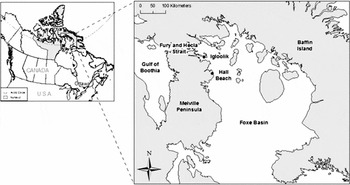
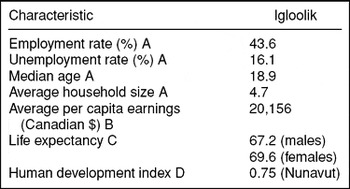
Igloolik is a coastal Inuit community of 1540 people located on Igloolik Island in the Canadian high Arctic territory of Nunavut (Fig. 1). The community has an economy consisting of waged employment and subsistence hunting (Ford and others Reference Ford, Pearce, Gilligan, Smit and Oakes2008a; Ford and others Reference Ford, Smit, Wandel, Allurut, Shappa, Qrunnut and Ittusujurat2008b). Community socio-economic indicators are provided in Table 1. The waged economy is largely based on public administration and tourism, including the production of traditional art and the guiding of southern sports hunters. Igloolik is also the base for the film company ISUMA productions and has a local office for the Inuit Broadcasting Corporation (IBC), and local guides are occasionally employed in the production of feature films and documentaries. In recent years, mining companies have begun to explore iron ore and diamond deposits in the region, providing well-paying seasonal jobs in mining camps in summer months. Earning a cash income and procuring traditional food are not separate activities for many locals: especially for seasonal and occasional jobs, cash income is used to support part- and full-hunting activities, and when local guides take sports hunters to harvest polar bear or walrus, the meat is often kept for local consumption (sports hunters usually take the skin of polar bear and walrus ivory) (Ford in press).
Igloolik, Nunavut.

Socio-economic characteristics of Igloolik, Nunavut.

A. Canadian census 2006.
B. Canadian census 2001.
C. 2002 data from URL: http://www.statcan.ca/english/freepub/84F0211XIE/2002/tables/html/t027_en.htm. Note this data is the average for Nunavut as a whole.
D. Data from Senecal and Guimond (Reference Senécal and Guimond2006). Human development index calculated based on life expectancy (health), education (literacy/ knowledge), income per capita (access to goods and services). Note this data is the average for Nunavut as a whole.
The harvesting of marine and terrestrial mammals is widely practiced in Igloolik, as is common in most Nunavut communities. ‘Country foods’ (traditional foods harvested by Inuit) contribute a significant portion of the community's nutritional intake (Ford and others Reference Ford, MacDonald, Smit and Wandel2006; Ford and others Reference Ford, Smit, Wandel, Allurut, Shappa, Qrunnut and Ittusujurat2008b). Common animals in the Igloolik diet include walrus (Odobenus rosmarus), ringed seal (Phoca hispida), caribou (Rangifer tarandus) and Arctic char (Salvelinus alpinus) (Laidler and Ikummaq Reference Laidler and Ikummaq2008). Country foods are widely shared, with the extended household unit forming the basis of traditional food production and exchange. Wildlife is often harvested by household members on a daily, weekly, or monthly basis, with equipment owned individually or pooled within the household. Store bought food is also important in the diet of Igloolik Inuit, particularly younger generations, with two stores stocking ‘southern foods’ and supplied by scheduled air service from the territorial capital, Iqaluit, seven times a week and by ship during resupply once a year. The food system surrounding store food reflects industrial/agriculture based food systems in southern Canada. Food production, processing, distribution and consumption are discrete activities involving many actors, often in different countries; availability is shaped by the decisions made by the store about what food to stock; and store food is rarely shared with access governed through the cash economy (Ford in press). Food delivery is susceptible to inclement weather including blizzard, high winds, snow, and fog, which can cause shortages of food items. The combination of store food and foods derived from hunting and fishing is characteristic of dual food systems (Ford in press).
The selection of Igloolik for this study reflects continuing research collaboration between the authors and the community. Specifically, the research builds upon four years of research on natural hazards during which compromised food security was identified as a concern and chronic problem by Inuit residents. Igloolik was initially selected due to an identified research need in the natural hazards field and community interest in such a study (Ford Reference Ford2006b). Moreover, with its mixed economy and largely Inuit population (94%), the community is representative of small to medium sized communities in Nunavut (Ford Reference Ford, Oakes and Riewe2006a; Ford and others Reference Ford, Pearce, Gilligan, Smit and Oakes2008a). The community is therefore an appropriate case study for exploratory identification of key food security trends in Nunavut in general.
Research approach
A community based approach guided the research process, including the involvement of participants in the research (that is design, data collection, verification and evaluation), and the employment and training of two local assistants. The research followed ethical norms for working with communities in northern Canada, including obtaining university ethics approval and a research licence from the Nunavut Research Institute, and eliciting informed consent from all study participants.
Data were collected using a food security survey, which was developed and administered to 50 participants by the first author and community researchers in July 2007. Community researchers reviewed the survey questions, and pre-testing was conducted to assess further the merits of design and to check appropriateness for Inuit. Interview length was between 15 and 45 minutes. At the end of the interview, the subjects received $C20 compensation for their time. Interviews took place in the preferred language of the participant, with translation (into Inuktitut) provided by local researchers where necessary. Participation was voluntary and confidential.
Participants were selected based on quota sampling, a non-probabilistic approach which seeks to obtain sufficient representation of a sample by seeking to reproduce, more or less proportionately, a distribution of characteristics relevant to the research problem (Chabot Reference Chabot2003; Sousa and others Reference Sousa, Zauszniewski and Musil2004). Quota sampling was selected for this study because, unlike probabilistic methods, it does not require population lists which in many communities in Arctic Canada are incomplete, biased towards those who are literate, outdated, and are often unavailable. Despite the need for added caution in inferring results to the target population, non-probabilistic methods are commonly employed as valuable and valid approaches in the context of exploratory investigations (Ghiglione and Matalon Reference Ghiglione and Matalon1992; Lunsford and Lunsford Reference Lunsford and Lunsford1995; Chabot Reference Chabot2003; Sousa and others Reference Sousa, Zauszniewski and Musil2004; Parfitt Reference Parfitt, Flowerdew and Martin2005; Chaput and others Reference Chaput, Gilbert and Tremblay2007; Mejean and others Reference Mejean, Traissac, Eymard-Duvernay, El Ati, Delpeuch and Maire2007; Rush and others Reference Rush, Ng, Irwin, Stitt and He2007). Moreover, non-probabilistic approaches can serve to guide targeted, in-depth research by providing a rapid and cost effective means of locating high risk groups and identifying processes and trends worthy of further examination (Pheley and others Reference Pheley, Holben, Graham and Simpson2002; Kaiser and others Reference Kaiser, Townsend, Melgar-Quinonez, Fujii and Crawford2004; Sousa and others Reference Sousa, Zauszniewski and Musil2004; Coleman and Ball Reference Coleman and Ball2007; Halm and Bakas Reference Halm and Bakas2007; Leahy-Warren Reference Leahy-Warren2007). They are used here for this purpose.
The authors performed quota sampling to reproduce the demographic distribution of Igloolik residents. To be eligible, participants had to be over 18 years of age, be Inuit, and reside permanently in the community. Neither formal population lists nor reliable, informal population records for the community were available to guide recruitment of subjects within categories. Participant lists were therefore developed in collaboration with local Inuit research assistants to represent the age, gender, and livelihood occupation distributions of Igloolik. Individuals were then recruited using convenience sampling, a common procedure in exploratory analysis in food systems and health research (Lunsford and Lunsford Reference Lunsford and Lunsford1995; Kaiser and others Reference Kaiser, Townsend, Melgar-Quinonez, Fujii and Crawford2004; Coleman and Ball Reference Coleman and Ball2007; Halm and Bakas Reference Halm and Bakas2007). Survey population data were compared to official statistical data, where available, and discussed with community key informants to evaluate and validate the extent to which the sample population was representative of the whole (see results and discussion below).
The survey
The survey consisted of four main sections with 35 close ended questions. The first section documents respondent characteristics in terms of age, sex, occupation, and hunting behaviour to facilitate data comparison between categories. The second section, comprising nine questions, characterised the nature of the food system in Igloolik, documenting the role of store bought and traditional foods in peoples' diets and the mechanisms through which food is produced and exchanged. Questions related to food consumption from traditional foods were based on respondents' interpretations of proportional consumption rather than pre-defined caloric or value categories. Section three, with four questions, developed baseline information of food availability in 2006–2007 and characterised differences compared to previous years.
Section four forms the key module in the survey and the main focus of this paper, with questions evaluating the severity and prevalence of food insecurity in Igloolik between July 2006 and July 2007. The questions build upon the U.S. Department of Agriculture's (USDA) food security survey module (FSSM) (Bickel and others Reference Bickel, Nord, Price, Hamilton and Cook2000; USDA 2007b). The FSSM represents the most widely used and most tested measure of food security and has been used in the U.S Census Bureau's monthly current population survey since 1995 (Toronto Public Health 2006). Versions of the FSSM have been used in research with indigenous peoples in Canada including work by Indian and Northern Affairs Canada (Bickel and others Reference Bickel, Nord, Price, Hamilton and Cook2000; Lawn and Harvey Reference Lawn and Harvey2003; Lawn and Harvey Reference Lawn and Harvey2004; USDA 2007b), and among the Canadian population in general (Health Canada 2007).
The version of the FSSM used in this survey is similar to that used by Lawn and Harvey (Reference Lawn and Harvey2003); questions explore the conditions, experiences and behaviours that characterise ranges of food insecurity and hunger severity experienced over the past 12 months (see Appendix for list of questions). The section contains eight questions concerning adult food security; the first three reflect uncertainty about having enough food, the experience of running out of food, and not being able to obtain healthy food. The remaining five items are arranged in increasing order of severity and concern changes in diet and food intake as a result of constrained food availability, accessibility, and/or quality, finishing with the most severe conditions of food insecurity: losing weight and not being able to eat for a whole day due to lack of food. These five questions also have sub-questions on the frequency at which the described condition was experienced and at what time of the year.
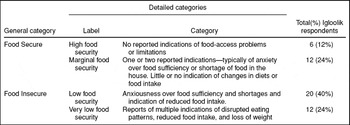
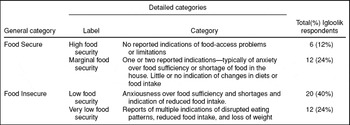
Survey results were entered into SPSS version 15.0 for analysis. Basic descriptive statistics were used to describe the sample population, responses to each question, and to ascertain the distribution of responses by age, sex, occupation, and hunting behaviour. Responses to the food security questions in section four were then categorised according to severity of food (in)security following procedures outlined by the USDA and illustrated in Table 2 (Bickel and others Reference Bickel, Nord, Price, Hamilton and Cook2000; USDA 2007a; USDA 2007b). Following classification, chi-squared (x2) and Fischer's exact tests were conducted to assess variation in food security indicators by respondent characteristics, using a significance level of 95%. Unless otherwise marked, p-values refer to Fischer's exact test analyses in both text and tables.
Food security categorisation rules (adapted from USDA (USDA 2007b)) and Igloolik survey results.
Results
Key findings from the research are reported in three sections: the first characterising the nature of the Igloolik food system, the second assessing levels of insecurity, and the third evaluating the food access and availability in 2006–2007 compared to previous years. Table 2 provides a summary of the food security categorisations of the sample population. The population characteristics of the survey respondents are compared to respondent food security status and manifestations of food security in tables presented below. The dominant results from these tables and analyses are presented below based on key trends/themes in the data. The authors begin this section by examining the nature of the survey population distribution.
Survey population distributions
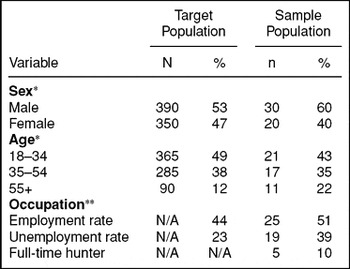
A comparison of the demographic characteristics of the sample population with available census data (Table 3) suggests that the survey sample is broadly representative of the target population. Sample populations were consistently within 8% of the census distribution for all variables except the 55+ age group, which was due to higher than expected response rates in this category. These differences were deemed to be within acceptable ranges and are consistent with other published research (Sousa and others Reference Sousa, Zauszniewski and Musil2004; Huttunen and others Reference Huttunen, Kokko and Ylijukuri2005; Keller-Olaman and others Reference Keller-Olaman, Edwards and Elliot2005; Wardman and others Reference Wardman, Quantz and Clement2006; Bersamin and others Reference Bersamin, Zidenberg-Cherr, Stern and Luick2007; Rush and others Reference Rush, Ng, Irwin, Stitt and He2007). The most recent data on employment characteristics specific to Igloolik are from the 2001 census. Given the rapid growth of Igloolik since this time, the 2001 data are unlikely to be representative of current employment characteristics. To compare the sample and target populations, we therefore use data on average employment characteristics for Nunavut's ten largest communities (including Igloolik) published in the Nunavut labour force statistics report (Government of Nunavut 2006). While the data are not specific to Igloolik and are averaged over communities with different economic characteristics, they enable a coarse comparison. The employment rate between the survey and research population are comparable, with unemployed overrepresented. The unofficial unemployment rate in Igloolik, however, is believed to be higher than in the official data, reflecting the part-time nature of employment in the north, high turn over of employees, and official criteria used to measure unemployment (Government of Nunavut 1999; RT&Associates 2002; Nunavut 2006). Key informants in the community suggest an unemployment rate of over 30% might be closer to the reality.
Characteristics of the target population derived from census data and characteristics of the sample population.
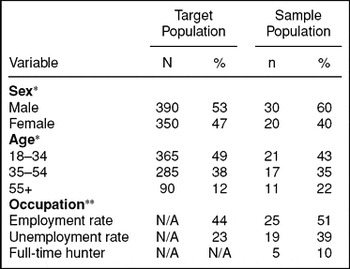
*Target population characteristics derived from the 2006 census.
**Occupation characteristics derived from Nunavut labour force statistics report (Government of Nunavut, 2006) and representing average employment characteristics for the nine largest communities in Nunavut in July 2005 (excluding Iqaluit).
The Igloolik food system
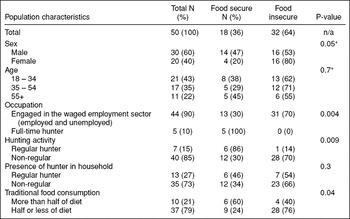
All survey respondents reported eating traditional foods, with 21% obtaining more than half of their food from traditional sources (Table 4). Significant differences were observed by sex and occupation. Males were more likely to obtain more than half of their food from traditional sources than females (p = 0.04), with those hunting full time for a living most likely to obtain more than half of their food from traditional sources (p = 0.04). It is noteworthy that hunting is to a large extent a male activity, with a strong correlation between hunting activity and sex.
Food security status by population characteristics.

Note that total column may not add to 50 due to missing information.
+ Analysis uses chi-squared test.
Harvested food is shared with family members: 80% of participants received traditional food this way at some point in the last year. 34% of respondents reported paying for traditional food in 2006–2007. This compares to previous research documenting a reluctance to exchange traditional foods directly for money in Igloolik and other Inuit communities (Ford and others Reference Ford, MacDonald, Smit and Wandel2006; Gombay Reference Gombay2007). Store bought foods are also important in the food system. 79% of respondents obtained half or more of their food from the store in the year starting July 2006 (Table 3). Store food, however, is shared less than traditional food, with half of respondents reporting not receiving store food from other people and access largely governed by ability to pay (except for some inelastic products such as tea and coffee).
Food security
There is a high prevalence of food insecurity among the sample population
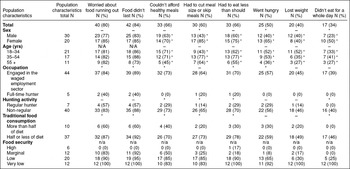
Food insecurity is a problem among survey respondents, with 64% having experienced some degree of food insecurity (very low or low security) in the year; of the survey population, 24% were categorised as having a very low food security status (Table 2). By comparison, 12% of participants are classified as having high food security and 24% as being marginally food secure. As highlighted in table 5, the majority of those surveyed noted anxiousness regarding food running out and not lasting, indicating widespread unease over food even among those who are classified as marginally food secure (Table 5). Also highlighted in table 5 is the high prevalence of respondents experiencing the more severe manifestations of food insecurity, with 40% reporting losing weight in the last year due to difficulty getting enough food, and 34% reporting not eating for a whole day at least once in the last year. The frequency of occurrence of conditions of food insecurity provides additional insight into the severity of the problem. For example, of those who reported not eating for a whole day in the last year, 29% said this happened to them every month, with 31% of those eating less than they felt they should experiencing this condition every month (data not reported in table 5). Negative health implications of low food security were largely described as psychological in nature, concerning the stress of obtaining enough food and being able to support immediate and extended family. Health implications associated with very low food security noted by respondents included feeling unhealthy and lacking energy.
Manifestations of food insecurity by population characteristics.

Note that not all the cells add up to the total column N. In such instances respondents declined to identify their ‘population characteristic’ in the survey.
–p > 0.05.
*p ≤ 0.05.
+ Analysis uses chi-squared test.
N/A Violates chi-square and Fischer's goodness of fit criteria.
Food insecurity is higher among females
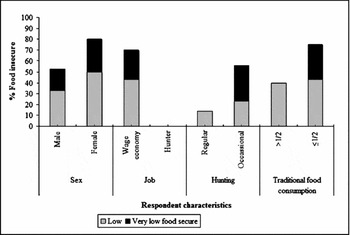
Females in the survey were more likely to be food insecure than males (p = 0.05, Table 4), with 80% of females categorised as food insecure compared to 53% of males (Table 4, Fig. 2). Women were significantly more likely than men to cut the size of their meals or skip meals (x2 p = 0.03), go hungry due to lack of food (x2 p = 0.05), and not eat for a whole day (x2 p = 0.03) (Table 5). Females also report a higher frequency of conditions of food insecurity. Of those respondents who reported not eating for a whole day, 43% of females identified this happening almost every month, compared to 29% of males (data not included in table 5).
Dimensions of food insecurity as they vary by respondent characteristics, indicating percentage of respondents classified as having a low food security and very low food security.

Food security differs by occupation
Food security differed according to occupation (Table 4, Fig. 2). Those respondents who hunt for a living are significantly more likely to be food secure than those who are engaged in some form in the waged economy (p = 0.004, Table 4), with all occupational hunters interviewed classified as food secure compared to 30% of those engaged in the waged economy. Responses to individual questions also show significant differences according to occupation (Table 5). Those who hunt for a living are less likely to be worried about food running out (p = 0.05), to report food not lasting (p = 0.03), to not be able to afford healthy meals (p = 0.003), to have to eat less (p = 0.04), or report going hungry (p = 0.02). Moreover, analysing response by hunting frequency, those who hunt regularly were significantly more likely to be food secure than those who never hunt or hunt occasionally, with 86% of regular hunters being food secure compared to 30% of non-regular hunters (p = 0.009, Table 5, Fig. 2). Those who regularly hunt were also significantly less likely to have to cut or skip meals due to lack of food (p = 0.02), eat less (p = 0.04), or not eat for a whole day (p = 0.04) compared to non-regular hunters (Table 5). For example, no regular hunters reported not eating for a whole day compared to 40% of non-regular hunters.
Prevalence of food insecurity is lower among those who consume traditional foods
Those who obtain more than half of their total food consumption from traditional sources were more likely to be food secure (p = 0.04, Table 4). No respondents who obtained more than half of their food from traditional sources were classed as ‘very low food security,’ compared to 32% of those respondents who obtained half or less. Consuming traditional foods is associated with lower prevalence of conditions of severe food insecurity (Table 5). Respondents who consumed more than half of their food from traditional sources were significantly less likely to have to cut or skip meals in the last year (p = 0.004), have eaten less (p = 0.007), or have not eaten for a whole day (p = 0.05). For example, none of those who obtained more than half of their food from traditional sources reported going a whole day without eating in the last year, compared to 46% of those who eat half or less.
Food security does not differ by age
Among the survey population, food security was not observed to differ significantly by age.
Food was harder to obtain in 2006–2007 than previous years
Traditional and store-bought foods were identified as being significantly harder to obtain between July 2006 and July 2007 compared to previous years (x2 p = 0.001 for both store food and traditional food) (data not reported in tables). When asked whether food was harder or easier to obtain in 2006–2007 than in previous years, only 2% of respondents identified it being easier for traditional food, and only 8% for store food. The most commonly identified reasons for difficulty in obtaining traditional and store food included lack of income, the high price of store food and fuel, lack of hunting equipment, the increasing costs of hunting, and social problems including addiction.
Discussion
Data reliability and sample size must be taken into account when evaluating the findings. For some relationships with low cell counts in the data tables, there was insufficient power to test significance and/or confounding. The impact of over-representation of males and older respondents in the survey is unlikely to significantly affect the results given the association of those variables in the analysis. Age, for example, was not found to be significantly associated with either prevalence of food security or its reported manifestations. The under-representation of females in the sample, given the identification of increased levels of insecurity and its manifestations in that sub-population, indicates that overall reported means are likely to be conservative. The higher insecurity of Inuit women could reflect, to some extent, differential self-reporting between males and females. Furthermore, the data provides a cross-sectional snapshot of food security status for period July 2006 to July 2007 and may overestimate the prevalence of food insecurity given that 2006–2007 was regarded as a poor year for hunting and accessing store food due to late sea ice freeze-up in 2006 and price increases (Ford and others Reference Ford, Pearce, Smit, Wandel, Allurut, Shappa, Ittusujurat and Qrunnut2007). Moreover, while the sample is broadly representative of the research population, caution is required in generalising the findings of the study with the community as a whole due to the use of quota and convenience sampling. Nevertheless, the authors concur with other research which highlights the utility of these sampling approaches in exploratory analysis (Chabot Reference Chabot2003; Kaiser and others Reference Kaiser, Townsend, Melgar-Quinonez, Fujii and Crawford2004; Sousa and others Reference Sousa, Zauszniewski and Musil2004; Keller-Olaman and others Reference Keller-Olaman, Edwards and Elliot2005; Booth Reference Booth2006; Leahy-Warren Reference Leahy-Warren2007; Mejean and others Reference Mejean, Traissac, Eymard-Duvernay, El Ati, Delpeuch and Maire2007; Rush and others Reference Rush, Ng, Irwin, Stitt and He2007).
The prevalence of food insecurity in the sample population greatly exceeds the Canadian average, with 64% of participants classed as food insecure compared to 9.2% of all Canadians as calculated by the Canadian community health survey between 2004 and 2005 (Health Canada 2007). This is significantly higher than the most food insecure province in Canada, Nova Scotia, where 14.6% of people are classified as food insecure. The level of food insecurity is consistent with qualitative food system studies in other indigenous communities in Arctic Canada (Pratley Reference Pratley2005; Chan and others Reference Chan, Fediuk, Hamilton, Rostas, Caughey, Kuhnlein, Egeland and Loring2006; Lambden and others Reference Lambden, Receveur, Marshall and Kuhnlein2006) and a limited number of quantitative studies that have been conducted. In Kugaruuk, Nunavut, for example, food surveys documented 83% of Inuit to be food insecure (Lawn and Harvey Reference Lawn and Harvey2003), and Ledrou and Gervais (Reference Ledrou and Gervais2005) estimate that 56% of the population in Nunavut is food insecure based on response to three question food questions. This study therefore adds weight to the need for further research to investigate determinants of food insecurity, raises concern about the susceptibility of Inuit food systems to emerging stresses including climate change and rising prices, and documents the severity of the problem in Igloolik.
Conditions of severe food insecurity are also more prevalent among Inuit surveyed in Igloolik than the Canadian population as a whole. 2.7% percent of non-aboriginal Canadians were classified as severely food insecure in the CCHS (Health Canada 2007). In comparison, 24% of respondents were classified in the lowest food security category in this study; although this figure is lower than that observed in Kugaaruk where 59% of participants were classified as experiencing the most severe manifestation of food insecurity. Survey data from Igloolik also reveal the precarious nature in which many community members find themselves. For instance, of those respondents who are classified as food secure, approximately 66% are only marginally food secure having indicated anxiousness over food sufficiency or food shortages in the last year, and can be considered vulnerable to experiencing future food insecurity.
The level of food insecurity indicated by this case study is cause for concern. Those classified as having low food security reported anxiousness over food sufficiency and food shortages, and indicated reduced food intake during the last year. Respondents classed as having very low food security reported multiple indications of disrupted eating patterns, anxiety of over food, reduced food consumption, and loss of weight because they had insufficient money or other resources for food. Food studies indicate severe outcomes for poorly nourished people, including lower resistance to infections, increased susceptibility to disease, and longer hospital stays; particularly if food insecurity is a chronic problem (Che and Chen Reference Che and Chen2005). Among children, prolonged inadequate nutrition can affect the development of the intellectual, social and emotional skills, and among elderly can increase susceptibility to infection (Brown and Pollitt Reference Brown and Pollitt1996; Kleinman and others Reference Kleinman, Murphy, Little, Pagano, Wehler, Regal and Jellinek1998). The results from this exploratory study thus support reports of widespread and continuing patterns of poor nutritional, emotional, and social well-being in Arctic communities (ACIA 2004; Poppel and others Reference Poppel, Kruse, Duhaime and Abryutina2007).
One of the key trends emerging from these data is the role of traditional food consumption in promoting food security. Respondents who consumed more than half of their food from traditional sources were significantly more likely to be food secure. Higher traditional food consumption was also observed to increase food security of high risk groups. From a food security perspective, traditional food consumption confers a number of advantages. Firstly, community members described traditional foods as being economically more accessible than store bought foods due to low household income and the high price of store food. The economic necessity of traditional foods has been widely demonstrated elsewhere in the north (Chabot Reference Chabot2003; Fisk and others Reference Fisk, Hobbs and Muir2003; Lawn and Harvey Reference Lawn and Harvey2003; Lambden and others Reference Lambden, Receveur, Marshall and Kuhnlein2006; Kuhnlein and Receveur Reference Kuhnlein and Receveur2007; Poppel and others Reference Poppel, Kruse, Duhaime and Abryutina2007). However, the rising price of fuel and equipment is making hunting expensive, with many hunters requiring part-time or seasonal income and/or contributions from household members to support the procurement of traditional foods. Indeed, the link between traditional food consumption and food security is probably more complex than indicated by the survey; for many, access to income sharing networks is likely to be important in determining the availability and access to traditional foods by affecting the ability to engage in harvesting activities. Secondly, the benefits of traditional food consumption are associated with availability, with nutritious store foods regularly running out between scheduled flight deliveries. By the time they reach the community, food stuffs, particularly fresh foods, are often close to their use-by date. Moreover, the health benefits of consuming traditional foods are widely acknowledged in the scientific literature, and among Inuit themselves, providing a rich source of antioxidants, iron, zinc, vitamins, lipids, micronutrients and phyto-chemicals, and contributing to overall community well being (Van Oostdam and others Reference Van Oostdam, Donaldson, Feeley, Arnold, Ayotte, Bondy, Chan, Dewaily, Furgal, Kuhnlein, Loring, Muckle, Myles, Receveur, Tracy, Gill and Kalhok2005).
Examining food security according to respondent characteristics revealed a number of interesting trends. The females in the survey were more likely to be food insecure than males and experience more severe manifestations of food insecurity, even when differences in respondent characteristics among female participants were taken into account. A number of explanations for differences by sex are evident in the survey data. Firstly, females are often the first to cut or skip meals when food access is constrained to ensure other family members, particularly children, have access to sufficient food. This has been documented elsewhere in the north and southern Canada. Secondly, traditional food consumption is significantly lower among females in the survey, and those who obtain half or less than half of their food from traditional sources are more likely to be food insecure. Increasing prices of store food in recent years have compounded the difficulties for those relying on the store for the majority of their food requirements. Thirdly, females noted hunting less than males. Female respondents are therefore more dependent on sources of traditional food from outside the household, a problem particularly for single females living alone and single mothers. Consequently females are more exposed to changes or stresses in intra-household food sharing networks. In December 2006, for example, in interviews conducted during previous research, participants noted sharing less traditional food due to limited availability associated with late sea ice freeze up (Ford and others Reference Ford, Gough, Laidler, MacDonald, Qrunnut and Irngaut2009). Anecdotal evidence suggests that intra-household sharing may be the first to suffer at times of reduced food availability. Increased prevalence of food insecurity among females has been noted elsewhere in northern Canada (Lambden and others Reference Lambden, Receveur, Marshall and Kuhnlein2006).
Participants who hunt for a living are also more likely to be food secure than those engaged in the waged employment sector. This is expected given the strong association between traditional food consumption and food security, and higher traditional food consumption among occupational hunters. However, as noted above, access to income sharing networks is likely to be important in enabling occupational hunters to afford hunting costs, particularly in light of rising hunting costs. Interestingly, food security was not observed to differ significantly by age. This contrasts with studies elsewhere in Arctic Canada suggesting higher insecurity among young Inuit and the general assumption that young Inuit have higher levels of food insecurity due to changing dietary patterns and less interest in hunting (Chan and others Reference Chan, Fediuk, Hamilton, Rostas, Caughey, Kuhnlein, Egeland and Loring2006; Chapin Reference Chapin2006; Health Canada 2007); although younger participants may be less likely to report food insecurity manifestations in households where older family members bear the burden of food acquisition, concern, and shortfall. Contrary to such pronouncements, hunting behaviour and traditional food consumption were not significantly lower among younger age groups in the survey.
Conclusion
The findings presented in this paper demonstrate a high prevalence of food insecurity among survey respondents. Females and those obtaining most of their food from the store were more likely to be at high risk of food insecurity. Among all groups, prevalence of food insecurity is lower among those who obtain most of their food from traditional sources. These findings are consistent with previous research that has demonstrated high food insecurity among Inuit in general and women in particular (Lawn and Harvey Reference Lawn and Harvey2003; Ledrou and Gervais Reference Ledrou and Gervais2005; Lambden and others Reference Lambden, Receveur, Marshall and Kuhnlein2006; Health Canada 2007). Based on these exploratory findings further work is required to investigate key trends documented by the surveys and identify entry points for policy in order to strengthen the food system. A number of key areas for research are suggested here.
Firstly, the low prevalence of food insecurity among those with high levels of traditional food consumption is particularly interesting. The nature of this relationship, specifically among high risk groups, requires further analysis, particularly in the light of climatic and socio-economic change, and rising costs of hunting which threaten the Inuit food system. Access to income sharing networks, for example, is likely a major determinant of ability to hunt and procure traditional foods. Finding out why food insecurity was more prevalent among those who consume more store foods is also an area meriting investigation. For example, did rising store food prices in 2006–2007 increase food insecurity? Did the late ice freeze-up in autumn 2006 play a role? Is this an underlying trend in the community? Secondly, future studies should focus on high risk groups, particularly females, to explore in greater detail the drivers of vulnerability and opportunities to strengthen the food system for those at risk. For other groups, including those in the wage employment sector, greater understanding of coping mechanisms by which constrained food access and availability are managed is required. Thirdly, by providing a snapshot of food insecurity between July 2006 and July 2007, this study provides a baseline from which to assess change over time. Continuation of food security studies will permit greater understanding of the determinants of food insecurity, particularly how Inuit foods systems are affected by socio-economic and biophysical stresses. Finally, and perhaps most importantly, given the high prevalence of food insecurity among adults, further research is required to investigate food insecurity among children given the health implications that can arise from compromised nutritional status.
Acknowledgements
The authors are grateful for the support and collaboration of community members and local organizations in Igloolik that made this research possible. Special thanks go to Celina Irngaut and Kevin Qrunnut in Igloolik who helped administer the surveys, the Igloolik branch of the Nunavut Research Institute (John MacDonald, Leah Otak, and William Qamukak) for their help in facilitating this work. Financial support for this research was provided by the Social Sciences and Humanities Research Council, a Climate Change Impacts and Adaptations (CCIAP) grant from Natural Resources Canada, the Canadian Institutes of Health Research Nasivvik Centre for Inuit Health and Changing Environments, and the International Polar Year CAVIAR project, and was conducted under Nunavut Research Licence #0203204N-M.
Appendix
1. Some people might say, ‘We worried whether our food would run out before we got money to buy more or were able to go hunting.’ In the last 12 months, did that happen to you often, sometimes, or never?
2. Some people might say, ‘The food that we bought or hunted just didn't last, and we were not able to get more.’ In the last 12 months did that happen to you often, sometimes, or never?
3. Some people might say, ‘We couldn't afford to eat healthy meals.’ In the last 12 months did this happen to you often, sometimes, or never?
4. Since July last year, did you ever cut the size of your meals or skip meals because there wasn't enough food?
5. In the last 12 months, did you ever eat less than you felt you should because there wasn't enough food?
6. In the last 12 months, were you ever hungry but didn't eat because you couldn't afford enough food OR were not able go hunting?
7. In the last 12 months, did you lose weight because you didn't eat enough food?
8. In the last 12 months, did you ever not eat for a whole day because there wasn't enough food?