Introduction
There is accumulating evidence that certain types of personality are at higher risk for developing depressive disorders (e.g. Kendler et al. Reference Kendler, Neale, Kessler, Heath and Eaves1993; Fanous et al. Reference Fanous, Gardner, Prescott, Cancro and Kendler2002). Several studies have suggested that the personality trait most closely related to depressive disorder is neuroticism (Roberts & Kendler, Reference Roberts and Kendler1999; Kendler et al. Reference Kendler, Gatz, Gardner and Pedersen2006a; Steunenberg et al. Reference Steunenberg, Beekman, Deeg and Kerkhof2006). Neuroticism and depression have been associated in clinical (Duberstein & Heisel, Reference Duberstein and Heisel2007), family (Duggan et al. Reference Duggan, Sham, Lee, Minne and Murray1995), twin (Kendler et al. Reference Kendler, Gatz, Gardner and Pedersen2006a; Fanous et al. Reference Fanous, Neale, Aggen and Kendler2007) and general population-based (Romanov et al. Reference Romanov, Varjonen, Kaprio and Koskenvuo2003; Jylhä & Isometsä, Reference Jylhä and Isometsä2006) studies. Earlier twin studies (e.g. Kendler et al. Reference Kendler, Gatz, Gardner and Pedersen2006a) have also found a genetic correlation between these two traits, which indicates that genes having an impact on neuroticism are also likely to affect depression. The association between extraversion and depression has instead been controversial as some studies have found that extraversion protects from later depressive symptoms (Jylhä & Isometsä, Reference Jylhä and Isometsä2006), while other studies have found no associations (Kendler et al. Reference Kendler, Neale, Kessler, Heath and Eaves1993). Also, twin studies investigating a genetic correlation between extraversion and depression have found contradictory results, where some studies have detected a modest genetic correlation between these traits (Kendler et al. Reference Kendler, Gatz, Gardner and Pedersen2006a), whereas others have not (Kendler et al. Reference Kendler, Neale, Kessler, Heath and Eaves1993).
The mean levels and test–retest correlations of personality traits are mostly consistent in adulthood and old age (Caspi et al. Reference Caspi, Roberts and Shiner2005). Extraversion and neuroticism are also moderately heritable and the greatest sources of individual differences during adulthood are non-shared environmental influences (for a review, see Bouchard & Loehlin, Reference Bouchard and Loehlin2001). The genetic and environmental influences on personality are relatively stable over time in adulthood and old age (Viken et al. Reference Viken, Rose, Kaprio and Koskenvuo1994; Pedersen & Reynolds, Reference Pedersen and Reynolds1998; Johnson et al. Reference Johnson, McGue and Krueger2005; Read et al. Reference Read, Vogler, Pedersen and Johansson2006). Depressive symptoms are also genetically influenced, although several studies have generally shown rather low genetic effects and considerable unique environmental effects explaining individual differences in adulthood and old age (Gatz et al. Reference Gatz, Pedersen, Plomin, Nesselroade and McClearn1992; Carmelli et al. Reference Carmelli, Swan, Kelly-Hayes, Wolf, Reed and Miller2000; Jansson et al. Reference Jansson, Gatz, Berg, Johansson, Malmberg, McClearn, Schalling and Pedersen2004).
The relationship between depression and personality is complex. Personality characteristics may predispose to, result from or modify the expression of depressive illness (Kendler et al. Reference Kendler, Neale, Kessler, Heath and Eaves1993). A powerful natural experiment with which to evaluate such risk factors would include both longitudinal and genetic designs. We report here the results of a study where we have followed initially middle-aged female twin pairs for 28 years and assessed their personality at baseline and depressive symptoms at follow-up. Among older adults, depressive symptoms not meeting the diagnostic criteria for depression are highly prevalent, while their consequences for disability risk and decrease in well-being are similar to those of clinical depression (Blazer, Reference Blazer2003). Understanding what characteristics of personality increase the risk for depression in old age could provide a window to the etiology of depression and therefore provide a more rational basis for targeted preventive interventions. Investigating early personality factors would also offer opportunities for identifying those younger persons who are at risk for developing depressive symptoms later in life. Studying depressive symptoms among older women is also well-grounded as depressive symptoms in later life are more prevalent among women than men (Piccinelli & Wilkinson, Reference Piccinelli and Wilkinson2000).
Our objective in the present study was to investigate if middle age personality traits of neuroticism and extraversion are associated with depressive symptoms experienced in old age. Using quantitative trait modeling, we also wanted to investigate to what extent the correlation between neuroticism, extraversion and depressive symptoms is due to shared genetic and/or shared environmental factors.
Method
Subjects
The present study is a part of the Finnish Twin Study on Aging (FITSA), which is a study on the genetic and environmental influences on the disablement process in older women. The participants were recruited from the Finnish Twin Cohort, which comprises all the same-sex twin pairs born before 1958 and with both co-twins alive in 1975 (Kaprio et al. Reference Kaprio, Sarna, Koskenvuo and Rantasalo1978; Kaprio & Koskenvuo, Reference Kaprio and Koskenvuo2002). In August 2000, there were 1260 female twin pairs in the age group of 63–76 years who had participated in the Finnish Twin Cohort in 1975. In this group an invitation to participate in the FITSA study was sent on the basis of age and zygosity to a subsample of 414 twin pairs aged 63–76 years. To be included in the study, both individuals in a pair had to agree to participate and be sufficiently healthy to travel to the laboratory exam. Reasons for non-participation were refusal (106 pairs), poor health status (85 pairs), or death (six pairs) of one or both twin sisters. The zygosity of the twin pairs was confirmed using a battery of 10 highly polymorphic gene markers in DNA extracted from a venous blood sample. The final sample of the FITSA study was 103 monozygotic (MZ) and 114 dizygotic (DZ) twin pairs (434 individuals). Follow-up measurements of the FITSA study were conducted after 3 years, in years 2003–2004, with 419 individuals from the original sample. The death of one twin sister had occurred in two MZ and five DZ twin pairs and eight participants dropped out for health reasons.
Measures
Assessment of depressive symptoms in the year 2003 questionnaire
Depressive symptoms were assessed at the follow-up measurements in year 2003 using the Center for the Epidemiologic Studies Depression Scale (CES-D; Radloff, Reference Radloff1977) questionnaire. The CES-D scale is a widely used self-report measure in community samples with reliability and validity demonstrated in heterogeneous samples (e.g. Beekman et al. Reference Beekman, Deeg, van Limbeek, Braam, de Vries and van Tilburg1997). The total CES-D scale has 20 items and respondents rate the frequency with which they have experienced particular depressive symptoms during the past week. Each item is scored from 0 to 3, for a possible total range of 0 to 60. In the CES-D scale, the standard cut-off score indicating the presence of clinically important depressive symptomatology in community populations is 16 or more of the possible 60 points (McDowell & Newell, Reference McDowell and Newell1996), which was also used here. In calculating intra-class correlation coefficients (ICC) and in the twin modeling a continuous measure of depressive symptoms was also used. The internal consistency of the CES-D scale was adequate in the present study; Cronbach's alpha was 0.87 in year 2003 measurements. Also, the distribution of the scale was acceptable.
Assessment of personality in the year 1975 questionnaire
Extraversion and neuroticism were studied in year 1975 using a short form of the Eysenck Personality Inventory (Floderus, Reference Floderus1974) questionnaire. The version has been widely used in Nordic twin studies and has good reliability and validity (Floderus-Myrhed et al. Reference Floderus-Myrhed, Pedersen and Rasmuson1980; Rose et al. Reference Rose, Koskenvuo, Kaprio, Sarna and Langinvainio1988; Pedersen & Reynolds, Reference Pedersen and Reynolds1998; Read et al. Reference Read, Vogler, Pedersen and Johansson2006). The two subscales have nine items each, with dichotomous responses (1=no, 2=yes) for a possible total range of 9–18. The Cronbach's alpha was 0.71 for extraversion and 0.72 for neuroticism. Both the personality scales were normally distributed.
Assessment of confounding variables in the year 1975 questionnaire
The following sociodemographic and health variables measured at baseline were examined as potential confounders when assessing current depressive symptoms during the 28-year study period. The sociodemographic variables included were age, marital status and education status. Marital status was dichotomized as married or cohabitating or not married (single, divorced, widowed). Education status was dichotomised into lower (elementary school or less) and higher (more than elementary school) education. The number of chronic diseases was assessed by asking participants if they had ever had any chronic diseases diagnosed by a physician (a list containing 16 diseases: chronic bronchitis; pulmonary emphysema; bronchial asthma; allergic rhinitis; allergic eruption; urticaria; arterial hypertension; angina pectoris; myocardial infarction; stroke; gastric ulcer; cholelithiasis; diabetes; gout; operated varicose vein; some other chronic disease) and the number of diseases was calculated by summing up all specific diseases reported to be present. Smoking status was classified from responses to a detailed smoking history questionnaire including questions on quantity smoked and ages at initiation and cessation (Kaprio & Koskenvuo, Reference Kaprio and Koskenvuo1988) and was dichotomized as smokers (regular or occasional smokers) and non-smokers (former and never). Dichotomous index of heavy use of alcohol was obtained from a binge drinking item that asked whether ‘at least once per month and on a single occasion’ the respondent consumed more than five beers, a bottle of wine or a half-bottle of spirits (Kaprio et al. Reference Kaprio, Koskenvuo, Langinvainio, Romanov, Sarna and Rose1987). The frequency of leisure time physical activity was measured by a 5-point scale with alternative response categories ranging from no physical activity to a high level of leisure time physical activity. Those who reported at least a slight amount of leisure time physical activity were classified as physically active and those without any leisure time physical activity as physically inactive.
Statistical method
Analyses were limited to a subsample of participants who were healthy at baseline. To accomplish this, we excluded all participants who reported angina pectoris, myocardial infarction, stroke or diabetes at baseline. We also excluded those participants who had used a hypnotic/tranquilizer for more than 6 months in the preceding year or who were on a work disability pension due to any cause at baseline. Thus, the final size of the study cohort in the present study was 409 individuals, of whom 391 had valid measures of depressive symptoms and extraversion and 386 in neuroticism. If more than two items had missing answers in the CES-D scale, extraversion or neuroticism, the total score was not computed. In 180 pairs, we had complete information on depressive symptoms in both members, whereas the remaining pairs had varying degrees of partial information. The corresponding values for extraversion and neuroticism were 181 and 176, respectively.
The relationship between middle age personality and current late life depressive symptoms was first studied in generalized estimating equations models using the SAS procedure genmod (SAS Institute, USA) to correct for the co-twin dependence. Analyses were adjusted for age, marital status, number of chronic diseases, binge drinking, smoking status, level of leisure time physical activity and education status.
In the preliminary twin analyses the equality of means of personality and depressive symptom variables between MZ and DZ twins was analyzed with adjusted Wald test and the equality of variances was tested with variance ratio test (Stata 8.0; Stata Corp., USA). The dependence of observations of the co-twins was taken into account in these analyses. The within-individual correlations for the whole sample and cross-twin cross-trait correlations separately for the MZ and DZ groups were calculated using Pearson's correlation coefficient. The within-pair resemblances in personality and depression variables were estimated separately for MZ and DZ groups using age-adjusted ICC (SPSS 14.0; SPSS Inc., USA).
In quantitative genetic analyses, the phenotypic variation was decomposed to three sources of variances: additive genetic (A); shared environmental (C); non-shared environmental effects (E). The genetic analyses is based on the fact that MZ twins share 100% of their genes and DZ twins share on average 50% of their segregating genes. A further assumption is that MZ and DZ twins are equally susceptible to environmental influences that are productive of similarities between both twins (see Posthuma et al. Reference Posthuma, Beem, de Geus, van Baal, von Hjelmborg, Iachine and Boomsma2003). It is also assumed that there is no effect of assortative mating or gene–environment interaction in the traits in question.
Genetic and environmental influences contributing to neuroticism, extraversion and depressive symptoms were estimated first with univariate quantitative trait models. To understand further the nature of the association of personality and depressive symptoms, the trivariate Cholesky decomposition model was used to evaluate whether the genetic and environmental influences were common or specific to neuroticism, extraversion and depressive symptoms. The aim of the genetic modeling is to find a model that provides a theoretically meaningful interpretation, fits the data well and has as few explanatory parameters as possible. In the present study the obtained alternative univariate models (AE, CE, E) were compared against the full model (ACE) by χ2 difference test and Akaike's information criterion (AIC=−2 times log-likelihood – 2×degrees of freedom). A non-significant difference between the nested models and a smaller AIC indicates a better fitting model. The full Cholesky model consists of: genetic effect A1, which is shared by neuroticism, extraversion and depressive symptoms; genetic effect A2, which is shared by extraversion and depressive symptoms; genetic effect A3, which loads only on to depressive symptoms. The shared environmental (C1, C2, C3) and non-shared (E1, E2, E3) environmental effects have similar patterns of loadings. The analysis was started with the hypothetic full Cholesky decomposition model. To get a more parsimonious model, the full model was modified by dropping the non-significant parameters one by one, until the model consisted only of significant parameters. The alternative multivariate models obtained were compared against the full model by using the χ2 difference test and AIC. The univariate and multivariate genetic analyses were performed with Mx software using full information maximum likelihood method with raw data input (Neale et al. Reference Neale, Boker, Xie and Maes2003). In all genetic analyses age was included as a covariate.
Results
Individual based analyses
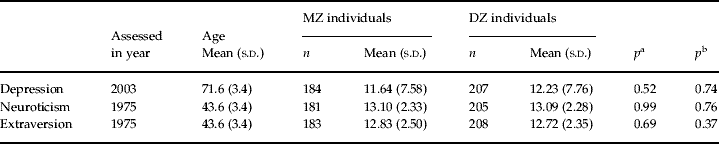
The mean [standard deviation (s.d.)] ages of this sample in the year 1975 and year 2003 were 43.6 (3.4) and 71.6 (3.4) years, respectively. Among all the study subjects the mean (s.d.) scores of the CES-D scale, neuroticism and extraversion were 12.0 (7.7), 13.1 (2.3) and 12.3 (2.4) points, respectively. The means and variances of the MZ and DZ groups did not differ from each other in neuroticism, extraversion and depressive symptoms (Table 1). Of the 391 individuals with valid data on depressive symptoms in the sample, 99 (25.3%) scored above the CES-D cut-off 16 and were considered to have depressive symptomatology in year 2003. The within-individual Pearson's correlation between neuroticism and extraversion was –0.25 (p<0.01), between neuroticism and depressive symptoms 0.32 (p<0.01), and between extraversion and depressive symptoms –0.19 (p<0.01). Associations between middle age personality and late life depressive symptoms were first conducted by generalized estimating equation regression analysis (Table 2). After adjusting for age, marital status, number of chronic diseases, binge drinking, smoking status, level of leisure time physical activity and education status, neuroticism in middle age was significantly associated with the risk for late life depressive symptoms. The same analyses with extraversion revealed a modest but significant inverse relationship on depressive symptoms. Because neuroticism and extraversion were negatively correlated, we also conducted the same analysis with both neuroticism and extraversion as predictors in the model. The association between depressive symptoms, neuroticism and extraversion remain the same although the statistical significance weakened compared with simple regression models.
Means and standard deviations (s.d.) for depressive symptoms, neuroticism and extraversion among monozygotic (MZ) and dizygotic (DZ) twin individuals

a Adjusted Wald test.
b Variance ratio test.
Results of generalized estimating equations regression analysis for the effect of middle age neuroticism and extraversion on depressive symptoms experienced in later life in women followed for 28 years

OR, Odds ratio; CI, confidence interval.
Generalized estimating equations regression analysis adjusted for age, marital status, number of chronic diseases, binge drinking, smoking status, level of leisure time physical activity and education status. The twin structure of the data was corrected by using an unstructured working correlation matrix.
Simple regression model: the index variable is adjusted for confounders in the model.
Multiple regression model: both the index variables and confounders are included in the model.
Twin analyses
The intra-class correlations for neuroticism, extraversion and depressive symptoms were higher among MZ than DZ twins, which suggested the contribution of genetic effects. In neuroticism, the age-adjusted intra-class correlation for the MZ twins was 0.51 [95% confidence interval (CI) 0.34–0.66], for extraversion 0.53 (95% CI 0.36–0.67) and for depressive symptoms 0.61 (95% CI 0.46–0.72). The respective correlations for the DZ twins were 0.20 (95% CI 0.03–0.39), 0.06 (95% CI –0.14 to 0.26) and 0.14 (95% CI –0.06 to 0.33). Univariate genetic modeling confirmed the presence of genetic and non-shared environmental influences on both the personality variables and depressive symptoms. In the neuroticism, extraversion and depressive symptoms, additive genetic effects accounted for 50%, 47% and 63% of the total variance, respectively. The remaining variance was due to non-shared environmental effects. The effect of age explained approximately 2% of the variance in extraversion, but had no effect on neuroticism or depressive symptoms in this sample from a relatively narrow birth cohort (data not shown).
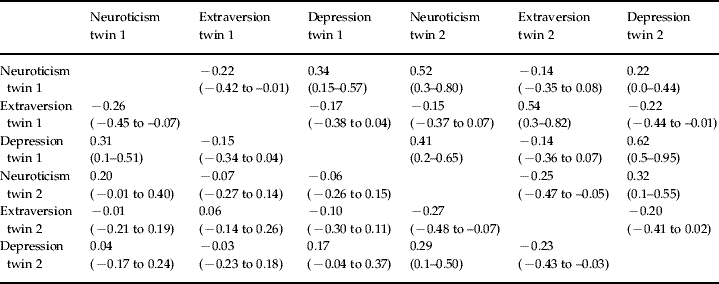
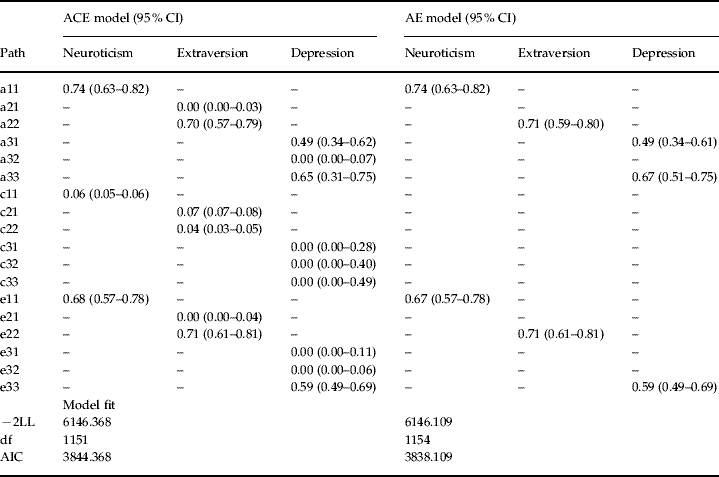
Given the evidence from the individual-based regression analyses that both the middle age neuroticism and extraversion were significantly associated with the risk for late life depressive symptoms, we wanted to test whether there are also shared genetic and environmental effects between the personality measures and depressive symptoms. It is important to note that high phenotypic correlation between the traits does not necessarily indicate genetic or environmental correlations or vice versa. The cross-twin cross-trait correlations (Table 3) suggest the presence of genetic effects on the associations between the traits when these correlations are greater for MZ than DZ pairs. We also fitted a series of trivariate twin models to data on neuroticism, extraversion and depressive symptoms. The analysis was started with the hypothetic full Cholesky decomposition model, including all plausible parameters (Table 4). Because several coefficients were statistically non-significant, the full model was modified by dropping the non-significant parameters one by one, until a more parsimonious and theoretically acceptable model was reached (Table 4). In the model, middle age neuroticism and old age depressive symptoms shared an additive genetic component in common (A1) explaining 55% (95% CI 40–67) of the total variance in neuroticism and 24% (95% CI 12–38) in depressive symptoms. The rest of the variance in middle age neuroticism was due to trait-specific individual environmental factors (E1) accounting for 45% (95% CI 33–60) of the variance. Old age depressive symptoms also had their own trait-specific additive genetic component (A3), accounting for 42% (95% CI 26–56) of the variance and individual environmental (E3) factors of 34% (95% CI 24–48), which explained the remaining variance. As regards middle age extraversion, only trait-specific additive genetic (A2) and individual environmental (E2) factors explained the phenotypic variation. The relative contribution of a trait-specific additive genetic factor for extraversion was 50% (95% CI 34–63) and for individual environmental factors 50% (95% CI 37–66). In this most parsimonious model, none of the 95% CI for the parameter estimates included zero (Fig. 1).
The most parsimonious Cholesky decomposition model for neuroticism, extraversion and depressive symptoms. The percentages (95% confidence intervals) are the proportions of genetic and environmental effects of the total variance.

Intra-pair cross-twin and within individual Pearson's correlation coefficients (95% CI) for monozygotic (MZ) and dizygotic (DZ) twins

The correlations of the MZ pairs are above the diagonal and the correlations of the DZ pairs are below the diagonal.
Proportions of variances explained by the path coefficients in the Cholesky decomposition model for neuroticism, extraversion and depressive symptoms

A, Additive genetic effects; C, shared environmental effects; E, non-shared environmental effects; a11, a21, a22, a31, a32, a33, standardized path coefficient of phenotype on effect A; c11, c21, c22, c31, c32, c33, standardized path coefficient of phenotype on effect C; e11, e21, e22, e31, e32, e33, standardized path coefficient of phenotype on effect E; −2LL, −2 times log-likelihood; df, degrees of freedom; AIC, Akaike's Information Criterion.
As the patterns of intra-class correlations among MZ and DZ twins suggested the presence of non-additive (D) genetic effects for both the personality variables and depressive symptoms, the ADE model was also tested. However, in trivariate analysis the genetic modeling resulted to DE model, which is biologically implausible (as dominance effects in the absence of additive effects are rarely seen) and therefore the use of ADE model in our study was rejected (data not shown).
Finally, to control for the possible confounding effect of the use of antidepressants in year 2003, we repeated both the individual-based and twin analyses with data where we had excluded those participants (n=19) who reported using antidepressant medication in year 2003. Controlling for the use of antidepressant medication had no effect on study results (data not shown).
Discussion
The goal of our report was to examine, from both an epidemiologic and genetic perspective, the relationship between old age depressive symptoms and two important middle age personality dimensions, neuroticism and extraversion. Our epidemiologic analysis indicated that both of the middle age personality dimensions of neuroticism and extraversion were strongly associated with old age depressive symptoms. By contrast to the relationship between neuroticism and depression, middle age extraversion had a protective effect on depressive symptoms experienced in old age. The second research question aimed to clarify to what extent are the correlations between neuroticism, extraversion and depressive symptoms due to shared genetic and/or shared environmental factors. The best-fitting twin model contained a genetic component that was common to both middle age neuroticism and old age depressive symptoms, individual specific environmental factors unique to both neuroticism and depressive symptoms and a trait-specific genetic component unique to old age depression. Middle age extraversion had only trait-specific additive genetic and individual environmental factors explaining the phenotypic variation.
There were similarities and differences between our results and previous studies. Our results are in agreement with previous prospective and twin studies by Kendler et al. (Reference Kendler, Neale, Kessler, Heath and Eaves1993), Roberts & Kendler (Reference Roberts and Kendler1999) and Steunenberg et al. (Reference Steunenberg, Beekman, Deeg and Kerkhof2006), who have found neuroticism to be a strong predictor for later depression and that this association is partly due to common genetic vulnerability for both neuroticism and depression. However, part of the genetic vulnerability to depression was not reflected in neuroticism. Fanous et al. (Reference Fanous, Neale, Aggen and Kendler2007) found instead that neuroticism predicts the onset of depression and that all of the covariation between neuroticism and depression is due to additive genetic and individual specific environmental factors shared by both traits. As regards extraversion, the present study is in line with Jylhä and Isometsä (Reference Jylhä and Isometsä2006), who found extraversion to be associated with depression in the general population-based sample. Also, Fanous et al. (Reference Fanous, Neale, Aggen and Kendler2007) found negative correlation between extraversion and 1-year prevalence of depression in a population-based sample of male twins. On the other hand, Kendler et al. (Reference Kendler, Neale, Kessler, Heath and Eaves1993) found no longitudinal or genetic relationship between extraversion and depression among female twins. However, these previous studies are not entirely comparable to our study, because of the heterogeneity of the study populations, study designs, personality measures and psychological outcomes.
We found only one earlier twin study where the follow-up time was comparable to our study design. Kendler et al. (Reference Kendler, Gatz, Gardner and Pedersen2006a) followed Swedish twins for 25 years and found that neuroticism reflects the liability to later depression and that this association arose partly from the same genetic factors influencing for both neuroticism and depression. However, also in this study, a significant proportion of the genetic vulnerability to depression was not common with neuroticism. Extraversion, by contrast, was only weakly related to risk for later depression and shared only a modest genetic relationship with later depression. The results we obtained in our epidemiological and genetic analyses of neuroticism and depressive symptoms were broadly similar to those from the study of Swedish twins. One major difference was the modest genetic relationship between extraversion and depression, which was not found in our study. However, differences between these two studies may result from having both sexes, a larger age range and a larger sample size used in the study by Kendler et al. (Reference Kendler, Gatz, Gardner and Pedersen2006a).
According to our study, there is a modest genetic overlap between the genetic risk factors for middle age neuroticism and old age depressive symptoms. Given the stability of mean levels and test–retest correlations of personality and its genetic basis in adulthood, investigating personality risk factors earlier in adulthood to identify those people who might develop depressive symptoms in later adulthood is important. However, it is important to note that according to our findings, old age depressive symptoms also had their own substantial genetic background and it would be unwise to assume that everybody with high middle age neuroticism would therefore be at risk for developing depressive symptoms in later life.
As regards extraversion, our study results are more controversial. We found extraversion in middle age to protect from later depressive symptoms, but no genetic relationship between these two traits. There are some possible interpretations for these results. First, in trivariate genetic modeling where both personality traits were included, the effect of low extraversion, in other words introversion, was possibly mediated through the inverse correlation between neuroticism and extraversion. Second, as Kendler et al. (Reference Kendler, Gatz, Gardner and Pedersen2006a) found in their study, compared with the present study, there was only a weak genetic relationship between extraversion and depression with a larger sample size. It is possible that to detect such differences we should have had a substantially larger study population. It is also important to keep in mind that estimates of heritability may vary from population to population and from one type of environment to another (Bouchard & Loehlin, Reference Bouchard and Loehlin2001). The possible non-additive genetic effects in extraversion may also make the detection of common genes between depression and personality difficult.
With regard to depressive symptoms, the somewhat high heritability estimate warrants further explanation. Our estimate of 63% for the heritability of CES-D is higher compared with estimates reported in many earlier studies. For example, the review study by Sullivan et al. (Reference Sullivan, Neale and Kendler2000) revealed that the heritability of major depression was likely to be in the range of 32–42% according to different twin studies. However, Jansson et al. (Reference Jansson, Gatz, Berg, Johansson, Malmberg, McClearn, Schalling and Pedersen2004) reported the heritability estimate of 49% for depressive state among female twins aged 50 years or older. Also, Carmelli et al. (Reference Carmelli, Swan, Kelly-Hayes, Wolf, Reed and Miller2000) found higher heritability estimates in their longitudinal study, where the follow-up heritability estimate of CES-D was 55% among older male twins. Our somewhat high heritability estimate is nonetheless in accordance with the findings from earlier studies, that heritability is usually higher for females than males (e.g. Jansson et al. Reference Jansson, Gatz, Berg, Johansson, Malmberg, McClearn, Schalling and Pedersen2004; Kendler et al. Reference Kendler, Gatz, Gardner and Pedersen2006b) and for an older than younger population (Gatz et al. Reference Gatz, Pedersen, Plomin, Nesselroade and McClearn1992). Also, changes in gene expression over the life cycle, in which genetic systems switch off and on, have been invoked as explanations for fluctuations in heritability estimates across adult life (Carmelli et al. Reference Carmelli, Swan, Kelly-Hayes, Wolf, Reed and Miller2000).
Some limitations of the present study should be taken into consideration. First, the inclusion of only female twins means that care should be taken in generalizing these findings to males. Second, a psychiatric assessment of clinical depression was not included and the measurement of depression was limited to the assessment of symptoms. Third, participants' baseline depression level was not assessed in the year 1975 questionnaire and, therefore, to avoid potential confounding effects of prevalent depressive symptoms, analyses were limited to a subsample of participants who were healthy at baseline. Fourth, extraversion and neuroticism were not tested for stability. Fifth, in the most parsimonious Cholesky decomposition model the confidence intervals were still quite large, indicating that care should be taken when interpreting these estimates. In addition, although our sample was population-based, the inclusion criteria may have led to the exclusion of pairs with at least one sister with poor health. This may have reduced the variance in the personality and depressive symptom phenotypes, increased the similarity within the pairs and thus influenced the heritability estimates. Sixth, although intra-class correlations suggested the presence of non-additive genetic effects, we had inadequate power to discriminate non-additive from additive genetic effects. Larger sample sizes and additional kinship groups (e.g. twins reared apart) would enable us to evaluate better the relative importance of non-additive genetic variance for personality dimensions of neuroticism and extraversion and depressive symptoms. Finally, these genetic analyses cannot differentiate the effects of possible gene–environment interactions, which may have an influence on personality and depression. The strengths of this study include its exceptionally long follow-up time and the use of both longitudinal and genetic analyses.
In summary, our results suggest that the middle age personality dimension of neuroticism is strongly associated with old age depressive symptoms and that this association arises partly because neuroticism and depressive symptoms share some genetic effects in common. However, substantial proportions of the genetic vulnerability to old age depressive symptoms are not reflected in middle age neuroticism. On the contrary, middle age extraversion has a protective effect on depressive symptoms experienced in old age, but no genetic relationship with old age depression. In the future, the number of people living up to very old age will increase, emphasizing the need for new multidimensional methods to maintain and increase well-being in old age. These findings have implications for identifying early risk factors for old age depressive symptoms as well as planning for more individually targeted interventions for old age depression. Further research is required to find the kind of mechanisms that strongly relate neuroticism and extraversion to depressive symptoms in old age.
Acknowledgements
We are grateful to the twin pairs who participated in the study. The study was financially supported by Ministry of Education and Juho Vainio Foundation. The Finnish Twin Cohort is supported by the Centre of Excellence in Complex Disease Genetics. The funding instances of the study had no role in the study design, data collection, data analysis or reporting.
Declaration of Interest
None.