Introduction
Many aphid species (Hemiptera: Aphididae) change their reproductive strategy from summer to autumn. In spring and summer females are asexual through many viviparous parthenogenetic generations, before a single sexual generation of males and mating females appears near the end of the season (Blackman Reference Blackman1974). The sexual generation produces eggs, the only stage capable of surviving winter when temperatures drop below freezing for extended periods (Butts Reference Butts1992; Leather Reference Leather1993). This annual cycle of asexual and sexual reproduction is called holocycly. The alternative, anholocycly, occurs in the warm-temperate or tropical zones, where aphids reproduce parthenogenetically all year, never producing a sexual generation or eggs (MacKay et al. Reference MacKay, Lamb and Hughes1989). In the United Kingdom (Kenten Reference Kenten1955; Lees Reference Lees1989; Vaz Nunes and Hardie Reference Vaz Nunes and Hardie1996) and near St. Petersburg, Russia (Erlykova Reference Erlykova2003), the pea aphid, Acyrthosiphon pisum (Harris) is holocyclic. However, the reproductive strategy varies among clones of some aphid species in western and southern Europe where winters are sufficiently mild that anholocyclic aphids may survive; selection sometimes favours anholyclic genotypes and sometimes holocyclic genotypes (Blackman Reference Blackman1971; Dedryver et al. Reference Dedryver, Le Gallic, Gauthier and Simon1998; Hullé et al. Reference Hullé, Maurice, Rispe and Simon1999). In Canada, the pea aphid and the potato aphid, Macrosiphum euphorbiae (Thomas), are holocyclic (MacGillivray and Anderson Reference MacGillivray and Anderson1964; Lamb and Pointing Reference Lamb and Pointing1972; Sharma et al. Reference Sharma, Larrivée and Thériault1973, Reference Sharma, Larrivée and Thériault1974; MacKay et al. Reference MacKay, Reeleder and Lamb1983; MacKay Reference MacKay1989; Smith and MacKay Reference Smith and MacKay1990; Lamb and MacKay Reference Lamb and MacKay1997), as is the pea aphid in the northern United States of America (Smith and MacKay Reference Smith and MacKay1990), although anholocyclic genotypes survive some winters as far north as Kansas (Smith Reference Smith1987).
The seasonal change from asexual to sexual reproduction is triggered by short day length (Lees Reference Lees1966; Blackman Reference Blackman1974; Hardie Reference Hardie2010), although temperature also plays a role (Lamb and Pointing Reference Lamb and Pointing1972; Ward et al. Reference Ward, Leather and Dixon1984; Smith et al. Reference Smith, MacKay and Lamb2011). For a local population the timing of the change is adapted to the end of the season, ultimately to allow eggs to be produced before winter arrives (Ward et al. Reference Ward, Leather and Dixon1984; Smith and MacKay Reference Smith and MacKay1990; Austin et al. Reference Austin, Tatchell, Harrington and Bale1996; Lamb et al. Reference Lamb, Wise and MacKay1997; Halkett et al. Reference Halkett, Harrington, Hullé, Kindlmann, Menu and Rispe2004). For the pea aphid, production of sexual phenotypes is timed so that the number of asexual generations is maximised and adult males and mating females occur just prior to the date when day-degrees (DD) approach zero, and the possibility of further development ends for the season (Smith et al. Reference Smith, MacKay and Lamb2011).
This seasonal adaptation is evidently under strong selection for a particular photoperiodic response in a local population, because the response to photoperiod shows a latitudinal cline (Smith and MacKay Reference Smith and MacKay1990). Nevertheless, variation in the photoperiodic response of aphids collected from the same location occurs (MacKay Reference MacKay1989; Smith and MacKay Reference Smith and MacKay1990; Austin et al. Reference Austin, Tatchell, Harrington and Bale1996; Lushai et al. Reference Lushai, Hardie and Harrington1996; Lamb and MacKay Reference Lamb and MacKay1997; Erlykova Reference Erlykova2003). Although a local habitat always has the same day length on a particular date, the timing of the end of the season varies from year to year because of variation in autumn weather. An early or late arrival of the end of the season would prevent an aphid from perfectly timing its response to day length every year (Smith et al. Reference Smith, MacKay and Lamb2011), and possibly lead to genetic variation in the photoperiodic response. On the other hand, aphids might be adapted to use temperature to modulate their photoperiodic response (Lamb and Pointing Reference Lamb and Pointing1972; Ward et al. Reference Ward, Leather and Dixon1984; Austin et al. Reference Austin, Tatchell, Harrington and Bale1996). The photoperiodic response of one genotype of the pea aphid is modulated by temperature and so this clone can vary the timing of its response to yearly variation in the timing of the end of the season (Smith et al. Reference Smith, MacKay and Lamb2011).
Genetic variation in the response to day length also results from long-distance, north-south dispersers, adapted to a different seasonality than the one in their new habitat (Smith and MacKay Reference Smith and MacKay1989). MacKay (Reference MacKay1989) proposed that immigrant clones also might use temperature modulation of their photoperiodic response to produce sexual phenotypes at the appropriate time in the season. This hypothesis has yet to be tested (Smith et al. Reference Smith, MacKay and Lamb2011). If correct, temperature modulation of the photoperiodic response would allow some long-distance dispersers to contribute genetically if their sexual phenotypes overlapped sufficiently with those of the local population.
This paper examines variation in the timing of the transition from asexual to sexual reproduction in a local population of pea aphids, to assess its adaptive significance. Our objectives are to: (1) quantify variation in the response to the end of the season; (2) assess the contribution of genotype and environment to the variation, specifically whether different lines show different responses at the end of the season and whether temperature modulates the response to day length; (3) assess whether immigrants contribute to variation in the response to day length at the end of the season; and (4) test the hypothesis that temperature modulation of photoperiodism allows genotypes with photoperiodic responses potentially inappropriate to local day length, such as immigrants, to produce sexual phenotypes at the appropriate time. The “appropriate time” is assumed to be at the same time as a local genotype (Smith et al. Reference Smith, MacKay and Lamb2011).
Materials and methods
Aphid population
To investigate variation, “Field Aphids” (individuals collected at the end of the summer) and “Field Lines” (lineages established from aphids collected in July) were studied. The responses of these aphids were compared with those of two laboratory clones, L and P, with well-defined responses to photoperiod. All aphids were collected from a field of alfalfa, Medicago sativa Linnaeus (Fabaceae), at Glenlea, Manitoba, Canada (49°39′N, 97°08′W), subsequently referred to as Glenlea.
Field aphids represented a random sample of genotypes in the population at the end of the summer. One to five wingless fourth-instar larvae (larvae of almost adult size with an undeveloped cauda and without wing buds) were collected at 5–7 day intervals from each of 8–10 widely spaced sweep samples, with sampling beginning in late July or early August. From 1988 to 1993, 21–71 aphids were assessed each year. Aphid population density often was low at the end of the season, and many of the aphids were parasitised or died of unknown causes, limiting the sample size. The genetic relationships among Field Aphids were unknown and so genetic and environmental effects on their responses could not be distinguished.
Field Lines were established to increase the sample and investigate distinct genotypes. In late June or early July each year from 1991 to 1993, 10 widely spaced sweep samples were collected. An individual aphid from each sample and then its offspring were reared in the laboratory, to provide a parthenogenetic lineage with the same genotype as each of the original field-collected aphids; each lineage was termed a “line”.
In 1991 and 1992, Field Lines were exposed to natural day length and temperature in field cages adjacent to the collection site. In 1993, field cages were moved to the University of Manitoba (49°39′N, 97°08′W), because roads to Glenlea were impassable. Each year, colonies were established for each of the 10 lines in 1-m3 screen cages in mid-July (Smith et al. Reference Smith, MacKay and Lamb2011). One or two adult wingless females were confined on individually potted, broad bean seedlings, Vicia faba Linnaeus (Fabaceae), using a net-topped clear plastic cup. Aphids were collected 2 weeks after the initial set-up in mid-July, and about every 5 days thereafter until mid-September. On each sampling, a seedling with aphids was collected, a new uninfested seedling was added, and adult or fourth-instar aphids from another seedling were transferred to initiate new colonies. At each sampling, up to eight fourth-instar aphids were collected for each line to produce progeny in the laboratory.
The two laboratory clones, L and P, were used as standards against which the responses of Field Aphids and Field Lines could be compared. They were collected at Glenlea in August 1979 and subsequently reared continuously for many years in the laboratory (MacKay Reference MacKay1989). Clone P has a photoperiodic response close to the average for aphid genotypes that over-winter at Glenlea (MacKay Reference MacKay1989; Smith and MacKay Reference Smith and MacKay1990), and its response to day length was well adapted at Glenlea when this study was conducted. The data for Clone P were described previously to identify the seasonal characteristics of a local genotype (Smith et al. Reference Smith, MacKay and Lamb2011). The photoperiodic response of Clone L differs from that of Clone P (MacKay Reference MacKay1989). Clone L is thought to have dispersed to Glenlea from the north, because its photoperiodic response is close to the average of aphids from 53°N, 4° north of Glenlea (Smith and MacKay Reference Smith and MacKay1990). Clone P represented local genotypes and Clone L represented immigrant genotypes from the north. Colonies of Clones L and P were reared in field cages at Glenlea as described for the Field Lines. Up to 20 fourth-instar aphids were collected at about 5-day intervals as described for Field Lines.
Measuring responses to the seasons
Each fourth-instar aphid was reared to adulthood and through the first 10 days of its reproductive period in Petri dishes, on excised broad bean leaves kept moist on a nutrient solution solidified with 1% agar, at 20 ± 1 °C and a photoperiod of 20L:4D (light:dark hours) (MacKay Reference MacKay1987). Adults were transferred daily to fresh dishes, progeny were reared to adulthood and counted, and phenotypes identified (for females by dissection, to reveal the presence of embryonic larvae or eggs). The progeny of each aphid was assigned a progeny sequence rating (PS) of 1, 2, 3, 4, or 5 (MacKay Reference MacKay1987; Smith and MacKay Reference Smith and MacKay1990; Smith et al. Reference Smith, MacKay and Lamb2011). Progeny sequences could be assigned unequivocally as follows: PS 1 – parthenogenetic females only; PS 2 – parthenogenetic females followed by males; PS 3 – parthenogenetic females followed by mating females followed by males; PS 4 – mating females followed by males; PS 5 – mating females followed by parthenogenetic females. Progeny sequences measured the response of an aphid to the day length experienced before it was collected, with PS 1 being an early and mid-season response, PS 2 being a late summer response, PS 3 and 4 being an end of summer response, and PS 5 being an end of season response. The aphid's period of sensitivity to photoperiod is known to be complete by the fourth instar (Reeleder Reference Reeleder1978) assuring that aphids were responding to conditions in nature, although that response was assessed in the laboratory.
Data analyses
Variation in the seasonal pattern of progeny sequences
The frequency distributions of PS for successive time intervals were aggregated for all years, separately for Field Aphids, Field Lines, Clones L and P to reveal the pattern of change in production of asexual and sexual phenotypes as the season progressed. Although values of PS are well defined and ordered, they are not continuous values or normally distributed, and therefore not amenable to parametric statistics. Differences in frequencies of PS were assessed by χ2-tests (SYSTAT Software Inc. 2009), in comparison with Clone P, at the transition to males, PS 1 versus PS ⩾ 2, and at the transition to mating females, PS ⩽ 2 versus PS ⩾ 3.
Variation among years was assessed by calculating average PS for samples collected as close as possible to two dates, 26 August and 11 September, when day lengths are 15L:9D and 14L:10D, respectively. For Clone P in the laboratory, these photoperiods result in PS = 2.0 (transition to male production) and PS = 3.0 (transition to mating female production), respectively (MacKay Reference MacKay1987, Reference MacKay1989; Smith et al. Reference Smith, MacKay and Lamb2011). Day length on a particular date is the length of the light period that the pea aphid is believed to perceive, which includes civil twilight (light periods before sunrise and after sunset) (Lees Reference Lees1989). “Day length” refers to the light–dark period in nature, whereas “photoperiod” refers to an equivalent light–dark period in the laboratory. Local day lengths for each date were calculated from sunrise and sunset tables for Winnipeg (49°53′N) (Environment Canada, Winnipeg, Manitoba, Canada).
Genetic variation in the production of progeny sequences
During the parthenogenetic portion of the pea aphid's seasonal cycle, all individuals from a line are genetically identical. A clone is a line with a response that differs from that of another clone in the same environment. Comparisons among lines exposed to the same environment can reveal genetic differences, and exposing a single line to different environments can reveal the effects of the environment on the response of that line.
Critical photoperiod is used to quantify the photoperiodic response of a clone (MacKay Reference MacKay1989), defined as the photoperiod at which 50% of the test aphids respond to that photoperiod and 50% do not. The equivalent concept for the field is the critical day length, or alternatively, the critical date on which the critical day length occurs. The critical day length for transition from production of one phenotype to another is defined as the day length on the day of collection of fourth-instar aphids that subsequently produce males (50% PS 2 or greater and 50% PS 1) or mating females (50% PS 3 or greater and 50% PS 2 or less). By definition, 50% of the population in the fourth instar on the day of collection would not respond to the day length experienced at that time, and another generation must pass before a response could be triggered.
The critical dates for male and mating female production were estimated for each Field Line and laboratory clone. Each estimate of average PS was based on progeny of 7–20 aphids, with precision on the time scale determined by the sampling interval, usually 5 days. If the critical date fell between two sample dates, it was estimated by linear interpolation. To assess the relative earliness or lateness in the response of each Field Line each year, a correlation analysis was performed on the critical dates for males and mating females (Pearson Product Moment Correlation, SYSTAT Software Inc. 2009), assuming that a line with the genetic propensity to respond early would produce both males and mating females early in the season.
Temperature and variation in progeny sequences
The effect of temperature on the response to day length was first assessed for Clone L, comparing the critical dates for production of sexual phenotypes among 4 years, and associating any variation in critical date with the mean temperature in August for that year, following the approach used earlier for Clone P (Smith et al. Reference Smith, MacKay and Lamb2011). The effect of temperature on the response to photoperiod for Clone L also was investigated at 20 and 15 ± 1 °C and 15L:9D, as described for Clone P (Smith et al. Reference Smith, MacKay and Lamb2011). For Field Aphids, Field Lines, Clones L and P, the extent of temperature modulation of the response to day length was determined by linear regression (SYSTAT Software Inc. 2009), estimating the slopes of the relationships between critical date and mean temperature in August for all years. Finally, day to day temperature changes through the latter part of the season were considered in relation to sampling dates, to determine whether temperature changes could explain observed anomalies in the pattern of PS for Field Lines, particularly in 1993. Daily maximum and minimum temperatures for Glenlea were obtained from Environment Canada.
Contribution of long-distance dispersal to variation
Although pea aphids collected at Glenlea were expected to be holocyclic, anholocyclic lines were found in the samples. These lines were confirmed as anholocyclic by tests at short photoperiods in the laboratory (10L:14D and 18 °C). They must have dispersed to Glenlea during the current summer from far to the south, because they could not have over-wintered locally. The number of anholocyclic Field Aphids and Field Lines present in samples helped estimate the frequency of long-distance dispersal into the local population.
Holocyclic aphids could not be identified as immigrant or local with such confidence. Possible holocyclic immigrants among Field Lines were identified by comparing their PS at a day length of 14L:10D (samples collected close to 11 September) with those of known immigrants to Glenlea (Smith and MacKay Reference Smith and MacKay1989) and holocyclic populations from north or south of Glenlea that had been tested at a photoperiod of 14L:10D (Smith and MacKay Reference Smith and MacKay1990). Field Lines with the same PS at this day length as those from distant populations were inferred to be possible long-distance dispersers. They at least had the photoperiodic responses of distant populations and so could be assessed to determine whether or not they produced sexual phenotypes at the appropriate time in the season in southern Manitoba.
Adaptive significance of variation
To assess whether or not temperature modulation of the photoperiodic response is an adaptation that might benefit long-distance dispersers with a photoperiodic response apparently inappropriate to their current location, seasonal changes in PS for Clone L (a probable immigrant from the north) were compared with those of locally adapted Clone P. The heat units available to the clones from the dates of their critical photoperiods to the end of the season were estimated as DD, and compared with the DD available after the observed dates for critical day length. DD were estimated from a threshold of 4.7 °C and accumulated up to the date when DD reached zero (Smith et al. Reference Smith, MacKay and Lamb2011). Years served as replicates. Differences in observed and expected available DD were compared by analysis of variance (SYSTAT Software Inc. 2009). A similar approach was used for holocyclic Field Lines, estimating the DD available to each line between the time sexual phenotypes would have matured and the end of the season.
Results
Variation in the seasonal pattern of progeny sequences
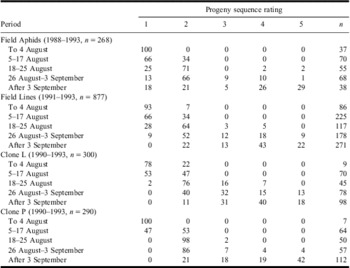
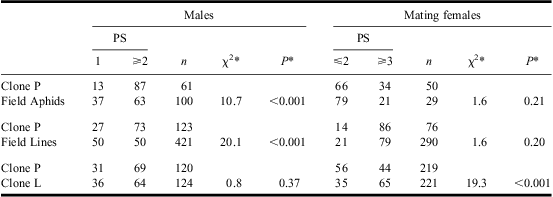
Aphids of Clone P produced only parthenogenetic female progeny in mid-summer (PS 1), half produced males (PS 2) by the middle of August, and some produced mating females (PS 3) in the latter part of August, although the majority produced mating females (PS 3, 4, 5) in September (Table 1). For Field Aphids and Field Lines, progeny sequences also progressed from PS 1 to PS 5 through the season, although some Field Aphids continued to produce only PS 1 until the end of the season and Field lines produced PS 1 later than Clone P. Some Field Aphids and Field Lines began producing PS 4 and PS 5 earlier than Clone P. Some Field Lines began producing males (PS 2) earlier than Clone P. Clone L began producing males (PS 2) and mating females (PS 3 and 4) earlier in the season than Clone P, but did not continue producing PS 1 as late in the season as Field Aphids or Field Lines. χ2-tests detected differences in the timing of appearance and disappearance of parthenogenetic females, males, or mating females (Table 2).
Frequencies (pooled over years, %) of progeny sequence ratings from 1 (summer response) to 5 (end of season response) for individual female Acyrthosiphon pisum sampled in southern Manitoba: Field Aphids were sampled directly; Field Lines were established in early summer and later reared in the field; Clones L and P were laboratory clones from the same population and later reared in the field.

Frequency (%) of Acyrthosiphon pisum females in two classes of PS for Field Aphids (1990–1992), Field Lines (1991–1993), and Clone L (1990–1993) compared with Clone P, during the transitions from parthenogenetic female to male production (PS 1 to PS 2 or higher) and to mating female production (PS 1 and PS 2 to PS 3 or higher).
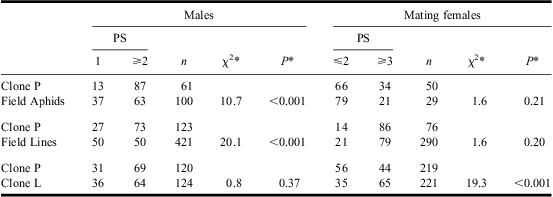
*χ2 (2 × 2 table of counts, df = 1) comparing frequencies; P, the probability that χ2 = 0.
PS, progeny sequence ratings.
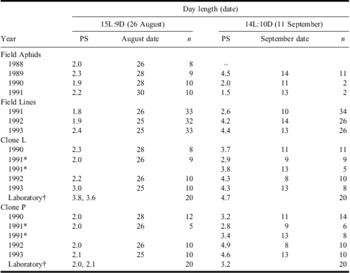
The PS for Clone P on 26 August at the transition to males (PS 2) was the same as PS in the laboratory at 15L:9D, the day length on that date in the field, and uniform from year to year (Table 3). The PS for Clone P on 11 September, 1990 and 1991, at the transition to mating females (PS 3) was similar to PS in the laboratory at 14L:10D, but PS was higher than expected in 1992 and 1993 (Table 3). PS of Clone L was always lower than for laboratory photoperiods, and in some years substantially lower than expected based on its photoperiodic response (Table 3). Clone L showed variation in PS from year to year on both dates, as did the Field Aphids and Field Lines (Table 3). Field Lines usually had slightly lower PS than Clone P, and Field Aphids had lower PS than Clone P on 11 September (Table 3).
Average PS for Acyrthosiphon pisum females in southern Manitoba, Canada at sampling dates with day lengths that correspond to two laboratory photoperiods, for the aphids described in Table 1.
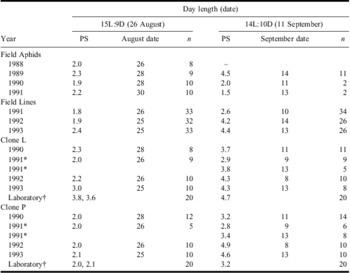
*Values for 9 and 13 September 1991 because 11 September was mid-way between the samples collected on those dates.
†PS at equivalent photoperiods and 20 °C in laboratory experiments (MacKay Reference MacKay1987, Reference MacKay1989; Smith et al. Reference Smith, MacKay and Lamb2011; Table 5).
Genetic variation in the production of progeny sequences
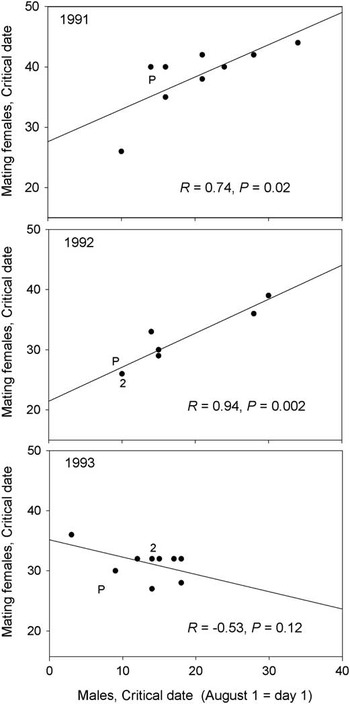
The timing of production of males and mating females for Field Lines was significantly correlated in 1991 and 1992 (Fig. 1). If a line produced males late in the season, it was likely to produce mating females late in the season. As each of the points was based on replicate tests of parthenogenetically produced aphids for each Field Line, the consistent differences among lines is evidence that the timing of appearance of sexual phenotypes is, in part, a result of genetic differences among lines. In 1993, however, most lines produced mating females at nearly the same time, eliminating any correlation (Fig. 1). The 1993 data are considered in more detail below. Most Field Lines produced sexual phenotypes later in the season than Clone P, but over the 3 years two lines were earlier, and usually some lines began producing sexual phenotypes at the same time as Clone P (Fig. 1).
Relationships between the critical dates for production of males and mating females by individual Field Lines of Acyrthosiphon pisum in southern Manitoba, Canada. The correlation coefficient (R) and the probability that it differs from 0 (P) are provided. “P” – the estimate for Clone P; “2” identifies a point where the values for two Field Lines coincide.

Temperature and variation in progeny sequences
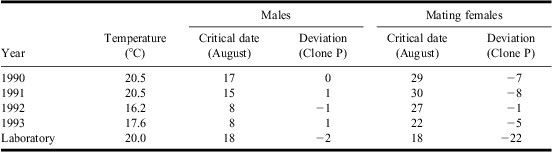
The timing of male production for Clone L was similar to that of Clone P over 4 years (Table 4). The expected critical date based on critical photoperiod was 18 August (when PS = 1.5), close to that observed in the field in 1990 and 1991 when average August temperatures were close to the laboratory temperature. Critical dates were early in 1992 and 1993, associated with August temperatures that were 3–4 °C lower than in 1990 and 1991. The critical date for mating female production for Clone L (when PS = 2.5) was 22–30 August over 4 years, later than for male production. This result was unexpected because the critical date based on laboratory photoperiod is 18 August, the same for males and mating females (Table 4). These critical dates were 5 days earlier than for Clone P, but not nearly as early as the 22 days expected based on critical photoperiod. Photoperiod response alone did not account for the PS of Clone L in the field, either for differences from year to year for both sexes or for differences between Clones L and P for mating females.
Critical date for the production of sexual phenotypes for Clone L of Acyrthosiphon pisum and the deviation of that date (days) from that of Clone P in southern Manitoba, Canada.
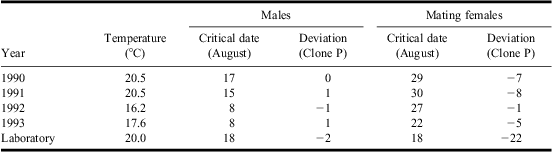
Notes: Deviation was calculated as the critical date for Clone L minus that for Clone P (a minus value means earlier than and a plus value means later than Clone P). The expected critical dates based on laboratory photoperiodic responses (MacKay Reference MacKay1989) are provided. Temperatures are the monthly average in August.
Temperature affected the photoperiodic response of Clone L at 15L:9D and 20 °C and 15 °C (Table 5). PS rose to 5.0 from 3.6 when temperature was lowered by 5 °C.
Response to temperature of Clone L of Acyrthosiphon pisum reared at a photoperiod of 15L:9D in the laboratory (corresponding to the day length on 26 August in southern Manitoba, Canada).

Notes: The response is quantified as a PS on a scale from 1 to 5, where 1 is a summer and 5 is an autumn response, and as the proportion of females producing, and the proportion among the progeny, of males (♂) and mating females (m♀).
*Males among all progeny and mating females among all females.
PS, progeny sequence rating.
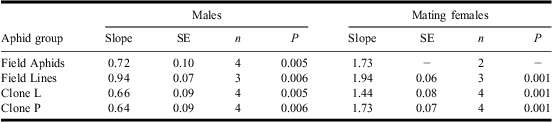
Field Aphids, Field Lines, Clone L, and Clone P all showed positive slopes for the relationship between critical date for production of sexual phenotypes and August temperature (Table 6). When August temperature was low, the critical date was early (critical day length was long) and sexual phenotypes were produced early in the season. The slopes of the relationships were more than twice as high for mating females as for males. Temperature modulation of photoperiodic response explained a significant portion of the variation in PS from year to year (Table 6) that is evident in Table 3.
Slope and SE of the relationship between critical date for production of sexual phenotypes and the average temperature in August, estimated by linear regression for fourth-instar Acyrthosiphon pisum from the field for the aphid groups described in Table 1.
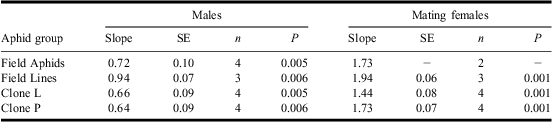
Note:n – the number of years aphids were tested; P – probability that the slope = 0.
SE, standard error.
Nine of 10 Field Lines initiated production of mating females on the same collection day in 1993, whereas in 1991 and 1992 initial production was spread over 10–15 days. The result was a narrow range of critical dates for mating females in 1993, and no correlation in timing between males and mating females (Fig. 1). This response was consistent with the pattern of temperature in 1993. The average temperature in the week prior to initiation of mating females for Clone P on 25 August 1993 (day length 15 hours, 4 minutes) was 20.3 °C, higher than the normal temperature of 18.2 °C for that week. At this temperature, day length was just short enough to initiate mating female production in one of 10 Clone P aphids (PS 2.1) and a few aphids from the Field Lines, as expected for that day length and temperature (Table 3). In the 9 days following 25 August, the average temperature was 15.1 °C, 5 °C lower and below the normal temperature of 16.6 °C at that time of year. This cool period, in conjunction with the day length, 14 hours, 31 minutes by 3 September, was sufficient to induce mating female production in all the Field Lines, and increase PS to 4.0 (n = 46), much higher than PS 2.1–2.5 observed when mating female production begins. Even if the Field Lines had a diversity of critical day lengths in 1993 as observed in 1991 and 1992, little variation would have been detected because nearly all Field Lines were triggered at the same time coincident with a period of lower-than-normal temperature following a period of higher-than-normal temperature. Temperature modulation of the photoperiodic response in the field probably masked the genetic variation among Field Lines that was observed in two previous seasons.
Contribution of long-distance dispersal to variation
After 17 August, 19% (n = 161) of Field Aphids were PS 1 compared with 0% (n = 219) for Clone P (Table 1). After 3 September, 18 of 38 Field Aphids still were PS 1, when no other aphids produced PS 1 (Table 1). Six lines established from these aphids were all confirmed to be anholocyclic when tested in the laboratory. These aphids must have been the offspring of immigrants that arrived in the current summer because anholocyclic genotypes cannot overwinter at Glenlea. Some Field Lines also produced only parthenogenetic progeny at the end of the season: one of 10 in 1991 and three of 10 in 1992, but none in 1993. These lines also were anholocyclic and excluded from Table 1. Therefore, by early July in 1991 and 1992, between 10% and 30% of aphids were the progeny of long-distance dispersers from the south and the progeny of these immigrants, or subsequent anholocyclic immigrants, continued in the population until the end of the season.
None of the Field Aphids and only one or two of the 30 Field Lines produced males or mating females as early as or earlier than Clone L, a probable immigrant from 4° north of Glenlea (Table 1), suggesting that immigration from this far north is unusual. However, many of the 26 holocyclic Field Lines produced males and mating females later in the season than Clone P (Fig. 1). Such a late response was consistent with these lines being immigrants to Glenlea from the south, although not from as far south as the anholocyclic lines. This interpretation was supported by four Field Lines that had progeny sequences of PS 2.0 or less when sampled on 9 September 1991 (day length near 14 hours light), lower than PS 2.8 for Clone P at Glenlea or PS 3.2 for Clone P in the laboratory (Table 3). The responses of these four lines were similar to the response at 14L:10D of a line known to have immigrated to Glenlea from 3° to the south (Smith and MacKay Reference Smith and MacKay1989), and close to the average response of spring-collected lines from 3–5° south of Glenlea (Smith and MacKay Reference Smith and MacKay1990). The low PS of Field Aphids sampled 11 September 1990 and 13 September 1991 suggest that those aphids may also have been immigrants from the south (Table 3). The three anholocyclic lines sampled in 1992, and the Field Lines from 1992 and 1993 that responded substantially later than Clone P (Fig. 1) indicate that many immigrants also arrived in Glenlea from the south in those years, although they could not be as clearly identified because average temperatures in the first part of September were 11.8 °C and 12.7 °C, respectively, compared with 17.0 °C in 1991, and holocyclic Field Lines produced mating females (>PS 3) earlier than in 1991.
Adaptive significance of variation
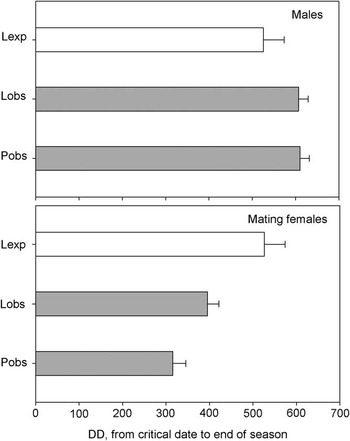
In the field, the timing of mating female production by Clone L was closer to that of Clone P than expected from its photoperiod response (Table 4). Also, the observed DD available to Clone L at Glenlea after the critical date for males were close to those of Clone P (two-way Anova, F 1,3 = 0.2, P >> 0.1), but greater than expected based on photoperiod alone (two-way Anova, F 1,3 = 6.4, P < 0.1 > 0.05) (Fig. 2). The observed DD available to Clone L after the critical date for mating females were greater than but more similar to those of Clone P (two-way Anova, F 1,3 = 7.4, P < 0.1 > 0.05) than to the DD expected based on photoperiod alone (two-way Anova, F 1,3 = 18.3, P < 0.025) (Fig. 2). Thus, Clone L, a probable immigrant genotype from the north, produced sexuals at a time similar to Clone P, a locally adapted genotype, and was better adapted to local seasonality than would be the case without temperature modulation of its photoperiodic response. Without temperature modulation, Clone L would have produced mating females early in the season (Fig. 2), and missed out on an additional asexual generation (122 DD, from Table 3 in Smith et al. Reference Smith, MacKay and Lamb2011).
Day-degrees (DD) above 4.7 °C (DD ± standard error) available to Acyrthosiphon pisum Clones L and P in southern Manitoba from 1990–1993, estimated from the critical date for production of males or mating females to the end of the season when DD reach 0. The DD expected based only on the photoperiod response of Clone L (Lexp) are compared with the DD observed for Clone L (Lobs), and those of locally adapted Clone P (Pobs).

Temperature modulation of photoperiodism also stabilised the DD available from year to year for Clone L: the standard deviations for year-to-year variation in DD available after the critical photoperiod was 96 (n = 4) for both males and mating females, about twice that for either males, 44 (n = 4), or mating females, 52 (n = 4), when modulated by temperature (see standard errors in Fig. 2).
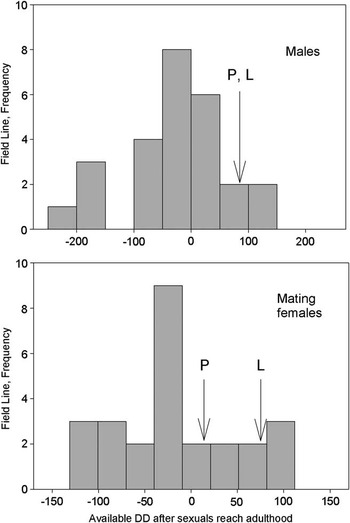
The late production of sexuals by many of the 26 holocyclic Field Lines (Fig. 1) meant they were less adapted to seasonality at Glenlea than either Clone P or Clone L (Fig. 3). The critical dates for some lines were so late that too few DD (<0 DD) remained for most of their offspring to reach adulthood, mate and oviposit. In 1991 when temperatures were relatively high, the DD available to more than half the lines were negative, and two of the lines were more than 100 DD short for both males and mating females. However, in 1992 when early September was cool, only two of seven holocyclic lines had values of −4 and −18 DD for mating females. In a cool year, temperature modulation of photoperiodism allowed many lines to produce sexual offspring at close to the same time as the locally adapted Clone P. Photoperiodism modulated by temperature was more effective at timing production of sexuals in a cool than in a warm year. The DD available to individual Field Lines were also estimated for the aphids that first initiated production of males or mating females, to assess whether particular lines could produce any sexuals before the end of the season. Of the 26 holocyclic Field Lines, only one from 1991 had negative residuals: −5 DD for male and −9 DD for mating female production. This line could not have produced any adult sexuals before the end of the season, but the other 25 lines might have contributed at least some males and mating females to the sexual generation.
Distributions of day-degrees (DD) above 4.7 °C available after sexuals reach adulthood for 26 lines of Acyrthosiphon pisum in southern Manitoba, Canada from 1991–1993, estimated from the critical dates for males and mating females to the end of the season when DD reach zero, and reduced by the 520 DD required for males or the 170 DD required by mating females to reach adulthood, mate and oviposit (Smith et al. Reference Smith, MacKay and Lamb2011). The equivalent values for Clones P and L are indicated by arrows.

Discussion
Different samples and lines from a local field population of pea aphids varied in their timing of production of asexual and sexual offspring as the summer ended. Compared with the locally adapted Clone P (Smith et al. Reference Smith, MacKay and Lamb2011), one or two Field Lines responded to seasonal cues early, some responded at the same time, many responded late, and some responded not at all. This variation in the response to natural day lengths reflected, in part, genetic variation among aphid lines and, in part, year-to-year variation in temperature. Genetic variation was confirmed by the different responses of two clones to the same environment, the presence of anholocyclic genotypes in the primarily holocyclic population, and by the correlation between the timing of production of males and mating females for many Field Lines. The importance of temperature in causing variation in the photoperiodic response was confirmed by the failure of day length alone to account for year-to-year variation in the responses of Field Aphids, Field Lines and Clone L, the effect of temperature on the photoperiodic response of Clone L in the laboratory, and the effect of temperature on the critical day length for Field Aphids, Field Lines, and two laboratory clones. In one year, the near simultaneous initiation of sexual phenotypes in all Field Lines was associated with a period of cool weather, obscuring genetic differences among the lines.
Some of the genetic variation was due to the presence of immigrants in the population, confirmed by the presence of anholocyclic Field Aphids and Field Lines. The anholocyclic lines must be long-distance dispersers arriving in the current season because the most northerly latitude where anholocyclic pea aphids are known to over-winter asexually is 39.5°N, over 1000 km south of Glenlea (Smith Reference Smith1987). No asexual lines were detected in spring samples from southern Minnesota, North Dakota, southern Manitoba, or central Saskatchewan (Smith and MacKay Reference Smith and MacKay1990). We infer that some of the holocyclic Field Aphids and Field Lines that did not initiate production of males or mating females until late in the season also were immigrants from the south, but from higher latitudes than anholocyclic clones, as has been observed previously (Smith and MacKay Reference Smith and MacKay1989). The response to day length of four Field Lines in 1991 was similar to those of aphids sampled 3–5° south of Glenlea (Smith and MacKay Reference Smith and MacKay1990). These four Field Lines plus one anholocyclic Field Line represented half of the Field Lines that year showing how large a contribution genotypes immigrating from the south can make to a local population in southern Manitoba. A small proportion of the aphids and lines produced males and mating females earlier than Clone P, consistent with immigration from the north.
Although photoperiod is generally thought to be the cue used to time the transition from asexual to sexual reproduction (Hardie Reference Hardie2010), a temperature cue can also play an important role for the pea aphid. All pea aphids in this study show a similar modulation of their response to day length by temperature, responding to longer day lengths earlier in the season in years when August temperature is low than in years when temperature is high. The degree of modulation is greater for mating females than for males. Temperature modulation of the photoperiodic response was previously documented for Clone P from Glenlea (Smith et al. Reference Smith, MacKay and Lamb2011) and for a pea aphid clone from southern Ontario (Lamb and Pointing Reference Lamb and Pointing1972).
Temperature modulation of photoperiodism is an adaptation for year-to-year variation in weather at a location. In warm years, critical day lengths are shorter and sexuals are produced later than in cool years; in cool years the opposite occurs (Smith et al. Reference Smith, MacKay and Lamb2011). A similar adaptation occurs in Rhopalosiphum padi (Linnaeus) (Ward et al. Reference Ward, Leather and Dixon1984; Halkett et al. Reference Halkett, Harrington, Hullé, Kindlmann, Menu and Rispe2004). All the genotypes of aphids tested in southern Manitoba show temperature–photoperiod responses consistent with this hypothesis, and temperature modulation does reduce the variance in heat units available to the end of the season from year to year for Clone L, as observed for Clone P (Smith et al. Reference Smith, MacKay and Lamb2011).
Immigrants that have a photoperiod response adapted to the latitude of their original habitat (Smith and MacKay Reference Smith and MacKay1989) and different from the one they disperse to would also benefit from temperature modulation, as hypothesised by MacKay (Reference MacKay1989). A southern clone that migrates north is exposed to day lengths that are longer (prior to the equinox) but temperatures that are lower than where it originated, whereas a northern clone experiences the opposite. Aphid genotypes found in southern Manitoba support this hypothesis. Clone L, thought to be from the north, responds to short day lengths later in the season as a result of temperature modulation, than if it relied on day length alone. Holocyclic lines with photoperiodic responses matching those from southern lines (Smith and MacKay Reference Smith and MacKay1990) respond to day length and temperature in southern Manitoba later than a locally adapted clone, but in time that many of their offspring would be able to reach adulthood, mate and oviposit before the end of the season. The adaptation is not perfect, however, and one line presumably from further south than the others does not respond in time for any of its sexual offspring to reach maturity before the end of the season.
We conclude that both temperature and day length cues trigger the transition from asexual to sexual reproduction by the pea aphid at the end of the season. This temperature modulation of photoperiodism has at least two functions: adaptation to year-to-year variation in weather at a location and adaptation to north–south migration that allows immigrants to respond more appropriately to local patterns of seasonal change than if they relied only on day length. Temperature modulation of photoperiodism assures that in most years local and many immigrant genotypes are able to produce sexual individuals that mate and produce winter-hardy eggs, in a timely way at the end of the season. The mechanism that allows temperature to modulate photoperiodic response needs to be incorporated into models of photoperiodism if we are to understand how aphids are adapted to seasonal change.
Acknowledgements
Funding for this research was provided by the Natural Sciences and Engineering Research Council of Canada through an Operating Grant to P.A. MacKay.