INTRODUCTION
As global warming increases sea temperatures, some coral reef fishes can be expected to extend their geographical range beyond the tropics (Munday et al., Reference Munday, Jones, Pratchett and Williams2008). On the east coast of Australia, the world's largest coral reef, the Great Barrier Reef (GBR) spans from approximately 10°S to 24°S. During the austral summer, the East Australian Current (EAC) travels south from the GBR transporting larvae of coral reef fishes to the temperate south-east coast of Australia and offshore islands such as Lord Howe Island (Francis, Reference Francis1993; Booth et al., Reference Booth, Figueira, Gregson, Brown and Beretta2007). Coral reef fishes are not usually able to establish populations in these temperate waters because they are unable to survive the winter (Booth et al., Reference Booth, Figueira, Gregson, Brown and Beretta2007). However, the south-east coast is undergoing relatively rapid increases in seawater temperature associated with global warming, which is allowing some coral reef fishes to survive the winter (Figueira & Booth, Reference Figueira and Booth2010).
Angelfishes (family Pomacanthidae) are a diverse and conspicuous group of coral reef fishes. They are found throughout the tropical seas of the world. The lemonpeel angelfish, Centropyge flavissima (Cuvier, 1831), inhabits coral reefs across the Pacific Ocean from the GBR to southern Japan and east to the Marquesas Islands (Figure 1) (Allen et al., Reference Allen, Steene and Allen1998). This geographical distribution is typical of many coral reef fishes in the Pacific Ocean (Allen et al., Reference Allen, Steene and Allen1998). The southern limit of the distribution of this species includes the southern GBR (24°S), New Caledonia (23°S) and Easter Island (27°S) (Allen et al., Reference Allen, Steene and Allen1998). This study reports on a new record of the lemonpeel angelfish that is more than 1000 km south of the known southern limit of its range.
Known geographical range of Centropyge flavissima in the Pacific Ocean (from Allen et al., Reference Allen, Steene and Allen1998). The locations of the Great Barrier Reef (GBR) and Lord Howe Island (LHI) are indicated.

MATERIALS AND METHODS
Underwater visual surveys of reef fishes were conducted at Lord Howe Island (LHI: 31°S–159°E) off the east coast of Australia from 22 March to 4 April 2009. Twenty-three sites distributed around LHI, within the lagoon and at surrounding rocky outcrops were surveyed whilst SCUBA diving. Surveys were done on reef habitat in shallow (0–5 m) and deeper water (15–20 m). Some sites were within marine protected areas where collecting is prohibited and therefore potential new records were photographed underwater with a digital camera (Sony DSC-W80) to verify identity.
RESULTS
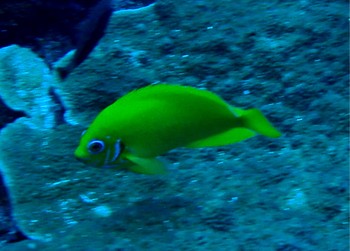
On 26 March 2009, one 9 cm (total length (TL)) lemonpeel angelfish (Figure 2) was observed at 20 m depth at Ball's Pyramid (31°45′S– 59°14′E), a rocky outcrop located 23 km south-east of LHI. This angelfish usually forms small social groups (harems) (Allen et al., Reference Allen, Steene and Allen1998) but despite intensive searching no other individuals were found. Also, no individuals were observed during the two weeks of underwater surveys at LHI. Elsewhere, lemonpeel angelfish mature at 5 cm TL (author's unpublished data) and can grow to 10.5 cm (Randall, Reference Randall2005). At 9 cm TL, lemonpeel angelfish can be 7–8 years old (author's unpublished data).
An underwater photograph of the new record of Centropyge flavissima (size = 9 cm TL) from 20 m depth at Balls Pyramid, 23 km south-east of Lord Howe Island.

DISCUSSION
The fish fauna of LHI has been well studied over the past 120 years, with 443 coastal species recorded, including nine angelfishes (Francis, Reference Francis1993; Allen et al., Reference Allen, Steene and Allen1998). Globally, there are more than 80 angelfishes and their conspicuous coloration makes them readily identifiable and therefore their geographical distributions are generally well known (Allen et al., Reference Allen, Steene and Allen1998). The lemonpeel angelfish is one of the most brightly coloured reef fishes and is most common in shallow water (0–20 m: Allen et al., Reference Allen, Steene and Allen1998), which makes it easily noticed. If this species was established and more common at LHI it would have been recognized during the numerous previous surveys, indicating that the individual observed in this study is a distant colonist that has only recently been detected.
Colonization of LHI by the lemonpeel angelfish most likely occurred through larval dispersal from the southern GBR (~1200 km north-west of LHI) via the EAC, or less likely from New Caledonia (~1400 km north-east of LHI). The EAC entrains reef fish larval from the southern GBR as it travels south along the east coast until about 32°S where the EAC heads away from the coast and eastward towards LHI (Francis, Reference Francis1993; Booth et al., Reference Booth, Figueira, Gregson, Brown and Beretta2007). The relatively large size of the individual lemonpeel angelfish at LHI indicates it is several years old and its survival over several winters may have been enhanced by rising sea temperatures (Figueira & Booth, Reference Figueira and Booth2010). Survivorship to adult size also indicates that there is a sufficient habitat and food resource for this species at LHI. To the best of my knowledge this species has not been recorded at similar latitudes on the south-east coast of Australia, or on the northern New South Wales coastline (e.g. 30°S: Booth et al., Reference Booth, Figueira, Gregson, Brown and Beretta2007) where sea temperatures during winter can be warmer than LHI (Figueira & Booth, Reference Figueira and Booth2010). This indicates that, in addition to warmer winter sea temperatures, other factors (e.g. habitat) may influence whether this species can become established in temperate areas.
Whether the lemonpeel angelfish can establish a reproductive population at LHI will also be dependent on the availability of mates. The arrival of rare vagrants to isolated or peripheral locations can lead a species to hybridize with a closely related species due to a lack of conspecific mates (Hobbs et al., Reference Hobbs, Frisch, Allen and van Herwerden2009). At other peripheral island locations the lemonpeel angelfish hybridizes with congenerics (Allen et al., Reference Allen, Steene and Allen1998; Hobbs et al., Reference Hobbs, Frisch, Allen and van Herwerden2009), including Centropyge vrolikii, which is present at LHI and therefore these two species may hybridize at LHI in the future. Although poleward range expansions of tropical organisms into temperate locations may be expected with increasing sea temperatures, successful establishment of populations may be determined by reproductive (physiology, availability of mates), ecological (competition, predation) and biophysical (habitat) factors.
ACKNOWLEDGEMENTS
Financial and logistical support for this study was provided by Envirofund Australia Natural Heritage Trust and the Lord Howe Island Marine Park. The author thanks B. Busteed, J. Gilligan, S. Gudge, I. Kerr and J. Neilson for valuable field assistance and A. Frisch and two anonymous referees for constructive comments on the manuscript.