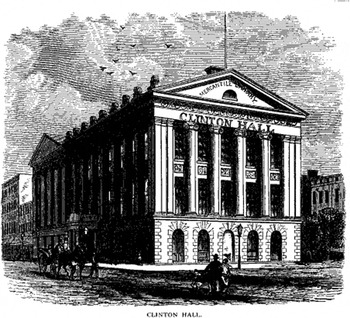
On the corner of Nassau and Beekman Streets, the lecture room of Manhattan's Clinton Hall was filling up for the evening performance. After struggling to secure high-quality speakers during 1849, the Mercantile Library Association had scheduled an impressive cast of orators for the winter 1850 season, and such was the opening performer's popularity that organizers had been “strongly urged to choose another hall.”Footnote 1 Complaints about the state of the city's lecturing facilities had been escalating of late, and Clinton Hall in particular was dismissed as “out of the way, too small and too uncomfortable.”Footnote 2 Nonetheless, on the evening of Tuesday, 22 January 1850, a significant audience had begun to assemble, including several correspondents from the chief newspapers of the city. One recalled that the auditorium was “crowded to its utmost capacity”; another observed that “a large number were obliged to go from the door without obtaining admission”; a third wrote that even among those who gained entry, “many had to shift for accommodation.”Footnote 3 The magazine writer Nathaniel Parker Willis was fortunate enough to get inside, but, having arrived late,
found the place crowded, and no chance of a near view of the speaker. The only foothold to be had was up against the farthest wall; and a row of unsheltered gas-lights blazed between us and the pulpit, with one at either ear-tip of the occupant, drowning the expression of his face completely in the intense light a little behind it.Footnote 4
With this ecclesiastical tableau, Willis captured an atmosphere of almost messianic anticipation. The evening's performance was the first time many had seen this well-known, out-of-town orator, and expectation for intellectual, aural and visual stimulation from the “pulpit” was intense.
Ralph Waldo Emerson's appearance at Clinton Hall was clearly a media event, yet to many in the audience the material he was to present was already familiar. He had agreed to deliver a piece performed several times in New England during the previous winter entitled “England,” reports of which had appeared in both the American and British press.Footnote 5 Though it was to prove one of his most popular lectures, its tone had surprised early audiences. For one thing, it engaged with less-abstract subject matter; moreover, many heard it as a startlingly positive appraisal of British society. Reporting on an early performance, a Boston journalist informed readers that Emerson had “lain it on quite thick, I assure you,” and his commentary was widely censured as a provocatively reverent account.Footnote 6
By contrast, a number of the reporters gathered in Clinton Hall on 22 January found much to commend in such provocation. The New York Herald commented on its “surprising epithets,” “singular conjunctions,” and “striking contraries of ideas.”Footnote 7 In the Home Journal, Willis praised Emerson's mastery of “surprise” and his “very bold and fearless comment.”Footnote 8 The Albion thought it possessed an admirably “bold, uncompromising love of truth, and a carelessness of consequences.”Footnote 9 Such divergence of response was not unfamiliar for Emerson; nor was such disparity uncommon in coverage of the popular lecture circuit. However, the reception history of this performance provides instructive insights into the construction of Emerson's persona, into antebellum debates over Anglo-American identity, and into the dynamic interplay of oratory with the print media.
Since the operative meanings of lectures such as “England” were fashioned by the interpretive gestures of the print media, Emerson's full impact can be understood only by attempting to recapture the figure he struck both on the lyceum platforms and in the newspaper lecture columns of antebellum America.Footnote 10 The recent publication of his later lectures has generated renewed interest in Emerson the speaker, focussing on how these neglected pieces mark his intellectual growth.Footnote 11 However, this essay adopts a different approach, by attempting a detailed account of the context, delivery and conflicting readings of a single Emerson appearance. In doing so, it aims to reveal how the lecture circuit, so often omitted from discussions of broader performance culture, needs to be reconnected to wider debates within the antebellum media concerning Anglo-American show practices, physicality and manners.Footnote 12 Such reconstruction allows us to recapture a sense of how the press seized on both the “England” talk itself and aspects of Emerson's performance style, as a means of shoring up of civic order and Anglo-American kinship.Footnote 13 Moreover, building on work of scholars such as Sandra Gustafson on early American orality, this essay argues for a reexamination of the textual interchanges of nineteenth-century oratorical culture.Footnote 14 It demonstrates how the reanimation of lecture reports reconnects us to forgotten means of listening through texts, and to discursive contests over thoughts voiced in spaces such as Clinton Hall.Footnote 15
DECIPHERING EMERSON'S PERFORMANCES
This endeavour is particularly rewarding in the case of as copiously documented a performer as Emerson. As his most recent editors argue, the Emerson of the platform is a figure whose cultural place “we are just now beginning to appreciate.”Footnote 16 Newspaper lecture coverage was instrumental in establishing this significance, since, as Mary Kupiec Cayton maintains, the “impact” of his lecturing “may have depended less on what he intended than on what key communities of interpreters made of him.”Footnote 17 The ways in which the listeners in the media articulated what they heard was often a consciously partial ideological process.
Emerson developed an adversarial relation to such reporting, for its erratic entanglement of oral and print values, and what he saw as its financially injurious theft of intellectual property.Footnote 18 Such opposition may have contributed to his cultivation of an unrecordable idiom; both his notoriously elliptical style and habit of rearranging pieces at the lectern presented formidable obstacles to transcription.Footnote 19 Consequently, accounts often involved conscious “misconstrual” and were a means by which reporters could annex their own version of his positions: on reform, the market, nationality and modernity. Following his Clinton Hall lectures, one publication observed that
Mr. Emerson seems to be used in a good many places, as the wagon full of chain cables is used on board our steamboats, to trim ship. If the orthodoxy of a man is suspected, let him abuse Mr. Emerson; if his liberality is doubted, let him praise him.Footnote 20
These interpretive strategies were a recognized contemporary phenomenon.
Newspaper consumption allowed the republic to conceive of itself, in Benedict Anderson's terms, as “a deep, horizontal comradeship,” and lecture reporting allowed citizens to become part of an abstract community of listeners.Footnote 21 Yet, crucially, these columns captured more than words alone. The lyceum was a discursive space that married intellectual stimulation with a structure of display, a conflation of intellectual and physical performance. As his first biographer maintained, “his voice and manner become a fine commentary on his written thought, giving to it new and unexpected meaning.”Footnote 22 Accounts of Emerson's lectures bear this interplay out, since reporters attempted to capture the man, more than almost any other speaker, in full: costume, gesture and voice.
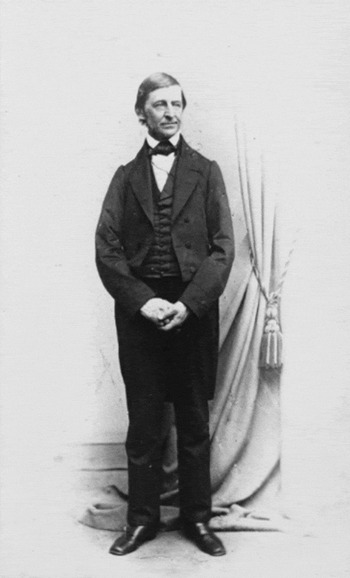
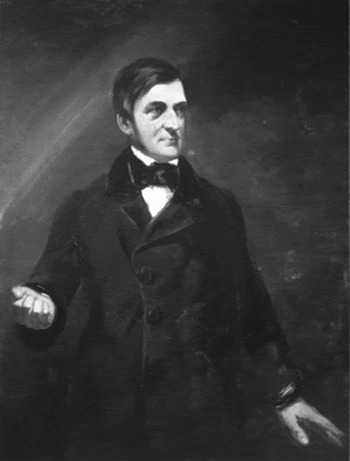
Emerson was a gadfly of the lyceum: he offered contradictory messages, he took aim at majority beliefs, he refused to obey traditional structures. His performances, by contrast, were entirely free of such drama. His act involved a disjunction between text and body, with his words imparting vigorous ideas, whilst his demeanour projected benign indifference. One curious exception was his “customary gesture,” captured in various visual sources, of clenching the right fist, “knuckles upward, arm bent at the elbow … to deliver a downward blow of the forearm, full of power bridled” (see Figures 1 and 2).Footnote 23 Combined with his peculiarly resonant vocal style, such enigmatic physicality was often a focal emphasis of contemporary interpretations. Emerson's body was presented as a beguiling social text, suggestive of an almost inscrutable moral identity. As reports of his Clinton Hall performance reveal, the interpretive stances involved in rendering these nontextual properties were richly ideological.
Ralph Waldo Emerson, carte de visite, c. 1850. Courtesy of Harvard Houghton Library.

David Scott, Ralph Waldo Emerson, oil on panel, 1848. Courtesy of Concord Free Public Library.

Such scrutiny took on a new significance at Clinton Hall. 1850 was a pivotal year for Emerson, representing his final transition from secular preacher to professional lecturer of national stature. Shorn of much of his troubling early radicalism, his cultural symbolism was in flux, available for audience manipulation. To attend a talk by the Sage of Concord afforded the opportunity to scrutinize the character of one of the nation's most prominent moral critics. Moreover, now a transatlantic celebrity, freshly returned from the seat of world power, his verdict on the moral character of Britain was highly anticipated. Having followed his trip to Europe and his troublingly pro-British lecture in Boston with interest, New York newspapers were eager to assess at first hand the extent to which this symbol of Yankee intellectual independence had been tainted – physically or mentally – by his global exposure.Footnote 24
“ENGLAND” AS AFFIRMATION?
Travel lectures such as “England” were interpretive performances, or dramas of appraisal, through which cultural and civic values were articulated. Whether delivered by men of letters such as Wendell Phillips or Herman Melville, or by those noted for their explorations such as Bayard Taylor, travel testimonies transcended mere entertainment, possessing the potential to galvanize political opinion.Footnote 25 Lectures on transatlantic themes were a particular case in point. In the antebellum party-political climate, positions on a range of pressing contemporary issues became inflected by one's attitude to Britain; the content, tone and spirit of appraisals of British culture and society were therefore richly significant gestures.Footnote 26 Just like his more celebrated “Fugitive Slave Law” address of the following year, “England” seems designed to be read as an expressive speech act that, unlike many of his earlier, more elusive, gestures, conveyed affiliation with particular social positions. To many, it sounded like a surprisingly affirmative gesture towards British society.
One of his most popular performances, “England” was delivered under varying titles dozens of times throughout the Northeast and Mid-west during 1848–51.Footnote 27 It represented an early version of the influential transatlantic vision of English Traits (1856), a work which has enjoyed a divided recent scholarly reputation, seen variously as a maturation of global perspective, a disingenuous “double-cross,” or an evasion of domestic sectional tensions.Footnote 28 The book is also an important moment for those who read Emerson's later career as a drift from enraptured idealism to accommodation of the market.Footnote 29 Such attention has enriched our understanding of his evolving responses to transatlantic relations and Anglo-Saxon culture, but neglects the light that can be shed by their gestation on the lecture circuit.
Though characteristically resistant to linear summary, “England” contained some key strands.Footnote 30 It purported to be an account of experiences gained on his recent lecture tour; like English Traits, it began with an impressionistic passage describing the visceral experience of British modernity, before interrogating the paradox of the nation's “success” through the question “Why England Is England.” Emerson's idiosyncratic theories pointed to the temperate British climate, the strong diet, the presence of an aristocratic class, the history of racial mixing, and other intangible qualities such as English “pluck.” Various anecdotal illustrations were introduced to support these arguments, and he concluded by denouncing prophesies of the nation's imminent decline. On the surface, at least, it was an affirmation of English modernity and supremacy, conveyed through a series of bold, counterintuitive moments.
The lecture began with the first such striking set piece that commenced the experience of English travel in medias res:
The traveller, on arriving in England, is struck at once with the cultivation. On every side, he sees the triumph of labor. Man has subdued and made everything. The country is a garden. Under that ash-colored sky, the fields are so combed and rolled, that it seems as if they had been finished with a pencil instead of a plough. The structures that compose the towns have been piled by the wealth and skill of ages. Nothing is left as it was made. Rivers, hills, valleys, the sea all feel the hand of a master. (151–52)
In classical rhetorical terms, this is no standard exordium but rather an establishment of tone: admiring, fervent and seemingly deferential. It unfolds a provocative catalogue, its sequence of superlatives almost amounting to a panegyric to the accomplishments of British modernity. The resonances of “cultivation” and “finish” suggest twinned admiration for both social and technical refinements. Such approval seems rich in domestic party-political signification, its esteem for the “hand of a master” presented in a Whig-inflected register of internal improvements.Footnote 31 Above all, the passage's ebullient present-tense constructions framed an unmistakable rhetorical argument: that the nation required confrontation as a contemporary fact, not, as in his own famous early formulation in Nature, as the mere “dry bones of the past.”Footnote 32
Two other crucial moments affirmed British supremacy against claims of imminent expenditure. In a second key passage, Emerson treated audiences to another fulsome celebration of British progress:
In America, we fancy that we live in a new and forming country, but that England was finished long ago. But we find London and England in full growth … Trafalgar Square was only new finished in April 1848 … The London University opens like our mushroom colleges at the West … Everything in England bespeaks an immense and energetic population. (157–58)
In their striking assertion of growth, these lines reprise the tenor of his patriotic tribute to domestic energies in “The Young American.”Footnote 33 Yet here, such spread-eagled boosterism is recast as mere “fancy.” Similarly, at the lecture's close, a final refutatio rejects notions of British expenditure – “It is common to augur evil of England's future and to forbode her sudden or gradual decline under the loads of debts, and pauperism, and the unequal competition with new nations where land is cheap” (168) – before leaving audiences with a vivid closing metaphor:
But though she may yield to time and change, what a fate is hers! She has planted her banian roots in the ground, they have run under the sea, and the new shoots have sprung in America, in India, in Australia, and she sees the spread of her language and laws over the most part of the world made certain for as distant a future as the science of man can explore. (168)
The piece thus ended by inviting audiences to resist Anglophobic sentiments, demanding that they be mindful of transatlantic inheritance and Anglo-American unity. Yet, in typically subtle fashion, the nuanced “banyan” image resolved his analysis with the implicit argument that Anglo-Saxon greatness could only persist and continue in the nation's “offspring.”
One of the talk's most notable formal features was, in fact, its emphasis on dispassionate balance and nuance. In an 1844 Dial review, Emerson had lamented “a certain disproportion in the picture” presented of English society in Thomas Carlyle's Past and Present (1843).Footnote 34 By contrast, evenness became a central principle of “England,” every superlative tempered by qualification and caveat. Such balance was a quality he commended in the natural character: “a certain balance of qualities in their nature, corresponding to what we call temper in steel … neither too cold, nor too hot; neither too swift, nor too slow” (162). Therefore what appeared as pure affirmation was in fact a subtle broadside against hyperbole. It was an attempt to demystify British modernity, presenting it as cause for neither automatic alarm nor blind admiration.
There was also something more insinuating at work. The lecture represented an instance of the dialectical aesthetic employed in Emerson's wider portraiture in studies that – like his elegy to Thoreau and the sketches of Representative Men (1850) – first praised only to undercut.Footnote 35 Consider the dual effect of the opening passage above, which operated both as praise and also as a bravura performance of encapsulation and interpretation, capturing the nation in acts of summary interpretation, each aphorism subtly undermining through a process of reverse colonization. When Carlyle read reports in London of its 1849 Boston rendition, he wrote to Emerson in praise of the “hidden genius lodged in it,” terming it “an excellent sly little word.”Footnote 36 During the moment of oral rendition, however, much is lost even to dutiful ears, and this “sly,” “hidden” nature seems to have been missed. In any case, the texture of reception was determined not by Emerson's text alone, but by recent events in New York performance culture.
“ENGLAND” AND ASTOR PLACE
In contrast to the furore surrounding its Boston performance, the New York media's response was generally positive.Footnote 37 As stated earlier, readings were characterized by a vocabulary of audacity and bravado: “bold, fearless comment,” “honest bluntness” and “carelessness of consequences.” We might well take pause at such language – why speak of a travel account in such terms, or consider a mere analysis of Britain “defiant”? Part of the answer lay in the character of the Manhattan media's evolving management of urban class tensions.
Emerson was entering the city at a volatile time for civic and cultural life, and particularly for public performances that took as their theme discussion of transatlantic affairs. In May 1849, the infamous “Shakespeare Riot” had taken place at the Astor Place Opera House, in which supporters of the American actor Edwin Forrest besieged the theatre where the illustrious English actor William Charles Macready's Macbeth was to open on 7 May.Footnote 38 After several days of escalating unrest, culminating in tens of thousands of protesters in the streets around Astor Place, the city's Whig authorities sent the National Guard to quell the disturbance, resulting in twenty-five dead and 120 injured. Though the idiosyncratic origins of the event have led to the its being cast as a vaudevillian historical curiosity, it was nonetheless the deadliest civic disturbance of the early republic, and the urban divisions it revealed were stark.
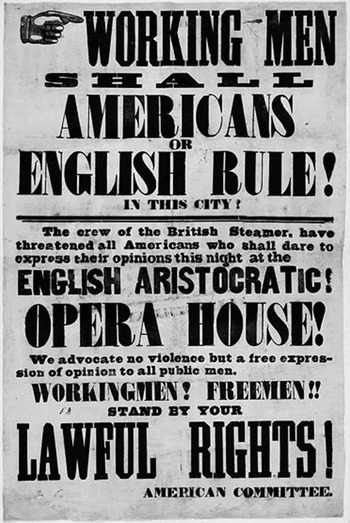
“American Committee,” “Working Men: Shall Americans or English Rule This City?”, broadside, 1849. Courtesy of Folger Shakespeare Library.

As notorious broadsides reveal, the ferment surrounding the riot was conducted rhetorically in terms as much of anti-British sentiment as of more local socioeconomic tensions (Figure 3). The fissures of Manhattan's class politics found expression through reference to perceived adherence to or rejection of British manners or cultural practices, with putative battle lines established between the bearing and costume of demotic Democrats and effete Eurocentric Whigs. The Democrat-leaning Herald regularly fuelled such divisions, and during the build-up to the riot had chronicled developments in a language marked by vilification of the “coteries and cliques which make up our pseudo-aristocratic circles,” castigating their anti-democratic, implicitly Whig, pro-British sentiments.Footnote 39 Inevitably, both tragedians’ performances were read in terms of national synecdoche's: Forrest as the authentic everyman, overbearing and stridently demotic; Macready as haughty, introspective and aristocratic.
The outpouring of anti-British sentiment in Astor Place, however, had sounded a note of alarm for the city's cultural elite. Publications such as the Herald were conscious of their influence on street-level resentment and the potential for further disturbance, and there was a broad sense of the wisdom of enforced austerity.Footnote 40 Willis, himself chief among the tastemakers of the “aristocratic coteries,” wrote a considered response to the riot, in which he rejected claims that it represented “the breaking out of a deep-seated hostility to England and Englishmen”; it was instead a symptom of needlessly stoked class antagonisms.Footnote 41 Nonetheless, there is a sharpened degree of sensitivity over the treatment of British themes. Observing the affair with a mixture of concern and bemusement, the London Times warned that the violent indignation of the Bowery Boys, “supplied as it is with so much anti-British material, is too likely to be repeated, unless all the good sense of the Union is exercised to extinguish it.”Footnote 42
Emerson's invitation to speak came from the Mercantile Library Association, whose lectures attracted an audience of the rising professional class and, for speakers as prominent as Emerson, the cream of the city's cultural elite.Footnote 43 Of the crowd at Emerson's January 1850 engagements, the Christian Inquirer recalled “rarely having even seen so splendid a collection of cultivated people gathered by any public lectures.”Footnote 44 However, its membership drew upon a demographic of clerks and tradesmen, the very clientele the city's cultural elders were hoping to reclaim from potentially anarchic Anglophobic influences.Footnote 45
Issues of class tension and perceived exclusivity remained central to the atmosphere of the city's show culture. The riots were a sequence of disturbances which enfolded all other public events into an orbit that invoked issues of Anglo-American identity, whose performance values invited interpretation as articulations of attitudes to transatlantic relations. It was a continuum in which “England” was embedded. We might conceive of interplay between three players – Forrest, Macready and Emerson – each presenting competing answers to the questions of national styles and performance values. Those who termed Emerson's appearance “bold” and “fearless” spoke to the risk of presenting such an affirmative version of British culture amidst such a climate of agitation. As a result, discussions involved coded recognitions of his hazardous discussion of transatlantic themes, and attempts to fix the symbolism of his performance style and affirmative vision.
ENDORSING “ENGLAND”
It is useful to conceive of this process in terms of what Stuart Hall terms transparent, negotiated and oppositional readings: secondary textual representations that, respectively, channel, mediate or recode elements of any given performance.Footnote 46 Responses to “England” can be mapped onto this spectrum. A neutral report in Horace Greeley's New York Tribune, for example, was effectively transparent, merely providing a neutral account. The Albion and the Home Journal, however, offered more interpretive, negotiated readings, and the rhetoric of their accounts offered pointed commentaries on both message and performance style.
The Albion began with an extended commentary on Emerson's mode of presentation, observing how his impressions had
undergone the scrutiny of a clear and singularly masculine intellect … he contrived for an hour to enchain the closest attention of his hearers, and to wring from them marks of their approbation. These testimonies to the power of his simple eloquence, and to the justness of his conclusions were wrung, we say, from the listeners, because Mr. Emerson made no appeals to their own national and patriotic feelings – the shortest and surest road to the applause of a public meeting. On the contrary, there was an honest bluntness, a directness of purpose, a defiance, so to speak, of the prejudices of those around him, that argued a bold, uncompromising love of truth, and a carelessness of consequences, worthy of a philosophic mind.
The violent register here (“enchain,” “wrung”) approvingly emphasizes both Emerson's forceful counterintuitive ideas and the agonistic process of quelling audience resistance. The means by which he “contrived” such “marks of approbation” is presented as a subtly dynamic process: a fusion of sincerity, insouciance and dispassionate objectivity. As the distinction between lyceum and “public meeting” suggests, this passage also represents a commentary on competing performance practices. His talk had been “masculine” both for its authoritative handling of ideas and for avoidance of the crude xenophobic rhetoric of the city's Anglophobic orators such as “Ned Buntline” or Mike Walsh, or the physical, more “native” performers such as Edwin Forrest.Footnote 47 Emerson's physicality, shorn of ostentation and bombast, is figured as a reclamation of the nature of noble civic vigour.
The report then closed with an overwhelmingly favourable account of the lecture's concluding remarks:
In concluding, Mr. Emerson touched upon the croakers and detractors from England's glory, assuring them that he saw no signs of her approaching fall from the lofty vantage ground that she occupies. Forced she may be by circumstances to contract the limits of her immediate sway; but she has indelibly impressed upon countless regions of the earth the genius of her laws, her institutions and her language. Yes, Mr. Emerson is right. Trim, as men and Time may, the ample skirts of her flowing garments, the great heart of England yet beats with undiminished vitality, and the generous blood of her sons yet courses with vigour through her veins.Footnote 48
The passage adopts an analytical tone that overplays the linearity and prominence of Emerson's argument. His script, in fact, did even less “touch upon” theories of decline than it dismissed them in a single phrase. Here, the nuanced “banyan” image of cultural transfer is recast as a matter of indelible global “impress,” presenting the lecture's finale as a simple gesture of confirmation of supremacy. Ending with the outspoken affirmation of lineage as organ for the “sons” of England, the passage cements its negotiated reading of Emerson's nuanced portrait as an act of Anglophilic affirmation.
Willis's sketch in the Home Journal was the most elaborate report, and through subsequent reappearances in the national media helped to secure the popularity and meanings of the lecture.Footnote 49 Having become a national tastemaker through his journalistic portraits, Willis was also a divisive symbol of urban class strife, and his representation can be read in the light of an attempt to dampen the tensions he had helped to generate.Footnote 50 After narrating Emerson's arrival at “crowded” Clinton Hall, he spent much of his sketch elaborating on the speaker's oddities of vocal expression and his use of “surprises.” The report then largely skirts over the message of the lecture itself:
We can only say of this Lecture on England, that it was, as all is which he does, a compact mass of the exponents of far-reaching thoughts – stars which are the pole-points of a universe beyond, and at the close of each sentence, one wanted to stop and wonder at that thought, before being hurried to the next. He is a suggestive, direction-giving, soul-fathoming mind, and we are glad there are not more such. A few Emersons would make the every-day work of one's mind intolerable.Footnote 51
It is a document of respect for sheer force; the qualities ascribed are all coercive (“direction-giving, soul-fathoming”), suggestive of aphoristic generalizations almost tyrannical in their force. As with the Albion account, we get the sense not of a pleasurable aural experience, but of a bold intellectual encounter with uncomfortable ideas.
Willis ended his piece with a paraphrase of the “banyan tree” passage, preceded with praise for the “very bold and fearless comments” that he offered “on the croaking that predicts the speedy downfall of England.”Footnote 52 Such was the strength of the closing metaphor, argued Willis, that “Queen Victoria should name one of her children ‘Emerson’.” The nature of Emerson's praise was therefore “fearless” in various senses: undaunted by the prospect of audience reproach, of the real danger of provoking violence in the immediate urban context, and of the risk that the grandeur of his generalizations be proved wrong and his prophecy thought ridiculous. In his summary, Willis deliberately seems to eschew Emerson's negative message, and instead the sense we take away from his negotiated reading is his exaltation of Emerson's benign cosmopolitan affirmation, and endorsement of his physical geniality as an exemplary, salutary cultural stance.
RECODING “ENGLAND”
The Herald report was in some ways the most intriguing. No regular supporter of the lecture circuit, the paper often prophesied its demise, which meant that its front-page coverage of Clinton Hall presented the event as a newsworthy act, rather than a routine cultural event.Footnote 53 The account opened with a concise introductory sketch subtly inflected with commentary on matters of exclusivity and elitism:
Mr. Emerson delivered a lecture on the above subject last evening. The room was crowded to its utmost capacity from curiosity to hear this gentleman's lecture who has deservedly acquired a high reputation for the originality, boldness, and some have said, the transcendentalism of his style and ideas. On entering the room and taking his place at the reading desk, Mr. Emerson was greeted with some applause and marks of public admiration. His appearance is pleasingly prepossessing, being modest, simple, and unostentatious, having in his countenance the marks of intellect and benevolence, and in his manners of the evidence of quiet gentility and good breeding.Footnote 54
The tone is carefully modulated. Whilst “deservedly” seems to convey a measure of respect, the wry reference to “transcendentalism” (still decidedly a pejorative in 1850) and the double-edged valences of “boldness” and “originality” betray muted scepticism. Similarly ambivalent is the emphasis on “curiosity” as the motive to “hear” him speak, a curiosity that resided as much in visual as in aural stimulation.
Accordingly, the final sentence presents a full physical sketch, encompassing physiognomy, costume and gesture. Placing such a nuanced pen portrait before an account of his words performed an implicit service for the reader. It suggested that the enigmatic nature of his potentially unruly utterances demanded comprehension through nonverbal signals. Only after such prior scrutiny were audiences thought equipped to assess the weight to attach to his “original, bold” discourse. Several of the terms here (“prepossessing,” “ostentatious,” “gentility,” and “manners”) operated in the 1849 New York media as freighted code words. Through such terms, the social text of Emerson's lecturing body is scoured for its meanings, and ultimately found safe, sentient and “benevolent,” not the bearing of a supercilious aristocrat, nor a threatening reformist firebrand. “We do not shut our eyes,” the paper had reported in June 1849, “to the fact that among the [Astor] rioters there were a large proportion of youth, persons at that age when the temperament is most excitable.” Emerson's quietly forceful performance style furnished an example of positive “temperament,” counteracting more inflammatory anti-British oratory.Footnote 55
His message itself is then conveyed in relatively neutral terms, reducing his argument to a tabulation of factors. However, the report closes with another vivid commentary on both performer and audience:
It would be an impossible task to follow Mr. E in his eloquent and descriptive lecture. It abounded with scintillations of striking and original genius, with rare and surprising epithets, and occasioned singular conjunctions of ideas and analogies. Herein his forte seems to lie joined with a power of vivid description and striking contraries of ideas. Singularly enough, though Mr. Emerson was loudly cheered at several striking passages, we remarked that the loudest and most animated cheering occurred at the mention of the name of Oliver Cromwell, proof positive that he was before an audience who sprang from the people of whom Oliver was one – the people who settled New England, and the people who decapitated a king – a deed for which Oliver and his companions were called regicides and who afterwards for asserting their right to independence and liberty were called rebels.Footnote 56
Once again, conventional compliments sit amidst other indicators of a more cautious tone. “singularly enough” reprises “singular” in a way that suggests that Emerson was a victim of his own “singularity,” a sense illustrated by the shift into audience response. Through the kinship of the forename “Oliver” the Herald seems to validate and claim affinity with the crowd's reaction. Since the reference to Cromwell in Emerson's script was minimal, and since no account of reaction occurs in any other report, the overemphasis here seems pointed.Footnote 57 What was at stake at this moment, and what does this record of equivocal vocal interaction achieve or make audible?
It implies, first, that audience reaction was therefore ultimately beyond Emerson's verbal control; that whilst his carefully calibrated “contrary” moments met with approval, it was to a passing historical allusion that his audience were most receptive. The Herald celebrates the means by which unpredictability of response overcame him; that the contingency of the lecture hall was just as “singular” as Emerson's own provocative message. Second, the energies that emerge through this moment offer a potential glimpse of the anti-aristocratic boisterousness of the city's performance culture. During the week leading up to the lecture, the Herald had been running coverage of the trial of the Astor Place rioters, and reported rumours of another impending riot at the Italian Opera House.Footnote 58 As Willis's sketch had described it, Clinton Hall was a primitive, overcrowded auditorium, significantly downtown from the gentility of Astor Place. Through the resonances of the Herald report, and the sudden lexical intensification (“decapitate,” “regicide” and “rebel”), we get a sense of the genuine “fearlessness” it may have taken to speak so provocatively in praise of Victoria's realm in such an arena.
Impossible though it may have been to “follow Mr. E” and his lecture, the Herald passage achieved just that, subtly recoding the meaning of his performance. Such mediation foreclosed the meanings of his words, refracting his appraisal through the ambivalent centripetal force of audience vocality, wresting control of the oral discourse from the speaker. One of the duties of lecture reporting, the Herald suggests, was the gauging of public response; scouring newspaper columns was the chief means by which the urban public not only “read,” but also “heard” the character and mood of their own civic life. The Herald leaves readers listening not to Emerson, but to the clamour of antimonarchical rowdiness.
CONCLUSION: CLINTON HALL, URBAN POLITICS AND MULTIMEDIA TEXTS
In mid-century oratorical culture even as authoritative a figure as Emerson was regularly a victim of decentring and appropriation. By 1850 he had developed from a threatening embodiment of reform to a potentially consensual voice: the late, conservative Emerson, whom interpreters as various as Willis and the Herald were instrumental in constructing. The shift in reaction between Boston and New York performances of “England” – consternation at the former, qualified embrace of the latter – allows us to glimpse the various ways in which a culture of Whig stewardship attempted to rein in Anglophobic sentiment. Emerson's “England” was presented as a model of renovated nationalism, by which, as Elisa Tamarkin argues, “a renewed commitment to belonging could be learned from feelings for Britain.”Footnote 59
The lyceum offered a realm in which temperament could be cultivated. Lawrence Levine famously located the emergence of American high/low cultural distinction at the turn of the twentieth century, yet a plausible reading of the lyceum's rise might be that it represented a pragmatic middle ground between realms already engaged, by mid-century, in vigorous, unruly dispute.Footnote 60 Civic tensions over bodily control, audience conduct and modes of attention coalesced to promote this self-consciously nonpartisan institution. In the North, but to a lesser extent in the antebellum South, lecture halls represented a neutralizing middle realm, a crucible in which collective habits of listening could be forged, and lyceum attendance duly became a performance of middle-class identity.
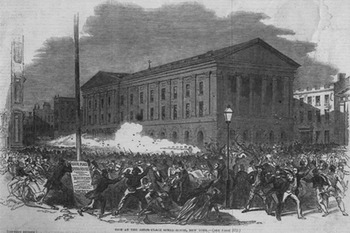
“Riot at the Astor-Place Opera-House,” New York. Wood engraving, 1849. Folger Shakespeare Library.

Astor Place Opera House reborn as the new “Clinton Hall,” “The New York Mercantile Library,” Scribner's Monthly, February 1871.

Clinton Hall provides an instructive closing vignette regarding this ascendancy. Following its damage in the riots (Figure 4), the Astor Place Opera House declined and observers advised its conversion to other uses; the Herald swiftly recommend that “the proprietors of Massacre Place Opera House convert it into a church.”Footnote 61 The Mercantile Library Association acquired the building in June 1850 and reopened it as the new “Clinton Hall” (Figure 5), with a lecture hall at the centre.Footnote 62 The institution that rose out of the ashes of the Astor Place Opera House symbolized a reorganization of urban space, the ascendancy of middlebrow culture through a medium that embodied aspiration ostensibly divorced from the troubling associations of elitism. As the 1850s opened, this civic enthusiasm for the lecture circuit was reaching its zenith. Though Clinton Hall was to decline as a venue once more during the Civil War, while it retained its status as a lecturing platform it was a symbol of a certain strain of urban civic nationalism in the North, an arena of multilevelled performances, whose complexity and agency we are only now beginning to comprehend.
Lecture reports immerse us in this oral culture. These artefacts were often deeply felt responses to a communal verbal experience, multimedia texts that broadcast oratorical events throughout the print media. Their reanimation allows for a fuller account of nineteenth-century performance culture: they lay bare the collective processes of meaning creation; they remind us that show events were not isolated, but embedded in a web of textual representations. Above all, they help to break down what Gustafson laments as “the sharp divide between printed texts and oral performances.”Footnote 63 Lecturing to a New York audience in 1854, Emerson spoke of “the silent revolution which the newspaper has wrought”; yet far from noiseless, the medium of print remained full of sound.Footnote 64 It is a world whose reverberations we perceive anew when attending to the methodical and instrumental words of spectators such as those listening to “England” at Clinton Hall.