


Ambition for office is the raw material of politics, the grist whereby electoral competition and office holders' accountability is assured. It lies at the heart of our understanding of democratic theory, explaining when, why, and how political elites respond to citizen interests. Accordingly, studies of a variety of countries and electoral systems link the political career aspirations of office holders to key political outcomes.1
See, for examples of research in various settings, Clarke and Price 1981 (Canada); Cox, Rosenbluth; and Theis 2000; Epstein et al. 1997 (Japan); Herrick and Moore 1993 (United States); Jones et al. 2002 (Argentina); or Santos 1999 (Brazil).
Despite the importance of political ambition, there is surprisingly little research that systematically examines the theoretical and empirical underpinnings of individual ambition, particularly the desire to progress from one political office to another.2
There is an extensive literature on candidacies that include some discussion of ambition (see Fowler 1993 for a review), but very few studies where progressive ambition serves as a dependent variable. An exception to this is the body of research on gender and career ambition. See Fulton et al. 2006 for a review of this literature.
We propose a significant revision to the decision model commonly used to explain lower office-holders' choices to seek higher office. We separate the decision into a two-stage process where the formation of ambition for higher office is a distinct stage that precedes the decision to run. Our interest is in developing and testing a general model that relates progressive ambition to characteristics of the lower office, to the strategic opportunity to win higher office, and to the personal characteristics of office-holders. We also explore how lower office conditions mediate the translation of ambition into a decision to enter a race for higher office.
The immediate locus of our research is state legislators' ambition to move to the U.S. House of Representatives. We surveyed a national sample of state legislators to examine their perceptions of institutional, strategic, and personal factors that might influence their ambition or their candidacy decisions. With these data, we can directly test a number of causal assumptions that have gone untested in previous research. Although we develop the two-stage model in the context of progressive ambition in the United States, our argument applies to any multilevel political system where politicians in one office might aspire to hold another.
STATE LEGISLATURES AND THE PUZZLE OF PROGRESSIVE AMBITION FOR THE U.S. HOUSE
State legislatures have provided the dominant pathway to the U.S. House. For example, over half of the members of the 2002 House held office in a state legislature prior to winning their congressional seat. At the same time, however, relatively few state legislators run in any given year. In 2002, only 45 U.S. House races nationwide attracted a state legislator as a candidate, from among over 7500 individuals holding that office.3
Data compiled from various issues of CQ Weekly during the period of 2001–2002.
An obvious answer is that few races are competitive in any given election. However, this poses a “chicken-and-egg” problem because more races might have been competitive had an experienced, well-funded state legislator decided to run. Certainly, we expect the prospects of winning to weigh heavily on the minds of state legislators who are considering a run for higher office. But, focusing on prospects alone does not address the more fundamental question of whether state legislators want to move up. If progressive ambition rests on more than just the anticipation of a competitive race, then year-to-year changes in prospects of winning that arise from national political or economic tides or a variety of local conditions may fail to stimulate experienced challengers to run. Thus, we turn to a broader question about the formation of progressive ambition and we distinguish it from the subsequent decision to run. How do personal and institutional factors, independent of and in conjunction with competition for office, shape state legislators' ambitions and their decisions to run for the U.S. House?
We pay particular attention to how lower office characteristics influence state legislators because previous research presents an intriguing puzzle. Scholars of state legislatures uniformly agree that increases in legislative professionalism over the past few decades have made long-term service in some state legislatures more attractive (e.g. Berkman 1994; Squire 1988a). At the same time, scholars offer mixed views when speculating whether professionalization might affect the pool of candidates for higher office. On one hand, professional legislatures are full time, which allows ambitious individuals to focus on politics as a career. As a result, they develop campaign skills, policy expertise, and a base of supporters to help them move from one office to the next. Fiorina (1994, 312) and Berkman (1994, 1051) both speculate that increases in professionalism could increase the pool of strong potential candidates for the U.S. House, but might also elevate partisan biases that exist in state legislatures to the national level. Moreover, this process may be exacerbated by the introduction of term limits which force politically ambitious legislators out of lower office.
On the other hand, professionalization may reduce the size of the U.S. House candidate pool because professionalized institutions offer members an attractive long-term political career in the state legislature. The increasing array of policies devolved to the state, combined with increases in legislative staff and policymaking resources, allow members to fulfill many of their partisan or personal policy goals at the state level. Professional legislatures, then, may become for many the destination rather than a rung to higher office (Berkman 1994; Squire 1988a, 1988b).
RUNNING FOR HIGHER OFFICE: A TWO-STAGE DECISION PROCESS
To identify how professionalism influences progressive ambition and the decision to run, we begin with a theory of progressive behavior. The common approach pits the expected utility of retaining the current, lower office—E(Ul)—against the expected utility of winning a higher office—E(Uh) (Black 1972; Rohde 1979).

Here, p is the probability of winning the election, B is the value of the target office, and C is the cost of running for office. When the expected utility of winning a higher office exceeds the expected utility of winning the lower office, an ambitious politician will attempt to move to the higher office.
A key assumption that is commonly used in this model is that politicians place enough value on holding higher office that they would attempt to move up if doing so were costless and riskless (e.g., Rohde 1979). In other words, scholars assume that politicians are progressively ambitious because “higher” office provides greater status, salary, or territorial jurisdiction than “lower” office (Francis and Kenny 2000). This assumption is problematic, however, because the attributes of higher office that scholars deem attractive may not be given the same value by those holding lower office. For example, some lower office holders may view policy jurisdictions of their own office as more rewarding than the jurisdictions associated with the higher office. If so, they might not be tempted by the higher office, regardless of costs or risks. This is an example where we could not assume that the difference between Bh and Bl is sufficient to induce progressive ambition.
Perhaps more important, however, is the implicit assumption that all lower office-holders make this sort of utility comparison each time a race occurs. Theoretically, this assumption suggests that all state legislators should be responsive to short-term variation in the political environment that affect ph, such as incumbent missteps or shifts in national political tides. However, in-depth interviews with state legislators and other potential candidates suggest that only those with a high level of ambition are willing to bear the costs associated with seriously considering a run for higher office, for example, assessing their prospects, ph, for a given race (Fowler and McClure 1989; Kazee 1994).
The two-stage model we propose distinguishes between ambition formation and the decision to run. In our model, only individuals who are sufficiently attracted to the higher office move to the second stage of the decision process and expend the resources necessary to explore whether to run in a particular election or await a better opportunity. We see the formation of progressive ambition as an important step to isolate in order to understand how institutional and individual characteristics nurture the ambitions of future leaders. Our conception of the process differentiates the general costs, benefits, and prospects associated with running for higher office from the specific costs and prospects of running in a particular race.
We define progressive ambition as the general attraction one holds for a career in a different political office than the one he or she currently holds, apart from a specific intent to run in a given year. We treat ambition as causally prior to the decision to run in a particular race; we think it unlikely that the decision to run precedes the evaluation of the attractiveness of higher office. Of course, this conceptualization does not preclude the possibility that the political opportunity structure or other strategic variables affect the attractiveness of office. As Schlesinger (1966) points out, political hopefuls direct their ambitions toward offices that are obtainable. However, opportunity alone is insufficient to create ambition. Instead, ambition for higher office stems from a combination of factors, many of which are personal assessments about the costs and benefits of moving up. These costs and benefits affect ambition, rather than the immediate decision to enter a particular race.
Like Black (1972), we see ambition as a function of an expected utility calculation, but we suggest that the calculation rests on relatively stable cost-and-benefit comparisons rather than the attributes of a particular race. Many costs of running for the U.S. House and holding office are known well in advance and vary little from one election to the next. General costs such as time away from family, a move to Washington DC, and the grueling schedules associated congressional life are all part and parcel of a congressional career. Individuals evaluate their attraction to a House career with these factors in mind. Similarly, individuals assess their attraction to a House seat with a general view of the prestige or effectiveness of the House as an institution, and with a general sense of the competitiveness of their district. These factors, in other words, are intrinsic to a congressional candidacy and bear on individuals' general attraction to the House rather than on their decision about whether to enter a particular race.
Specifically, we argue that the attractiveness of an alternative office stems from potential candidates' general, or long-run, chances of winning that office (pgen), their marginal expected gain from the target office (Bmarg), and the marginal costs of running (Cmarg).4
We make the simplifying assumption that lower-office holders believe they can win reelection to their own office, thus lower office chances are not a source of variation in ambition formation.

Progressive ambition, then, is a function of the expected utility of the alternative office, E(UA). Only those who find that the intrinsic benefits outweigh the intrinsic costs move to the second stage of the decision process—the choice about entering a particular race. Those who find that the costs of attaining the higher office outweigh its potential benefits pursue different career avenues. Because they find a House career unattractive, national or local circumstances that may create an opportunity in a given race do not encourage them to run.
We depart markedly from Black (1972) and others in our conceptualization of the second stage of the candidate entry decision in that ours is not an expected utility model. We argue that the strategic choice to run is not about whether to run; it is a choice about when to run. Those who enter the second stage have already crossed a threshold level of ambition; the general costs and benefits of running for higher office are not a significant influence on the decision to enter a race. Instead, ambitious potential candidates weigh the conditions that tend to shift from race to race:

For instance, potential candidates' electoral prospects for a given race (pt) change dramatically if the incumbent retires or dies and this affects when it makes sense to run. Those who view their prospects as high are more likely to run than those who view their chances as low. Similarly, the immediate cost (Ct) of giving up one's current position to run for higher office may loom large for office-holders but decrease as they approach term limits in office. Progressively ambitious potential candidates always have the option of waiting for a more opportune race; thus there is a temporal dimension to the choice (see Banks and Keiweit 1989). Those who view their long-term prospects of securing a seat as high may require greater odds in the impending race to enter.
In contrast, those who did not form ambition for higher office in the first stage do not respond to variations in the prospects or costs associated with the upcoming race. They simply do not run:

Separating the decision process into two stages is important from both a theoretical and an empirical standpoint. Our theory contends that the factors influencing the formation of ambition are fundamentally different from those driving the decision to run. Therefore, we must explicitly identify how and whether relevant costs, benefits, and prospects influence each stage in the decision process before we can formulate hypotheses about the direct and indirect effects of lower office professionalism. Empirically, if different ambitions lead to different decision processes in the second stage, pooling ambitious and nonambitions potential candidates into a single statistical model of entering a House race will result in biased and misleading findings for both groups. For example, if we are correct that short-term forces such as partisan political tides or incumbent behavior affect only those with ambition, the results from pooling both groups would systematically underestimate the effects of short-term forces for the ambitious while overestimating the effects for the nonambitious.
THE ROLE OF STATE LEGISLATIVE PROFESSIONALISM
Although scholars of congressional elections often distinguish between the qualities and the behavior of office holders and non-office-holders, they do not typically make distinctions among individuals who hold the same type of elective office (Bianco 1984; Bond, Covington, and Fleisher 1985, Jacobson and Kernell 1981). Instead, they assume that legislators who hold a seat in New Hampshire's citizen legislature are equally equipped to mount a House campaign as members of California's highly professional legislature. Moreover, they assume that state legislators in professional and nonprofessional institutions respond identically to changes in the competitive environment.
In contrast to the assumption that all state legislators (and legislatures) are alike, there is reason to believe that the electoral experiences and institutional resources associated with serving in professional legislatures result in members developing substantially different skills and career goals. Squire (1988a, 1988b) links the qualities of state legislative institutions to the development of static and progressive ambition. He finds that professional institutions with strong external career paths promote progressive ambition and have higher turnover. In contrast, legislatures with strong internal career paths and fewer external opportunities promote static ambition and have lower turnover.
Berkman (1994) finds that states with more professional legislatures generally have a higher proportion of freshmen House members with state legislative experience than states with nonprofessional legislatures, particularly among Democrats. But in a later article, Berkman and Eisenstein (1999) show that U.S. House races in states with a professional legislature are more likely to have House candidates emerge from outside the state legislature. This suggests that professionalism may dampen the ambitions of state legislators, their willingness to run, or both. However, they also find that when state legislators do run they are more successful than their counterparts from less professional legislatures at raising money and gaining votes. Although both articles provide evidence that state legislative professionalism shapes House candidacies, neither provides a clear view of the mechanisms through which this occurs.
We build on these and other studies and link legislative professionalism to four elements in the model outlined previously: the personal motivations of members (M), the marginal benefit of moving from the statehouse to higher office (Bmarg), chances of winning higher office (pgen), and the marginal costs of running (Cmarg). In addition, we expect service in a professional legislature to alter legislators' responsiveness to the strategic conditions surrounding specific races.
Legislative Professionalism and Progressive Ambition
We expect legislative professionalism to have offsetting effects on the ambition stage of the decision process, which makes it impossible to predict a net effect from the theoretical model alone. But tracing the expected paths of influence allows us to set up testable hypotheses to resolve the question empirically.
The positive effect of professionalism stems from the ability of professional institutions to attract skilled campaigners and career-oriented politicians. Individuals who are younger and interested in pursuing politics as a career find the full-time work of a professional legislature appealing (Francis and Kenny 2000; Squire 1988b). Because they come to office with greater ambition, they are also more likely to look to higher office as an avenue to express that ambition.
Perhaps more importantly, professional legislatures allow career-oriented politicians to build a portfolio of skills and resources that enhance their prospects for winning a U.S. House seat. Black (1972) argues that ambition reflects investments in a political career, noting that office-holders are most likely to form ambition for offices that capitalize on their past investments. But the value of the investment for a House candidacy depends on the characteristics and resources of the state legislature. It is generally more difficult to win office in a professional legislature, which results in greater investment in the development of fund-raising and campaign skills. State legislative candidates in professional institutions typically raise hundreds of thousands of dollars, hire professional consultants, and campaign through both mass and targeted media (Berkman and Eisenstein 1999; Hogan 2001; Moncrief and Thompson 1997). In contrast, candidates for seats in nonprofessional institutions raise much less money and often rely on friends and family as campaign staff. Once in office, the disparity continues as those who serve in the most professional institutions have staff and other resources at their disposal to help them stay in office, contact constituents, provide constituency services, and build visible records, all of which might help to build a base to run for higher office (Berry, Berkman, and Schneiderman 2000; Cox and Morgenstern 1993).
In our model, then, legislative professionalism influences ambitions indirectly by encouraging legislators to invest in the skills that increase their general prospects of winning a House seat (pgen). Moreover, it is likely that members of professional legislatures see the marginal costs of competing in a House race as less than those in nonprofessional legislatures because the campaign process to win a professionalized seat more closely resembles running for the U.S. House (Cmarg). Of course, these positive effects are offset by the opportunity costs of giving up such a desirable post.
The positive effects of professionalism on ambition may be offset by the opportunity costs of giving up a relatively desirable post and by reducing the relative value legislators place on a U.S. House seat. A key comparison in the formation of ambition is the value of the higher office compared to the lower office. It is likely that members of professional institutions value their own position quite highly—perhaps even more highly than they value a U.S. House seat. Professional institutions provide a work environment that is more similar to the U.S. Congress (Squire 1988b). As a result, the marginal benefit of moving from the state legislature to the House (Bmarg) even for those who prefer a House seat over their state legislative office should be smaller for members of more professional institutions and might fail to outweigh the costs associated with seeking and holding a seat in the House.
Legislative Professionalism and the Decision to Enter a Race
Apart from influencing ambitions, how might professionalism affect the decision to enter a specific U.S. House race? Previous research indicates that experienced politicians are more sensitive to the strategic environment than amateur politicians because they are reluctant to risk their reputation or seat on an uncertain race (Banks and Kiewiet 1989; Canon 1990; Krasno and Green 1988). This is partly a matter of opportunity costs: experienced candidates do not want to make the sacrifice unless their chances of winning are strong. Although most studies focus on the differences between office holders and nonoffice holders, a similar logic may apply to state legislators. When the chances of winning the race are low, legislators who have the most to lose—those in the most professional institutions—should be the most reluctant to jump into the race (Berkman and Eisenstein 1999).
If professional legislators are less likely to run when their prospects are poor, are they also less likely to run when their prospects are good? An explanation that centers on opportunity cost alone might suggest so, but we argue that legislators' prior investments in campaign skills combined with office resources affect the ease with which they can respond to an opportunity. Thus, it is not simply that professional legislators have developed skills and resources that increase their chances of winning; they are also more nimble in deploying those skills and resources when an opportunity arises. Professional legislators have developed networks of campaign donors and relationships with professional campaign personnel, they are familiar with local media practices, and they have utilized their office staff in building a constituent base for their current office. These investments in their political careers—particularly in campaign skills—can help them quickly build the visibility and financial backing necessary to run a strong race if the opportunity presents itself. As a result, when odds become more favorable, legislators in professional institutions should face fewer transaction costs associated with stepping from the state legislative ring into a U.S. House campaign. This should produce an interactive effect between the chances of winning (pt) and lower-office professionalism, where small changes in the strategic context of a race lead to larger changes in chances of running for legislators in professional legislatures.
In a broader sense, evidence of an interaction between professionalism and prospects for victory would indicate that professionalism increases the responsiveness of the strongest potential candidates in state legislatures to the changing political climate. If so, professionalism enhances accountability in U.S. House campaigns by increasing the odds that a strong challenger will emerge from the state legislature when voters become dissatisfied with the status quo.
EMPIRICAL ANALYSIS
We test our hypotheses using data drawn from a survey of state legislators whose districts overlap with 200 randomly selected U.S. House districts in 41 states.5
During fall 1997 and spring 1998, we mailed a nine-page questionnaire to 2,714 legislators. A total of 874 responded, for a response rate of 32.2%. Logit analysis indicates the following response biases (p <.05): legislators in professional legislatures, Democrats, upper-chamber members, and those surveyed during the winter are underrepresented; those with longer service, term limits, and in marginal U.S. House districts are overrepresented. We weight all descriptive statistics by the inverse of the probability of response. Our multivariate models include statistical controls for the factors associated with response bias. The data are drawn from the 1998 wave of the Candidate Emergence Study, NSF SBR-9515450. Details of the full study can be found at http://ces.iga.ucdavis.edu/ or in Stone and Maisel 2003.
The few studies at the individual level have relied heavily on interview data and a small number of cases, making it difficult to generalize their findings (Kazee 1994; Fowler and McClure 1989).
The survey was administered in the months just prior to the filing deadline in each state and asked state legislators about their general interest in seeking a House seat, the likelihood they would run in 1998 or at some point in the future, and the likelihood that they would win if they were to run. In addition, we sought their views on characteristics of their House district, their evaluations of the incumbent, their perceptions of their own strengths and weaknesses as potential candidates, and their motivations for seeking office. We employ Squire's (2000) index of legislative professionalism to identify legislators in the top and bottom quartiles. The index measures the similarity between each state legislature and the U.S. House on three dimensions—salary, staff, and days in session. Those in the top quartile are full-time, well-paid legislatures with professional staff; those in the least professional legislatures are part-time, have low pay, and little or no support staff.7
Legislatures in the second and third quartile vary in these attributes and do not lend themselves to clear classification as “professional” or “nonprofessional.” Accordingly, we focus on examining differences between those at the ends of the scale.
Modeling Progressive Ambition and the Chances of Running
We use two ordered probit selection models to capture the two-stage process outlined in our theory: the first stage models ambition for a House seat; the second stage models the decision to run in 1998, given legislators' ambitions.8
An alternative approach is to run a single model for the whole sample that interacts ambition with all independent variables in the decision to run model. However, if unmeasured factors influence both ambition and the decision to run, ambition will be correlated with the error term leading to biases in estimating the coefficients for interaction terms.
Second, the models correct for biases in the decision-to-run stage that arise from self-selection into one of the categories of ambition. The empirical model captures many of the cost-benefit components associated with ambitions for a House seat. However, there may be other factors we have failed to include that influence both stages of the process, some of which may be psychological components of progressive ambition that are unmeasured (and perhaps unmeasurable). If so, the errors between the two stages will be correlated and coefficients in the second stage may be biased. The selection model corrects these biases and estimates the correlation of the errors between stages, ρ.
Legislators are categorized as progressively ambitious based on their response to a survey question asking them their level of attraction to a U.S. House career. Those who describe their attraction as “extremely low,” “low,” or “somewhat low” form the group of nonambitious legislators. Those who indicated their attraction was “neutral,” “somewhat high,” “high,” and “extremely high,” form the group of ambitious legislators.9
We also experimented with the “neutral” category in the non-ambitious group rather than the ambitious category. The substantive results are nearly identical in both models. In the end, we decided that it made more sense to include those who expressed anything less than low attraction in the unambitious group.
The dependent variable for the second stage is legislators' reported chances of running for the U.S. House in 1998. Because this is a prospective measure based on a survey prior to the filing date in each state, it does not indicate whether the candidate actually ran in 1998.10
Only six respondents actually ran in 1998.
EXPLAINING PROGRESSIVE AMBITION
Our model allows us to identify the size and significance of personal, institutional, and electoral influences on ambition for a House seat. We include measures of the long-term opportunity to win a House seat, the relative evaluation of the U.S. House to the current seat, and the costs associated with running for and serving in the U.S. House. We also include controls for party, gender, age, risk orientation, and personal motivations for entering politics.11
We assessed respondents' risk orientation with a survey question asking about their level of comfort in making risky financial and career decisions. Those who responded that they were “very comfortable” or “somewhat comfortable” were coded as risk acceptant. To measure personal motivation, we asked respondents to assess the importance of various reasons for their involvement in politics. We include a “personal motivations” measure that indicates the average importance of the importance of “making social contacts,” “making business contacts,” and the “excitement of politics” for individuals' involvement in politics.
The opportunity to win a House seat is central in the formation of ambition. Although opportunity structure is often measured through such objective criteria as the number of higher office seats available per member or the competitiveness of district vote, the survey data allow us a unique view of potential candidates' subjective views of the opportunity in their district. Arguably, it is those perceptions rather than the objective indicators that are essential to the formation of progressive ambition.
To measure the long-term opportunity to win a House seat, we asked state legislators to estimate their chances of winning the nomination if they ran in the foreseeable future and their chances of winning the general election if they won the nomination. Each of the two responses is scaled as a “pseudo-probability” ranging from .01 (extremely unlikely) to .99 (extremely likely), with .5 indicating a toss up. Because winning office requires candidates to win both the nomination and the general election, we multiply the nomination chances and the general election chances to capture each potential candidate's view of his or her chance of winning the seat in a future race. These long-term prospects for winning reflect relatively fixed district demographics as well as legislators' views of their own skills and resources as campaigners.12
Analysis (not shown) reveals that this measure is related to such structural factors as the number of state legislators whose districts overlap with the U.S. House district in their area, perceptions of district party composition, and the professionalism of the state legislature. It is not related to race-specific factors such as whether the seat was open in 1998 or whether the legislator was in the same party of the sitting incumbent. See note 20 for further discussion.
We also control for the opportunity structure by including a measure of each potential candidates' perception of the district partisan balance and a measure of party recruitment efforts. We expect potential candidates who view the district structure as favorable to be more ambitious for a House seat. We also expect party recruitment to shape potential candidates' views of the opportunity structure. Party contact signals a commitment to winning a district and may cue potential candidates that party leaders view them as strong potential candidates. We asked legislators to indicate whether they had been contacted by their local, state, or national party about running for the U.S. House and use the sum to capture the degree of party encouragement.
How one views the House as an institution is also essential to the formation of ambition for a House seat. Yet, it is not simply a question of whether the House is valued as an institution, but whether the legislator assigns a greater value to the House than to his or her current office. We asked legislators to assess the prestige and effectiveness of a career in the U.S. House, as well as the legislature in which they currently serve, using a seven-point scale ranging from extremely low (−3) to extremely high (+3). We combine these two items—prestige and effectiveness—to form an evaluation score for each office, and the difference between the evaluation scores provides a measure of the personal assessment of the relative value of the House compared to the current office. The overall average relative evaluation is slightly negative, with 59% of state legislators rating their own office higher than a U.S. House seat. At first glance, the number of state legislators who evaluate their own office as higher seems surprising, given that the House offers greater salary, resources, and policy jurisdiction than do state legislatures. However, respondents' evaluations are shaped by a number of personal factors apart from the institutional characteristics of the two offices, such as majority status, partisan assessments, and length of service. For our purposes, the most important relationship is the link between lower office characteristics and evaluations. Sixty-one percent of those in the most professional institutions view their institution more favorably, as compared to only 52% of those in the least professional legislatures (p <.05).
Even individuals who view the House as a prestigious and effective venue for public service may be unwilling to bear the opportunity costs associated with running for and holding a House seat. Because many members serve in institutions where seniority is rewarded, and because professional state legislatures offer greater perquisites and opportunities to pursue policy goals, we expect those in more professional institutions and those who have served for long periods in office to evaluate those costs more highly. Term-limited legislators, to the contrary, may view the opportunity costs of losing the seat as lower because they will be forced out of office in the near future (Lazarus 2004).13
Previous research on term limits suggests that legislators may exit early to run for higher office as term limits approach (Carey, Neimi, and Powell 2000; Lazarus 2004). Our measure reflects this dynamic by scoring as term limited those facing limits in 1998 or 2000. Because so few respondents faced term limits in each year, it is impractical to separate out the two years.
Beyond the opportunity costs of giving up a current seat, running for and holding a U.S. House seat requires a substantial commitment in time, money, and personal stress. We constructed a “family cost” index from responses to items assessing how much the “loss of personal and family privacy,”“loss of leisure time,” and “separation from family and friends” discourage a state legislator from running for the U.S. House.14
Using a 4-point scale ranging from “makes no difference” to “strongly discourage,” we asked respondents to indicate whether each factor discouraged them from running for a U.S. House seat.
Table 1 presents the results for the selection portion of the model. Although we estimate the selection and outcome models simultaneously, we discuss the results for each stage separately.15
For the selection model, we present the only the estimates from the model of those who are ambitious. The selection model for ambition = 1 and the selection model for ambition = 0 are both estimated on the full sample and are substantively identical.
Because 82% of legislators were not contacted by their political party, the 25th and 75th percentiles are identical. Thus, we vary this variable by one category.


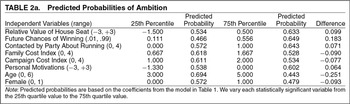
The largest effect stems from age, as older state legislators are much less likely to be ambitious for a U.S. House seat than their younger counterparts. The predicted probability of being ambitious for those in the 60 to 64 age range is .25 less than those in the age range of 40 to 49 age range. This result is consistent with the hypothesis that those nearing retirement age are less interested in starting a new and challenging career in another political office. Legislators who come to office late in life after private sector careers might see the state legislature as the pinnacle of their political aspirations.
The second largest effect stems from differences in how legislators perceive their future chances of winning a U.S. House seat. The probability of ambition for those who view their future chances as quite low is only .46, whereas the probability of being ambitious for those who view their chances of winning as relatively high (just over 50/50) is nearly .65. Schlesinger (1966) argued that opportunity structure is central to the formation of ambition because people are rarely ambitious for the unattainable. Our results are consistent with this expectation. However, optimistic future prospects are neither necessary nor sufficient for the formation of progressive ambition. Setting the prospects variable to zero, its theoretical minimum, does not result in a near zero predicted probability of being ambitious. Likewise, setting it to one, its theoretical maximum, does not yield a predicted probability that approaches one. Thus, ambitions may flourish when the prospects of obtaining higher office appear hopeless, and ambition is not certain even if the prospects of winning appear to be guaranteed.
The sizable effects of other variables in the model highlight the importance of looking beyond the opportunity structure for explanations of ambition. Evaluation of the relative effectiveness and prestige of political institutions alters ambitions for higher office. Legislators who evaluate their own office more highly than the U.S. House are less likely to harbor attraction to a career in the U.S. House.17
It is possible that those who see their chances of obtaining a House seat as small rationalize that their own office is better than a House seat. However, contrary to this hypothesis, the correlation between future chances of winning and relative evaluation of the U.S. House is small and negative (−.08).
Legislative Professionalism and Ambitions
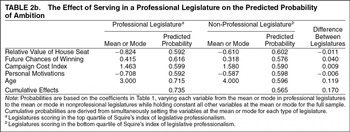
A central question is whether state legislative professionalism enhances the pool of potential candidates by increasing legislators' ambitions for a U.S. House seat. Table 1 provides no evidence of a direct effect of legislative professionalism on ambition; the coefficient is correctly signed, but insignificant. However, this is not to say that state legislative professionalism has no impact. Because professionalism is associated with legislators' assessments of future chances, relative evaluations of the prestige and effectiveness of the U.S. House, age, and assessments of the costs of campaigning for the House, we also consider whether professionalism has indirect effects. In other words, if institutional professionalism has implications for the characteristics and perceptions of its members, these differences may indirectly lead to a gap in House attraction between professional and nonprofessional state legislators. Table 2b evaluates such indirect effects by calculating the predicted probability of being ambitious based on mean or mode of each variable for legislators in professional institution, compared to legislators in nonprofessional institutions, holding all other variables at their sample mean or mode.18
We compare only those variables that were significant in the model and for which a difference of means test between professional and nonprofessional legislatures is significant at p <.10. The direct effect of legislative professionalism in the ambition model is not statistically significant at conventional levels, and we treat the direct effect as 0 when predicting probabilities.

Lower-office professionalism has both positive and negative effects on variables that help account for ambition. Differences in age between members of professional and nonprofessional state legislatures generate the greatest gap in the predicted probability of being ambitious. Professional legislatures with full-time pay tend to attract younger members, and younger members are more ambitious for the House. In addition to age, legislators who serve in the most professional institutions view their chances of winning nearly a full .10 higher than those in nonprofessional legislatures, leading to a .04 increase in the predicted probability of being ambitious. Serving in a more professional institution makes a higher office seem more attainable, and the enhanced prospects of securing a seat at some point in the future makes a U.S. House seat a more attractive and viable career goal.
The independent effects of the remaining factors, such as costs and personal motivations, are quite small. Legislators in professional institutions are, on average, slightly less discouraged than those in nonprofessional legislatures by the costs associated with campaigning for the House, but this difference provides only a .009 boost to the probability of ambition. Legislators in professional institutions are less likely to indicate that they entered politics for such personal motivations as the excitement of politics, or for business and social connections, but this difference likewise has only a slight effect on progressive ambition.
Because professionalism both stimulates and deters progressive ambition, the only way to assess the cumulative effect of lower-office characteristics on ambitions is by comparing the overall predicted probabilities for members in each type of legislature. The bottom row of Table 2b shows the cumulative effect of setting all variables in Table 2 at their mean or mode for each type of institution. The predicted probability of being ambitious for members of professional institutions is .735—fully .17 higher than those in nonprofessional institutions. Although state legislative professionalism has both positive and negative effects on ambition, the benefits that accrue from attracting younger members and giving them experience running tough campaigns outweigh the opportunity costs associated with leaving the state institution. As a result, professionalism provides a net gain to the pool of potential House candidates from a state's legislature.
EXPLAINING CHANCES OF RUNNING IN 1998
Progressively ambitious legislators move to the second stage of the decision process—the decision about whether to enter the 1998 House race. In this stage, potential candidates weigh their prospects in the current race against their long-term prospects for winning a House seat and against the immediate costs of giving up their position. We test whether legislators in professional institutions are more responsive to their prospects than those in unprofessional institutions by including an interaction between legislative professionalism and prospects of winning in the current race. The model also includes controls for age, gender, risk orientation, personal motivations for entering politics, and legislators' assessments of the quality of the incumbent, all of which may shape the decision to run apart from strategic considerations.
We assess the “now versus later” aspect of the decision process by including measures that tap how legislators perceived their chances of winning in 1998 as well as their assessment of their general chances of winning.19
Like long-term prospects, we measure chances of winning in 1998 with questions asking potential candidates to estimate their chances of winning the nomination in 1998 if they were to run and general election chances if they were to win the nomination. Prospects for winning the seat, then, are computed as the nomination prospects X general election prospects.
Although modeling the 1998 chances of winning and the long-term chances of winning is beyond the scope of this paper, it is worth noting that factors that stay relatively constant, such as campaign skills of legislators, the number of legislators per house seat, legislative professionalism, and district partisanship significantly affect long-term chances of winning, but the presence of an open-seat race in 1998 and the party of the incumbent do not. In contrast, incumbency factors dominate chances of winning in 1998. Open seat and incumbent party are strongly related to prospects in 1998, but district partisan structure and legislative professionalism have no independent effect. Legislators' evaluations of incumbent prospects influence both future and immediate chances of winning, and the beta coefficient for immediate chances (−.20) is nearly triple the effect on future chances (−.07). Results of this analysis are available on request.
The other component of the entry decision is the expected costs of running. State legislators who hold leadership positions, those who would move from majority status at the state level to minority status in the U.S. House, and those with more seniority in their current positions are likely to view the immediate opportunity costs of running as high. Of course, those facing term limits face lower opportunity costs of running since they must give up their seats in short order. We also include the “family cost” and “campaign cost” measures from the ambition stage, but we are skeptical of their importance in the second stage. Although such measures are typically cited as reasons for staying out of a race, we argue that this occurs at the level of ambition formation rather than the decision to run. Nevertheless, we include these as a means of testing our expectation that ambitious state legislators have accepted and discounted these costs of running.
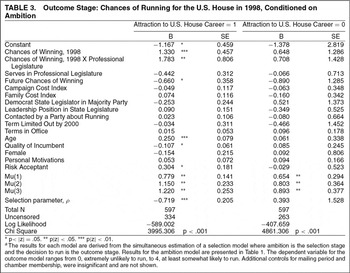
Table 3 supports our view that progressive ambition is a necessary precondition for office holders to assess the strategic conditions surrounding a specific race. Only legislators with ambitions for a House seat are influenced by their chances of winning in 1998. Incumbent missteps or unfavorable national political and economic tides that tend to boost the prospects of potential candidates do not lure the unambitious into the ring. When lower-office conditions and other factors shape ambitions, then, they also affect the potential candidate pool that might respond to changes in the quality of representation provided by incumbents and their parties.

The results make clear that the principal decision for ambitious legislators is whether to run in a particular race or wait. Costs that played a key role in the formation of ambition have no effect on the decision of when to run. Instead, ambitious legislators weigh their immediate prospects against their odds in future campaigns as they consider whether to run. Those who perceived their chances of winning in 1998 as high were much more likely to enter the race than those who perceived their chances as low. At the same time, those who perceived their chances of winning a future race as high were more likely to wait. Indeed, the higher a legislator perceives the future odds, the greater the current odds must be to compensate and induce a run. Finally, we note the significant coefficient for the risk orientation variable. Rohde (1979) argued that legislators who are risk acceptant would need a lower probability of success to enter a race and our findings provide additional support for this. Legislators who feel “very” or “somewhat comfortable” taking risks in their careers are more likely to run than risk-averse legislators with the same probability of victory.
Thus far, we have found that professionalism affects ambition, and through ambition, who is willing to weigh the strategic conditions that surround a specific race. But how does professionalism affect the chances of running? Lower office professionalism interacts with the strategic environment, but we find no evidence that professionalism affects the chances of running, independent of the strategic environment. In addition, there is no indirect effect of professionalism on the decision to run through other variables in the model. Legislators who cross the ambition threshold are remarkably similar in their characteristics regardless of the type of institution in which they currently serve. Differences that were apparent when pooling all legislators, such as age, long-term prospects, and so on, evaporate when looking only at the ambitious. Legislators in highly professional institutions rate their long-term chances, on average, at .44, whereas those in nonprofessional legislatures rate their chances at .41. Chance of winning in 1998 also has only a slight gap; nonprofessional legislators rate their chances at .12, whereas those in professional institutions rate their chances at .17, but the difference is not large enough to be statistically significant.
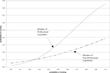
In contrast to a direct, additive effect of professionalism on the chances of running, the principal effect of lower office professionalism is interactive. Not only does professionalism increase the probability that an individual state legislator will enter the pool of potential candidates, but also it increases his or her responsiveness to the strategic environment surrounding each race. Figure 1 graphs the relationship between the chances of winning in 1998 and the chances of running. At very low chances of winning, legislators in professional institutions are unlikely to run. However, as their chances improve, the odds of entering the race increase at a faster pace, to the point that they are more likely to enter a House race than are nonprofessional state legislators facing the same odds.

Effect of Chances of Winning in 1998 on Chances of Running
As we argued earlier, we believe this effect stems from the fact that legislators in the most professional institutions have invested in political resources that are more easily transferred to a U.S. House campaign. Legislators in professional institutions have already developed campaign contacts, fund-raising networks, media contacts, and a constituent base as a means of gaining and retaining their office. It is not only the experiences of a professional legislator, but also their ability to transfer relevant skills and resources that make the costs of running a House race less daunting for them than for legislators in nonprofessional settings. As a result, they can more easily respond to an opportunity than legislators in nonprofessional institutions who lack those resources.
Overall, the findings from this model point to ambitious candidates from professional and nonprofessional institutions who weigh carefully their present and future chances when considering when to risk a run for the House. Although legislators in both types of institutions rate their chances similarly, they respond to their prospects differently. Those in the most professional institutions are cautious when their prospects are poor but bold when their chances of victory are good.
DISCUSSION
Our analysis reexamines the sources of progressive ambition and highlights how ambition, in conjunction with lower office conditions, creates incentives for responsiveness in a multilevel electoral system. As Joseph Schlesinger (1966) asserted in his classic study, without the ambition of elites for elective office, citizens have no hold on their representatives' behavior. Similarly, without ambition for office and the risk-taking behavior required to mount a campaign, there would be no electoral competition, no matter how much voters might long for a choice, and no matter how much political scientists might extol competition as essential to democratic accountability.
Rohde (1979) assumed progressive ambition by asserting that all politicians would seek higher office if doing so was without cost or risk. In one sense, our model supports this assumption. After all, if we set our future prospects variable at 1 and our cost variables at 0, the model predicts a .92 probability of ambition for a House seat. But the real story is more complex because lower office characteristics help shape assessments of prospects and costs along with the relative benefits of higher office. Moreover, we show that opportunity alone is insufficient to stimulate ambition for higher office. State legislators who view the fixed costs of running for and holding a U.S. House seat as high and the relative benefits as low are unlikely to harbor progressive ambition, even if their long-term prospects of winning are strong. Indeed, with costs set at the maximum value and relative benefits set at the minimum value, the predicted probability of ambition for a House seat never exceeds .4, regardless of future prospects.
Our model further shows that progressive ambition mediates responsiveness to short-term shifts in the political environment—responsiveness that is necessary to generate a supply of high-quality, experienced candidates for U.S. House races. Indeed, it is this point that perhaps brings to light the greatest problem with the classic expected utility formulation of office seeking behavior: it fails to distinguish between short-term and long-term costs and prospects. As a result, analysis in this tradition suggests that fluctuations in short-term prospects can outweigh the costs of holding higher office or offset low relative benefits. In contrast, our research demonstrates that short-term prospects do not encourage a candidacy among those who lack progressive ambition. Those who see little net gain in moving from the state legislature to the U.S. House, or who see the costs of running for and holding higher office as prohibitive are uninterested in moving up and are unwilling to enter a race even if their prospects of winning the seat in the immediate race are high. Only a fraction of state legislators are ambitious for what scholars often assume is a more prestigious and influential U.S. House seat.
Our model has implications for how we view the prospects for representation in the political system as a whole. Systemic responsiveness depends in part on how short-term political changes translate into choices at the ballot box. Citizens respond primarily to the quality of candidates rather than to the specific national conditions; thus it is potential candidates' entry decisions that help channel national political conditions into competitive local elections (Jacobson 1989; Jacobson and Kernell 1983). Our research shows that long-term costs and benefits associated with various offices, along with relatively fixed features of the electoral environment, determine the willingness of potential candidates to assess and respond to the call of opportunities created by factors such as short-term national tides. This willingness, in the form of greater ambition, may in turn affect the size of the potential candidate pool in the state legislature, with professional legislatures generating larger numbers of ambitious potential candidates, taking opportunities offered by national tides, incumbent missteps, or other factors that affect potential candidates' risk. The number of state legislators in the candidate pool, moreover, is potentially important to the quality of representation in the system because state legislatures offer invaluable training grounds for future candidates and policymakers who eventually make the move to Congress. Members of Congress with state legislative experience, particularly in professional legislatures, exhibit greater policy mastery in Congress than do amateurs and are more likely to be assigned to policy and prestige committees (Berkman 1993). Thus, increasing the pool of candidates in professional institutions enhances the chance of well-prepared successors to current members of Congress. Nationally, larger pools of qualified candidates increase the odds that in any given race a strong candidate will emerge when conditions are favorable. Institutions and conditions that foster progressive ambitions increase the likelihood that opportunity will be translated into political outcomes.
The presence of strong and ambitious potential candidates can alter incumbents' assessments of the chances a strong challenger will run against them and hasten strategic retirements among incumbents who perform poorly. Political systems in which national offices are less attractive venues than local, state, or provincial offices will lack a broad pool of candidates willing and able to hold national leaders accountable in this way. A system that encourages ambitions by creating favorable opportunity structures and favorable conditions for serving in higher office also increases the number of watchful eyes over the activities of higher office-holders.
Our understanding of progressive ambition also speaks to choices leaders make on a daily basis. Previous research on legislators in the United States, Canada, Japan, and Brazil shows that progressively ambitious office-holders make decisions in office with an eye toward their future goals and constituents (e.g., Clarke and Price, 1981; Cox, Rosenbluth, and Theis 2000; Santos 1999). Closer to home, previous research shows that ambitious state legislators allocate more time and effort to communicate with constituents than do their colleagues who lack progressive ambition, and that their policy decisions reflect broad rather than narrow constituencies (Maestas 2000, 2003). As a result, professional “springboard” legislatures produce policy more consistent with statewide public opinion than nonprofessional, “dead-end” legislatures (Maestas 2000). Lower-office conditions that foster progressive ambition enhance the ties of representatives to the voters and parties that can help them achieve their long-term career goals.
Finally, our research has implications for how we think about state legislative professionalism. Legislative professionalism encourages and equips younger, career-oriented individuals to seek office, and stimulates their sensitivity to factors affecting the opportunity to advance. States that allow legislator salary to erode, limit legislators' terms in office, or reduce legislative resources may become less attractive to career-oriented, progressively ambitious members (Rosenthal 1998). Reducing the pool of progressively ambitious state legislators potentially reduces the prospects for representation at both the national and the state level.
The founding fathers set up a system of representation that requires and responds to political career ambitions. Although the concept of the “citizen-legislator” may be popular among voters, it is not clear that their interests are best served by creating institutions that attract politically unambitious members to short-term service. They may be better off fostering and channeling the ambitions of their representatives toward higher office. Our results show that the most desirable offices stimulate ambitions and create potential candidates better able to hold U.S. House members accountable.
We would like to thank Bill Berry, Tom Carsey, Chris Reenock, Jeff Staton, John Scholz, and Will Moore, as well as the editor and the anonymous reviewers for their insightful feedback and helpful suggestions. This research was supported by grants from the Carnegie Corporation of New York and from the National Science Foundation (SBR-9515450).




Comments
No Comments have been published for this article.