The transmission of multidrug-resistant organisms (MDROs) through regional patient care networks is well established.Reference Smith, Levin and Laxminarayan1,Reference Trick, Kuehnert and Quirk2 Recent multifacility studies have shown frequency of patient transfers between facilities to be a risk factor for increasing prevalence of MDROs, as well as Clostridioides difficile, in healthcare settings.Reference Barnes, Harris, Golden, Wasil and Furuno3–Reference Simmering, Polgreen, Campbell, Cavanaugh and Polgreen6 When patients colonized or infected with MDROs transfer between hospitals or between hospitals and other levels of care (eg, skilled nursing facilities, SNFs), the MDRO status of a given patient may not be communicated.Reference King, Gilmore-Bykovskyi, Roiland, Polnaszek, Bowers and Kind7–Reference Lin, Lyles-Banks and Lolans10 Consequently, implementation of transmission-based precautions may be delayed in facilities receiving transfers, which can increase the possibility of MDRO transmission at the receiving facility.Reference Polgreen and Segre11
Communication lapses between healthcare facilities can compromise patient safety when receiving facilities do not receive complete information on the patient’s condition or medications.Reference Ong and Coiera12 Interfacility transfer communication (IFTC) has been proposed as a strategy to limit the potential for MDRO transmission by alerting and preparing the receiving facility to implement appropriate infection prevention practices.13,14 Communication about patient infection status also supports antimicrobial stewardship by preventing future MDRO infections, thereby avoiding the adverse effects of antimicrobials.Reference Barlam, Cosgrove and Abbo15,Reference Tamma, Avdic and Li16 State and federal public health authorities support IFTC through recommendations, standardized tools, position statements, and laws.14,17,Reference Slayton, Toth and Lee18 Strategies to facilitate IFTC, barriers to implementation, and perceived impact of IFTC protocols, however, are poorly understood.
We have previously described compliance with an administrative rule requiring interfacility communication of MDROs and C. difficile among Oregon acute-care hospitals and SNFs.Reference Tamma, Avdic and Li16 In that study, more than two-thirds of hospitals and SNFs reported compliance with the IFTC protocol, but methods for compliance were heterogeneous, and less than half reported the use of a standardized method for transfer communication.Reference Ellingson, Noble and Tran19 Most jurisdictions in the United States do not have IFTC requirements. Therefore, in this study we surveyed acute-care hospitals participating in the Society for Healthcare Epidemiology of America (SHEA) Research Network (SRN) to (1) describe the prevalence of IFTC protocols across different hospital types; (2) assess differences in barriers to IFTC, frequency of notification of MDRO colonization or infection status to receiving facilities, and perceived impact of IFTC by presence of an IFTC protocol; and (3) describe methods for IFTC among hospitals with an IFTC protocol in place.
Methods
Survey development and distribution
The SRN is a consortium of acute-care hospitals collaborating on multicenter research projects of interest to the SHEA membership to identify knowledge gaps in healthcare epidemiology and to address those gaps by through data collection, analysis, and collective expertise.20 The survey was designed by a multidisciplinary group of clinicians and researchers affiliated with the SHEA Research Committee and guided by their experiences with interfacility transfers from clinical, public health, and research perspectives. The survey included sections on hospital characteristics, hospital network characteristics, methods for IFTC, barriers to implementing IFTC, and perceived impact of IFTC. The survey was reviewed by the SHEA Research Committee and the SRN leadership prior to deployment. The Oregon Health and Science University Institutional Review Board approved this study.
SHEA staff distributed the survey as an embedded link within an e-mail to 1 representative of each SRN hospital. The survey was sent to respondents who identified as either hospital epidemiologists, infection preventionists, or chairs of antimicrobial stewardship committees. Surveys were sent to both domestic and international SRN members from December 5, 2017, through January 24, 2018. Survey recipients were sent 3 reminders to complete the survey. Respondents completed the surveys online via Research Electronic Data Capture (REDCap).Reference Harris, Taylor, Thielke, Payne, Gonzalez and Conde21
Statistical analysis
We merged data collected in REDCap using a unique identifier with deidentified data containing hospital demographics for all respondents and nonrespondents provided by SHEA staff. In one instance, a response from a hospital was duplicated; we used the first response only for analysis. We then compared respondents to nonrespondents according to hospital size, academic medical center affiliation, and international location. We examined the statistical differences in the frequency of these characteristics using χ2 tests (Table 1).
Characteristics of 54 Respondents to the Survey on Interfacility Transfer Communication and 82 Nonrespondents From the SHEA Research Network (SRN)

Next, we assessed whether respondents reporting IFTC protocols in place at their hospitals (defined as responding “Yes” to “Does your facility currently have a protocol for communication of MDRO/CDI status when discharging patients to other healthcare facilities?”), differed significantly by hospital size (0–500 vs >500 beds), academic affiliation, whether the hospital was part of a network, and international status. Next, we examined differences in frequency of notification of receiving facilities at transfer, as well as perceived impact of communication about infection status upon transfer, by presence of a protocol using χ2 tests. We used a t test to evaluate the difference in the mean number of barriers reported by respondents from hospitals with and without IFTC protocols in place. We then examined differences in frequency of 8 standardized barriers reported by respondents from hospitals with and without IFTC protocols using χ2 tests. Finally, for facilities with IFTC protocols in place, we examined the use of specific strategies and responsibilities among staff and departments for communicating and receiving information at transfer. All data management and analyses were conducted using SAS version 9.4 statistical software (SAS Institute, Cary, NC).
Results
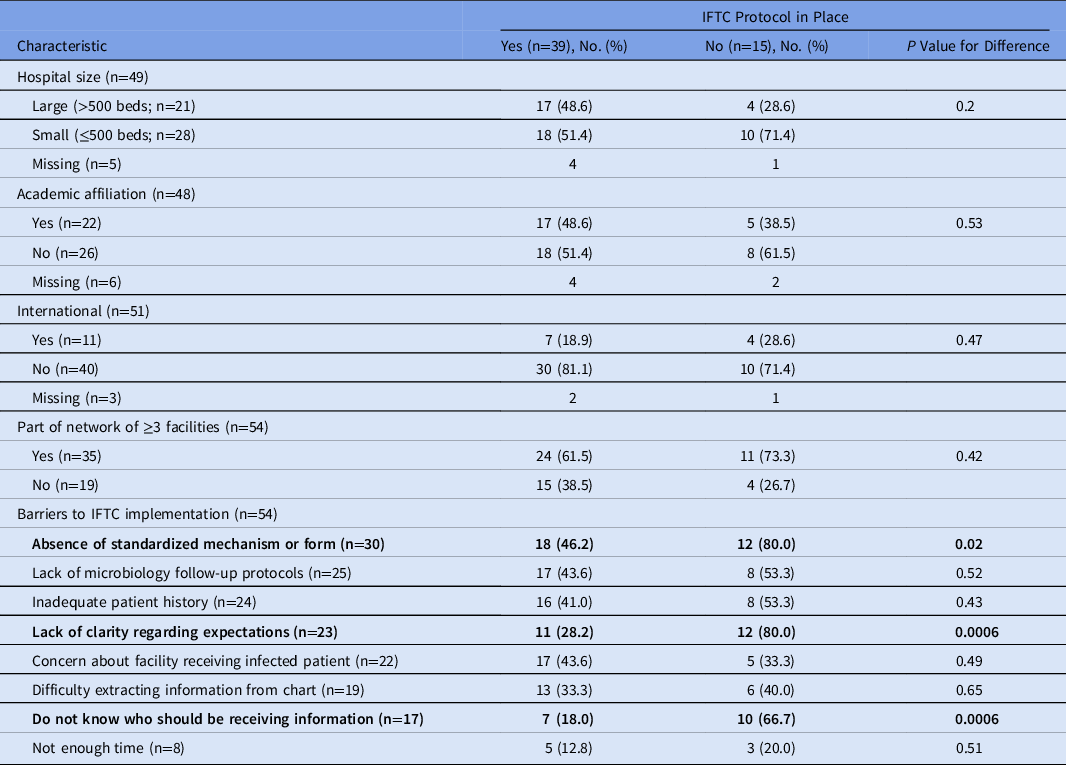
Of the 136 hospitals sent the survey, 54 (40%) respondents from unique hospitals completed the survey. We detected no statistically significant differences between respondents and nonrespondents in terms of bed size, academic medical center affiliation, or domestic versus international location (Table 1). Most respondents were from hospitals with 100–500 beds (57%), nonacademic medical centers (54%), and the United States (78%). Overall, 39 of 54 (72%) respondents reported having an IFTC protocol at their hospital and 35 (65%) reported being part of a network of 3 or more healthcare facilities, which could include facilities with lower-acuity care.
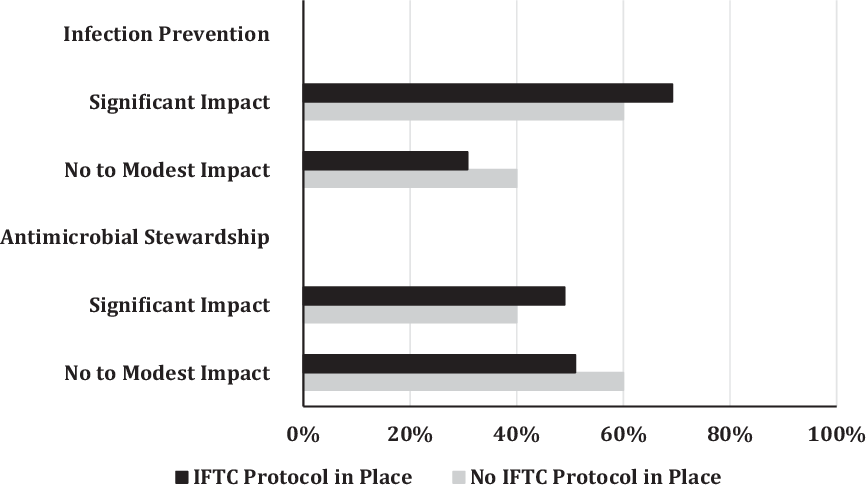
Of respondents from hospitals with IFTC protocols in place, 44% reported that they notify receiving facilities of a patient’s MDRO infection or colonization status often (76%–100% of the time) versus 13% of respondents from hospitals without an IFTC protocol (P value for difference = .03) (Fig. 1). Overall, 67% of respondents perceived IFTC protocols as having a significant impact on infection prevention, whereas 46% of overall respondents perceived protocols as having a significant impact on antimicrobial stewardship. Most respondents (56%) reported that they were unaware of the Centers for Disease Control and Prevention (CDC) Infection Control Interfacility Transfer form available on the agency’s website.17 However, 8% reported using the CDC form, and 37% were aware of it but did not use the CDC form. In this sample, we detected no statistically significant differences in respondents reporting an IFTC protocol by hospital size, international status, academic medical affiliation, or membership in network of facilities (Table 2).
Percentage of respondents estimating that they notify receiving facilities of patient’s colonization status at the time of transfer >75% of the time, ≤75% of the time, or unaware of how often notification occurs by interfacility transfer communication (IFTC) protocol status.

Hospital Characteristics and Barriers to Implementation of Interfacility Transfer Communication (IFTC) Stratified by Presence of an IFTC Protocol in Place

Note. Bold indicates statistical significance.
Respondents with an IFTC protocol in place reported significantly fewer barriers to communication at patient transfer (mean, 2.8 barriers; SD, 1.7) than respondents from hospitals without an IFTC protocol in place (mean, 4.3 barriers; SD, 1.2; P = .04) (Table 2). Respondents from hospitals with IFTC protocols less frequently reported lack of clarity regarding expectations at transfer compared to facilities without IFTC protocols (28% vs 80%; P < .01). Furthermore, respondents from hospitals with an IFTC protocol in place less frequently reported not knowing who should be receiving information upon transfer when compared with those from hospitals without an IFTC protocol in place (18% vs 67%; P < .01). Despite reduced barriers overall, nearly half (46%) of facilities with IFTC protocols reported absence of a standardized mechanism or form for communication was a barrier.
Among the 39 respondents reporting an IFTC protocol, respondents listed an average of 2.4 strategies (SD, 1.7) for communicating MDRO or CDI infection or colonization status. The most frequently listed strategy was documentation in a specific field on the transfer documents (64%). Other reported strategies included documenting MDRO status as a discharge diagnosis (46%); calling the staff at the receiving facility (44%); using a standardized interfacility transfer form (36%); documentation in the discharge summary (33%); and documentation in the patient after visit summary (13%).
Of the 39 respondents who reported having an IFTC protocol, when asked who or which department was primarily responsible for communicating MDRO/CDI status on patient transfer, 44% listed case manager, 23% listed discharging physician, 13% listed infection prevention, 13% listed unit nurse, 8% listed other, and 0% did not know (Fig. 2). When asked who at the receiving facility was responsible for receiving this information, the most frequently response was “I don’t know” (36%), followed by admitting staff (28%), unit nurse (15%), infection control (13%), and “other” (8%) (Fig. 2). For both questions, “other” responses included “nobody” and “paramedics.”
Job title of person or department primarily responsible for communicating MDRO/CDI status information at transfer (black bars) and receiving information at transfer (gray bars).

Discussion
We surveyed hospitals participating in the SRN about interfacility transfer communication (IFTC) and associated protocols. Of the 54 hospital representatives who responded to the survey, most (72%) reported having a protocol in place for communicating information about MDRO or C. difficile infection or colonization at the time of patient transfer. Respondents from hospitals with IFTC protocols in place reported significantly fewer barriers to communication. Most respondents from hospitals without IFTC protocols in place reported a lack of clarity regarding expectations (80%) and did not know who should be receiving this information (67%). Presence of an IFTC protocol, however, did not affect whether respondents perceived such protocols as having a significant impact on infection prevention or antimicrobial stewardship. Among hospitals with IFTC protocols in place, we observed remarkable heterogeneity in how hospitals implemented IFTC protocols, with only 36% using a standardized form. Our findings suggest that IFTC protocols are recognized as important enough to incorporate into hospital protocols and can reduce barriers to communication at transfer, but optimal implementation strategies have yet to be defined.
Concerns about the lack of standardization in IFTC practices in this international sample of hospitals are consistent with our previous findings from a survey of Oregon hospitals and skilled nursing facilities, where documentation of IFTC has been mandatory by state law since 2014.Reference Ellingson, Noble and Tran19 In addition to lack of standardization in communication, more than one-third of respondents reported not knowing who or what department at the receiving facility would be receiving the information about the MDRO or C. difficile infection or colonization status of patients transferred from their hospitals. Other reported barriers to IFTC also align with previous reports, such as a lack of protocols for communicating pending laboratory tests from the transferring to receiving facility, and whether a patient will be accepted for transfer in light of infection and colonization status.Reference Walz, Smith, Cox, Sattin and Kind22,Reference Reynolds, Kim and Kaplan23
One potential reason for uncertainty or confusion about IFTC protocols reflected in this survey is that most SRN members are infection preventionists or hospital epidemiologists, whereas the person responsible for IFTC was most frequently reported to be a case manager. Only 13% reported infection prevention as responsible for communicating this information. Recommendations to more explicitly incorporate infection prevention and hospital epidemiology departments into the IFTC process could improve standardization of processes, confidence in the reporting practices of other facilities, and utility of information about MDRO and C. difficile colonization status once it is received upon patient transfer.
This study has several limitations. First, the response rate of 40% yielded a relatively small sample size. However, there were no significant differences between respondents and nonrespondents in terms of hospital size, academic affiliation, or international status suggesting that respondents were representative of SRN hospitals in these variables. In addition, although relatively small, this is the first study of IFTC across state and international boundaries, so it provides a more expansive view of IFTC implementation practices, protocols, and perceptions than has been published previously. Furthermore, our small sample size limited our ability to meaningfully perform statistical adjustment by hospital characteristics. Finally, our survey respondents were typically infection preventionists or hospital epidemiologists who are not necessarily knowledgeable about every detail of the workflow at their institutions, which could have limited their ability to answer questions about transfer protocols. Future surveys should include larger and more representative samples. Furthermore, agencies responsible for surveillance and infection prevention monitoring, including the CDC or the Centers for Medicare and Medicaid Services, could consider incorporating IFTC protocols into surveys of healthcare facilities.
The spread of emerging infectious pathogens, such as carbapenem-resistant Enterobacteriaceae, Candida auris, and SARS-CoV-2, highlight the positive role of clear communication at patient transfer to prevent transmission between healthcare facilities.Reference Lin, Hsieh and Chi24 Required clear and standardized processes for communication of infection or colonization status at patient transfer could mitigate the frequent confusion and anxiety reported by patients and staff during care transitions.Reference Gadbois, Tyler and Shield25 This could include using available standardized tools, such as the CDC Infection Control Interfacility Transfer form,17 and support for future research to understand study feasibility and acceptability of IFTC strategies.Reference Ong, Magrabi and Post26 Finally, incorporation of health information exchange mechanisms, such as regional MDRO registries, through state and local health authorities would bolster IFTC by enabling the tracking of patients between facilities.Reference Lin, Lyles-Banks and Lolans10,Reference Pfeiffer, Cunningham and Poissant27
Acknowledgments
The authors would like to thank the leadership and members of the SHEA Research Network for their support of and participation in this study.
Financial support
This study was supported by the Oregon Clinical and Translational Research Institute funded by National Center for Advancing Translational Sciences (award no. UL1TR000128).
Conflicts of interest
Graham M. Snyder is a scientific advisor for Infectious Diseases Connect.
Clare Rock reports grant funding and funding from the Clorox Cooperation. All other authors report no conflicts of interest relevant to this article.
Supplementary material
To view supplementary material for this article, please visit https://doi.org/10.1017/ice.2021.131