1. Introduction
Massive riots broke out in Tibet and Xinjiang in 2008 and 2009, respectively. Unrest of this scale or severity had not been seen in those regions in many years. The timing of the Tibetan riots was particularly bad for the Chinese government. They occurred just before the Beijing Olympics. Moreover, they occurred just two years after the opening of the Qingzang Railway, which was the first rail link connecting Tibet to other parts of China. The railway was considered the most important economic assistance policy tool for Tibet, and the Chinese government expected it to alleviate dissatisfaction among the Tibetans for lagging behind the fast-growing Chinese economy for the last three decades. The timing of the Xinjiang riots was ironic, too. The year 2009 marked the ninth year of a key national development project for China, the Great Western Development Strategy (GWDS), in which Xinjiang Province was given the highest priority for investment in development. Do these developmental projects have any causal link to the riots in Tibet or Xinjiang? The Chinese government has frequently advertised these developmental programs as showing its intention to be committed to development in the two ethnic provinces. It has attempted to placate the ethnic minorities’ dissatisfaction by conducting developmental projects along with fiscal transfer from central government to these two provinces. However, the riots in 2008 and 2009 suggest that this strategy apparently failed.
Why did the economic assistance strategy fail in Tibet and Xinjiang? This article compares the case of Xinjiang with the case of Hong Kong, where the central government's policy efforts to maintain integration with other parts of China have worked since Hong Kong's turnover from Britain in 1997. What would explain the difference between Xinjiang and Hong Kong? In this article, we intend to provide a simple argument to explain the variation between Xinjiang and Hong Kong. We argue that it is not a coincidence that the riots occurred after the introduction of the gigantic developmental projects in Xinjiang. Rather, the unrest was a consequence of those projects. The riots in China reflect an agency problem confronting authoritarian leaders: they face the difficulty of preventing local officials, who are responsible for project implementation, from pursuing their own individual interests, which are often different from the center's intention for the project. However, central government has to rely on local officials to implement the policies and, more generally, govern the locality in a big country like China.
There are two general approaches to solve this problem: strengthening political accountability of local officials, and offering economic benefits to give local officials an incentive to comply with central government. The first approach is less common in authoritarian regimes for the following reason: authoritarian leaders in central government are not exposed to political accountability. They may be afraid of the possibility that local officials accountable to local residents will rebel against central government. Even if outright rebellion is unlikely, trouble may arise when local governments that enjoy a popular mandate refuse to execute policies given by the authoritarian central government. All these political uncertainties may explain the Chinese government's reluctance to extend village elections to the county level (the lowest rung of government in China), despite the fact that village elections have been around for more than two decades.Footnote 1
As strengthening political accountability is less viable for authoritarian regimes, authoritarian leaders are more inclined to rely on providing economic benefits to solicit local government support. By ‘economic benefits’, we refer not only to one-sided transfers from the central government to the local governments, such as fiscal subsidies, tax reduction, and low-interest loans, but also policies that offer mutual economic benefits, including developmental programs and interprovincial trade arrangements. The reason for defining ‘economic benefits’ in this way is that it is difficult to identify programs that give strictly unilateral benefits. Even one-sided transfers such as fiscal subsidies may well serve the central government's political interest of combating secession movement, and we have no reason to exclude economic interests and confine ourselves only to political interests when analyzing the central government's strategic behavior.
Note that central government's distribution of economic benefits to local governments is not necessarily equal. One can easily imagine that central government is strategic in deciding how to distribute economic benefits. The regions with many ethnic minorities may receive favorable treatment in the central government's economic assistance policy, because those regions are more prone to secession movement. In this sense, the central government may have a stronger incentive to give more economic assistance to ethnic minority regions.Footnote 2 However, in another sense, if local governments are strategic players, they may exaggerate the threat of secession in order to extract more economic assistance from the central government. Thus, the central government will face the dilemma of encouraging a secession movement or encouraging an irresponsible local government.
A caveat is in order. We are fully aware of the limitation of comparative case studies. No theory can be proven by only two cases. Despite our effort to select two cases from within the same country, in order to control for a variety of potential confounding factors, there may still be many possible alternative explanations for the differences in the outcomes of the two cases (or any pair of cases). Imperfect as it is, the comparison between the Hong Kong and Xinjiang cases nevertheless has some instrumental value: it provides a recent and more or less contemporaneous account of how the central government of China deals with unpopular local leaders.
With the limitation of comparative case studies, our goal for this article is modest. We do not attempt to provide a comprehensive explanation in a systematic way with the cases of Hong Kong and Xinjiang. We do not even argue that we have the most important explanation for the variations observed in the two cases. Rather, we aim to present historical narratives on the relationship between each region and Beijing to highlight one underappreciated factor that contributes to the divergent outcomes with respect to Beijing's economic assistance programs in order to encourage further debates about the impact of economic assistance policy on the prevention of rebellions, riots, and secessions.
In the next section, we briefly discuss central−local fiscal transfer in the context of democratic institutions in authoritarian regimes. In the third section, we introduce a formal model to present our analytical framework. In the fourth section, we examine Beijing's relationship with Xinjiang and Hong Kong. The final section summarizes our findings in this article and discusses their implications.
2. Central–local relations in authoritarian regimes
We examine how the central government wrestles with the dilemma of fiscal transfer to ethnic minority regions, based on the study of authoritarian politics, especially of democratic institutions in authoritarian regimes.Footnote 3 This literature suggests that even authoritarian regimes cannot remain in power without popular support, and argues that these regimes strategically use nominally democratic institutions such as elections, congresses, and parties to maintain authoritarian rule (e.g., Bueno de Mesquita et al., 2003; Cheibub et al., Reference Cheibub, Gandhi and Vreeland2010; Gandhi and Przeworski, Reference Gandhi and Przeworski2007; Geddes, Reference Geddes1999; Hadenius and Teorell, Reference Hadenius and Teorell2007; Magaloni, Reference Magaloni2008; Wright, Reference Wright2008).
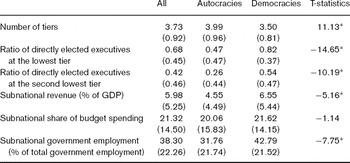
Empirical research in this literature predominantly focuses on politics at the national level. In this article, we focus on subnational politics and central−local relations in an authoritarian regime. Authoritarian regimes significantly differ from democratic regimes in a number of measures of central–local relations (see Table 1). Authoritarian regimes tend to have more tiers of local governments. Not surprisingly, fewer executives at subnational levels are elected in authoritarian regimes. Interestingly, although local governments tend to generate a smaller share of government revenue in authoritarian regimes than in democratic regimes, the local government's share of budget spending does not differ based on regime type. This observation suggests the importance of central–local fiscal transfer in authoritarian regimes. Authoritarian regimes tend to be more centralized than democratic regimes in terms of generating governmental revenue. However, government expenditure in authoritarian regimes is not centralized compared with revenue collection. Thus, the central government has to establish a system to transfer the revenue to local governments so that local governments would have an incentive to spend in a way that the central government intends.
Summary statistics of central–local relations and regime types

Notes: This table reports mean values of various measures on decentralization by regime types from 1990 to 2000, based on the data of 164 countries provided by Treisman (Reference Treisman2007). Standard deviations are in parentheses. T-statistics are calculated from one-sided t-test. The t-statistics with an asterisk are statistically significant at the 0.01% level.
Sources: Cheibub et al. (Reference Cheibub, Gandhi and Vreeland2010); Treisman (Reference Treisman2007).
Among the important contemporary literature on decentralization in authoritarian regimes, Malesky (Reference Malesky2009) finds that reformers in Vietnam advanced market-oriented economic reforms by creating new provinces − what he calls ‘gerrymandering with the Vietnamese style’ − so that reformers could acquire sufficient support in the locally elected legislative organ. Moreover, studies of Chinese politics have shown that even under decentralization, the Chinese Communist Party (CCP) manages local officials in order to keep the regions in check through its authority over the personnel system (e.g., Huang, Reference Huang1996; Landry, Reference Landry2008; Manion, Reference Manion2004; Shih, Reference Shih2008). While the CCP government has decentralized economic decision making by empowering local officials, at each vertical intergovernmental relationship a superior government keeps authority and resources to sanction a lower government under a personnel management mechanism called the cadre responsibility system (CRS). As Landry (Reference Landry2008: 117) says: ‘A large number of agents are monitored by a multiplicity of principals who each have some authority to grant rewards promotions or inflict punishments dismissal or demotion’ (italics in original).Footnote 4
Although a body of literature suggests that China's central government has maintained its political control over local officials through the CRS (e.g., Edin, Reference Edin2003; Whiting, Reference Whiting, Naughton and Yang2004), another body of literature suggests that the central government is dissatisfied with local officials’ neglect of the central government's national policies (e.g., O'Brien and Li, Reference O'Brien and Li1999; Wedeman, Reference Wedeman2001). In the context of comparative politics, Migdal (Reference Migdal1988) points out that in many countries (especially in developing countries), local governments implement policies introduced by the central government in a manner drastically different from what is envisioned. China is no exception. Well-known Chinese precepts such as ‘the above has policies while the below has countermeasures’ (shang you zhengce xia you duice) and ‘we see heaven high and emperor far’ (tian gao huangdi yuan) suggest that the tendency for local officials to reinterpret central mandates for their own interests has deep historical roots. The divergence between the central government's demands and local governments’ discretion has become further apparent in the post-Mao era (e.g., Bernstein and Lü, Reference Bernstein and Lü2003; O'Brien and Li, Reference O'Brien and Li2006; Pei, Reference Pei2006).
In the context of China's central–local governmental relationship, the details of the policy implementation are generated at the central level. However, the CRS gives local officials an incentive to deceive higher authorities to hide local problems, in order to avoid demotion or other unfavorable treatment in personnel management. Moreover, conditions for performance contracts under the CRS signed between local governments and higher authorities often include targets of policy outcomes higher than the feasible level for local conditions, because officials of the lower government are at an inferior position to higher authorities (Bernstein and Lü, Reference Bernstein and Lü2003; Zhan, Reference Zhan2009). Therefore, the contracts give local officials strong incentives to shirk and cheat higher authorities.
3. A formal model
In the following section, we set up a formal model to analyze the strategic interactions between the central government and local governments in an authoritarian regime, and explore how fiscal transfer affects local governments’ incentives to rebel. In a hypothetical authoritarian regime, there are two levels of government (central and local) and N provinces. Because it is an authoritarian regime, neither central nor local leaders are popularly elected. It is the central government that controls the hiring and firing of local officials of the N provinces. There are two ethnic groups of residents (A and B) living in the polity. A is the majority group in the country and controls the central government. Suppose that there is an ethnic province E, in which B is the majority, and assume that A is the majority in all the other provinces and controls their local governments. In the language of Alemán and Treisman (Reference Alemán, Treisman, Roeder and Rothchild2005), B is a ‘local–majority/countrywide–minority ethnicity’. We assume that A also controls the local government of the E province even though A is a minority group in the province. The game focuses on the interaction among the central government, the local government of the province controlled by A, and the group B over economic development within the province E.
Economic production (Y) involves inputs denoted by θ. Suppose that A and B possess different kinds of production technology. In other words, A and B have a comparative advantage in different types of economic production.Footnote 5 To avoid distracting the model's focus, we choose not to model the details of their production technologies. Instead, we use YA(θi) and YB(θi) to denote the economic outputs based on A's and B's production technologies for a given set of inputs, θi.
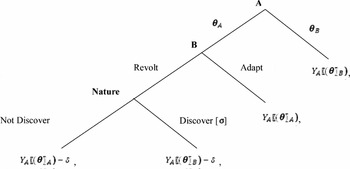
To focus on the interaction between different levels of government, we ignore private investment and assume that the local government is the only actor to be involved in the decision-making on the investment level. Assume that the local investment is a public good such that both A and B can use it for their own production (for example, local government's construction of infrastructure). Owing to the difference in their production technologies, a specific set of inputs benefits A and B differently, such that, for example, YA is more responsive to capital inputs than YB, which means that an additional input of capital in the whole local economy benefits A's production more than B’s. Figure 1 displays the extensive form of the game.
The game in extensive form
Note: Payoffs for A and B are shown at the end of each branch. Probabilities are in brackets.

The sequence of moves
Step (1) The local government controlled by A decides the distribution of the central government's economic assistance, which is intended to serve the central government's interests such as warding off secession movements. For example, if the central government intends to launch a developmental program in E, then A decides how to implement the program, including the use of fiscal transfers. Suppose that it has two choices: θA and θB.Footnote 6 The parameters θA and θB can be interpreted as two different plans. One plan benefits capital-intensive sectors (thus favoring A) while another plan benefits labor-intensive sectors (thus favoring B). This implies that Yi(θi)>Yi(θj). If the local government chooses θB, then the game will end, and A and B will respectively receive YA(θB) and YB(θB). We assume that only the local actors (i.e., A and B) can observe the choice of θ, but the central government cannot.
Step (2) If A chooses θA, then inequality between A and B will increase, and B may acquire new skills to make themselves more productive given the assigned combination of inputs (Adapt), or may rebel against the local government (Revolt). The cost of acquiring new skills is independent of the assigned combination of inputs and assumed to be γ. If B chooses to acquire new skills, then the game will end, and A and B will respectively receive YA(θA) and YB(θA)(1+s)−γ, where s measures the ethnic similarity between A and B and is assumed to be s∈[0, 1]. Following the assumption made by Caselli and Coleman (2006), we assume that the higher the ethnic similarity, the easier the transfer of skills from A to B.
Because ethnic similarity plays an important role in our analysis, it is important to discuss the concept in greater detail. There are various measures to characterize ethnic similarity between two groups. Culture, language, and religion are common measures. Interestingly, a small but growing literature in economics proposes the use of genetic distance to measure ethnic differences (see, for example, Guiso et al., Reference Guiso, Sapienza and Zingales2006). Spolaore and Wacziarg (Reference Spolaore and Wacziarg2009) point out that genetic distance, a biological measure based on the genetic differences between two populations, is actually an excellent summary statistic capturing their cultural differences, including beliefs, customs, and habits.Footnote 7 Indeed, using the World Values Survey, Desmet et al. (Reference Desmet, Breton, Ortuno-Ortin and Weber2009) find a strong correlation between genetic distance and perceptions of life, family, and morals. Our conception of ethnic similarity is similar to that of genetic distance. Although we acknowledge that ethnic differences between two groups may involve multiple dimensions, it is nevertheless possible to summarize such differences with a single parameter, such as genetic distance. Note also that we define ethnic similarity s as a parameter not dependent on either group's production technologies but solely dependent on the ethnic characteristics between the two groups. The implicit assumption made here is that B should find it easier to learn from A or to acquire new skills from A if they speak the same language or share some ethnicity-based factors (such as religion). The ease is not only a matter of verbal communication, but also a matter of attitude and trust. People tend to be more willing to learn from or share with in-group members than with strangers.
Step (3) If B chooses to revolt against the local government, then the social cost of δ will be inflicted on both A and B, and the central government will step in to investigate the cause of the revolt.Footnote 8 With the probability of σ, which is observable to all players, the central government will find accurate information on how the revolt resulted from A's implementation of θA. Then it will correct the local government's ‘mistake’ by replacing θA with θB, so that it could avoid future revolts. As a result, the payoffs will be YA(θB)−δ for A and YB(θB)−δ for B. With the probability of 1−σ, the central government will fail to find how A's implementation of θA resulted in the revolt. In that case, because it cannot correct the local government's ‘mistake’, it will leave the policy of θA intact. The payoff will be YA(θA)−δ for A and YB(θA)−δ for B.
We assume that the probability that the central government finds accurate information on why the revolt occurred (i.e., σ) is positively associated with ethnic similarity (i.e., s).Footnote 9 The value of s would determine the comparability of ethnic province E to other provinces with respect to local officials’ job performance. The central government may take the occurrence of a local revolt as a signal of the local government's incompetence. However, in an ethnic province with a low value of s, a revolt may not be an informative signal for the central government. An alternative interpretation of this assumption is that the value of s characterizes the trust or sympathy that the central government may place on B. For example, the central government led by A may be simply unsympathetic to B who refuses to embrace the technology of A. If this is the case, the central government is less likely to ‘discover’ the wrongdoing of the local government because the former self-selects to stand by the latter.
Equilibrium of the game
The equilibrium in this model is characterized by A's (the local government) choice of inputs and B's reaction to A's choice. When solving the model for equilibrium, we rule out the case in which B's payoff of adaptation is greater than their payoff under a policy favoring its production (i.e., YB(θA)(1+s)−δ>YB(θB)). Under that condition, B would prefer a policy favoring A, rather than the one that would favor themselves, because B could catch up to the new technology so easily that it would adopt an unfamiliar production rather than embrace one in which it has a comparative advantage. Such a scenario is unrealistic. Hence, we omit this absurd case, and assume that YB(θA)(1+s)−δ<YB(θB).
We solve this simple game by backward induction. At Step (2), B will choose to revolt or to adapt, depending on the probability that the central government will find accurate information on how A's policy implementation will result in the revolt at Step (3). B will revolt if  $s > \frac{{\delta {\,-\,} \gamma}}{{Y_B (\theta _B ) {\,-\,} 2Y_B (\theta _A )}}$?></alt-text></inline-graphic> and <emphasis type="italic">Y<sub>B</sub></emphasis>(θ<emphasis type="italic"><sub>B</sub></emphasis>)−2<emphasis type="italic">Y<sub>B</sub></emphasis>(θ<emphasis type="italic"><sub>A</sub></emphasis>)>0; or <inline-graphic name="S1468109912000369_inline2"><alt-text><![CDATA[$s < \frac{{\delta {\,-\,} \gamma}}{{Y_B (\theta _B ) {\,-\,} 2Y_B (\theta _A )}}$ and YB(θB)−2YB(θA)<0. To refine our analysis, we assume that δ>γ, which means that the social cost of revolt is always greater than the adaptation cost. This assumption is based on the conjecture that organizing a revolt in an authoritarian regime would involve fatal risk. With this assumption, we can rule out the second inequality and hence define the ‘revolt threshold’ as SRevolt, where
 $S_{Revolt} \equiv \frac{{\delta {\,-\,} \gamma}}{{Y_B (\theta _B ) {\,-\,} 2Y_B (\theta _A )}}$.Footnote 10 Note that a revolt is possible if and only if the difference between YB(θB) and YB(θA) is sufficiently large (i.e., YB(θB)>2YB(θA)).
Suppose that the value of s is smaller than the threshold and hence B chooses to adapt. Then, A will always choose θA because YA(θA)>YA(θB). The inequality between A and B may increase, depending on the extent to which B catches up through adaptation. Alternatively, when the value of s is larger than the threshold, B will revolt and A will choose θB if their utility (i.e., YA(θB)) is larger than the expected utility of θA. Solving the inequality for A, we define the ‘compromise threshold’ as SCompromise, where  $S_{\hbox{\scriptsize\it Compromise}} \equiv 1 - \frac{\delta}{{Y_A (\theta _A ) - Y_A (\theta _B )}}$.Footnote 11 If the value of s is larger than SCompromise, then A will opt for θB. Otherwise, A will implement θA regardless of the level of B's threat of revolt.
We can identify three possible scenarios from the game: (a) the harmony scenario (i.e., s > SCompromise); (b) the exploitation scenario (i.e., s < SCompromise and s<SRevolt); and (c) the confrontation scenario (i.e., < SCompromise and s>SRevolt). First, in the harmony scenario, A and B are ethnically so similar that A will cater to B's development needs, because failing to do so may incite B to revolt, which will in turn cause greater damage to A's interests. Second, in the exploitation scenario, A and B are ethnically so dissimilar that A will not care about B's developmental needs, because A knows that the central government will not punish them even if B revolts. In the meantime, B knows that they cannot count on the central government to redress the balance either because the centre will not be able to ‘discover’ the local government's misdeeds or because the central government is simply unsympathetic to B. As a result, B simply will stay quiet, while A can enjoy an economic rent generated from the ethnic distance between A and B.Footnote 12 Third, in the confrontation scenario, A will find B ethnically so distant that they expect B's revolt to be able to escape the central government's investigation. At the same time, B would think that adaptation might yield little benefit due to the distance between the two ethnic groups. B would also know that their ethnic difference with A might not be so large as to cause the central government to entirely ignore B's needs. As a result, A will always choose a development plan favorable to their own group while B will always retaliate by organizing a revolt against the local government.
These three scenarios illustrate possible outcomes of the stylized game. The reality is often more complicated than the stylized descriptions based on a static game.Footnote 13 Nevertheless, we can still derive some useful implications from the formal model to analyze empirical cases. We highlight three implications:
Implication 1. In regions where the ethnic distance between two groups is high, economic assistance programs originating from the central government are likely to aggravate the social tensions along ethnic lines.
Implication 2. Ethnic distance may cause rent-seeking opportunities for local officials when the central government relies on top-down supervision to evaluate local officials’ job performance measured by their responsiveness to local demands.
Implication 3. Related to the second implication, ethnic distance decreases the effectiveness of local revolts as a signaling device on local officials’ job performance. As a result, ill-performing local officials from ethnic provinces are not as easily detected by the central government as those from non-ethnic provinces.
In sum, our analysis here suggests a principal-agent problem confronting authoritarian leaders. It is difficult for authoritarian leaders to introduce an institution that popularly elects leaders of subnational governments. Authoritarian leaders do not want subnational leaders to be popular among local residents at the expense of central leaders’ legitimacy. As a result, to maintain popular support for the central government, authoritarian leaders have a strong incentive to rely on financial means, such as fiscal transfers, rather than political decentralization. Our analysis here suggests that such fiscal transfers will backfire if the region is populated by a minority ethnic group.
Several policy recommendations can be derived from our formal model. First, to achieve local stability in ethnic provinces, authoritarian leaders should strengthen local officials’ political accountability, rather than relying on economic assistance policy. Top-down supervision will work if and only if the province has an ethnic profile similar to the whole nation, so that the occurrence of local revolts would be more indicative of local officials’ job performance than of ethnic grievances. However, strengthening the political accountability of local officials may threaten the regime's survival, which suggests the second policy recommendation. If the central government has to rely on economic assistance policy, then the central government will have to ensure the benefits of the transfers would reach the ethnic minority. For example, the central government may have to give the ethnic minority greater access to higher education (i.e., a lower value of γ), so that the group could benefit from fiscal transfers through adaptation even if the local developmental program using the economic transfers is not designed solely for the ethnic minority's benefits.Footnote 14
In this section, we derive from a simple formal model some implications on ethnic politics and central–local relations in authoritarian regimes. In the next two sections, we explore two cases in China − Xinjiang and Hong Kong − to illustrate our arguments in an empirical context.
4. Empirical comparison
Both Xinjiang and Hong Kong have received a substantial amount of economic support from China's central government in recent years.Footnote 15 However, the outcomes are remarkably different. In Hong Kong, Beijing has succeeded in integrating the local economy into the larger Chinese economy through various economic policies. Meanwhile, in Xinjiang, Beijing has faced a backlash and the economic assistance policy has apparently led to a revolt against the central government. The divergent local responses to similar economic assistance programs are consistent with our model predictions: ethnic distance decreases the central government's ability to monitor local officials, who become less constrained to implement the economic assistance programs to maximize their own group's comparative advantage in production, rather than the local population's, resulting in the intensification of ethnic conflicts. As was mentioned, ethnic distance or similarity can be measured in religious, linguistic, or even genetic terms. By economic production, we refer to three main types: agriculture, manufacturing, and services.
It is worth emphasizing again that our intention here is not to offer a comprehensive explanation for the long-standing relationship between Beijing and these regions. Instead, we use the two cases to highlight some empirical aspects consistent with the theoretical expectations of our model; that is, how ethnic compositions in these regions may lead to the divergent outcomes of the central government's economic assistance programs.
Xinjiang
Xinjiang Province − officially called the Xinjiang Uighur Autonomous Region − is China's largest province, located in the westernmost part of China.Footnote 16 Xinjiang has abundant natural resources, most notably oil and natural gas. Xinjiang produces 11% of China's crude oil (Wiemer, Reference Wiemer and Starr2004). In addition to the oil reserves, Xinjiang's geographical location is also of paramount strategic importance to China. Xinjiang borders eight countries, including Afghanistan, India, Kazakhstan, Pakistan, and Russia. It provides China a venue to extend its influence into Central Asia through border trade, military cooperation, and natural gas pipelines. The Chinese government also used the province, at the Lop Nur area, as a nuclear test site. Its population was approximately 21 million in 2007 and 61% of the population belong to non-Han ethnic minorities. Historically, Xinjiang was predominantly populated by an ethnic group known as the Uighurs. Despite the recent wave of internal migration by the Han Chinese, who represent 92% of the population in China but only 39% in Xinjiang, the Uighurs were still Xinjiang's largest ethnic group as of 2008 (about 41% of the population).
The ethnic distance between Han Chinese and Uighurs cannot be understated. Most Uighurs are Muslims. Their language is a branch of the Turkic language family. Genetically, one study finds that only 40% of their genes can be identified to come from an East Asia ancestry, while the rest has a European origin (Xu et al., Reference Xu, Huang, Qian and Jin2008). The study also shows that the Japanese are genetically closer to Han Chinese than are the Uighurs. In addition to the ethnic differences, the Uighurs also differ from the Han Chinese with respect to the mode of economic production. Many Uighurs are non-industrialized farmers, while most Han Chinese work in urban areas and many are employed by state-owned enterprises.
Ethnic conflicts in Xinjiang, mainly between the Han Chinese and Uighurs, have long been a thorny issue in the province. An important point of contention between these two groups is rooted in the province's history. While the Uighurs might claim that they have been the indigenous people of Xinjiang for thousands of years, the Chinese government emphasizes that Xinjiang has been historically a multi-ethnic region and that the Han Chinese moved there as early as 200 B.C. One of the events that institutionalized the conflict between the Han Chinese and the Uighurs was the establishment of the East Turkistan Republic in 1933. Though this Republic only existed for less than six months, it became at least a symbolic basis for Uighur nationalism. A new Uighur regime with the same name was established in the western region of Xinjiang in 1944 and continued until 1949, while China experienced a civil war between the Communist Party (CCP) and the Nationalist Party (KMT). These short-lived republics have been key reference points for today's independence movement.
The CCP took over Xinjiang soon after defeating the KMT in the civil war. To placate the Uighurs, Beijing appointed Uighur figures such as Burhan Shahidi (1949–1955) and Saifuddin (1955–1968) as provincial governor. Yet, in reality, the real power rested with the Han Chinese military commanders of the Xinjiang Production and Construction Corps (XPCC), a unique military organization that performed not only regular military duties but also governmental functions in various subregions in Xinjiang. It is noteworthy that the XPCC is not accountable to the Xinjiang provincial government but only to the CCP and the central government, and its Han leader often takes a concurrent position as Provincial Party Secretary.
Prior to the 1980s, anti-PRC unrest broke out only sporadically in Xinjiang. Most notably, a group known as the East Turkistan People's Revolutionary Party was founded around 1968, if not earlier, capitalizing on the chaotic political situation in other parts of China as a result of the Cultural Revolution. This group, which was allegedly supported by the Soviet Union, maintained an elaborate organizational structure, with grassroots units spanning 12 Xinjiang prefectures. In addition to publishing pamphlets and newspapers to advocate Uighur independence, it also engaged in robberies and armed attacks against ordinary people. The movement was crushed within a year by the Chinese authorities. Following the defeat of this group, together with the influences of the Cultural Revolution, political and social controls were heightened in Xinjiang. Many mosques as well as religious schools were forced to close. Uighur nationalism was subdued.
With the advent of China's reform era in the late 1970s, the authorities relaxed the political controls in Xinjiang. Mosques that had been closed during the Cultural Revolution were allowed to reopen (Dillon, Reference Dillon2004). Uighurs and other ethnic minorities generally welcomed this change. Some radical Uighurs, however, took advantage of the liberalized atmosphere to resuscitate the demand of Uighur independence. There were a few student-led pro-independence demonstrations in the 1980s, all of which were swiftly suppressed by the authorities. The undercurrent of the anti-PRC sentiment, however, culminated in the Baren Uprising in 1990, in which rioters stole weapons and blew up part of the local government building. It was also reportedly the first time protesters used religious rhetoric to mobilize public support; that is, they called for a jihad to drive the Han Chinese out of Xinjiang.
The revival of Uighur nationalism alarmed Beijing. The Chinese authorities devised new approaches to deal with the Uighur issue. On the one hand, it escalated its assaults against separatist movements. Beijing appointed Wang Lequan as Provincial Party Secretary. Wang has been nicknamed ‘stability secretary’, thanks to his unreserved use of repressive power in the name of maintaining Xinjiang's stability. During his tenure, he launched a series of ‘Strike Hard’ campaigns against ‘East Turkistan terrorists’ and ‘illegal religious activities’. On the other hand, Beijing offered more economic assistance to Xinjiang, aiming to solicit local people's political support. Two important transportation infrastructure projects − the Taklamakan Highway connecting the northern and southern parts of Xinjiang; and a rail route between Korla and Kashgar − were completed in 1995 and 1999, respectively. Economic zones were set up to attract foreign direct investment. Beijing also enforced policies to encourage cross-border trade with Central Asian countries. To finance these projects, Beijing's investment for infrastructure in Xinjiang increased from 7.3 billion yuan in 1991 to 16.5 billion yuan in 1994 (Becquelin, Reference Becquelin2000). Despite the coercive and co-opting policies taken by Beijing, the undercurrent of an anti-PRC sentiment prevailed in the Uighur community in the late 1990s and beyond. A series of bus bombings occurred in Urumqi, the capital of Xinjiang, in 1997.
In examining what has happened in Xinjiang, one should be cautious when using official documents, which emphasize political violence organized by the so-called East Turkistan terrorists. Millward (Reference Millward2004) argues that the frequency and severity of violent incidents have actually declined in Xinjiang since 1997. The threat of Uighur separatist movements may be exaggerated. From Beijing's point of view, the projected Islamic fundamentalist threat, together with the emphasis on its foreign linkage, would help rebuild the army's image as a defender of national interests and local people's interests. This is of paramount importance because the image of the People's Liberation Army was tarnished by its brutal crackdown on the pro-democracy movement during the Tiananmen Incident in 1989. From the Xinjiang provincial government's point of view, the exaggerated terrorist threat would justify the government's hard-line stance and help the government gain popular support. Wang Lequan actually managed to stay in the same position of Provincial Party Secretary for 15 years, unusual as the general rule is that no Provincial Party Secretary should stay at the same post for more than ten years. The term limit is meant to prevent the deepening of patron–client ties between a Party Secretary and local vested interests. Thus, one can reasonably speculate that the extended length of Wang's tenure, despite his unpopularity among the Uighurs, reflects Beijing's distrust of the Uighurs and its trust in Wang's loyalty, even if Beijing did not trust Wang's governing ability. As we discussed in the previous section, one of the model's implications is that it would be difficult for the central government to evaluate local officials’ performance in an ethnic province, because the central government could not accurately evaluate the signal of the governor's unpopularity if it does not trust the ethnic minority that is the majority in the province. In the case of Xinjiang, the center simply has failed to distinguish between separatist terrorism and socio-economic popular grievances. As a result, Beijing's economic assistance policy has not worked to maintain political and social stability in Xinjiang.
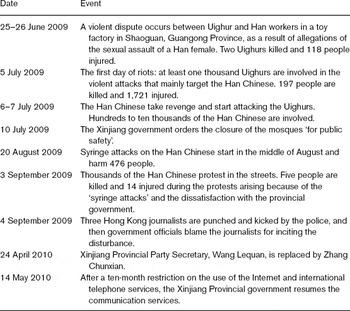
The riots that broke out in July of 2009 put Beijing's trust of the Han elite in Xinjiang to the most severe test. The first riot broke out on 5 July and more than a thousand Uighurs were reportedly involved. They specifically attacked the Han Chinese on the street, leaving 197 killed and 800 others injured. Two days later, some Han Chinese took to the street to launch a retaliation attack on Uighurs, although they were soon dispersed by the police. The provincial government immediately tightened security control of the cities. Mosques were ordered to be closed down and armed police surrounded Uighur neighborhoods.Footnote 17 The severity of the heightened social control can be gleaned from the official restrictions on information. The authorities cut off the entire province's Internet access for ten months. International long distance calls were also suspended. The 2009 riots were the deadliest ethnic conflict since the 1989 Tiananmen Incident. Table 2 displays a timeline of the 2009 riots.
Timeline of the Xinjiang riots in 2009

Despite the brutality of the 2009 riots, it is important to note that only an insignificant few were engaged in the previous movements of anti-PRC political violence. Most Uighurs accepted the rule of the PRC. Yet it is also true that many Uighurs share the view that the Han Chinese ‘colonize’ their homeland (Finley, Reference Finley2007). We contend that ideology alone is insufficient for sustaining the Uighurs’ self-perceived victimhood for the past decades, let alone explaining the large-scale anti-Han riots of 2009. The victim psychology has been supported by actual experiences of relative deprivation compared to the Han Chinese. In what follows, we use the central government's GWDS policy as a case to analyze how developmental programs to appease the Uighurs’ dissatisfactions ended up fueling the existing ethnic tensions.
As we argue in the previous section, developmental programs may benefit different modes of production differently. If the difference in the modes of production coincides with the difference in ethnicity, one ethnic group would become worse off than another group under a developmental program. In Xinjiang, many Uighurs are non-industrialized farmers while most Han Chinese work in urban areas and many are employed by state-owned enterprises. While the Uighurs are 90% of the population in the rural southern Xinjiang, they represent only 12% of the population in Urumqi.
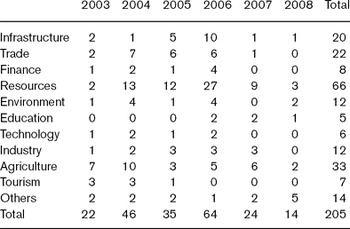
Table 3 lists the key projects of the GWDS in Xinjiang. The list may not be complete, but it includes all the key projects identified by the provincial government. The table shows that resource extraction is the centerpiece of the developmental plan. As resource extraction is a capital-intensive business and is predominantly managed by state-owned enterprises, the Uighurs gain little benefit from the projects. The provincial government is superficially concerned with agricultural development as there are 33 agricultural items listed in the table. In addition, it is the XPCC who manages these projects, so we doubt if the 33 items all benefit the non-industrialized Uighurs.
Key projects of the Great Western Development Strategy in Xinjiang

Source: The web site of the Leading Committee of Great Western Development Strategy, Xinjiang Provincial Government. See http://www.xjwd.gov.cn (accessed on 9 August 2010).
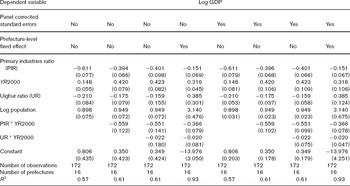
We also test the effects of the GWDS on the development of each region in Xinjiang using prefectural-level data by running difference-in-difference regressions.Footnote 18 The dependent variable is a prefecture's log GDP. Because the GWDS was launched in 2000, we define a dummy variable YR2000 that takes 1 for the year 2000 or after and 0 otherwise. The key independent variables are two interaction terms: one between YR2000 and the ratio of primary industries (i.e., farming, forestry, animal husbandry, and fishery) to other industries (PIR); and the other between YR2000 and the ratio of the Uighur population (UR). These interaction terms indicate how the effect of the GWDS on local development may vary among the prefectures in Xinjiang depending on industrial structure and the ethnic population. We also include the prefecture-level fixed effects to control for any unobserved factors peculiar to the prefecture. As recommended by Beck and Katz (Reference Beck and Katz1995), panel-corrected standard errors are reported in some regressions to deal with the potential problem of sampling variability common to time-series-cross-section data such as our own.
Table 4 displays the results of the difference-in-difference regressions. The coefficient of PIR is negative in all specifications, indicating that prefectures specializing in primary industries had a lower GDP prior to the launch of the strategy. The coefficient of YR2000 is positive, which is not surprising, as it indicates that these prefectures tend to improve their per capita GDP after 2000. The GWDS has presumably played a significant role in this positive change. The coefficients of UR display unexpected results. In regressions without adding the prefecture-level fixed effects, the coefficient of UR is negative, consistent with the conjecture that prefectures with a large Uighur population should ceteris paribus be poorer. But the sign would switch if we include the fixed effects, indicating that some unobserved factors other than ethnicity might be the real factor driving these prefectures’ relative poverty.
Economic development and ethnic population: difference-in-difference regression

Notes: PIR = (GDP of primary industries)/(GDP of other industries). Coefficients of prefecture-level fixed effects are not reported. Standard errors are in parentheses.
Source: Xinjiang Tongji Nianjian [Xinjiang Statistical Yearbook] (1997–2008).
The interaction term between PIR and YR2000 consistently shows negative effects on the prefecture's log GDP. This suggests that prefectures specializing in primary industries are worse off than those specializing in other industries (such as natural resources or manufacturing sectors). A one-unit increase in PIR would result in a decline of 0.37 or 0.55 in log GDP, which is about one standard deviation of the dependent variable (0.45). The coefficient of the other interaction term between UR and YR2000 also yields a negative sign. However, it is not statistically significant. We fail to reject the hypothesis that prefectures with a larger Uighur population are not systematically worse off after the launch of the GWDS, once we control for the influences of primary industries. This result suggests that if the Uighurs are apparently worse off due to the launch of the GWDS, it will not be because of their ethnicity itself but because their economic activities do not benefit from the GWDS. Development programs under the GWDS were heavily skewed toward industrial production and natural resource development, whose employment is occupied by the Han Chinese. This is consistent with our model's Implication 3: local officials in Xinjiang were happy to set developmental policies closer to their in-group's preferences in defiance of the excluded out-groups’ protests because the officials know that the central government is not likely to punish them for that matter.
The model's equilibrium suggests that ethnic groups would not choose to revolt when they can easily adapt to the technology required for the dominant mode of production. If adaptation is defined narrowly as opportunities for education, then Uighurs should stand a good chance of switching to the more advanced mode of production. The Chinese authorities have implemented various kinds of affirmative action to help Uighur students attend college since the 1980s. For example, Uighur students can enter colleges with a much lower score on entrance examinations than Han students. However, in reality, adaptation involves more complicated socio-economic processes. In fact, many Uighur students complain that they cannot find jobs after graduation not because they are under-qualified for job skills, but because employers have cultural biases favorable for Han students. Fuller and Lipman (Reference Fuller, Lipman and Starr2004) find that Han employers tend to have a belief that the Uighurs lack a work ethic. The situation would be worse for Muslims, who would be discouraged from engaging in religious practices in the workplaces in many ways (Finley, Reference Finley2007). In sum, the plight of Uighurs in Xinjiang echoes our model's Implication 1: in a region (Xinjiang) where ethnic distance between social groups is high, developmental programs would intensify existing social tensions along ethnic lines, because minorities would find it difficult to adapt to the changing economic opportunities brought by the development programs.
In April 2010, about ten months after the 2009 Xinjiang riots, the central government announced that Wang Lequan would be replaced by Zhang Chunxian, a moderate figure who had been Party Secretary of Hunan Province. The central government also introduced a new series of development programs in Xinjiang in hopes of using economic benefits to reduce ethnic conflicts. However, as we have argued in this article, the overarching problem is that developmental programs widen the economic gap between groups engaging in different economic productions. Uighurs are not engaged in the industries that benefit from the developmental programs, and the costs of industrial transformation are too high for them. At the same time, economic opportunities accompanied by the GWDS disproportionately go to the Han Chinese − not only the Han Chinese in Xinjiang, but also those from other provinces who have been attracted by the development programs to settle in ever-increasing numbers in Xinjiang. Thus, the developmental programs actually increase Uighurs’ dissatisfaction with the current system, and reinforce their resentment as victims of the Han Chinese colonialism. In survey research, Yee (Reference Yee2003) finds that nearly 40% of the Uighurs feel that the improvement in their living standard has been ‘slower’ than that of the Han Chinese while only 15% answer ‘faster.’ More developmental aid doled out by the central government would not only fail to alleviate the existing ethnic tensions but might exacerbate the problem.
Hong Kong
Unlike Xinjiang, Hong Kong has a more or less ethnically homogenous population. Over 90% of the population is the Cantonese-speaking Han Chinese. Despite the same ethnic background, the Hong Kong people's distrust of Beijing cannot be understated. Under British rule, Hong Kong transformed itself from a fishing village to a cosmopolitan city. Much of this miracle was achieved during the post-war era. Hong Kong's GDP per capita was around 3,000 US dollars in 1960 and 22,000 US dollars in 1997. By comparison, China's per capita GDP was slightly above 3,000 US dollars in 1997. The enormous economic gap between China and Hong Kong at the dawn of reunification made the Hong Kong people nervous about the future of Hong Kong, for they feared that the return might jeopardize the vitality of Hong Kong's economy. The suspicion of the Hong Kong people about their future ran deeper than the sheer income gap between China and Hong Kong. Almost 30% of the city's population was former immigrants from China. They fled to Hong Kong in order to escape the political unrest that punctuated modern Chinese history, including the civil war between the KMT and the CCP, the Communist takeover in 1949, Mao's various political campaigns, and the Cultural Revolution. As the memory of political unrest was still fresh in the mind of many Hong Kong people, they developed a deep-seated suspicion of Beijing. For this reason, shortly after the British government began to negotiate the terms and conditions with Beijing over Hong Kong's sovereignty transfer, people began to sell the Hong Kong dollar, causing its rapid devaluation in 1983. The colonial government was forced to install a fixed exchange rate system, pegging the Hong Kong dollar to the US dollar in order to restore public confidence in the currency.
The worst fear came true in 1989. The People's Liberation Army's brutal crackdown on the student-led pro-democracy movement in Beijing shocked Hong Kong. More than a million people took to the street to support the repressed students. As many realized that their voices could not affect any change over the brutal regime, they opted for an exit strategy to express their dissatisfaction. The wave of emigration, which had begun in the mid-1980s, was escalated to crisis proportions after the Tiananmen crackdown. The rich joined the ‘immigration-through-investment’ program to move to the United States or Canada, while the less well-off headed for countries like Mauritius and Tahiti whose passports cost less (Los Angeles Times, 26 July 1990).
The Hong Kong people's vote-with-the-feet strategy disturbed Beijing, which wanted to make the return of Hong Kong successful. Thus, Beijing devised various measures aiming to restore the city's political confidence. To break its isolated position after 1989, Beijing started reaching out to Hong Kong's Chinese business elites by inviting them to participate in key political institutions of the transition government (So, Reference So2000; Wong, 2012). The political support from these elites sent Hong Kong's society a positive signal that it would still be safe to stay in Hong Kong after reunification. In addition, Beijing emphasized that Hong Kong was going to benefit from its prescribed ‘one country, two systems’ formula; that is, Hong Kong would continue to enjoy a high degree of freedom and autonomy. The Basic Law, the de facto Constitution of post-handover Hong Kong, contains numerous clauses that guarantee the civil liberties and political freedom of the Hong Kong people. For example, Article 27 stipulates: ‘Hong Kong residents shall have freedom of speech, of the press and of publication; freedom of association, of assembly, of procession and of demonstration; and the right and freedom to form and join trade unions, and to strike.’
However, despite the pledge to provide local autonomy, Beijing retained ultimate control over Hong Kong's political system and beyond. First, as of 2007, the city's Chief Executive is elected by an 800-member Election Committee. Although the committee is supposed to broadly represent Hong Kong's society according to the Basic Law, in reality the process through which the 800 members are elected means that the committee represents Beijing's interests more than the Hong Kong people's. Of the 800 members, fewer than 100 are directly elected by the general populace. The rest come from social sectors and professional groups that Beijing approves. In addition, more than 300 seats are uncontested. All these outlandish rules and regulations aim to guarantee that pro-Beijing business elites will over-represent the committee, so that Beijing's preferred candidates will always be elected Chief Executive. Second, although popular elections have been held for the legislative branch since the handover in 1997, the elections are confined to 35 seats of the 70-member Legislative Council (LegCo). The other 35 seats are reserved for the ‘functional constituencies’, who are elected from various privileged social sectors or professional groups that are mostly pro-Beijing.Footnote 19 As a result, the functional seats are dominated by pro-Beijing business elites. With the functional constituencies, Beijing can guarantee that the opposition will never get more than 50% of the seats in the LegCo. Furthermore, the unicameral LegCo paradoxically has a distinctly bicameral feature: a separate vote-counting system. Under this system, private bills have to be passed separately by popularly elected seats and functional seats. Thus, this system gives the pro-Beijing camp a veto power over any bill endorsed by the opposition. All these institutional constraints relegate the opposition to a toothless watchdog and ensure that Beijing has the ability to exercise ultimate control over local politics (Loh, Reference Loh2006).
The incompetence of the Hong Kong government has gradually surfaced since 1997. Chief Executive Tung Chee-hwa launched a number of large projects during his first administration. These projects either received severe criticism or failed to take off for unknown reasons. For example, Tung's vision for building a silicon valley in Hong Kong ended up creating yet another luxurious housing compound. What the public knew was that the land designated for the science park was sold to the city's richest real estate magnate without going through any bidding process. In 2002, Tung set up the Accountability System for Principal Officials. In theory, major officials under this system need to resign for policy failures. In reality, Tung himself often stood in the way of holding public officials accountable. There were a couple of political scandals, in which Tung insisted on keeping the officials in question despite widespread public discontent.
The SARS outbreak in 2003 dealt an additional blow to the ailing economy. At the same time, the Tung administration was trying to introduce the legislation of Article 23 of the Basic Law, a controversial security law that would restrict the Hong Kong people's freedom of speech. Public discontent reached its breaking point. On 1 July 2003, the sixth anniversary of Hong Kong's reunification with the mainland, more than half a million Hong Kong people took to the streets. Two slogans resonated throughout the demonstration (also known as the 1 July March): ‘Down with Tung’ and ‘Return the Government to the People’.
The massive turnout for the march has an important political implication: the Hong Kong people have changed their method of expressing political dissatisfaction. In the language of Hirschman (Reference Hirschman1970), the ‘voice’ option replaced the ‘exit’ option. In the 1980s and early 1990s, Hong Kong people used an exit strategy to express their distrust of Beijing. As Hong Kong underwent a peaceful sovereignty transfer, and no major political turmoil occurred thereafter, not only did the wave of emigration subside, previous émigrés returned en masse. Thus, when encountering policy failures or governance problems, the Hong Kong people are now eager to voice their discontent in hopes of bringing the government to the right track, rather than deserting the government once and for all by adopting the exit option. However, despite their growing interest in local politics, the Hong Kong people's participation in an organized democratization movement remained limited. The massive turnout for the march was the result of the people's spontaneous reaction to their current plight, rather than the opposition leaders’ success in mobilization. In fact, the opposition leaders could never organize another protest with the same turnout in subsequent years, in part because the local economy has improved consistently since 2003. The 1 July March led to an unprecedented split within the ruling coalition. James Tien, chairman of the pro-Beijing Liberal Party, resigned from Tung's cabinet after his call to delay the legislation of Article 23 was rejected. Facing a governing crisis unseen before, the Tung administration announced an indefinite postponement of the legislation on the same day.
With the march and the subsequent political fallout, Beijing came to realize Tung's incompetence. In March 2005, Beijing accepted Tung's ‘resignation’, which was allegedly due to ‘health problems’. Tung's shorter-than-usual term of office stood in stark contrast to Xinjiang's Wang Lequan, who managed to stay in office in the province for an extended length of time, despite recurring political unrest. We argue that this difference is consistent with our Implication 2 that the central government finds it easier to evaluate the performance of local officials who come from a region that shares a similar ethnic profile with other regions. Local unrest in such a region is indicative of the local officials’ incompetence from the central government's point of view.
The early retirement of Tung did not amount to greater political accountability in Hong Kong's political institutions. Typical of an authoritarian regime, Beijing's approach to deal with this kind of local political crisis is not to strengthen local government's accountability through political decentralization. In fact, in response to the Hong Kong people's call for democratization, Beijing announced in 2004 that there would be no universal suffrage for the elections of the Chief Executive and of the LegCo in 2007 and 2008, shattering the hope of many 1 July marchers. Beijing instead stuck to its usual strategy − economic assistance − to handle Hong Kong's political unrest, devising a trade agreement between the mainland and Hong Kong − the Closer Economic Partnership Arrangement (CEPA). Interestingly, the CEPA was signed two days before the 1 July March, and the march gave Beijing a further reason for expanding CEPA's contents and advertising its benefits (Chiu, Reference Chiu2006).
The general principle of the CEPA is to allow Hong Kong business firms to have greater access to the mainland markets. Under the auspices of the central government, the Hong Kong government's Commerce and Economic Development Bureau worked closely with Beijing's Ministry of Commerce to define the scope and contents of the trade agreement. Under the CEPA, hundreds of industrial products made by Hong Kong companies can be exported to the mainland with no tariff. However, as Hong Kong's industrial sectors shrank significantly in the 1980s, such benefits were relevant only to a limited number of surviving industries. A more broad-based benefit brought by the CEPA is the reduction of the service sectors’ barriers to entry to the mainland. For example, medical doctors and dentists can now practice in China (although they still have to observe certain regulations). Urban planning and architectural firms can take up mainland jobs. Since 2004, a new supplemental arrangement has been signed between the Hong Kong government and Beijing each year to expand the scope and depth of the current CEPA.
Even those not being employed in the above professional groups can also enjoy CEPA's benefits, for the CEPA has relaxed the travel restrictions applied to Chinese nationals visiting Hong Kong. Prior to the launch of the CEPA, Chinese citizens needed to join tourist groups if they wanted to visit Hong Kong. The CEPA initially provided that citizens of four major cities of Guangdong Province were allowed to come to Hong Kong on an individual basis. The Chinese authorities gradually expanded the number of participating cities and relaxed the visa application procedures. The annual number of mainland visitors doubled between 2003 and 2009, reaching 17 million. We can infer from these numbers that the CEPA has taken care of a good many non-tradable sectors, such as restaurants and retailing.
One should note the dominant influence of pro-Beijing business elites over the Hong Kong government. It is a widely shared belief among the Hong Kong people that the government is willing to cater to these elites even at the expense of the people's interests. In addition to ample anecdotal evidence showing that government policies are biased toward the ruling business elites, Wong (Reference Wong2010) finds that firms systematically improved their business performance after the firms’ stakeholders joined the Election Committee. For a government heavily influenced by a small group of business elites, it is natural to expect that the government would formulate development policies that serve the elites’ parochial interests, as is the case in Xinjiang. However, the CEPA appeals to the middle or lower-middle classes, whose interests are traditionally underrepresented in the city's political institutions.
The broad-based contents of Hong Kong's CEPA, as opposed to the restrictive scope of benefits delivered by Xinjiang's GWDS, are consistent with our Implication 3. The Hong Kong government, run by elites not ethnically different from the rest of the citizenry, is more sensitive to local political unrest than the political elites in Xinjiang. This is because local unrest in Hong Kong, a city that shares an identical ethnic profile with most other Chinese regions, is indicative of the performance of the local government. The abrupt and early resignation of Tung Chee-hwa taught an important lesson to succeeding political leaders. Had they not taken public discontent seriously, they would have followed in Tung's footsteps.
Why did Hong Kong not experience the Xinjiang-type social conflicts as a result of Beijing's development program? An important reason is that unlike Xinjiang, Hong Kong had a more or less ethnically homogenous population. Over 90% of the population was Cantonese-speaking ethnic Chinese. Therefore, for those who failed to capture the immediate benefits of the CEPA or who were harmed by it due to the reallocation of social resources, they did not bear a high ‘adaptation cost’ as a result of ethnic identity. That is, they faced no ethnic barrier to switch to professions or sectors covered by the CEPA. Low-skilled workers certainly had a difficult time changing occupations, but their difficulty was correlated with individual characteristics rather than any ethnic characteristics. The Hong Kong people's receptiveness toward the CEPA is consistent with our Implication 1: developmental programs are less likely to aggravate social tensions because the distributional problems generated by such programs are less visible when the ethnic distance between different social groups is not great.
5. Discussion and conclusion
Based on the above discussion, one can see Hong Kong and Xinjiang share a number of important similarities with respect to their relations with Beijing. First, the people in both places have historically developed a deep-seated suspicion of the rule of Beijing. Fully aware of their suspicion, Beijing has consciously devised a variety of measures to bring both places closer to the central government, including setting up political institutions within its control, strengthening economic integration, and accelerating immigration. Second, both places have experienced some kind of spontaneous anti-government protests. The protests prompted Beijing to devise center−local economic assistance programs. A striking difference between the two places, however, is their reaction to Beijing's appeasement policy. While Beijing's GWDS has reinforced Uighurs’ impression of being colonized and has deepened the conflicts between the Han and the Uighurs, Hong Kong's society has generally held a positive view of Beijing's economic assistance.
There are many reasons for the difference in the outcomes. For example, Hong Kong has a relatively vibrant free media compared to the rest of China, which helps the civil society, if not Beijing as well, monitor the local officials’ job performance, ensuring that the implementation of the economic assistance programs addresses the local needs. In addition, the repressive governing style of Wang Lequan may also partly explain the Uighurs’ animosity toward the Xinjiang government. Hong Kong is unlikely to produce a repressive figure like Wang because as a small open economy, Hong Kong allows for a free movement of capital. Capital mobility helps constrain the local officials. For one thing, they have to rely more on co-optation than coercion to solicit political support.
Despite these alternative explanations, we argue that one underappreciated factor also contributes to the divergent outcomes in Hong Kong and Xinjiang: the respective ethnic compositions of the two places. In Hong Kong, the ethnic distance between socio-economic elites who control the government and the rest of the population is small. Whatever developmental programs are adopted by the Hong Kong government, few social groups would face insurmountable ethnic barriers to adapt themselves to the new economic opportunities. In addition, the ruling elites would also have an incentive to set policies closer to the people's needs because failing to do so may intensify public discontent, and public discontent in this predominantly Chinese city would be indicative, from Beijing's point of view, of the ruling elites’ job performance. The shorter-than-usual tenure of the former Chief Executive attests to this point.
On the contrary, in Xinjiang, the real political power rests with the Han Chinese, but they are only an ethnic minority in the province. The Uighurs, the largest ethnic group in Xinjiang, have often been sidelined from the local government's policymaking process. When the GWDS was introduced, the local government focused on industrial sectors and geographical areas in which the Han Chinese would have a comparative advantage. The less-industrialized Uighurs, in greater need of the economic aid than many Han Chinese in urban areas in Xinjiang, find themselves not obtaining their fair share of benefits. Some resort to political violence to vent their anger. Given Xinjiang's unique ethnic composition and history, the central government has failed to distinguish between political violence resulting from social grievances and that instigated by separatist terrorism, siding with Han Chinese provincial officials. Under Wang Lequan's leadership, developmental programs were drawn into a downward spiral. More such programs create more discontent among Uighurs, and more discontent among Uighurs lead to more such programs under the auspices of Beijing.
The comparison between Hong Kong and Xinjiang illustrates our central argument. Dictators tend to rely on the use of economic benefits (pork or developmental programs), rather than increasing the political accountability of local officials, to deal with local demands. Whether the economic benefits can achieve the central government's intended effect depends on the ethnic composition of the locality. When the ethnic distance between the social groups is great, the social group that is excluded from the policymaking process would find it difficult to adapt to new economic opportunities brought by the center. In addition, unless there are regions with a similar ethnic composition, the social group that controls the local government has little incentive in this case to set policies that take care of the excluded group's preferences. This is because the great ethnic distance between the two groups often makes it difficult for the center to evaluate the local officials’ performance relative to local officials from other regions that have a more homogeneous ethnic composition.
No theory can be proven with a comparison of two cases. We are fully aware of the limitation. We leave the judgment of the value of the anecdotal evidence provided in this study to the readers. Our goal here is more limited. Central–local relations have been an important topic in the studies of comparative politics, but this topic has escaped the attention of the recent literature on authoritarian politics. We propose a simple theory to invite discussion from scholars of authoritarian politics as a step to stimulate more research in this area in the future.
About the authors
Stan Hok-Wui Wong is Assistant Professor of Government and Public Administration at the Chinese University of Hong Kong. His research interests include authoritarian politics and democratic transitions, with a focus on East Asian countries. His recent publications include: ‘Political Connections and Firm Performance: The Case of Hong Kong’, Journal of East Asian Studies 10 (2010) and ‘Authoritarian Co-optation in the Age of Globalisation: Evidence from Hong Kong’ Journal of Contemporary Asia 42 (2012).
Hiroki Takeuchi is Assistant Professor of Political Science and Fellow of the John Goodwin Tower Center for Political Studies at the Southern Methodist University. His research interests include Chinese and Japanese politics, comparative political economy of authoritarian regimes, and political economy and international relations of East Asia, as well as applying game theory to political science. His recent publication includes: ‘Informal Lenders and Rural Finance in China: A Report from the Field’ (co-authored with Li Zhou), Modern China 36 (2010).