INTRODUCTION
Attentional and Executive Abilities in Preterm Children
Recent studies have shown that preterm children have attentional and executive difficulties (Elgen, Lundervild, & Sommerfeld, Reference Elgen, Lundervold and Sommerfeld2004), which have a negative impact on school-related performance (Anderson, Doyle, & Victorian Infant Collaborative Study Group, Reference Anderson and Doyle2003; Bhutta, Cleves, Cradock, & Anand, Reference Bhutta, Cleves, Cradock and Anand2002). With respect to attention problems, Breslau, Chilcoat, DelDotto, Andreski, and Brown (Reference Breslau, Chilcoat, DelDotto, Andreski and Brown1996) studied selective and sustained attention in 6-year-old preterm children with low birth weight (LBW; birth weight between 1500 and 2500 g). Results showed that LBW children performed more poorly on selective attention tasks than did normal birth-weight (NBW, birth weight > 2500 g) children. Taylor, Hack, and Klein (Reference Taylor, Hack and Klein1998) compared the attentional performance of extremely low birth-weight (ELBW, birth weight < 750 g) and very low birth-weight (VLBW, birth weight between 1000 and 1499 g) children at 5 to 9 years of age with NBW children using similar tasks, as well as on one test of mental set shifting. The ELBW children performed worse than the NBW controls on the sustained attention and set shifting tasks, but not on the measure of selective attention. However, when Taylor, Minich, Klein, and Hack (Reference Taylor, Minich, Klein and Hack2004) assessed this same sample longitudinally (from mean ages 7 to 14 years), results showed that ELBW children had greater difficulties even in selective attention. In another study using tests of attention, Shum, Neulinger, O’Callaghan, and Mohay (Reference Shum, Neulinger, O’Callaghan and Mohay2008) assessed 45 extremely preterm children (≤ 27 weeks of gestation) aged 7 to 9 years. They reported that preterm children had difficulties with working memory, selective attention, and attention shifting abilities. Finally, Elgen et al. (Reference Elgen, Lundervold and Sommerfeld2004) failed to find differences between LBW and NBW groups in selective and sustained attention or in shifting abilities, despite reports from parents suggesting more attention problems in the preterm group. Taken together, findings with respect to attention deficits in preterm children have been inconsistent, especially for selective and sustained attention. These studies have also failed to adequately differentiate among distinct attention skills.
Studies of executive functions in preterm children have demonstrated more consistent deficits on tasks assessing inhibition and attention shifting. Espy, Stalets, McDiarmid, Senn, Cwik, and Hamby (Reference Espy, Stalets, McDiarmid, Senn, Cwik and Hamby2002) assessed working memory, inhibition, and shifting abilities in 29 preterm children with a gestational age (GA) between 28 and 36 weeks and a chronological age (CA) of 2 to 3 years. Results showed that preterm children had inhibition deficits, as measured by responses to a Delayed Alternation Task. Edgin, Inder, Anderson, Hood, Clark, and Woodward (Reference Edgin, Inder, Anderson, Hood, Clark and Woodward2008) examined inhibition and shifting abilities of 88 preterm children (GA of < 33 weeks), using scores on a Multi-Search Multi-Location task for 2-year-old children, and Detour Reaching Box scores for 4-year-old children. They concluded that preterm children present inhibition and shifting deficits as early as preschool age, and that these deficits are linked with white matter abnormalities. Harvey, O’Callaghan, and Mohay (Reference Harvey, O’Callaghan and Mohay1999) examined the executive abilities of 48 ELBW children between the ages of 4½ and 5½ years. They observed greater difficulties in planning, sequencing, and inhibition in these children compared with NBW children. Böhm, Katz-Salamon, Lagercrantz, and Forssberg (Reference Böhm, Katz-Salamon, Lagercrantz and Forssberg2002) used the NEPSY battery (Korkman, Kirk, & Kemp, Reference Korkman, Kirk and Kemp2003) to compare a large sample (n = 182) of 5½-year-old VLBW children with NBW controls on tests of executive function. These authors observed deficits in initiation, inhibition, and selective attention abilities in the VLBW group. More recently, Deforge, André, Mascoët, Toniolo, Demange, and Fresson (Reference Deforge, André, Hascoët, Toniolo, Demange and Fresson2006) found deficits in attention efficiency in a sample of 71 preterm children (GA between 28 and 36 weeks) at 8 to 10 years. Finally, Bayless and Stevenson (Reference Bayless and Stevenson2007) used the Test of Everyday Attention in Children (Manly, Anderson, Nimmo-Smith, Turner, Watson, & Robertson, Reference Manly, Anderson, Nimmo-Smith, Turner, Watson and Robertson2001) to compare the attention and executive functions in a group of forty 6- to 12-year-old preterm children (GA between 28 and 32 weeks) to full-term children. Results showed that preterm children had difficulties in attention shifting and inhibition.
However, it is unclear from these studies if preterm children have greater weaknesses in some executive skills than in others, or if they have a more general executive deficit. The fact that past studies have sampled heterogeneous groups of preterm children with respect to CA (Bayless & Stevenson, Reference Bayless and Stevenson2007; Taylor et al., Reference Taylor, Minich, Klein and Hack2004), GA (Espy et al., Reference Espy, Stalets, McDiarmid, Senn, Cwik and Hamby2002; Deforge et al., Reference Deforge, André, Hascoët, Toniolo, Demange and Fresson2006), and birth weight (Breslau et al., Reference Breslau, Chilcoat, DelDotto, Andreski and Brown1996) also makes it difficult to draw any firm conclusions. Furthermore, the results of some studies have been based on nonspecific and complex cognitive tasks that do not allow identification of specific deficits in attention or executive functions (Deforge et al., Reference Deforge, André, Hascoët, Toniolo, Demange and Fresson2006; Edgin et al., Reference Edgin, Inder, Anderson, Hood, Clark and Woodward2008). It is also noteworthy that previous research in this area has not been guided by an explicit theory for conceptualizing the links among the different aspects of attention.
Attentional abilities are complex and are composed of different processes that develop throughout childhood and adolescence. They play an important role in school achievement and social adjustment (Eisenberg et al., Reference Eisenberg, Guthrie, Fabes, Shepard, Losoya and Murphy2000). Because deficits in these abilities are multidimensional in the preterm population and persist to adulthood (Nosarti, Giouroukou, Micali, Rifkin, Morris, & Murray, Reference Nosarti, Giouroukou, Micali, Rifkin, Morris and Murray2007), a theoretical framework is needed to guide research, such as that proposed by Posner and Peterson (Reference Posner and Perterson1990). According to this model, attention is composed of the three systems: alerting (maintaining vigilance abilities), orienting (ability to shift the attention), and executive control (inhibition abilities).
The Attentional Networks Task
Fan, McCandliss, Sommer, Raz, and Posner (Reference Fan, McCandliss, Sommer, Raz and Posner2002) proposed that these three systems could be assessed with a single behavioral task: the Attention Network Task (ANT). Many studies using the ANT have confirmed the independence of the three systems in terms of cognitive processes and neuronal networks in adults (Fan et al., Reference Fan, McCandliss, Sommer, Raz and Posner2002; Fan, Fossella, Sommer, Yanghong, & Posner, Reference Fan, Fossella, Sommer, Yanghong and Posner2003; Fan McCandliss, Fossella, Flombaum, & Posner, Reference Fan, McCandliss, Fossella, Flombaum and Posner2005; Fernandez-Duque & Posner, Reference Fernandez-Duque and Posner2001). Rueda et al. (Reference Rueda, Fan, McCandliss, Halparin, Gruber and Lercari2004) adapted a version of the ANT for children and used it with children between the ages of 4 and 10 years. They observed that the three attentional networks were independent even in childhood. Alerting and orienting skills improved until 6 years of age and then stabilized. Indeed, no change in orienting and alerting abilities was found between 6-year-old children and adults in this task. Executive control ability improved up to the age of 7 years, but remained stable after this age, a finding that is consistent with the literature on conflict resolution tasks (Ridderinkhof, van der Molen, & Band, Reference Ridderinkhof, van der Molen, Band and Bashore1997). More recently, Hrabok, Kerns, and Müller (Reference Hrabok, Kerns and Müller2006) examined changes in vigilance (i.e., synonymous with alerting), orienting, and executive control abilities in children ages 4 to 5 years. They found age-related improvement on executive control and orienting tasks but not on a vigilance task.
The Attentional Networks in Preterm Children
Little research on preterm children has assessed the three attentional networks included in Posner and Peterson’s model (1990). Snyder, Davis, Burns, and Robinson (Reference Snyder, Davis, Burns and Robinson2007) observed that a sample of 4- and 5-year-old VLBW children had significantly slower reaction times on orienting, vigilance, and spatial conflict tasks compared with full-term children. The orienting task consisted of a Posner’s cuing paradigm. Vigilance was measured with a task using an auditory warning signal (present or not) and the spatial conflict task presented a cognitive conflict between the location of a target and the location of the response (Berger et al., 2000). These three tasks were similar to those included in the Child ANT. Thus, this study was among the first to use attention tasks based on the theoretical model proposed by Posner and Peterson (1990) in a preterm sample. However, the general pattern of performance on the three tasks showed a high rate of accuracy (i.e., ceiling effects), precluding detection of specific deficits in preterm children.
Leclercq, Jambaqué, Picard, Bricout, and Siéroff (Reference Leclercq, Jambaqué, Picard, Bricout and Siéroff2006) assessed the efficiency of the three attentional networks with an adaptation of the Child ANT in seven preterm children (mean GA = 30.2 weeks; range, 28–34 weeks) between 7 and 11 years of age. Results showed that preterm children had a deficit in executive control. Other findings from this study suggested that the effect of distractors was dependent on children’s ability to orient to the stimuli (Fan et al., Reference Fan, McCandliss, Sommer, Raz and Posner2002). Leclercq et al. (Reference Leclercq, Jambaqué, Picard, Bricout and Siéroff2006) interpreted this finding as an indication that executive control and alerting networks were poorly differentiated in preterm children. Despite the small sample size and limitations related to manner in which the ANT task was modified for this study, the demonstration by Leclercq et al. (Reference Leclercq, Jambaqué, Picard, Bricout and Siéroff2006) of a specific attentional deficit in preterm children provides impetus for further studies of attentional networks in preterm children.
The present study used the version of the original Child ANT by Rueda et al. (Reference Rueda, Fan, McCandliss, Halparin, Gruber and Lercari2004) to assess the efficiency of the three attentional networks in preterm children. A further aim was to investigate relations between the three attentional networks. Based on findings from the studies of Snyder et al. (Reference Snyder, Davis, Burns and Robinson2007) and Leclercq et al. (Reference Leclercq, Jambaqué, Picard, Bricout and Siéroff2006), we hypothesized that preterm children would have slower overall reaction times on all task conditions than full-term children. We also hypothesized that the preterm children would have a less efficient executive control network, even when controlling for their slower response times, and that the three attentional networks would be less well differentiated in preterm children than in full-term controls.
METHODS
Participants
The group of prematurely born children was recruited by the Developmental Units of the Children’s Hospital of Geneva and the University Hospital of Lausanne. These centers track all preterm children (< 32 weeks GA) from birth to 8 years of age. From March through July 2006, all preterm children with a GA < 32 and a CA between 5½ and 6½ years who came to the hospital for their annual developmental follow-up were asked to participate in the study. Children with severe disabilities (blindness, hearing loss, cerebral palsy) were excluded, and 2 of 27 families refused to participate. Fourteen girls and 11 boys formed the preterm group in this study with mean CA was 5.83 years (SD = .27). The GA of this group ranged from 25 to 32 weeks (M = 28.56; SD = 2.80) and birth weight ranged from 600 g and 1980 g (M = 1125.6; SD = 347.2). Nine of the children were diagnosed with intra-uterine growth retardation and one child had a Grade 1 intraventricular hemorrhage. None of the children had bronchopulmonary dysplasia. All children were educated in mainstream schools and were not enrolled in special educational learning support services. Using the index of Largo et al. (Reference Largo, Pfister, Mohnari, Kundu, Lipp and Due1989), the mean socioeconomic status (SES) of the preterm children was 4.83 (SD = 2.43). The index is computed on a six-point scale, taking into account the mother’s and the father’s educational/professional status [1 = high education and/or liberal (i.e., independent) activity and level 6 = no training and/or a position of employee]. Education and professional status are coded separately, and the scores are then averaged to obtain a family’s SES.
The general cognitive abilities of the preterm group were assessed with the Kaufman Assessment Battery for Children (K-ABC; Kaufman & Kaufman, 1993). Preterm children had a mean Mental Processing Composite score of 100.45 (SD = 18.46), with means of 99.96 (SD = 15.69) and 101.17 (SD = 17.82), respectively, on the Sequential and Simultaneous Processing scales. As a measure of general cognitive ability was not administered to the control group, we cannot be sure that the control children had similar global cognitive abilities. However, the procedure of controlling for composite ability measures such as IQ in group comparisons has been criticized in a recent review (Dennis, Francis, Cirino, Schachar, Barnes, & Fletcher, Reference Dennis, Francis, Cirino, Schachar, Barnes and Fletcher2009) and is unwarranted given the lack of correspondence between executive skills and general intelligence (Friedman et al., 2006).
The control group consisted of 25 children born at term who had never been diagnosed with learning difficulties or required special educational learning support. Children in the control group were recruited through local schools and matched to the preterm group on CA (M = 5.10 years; SD = 0.3), gender, and SES (M = 4.5; SD = 2.67). Informational letters were sent to parents of children between 5½ and 6½ years of age, inviting them to return consent forms.
Materials and Procedure
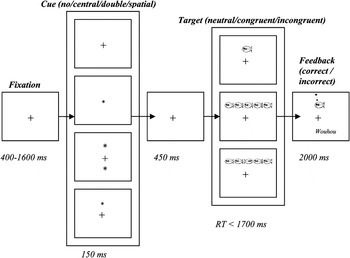
The Child ANT was created with the E-prime program (Psychological Software Tools) and was downloaded on a laptop computer from the Internet site of the Sackler Institute for Developmental Psychobiology. The target, a yellow fish, was presented alone or in the center of a horizontal row of five yellow fish. The target was presented either above or below the fixation cross. Children were instructed to keep their eyes on a fixation cross during the task and to respond whether the center fish was facing left or right by pressing the right or the left mouse button. On congruent trials, the flanking fish were pointing in the same direction as the central fish and on incongruent trials the flanking fish were pointing in the opposite direction. On neutral trials the central fish appeared alone (Fan et al., Reference Fan, McCandliss, Sommer, Raz and Posner2002). Each target was preceded by one of the following four cue (asterisk) conditions: a center cue, presented at the location of the fixation cross; a double cue, appearing approximately 1° above and below the fixation cross at one of which locations the target is presented; a spatial cue, appearing at approximately 1° above or below the fixation cross at the location of the target; or no cue (see Figure 1).
Schematic of the Child Attention Network Test (Child ANT). The background color is magenta, and the fish are yellow.

The task was composed of 24 practice trials and three experimental blocks of 48 trials each. Each block had 12 conditions in equal proportions: three target types (congruent, incongruent, and neutral) and four cues (no cue, central cue, double cue, spatial cue). The task took approximately 20 min to complete and was administered individually in a quiet room by a qualified clinical psychologist. Informed consent was obtained from parents of children, and the research was approved by the Ethics Committees of both the University of Geneva and the Cantonal Hospital of Geneva.
Analysis
We compared the efficiency of the alerting, orienting, and executive networks between the two groups based on two scoring methods with one-way analysis of variance (ANOVA). The first method was the subtraction method used by Fan et al. (Reference Fan, McCandliss, Sommer, Raz and Posner2002) and adapted by Rueda et al. (Reference Rueda, Fan, McCandliss, Halparin, Gruber and Lercari2004) for the Child ANT. To calculate the alerting network score using the subtraction method, the median reaction time (MRT) was collapsed across the three flanker types (congruent, incongruent, and neutral) in the no cue condition and in the double cue condition. This collapsed no cue MRT was then subtracted from the collapsed double cue MRT to obtain the alerting network score. To calculate the orienting network score using subtraction method, MRT was collapsed across the three flanker types in the center cue condition and in the spatial cue condition. This collapsed center cue MRT was then subtracted from the collapsed spatial cue MRT to obtain the orienting network score. Finally, to calculate the executive control network score, the MRT was collapsed across the four cue conditions (no cue, center cue, double cue, and spatial cue) in the incongruent condition and in the congruent condition. This collapsed incongruent condition MRT was then subtracted from the collapsed congruent condition MRT to obtain the executive control network score. The measures were calculated using an Excel macro downloaded from Fan’s (2001) Web page. Data on error rates were also collected.
In the second, or Relative Interference Ratio method (de Frias, Dixon, & Strauss, Reference de Frias, Dixon and Strauss2006; Spieler, Balota, & Faust, Reference Spieler, Balota and Faust1996), we used a relative ratio of MRT to control for possible overall differences in speed among participants. The interference ratio was calculated by first subtracting MRT in the control condition (e.g., no cue condition for the alerting network) from MRT in the experimental condition (e.g., double cue condition for the alerting network), and subsequently dividing this difference by his or her MRT in the control condition (e.g., no cue condition for the alerting network): interference = (experimental MRT – control MRT) / control MRT. Only correct responses were considered in computing these values. The interference scores for the different networks were calculated as follows: alerting = (no-cue MRT – double-cue MRT) / double-cue MRT; orienting = (center-cue MRT – spatial-cue MRT) / spatial-cue MRT; executive control = (incongruent flanker MRT – congruent flanker MRT) / congruent flanker MRT. Interference scores were expressed as percentages, with higher scores representing greater difficulties in responding to experimental relative to control trials.
Before undertaking these analyses, we verified that the GA and the BW had no impact on the performance of the preterm children (p > .05). Thus, GA and BW were not used as covariates in our analyses. The lack of association between the degree of prematurity (defined in terms of GA and BW) and the performance of the preterm children on the Child ANT contrasts with previous findings (Aylward, 2002) but is consistent with observations that neonatal risks account for only limited variability in outcomes within preterm samples (van de Weijer-Bergsma et al., Reference van de Weijer-Bergsma, Wijnroks and Jongmans2008). The data were analyzed using SPSS Version 15, with analyses of network efficiency scores adjusted with Bonferroni alpha correction.
RESULTS
Performance Across Task Conditions of the ANT for the Preterm and Full-Term Groups
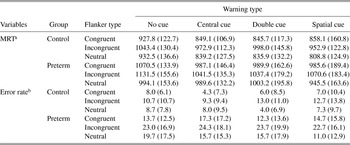
Table 1 summarizes MRT and error data for the two groups on all 12 task conditions (3 flanker types × 4 cue types). Results of ANOVAs comparing the two groups revealed significantly slower MRT and higher error rates for the preterm group than for the control group across most of the task conditions. To illustrate the magnitude of these differences for the preterm and full-term groups, respectively, mean MRT for the neutral condition collapsed across all cue types were 983.09 ms and 854.14 ms, and mean errors for the corresponding condition were .16 and .07 (p’s < .01). Concerning the congruent condition collapsed across all cue types, the mean MRT was 1008.26 ms for the preterm and 1170.22 ms for the full-term children. Respectively, the mean errors for the corresponding condition were .14 and .06 (p’s < .01). Finally, regarding the magnitude of these differences for the incongruent condition collapsed across all cue types were 1070.26 ms and 991.84 ms, and mean errors for this condition were .23 and .11 (p’s <.05), respectively, for the preterm and for the full-term children.
Mean performances and (standard deviation) of preterm group and control group

a ms.
b percentage.
Group Comparisons Using the Subtraction and Interference Ratio Methods
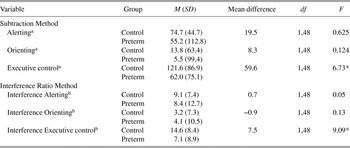
Results of ANOVAs comparing the two groups on the subtraction and interference ratio scores are listed in Table 2. Analysis of subtraction network scores revealed a significant group difference only for executive control, F(1,48) = 6.73; p = .013; ηp2 = .123, but not for the alerting, F(1,48) = 0.64; p = .43; ηp2 = .013, or orienting, F(1,48) = 0.12; p = .73; ηp2 = .003. Analysis using the Interference Ratio Method indicated a similar pattern of findings, with a significant difference only for executive control, F(1,48) = 9.09; p = .004; ηp2 = .159 and not for alerting, F(1,48) = 0.05; p = .82; ηp2 = .001, or orienting, F(1,48) = 0.13; p = .73; ηp2 = .003.
Comparisons between the Preterm and the Control Group for the Subtraction and the Interference Ratio Scores

* p < .05.
a scores in ms.
b percentage.
Correlations Between Attentional Network Scores Computed by the Subtraction and Interference Ratio Methods
Correlations between the subtraction and interference ratio scores for each of the three attentional networks was high, suggesting that the two scoring methods reflected similar constructs. Correlations for the preterm and control groups, respectively, were .888 and .641 for the alerting network, .860 and .601 for the orienting network, and .728 and .706 for the executive control network (all p’s < .001).
Correlations Among the Attentional Networks
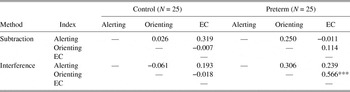
Table 3 presents the correlations between the network scores considered separately for the two types of scores (subtraction and interference ratio) for each group. Results confirm the independence of the network scores for both groups, the major exception being a robust correlation between the orienting and executive control network efficiency scores. According to results from a Fisher r-to-Z transformation (Zimmerman, Reference Zimmerman1986), the correlation between these two scores was significantly higher for the preterm group than for the full-term group (p = .004).
Correlations among Alerting, Orienting, and Executive Control (EC) Network of the Subtraction and Interference Ratio Method for the Control and Preterm Groups separately

*** p ≤ .001.
DISCUSSION
The aim of the present study was to explore the efficiency of the attentional networks identified by Fan et al. (Reference Fan, McCandliss, Sommer, Raz and Posner2002) in preterm children at an early school age. We also sought to determine whether these three attentional networks were related in a preterm sample, as was found by Rueda et al. (Reference Rueda, Fan, McCandliss, Halparin, Gruber and Lercari2004) in full-term children. In initial analyses examining group differences across all task conditions, preterm children had generally slower MRT than full-term children, as is consistent with the results of Snyder et al. (Reference Snyder, Davis, Burns and Robinson2007). The latter differences justified controlling for MRT in analysis of the attention networks interference scores. In analyses of attention network efficiency using both the subtraction and interference ratio methods, we failed to observe group differences in alerting or orienting abilities. Thus, preterm children benefited from the presence of a preparatory cue as well as the full-term children and had no difficulty shifting their attention across spatial location. In contrast, executive control abilities were significantly less well developed in preterm children than in full-term children. Consistent with Leclercq et al. (Reference Leclercq, Jambaqué, Picard, Bricout and Siéroff2006), this difference indicated a specific deficit in the ability to resist distractor interference in our preterm group, suggesting a negative impact of prematurity on executive control abilities.
The correlation analysis revealed a stronger relation between the executive control and orienting networks in the preterm children than in the full-term children, suggesting less differentiation between these two networks in the preterm group. Our results are similar to those obtained by Hrabok et al. (Reference Hrabok, Kerns and Müller2006), who found that the executive control and orienting networks were related in children 4 to 5 years of age. The authors explained this association by proposing that the process of engaging, disengaging, and shifting required executive control abilities. A similar hypothesis is suggested by Posner and Rothbart (Reference Posner and Rothbart2000), who propose that orienting represents a more automatic form of executive control process. Leclercq et al. (Reference Leclercq, Jambaqué, Picard, Bricout and Siéroff2006) also found that the executive control and alerting networks were less differentiated in preterm than in full-term children, but modifications they made in the ANT task make it difficult to interpret their findings.
As demonstrated by Fan et al. (Reference Fan, Fossella, Sommer, Yanghong and Posner2003, Reference Fan, McCandliss, Fossella, Flombaum and Posner2005), the three networks are not only independent at a behavioral level but also at a neuroanatomic level. Therefore, it might be interesting to determine whether the less-segregated nature of the networks observed at a behavioral level could also be observed in preterm children at a neuronal activation level. These findings also suggest that differentiation among these networks may be delayed by prematurity, although longitudinal studies are needed to determine if differentiation occurs at a later age or persists as a more permanent feature of preterm birth.
Our findings confirm the utility of the Child ANT in identifying a specific executive control deficit in preterm children. This deficit was manifest as a weakness in inhibiting responses to nonpertinent task information. As this skill likely contributes to children’s learning aptitudes, further research might examine the link between this deficit and academic competences of preterm children. Preterm children often show learning difficulties (Rickards et al., Reference Rickard, Kelly, Doyle and Callanan2001), particularly in arithmetic (Anderson et al., Reference Anderson and Doyle2003). Although deficits in executive function likely contribute to learning problems (Assel et al.,), less is known about the relationships between specific executive skills and children’s academic competencies. For example, some studies report an association between inhibitory abilities and mathematics skills in young children (Espy et al., 2004). However, these relationships are less clear in older children (Bull, Espy, & Wiebe, Reference Bull, Espy and Wiebe2008).
A better appreciation of how executive abilities develop in preterm children is also of central importance in examining developmental outcomes in this population. As proposed by Anderson (2002), inhibition is a skill that emerges early in life and is essential for the development of other more complex executive abilities (i.e., planning). Executive control abilities such as behavioral self-regulation have also been linked to externalizing problems (Eisenberg, Reference Eisenberg2000). Early theory-driven assessment of attentional abilities, such as that used here, may be important for identifying children who are at risk for difficulties in executive control or other aspects of attention. This early identification may lead to the development of early interventions to address these problems, as it was recently proposed by Rueda and collaborators with preschool children (Tamm et al., in press).
ACKNOWLEDGMENTS
This work was partly supported by Swiss National Science Foundation (Number 32000B0-113632; Principal Investigator: Prof P. Hüppi). Authors Pizzo, Urben, Van der Linden, Hüppi, Borradori-Tolsa, Freschi, Forcada-Guex, and Barisnikov report neither personal or financial interests nor potential conflicts of interest.