INTRODUCTION
The spatial allocation of attention influences estimates of magnitude, including line length and the line bisection task has been used in the clinic to assess asymmetrical allocation of spatial attention associated with hemispheric injury (Diller et al., 1974). Thus, when patients with left unilateral inattention (spatial neglect), attempt to bisect a horizontal line, they estimate/perceive the right side of a line as being longer and/or the left side of the line as being shorter than its actual length and misplace their bisection mark rightward. This attentional–spatial bias might be viewer or environmentally centered, and patients with neglect might be inattentive to stimuli presented on the left side of the environment or to the space on the left side of the body, as defined by the midsagittal plane of the trunk, head, or visual field. Inattention (neglect) might also be object centered (allocentric), such that patients are inattentive to the left side of stimuli, regardless of its location with respect to the viewer or its position in the environment (Chatterjee, 1994; Farah et al., 1990; Ladavas, 1987; Rapcsak et al., 1989; Vallar et al., 2003). Although patients with right hemisphere injury show the most severe biases, normal people often also show a subtle bias on tasks such as line bisection (pseudoneglect) and this bias is thought to be related to a hemispheric asymmetry of the spatial allocation of attention (Bowers & Heilman, 1980; Jewell & McCourt, 2000).
Studies of normal participants have revealed that there is a behavioral spatial “stimulus–response compatibility” such that subjects respond to lateralized visual stimuli with the hand that is on the same side of space as these stimuli (Verfaellie et al., 1988). This compatibility effect suggests that lateralized stimuli primarily activate the contralateral hemisphere. In addition, electrophysiological studies of right–left spatial stimulus–response paradigms (Heilman & Van den Abell, 1980), as well as functional imaging (Pardo et al., 1991; Schiffer et al., 2004), have revealed that, although the right hemisphere activates more to ipsilateral stimuli than does the left, each hemisphere is aroused and activated by stimuli presented in viewer centered contralateral hemispace. According to this activation-orienting hypothesis, when a line is placed in right or left hemispace, the hemisphere contralateral to this stimulus should be activated more than the ipsilateral hemisphere and attention should be shifted to the portion of the stimulus that is contralateral to the stimulated hemisphere. Thus, the presentation of a stimulus in right viewer centered hemispace should produce greater left than right hemisphere activation and a concomitant orienting shift to the right. In contrast, a leftward shift should result from the presentation of stimuli in left hemispace. This hemispheric asymmetry of activation–arousal might bias attention toward the segment of the line that is most contralateral to the more activated hemisphere, thereby inducing a line bisection bias toward the contralateral side.
Several studies have investigated the influence of the spatial location of the visual stimulus on line bisection task performance, but the results are not entirely consistent (see Jewell & McCourt, 2000, for a review). For example, the study by Milner and colleagues (1992) of young normal subjects found rightward errors with right hemispace presentation and leftward errors in midline and left hemispace presentation, findings compatible with lateral arousal activation hypothesis mentioned above. Reuter-Lorenz and Posner (1990) reported that normal participants showed no consistent lateral biases. Unfortunately, in this study, as noted by the authors, the lines were not placed very far into lateral hemispace. Luh (1995) also reported that subjects erred to the left under all conditions, consistent with the hypothesis that the right hemisphere is dominant for attention–arousal–activation. Luh did find, however, that the errors were larger with left hemispace presentations than with center or right hemispace presentations, compatible with the hypothesis that stimuli placed in viewer centered left hemispace activate the right hemisphere more than do stimuli placed in either the center or right hemispace. Unlike Luh's (1995) results, Mennemeier and coworkers (1997) found that, in elderly normal subjects, the placement of stimuli in all viewer centered spatial conditions produced rightward errors, suggesting that, with aging, the left hemisphere becomes dominant for attention, but Mennemeier et al. also found that this rightward deviation was less for the midline and left hemispace presentations than for right hemispace presentations, a result that is also partially compatible with the hemispatial (lateral) arousal–activation hypothesis. Other studies report no effect of lateralized spatial presentation (Butter et al., 1988; Fukatsu et al., 1990; Reuter-Lorenz & Posner, 1990). One study even reported errors in the direction opposite to the hemispace of line presentation (Nichelli et al., 1989), and these latter results are not compatible with the hemispatial arousal–activation hypothesis.
Using a reaction time (RT) paradigm, Hughes and Zimba (1987) found that, when the targets are in an expected or unexpected location, the RTs to these probes were equivalent to those obtained at the expected location so long as the probe was in the same hemifield as the subject's expectancy. Hughes and Zimba (1987) found that the vertical meridian was also important. These findings provide support for the postulate that the principal transitions in performance tend to occur either at the horizontal meridian, the vertical meridian, or both meridians. Thus, based on the research of Hughes and Zimba, it appears that the spatial location of stimuli in left versus right hemispace and up versus down hemispace influence different modular networks. The reason why some studies appear to support the hemispatial–hemisphere arousal–activation hypothesis and others do not is unclear. One possible explanation might be related to the results of Hughes and Zimba such that, to obtain selective hemispheric activation, the left- and right-sided stimuli have to be placed at certain distances from the trunk or head (e.g., below the vertical meridian in down–proximal, vs. above the vertical meridian in up–distal peripersonal space).
Studies of patients with focal lesions have demonstrated that ventral occipitotemporal lesions induce object and facial agnosias (Bauer & Demery, 2003; Bodamer, 1947; Lissauer, 1890), and lesions of the dorsal occipitoparietal regions induce spatial localization deficits such as optic ataxia (Balint, 1909). Based on these types of observations, Kleist (1934) suggested that the dorsal visual stream is important in making spatial localization computations and the ventral visual stream makes detection computations. Ungerleider and Mishkin's research in monkeys (Mishkin et al., 1982) support Kleist's dual visual stream hypothesis, and functional brain imaging studies provide converging evidence (Haxby et al., 1993). Studies of brain-damaged subjects also suggest that bilateral injury to the dorsal stream induces inattention to down–proximal space (Mennemeier et al., 1992; Rapcsak et al., 1988) and injury to the right hemisphere's dorsal stream is most likely to induce contralesional inattention for stimuli presented in the left down (proximal) space (Halligan & Marshall, 1989; Mark & Heilman, 1997, 1998). Based on these studies of brain-injured subjects, it is possible that stimuli presented in lateral down–proximal viewer centered space would be more likely to activate, in the contralateral hemisphere, the portion of the dorsal stream that performs spatial computations. Activation of the contralateral hemisphere's dorsal stream might also induce contralateral attentional bias. Thus, we wanted to learn if the placement of lines in down–proximal right and left viewer (head and trunk) centered hemispace, would influence attentional biases in normal subjects more than when these same lines were placed in up–distal right and left hemispace.
METHODS
Research Participants
There were 14 normal adults (7 women and 7 men; mean age, 35.46; range, 27–58 years), without a history of neurological or psychiatric diseases, learning disability, substances abuse, or a medical condition that could influence cognitive functions, who were enrolled as subjects. All the subjects preferred their right hand as determined by the Edinburgh Handedness Inventory (Oldfield, 1971) and were right eye dominant, as determined by a modified Porta test (Crovitz & Zenner, 1962; Porta, 1593) and the “hole in the hand test”, a variation of the Miles test (Miles, 1930). Only subjects who were right eye dominant in both eye dominance tests were included. Our institution review board approved this study, and informed consent was obtained from all subjects.
Apparatus–stimuli
The stimuli for the visual bisection task consisted of straight horizontal lines that were 0.5 mm in width and 50 mm, 160 mm, and 240 mm in length. Each line was drawn in black in the center of a 219.5 × 276.4 mm sheet of white paper.
Procedure
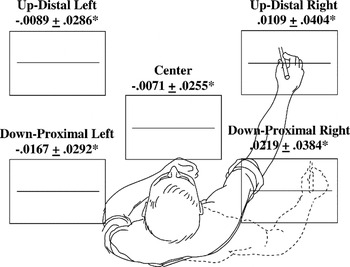
The subjects were seated in a chair, directly in front of a table. They were allowed to move their eyes and head but not their torso. The subjects, were given a pencil and instructed to use their right hand to make a mark in the middle of the line, as accurately as possible. The subjects were not instructed to adopt a consistent attentional scan before performing the bisection task, and the task was not time restricted. All the lines were presented horizontally at the intersection of the trunks' transverse and coronal planes. The line stimuli were presented in five different head–trunk centered spatial locations, including center (control condition), up–distal right, down–proximal right, up–distal left, down–proximal left. Two-word terms are used to describe the spatial positions of the stimuli because the head was free to move and when subjects attempt to bisect lines that are placed below eye level they flex their necks. Flexing the neck causes the stimulus lines to have different spatial relationships with the head versus the trunk. Thus, stimuli placed “proximal” to the trunk are “down” in relation to the head and stimuli placed more “distal” to the trunk that are “up” in relation to the head. In the center position the line, as well as the sheet of paper on which the line was drawn, was placed such that the subjects' midsagittal plane went through the center of the line and the center of the white paper. In the “right” and “left” conditions, the medial edge of the sheet of paper was placed along the sagittal plane that passes along the lateral side of subject's shoulder. In the down–proximal right or left conditions, the lines were placed in the trunk's transverse plane approximately 10 cm from the subject's trunk, and in the up–distal condition, the lines were also placed in the trunk's transverse plane approximately 40 cm from the subject's trunk (see Figure 1). There were eight bisection trials for each line length, in each of the five spatial conditions. The order of the presentation of these spatial conditions as well as line length was pseudorandomized. Deviations from the actual midline were measured to the nearest 0.5 mm and recorded as the signed distance from the true midpoint. For the right hemispace stimuli (up–distal right and down–proximal right), a negative value was arbitrarily assigned to those bisection marks that deviated from the midline toward the midsagittal plane and a positive value assigned to bisections that deviated from the midline away from the midsagittal plane. For the left hemispace stimuli (up–distal left and down–proximal left), a negative value was arbitrarily assigned to bisections that deviated from the midline away from the midsagittal plane and a positive value was assigned to those bisection marks that deviated from the midline toward the midsagittal plane. For the center condition, a negative value was assigned to bisection marks that were to the left of the true point and a positive value assigned to bisection to the right of the true midpoint. The dependent variable was the average deviation across trials in each spatial condition.

Accuracy performance as a function of spatial location. The means are expressed in percentages. Asterisks indicate means ± SD.
RESULTS
The dependent measure for all statistical analyses consisted of the percentage deviation of the attempted bisection for each line length. The descriptive data for the different test conditions are presented in Figure 1. The data were subjected to a repeated measures analysis of variance, with the spatial test condition as the within-subjects variable. This analysis revealed a significant difference across the testing conditions: F(4,52) = 8.37; p < .001. Paired comparisons between the different testing conditions using a Bonferroni correction for multiple comparisons (alpha = 0.025) revealed that the up–distal left condition was significantly different from the down–proximal right condition (p = .012). These post hoc analyses also revealed that down–proximal left was significantly different from down–proximal right (p = .003). Marginal differences were found between the up–distal right and down–proximal right conditions (p = .051).
We performed a separate analysis, to learn if overall, independent of side, the amount of lateral deviation induced by lateral presentation was greater in down-proximal versus up-distal space. For this analysis, the up and down scores were converted to absolute values and averaged. The deviation in the center condition was also converted to an absolute value. Two separate paired-samples t tests were conducted, one comparing the average up–distal deviation with the absolute deviation in the center condition, and the other comparing the average down–proximal deviation with the absolute center condition. A Bonferroni correction was used to correct for multiple comparisons, resulting in a critical alpha level of .025. The comparison of deviation between center and average down–proximal space was significant [t(13) = 2.4; p < .025], with greater deviations occurring in down–proximal space (M = 0.033; SD = 0.012) than in the center condition (M = 0.02; SD = 0.017). There was no significant difference, however, between average up–distal space (M = 0.028; SD = 0.017) and center space.
To learn whether there were any differences when comparing overall bisection errors between left (down–proximal left + up–distal left) and right (down–proximal right + up–distal right) space conditions, and between proximal (down–proximal left + down–proximal right) and distal (up–distal left + up–distal right) spatial conditions, two separate paired samples t test were conducted. We compared the average proximal and distal right deviations with the average proximal and distal left deviations. We found that the right condition was significantly different from the left condition (p = .0001). We also compared the proximal right and left conditions with distal right and left conditions, but we did not find any significant differences.
DISCUSSION
Object centered attentional biases should not vary as a function of these objects' position in viewer centered space (Jeerakathil & Kirk, 1994). Thus, the finding of a lateral (right vs. left) dichotomy in down–proximal head–trunk centered space suggests that the attentional bias observed in these normal subjects was not object centered.
As mentioned, while the stimuli were in the body's transverse plan, because head and eye movements were not restricted and when performing this task the paper was below the eyes and head, to foveate these lines, the subject needed to lower his or her head and eyes. This postural adjustment moves these lines that are proximal and distal in the trunk's transverse plane into down and up in the head's coronal plane. The finding that stimuli (e.g., lines) placed in lateral down–proximal but not lateral up–distal head-trunk centered space induced attentional biases is consistent with observations of brain-impaired subjects. These studies suggest that injury to the parietal lobes, as determined by tasks such as line bisection, induces the most severe ipsilesional attention bias (Bisiach & Vallar, 2000; Diller et al., 1974; Heilman et al., 1983; Vallar, 1993), and this attentional bias appears to be most severe in the down–proximal portion of viewer centered space (Halligan & Marshall, 1989; Mark & Heilman, 1997, 1998).
The relationship between the locus of injury and the position of the neglect stimuli suggests that these down–proximal lines might be primarily processed by the parietal lobes. Ablative studies in monkeys and humans suggest that the parietal lobes play a critical role in a cortical–limbic–reticular network important in mediating spatial attention (Heilman, 1979; Mesulam, 1981; Vallar, 2001) and arousal (Watson et al., 1994). These observations of patients with neglect would suggest that the parietal lobes play a critical role in directing attention in normal people and electrophysiological as well as functional imaging studies provided converging evidence (Fink et al., 2000, 2001; Heilman & Van den Abell, 1980; Pardo et al., 1991). For example, Weiss et al. (2000) used functional imaging to determine which brain regions are implicated when normal volunteers bisect horizontal lines in peripersonal or extrapersonal space. They found that attending to and acting in near space, activated the dorsal stream, but acting in and attending to far space, activated the ventral stream. Based on these studies, it is possible that, in normal subjects horizontal lines placed in right or left proximal–down space would be more likely to induce activation of the contralateral parietal lobe than those lines positioned in up–distal space and that this disproportional activation of the parietal lobes would induce a disproportional allocation of attention.
Although some of the prior studies, mentioned above, did not find that lateral viewer centered placements of lines induced a spatial bias, the results of this study might help explain the negative results of some of these former studies. The current study demonstrates that, to induce asymmetrical allocation of attention, the stimulus lines should be placed in proximal–down space, and these lines must be placed far lateral in relation to the subject. As mentioned above, lateral stimuli in down space might be more able to activate the dorsal visual stream, or “where” system, than stimuli in up space. Asymmetrical activation of this “where” system might be more likely to induce a contralateral bias than activation of the ventral “what” visual stream. Stimuli placed in far lateral viewer centered space might also be more able to asymmetrically activate the contralateral hemisphere, than stimuli placed more medially.
The reason we found a significant difference in bisection performance between up–distal left and down–proximal right, but not a difference between up–distal right and down–proximal left, is not entirely known. However, the lateral deviation in the down–proximal right condition tended to be greater than the lateral deviation in the right up–distal condition, but the deviation of the left up–distal was not different than left–down proximal. Prior studies have suggested that the right hemisphere is dominant for mediating attention, and the vertical dissociation observed in this study suggests that the left hemisphere might have a greater difference between the attentional biases mediated by the dorsal versus ventral systems than does the right hemisphere.
Although attentional asymmetries most likely account for the lateral biases reported here, we cannot exclude the possibility that viewing these lines at an angle in proximal space induced a visual–perceptual illusion (foreshortening). In addition, in this study, down in the head's coronal plane was not dissociated from proximal in the trunk's transverse plane, and up in the heads coronal plane was not dissociated from distal in the trunk's transverse plane. Thus, future research might be directed at dissociating the influence of foreshortening and the plane in which the stimuli are presented.
Another possible limitation of this study involves the sample size, which is confined to 14 healthy adults. Given this relatively small sample of healthy adults, the results of this study could be susceptible to a sampling bias. Nevertheless, the magnitude of our effects is quite robust, achieving statistical significance with this limited sample size. Future studies that attempt to replicate these findings with larger samples of subjects might be valuable.
ACKNOWLEDGMENTS
Supported by the Department of Veteran's Affairs and University of Messina, Italy.