One well-documented area of difficulty experienced by children with specific language impairment (SLI) is the use of tense. During the preschool years, children with SLI are very inconsistent in their use of tense inflections such as past tense -ed and third person singular -s, and copula and auxiliary be forms such as is, are and was. Not only do children with SLI make less use of these tense morphemes than typically developing (TD) same-age peers, they also use these forms in fewer obligatory contexts than younger TD children matched for mean length of utterance (MLU) (Leonard, Eyer, Bedore & Grela, Reference Leonard, Eyer, Bedore and Grela1997; Oetting & Horohov, Reference Oetting and Horohov1997; Rice & Wexler, Reference Rice and Wexler1996; Rice, Wexler & Cleave, Reference Rice, Wexler and Cleave1995). Although this inconsistency is most conspicuous during the preschool years, even when children with SLI enter school their level of tense morpheme use is not at mastery levels (Marchman, Wulfeck & Ellis Weismer, Reference Marchman, Wulfeck and Ellis Weismer1999; Norbury, Bishop & Briscoe, Reference Norbury, Bishop and Briscoe2001; Rice, Wexler & Hershberger, Reference Rice, Wexler and Hershberger1998).
The difficulties with tense exhibited by children with SLI have been characterized as a failure to grasp that tense is obligatory in main clauses (Rice et al., Reference Rice, Wexler and Cleave1995; Rice & Wexler, Reference Rice and Wexler1996; Rice, Reference Rice, Levy and Schaeffer2003). When tense is expressed, its use is appropriate in context. Thus, whereas a child with SLI might produce either Yesterday Priscilla was helping me or Yesterday Priscilla helping me, the child would be very unlikely to say Tomorrow Priscilla was helping me. Evidence from grammaticality judgment tasks are also generally in line with this interpretation; children with SLI sometimes accept as grammatical a sentence that lacks tense, but they usually reject sentences in which tense is explicitly marked in an inappropriate manner (Rice, Wexler & Redmond, Reference Rice, Wexler and Redmond1999).
Although the findings support the view that children with SLI have a general understanding of tense but treat tense as optional rather than obligatory in main clauses, it is not yet clear that these children understand tense in quite the same way as do TD children. In a language such as English, tense and aspect interact in important ways, and young TD children's early interpretation of tense is not independent of aspect. Tense is defined as the temporal relationship between the time of the event being described and some other time. In young children's speech this other time is usually the time of speaking. Thus, a sentence such as I ran the race refers to an event that occurred before the sentence itself (the time of speaking). Aspect refers to the temporal distribution of an event independent of the event's location in time (Comrie, Reference Comrie1976). For example, I was running the race and I am running the race differ in tense but both refer to an event spread across some period of time. In contrast, two sentences can employ the same lexical verb and same tense but may differ in aspect. For example, I ran the race (and did well) indicates not only an event in the past but also that the event was completed. In contrast, I was running the race (when I discovered my shoelace was untied) indicates that the event occurred in the past but does not imply that the event was completed.
Aspect comes in two forms. Lexical aspect refers to elements of aspectual meaning related to verb semantics, or, more precisely, the meaning of verbs in combination with the contents of the larger verb phrase or predicate. A major lexical aspect distinction is that between bounded and non-bounded events. Telic events specify an endpoint or completion, whereas atelic events do not. This distinction can be seen using the same verb (thus illustrating the importance of considering the larger predicate, not just the lexical verb alone). For example, I walked home is telic, whereas I walked around is atelic. Grammatical aspect, sometimes referred to as viewpoint aspect (Smith, Reference Smith1997), makes the distinction between the perfective and the imperfective (Bybee, Reference Bybee1985). Use of the perfective involves viewing an event ‘from the outside, as a completed whole’ (Wagner, Reference Wagner2001: 663), whereas the imperfective involves viewing the event from within, with no commitment to its completion. In English, the imperfective is seen in the use of the progressive construction, as in the earlier examples, I am/was running the race. English does not have a means of expressing perfective aspect that is fully independent of tense, although a simple tense such as past tense may have a default perfective interpretation. (The present perfect, as in They have eaten, does not express perfective aspect as much as it refers to past events that have present relevance; see Comrie, Reference Comrie1976). Importantly, lexical aspect and grammatical aspect are separable. For example, telic predicates can be used in imperfective (progressive) constructions, or in constructions that have a perfective interpretation, as in She was reading the book and She read the book, respectively.
In the literature on typical language development, there has been considerable discussion of the degree to which lexical aspect plays a role in young children's expression of tense (e.g. Antinucci & Miller, Reference Antinucci and Miller1976; Bloom, Lifter & Hafitz, Reference Bloom, Lifter and Hafitz1980; Weist, Wysocka, Witkowska-Stadnik, Buczowska & Konieczna, Reference Weist, Wysocka, Witkowska-Stadnik, Buczowska and Konieczna1984; Shirai & Andersen, Reference Shirai and Andersen1995). Early reports focusing on young children's initial use of verb morphology suggested that the inflection -ed (and irregular past forms) seemed to be closely associated with completed actions as expressed in telic predicates, whereas the inflection -ing seemed to be associated with atelic predicates along with marking imperfective (progressive) grammatical aspect. Subsequent reports provided evidence that young children have at least a general sense of tense apart from aspect; however, the degree to which these two notions overlap in children's grammars – and the age at which they evolve into independent notions – has continued to be a subject of some important research.
The relationship between tense and aspect has been examined in an especially clever way by Wagner (Reference Wagner2001). In one of Wagner's experiments (Experiment 2), children observed a toy character who proceeded along a path. At prescribed points along the path, the character performed a particular action. These locations along the path were demarcated by toys used for the action (or an X if the action employed no toys). The character performed the same action two times, at two different locations along the path. While the character was performing the action for the second time, the experimenter asked the child to indicate the location of the past or present action. A past progressive request (e.g. Show me where the kitty was filling in a puzzle) corresponded to the location where the character initially performed the action; a present progressive request (e.g. Show me where the kitty is filling in a puzzle) corresponded to the location at which the character was in the process of performing the action. All requests involved the use of telic predicates. For one-half of the past and one-half of the present actions, the action reached completion (e.g. all of the puzzle pieces were completely filled in), and for the other half of the items, the action had not reached completion. For example, for the incomplete action in the past, the character had only filled in half of the puzzle pieces in the first location and had proceeded to the second location when the experimenter made the request Show me where the kitty was filling in the puzzle.
Wagner's (Reference Wagner2001) findings indicated that three- and four-year-olds could respond above chance levels for both present and past progressive requests, regardless of whether the action had been completed or not. However, two-year-olds did not distinguish past from present progressive requests when the actions did not reach an endpoint. It appeared that the youngest children were regarding the distinction between is and was as one that involved aspect.
Although the findings of Wagner (Reference Wagner2001) indicate that young children's understanding of tense may not be independent of aspect, this aspectual influence on tense may actually be facilitative. For example, completed actions may provide children with salient cues that are often associated with past events, thus allowing them to focus on such events and gradually arrive at the proper distinction between past tense and action completion.
There are reasons to suspect that children with SLI do not focus on aspect in the same way as young TD children, and this relative insensitivity to aspect may contribute to the protracted period of inconsistent use of tense seen in these children. First, in a study conducted by Kelly & Rice (Reference Kelly and Rice1994), a group of children with SLI differed from their same-age TD peers in their interpretation preferences for novel verbs. When provided with a choice of interpreting a novel verb as referring to a motion (e.g. moving up and down) or a change of state (e.g. splitting into three pieces), the TD group preferred the change-of-state interpretation. The children with SLI, in contrast, showed no such preference.
In a study by Penner, Schulz & Wymann (Reference Penner, Schulz and Wymann2003), German-speaking children with SLI were less likely than their TD peers to require evidence of an endpoint when judging the telic verb aufmachen ‘open’ as suitable. Similar findings were obtained by Schulz & Wittek (Reference Schulz, Wittek, Beachley, Brown and Conlin2003) with an expanded set of German telic verbs. For example, with a door only halfway closed, children with SLI were more likely than TD children to answer ‘yes’ to the question Hat das Mädchen 'se zugemacht? ‘Has the girl closed it [the door]?’.
In a study focusing on production, Leonard et al. (Reference Leonard, Deevy, Kurtz, Krantz Chorev, Owen, Polite, Elam and Finneran2007) asked English-speaking preschoolers with SLI, same-age TD peers and younger MLU-matched TD children to describe actions that promoted either past tense -ed or progressive -ing in past contexts. Half of the predicates involved actions with distinct endpoints, and the remaining predicates referred to actions that had less distinct endpoints. Both groups of TD children showed a pattern of use that corresponded to the aspectual nature of the events – past tense -ed was most likely to be used for actions with clear endpoints, and -ing was most likely when endpoints were not distinct. However, the children with SLI did not show any such pattern. Because the children with SLI also made less overall use of -ed than both groups of TD children and less overall use of -ing than the TD same-age peers, Leonard et al. speculated that the apparent insensitivity to aspectual distinctions seen in the children with SLI may have had a slowing effect on their development of tense.
In the present study, we examined the tense–aspect relationship in English-speaking children with SLI by adapting the task developed by Wagner (Reference Wagner2001). Children with SLI and TD peers were asked to indicate the locations at which characters performed particular actions. Stimulus sentences involved telic predicates in either the present progressive or the past progressive. For both present and past progressive items, half of the actions were completed at the first point on the path at which the action was performed (corresponding to ‘past’ in the context of the experiment); for the other half, the actions were incomplete at this point. Although past progressive items were expected to be more difficult in general, of special interest was the role of action completion. TD children were expected to make use of completion information, enabling them to perform as well on past completed actions as on present actions, whereas children with SLI were expected to make less use of completion information. For these children, past progressive items describing completed as well as incomplete actions were expected to be difficult. Such a finding would be consistent with the view that insensitivity to aspectual information may be contributing to the problems with tense that are seen in children with SLI.
EXPERIMENT 1
METHOD
Participants
Thirty monolingual English-speaking children participated in Experiment 1. Fifteen children met the criteria for SLI. These children had either recently enrolled in a language intervention program or had been scheduled for enrollment in such a program. The children in this group ranged from age 4 ; 1 to 6 ; 4 (M=62·40 months, SD=7·12). Each of the children in the SLI group scored more than 1·5 standard deviations (SD) below the mean on the Structured Photographic Expressive Language Test – II (SPELT–II, Werner & Kresheck, Reference Werner and Kresheck1983). This test has displayed acceptable sensitivity and specificity in distinguishing children with SLI from their typically developing peers (Plante & Vance, Reference Plante and Vance1994). A score of –1·5 SD was used as the cut-off because calculation of the SPELT-II means and SDs from a sample of 77 four- and five-year-old typically developing children tested in our own laboratory revealed score distributions that closely matched those of the test manual. Only two of the 77 typically developing children scored below –1·5 SD. We then examined the SPELT-II scores of a group of 40 children independently diagnosed as exhibiting SLI and found that the highest score in the SLI group was –2·0 SD. Although we employed –1·5 SD as the cut-off in the present study, all 15 children with SLI that we recruited scored –1·8 SD or lower on this test.
All 15 children with SLI passed a hearing screening and a screening for oral motor structure, and scored above 85 on the Columbia Mental Maturity Scale (CMMS, Burgemeister, Blum & Lorge, Reference Burgemeister, Blum and Lorge1972), a measure of non-verbal intelligence. No child had a history of seizures or neurological impairment, and none displayed symptoms suggestive of autism spectrum disorder. To ensure that the children's performance on the experimental task was not hampered by a more general limitation in comprehension ability, all children with SLI selected for the study scored 85 or higher (at least within 1 SD of the mean) on the Peabody Picture Vocabulary Test – III (PPVT-III, Dunn & Dunn, Reference Dunn and Dunn1997), a measure of receptive vocabulary. Two additional children with SLI were excluded from the study because their PPVT-III scores did not meet this criterion.
Additional diagnostic information was available that provided further descriptive data regarding the children with SLI, although these measures did not serve as selection criteria. Thirteen of the 15 children scored within 1 SD of the mean or higher on the receptive composite of the Clinical Evaluation of Language Fundamentals – Preschool 2 (CELF-P2, Wiig, Secord & Semel, Reference Wiig, Secord and Semel2004); the remaining two children in this group had standard scores of 77 and 79.
The remaining 15 children were typically developing children and were matched with the children with SLI according to age (hereafter, the TD-A group). Each child in this group was within one month of the age of a child in the SLI group. These children ranged in age from 4 ; 1 to 6 ; 5 (M=62·40 months, SD=8·06). At the time of Experiment 1, age matching seemed acceptable because all children with SLI included in the study had earned age-appropriate scores on the PPVT-III. All children in the TD-A group scored at age level on the SPELT-II. In addition, they passed the hearing and oral motor screening tests and scored within the normal range on the CMMS. None had a history of seizures, neurological impairment or exhibited symptoms suggestive of autism spectrum disorder. All children in this group scored within 1 SD of the mean or higher on the PPVT-III. Similarly, all 15 children in the TD-A group scored within 1 SD of the mean or higher on the receptive composite of the CELF-P2.
Although the receptive composite of the CELF-P2 was not used as part of our selection criteria, the TD-A children earned significantly higher scores on this measure than the children with SLI (t(28)=−4·28, p<0·001, d=1·56). The mean score for the TD-A group was 111·47 (SD=8·82); for the SLI group, the mean score was 95·73 (SD=11·19).
Procedure
The authors and a doctoral student trained on the procedure served as experimenters. For any given child, one experimenter manipulated the materials and played the part of the character, while a second sat next to the child and provided the request to which the child was to respond. The experimental task was adapted from the task developed by Wagner (Reference Wagner2001). For each item, a toy character (e.g. Buzz Lightyear) walked along a path that had two locations marked, one (point A) at the beginning of the path, the other (point B) approximately halfway along the path. Toy props were located at each location. The character stopped at point A and stated his or her intention to perform an action (e.g. I want to draw a happy face). The character then began the action. For one-half of the actions at point A, the character finished the action and for the remaining half of the items the action was left incomplete when the character continued along the path toward point B (e.g. only one eye and half of a smile were drawn). At point B, the character began performing the same action that was performed at point A. In this instance, the character did not announce the action to be performed. The experimenter played the stimulus sentence as the character performed (but did not complete) the action. One-half of the items were in the past progressive and thus referred to the action performed at point A; the remaining items were in the present progressive and referred to the action performed at point B. Examples of past and present progressive items are shown in (1) and (2), respectively.
(1) Elmo approaches point A.
elmo: I want to fill in a puzzle.
Elmo fills in part of the puzzle, but proceeds toward point B with pieces still remaining next to the puzzle.
Elmo begins filling in the puzzle at point B
experimenter: Show me where Elmo was filling in a puzzle.
(2) Elmo approaches point A.
elmo: I want to climb over a fence.
Elmo climbs over the fence and proceeds toward point B
Elmo begins climbing over a fence located at point B
experimenter: Show me where Elmo is climbing over a fence.
Thirty-two items were employed. Sixteen items were in the past progressive, divided equally into actions completed at point A and actions left incomplete at point A. The remaining 16 items were in the present progressive. Eight of these referred to actions being performed at point B after the character had completed the same action at point A. Even though the actions at point B were still ongoing when the request (e.g. Show me where Elmo is climbing over a fence) was made, we shall refer to these items as ‘present (completed) actions’ to make clear that these actions were the same (though now in the present) as earlier actions that had been completed. The remaining eight items referred to actions being performed at point B after the same action was performed but left incomplete at point A. Hereafter, these items shall be referred to as ‘present (incomplete) actions’. All items were recorded by a female speaker and digitized for presentation. Stimuli were presented using a laptop computer and an external speaker.
All items employed telic predicates, based on operational tests employed by Shirai & Andersen (Reference Shirai and Andersen1995) and Dowty (Reference Dowty1979). Specifically, for each item, we asked whether the event as expressed in the present progressive (e.g. Elmo is climbing over a fence) entails the event as expressed in the present perfect (e.g. Elmo has climbed over the fence). For telic predicates this should not be true; all of our items passed this operational test.
The specific predicates used for completed actions in the past were also used for the present (completed) actions. Likewise, the specific predicates used for incomplete actions in the past were also used for the present (incomplete) actions. This design feature was employed to ensure that any difference in interpreting past versus present actions would not be attributable to differences in the predicates. The items were divided into two lists with one-half of the items of each type appearing on each list. The items were arranged so that the past and present items involving the same predicate did not appear in the same list. The order of presentation of the lists was counterbalanced across the children and participant groups, with the lists administered on separate days. Four practice items were presented at the beginning of each list, two in the past progressive and two in the present progressive, presented in alternating order. Feedback was provided; if the child answered incorrectly, the two possibilities were contrasted. For example, the experimenter would perform the actions at the two positions and then indicate the appropriate label (was hopping, is hopping) for each point on the path. In this manner, the children learned that the action referred to in the experimenter's request could be the action at either point A or point B.
To monitor the children's attention to the task and their continued understanding that the requested actions could be those at either point A or point B, we inserted a total of six control items, with three control items appearing in each list. These items contained additional cues in the form of temporal adverbials, with right now included in the present progressive control items (e.g. Show me where Scooby is sleeping right now) and a minute ago included in the past progressive control items (e.g. Show me where Elmo was driving a minute ago). We employed atelic predicates for the control items, as these items were included solely to ensure that the children were capable and willing to respond to more than one point along the path as the appropriate location of the action. We set a minimal criterion of at least 67% correct on the control items, a level that could only be achieved if the child pointed correctly to more than one location on the path. All 30 children met this criterion. All items, including practice items are provided in Appendix A.
Children's pointing responses to point A or point B were scored. A scorable response was defined as a response to only one of the two locations. Scorable responses were obtained for all 32 items from each of the 30 children.
We assessed scoring reliability by reviewing videotapes for approximately 25% of the data (eight sessions from each group). A second experimenter watched the video-recording without sound. The video-recordings provided visual cues as to which item was being presented, but the absence of audio allowed her to be blind to whether a past progressive or present progressive request had been presented. She recorded what she judged to be the response of the child, that is, pointing either to point A or point B on the path. A point-by-point comparison was made between the original scoring and the second scoring. Including experimental and control items, comparisons were made for 152 responses in each group. There was 100% agreement between the first and second scorer for the data of the SLI group and 95% agreement for the data of the TD-A group.
RESULTS
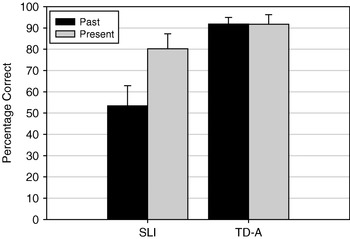
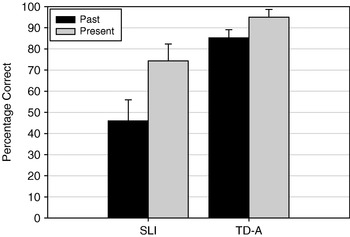
A mixed model analysis of variance was computed with participant group (SLI, TD-A) as a between-subjects variable and tense (past, present) and completeness (completed, incomplete) as within-subjects variables. The effect size d was calculated to assist interpretation of the significant interactions, with a d of 0·80 or greater constituting a large effect size and a value between 0·50 and 0·80 representing a medium effect size (Cohen, Reference Cohen1988). As expected, a significant main effect was found for participant group (F(1, 28)=32·16, p<0·001, ηp2=0·53), favoring the TD-A group. Tense was also significant (F(1, 28)=5·30, p=0·029, ηp2=0·16), with higher scores on present tense than on past tense. In addition, completeness was significant (F(1, 28)=4·26, p=0·048, ηp2=0·13). However, each of these main effects must be interpreted in light of significant interactions. Specifically, there was a significant tense X completeness interaction (F(1, 28)=4·31, p=0·047, ηp2=0·13), and a group X tense X completeness interaction that approached significance (F(1, 28)=3·12, p=0·088, ηp2=0·10). Post-hoc Tukey HSD testing at the. 05 level indicated that for both participant groups accuracy on incomplete past actions (SLI M=46·00% correct, SD=38·34; TD-A M=85·20% correct, SD=15·07) was significantly lower than on present (incomplete) items (SLI M=74·33%, SD=30·73, d=0·821; TD-A M=95·00%, SD=14·02, d=0·676). However, whereas the SLI group was also significantly less accurate on completed past actions (M=53·40%, SD=36·73) than on present (completed) items (M=80·20%, SD=27·40, d=0·836), this was not true for the TD-A group (M=91·80%, SD=12·08 versus M=91·73%, SD=17·35, p=0·998). Computing degree of overlap between the TD children's scores on completed past and present (completed) items based on the effect size, we found that the overlap in scores approached 100% (Cohen, Reference Cohen1988). For the TD-A children, past actions were not problematic if they had been completed. An illustration of the findings appears in Figures 1 and 2.
Mean percentages correct for the children with SLI and the typically developing (TD-A) children in Experiment 1 on present progressive and past progressive items involving completed actions. Error bars are standard errors.

Mean percentages correct for the children with SLI and the typically developing (TD-A) children in Experiment 1 on present progressive and past progressive items involving incomplete actions. Error bars are standard errors.

Fourteen of the 15 TD children scored above 60% (at least 10 of 16 items correct) on past progressive items as well as on present progressive items. However, only 11 of the 15 children with SLI scored above 60% on the present progressive items, and only 7 of these 11 scored above 60% on the past progressive items. Three children with SLI scored 0% on the past progressive items, even though their scores on the control items were 67%, 83% and 100%. These three children's diagnostic test scores likewise shed no light on their unusually poor performance on the past progressive items. All three scored within 1 SD of the mean on the receptive composite of the CELF-P2, two of the three were within 1 SD of the mean on the PPVT-III, and the remaining child scored more than 1 SD above the mean on the PPVT-III.
We inspected the data to determine whether the SLI group's relative insensitivity to completion cues in the past progressive items might be attributable to only a few items. Only six children in this group were accurate on the item Show me where Elmo was climbing over a fence whereas twelve children were accurate on the item Show me where Ernie was building a bridge. These same two items also had the fewest, and the most accurate responses, respectively, by the TD-A group. Furthermore, for every item, there were at least three more TD-A children than children with SLI who responded accurately; the performance of the two groups was clearly distinguishable on all eight items. It seems noteworthy that the most difficult item for both groups – Show me where Elmo was climbing over a fence – offered the children no cues that the action had been completed. The fence remained unchanged after having been climbed over, unlike other items (e.g. the completed bridge represented a clear change from its state before the action occurred).
EXPERIMENT 2
The results of Experiment 1 raise the possibility that children with SLI differ from their typically developing peers in their sensitivity to completion cues. Whereas the typically developing children in Experiment 1 were as accurate on past progressive items as on present progressive items when the past actions had been completed, these children were less accurate on past progressive than present progressive items when the past actions had been left incomplete. The children with SLI exhibited no such difference according to completion; both completed and incomplete actions in the past were more difficult than actions in the present.
However, there are several details in the design of Experiment 1 that complicate the interpretation of the findings. First, in Experiment 1, the particular predicates used for completed and incomplete actions were not the same. This discrepancy allowed for the possibility that differences in the actions, rather than differences in completion, were responsible for the findings. In Experiment 2, the completed actions and the actions left incomplete are the same.
A second factor that complicates the interpretation of the results of Experiment 1 is the generally poor performance of the children with SLI on both types of past progressive items. We attributed this result to the children's insensitivity to completion cues, but it is just as plausible that some of the children had no understanding of past tense in general. Their adequate performance on the control items might have been based entirely on a reliance on the temporal adverbials that were included in the experimenter's requests.
Our solution to this potential problem was to recruit children for Experiment 2 who demonstrated comprehension of both copula is and copula was. The copula forms is and was differ in tense and have the additional advantage that these forms appear in present and past progressive constructions, respectively. If children demonstrate adequate understanding of both copula is and copula was, then any difficulty they experience with past progressive items is not likely to be attributable to problems with past tense itself.
A third design feature of Experiment 1 that was modified for Experiment 2 concerns the children used as the comparison group. In Experiment 1, the typically developing children were matched with the children with SLI according to chronological age. Although most of the children with SLI scored near age level on the receptive composite of the CELF-P2, some of the children earned low scores, and as a group the children with SLI scored lower on this measure than their same-age peers. We were not surprised that the children with SLI had difficulty on our experimental task even when their scores on the receptive composite of the CELF-P2 were adequate; a major assumption of our study was that tense and aspect interpretation is among the most serious weaknesses of children with SLI, and this type of ability is not assessed by the CELF-P2. However, when the two groups also differ on a more general language comprehension measure such as the receptive composite of the CELF-P2, as they did in Experiment 1, it is difficult to attribute the findings to problems with tense and aspect in particular.
We remedy this complication in Experiment 2 by matching the children with SLI and typically developing children on their raw scores on the Sentence Structure (receptive) subtest of the CELF-P2. This subtest assesses children's comprehension of a variety of syntactic structures without focusing narrowly on tense or aspect. Given our assumption of extraordinary tense and aspect weaknesses in children with SLI, a group difference is predicted even when the two groups are matched on this more general syntactic comprehension measure.
METHOD
Participants
Nineteen monolingual English-speaking children were recruited to participate, ten children who met the criteria for SLI and nine who met the criteria as developing language in a typical fashion. The children with SLI were enrolled in a language intervention program or were scheduled to enter such a program. These children ranged in age from 4 ; 4 to 5 ; 7 (M=59·00 months, SD=5·45). Each of these children scored below –1·5 SD on the SPELT-II but scored within age level on the CMMS and passed a hearing screening, a screening for oral structure and function, and exhibited no signs suggestive of autism spectrum disorder. No child had a history of seizures or neurological impairment.
The children with SLI were administered the Sentence Structure (receptive) subtest of the CELF-P2. This subtest requires children to point to one of four drawings on a page that corresponds to the experimenter's sentence. The sentences represent a range of syntactic structures (e.g. They like to bake cookies; The baby will find the doll; The spotted puppy is in the box). Tense and aspect are not emphasized. For example, the foils for the item The spotted puppy is in the box include two drawings of non-spotted puppies in a box, and a drawing of a spotted puppy outside of a box. Each of the ten children with SLI scored within 1 SD of the mean on this subtest.
The typically developing children ranged in age from 3 ; 5 to 4 ; 0 (M=44·50 months, SD=2·07). They scored within age level on the CMMS, and passed a hearing screening. Given the younger ages of these children, the use of the SPELT-II was precluded. Instead, the children were administered the Reynell Developmental Language Scales (Reynell & Gruber, Reference Reynell and Gruber1990). All nine children scored within age level on this test.
The typically developing children were on average approximately 14 months younger than the children with SLI. These children were selected because their raw scores on the Sentence Structure (receptive) subtest of the CELF-P2 were very similar to the raw scores earned by the children with SLI. The raw score of each typically developing child was within 1 point of one or more children with SLI. Hereafter these typically developing children will be referred to as the typically developing children matched for syntactic comprehension, or TD-SC. The mean Sentence Structure raw scores for the SLI and TD-SC groups were 15·50 (SD=3·78) and 15·00 (SD=4·00), respectively.
Present and past tense copula screening task
To assess the children's understanding of tense in general and of the forms is and was in particular, we devised a present and past tense copula task. To be included in Experiment 2, the children were required to score 75% or higher on both copula is items and copula was items. In key respects, the task was modeled after the present and past progressive task of Experiment 1. One experimenter manipulated the material and played the role of the character; another sat next to the child and issued the request to which the child was to respond. For each item, an event occurred at one point (point A) along the path (e.g. a cat sits under a table located at point A and remains there for 10 seconds) and then the event occurred again at another point (point B) along the path (e.g. the cat sits under a table located at point B and remains there), during which the experimenter provided the test sentence (e.g. Show me where the cat was under a table). Each event could be described appropriately using a copula form (is or was) followed by a spatial prepositional phrase. As in Experiment 1, props were located at both points A and B. Eight items assessing copula is and eight items assessing copula was were employed. The copula is and copula was items employed the same spatial prepositional phrases (e.g. under a table), though we used different characters in the copula is and copula was items. In addition, three control items were included that contained either copula is or copula was as well as a temporal adverbial clue in the form of right now or a minute ago (e.g. Show me where the boy was next to a boat a minute ago). All copula items were presented in a single session, in quasi-random order, with the qualification that control items were separated by four experimental items and no more than two experimental items assessing the same copula form (is or was) appeared consecutively. Two practice items were presented prior to presentation of the experimental and control items. Examples of the present and past tense copula items are shown in (3) and (4), respectively.
(3) Tigger approaches point A.
tigger: I want to be in a wagon.
Tigger sits in the wagon located at point A and remains there for 10 seconds.
Tigger then proceeds along the path and sits, and remains in the wagon located at point B.
experimenter: Show me where Tigger is in a wagon.
(4) Dora approaches point A.
dora: I want to be in a pool.
Dora sits in the pool located at point A and remains there for 10 seconds.
Dora then proceeds along the path and sits, and remains in the pool located at point B.
experimenter: Show me where Dora was in a pool.
Two of the ten children with SLI and one of the nine TD-SC children originally recruited for Experiment 2 did not meet our performance criterion of at least 75% correct on both copula is items and copula was items. One of the non-qualifying children with SLI responded to all items by selecting point A (which was correct only for copula was items). The other non-qualifying child with SLI was at chance (50%) on is items and at or below chance (38%) on was items. The non-qualifying TD-SC child responded to all items by selecting point B (which was correct only for copula is items). The eight children with SLI who were retained in Experiment 2 averaged 95·38% correct (SD=9·24) on copula is items and 92·38% correct (SD=9·20) on copula was items. The eight TD-SC children who were retained averaged 100% on copula is items and 92·38% (SD=9·20) on copula was items. The eight children in each group who were retained in Experiment 2 continued to be well matched in their Sentence Structure (receptive) subtest scores on the CELF-P2.
Present and past progressive task
The present and past progressive task employed in Experiment 2 was identical to the task of Experiment 1 except for the number of items and the (important) fact that each predicate was employed in all four conditions – both present progressive and past progressive involving both completed and incomplete actions. Twelve items were employed in each condition. Telic predicates were used; these predicates met the operational tests described in Experiment 1. In selecting items for Experiment 2, we avoided predicates used in Experiment 1 (e.g. climbing over a fence, reading a book) that referred to actions whose completion was less salient. Twelve control items were also used. Half were in present progressive form and half were in past progressive form, and each contained an additional clue in the form of the temporal adverbial right now or a minute ago, as in Experiment 1. Atelic predicates were used for the control items (e.g. Show me where Scooby is sleeping right now). A list of the experimental and control items appears in Appendix B. These items were recorded by a female speaker and then digitized. The digitized stimuli were presented through a laptop computer with an external speaker.
The items were divided into four lists with twelve experimental items (three from each condition) and three control items appearing in each list. The items were arranged to avoid the same predicate appearing more than once in the same list. The lists were presented on separate days. The order of presentation of the lists was counterbalanced across children and participant groups. Two practice items were presented at the beginning of each list. Examples of the same predicate used in an item from the past completed action condition and the past incomplete action condition are shown in (5) and (6), respectively.
(5) Minnie proceeds to point A.
minnie: I want to empty a cup.
Minnie completely empties the cup (that was filled with small beads) located at point A.
Minnie then proceeds to point B and begins to empty the cup located at this point.
experimenter: Show me where Minnie was emptying a cup.
(6) Minnie proceeds to point A.
minnie: I want to empty a cup.
Minnie begins to empty the cup (that was filled with small beads) located at point A but, before finishing, puts down the cup and proceeds to point B.
Minnie then begins to empty the cup located at point B.
experimenter: Show me where Minnie was emptying a cup.
RESULTS
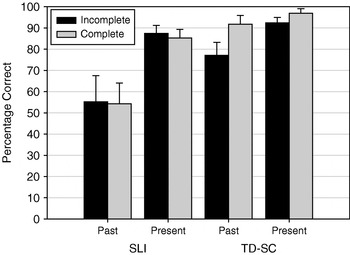
The data were examined through a mixed model ANOVA with participant group (SLI, TD-SC) as a between-subjects variable and tense (present, past) and completeness (complete, incomplete) as within-subjects variables. A main effect was found for participant group (F(1, 14)=9·40, p=0·008, ηp2=0·40) with higher overall accuracy by the TD-SC group (M=89·53, SD=13·19) than by the SLI group (M=70·53, SD=27·57). A main effect was also found for tense (F(1, 14)=11·28, p=0·005, ηp2=0·45), with higher accuracy on present progressive items (M=90·47, SD=9·90) than on past progressive items (M=69·59, SD=28·24). We also observed a significant main effect for completeness (F(1, 14)=5·95, p=0·029, ηp2=0·30). The children responded more accurately to completed actions (M=82·03, SD=22·94) than to incomplete actions (M=78·03, SD=24·20). A significant participant group×completeness interaction was also seen (F(1, 14)=8·26, p=0·012, ηp2=0·37). Tukey HSD testing revealed that the TD-SC children were more accurate on completed actions than on incomplete actions (p=0·002, d=0·77), whereas the children with SLI did not differ in these two types of actions (p=0·763). In addition, the children with TD-SC were more accurate than the children with SLI on completed actions (p=0·009, d=1·24), but not on incomplete actions (p=0·220). No other interactions were significant. However, a closer inspection of the data revealed that whereas both the children with SLI (p=0·002, d=1·25) and the TD-SC children (p=0·014, d=1·17) were more accurate on present (incomplete) items than on past incomplete items, only the children with SLI (p=0·001, d=1·43) were more accurate on present (complete) items than on past complete items. The TD-SC children performed at similar levels on these item types (p=0·198). Similarly, whereas the TD-SC children were significantly more accurate on past complete items than on past incomplete items (p=0·009, d=1·00), this was not true for the children with SLI (p=0·797). An illustration of the findings can be seen in Figure 3.
Mean percentages correct for the children with SLI and the typically developing (TD-SC) children in Experiment 2 on present progressive and past progressive items involving completed and incomplete actions. Error bars are standard errors.

All eight TD-SC children scored above 60% correct on past complete items and seven of the eight children in this group scored above 60% correct on past incomplete items. Only five children with SLI scored above 60% correct on past incomplete items, with three of these five scoring above 60% correct on past complete items.
DISCUSSION
The findings of Experiment 1 revealed clear group differences between the children with SLI and the TD-A children. However, more revealing were the differences in the pattern of responding. Both groups of children had more difficulty responding to requests describing incomplete past actions than to requests referring to the same actions in the present. However, whereas the children with SLI also had greater difficulty responding to requests describing completed past actions than requests describing the same actions in the present, no such difference was seen in the TD-A children. For the TD-A children, past actions were not problematic if they had been completed.
The design of Experiment 1 allowed for the possibility that unintended factors had an influence on the results. These factors were controlled in Experiment 2 by our use of: (1) a preliminary task assessing the children's comprehension of copula is and was; (2) our selection of the same predicates for both the completed actions and the incomplete actions in the present and past progressive task; and (3) our recruitment of a group of younger typically developing children who were matched with the children with SLI on a general measure of syntactic comprehension.
Eight of the ten children with SLI and eight of the nine typically developing children originally recruited for Experiment 2 demonstrated adequate comprehension of copula is and copula was by associating the former with events/locations in the present and the latter with events/locations in the past. Because the forms is and was were employed in the present and past progressive items, these children's performance on the copula task gave us confidence that any insensitivity to the completion cues was not likely to be due to a more general confusion about past tense.
The results of Experiment 2 essentially replicated those of Experiment 1. In both experiments, the typically developing children (TD-A or TD-SC) responded more accurately than the children with SLI. In addition, the children overall were more accurate on present tense items than on past tense items, and more accurate on completed actions than on actions left incomplete. Importantly, in both experiments, the typically developing children (TD-A, TD-SC) were more accurate on present incomplete actions than on past incomplete actions but were just as accurate on past complete actions as on present complete actions. Furthermore, in Experiment 2 (in which the same predicates were used in the complete and incomplete conditions), the TD-SC children were more accurate on past completed actions than on past incomplete actions. The children with SLI in both experiments, on the other hand, were more accurate on present actions than on past actions for both complete and incomplete actions, and showed very similar levels of performance on past completed actions and past incomplete actions in Experiment 2.
As noted by Wagner (Reference Wagner2001), typically developing children's tendency to respond less accurately to past progressive items when the events were incomplete could have two somewhat different explanations. First, children's interpretation of past tense may not yet be entirely free of aspect. Clearly, for the typically developing children in the present study, the distinction between completed–incomplete and the distinction between past–present had already begun in these children's linguistic systems, given that even their performance on incomplete actions in the past was well above chance in both experiments. However, the fact that this performance was significantly below these children's performance on actions in the present suggests that we may have been observing the remnants of an earlier conflation of tense and aspect.
A second possible explanation suggested by Wagner (Reference Wagner2001) is that typically developing children may grasp the past–present distinction but have difficulty retaining temporal information without completion cues. Some hint of that was seen in our finding in Experiment 1 that the most difficult completed past action item for both groups of children (Show me where Elmo was climbing over the fence) offered the child no physical cues that the action had been completed. The children may have recognized that an action described with was … -ing occurred in the past but may have had difficulty remembering this fact in the absence of completion cues when (as in Experiment 1) the children were also presented with the same action in the present as part of the same item.
In contrast to the TD-A and TD-SC children, the children with SLI showed no sensitivity to completion cues in the past progressive items. It does not seem likely that this insensitivity could have been due to broad deficits in language comprehension. In Experiment 2, the two groups of children were matched on a general measure of syntactic comprehension. The TD-SC children in that experiment were approximately 14 months younger than the children with SLI.
In fact, even two-year-old typically developing children make use of completion as a cue to past action (Wagner, Reference Wagner2001), and all receptive scores from all of the children with SLI in the present study translate into developmental levels of language that are well beyond the two-year level. In addition, evidence from Kelly & Rice (Reference Kelly and Rice1994) suggests that children with SLI may have natural preferences away from changes of state in favor of motions – a bias that would be consistent with an insensitivity to completion cues.
As can be seen from Figure 3, the children with SLI in Experiment 2, as a group, performed essentially at chance levels on both past complete and past incomplete actions. Recall, however, that their performance on the copula is and was screening task suggested an understanding of past tense. Furthermore, their general success with the copula items suggest that they could recall the locations of past events, at least (as in this task) when props remained in the locations after the event had occurred. This point is especially relevant given the frequent findings that children with SLI have limitations in information processing (e.g. Bishop, Reference Bishop1997; Leonard, Reference Leonard1998). It appears that the presence of the props reduced the processing demands of the task to the point where the children could succeed, at least when the linguistic demands of the task were minimal, as in the copula task.
Given the children's relative success on the copula task, it seems likely that their generally weak performance on past complete and past incomplete items on the experimental task reflected in part a limited grasp of the past progressive. We suspect that the children with SLI may have improperly associated imperfective grammatical aspect (the progressive construction) with events in the present, and for this reason did not respond differentially to was when this form appeared in a progressive item.
The relatively low scores on the past progressive items by the children with SLI reveals an important limitation in current clinical categories. Based on a comparison of their scores on the SPELT-II and the CELF-P2, the children with SLI in our experiments could be classified as exhibiting an ‘espressive language disorder’, in contrast to a ‘receptive–expressive language disorder’. That is, whenever comprehension (receptive) language test scores reach age-appropriate levels and are higher than production (expressive) language scores, the term ‘expressive language disorder’ is assumed to be appropriate, based on widely adopted classification schemes such as that of the DSM-IV-TR (American Psychiatric Association, 2005) and the ICD-10 (World Health Organization, 2005). However, one of the problems with these schemes is that there is no requirement that the receptive and expressive language tests focus on the same details of language. As noted in the Introduction, tense is well documented as an area of extraordinary difficulty for children with SLI. During the preschool years, this difficulty is reflected in production limitations (especially a protracted period of inconsistent use of tense), but standardized tests that concentrate on the comprehension of tense are lacking. Our results suggest that the problems of the children with SLI in the present study would not warrant the assumption that their deficits were restricted to expressive language.
Although the source of the SLI group's insensitivity to completion cues for past actions is not yet clear, the results themselves seem compelling, especially in light of previous findings. Evidence from German-speaking children with SLI (Penner et al., Reference Penner, Schulz and Wymann2003; Schulz & Wittek, Reference Schulz, Wittek, Beachley, Brown and Conlin2003) is compatible with our findings, even though the language spoken and the type of comprehension task employed differed from those used in our study. In addition, our present findings parallel the Leonard et al. (Reference Leonard, Deevy, Kurtz, Krantz Chorev, Owen, Polite, Elam and Finneran2007) finding for the production of past and past progressive forms by English-speaking children with SLI. In that study, typically developing children's use of these tense forms was influenced by aspectual characteristics such as the presence or absence of a distinct endpoint. The use of the forms by the children with SLI, on the other hand, did not vary as a function of these characteristics of the predicates. Thus, in the Leonard et al. (Reference Leonard, Deevy, Kurtz, Krantz Chorev, Owen, Polite, Elam and Finneran2007) study dealing with production in English, earlier comprehension studies involving German, and the present study (with two experiments) dealing with comprehension in English, typically developing children demonstrated sensitivity to aspectual properties whereas children with SLI did not.
The strong evidence for a relative insensitivity to completion cues on the part of children with SLI notwithstanding, we simply do not yet know if this insensitivity has a slowing effect on these children's development of tense. It is possible that sensitivity to completion cues is unrelated to the pace of tense development, in spite of the fact that children known to use such cues (viz. typically developing children) acquire tense at a much faster rate than do children with SLI. Although we cannot conclude that insensitivity to completion cues plays a contributing role, we should note that current accounts of the tense problems in SLI do leave room for this possibility. For example, the view that children with SLI proceed through a protracted period of treating tense as optional pertains only to these children's alternation between correct use of tense and the use of a non-finite form (e.g. Mommy is/was running versus Mommy running) (e.g. Rice, Reference Rice, Levy and Schaeffer2003). When tense is used, it is almost always correctly applied. Thus, when children have difficulties interpreting distinctions in tense as in the present study, a factor in addition to optionality – such as insensitivity to completion cues – may also be operating. To determine whether such insensitivity does, in fact, contribute to these children's slow tense development, longitudinal data will be needed. Although these parallels may prove to be merely coincidental, they seem sufficiently compelling to warrant further investigation of the role of aspect in the tense development of children with SLI.
APPENDIX A: THE EXPERIMENTAL AND CONTROL ITEMS USED IN EXPERIMENT 1
All requests began with Show me where … (e.g. Show me where Ernie is building a bridge).

APPENDIX B: THE EXPERIMENTAL AND CONTROL ITEMS USED IN EXPERIMENT 2
All requests began with Show me where … (e.g. Show me where Buzz is drawing a happy face). The same items (in separate sessions) were used to refer to completed actions as well as actions left incomplete.